


 |
市場調查報告書
商品編碼
1910601
危險品物流:市場佔有率分析、產業趨勢與統計、成長預測(2026-2031)Hazardous Goods Logistics - Market Share Analysis, Industry Trends & Statistics, Growth Forecasts (2026 - 2031) |
||||||

※ 本網頁內容可能與最新版本有所差異。詳細情況請與我們聯繫。
預計危險品物流市場規模將從 2025 年的 2,748 億美元成長到 2026 年的 2,913.3 億美元,到 2031 年將達到 3,898.9 億美元,2026 年至 2031 年的複合年成長率為 6.01%。
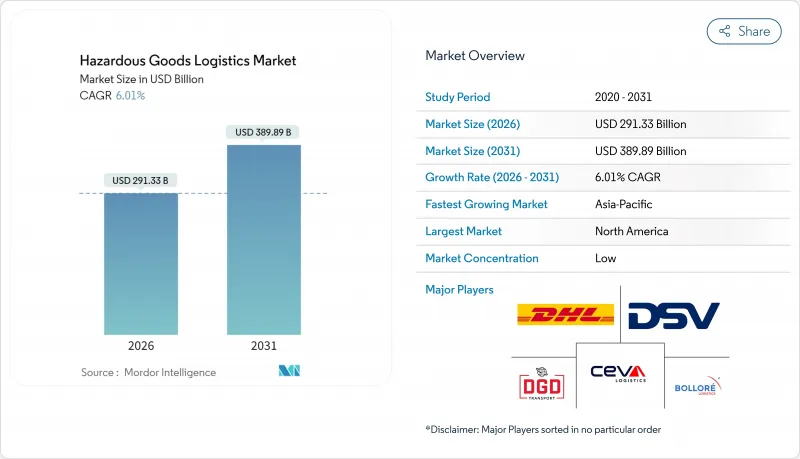
這一上升趨勢得益於化工和石化產品貿易量的成長、鋰離子電池需求的增加,以及對需要在公路、鐵路、航空和海運網路中進行特殊處理的溫控生技藥品的需求。數位化進步,特別是物聯網感測器、基於區塊鏈的監管鏈工具和人工智慧驅動的路線規劃,正在提升營運視覺性,同時幫助營運商遵守日益嚴格的全球安全法規。北美、歐盟和亞太地區的監管機構正在協調包裝、標籤和即時數據共用標準,迫使承運商對其車輛進行現代化改造,以符合歐盟6排放標準或採用零排放動力系統和滅火技術。同時,不斷上漲的保險費和日益增加的跨境合規成本帶來的持續壓力,正推動產業整合,大型業者尋求規模經濟效益。
全球危險品物流市場趨勢與洞察
全球化工和石油產品貿易擴張
全球製造商目前正大量運輸需要特定類別包裝、通風和隔離的產品,例如特殊化學品、化肥和精煉產品。光是美國在2024年每天就將處理120萬噸危險品貨物,佔所有貨運噸英哩的12%。化學品將在2024年佔危險品物流市場總收入的36%,顯示需要壓力罐車和ISO槽式貨櫃等大型資產。 3類易燃液體和8類腐蝕性物質佔鐵路運輸的大部分,承運商的無事故交付率高達99.99%,從而維護了公眾和監管機構的信任。管道、碼頭和鐵路營運商正在加速部署負載感測器,將裝載週期縮短至45分鐘,從而在不影響安全的前提下提高吞吐量。墨西哥灣沿岸和亞太地區港口吞吐能力的持續擴張,促使托運人將危險液體散貨與容器化危險品在附加價值服務協議中結合起來運輸。這些因素共同推動了危險品物流市場潛在需求的成長。
日益嚴格的多模態安全法規與審核
世界各國政府都在加強對違規行為的處罰力度,迫使物流公司投資認證設備和員工訓練。美國管線與危險物質安全管理局 (美國) 將於 2025 年起將民事罰款提高至每日 10 萬美元以上,鐵路業者將被要求根據《促進危險物質運輸安全法案》(FAST Act) 向緊急應變機構提交電子編組資料。預計這十年的總成本將達到 1,770 萬美元。與聯合國示範規則進行跨境協調,每年可為托運人節省 5,000 萬至 1.3 億美元的文書工作成本,同時還能縮短 7 類放射性物質的清關時間。歐洲的《2023 年歐洲運輸法規》(ADR 2023) 收緊了對氫氧化四甲基銨和再生塑膠 IBC 的限制,迫使承運人更新貨櫃內襯和密封墊。主要製造商安裝的衛星追蹤系統和ATEX認證感測器可確保700個槽式貨櫃內溫度和壓力資料的持續記錄,從而進一步加強合規性。在監管力道加大的背景下,採用風險管理通訊協定的公司在危險品物流市場中正獲得競爭優勢。
跨司法管轄區合規的複雜性
各國法規的差異迫使運輸公司掌握多種文件系統、訓練計畫和包裝規範。美國雖然遵循聯合國標準,但仍保留其獨特的罐車規格,增加了外國車隊的改裝成本。中國的GB 6944-2012分類標準與ADR不同,因此從深圳運送到鹿特丹時需要包裝轉換。歐洲擬議的PFAS法規可能會擾亂半導體和印刷基板的供應鏈,因為企業將爭相尋找替代化學品。駕駛人危險品運輸資格認證時長、文件語言規則和緊急通訊程序方面的差異導致滯期費和緩衝庫存增加。因此,物流業者需要設立多個合規團隊,這增加了管理成本,並延緩了危險品物流市場新貿易路線的實施。
細分市場分析
運輸仍將是核心環節,預計2025年將佔危險物品物流市場收入的66.42%。業者使用專用油輪、不鏽鋼ISO罐、耐壓鐵路車輛和專用貨機,近乎完美的安全性確保1類爆炸物、2類氣體和3類易燃物的運輸。儘管貨運量成長保持穩定,但托運人對點對點運輸以外的綜合服務需求日益成長。這種轉變解釋了增值服務領域到2031年7.56%的複合年成長率,反映了對現場貼標、套件組裝、清關和法規諮詢的需求。例如,醫療保健公司需要具備資料記錄功能的端到端低溫運輸路徑,以滿足GDP檢查的要求。同樣,化學品製造商也將SDS更新和多語言危險物品文件外包,以便專注於核心生產營運。物聯網感測器包、區塊鏈時間戳記和人工智慧風險評分引擎正被納入高級契約,以提高可視性和主動異常管理能力。投資建設配備隔離區、防爆溫控系統和惰性氣體滅火系統的專用倉庫,能夠實現反應性貨物的長期儲存。這些綜合能力有助於提高客戶留存率,並支持危險品物流市場持續的收入成長。
為了法規,倉儲和配送服務透過將不相容的物品存放在同一設施內,與運輸服務相輔相成。設施配備了LiDAR(LIDAR)機器人碼垛機,以防止火花產生。即時氣體偵測器會在蒸氣濃度接近美國職業安全與健康管理局(OSHA)基準值時啟動自動通風系統。區域配送模式縮短了最終交付距離,這對溫度敏感型生技藥品至關重要。承運商正在利用預測分析技術將庫存部署在更靠近需求中心的位置,從而降低浪費風險並縮短前置作業時間。鐵路公司正在推廣散裝貨物轉運樞紐,將罐車到貨與中型散貨箱(IBC)的填充連接起來,從而消除冗餘的長途道路運輸。隨著客戶追求範圍3碳減排目標,物流供應商正在實施生命週期評估儀錶板,以量化從生產到運輸過程中的隱含排放。這些指標反映在永續發展報告中,並影響供應商的選擇標準。這些趨勢共同推動了附加價值服務的成長,確保危險品物流市場持續發展,從簡單的運輸營運轉向獲利且數據豐富的解決方案。
區域分析
北美在危險品物流市場佔據最大佔有率,這得益於其330萬英里的受監管管道、一體化的鐵路網路和先進的緊急應變基礎設施。 BNSF和聯合太平洋鐵路等主要鐵路公司保持著99.999%的零事故記錄,並秉持著安全投資和預防性維護的文化。美國走廊正在利用統一的標牌代碼和共用數據入口網站來加快清關速度,而美國墨走廊則在三方貿易便利化計劃下進行優先升級。運輸業者正在將自動化預算分配給軌道旁缺陷檢測設備、預測性維護人工智慧以及聯邦鐵路管理局(FRA)核准的煞車健康分析,從而共同減少停機時間。立法者正在推動港口零排放短途運輸卡車的津貼,幫助托運人減少碳排放,同時又不影響危險物品運輸的監管合規性。
歐洲作為第二大區域,正受到嚴格的ADR法規和促進低碳多模態走廊的政策的影響。鐵路貨運業者正充分利用單一歐洲鐵路區計劃,該計劃允許跨境機車交換,無需繁瑣的官僚程序。鹿特丹和安特衛普等港口提供專用的7類同位素加註設施,而內河航運則使用配備蒸氣回收系統的雙殼駁船運送3類液體。歐洲綠色交易正在模式轉換從公路轉向鐵路和內河航運,承運商也積極響應,投資建設45英尺可互換船體,以適應兩種運輸方式。 DSV以143億歐元(157.8億美元)收購Schenker,增強了其在90個國家的網路密度,確保為跨國托運人提供更廣泛的服務覆蓋。營運商也正在試點使用氫燃料幹線卡車,以滿足擬議的歐VII排放標準,這凸顯了歐洲在危險品物流市場作為技術培養箱的作用。
亞太地區正展現出最快的成長速度,這主要得益於中國、東南亞和印度的工業擴張。中國持續推動管理體制現代化,強制要求2類氣瓶運輸車輛安裝遠端資訊處理系統,並在危險物品運輸路線沿線建造隔離服務區。印度正投資興建專用貨運走廊,以縮短危險物品列車的停靠時間並採用電氣化牽引。日本港口正在引進配備防爆電池的自動導引運輸車(AGV),以縮短船舶週轉時間。製造商正在實現供應鏈多元化,並將部分電子產品和電池生產轉移到越南和泰國,加速了該地區對客製化物流的需求。澳洲和韓國正在升級其化學園區,配備園區消防隊數位雙胞胎模擬系統,以提升緊急應變能力。這些措施共同增強了亞太地區相關企業的競爭力,並提高了它們對危險品物流市場的總收入貢獻。
其他福利:
- Excel格式的市場預測(ME)表
- 3個月的分析師支持
目錄
第1章 引言
- 研究假設和市場定義
- 調查範圍
第2章調查方法
第3章執行摘要
第4章 市場情勢
- 市場概覽
- 市場促進因素
- 全球化工和石油產品貿易擴張
- 加強多模態安全法規與審核
- 危險物品B2B電子商務平台快速成長
- 利用區塊鏈技術的監管鏈解決方案正引起人們的注意。
- 用於危險品運輸的低碳鐵路和水路聯運走廊
- 工業回收對逆向物流的需求
- 市場限制
- 跨司法管轄區合規的複雜性
- 保險和責任險險保費飆升
- 歐盟6/零排放危險物品運輸車輛短缺
- 電子危險品申報系統的網路安全漏洞
- 價值/供應鏈分析
- 監管環境
- 技術展望
- 相關人員分析(第三方物流業者、報關行、貨運代理、顧問)
- 文件和許可證要求
- 設備和配件(IBC噸桶、聯合國噸桶、追蹤感測器)
- 危險品運輸中的風險評估
- 包裝知識
- 地緣政治事件對市場的影響
- 波特五力模型
- 供應商的議價能力
- 買方的議價能力
- 新進入者的威脅
- 替代品的威脅
- 競爭對手之間的競爭
第5章 市場規模與成長預測
- 透過服務
- 運輸
- 路
- 鐵路
- 航空
- 海路和內河航道
- 倉儲/配送
- 附加價值服務(貼標籤、套件組裝、諮詢)
- 運輸
- 按目的地
- 國內的
- 國際/跨境
- 按最終用途行業分類
- 石油和天然氣
- 化學品/石油化工
- 醫療保健和製藥
- 農業/肥料
- 採礦和金屬
- 能源與公共產業
- 製造業(電子設備、汽車等)
- 廢棄物管理和回收
- 其他
- 地區
- 北美洲
- 美國
- 加拿大
- 墨西哥
- 南美洲
- 巴西
- 秘魯
- 智利
- 阿根廷
- 其他南美洲
- 亞太地區
- 印度
- 中國
- 日本
- 澳洲
- 韓國
- 東南亞(新加坡、馬來西亞、泰國、印尼、越南、菲律賓)
- 亞太其他地區
- 歐洲
- 英國
- 德國
- 法國
- 西班牙
- 義大利
- 比荷盧經濟聯盟(比利時、荷蘭、盧森堡)
- 北歐國家(丹麥、芬蘭、冰島、挪威、瑞典)
- 其他歐洲地區
- 中東和非洲
- 阿拉伯聯合大公國
- 沙烏地阿拉伯
- 南非
- 奈及利亞
- 其他中東和非洲地區
- 北美洲
第6章 競爭情勢
- 市場集中度
- 策略趨勢
- 市佔率分析
- 公司簡介
- Deutsche Post DHL Group
- DSV
- CEVA Logistics
- Bollore Logistics
- DGD Transport
- Toll Group
- YRC Worldwide(USF HazMat)
- Hellmann Worldwide Logistics
- Kuehne+Nagel
- XPO Logistics
- GEODIS
- Rhenus Logistics
- FedEx Custom Critical
- UPS Healthcare/Hazmat
- CH Robinson
- Nippon Express
- Sinotrans
- Kintetsu World Express
- GXO Logistics
- SNCF Geodis Rail Freight*
第7章 市場機會與未來展望
The Hazardous Goods Logistics market is expected to grow from USD 274.80 billion in 2025 to USD 291.33 billion in 2026 and is forecast to reach USD 389.89 billion by 2031 at 6.01% CAGR over 2026-2031.
The upward trajectory is underpinned by expanding chemical and petrochemical trade flows, growing lithium-ion battery volumes, and the need for temperature-controlled biologics that demand specialized handling across road, rail, air, and maritime networks. Progressive digitalization-chiefly IoT sensors, blockchain-enabled chain-of-custody tools, and AI-driven routing-reinforces operational visibility while helping operators navigate tightening global safety mandates. Regulatory bodies in North America, the European Union, and Asia-Pacific are synchronizing standards around packaging, labeling, and real-time data sharing, which is prompting carriers to modernize fleets with Euro VI or zero-emission powertrains and fire-suppression technologies. Meanwhile, persistent pressure from rising insurance premiums and cross-border compliance costs is encouraging consolidation as large providers pursue economies of scale.
Global Hazardous Goods Logistics Market Trends and Insights
Expansion of Global Chemical & Petro-Product Trade
Global manufacturers now move larger volumes of specialty chemicals, fertilizers, and refined products that require class-specific packaging, ventilation, and segregation. The United States alone handled 1.2 million daily hazmat consignments in 2024, equal to 12% of all freight ton-miles . Chemicals represented 36% of overall 2024 revenues inside the Hazardous Goods Logistics market, demonstrating the need for scale assets such as pressurized tank cars and ISO tank containers. Class 3 flammable liquids and Class 8 corrosives dominate rail traffic, and carriers cite a 99.99% incident-free delivery rate that helps maintain public and regulatory confidence. Pipeline, terminal, and rail operators are accelerating load-sensor adoption that cuts loading cycles to 45 minutes, facilitating greater throughput without compromising safety. Capacity upgrades across Gulf Coast and Asia-Pacific ports continue, encouraging shippers to bundle hazardous liquid bulk with containerized dangerous goods inside value-added service contracts. These combined forces collectively expand addressable demand inside the Hazardous Goods Logistics market.
Tightening Multi-Modal Safety Regulations & Audits
Governments are elevating penalties for non-compliance, which compels logistics providers to invest in certified equipment and staff training. PHMSA raised civil fines above USD 100,000 per day in 2025, and railroads must now deliver electronic consist data to first responders under FAST Act mandates, a ten-year outlay estimated at USD 17.7 million. Cross-border harmonization with UN Model Regulations saves shippers USD 50-130 million annually in avoided paperwork while shrinking clearance times for Class 7 radioactive materials. Europe's ADR 2023 added stricter provisions for tetramethylammonium hydroxide and recycled-plastic IBCs, forcing fleets to upgrade container linings and gaskets. Compliance is further supported by satellite tracking and ATEX-certified sensors rolled out by major producers, ensuring continuous temperature and pressure logging on 700 tank containers. As oversight deepens, companies that embed risk-management protocols gain a competitive edge across the Hazardous Goods Logistics market.
Compliance Complexity Across Jurisdictions
A patchwork of national regulations compels carriers to master multiple documentation regimes, training schedules, and packaging codes. The United States aligns with UN standards yet retains country-specific tank car specifications that add retrofit costs for foreign fleets. China's GB 6944-2012 classification diverges from ADR, necessitating packaging conversions when shipments transit from Shenzhen to Rotterdam. Europe's pending PFAS restrictions could interrupt semiconductor and PCB supply chains as firms scramble for substitute chemistries. Varying driver-hazmat endorsement hours, document language rules, and emergency-contact protocols lead to detention fees and higher buffer inventories. Logistics providers therefore maintain parallel compliance teams, which inflates overhead and slows onboarding of new trade lanes inside the Hazardous Goods Logistics market.
Other drivers and restraints analyzed in the detailed report include:
- Rapid Growth of B2B E-Commerce Platforms for Hazmat
- Blockchain-Enabled Chain-of-Custody Solutions Gain Traction
- Escalating Insurance & Liability Premiums
For complete list of drivers and restraints, kindly check the Table Of Contents.
Segment Analysis
Transportation remains the backbone, responsible for 66.42% of 2025 revenues inside the Hazardous Goods Logistics market. Operators run dedicated road tankers, stainless ISO tanks, pressure-rated railcars, and specialized cargo aircraft that together guarantee arrival of Class 1 explosives, Class 2 gases, and Class 3 flammables with near-perfect safety statistics. While transport volume growth is steady, shippers increasingly request integrated services that extend beyond point-to-point haulage. This shift explains why the value-added segment posts a 7.56% CAGR to 2031, reflecting demand for on-site labeling, kit assembly, customs brokerage, and regulatory consulting. Healthcare firms, for example, require end-to-end cold chain pathways, complete with data-logger archiving that satisfies GDP inspections. Chemical producers similarly outsource SDS updates and multi-language hazard documentation, allowing them to focus on core production tasks. IoT sensor packages, blockchain timestamping, and AI risk-scoring engines are embedded into premium contracts, conferring enhanced visibility and proactive exception management. Investment in specialized warehouses equipped with segregated bays, explosion-proof HVAC, and inert-gas fire suppression supports longer dwell times for reactive cargoes. Together, these capabilities broaden customer stickiness and underpin sustained revenue momentum inside the Hazardous Goods Logistics market.
Warehouse and distribution services complement transportation by providing compliant storage for incompatible classes under one roof. Facilities now feature robotic pallet movers fitted with LIDAR to avoid spark generation, while real-time gas detectors trigger automated ventilation when vapor thresholds near OSHA limits. Regional distribution models shorten final-mile distances, which is essential for biologics requiring narrow temperature tolerances. Carriers tap predictive analytics to place inventory closer to demand clusters, thus lowering spoilage risks and shrinking lead times. Railroads promote bulk transload hubs that connect tank-car arrivals to intermediate bulk container refills, eliminating redundant long-haul road legs. As clients pursue scope 3 carbon-reduction targets, logistics providers roll out lifecycle assessment dashboards that quantify embedded emissions from cradle-to-gate. Those metrics feed sustainability reports and influence vendor selection criteria. All these trends collectively sustain growth in value-added offerings, ensuring the Hazardous Goods Logistics market continues to evolve from transactional hauling toward high-margin, data-rich solutions.
The Hazardous Goods Logistics Market is Segmented by Service (Transportation, Warehousing & Distribution and More), by Destination (Domestic and Cross-border/International), by End User Industry (Oil & Gas, Mining & Metals, Energy & Utilities, Manufacturing (Electronics, Automotive, Etc. ), and More), by Geography (North America, South America, Asia Pacific, and More). The Market Forecasts are Provided in Terms of Value (USD).
Geography Analysis
North America constitutes the largest share of the Hazardous Goods Logistics market, benefiting from 3.3 million miles of regulated pipelines, an integrated rail network, and sophisticated emergency-response infrastructure. Major railroads such as BNSF and Union Pacific continue to record 99.999% incident-free hazmat deliveries, underlining a culture of safety investment and proactive maintenance. The US-Canada corridor leverages harmonized placard codes and shared data portals that expedite customs clearance, while the US-Mexico lane earns priority upgrades under trilateral trade facilitation programs. Carriers allocate automation budgets to wayside defect detectors, predictive maintenance AI, and FRA-approved brake-health analytics that collectively reduce downtime. Legislators channel grants toward zero-emission drayage trucks at ports, helping shippers shrink carbon footprints without sacrificing compliant power for hazardous cargo.
Europe follows as the second-largest region, shaped by stringent ADR provisions and a policy push toward low-carbon multimodal corridors. Rail freight operators capitalize on Single European Railway Area initiatives that enable cross-border locomotive shifts without extensive administrative stops. Ports such as Rotterdam and Antwerp offer dedicated Class-7 isotope bunkers, while inland waterways handle Class 3 liquids on double-hulled barges fitted with vapor-recovery units. The European Green Deal incentivizes modal shifts from road to rail and inland waterway, and carriers respond by investing in 45-foot swap bodies compatible with both platforms. DSV's EUR 14.3 billion (USD 15.78 billion) acquisition of Schenker bolsters network density across 90 countries, ensuring broad service coverage for multinational shippers. Operators also trial hydrogen-powered line-haul trucks to comply with Euro VII proposals, demonstrating Europe's role as a technology incubator within the Hazardous Goods Logistics market.
Asia-Pacific delivers the fastest growth pace, propelled by industrial expansion in China, Southeast Asia, and India. China continues modernizing its regulatory regime, rolling out compulsory telematics on Class 2 cylinder trucks and constructing segregated service areas along hazardous routes. India invests in dedicated freight corridors that accommodate hazmat trains with reduced dwell times and electrified traction. Japanese ports host automated guided vehicles equipped with explosion-proof batteries, shortening vessel turnaround. Manufacturers diversify supply bases, redirecting some electronics and battery production toward Vietnam and Thailand, which in turn accelerates regional demand for compliant logistics. Australia and South Korea upgrade chemical parks with on-premise firefighting brigades and digital twin simulations that enhance preparedness. Collectively, these initiatives strengthen the competitive positioning of Asia-Pacific participants, expanding overall revenue contributions to the Hazardous Goods Logistics market.
- Deutsche Post DHL Group
- DSV
- CEVA Logistics
- Bollore Logistics
- DGD Transport
- Toll Group
- YRC Worldwide (USF HazMat)
- Hellmann Worldwide Logistics
- Kuehne + Nagel
- XPO Logistics
- GEODIS
- Rhenus Logistics
- FedEx Custom Critical
- UPS Healthcare / Hazmat
- C.H. Robinson
- Nippon Express
- Sinotrans
- Kintetsu World Express
- GXO Logistics
- SNCF Geodis Rail Freight*
Additional Benefits:
- The market estimate (ME) sheet in Excel format
- 3 months of analyst support
TABLE OF CONTENTS
1 Introduction
- 1.1 Study Assumptions & Market Definition
- 1.2 Scope of the Study
2 Research Methodology
3 Executive Summary
4 Market Landscape
- 4.1 Market Overview
- 4.2 Market Drivers
- 4.2.1 Expansion of global chemical & petro-product trade
- 4.2.2 Tightening multi-modal safety regulations & audits
- 4.2.3 Rapid growth of B2B e-commerce platforms for hazmat
- 4.2.4 Blockchain-enabled chain-of-custody solutions gain traction
- 4.2.5 Low-carbon intermodal rail-water corridors for hazmat shipments
- 4.2.6 Reverse-logistics demand from on-site industrial recycling
- 4.3 Market Restraints
- 4.3.1 Compliance complexity across jurisdictions
- 4.3.2 Escalating insurance & liability premiums
- 4.3.3 Shortage of Euro VI / zero-emission hazmat vehicles
- 4.3.4 Cyber-vulnerabilities in e-Dangerous Goods Declaration systems
- 4.4 Value / Supply-Chain Analysis
- 4.5 Regulatory Landscape
- 4.6 Technological Outlook
- 4.7 Stakeholder Mapping (3PLs, GHA, Carriers, Advisors)
- 4.8 Documentation & Permit Requirements
- 4.9 Equipment & Accessories (IBC, UN drums, track-&-trace sensors)
- 4.10 Risk Assessment in Hazmat Shipments
- 4.11 Packaging Insights
- 4.12 Impact of Geo-Political Events in the Market
- 4.13 Porter's Five Forces
- 4.13.1 Bargaining Power of Suppliers
- 4.13.2 Bargaining Power of Buyers
- 4.13.3 Threat of New Entrants
- 4.13.4 Threat of Substitutes
- 4.13.5 Intensity of Competitive Rivalry
5 Market Size & Growth Forecasts
- 5.1 By Service (Value)
- 5.1.1 Transportation
- 5.1.1.1 Road
- 5.1.1.2 Rail
- 5.1.1.3 Air
- 5.1.1.4 Sea and Inland Waterways
- 5.1.2 Warehousing & Distribution
- 5.1.3 Value-added Services (Labelling, Kitting, Consulting)
- 5.1.1 Transportation
- 5.2 By Destination (Value)
- 5.2.1 Domestic
- 5.2.2 International / Cross-border
- 5.3 By End-use Industry (Value)
- 5.3.1 Oil & Gas
- 5.3.2 Chemicals & Petrochemicals
- 5.3.3 Healthcare & Pharma
- 5.3.4 Agriculture & Fertilizers
- 5.3.5 Mining & Metals
- 5.3.6 Energy & Utilities
- 5.3.7 Manufacturing (Electronics, Automotive, etc.)
- 5.3.8 Waste Management & Recycling
- 5.3.9 Others
- 5.4 Geography (Value)
- 5.4.1 North America
- 5.4.1.1 United States
- 5.4.1.2 Canada
- 5.4.1.3 Mexico
- 5.4.2 South America
- 5.4.2.1 Brazil
- 5.4.2.2 Peru
- 5.4.2.3 Chile
- 5.4.2.4 Argentina
- 5.4.2.5 Rest of South America
- 5.4.3 Asia Pacific
- 5.4.3.1 India
- 5.4.3.2 China
- 5.4.3.3 Japan
- 5.4.3.4 Australia
- 5.4.3.5 South Korea
- 5.4.3.6 South East Asia (Singapore, Malaysia, Thailand, Indonesia, Vietnam, and Philippines)
- 5.4.3.7 Rest of Asia-Pacific
- 5.4.4 Europe
- 5.4.4.1 United Kingdom
- 5.4.4.2 Germany
- 5.4.4.3 France
- 5.4.4.4 Spain
- 5.4.4.5 Italy
- 5.4.4.6 BENELUX (Belgium, Netherlands, and Luxembourg)
- 5.4.4.7 NORDICS (Denmark, Finland, Iceland, Norway, and Sweden)
- 5.4.4.8 Rest of Europe
- 5.4.5 Middle East And Africa
- 5.4.5.1 United Arab of Emirates
- 5.4.5.2 Saudi Arabia
- 5.4.5.3 South Africa
- 5.4.5.4 Nigeria
- 5.4.5.5 Rest of Middle East And Africa
- 5.4.1 North America
6 Competitive Landscape
- 6.1 Market Concentration
- 6.2 Strategic Moves
- 6.3 Market Share Analysis
- 6.4 Company Profiles (includes Global level Overview, Market level overview, Core Segments, Financials as available, Strategic Information, Market Rank/Share, Products & Services, Recent Developments)
- 6.4.1 Deutsche Post DHL Group
- 6.4.2 DSV
- 6.4.3 CEVA Logistics
- 6.4.4 Bollore Logistics
- 6.4.5 DGD Transport
- 6.4.6 Toll Group
- 6.4.7 YRC Worldwide (USF HazMat)
- 6.4.8 Hellmann Worldwide Logistics
- 6.4.9 Kuehne + Nagel
- 6.4.10 XPO Logistics
- 6.4.11 GEODIS
- 6.4.12 Rhenus Logistics
- 6.4.13 FedEx Custom Critical
- 6.4.14 UPS Healthcare / Hazmat
- 6.4.15 C.H. Robinson
- 6.4.16 Nippon Express
- 6.4.17 Sinotrans
- 6.4.18 Kintetsu World Express
- 6.4.19 GXO Logistics
- 6.4.20 SNCF Geodis Rail Freight*
7 Market Opportunities & Future Outlook

 化學物質濃度監測儀市場:按類型、測量介質、輸送方式、產品類型、技術、最終用途、國家和地區分類-全球產業分析、市場規模、市場佔有率及2026年至2033年預測
 危險品包裝市場規模、佔有率、成長、產業分析和預測:按材料、產品類型、最終用戶和地區分類(至2034年)化學測量儀器市場:依產品類型、技術、組件、最終用途產業、國家及地區分類-產業分析、市場規模、市場佔有率及2026年至2033年預測
 印度危險化學品物流:市場佔有率分析、產業趨勢與統計及成長預測(2026-2031 年)
 2026年全球危險物品物流市場報告
 煙霧密度監測儀市場按產品類型、技術、應用、最終用戶、連接方式和分銷管道分類,全球預測(2026-2032年)2026年全球化學測量儀器市場報告
 全球化學濃度監測儀市場按介質、產品、技術、終端用戶產業和地區分類-預測至2030年
 全球危險品物流市場
 危險品物流市場-全球產業規模、佔有率、趨勢、機會及預測(按服務、應用、產品類型、地區、競爭細分,2020-2030 年)