


 |
市場調查報告書
商品編碼
1910596
工業控制系統安全:市場佔有率分析、產業趨勢與統計、成長預測(2026-2031)Industrial Control Systems Security - Market Share Analysis, Industry Trends & Statistics, Growth Forecasts (2026 - 2031) |
||||||

※ 本網頁內容可能與最新版本有所差異。詳細情況請與我們聯繫。
預計到 2026 年,工業控制系統安全市場規模將達到 205.5 億美元,高於 2025 年的 192.4 億美元。
預計到 2031 年將達到 285.7 億美元,2026 年至 2031 年的複合年成長率為 6.83%。
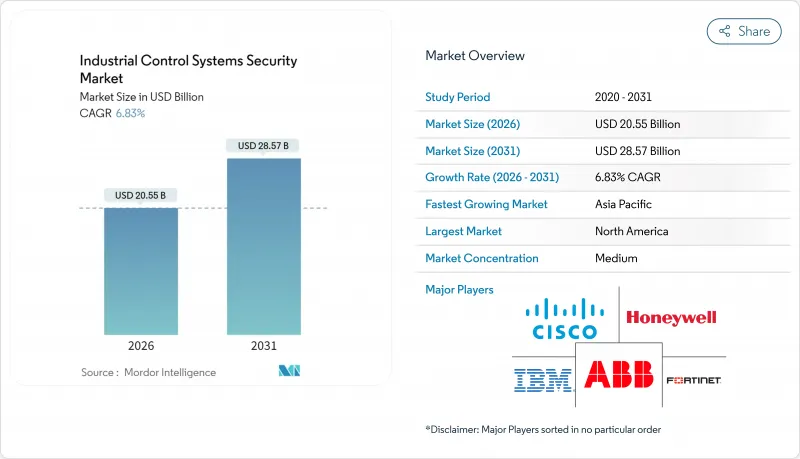
經營團隊主管對操作技術(OT) 網路彈性、IT-OT 網路整合以及日益猖獗的勒索軟體活動的高度重視,推動了持續的需求成長。北美憑藉 NERC CIP-013 等法規以及 CIRCIA 下的快速事件報告要求,保持主導地位。隨著公共產業和離散製造企業對 SCADA 資產進行現代化改造並大規模連接工業物聯網 (IIoT) 設備,亞太地區預計將實現最快速的成長。儘管解決方案仍然是收入的基礎,但託管保全服務的兩位數成長表明,在 OT 技能嚴重短缺的情況下,企業正在轉向全天候外包監控。網路分段和深層封包檢測主導目前的應用,而託管歷史資料庫和遠端維護入口網站的普及則推動了對雲端/遠端存取保護的需求。
全球工業控制系統 (ICS) 安全市場趨勢與洞察
加速工業物聯網主導的營運技術連接將變革製造業安全
預計到2025年,全球將有750億台連網設備投入使用,其中三分之一將安裝在工廠內,這將使傳統生產線面臨前所未有的網路風險。歐洲和日本的離散元件製造商正在整合視覺系統、機器人和預測性維護感測器,這需要東西向流量檢測和零信任分段。這種日益成長的資料流給傳統的邊界防禦帶來了壓力,迫使在乙太網路/IP、PROFINET和Modbus網路中部署通訊協定感知型偵測工具。供應商正在透過輕量級代理程式來應對資源受限的控制器,以及能夠在不中斷生產週期的情況下分析專有工業框架的深度套件檢測(DPI)感測器。隨著IT和OT團隊共同管理資產,對能夠繪製普渡安全等級0-3並自動部署策略的統一儀錶板的需求日益成長。預算負責人正擴大將安全支出與整體設備效率(OEE)指標掛鉤,從而強調透過預防停機時間來實現投資回報率(ROI)的重要性。
監理合規推動關鍵基礎設施安全投資
北美NERC CIP-013指令和歐盟NIS2指令對供應鏈風險管理和72小時內事件報告等環節都提出了具有約束力的義務。公共產業、交通網和化工廠正在加速採購,以避免可能超過年收入2%的罰款。這些法規將網路安全討論從技術團隊提升到經營團隊層,縮短了提供符合審核要求的報告和證據收集功能的供應商的銷售週期。整合商透過整合資產發現、配置監控和安全檔案傳輸功能,簡化了跨司法管轄區的合規流程,從而同時滿足兩項標準。此外,保險公司要求ICS(工業控制系統)分段證明作為保單續保和保費降低的先決條件,這進一步推動了ICS安全市場的發展。
舊有系統整合難題阻礙了安全實施
現代防火牆和異常檢測引擎必須適應已有20年歷史的可程式邏輯控制器 (PLC),這些控制器缺乏加密韌體和基於角色的存取控制。維修通常需要輪流停機,這會危及生產目標和合約規定的服務等級協定 (SLA)。 46% 的資產所有者需要長達六個月的時間來修復關鍵漏洞,延長了漏洞暴露的時間。成本效益的考慮導致全面的微隔離計劃被推遲,一些運營商轉而採用部分實施方案,例如只讀被動監控,雖然這種方案可以提供可見性,但卻使寫入訪問途徑暴露在外。
細分市場分析
到2025年,解決方案領域將佔據工業控制系統安全市場129.6億美元的佔有率,佔總收入的67.35%。防火牆、通訊協定感知型入侵防禦系統(IPS)、身分閘道器和漏洞掃描器構成了第一波應用的基礎。隨著供應商不斷整合人工智慧分析功能、縮短特徵碼更新周期並即時檢測零日漏洞,相關支出正在穩步成長。目前,工業控制系統安全市場正在湧現融合平台,這些平台能夠採集跨層級日誌並加速根本原因關聯分析。
預計到2025年,服務板塊的估值將達到62.8億美元,並在2031年之前保持10.86%的最高複合年成長率。託管式偵測和回應服務將遠端第一線故障排查與現場事件回應人員結合,使工廠能夠維持運作並滿足72小時報告義務。整合和實施合作夥伴負責連接不同的供應商系統,將資產清單對應到ISA/IEC 62443區域,然後配置多層控制。諮詢團隊使用攻擊鏈模擬進行成熟度評估,並制定與資本支出更新周期一致的分階段藍圖。支援和維護協議確保韌體更新和定期規則集調整,從而將高度監管的能源營業單位的平均修補時間縮短30%以上。
到2025年,網路安全將佔收入的36.55%,營運商將優先部署實體和虛擬分段設備,以過濾通訊協定命令並將流量鏡像到被動收集器。零信任架構隔離人機介面 (HMI)、歷史資料庫和工程工作站,防止IT子網路橫向移動。威脅情報源注入工業級入侵指標 (IOC),以幫助安全營運中心 (SOC) 團隊阻止惡意的OT特定命令序列。
在所有類別中,雲端/遠端存取安全預計將以 12.01% 的複合年成長率 (CAGR) 實現最高成長,這主要得益於工廠中數位雙胞胎技術和廠商輔助維護入口網站的普及。多因素身份驗證閘道器、即時會話仲介和持續態勢評估將被部署,以應對來自暴露於網際網路的端點的日益成長的風險。端點安全工具將透過無代理監控來強化 PLC、RTU 和感測器,從而追蹤韌體狀態和記憶體完整性。應用層防禦將使用動態程式碼分析來檢測 MES 和批次執行軟體中的不安全調用,而資料庫防火牆將防止時間序列運行資料的洩漏。
區域分析
預計到2025年,北美將佔全球收入的32.60%。大規模資料外洩事件導致聯邦政府加強審查,資產所有者紛紛採納美國網路安全和基礎設施安全局(CISA)的「加強防護」建議,並要求在規定時間內提交漏洞報告。對配備人員的泵站和風電場的安全遠端存取的投資正在加速。加拿大國家網路威脅評估警告稱,敵對國家可能干擾能源出口,各省監管機構正在推動遵守北美電力可靠性委員會(NERC)的網路安全改進計劃(CIP)框架。
亞太地區將在2026年至2031年間達到最高的複合年成長率,達到8.15%。中國正在數千個新建變電站中擴大網路安全防護力度,將國產防火牆品牌與全球分析引擎結合。日本正在升級其機器人密集型汽車生產線,將深層封包檢測設備與支援OT的SIEM整合系統整合。韓國正利用其5G骨幹網,強制要求對毫秒延遲的控制指令進行加密和ID疊加。印度正在水力發電發電工程中更換串口轉乙太網路轉換器,並插入檢測分接器,將資訊傳輸至國家級安全營運中心(SOC)。隨著本地人才儲備的成熟,東協地區的中小型企業正擴大依賴供應商提供的SOC。
隨著NIS2將業務拓展至中型關鍵營業單位領域,歐洲仍是其核心市場。德國聯邦資訊安全辦公室(BSI)正在推動跨行業漏洞諮詢共用,法國國家資訊安全局(ANSSI)則在製定分段檢查清單。英國公共產業正在試行基於人工智慧的預測性異常檢測引擎,以滿足英國天然氣和電力市場監管局(Ofgem)的彈性目標。西班牙和義大利可再生能源的成長推動了對認證仲介的需求,以便在現場維護期間管理逆變器原始設備製造商(OEM)。拉丁美洲以及中東和非洲地區正在穩步採取防禦措施,例如巴西公共產業正在實施PLC韌體的供應鏈認證,而沿岸地區的管道運營商則部署了欺騙網路以阻止偵察活動。
其他福利:
- Excel格式的市場預測(ME)表
- 3個月的分析師支持
目錄
第1章 引言
- 研究假設和市場定義
- 調查範圍
第2章調查方法
第3章執行摘要
第4章 市場情勢
- 市場概覽
- 市場促進因素
- 加速離散製造業中工業物聯網主導的營運技術連結(歐盟和日本)
- 關鍵基礎設施營運商必須遵守NERC CIP-013和歐盟NIS2標準
- 亞洲電力和供水事業老舊SCADA/DCS資產現代化改造
- 美國和中東地區石油和天然氣管道遭受勒索軟體攻擊激增
- 分散式可再生能源的成長需要遠端存取保護
- 引入基於雲端的歷史資料庫和遠端維護平台
- 市場限制
- 傳統PLC維修成本高且停機時間長
- 東協中型製造業缺乏具備OT技能的網路安全人才
- 專有的行業通訊協定限制了互通性。
- 重複的IT/OT工具堆疊導致採購延誤(「安全疲勞」)
- 價值/供應鏈分析
- 監理與技術展望
- 波特五力分析
- 供應商的議價能力
- 買方的議價能力
- 新進入者的威脅
- 替代品的威脅
- 競爭對手之間的競爭
- 投資分析
第5章 市場規模與成長預測
- 按組件
- 解決方案
- 防火牆和入侵防禦系統
- 身分和存取管理
- 防毒和反惡意軟體
- 安全和漏洞管理
- 預防資料外泄和恢復
- 其他解決方案
- 服務
- 諮詢與評估
- 整合與部署
- 支援與維護
- 資安管理服務
- 解決方案
- 按安全類型
- 網路安全
- 端點安全
- 應用程式安全
- 資料庫安全
- 雲端/遠端存取安全
- 按控制系統類型
- 監控與數據採集(SCADA)
- 分散式控制系統(DCS)
- 可程式邏輯控制器(PLC)
- 其他控制系統
- 按最終用戶行業分類
- 車
- 化工/石油化工
- 電力/公共產業
- 石油和天然氣
- 食品/飲料
- 製藥
- 供水/污水處理
- 採礦和金屬
- 運輸/物流
- 其他行業
- 按地區
- 北美洲
- 美國
- 加拿大
- 墨西哥
- 歐洲
- 英國
- 德國
- 法國
- 義大利
- 其他歐洲
- 亞太地區
- 中國
- 日本
- 印度
- 韓國
- 亞太其他地區
- 中東
- 以色列
- 沙烏地阿拉伯
- 阿拉伯聯合大公國
- 土耳其
- 其他中東地區
- 非洲
- 南非
- 埃及
- 其他非洲地區
- 南美洲
- 巴西
- 阿根廷
- 南美洲其他地區
- 北美洲
第6章 競爭情勢
- 市場集中度
- 策略趨勢
- 市佔率分析
- 公司簡介
- Honeywell International Inc.
- Cisco Systems Inc.
- IBM Corporation
- Fortinet Inc.
- ABB Ltd.
- Rockwell Automation Inc.
- Dragos Inc.
- Nozomi Networks Inc.
- Palo Alto Networks Inc.
- Check Point Software Technologies Ltd.
- Darktrace Holdings Limited
- Broadcom Inc.(Symantec)
- Trellix
- Schneider Electric SE
- Siemens AG
- Kaspersky Lab
- GE Vernova(GE Digital)
- Claroty Ltd.
- Trend Micro Inc.
- AhnLab Inc.
第7章 市場機會與未來展望
Industrial Control Systems Security Market size in 2026 is estimated at USD 20.55 billion, growing from 2025 value of USD 19.24 billion with 2031 projections showing USD 28.57 billion, growing at 6.83% CAGR over 2026-2031.
Board-level prioritization of operational technology cyber-resilience, convergence of IT-OT networks, and escalating ransomware activity underpin sustained demand. North America retains leadership thanks to regulations such as NERC CIP-013 and the rapid incident-reporting mandate in CIRCIA. Asia-Pacific delivers the steepest growth as utilities and discrete manufacturers modernize SCADA assets and connect IIoT devices at scale. Solutions remain the revenue backbone, yet double-digit expansion of managed security services shows enterprises shifting toward 24/7 outsourced monitoring amid an acute OT-skilled labor shortage. Network segmentation and deep-packet inspection dominate current deployments, while cloud/remote-access protection gains momentum with the rise of hosted historians and remote maintenance portals.
Global Industrial Control Systems Security Market Trends and Insights
Accelerating IIoT-driven OT Connectivity Transforms Manufacturing Security
One-third of the 75 billion connected devices expected in 2025 will sit inside factories, exposing legacy production lines to unprecedented cyber risk. European and Japanese discrete manufacturers are integrating vision systems, robotics, and predictive-maintenance sensors that require east-west traffic inspection and zero-trust segmentation. This intensified data flow strains traditional perimeter defenses and forces deployment of protocol-aware detection tools inside Ethernet/IP, PROFINET, and Modbus networks. Vendors respond with lightweight agents for resource-constrained controllers and DPI sensors that parse proprietary industrial frames without disrupting cycle times. As IT and OT teams co-manage assets, demand rises for unified dashboards that map Purdue levels 0-3 and automate policy rollouts. Budget holders increasingly tie security spend to overall equipment effectiveness metrics, reinforcing ROI narratives around avoided downtime.
Regulatory Compliance Drives Critical-Infrastructure Security Investment
NERC CIP-013 in North America and the EU's NIS2 Directive impose binding obligations ranging from supply-chain risk management to 72-hour incident reporting. Utilities, transport networks, and chemical plants accelerate procurements to avoid fines that can exceed 2% of annual turnover. The regulations also elevate cyber discussions from engineering teams to executive committees, compressing sales cycles for vendors offering audit-ready reporting and evidence collection. Integrators bundle asset-discovery, configuration-monitoring, and secure-file-transfer capabilities to meet both standards concurrently, simplifying multi-jurisdiction compliance. Momentum in the ICS security market is further boosted by insurers demanding proof of ICS segmentation before renewing coverage or lowering premiums.
Legacy System Integration Challenges Hinder Security Implementation
Modern firewalls and anomaly-detection engines must adapt to 20-year-old PLCs that lack encrypted firmware or role-based access controls. Retrofitting often requires staged shutdowns that jeopardize output quotas and contractual service-level agreements. Forty-six percent of asset owners need up to six months to patch a critical vulnerability, prolonging exposure windows. Cost-benefit debates delay full micro-segmentation projects, pushing some operators toward partial implementations like read-only passive monitoring, which offers visibility yet leaves write-access pathways unguarded.
Other drivers and restraints analyzed in the detailed report include:
- Aging Infrastructure Modernization Creates Security Imperatives
- Ransomware Targeting Critical Infrastructure Drives Security Urgency
- Cybersecurity Talent Gap Constrains Security Implementation
For complete list of drivers and restraints, kindly check the Table Of Contents.
Segment Analysis
In 2025, the industrial control systems security market size attributed USD 12.96 billion to solutions, equal to a 67.35% revenue share. Firewalls, protocol-aware IPS, identity gateways, and vulnerability scanners formed the backbone of first-wave deployments. Spending grows steadily as vendors embed artificial-intelligence analytics that cut signature-update cycles and flag zero-day behaviors in real time. The industrial control systems security market now witnesses converged platforms that ingest logs across Purdue levels, enriching context for quicker root-cause correlation.
The services segment, valued at USD 6.28 billion in 2025, records the fastest 10.86% CAGR through 2031. Managed detection and response offerings combine remote tier-1 triage and on-site incident-handlers, allowing plants to maintain uptime while meeting 72-hour reporting mandates. Integration and deployment partners bridge heterogeneous vendor stacks, mapping asset inventories against ISA/IEC 62443 zones before configuring layered controls. Consulting teams benchmark maturity via kill-chain simulations, then craft phased roadmaps tied to capex refresh cycles. Support and maintenance contracts secure firmware updates and periodic rule-set tuning, reducing mean time to patch by more than 30% in highly regulated energy utilities.
Network security anchors 36.55% of 2025 revenues as operators prioritize physical and virtual segmentation appliances that filter protocol commands and mirror traffic to passive collectors. Zero-trust architectures isolate HMIs, historians, and engineering workstations, preventing lateral movement from IT subnets. Threat-intelligence feeds inject industrial IOCs, helping SOC teams block malicious OT-specific command sequences.
Cloud/remote-access security posts a 12.01% forecast CAGR, the highest among categories, as plants adopt digital twins and vendor-assisted maintenance portals. Multi-factor identity gateways, just-in-time session brokers, and continuous posture assessment counter the heightened risk from internet-exposed endpoints. Endpoint security tools harden PLCs, RTUs, and sensors with agentless monitoring that tracks firmware states and memory integrity. Application-layer defenses use dynamic code analysis to spot unsafe calls within MES and batch-execution software, while database firewalls safeguard time-series operational data against exfiltration.
The Industrial Control Systems ICS Security Market Report is Segmented by Component (Solutions, Services), Security Type (Network Security, Endpoint Security, Application Security, and More), Control System Type (SCADA, Distributed Control System (DCS), and More), End-User Industry (Automotive, Chemical & Petrochemical, Power and Utilities, and More), and Geography. The Market Forecasts are Provided in Terms of Value (USD).
Geography Analysis
North America generated 32.60% of 2025 global revenue. Federal scrutiny intensified after headline breaches, prompting asset owners to adopt CISA's Shields-Up advisories and submit vulnerability reports within stipulated windows. Investments accelerate around secure remote access for sparsely staffed pumping stations and wind farms. Canada's National Cyber Threat Assessment warns that hostile states could disrupt energy exports, pushing provincial regulators to align with NERC CIP frameworks.
Asia-Pacific records the highest 8.15% CAGR from 2026 to 2031. China scales cyber-hygiene across thousands of new substations, blending domestic firewall brands with global analytics engines. Japan upgrades robot-dense automotive lines, coupling deep-packet inspection appliances with OT-aware SIEM integrations. South Korea leverages its 5G backbone, necessitating encryption and identity overlays for millisecond-latency control commands. India replaces serial-to-Ethernet converters in hydro projects, inserting inspection taps that feed national-level SOCs. ASEAN SMEs rely on vendor-hosted SOCs as local talent pipelines mature.
Europe remains a pivotal market as NIS2 expands enforcement to medium-sized critical entities. Germany's BSI drives cross-sector vulnerability advisory sharing, while France's ANSSI prescribes segmentation checklists. United Kingdom utilities pilot AI-based predictive anomaly engines to meet Ofgem resilience targets. Renewable-energy growth in Spain and Italy sparks demand for authentication brokers that manage inverter OEMs during field maintenance. Latin America and Middle East & Africa steadily adopt defenses; Brazilian utilities implement supply-chain attestation for PLC firmware, and Gulf pipeline operators deploy deception grids to deter reconnaissance.
- Honeywell International Inc.
- Cisco Systems Inc.
- IBM Corporation
- Fortinet Inc.
- ABB Ltd.
- Rockwell Automation Inc.
- Dragos Inc.
- Nozomi Networks Inc.
- Palo Alto Networks Inc.
- Check Point Software Technologies Ltd.
- Darktrace Holdings Limited
- Broadcom Inc. (Symantec)
- Trellix
- Schneider Electric SE
- Siemens AG
- Kaspersky Lab
- GE Vernova (GE Digital)
- Claroty Ltd.
- Trend Micro Inc.
- AhnLab Inc.
Additional Benefits:
- The market estimate (ME) sheet in Excel format
- 3 months of analyst support
TABLE OF CONTENTS
1 INTRODUCTION
- 1.1 Study Assumptions and Market Definition
- 1.2 Scope of the Study
2 RESEARCH METHODOLOGY
3 EXECUTIVE SUMMARY
4 MARKET LANDSCAPE
- 4.1 Market Overview
- 4.2 Market Drivers
- 4.2.1 Accelerating IIoT-driven OT Connectivity in Discrete Manufacturing (EU and Japan)
- 4.2.2 Mandatory NERC CIP-013 and EU NIS2 Compliance for Critical Infrastructure Operators
- 4.2.3 Modernization of Ageing SCADA/DCS Assets in Asian Power and Water Utilities
- 4.2.4 Surge in Ransomware Attacks on Oil and Gas Pipelines (US and Middle East)
- 4.2.5 Growth of Distributed Renewables Requiring Remote-Access Protection
- 4.2.6 Adoption of Cloud-hosted Historians and Remote Maintenance Platforms
- 4.3 Market Restraints
- 4.3.1 High Retrofit Costs and Downtime for Legacy PLCs
- 4.3.2 OT-Skilled Cyber-Talent Shortage in Mid-size ASEAN Manufacturers
- 4.3.3 Limited Interoperability of Proprietary Industrial Protocols
- 4.3.4 Procurement Delays from IT/OT Tool-Stack Overlap ("Security Fatigue")
- 4.4 Value / Supply-Chain Analysis
- 4.5 Regulatory and Technological Outlook
- 4.6 Porter's Five Forces Analysis
- 4.6.1 Bargaining Power of Suppliers
- 4.6.2 Bargaining Power of Buyers
- 4.6.3 Threat of New Entrants
- 4.6.4 Threat of Substitutes
- 4.6.5 Intensity of Competitive Rivalry
- 4.7 Investment Analysis
5 MARKET SIZE AND GROWTH FORECASTS (VALUE)
- 5.1 By Component
- 5.1.1 Solutions
- 5.1.1.1 Firewall and IPS
- 5.1.1.2 Identity and Access Management
- 5.1.1.3 Antivirus and Antimalware
- 5.1.1.4 Security and Vulnerability Management
- 5.1.1.5 Data Loss Prevention and Recovery
- 5.1.1.6 Other Solutions
- 5.1.2 Services
- 5.1.2.1 Consulting and Assessment
- 5.1.2.2 Integration and Deployment
- 5.1.2.3 Support and Maintenance
- 5.1.2.4 Managed Security Services
- 5.1.1 Solutions
- 5.2 By Security Type
- 5.2.1 Network Security
- 5.2.2 Endpoint Security
- 5.2.3 Application Security
- 5.2.4 Database Security
- 5.2.5 Cloud/Remote Access Security
- 5.3 By Control System Type
- 5.3.1 Supervisory Control and Data Acquisition (SCADA)
- 5.3.2 Distributed Control System (DCS)
- 5.3.3 Programmable Logic Controller (PLC)
- 5.3.4 Other Control Systems
- 5.4 By End-user Industry
- 5.4.1 Automotive
- 5.4.2 Chemical and Petrochemical
- 5.4.3 Power and Utilities
- 5.4.4 Oil and Gas
- 5.4.5 Food and Beverage
- 5.4.6 Pharmaceuticals
- 5.4.7 Water and Wastewater
- 5.4.8 Mining and Metals
- 5.4.9 Transportation and Logistics
- 5.4.10 Other Industries
- 5.5 By Geography
- 5.5.1 North America
- 5.5.1.1 United States
- 5.5.1.2 Canada
- 5.5.1.3 Mexico
- 5.5.2 Europe
- 5.5.2.1 United Kingdom
- 5.5.2.2 Germany
- 5.5.2.3 France
- 5.5.2.4 Italy
- 5.5.2.5 Rest of Europe
- 5.5.3 Asia-Pacific
- 5.5.3.1 China
- 5.5.3.2 Japan
- 5.5.3.3 India
- 5.5.3.4 South Korea
- 5.5.3.5 Rest of Asia-Pacific
- 5.5.4 Middle East
- 5.5.4.1 Israel
- 5.5.4.2 Saudi Arabia
- 5.5.4.3 United Arab Emirates
- 5.5.4.4 Turkey
- 5.5.4.5 Rest of Middle East
- 5.5.5 Africa
- 5.5.5.1 South Africa
- 5.5.5.2 Egypt
- 5.5.5.3 Rest of Africa
- 5.5.6 South America
- 5.5.6.1 Brazil
- 5.5.6.2 Argentina
- 5.5.6.3 Rest of South America
- 5.5.1 North America
6 COMPETITIVE LANDSCAPE
- 6.1 Market Concentration
- 6.2 Strategic Moves
- 6.3 Market Share Analysis
- 6.4 Company Profiles (includes Global-level Overview, Market-level overview, Core Segments, Financials, Strategic Information, Market Rank/Share, Products and Services, Recent Developments)
- 6.4.1 Honeywell International Inc.
- 6.4.2 Cisco Systems Inc.
- 6.4.3 IBM Corporation
- 6.4.4 Fortinet Inc.
- 6.4.5 ABB Ltd.
- 6.4.6 Rockwell Automation Inc.
- 6.4.7 Dragos Inc.
- 6.4.8 Nozomi Networks Inc.
- 6.4.9 Palo Alto Networks Inc.
- 6.4.10 Check Point Software Technologies Ltd.
- 6.4.11 Darktrace Holdings Limited
- 6.4.12 Broadcom Inc. (Symantec)
- 6.4.13 Trellix
- 6.4.14 Schneider Electric SE
- 6.4.15 Siemens AG
- 6.4.16 Kaspersky Lab
- 6.4.17 GE Vernova (GE Digital)
- 6.4.18 Claroty Ltd.
- 6.4.19 Trend Micro Inc.
- 6.4.20 AhnLab Inc.
7 MARKET OPPORTUNITIES AND FUTURE OUTLOOK
- 7.1 White-space and Unmet-Need Assessment

 2026-2034年工業控制系統安全全球市場規模、佔有率、趨勢和成長分析報告
 工業控制系統(ICS)安全市場報告:按組件、系統類型、安全類型、應用和地區分類(2026-2034 年)
 2026年全球工業控制系統(ICS)安全市場報告
 工業控制系統 (ICS) 安全市場規模、佔有率和成長分析(按組件、安全類型、垂直產業、部署模式和地區分類)—產業預測 (2026-2033)
 工業控制系統安全市場-全球產業規模、佔有率、趨勢、機會和預測,按組件、安全類型、系統、最終用戶、地區和競爭格局分類,2020-2030年預測
 工業控制系統安全市場,按組件、按解決方案、按服務、按類型、按最終用戶、按國家和地區 - 2025 年至 2032 年全球行業分析、市場規模、市場佔有率和預測
 工業控制系統安全市場:按組件、安全類型和行業分類 - 2025-2030 年全球預測