


 |
市場調查報告書
商品編碼
1910577
神經行銷:市場佔有率分析、產業趨勢與統計、成長預測(2026-2031)Neuromarketing - Market Share Analysis, Industry Trends & Statistics, Growth Forecasts (2026 - 2031) |
||||||

※ 本網頁內容可能與最新版本有所差異。詳細情況請與我們聯繫。
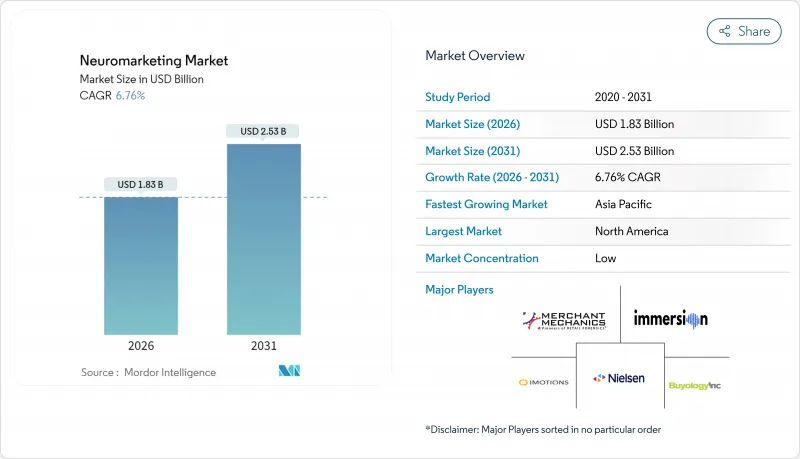
預計到 2026 年,神經行銷市場價值將達到 18.3 億美元,高於 2025 年的 17.1 億美元,預計到 2031 年將達到 25.3 億美元,2026 年至 2031 年的複合年成長率為 6.76%。
這項擴張的驅動力源自於腦電圖 (EEG) 和機器學習系統在預測購買意願方面高達 87.1% 的準確率,身臨其境型和擴增實境測試環境的興起,以及隱私法規與傳統消費者洞察工具之間日益擴大的差距。全球品牌正將神經行銷平台視為宣傳活動預測試、受眾細分和用戶體驗最佳化的基礎,而投資者則在支持那些致力於將硬體小型化與雲端分析相結合的新業務。加州 SB 1223 法案和歐盟 GDPR 等嚴格的資料保護法律迫使供應商採用保護隱私的設計原則,雖然增加了合規成本,但也創造了永續的競爭優勢。隨著大型科技公司收購專業公司並將神經測量功能嵌入其更廣泛的行銷技術體系中,產業整合正在進行中。
全球神經行銷市場趨勢與洞察
對先進行銷工具的需求不斷成長
品牌行銷人員面臨著碎片化的數位化體驗,這削弱了點擊率和轉換率作為衡量用戶參與度的重要指標。基於腦電圖 (EEG) 並結合機器學習的系統能夠提供即時認知指標,例如認知負荷、情緒喚醒和購買意向,這些指標與銷售成長直接相關。一項突破性研究表明,神經生物學測量方法在購買預測方面取得了顯著成效,其準確率高達 87.1%,而傳統問卷的準確率僅為 64%。採用這些工具的消費品公司能夠更快地迭代創新,減少媒體浪費,並提高廣告支出報酬率。在競爭激烈的線上市場中,對更深入的行為洞察的需求也日益成長。
引入人工智慧驅動的預測性注意力分析
神經行銷供應商利用卷積類神經網路和梯度提升模型,在宣傳活動啟動前預測受眾的注意力模式。基於大規模多模態集的訓練,能夠實現跨文化細分,區分不同人群之間微妙的情感徵兆。功能性近紅外線光譜 (fNIRS) 研究揭示了跨文化融合廣告中存在性別特異性的前額葉活化模式,使品牌能夠基於神經生物學兼容性最佳化通訊。預測範圍不僅限於單一創新,還能預測長期的品牌價值軌跡,進而引導預算分配和投資組合指南。將這些預測引擎整合到媒體規劃流程中的公司,可以將洞察週期從數週縮短至數小時。
黃金標準神經影像技術(fMRI)的高昂資本成本
一套完整的fMRI設備造價可能超過300萬美元,每年的維修費用高達20萬美元。雖然大型製藥企業能夠負擔這樣的支出,但大多數廣告公司和Start-Ups卻難以企及。這種資金壁壘加劇了資源匱乏的機構之間的兩極化:資源雄厚的機構能夠獲得高解析度數據,而其他機構則依賴低成本的腦電圖(EEG)和眼動追蹤技術。攜帶式近紅外線光譜(fNIRS)設備能夠以fMRI十分之一的成本提供約75%的精度,但目前尚無法完全複製全腦成像。這項限制阻礙了fNIRS的大規模應用,並減緩了調查方法的創新。
細分市場分析
到2025年,零售和消費品品牌將佔據神經行銷市場37.12%的佔有率,主要得益於消費品產業的大規模宣傳活動測試。然而,醫療保健和製藥應用領域的成長速度最快,年複合成長率達7.12%。基於神經科學的內容能夠提高患者的依從性和參與臨床試驗的意願,從而推動醫療傳播領域神經行銷市場規模的成長。製藥行銷人員正在利用數位生物標記即時監測認知副作用。同時,醫院網路正在測試遠端保健入口網站的使用者體驗流程,以減少使用者操作障礙和爽約率。
銀行和保險公司正在將神經回饋技術融入新的客戶獲取流程,以縮短表格填寫時間並降低客戶流失率。市場調查機構正將生物識別面板整合到傳統的調查體系中,以提高預測效度。學術機構正在利用公私津貼擴建腦機介面實驗室,尤其是在亞太地區,各國政府正在資助轉化神經科學研究。汽車和娛樂公司正在探索車載情緒監測和故事板最佳化技術,以創造多樣化的終端用戶環境,從而增強需求韌性。
腦電圖 (EEG) 預計在 2025 年將維持 40.28% 的收入佔有率,這主要得益於成熟的研究通訊協定和感測器成本的下降。功能性近紅外線光譜 (fNIRS) 將以 7.35% 的年成長率成長,隨著攜帶式無纖維帽的推出,其市場佔有率將進一步縮小。該帽子能夠繪製使用者在實體貨架或虛擬商店瀏覽時前額葉皮質的血氧飽和度圖。隨著頭戴式設備製造商將光電二極體整合到混合實境設備中,fNIRS 解決方案的神經行銷市場規模預計將會擴大。眼動追蹤模組也受益於與智慧眼鏡的整合,可用於評估駕駛時的注意力分散情況以及在零售貨架上的注視情況。
對於高解析度的隱性品牌聯想研究而言,功能性磁振造影(fMRI)仍然至關重要,即便預算壓力促使人們傾向於採用更輕的方法。結合皮膚電反應和光電容積脈搏波描記法的穿戴式生物辨識技術,能夠持續追蹤消費者在全天消費行為中的情緒變化。新興的腦波耳塞和神經形態感測器處於技術前沿,能夠實現免持被動資料流,一旦達到可靠性閾值,便有望重塑調查方法的規範。
區域分析
到2025年,北美將佔據神經行銷市場41.20%的佔有率,這反映了該地區充裕的創業投資、強大的神經科學學術叢集以及清晰的隱私指南。同年,美國神經科技領域的資金籌措達23億美元,共達成129筆交易,推動了突破性感測器設計和人工智慧流程的發展。加拿大透過公共津貼促進跨國合作,發揮了補充作用;而在墨西哥,隨著數位廣告技術的日趨成熟,消費品公司正在採用價格親民的眼動追蹤技術。蘋果以2,200萬美元收購Datakalab等併購活動,凸顯了該地區對嵌入式神經分析能力的強勁需求。
預計到2031年,亞太地區將以7.83%的複合年成長率成長,隨著中國、印度、日本和韓國將神經行銷融入全通路零售、遊戲和汽車體驗,區域收入差距將逐漸縮小。在中國,政府研究津貼正支持神經人工智慧Start-Ups與全球品牌合作,而印度的D2C平台則在其可用性實驗室中部署腦電圖(EEG)頭帶。強調群體和諧的文化規範放大了社會認知指標的影響,促使當地機構客製化研究通訊協定以捕捉集體主義因素。一家日本電子巨頭和一家韓國娛樂集團正在率先建立身臨其境型XR實驗室,將功能性近紅外光譜(fNIRS)和觸覺回饋相結合,以提高產品發布的精準度。
在歐洲,德國的汽車製造傳統、法國的奢侈品創意以及英國媒體機構的創新能力,共同支撐著強勁的需求。嚴格的GDPR(一般資料保護規範)正在推動邊緣分析和聯邦學習解決方案的發展,這些方案限制了個人資料傳輸,使歐洲供應商成為全球神經行銷領域道德規範的標竿。諸如「人類大腦計劃」之類的學術網路正在推動測量技術的進步,這些技術正逐步應用於商業產品。注重隱私的聲譽正在吸引那些面臨消費者日益成長的疑慮的跨國品牌,並將合規性提升轉化為營收成長的催化劑。隨著數位基礎設施的加速發展以及跨國零售商對其全通路策略的在地化,南美以及中東和非洲地區也湧現出長期機會。
其他福利:
- Excel格式的市場預測(ME)表
- 3個月的分析師支持
目錄
第1章 引言
- 研究假設和市場定義
- 調查範圍
第2章調查方法
第3章執行摘要
第4章 市場情勢
- 市場概覽
- 市場促進因素
- 對先進行銷工具的需求不斷成長
- 基於智慧型手機的即時體驗追蹤技術的興起
- 引入人工智慧驅動的預測性注意力分析
- 對符合隱私權保護規定、採用選擇加入模式的消費者洞察的需求日益成長
- 神經行銷與身臨其境型XR平台的整合
- 增加神經科技Start-Ups的創業融資
- 市場限制
- 黃金標準神經影像學(fMRI)的高昂資本成本
- 監管環境分散和資料隱私限制
- 缺乏跨學科人才
- 消費者對潛意識操縱的懷疑態度
- 產業生態系分析
- 監管環境
- 宏觀經濟因素的影響
- 波特五力分析
- 供應商的議價能力
- 買方的議價能力
- 新進入者的威脅
- 替代品的威脅
- 競爭對手之間的競爭
第5章 市場規模與成長預測
- 最終用戶
- 銀行、金融服務和保險
- 零售與消費品牌
- 市場研究機構
- 科學機構
- 醫療/製藥
- 其他最終用戶
- 透過技術
- 腦電圖(EEG)
- 功能性磁振造影(fMRI)
- 眼動追蹤
- 生物識別(皮膚電反應、心率)
- 臉部分析/情緒人工智慧
- 功能性近紅外線光譜(fNIRS)
- 其他技術
- 報價
- 硬體/設備
- 軟體/平台
- 服務
- 透過使用
- 廣告與媒體測試
- 產品和包裝設計
- 使用者體驗與數位分析
- 零售和店內分析
- 價格調查
- 政治和社會宣傳活動測試
- 其他用途
- 按地區
- 北美洲
- 美國
- 加拿大
- 墨西哥
- 南美洲
- 巴西
- 阿根廷
- 其他南美洲
- 歐洲
- 德國
- 法國
- 英國
- 義大利
- 西班牙
- 俄羅斯
- 其他歐洲地區
- 亞太地區
- 中國
- 日本
- 印度
- 韓國
- 澳洲和紐西蘭
- 亞太其他地區
- 中東
- 沙烏地阿拉伯
- 阿拉伯聯合大公國
- 土耳其
- 其他中東地區
- 非洲
- 南非
- 埃及
- 奈及利亞
- 其他非洲地區
- 北美洲
第6章 競爭情勢
- 市場集中度
- 策略趨勢
- 市佔率分析
- 公司簡介
- The Nielsen Company LLC
- Neurons Inc.
- Immersion Neuroscience Inc.
- NVISO SA
- Cadwell Industries Inc.
- Compumedics Limited
- Merchant Mechanics Inc.
- Neural Sense(Pty)Ltd
- SR Labs SRL
- Synetiq Ltd.
- Mindspeller BV
- MindMetriks LLC
- Uniphore Technologies Inc.
- Tobii AB
- iMotions A/S
- Bitbrain Technologies SL
- Emotiv Inc.
- Shimmer Research Ltd.
- Myndlift Ltd.
- Blackbox Biometrics LLC
- Innerscope Research Inc.
- Eye Square GmbH
- HCL Technologies Limited(Neuromarketing Practice)
- Spark Neuro Inc.
- Affectiva Inc.
- Sensory Logic Inc.
- Neurotrend LLC
- SalesBrain LLC
- NeuroVision Marketing LLC
- Neuro-Insight Pty Ltd
第7章 市場機會與未來展望
Neuromarketing market size in 2026 is estimated at USD 1.83 billion, growing from 2025 value of USD 1.71 billion with 2031 projections showing USD 2.53 billion, growing at 6.76% CAGR over 2026-2031.
Expansion is fueled by the proven ability of electroencephalography-machine learning systems to predict purchase intent with 87.1% accuracy, the rise of immersive extended-reality testing environments, and the widening gap between privacy regulations and traditional consumer-insight tools. Global brands view neuromarketing platforms as infrastructure for campaign pre-testing, audience segmentation, and user-experience optimization, while investors support new ventures that bridge hardware miniaturization with cloud analytics. Strict data-protection laws, notably California SB 1223 and the European Union's GDPR, compel vendors to embed privacy-preserving design principles that add compliance costs yet create durable competitive advantages. Consolidation is underway as larger technology companies acquire specialist firms to embed neural measurement across wider marketing-technology stacks.
Global Neuromarketing Market Trends and Insights
Increasing Need for Advanced Marketing Tools
Brand marketers face fragmented digital journeys that weaken click-through and conversion metrics as proxies for engagement. EEG-based systems integrated with machine learning provide real-time readouts of cognitive load, emotional arousal, and motivational intent that correlate directly with sales lift. A landmark study reported 87.1% purchase-prediction accuracy against 64% for surveys, validating the shift toward neurobiological measurement. Consumer goods firms that deploy these tools achieve faster creative iteration, reduced media wastage, and higher return on advertising spend. Heightened competition inside crowded online marketplaces further elevates demand for deeper behavioral insight.
AI-Powered Predictive Attention Analytics Adoption
Neuromarketing vendors embed convolutional neural networks and gradient-boosting models to forecast attention patterns before campaigns launch. Training on large multi-modal datasets enables cross-cultural segmentation that distinguishes subtle emotional cues among demographic cohorts. Functional near-infrared spectroscopy studies reveal gender-specific prefrontal activation during mixed-culture adverts, allowing brands to tailor messaging by neurobiological fit. Forecasting extends beyond single creatives to long-term brand-equity trajectories, guiding budget allocation and portfolio strategy. Companies that integrate these predictive engines into media-planning workflows compress insights cycles from weeks to hours.
High Capital Cost of Gold-Standard Neuroimaging (fMRI)
Installing an fMRI suite can exceed USD 3 million, with recurrent maintenance topping USD 200,000 each year. Such spending is feasible for large pharmaceutical firms but unattainable for most agencies and start-ups. The capital hurdle entrenches a two-tier structure in which resource-rich organizations access high-resolution data while others rely on lower-cost EEG or eye-tracking alternatives. Portable fNIRS devices deliver roughly 75% of fMRI precision at 10% of its cost, but they cannot yet fully replicate whole-brain mapping. This constraint limits large-scale adoption and slows methodological innovation.
Other drivers and restraints analyzed in the detailed report include:
- Rising Demand for Privacy-Compliant, Opt-In Consumer Insights
- Integration of Neuromarketing with Immersive XR Platforms
- Fragmented Regulatory Landscape and Data-Privacy Constraints
For complete list of drivers and restraints, kindly check the Table Of Contents.
Segment Analysis
Retail and consumer brands captured 37.12% neuromarketing market share during 2025, driven by high-volume campaign testing across fast-moving consumer goods. Healthcare and pharma applications, however, are advancing at a 7.12% CAGR, the fastest among end users. The neuromarketing market size for healthcare communications will benefit from neuroscience-based content that improves patient adherence and clinical-trial engagement. Pharmaceutical marketers employ digital biomarkers to monitor cognitive side effects in real time, while hospital networks test user-experience flows of telehealth portals to reduce friction and missed appointments.
Banks and insurers integrate neural feedback into onboarding journeys that shorten form-completion times and lower abandonment. Market-research agencies embed biometric panels within traditional survey infrastructures to boost predictive validity. Academic institutions expand brain-computer-interface labs through public-private grants, particularly in Asia Pacific where governments fund translational neuroscience. Automotive and entertainment firms explore in-vehicle emotion monitoring and storyboarding optimization, rounding out a diversified end-user landscape that strengthens demand resilience.
Electroencephalography held 40.28% revenue in 2025 thanks to well-established research protocols and shrinking sensor costs. Functional near-infrared spectroscopy is growing 7.35% annually, narrowing the gap by offering mobile, fiber-less caps that map prefrontal blood oxygenation while users browse physical aisles or virtual storefronts. The neuromarketing market size for fNIRS solutions will expand as headset manufacturers embed optical diodes inside mixed-reality devices. Eye-tracking modules benefit from integration into smart glasses that assess driver distraction and retail shelf gaze.
Functional magnetic resonance imaging remains indispensable for high-resolution studies of subconscious brand associations, even as budget pressures favor lighter modalities. Wearable biometrics that combine galvanic skin response with photoplethysmography enable continuous emotion tracking during day-long consumer safaris. Emerging brain-sensing earbuds and neuromorphic sensors sit at the frontier, promising hands-free passive data streams that could reshape methodological norms once reliability thresholds are met.
The Neuromarketing Market Report is Segmented by End Users (BFSI, Retail and Consumer Brands, Market Research Agencies, Scientific Institutions, and More), Technology (EEG, Eye Tracking, Biometrics, Facial Coding, FNIRS, and More), Offering (Hardware, Software, and Services), Application (Advertising and Media Testing, Product and Packaging Design, and More), and Geography. The Market Forecasts are Provided in Terms of Value (USD).
Geography Analysis
North America commanded 41.20% neuromarketing market share in 2025, reflecting deep venture-capital pools, academic brain-science clusters, and clear privacy guidance. United States funding for neurotechnology reached USD 2.3 billion across 129 deals that year, catalyzing breakthrough sensor designs and AI pipelines. Canada supplements with public grants that encourage cross-border consortia, while Mexico's consumer-goods companies adopt budget-friendly eye-tracking as digital advertising sophistication rises. Acquisition activity, such as Apple's USD 22 million purchase of Datakalab, underscores the region's appetite for embedded neural-analysis capability.
Asia Pacific is growing at a 7.83% CAGR through 2031 and will narrow the regional revenue gap as China, India, Japan, and South Korea integrate neuromarketing into omnichannel retail, gaming, and automotive experiences. Government research grants in China support neuro-AI startups that partner with global brands, while India's direct-to-consumer platforms deploy EEG headbands in usability labs. Cultural norms that emphasize group harmony amplify the impact of social-cognition metrics, motivating local agencies to customize study protocols that capture collectivist cues. Japan's electronics giants and South Korea's entertainment groups pioneer immersive XR laboratories that fuse fNIRS with haptic feedback to refine product launches.
Europe maintains healthy demand anchored by Germany's automotive heritage, France's luxury-goods creativity, and the United Kingdom's media-agency innovation. Stringent GDPR enforcement propels edge-analytics and federated-learning solutions that limit personal-data transfer, positioning European vendors as global benchmarks for ethical neuromarketing. Academic networks such as the Human Brain Project spin off instrumentation advances that flow into commercial offerings. Privacy-focused reputation attracts multinational brands facing rising consumer skepticism, turning compliance sophistication into a revenue catalyst. Long-run opportunities also emerge in South America, the Middle East, and Africa as digital infrastructure accelerates and multinational retailers localize omnichannel strategies.
- The Nielsen Company LLC
- Neurons Inc.
- Immersion Neuroscience Inc.
- NVISO SA
- Cadwell Industries Inc.
- Compumedics Limited
- Merchant Mechanics Inc.
- Neural Sense (Pty) Ltd
- SR Labs SRL
- Synetiq Ltd.
- Mindspeller BV
- MindMetriks LLC
- Uniphore Technologies Inc.
- Tobii AB
- iMotions A/S
- Bitbrain Technologies SL
- Emotiv Inc.
- Shimmer Research Ltd.
- Myndlift Ltd.
- Blackbox Biometrics LLC
- Innerscope Research Inc.
- Eye Square GmbH
- HCL Technologies Limited (Neuromarketing Practice)
- Spark Neuro Inc.
- Affectiva Inc.
- Sensory Logic Inc.
- Neurotrend LLC
- SalesBrain LLC
- NeuroVision Marketing LLC
- Neuro-Insight Pty Ltd
Additional Benefits:
- The market estimate (ME) sheet in Excel format
- 3 months of analyst support
TABLE OF CONTENTS
1 INTRODUCTION
- 1.1 Study Assumptions and Market Definition
- 1.2 Scope of the Study
2 RESEARCH METHODOLOGY
3 EXECUTIVE SUMMARY
4 MARKET LANDSCAPE
- 4.1 Market Overview
- 4.2 Market Drivers
- 4.2.1 Increasing Need for Advanced Marketing Tools
- 4.2.2 Proliferation of Smartphone-Based Real-Time Experience Tracking
- 4.2.3 AI-Powered Predictive Attention Analytics Adoption
- 4.2.4 Rising Demand for Privacy-Compliant, Opt-In Consumer Insights
- 4.2.5 Integration of Neuromarketing with Immersive XR Platforms
- 4.2.6 Growing Venture Funding in Neurotechnology Start-Ups
- 4.3 Market Restraints
- 4.3.1 High Capital Cost of Gold-Standard Neuroimaging (fMRI)
- 4.3.2 Fragmented Regulatory Landscape and Data Privacy Constraints
- 4.3.3 Shortage of Multidisciplinary Talent
- 4.3.4 Consumer Skepticism over Subconscious Manipulation
- 4.4 Industry Ecosystem Analysis
- 4.5 Regulatory Landscape
- 4.6 Impact of Macroeconomic Factors
- 4.7 Porter's Five Forces Analysis
- 4.7.1 Bargaining Power of Suppliers
- 4.7.2 Bargaining Power of Buyers
- 4.7.3 Threat of New Entrants
- 4.7.4 Threat of Substitutes
- 4.7.5 Intensity of Competitive Rivalry
5 MARKET SIZE AND GROWTH FORECASTS (VALUE)
- 5.1 By End Users
- 5.1.1 Banking, Financial Services and Insurance
- 5.1.2 Retail and Consumer Brands
- 5.1.3 Market Research Agencies
- 5.1.4 Scientific Institutions
- 5.1.5 Healthcare and Pharma
- 5.1.6 Other End Users
- 5.2 By Technology
- 5.2.1 Electroencephalography (EEG)
- 5.2.2 Functional Magnetic Resonance Imaging (fMRI)
- 5.2.3 Eye Tracking
- 5.2.4 Biometrics (GSR, Heart Rate)
- 5.2.5 Facial Coding / Emotion AI
- 5.2.6 Functional Near-Infrared Spectroscopy (fNIRS)
- 5.2.7 Other Technologies
- 5.3 By Offering
- 5.3.1 Hardware / Devices
- 5.3.2 Software / Platforms
- 5.3.3 Services
- 5.4 By Application
- 5.4.1 Advertising and Media Testing
- 5.4.2 Product and Packaging Design
- 5.4.3 User Experience and Digital Analytics
- 5.4.4 Retail and In-Store Analytics
- 5.4.5 Pricing Research
- 5.4.6 Political and Social Campaign Testing
- 5.4.7 Other Applications
- 5.5 By Geography
- 5.5.1 North America
- 5.5.1.1 United States
- 5.5.1.2 Canada
- 5.5.1.3 Mexico
- 5.5.2 South America
- 5.5.2.1 Brazil
- 5.5.2.2 Argentina
- 5.5.2.3 Rest of South America
- 5.5.3 Europe
- 5.5.3.1 Germany
- 5.5.3.2 France
- 5.5.3.3 United Kingdom
- 5.5.3.4 Italy
- 5.5.3.5 Spain
- 5.5.3.6 Russia
- 5.5.3.7 Rest of Europe
- 5.5.4 Asia Pacific
- 5.5.4.1 China
- 5.5.4.2 Japan
- 5.5.4.3 India
- 5.5.4.4 South Korea
- 5.5.4.5 Australia and New Zealand
- 5.5.4.6 Rest of Asia Pacific
- 5.5.5 Middle East
- 5.5.5.1 Saudi Arabia
- 5.5.5.2 United Arab Emirates
- 5.5.5.3 Turkey
- 5.5.5.4 Rest of Middle East
- 5.5.6 Africa
- 5.5.6.1 South Africa
- 5.5.6.2 Egypt
- 5.5.6.3 Nigeria
- 5.5.6.4 Rest of Africa
- 5.5.1 North America
6 COMPETITIVE LANDSCAPE
- 6.1 Market Concentration
- 6.2 Strategic Moves
- 6.3 Market Share Analysis
- 6.4 Company Profiles (includes Global level Overview, Market level overview, Core Segments, Financials as available, Strategic Information, Market Rank/Share for key companies, Products and Services, and Recent Developments)
- 6.4.1 The Nielsen Company LLC
- 6.4.2 Neurons Inc.
- 6.4.3 Immersion Neuroscience Inc.
- 6.4.4 NVISO SA
- 6.4.5 Cadwell Industries Inc.
- 6.4.6 Compumedics Limited
- 6.4.7 Merchant Mechanics Inc.
- 6.4.8 Neural Sense (Pty) Ltd
- 6.4.9 SR Labs SRL
- 6.4.10 Synetiq Ltd.
- 6.4.11 Mindspeller BV
- 6.4.12 MindMetriks LLC
- 6.4.13 Uniphore Technologies Inc.
- 6.4.14 Tobii AB
- 6.4.15 iMotions A/S
- 6.4.16 Bitbrain Technologies SL
- 6.4.17 Emotiv Inc.
- 6.4.18 Shimmer Research Ltd.
- 6.4.19 Myndlift Ltd.
- 6.4.20 Blackbox Biometrics LLC
- 6.4.21 Innerscope Research Inc.
- 6.4.22 Eye Square GmbH
- 6.4.23 HCL Technologies Limited (Neuromarketing Practice)
- 6.4.24 Spark Neuro Inc.
- 6.4.25 Affectiva Inc.
- 6.4.26 Sensory Logic Inc.
- 6.4.27 Neurotrend LLC
- 6.4.28 SalesBrain LLC
- 6.4.29 NeuroVision Marketing LLC
- 6.4.30 Neuro-Insight Pty Ltd
7 MARKET OPPORTUNITIES AND FUTURE OUTLOOK
- 7.1 White-Space and Unmet-Need Assessment

 神經行銷解決方案市場按服務提供、技術類型、數據解釋、組織規模、應用和最終用戶分類 - 全球預測 2025-2032
 神經行銷解決方案市場(按技術和地區分類)
 神經行銷技術市場 - 全球產業規模、佔有率、趨勢、機會和預測,按技術、按地區和競爭的解決方案細分,2019-2029 年神經行銷解決方案市場 - 按技術(功能性磁振造影、腦電圖)、最終用戶、地區和競爭細分的全球行業規模、佔有率、趨勢、機會和預測,2019-2029F
 神經行銷市場,佔有率,規模,趨勢,行業分析報告:依檢查技術類型,技術,最終用戶,地區,細分市場,預測2024-2032 年