


 |
市場調查報告書
商品編碼
1910554
石墨電極:市場佔有率分析、產業趨勢與統計、成長預測(2026-2031)Graphite Electrode - Market Share Analysis, Industry Trends & Statistics, Growth Forecasts (2026 - 2031) |
||||||

※ 本網頁內容可能與最新版本有所差異。詳細情況請與我們聯繫。
預計到 2026 年,石墨電極市場規模將達到 173 萬噸,高於 2025 年的 167 萬噸。
預計到 2031 年將達到 205 萬噸,2026 年至 2031 年的複合年成長率為 3.51%。
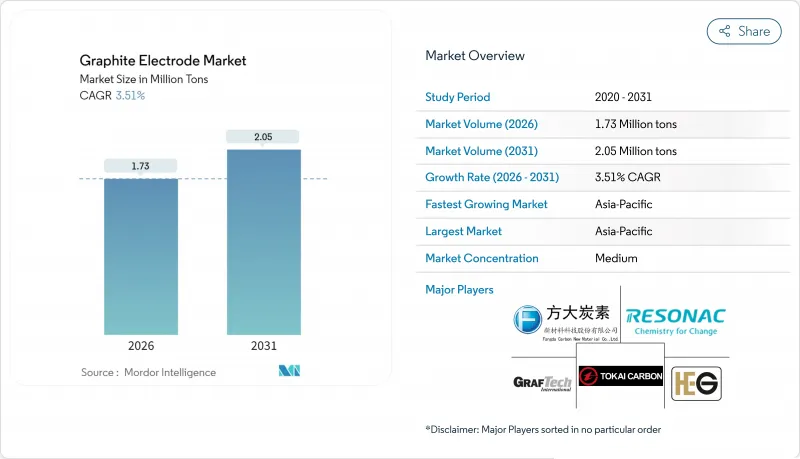
需求成長主要受鋼鐵業轉型為電弧爐(EAF)技術、日益嚴格的環保法規以及超高功率(UHP)焊條所帶來的營運優勢。不斷增加的鋼鐵脫碳政策壓力,尤其是在中國和歐盟,支持了以廢鋼為基礎的長期生產模式,而更高品質的焊條則有助於鋼廠降低每噸鋼的電力消耗。針狀焦供應風險和來自電池石墨的競爭限制了近期產能擴張,而垂直整合和回收技術的進步則在一定程度上抵消了原料成本壓力。亞太地區仍將是重要的需求中心,這主要得益於該地區大規模的鋼鐵產量、電弧爐的快速普及以及有利於非中國供應商的貿易結構調整。競爭策略日益圍繞著原料安全、人工智慧驅動的爐窯最佳化以及廢舊焊條閉合迴路回收的商業化。
全球石墨電極市場趨勢與洞察
向電爐煉鋼過渡
預計到2025年,電弧爐煉鋼將佔全球煉鋼產量的30%,隨著高爐排放法規的日益嚴格,到2030年這一比例將達到40%。與傳統的氧氣高爐相比,電弧爐煉鋼可減少高達70%的二氧化碳排放,幫助歐洲和東亞的企業實現淨零排放目標。儘管煉鋼產能持續成長,但中國將於2024年上半年禁止新建燃煤煉鋼計劃,將進一步強化此一趨勢。電弧爐的柔軟性使其能夠在電價飆升時調整產量,這使其在能源市場不穩定的地區具有優勢。這種轉型將維持對能夠承受更高電流密度的高性能電極的長期需求,從而鞏固石墨電極市場。
全球廢鋼供應量不斷增加
隨著使用了數十年的基礎設施逐漸達到使用壽命終點,廢鋼回收池不斷擴大,增加了北美和歐洲二次煉鋼的原料供應。分類技術的進步提高了廢鋼的純度,使鋼廠無需使用原鐵礦石即可滿足嚴格的品質標準。亞太地區各國正加速投資建設現代化破碎設施和物流網路,以收集和處理生活垃圾和工業廢棄物。每生產一噸電爐鋼需要消耗1-2公斤石墨電極,廢鋼循環的擴張為石墨電極市場創造了可預測的需求和成長。這一趨勢降低了對焦煤的依賴,並符合脫碳目標。
針焦價格波動與供應風險
針狀焦佔電極生產成本的60%之多,且依賴少數幾家工廠集中的專業精煉產能。 2024年美國針狀焦產量預計將下降3%,導致供應趨緊,而電池產業的需求進一步加劇了供應壓力。硫含量和熱膨脹係數等品質指標限制了可用原料的選擇,也使得替代品難以找到。現貨價格在過去12個月內波動超過40%,迫使電極製造商盡可能進行避險並簽訂長期合約。預計新的針狀焦計劃延期將使石墨電極市場供應緊張的局面持續到2027年。
細分市場分析
2025年,超高壓石墨電極佔石墨電極市場的69.88%,預計到2031年將以4.06%的複合年成長率成長。這一細分市場受惠於單爐產量超過400噸的大型電弧爐(EAF)的引進。這些電弧爐需要在保持結構完整性的同時,提供高電流密度。隨著鋼鐵廠越來越重視整體擁有成本(TCO),延長電極壽命和減少更換停機時間使得其溢價合理。石墨電極市場正持續從高功率(SHP)和常規功率(RP)等級轉變為超高壓(UHP)等級,隨著技術的成熟,平均售價(ASP)差距正在縮小。
超高功率電極的生產需要優質針狀焦和多次石墨化循環,垂直整合的製造商依靠自有焦爐和遠期合約來保障原料供應。新參與企業面臨資金障礙和嚴格的品質檢驗,這維持了石墨電極市場當前的競爭格局。區域性高爐和氧氣吹煉爐向電弧爐(EAF)的轉型,尤其是在印度和東南亞地區,正在推動超高功率電極需求的逐步成長。與碳足跡相關的永續性認證正在促使採購審查更加嚴格,並青睞那些在其營運中展現閉合迴路回收和可再生能源使用的供應商。
本《石墨電極市場報告》按電極等級(超高功率 (UHP)、高功率 (SHP)、常規功率 (RP))、應用領域(電弧爐、鹼性氧氣轉爐、非鐵金屬)和地區(亞太地區、北美地區、歐洲地區、南美地區、中東和非洲地區)分析石墨電極市場。市場預測以公噸為單位。
區域分析
預計到2025年,亞太地區將主導石墨電極市場,佔據59.12%的市場佔有率,並在2031年之前保持4.58%的複合年成長率,成為成長最快的地區。中國對新建燃煤鋼鐵廠的政策限制以及印度雄心勃勃的基礎設施建設計劃,都為該地區的成長提供了支撐。日本對中國產電極徵收95.2%的進口關稅,該關稅於2025年3月生效,迫使日本買家將採購來源多元化,轉向國內和韓國供應商,從而改變了亞洲內部的貿易流量。韓國的高階鋼鐵業依賴超高純度電極進行汽車級生產,而不斷擴展的電池材料生態系統正在推動閉合迴路回收合作。
在北美,受完善的廢鋼回收網路和電弧爐效率持續提升的推動,需求保持溫和的個位數成長。中西部和東南部豐富的頁岩氣發電資源降低了營運成本,促進了大型小型鋼廠的產能擴張。在加拿大,安大略省和魁北克省的水力發電電弧爐正在運作,以協助實現範圍2的排放目標。這推動了對高等級焊條的需求。墨西哥毗鄰美國廢鋼來源地,加上汽車生產的快速成長,推動了全部區域焊條進口量的成長。
儘管歐洲宏觀經濟持續疲軟,但預計在經歷了多年的萎縮之後,表觀鋼鐵消費量將從2025年起回升2.20%。能源成本的上漲正促使鋼鐵廠轉向數位化爐窯最佳化和靈活的生產調度,而這兩者都需要可靠的超純電極。歐盟電池法規2023/1542推動了人們對將廢棄電極回收為陽極材料的興趣日益濃厚,並透過整合鋼鐵和電池供應鏈來增強石墨電極市場。包括波蘭和土耳其在內的東歐國家,由於勞動力成本低廉且建築業蓬勃發展,正在吸引新的電弧爐投資,這將推動電極出貨量在2020年代後期持續成長。
其他福利:
- Excel格式的市場預測(ME)表
- 3個月的分析師支持
目錄
第1章 引言
- 研究假設和市場定義
- 調查範圍
第2章調查方法
第3章執行摘要
第4章 市場情勢
- 市場概覽
- 市場促進因素
- 過渡到電弧爐煉鋼(EAF)
- 全球廢鋼供應量不斷增加
- 對超高功率(UHP)電極的需求不斷成長
- 將廢棄電極封閉回路型回收製成電池級碳
- 煉油廠投資興建高品質針狀焦產能
- 市場限制
- 針焦價格波動與供應風險
- 全球鋼鐵生產的周期性
- 電池負極材料中高矽含量對石墨原料構成壓力。
- 價值鏈分析
- 波特五力模型
- 供應商的議價能力
- 買方的議價能力
- 新進入者的威脅
- 替代產品和服務的威脅
- 競爭程度
第5章 市場規模和成長預測(價值和數量)
- 按電極等級
- 高功率(UHP)
- 高功率(SHP)
- 標準輸出(RP)
- 透過使用
- 電弧爐
- 鹼性氧氣爐
- 有色金屬
- 按地區
- 亞太地區
- 中國
- 印度
- 日本
- 韓國
- 馬來西亞
- 泰國
- 印尼
- 越南
- 亞太其他地區
- 北美洲
- 美國
- 加拿大
- 墨西哥
- 歐洲
- 德國
- 英國
- 義大利
- 法國
- 俄羅斯
- 西班牙
- 土耳其
- 北歐國家
- 其他歐洲
- 南美洲
- 巴西
- 阿根廷
- 哥倫比亞
- 其他南美洲
- 中東和非洲
- 沙烏地阿拉伯
- 卡達
- 阿拉伯聯合大公國
- 埃及
- 南非
- 其他中東和非洲地區
- 亞太地區
第6章 競爭情勢
- 市場集中度
- 策略趨勢
- 市佔率(%)/排名分析
- 公司簡介
- El 6 LLC
- Fangda Carbon New Material Technology Co. Ltd
- GrafTech International
- Graphite India Limited
- HEG Limited
- Jilin Carbon New Material Co., Ltd.
- Kaifeng Pingmei New Carbon Materials Technology Co. Ltd
- Liaoning Dantan Technology Group Co. Ltd(Dan Carbon)
- Nantong Yangzi Carbon Co. Ltd
- Nippon Carbon Co. Ltd
- Resonac Holdings Corporation
- Sangraf International Inc.
- SEC Carbon Limited
- Tokai Carbon Co. Ltd
- Zhongze Group
第7章 市場機會與未來展望
Graphite Electrode market size in 2026 is estimated at 1.73 million tons, growing from 2025 value of 1.67 million tons with 2031 projections showing 2.05 million tons, growing at 3.51% CAGR over 2026-2031.
Demand growth stems from the steel industry's pivot toward electric-arc-furnace (EAF) technology, stronger environmental regulations, and the operational advantages of ultra-high-power (UHP) electrodes. Intensifying policy pressure to decarbonize steelmaking, especially in China and the European Union, supports long-run uptake of scrap-based production, while premium electrode grades help mills cut electricity consumption per ton of steel. Needle coke supply risk and competition from battery-grade graphite constrain short-term capacity additions, yet vertical integration and recycling advances partially offset raw-material pressure. Asia-Pacific remains the principal demand hub, underpinned by large steel output, rapid EAF adoption, and trade realignments favoring non-Chinese suppliers. Competitive strategies increasingly revolve around securing feedstock, deploying AI-enabled furnace optimization, and commercializing closed-loop recycling for spent electrodes.
Global Graphite Electrode Market Trends and Insights
Shift to Electric-Arc-Furnace Steelmaking
EAF steelmaking represents 30% of global output in 2025 and is expected to reach 40% by 2030 as policy mandates tighten on blast furnace emissions. The route emits up to 70% less CO2 than the traditional blast-oxygen pathway, supporting corporate net-zero commitments in Europe and East Asia. China banned new coal-based steel projects in H1 2024, reinforcing the trend despite continued additions of ironmaking capacity. EAF flexibility lets mills modulate production when electricity prices spike, useful in regions with volatile energy markets. The shift sustains long-run demand for high-performance electrodes that tolerate higher current densities, strengthening the graphite electrode market.
Rising Global Steel-Scrap Availability
Scrap pools grow as infrastructure built decades earlier reaches end-of-life, boosting feedstock for secondary steelmaking in North America and Europe. Advances in sorting improve scrap purity, letting mills hit tight quality specifications without virgin iron ore. Asia-Pacific nations accelerate investment in modern shredding and logistics networks that collect and process household and industrial scrap. Each ton of EAF steel consumes 1-2 kg of graphite electrodes, so expanding scrap flows create predictable electrode demand and growth in the graphite electrode market. The trend also reduces reliance on coking coal, aligning with decarbonization goals.
Needle Coke Price Volatility & Supply Risk
Needle coke constitutes up to 60% of electrode production cost and relies on specialized petroleum refining capacity concentrated in a handful of plants. A 3% drop in U.S. coke output in 2024 tightened supply, while battery-sector demand compounds pressure on availability. Quality specifications involving sulfur and the coefficient of thermal expansion narrow the pool of acceptable material, limiting substitution. Spot prices fluctuated by more than 40% within twelve months, forcing electrode makers to hedge and lock in long-term contracts wherever possible. Delays in greenfield needle-coke projects keep the graphite electrode market tight through 2027.
Other drivers and restraints analyzed in the detailed report include:
- Accelerating Demand for Ultra-High-Power Electrodes
- Closed-Loop Recycling of Spent Electrodes into Battery-Grade Carbon
- Cyclicality of Global Steel Production
For complete list of drivers and restraints, kindly check the Table Of Contents.
Segment Analysis
UHP electrodes accounted for a dominant 69.88% graphite electrode market share in 2025 and are estimated to grow at a 4.06% CAGR through 2031. The segment benefits from the rollout of mega-EAF units exceeding 400 tons per heat, which require elevated current densities while maintaining structural integrity. Mills' focus on total cost of ownership; consequently, longer electrode life and reduced change-out downtime justify premium pricing. The graphite electrode market continues shifting volume from high-power (SHP) and regular-power (RP) grades toward UHP, compressing ASP differentials over time as technology matures.
Production of UHP electrodes demands top-tier needle coke and multiple graphitization cycles, prompting vertically integrated players to secure feedstock via captive cokers and forward contracts. New entrants confront capital hurdles and stringent quality validation, preserving current competitive hierarchies in the graphite electrode market. Regional blast-oxygen furnace retrofits to EAF, especially in India and Southeast Asia, sustain incremental UHP demand. Sustainability certifications on carbon footprint intensify procurement scrutiny, favoring suppliers who demonstrate closed-loop recycling and renewable-energy usage in their operations.
The Graphite Electrode Market Report is Segmented by Electrode Grade (Ultra High Power (UHP), High Power (SHP), Regular Power (RP)), Application (Electric Arc Furnace, Basic Oxygen Furnace, Non-Steel), and Geography (Asia-Pacific, North America, Europe, South America, Middle East and Africa). The Market Forecasts are Provided in Terms of Volume (Tons).
Geography Analysis
Asia-Pacific dominated the graphite electrode market in 2025, holding 59.12% share and registering the fastest 4.58% CAGR through 2031. China's policy curbs on new coal-based ironmaking combined with India's ambitious infrastructure pipeline underpin regional growth. Japanese import tariffs of 95.2% on Chinese electrodes, effective March 2025, prompt local buyers to diversify toward domestic and Korean suppliers, altering intra-Asian trade flows. South Korea's premium steel segment relies on UHP electrodes for automotive-grade outputs, while its expanding battery-material ecosystem fosters closed-loop recycling collaborations.
North America sustains mid-single-digit demand increases anchored by robust scrap collection networks and continuous efficiency upgrades at EAF mills. Abundant shale-gas electricity in the Midwest and Southeast supports low operating costs, encouraging capacity expansions by leading mini-mills. Canada leverages hydroelectric power to run EAFs in Ontario and Quebec, achieving low Scope 2 emissions targets that drive premium electrode procurement. Mexico's proximity to U.S. scrap and surging automotive production adds incremental tonnage to regional electrode imports.
Europe contends with lingering macro-economic softness; however, from 2025 the region anticipates a 2.20% recovery in apparent steel consumption after multi-year contraction. High energy costs propel mills toward digital furnace optimization and flexible production scheduling, both demanding reliable UHP electrodes. The EU Battery Regulation 2023/1542 boosts interest in recycling spent electrodes into anode material, integrating steel and battery supply chains reinforcing the graphite electrode market. Eastern European nations with lower labor costs and growing construction sectors, including Poland and Turkey, capture new EAF investments that lift electrode shipments into the late decade.
- El 6 LLC
- Fangda Carbon New Material Technology Co. Ltd
- GrafTech International
- Graphite India Limited
- HEG Limited
- Jilin Carbon New Material Co., Ltd.
- Kaifeng Pingmei New Carbon Materials Technology Co. Ltd
- Liaoning Dantan Technology Group Co. Ltd (Dan Carbon)
- Nantong Yangzi Carbon Co. Ltd
- Nippon Carbon Co. Ltd
- Resonac Holdings Corporation
- Sangraf International Inc.
- SEC Carbon Limited
- Tokai Carbon Co. Ltd
- Zhongze Group
Additional Benefits:
- The market estimate (ME) sheet in Excel format
- 3 months of analyst support
TABLE OF CONTENTS
1 Introduction
- 1.1 Study Assumptions and Market Definition
- 1.2 Scope of the Study
2 Research Methodology
3 Executive Summary
4 Market Landscape
- 4.1 Market Overview
- 4.2 Market Drivers
- 4.2.1 Shift to electric-arc-furnace (EAF) steelmaking
- 4.2.2 Rising global steel-scrap availability
- 4.2.3 Accelerating demand for ultra-high-power (UHP) electrodes
- 4.2.4 Closed-loop recycling of spent electrodes into battery-grade carbon
- 4.2.5 Refiners' investments in premium needle-coke capacity
- 4.3 Market Restraints
- 4.3.1 Needle-coke price volatility and supply risk
- 4.3.2 Cyclicality of global steel production
- 4.3.3 Silicon-rich battery anodes squeezing graphite feedstock
- 4.4 Value Chain Analysis
- 4.5 Porter's Five Forces
- 4.5.1 Bargaining Power of Suppliers
- 4.5.2 Bargaining Power of Buyers
- 4.5.3 Threat of New Entrants
- 4.5.4 Threat of Substitute Products and Services
- 4.5.5 Degree of Competition
5 Market Size and Growth Forecasts (Value and Volume)
- 5.1 By Electrode Grade
- 5.1.1 Ultra High Power (UHP)
- 5.1.2 High Power (SHP)
- 5.1.3 Regular Power (RP)
- 5.2 By Application
- 5.2.1 Electric Arc Furnace
- 5.2.2 Basic Oxygen Furnace
- 5.2.3 Non-steel
- 5.3 By Geography
- 5.3.1 Asia-Pacific
- 5.3.1.1 China
- 5.3.1.2 India
- 5.3.1.3 Japan
- 5.3.1.4 South Korea
- 5.3.1.5 Malaysia
- 5.3.1.6 Thailand
- 5.3.1.7 Indonesia
- 5.3.1.8 Vietnam
- 5.3.1.9 Rest of Asia-Pacific
- 5.3.2 North America
- 5.3.2.1 United States
- 5.3.2.2 Canada
- 5.3.2.3 Mexico
- 5.3.3 Europe
- 5.3.3.1 Germany
- 5.3.3.2 United Kingdom
- 5.3.3.3 Italy
- 5.3.3.4 France
- 5.3.3.5 Russia
- 5.3.3.6 Spain
- 5.3.3.7 Turkey
- 5.3.3.8 NORDIC Countries
- 5.3.3.9 Rest of Europe
- 5.3.4 South America
- 5.3.4.1 Brazil
- 5.3.4.2 Argentina
- 5.3.4.3 Colombia
- 5.3.4.4 Rest of South America
- 5.3.5 Middle East and Africa
- 5.3.5.1 Saudi Arabia
- 5.3.5.2 Qatar
- 5.3.5.3 United Arab Emirates
- 5.3.5.4 Egypt
- 5.3.5.5 South Africa
- 5.3.5.6 Rest of Middle East and Africa
- 5.3.1 Asia-Pacific
6 Competitive Landscape
- 6.1 Market Concentration
- 6.2 Strategic Moves
- 6.3 Market Share (%)**/Ranking Analysis
- 6.4 Company Profiles (includes Global level Overview, Market level Overview, Core Segments, Financials, Strategic Info, Market Rank/Share, Products and Services, Recent Developments)
- 6.4.1 El 6 LLC
- 6.4.2 Fangda Carbon New Material Technology Co. Ltd
- 6.4.3 GrafTech International
- 6.4.4 Graphite India Limited
- 6.4.5 HEG Limited
- 6.4.6 Jilin Carbon New Material Co., Ltd.
- 6.4.7 Kaifeng Pingmei New Carbon Materials Technology Co. Ltd
- 6.4.8 Liaoning Dantan Technology Group Co. Ltd (Dan Carbon)
- 6.4.9 Nantong Yangzi Carbon Co. Ltd
- 6.4.10 Nippon Carbon Co. Ltd
- 6.4.11 Resonac Holdings Corporation
- 6.4.12 Sangraf International Inc.
- 6.4.13 SEC Carbon Limited
- 6.4.14 Tokai Carbon Co. Ltd
- 6.4.15 Zhongze Group
7 Market Opportunities and Future Outlook
- 7.1 White-space and Unmet-Need Assessment

 石墨電極市場規模、佔有率、成長、全球產業分析、區域趨勢及2026-2034年預測。
 石墨電極市場:2026-2032年全球市場預測(依產品類型、電極直徑、等級、應用及最終用戶產業分類)
 石墨電極市場規模、佔有率、趨勢和預測:按產品類型、應用和地區分類,2026-2034年全球石墨電極市場規模、佔有率、趨勢和成長分析報告(2026-2034年)
 2026年全球石墨電極市場報告大直徑石墨電極市場(按類型、直徑、原料、應用和最終用戶分類)—2026-2032年全球預測
 石墨電極棒市場規模、佔有率及成長分析(按應用、類型、最終用途產業、製造流程和地區分類)-2026-2033年產業預測
 石墨電極市場規模、佔有率及成長分析(按電極等級、應用和地區分類)-2026-2033年產業預測
 石墨電極:全球市場佔有率和排名、總收入和需求預測(2025-2031 年)全球石墨電極市場規模(按直徑、電極等級、應用、地區和預測)