


 |
市場調查報告書
商品編碼
1910482
中密度纖維板(MDF):市場佔有率分析、產業趨勢與統計、成長預測(2026-2031)Medium Density Fiberboard (MDF) - Market Share Analysis, Industry Trends & Statistics, Growth Forecasts (2026 - 2031) |
||||||

※ 本網頁內容可能與最新版本有所差異。詳細情況請與我們聯繫。
預計中密度纖維板(MDF)市場將從2025年的1.2187億立方米成長到2026年的1.2645億立方米,到2031年將達到1.5205億立方米,2026年至2031年的複合年成長率為3.76%。
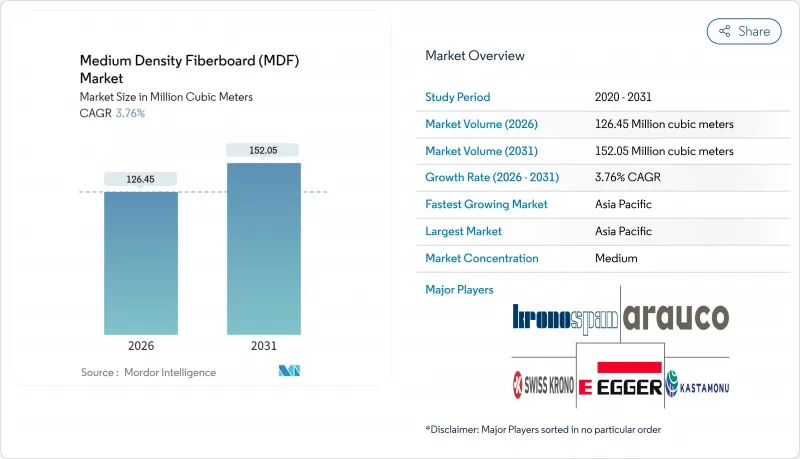
儘管全球板材產能成長放緩,但中密度纖維板(MDF)的擴張仍在持續。生產商日益注重透過製程改進、生物基樹脂和循環製造技術來提升產品品質,而非單純追求產量成長。 MDF優異的加工性能、均勻的核心材料和光滑的表面使其成為組裝櫥櫃、門和層架的理想基材,使家具製造商能夠實現一致的塗漆和貼面效果。到2024年,亞太地區將佔全球產量的60.72%,其中越南和印度等成本優勢顯著的地區正在增設生產線,以支持國內住宅項目和海外家具訂單。同時,北美和歐洲正致力於生產優質、低VOC等級的MDF,以滿足日益嚴格的排放法規。儘管木纖維和脲醛樹脂的價格波動仍是短期挑戰,但製造商正透過節能精煉、後向整合林業以及採用可減少甲醛排放的聚合物MDI黏合劑來抵消成本上漲的影響。
全球中密度纖維板(MDF)市場趨勢及展望
亞太家具製造地產能快速擴張
2024年7月,西門子(Siempelkamp)在越南運作一條日產能600立方公尺的生產線,這標誌著出口商正向後向整合組裝,將生產環節延伸至板材生產,以確保原料供應安全和物流可靠性。印尼和菲律賓的類似計劃正在提升區域板材自給率,降低運輸成本,並使家具OEM廠商能夠根據客戶的加工系統調整基材規格。在越南擴張的承包商正在柬埔寨和寮國建立衛星裝配線,以分散勞動力和港口風險,這種模式正在推動中密度纖維板(MDF)的需求向東道國以外的地區轉移。面對不斷上漲的電費,中國製造商正將部分生產轉移到湄公河流域成本較低的地區,以維持利潤率並接近性進口客戶。隨著生產線總合的消除和新工廠的運作,預計2024年至2026年間,東南亞中密度纖維板(MDF)市場將受益於每年超過600萬立方公尺的新增產能。
疫情後全球住宅維修支出復甦
根據Houzz發布的2025年住宅調查,廚房和浴室的翻新意願已恢復到疫情前的水平,推動了北美地區對櫥櫃用中密度纖維板(MDF)的需求。在美國,抵押房屋抵押貸款再融資的增加釋放了資金,而節能補貼也促進了門窗更換,這些更換通常會指定使用MDF框架材料和包覆層。在歐洲,由於高昂的能源價格推遲了大型計劃,MDF的需求成長較為穩定,但對於更換衣櫃門板等小規模工程,MDF的需求依然強勁,因為人們更傾向於選擇更薄、更易於塗漆的板材。防水和防火等級的MDF供應商獲得了溢價,抵消了樹脂成本上漲的影響。因此,即使在成熟經濟體的新房住宅有所放緩,更廣泛的維修需求的復甦也支撐了基準成長。
木材和脲醛樹脂價格的波動會對利潤率造成壓力。
德國和日本生質發電廠對紙漿材的需求激增,導致原木供應緊張,交付格上漲了9%。同時,與天然氣價格掛鉤的甲醇合約價格飆升,推動脲醛樹脂價格達到15個月以來的最高點。 2024年4月,德國中密度纖維板(MDF)價格上漲了1.26%,但由於RTA家具買家提前六個月鎖定價格,製造商無法將價格上漲完全轉嫁給消費者。工廠正透過轉向自建樹脂廠來降低價格波動,這些樹脂廠將尿素與低成本的豆粉填料混合。一些東南亞製造商正在採用長木片原料以降低精煉能耗,但這種方法存在降低表面光滑度的風險,凸顯了成本與品質之間的權衡。
細分市場分析
2025年,家具業佔中密度纖維板(MDF)總產量的51.10%,支撐著MDF市場規模達到約6,228萬立方公尺。 2026年至2031年,由於消費者傾向於用塗漆的Shaker風格櫥櫃翻新老舊廚房,而這種風格需要無缺陷的MDF芯材,預計櫥櫃門、抽屜面板和擱板的複合年成長率將保持4.04%。歐洲建築商偏好用於浴室盥洗台的防潮綠色芯材板材,而北美則正在向用於無框櫥櫃的18毫米厚板材過渡。地板材料應用(主要是複合地板基材)正趨於穩定,高階價格分佈瓷磚不斷取代木紋複合地板,但MDF在價格比尺寸穩定性更重要的低階地板材料中仍然發揮關鍵作用。
高階家具系列正採用抗菌層壓板和超啞光漆,這兩種材料都需要超精細拋光的表面。塑合板難以提供具競爭力的價格。巴西和土耳其的製造商透過在線連續共覆紙箔來增加產品價值,並提供減少客戶製作流程的組件坯料。源自楊木的輕質中密度纖維板(MDF)透過減輕門扇重量20%和鉸鏈負荷,正在打入高階室內門市場。這些創新正在鞏固中密度纖維板(MDF)作為首選基材的市場基礎,因為在這些市場中,表面完美和可加工性是產品差異化的關鍵。
中密度纖維板 (MDF) 報告按應用領域(家具、櫥櫃、地板、裝飾線條/門/木製品、包裝系統及其他應用)、終端用戶行業(住宅、商業和公共)以及地區(亞太地區、北美、歐洲、南美以及中東和非洲)進行細分。市場預測以體積(立方米)為單位。
區域分析
亞太地區鞏固了其主導地位,預計到2025年將佔全球產量的60.30%。印度和越南的政策主導住宅計劃進一步強化了這一地位,推動了可預測的中密度纖維板(MDF)需求。儘管中國仍然是最大的生產國,但不斷上漲的電費和更嚴格的環境審核正在促使外國投資流向低成本的東南亞國協。因此,即使產能的增加分散在多個國家,該地區的中密度纖維板市場佔有率也在不斷提升。由於Biesse數控工具機的在地化生產(國產化率已達80%),印度生產商現在能夠滿足櫥櫃製造商的精密加工需求,並縮短出口訂單的前置作業時間。
北美20.15%的市佔率主要由維修帶動的板材需求推動,尤其是實木廚房櫥櫃的需求。中密度纖維板(MDF)易於塗漆,因此其價格高於膠合板。美國喬治亞和北卡羅來納州的工廠利用當地豐富的速生松木資源和完善的鐵路網路,維持了中西部地區具有競爭力的交付價格。加拿大供應商則以北方森林產品認證(Boreal Forest Products Certification)贏得LEED計劃,同時也將剩餘產品出口到美國東北部。
向循環經濟轉型是歐洲的重點。德國和波蘭計畫在2027年將纖維回收率提高到原料投入的11%,具體措施包括引進砂磨粉塵壓塊鍋爐和光學分選線,從生產廢棄物中回收纖維。歐盟2026年甲醛排放上限將要求升級吹塑生產線的樹脂計量設備和排列型封設備,但許多小規模工廠將無力承擔這些成本,導致產業整合。南歐正從上次經濟衰退中復甦,西班牙櫥櫃出口的激增已推動伊比利亞半島的中密度纖維板(MDF)運轉率超過90%。
其他福利:
- Excel格式的市場預測(ME)表
- 3個月的分析師支持
目錄
第1章 引言
- 研究假設和市場定義
- 調查範圍
第2章調查方法
第3章執行摘要
第4章 市場情勢
- 市場概覽
- 市場促進因素
- 亞太家具製造地產能快速擴張
- 疫情後全球住宅維修支出復甦
- 從膠合板/塑合板過渡到光滑的中密度纖維板(用於組裝式家具)
- 印度和東南亞政府支持的低收入住宅計劃
- 採用PMDI/生物基樹脂開啟了高階低VOC市場。
- 市場限制
- 木材和脲醛樹脂價格的波動會對利潤率造成壓力。
- 與替代裝飾板材(三聚氰胺板、塑膠板、木塑複合材料)的競爭
- 中國不斷上漲的電費推高了紡織精煉業的營運成本。
- 價值鏈分析
- 波特五力模型
- 新進入者的威脅
- 供應商的議價能力
- 買方的議價能力
- 替代品的威脅
- 競爭對手之間的競爭
第5章 市場規模與成長預測
- 透過使用
- 家具
- 內閣
- 地板材料
- 裝飾線條、門、木工製品
- 包裝系統
- 其他用途
- 按最終用途行業分類
- 住宅
- 商業的
- 公共設施
- 按地區
- 亞太地區
- 中國
- 印度
- 日本
- 韓國
- 東南亞國協
- 亞太其他地區
- 北美洲
- 美國
- 加拿大
- 墨西哥
- 歐洲
- 德國
- 英國
- 法國
- 義大利
- 俄羅斯
- 北歐國家
- 其他歐洲地區
- 南美洲
- 巴西
- 阿根廷
- 其他南美洲
- 中東和非洲
- 沙烏地阿拉伯
- 南非
- 其他中東和非洲地區
- 亞太地區
第6章 競爭情勢
- 市場集中度
- 策略趨勢
- 市佔率(%)/排名分析
- 公司簡介
- ARAUCO
- EGGER
- Fantoni SpA
- Finsa
- Georgia-Pacific Wood Products LLC
- GREENPANEL INDUSTRIES LIMITED
- Kastamonu Entegre
- Kronoplus Limited
- Masisa
- MDF Mekong
- Pfleiderer Deutschland GmbH
- Roseburg Forest Products
- Sonae Arauco
- Swiss Krono Group
- Unilin Panels
- VRG Dongwha MDF
- West Fraser
- Weyerhaeuser Company
- Yildiz Entegre
第7章 市場機會與未來展望
The Medium Density Fiberboard market is expected to grow from 121.87 million cubic meters in 2025 to 126.45 million cubic meters in 2026 and is forecast to reach 152.05 million cubic meters by 2031 at 3.76% CAGR over 2026-2031.
This expansion continues even as global panel capacity grows more slowly, because producers increasingly rely on process upgrades, bio-based resins and circular manufacturing to lift output quality rather than pure tonnage. MDF's superior machinability, uniform core and smooth face make it the preferred substrate for ready-to-assemble (RTA) cabinets, doors and shelving, allowing furniture makers to achieve consistent painted and laminated finishes. Asia-Pacific commands 60.72% of 2024 production as Vietnam, India and other cost-competitive hubs add lines to serve both domestic housing programs and offshore furniture contracts, while North America and Europe concentrate on premium low-VOC grades to satisfy tightening emission rules. Price volatility for wood fiber and urea-formaldehyde resin remains a short-term challenge, yet manufacturers are offsetting cost spikes through energy-efficient refining, backward integration in timberlands, and adoption of polymeric MDI binders that cut formaldehyde out-gassing.
Global Medium Density Fiberboard (MDF) Market Trends and Insights
Rapid Capacity Additions in Asia-Pacific Furniture Manufacturing Hubs
Vietnam's July 2024 start-up of a 600 m3 day line supplied by Siempelkamp underscores how exporters are back-integrating into panel production to secure feedstock and logistics certainty. Similar projects in Indonesia and the Philippines lift regional panel self-sufficiency, reduce freight exposure, and allow furniture OEMs to align substrate specs with customer finishing systems. Contractors expanding in Vietnam also establish satellite assembly lines in Cambodia and Laos to diversify labor and port risk, a pattern that multiplies MDF demand beyond the host country. Chinese producers, facing higher electricity tariffs, relocate incremental capacity to lower-cost Mekong provinces to protect margins while maintaining proximity to import customers. The medium density fiberboard market benefits as line debottlenecking and new-plant commissioning collectively add more than 6 million m3 of annual nameplate capacity in Southeast Asia between 2024 and 2026.
Recovery in Global Residential Renovation Spending Post-Pandemic
Houzz's 2025 homeowner sentiment survey shows kitchen and bath remodel intentions back at pre-pandemic highs, translating to heightened demand for cabinet-grade MDF panels in North America. Increased mortgage refinancing in the United States frees up discretionary funds, while energy-efficiency rebates spur window and door replacements that often specify MDF jambs and casings. In Europe, the pace is steadier because elevated energy prices delay bigger projects, yet MDF volumes hold as smaller tasks such as closet re-fronting favor thinner, paint-ready boards. Suppliers of water-repellent and fire-rated grades enjoy price premiums, offsetting resin cost inflation. The broader renovation upturn therefore underwrites baseline growth even if new housing starts soften in mature economies.
Volatile Wood and Urea-Formaldehyde Prices Pressuring Margins
Surging pulpwood demand from biomass energy plants in Germany and Japan tightens log supply, lifting delivered fiber costs by 9% between Q4 2024 and Q2 2025. Concurrently, natural-gas-linked methanol contracts spike, pushing urea-formaldehyde resin prices to a 15-month high. German MDF panel prices rose 1.26% in April 2024, yet producers failed to fully pass through hikes because RTA furniture buyers lock prices six months in advance. Mills mitigate volatility by shifting to in-house resin plants that blend urea with lower-cost soy flour extenders. Some Southeast Asian producers adopt longer-chip furnish to cut refining energy, but this approach risks lower face smoothness, underscoring the trade-off between cost and quality.
Other drivers and restraints analyzed in the detailed report include:
- Shift From Plywood/Particleboard to Smoother MDF for RTA Furniture
- Government-Backed Affordable Housing Programs in India and SE Asia
- Competition From Substitute Decorative Panels (Melamine PB, WPC)
For complete list of drivers and restraints, kindly check the Table Of Contents.
Segment Analysis
The furniture segment captured 51.10% of 2025 volume, anchoring the medium density fiberboard market size near 62.28 million m3. Over 2026-2031, cabinet doors, drawer fronts and shelving sustain a 4.04% CAGR as consumers replace dated kitchens with painted shaker styles that rely on defect-free MDF cores. European builders favor moisture-resistant green-core panels for bath vanities, while North America shifts to thicker 18 mm boards for frameless cabinetry. Flooring uses, mainly laminate substrate, stabilize as luxury vinyl tile keeps displacing wood-look laminate, yet MDF remains pivotal in budget flooring where dimensional stability matters less than price.
Upgraded furniture lines integrate antibacterial laminates and super-matte lacquers, both demanding ultra-fine-sanded surfaces that particleboard struggles to provide at competitive cost. Producers in Brazil and Turkey advance value retention by co-laminating paper foil in-line, thereby shipping component blanks that reduce customer processing steps. Lightweight MDF variants leveraging poplar furnish penetrate premium interior doors by cutting leaf weight 20%, easing hinge load. These innovations reinforce the medium density fiberboard market as the substrate of choice whenever surface perfection and machinability underpin product differentiation.
The Medium Density Fiberboard Report is Segmented by Application (Furniture, Cabinet, Flooring, Molding/Door/Millwork, Packaging System, and Other Applications), End-Use Industry (Residential, Commercial, and Institutional), and Geography (Asia-Pacific, North America, Europe, South America, and Middle East and Africa). The Market Forecasts are Provided in Terms of Volume (Cubic Meters).
Geography Analysis
Asia-Pacific solidified its lead with 60.30% of 2025 production, a position strengthened by policy-driven housing schemes in India and Vietnam that funnel predictable MDF offtake. China remains the single-largest producer, but rising electricity tariffs and stricter environmental audits encourage outbound investment to lower-cost ASEAN states. The region's medium density fiberboard market share therefore rises in qualitative value even as incremental capacity growth disperses across multiple countries. Indian producers, aided by Biesse CNC localization hitting 80% domestic content, now meet cabinetmakers' precision-routing needs and reduce lead times for export orders.
North America's 20.15% share rests on renovation-heavy panel demand, especially for frameless kitchen cabinetry where MDF's paintability justifies a price premium over plywood. U.S. mills in Georgia and North Carolina exploit abundant fast-growing pine and well-developed rail networks, sustaining competitive delivered pricing into the Midwest. Canadian suppliers capitalize on boreal fiber certification to win LEED projects while exporting surplus to the northeastern United States.
Europe emphasizes circular economy compliance. Germany and Poland install sander-dust briquette boilers and optical-sorting lines to reclaim fiber from production waste, thereby raising fiber recovery yield to 11% of intake by 2027. The EU's 2026 formaldehyde cap compels upgrades to blow-line resin dosing and in-line press sealing, costs that many small mills cannot absorb, likely spurring consolidation. Southern Europe rebounds from earlier recessions, and Spain's kitchen cabinet export surge lifts Iberian MDF utilization above 90%.
- ARAUCO
- EGGER
- Fantoni SpA
- Finsa
- Georgia-Pacific Wood Products LLC
- GREENPANEL INDUSTRIES LIMITED
- Kastamonu Entegre
- Kronoplus Limited
- Masisa
- MDF Mekong
- Pfleiderer Deutschland GmbH
- Roseburg Forest Products
- Sonae Arauco
- Swiss Krono Group
- Unilin Panels
- VRG Dongwha MDF
- West Fraser
- Weyerhaeuser Company
- Yildiz Entegre
Additional Benefits:
- The market estimate (ME) sheet in Excel format
- 3 months of analyst support
TABLE OF CONTENTS
1 Introduction
- 1.1 Study Assumptions and Market Definition
- 1.2 Scope of the Study
2 Research Methodology
3 Executive Summary
4 Market Landscape
- 4.1 Market Overview
- 4.2 Market Drivers
- 4.2.1 Rapid Capacity Additions in Asia-Pacific Furniture Manufacturing Hubs
- 4.2.2 Recovery in Global Residential Renovation Spending Post-Pandemic
- 4.2.3 Shift From Plywood/Particleboard to Smoother MDF for RTA Furniture
- 4.2.4 Government-Backed Affordable Housing Programs in India and SE Asia
- 4.2.5 Adoption of Pmdi/Bio-Based Resins Unlocking Premium Low-VOC Segments
- 4.3 Market Restraints
- 4.3.1 Volatile Wood and Urea-Formaldehyde Prices Pressuring Margins
- 4.3.2 Competition from Substitute Decorative Panels (Melamine PB, WPC)
- 4.3.3 Rising Chinese Electricity Tariffs Inflating Fibre-Refining OPEX
- 4.4 Value Chain Analysis
- 4.5 Porter's Five Forces
- 4.5.1 Threat of New Entrants
- 4.5.2 Bargaining Power of Suppliers
- 4.5.3 Bargaining Power of Buyers
- 4.5.4 Threat of Substitutes
- 4.5.5 Competitive Rivalry
5 Market Size and Growth Forecasts (Volume)
- 5.1 By Application
- 5.1.1 Furniture
- 5.1.2 Cabinet
- 5.1.3 Flooring
- 5.1.4 Molding, Door, and Millwork
- 5.1.5 Packaging System
- 5.1.6 Other Applications
- 5.2 By End-Use Industry
- 5.2.1 Residential
- 5.2.2 Commercial
- 5.2.3 Institutional
- 5.3 By Geography
- 5.3.1 Asia-Pacific
- 5.3.1.1 China
- 5.3.1.2 India
- 5.3.1.3 Japan
- 5.3.1.4 South Korea
- 5.3.1.5 ASEAN Countries
- 5.3.1.6 Rest of Asia-Pacific
- 5.3.2 North America
- 5.3.2.1 United States
- 5.3.2.2 Canada
- 5.3.2.3 Mexico
- 5.3.3 Europe
- 5.3.3.1 Germany
- 5.3.3.2 United Kingdom
- 5.3.3.3 France
- 5.3.3.4 Italy
- 5.3.3.5 Russia
- 5.3.3.6 NORDIC Countries
- 5.3.3.7 Rest of Europe
- 5.3.4 South America
- 5.3.4.1 Brazil
- 5.3.4.2 Argentina
- 5.3.4.3 Rest of South America
- 5.3.5 Middle East and Africa
- 5.3.5.1 Saudi Arabia
- 5.3.5.2 South Africa
- 5.3.5.3 Rest of Middle East and Africa
- 5.3.1 Asia-Pacific
6 Competitive Landscape
- 6.1 Market Concentration
- 6.2 Strategic Moves
- 6.3 Market Share (%)/Ranking Analysis
- 6.4 Company Profiles (includes Global level Overview, Market level overview, Core Segments, Financials as available, Strategic Information, Market Rank/Share for key companies, Products and Services, and Recent Developments)
- 6.4.1 ARAUCO
- 6.4.2 EGGER
- 6.4.3 Fantoni SpA
- 6.4.4 Finsa
- 6.4.5 Georgia-Pacific Wood Products LLC
- 6.4.6 GREENPANEL INDUSTRIES LIMITED
- 6.4.7 Kastamonu Entegre
- 6.4.8 Kronoplus Limited
- 6.4.9 Masisa
- 6.4.10 MDF Mekong
- 6.4.11 Pfleiderer Deutschland GmbH
- 6.4.12 Roseburg Forest Products
- 6.4.13 Sonae Arauco
- 6.4.14 Swiss Krono Group
- 6.4.15 Unilin Panels
- 6.4.16 VRG Dongwha MDF
- 6.4.17 West Fraser
- 6.4.18 Weyerhaeuser Company
- 6.4.19 Yildiz Entegre
7 Market Opportunities and Future Outlook
- 7.1 White-space and unmet-need assessment

 超薄纖維板市場-2026年至2032年全球市場預測中密度纖維板(MDF)市場-2026-2032年全球市場預測
 高密度纖維板(HDF)市場規模、佔有率和趨勢分析報告:按產品、地區、主要參與者和競爭對手分析以及細分市場預測(2026-2033 年)
 中密度纖維板(MDF)市場報告:按住宅和商業用途、新建和維修用途以及地區分類(2026-2034 年)纖維板市場:2026-2032年全球市場預測(依產品類型、應用、最終用戶、樹脂類型、通路、製造流程和厚度分類)
 中密度纖維板(MDF)市場:按應用、最終用戶和地區分類
 壓縮纖維板全球市場規模、佔有率、趨勢和成長分析報告(2026-2034)日本中密度纖維板(MDF)市場規模、佔有率、趨勢及按應用、產業和地區分類的預測(2026-2034年)
 2026年全球瀝青浸漬纖維板市場報告2026年全球耐火中密度纖維板市場報告