


 |
市場調查報告書
商品編碼
1910452
聚四氟乙烯(PTFE):市場佔有率分析、產業趨勢與統計、成長預測(2026-2031)Polytetrafluoroethylene (PTFE) - Market Share Analysis, Industry Trends & Statistics, Growth Forecasts (2026 - 2031) |
||||||

※ 本網頁內容可能與最新版本有所差異。詳細情況請與我們聯繫。
預計聚四氟乙烯(PTFE)市場將從2025年的224.82千噸成長到2026年的234.66千噸,到2031年將達到290.73千噸,2026年至2031年的複合年成長率為4.38%。
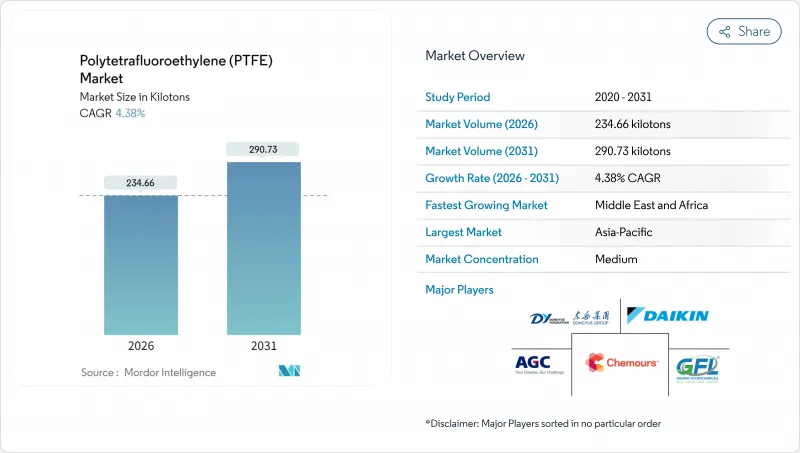
這種成長反映了該材料在嚴苛工業環境中的強勢地位,其化學惰性、低摩擦係數和熱穩定性難以取代。半導體製造、石油化工加工和電動車基礎設施的持續產能擴張支撐著基準消費量,即便潛在的 PFAS 法規收緊了新應用的認證程序。此外,PTFE 市場也受到以下因素的推動:應用設計領域正朝著需要兼具介電強度和耐熱性的聚合物方向發展,例如高壓輕型線束、固態電池隔膜和積層製造機械部件。競爭策略日益強調螢石供應的垂直整合、開發符合 PFAS 標準的產品線以及靠近電子產業叢集的接近性。
全球聚四氟乙烯(PTFE)市場趨勢與洞察
亞洲電子製造業快速擴張
中國當地、台灣、韓國和新加坡正在建造的新型晶圓製造生產線需要超純聚四氟乙烯(PTFE)閥門、襯墊和晶圓加工組件來應對腐蝕性化學物質。對3奈米和2奈米邏輯節點的大規模投資推動了對耐等離子體氟聚合物組件的需求,而這些組件無法被一般塑膠塑膠經濟地取代。晶片晶圓代工廠、代工組裝廠和顯示器製造商的高度位置如同磁石,將PTFE市場吸引到能夠按時交付高精度零件的區域供應商手中。為此,設備供應商正在簽訂多年期的顆粒狀PTFE原料供應契約,以確保無塵室認證的持續性。這些合作正在鞏固亞太地區作為全球PTFE市場消費中心的地位。
擴大全球化學加工能力
沙烏地阿拉伯、阿拉伯聯合大公國和印度的油氣生產商持續批准建造運作條件日益嚴苛的綜合煉油廠和石化聯合裝置。這些裝置內的反應器、熱交換器和管道暴露於酸性環境、過熱蒸氣和高速顆粒物中,進一步鞏固了聚四氟乙烯(PTFE)在墊片、閥座和襯裡方面的優勢。同時,特種化學品產能的提升推動了成型坯料和等靜壓塊需求的成長。由於化學聯合裝置高度重視長壽命和低停機時間,採購部門通常會在總括採購協議中指定PTFE等級,從而確保了跨經濟週期的穩定需求。這些採購量保障是PTFE市場穩定成長的基石。
PFAS 和 PTFE 的環境法規
歐洲化學品管理局 (ECHA) 擬於 2025 年實施的 PFAS 法規草案,除非維持必要的用途豁免,否則將對多種含氟聚合物構成威脅。主要加工商已透過推出符合 PFAS 標準或不含 PFAS 的產品線來應對。 Avient 於 2024 年初推出了用於精密齒輪和襯套的 LubriOne 系列不含 PTFE 的潤滑劑。小型製造商由於無法攤銷合規性測試成本,被迫退出市場,Micropowders 在 2024 年的新聞稿中宣布,將於 2025 年底前逐步停止其 PTFE 業務,這正反映了這一趨勢。消費廚具和服裝行業的終端用戶正在加速採用矽塗層和溶膠-凝膠基替代品進行雙重採購,這減緩了這些領域的需求成長,並減少了對 PTFE 的潛在需求基礎。
細分市場分析
截至2025年,顆粒狀和模塑狀聚四氟乙烯(PTFE)佔據了56.74%的市場佔有率,這得益於墊片、閥門和軸承製造商成熟的壓縮成型基礎設施。典型的批量可達數噸,確保了規模經濟效益,並為具有競爭力的價格奠定了基礎。該細分市場為一體化生產商提供了穩定的收入來源,因為其物理性能範圍能夠滿足各種工業設備的規格要求。頂級化學企業通常會將特定的顆粒狀PTFE樹脂納入其全廠核准的材料清單,這進一步增強了維護、維修和大修週期中的需求。
由於其基數小,微粉化粉末預計將成為所有粉末形式中成長最快的,到2031年複合年成長率將達到5.82%。粒徑小於微米的細顆粒可應用於高性能潤滑脂的減摩添加劑、雷射燒結3D列印齒輪以及航太塗料的紋理控制劑等領域。製造商透過投資噴射磨機系統和在線連續分級設備,實現了窄粒徑分佈,從而能夠獲得更高的價格。積層製造技術的進步正在加速這一趨勢,設計人員擴大指定使用聚四氟乙烯(PTFE)微粉來改善複雜形狀的脫模性能和尺寸精度。因此,預計微粉化PTFE的市場規模(無論在價值或銷售量方面)都將超過整個PTFE市場的成長速度。
聚四氟乙烯 (PTFE) 市場報告按產品形態(顆粒狀/模塑 PTFE、細粉/分散 PTFE 等)、終端用戶行業(航太、汽車、建築、電氣電子、工業機械等)和地區(亞太、北美、歐洲、南美等)進行細分。市場預測以數量(噸)和價值(美元)為單位。
區域分析
預計到2025年,亞太地區將佔據52.28%的聚四氟乙烯(PTFE)市場佔有率,並憑藉新建晶圓廠和電池材料工廠的運作,在2031年之前保持領先地位。中國已建構起從螢石開採到成品電纜擠出的完整價值鏈,本土供應商能夠提供交貨期短、價格具競爭力的產品。政府在「十四五」規劃下的獎勵措施鼓勵了對氟化學品產業的資本流入,從而擴大了國內對樹脂的需求。印度正在發展煉油和石化合資企業,這些企業需要耐腐蝕襯裡;而韓國和日本則專注於為測量儀器和醫療設備生產高精度氟聚合物零件。
儘管基準較小,但中東和非洲地區預計將超越其他地區,到2031年複合年成長率將達到5.72%。沙烏地阿拉伯的NEOM大型企劃和阿拉伯聯合大公國ADNOC的下游擴建計畫正在其硫酸、氯氣和鋰加工裝置中採用聚四氟乙烯(PTFE)組件。當地電纜製造商正在改用PTFE護套,以符合IEC 62893阻燃標準,用於沙漠氣候下的太陽能佈線。
儘管北美和歐洲的需求結構已趨於成熟,但監管和技術因素正在重塑消費模式。美國商務部對從古吉拉突邦氟化學有限公司進口的顆粒狀聚四氟乙烯徵收4.70%至4.89%的反補貼稅,正促使國內加工商討論將生產遷回國內的事宜。
同時,隨著歐盟 PFAS 法規藍圖的不斷完善,設備原始設備製造商 (OEM) 現在被要求提供必要用途的證明文件,這可能會延緩訂單週期,並提高準備不足的供應商的准入門檻。然而,航太主要製造商仍指定使用 PTFE 作為液壓密封材料,其工作溫度範圍為 -55°C 至 +200°C,從而確保了其在高價值細分市場中的穩固地位。
其他福利:
- Excel格式的市場預測(ME)表
- 3個月的分析師支持
目錄
第1章 引言
- 研究假設和市場定義
- 調查範圍
第2章調查方法
第3章執行摘要
第4章 市場情勢
- 市場概覽
- 市場促進因素
- 亞洲電氣和電子設備製造業的快速擴張
- 全球化學加工能力成長
- 電動車需求推動了對輕質電線電纜絕緣材料的需求。
- 聚四氟乙烯(PTFE)在不沾鍋市場的應用激增
- 固態電池中的聚四氟乙烯薄膜
- 市場限制
- PFAS 和 PTFE 環境法規的發展趨勢
- 螢石供應面臨的地緣政治風險
- 用於 5G 硬體的工程塑膠替代品
- 價值鏈分析
- 波特五力模型
- 新進入者的威脅
- 供應商的議價能力
- 買方的議價能力
- 替代品的威脅
- 競爭對手之間的競爭
- 進出口趨勢
- 形態趨勢
- 法律規範
- 阿根廷
- 澳洲
- 巴西
- 加拿大
- 中國
- EU
- 印度
- 日本
- 馬來西亞
- 墨西哥
- 奈及利亞
- 俄羅斯
- 沙烏地阿拉伯
- 南非
- 韓國
- 阿拉伯聯合大公國
- 英國
- 美國
- 終端用戶產業趨勢
- 航太(航太零件生產收入)
- 汽車(汽車產量)
- 建築與施工(新建建築占地面積)
- 電氣和電子(電氣和電子產品生產收入)
- 包裝(塑膠包裝量)
第5章 市場規模和成長預測(價值和數量)
- 按產品形式
- 顆粒狀/模製聚四氟乙烯
- 細粉/分散型聚四氟乙烯
- 微粉化聚四氟乙烯
- 聚四氟乙烯水性分散體
- 按最終用戶行業分類
- 航太
- 車
- 建築/施工
- 電氣和電子
- 工業和機械
- 包裝
- 其他終端用戶產業
- 按地區
- 亞太地區
- 中國
- 印度
- 日本
- 韓國
- 亞太其他地區
- 北美洲
- 美國
- 加拿大
- 墨西哥
- 歐洲
- 法國
- 德國
- 義大利
- 俄羅斯
- 英國
- 其他歐洲地區
- 南美洲
- 巴西
- 阿根廷
- 其他南美洲
- 中東和非洲
- 沙烏地阿拉伯
- 南非
- 其他中東和非洲地區
- 亞太地區
第6章 競爭情勢
- 市場集中度
- 策略趨勢
- 市佔率(%)/排名分析
- 公司簡介
- 3M
- AGC Inc.
- Arkema
- Daikin Industries, Ltd.
- Dongyue Group
- Gujarat Fluorochemicals Limited(GFL)
- HaloPolymer, OJSC
- Saint-Gobain
- Shanghai Huayi 3F New Materials Co., Ltd.
- Sinochem Holdings
- Syensqo
- The Chemours Company
第7章 市場機會與未來展望
第8章:執行長面臨的關鍵策略挑戰
The Polytetrafluoroethylene market is expected to grow from 224.82 kilotons in 2025 to 234.66 kilotons in 2026 and is forecast to reach 290.73 kilotons by 2031 at 4.38% CAGR over 2026-2031.
This growth reflects the material's entrenched position in demanding industrial environments, where chemical inertness, low friction, and thermal stability remain hard to substitute. Continuous capacity additions in semiconductor fabrication, petrochemical processing, and electric-vehicle (EV) infrastructure sustain baseline consumption even as potential PFAS restrictions intensify qualification procedures for new applications. The PTFE market also benefits from design shifts toward higher-voltage, lighter-weight wire harnesses, solid-state battery membranes, and additive-manufactured machine parts, all of which require the polymer's unique combination of dielectric strength and temperature resistance. Competitive strategies increasingly revolve around vertical integration of fluorspar supply, development of PFAS-compliant product lines, and geographic proximity to electronics clusters.
Global Polytetrafluoroethylene (PTFE) Market Trends and Insights
Rapid Expansion of Electronics Manufacturing in Asia
Wave after wave of new wafer-fab lines across mainland China, Taiwan, South Korea and Singapore require ultrapure PTFE valves, liners and wafer-processing components to manage aggressive chemistries. Large-scale investments in 3 nm and 2 nm logic nodes elevate demand for plasma-resistant fluoropolymer parts that cannot be economically replaced with commodity plastics. Close clustering of chip foundries, outsourced assembly plants and display makers acts as a demand magnet, pulling the PTFE market toward regional suppliers that can deliver tight-tolerance parts on accelerated build schedules. Equipment suppliers, in turn, lock in multi-year contracts for granular PTFE feedstock to ensure clean-room qualification continuity. These linkages consolidate Asia-Pacific's role as the consumption epicenter of the global PTFE market.
Growth in Global Chemical-Processing Capacity
Hydrocarbon producers in Saudi Arabia, the United Arab Emirates, and India continue to sanction integrated refinery-petrochemical complexes with increasingly severe operating envelopes. Reactors, heat exchangers, and piping in these plants confront acids, superheated steam, and high-velocity particulates, environments that reinforce PTFE's dominance in gaskets, valve seats, and linings. Concurrent debottlenecking in specialty chemicals calls for larger volumes of molded billets and isostatic blocks. Because chemical parks favor long service life and low downtime, procurement departments often specify PTFE grades in blanket purchase agreements, stabilizing offtake across economic cycles. Resultant volume commitments underpin the PTFE market's steady baseline growth trajectory.
Environmental Scrutiny on PFAS and PTFE
The European Chemicals Agency's 2025 draft restriction on PFAS threatens broad classes of fluoropolymers unless exemptions for essential uses are retained. Major processors respond by launching PFAS-compliant or PFAS-free product lines; Avient introduced a PTFE-free LubriOne range for precision gears and bushings in early 2024. Smaller players unable to amortize compliance testing are exiting the category, as reflected in Micro Powders' notice to wind down PTFE operations by late 2025 (company press release, 2024). End-users in consumer cookware and apparel accelerate dual-sourcing with silicon-coated or sol-gel alternatives, blunting incremental demand in these segments and tightening the PTFE market's addressable base.
Other drivers and restraints analyzed in the detailed report include:
- EV-Driven Demand for Lightweight Wire and Cable Insulation
- Surging PTFE Use in Non-Stick Cookware
- Geopolitical Risk to Fluorspar Supply
For complete list of drivers and restraints, kindly check the Table Of Contents.
Segment Analysis
Granular and molded grades constituted 56.74% of the PTFE market share in 2025, supported by well-established compression-molding infrastructure across gasket, valve, and bearing manufacturers. Typical batch sizes run into metric tons, ensuring scale economies that anchor competitive pricing. The segment delivers stable baseline revenue for integrated producers because its physical-property envelope fits a wide range of industrial equipment standards. Tier-one chemical processors often codify specific granular PTFE resins into plant-wide approved-materials lists, further reinforcing demand in maintenance, repair, and overhaul cycles.
Micronized powder, while starting from a smaller base, is forecast to post a 5.82% CAGR through 2031, the fastest among all forms. Particles under 10 µm unlock friction-reduction additives for high-performance greases, laser-sintered 3-D-printed gears, and texture-control agents for aerospace coatings. Producers invest in jet-milling systems and in-line classification to deliver narrow particle-size distributions, a capability that commands premium pricing. Growth in additive manufacturing accentuates this trend, as designers specify PTFE micropowders to enhance surface release and dimensional accuracy in complex geometries. The PTFE market size for micronized grades is therefore projected to expand both in value and in volume terms at rates exceeding the overall PTFE market.
The Polytetrafluoroethylene (PTFE) Report is Segmented by Product Form (Granular/Molded PTFE, Fine Powder/Dispersion PTFE, and More), End-User Industry (Aerospace, Automotive, Building and Construction, Electrical and Electronics, Industrial and Machinery, and More), and Geography (Asia-Pacific, North America, Europe, South America, and More). The Market Forecasts are Provided in Terms of Volume (Tons) and Value (USD).
Geography Analysis
Asia-Pacific dominated with 52.28% of PTFE market share in 2025 and is projected to keep its lead through 2031 as new wafer-fab and battery-material plants come online. China hosts integrated value chains stretching from fluorspar mining to finished cable extrusion, enabling local suppliers to quote shorter lead times and aggressive pricing. Government incentives under China's 14th Five-Year Plan funnel capital into fluorochemicals, catalyzing internal resin demand. India follows with refinery-petrochemical joint ventures that require corrosion-resistant linings, while South Korea and Japan focus on high-precision fluoropolymer components for metrology and medical devices.
The Middle East and Africa, although accounting for a smaller baseline, is forecast to log a 5.72% CAGR to 2031-outpacing all other regions. Mega-projects in Saudi Arabia's NEOM and ADNOC's downstream expansion in the UAE embed PTFE components in sulfuric acid, chlorine, and lithium-processing units. Local cable makers pivot toward PTFE jacketing to meet IEC 62893 fire-retardant standards for photovoltaic wiring in desert climates.
North America and Europe reflect mature demand profiles, yet regulatory and technological factors reshape consumption patterns. The U.S. Department of Commerce's 4.70-4.89% countervailing duties on granular PTFE imports from Gujarat Fluorochemicals Limited encourage reshoring dialogues among domestic converters.
Meanwhile, the European Union's evolving PFAS roadmap compels equipment OEMs to document essential-use justifications, a hurdle that may slow order cycles but also raises barriers to entry for less-prepared suppliers. Aerospace primes, however, continue to specify PTFE for hydraulic seals that function from -55 °C to +200 °C, ensuring a resilient high-value niche.
- 3M
- AGC Inc.
- Arkema
- Daikin Industries, Ltd.
- Dongyue Group
- Gujarat Fluorochemicals Limited (GFL)
- HaloPolymer, OJSC
- Saint-Gobain
- Shanghai Huayi 3F New Materials Co., Ltd.
- Sinochem Holdings
- Syensqo
- The Chemours Company
Additional Benefits:
- The market estimate (ME) sheet in Excel format
- 3 months of analyst support
TABLE OF CONTENTS
1 Introduction
- 1.1 Study Assumptions and Market Definition
- 1.2 Scope of the Study
2 Research Methodology
3 Executive Summary
4 Market Landscape
- 4.1 Market Overview
- 4.2 Market Drivers
- 4.2.1 Rapid expansion of electricals and electronics manufacturing in Asia
- 4.2.2 Growth in global chemical processing capacity
- 4.2.3 EV-driven demand for lightweight wire and cable insulation
- 4.2.4 Surging PTFE use in non-stick cookware markets
- 4.2.5 Adoption of PTFE membranes in solid-state batteries
- 4.3 Market Restraints
- 4.3.1 Environmental scrutiny on PFAS and PTFE
- 4.3.2 Geopolitical risk to fluorspar supply
- 4.3.3 Engineering-plastic substitutes for 5G hardware
- 4.4 Value Chain Analysis
- 4.5 Porter's Five Forces
- 4.5.1 Threat of New Entrants
- 4.5.2 Bargaining Power of Suppliers
- 4.5.3 Bargaining Power of Buyers
- 4.5.4 Threat of Substitutes
- 4.5.5 Competitive Rivalry
- 4.6 Import and Export Trends
- 4.7 Form Trends
- 4.8 Regulatory Framework
- 4.8.1 Argentina
- 4.8.2 Australia
- 4.8.3 Brazil
- 4.8.4 Canada
- 4.8.5 China
- 4.8.6 European Union
- 4.8.7 India
- 4.8.8 Japan
- 4.8.9 Malaysia
- 4.8.10 Mexico
- 4.8.11 Nigeria
- 4.8.12 Russia
- 4.8.13 Saudi Arabia
- 4.8.14 South Africa
- 4.8.15 South Korea
- 4.8.16 United Arab Emirates
- 4.8.17 United Kingdom
- 4.8.18 United States
- 4.9 End-use Sector Trends
- 4.9.1 Aerospace (Aerospace Component Production Revenue)
- 4.9.2 Automotive (Automobile Production)
- 4.9.3 Building and Construction (New Construction Floor Area)
- 4.9.4 Electrical and Electronics (Electrical and Electronics Production Revenue)
- 4.9.5 Packaging(Plastic Packaging Volume)
5 Market Size and Growth Forecasts (Value and Volume)
- 5.1 By Product Form
- 5.1.1 Granular/Molded PTFE
- 5.1.2 Fine Powder/Dispersion PTFE
- 5.1.3 Micronized Powder PTFE
- 5.1.4 Aqueous Dispersion PTFE
- 5.2 By End-User Industry
- 5.2.1 Aerospace
- 5.2.2 Automotive
- 5.2.3 Building and Construction
- 5.2.4 Electrical and Electronics
- 5.2.5 Industrial and Machinery
- 5.2.6 Packaging
- 5.2.7 Other End-user Industries
- 5.3 By Geography
- 5.3.1 Asia-Pacific
- 5.3.1.1 China
- 5.3.1.2 India
- 5.3.1.3 Japan
- 5.3.1.4 South Korea
- 5.3.1.5 Rest of Asia-Pacific
- 5.3.2 North America
- 5.3.2.1 United States
- 5.3.2.2 Canada
- 5.3.2.3 Mexico
- 5.3.3 Europe
- 5.3.3.1 France
- 5.3.3.2 Germany
- 5.3.3.3 Italy
- 5.3.3.4 Russia
- 5.3.3.5 United Kingdom
- 5.3.3.6 Rest of Europe
- 5.3.4 South America
- 5.3.4.1 Brazil
- 5.3.4.2 Argentina
- 5.3.4.3 Rest of South America
- 5.3.5 Middle-East and Africa
- 5.3.5.1 Saudi Arabia
- 5.3.5.2 South Africa
- 5.3.5.3 Rest of Middle-East and Africa
- 5.3.1 Asia-Pacific
6 Competitive Landscape
- 6.1 Market Concentration
- 6.2 Strategic Moves
- 6.3 Market Share (%)/Ranking Analysis
- 6.4 Company Profiles (includes Global level Overview, Market level overview, Core Segments, Financials as available, Strategic Information, Market Rank/Share for key companies, Products and Services, and Recent Developments)
- 6.4.1 3M
- 6.4.2 AGC Inc.
- 6.4.3 Arkema
- 6.4.4 Daikin Industries, Ltd.
- 6.4.5 Dongyue Group
- 6.4.6 Gujarat Fluorochemicals Limited (GFL)
- 6.4.7 HaloPolymer, OJSC
- 6.4.8 Saint-Gobain
- 6.4.9 Shanghai Huayi 3F New Materials Co., Ltd.
- 6.4.10 Sinochem Holdings
- 6.4.11 Syensqo
- 6.4.12 The Chemours Company
7 Market Opportunities and Future Outlook
- 7.1 White-space and Unmet-Need Assessment
8 Key Strategic Questions for CEOs

 聚四氟乙烯(PTFE)薄膜市場:按薄膜類型、厚度、製造流程、終端用戶產業和應用分類-2026-2032年全球市場預測聚四氟乙烯市場:依形態、應用、最終用途產業、產品、等級及通路分類-2026-2032年全球市場預測
 聚四氟乙烯(PTFE)市場規模、佔有率、趨勢和預測:按形態、類型、應用、最終用途行業和地區分類,2026-2034年膨體聚四氟乙烯市場:依產品類型、密度、應用、終端用戶產業及通路分類-2026-2032年全球市場預測聚四氟乙烯顆粒市場:依等級、製程、包裝及應用分類-2026-2032年全球預測聚四氟乙烯內襯水熱合成反應器市場:按加熱方式、壓力類型、應用和最終用戶分類的全球預測,2026-2032年
 全球聚四氟乙烯(PTFE)市場規模、佔有率、趨勢和成長分析報告(2026-2034年)聚四氟乙烯(PTFE)市場規模、佔有率、成長及全球產業分析:按類型、應用和地區分類,並提供2026-2034年的洞察和預測
 2026年全球聚四氟乙烯市場報告聚四氟乙烯彈性膠帶市場按產品類型、黏合劑類型、厚度和應用分類,全球預測(2026-2032年)