


 |
市場調查報告書
商品編碼
1910448
數位轉型(DX):市場佔有率分析、產業趨勢與統計、成長預測(2026-2031)Digital Transformation (DX) - Market Share Analysis, Industry Trends & Statistics, Growth Forecasts (2026 - 2031) |
||||||

※ 本網頁內容可能與最新版本有所差異。詳細情況請與我們聯繫。
預計數位轉型(DX)市場將從 2025 年的 1.65 兆美元成長到 2026 年的 2.01 兆美元,到 2031 年將達到 5.33 兆美元,2026 年至 2031 年的複合年成長率為 21.55%。
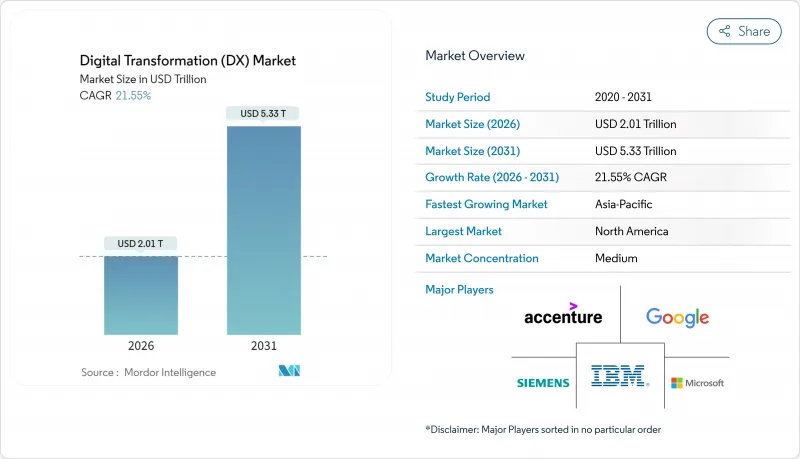
這一強勁成長得益於企業人工智慧的廣泛應用、雲端優先的支出策略以及監管要求企業實現營運數位化。企業自主制定的人工智慧政策正在推動企業運算在地化,而5G網路則為製造業和醫療保健產業開闢了即時應用情境。低程式碼平台正在將應用開發拓展到IT部門之外,而ESG報告法規則加速了資料驅動型合規投資。隨著企業在創新目標與舊有系統成本壓力之間尋求平衡,漸進式現代化策略正日益受到青睞。由於企業尋求多供應商雲端和人工智慧策略以避免被單一供應商鎖定,市場競爭仍然保持溫和。然而,超大規模雲端服務供應商的資本支出正在重新定義數位轉型(DX)市場的規模經濟。
全球數位轉型(DX)市場趨勢與洞察
雲端優先策略推動企業IT支出快速成長
各組織正在將預算從本地硬體重新分配到支援人工智慧工作負載和混合工作模式的雲端原生平台。例如,亞馬遜網路服務 (AWS) 的人工智慧助理 Amazon Q 已解答了超過 100 萬個內部開發人員的問題,節省了 45 萬小時的人力工作。雲端經濟縮短了採購週期,並將支出從資本預算轉移到營運預算,從而加快了實驗速度。微軟與可口可樂的合作等策略協議表明,生成式人工智慧服務將建構在可擴展的雲端基礎上。隨著企業將雲端基礎設施視為必需品,供應商正在擴展區域資料中心,以符合各國的資料法規。
跨功能人工智慧/機器學習整合的進展
人工智慧正從試點階段走向大規模生產。高盛已在多個部門部署了人工智慧助手,聯合健康集團正在管理超過1000個人工智慧應用案例,用於自動化理賠處理和臨床決策。國防、工業和零售業的領導企業也正在效仿類似的模式,將生成模型融入設計、維護和客戶體驗工作流程。同時,員工技能提升與資料管治架構也不斷完善,使人工智慧從實驗性附加功能轉變為核心能力。
由於遺留技術債所導致的鎖定效應
企業仍然將高達 80% 的 IT 預算用於維護使用了數十年的系統,從而減少了創新資金。 ServiceNow 的一項研究表明,老舊應用程式每年為企業造成每個系統 4 萬美元的損失,並每週浪費員工 17 小時的時間。政府機構尤其面臨這個問題,它們將 1000 億美元的 IT 支出中的絕大部分用於維護遺留資產。由此產生的技術債增加了網路安全風險,因為過時的軟體缺乏現代化的控制措施。
細分市場分析
到2025年,人工智慧和機器學習將佔據數位轉型市場佔有率的28.05%,預計該細分市場將以23.9%的複合年成長率成長,這印證了數據驅動的自動化是一項策略差異化優勢。推動數位轉型市場規模成長的主要因素是企業正在擴展聊天機器人、建議引擎和預測性維護模型。高盛和洛克希德馬丁的生產部署案例表明,這些系統正從試點階段邁向關鍵任務階段。擴增實境工具可將工業員工的培訓留任率提高275%,而沃爾瑪的食品溯源網路等區塊鏈解決方案則可將溯源檢查時間從7天縮短至2.2秒。
同時,邊緣運算叢集正以前所未有的速度在感測器附近處理數據,從而避免雲端延遲的損失。與數位雙胞胎同步的工業機器人能夠實現汽車和電子工廠的持續流程最佳化。積層製造生產線利用即時列印工具零件來減少停機時間。這些技術共同推動了數位轉型(DX)在重工業領域的市場滲透。
預計到2025年,雲端解決方案將佔據數位轉型(DX)市場62.65%的佔有率,並在2031年之前以22.1%的複合年成長率成長。這一市場佔有率與超大規模資料中心超大規模資料中心業者十億美元的資料中心建設密切相關。 AWS的「Project Rainier」叢集將Trainium 2晶片集群化,旨在打造全球最強大的AI訓練電腦。微軟800億美元的基礎建設投資也印證了投資週期的加速。儘管企業仍會維護本地節點來處理受監管的工作負載,但混合架構正變得越來越普遍。 Oracle與Oracle雲端的合作提供了低延遲、雙向且無出口費用的連線。
雲端運算的經濟模式對缺乏伺服器部署資金的中小型企業也極具吸引力。計量收費模式將成本與實際使用量掛鉤,而區域可用區則符合資料居住法規的要求。隨著時間的推移,平台鎖定問題促使許多公司將微服務分佈在多個雲端平台上,從而催生了對跨平台編配工具的需求。
數位轉型 (DX) 市場按技術(人工智慧/機器學習、擴增實境(VR/AR) 等)、部署模式(雲端、本地部署、混合部署)、組織規模(大型企業、中小企業 (SME))、垂直產業(金融、保險和證券 (BFSI)、醫療保健和生命科學、製造業和工業等)以及地區進行細分。市場預測以價值(美元)為單位。
區域分析
到2025年,北美將佔據數位轉型(DX)市場31.95%的佔有率,主要得益於充裕的創業投資和接近性超大規模雲端總部的地理優勢。光是在德克薩斯州,一項耗資5000億美元的資料中心擴建計劃(其中包括英偉達超級電腦)以及德克薩斯投資300億美元的晶片工廠,就創造了數千個技術就業機會。聯邦和州政府機構正在部署「漢弗萊」等人工智慧助理來自動化行政任務,進一步推動了市場需求。美國墨加協定(USMCA)下的跨國合作正在支持加拿大和墨西哥製造業的數位化。
亞太地區正經歷最快成長速度,年複合成長率高達22.0%,這主要得益於政府主導的基礎建設發展計畫和行動優先的消費行為。數位錢包約佔電子商務支付的70%,凸顯了該地區數位支付的指數級成長。印度、日本和韓國都已製定國家人工智慧戰略,澳洲昆士蘭州也已累計12億澳元(約8億美元)用於發展自主雲端服務。這些趨勢共同推動了數位轉型市場的潛在成長。
歐洲高度重視數位主權,並依據eIDAS 2.0標準強制要求在2027年實現歐洲數位身分錢包的普遍認可。德國的EuroStack計畫預計到2035年將投資3,000億歐元用於計算堆疊的本地化。石勒蘇益格-荷爾斯泰因州逐步淘汰專屬軟體的做法,體現了主權概念的實際應用。儘管南美洲和中東及非洲地區落後於領先地區,但外國對光纖骨幹、雲端區域和5G部署的投資不斷增加,正在為其開闢新的服務機會。
其他福利:
- Excel格式的市場預測(ME)表
- 3個月的分析師支持
目錄
第1章 引言
- 研究假設和市場定義
- 調查範圍
第2章調查方法
第3章執行摘要
第4章 市場情勢
- 市場概覽
- 市場促進因素
- 雲端優先策略推動企業IT支出快速成長
- 加強人工智慧/機器學習在各業務職能中的整合
- 利用5G進行即時數據應用的案例
- ESG報告的數位化
- 「數位主權」公共部門資金籌措趨勢
- 利用低程式碼/無程式碼平台實現數位轉型民主化
- 市場限制
- 由於遺留技術債所導致的鎖定效應
- 網路人才短缺和薪資上漲的壓力
- 數位身分監管碎片化
- ESG審核中範圍3的數據品質差距
- 供應鏈分析
- 監管環境
- 技術展望
- 波特五力模型
- 新進入者的威脅
- 供應商的議價能力
- 買方的議價能力
- 替代品的威脅
- 競爭對手之間的競爭
- 產業生態系分析
- 對影響市場的宏觀經濟因素進行評估
第5章 市場規模與成長預測
- 透過技術
- 人工智慧和機器學習
- 擴增實境(VR/AR)
- 物聯網 (IoT)
- 工業機器人
- 區塊鏈
- 數位雙胞胎
- 積層製造/工業3D列印
- 邊緣運算
- 其他
- 按部署模式
- 雲
- 本地部署
- 混合
- 按組織規模
- 主要企業
- 中小企業
- 按行業
- BFSI
- 醫療保健和生命科學
- 製造業和工業
- 零售與電子商務
- 能源與公共產業
- 汽車/運輸設備
- 政府和公共部門
- 其他(媒體、教育等)
- 按地區
- 北美洲
- 美國
- 加拿大
- 墨西哥
- 南美洲
- 巴西
- 阿根廷
- 其他南美洲
- 歐洲
- 德國
- 英國
- 法國
- 義大利
- 西班牙
- 其他歐洲地區
- 亞太地區
- 中國
- 日本
- 印度
- 韓國
- 東南亞
- 亞太其他地區
- 中東和非洲
- 中東
- 沙烏地阿拉伯
- 阿拉伯聯合大公國
- 土耳其
- 其他中東地區
- 非洲
- 南非
- 奈及利亞
- 埃及
- 其他非洲地區
- 中東
- 北美洲
第6章 競爭情勢
- 市場集中度
- 策略趨勢
- 市佔率分析
- 公司簡介
- Accenture
- Microsoft
- IBM
- Google(Alphabet)
- AWS(Amazon)
- SAP
- Oracle
- Adobe
- Salesforce
- Cisco Systems
- Dell Technologies
- Siemens
- Hewlett Packard Enterprise
- Cognex
- Apple
- ServiceNow
- Infosys
- Capgemini
- Wipro
- Schneider Electric
- Honeywell
- Hitachi
- Fujitsu
- Huawei
第7章 市場機會與未來展望
The digital transformation market is expected to grow from USD 1.65 trillion in 2025 to USD 2.01 trillion in 2026 and is forecast to reach USD 5.33 trillion by 2031 at 21.55% CAGR over 2026-2031.
Strong growth stems from enterprise AI adoption, cloud-first spending priorities, and regulatory mandates that compel organizations to digitize operations. Sovereign-AI policies push companies to localize computing, while 5G networks open real-time use cases in manufacturing and healthcare. Low-code platforms extend application development beyond IT departments, and ESG reporting rules accelerate data-driven compliance investments. Incremental modernization strategies gain favor as enterprises balance innovation goals with legacy-system cost pressures. Competitive intensity remains moderate because businesses pursue multi-vendor cloud and AI strategies to avoid lock-in, yet hyperscale-provider capital expenditure is redefining scale economics in the digital transformation market.
Global Digital Transformation (DX) Market Trends and Insights
Cloud-first enterprise IT spending boom
Organizations are reallocating budgets from on-premise hardware toward cloud-native platforms that support AI workloads and hybrid work models. For example, Amazon Web Services resolved more than 1 million internal developer questions with its AI assistant Amazon Q, saving 450,000 hours of manual effort. Cloud economics shorten procurement cycles and shift spending from capital to operating budgets, allowing faster experimentation. Strategic deals, such as Microsoft's partnership with Coca-Cola, show how generative-AI services ride atop scalable cloud foundations. As enterprises view cloud infrastructure as essential, vendors expand regional data centers to comply with sovereign-data rules.
Rising AI/ML integration across business functions
AI moves from pilots to production at scale. Goldman Sachs rolled out AI assistants across multiple departments, and UnitedHealth Group manages more than 1,000 AI use cases that automate claims and clinical decisions. Defense, industrial, and retail leaders replicate the pattern, embedding generative models in design, maintenance, and customer-experience workflows. Workforce upskilling and data-governance frameworks mature in tandem, making AI a core competency rather than an experimental add-on.
Legacy technical-debt lock-ins
Enterprises still devote up to 80% of IT budgets to maintain decades-old systems, reducing funds for innovation. ServiceNow found that aging applications cost USD 40,000 annually per system and drain 17 employee hours weekly.Government agencies illustrate the problem, spending the majority of their USD 100 billion IT outlay on legacy assets. The resulting technical debt inflates cybersecurity risk because outdated software lacks modern controls.
Other drivers and restraints analyzed in the detailed report include:
- 5G-enabled real-time data use-cases
- Mandatory ESG reporting digitisation
- Cyber-talent scarcity and wage inflation
For complete list of drivers and restraints, kindly check the Table Of Contents.
Segment Analysis
AI and ML claimed 28.05% of digital transformation market share in 2025, and the segment is expected to grow at 23.9% CAGR, reinforcing that data-driven automation is a strategic differentiator. This portion of the digital transformation market size is fueled by enterprises scaling chatbots, recommendation engines, and predictive-maintenance models. Production deployments at Goldman Sachs and Lockheed Martin exemplify the shift from pilots to mission-critical systems. Extended-Reality tools deliver 275% training-retention gains for industrial employees, while blockchain solutions such as Walmart's food-traceability network cut provenance checks from 7 days to 2.2 seconds.
A parallel wave of edge-computing clusters processes data near sensors to avoid cloud-latency penalties. Industrial robotics synchronized with digital twins allow continuous process optimization in automotive and electronics plants. Additive-manufacturing lines use real-time prints of tooling components to shrink downtime. Together these technologies deepen the digital transformation market penetration across heavy industries.
Cloud solutions owned 62.65% of digital transformation market share in 2025 and will expand at 22.1% CAGR through 2031. This share of the digital transformation market size correlates with hyperscalers' multi-billion-dollar data-center builds. AWS's Project Rainier clusters Trainium 2 chips into the world's most powerful AI training computer. Microsoft's USD 80 billion infrastructure spend underscores escalating investment cycles. Enterprises retain on-premises nodes for regulated workloads, yet hybrid architectures flourish; Oracle's pact with Google Cloud allows bidirectional low-latency links with no egress fees.
Cloud economics also attract small businesses that lack capital budgets for servers. Pay-as-you-go models align costs with usage, and regional availability zones satisfy data-residency regulations. Over time, platform lock-in concerns lead many firms to distribute microservices across multiple clouds, creating demand for cross-plane orchestration tools.
Digital Transformation Market is Segmented by Technology (AI and ML, Extended Reality (VR/AR), and More), Deployment Model (Cloud, On-Premises, Hybrid), Organization Size (Large Enterprises, Small and Medium Enterprises (SMEs)), Industry Vertical (BFSI, Healthcare and Life-Sciences, Manufacturing and Industrial, and More), and by Geography. The Market Forecasts are Provided in Terms of Value (USD).
Geography Analysis
North America secured 31.95% of digital transformation market share in 2025, anchored by deep venture capital pools and proximity to hyperscale-cloud headquarters. Texas alone hosts a USD 500 billion data-center expansion featuring NVIDIA supercomputers, plus Texas Instruments' USD 30 billion chip plant that adds thousands of tech jobs. Federal and state agencies adopt AI assistants like "Humphrey" to automate administrative tasks, further boosting demand. Cross-border initiatives under USMCA support manufacturing digitisation throughout Canada and Mexico.
Asia-Pacific delivers the fastest growth at 22.0% CAGR due to extensive government infrastructure programs and mobile-first consumer behavior. Digital wallets account for nearly 70% of e-commerce checkouts, highlighting the region's leapfrog adoption curves. India, Japan, and South Korea each articulate national AI strategies, while Australia's Queensland earmarked AUD 1.2 billion (USD 800 million) for sovereign-cloud services. Combined, these moves expand the addressable digital transformation market.
Europe emphasizes digital sovereignty under eIDAS 2.0, mandating universal acceptance of European Digital Identity Wallets by 2027. Germany's EuroStack program predicts EUR 300 billion investment to localize compute stacks by 2035. Schleswig-Holstein's migration away from proprietary software shows practical implementation of sovereignty ideals. South America and the Middle East and Africa trail the leading regions but experience rising foreign investment in fiber backbones, cloud regions, and 5G rollouts, unlocking new service opportunities.
- Accenture
- Microsoft
- IBM
- Google (Alphabet)
- AWS (Amazon)
- SAP
- Oracle
- Adobe
- Salesforce
- Cisco Systems
- Dell Technologies
- Siemens
- Hewlett Packard Enterprise
- Cognex
- Apple
- ServiceNow
- Infosys
- Capgemini
- Wipro
- Schneider Electric
- Honeywell
- Hitachi
- Fujitsu
- Huawei
Additional Benefits:
- The market estimate (ME) sheet in Excel format
- 3 months of analyst support
TABLE OF CONTENTS
1 INTRODUCTION
- 1.1 Study Assumptions and Market Definition
- 1.2 Scope of the Study
2 RESEARCH METHODOLOGY
3 EXECUTIVE SUMMARY
4 MARKET LANDSCAPE
- 4.1 Market Overview
- 4.2 Market Drivers
- 4.2.1 Cloud-first enterprise IT spending boom
- 4.2.2 Rising AI/ML integration across business functions
- 4.2.3 5G-enabled real-time data use-cases
- 4.2.4 Mandatory ESG reporting digitisation
- 4.2.5 "Digital-sovereignty" public-sector funding waves
- 4.2.6 Low-code / no-code platforms democratising DX
- 4.3 Market Restraints
- 4.3.1 Legacy technical-debt lock-ins
- 4.3.2 Cyber-talent scarcity and wage inflation
- 4.3.3 Digital-identity regulatory fragmentation
- 4.3.4 Scope-3 data-quality gaps for ESG audits
- 4.4 Supply-Chain Analysis
- 4.5 Regulatory Landscape
- 4.6 Technological Outlook
- 4.7 Porter's Five Forces
- 4.7.1 Threat of New Entrants
- 4.7.2 Bargaining Power of Suppliers
- 4.7.3 Bargaining Power of Buyers
- 4.7.4 Threat of Substitutes
- 4.7.5 Competitive Rivalry
- 4.8 Industry Ecosystem Analysis
- 4.9 Assesment of Macroeconomic Factors on the market
5 MARKET SIZE AND GROWTH FORECASTS (VALUE)
- 5.1 By Technology
- 5.1.1 AI and ML
- 5.1.2 Extended Reality (VR/AR)
- 5.1.3 Internet of Things (IoT)
- 5.1.4 Industrial Robotics
- 5.1.5 Blockchain
- 5.1.6 Digital Twin
- 5.1.7 Additive Manufacturing / Industrial 3-D Printing
- 5.1.8 Edge Computing
- 5.1.9 Others
- 5.2 By Deployment Model
- 5.2.1 Cloud
- 5.2.2 On-Premise
- 5.2.3 Hybrid
- 5.3 By Organization Size
- 5.3.1 Large Enterprises
- 5.3.2 Small and Medium Enterprises (SMEs)
- 5.4 By Industry Vertical
- 5.4.1 BFSI
- 5.4.2 Healthcare and Life-Sciences
- 5.4.3 Manufacturing and Industrial
- 5.4.4 Retail and E-commerce
- 5.4.5 Energy and Utilities
- 5.4.6 Automotive and Transportation
- 5.4.7 Government and Public Sector
- 5.4.8 Others (Media, Education, etc.)
- 5.5 By Geography
- 5.5.1 North America
- 5.5.1.1 United States
- 5.5.1.2 Canada
- 5.5.1.3 Mexico
- 5.5.2 South America
- 5.5.2.1 Brazil
- 5.5.2.2 Argentina
- 5.5.2.3 Rest of South America
- 5.5.3 Europe
- 5.5.3.1 Germany
- 5.5.3.2 United Kingdom
- 5.5.3.3 France
- 5.5.3.4 Italy
- 5.5.3.5 Spain
- 5.5.3.6 Rest of Europe
- 5.5.4 Asia-Pacific
- 5.5.4.1 China
- 5.5.4.2 Japan
- 5.5.4.3 India
- 5.5.4.4 South Korea
- 5.5.4.5 Southeast Asia
- 5.5.4.6 Rest of Asia-Pacific
- 5.5.5 Middle East and Africa
- 5.5.5.1 Middle East
- 5.5.5.1.1 Saudi Arabia
- 5.5.5.1.2 United Arab Emirates
- 5.5.5.1.3 Turkey
- 5.5.5.1.4 Rest of Middle East
- 5.5.5.2 Africa
- 5.5.5.2.1 South Africa
- 5.5.5.2.2 Nigeria
- 5.5.5.2.3 Egypt
- 5.5.5.2.4 Rest of Africa
- 5.5.5.1 Middle East
- 5.5.1 North America
6 COMPETITIVE LANDSCAPE
- 6.1 Market Concentration
- 6.2 Strategic Moves
- 6.3 Market Share Analysis
- 6.4 Company Profiles {(includes Global level Overview, Market level overview, Core Segments, Financials as available, Strategic Information, Market Rank/Share for key companies, Products and Services, and Recent Developments)}
- 6.4.1 Accenture
- 6.4.2 Microsoft
- 6.4.3 IBM
- 6.4.4 Google (Alphabet)
- 6.4.5 AWS (Amazon)
- 6.4.6 SAP
- 6.4.7 Oracle
- 6.4.8 Adobe
- 6.4.9 Salesforce
- 6.4.10 Cisco Systems
- 6.4.11 Dell Technologies
- 6.4.12 Siemens
- 6.4.13 Hewlett Packard Enterprise
- 6.4.14 Cognex
- 6.4.15 Apple
- 6.4.16 ServiceNow
- 6.4.17 Infosys
- 6.4.18 Capgemini
- 6.4.19 Wipro
- 6.4.20 Schneider Electric
- 6.4.21 Honeywell
- 6.4.22 Hitachi
- 6.4.23 Fujitsu
- 6.4.24 Huawei
7 MARKET OPPORTUNITIES AND FUTURE OUTLOOK
- 7.1 White-space and Unmet-need Assessment

 數位轉型市場:依產品類型、部署模式、組織規模、業務職能與產業分類-2026-2032年全球市場預測
 2026年全球數位轉型諮詢服務市場報告
 數位轉型市場規模、佔有率、趨勢和預測:按類型、部署模式、企業規模、最終用戶產業和地區分類,2026-2034 年物流數位轉型市場:依物流類型、技術、部署模式、組織規模及最終用戶分類-2026-2032年全球市場預測2026年全球港口數位排隊平台市場報告
 數位採用平臺市場規模、佔有率、成長率及全球產業分析:按類型、應用和地區分類的洞察,2026-2034年預測數位轉型市場規模、佔有率、成長及全球產業分析:按類型、應用和地區分類的洞察,2026-2034 年預測2026年全球教育科技數位轉型市場報告首席資訊安全長 (CISO) 的洞察:DNS 安全2026年全球數位轉型市場報告