


 |
市場調查報告書
商品編碼
1907284
塑膠瓶和容器:市場佔有率分析、行業趨勢和統計數據、成長預測(2026-2031)Plastic Bottles And Containers - Market Share Analysis, Industry Trends & Statistics, Growth Forecasts (2026 - 2031) |
||||||

※ 本網頁內容可能與最新版本有所差異。詳細情況請與我們聯繫。
預計到 2026 年,塑膠瓶和容器市場規模將達到 4,379 萬噸,高於 2025 年的 4,220 萬噸。
預計到 2031 年將達到 5,272 萬噸,2026 年至 2031 年的複合年成長率為 3.77%。
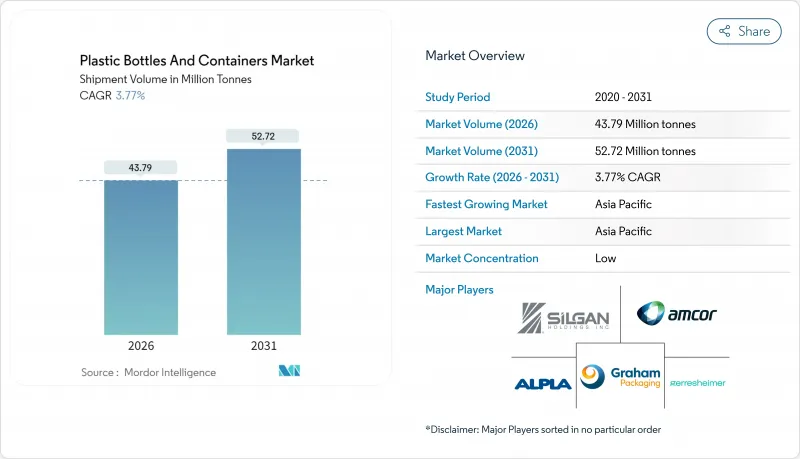
飲料、家居和製藥業的強勁需求支撐著產業的基本成長,而監管機構設定的再生材料含量目標正在加速材料創新。 PET的廣泛應用、為減輕容器重量(15-20%)而採取的輕量化措施,以及對電商物流友善設計的重視,都顯示產業正向效率和循環經濟轉型。以Amcor和Berry Global的全股票合併為代表的行業整合,正在加強圍繞再生PET(rPET)採購和先進回收技術的垂直整合。同時,市場集中度仍然適中,為專注於區域市場的公司和生物基創新者提供了充足的空間,使其能夠開闢盈利的細分市場。
全球塑膠瓶和容器市場趨勢及洞察
對輕量、抗衝擊包裝材料的需求日益成長
品牌商正透過減少壁厚並保持強度來降低物流成本和排放。 PureCycle 的超純再生聚丙烯樹脂可在不犧牲剛性的前提下減輕 15-20% 的重量。這些輕質容器在電子商務領域尤其具有優勢,因為該領域頻繁的搬運會增加破損風險。美國食品藥物管理局 (FDA) 的無菌包裝指南推薦此類容器用於常溫保存食品,進一步促進了其應用。供應商目前正將有限元素設計軟體與高流動性樹脂結合,以創建複雜的肋狀結構,從而提高承載能力,為加工商提供清晰的投資回報路徑。
PET/HDPE的成本優勢和擴充性
PET和HDPE之所以能保持成本優勢,得益於每小時可生產10萬件產品的大批量注塑拉伸吹塑成型線。完善的原料採購網路有效緩解了樹脂價格的波動,而陶氏化學等公司主導的化學品回收先導計畫旨在實現供應與原生石化產品的脫鉤。 HDPE的化學惰性使其在清潔劑和製藥領域的需求穩固,有效防止了快速的替代方案。自動化物料搬運料倉和在線連續著色系統進一步降低了人事費用和廢棄物處理成本,確保了具有競爭力的單位成本。
禁止並課稅一次性塑膠製品
德國的《一次性塑膠基金法》規定,製造商需根據容器重量繳納一定費用,這鼓勵了成本轉嫁和配方改進。西班牙對原生聚合物徵收每公斤0.45歐元(0.49美元)的稅,英國則對再生材料含量低於30%的包裝徵收關稅。這些財政措施擠壓了傳統包裝形式的利潤空間,並將資金重新分配到再生PET和可重複填充包裝項目。合規追蹤增加了行政成本,尤其對於在多個司法管轄區營運的中小型企業而言更是如此。
細分市場分析
到2025年,PET將佔塑膠瓶和容器市場61.73%的佔有率,年複合成長率(CAGR)為4.01%。這種規模效應帶來了規模經濟,即使樹脂價格波動,也能持續降低單位成本。在歐盟和加拿大強制推行再生材料含量規定的推動下,預計到2031年,PET塑膠瓶和容器市場將增加505萬噸。 HDPE仍將是漂白劑、清潔劑和非處方藥等產品的耐用且成熟的材料,但其較低的回收率阻礙了向循環經濟的轉型。 LDPE和PP滿足了透明度和耐熱性等細分市場的需求,而生物基聚聚羥基烷酯(PHA)樹脂正透過品牌試驗計畫逐步實現商業化。 Calbio 的 5 萬噸生物回收工廠計劃於 2026 年運作,它將透過向飲料回收系統供應高純度再生 PET (rPET) 來支持循環 PET 經濟的基礎。
從長遠來看,酵素分解和溶劑型回收技術可望提高原料的柔軟性,並保持PET的顏色和機械性能,使其能夠抵禦複合紙瓶的競爭,並捍衛其市場佔有率。因此,投資人正將資金集中投入到能夠確保與品牌商達成回收協議的解聚反應器和片狀PET清洗生產線上。然而,不斷上漲的生產者責任成本正在推動材料多樣化,為小眾生物基公司在化妝品和保健品領域佔據高利潤產品創造了機會。
射出式吹塑成型預計到2025年將佔總產量的47.62%,憑藉其可重複性和薄壁成型能力,主要用於小型藥品瓶和旅行裝個人保健產品的生產。同時,擠出吹塑成型預計將以4.36%的複合年成長率成長,這主要得益於其在大容量容器生產中更高的單腔生產效率。隨著亞太地區家用及工業清潔劑塑膠瓶及容器市場的擴張,每小時處理能力達25公斤的擠出生產線正成為加工業者的主力設備。拉伸吹塑成型是碳酸飲料生產的關鍵工藝,其瓶頸精整技術每年可使每個瓶子的重量減輕1-2克,從而持續為企業節省數百萬日元的樹脂成本。
自動化程度的提高模糊了製程的界線。射出成型預成型件與在線連續擠出覆膜相結合的混合生產線,正在生產用於高階冷萃咖啡的多層阻氧瓶。快速更換模板減少了停機時間,使代工包裝商能夠滿足按需個性化標籤和快速SKU切換的需求。然而,在尺寸公差必須達到±0.05毫米或更高的領域,射出成型平台仍佔據主導地位。
塑膠瓶和容器市場報告按材料(例如,聚對苯二甲酸乙二醇酯 (PET)、高密度聚苯乙烯(HDPE))、製造過程(例如,擠出吹塑成型、注塑吹塑成型)、容量範圍(小於 100 毫升、100-250 毫升以上)、終端用戶行業(例如,飲料、食品)和地區進行細分。市場預測以噸為單位。
區域分析
到2025年,亞太地區將佔全球出貨量的49.62%,年複合成長率達4.49%。這主要得益於印度和東南亞都市區收入的成長,推動了飲料和個人保健產品的人均消費量。中國已擁有全球最大的PET樹脂產能,並正在其大型瓶子製造地附近投資建造再生PET薄片生產線,從而降低物流成本和範圍3排放。印度在汽油中摻入20%乙醇的措施增加了對HDPE AdBlue容器的需求,促進了全部區域。日本和韓國在精密拉伸吹塑成型技術領域處於主導,它們將該技術授權給東協地區的加工商,並出口利潤豐厚的模具。
歐洲正利用其監管權力塑造全球標準。歐盟一項指令規定,到2030年,一次性飲料瓶的再生材料含量必須達到30%。該指令已推動了押金返還機制的實施,並促使各地區PET塑膠瓶回收量在2024年達到人均27公斤。德國的「綠點」計畫透過收取與回收率掛鉤的費用,從設計階段就鼓勵回收。法國正在試行推行數位產品護照,利用唯一ID將容器與國家碳排放登記系統關聯起來,並根據環境影響調整廢棄物處理費用。
在北美,品牌自願承諾與各州的新法規結合。加州的SB343法案強制要求真實標註回收訊息,並強制要求材料資料透明化。到2024年,美國的寶特瓶回收率將達到29.1%,與歐洲相比,回收率有顯著差距。加拿大設定了2030年使用50%再生材料的目標,並正在加快對多倫多和溫哥華附近清潔和剝片設施的投資。同時,墨西哥正利用其低廉的人事費用吸引為區域主要飲料公司供貨的吹塑成型代工製造商,從而確立了自身作為重要近岸外包生產基地的地位。
其他福利:
- Excel格式的市場預測(ME)表
- 分析師支持(3個月)
目錄
第1章 引言
- 研究假設和市場定義
- 調查範圍
第2章調查方法
第3章執行摘要
第4章 市場情勢
- 市場概覽
- 市場促進因素
- 對輕量、防碎包裝材料的需求日益成長
- PET/HDPE的成本優勢和擴充性
- 電子商務物流快速成長
- 推廣rPET循環利用的品牌(低調)
- 受歐盟配額限制法規影響的供應量(低調)
- 用於乳製品替代品的無菌冷灌裝技術(鮮為人知)
- 市場限制
- 禁止並課稅一次性塑膠製品
- 過渡到鋁和紙張替代品
- 揮發性PCR樹脂供應(低調趨勢)
- 輕質玻璃技術導致重量優勢減弱(關注度較低)
- 產業供應鏈分析
- 監管環境
- 技術展望
- 波特五力分析
- 供應商的議價能力
- 買方的議價能力
- 新進入者的威脅
- 替代品的威脅
- 競爭對手之間的競爭
- 投資分析
- 評估地緣政治趨勢
第5章 市場規模與成長預測
- 材料
- 聚對苯二甲酸乙二醇酯(PET)
- 高密度聚苯乙烯(HDPE)
- 低密度聚乙烯(LDPE)
- 聚丙烯(PP)
- 生物基和可堆肥塑膠
- 其他成分
- 透過製造程序
- 擠出吹塑成型
- 注塑吹塑成型
- 拉伸吹塑成型
- 其他製造程序
- 按容量範圍
- 少於100毫升
- 100-250 mL
- 251-500 mL
- 501-1,000 mL
- 1000毫升或更多
- 按最終用戶行業分類
- 飲料
- 食物
- 化妝品和個人護理
- 製藥
- 家居用品
- 其他終端用戶產業
- 按地區
- 北美洲
- 美國
- 加拿大
- 墨西哥
- 南美洲
- 巴西
- 阿根廷
- 智利
- 南美洲其他地區
- 歐洲
- 英國
- 德國
- 法國
- 義大利
- 西班牙
- 俄羅斯
- 其他歐洲地區
- 亞太地區
- 中國
- 印度
- 日本
- 韓國
- 澳洲
- 馬來西亞
- 亞太其他地區
- 中東和非洲
- 中東
- 沙烏地阿拉伯
- 阿拉伯聯合大公國
- 土耳其
- 其他中東地區
- 非洲
- 南非
- 奈及利亞
- 其他非洲地區
- 中東
- 北美洲
第6章 競爭情勢
- 市場集中度
- 策略趨勢
- 市佔率分析
- 公司簡介
- Amcor plc
- ALPLA Group
- Graham Packaging Company
- Silgan Holdings Inc.
- Gerresheimer AG
- Greiner Packaging International GmbH
- Resilux NV
- Altium Packaging LLC
- Retal Industries Ltd.
- Nampak Ltd.
- Comar LLC
- Alpha Packaging Pvt. Ltd.
- Plastipak Holdings Inc.
- Pretium Packaging LLC
- CoastPak Industrial Co. Ltd.
- Grief, Inc.
- O.Berk Company, LLC
- Mauser Packaging Solutions Holding Company
- Richards Glass Co. Ltd.
- Triumbari Corp.
第7章 市場機會與未來展望
The plastic bottles and containers market size in 2026 is estimated at 43.79 million tonnes, growing from 2025 value of 42.2 million tonnes with 2031 projections showing 52.72 million tonnes, growing at 3.77% CAGR over 2026-2031.
Robust demand from the beverages, household care, and pharmaceuticals sectors sustains baseline growth, while regulation-driven targets for recycled content accelerate material innovation. PET's dominance, lightweighting efforts that cut container weight by 15-20%, and a sharp focus on logistics-ready designs for e-commerce signal an industry pivot toward efficiency and circularity. Consolidation, exemplified by Amcor's all-stock merger with Berry Global, augments vertical integration around rPET sourcing and advanced recycling. At the same time, moderate market concentration leaves ample room for regional specialists and bio-based disruptors to carve out high-margin niches.
Global Plastic Bottles And Containers Market Trends and Insights
Rising Demand for Lightweight, Shatter-Resistant Packaging
Brands reduce logistics costs and emissions by trimming wall thickness yet preserving strength. PureCycle's ultra-pure recycled PP resin supports 15-20% weight cuts without compromising rigidity. Such lightweight containers excel in e-commerce, where multiple handling points raise breakage risks. The FDA's aseptic guidelines endorse these formats for shelf-stable foods, further validating adoption. Suppliers now pair finite-element design software with high-flow resins to create intricate ribs that boost top-load resistance, giving converters a clear ROI path.
Cost Advantage and Scalability of PET/HDPE
PET and HDPE retain a cost edge through high-volume injection stretch blow molding cells capable of 100,000 units hourly. Established feedstock networks temper resin price swings, while chemical-recycling pilots from Dow and others aim to decouple supply from virgin petrochemicals. HDPE's chemical inertness secures detergent and pharmaceutical demand, shielding it from rapid substitution. Automated material-handling silos and inline color-dosage systems further shave labor and scrap costs, ensuring competitive per-unit economics.
Single-Use-Plastic Bans and Taxes
Germany's Single-Use Plastic Fund Act levies manufacturer fees tied to container weight, prompting cost pass-throughs and recipe changes. Spain enforces a EUR 0.45 kg (USD 0.49 kg) tax on virgin polymer, while the United Kingdom imposes duties on packaging with under 30% recycled content. These fiscal tools compress margins for legacy formats and redirect capital to rPET and refill schemes. Compliance tracking elevates administrative overhead, especially for SMEs operating across multiple jurisdictions.
Other drivers and restraints analyzed in the detailed report include:
- Surge in E-commerce Logistics
- Brand Circularity Push for rPET
- Shift to Aluminum and Paper Alternatives
For complete list of drivers and restraints, kindly check the Table Of Contents.
Segment Analysis
PET held 61.73% of the plastic bottles and containers market share in 2025 and is expanding at a 4.01% CAGR. That scale generates economies that continually compress cost-per-unit even as resin prices fluctuate. The plastic bottles and containers market size attributable to PET applications is projected to add 5.05 million tonnes by 2031, supported by mandatory recycled-content thresholds in the European Union and Canada. HDPE follows as a durable incumbent for bleach, detergent, and OTC medications, but lower collection rates hinder its circular momentum. LDPE and PP fill clarity- and heat-resistant niches, while bio-based polyhydroxyalkanoate (PHA) resins inch toward commercial volume thanks to brand pilot programs. Carbios' 50,000 tonne biorecycling plant, scheduled for 2026 start-up, underpins PET's circular flywheel by feeding high-purity rPET back into beverage loops.
In the longer term, enzymatic and solvent-based recycling promise feedstock flexibility that preserves color and mechanical performance, positioning PET to defend share even against composite paper bottles. Investors, therefore, channel capital into depolymerization reactors and flake-washing lines that secure brand off-take agreements. However, emerging extended producer responsibility fees favor material diversification, creating space for niche bio-based players to capture high-margin SKUs in cosmetics and nutraceuticals.
Injection blow molding delivered 47.62% of 2025 volume through repeatability and thin-wall capability, anchoring small-format bottles for pharmaceuticals and travel-size personal care. Yet extrusion blow molding is tracking a 4.36% CAGR, underpinned by its superior per-cavity output in large-volume containers. As the plastic bottles and containers market size tied to household and industrial cleaners grows across the Asia Pacific, extrusion lines capable of 25 kg hourly throughput become the converter's workhorse. Stretch blow molding, critical for sparkling beverages, continues to benefit from neck-finish lightweighting that saves 1-2 g per bottle and aggregates millions in resin savings annually.
Automation advances blur process boundaries: hybrid lines that marry injection-molded preforms with in-line extrusion overlay enable multilayer oxygen-barrier bottles, catering to premium cold-brew coffee. Rapid-change mold plates reduce downtime, letting contract packers switch SKUs quickly in response to on-demand personalized labeling trends. Even so, injection platforms retain an edge where dimensional tolerances below +-0.05 mm are mandatory.
The Plastic Bottles and Containers Market Report is Segmented by Material (Polyethylene Terephthalate (PET), High-Density Polyethylene (HDPE), and More), Manufacturing Process (Extrusion Blow Molding, Injection Blow Molding, and More), Capacity Range (Less Than 100 ML, 100 - 250 ML, and More), End-User Vertical (Beverages, Food, and More), and Geography. The Market Forecasts are Provided in Terms of Volume (Tonnes).
Geography Analysis
Asia Pacific controlled 49.62% of 2025 shipments, adding 4.49% CAGR as rising urban incomes in India and Southeast Asia lift per-capita beverage and personal-care consumption. China, already home to the world's largest PET resin capacity, channels investment into rPET flake lines co-located with mega-bottling hubs, shrinking logistic costs, and Scope 3 emissions. India's push for 20% ethanol blending in petrol elevates demand for HDPE AdBlue containers, further boosting regional volume. Japan and South Korea champion precision stretch-blow technologies, licensing these to ASEAN converters and exporting high-margin mold sets.
Europe wields regulatory muscle that shapes global standards. The EU directive mandating 30% recycled content in single-use beverage bottles by 2030 has already spurred deposit-return schemes that lifted regional PET collection to 27 kg per capita in 2024. Germany's Green Dot fees, indexed to recycled content, incentivize design-for-recycling bottle geometries. France pilots digital product passports, requiring unique container IDs that feed state carbon registries and guide eco-modulation of waste fees.
North America blends voluntary brand pledges with emerging state-level mandates. California's SB 343 dictates truth-in-recycling labeling, forcing material data transparency. The United States recycled 29.1% of PET bottles in 2024, underscoring a sizable recovery gap relative to Europe. Canada's 50% recycled-content goal for 2030 accelerates investments in wash-flake capacity near Toronto and Vancouver. Mexico, meanwhile, leverages low labor costs to attract contract blow molders supplying regional beverage giants, positioning itself as a pivotal nearshore hub.
- Amcor plc
- ALPLA Group
- Graham Packaging Company
- Silgan Holdings Inc.
- Gerresheimer AG
- Greiner Packaging International GmbH
- Resilux NV
- Altium Packaging LLC
- Retal Industries Ltd.
- Nampak Ltd.
- Comar LLC
- Alpha Packaging Pvt. Ltd.
- Plastipak Holdings Inc.
- Pretium Packaging LLC
- CoastPak Industrial Co. Ltd.
- Grief, Inc.
- O.Berk Company, LLC
- Mauser Packaging Solutions Holding Company
- Richards Glass Co. Ltd.
- Triumbari Corp.
Additional Benefits:
- The market estimate (ME) sheet in Excel format
- 3 months of analyst support
TABLE OF CONTENTS
1 INTRODUCTION
- 1.1 Study Assumptions and Market Definition
- 1.2 Scope of the Study
2 RESEARCH METHODOLOGY
3 EXECUTIVE SUMMARY
4 MARKET LANDSCAPE
- 4.1 Market Overview
- 4.2 Market Drivers
- 4.2.1 Rising demand for lightweight, shatter-resistant packaging
- 4.2.2 Cost advantage and scalability of PET/HDPE
- 4.2.3 Surge in e-commerce logistics
- 4.2.4 Brand circularity push for rPET (under-the-radar)
- 4.2.5 EU tethered-cap regulation-driven volumes (under-the-radar)
- 4.2.6 Aseptic cold-fill for dairy-alternatives (under-the-radar)
- 4.3 Market Restraints
- 4.3.1 Single-use-plastic bans and taxes
- 4.3.2 Shift to aluminum and paper alternatives
- 4.3.3 Volatile PCR resin supply (under-the-radar)
- 4.3.4 Lightweight glass tech eroding weight edge (under-the-radar)
- 4.4 Industry Supply-Chain Analysis
- 4.5 Regulatory Landscape
- 4.6 Technological Outlook
- 4.7 Porter's Five Forces Analysis
- 4.7.1 Bargaining Power of Suppliers
- 4.7.2 Bargaining Power of Buyers
- 4.7.3 Threat of New Entrants
- 4.7.4 Threat of Substitutes
- 4.7.5 Intensity of Competitive Rivalry
- 4.8 Investment Analysis
- 4.9 Assessment of Geopolitical Developments
5 MARKET SIZE AND GROWTH FORECASTS (VOLUME)
- 5.1 By Material
- 5.1.1 Polyethylene Terephthalate (PET)
- 5.1.2 High-density Polyethylene (HDPE)
- 5.1.3 Low-density Polyethylene (LDPE)
- 5.1.4 Polypropylene (PP)
- 5.1.5 Bio-based and Compostable Plastics
- 5.1.6 Other Materials
- 5.2 By Manufacturing Process
- 5.2.1 Extrusion Blow Molding
- 5.2.2 Injection Blow Molding
- 5.2.3 Stretch Blow Molding
- 5.2.4 Other Manufacturing Processes
- 5.3 By Capacity Range
- 5.3.1 Less than 100 mL
- 5.3.2 100 - 250 mL
- 5.3.3 251 - 500 mL
- 5.3.4 501 - 1,000 mL
- 5.3.5 More than 1,000 mL
- 5.4 By End-user Vertical
- 5.4.1 Beverages
- 5.4.2 Food
- 5.4.3 Cosmetics and Personal Care
- 5.4.4 Pharmaceuticals
- 5.4.5 Household Care
- 5.4.6 Other End-user Verticals
- 5.5 By Geography
- 5.5.1 North America
- 5.5.1.1 United States
- 5.5.1.2 Canada
- 5.5.1.3 Mexico
- 5.5.2 South America
- 5.5.2.1 Brazil
- 5.5.2.2 Argentina
- 5.5.2.3 Chile
- 5.5.2.4 Rest of South America
- 5.5.3 Europe
- 5.5.3.1 United Kingdom
- 5.5.3.2 Germany
- 5.5.3.3 France
- 5.5.3.4 Italy
- 5.5.3.5 Spain
- 5.5.3.6 Russia
- 5.5.3.7 Rest of Europe
- 5.5.4 Asia Pacific
- 5.5.4.1 China
- 5.5.4.2 India
- 5.5.4.3 Japan
- 5.5.4.4 South Korea
- 5.5.4.5 Australia
- 5.5.4.6 Malaysia
- 5.5.4.7 Rest of Asia Pacific
- 5.5.5 Middle East and Africa
- 5.5.5.1 Middle East
- 5.5.5.1.1 Saudi Arabia
- 5.5.5.1.2 United Arab Emirates
- 5.5.5.1.3 Turkey
- 5.5.5.1.4 Rest of Middle East
- 5.5.5.2 Africa
- 5.5.5.2.1 South Africa
- 5.5.5.2.2 Nigeria
- 5.5.5.2.3 Rest of Africa
- 5.5.5.1 Middle East
- 5.5.1 North America
6 COMPETITIVE LANDSCAPE
- 6.1 Market Concentration
- 6.2 Strategic Moves
- 6.3 Market Share Analysis
- 6.4 Company Profiles (includes Global level Overview, Market level overview, Core Segments, Financials as available, Strategic Information, Market Rank/Share for key companies, Products and Services, and Recent Developments)
- 6.4.1 Amcor plc
- 6.4.2 ALPLA Group
- 6.4.3 Graham Packaging Company
- 6.4.4 Silgan Holdings Inc.
- 6.4.5 Gerresheimer AG
- 6.4.6 Greiner Packaging International GmbH
- 6.4.7 Resilux NV
- 6.4.8 Altium Packaging LLC
- 6.4.9 Retal Industries Ltd.
- 6.4.10 Nampak Ltd.
- 6.4.11 Comar LLC
- 6.4.12 Alpha Packaging Pvt. Ltd.
- 6.4.13 Plastipak Holdings Inc.
- 6.4.14 Pretium Packaging LLC
- 6.4.15 CoastPak Industrial Co. Ltd.
- 6.4.16 Grief, Inc.
- 6.4.17 O.Berk Company, LLC
- 6.4.18 Mauser Packaging Solutions Holding Company
- 6.4.19 Richards Glass Co. Ltd.
- 6.4.20 Triumbari Corp.
7 MARKET OPPORTUNITIES AND FUTURE OUTLOOK
- 7.1 White-space and Unmet-need Assessment

 2026-2030年全球吹塑成型塑膠瓶市場
 塑膠瓶及容器市場機會、成長要素、產業趨勢分析及2026-2035年預測
 吹塑成型塑膠瓶市場:2026-2032 年全球市場預測,按最終用途產業、材料、製造技術、產能、瓶子類型和瓶蓋類型細分。塑膠瓶和容器市場:2026-2032年全球市場預測(按樹脂原料、產品類型、材料類型、分銷管道和最終用途行業分類)
 吹塑成型瓶市場-2026-2031年預測
 塑膠瓶市場規模、佔有率和成長分析(按材料、銷售、技術、終端用途產業和地區分類)-2026-2033年產業預測
 亞太地區塑膠瓶和容器:市場佔有率分析、行業趨勢和統計、成長預測(2025-2030 年)歐洲塑膠瓶和容器市場:市場佔有率分析、行業趨勢和統計數據、成長預測(2025-2030 年)
 吹塑成型塑膠瓶市場報告:2031 年趨勢、預測與競爭分析中東和非洲:塑膠瓶和容器市場佔有率分析、產業趨勢和成長預測(2025-2030)