


 |
市場調查報告書
商品編碼
1907228
鎳:市場佔有率分析、產業趨勢與統計、成長預測(2026-2031)Nickel - Market Share Analysis, Industry Trends & Statistics, Growth Forecasts (2026 - 2031) |
||||||

※ 本網頁內容可能與最新版本有所差異。詳細情況請與我們聯繫。
2025 年鎳市場價值為 340 萬噸,預計從 2026 年的 355 萬噸成長到 2031 年的 439 萬噸,在預測期(2026-2031 年)內複合年成長率為 4.36%。
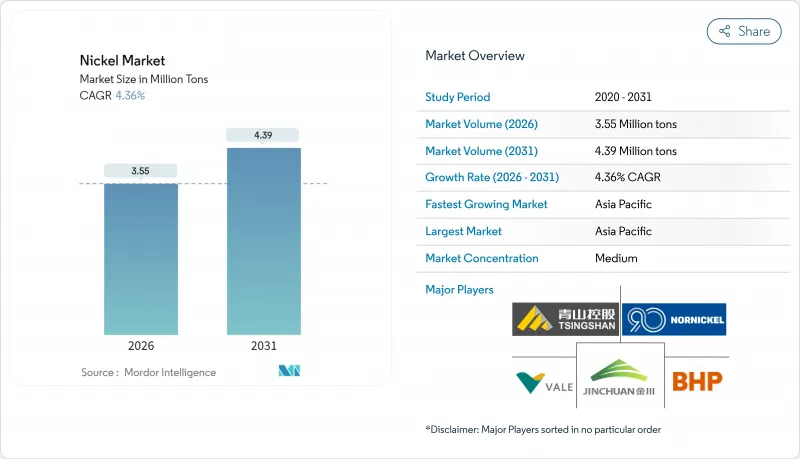
中國和印尼不銹鋼產量快速成長,對電池級提煉的持續投資,以及對低碳供應鏈日益成長的偏好,都支撐著銷售成長。同時,持續的二級鎳供應過剩對基準價格構成壓力。印尼具有成本優勢的鎳生鐵和高壓酸浸裝置,目前佔供應量的60%以上,正在重塑貿易格局,並加速與中國不銹鋼聯合企業的垂直整合。儘管電池產業的需求仍佔比不高,但低等級鎳材料的供應過剩和電池原料的短缺,正促使企業將策略資本配置到能夠供應電動車正極材料的一級鎳計劃上。由於菲律賓正考慮效法印尼2014年的礦石出口禁令,實施出口限制,政策風險依然較高;此外,深水結核礦計劃也成為鎳市場長期不確定因素。
全球鎳市場趨勢及展望
中國和印尼不銹鋼產量激增
2025年第一季,中國粗鋼產量年增10.6%,光3月就達358萬噸。產量的成長帶動了對進口含鎳原料需求的增加。同時,印尼鎳鐵產量的不斷成長形成了一條完整的供應鏈,使冶煉廠免受價格波動的影響。這種綜效確保了鎳市場原料供應的穩定,使得中印合資企業即使在西方高成本礦場停產的經濟低迷時期也能繼續運作。然而,這種集中化也加劇了系統性風險,因為任何干擾,無論是政策、天氣或物流的因素,都可能迅速導致全球供應短缺。
電動車電池級硫酸鎳精煉廠快速擴張
淡水河谷於2024年12月完成了其航海灣(Voyages Bay)計畫的擴建,新增年產能4.5萬噸。預計2026年下半年全面運作。加拿大鎳業公司(Canada Nickel)的克勞福德(Crawford)計劃預計將於2027年底投產,並在41年的營運期間累積生產160萬噸鎳。BASF和埃拉梅特在印尼投資26億美元的合資項目已被取消,但加拿大和美國宣布的新提煉計劃表明,鎳市場對本地在地採購的、適用於電池的材料的需求依然旺盛,這些材料將用於區域性超級工廠。生產商正尋求透過將高ESG(環境、社會和治理)資格與碳捕獲技術相結合,來獲得潛在的稅額扣抵和價格溢價。
持續的二級原油供應過剩導致基準價格下跌
印尼鎳鐵供應量預計將從2018年佔全球供應量的6%飆升至2025年的50%以上,這將壓低鎳價,並迫使西方高成本礦場進行維護。必和必拓(BHP)已暫停其位於提煉)、卡爾古利(Kalgoorlie)、基思山(Mount Keith)和倫斯特(Leinster)的礦山運營至2027年,約1600名員工將受到影響。嘉能可(Glencore)計畫在2024年減產9%,並關閉其科尼亞姆博(Koniambo)礦山,這進一步凸顯了鎳市場在適應新的成本領先者時,現有資產面臨的壓力。
細分市場分析
2025年,不鏽鋼產量佔鎳市場佔有率的69.20%,再次鞏固了其作為建築、消費品和工業領域關鍵耐腐蝕合金的地位。儘管經濟成長放緩,中國鋼鐵廠在2025年初仍實現了10.6%的增產,支撐了強勁的需求。鑄造和合金領域保持了航太和耐熱部件的穩定(但呈下降趨勢)供應,而電鍍應用在裝飾性表面處理方面獲得了較高的附加價值利潤。
儘管電池市場佔有率較小,但它是成長最快的細分市場,預計到2031年將以4.96%的複合年成長率成長。對電動車電池組和大規模儲能的需求正在推動相關投資,例如淡水河谷的航海灣礦擴建項目和加拿大鎳業的碳捕獲提煉。預計到2031年,電池用鎳市場規模將達到61萬噸,比2024年的基準值翻倍。雖然磷酸鐵鋰電池和磷酸鋰鐵離子電池的普及將抑制市場成長,但高鎳電池仍將繼續主導高階汽車的高能量正極材料市場,並有望獲得一級溢價。
本鎳市場報告按應用領域(不銹鋼、鑄造、合金、電池、電鍍及其他應用)、終端用戶行業(汽車及運輸設備、金屬製品、耐用消費品、建築、工業機械及其他終端用戶行業)和地區(亞太地區、北美、歐洲及其他地區)進行細分。市場預測以噸為單位。
區域分析
預計到2025年,亞太地區將佔全球鎳市場需求的71.10%,並在2031年之前以5.10%的複合年成長率成長。中國對不銹鋼需求的快速成長以及印尼垂直整合的供應鏈正在推動區域成長,而菲律賓潛在的礦石出口限制可能會進一步加劇東協內部的加工集中。日本和韓國保持先進合金的生產,而印度的工業基礎也在穩步推動消費。
在北美,以加拿大鎳業的克勞福德礦計劃和淡水河谷公司的航海灣擴建計劃為代表的本地化供應工作正在加緊推進。隨著美國超級工廠建設計畫需要符合《反通膨法案》採購規定的I類原料,預計北美鎳市場規模將進一步擴大。墨西哥由於地理位置接近性美國汽車工廠,在物流方面具有優勢,但關稅波動帶來了不確定性。
歐洲正努力在嚴格的ESG標準和成本壓力之間尋求平衡。汽車製造商對經認證的綠色金屬的需求,正推動歐洲及鄰國挪威對低碳提煉的投資。南美洲,巴西擁有全球約12%的蘊藏量,儘管面臨物流挑戰,但仍吸引大量資本,巴西鎳業的皮奧伊計劃是最好的例證。中東和非洲地區是一個新興市場,正吸引海灣投資基金的關注,他們尋求在前景看好的礦產資源中尋找投資機會。
其他福利:
- Excel格式的市場預測(ME)表
- 3個月的分析師支持
目錄
第1章 引言
- 研究假設和市場定義
- 調查範圍
第2章調查方法
第3章執行摘要
第4章 市場情勢
- 市場概覽
- 市場促進因素
- 中國和印尼不銹鋼產量激增
- 電動車電池級硫酸鎳精煉廠快速擴張
- 綠色鎳溢價和OEM供應鏈本地化
- 儘管整體供應過剩,一級鎳仍出現短缺。
- 多個新興的深海結核計劃
- 市場限制
- 持續的II類藥物供應過剩導致基準價格走低
- 採用磷酸鐵鋰電池和鈉離子電池化學體系
- 印尼HPAL和NPI計劃遭遇ESG輿論反彈
- 價值鏈分析
- 監管環境
- 技術展望
- 波特五力模型
- 供應商的議價能力
- 買方的議價能力
- 新進入者的威脅
- 替代品的威脅
- 競爭程度
第5章 市場規模與成長預測
- 透過使用
- 不銹鋼
- 鑄件
- 合金
- 電池
- 電鍍
- 其他用途
- 按最終用戶行業分類
- 汽車和運輸設備
- 金屬加工產品
- 耐久性消費品
- 建造
- 工業機械
- 其他終端用戶產業
- 按地區
- 亞太地區
- 中國
- 印度
- 日本
- 韓國
- 亞太其他地區
- 北美洲
- 美國
- 加拿大
- 墨西哥
- 歐洲
- 德國
- 英國
- 義大利
- 法國
- 俄羅斯
- 其他歐洲地區
- 南美洲
- 巴西
- 阿根廷
- 其他南美洲
- 中東和非洲
- 沙烏地阿拉伯
- 南非
- 其他中東和非洲地區
- 亞太地區
第6章 競爭情勢
- 市場集中度
- 策略趨勢
- 市佔率(%)/排名分析
- 公司簡介
- Anglo American
- Antam
- BHP
- Canada Nickel Company
- Eramet
- Glencore
- Jinchuan Group International Resources Co., Ltd.
- Nickel Asia Corporation
- Norilsk Nickel
- PACIFIC METALS CO., LTD.
- PT Vale Indonesia
- Sherritt International Corporation
- Sibanye-Stillwater
- South32
- Sumitomo Metal Mining Co., Ltd.
- TSINGSHAN HOLDING GROUP
- Vale
第7章 市場機會與未來展望
The Nickel Market was valued at 3.40 million tons in 2025 and estimated to grow from 3.55 million tons in 2026 to reach 4.39 million tons by 2031, at a CAGR of 4.36% during the forecast period (2026-2031).
Surging stainless-steel production in China and Indonesia, sustained investment in battery-grade refining, and mounting preference for low-carbon supply chains underpin volume growth, even as persistent Class II oversupply weighs on benchmark prices. Indonesia's cost-advantaged nickel pig iron and high-pressure acid-leach hubs now account for more than 60% of the supply, reshaping trade flows and accelerating vertical integration into Chinese stainless-steel complexes. Battery-sector demand, though still a minority share, drives strategic capital allocation toward Class I projects capable of supplying electric-vehicle cathodes amid a simultaneous surplus of lower-grade material and deficit of battery-ready feedstock. Policy risk remains elevated as the Philippines considers export restrictions modeled on Indonesia's 2014 ore ban, while deep-sea nodule projects emerge as a long-term wildcard for the nickel market.
Global Nickel Market Trends and Insights
Surging Stainless-Steel Output in China and Indonesia
Chinese crude stainless-steel production rose 10.6% year-over-year in Q1 2025, reaching 3.58 million tons in March alone. Higher output lifts import demand for nickel-bearing feedstock, while Indonesian nickel pig iron growth creates an integrated corridor that cushions mills against price swings. This symbiosis ensures raw material availability for the nickel market and enables Chinese-Indonesian ventures to operate during downturns that sideline higher-cost Western mines. Yet, the concentration amplifies systemic risk because any disruption-whether policy, weather, or logistics-could quickly tighten global supply.
Rapid Build-Out of EV Battery-Grade Nickel-Sulfate Refineries
Vale finalized the Voisey's Bay expansion in December 2024, adding 45,000 tons of annual capacity with full ramp-up slated for H2 2026. Canada Nickel Company's Crawford project aims to achieve first output by the end of 2027, projecting 1.6 million tons over a 41-year life. Although BASF-Eramet canceled a USD 2.6 billion Indonesian venture, new refinery announcements in Canada and the United States underscore the nickel market's need for localized, battery-ready feedstock to serve regional gigafactories. Producers aim to blend elevated ESG credentials with carbon-capture technology to unlock potential tax credits and price premiums.
Persistent Class II Oversupply Drags Benchmark Pricing
Indonesian nickel pig iron surged from 6% of global supply in 2018 to more than 50% in 2025, depressing prices and forcing higher-cost Western mines into care and maintenance. BHP suspended operations at its Kwinana refinery, Kalgoorlie smelter, Mt Keith, and Leinster mines until 2027, affecting approximately 1,600 workers. Glencore's 9% decline in 2024 output and Koniambo's shutdown further highlight pressure on legacy assets as the nickel market adjusts to the new cost leader.
Other drivers and restraints analyzed in the detailed report include:
- Green-Nickel Premiums and OEM Supply-Chain Localization
- Class I Nickel Deficit Despite Overall Surplus
- LFP and Sodium-Ion Battery Chemistry Adoption
For complete list of drivers and restraints, kindly check the Table Of Contents.
Segment Analysis
Stainless-steel production retained 69.20% of the nickel market in 2025, reaffirming the metal's role in corrosion-resistant alloys across construction, consumer, and industrial spheres. Chinese mills boosted output by 10.6% in early 2025, underpinning bulk demand even as economic growth moderates. Casting and alloy segments serve aerospace and heat-resistant parts with stable but lower volumes, while plating applications extract premium margins for decorative finishes.
The batteries segment, although accounting for a smaller share, is the fastest-growing slice with a 4.96% CAGR through 2031. Demand stems from electric-vehicle packs and grid-scale storage, driving investments such as Vale's Voisey's Bay upgrade and Canada Nickel's carbon-capture-enabled refinery. The nickel market size for batteries is forecast to reach 0.61 million tons by 2031, doubling its 2024 baseline. LFP and sodium-ion adoption constrain the upside, yet high-energy cathodes in premium vehicles continue to favor nickel-rich chemistries that command Class I premiums.
The Nickel Market Report is Segmented by Application (Stainless Steel, Casting, Alloys, Batteries, Plating, and Other Applications), End-User Industry (Automotive and Transportation, Fabricated Metal Products, Consumer Durables, Construction, Industrial Machinery, and Other End-User Industries), and Geography (Asia-Pacific, North America, Europe, and More). The Market Forecasts are Provided in Terms of Volume (Tons).
Geography Analysis
Asia-Pacific governed 71.10% of global nickel market demand in 2025 and is projected to expand at a 5.10% CAGR through 2031. China's stainless-steel surge and Indonesia's vertically integrated supply chain define regional momentum, while possible Philippine ore-export restrictions could further concentrate processing inside ASEAN. Japan and South Korea maintain advanced alloy production, and India's industrial base steadily lifts consumption.
North America intensifies efforts to localize supply, led by Canada Nickel's Crawford project and Vale's Voisey's Bay expansion. The nickel market size in North America is forecast to grow as gigafactory pipelines in the United States demand Class I feedstock compliant with the Inflation Reduction Act sourcing rules. Mexico's proximity to U.S. auto plants offers logistical advantages, though tariff volatility injects uncertainty.
Europe balances stringent ESG standards with cost pressures. Automakers seek certified green metal, encouraging investment in low-carbon refining within the bloc and in neighboring Norway. South America, with Brazil holding around 12% of global reserves, attracts capital despite logistics challenges, evidenced by Brazilian Nickel's Piaui project. The Middle-East and Africa remain emergent but attract Gulf investment funds seeking exposure to future-oriented minerals.
- Anglo American
- Antam
- BHP
- Canada Nickel Company
- Eramet
- Glencore
- Jinchuan Group International Resources Co., Ltd.
- Nickel Asia Corporation
- Norilsk Nickel
- PACIFIC METALS CO., LTD.
- PT Vale Indonesia
- Sherritt International Corporation
- Sibanye-Stillwater
- South32
- Sumitomo Metal Mining Co., Ltd.
- TSINGSHAN HOLDING GROUP
- Vale
Additional Benefits:
- The market estimate (ME) sheet in Excel format
- 3 months of analyst support
TABLE OF CONTENTS
1 Introduction
- 1.1 Study Assumptions and Market Definition
- 1.2 Scope of the Study
2 Research Methodology
3 Executive Summary
4 Market Landscape
- 4.1 Market Overview
- 4.2 Market Drivers
- 4.2.1 Surging stainless-steel output in China and Indonesia
- 4.2.2 Rapid build-out of EV battery-grade nickel sulphate refineries
- 4.2.3 Green-nickel premiums and OEM supply-chain localisation
- 4.2.4 Class I nickel deficit despite overall surplus
- 4.2.5 Multiple emerging deep-sea nodule projects
- 4.3 Market Restraints
- 4.3.1 Persistent Class II oversupply drags benchmark pricing
- 4.3.2 LFP and sodium-ion battery chemistry adoption
- 4.3.3 ESG backlash versus Indonesian HPAL and NPI projects
- 4.4 Value Chain Analysis
- 4.5 Regulatory Landscape
- 4.6 Technological Outlook
- 4.7 Porter's Five Forces
- 4.7.1 Bargaining Power of Suppliers
- 4.7.2 Bargaining Power of Buyers
- 4.7.3 Threat of New Entrants
- 4.7.4 Threat of Substitutes
- 4.7.5 Degree of Competition
5 Market Size and Growth Forecasts (Volume)
- 5.1 By Application
- 5.1.1 Stainless Steel
- 5.1.2 Casting
- 5.1.3 Alloys
- 5.1.4 Batteries
- 5.1.5 Plating
- 5.1.6 Other Applications
- 5.2 By End-user Industry
- 5.2.1 Automotive and Transportation
- 5.2.2 Fabricated Metal Products
- 5.2.3 Consumer Durables
- 5.2.4 Construction
- 5.2.5 Industrial Machinery
- 5.2.6 Other End-user Industries
- 5.3 By Geography
- 5.3.1 Asia-Pacific
- 5.3.1.1 China
- 5.3.1.2 India
- 5.3.1.3 Japan
- 5.3.1.4 South Korea
- 5.3.1.5 Rest of Asia-Pacific
- 5.3.2 North America
- 5.3.2.1 United States
- 5.3.2.2 Canada
- 5.3.2.3 Mexico
- 5.3.3 Europe
- 5.3.3.1 Germany
- 5.3.3.2 United Kingdom
- 5.3.3.3 Italy
- 5.3.3.4 France
- 5.3.3.5 Russia
- 5.3.3.6 Rest of Europe
- 5.3.4 South America
- 5.3.4.1 Brazil
- 5.3.4.2 Argentina
- 5.3.4.3 Rest of South America
- 5.3.5 Middle-East and Africa
- 5.3.5.1 Saudi Arabia
- 5.3.5.2 South Africa
- 5.3.5.3 Rest of Middle-East and Africa
- 5.3.1 Asia-Pacific
6 Competitive Landscape
- 6.1 Market Concentration
- 6.2 Strategic Moves
- 6.3 Market Share (%)/Ranking Analysis
- 6.4 Company Profiles (includes Global level Overview, Market level overview, Core Segments, Financials as available, Strategic Information, Market Rank/Share for key companies, Products and Services, and Recent Developments)
- 6.4.1 Anglo American
- 6.4.2 Antam
- 6.4.3 BHP
- 6.4.4 Canada Nickel Company
- 6.4.5 Eramet
- 6.4.6 Glencore
- 6.4.7 Jinchuan Group International Resources Co., Ltd.
- 6.4.8 Nickel Asia Corporation
- 6.4.9 Norilsk Nickel
- 6.4.10 PACIFIC METALS CO., LTD.
- 6.4.11 PT Vale Indonesia
- 6.4.12 Sherritt International Corporation
- 6.4.13 Sibanye-Stillwater
- 6.4.14 South32
- 6.4.15 Sumitomo Metal Mining Co., Ltd.
- 6.4.16 TSINGSHAN HOLDING GROUP
- 6.4.17 Vale
7 Market Opportunities and Future Outlook
- 7.1 White-space and unmet-need assessment

 鎳市場-全球產業規模、佔有率、趨勢、機會和預測:按應用、終端用戶產業、地區和競爭格局分類,2021-2031年
 鎳市場:全球市場按產品類型、原料、製造流程、應用和最終用途產業分類的預測 - 2026-2032年
 鎳市場規模、佔有率、趨勢和預測:按產品類型、應用、最終用途行業和地區分類,2026-2034年
 鎳市場分析及預測(至2035年):類型、產品類型、應用、形態、材質類型、最終用戶、技術、製程、組件、安裝類型
 2026-2034年全球鎳市場規模、佔有率、趨勢和成長分析報告日本鎳市場規模、佔有率、趨勢和預測:按產品類型、應用、最終用途行業和地區分類,2026-2034年
 2026年全球鎳市場報告PVD鎳泡棉市場按產品、製造流程、厚度範圍、應用和終端用戶產業分類-2026-2032年全球預測依電池類型、形態、純度等級、製造流程和應用分類的電動車電池用硫酸鎳市場-2026年至2032年全球預測全球高溫球形氫氧化鎳材料市場(依等級、粒徑、純度、製造製程及應用分類)2026-2032年預測