


 |
市場調查報告書
商品編碼
1906956
高密度聚苯乙烯(HDPE):市佔率分析、產業趨勢與統計、成長預測(2026-2031)High-density Polyethylene (HDPE) - Market Share Analysis, Industry Trends & Statistics, Growth Forecasts (2026 - 2031) |
||||||

※ 本網頁內容可能與最新版本有所差異。詳細情況請與我們聯繫。
高密度聚苯乙烯(HDPE)市場預計將從 2025 年的 6,187 萬噸成長到 2026 年的 6,468 萬噸,預計到 2031 年將達到 8,079 萬噸,2026 年至 2031 年的複合年成長率為 4.55%。
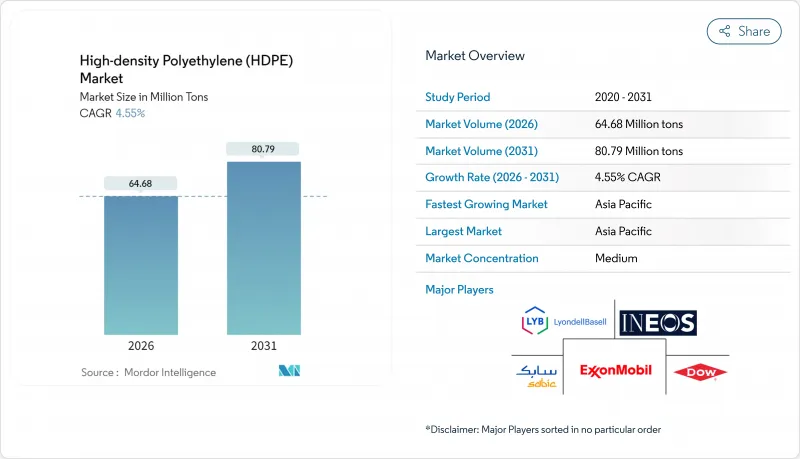
穩健的基礎設施投資、不斷擴展的化學回收供應鏈以及氫兼容管道系統的日益普及,都為這一成長軌跡提供了支撐。此外,由於高密度聚苯乙烯)材料固有的耐久性、耐化學性和可回收性,終端使用者對其解決方案持續保持濃厚的興趣。印度和東南亞國協加速推動社會住宅計畫、食品級吹塑成型成型技術在電子商務配送領域的應用,以及用於低碳天然氣網的PE-100-RC管道網路的推廣,都促進了HDPE潛在需求的成長。化學回收商將混合廢棄物流轉化為原生級再生HDPE(rHDPE),從而增強了供應安全,緩解了原料價格波動,並支持了循環經濟的需求。儘管競爭格局仍然較為分散,但將裂解裝置與先進回收技術結合的垂直整合型製造商,在成本和永續性方面都保持優勢。
全球高密度聚苯乙烯(HDPE)市場趨勢及展望
水利基礎設施維修計畫中對承壓和非承壓塑膠管道的需求不斷成長
由於HDPE管道擁有長達百年的使用壽命,且可採用非開挖施工,從而降低30-40%的土木工程成本,因此供水管網現代化計劃優先選用HDPE管道。美國土木工程師協會強調了HDPE在老化輸水管中的耐腐蝕性。印度自2024年起強制實施的全新聚乙烯品質標準將進一步提升HDPE在關鍵供水應用中的可靠性。計劃設計人員青睞HDPE,因為柔軟性,能夠適應地基移動,從而降低洩漏風險。公共部門的資金籌措週期跨越多個五年計劃,確保了管道需求的穩定,進而保證了HDPE市場的可預測成長。此外,非開挖施工方法的應用進一步降低了總安裝成本,使HDPE在與混凝土和球墨鑄鐵管道的競爭中脫穎而出。
食品級吹塑成型包裝在新興電商通路的拓展
電子商務的快速發展對包裝提出了更高的要求,即包裝必須能夠承受複雜的物流環境並保障食品品質。食品級高密度聚乙烯(HDPE)容器已通過嚴格的遷移測試並獲得美國食品藥物管理局(FDA)的批准,成為乳製品、調味品和常溫飲料的首選包裝。歐盟將於2025年3月生效的新規將要求食品接觸塑膠具備全面的可追溯性,但HDPE生產商目前已達到這些標準。透過薄壁吹塑成型實現輕量化,減少了樹脂用量,幫助企業實現排放目標並維持市場需求,從而增強了HDPE市場的韌性。
加強對一次性塑膠的監管和課稅
包裝法規的收緊正在降低歐洲和北美部分地區對一次性高密度聚乙烯(HDPE)產品的需求。然而,HDPE的可回收性降低了其在多次使用應用中的政策風險,而且完善的回收系統使其相比沒有機械回收途徑的多層薄膜更具吸引力。加工商正在重新設計瓶蓋和分配系統,以符合重量限制,從而減少體積損失。因此,法規只是減緩而非逆轉了HDPE市場的成長。
細分市場分析
到2025年,片材和薄膜將佔高密度聚乙烯(HDPE)市場佔有率的40.65%,這主要得益於穩定的包裝需求以及下游加工商對吹膜處理法日益熟練的掌握。永續包裝的目標正在推動單一材料薄膜設計的發展,而HDPE薄膜優於混合聚合物薄膜。
儘管管道和管材在HDPE市場中所佔比例小規模,但預計在2026年至2031年間,其複合年成長率將達到6.07%,成為該細分市場中成長最快的領域。這主要得益於供水基礎設施維修、氫氣天然氣管網建設以及非開挖式翻新工程的推動。日益嚴格的洩漏損失罰款公共產業採用具有均質焊接接頭和百年使用壽命的HDPE管道。工業薄膜、地工止水膜和手提袋等產品完善了HDPE產品組合,在建築支出放緩的情況下,支撐了樹脂的基準需求。
高密度聚苯乙烯(HDPE) 市場報告按應用(管道和管材、板材和薄膜、硬質產品、其他應用)、樹脂等級(PE-80、PE-100、PE-100-RC、其他)、最終用戶行業(包裝、建築和施工、農業、運輸、電氣和電子等)以及地區(亞太地區、北美、歐洲、南美、中東和電子等)以及地區(亞太地區、北美、歐洲、歐洲和中東地區)。
區域分析
亞太地區預計到2025年將佔據全球高密度聚乙烯(HDPE)市場42.30%的佔有率,並預計到2031年將以5.55%的複合年成長率成長,這主要得益於中國下游薄膜出口的成長和印度基礎設施建設的蓬勃發展。該地區的綜合生產商受益於煤製烯烴轉化和石腦油裂解裝置的柔軟性,從而能夠緩解乙烯價格的波動。然而,供應過剩時期給區域利潤率帶來了壓力,導致需要進行計劃性維護以減少庫存。
北美高密度聚乙烯(HDPE)市場受益於以乙烷為主的原料供應以及化學回收領域投資熱潮帶來的再生樹脂供應成長。儘管其成長速度低於亞太地區,但對高附加價值管道、薄膜和醫用級產品的需求支撐著市場收入。
歐洲是一個政策主導,隨著氫能網路的擴展,高密度聚乙烯(HDPE)正被用於PE-100-RC管道計劃和化學品回收合作項目中,以確保可回收原料的供應。儘管由於禁止使用一次性塑膠的政策,對薄壁硬質包裝的需求正在下降,但HDPE憑藉其高可回收性,在可重複使用、可回收的包裝箱和化學品桶領域仍然佔據著重要地位。
其他福利:
- Excel格式的市場預測(ME)表
- 分析師支持(3個月)
目錄
第1章 引言
- 研究假設和市場定義
- 調查範圍
第2章調查方法
第3章執行摘要
第4章 市場情勢
- 市場概覽
- 市場促進因素
- 水利基礎設施維修計畫中對承壓和非承壓塑膠管道的需求不斷成長
- 食品級吹塑成型包裝在新興電商通路的拓展
- 東南亞國協和印度持續投入公共住宅和大量基礎建設。
- 氫氣天然氣網的部署需要PE-100-RC管道
- 化學回收廠將混合廢棄物流轉化為原生級 RHDPE。
- 市場限制
- 加強對一次性塑膠的監管和課稅
- 乙烯原料價格波動與原油價格相關
- 加速消費品硬質包裝材料向聚丙烯(PP)無規共聚物的轉化
- 價值鏈分析
- 波特五力模型
- 供應商的議價能力
- 消費者議價能力
- 新進入者的威脅
- 替代產品和服務的威脅
- 競爭程度
第5章 市場規模與成長預測
- 透過使用
- 管道和管材
- 片材和薄膜
- 硬產品
- 其他用途
- 依樹脂等級
- PE-80
- PE-100
- PE-100-RC
- 超高分子量聚乙烯(HDPE)
- 按最終用戶行業分類
- 包裝
- 建築/施工
- 農業
- 運輸
- 電氣和電子設備
- 工業機械
- 其他終端用戶產業
- 按地區
- 亞太地區
- 中國
- 印度
- 日本
- 韓國
- ASEAN
- 亞太其他地區
- 北美洲
- 美國
- 加拿大
- 墨西哥
- 歐洲
- 德國
- 英國
- 法國
- 義大利
- 西班牙
- 俄羅斯
- 其他歐洲地區
- 南美洲
- 巴西
- 阿根廷
- 南美洲其他地區
- 中東和非洲
- 沙烏地阿拉伯
- 阿拉伯聯合大公國
- 南非
- 其他中東和非洲地區
- 亞太地區
第6章 競爭情勢
- 市場集中度
- 策略趨勢
- 市佔率分析
- 公司簡介
- BASF
- Borealis AG
- Braskem
- Chevron Phillips Chemical
- Dow
- Exxon Mobil Corporation
- Formosa Plastics Corporation, USA
- Indian Oil Corporation
- INEOS
- LG Chem
- LyondellBasell Industries Holdings BV
- Mitsui Chemicals, Inc.
- NOVA Chemicals Corporate
- PTT Global Chemical Public Company Limited
- Qatar Chemical Company Ltd
- Reliance Industries Limited
- SABIC
- Sasol
- Sinopec
- TotalEnergies
- Westlake Corporation
第7章 市場機會與未來展望
The High-density Polyethylene (HDPE) market is expected to grow from 61.87 Million tons in 2025 to 64.68 Million tons in 2026 and is forecast to reach 80.79 Million tons by 2031 at 4.55% CAGR over 2026-2031.
Strong infrastructure spending, widening chemical-recycling supply chains, and rising adoption of hydrogen-ready pipe systems anchor this trajectory, while the material's intrinsic durability, chemical resistance, and recyclability keep end-users committed to high-density polyethylene solutions. Accelerated public-housing programs across India and ASEAN, expanding food-grade blow-molding in e-commerce distribution, and the rollout of PE-100-RC pipe networks for low-carbon gas grids collectively widen the HDPE market's addressable demand. Chemical recyclers diverting mixed-waste streams into virgin-grade rHDPE strengthen supply security, temper feedstock volatility, and reinforce circular-economy mandates. Moderately fragmented competition persists, yet vertically integrated producers that pair cracker capacity with advanced recycling retain cost and sustainability advantages.
Global High-density Polyethylene (HDPE) Market Trends and Insights
Rising Demand for Pressure and Non-Pressure Plastic Pipes in Water-Infrastructure Retrofit Programmes
Water-network modernisation projects prioritise HDPE pipes because they combine a 100-year service life with trenchless installation capability that cuts civil works costs by 30-40%. The American Society of Civil Engineers underscores HDPE's corrosion resistance for ageing distribution lines. India's 2024 quality-standard mandate for virgin polyethylene reinforces material integrity in critical water applications. Project designers favour HDPE because its flexibility accommodates ground movement, reducing leakage risk. Public-sector funding cycles spanning multiple five-year plans guarantee steady pipe volumes, ensuring predictable growth for the HDPE market. Integration of trenchless methods further differentiates HDPE from concrete and ductile-iron alternatives by lowering total installed costs.
Expansion of Food-Grade Blow-Molded Packaging in Emerging E-Commerce Channels
Rapid e-commerce penetration demands packaging that survives complex logistics while protecting food quality. Food-grade HDPE containers pass stringent migration tests and hold FDA clearance, making them default choices for dairy, condiments, and shelf-stable beverages. European Union regulations, effective March 2025, require extensive traceability for food-contact plastics, a standard that HDPE producers already meet. Weight-reduction via thin-wall blow-molding lowers resin usage, aligns with corporate emission targets, and sustains demand, reinforcing the HDPE market's resilience.
Escalating Anti-Single-Use-Plastic Regulations and Taxation
Tighter packaging rules compress demand for disposable HDPE articles in Europe and parts of North America. However, HDPE's recyclability mitigates policy risk in multi-use applications, and well-established collection streams preserve its appeal versus multi-layer films that lack mechanical-recycling pathways. Converters are redesigning closures and dispensing systems to remain within weight thresholds, limiting volume loss. Consequently, regulation restrains but does not reverse HDPE market growth.
Other drivers and restraints analyzed in the detailed report include:
- Sustained Public-Housing and Mega-Infrastructure Spend Across ASEAN and India
- Roll-out of Hydrogen-Ready Gas Grids Requiring PE-100-RC Pipes
- Volatile Crude-Oil-Linked Ethylene Feedstock Pricing
For complete list of drivers and restraints, kindly check the Table Of Contents.
Segment Analysis
Sheets and Films held 40.65% of the 2025 HDPE market share, underpinned by steady packaging demand and downstream converter familiarity with blown-film processes. Sustainable packaging targets stimulate mono-material film designs that favour HDPE over mixed polymers.
Pipes and Tubes, although a smaller slice of the HDPE market size, posted the sharpest 6.07% CAGR for 2026-2031 on the back of water-infrastructure retrofits, hydrogen-ready gas grids, and trenchless renewals. Rising leak-loss penalties push utilities toward HDPE piping thanks to its homogenous fusion joints and 100-year service life. Industrial films, geomembranes, and carrier bags round out the portfolio, sustaining baseline resin offtake when construction spending softens.
The High-Density Polyethylene (HDPE) Market Report is Segmented by Application (Pipes and Tubes, Sheets and Films, Rigid Articles, and Other Applications), Resin Grade (PE-80, PE-100, PE-100-RC, and More), End-User Industry (Packaging, Building and Construction, Agriculture, Transportation, Electrical and Electronics, and More), and Geography ( Asia-Pacific, North America, Europe, South America, and Middle-East and Africa).
Geography Analysis
Asia-Pacific controlled 42.30% of the 2025 HDPE market share and is forecast to record a 5.55% CAGR to 2031, propelled by Chinese downstream film exports and India's infrastructure boom. Integrated producers in the region benefit from coal-to-olefins and naphtha-cracker flexibility, buffering ethylene volatility. However, oversupply periods have compressed regional margins, prompting scheduled maintenance to balance inventories.
North America's HDPE market benefits from ethane-advantaged feedstock and a wave of chemical-recycling investments that elevate circular-resin availability. While growth rates are lower than Asia-Pacific, value-added pipe, film, and medical-grade demand sustains profit pools.
Europe remains policy-driven; its hydrogen-network build-out channels HDPE into PE-100-RC pipe projects and chemical-recycling alliances that secure recycled feedstock. Anti-single-use-plastic mandates depress thin-wall rigid packaging volumes, yet high recyclability keeps HDPE firmly in multi-use, returnable crates and chemical drums.
- BASF
- Borealis AG
- Braskem
- Chevron Phillips Chemical
- Dow
- Exxon Mobil Corporation
- Formosa Plastics Corporation, U.S.A.
- Indian Oil Corporation
- INEOS
- LG Chem
- LyondellBasell Industries Holdings B.V.
- Mitsui Chemicals, Inc.
- NOVA Chemicals Corporate
- PTT Global Chemical Public Company Limited
- Qatar Chemical Company Ltd
- Reliance Industries Limited
- SABIC
- Sasol
- Sinopec
- TotalEnergies
- Westlake Corporation
Additional Benefits:
- The market estimate (ME) sheet in Excel format
- 3 months of analyst support
TABLE OF CONTENTS
1 Introduction
- 1.1 Study Assumptions and Market Definition
- 1.2 Scope of the Study
2 Research Methodology
3 Executive Summary
4 Market Landscape
- 4.1 Market Overview
- 4.2 Market Drivers
- 4.2.1 Rising Demand for Pressure and Non-Pressure Plastic Pipes in Water-Infrastructure Retrofit Programmes
- 4.2.2 Expansion of Food?Grade Blow-Moulded Packaging in Emerging E-Commerce Channels
- 4.2.3 Sustained Public-Housing and Mega-Infrastructure Spend across ASEAN and India
- 4.2.4 Roll-Out of Hydrogen-Ready Gas Grids Requiring PE-100-RC Pipes
- 4.2.5 Chemical Recycling Plants Shifting Mixed-Waste Streams into Virgin-Grade RHDPE
- 4.3 Market Restraints
- 4.3.1 Escalating Anti-Single-Use-Plastic Regulations and Taxation
- 4.3.2 Volatile Crude-Oil-Linked Ethylene Feedstock Pricing
- 4.3.3 Accelerated Materials-Switch to PP Random Copolymers in Consumer Rigid Packaging
- 4.4 Value Chain Analysis
- 4.5 Porter's Five Forces
- 4.5.1 Bargaining Power of Suppliers
- 4.5.2 Bargaining Power of Consumers
- 4.5.3 Threat of New Entrants
- 4.5.4 Threat of Substitute Products and Services
- 4.5.5 Degree of Competition
5 Market Size and Growth Forecasts (Volume)
- 5.1 By Application
- 5.1.1 Pipes and Tubes
- 5.1.2 Sheets and Films
- 5.1.3 Rigid Articles
- 5.1.4 Other Applications
- 5.2 By Resin Grade
- 5.2.1 PE-80
- 5.2.2 PE-100
- 5.2.3 PE-100-RC
- 5.2.4 Ultra-High-Molecular-Weight HDPE
- 5.3 By End-User Industry
- 5.3.1 Packaging
- 5.3.2 Building and Construction
- 5.3.3 Agriculture
- 5.3.4 Transportation
- 5.3.5 Electrical and Electronics
- 5.3.6 Industrial Machinery
- 5.3.7 Other End-user Industries
- 5.4 By Geography
- 5.4.1 Asia-Pacific
- 5.4.1.1 China
- 5.4.1.2 India
- 5.4.1.3 Japan
- 5.4.1.4 South Korea
- 5.4.1.5 ASEAN
- 5.4.1.6 Rest of Asia-Pacific
- 5.4.2 North America
- 5.4.2.1 United States
- 5.4.2.2 Canada
- 5.4.2.3 Mexico
- 5.4.3 Europe
- 5.4.3.1 Germany
- 5.4.3.2 United Kingdom
- 5.4.3.3 France
- 5.4.3.4 Italy
- 5.4.3.5 Spain
- 5.4.3.6 Russia
- 5.4.3.7 Rest of Europe
- 5.4.4 South America
- 5.4.4.1 Brazil
- 5.4.4.2 Argentina
- 5.4.4.3 Rest of South America
- 5.4.5 Middle-East and Africa
- 5.4.5.1 Saudi Arabia
- 5.4.5.2 United Arab Emirates
- 5.4.5.3 South Africa
- 5.4.5.4 Rest of Middle-East and Africa
- 5.4.1 Asia-Pacific
6 Competitive Landscape
- 6.1 Market Concentration
- 6.2 Strategic Moves
- 6.3 Market Share Analysis
- 6.4 Company Profiles (includes Global level Overview, Market level overview, Core Segments, Financials as available, Strategic Information, Market Rank/Share for key companies, Products and Services, and Recent Developments)
- 6.4.1 BASF
- 6.4.2 Borealis AG
- 6.4.3 Braskem
- 6.4.4 Chevron Phillips Chemical
- 6.4.5 Dow
- 6.4.6 Exxon Mobil Corporation
- 6.4.7 Formosa Plastics Corporation, U.S.A.
- 6.4.8 Indian Oil Corporation
- 6.4.9 INEOS
- 6.4.10 LG Chem
- 6.4.11 LyondellBasell Industries Holdings B.V.
- 6.4.12 Mitsui Chemicals, Inc.
- 6.4.13 NOVA Chemicals Corporate
- 6.4.14 PTT Global Chemical Public Company Limited
- 6.4.15 Qatar Chemical Company Ltd
- 6.4.16 Reliance Industries Limited
- 6.4.17 SABIC
- 6.4.18 Sasol
- 6.4.19 Sinopec
- 6.4.20 TotalEnergies
- 6.4.21 Westlake Corporation
7 Market Opportunities and Future Outlook
- 7.1 White-Space and Unmet-Need Assessment

 高密度聚苯乙烯市場:依形態、應用及通路分類-2026-2032年全球市場預測
 2026年全球高密度聚苯乙烯(HDPE)管道市場報告(公用事業用)交聯高密度聚苯乙烯市場:依產品類型、交聯方法、形態和應用分類-全球預測,2026-2032年
 HDPE管材市場規模、佔有率和成長分析:按產品類型、最終用途行業、應用、尺寸/直徑、製造方法、分銷管道、地區和行業預測,2026-2033年高密度均聚物市場:依通路、加工技術、應用類型、產品等級及最終用途產業分類-全球預測,2026-2032年2026年全球高密度聚苯乙烯管道市場報告2026年全球高密度聚苯乙烯(HDPE)瓶市場報告2026年全球高密度聚苯乙烯市場報告2026年全球高密度聚苯乙烯(HDPE)防漏地工止水膜市場報告
 2025-2029年全球高密度聚苯乙烯(HDPE)市場