


 |
市場調查報告書
商品編碼
1906867
聚醯胺:市場佔有率分析、產業趨勢與統計、成長預測(2026-2031)Polyamides - Market Share Analysis, Industry Trends & Statistics, Growth Forecasts (2026 - 2031) |
||||||

※ 本網頁內容可能與最新版本有所差異。詳細情況請與我們聯繫。
2025 年聚醯胺市場價值為 509 萬噸,預計從 2026 年的 531 萬噸成長到 2031 年的 659 萬噸,在預測期(2026-2031 年)內複合年成長率為 4.41%。
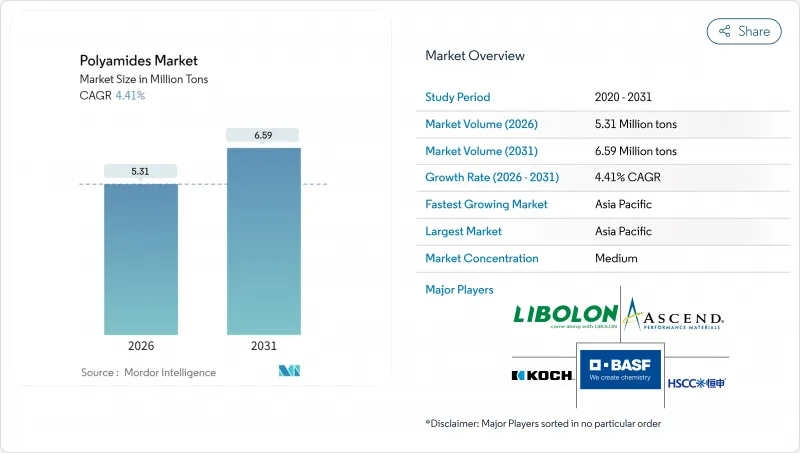
這一成長趨勢得益於汽車輕量化法規、電動車 (EV) 產量的快速成長以及 5G 電子產品中高溫聚合物的加速應用。聚醯胺,尤其是 PA6 和 PA66,正不斷取代金屬,應用於引擎室零件、線束和電池組件,從而在減輕重量的同時,還能承受約 180°C 的持續高溫。包裝應用領域也呈現成長勢頭,食品保鮮領域對阻隔薄膜的需求日益成長,而生物基聚醯胺則滿足了品牌所有者的永續性目標。供應安全仍然是戰略重點。 2024 年原物料價格的波動擠壓了利潤空間,己二腈供不應求限制了 PA 66 的生產,這使得擁有整合供應鏈的製造商獲得了市場佔有率。
全球聚醯胺市場趨勢與洞察
輕量化汽車應用領域需求強勁
為了滿足日益嚴格的燃油經濟性和排放氣體法規,汽車製造商正擴大採用PA6和PA66。電氣化進一步加速了這一趨勢,因為每減輕一公斤重量都能在不犧牲車內空間的前提下增加車輛續航里程。歐洲汽車製造商報告稱,將動力傳動系統部件從金屬部件轉向玻璃纖維增強聚醯胺,重量減輕了15-20%。對於引擎室零件而言,聚醯胺在高達180°C的溫度下仍保持穩定,其性能優勢是傳統聚丙烯無法比擬的。隨著全球乘用車產量的復甦和電動車普及速度的加快,整車製造商的籌資策略正在確保樹脂的長期供應,鞏固了聚醯胺市場最具影響力的成長支柱。
由於電氣化,對線束和溫度控管的需求迅速成長。
電動車架構需要緊湊的線束和能夠承受高電壓和高熱流的堅固電池外殼。 PA12 和耐熱 PA66 具有優異的耐電解性和低溫柔柔軟性,可實現更薄的壁厚和更小的彎曲半徑。特斯拉在其 Model Y 的線束網路中採用了特種聚醯胺,在保持介電性能的同時減輕了線束重量。電動車的快速普及加速了這一需求,亞洲、歐洲和北美的新電池和線束工廠紛紛運作。計劃從早期階段就開始指定使用高性能聚醯胺材料。
己內醯胺和己二酸原料價格波動
2024年,與原油價格掛鉤的己內醯胺價格大幅上漲,擠壓了未避險的聚合物工廠的轉換利潤率。依賴亞洲進口的歐洲和北美生產商面臨不斷擴大的到岸成本價差,壓縮了BASF聚醯胺部門的盈利。限制一氧化氧化亞氮的己二酸法規排放收緊了供應,加劇了成本波動,並抑制了長期合約的簽訂,尤其是對於中小加工商而言。
細分市場分析
2025年,PA 6佔據了聚醯胺市場58.12%的佔有率。其均衡的性能和寬廣的加工窗口使其適用於大規模生產的汽車零件和工業齒輪。區域性混煉廠商重視其與玻璃纖維和阻燃劑的相容性,並維持成熟的供應鏈。然而,隨著成熟應用接近飽和,其成長速度正在放緩。 PA66預計到2031年將以4.74%的複合年成長率(CAGR)保持最高水平,這主要得益於對熱變形溫度超過200°C的引擎艙部件、電池冷卻板和5G連接器的需求。儘管己二酸丁腈橡膠的供應受到限制,但原始設備製造商(OEM)對設計的執著將保障需求並維持其價格溢價。
醯胺纖維和PPA(聚亞苯丙烯)等特殊叢集佔據了小眾但盈利的市場需求。醯胺纖維在航太蜂窩、防彈材料和高抗張強度繩索等領域的應用利潤率很高,但產量仍有限。 PPA產品已滲透到渦輪增壓器空氣冷卻器端蓋和電動動力傳動系統模組中,並享有兩位數的價格溢價。為了因應特種纖維市場的擴張,BASF等傳統PA6供應商推出了「Ultramid Advanced」系列產品,該系列產品具有更高的玻璃化轉變溫度和耐化學性。這模糊了產品類別之間的界限,迫使買家評估特定應用的性能,而不是通用樹脂系列。聚醯胺市場佔有率的成長取決於成本、供應安全和技術利潤之間的平衡。 OEM材料選擇委員會越來越關注整體擁有成本(TCO),權衡輕量化和小型化帶來的好處與原物料價格波動帶來的風險。因此,PA6 在對成本敏感的組件領域保持主導地位,而 PA66 和 PPA 在對工作溫度和化學應力要求較高的先進應用中正在取得進展。
本聚醯胺市場報告按樹脂子類型(PA6、PA66、芳香聚醯胺、PPA)、終端用戶產業(汽車、電氣電子、航太、工業機械、建築施工、包裝及其他終端用戶產業)和地區(亞太、北美、歐洲、南美、中東和非洲)進行細分。市場預測以數量(噸)和價值(美元)為單位。
區域分析
預計到2025年,亞太地區將佔聚醯胺市場50.88%的佔有率,並在2031年之前以4.89%的複合年成長率成長。中國不斷擴大的電動車(EV)產量預計將增加對線束樹脂的需求,而印度蓬勃發展的電子產業預計將推動對高溫樹脂的需求。日本為混合動力傳動系統供應精密混煉和芳香族聚醯胺,而韓國則將聚醯胺聚合物(PPA)應用於銷往全球的5G模組。儘管原料自給率正在提高,但己內醯胺供應的集中性使得該地區容易受到原油價格波動的影響。馬來西亞和泰國等國正在推行下游投資獎勵措施,旨在實現生產基地多元化,吸引第二批尋求在中國以外地區建立生產基地的加工商。
美國汽車製造商正積極採用輕質聚合物,而航太巨頭則指定使用3D列印粉末製造乘客艙和引擎室零件。儘管Ascend垂直整合的PA66供應鏈在一定程度上保障了國內買家免受己二腈短缺的影響,但特種等級的PA66仍面臨產能限制。墨西哥日益成長的汽車組裝趨勢利用了當地複合材料生產商提供的具成本效益PA6,而加拿大的航太供應鏈正在試驗高性能芳香聚醯胺。歐洲正著力發展循環經濟。儘管成本增加,德國高階OEM廠商仍在推進生物基和再生聚醯胺的採用,並將永續性納入供應商評估標準。法國航空航太業正在加快積層製造等級的認證,而義大利機械工業叢集對耐磨零件的需求保持穩定。歐洲化學品管理局(ECHA)正在擴大其REACH法規的積層製造審查範圍,並對擁有完善監管文件的生產商給予獎勵。脫歐後,英國製造商正瞄準高利潤的特殊化合物,以彌補生產損失。南美洲和中東及非洲雖然合計佔有率較小,但由於汽車產業的本土化和基礎設施的擴張,呈現上升趨勢。巴西的軟包裝加工商正在探索用於出口型農產品運輸的聚醯胺多層薄膜,而波灣合作理事會(GCC)國家則利用低成本原料吸引樹脂投資。
其他福利:
- Excel格式的市場預測(ME)表
- 3個月的分析師支持
目錄
第1章 引言
- 研究假設和市場定義
- 調查範圍
第2章調查方法
第3章執行摘要
第4章 市場情勢
- 市場概覽
- 市場促進因素
- 輕量化汽車應用領域需求強勁
- 電動車對線束和溫度控管的需求快速成長
- 5G電子產品對耐高溫聚合物的需求成長
- 消費品牌向生物基聚醯胺的轉變
- 新興航太積層製造級
- 市場限制
- 己內醯胺和己二酸原料價格波動
- PA 66基聚合物持續供需失衡
- 軟包裝領域對PET和PP替代品的需求日益成長
- 價值鏈分析
- 波特五力分析
- 供應商的議價能力
- 買方的議價能力
- 替代品的威脅
- 競爭對手之間的競爭
- 新進入者的威脅
- 監管環境
- 進出口分析
- 價格趨勢
- 回收利用概述
- 終端用戶產業趨勢
- 航太(航太零件生產收入)
- 汽車(汽車產量)
- 建築與施工(新建建築占地面積)
- 電氣電子設備(電氣電子設備生產收入)
- 包裝(塑膠包裝量)
第5章 市場規模及成長預測(以金額為準及數量)
- 依樹脂亞型
- 聚醯胺(PA)6
- 聚醯胺(PA)66
- 芳香聚醯胺
- 聚鄰苯二甲醯胺(PPA)
- 按最終用戶行業分類
- 車
- 電氣和電子設備
- 航太
- 工業和機械
- 建築/施工
- 包裝
- 其他終端用戶產業
- 按地區
- 亞太地區
- 中國
- 日本
- 印度
- 韓國
- 澳洲
- 馬來西亞
- 亞太其他地區
- 北美洲
- 加拿大
- 墨西哥
- 美國
- 歐洲
- 德國
- 法國
- 義大利
- 英國
- 俄羅斯
- 其他歐洲地區
- 南美洲
- 巴西
- 阿根廷
- 其他南美洲
- 中東和非洲
- 沙烏地阿拉伯
- 阿拉伯聯合大公國
- 奈及利亞
- 南非
- 其他中東和非洲地區
- 亞太地區
第6章 競爭情勢
- 市場集中度
- 策略趨勢
- 市佔率(%)/排名分析
- 公司簡介
- AdvanSix
- Arclin
- Arkema SA
- Ascend Performance Materials
- BASF SE
- Celanese Corporation
- Domo Chemicals
- Envalior
- Evonik Industries
- Hangzhou Juheshun New Materials Co., Ltd.
- Highsun Holding Group
- Invista
- Koch Industries, Inc.
- Kuraray Co., Ltd.
- LIBOLON
- Solvay SA
- Ube Corporation
第7章 市場機會與未來展望
第8章:執行長面臨的關鍵策略挑戰
The Polyamides Market was valued at 5.09 million tons in 2025 and estimated to grow from 5.31 million tons in 2026 to reach 6.59 million tons by 2031, at a CAGR of 4.41% during the forecast period (2026-2031).
This growth trajectory is underpinned by automotive lightweighting mandates, the rapid scaling of electric vehicle (EV) production, and the accelerating adoption of high-temperature polymers in 5G electronics. Polyamide grades, notably PA 6 and PA 66, continue to displace metals in under-hood parts, wire harnesses, and battery components because they provide weight savings while withstanding sustained temperatures near 180 °C. Packaging applications are also gaining momentum as barrier-film requirements rise in food preservation, while bio-based polyamides answer brand-owner sustainability targets. Supply security remains a strategic priority: feedstock price swings in 2024 squeezed margins, and adiponitrile bottlenecks constrained PA 66 output, prompting producers with integrated chains to capture share.
Global Polyamides Market Trends and Insights
Robust Demand from Lightweight Automotive Applications
Automakers are increasingly selecting PA 6 and PA 66 to comply with stringent fuel-efficiency and emission regulations. Electrification intensifies this trend because every kilogram of mass eliminated extends driving range without sacrificing cabin space. European OEMs report 15-20% weight cuts in powertrain parts after shifting from metals to glass-fiber-reinforced polyamides. Under-hood components benefit from polyamides' stability up to 180 °C, providing performance margins that conventional polypropylene cannot achieve. As global passenger-vehicle output rebounds and EV penetration accelerates, OEM sourcing strategies lock in long-term resin volumes, anchoring the most influential growth pillar for the polyamides market.
Surge in E-Mobility Wire Harness and Thermal Management Needs
EV architecture demands compact wiring looms and robust battery housings that can handle higher voltages and heat flux. PA 12 and heat-stabilized PA 66 exhibit superior electrolyte resistance and low-temperature flexibility, enabling slim wall thickness and tighter bend radii. Tesla introduced specialized polyamides into the Model Y wiring networks, reducing harness mass while maintaining dielectric properties. Rapid EV scaling makes this driver immediate, with Asia, Europe, and North America commissioning greenfield battery and harness plants that specify high-performance polyamide grades from project inception.
Volatility in Caprolactam and Adipic Acid Feedstock Prices
Crude-linked caprolactam quotations spiked in 2024, eroding conversion margins at polymer plants that lack hedged sourcing. European and North American producers, who are dependent on Asian imports, faced wider landed-cost spreads, compressing profitability at BASF's polyamides division. Adipic-acid regulations restricting nitrous oxide emissions further squeezed the supply, amplifying cost volatility and deterring long-term contracts, especially for smaller processors.
Other drivers and restraints analyzed in the detailed report include:
- Growth in 5G Electronics Requiring High-Temperature Polymers
- Shift Toward Bio-Based Polyamides in Consumer Brands
- Persistent Supply-Demand Imbalance in PA 66 Base Polymer
For complete list of drivers and restraints, kindly check the Table Of Contents.
Segment Analysis
PA 6 accounted for 58.12% of the polyamides market size in 2025, as its balanced property set and wide processing window favor large-volume automotive components and industrial gears. Regional compounders appreciate its compatibility with glass fibers and flame retardants, sustaining entrenched supply chains. Yet growth moderates as mature applications saturate. PA 66 recorded the leading 4.74% CAGR through 2031, propelled by under-hood parts, battery cooling plates, and 5G connectors where heat deflection temperatures exceed 200 °C. Despite adiponitrile bottlenecks, OEM design lock-in protects demand, and price premiums remain defensible.
The specialty cluster-aramids and PPA-addresses niche but lucrative needs. Aramid fiber usage in aerospace honeycomb, ballistic protection, and high-tension cords yields strong margins; however, volumes remain modest. PPA grades penetrate turbocharger air-cooler end tanks and electric powertrain modules, commanding double-digit price premiums. Traditional PA 6 suppliers, such as BASF, introduced Ultramid Advanced lines that elevate glass-transition temperatures and chemical resistance to counter specialty incursions. This blurs category boundaries, nudging buyers to evaluate performance on an application-specific basis rather than generic resin families. Polyamides market share gains hinge on balancing cost, availability, and technical headroom. OEM material-selection committees are increasingly running total-cost-of-ownership scenarios, weighing feedstock volatility against the advantages of lightweighting or miniaturization. As such, PA 6 retains leadership in cost-critical parts, whereas PA 66 and PPA capture frontier applications where operating temperatures or chemical exposure escalate.
The Polyamides Market Report is Segmented by Sub-Resin Type (PA 6, PA 66, Aramid, and PPA), End-User Industry (Automotive, Electrical and Electronics, Aerospace, Industrial and Machinery, Building and Construction, Packaging, and Other End-User Industries), and Geography (Asia-Pacific, North America, Europe, South America, and Middle-East and Africa). Market Forecasts are Provided in Terms of Volume (Tons) and Value (USD)
Geography Analysis
The Asia-Pacific region held a 50.88% share of the polyamides market in 2025 and is projected to grow at a 4.89% CAGR through 2031. China's growing EV output will magnify demand for wire harness resins, while India's electronics push is expected to add volumes in high-temperature grades. Japan supplies precision compounding and aromatic polyamides for hybrid powertrains, and South Korea deploys PPA in 5G modules sold worldwide. Although feedstock self-sufficiency is improving, the caprolactam supply concentration makes the region vulnerable to crude oil price fluctuations. Nations such as Malaysia and Thailand target downstream investment incentives to diversify production footprints, attracting second-wave processors seeking China-plus-one strategies.
United States automakers incorporate lightweighting polymers aggressively, and aerospace primes specify 3D-printing powders for cabin and engine-bay parts. Ascend's vertically integrated PA 66 chain shields domestic buyers from some adiponitrile shortages, but capacity constraints still ripple across specialist grades. Mexico's vehicle assembly uptrend taps cost-efficient PA 6 from regional compounders, while Canada's aerospace supply base experiments with high-performance aramids. Europe underscores circularity. Germany's premium OEMs are locking in bio-content or recycled polyamides despite higher costs, thereby embedding sustainability into their supplier scorecards. France's aviation segment drives certification of additive-manufacturing grades, and Italy's machinery cluster maintains reliable demand for engineered wear parts. The European Chemicals Agency continues to expand scrutiny of additives under REACH, rewarding producers with robust regulatory dossiers. Brexit-era U.K. manufacturing targets high-margin specialty compounds to offset volume leakage. South America, the Middle East, and Africa collectively account for smaller shares, yet deliver upside through automotive localization and infrastructure expansion. Brazil's flexible-packaging converters are exploring polyamide multilayers for export-oriented agrifood shipments, whereas Gulf Cooperation Council countries are leveraging low-cost feedstock to attract resin investments.
- AdvanSix
- Arclin
- Arkema S.A.
- Ascend Performance Materials
- BASF SE
- Celanese Corporation
- Domo Chemicals
- Envalior
- Evonik Industries
- Hangzhou Juheshun New Materials Co., Ltd.
- Highsun Holding Group
- Invista
- Koch Industries, Inc.
- Kuraray Co., Ltd.
- LIBOLON
- Solvay S.A.
- Ube Corporation
Additional Benefits:
- The market estimate (ME) sheet in Excel format
- 3 months of analyst support
TABLE OF CONTENTS
1 Introduction
- 1.1 Study Assumptions and Market Definition
- 1.2 Scope of the Study
2 Research Methodology
3 Executive Summary
4 Market Landscape
- 4.1 Market Overview
- 4.2 Market Drivers
- 4.2.1 Robust Demand from Lightweight Automotive Applications
- 4.2.2 Surge in E-Mobility Wire Harness and Thermal Management Needs
- 4.2.3 Growth in 5G Electronics Requiring High-Temperature Polymers
- 4.2.4 Shift Toward Bio-Based Polyamides in Consumer Brands
- 4.2.5 Emerging Aerospace Additive-Manufacturing Grades
- 4.3 Market Restraints
- 4.3.1 Volatility in Caprolactam and Adipic Acid Feedstock Prices
- 4.3.2 Persistent Supply-Demand Imbalance in PA 66 Base Polymer
- 4.3.3 Rising PET And PP Substitution in Flexible Packaging
- 4.4 Value Chain Analysis
- 4.5 Porter's Five Forces Analysis
- 4.5.1 Bargaining Power of Suppliers
- 4.5.2 Bargaining Power of Buyers
- 4.5.3 Threat of Substitutes
- 4.5.4 Competitive Rivalry
- 4.5.5 Threat of New Entrants
- 4.6 Regulatory Landscape
- 4.7 Import and Export Analysis
- 4.8 Price Trends
- 4.9 Recycling Overview
- 4.10 End-use Sector Trends
- 4.10.1 Aerospace (Aerospace Component Production Revenue)
- 4.10.2 Automotive (Automobile Production)
- 4.10.3 Building and Construction (New Construction Floor Area)
- 4.10.4 Electrical and Electronics (Electrical and Electronics Production Revenue)
- 4.10.5 Packaging (Plastic Packaging Volume)
5 Market Size and Growth Forecasts (Value and Volume)
- 5.1 By Sub-Resin Type
- 5.1.1 Polyamide (PA) 6
- 5.1.2 Polyamide (PA) 66
- 5.1.3 Aramid
- 5.1.4 Polyphthalamide (PPA)
- 5.2 By End-User Industry
- 5.2.1 Automotive
- 5.2.2 Electrical and Electronics
- 5.2.3 Aerospace
- 5.2.4 Industrial and Machinery
- 5.2.5 Building and Construction
- 5.2.6 Packaging
- 5.2.7 Other End-User Industries
- 5.3 By Geography
- 5.3.1 Asia-Pacific
- 5.3.1.1 China
- 5.3.1.2 Japan
- 5.3.1.3 India
- 5.3.1.4 South Korea
- 5.3.1.5 Australia
- 5.3.1.6 Malaysia
- 5.3.1.7 Rest of Asia-Pacific
- 5.3.2 North America
- 5.3.2.1 Canada
- 5.3.2.2 Mexico
- 5.3.2.3 United States
- 5.3.3 Europe
- 5.3.3.1 Germany
- 5.3.3.2 France
- 5.3.3.3 Italy
- 5.3.3.4 United Kingdom
- 5.3.3.5 Russia
- 5.3.3.6 Rest of Europe
- 5.3.4 South America
- 5.3.4.1 Brazil
- 5.3.4.2 Argentina
- 5.3.4.3 Rest of South America
- 5.3.5 Middle-East and Africa
- 5.3.5.1 Saudi Arabia
- 5.3.5.2 United Arab Emirates
- 5.3.5.3 Nigeria
- 5.3.5.4 South Africa
- 5.3.5.5 Rest of Middle-East and Africa
- 5.3.1 Asia-Pacific
6 Competitive Landscape
- 6.1 Market Concentration
- 6.2 Strategic Moves
- 6.3 Market Share (%)/Ranking Analysis
- 6.4 Company Profiles (includes Global level Overview, Market level overview, Core Segments, Financials as available, Strategic Information, Market Rank/Share for key companies, Products and Services, and Recent Developments)
- 6.4.1 AdvanSix
- 6.4.2 Arclin
- 6.4.3 Arkema S.A.
- 6.4.4 Ascend Performance Materials
- 6.4.5 BASF SE
- 6.4.6 Celanese Corporation
- 6.4.7 Domo Chemicals
- 6.4.8 Envalior
- 6.4.9 Evonik Industries
- 6.4.10 Hangzhou Juheshun New Materials Co., Ltd.
- 6.4.11 Highsun Holding Group
- 6.4.12 Invista
- 6.4.13 Koch Industries, Inc.
- 6.4.14 Kuraray Co., Ltd.
- 6.4.15 LIBOLON
- 6.4.16 Solvay S.A.
- 6.4.17 Ube Corporation
7 Market Opportunities and Future Outlook
- 7.1 White-Space and Unmet-Need Assessment
8 Key Strategic Questions for CEOs

 聚醯胺市場:2026-2032年全球市場預測(依產品、形態、製造流程、產品形態、等級、應用及分銷通路分類)
 2026年全球長鏈聚醯胺市場報告
 聚醯胺腳輪市場規模、佔有率和成長分析:按腳輪類型、承載能力、材質、終端用戶產業、地區和產業預測分類,2026-2033年
 3D 聚醯胺(PA)市場規模、佔有率和成長分析:按聚醯胺類型、3D 列印方法、配方、應用和地區分類-2026-2033 年產業預測
 聚醯胺12市場:依最終用途產業和地區分類
 聚醯胺市場分析及預測(至2035年):類型、產品、應用、技術、終端用戶、形式、材料類型、製程及功能全球再生聚醯胺纖維市場依形態、來源、技術、聚醯胺類型和最終用途分類,預測至2026-2032年尼龍12市場按形態、等級、應用和最終用戶產業分類-2026年至2032年全球預測聚醯胺管材市場:按材料類型、應用、終端用戶產業和銷售管道- 全球預測(2026-2032年)聚醯胺著色劑市場:全球預測(2026-2032 年),按類型、形態、樹脂類型、應用和分銷管道分類