


 |
市場調查報告書
商品編碼
1906185
北美商用車遠端資訊處理市場:市場佔有率分析、產業趨勢與統計及成長預測(2026-2031 年)North America Commercial Vehicle Telematics - Market Share Analysis, Industry Trends & Statistics, Growth Forecasts (2026 - 2031) |
||||||

※ 本網頁內容可能與最新版本有所差異。詳細情況請與我們聯繫。
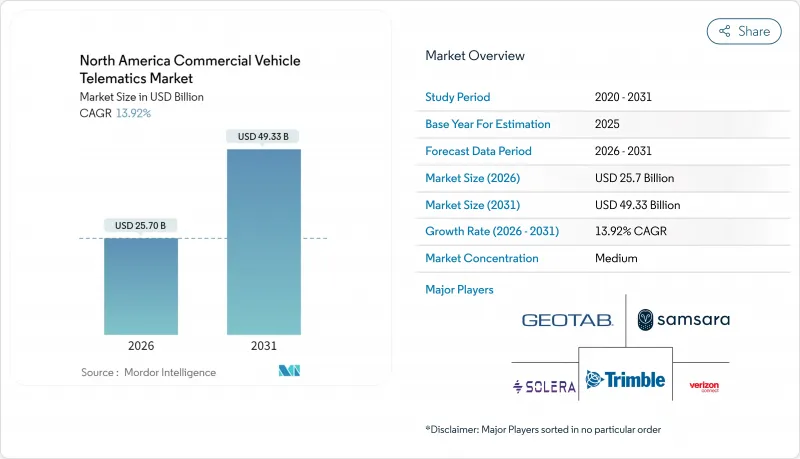
預計北美商用車遠端資訊處理市場將從 2025 年的 225.6 億美元成長到 2026 年的 257 億美元,到 2031 年將達到 493.3 億美元,2026 年至 2031 年的複合年成長率為 13.92%。
在日益嚴格的法令遵循、電氣化分析以及人工智慧技術的推動下,智慧交通系統的普及速度正在加快,這些技術將說明儀錶板轉化為預測性決策引擎。貨運市場疲軟反而促進了智慧交通系統的普及,承運商利用遠端資訊處理技術挖掘出更細緻的成本節約點,而5G網路的快速部署則實現了高頻寬、毫秒延遲的V2X資料流。汽車製造商透過將連網硬體作為出廠標配,擴大了客戶群;保險公司也為那些展現出檢驗的安全改進的車隊提供了顯著的保費優惠。
北美商用車遠端資訊處理市場趨勢與洞察
監理合規方面的法律義務
美國聯邦汽車運輸安全管理局 (FMCSA) 移除不合規的電子記錄設備,催生了強制性的更新週期,這將推動 2024-2025 年的設備出貨量成長。執法行動標誌著認證方式從一次性認證轉向持續的技術審核,迫使車隊選擇擁有成熟更新週期和安全資料管道的供應商。 2025 年 6 月引擎類型標準的延期以及自動緊急煞車法規的實施擴大了合規範圍。遠端資訊處理系統被定位為自動駕駛記錄採集、遠距離診斷和召回管理的中心樞紐。能夠提供符合審核要求的報告和無線韌體更新的供應商將獲得定價權,尤其是在需要應對聯邦和跨境法規的長途運輸業者中。
映像基礎的安全措施和人工智慧分析
人工智慧攝影機已從被動式錄影設備發展成為能夠預測碰撞風險並觸發車內警報的邊緣處理引導設備。 Geotab 的報告顯示,配備預測性安全評分系統的車隊碰撞事故減少了 40%。如果事故頻率的改善得到證實,保險公司可提供高達 30% 的保費折扣。即時車道偏離預警、跟車距離測量和自動事故資料上傳功能能夠產生可驗證的證據,從而降低責任風險,並且正被越來越多的車隊採用,甚至小規模車隊也在使用。感測器價格的暴跌和雲端原生分析技術的進步推動了影像和追蹤捆綁訂閱服務的普及,提高了每位用戶的平均收入。保護隱私的設備內處理技術正在緩解駕駛者的擔憂,並加速主要城市市場的工會化進程。
網路安全與資料主權責任
根據伊利諾伊州生物識別隱私法案提起的高調訴訟以及指控未經授權轉售數據的集體訴訟,增加了遠端資訊處理供應商和車主面臨的財務風險。諸如 Lytx 支付 425 萬美元的和解金等案例,推動了對端對端加密、區域資料儲存和明確駕駛員同意工作流程的需求。車隊營運商現在要求供應商提供合約安全審核和網路保險證明,從而提高了供應商的資格標準。投資 SOC 2 認證和零信任架構的供應商正在將風險轉化為競爭優勢,但小規模的供應商往往缺乏足夠的財力來滿足更高的安全保障標準。
細分市場分析
截至2025年,售後市場設備佔據了北美商用車遠端資訊處理市場62.35%的佔有率,這主要得益於車隊營運商無需等待新車型發布即可對多種品牌的卡車進行改裝。然而,成長主要傾向OEM嵌入式平台,預計到2031年,隨著製造商在工廠預裝支援4G/5G的閘道器,其複合年成長率將達到14.62%。對於擁有嚴格安全通訊協定的大型運輸公司而言,工廠出貨時裝載硬體極具吸引力,因為它無需安裝運作,能夠深度存取CAN總線數據,並提高防篡改能力。同時,售後市場供應商憑藉現有車隊的覆蓋範圍、快速的功能更新以及與品牌無關的儀錶板,仍然保持優勢。兩種模式的共存要求供應商提供雙重整合策略,既要保持向後相容性,又要擴展軟體生態系統。
隨著第二代售後市場供應商擴大與原始設備製造商 (OEM) 合作,透過連接器進行資料訪問,這兩類供應商之間的界限正變得日益模糊。 Platform Science 收購 Trimble 的交通運輸遠端資訊處理資產就是一個很好的整合策略案例,該策略將 OEM 認證的軟體與可設定的硬體抽象層結合。在預測期內,市場領導將透過銷售模組化訂閱方案來提高車隊更新周期中的客戶留存率,使車隊能夠無縫地從舊設備上的插入式單元切換到新車輛中的嵌入式閘道器。
到2025年,輕型商用車將佔北美商用車遠端資訊處理市場規模的51.20%,主要得益於車隊規模龐大以及服務車更新換代速度快。電商最後一公里配送車隊採用基本的GPS和交付證明工作流程,雖然收入穩定,但單車收入較低。大型商用車雖然數量較少,但預計到2031年將維持15.08%的複合成長率,因為嚴格的營運時間規定和高昂的停機成本促使大型商用車部署需要付費訂閱的綜合感測器套件。
食品、藥品和高價值電子產品領域對監管鏈透明度的需求日益成長,正在加速重型車輛市場的成長。預測性維護模組可預防關鍵引擎故障,而拖車溫度監控則可保護生鮮產品並提升其價值感知。中型商用車和非公路用設備雖然市場定位較為獨特,但市場需求穩定,其普及程度與建築週期和農業季節性密切相關,而非乾線貨運的經濟效益。
其他福利:
- Excel格式的市場預測(ME)表
- 分析師支持(3個月)
目錄
第1章 引言
- 研究假設和市場定義
- 調查範圍
第2章調查方法
第3章執行摘要
第4章 市場情勢
- 市場概覽
- 市場促進因素
- 合規性的監理要求
- 映像基礎的安全措施和人工智慧分析
- 車隊電氣化分析
- OEM工廠安裝的遠端資訊處理標準化
- 支援5G的即時V2X數據
- 貨運低迷時期的成本最佳化
- 市場限制
- 網路安全與資料主權責任
- 5G和人工智慧硬體成本不斷上漲
- 整合遺留IT債務
- 駕駛員隱私訴訟風險
- 產業價值鏈分析
- 監管環境
- 技術展望
- 宏觀經濟因素的影響
- 波特五力分析
- 供應商的議價能力
- 買方的議價能力
- 新進入者的威脅
- 替代品的威脅
- 競爭程度
第5章 市場規模與成長預測
- 按類型
- OEM嵌入式
- 售後市場
- 按車輛類型
- 輕型商用車
- 中型商用車
- 大型商用車輛
- 非公路用車輛
- 按部署模式
- 基於雲端的
- 本地部署
- 透過解決方案
- 車隊追蹤與監控
- 駕駛員管理
- 保險遠端資訊處理
- 安全與合規
- 視訊遠端資訊處理
- V2X解決方案
- 其他解決方案
- 按國家/地區
- 美國
- 加拿大
- 墨西哥
第6章 競爭情勢
- 市場集中度
- 策略趨勢
- 市佔率分析
- 公司簡介
- Geotab Inc.
- Verizon Connect Inc.
- Samsara Inc.
- Trimble Inc.
- Solera Holdings LLC
- Motive Technologies Inc.
- Teletrac Navman US Ltd.
- CalAmp Corp.
- Zonar Systems Inc.
- Lytx Inc.
- Spireon Holdings LP
- Fleet Complete USA Inc.
- GPS Insight LLC
- Gurtam UAB
- Powerfleet Inc.
- Platform Science Inc.
- EROAD Inc.
- Netradyne Inc.
- IntelliShift(BrainWave LLC)
- Geoforce LLC
- Azuga Inc.
- Michelin Connected Fleet SAS
第7章 市場機會與未來展望
The North America commercial vehicle telematics market is expected to grow from USD 22.56 billion in 2025 to USD 25.7 billion in 2026 and is forecast to reach USD 49.33 billion by 2031 at 13.92% CAGR over 2026-2031.
Strong adoption momentum arises from tightening compliance enforcement, electrification analytics, and artificial intelligence capabilities that transform descriptive dashboards into predictive decision engines. Freight-market softness paradoxically fueled penetration as carriers used telematics to uncover granular cost savings, while accelerating 5G rollouts unlocked high-bandwidth, millisecond-latency vehicle-to-everything data flows. OEMs widened the addressable pool by factory-installing connected hardware, and insurers offered sizable premium incentives for fleets demonstrating verifiable safety improvements.
North America Commercial Vehicle Telematics Market Trends and Insights
Regulatory Mandates for Compliance
Federal Motor Carrier Safety Administration (FMCSA) removals of non-compliant electronic logging devices created mandatory replacement cycles that lifted 2024-2025 unit shipments. Enforcement actions signal a shift from one-time certification to ongoing technical audits, compelling fleets to select providers with proven update cadences and secure data pipelines. June 2025 engine-vintage extensions and pending automatic emergency-braking rules expand the compliance footprint, positioning telematics as the central hub that automates log capture, remote diagnostics, and recall management. Providers differentiating on audit-ready reporting and over-the-air firmware updates gain pricing power, particularly among long-haul carriers balancing federal and cross-border mandates.
Video-Based Safety and AI Analytics
Artificial-intelligence cameras transitioned from passive recorders to edge-processed coaching devices that predict collision risk and trigger in-cab alerts. Geotab reports 40% collision reduction on fleets using predictive safety scoring, while insurers grant premium cuts of up to 30% for documented loss frequency improvements. Real-time lane-departure warnings, tailgating metrics, and automatic incident uploads generate defensible evidence for liability mitigation, prompting rising procurement even among small fleets. Rapid sensor price declines and cloud-native analytics encourage bundled video and tracking subscriptions that lift average revenue per user. Privacy-preserving on-device processing assuages driver concerns, accelerating union acceptance in major urban markets.
Cyber-Security and Data-Sovereignty Liability
High-profile lawsuits under the Illinois Biometric Information Privacy Act and class actions alleging unauthorized data resale heightened financial exposure for both telematics vendors and fleets. Settlements such as Lytx's USD 4.25 million payment catalyzed demand for end-to-end encryption, regional data residency, and explicit driver consent workflows. Fleets now stipulate contractual security audits and cyber insurance proof, increasing vendor qualification hurdles. Providers investing in SOC 2 certifications and zero-trust architectures convert risk into differentiation, whereas small vendors often lack the balance sheet to meet escalated assurance standards.
Other drivers and restraints analyzed in the detailed report include:
- Fleet Electrification Analytics
- 5G-Enabled Real-Time V2X Data
- Rising 5G and AI Hardware Costs
For complete list of drivers and restraints, kindly check the Table Of Contents.
Segment Analysis
Aftermarket devices controlled 62.35% of the North America commercial vehicle telematics market share in 2025 as fleets retrofitted mixed-brand trucks without waiting for new-model cycles. Growth, however, tilts toward OEM embedded platforms, which are forecast to post a 14.62% CAGR through 2031 as manufacturers pre-install 4G- and 5G-enabled gateways at the factory. Factory-fit hardware eliminates installation downtime, enables deeper CAN bus data access, and improves tamper resistance, appealing to large carriers with rigorous security protocols. Aftermarket vendors retain advantages in legacy fleet coverage, rapid feature iterations, and brand-agnostic dashboards. The coexistence of both models demands that providers offer dual integration strategies, thereby widening software ecosystems while preserving backward compatibility.
Second-generation aftermarket suppliers increasingly partner with OEMs for data-through-connector access, blurring lines between the two categories. Platform Science's acquisition of Trimble's transportation telematics assets exemplifies a convergence play that marries OEM-certified software with configurable hardware-abstraction layers. Over the forecast horizon, market leaders are expected to sell modular subscription tiers that allow fleets to toggle seamlessly from plug-in units on older equipment to embedded gateways on new builds, strengthening customer lock-in amid fleet turnover cycles.
Light commercial vehicles accounted for 51.20% of the North America commercial vehicle telematics market size in 2025 due to high fleet volumes and quick service-van replacement intervals. E-commerce last-mile fleets leverage basic GPS and proof-of-delivery workflows, generating steady but lower revenue per unit. Heavy commercial vehicles, although smaller in count, are set to compound at 15.08% through 2031 because stringent hours-of-service rules and costly downtime justify comprehensive sensor suites that command premium subscriptions.
Growth in heavy-duty segments accelerates as shippers demand chain-of-custody transparency for food, pharmaceuticals, and high-value electronics. Predictive maintenance modules avert catastrophic engine failures, and trailer-temperature monitoring safeguards perishables, bolstering value perception. Medium commercial and off-highway equipment occupy niche but stable roles, with adoption tied to construction cycles and agriculture seasonality rather than line-haul freight economics.
The North America Commercial Vehicle Telematics Market Report is Segmented by Type (OEM Embedded and Aftermarket), Vehicle Type (Light Commercial Vehicles, Medium Commercial Vehicles, and More), Deployment Model (Cloud-Based and On-Premise), Solution (Fleet Tracking and Monitoring, Driver Management, and More), and Country (United States, Canada, and Mexico). The Market Forecasts are Provided in Terms of Value (USD).
List of Companies Covered in this Report:
- Geotab Inc.
- Verizon Connect Inc.
- Samsara Inc.
- Trimble Inc.
- Solera Holdings LLC
- Motive Technologies Inc.
- Teletrac Navman US Ltd.
- CalAmp Corp.
- Zonar Systems Inc.
- Lytx Inc.
- Spireon Holdings LP
- Fleet Complete USA Inc.
- GPS Insight LLC
- Gurtam UAB
- Powerfleet Inc.
- Platform Science Inc.
- EROAD Inc.
- Netradyne Inc.
- IntelliShift (BrainWave LLC)
- Geoforce LLC
- Azuga Inc.
- Michelin Connected Fleet SAS
Additional Benefits:
- The market estimate (ME) sheet in Excel format
- 3 months of analyst support
TABLE OF CONTENTS
1 INTRODUCTION
- 1.1 Study Assumptions and Market Definition
- 1.2 Scope of the Study
2 RESEARCH METHODOLOGY
3 EXECUTIVE SUMMARY
4 MARKET LANDSCAPE
- 4.1 Market Overview
- 4.2 Market Drivers
- 4.2.1 Regulatory Mandates for Compliance
- 4.2.2 Video-Based Safety and AI Analytics
- 4.2.3 Fleet Electrification Analytics
- 4.2.4 OEM Factory-Fit Telematics Standardisation
- 4.2.5 5G-Enabled Real-Time V2X Data
- 4.2.6 Freight Recession Cost Optimisation
- 4.3 Market Restraints
- 4.3.1 Cyber-Security and Data-Sovereignty Liability
- 4.3.2 Rising 5G and AI Hardware Costs
- 4.3.3 Integration Debt with Legacy IT
- 4.3.4 Driver Privacy Litigation Risk
- 4.4 Industry Value Chain Analysis
- 4.5 Regulatory Landscape
- 4.6 Technological Outlook
- 4.7 Impact of Macroeconomic Factors
- 4.8 Porter's Five Forces Analysis
- 4.8.1 Bargaining Power of Suppliers
- 4.8.2 Bargaining Power of Buyers
- 4.8.3 Threat of New Entrants
- 4.8.4 Threat of Substitutes
- 4.8.5 Degree of Competition
5 MARKET SIZE AND GROWTH FORECASTS (VALUES)
- 5.1 By Type
- 5.1.1 OEM Embedded
- 5.1.2 Aftermarket
- 5.2 By Vehicle Type
- 5.2.1 Light Commercial Vehicles
- 5.2.2 Medium Commercial Vehicles
- 5.2.3 Heavy Commercial Vehicles
- 5.2.4 Off-Highway Vehicles
- 5.3 By Deployment Model
- 5.3.1 Cloud-Based
- 5.3.2 On-Premise
- 5.4 By Solution
- 5.4.1 Fleet Tracking and Monitoring
- 5.4.2 Driver Management
- 5.4.3 Insurance Telematics
- 5.4.4 Safety and Compliance
- 5.4.5 Video Telematics
- 5.4.6 V2X Solutions
- 5.4.7 Other Solutions
- 5.5 By Country
- 5.5.1 United States
- 5.5.2 Canada
- 5.5.3 Mexico
6 COMPETITIVE LANDSCAPE
- 6.1 Market Concentration
- 6.2 Strategic Moves
- 6.3 Market Share Analysis
- 6.4 Company Profiles (includes Global level Overview, Market level overview, Core Segments, Financials as available, Strategic Information, Market Rank/Share for key companies, Products and Services, and Recent Developments)
- 6.4.1 Geotab Inc.
- 6.4.2 Verizon Connect Inc.
- 6.4.3 Samsara Inc.
- 6.4.4 Trimble Inc.
- 6.4.5 Solera Holdings LLC
- 6.4.6 Motive Technologies Inc.
- 6.4.7 Teletrac Navman US Ltd.
- 6.4.8 CalAmp Corp.
- 6.4.9 Zonar Systems Inc.
- 6.4.10 Lytx Inc.
- 6.4.11 Spireon Holdings LP
- 6.4.12 Fleet Complete USA Inc.
- 6.4.13 GPS Insight LLC
- 6.4.14 Gurtam UAB
- 6.4.15 Powerfleet Inc.
- 6.4.16 Platform Science Inc.
- 6.4.17 EROAD Inc.
- 6.4.18 Netradyne Inc.
- 6.4.19 IntelliShift (BrainWave LLC)
- 6.4.20 Geoforce LLC
- 6.4.21 Azuga Inc.
- 6.4.22 Michelin Connected Fleet SAS
7 MARKET OPPORTUNITIES AND FUTURE OUTLOOK
- 7.1 White-Space and Unmet-Need Assessment

 商用車遠端資訊處理市場:按組件、部署模式、通訊技術、車輛數量、應用和車輛類型分類-2026-2032年全球市場預測
 2026年全球商用遠端資訊處理市場報告
 商用車載資訊服務市場規模、佔有率、成長及全球產業分析:按類型、應用與地區分類-2026-2034 年洞察與預測
 商用車遠端資訊處理:市場佔有率分析、產業趨勢與統計、成長預測(2026-2031)
 商用車載資訊服務市場規模、佔有率、趨勢及預測(按類型、系統類型、提供者類型、最終用戶產業及地區分類),2026-2034年日本商用車載資訊服務市場規模、佔有率、趨勢及預測(按類型、系統類型、供應商類型、最終用戶產業及地區分類),2026-2034年
 商用車載資訊服務市場-全球產業規模、佔有率、趨勢、機會及預測(依解決方案、應用、最終用戶、地區及競爭格局分類),2021-2031年
 商用車載資訊服務市場規模、佔有率及成長分析(依產品、解決方案類型、最終用戶及地區分類)-2026-2033年產業預測
 商用車遠端資訊處理市場規模、佔有率和成長分析(按組件、安裝類型、應用和地區分類)-2026-2033年產業預測
 商用車V2X技術-全球市佔率及排名、總銷售量及需求預測(2025-2031年)