


 |
市場調查報告書
商品編碼
1906161
工業網路解決方案:市場佔有率分析、產業趨勢與統計、成長預測(2026-2031)Industrial Networking Solutions - Market Share Analysis, Industry Trends & Statistics, Growth Forecasts (2026 - 2031) |
||||||

※ 本網頁內容可能與最新版本有所差異。詳細情況請與我們聯繫。
預計到 2026 年,工業網路解決方案市場規模將達到 364.7 億美元,高於 2025 年的 306.1 億美元。
預計到 2031 年將達到 874.7 億美元,2026 年至 2031 年的複合年成長率為 19.12%。
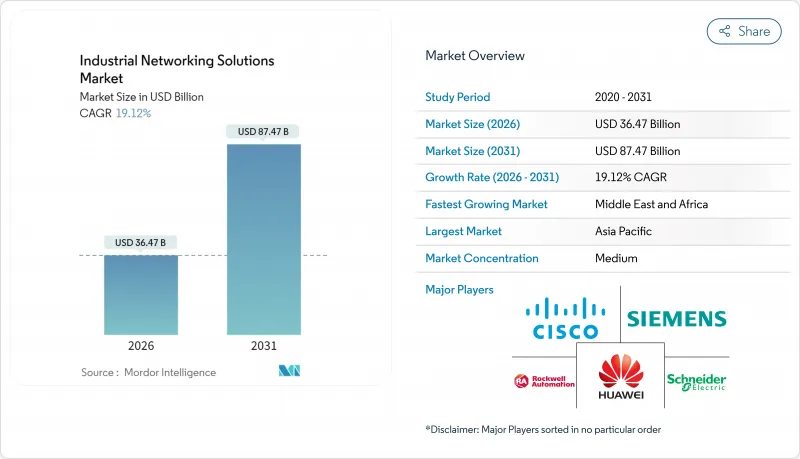
這種快速成長反映了操作技術資產和企業IT網路的快速整合,使得在日益自動化的生產環境中實現即時可視性成為可能。從傳統現場匯流排向以乙太網路為基礎的工廠車間遷移進一步推動了需求,實現了自主設備亞毫秒的延遲目標。私有5G與邊緣人工智慧的結合,透過預測性維護,將重工業的整體擁有成本降低了高達30%。在政府推動智慧製造的措施支持下,光是中國就計劃在2024年投入28億美元用於工業網路升級。這些因素共同推動工業網路解決方案市場維持結構性高成長。
全球工業網路解決方案市場趨勢與洞察
快速將支援工業物聯網的乙太網路基礎設施遷移到工廠車間
隨著工廠進行現代化改造以應對超過 1Gbps 的機器視覺工作負載,乙太網路目前已佔新建製造網路部署的 73%(高於 2020 年的 45%)。寶馬位於斯帕坦堡的工廠運營著一個私有的 5G 網路,確保視覺驅動的品質檢測 99.9% 的正常運行時間。然而,由於生產線維修成本高達 250 萬美元,中型企業採用 5G 網路的運轉率仍然較慢。
OT/IT融合推動工廠採用SD-WAN
到2024年,製造業採用SD-WAN的比例將激增340%,這主要得益於企業需要將安全策略應用於確定性的現場流量。現代汽車公司旗下子公司現代汽車電子(Hyundai Autoever)在47個站點上,透過SD-WAN技術,將網路管理成本降低了60%,應用效能提高了35%。由於傳統的VLAN分段缺乏自主移動機器人所需的彈性,支援OT的SD-WAN正逐漸成為業界標準。
現有設施中網路實體安全技能的缺口
約78%的製造商缺乏OT/網路安全人才,這延緩了他們的融合計畫。預計到2024年,與OT相關的網路安全事件將增加87%,暴露出舊有系統的漏洞。思科和羅克韋爾的「面向產業的數位化技能」舉措旨在透過在亞太地區培訓10萬名專業人員來克服這一瓶頸。
細分市場分析
到2025年,硬體收入將佔總收入的60.35%,這印證了市場對堅固耐用的交換器、路由器和網路基地台在嚴苛環境下工業網路解決方案中的依賴。高階無風扇交換器的價格通常是企業級產品的三倍,並且能夠承受持續的高溫和振動。然而,軟體和服務正以21.95%的複合年成長率快速成長,這標誌著網路監控和訂閱模式正發生決定性的轉變。西門子的SIRIUS 3RC7模組在控制層嵌入了軟體定義網路,展現了軟硬體的融合。隨著企業將網路安全加固和全天候監控外包,託管服務供應商預計在2024年將實現45%的年成長率。
由於確定性控制要求以及乙太網路APL(乙太網路應用層)1000公尺的本質安全距離,有線乙太網路預計在2025年將佔據67.55%的市場佔有率。無線技術正以25.1%的複合年成長率成長,因為私有5G網路的普及打破了自主機器人的限制,並加速了工廠的重構。豐田公司在物料搬運領域部署的5G技術實現了99.5%的可靠性,並且與銅線相比,安裝預算降低了60%。德克薩斯的超低功耗模組可將能耗降低90%,進而提升電池供電感測器的經濟性。
區域分析
亞太地區持續引領工業網路解決方案市場,預計2025年將佔據34.55%的市場佔有率,主要得益於中國政策支持的數位化和日本高產能的電子製造生態系統。該地區的成長前景依然強勁,這主要得益於印度「印度製造」計畫和東協「工業4.0」計畫推動智慧工廠的普及。北美地區緊隨其後,作為成熟的應用區域,美國聯邦政府津貼8億美元用於支持安全的OT-IT整合。歐洲受益於嚴格的網路安全指令以及德國為中小企業設立的12億歐元基金,推動了網路現代化進程的廣泛推進。中東和非洲地區雖然規模較小,但其複合年成長率將達到22.95%,成為成長最快的地區,這主要得益於沿岸地區的主要石油公司在腐蝕性沙漠和海上平台部署專用5G網路,用於鑽井設備作業。拉丁美洲的機會在於採礦業和可再生能源的擴張,這些產業需要高彈性的光纖乙太網路(EoF)拓樸結構。
其他福利:
- Excel格式的市場預測(ME)表
- 3個月的分析師支持
目錄
第1章 引言
- 研究假設和市場定義
- 調查範圍
第2章調查方法
第3章執行摘要
第4章 市場情勢
- 市場概覽
- 市場促進因素
- 快速將支援工業物聯網的乙太網路基礎設施遷移到工廠車間
- OT/IT融合推動工廠採用SD-WAN
- 透過 5G 專用網路實現超低延遲控制
- 利用邊緣人工智慧進行預測性維護,降低整體擁有成本 (TCO)
- 政府智慧製造促進措施
- 開放原始碼時間敏感網路 (TSN) 協定棧
- 市場限制
- 現有設施中網路實體安全技能的缺口
- 由於專有通訊協定的鎖定,遷移成本增加
- 工業網卡半導體供應鏈的波動性
- 無風扇工業開關設計中的功率密度限制
- 價值/供應鏈分析
- 監管環境
- 技術展望
- 波特五力分析
- 供應商的議價能力
- 買方的議價能力
- 新進入者的威脅
- 替代品的威脅
- 競爭對手之間的競爭
第5章 市場規模與成長預測
- 按組件
- 硬體
- 軟體和服務
- 按連線類型
- 有線
- 無線的
- 依部署類型
- 本地部署
- 雲
- 按最終用戶行業分類
- 車
- 金融服務
- 製造業
- 溝通
- 物流/運輸
- 採礦、石油天然氣、能源與公共產業
- 按地區
- 北美洲
- 美國
- 加拿大
- 墨西哥
- 歐洲
- 英國
- 德國
- 法國
- 義大利
- 其他歐洲地區
- 亞太地區
- 中國
- 日本
- 印度
- 韓國
- 亞太其他地區
- 中東
- 以色列
- 沙烏地阿拉伯
- 阿拉伯聯合大公國
- 土耳其
- 其他中東地區
- 非洲
- 南非
- 埃及
- 其他非洲地區
- 南美洲
- 巴西
- 阿根廷
- 南美洲其他地區
- 北美洲
第6章 競爭情勢
- 市場集中度
- 策略趨勢
- 市佔率分析
- 公司簡介
- ABB Ltd
- Advantech Co., Ltd.
- Antaira Technologies LLC
- Aruba Networks(Hewlett Packard Enterprise Co.)
- Belden Inc.
- Cisco Systems, Inc.
- Dell Technologies Inc.
- Eaton Corporation plc
- Hirschmann Automation(Belden)
- Honeywell International Inc.
- Huawei Technologies Co., Ltd.
- Juniper Networks, Inc.
- Moxa Inc.
- Nokia Corporation
- Phoenix Contact GmbH and Co. KG
- Red Lion Controls Inc.(Spectris plc)
- Rockwell Automation, Inc.
- Schneider Electric SE
- Sierra Wireless Inc.
- Siemens AG
第7章 市場機會與未來展望
Industrial networking solutions market size in 2026 is estimated at USD 36.47 billion, growing from 2025 value of USD 30.61 billion with 2031 projections showing USD 87.47 billion, growing at 19.12% CAGR over 2026-2031.
The surge reflects rapid convergence of operational-technology assets with enterprise IT networks, creating real-time visibility across increasingly automated production environments. Demand is amplified by a shift from legacy fieldbus to Ethernet-based factory floors that meets sub-millisecond latency targets for autonomous equipment. Private 5G in combination with edge AI is lowering total cost of ownership by up to 30% for heavy industries through predictive maintenance. Government smart-manufacturing stimulus is another catalyst: China alone routed USD 2.8 billion of 2024 funds into industrial networking upgrades. Together, these forces underpin a structurally high-growth trajectory for the Industrial networking solutions market.
Global Industrial Networking Solutions Market Trends and Insights
Rapid Shift to IIoT-Ready Ethernet-Based Factory Floors
Ethernet now powers 73% of new manufacturing network installs, up from 45% in 2020, as factories modernize for machine-vision workloads exceeding 1 Gbps. BMW's Spartanburg plant runs a private 5G grid that secures 99.9% uptime for vision-driven quality checks. Yet mid-size firms still face USD 2.5 million line-level retrofit costs that slow broad adoption.
Convergence of OT/IT Driving SD-WAN Adoption in Plants
SD-WAN deployments in manufacturing jumped 340% in 2024 as enterprises exported enterprise-security policies to deterministic shop-floor traffic. Hyundai AutoEver cut 60% in network management expense across 47 sites while boosting application performance 35%. Traditional VLAN segmentation lacks the agility required for autonomous mobile robots, so OT-aware SD-WAN is becoming standard.
Cyber-Physical Security Skill-Gap in Brown-Field Sites
Some 78% of manufacturers cannot find OT-cyber talent, slowing convergence plans. OT-oriented cyber incidents rose 87% in 2024, exposing legacy weaknesses. Cisco and Rockwell's Digital Skills for Industry initiative aims to train 100,000 APAC professionals to ease the bottleneck.
Other drivers and restraints analyzed in the detailed report include:
- 5G Private Networks Enabling Ultra-Low-Latency Control
- Edge-AI-Powered Predictive Maintenance Lowering TCO
- Proprietary Protocol Lock-In Inflating Migration Cost
For complete list of drivers and restraints, kindly check the Table Of Contents.
Segment Analysis
Hardware commanded 60.35% revenue in 2025, reinforcing the Industrial networking solutions market's dependence on rugged switches, routers, and access points for harsh sites. Premium fanless switches often list at triple enterprise prices, supporting sustained temperatures and vibration. However, software and services are scaling at 21.95% CAGR, signaling a decisive pivot toward AI-driven network monitoring and subscription models. Siemens' SIRIUS 3RC7 module embeds software-defined networking at the control layer, evidencing hardware-software convergence. Managed-service providers booked 45% annual growth in 2024 as firms outsourced cyber-hardening and 24X7 monitoring.
Wired Ethernet secured 67.55% share in 2025 owing to deterministic control requirements and Ethernet-APL's 1,000-m intrinsic-safety reach. Wireless is rising at a 25.1% CAGR as private 5G untethers autonomous robots and accelerates plant re-configuration. Toyota's material-handling 5G rollout clocked 99.5% reliability while slicing install budgets 60% versus copper. Ultra-low-power modules from Texas Instruments now consume 90% less energy, strengthening battery-powered sensor economics.
The Industrial Networking Solutions Market Report is Segmented by Component (Hardware, Software and Services), Type of Connectivity (Wired, Wireless), Deployment Type (On-Premises, Cloud), End-User Industry (Automotive, Financial Services, Manufacturing, Telecommunications, Logistics and Transportation, Mining, Oil and Gas, Energy and Utilities), and Geography. The Market Forecasts are Provided in Terms of Value (USD).
Geography Analysis
Asia-Pacific continues to anchor the Industrial networking solutions market with 34.55% 2025 share, propelled by China's policy-backed digitalization and Japan's high-throughput electronics manufacturing ecosystems. The region's growth outlook remains compelling as India and ASEAN economies scale smart-factory rollouts under Make-in-India and Industry4WRD programs. North America follows as a mature adopter, sustained by USD 800 million of US federal grants that subsidize secure OT-IT upgrades. Europe benefits from stringent cyber-resilience directives and Germany's EUR 1.2 billion SME fund, fostering broad-based network modernization. The Middle East & Africa region, though smaller, showcases the highest 22.95% CAGR, with Gulf oil majors installing private 5G to operate drilling assets in corrosive deserts and offshore platforms. Latin America's opportunity hinges on mining and renewable-energy build-outs that demand resilient Ethernet-over-fiber topologies.
- ABB Ltd
- Advantech Co., Ltd.
- Antaira Technologies LLC
- Aruba Networks (Hewlett Packard Enterprise Co.)
- Belden Inc.
- Cisco Systems, Inc.
- Dell Technologies Inc.
- Eaton Corporation plc
- Hirschmann Automation (Belden)
- Honeywell International Inc.
- Huawei Technologies Co., Ltd.
- Juniper Networks, Inc.
- Moxa Inc.
- Nokia Corporation
- Phoenix Contact GmbH and Co. KG
- Red Lion Controls Inc. (Spectris plc)
- Rockwell Automation, Inc.
- Schneider Electric SE
- Sierra Wireless Inc.
- Siemens AG
Additional Benefits:
- The market estimate (ME) sheet in Excel format
- 3 months of analyst support
TABLE OF CONTENTS
1 INTRODUCTION
- 1.1 Study Assumptions and Market Definition
- 1.2 Scope of the Study
2 RESEARCH METHODOLOGY
3 EXECUTIVE SUMMARY
4 MARKET LANDSCAPE
- 4.1 Market Overview
- 4.2 Market Drivers
- 4.2.1 Rapid shift to IIoT-ready Ethernet-based factory floors
- 4.2.2 Convergence of OT/IT driving SD-WAN adoption in plants
- 4.2.3 5G private networks enabling ultra-low-latency control
- 4.2.4 Edge-AI-powered predictive maintenance lowering TCO
- 4.2.5 Government smart-manufacturing stimulus packages
- 4.2.6 Open-source Time-Sensitive Networking (TSN) stacks
- 4.3 Market Restraints
- 4.3.1 Cyber-physical security skill-gap in brown-field sites
- 4.3.2 Proprietary protocol lock-in inflating migration cost
- 4.3.3 Semiconductor supply-chain volatility for industrial NICs
- 4.3.4 Power-density limits in fan-less industrial switch design
- 4.4 Value / Supply-Chain Analysis
- 4.5 Regulatory Landscape
- 4.6 Technological Outlook
- 4.7 Porter's Five Forces Analysis
- 4.7.1 Bargaining Power of Suppliers
- 4.7.2 Bargaining Power of Buyers
- 4.7.3 Threat of New Entrants
- 4.7.4 Threat of Substitutes
- 4.7.5 Competitive Rivalry
5 MARKET SIZE AND GROWTH FORECASTS (VALUE)
- 5.1 By Component
- 5.1.1 Hardware
- 5.1.2 Software and Services
- 5.2 By Type of Connectivity
- 5.2.1 Wired
- 5.2.2 Wireless
- 5.3 By Deployment Type
- 5.3.1 On-premises
- 5.3.2 Cloud
- 5.4 By End-User Industry
- 5.4.1 Automotive
- 5.4.2 Financial Services
- 5.4.3 Manufacturing
- 5.4.4 Telecommunications
- 5.4.5 Logistics and Transportation
- 5.4.6 Mining, Oil and Gas, Energy and Utilities
- 5.5 By Geography
- 5.5.1 North America
- 5.5.1.1 United States
- 5.5.1.2 Canada
- 5.5.1.3 Mexico
- 5.5.2 Europe
- 5.5.2.1 United Kingdom
- 5.5.2.2 Germany
- 5.5.2.3 France
- 5.5.2.4 Italy
- 5.5.2.5 Rest of Europe
- 5.5.3 Asia-Pacific
- 5.5.3.1 China
- 5.5.3.2 Japan
- 5.5.3.3 India
- 5.5.3.4 South Korea
- 5.5.3.5 Rest of Asia-Pacific
- 5.5.4 Middle East
- 5.5.4.1 Israel
- 5.5.4.2 Saudi Arabia
- 5.5.4.3 United Arab Emirates
- 5.5.4.4 Turkey
- 5.5.4.5 Rest of Middle East
- 5.5.5 Africa
- 5.5.5.1 South Africa
- 5.5.5.2 Egypt
- 5.5.5.3 Rest of Africa
- 5.5.6 South America
- 5.5.6.1 Brazil
- 5.5.6.2 Argentina
- 5.5.6.3 Rest of South America
- 5.5.1 North America
6 COMPETITIVE LANDSCAPE
- 6.1 Market Concentration
- 6.2 Strategic Moves
- 6.3 Market Share Analysis
- 6.4 Company Profiles (includes Global level Overview, Market level overview, Core Segments, Financials as available, Strategic Information, Market Rank/Share for key companies, Products and Services, and Recent Developments)
- 6.4.1 ABB Ltd
- 6.4.2 Advantech Co., Ltd.
- 6.4.3 Antaira Technologies LLC
- 6.4.4 Aruba Networks (Hewlett Packard Enterprise Co.)
- 6.4.5 Belden Inc.
- 6.4.6 Cisco Systems, Inc.
- 6.4.7 Dell Technologies Inc.
- 6.4.8 Eaton Corporation plc
- 6.4.9 Hirschmann Automation (Belden)
- 6.4.10 Honeywell International Inc.
- 6.4.11 Huawei Technologies Co., Ltd.
- 6.4.12 Juniper Networks, Inc.
- 6.4.13 Moxa Inc.
- 6.4.14 Nokia Corporation
- 6.4.15 Phoenix Contact GmbH and Co. KG
- 6.4.16 Red Lion Controls Inc. (Spectris plc)
- 6.4.17 Rockwell Automation, Inc.
- 6.4.18 Schneider Electric SE
- 6.4.19 Sierra Wireless Inc.
- 6.4.20 Siemens AG
7 MARKET OPPORTUNITIES AND FUTURE OUTLOOK
- 7.1 White-space and Unmet-Need Assessment

 工業網路解決方案市場:按組件、技術、部署模式、最終用戶、國家和地區分類-全球產業分析、市場規模、市場佔有率及2026年至2033年預測
 工業網路解決方案市場-2026-2032年全球市場預測
 2026-2030年全球工業有線網路市場工業自動化網路的發展趨勢與技術
 工業有線網路市場分析及預測(至2035年):類型、產品類型、服務、技術、組件、應用、部署模式、最終用戶、功能
 工業有線網路市場規模、佔有率和成長分析(按技術、組件、通訊類型、最終用戶產業和地區分類)-2026-2033年產業預測
 工業有線網路市場 - 全球產業規模、佔有率、趨勢、機會及預測(按類型、網路基礎設施、應用、最終用戶產業、地區和競爭格局分類,2021-2031年)
 工業網路解決方案市場規模、佔有率、成長及全球產業分析:依類型、應用和地區劃分的洞察與預測(2026-2034)
 工業網路解決方案市場規模、佔有率和成長分析(按產品、技術、服務、應用、網路類型、垂直產業和地區分類)-2026年至2033年產業預測
 工業網路技術:2029年前的商機與預測