


 |
市場調查報告書
商品編碼
1906156
PET瓶坯:市場佔有率分析、產業趨勢與統計、成長預測(2026-2031年)PET Preform - Market Share Analysis, Industry Trends & Statistics, Growth Forecasts (2026 - 2031) |
||||||

※ 本網頁內容可能與最新版本有所差異。詳細情況請與我們聯繫。
2025年PET瓶坯市場價值為232.7億美元,預計到2031年將達到263.6億美元,2026年為237.6億美元。
預計在預測期(2026-2031 年)內,複合年成長率將達到 2.10%。
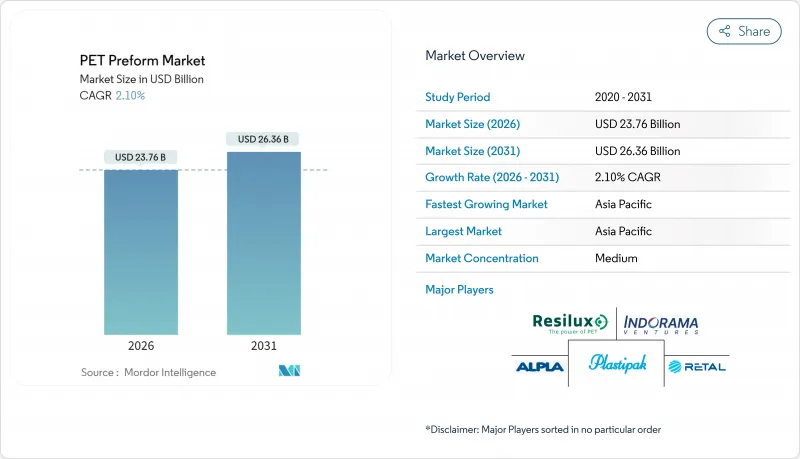
這一成長軌蹟的驅動力來自飲料行業需求的逐步成長、不斷擴大的回收利用要求以及持續推進的輕量化項目,所有這些因素都支撐著該行業穩步而強勁的擴張。新興經濟體可支配收入的增加、歐盟要求到2030年飲料瓶中含有30%再生材料的強制規定,以及本地動力吹塑成型技術的穩步發展,都促使加工商轉向材料高效利用的設計和垂直整合的回收網路。同時,精對純對苯二甲酸(PTA)和乙二醇(MEG)等原物料價格的波動性加劇,持續擠壓利潤空間,促使企業採用策略採購夥伴關係和避險策略。此外,繫繩式瓶蓋技術的快速商業化推動了模具升級,這有利於那些能夠提供工程支援和高腔模具能力相結合的解決方案的供應商。競爭優勢體現在可追溯再生PET(rPET)流、工廠能源最佳化和多層阻隔技術等方面的專業知識,從而支撐著一個強調規模和製程創新的市場環境。
全球PET瓶坯市場趨勢與洞察
飲料業需求不斷成長
強勁的飲料銷售持續支撐PET瓶坯市場銷售成長,尤其是在新興經濟體,都市化推動了軟性飲料和果汁人均消費量的成長。預計到2024年,巴西食品加工業的收入將達到2,310億美元,證實了包裝需求的成長,對瓶坯加工商而言是一個好消息。輕量化仍然是一項關鍵的戰略手段,新一代模具冷卻技術與改進的樹脂IV控制相結合,可在不影響頂部承重強度的前提下,逐克地減輕重量。加工商也將目光投向了高階營養補充品的即飲市場,這類產品需要高透明度和吸氧添加劑。飲料填充商與機械供應商之間的合作正在縮短從設計到上市的周期,而數位雙胞胎模擬則正在提高瓶頸性能並減少原型製作次數。這種多元化的客戶群正在推動主要設備製造商的模具升級和售後服務業務收益的成長。
新興經濟體瓶裝水消費量激增
在南亞和東南亞,由於城市供水基礎設施發展不平衡,對PET瓶坯的需求正在成長。在印度、印尼和越南等都市區,品牌瓶裝水的消費量正經歷兩位數的成長,預計從2025年起,這些國家將強制要求瓶裝水必須含有最低比例的再生材料。近期的一些資本投資,例如SKC集團在越南投資1億美元建設的生物分解性塑膠工廠,顯示投資者正在尋找成本效益高且能夠同時獲得原生樹脂和再生樹脂的位置。儘管永續性正在活性化,但確保安全飲用水的供應仍然是許多城市的當務之急,這強化了消費模式,以維持高性能產品的訂單。然而,成本敏感性迫使加工商保持精益運營,並對沖從2024年起PTA和MEG價格波動帶來的風險。
塑膠稅法和生產者責任延伸制度(EPR)成本對利潤率造成壓力。
歐洲生產商目前正將英國塑膠稅(每噸423英鎊)和德國一次性塑膠基金附加稅累計,這兩項稅收加起來可能使息稅折舊攤銷EBITDA獲利率)下降多達150個基點。此外,用於追蹤聚合物來源和檢驗再生材料含量聲明的IT系統投資也增加了管理成本。大規模跨國公司可以透過多元化的業務組合分攤成本,而規模較小的區域性公司則面臨更高的單位合規負擔,這促使它們加速轉向策略合作和收購。
細分市場分析
截至2025年,原生PET將佔PET瓶坯市場75.38%的佔有率,這主要得益於其成熟的供應鏈和穩定的熔融性能,有利於高速成型。然而,再生PET預計到2031年將以3.18%的複合年成長率成長,成為所有材料中成長最快的,這主要受品牌所有者追求循環經濟目標以及監管機構對最低rPET含量要求的推動。由於化學回收技術的進步,能夠再生食品接觸相容的直接替代單體,再生級PET瓶坯市場預計將超過整體市場成長速度。例如,DePoly近期向瑞士的解聚產能資金籌措2,300萬美元,進一步增強了投資者對先進回收技術經濟效益的信心。
展望2030年後,如果原料規模化生產面臨的挑戰得到緩解,生物基PET的應用範圍可能會進一步擴大。根據SpecialChem的一份報告顯示,Neste、ENEOS和三菱商事已開始使用可再生石腦油作為前驅原料進行試點生產,為未來低碳顆粒供應鋪平了道路。目前,高昂的生產成本和有限的產量限制了生物基PET在高階小眾市場的定位。然而,技術藍圖表明,生物基PET的長期發展路徑是擺脫對化石資源的依賴。最終,材料成分的多樣性將對能夠適應不同黏度指數(IV)和顏色規格且無需停機的靈活乾燥、稱重和檢測系統提出更高的要求。
PET瓶坯市場報告材料類型(原生PET、再生PET (rPET)、生物基PET)、應用領域(碳酸飲料及水、食品及乳製品、個人護理及化妝品、酒精飲料、其他應用)和地區(亞太地區、北美地區、歐洲地區、南美地區、中東和非洲地區)進行細分。市場預測以美元計價。
區域分析
亞太地區是PET瓶坯市場的核心,預計2025年將佔據46.20%的市場佔有率,並預計在2031年之前以2.78%的複合年成長率成長。中國供應具有成本競爭力的樹脂和模具,而印度將於2025年4月生效的強制性飲料瓶30%再生材料含量要求,正推動清洗和造粒生產線前所未有的投資。 Indorama Ventures、Dhunseri和Varun Beverages已成立一家合資企業,計劃在印度各地建立多個回收基地,以應對rPET供不應求並滿足即將生效的監管要求。
歐洲仍然是監管最嚴格的市場。儘管回收基礎設施已覆蓋四分之三的寶特瓶,但食品級rPET供應緊張,持續推高PET瓶的溢價。 2024年即將生效的固定瓶蓋法規將推動瓶頸形狀的大規模變革,通常還會伴隨輕量化設計的改進,從而減少10-15%的樹脂用量。嚴格的塑膠稅收制度和不斷變化的環境調整收費系統正促使填充商重新評估長途物流成本,並試行使用可重複填充的玻璃容器。同時,酵素回收技術的研究與開發也在同步推進,凸顯了該地區主導全球聚合物循環利用最佳實踐的雄心。
在北美,瓶裝水和機能飲料的需求強勁,消費者也越來越願意為再生材料產品付費。化學回收新興企業吸引了大量創業投資資金,而州級生產者責任延伸法(EPR)也正在加州、奧勒岡州和科羅拉多州等州推廣。南美洲的食品加工業蓬勃發展,其中以巴西主導,正經歷穩定擴張,但受到貨幣波動和間歇性政治不確定性。
其他福利:
- Excel格式的市場預測(ME)表
- 3個月的分析師支持
目錄
第1章 引言
- 研究假設和市場定義
- 調查範圍
第2章調查方法
第3章執行摘要
第4章 市場情勢
- 市場概覽
- 市場促進因素
- 飲料業需求不斷成長
- 新興經濟體瓶裝水消費量激增
- 透過再生塑膠(rPET)含量促進永續性
- 歐盟指令強制規定固定上限,推動預成型件重新設計需求
- 現場電動吹塑成型可即時 (JIT) 客製化
- 市場限制
- PTA和MEG價格的波動給轉換器的利潤率帶來了壓力。
- 塑膠稅收相關法律和生產者責任延伸(EPR)成本對利潤基礎造成壓力。
- 根據歐盟2029年回收目標,碳酸軟性飲料(CSD)包裝將過渡到可重複填充玻璃包裝。
- 價值鏈分析
- 波特五力模型
- 供應商的議價能力
- 買方的議價能力
- 新進入者的威脅
- 替代品的威脅
- 競爭程度
第5章 市場規模與成長預測
- 依材料類型
- 處女寵物
- 再生PET(rPET)
- 生物基PET
- 透過使用
- 碳酸飲料和水
- 食品和乳製品
- 個人護理及化妝品
- 酒精飲料
- 其他用途(家庭清潔)
- 按地區
- 亞太地區
- 中國
- 印度
- 日本
- 韓國
- 印尼
- 越南
- 泰國
- 馬來西亞
- 亞太其他地區
- 北美洲
- 美國
- 加拿大
- 墨西哥
- 歐洲
- 德國
- 英國
- 法國
- 義大利
- 西班牙
- 北歐國家
- 土耳其
- 俄羅斯
- 其他歐洲地區
- 南美洲
- 巴西
- 阿根廷
- 哥倫比亞
- 南美洲其他地區
- 中東和非洲
- 沙烏地阿拉伯
- 阿拉伯聯合大公國
- 卡達
- 南非
- 奈及利亞
- 埃及
- 其他中東和非洲地區
- 亞太地區
第6章 競爭情勢
- 市場集中度
- 策略趨勢
- 市佔率(%)/排名分析
- 公司簡介
- Alpla
- CAIBA
- Chemco
- Doloop
- Duy Tan Plastic Company
- Esterform Ltd
- Indorama Ventures Public Company Limited
- KOKSAN PET VE PLASTIK AMBALAJ SANAYI VE TICARET AS
- NOVAPET SA
- Pet Star
- Petainer Ltd
- PGD PLASTIQUES
- Plastipak Holdings Inc.
- Polisan Hellas
- RESILUX NV
- Retal Industries Ltd
- Schwarz Produktion Stiftung & Co. KG
- SGT
- TPAC
- Valgroup Italia Srl
- Varioform PET
- Wiegand-Glas Holding GmbH
第7章 市場機會與未來展望
The PET Preform Market was valued at USD 23.27 billion in 2025 and estimated to grow from USD 23.76 billion in 2026 to reach USD 26.36 billion by 2031, at a CAGR of 2.10% during the forecast period (2026-2031).
This forward trajectory stems from incremental demand in beverages, expanding recycling mandates and ongoing lightweighting programs that collectively support modest but resilient expansion. Rising disposable incomes in emerging economies, the European Union's 30% recycled-content requirement for beverage bottles by 2030, and steady progress in electrified on-site blow-molding are steering converters toward material-efficient designs and vertically integrated recycling networks. Intensified feedstock volatility for purified terephthalic acid (PTA) and mono-ethylene glycol (MEG) continues to compress margins, prompting strategic procurement alliances and hedging practices. Meanwhile, the rapid commercialization of tethered-cap technology is driving tooling upgrades that favor suppliers able to bundle engineering support with high-cavitation mold capabilities. Competitive differentiation increasingly revolves around traceable recycled PET (rPET) streams, factory energy optimization, and multi-layer barrier know-how, underpinning a market environment that rewards operational scale and process innovation.
Global PET Preform Market Trends and Insights
Growing Demand from Beverage Industry
Robust beverage sales continue to anchor volume growth for the PET preforms market, especially in emerging economies where per-capita soft-drink and juice consumption rises alongside urbanization. Brazil's food-processing revenues touched USD 231 billion in 2024, underscoring a packaging pull that benefits preform converters. Lightweighting remains a critical strategic lever, enabled by next-generation mold cooling and improved resin IV control that together shave gram weight without compromising top-load strength. Converters also capitalize on premium ready-to-drink nutraceutical beverages, which demand preforms with high clarity and oxygen-scavenging additives. Partnerships between beverage fillers and machinery suppliers shorten design-to-market cycles, while digital twin simulations improve neck-finish performance and reduce trial runs. This evolving customer mix boosts tooling upgrades and after-sales service revenues for leading equipment makers.
Surge in Bottled-Water Consumption in Emerging Economies
Persistently uneven municipal water infrastructure fuels PET preform demand in South and Southeast Asia. Urban centers in India, Indonesia, and Vietnam record double-digit volume gains for branded bottled water, with local mandates now requiring minimum recycled content beginning in 2025. Recent capital commitments, such as SKC Group's USD 100 million biodegradable-plastic plant in Vietnam, demonstrate how investors scout for cost-advantaged sites capable of supplying both virgin and recycled resin streams. Although sustainability discourse intensifies, the immediate priority in many cities remains access to safe drinking water, reinforcing a consumption pattern that sustains high-performance order books. Cost sensitivity, however, forces converters to maintain lean operations and hedge PTA and MEG price swings that have widened since 2024.
Plastic-Tax Legislation and EPR Fees Tightening Profit Pools
European producers now budget for the United Kingdom's GBP 423/t plastics tax and Germany's Single-Use Plastics Fund levy, which together can erode EBITDA margins by up to 150 basis points. Administrative overhead also rises as firms invest in IT systems to track polymer origin and validate recycled content declarations. While large multinationals amortize costs across diverse portfolios, smaller regional players confront steeper per-unit compliance burdens, accelerating the flight toward strategic partnerships or acquisitions.
Other drivers and restraints analyzed in the detailed report include:
- Sustainability Push for Recycled (rPET) Content
- Mandatory Tethered-Cap EU Directive Boosting Preform Redesign Volumes
- Shift to Refillable Glass in CSD Under EU 2029 Reuse Targets
For complete list of drivers and restraints, kindly check the Table Of Contents.
Segment Analysis
Virgin PET dominated 75.38% of the PET preforms market in 2025, leveraged by entrenched supply chains and consistent melt properties that simplify high-speed molding. Recycled PET is, however, forecast to deliver a 3.18% CAGR to 2031, the swiftest rise among materials, as brand owners chase circularity targets and regulators mandate minimum rPET thresholds. The PET preforms market size for recycled grades is expected to outpace overall growth, driven by chemical-recycling breakthroughs that regenerate drop-in monomers compatible with food contact. Investors such as DePoly recently gathered USD 23 million to fund depolymerization capacity in Switzerland, reinforcing confidence in advanced recycling economics.
Beyond 2030, bio-based PET could gain more traction once feedstock scaling challenges abate. SpecialChem reports that Neste, ENEOS and Mitsubishi Corporation have started pilot runs using renewable naphtha as precursor feedstock, opening future avenues for low-carbon pellet supply. For now, high production costs and limited volumes confine bio-based PET to niche premium segments, yet the technology roadmap signals a long-term diversification path away from fossil resources. Ultimately, material-mix volatility places a premium on flexible drying, dosing and inspection systems able to handle variable IV and color specs without line stoppages.
The PET Preforms Report is Segmented by Material Type (Virgin PET, Recycled PET (rPET), and Bio-Based PET), Application (Carbonated Soft Drinks and Water, Food and Dairy, Personal Care and Cosmetics, Alcoholic Beverages, and Other Applications), and Geography (Asia-Pacific, North America, Europe, South America, and Middle-East and Africa). The Market Forecasts are Provided in Terms of Value (USD).
Geography Analysis
Asia-Pacific possesses the fulcrum of the PET preforms market, harnessing 46.20% revenue share in 2025 and tracking a 2.78% CAGR to 2031. China supplies cost-advantaged resin and molds, while India's April 2025 mandate for 30% recycled content in beverage bottles spurs unprecedented investment in washing and pelletizing lines. Indorama Ventures, Dhunseri and Varun Beverages formed a joint venture aimed at multiple recycling hubs across India to close the rPET gap and meet incoming compliance deadlines.
Europe follows as the most regulation-intensive market. Collection infrastructure already secures three-quarters of PET bottles, but tight food-grade rPET availability continues to underpin premium pricing. The tethered-cap law, effective 2024, triggered large-scale neck-finish conversions, often bundled with lightweight redesigns that trimmed resin use by 10-15%. Aggressive plastic-tax frameworks and evolving eco-modulation fee schedules encourage fillers to re-evaluate long-haul logistics costs and explore refillable glass pilots. Parallel research and development into enzymatic recycling underlines the region's aspiration to lead global polymer circularity best practices.
North America is characterized by solid demand for bottled water and functional beverages alongside increasing willingness to pay for recycled content. Chemical-recycling startups secure substantial venture funding, while state-level EPR legislation now extends to California, Oregon and Colorado. South America, dominated by Brazil's vibrant food-processing sector, registers steady expansion tempered by currency volatility and sporadic political uncertainty.
- Alpla
- CAIBA
- Chemco
- Doloop
- Duy Tan Plastic Company
- Esterform Ltd
- Indorama Ventures Public Company Limited
- KOKSAN PET VE PLASTIK AMBALAJ SANAYI VE TICARET AS
- NOVAPET SA
- Pet Star
- Petainer Ltd
- PGD PLASTIQUES
- Plastipak Holdings Inc.
- Polisan Hellas
- RESILUX NV
- Retal Industries Ltd
- Schwarz Produktion Stiftung & Co. KG
- SGT
- TPAC
- Valgroup Italia Srl
- Varioform PET
- Wiegand-Glas Holding GmbH
Additional Benefits:
- The market estimate (ME) sheet in Excel format
- 3 months of analyst support
TABLE OF CONTENTS
1 Introduction
- 1.1 Study Assumptions and Market Definition
- 1.2 Scope of the Study
2 Research Methodology
3 Executive Summary
4 Market Landscape
- 4.1 Market Overview
- 4.2 Market Drivers
- 4.2.1 Growing demand from beverage industry
- 4.2.2 Surge in bottled water consumption in emerging economies
- 4.2.3 Sustainability push for recycled (rPET) content
- 4.2.4 Mandatory tethered-cap EU directive boosting preform redesign volumes
- 4.2.5 Electrified on-site blow-molding enabling JIT customization
- 4.3 Market Restraints
- 4.3.1 Volatile PTA and MEG prices disrupting converter margins
- 4.3.2 Plastic-tax legislation and EPR fees tightening profit pools
- 4.3.3 Shift to refillable glass in CSD under EU 2029 reuse targets
- 4.4 Value Chain Analysis
- 4.5 Porter's Five Forces
- 4.5.1 Bargaining Power of Suppliers
- 4.5.2 Bargaining Power of Buyers
- 4.5.3 Threat of New Entrants
- 4.5.4 Threat of Substitutes
- 4.5.5 Degree of Competition
5 Market Size and Growth Forecasts (Value)
- 5.1 By Material Type
- 5.1.1 Virgin PET
- 5.1.2 Recycled PET (rPET)
- 5.1.3 Bio-based PET
- 5.2 By Application
- 5.2.1 Carbonated Soft Drinks and Water
- 5.2.2 Food and Dairy
- 5.2.3 Personal Care and Cosmetics
- 5.2.4 Alcoholic Beverages
- 5.2.5 Other Applications (Household Cleaning)
- 5.3 By Geography
- 5.3.1 Asia-Pacific
- 5.3.1.1 China
- 5.3.1.2 India
- 5.3.1.3 Japan
- 5.3.1.4 South Korea
- 5.3.1.5 Indonesia
- 5.3.1.6 Vietnam
- 5.3.1.7 Thailand
- 5.3.1.8 Malaysia
- 5.3.1.9 Rest of Asia-Pacific
- 5.3.2 North America
- 5.3.2.1 United States
- 5.3.2.2 Canada
- 5.3.2.3 Mexico
- 5.3.3 Europe
- 5.3.3.1 Germany
- 5.3.3.2 United Kingdom
- 5.3.3.3 France
- 5.3.3.4 Italy
- 5.3.3.5 Spain
- 5.3.3.6 NORDIC Countries
- 5.3.3.7 Turkey
- 5.3.3.8 Russia
- 5.3.3.9 Rest of Europe
- 5.3.4 South America
- 5.3.4.1 Brazil
- 5.3.4.2 Argentina
- 5.3.4.3 Colombia
- 5.3.4.4 Rest of South America
- 5.3.5 Middle-East and Africa
- 5.3.5.1 Saudi Arabia
- 5.3.5.2 United Arab Emirates
- 5.3.5.3 Qatar
- 5.3.5.4 South Africa
- 5.3.5.5 Nigeria
- 5.3.5.6 Egypt
- 5.3.5.7 Rest of Middle-East and Africa
- 5.3.1 Asia-Pacific
6 Competitive Landscape
- 6.1 Market Concentration
- 6.2 Strategic Moves
- 6.3 Market Share (%)/Ranking Analysis
- 6.4 Company Profiles (includes Global level Overview, Market level overview, Core Segments, Financials as available, Strategic Information, Market Rank/Share, Products and Services, Recent Developments)
- 6.4.1 Alpla
- 6.4.2 CAIBA
- 6.4.3 Chemco
- 6.4.4 Doloop
- 6.4.5 Duy Tan Plastic Company
- 6.4.6 Esterform Ltd
- 6.4.7 Indorama Ventures Public Company Limited
- 6.4.8 KOKSAN PET VE PLASTIK AMBALAJ SANAYI VE TICARET AS
- 6.4.9 NOVAPET SA
- 6.4.10 Pet Star
- 6.4.11 Petainer Ltd
- 6.4.12 PGD PLASTIQUES
- 6.4.13 Plastipak Holdings Inc.
- 6.4.14 Polisan Hellas
- 6.4.15 RESILUX NV
- 6.4.16 Retal Industries Ltd
- 6.4.17 Schwarz Produktion Stiftung & Co. KG
- 6.4.18 SGT
- 6.4.19 TPAC
- 6.4.20 Valgroup Italia Srl
- 6.4.21 Varioform PET
- 6.4.22 Wiegand-Glas Holding GmbH
7 Market Opportunities and Future Outlook
- 7.1 White-space and Unmet-Need Assessment


