


 |
市場調查報告書
商品編碼
1906155
歐洲旅居車:市場佔有率分析、產業趨勢與統計、成長預測(2026-2031)Europe Motor Home - Market Share Analysis, Industry Trends & Statistics, Growth Forecasts (2026 - 2031) |
||||||

※ 本網頁內容可能與最新版本有所差異。詳細情況請與我們聯繫。
預計到 2026 年,歐洲旅居車市場價值將達到 253.3 億美元,高於 2025 年的 234.4 億美元。
預計到 2031 年將達到 372.4 億美元,2026 年至 2031 年的複合年成長率為 8.05%。
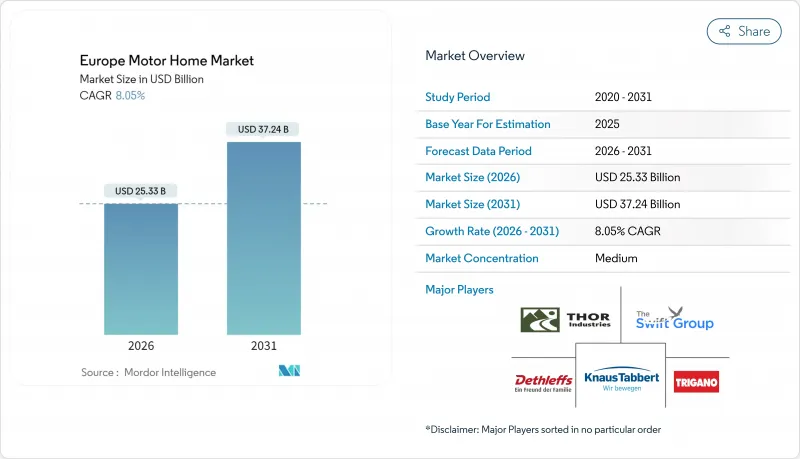
在歐洲,休閒、工作和交通的整合日益加深,推動了房車市場成長,其成長超過了整個汽車產業。旅居車因其隱私、柔軟性和成本控制優勢,正在取代飯店。隨著嬰兒潮世代退休,他們擁有豐厚的退休金收入,因此更加重視旅途舒適度;而數位遊牧者則利用車載互聯功能,將旅行延伸到傳統假期之外。歐盟對低排放交通途徑的監管日益嚴格,促使歐盟加強對露營地和公共充電基礎設施電氣化的投入,從而提升了消費者對新興純電動車款的信心。平台租賃服務的普及使得人們無需擁有車輛即可享受駕駛樂趣,從而加劇了市場競爭,推動了銷售成長,並為製造商帶來了持續的車隊訂單。生活方式的改變、環境政策的推行以及數位化零售的蓬勃發展,使得歐洲休閒車市場的發展軌跡比傳統乘用車更為穩健。
歐洲旅居車市場趨勢與洞察
休閒旅遊與「居家度假」文化的蓬勃發展
2024年,歐盟旅遊業的住宿突破30億,創下歷史新高。國內旅遊的成長延長了平均旅行時長,淡化了季節性,從而帶動了淡季期間對露營車的需求。雖然地中海地區仍吸引53%的露營者,但隨著監管的放鬆,北歐的野外露營也越來越受歡迎,偏遠地區的可及性也隨之提高。通貨膨脹和地緣政治風險正促使人們將自由裁量權支出轉向區域旅行,進一步推動了對旅居車(無論是自有還是租賃)的需求。這些趨勢在經濟不確定性中支撐了房車銷售的持續成長。
嬰兒潮世代與提早退休者的老化
2025年,歐洲五分之一的人口將達到61至79歲,隨著退休人員將舒適性、健康和成本控制置於速度之上,汽車需求將大幅增加。目前,老年人在歐盟住宿中約佔四分之一,他們通常選擇全年使用的車輛而非季節性租賃。退休時間的延長擴大了潛在客戶群,而多代同堂的旅行也讓年輕的親屬加入用戶層。這項人口結構變化有利於延長產品生命週期,並穩定二手車價格,從而鼓勵退休人員升級到更大或更適合長期旅行的車款。
高昂的初始購買和維護成本
疫情期間的供應限制導致標價較2020年以前上漲了近三分之一。雖然與經銷商的談判緩解了部分影響,但對於首次購車者而言,價格仍然是一大障礙。隨著車輛配備駕駛輔助技術(需要鋰電池、熱泵和專用維護工具),運作成本也不斷上升。這種影響在東歐和南歐尤為顯著,因為這些地區的居民可支配所得低於西歐。儘管融資管道有所改善,但跨境融資的分散意味著潛在車主必須依賴與房車折舊曲線不匹配的普通汽車貸款。
細分市場分析
到2025年,C級旅居車將佔歐洲旅居車市場的49.12%,反映出消費者對寬敞內部空間以滿足家庭需求的持續需求。同時,B級露營車預計將以13.61%的複合年成長率成長,這反映了都市化的加快以及消費者希望擁有一輛既能通勤又能住宅的車輛。歷史中心的停車限制和道路寬度限制推動了可停放在標準停車位的緊湊型廂型車的需求。製造商正在利用現有的輕型商用車平台來降低生產成本並加速電氣化轉型。歐洲旅居車市場正朝著多功能化方向發展,吸引著注重易用性和類似智慧型手機的數位介面的年輕消費群體。
大型A級房車價格仍居高不下,但卻面臨基礎設施方面的障礙:很少有露營地能夠容納超過8公尺的車輛,而且低排放區(LEZ)的規定通常也禁止重型車輛底盤。為了避免這些風險,製造商正在試驗自主拖車軸,使牽引車輛能夠在狹小空間內自主定位。在所有車型類別中,整合式太陽能發電系統、鋰電池和基於應用程式的診斷技術的引入,進一步模糊了傳統的車輛分類,因為買家的關注點已從簡單的面積轉向能源自主性和用戶體驗。
由於柴油車擁有豐富的加油站、強大的扭力輸出和久經考驗的可靠性,預計到2025年,柴油車將佔據歐洲房旅居車市場87.65%的佔有率。然而,純電動車型的商業化進程最為迅猛,年複合成長率高達13.85%。歐盟計畫在2030年安裝350萬個公共充電樁,並為露營地提供補貼,這項措施直接瞄準了歐洲旅居車市場。 Thor Industries的A級混合動力概念車實現了500英里(約800公里)的綜合續航里程,預示著房車在重量能量效率方面即將取得突破性進展。
汽油車仍將是那些擔心柴油車禁令但又無法完全轉向電動車的消費者的另一種選擇。混合動力系統填補了這一空白,為區域旅行者提供柔軟性的充電方式,同時又不犧牲負載容量。隨著電池能量密度的提高,設計師們正在縮短後懸並降低地板高度,彌補早期電動原型車在內部佈局方面存在的不足。因此,我們預計,一旦人們對車輛殘值充滿信心,並且公共快速充電網路日趨成熟,動力系統構成比將迅速重新平衡。
歐洲旅居車市場報告按類型(A級、B級、C級)、動力類型(柴油、汽油、其他)、最終用戶(個人買家、租賃/共享車隊、其他)、銷售管道(OEM授權經銷商、線上市場、其他)、長度/尺寸(6米以下、6-7.5米、7.5米以上)和國家/地區(例如德國)進行細分。市場預測以價值(美元)和銷售(輛)為單位。
其他福利:
- Excel格式的市場預測(ME)表
- 3個月的分析師支持
目錄
第1章 引言
- 研究假設和市場定義
- 調查範圍
第2章調查方法
第3章執行摘要
第4章 市場情勢
- 市場概覽
- 市場促進因素
- 休閒旅遊的激增和「居家度假」文化的興起
- 嬰兒潮世代老化與提早退休人口結構
- 拓展數位化房車市場
- 遠距辦公的普及導致了長期移動居住的出現。
- 由歐盟旅遊津貼資助的露營基礎建設
- 北歐露營法規的放寬刺激了潛在需求。
- 市場限制
- 高昂的初始購買和維護成本
- 城市層級的柴油車禁令以及低排放區(LEZ)的擴張限制了車輛通行。
- 停車限制和露營地使用限制
- 2024-2025年由於供應過剩,價格將下降
- 價值/供應鏈分析
- 監管環境
- 技術展望
- 波特五力分析
- 新進入者的威脅
- 買方的議價能力
- 供應商的議價能力
- 替代品的威脅
- 競爭對手之間的競爭
第5章 市場規模和成長預測(價值和數量)
- 按類型
- A級
- B級(露營車)
- C類(壁龕式/半整合式)
- 透過推廣
- 柴油引擎
- 汽油
- 混合
- 電池式電動車
- 最終用戶
- 個人直接買家
- 租賃和共享車輛
- 企業/活動/飯店車隊
- 按銷售管道
- 原廠授權經銷商
- 網路市集
- 直接面對消費者(工廠直銷)
- 按長度和尺寸
- 6米或以下
- 6至7.5米
- 超過7.5米
- 按國家/地區
- 德國
- 法國
- 英國
- 義大利
- 西班牙
- 荷蘭
- 瑞典
- 挪威
- 其他歐洲地區
第6章 競爭情勢
- 市場集中度
- 策略趨勢
- 市佔率分析
- 公司簡介
- Erwin Hymer Group
- Trigano SA
- Thor Industries Inc.
- Knaus Tabbert AG
- Rapido Group
- Swift Group
- Dethleffs GmbH and Co. KG
- Eura Mobil GmbH
- Groupe Pilote
- Rimor
- Adria Mobil
- Auto-Trail
- Burstner GmbH
- Laika Caravans
- Hobby Wohnwagenwerk
- Carthago Reisemobilbau
- Westfalia Mobil
- Possl Group
- Chausson(Groupe Trigano)
- Sunlight GmbH
- Malibu GmbH
第7章 市場機會與未來展望
The European motor homes market size in 2026 is estimated at USD 25.33 billion, growing from 2025 value of USD 23.44 billion with 2031 projections showing USD 37.24 billion, growing at 8.05% CAGR over 2026-2031.
Market momentum outpaces the broader automotive landscape because Europeans are blending leisure, work, and mobility, choosing motorhomes over hotels for privacy, flexibility, and cost control. Aging baby boomers with healthy pensions favor comfort on the move, while digital nomads rely on on-board connectivity to extend trips beyond classic holiday windows. Regulatory emphasis on lower-emission transport channels EU funding toward campground electrification and public charging, lifting buyer confidence in emerging battery-electric formats. Competition intensifies as platform-based rentals broaden access without upfront ownership, fueling unit volumes and giving manufacturers recurring fleet orders. The tight interplay between lifestyle shifts, environmental policy and digital retail puts the Europe recreational vehicle market on a structurally higher growth path than conventional passenger cars.
Europe Motor Home Market Trends and Insights
Rapid Rise in Recreational Travel And "Staycation" Culture
In 2024, the European Union achieved a record milestone in tourism, with accommodations hosting over 3 billion nights. Higher domestic travel has lengthened average trips, reduced seasonality, and pushed camper demand into the shoulder months. Mediterranean destinations still attract 53% of campers, yet Nordic wild-camping gains traction as deregulation makes remote sites easier to access. Inflation and geopolitical risk redirect discretionary spending toward local journeys, reinforcing the appeal of privately owned or rented motorhomes. These patterns support sustained volume growth even during economic uncertainty.
Aging Baby-Boomer and Early-Retirement Demographics
Citizens aged 61-79 will represent one-fifth of Europe's population in 2025, driving predictable demand because retirees prioritize comfort, health and cost control over speed. Seniors already account for nearly one-quarter of all EU tourism nights, frequently choosing vehicles they can drive year-round rather than paying for seasonal rentals. Extended retirement horizons enlarge the addressable base, while multi-generational trips bring younger relatives into the user pool. The demographic tailwind underpins long product cycles and stabilizes resale values, encouraging fresh purchases when pensioners upgrade to larger or electrified models suited for longer stays.
High Upfront Purchase and Maintenance Costs
Pandemic-era supply constraints forced sticker prices up to one-third above pre-2020 levels, and though dealer negotiations soften the hit, affordability remains an acute barrier for first-time buyers. Running expenses climb as models add lithium batteries, heat pumps and driver-assist technology requiring specialized service tools. Eastern and Southern Europe feel the impact most because disposable incomes lag Western standards. Financing options are improving, yet fragmented across borders, leaving potential owners reliant on general automotive loans that rarely match RV depreciation curves.
Other drivers and restraints analyzed in the detailed report include:
- Expansion of Digital RV-Rental Marketplaces
- Remote-Work Lifestyles Enabling Long-Term Mobile Living
- City-Level Diesel Bans and LEZ Expansion Curbing Access
For complete list of drivers and restraints, kindly check the Table Of Contents.
Segment Analysis
Class C motorhomes represented 49.12% of Europe's motorhome market size in 2025, illustrating continued appetite for spacious interiors that meet family needs. However, Class B campervans are projected to post a 13.61% CAGR, reflecting rising urbanization and user desire for a single vehicle that can serve as both commuter and holiday home. Parking regulations and road-width limits in historic European centers tilt momentum to compact vans that fit standard spaces. Manufacturers leverage existing light-commercial platforms, reducing production cost and enabling faster electrification rollouts. The European motor homes market thus pivots toward versatility, drawing younger buyers who value maneuverability and smartphone-like digital interfaces.
Large Class A units still command premium pricing but confront infrastructure barriers: few campsites host >8 m rigs, and LEZ rules often exclude heavy chassis. To hedge, builders experiment with self-driving caravan axles that let towable units reposition autonomously within cramped plots. Across all categories, integrated solar, lithium storage, and app-based diagnostics shift buyer focus from raw square meters to energy autonomy and user experience, further blurring traditional type distinctions.
Diesel retains 87.65% of the European motor homes market share in 2025, explained by abundant refueling, torque, and proven reliability, yet battery-electric models show the fastest commercialization path with a 13.85% CAGR. EU plans for 3.5 million public chargers by 2030, plus campground-level grants, directly target the European motor homes market. Thor Industries' hybrid Class A concept demonstrates 500-mile combined range, signaling impending breakthroughs in weight-to-energy ratios.
Gasoline remains a niche alternative for users wary of diesel bans but unwilling to commit to full electrification. Hybrid-electric drive trains bridge gaps, giving rural travelers charging flexibility without sacrificing payload. Designers shorten rear overhangs and lower floor height as battery density improves, correcting historic compromises that limited interior layouts on early electric prototypes. The propulsion mix is therefore poised for rapid rebalancing once residual-value confidence firms and public fast-charge coverage mature.
The Europe Motor Homes Report is Segmented by Type (Class A, Class B, and Class C), Propulsion (Diesel, Gasoline, and More), End User (Direct Individual Buyers, Rental and Sharing Fleets, and More), Sales Channel (OEM-Authorized Dealers, Online Marketplaces, and More), Length/Size (Up To 6m, 6-7. 5m, and Above 7. 5m), and Country (Germany and More). The Market Forecasts are Provided in Terms of Value (USD) and Volume (Units).
List of Companies Covered in this Report:
- Erwin Hymer Group
- Trigano S.A.
- Thor Industries Inc.
- Knaus Tabbert AG
- Rapido Group
- Swift Group
- Dethleffs GmbH and Co. KG
- Eura Mobil GmbH
- Groupe Pilote
- Rimor
- Adria Mobil
- Auto-Trail
- Burstner GmbH
- Laika Caravans
- Hobby Wohnwagenwerk
- Carthago Reisemobilbau
- Westfalia Mobil
- Possl Group
- Chausson (Groupe Trigano)
- Sunlight GmbH
- Malibu GmbH
Additional Benefits:
- The market estimate (ME) sheet in Excel format
- 3 months of analyst support
TABLE OF CONTENTS
1 Introduction
- 1.1 Study Assumptions and Market Definition
- 1.2 Scope of the Study
2 Research Methodology
3 Executive Summary
4 Market Landscape
- 4.1 Market Overview
- 4.2 Market Drivers
- 4.2.1 Rapid Rise in Recreational Travel And "Staycation" Culture
- 4.2.2 Aging Baby-Boomer and Early-Retirement Demographics
- 4.2.3 Expansion of Digital RV-Rental Marketplaces
- 4.2.4 Remote-Work Lifestyles Enabling Long-Term Mobile Living
- 4.2.5 Campground Infrastructure Upgrades Funded by EU Tourism Grants
- 4.2.6 Nordic Wild-Camping Deregulation Unlocking Latent Demand
- 4.3 Market Restraints
- 4.3.1 High Upfront Purchase and Maintenance Costs
- 4.3.2 City-Level Diesel Bans and LEZ Expansion Curbing Access
- 4.3.3 Parking Constraints and Limited Campsite Availability
- 4.3.4 Oversupply-Led Price Depreciation In 2024-25
- 4.4 Value / Supply-Chain Analysis
- 4.5 Regulatory Landscape
- 4.6 Technological Outlook
- 4.7 Porter's Five Forces Analysis
- 4.7.1 Threat of New Entrants
- 4.7.2 Bargaining Power of Buyers
- 4.7.3 Bargaining Power of Suppliers
- 4.7.4 Threat of Substitutes
- 4.7.5 Intensity of Competitive Rivalry
5 Market Size and Growth Forecasts (Value (USD) and Volume (Units))
- 5.1 By Type
- 5.1.1 Class A
- 5.1.2 Class B (Camper Van)
- 5.1.3 Class C (Alcove/Semi-integrated)
- 5.2 By Propulsion
- 5.2.1 Diesel
- 5.2.2 Gasoline
- 5.2.3 Hybrid
- 5.2.4 Battery-Electric
- 5.3 By End User
- 5.3.1 Direct Individual Buyers
- 5.3.2 Rental and Sharing Fleets
- 5.3.3 Corporate / Event and Hospitality Fleets
- 5.4 By Sales Channel
- 5.4.1 OEM-Authorized Dealers
- 5.4.2 Online Marketplaces
- 5.4.3 Direct-to-Consumer (Factory Delivery)
- 5.5 By Length/Size
- 5.5.1 Up to 6 m
- 5.5.2 6 to 7.5 m
- 5.5.3 Above 7.5 m
- 5.6 By Country
- 5.6.1 Germany
- 5.6.2 France
- 5.6.3 United Kingdom
- 5.6.4 Italy
- 5.6.5 Spain
- 5.6.6 Netherlands
- 5.6.7 Sweden
- 5.6.8 Norway
- 5.6.9 Rest of Europe
6 Competitive Landscape
- 6.1 Market Concentration
- 6.2 Strategic Moves
- 6.3 Market Share Analysis
- 6.4 Company Profiles (includes Global level Overview, Market level overview, Core Segments, Financials as available, Strategic Information, Market Rank/Share for key companies, Products and Services, and Recent Developments)
- 6.4.1 Erwin Hymer Group
- 6.4.2 Trigano S.A.
- 6.4.3 Thor Industries Inc.
- 6.4.4 Knaus Tabbert AG
- 6.4.5 Rapido Group
- 6.4.6 Swift Group
- 6.4.7 Dethleffs GmbH and Co. KG
- 6.4.8 Eura Mobil GmbH
- 6.4.9 Groupe Pilote
- 6.4.10 Rimor
- 6.4.11 Adria Mobil
- 6.4.12 Auto-Trail
- 6.4.13 Burstner GmbH
- 6.4.14 Laika Caravans
- 6.4.15 Hobby Wohnwagenwerk
- 6.4.16 Carthago Reisemobilbau
- 6.4.17 Westfalia Mobil
- 6.4.18 Possl Group
- 6.4.19 Chausson (Groupe Trigano)
- 6.4.20 Sunlight GmbH
- 6.4.21 Malibu GmbH
7 Market Opportunities and Future Outlook
- 7.1 White-space and Unmet-Need Assessment

 房車和旅居車市場規模、佔有率、趨勢和預測:按產品類型、最終用戶和地區分類,2026-2034 年
 露營車和旅居車市場:按長度、動力傳動系統、底盤類型、車輛類型和最終用戶分類-2026-2032年全球市場預測
 2026年全球旅居車市場報告2026年全球旅居車車市場報告自主型旅居車組裝市場:依產品類型、燃料類型、通路和最終用戶分類-2026年至2032年全球預測旅居車車租賃市場:2026年至2032年全球預測(依產品類型、租賃期限、客戶類型、促銷方式、價格範圍、座位數、分銷管道及最終用戶分類)
 露營車和旅居車:市場佔有率分析、行業趨勢和統計數據、成長預測(2026-2031)
 旅居車市場規模、佔有率和成長分析(按類型、燃料類型、長度、應用和地區分類)-2026-2033年產業預測
 全球旅居車市場
 房車市場 - 全球產業規模、佔有率、趨勢、機會和預測,按類型(A 類、B 類、C 類)、按最終用戶(車隊所有者、直接買家)、按地區和競爭進行細分,2020 年至 2030 年預測