


 |
市場調查報告書
商品編碼
1906124
乘用車配件:市場佔有率分析、產業趨勢與統計、成長預測(2026-2031)Passenger Car Accessories - Market Share Analysis, Industry Trends & Statistics, Growth Forecasts (2026 - 2031) |
||||||

※ 本網頁內容可能與最新版本有所差異。詳細情況請與我們聯繫。
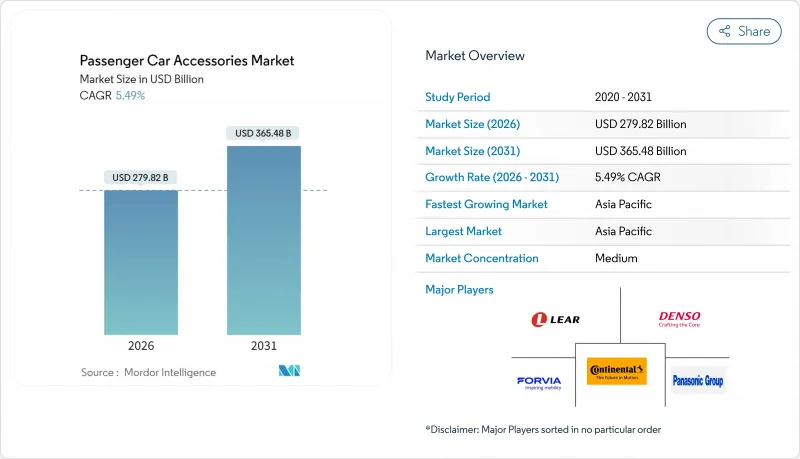
2025年乘用車配件市場價值為2,652.7億美元,預計到2031年將達到3,654.8億美元,而2026年為2,798.2億美元。
預計在預測期(2026-2031 年)內,複合年成長率將達到 5.49%。
SUV和跨界車銷售成長、電商主導的售後市場擴張以及汽車製造商向訂閱式聯網汽車功能轉型,共同推動了汽車配件市場的穩定成長。亞太地區保持了其需求主導,這反映了中國龐大的零件製造規模以及印度對電動車的快速普及。內裝升級,尤其是資訊娛樂系統和智慧表面解決方案,持續推動收入成長,而外觀配件則因生活方式的改變和輕量化電動車設計而呈現成長動能。平台整合、ADAS功能配件以及永續材料創新正在重塑汽車配件市場的價值結構,因此市場競爭強度仍然適中。
全球乘用車配件市場趨勢與洞察
SUV和CUV配件需求快速成長
運動型多用途車 (SUV) 和跨界車 (CUV) 平台正日益主導汽車配件需求,進而帶動了車頂架、踏腳板和防護覆層等在轎車上鮮少需要的配件的開發。緊湊型 SUV 在都市區的普及刺激了個人化需求,而中國消費者如今也越來越傾向於追隨西方的配件潮流。這種轉變推動了外觀配件市場的收入成長,同時也促使需要對支援高級駕駛輔助系統 (ADAS) 的配件進行重新設計,以避免遮擋感測器的視線。那些通過認證確保產品感測器完整性的配件供應商,在整個汽車配件市場中佔據高階地位。
電子商務主導的售後市場成長
線上汽車配件入口網站的成長速度超過了實體店,人工智慧驅動的適配工具有助於提高轉換率並降低退貨率。光是NAPA Online在2025年5月就處理了217,385筆交易,充分展現了純線上網站的規模經濟效益。全球擴張使中小品牌無需經銷商即可滿足長尾需求。然而,數位市場也助長了仿冒品的流通,因此需要投資於認證技術,以維護信任並保護不斷成長的線上汽車零件市場。
假冒偽劣和灰色市場零件的普遍存在
仿冒零件會削弱消費者信心,並引發安全召回。由業界主導的「抵制假冒產品」宣傳活動旨在強調劣質煞車零件在負荷下失效的風險。電子商務的匿名性加劇了這種風險,尤其是在價格敏感地區。基於區塊鏈的原產地控制系統和包裝上的QR碼認證旨在遏制這一問題,但實施成本給小規模供應商帶來了沉重負擔。
細分市場分析
預計到2025年,內裝配件將佔汽車配件市場57.68%的佔有率,因為消費者優先考慮資訊娛樂系統升級、豪華座椅套和電子安全系統。這個細分市場受益於汽車製造商向軟體定義車輛的轉型,軟體定義車輛可以透過空中下載(OTA)更新無縫整合新功能。地墊、隔熱座椅套和人工智慧增強型環境燈等產品將在車輛的整個生命週期中保持持續的銷售。
外飾配件依然是成長最快的細分市場,複合年成長率高達 8.18%。 LED 照明套件、空氣動力學車身加強件和多功能車頂行李架系統深受追求個性與實用性的 SUV 車主歡迎。在越野旅遊和積極生活方式交會的地區,市場需求特別強勁。隨著電動車的日益普及,為避免續航里程損失而轉向輕量化複合材料,正推動汽車外飾配件市場以高於平均水平的速度成長。
2025年,OEM通路憑藉原廠認證零件和保固服務,將維持75.63%的市佔率。汽車製造商正利用聯網汽車遙測技術,直接透過車載資訊娛樂系統螢幕銷售服務計畫和訂閱式配件功能。這種整合式模式將消費者牢牢鎖定在品牌生態系統中,有助於穩定整個汽車配件市場的利潤率。
受電子商務便利性、產品選擇範圍擴大和價格競爭的推動,汽車後市場正以9.71%的複合年成長率高速成長。人工智慧驅動的庫存管理工具使獨立經銷商能夠實現與原廠配件媲美的組裝品質。因此,汽車配件產業正在經歷漸進式的重新平衡:原廠配件製造商(OEM)試圖透過軟體鎖定和專有數據通訊協定來保護其市場佔有率,而數位平台則降低了小眾品牌的准入門檻,並促進了跨境銷售。
區域分析
預計到2025年,亞太地區將佔全球營收的63.78%,並在2031年之前以7.63%的複合年成長率持續成長。中國的零件製造能力正呈指數級成長,為整車廠配套(OEM)和售後市場供應鏈提供強力支撐。印度大力發展電動車,推動了對適合當地路況的輕量化模組化附加零件的需求。日本在設計和人機介面(HMI)領域處於主導地位,而韓國則在顯示器和電池整合方面為供應鏈深度提供了支援。在東協市場,可支配收入的成長和線上零售的蓬勃發展正在推動汽車配件市場的擴張。
北美仍然是重要的收入來源。車輛老化和濃厚的DIY文化推動了地墊、照明設備和拖車設備的銷售。安全法規的差異影響了配件認證,加拿大和墨西哥仍然是重要的生產和分銷地點。
歐洲正憑藉其工程技術傳統,在應對複雜的監管環境的同時,不斷提升自身競爭力。歐盟第二版通用安全法規(EU General Safety Regulation II)限制了某些外部配件的使用,同時也推動了對能夠保持感測器完整性的ADAS(高級駕駛輔助系統)解決方案的需求。大陸集團2024年的售後市場擴張計畫新增700個SKU,使其歐洲市場覆蓋率提升50%。德國和英國對高階內裝技術的需求強勁,而法國、義大利和西班牙則專注於更具成本效益的替代方案。由於強而有力的貿易協定,越來越多的供應商尋求接近性歐盟市場,東歐作為製造地的地位也日益凸顯。
其他福利:
- Excel格式的市場預測(ME)表
- 3個月的分析師支持
目錄
第1章 引言
- 研究假設和市場定義
- 調查範圍
第2章調查方法
第3章執行摘要
第4章 市場情勢
- 市場概覽
- 市場促進因素
- SUV和CUV配件需求激增
- 電子商務主導的售後市場成長
- 汽車製造商關注聯網汽車的升級週期
- 主要市場車輛平均車齡不斷增加
- 用於延長電動車續航里程的輕量化模組化配件
- 採用智慧內裝表面(人機互動/手勢控制)
- 市場限制
- 假冒偽劣和灰色市場零件的普遍存在
- 減少純電動車的零件數量將抑制需求。
- 安全關鍵型ADAS感測器限制了外部改裝
- 原物料價格(塑膠和合金)波動
- 價值/供應鏈分析
- 監管環境
- 技術展望
- 波特五力模型
- 新進入者的威脅
- 買方的議價能力
- 供應商的議價能力
- 替代品的威脅
- 競爭對手之間的競爭
第5章 市場規模與成長預測
- 透過使用
- 室內裝飾品
- 資訊娛樂系統
- 地毯和墊子
- 座椅套
- 電氣和電子系統
- 安全系統
- 其他
- 外部配件
- LED和輔助照明
- 合金輪圈
- 車身套件和空氣動力學零件
- 車頂行李架及載物架
- 窗膜和窗膜
- 車罩(車身罩、車輪罩、備胎罩)
- 防撞桿和防撞桿
- 其他
- 室內裝飾品
- 按銷售管道
- 相容原廠設備
- 售後市場
- 按車輛類型
- 掀背車
- 轎車
- 跑車和豪華車
- 緊湊型SUV和CUV
- 中型和大型SUV
- 皮卡和輕型卡車
- 依材料類型
- 塑膠
- 金屬
- 皮革製品
- 其他
- 按地區
- 北美洲
- 美國
- 加拿大
- 北美其他地區
- 南美洲
- 巴西
- 阿根廷
- 南美洲其他地區
- 歐洲
- 德國
- 英國
- 法國
- 義大利
- 西班牙
- 俄羅斯
- 其他歐洲地區
- 亞太地區
- 中國
- 印度
- 日本
- 韓國
- 亞太其他地區
- 中東和非洲
- 沙烏地阿拉伯
- 阿拉伯聯合大公國
- 土耳其
- 埃及
- 南非
- 其他中東和非洲地區
- 北美洲
第6章 競爭情勢
- 市場集中度
- 策略趨勢
- 市佔率分析
- 公司簡介
- Adient PLC
- Grupo Antolin
- Panasonic Holdings Corp.
- Faurecia SE
- Lear Corporation
- Continental AG
- Denso Corporation
- Harman International
- Robert Bosch GmbH
- JVCKenwood Corp.
- Alps Alpine Co.
- Magna International
- Pioneer Corporation
- Garmin Ltd.
- Covercraft Industries
- Webasto SE
- Thule Group AB
- 3M Company
- Katzkin Leather
- Valeo SA
- Gentex Corporation
- Momo Srl
- Visteon Corporation
- Yokohama Wheels
- Clarion Co.
第7章 市場機會與未來展望
The passenger car accessories market was valued at USD 265.27 billion in 2025 and estimated to grow from USD 279.82 billion in 2026 to reach USD 365.48 billion by 2031, at a CAGR of 5.49% during the forecast period (2026-2031).
Steady growth stems from rising SUV and crossover sales, e-commerce-led aftermarket expansion, and OEM moves toward subscription-based connected-car features. Asia-Pacific retains demand leadership, reflecting China's component manufacturing scale and India's rapid electric-mobility adoption. Interior upgrades, especially infotainment and smart-surface solutions, drive recurring revenue, while exterior categories gain momentum from lifestyle modifications and lightweight EV-compatible designs. Competitive intensity remains moderate as platform consolidations, ADAS-ready accessories, and sustainable material innovations reshape value pools within the wider car accessories market.
Global Passenger Car Accessories Market Trends and Insights
Surge in SUV and CUV Accessorizing
Sport-utility and crossover platforms increasingly dictate accessory demand, spurring the development of roof carriers, running boards, and protective cladding that sedans rarely require. Compact SUVs in urban areas accelerate personalization needs, while Chinese consumers now mirror Western accessory trends. The shift lifts exterior-category revenue yet forces ADAS-compatible redesigns so sensors remain unobstructed. Accessory suppliers certifying sensor integrity products secure premium positioning across the broader car accessories market.
Growth of E-Commerce-Led Aftermarket
Online parts portals outpace brick-and-mortar growth as AI-powered fitment tools boost conversion and reduce returns. NAPA Online alone processed 217,385 transactions in May 2025, evidencing scale economics for pure-play sites. Global reach helps smaller brands bypass distributors and tap long-tail demand. Yet digital marketplaces also facilitate counterfeit flow, prompting authentication tech investments that preserve trust and protect the expanding online slice of the car accessories market.
Counterfeit and Grey-Market Parts Penetration
Illicit parts erode consumer confidence and trigger safety recalls. The industry-led "Brakes on Fakes" campaign highlights risks from sub-standard brake components that can fail under load. E-commerce anonymity worsens exposure, particularly in price-sensitive regions. Blockchain-based provenance systems and QR-code authentication on packaging aim to curb the issue, but implementation costs strain small suppliers.
Other drivers and restraints analyzed in the detailed report include:
- OEM Focus on Connected-Car Upgrade Cycles
- Rising Average Vehicle Age
- Safety-Critical ADAS Sensors Limiting Exterior Mods
For complete list of drivers and restraints, kindly check the Table Of Contents.
Segment Analysis
Interior accessories controlled 57.68% of the car accessories market in 2025 as consumers prioritized infotainment upgrades, premium seat coverings, and electronic security systems. The segment benefits from OEM moves toward software-defined vehicles that allow seamless integration of new features via over-the-air updates. Flooring products, thermal-comfort seat covers, and AI-enhanced ambient lighting sustain recurring sales throughout extended vehicle lifecycles.
Exterior accessories remain the fastest-growing slice at an 8.18% CAGR. LED lighting kits, aerodynamic body enhancements, and multi-sport roof rack systems appeal to SUV owners seeking personalization and utility. Demand is especially strong where off-road tourism and active lifestyle demographics intersect. Increasing EV adoption steers design toward lightweight composites that avoid range penalties, ensuring the car accessories market size for exterior products expands faster than the average.
The OEM channel retained 75.63% market share in 2025 by bundling factory-approved parts with warranty protection. Automakers leverage connected-car telemetry to market service plans and subscription-based accessory features directly through infotainment screens. This integrated approach locks consumers into branded ecosystems and helps stabilize margins across the car accessories market.
The aftermarket grows at a brisk 9.71% CAGR, propelled by e-commerce convenience, broader assortment, and competitive pricing. AI-driven inventory tools allow independents to mirror OEM-quality fitment confidence. The car accessories industry, therefore, sees a slow rebalancing as digital platforms lower entry barriers for niche brands and encourage cross-border sales, even while OEMs defend their share through software locks and proprietary data protocols.
The Passenger Car Accessories Market Report is Segmented by Application (Interior Accessories and Exterior Accessories), Sales Channel (OEM Fitted and Aftermarket), Vehicle Type (Hatchback, Sedan and More), Material Type (Plastic, Metal, and More), and Geography (North America, South America, Europe, Asia-Pacific, Middle East and Africa). The Market Forecasts are Provided in Terms of Value (USD).
Geography Analysis
Asia-Pacific held 63.78% revenue in 2025 and is projected to grow 7.63% CAGR through 2031. China's component manufacturing output expands exponentially and feeds OEM and aftermarket pipelines. India's electric-mobility push widens demand for lightweight modular add-ons suited to local road conditions. Japan contributes design and HMI leadership, while South Korea supports supply-chain depth for display and battery integration. ASEAN markets ride rising disposable incomes and online retail proliferation, which enlarges the car accessories market.
North America remains a vital profit center. Aging fleets and a strong DIY culture spur floor mats, lighting, and towing equipment sales. Although differing safety regulations fragment accessory homologation, Canada and Mexico anchor manufacturing and distribution corridors.
Europe confronts regulatory complexity but leverages engineering heritage. The EU's General Safety Regulation II curbs certain exterior add-ons but fosters a premium for ADAS-compatible solutions that preserve sensor integrity. Continental's 2024 aftermarket expansion added 700 SKUs, raising European market coverage by 50%. Germany and the United Kingdom dominate demand for premium interior tech, while France, Italy, and Spain emphasize cost-effective replacements. Eastern Europe's role as a manufacturing hub grows as suppliers seek proximity to EU markets under resilient trade agreements.
- Adient PLC
- Grupo Antolin
- Panasonic Holdings Corp.
- Faurecia SE
- Lear Corporation
- Continental AG
- Denso Corporation
- Harman International
- Robert Bosch GmbH
- JVCKenwood Corp.
- Alps Alpine Co.
- Magna International
- Pioneer Corporation
- Garmin Ltd.
- Covercraft Industries
- Webasto SE
- Thule Group AB
- 3M Company
- Katzkin Leather
- Valeo SA
- Gentex Corporation
- Momo Srl
- Visteon Corporation
- Yokohama Wheels
- Clarion Co.
Additional Benefits:
- The market estimate (ME) sheet in Excel format
- 3 months of analyst support
TABLE OF CONTENTS
1 Introduction
- 1.1 Study Assumptions and Market Definition
- 1.2 Scope of the Study
2 Research Methodology
3 Executive Summary
4 Market Landscape
- 4.1 Market Overview
- 4.2 Market Drivers
- 4.2.1 Surge In SUV and CUV Accessorizing
- 4.2.2 Growth Of E-Commerce-Led Aftermarket
- 4.2.3 OEM Focus On Connected-Car Upgrade Cycles
- 4.2.4 Rising Average Vehicle Age In Core Markets
- 4.2.5 Lightweight Modular Accessories For EV Range-Boost
- 4.2.6 Smart Interior Surfaces (HMI/Gesture) Adoption
- 4.3 Market Restraints
- 4.3.1 Counterfeit and Grey-Market Parts Penetration
- 4.3.2 Reduced Parts Count In BEVs Curbing Demand
- 4.3.3 Safety-Critical ADAS Sensors Limiting Exterior Mods
- 4.3.4 Raw-Material Price Volatility (Plastics and Alloys)
- 4.4 Value/Supply-Chain Analysis
- 4.5 Regulatory Landscape
- 4.6 Technological Outlook
- 4.7 Porter's Five Forces
- 4.7.1 Threat of New Entrants
- 4.7.2 Bargaining Power of Buyers
- 4.7.3 Bargaining Power of Suppliers
- 4.7.4 Threat of Substitute Products
- 4.7.5 Intensity of Competitive Rivalry
5 Market Size and Growth Forecasts
- 5.1 By Application
- 5.1.1 Interior Accessories
- 5.1.1.1 Infotainment Systems
- 5.1.1.2 Floor Carpets and Mats
- 5.1.1.3 Seat Covers
- 5.1.1.4 Electrical and Electronic Systems
- 5.1.1.5 Security Systems
- 5.1.1.6 Others
- 5.1.2 Exterior Accessories
- 5.1.2.1 LED and Auxiliary Lighting
- 5.1.2.2 Alloy Wheels
- 5.1.2.3 Body Kits and Aero Parts
- 5.1.2.4 Roof Racks and Carriers
- 5.1.2.5 Window Films and Tinting
- 5.1.2.6 Covers (Car, Wheel, Spare-tire)
- 5.1.2.7 Crash Guards and Bull Bars
- 5.1.2.8 Others
- 5.1.1 Interior Accessories
- 5.2 By Sales Channel
- 5.2.1 OEM Fitted
- 5.2.2 Aftermarket
- 5.3 By Vehicle Type
- 5.3.1 Hatchback
- 5.3.2 Sedan
- 5.3.3 Sports and Luxury Cars
- 5.3.4 Compact SUV and CUV
- 5.3.5 Mid and Full-size SUV
- 5.3.6 Pick-up Trucks and Light Trucks
- 5.4 By Material Type
- 5.4.1 Plastic
- 5.4.2 Metal
- 5.4.3 Leather
- 5.4.4 Others
- 5.5 By Geography
- 5.5.1 North America
- 5.5.1.1 United States
- 5.5.1.2 Canada
- 5.5.1.3 Rest of North America
- 5.5.2 South America
- 5.5.2.1 Brazil
- 5.5.2.2 Argentina
- 5.5.2.3 Rest of South America
- 5.5.3 Europe
- 5.5.3.1 Germany
- 5.5.3.2 United Kingdom
- 5.5.3.3 France
- 5.5.3.4 Italy
- 5.5.3.5 Spain
- 5.5.3.6 Russia
- 5.5.3.7 Rest of Europe
- 5.5.4 Asia-Pacific
- 5.5.4.1 China
- 5.5.4.2 India
- 5.5.4.3 Japan
- 5.5.4.4 South Korea
- 5.5.4.5 Rest of Asia-Pacific
- 5.5.5 Middle East and Africa
- 5.5.5.1 Saudi Arabia
- 5.5.5.2 United Arab Emirates
- 5.5.5.3 Turkey
- 5.5.5.4 Egypt
- 5.5.5.5 South Africa
- 5.5.5.6 Rest of Middle East and Africa
- 5.5.1 North America
6 Competitive Landscape
- 6.1 Market Concentration
- 6.2 Strategic Moves
- 6.3 Market Share Analysis
- 6.4 Company Profiles (Includes Global Level Overview, Market Level Overview, Core Segments, Financials as Available, Strategic Information, Market Rank/Share for Key Companies, Products and Services, and Recent Developments)
- 6.4.1 Adient PLC
- 6.4.2 Grupo Antolin
- 6.4.3 Panasonic Holdings Corp.
- 6.4.4 Faurecia SE
- 6.4.5 Lear Corporation
- 6.4.6 Continental AG
- 6.4.7 Denso Corporation
- 6.4.8 Harman International
- 6.4.9 Robert Bosch GmbH
- 6.4.10 JVCKenwood Corp.
- 6.4.11 Alps Alpine Co.
- 6.4.12 Magna International
- 6.4.13 Pioneer Corporation
- 6.4.14 Garmin Ltd.
- 6.4.15 Covercraft Industries
- 6.4.16 Webasto SE
- 6.4.17 Thule Group AB
- 6.4.18 3M Company
- 6.4.19 Katzkin Leather
- 6.4.20 Valeo SA
- 6.4.21 Gentex Corporation
- 6.4.22 Momo Srl
- 6.4.23 Visteon Corporation
- 6.4.24 Yokohama Wheels
- 6.4.25 Clarion Co.
7 Market Opportunities & Future Outlook

 可拆卸皮卡車露營車市場:全球市場預測,2026-2032年
 美國汽車配件市場規模、佔有率和趨勢分析報告:按產品、分銷管道和細分市場預測(2026-2033 年)汽車配件市場規模、佔有率和趨勢分析報告:按產品、分銷管道、地區和細分市場預測(2026-2033 年)汽車簾市場:依產品類型、材料、安裝類型、操作方式、車輛類型和通路分類-全球預測,2026-2032年寵物車用配件市場按配件類型、價格範圍、寵物類型、材質類型、分銷管道、安裝類型和車輛類型分類,全球預測(2026-2032年)
 全球商用車配件市場規模、佔有率、趨勢及成長分析報告(2026-2034年)全球汽車配件市場規模、佔有率、趨勢和成長分析報告(2026-2034)
 2026年全球乘用車內外飾零件市場報告
 商用車配件市場 - 全球產業規模、佔有率、趨勢、機會及預測(按產品類型、車輛類型、應用、地區和競爭格局分類,2021-2031年)
 乘用車配件市場規模、佔有率及成長分析(按應用、銷售管道、車輛類型、材質及地區分類)-2026-2033年產業預測