


 |
市場調查報告書
商品編碼
1851850
雷達液位傳送器:市場佔有率分析、行業趨勢、統計數據和成長預測(2025-2030 年)Radar Level Transmitter - Market Share Analysis, Industry Trends & Statistics, Growth Forecasts (2025 - 2030) |
||||||

※ 本網頁內容可能與最新版本有所差異。詳細情況請與我們聯繫。
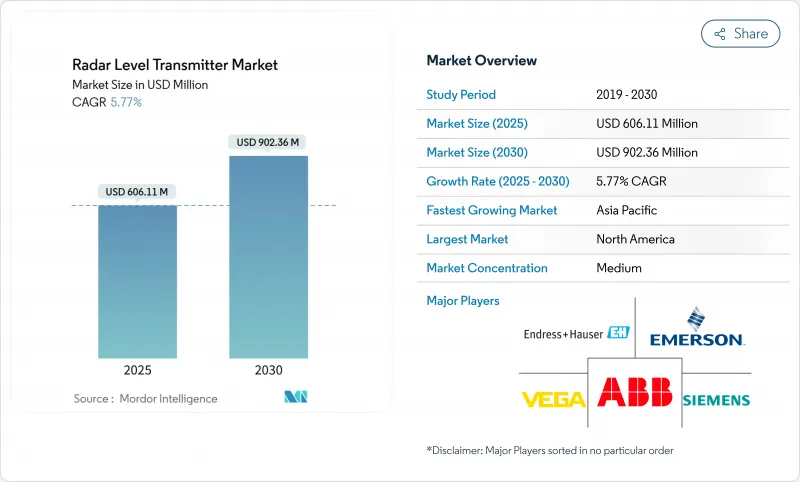
預計雷達液位傳送器市場將從 2025 年的 6.0611 億美元成長到 2030 年的 9.0236 億美元,複合年成長率為 5.77%。
工業自動化專案需要精確的液位監測以滿足日益嚴格的環境和安全法規,這推動了市場需求。歐洲石油接收站從超音波技術向 80 GHz 雷達技術的過渡、墨西哥灣海水淡化產能投資的增加以及北美老舊營業單位的維修升級,都是重要的成長動力。此外,中國的煤製化工計劃正在採用導波雷達進行複雜介面測量,製造商也受益於無線、工業網際網路感測器的穩定發展,這些感測器支援預測性維護。競爭優勢體現在天線小型化、用於發泡體和低介電常數介質的先進訊號處理技術以及能夠縮短試運行時間的服務體系。
全球雷達液位傳送器市場趨勢及洞察
歐盟石油接收站防護系統將採用80GHz雷達取代超音波感測器,用於油庫溢油保護。
歐洲法規強制要求採用先進的溢流保護技術,促使操作人員以 80 GHz 雷達取代超音波液位計。窄波束角可集中微波能,即使在存在蒸氣和溫度波動的情況下也能實現可靠的測量;緊湊的天線設計簡化了對浮動頂儲罐的改造。此外,該技術無需維護,可確保合規性並降低生命週期成本。
海灣合作理事會海水淡化資本支出激增,推動雷達安裝。
沙烏地阿拉伯、阿拉伯聯合大公國和科威特三國合計佔全球海水淡化產能的一半。新型多級閃蒸和逆滲透海水淡化廠需要能夠承受腐蝕性高鹽度濃鹽水的非接觸式雷達。與數位控制系統整合可提高能源效率和水回收率,因此雷達已成為該地區EPC合約中的標準配置。
泡沫反應器中的訊號損失
厚厚的泡沫層會衰減微波並產生雜散回波,阻礙乙氧基化和發酵槽中的液位控制。先進的訊號處理技術和混合雷達-電容探頭可以緩解這個問題,但嚴重的發泡會從物理上限制雷達的穿透深度。
細分市場分析
到2024年,非接觸式感測器將佔總收入的65%,這反映出在腐蝕性或高溫應用中,免維護運作的需求日益成長。該細分市場將以6.8%的複合年成長率成長,這主要得益於調頻連續波(FMCW)平台提高了信噪比。導波雷達在介面偵測和高泡棉區域仍保持著獨特的市場地位。緊湊型80 GHz天線現在可以改裝到以前只能使用超音波探頭的船舶上,從而擴大了雷達液位傳送器市場的潛在需求。
藍牙性能驗證和感測器內診斷等數位化正在簡化合規性審核,並提升雷達液位傳送器產業的價值提案。供應商正將自監控功能定位為應對勞動力短缺的保障,並將雷達提升為企業資產性能平台的核心節點。
2024年,K波段(24-26 GHz)感測器仍將佔出貨量的38%,這主要得益於其成本效益和廣泛的核准。然而,W波段(76-81 GHz和120 GHz)感測器的複合年成長率將達到7.4%,這得益於其小於3°的波束角,能夠忽略葉輪和狹窄噴嘴,從而在40米高的塔筒和狹長的釀造釜中實現可靠的讀數。美國、歐盟和中國的認證機構對W波段感測器在製程應用方面的認可,正在推動規模經濟的實現,並逐漸降低其以往的價格溢價。加之組件成本的下降,W波段感測器的普及將重塑市場競爭格局。
區域分析
北美地區32%的收入來自成熟的石油、化學和食品產業,以及鼓勵水利基礎設施數位化升級的聯邦津貼。公用事業公司正在利用雲端連接雷達來減少現場巡檢次數,而精釀啤酒廠則正在採用能夠承受高強度原位清洗循環的衛生模式。
亞太地區是成長引擎,複合年成長率達7.5%,主要得益於中國煤製化工專案和印度智慧城市污水計劃。澳洲礦業公司正在指定使用抗泡沫的80GHz設備進行尾礦處理,而東南亞的棕櫚油精煉廠則需要用於黏性介質的導波式設備。
歐洲持續保持強勁發展勢頭,這主要得益於德國化工工業的製程最佳化以及甲烷排放法規對整個歐洲大陸儲罐計量精度提出的更高要求。一家斯堪地那維亞公用事業公司正在採購適用於寒冷氣候儲罐的低功耗雷達感測器,優先考慮永續性和降低維護成本。
在中東,海水淡化熱潮將支撐長期需求;而在拉丁美洲,銅和鋰產業的擴張將推動以固態材料為中心的雷達部署。隨著電氣化進程的持續推進,非洲的水泥和飲料產業將採用成本更低的24GHz設備。
其他福利:
- Excel格式的市場預測(ME)表
- 3個月的分析師支持
目錄
第1章 引言
- 研究假設和市場定義
- 調查範圍
第2章調查方法
第3章執行摘要
第4章 市場情勢
- 市場概覽
- 市場促進因素
- 歐盟石油接收站防護系統將採用80GHz雷達取代超音波感測器,用於油庫溢油保護。
- 海灣合作理事會海水淡化投資熱潮推動雷達安裝量成長
- 中國煤化學界面測量需求
- 美國老舊水質淨化廠迎來工業物聯網改裝浪潮
- 北美精釀啤酒廠採用衛生型非接觸式雷達
- 澳洲採礦業尾礦壩用抗泡沫雷達
- 市場限制
- 發泡高強度反應器中的訊號損失
- 東協地區合格雷達技術人員短缺
- 高昂的初始成本與OEM撬裝設備的超音波相比
- 在精度要求較高的場合,低介電常數粉末是關鍵。
- 價值/供應鏈分析
- 監理與技術展望
- 波特五力分析
- 新進入者的威脅
- 買方的議價能力
- 供應商的議價能力
- 替代品的威脅
- 競爭對手之間的競爭
第5章 市場規模與成長預測
- 透過技術
- 聯繫系統(導波雷達)
- 非接觸式系統(自由太空雷達)
- FMCW雷達
- 脈衝雷達
- 頻寬
- C 波段和X波段(6 至 12 GHz)
- K波段(24-26 GHz)
- W波段(76-81和120 GHz)
- 透過使用
- 液體、漿液和介面
- 固體(散裝粉末和顆粒)
- 按最終用戶行業分類
- 石油和天然氣
- 化工和石油化工
- 用水和污水
- 飲食
- 發電
- 製藥和生物技術
- 金屬和採礦
- 海洋/造船
- 其他行業(紙漿和造紙、水泥)
- 按地區
- 北美洲
- 美國
- 加拿大
- 墨西哥
- 歐洲
- 英國
- 德國
- 法國
- 義大利
- 其他歐洲地區
- 亞太地區
- 中國
- 日本
- 印度
- 韓國
- 亞太其他地區
- 中東
- 以色列
- 沙烏地阿拉伯
- 阿拉伯聯合大公國
- 土耳其
- 其他中東地區
- 非洲
- 南非
- 埃及
- 其他非洲地區
- 南美洲
- 巴西
- 阿根廷
- 其他南美洲國家
- 北美洲
第6章 競爭情勢
- 市場集中度
- 策略性舉措(MandA、夥伴關係、新產品)
- 市佔率分析
- 公司簡介
- Emerson Electric Co.
- Siemens AG
- Endress+Hauser Group
- ABB Ltd.
- Honeywell International Inc.
- VEGA Grieshaber KG
- KROHNE Messtechnik
- Yokogawa Electric Corp.
- AMETEK Inc.
- Magnetrol International(AMETEK)
- Schneider Electric SE
- Pepperl+Fuchs SE
- Automation Products Group Inc.
- Nivelco Process Control Corp.
- Matsushima Measure Tech Co. Ltd.
- Hawk Measurement Systems
- Bindicator(Venture Measurement)
- Drexelbrook(Ametek)
- FEEJOY Technology
- SOR Inc.
第7章 市場機會與未來展望
The radar level transmitter market is valued at USD 606.11 million in 2025 and is forecast to reach USD 902.36 million by 2030, advancing at a 5.77% CAGR.
Demand is anchored in industrial automation programs that require precise level monitoring to meet stricter environmental and safety mandates. Technology migration from ultrasonic to 80 GHz radar in European oil terminals, growing desalination capital spending across the Gulf states, and retrofit activity in aging North-American water utilities are pivotal growth vectors. Manufacturers are also benefiting from coal-to-chemicals projects in China, where complex interface measurements favor guided-wave radar, and from a steady move toward wireless, Industrial-Internet-ready sensors that support predictive maintenance. Competitive differentiation hinges on antenna miniaturization, advanced signal processing for foam or low-dielectric media, and service ecosystems that shorten commissioning times.
Global Radar Level Transmitter Market Trends and Insights
80 GHz radar replacing ultrasonic sensors in EU oil-terminal overfill protection
European regulations mandate advanced overfill protection, prompting operators to replace ultrasonic gauges with 80 GHz radar. Narrow beam angles concentrate microwave energy, delivering reliable measurements even through vapors and temperature swings, while compact antenna designs simplify retrofits in tanks fitted with floating roofs. Coupled with maintenance-free operation, the technology ensures compliance and lowers lifecycle cost.
Desalination CAPEX boom in GCC boosting radar installations
Saudi Arabia, the UAE, and Kuwait collectively account for half of global desalination capacity. New multi-stage flash and reverse-osmosis plants demand non-contact radar that withstands corrosive, high-salinity brines. Integration with digital control systems improves energy efficiency and water recovery, embedding radar as a standard specification in regional EPC contracts.
Signal loss in foam-intense reactors
Thick foam layers attenuate microwaves, causing spurious echoes that disrupt level control in ethoxylation or fermentation vessels. Enhanced signal processing and hybrid radar-capacitance probes mitigate, but physics still limits radar penetration in extreme foaming.
Other drivers and restraints analyzed in the detailed report include:
- China coal-to-chemicals interface measurement demand
- Retrofit Wave of IIoT-Ready Instruments in Ageing US Water Plants
- Shortage of certified radar technicians in ASEAN
For complete list of drivers and restraints, kindly check the Table Of Contents.
Segment Analysis
Non-contact sensors captured 65% of 2024 revenue, reflecting preference for maintenance-free operation in corrosive or high-temperature duties. The sub-segment will expand at 6.8% CAGR, reinforced by frequency-modulated continuous-wave (FMCW) platforms that sharpen signal-to-noise ratios. Guided-wave radar retains a niche where interface detection or heavy foam is prevalent. Compact 80 GHz antennas now retrofit vessels once limited to ultrasonic probes, enlarging addressable demand for the radar level transmitter market.
Digital advances such as Bluetooth commissioning and in-sensor diagnostics simplify compliance audits, enhancing the radar level transmitter industry's value proposition. Suppliers position self-monitoring features as a hedge against workforce shortages, elevating radar to a core node in enterprise asset-performance platforms.
K-band (24-26 GHz) still held 38% of 2024 shipments, appreciated for cost-effectiveness and broad approvals. Yet W-band (76-81 GHz and 120 GHz) sensors show 7.4% CAGR due to sub-3° beam angles that ignore agitator blades and narrow nozzles, delivering reliable readings in 40-m columns or slender brew kettles. Certification agencies in the United States, EU, and China cleared W-band for process use, driving scale economies that are eroding historic price premiums. As component costs fall, W-band penetration will remake competitive positioning in the radar level transmitter market.
The Radar Level Transmitter Market Report is Segmented by Technology (Contact System, Non-Contact System), Frequency Range (C and X Band, K Band, W Band), Application (Liquids/Interfaces, Solids), End-User Industry (Oil and Gas, Chemicals, Water, Power Generation, Pharmaceuticals and Biotechnology, and More), and Geography. The Market Forecasts are Provided in Terms of Value (USD).
Geography Analysis
North America's 32% revenue share stems from mature oil, chemical, and food industries, coupled with federal grants that incentivize digital upgrades in water infrastructure. Utilities leverage cloud-connected radar to cut field visits, while craft brewers adopt hygienic models that withstand aggressive clean-in-place cycles.
Asia-Pacific is the growth engine at 7.5% CAGR, led by Chinese coal-to-chemicals plants and Indian smart-city wastewater projects. Australian miners specify foam-tolerant 80 GHz units for tailings management, and Southeast Asian palm-oil refineries demand guided-wave models that handle sticky media.
Europe maintains steady momentum, driven by process optimization in Germany's chemical parks and methane-emission rules that mandate tighter tank-gauging accuracy across the continent. Scandinavian utilities procure low-power radar sensors suited to cold-climate reservoirs, emphasizing sustainability and reduced servicing trips.
The Middle East's desalination boom anchors long-term demand, whereas Latin America's copper and lithium expansions support solids-focused radar deployments. Africa's cement and beverage sectors adopt cost-optimized 24 GHz units as electrification spreads.
- Emerson Electric Co.
- Siemens AG
- Endress+Hauser Group
- ABB Ltd.
- Honeywell International Inc.
- VEGA Grieshaber KG
- KROHNE Messtechnik
- Yokogawa Electric Corp.
- AMETEK Inc.
- Magnetrol International (AMETEK)
- Schneider Electric SE
- Pepperl+Fuchs SE
- Automation Products Group Inc.
- Nivelco Process Control Corp.
- Matsushima Measure Tech Co. Ltd.
- Hawk Measurement Systems
- Bindicator (Venture Measurement)
- Drexelbrook (Ametek)
- FEEJOY Technology
- SOR Inc.
Additional Benefits:
- The market estimate (ME) sheet in Excel format
- 3 months of analyst support
TABLE OF CONTENTS
1 INTRODUCTION
- 1.1 Study Assumptions and Market Definition
- 1.2 Scope of the Study
2 RESEARCH METHODOLOGY
3 EXECUTIVE SUMMARY
4 MARKET LANDSCAPE
- 4.1 Market Overview
- 4.2 Market Drivers
- 4.2.1 80 GHz Radar Replacing Ultrasonic Sensors in EU Oil-Terminal Overfill Protection
- 4.2.2 Desalination CAPEX Boom in GCC Boosting Radar Installations
- 4.2.3 China Coal-to-Chemicals Interface Measurement Demand
- 4.2.4 Retrofit Wave of IIoT-Ready Instruments in Ageing US Water Plants
- 4.2.5 Hygienic Non-Contact Radar Adoption by North-American Craft Breweries
- 4.2.6 Foam-Tolerant Radar for Tailings Dams in Australian Mining
- 4.3 Market Restraints
- 4.3.1 Signal Loss in Foam-Intense Reactors
- 4.3.2 Shortage of Certified Radar Technicians in ASEAN
- 4.3.3 High Up-Front Cost vs Ultrasonic on OEM Skids
- 4.3.4 Low-Dielectric Powders Causing Accuracy Concerns
- 4.4 Value / Supply-Chain Analysis
- 4.5 Regulatory and Technological Outlook
- 4.6 Porter's Five Forces Analysis
- 4.6.1 Threat of New Entrants
- 4.6.2 Bargaining Power of Buyers
- 4.6.3 Bargaining Power of Suppliers
- 4.6.4 Threat of Substitute Products
- 4.6.5 Intensity of Competitive Rivalry
5 MARKET SIZE AND GROWTH FORECASTS (VALUE)
- 5.1 By Technology
- 5.1.1 Contact System (Guided Wave Radar)
- 5.1.2 Non-Contact System (Free-Space Radar)
- 5.1.2.1 FMCW Radar
- 5.1.2.2 Pulsed Radar
- 5.2 By Frequency Range
- 5.2.1 C and X Band (6-12 GHz)
- 5.2.2 K Band (24-26 GHz)
- 5.2.3 W Band (76-81 and 120 GHz)
- 5.3 By Application
- 5.3.1 Liquids, Slurries and Interfaces
- 5.3.2 Solids (Bulk Powders and Granulates)
- 5.4 By End-user Industry
- 5.4.1 Oil and Gas
- 5.4.2 Chemicals and Petrochemicals
- 5.4.3 Water and Wastewater
- 5.4.4 Food and Beverages
- 5.4.5 Power Generation
- 5.4.6 Pharmaceuticals and Biotechnology
- 5.4.7 Metals and Mining
- 5.4.8 Marine and Shipbuilding
- 5.4.9 Other Industries (Pulp and Paper, Cement)
- 5.5 By Geography
- 5.5.1 North America
- 5.5.1.1 United States
- 5.5.1.2 Canada
- 5.5.1.3 Mexico
- 5.5.2 Europe
- 5.5.2.1 United Kingdom
- 5.5.2.2 Germany
- 5.5.2.3 France
- 5.5.2.4 Italy
- 5.5.2.5 Rest of Europe
- 5.5.3 Asia-Pacific
- 5.5.3.1 China
- 5.5.3.2 Japan
- 5.5.3.3 India
- 5.5.3.4 South Korea
- 5.5.3.5 Rest of Asia-Pacific
- 5.5.4 Middle East
- 5.5.4.1 Israel
- 5.5.4.2 Saudi Arabia
- 5.5.4.3 United Arab Emirates
- 5.5.4.4 Turkey
- 5.5.4.5 Rest of Middle East
- 5.5.5 Africa
- 5.5.5.1 South Africa
- 5.5.5.2 Egypt
- 5.5.5.3 Rest of Africa
- 5.5.6 South America
- 5.5.6.1 Brazil
- 5.5.6.2 Argentina
- 5.5.6.3 Rest of South America
- 5.5.1 North America
6 COMPETITIVE LANDSCAPE
- 6.1 Market Concentration
- 6.2 Strategic Moves (MandA, Partnerships, New Products)
- 6.3 Market Share Analysis
- 6.4 Company Profiles {(includes Global level Overview, Market level overview, Core Segments, Financials as available, Strategic Information, Market Rank/Share for key companies, Products and Services, and Recent Developments)}
- 6.4.1 Emerson Electric Co.
- 6.4.2 Siemens AG
- 6.4.3 Endress+Hauser Group
- 6.4.4 ABB Ltd.
- 6.4.5 Honeywell International Inc.
- 6.4.6 VEGA Grieshaber KG
- 6.4.7 KROHNE Messtechnik
- 6.4.8 Yokogawa Electric Corp.
- 6.4.9 AMETEK Inc.
- 6.4.10 Magnetrol International (AMETEK)
- 6.4.11 Schneider Electric SE
- 6.4.12 Pepperl+Fuchs SE
- 6.4.13 Automation Products Group Inc.
- 6.4.14 Nivelco Process Control Corp.
- 6.4.15 Matsushima Measure Tech Co. Ltd.
- 6.4.16 Hawk Measurement Systems
- 6.4.17 Bindicator (Venture Measurement)
- 6.4.18 Drexelbrook (Ametek)
- 6.4.19 FEEJOY Technology
- 6.4.20 SOR Inc.
7 MARKET OPPORTUNITIES AND FUTURE OUTLOOK
- 7.1 White-space and Unmet-Need Assessment

 液位傳送器市場:按類型、技術、安裝方式和最終用戶分類 - 2026-2032年全球市場預測
 雷達液位傳送器市場規模、佔有率、趨勢和預測:按技術、頻段、應用、終端用戶產業和地區分類,2026-2034年腐蝕性液體雷達液位計市場:按類型、輸出訊號、安裝方式、測量範圍、材料和最終用戶分類,全球預測(2026-2032年)
 全球液位傳送器市場規模、佔有率、趨勢和成長分析報告(2026-2034年)
 2026年全球液位傳送器市場報告
 液位傳送器市場 - 全球產業規模、佔有率、趨勢、機會及預測(按類型、產品、最終用戶、地區和競爭格局分類,2021-2031年)浮球式液位傳送器市場 - 2026-2031年預測
 液位傳送器市場規模、佔有率和成長分析(按類型、技術、測量方法、應用、最終用戶產業、輸出類型和地區分類)-2026-2033年產業預測雷達液位傳送器市場規模、佔有率及成長分析(依技術、頻率範圍、應用、產業垂直領域及地區分類)-2026-2033年產業預測
 重量變送器市場(按類型和地區)