


 |
市場調查報告書
商品編碼
1851784
虛擬私人網路:市場佔有率分析、行業趨勢、統計數據和成長預測(2025-2030 年)Virtual Private Network - Market Share Analysis, Industry Trends & Statistics, Growth Forecasts (2025 - 2030) |
||||||

※ 本網頁內容可能與最新版本有所差異。詳細情況請與我們聯繫。
預計到 2025 年,虛擬專用網路市場規模將達到 612.6 億美元,到 2030 年將達到 1,249.4 億美元,年複合成長率為 15.32%。
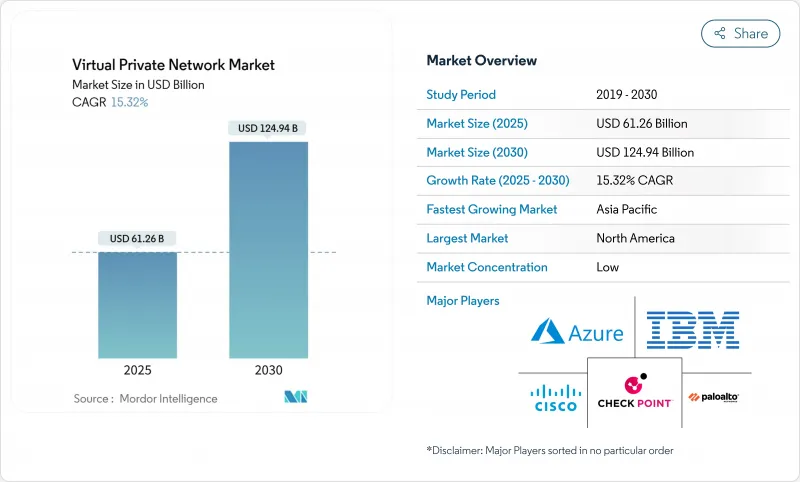
此次擴張的驅動力來自於混合辦公模式的安全需求、勒索軟體持續帶來的壓力,以及向整合網路和安全功能的安全存取服務邊緣 (SASE) 平台的轉變。雖然硬體設備在許多部署中仍然佔據核心地位,但雲端服務正在加速發展,以消除本地瓶頸並簡化管理。零信任網路存取 (ZTNA) 模型正在取代傳統的集中器,從而縮小攻擊面並改善使用者體驗。物聯網 (IoT) 工廠中設備數量的增加、5G 的部署以及衛星寬頻的普及,都使得加密連線對新站點和新地區的需求不斷成長。競爭優勢正向那些能夠將人工智慧驅動的威脅偵測、後量子加密和統一策略管理結合的供應商轉移。
全球虛擬專用網路市場趨勢與洞察
混合辦公模式越來越依賴安全的遠端存取。
工作模式的改變正將 VPN 連線提升至業務關鍵層面。紐約市教育局已將超過 100 萬用戶和 200 萬台設備遷移到零信任框架,並報告稱,攔截的威脅數量增加了 40%,而攻擊數量減少了 15%。企業正擴大採用雲端原生 SASE 平台,這些平台可將流量直接路由到應用程式,從而消除傳統集中器帶來的延遲和修補程式維護負擔。
物聯網設備的激增需要加密連接
工業網路如今需要精細化的、基於身分的存取控制。思科的安全設備存取 (SEA) 解決方案取代了普遍存在的 VPN 隧道,實現了對操作技術資源的精細化、零信任控制。在廣東大學,中國移動的 5G VPN 支援 2 萬同時上線用戶,下行速度比傳統解決方案提升了 10 倍。
VPN/SASE管理人員短缺推高整體擁有成本
對熟練工程師的需求遠超供應,促使企業轉向託管服務。服務提供者報告稱,員工人事費用已接近總營運支出的30%,而客戶則轉向能夠減少人工維護的整合式SASE服務。
細分市場分析
到2024年,硬體設備將佔虛擬私人網路(VPN)市場的43.5%,為大規模遠端存取部署提供支援。該領域的韌性與本地部署合規性要求較高的地區較長的更新周期密切相關。然而,可在超大規模雲端上快速部署的容器化閘道和虛擬防火牆正推動軟體領域實現15.9%的概念驗證。涵蓋託管營運和實施計劃的服務收入與SASE轉型同步成長,如今已成為組件支出的第三大支柱。企業繼續將用於本地性能的硬體與用於擴展覆蓋範圍的軟體閘道器相結合,這體現的是共存而非替代。
到2024年,託管式服務將佔據虛擬私人網路(VPN)市場的24.7%。這些服務將持續更新、威脅情報來源和全天候監控整合到一個可預測的訂閱模式中。同時,隨著越來越多的企業需要確定性的延遲來實現混合雲端和關鍵任務協作,MPLS VPN正在經歷復興,其複合年成長率(CAGR)高達16.9%。雲端VPN和更廣泛的SASE套件將IPsec、SD-WAN和防火牆即服務(FSaaS)整合到統一的編配中,從而減少了策略的蔓延。 IPsec VPN對於遵循既定通訊協定認證的國防和政府機構仍然至關重要,而新興的WireGuard解決方案則強調精簡的程式碼庫和接近線速的吞吐量。
虛擬私人網路市場按元件(硬體、軟體、服務)、類型(託管/管理型、IPsec VPN、MPLS VPN 等)、部署模式(雲端、本地部署)、最終用戶產業(銀行、金融服務和保險、醫療保健和生命科學、IT 和通訊等)以及地區進行細分。市場預測以美元計價。
區域分析
北美仍將是最大的區域貢獻者,預計到2024年將佔虛擬私人網路(VPN)市場收入的27.1%。零信任試點計畫的早期應用和嚴格的資訊揭露法規正在維持市場支出的成長動能。聯邦和州政府的專案正在加速從IPsec集中器到以身分為中心的SASE節點的升級,而超大規模資料中心的高密度PoP(存取點)分佈則有助於維持分散式使用者的低延遲。
亞太地區是成長最快的地區,複合年成長率達16.3%。大規模數位化計畫以及網路保險的廣泛應用,正迫使企業更好地保護其雲端工作負載和行動工作人員的安全。中國某大學的一項試驗顯示,行動VPN的效能比5G獨立組網提升了10倍。印度金融監管機構強制要求與外包處理中心建立加密連接,這將進一步加速VPN的普及應用。
在歐洲, 《一般資料保護規則)正在穩步實施。企業傾向於選擇在本地設有資料中心的供應商以確保資料主權,許多供應商也正在為其 VPN 服務添加預防資料外泄功能以符合法規要求。德國和法國的政府計劃在新的遠端存取採購中明確要求供應商具備後量子時代的能力。同時,在中東和非洲,星鏈 (Starlink) 的部署正在推進,旨在將寬頻網路擴展到農村地區,VPN 服務也被用於保護新興的電子商務和電子政府流量。在拉丁美洲,巴西的銀行和墨西哥的零售商正在部署託管 VPN 服務,以應對本地人才短缺的問題。
其他福利:
- Excel格式的市場預測(ME)表
- 3個月的分析師支持
目錄
第1章 引言
- 研究假設和市場定義
- 調查範圍
第2章調查方法
第3章執行摘要
第4章 市場情勢
- 市場概覽
- 市場促進因素
- 混合辦公模式越來越依賴安全的遠端存取。
- 物聯網設備的激增需要加密連接
- 勒索軟體造成的損失日益增加,推動了對零信任網路的投入
- 雲端原生應用程式的普及推動了對雲端VPN和SASE的需求。
- 資料保護條例(GDPR、CPRA、LGPD)的推出將推動企業採用 VPN。
- 新興地區衛星寬頻的普及釋放了新的VPN用戶群
- 市場限制
- VPN/SASE管理人員短缺推高整體擁有成本
- 與 SDP 和 ZTNA 方案相比,性能/延遲損失
- 監管機構加強對消費者VPN日誌記錄行為的審查
- 超過400個零售VPN品牌之間的價格戰擠壓了利潤空間
- 供應鏈分析
- 監管環境
- 技術展望(Wireguard、後量子時代、SASE融合)
- 波特五力模型
- 新進入者的威脅
- 買方/消費者的議價能力
- 供應商的議價能力
- 替代品的威脅
- 競爭對手之間的競爭
- 評估市場的宏觀經濟因素
第5章 市場規模與成長預測
- 按組件
- 硬體
- 軟體
- 服務
- 按類型
- 託管/管理
- IPsec VPN
- MPLS VPN
- 雲端 VPN/SASE
- 其他
- 透過部署模式
- 雲
- 本地部署
- 按最終用戶行業分類
- BFSI
- 醫療保健和生命科學
- 資訊科技和電訊
- 政府和公共部門
- 製造業和工業
- 零售與電子商務
- 教育
- 其他
- 按地區
- 北美洲
- 美國
- 加拿大
- 墨西哥
- 南美洲
- 巴西
- 阿根廷
- 其他南美洲
- 歐洲
- 德國
- 英國
- 法國
- 荷蘭
- 其他歐洲地區
- 亞太地區
- 中國
- 日本
- 印度
- 韓國
- 澳洲和紐西蘭
- 亞太其他地區
- 中東和非洲
- 中東
- 阿拉伯聯合大公國
- 沙烏地阿拉伯
- 土耳其
- 其他中東地區
- 非洲
- 南非
- 奈及利亞
- 其他非洲地區
- 北美洲
第6章 競爭情勢
- 市場集中度
- 策略趨勢
- 市佔率分析
- 公司簡介
- Cisco Systems Inc.
- Microsoft Corp.(Azure)
- Palo Alto Networks Inc.
- Check Point Software Technologies Ltd.
- IBM Corp.
- Nord Security(NordVPN)
- Kape Technologies PLC(ExpressVPN, CyberGhost)
- Avast sro(AVG Secure)
- Fortinet Inc.
- Juniper Networks Inc.
- OpenVPN Inc.
- Citrix Systems Inc.
- Array Networks Inc.
- NetMotion Software Inc.(Absolute Secure Access)
- Golden Frog GmbH(VyprVPN)
- Cloudflare Inc.(Cloudflare One/WARP)
- Google LLC(Google VPN)
- McAfee LLC
- Sophos Ltd.
- F5 Inc.(BIG-IP APM)
- Zscaler Inc.(Zscaler Private Access)
- Barracuda Networks Inc.
- Perimeter 81 Ltd.
- Tailscale Inc.
- WireGuard Development Team
第7章 市場機會與未來展望
The virtual private network market generated USD 61.26 billion in 2025 and is forecast to reach USD 124.94 billion by 2030, advancing at a 15.32% CAGR.
Expansion stems from hybrid-workforce security requirements, persistent ransomware pressure, and firm migration toward Secure Access Service Edge (SASE) platforms that merge networking and security functions. Hardware appliances still anchor many deployments, yet cloud-delivered services accelerate because they remove on-premises bottlenecks and simplify administration. Zero-trust network access (ZTNA) models are replacing legacy concentrators, trimming attack surfaces and enhancing user experience. Growing device footprints in Internet of Things (IoT) factories, 5G deployments, and satellite broadband roll-outs extend encrypted connectivity requirements into new sites and geographies. Competitive advantage is shifting to vendors that integrate AI-driven threat detection, post-quantum encryption, and unified policy management.
Global Virtual Private Network Market Trends and Insights
Rising Hybrid-Workforce Dependence on Secure Remote Access
Shifts in work patterns have elevated VPN connectivity to business-critical status. The New York City Department of Education migrated more than 1 million users and 2 million devices to a zero-trust framework and reported a 15% reduction in attacks alongside a 40% increase in blocked threats. Enterprises increasingly adopt cloud-native SASE platforms that route traffic directly to applications, eliminating the latency and patching burdens found in traditional concentrators.
Proliferation of IoT Devices Requiring Encrypted Connectivity
Industrial networks now demand granular, identity-based access. Cisco's Secure Equipment Access replaces broad VPN tunnels with fine-grained, zero-trust controls for operational technology resources. At Guangdong University, China Mobile's 5G VPN delivered ten-fold downlink speed versus legacy solutions while supporting 20,000 concurrent users.
Talent Shortage in VPN/SASE Administration Inflating Total Cost of Ownership
Demand for skilled engineers exceeds supply, pushing organizations toward managed services. Providers report staffing outlays approaching 30% of total operating expense, steering customers to integrated SASE offerings that reduce manual upkeep.
Other drivers and restraints analyzed in the detailed report include:
- Escalating Ransomware Losses Driving Zero-Trust Network Spending
- Cloud-Native Application Adoption Boosting Demand for Cloud VPN and SASE
- Performance and Latency Penalties Versus SDP and ZTNA Alternatives
For complete list of drivers and restraints, kindly check the Table Of Contents.
Segment Analysis
Hardware appliances accounted for 43.5% of the virtual private network market in 2024, underpinning many large-scale remote access roll-outs. Segment resilience is tied to long refresh cycles in sectors with on-premises compliance mandates. Yet software is growing at a 15.9% CAGR, fueled by containerized gateways and virtual firewalls that deploy in minutes on hyperscale clouds. Supply-chain tightness around semiconductors catalyzed adoption of cloud-hosted images such as pfSense Plus on AWS and Azure, accelerating proofs of concept. Services revenue, spanning managed operations and implementation projects, scales in tandem with SASE transitions and currently forms the third pillar of component spend. Organizations continue to blend hardware for on-site performance with software gateways to extend reach, signalling coexistence rather than replacement.
Hosted and managed offerings secured 24.7% of virtual private network market share in 2024 as enterprises shifted maintenance burdens to specialists. These services integrate continuous updates, threat intelligence feeds, and 24X7 monitoring within predictable subscription models. Meanwhile, MPLS VPN shows a renaissance, pacing at 16.9% CAGR as firms require deterministic latency for hybrid cloud and mission-critical collaboration. Cloud VPN and broader SASE suites converge IPsec, SD-WAN, and firewall-as-a-service under unified orchestration, trimming policy sprawl. IPsec VPN remains essential for defense and government entities adhering to established protocol accreditation, while emerging WireGuard solutions emphasize streamlined code bases and near-line-rate throughput.
Virtual Private Network Market is Segmented by Component (Hardware, Software, Services), Type (Hosted/Managed, Ipsec VPN, MPLS VPN and More), Deployment Mode (Cloud, On-Premise), End-User Industry (BFSI, Healthcare and Life Sciences, IT and Telecom and More), and by Geography. The Market Forecasts are Provided in Terms of Value (USD).
Geography Analysis
North America remained the largest regional contributor with 27.1% of virtual private network market revenue in 2024. Spending momentum is sustained by early zero-trust pilots and stringent breach disclosure regulations. Federal and state programs accelerate upgrades from IPsec concentrators to identity-centric SASE nodes, while hyperscalers' dense PoP distribution keeps latency low for dispersed users.
Asia-Pacific delivers the fastest expansion at 16.3% CAGR. Massive digitization programs, combined with rising cyber insurance uptake, push enterprises to secure cloud workloads and mobile workforces. Trials in Chinese universities demonstrate ten-fold performance gains for mobile VPN on 5G stand-alone networks. India's financial regulators now require encrypted connectivity for outsourced processing centers, further catalyzing adoption.
Europe maintains steady progress under General Data Protection Regulation enforcement. Enterprises prefer providers with in-region data centers to ensure sovereignty, and many layer VPN with data-loss prevention for compliance. Government projects in Germany and France specify post-quantum readiness in new remote access procurement. Meanwhile, Middle East and Africa benefit from Starlink roll-outs that extend broadband to rural districts; VPN services ride on top to protect emerging e-commerce and e-government traffic. Latin America gains traction as Brazilian banks and Mexican retailers embrace managed VPN to bypass local talent shortages.
- Cisco Systems Inc.
- Microsoft Corp. (Azure)
- Palo Alto Networks Inc.
- Check Point Software Technologies Ltd.
- IBM Corp.
- Nord Security (NordVPN)
- Kape Technologies PLC (ExpressVPN, CyberGhost)
- Avast s.r.o. (AVG Secure)
- Fortinet Inc.
- Juniper Networks Inc.
- OpenVPN Inc.
- Citrix Systems Inc.
- Array Networks Inc.
- NetMotion Software Inc. (Absolute Secure Access)
- Golden Frog GmbH (VyprVPN)
- Cloudflare Inc. (Cloudflare One / WARP)
- Google LLC (Google VPN)
- McAfee LLC
- Sophos Ltd.
- F5 Inc. (BIG-IP APM)
- Zscaler Inc. (Zscaler Private Access)
- Barracuda Networks Inc.
- Perimeter 81 Ltd.
- Tailscale Inc.
- WireGuard Development Team
Additional Benefits:
- The market estimate (ME) sheet in Excel format
- 3 months of analyst support
TABLE OF CONTENTS
1 INTRODUCTION
- 1.1 Study Assumptions and Market Definition
- 1.2 Scope of the Study
2 RESEARCH METHODOLOGY
3 EXECUTIVE SUMMARY
4 MARKET LANDSCAPE
- 4.1 Market Overview
- 4.2 Market Drivers
- 4.2.1 Rising hybrid-workforce dependence on secure remote access
- 4.2.2 Proliferation of IoT devices requiring encrypted connectivity
- 4.2.3 Escalating ransomware losses driving zero-trust network spending
- 4.2.4 Cloud-native application adoption boosting demand for Cloud VPN and SASE
- 4.2.5 Emergence of privacy regulations (GDPR, CPRA, LGPD) spurring corporate VPN roll-outs
- 4.2.6 Satellite broadband expansion in emerging regions unlocking new VPN user bases
- 4.3 Market Restraints
- 4.3.1 Talent shortage in VPN/SASE administration inflating total cost of ownership
- 4.3.2 Performance/latency penalties versus SDP and ZTNA alternatives
- 4.3.3 Heightened regulatory scrutiny on consumer VPN logging practices
- 4.3.4 Commodity pricing wars among 400+ retail VPN brands squeezing margins
- 4.4 Supply-Chain Analysis
- 4.5 Regulatory Landscape
- 4.6 Technological Outlook (WireGuard, Post-Quantum, SASE Convergence)
- 4.7 Porter's Five Forces
- 4.7.1 Threat of New Entrants
- 4.7.2 Bargaining Power of Buyers/Consumers
- 4.7.3 Bargaining Power of Suppliers
- 4.7.4 Threat of Substitutes
- 4.7.5 Intensity of Competitive Rivalry
- 4.8 Assesment of Macroeconomic Factors on the Market
5 MARKET SIZE AND GROWTH FORECASTS (VALUE)
- 5.1 By Component
- 5.1.1 Hardware
- 5.1.2 Software
- 5.1.3 Services
- 5.2 By Type
- 5.2.1 Hosted / Managed
- 5.2.2 IPsec VPN
- 5.2.3 MPLS VPN
- 5.2.4 Cloud VPN / SASE
- 5.2.5 Others
- 5.3 By Deployment Mode
- 5.3.1 Cloud
- 5.3.2 On-premise
- 5.4 By End-User Industry
- 5.4.1 BFSI
- 5.4.2 Healthcare and Life Sciences
- 5.4.3 IT and Telecom
- 5.4.4 Government and Public Sector
- 5.4.5 Manufacturing and Industrial
- 5.4.6 Retail and E-Commerce
- 5.4.7 Education
- 5.4.8 Others
- 5.5 By Geography
- 5.5.1 North America
- 5.5.1.1 United States
- 5.5.1.2 Canada
- 5.5.1.3 Mexico
- 5.5.2 South America
- 5.5.2.1 Brazil
- 5.5.2.2 Argentina
- 5.5.2.3 Rest of South America
- 5.5.3 Europe
- 5.5.3.1 Germany
- 5.5.3.2 United Kingdom
- 5.5.3.3 France
- 5.5.3.4 Netherlands
- 5.5.3.5 Rest of Europe
- 5.5.4 Asia-Pacific
- 5.5.4.1 China
- 5.5.4.2 Japan
- 5.5.4.3 India
- 5.5.4.4 South Korea
- 5.5.4.5 Australia and New Zealand
- 5.5.4.6 Rest of Asia-Pacific
- 5.5.5 Middle East and Africa
- 5.5.5.1 Middle East
- 5.5.5.1.1 United Arab Emirates
- 5.5.5.1.2 Saudi Arabia
- 5.5.5.1.3 Turkey
- 5.5.5.1.4 Rest of Middle East
- 5.5.5.2 Africa
- 5.5.5.2.1 South Africa
- 5.5.5.2.2 Nigeria
- 5.5.5.2.3 Rest of Africa
- 5.5.1 North America
6 COMPETITIVE LANDSCAPE
- 6.1 Market Concentration
- 6.2 Strategic Moves
- 6.3 Market Share Analysis
- 6.4 Company Profiles (includes Global-level Overview, Market-level Overview, Core Segments, Financials, Strategic Info, Market Share, Products and Services, Recent Developments)
- 6.4.1 Cisco Systems Inc.
- 6.4.2 Microsoft Corp. (Azure)
- 6.4.3 Palo Alto Networks Inc.
- 6.4.4 Check Point Software Technologies Ltd.
- 6.4.5 IBM Corp.
- 6.4.6 Nord Security (NordVPN)
- 6.4.7 Kape Technologies PLC (ExpressVPN, CyberGhost)
- 6.4.8 Avast s.r.o. (AVG Secure)
- 6.4.9 Fortinet Inc.
- 6.4.10 Juniper Networks Inc.
- 6.4.11 OpenVPN Inc.
- 6.4.12 Citrix Systems Inc.
- 6.4.13 Array Networks Inc.
- 6.4.14 NetMotion Software Inc. (Absolute Secure Access)
- 6.4.15 Golden Frog GmbH (VyprVPN)
- 6.4.16 Cloudflare Inc. (Cloudflare One / WARP)
- 6.4.17 Google LLC (Google VPN)
- 6.4.18 McAfee LLC
- 6.4.19 Sophos Ltd.
- 6.4.20 F5 Inc. (BIG-IP APM)
- 6.4.21 Zscaler Inc. (Zscaler Private Access)
- 6.4.22 Barracuda Networks Inc.
- 6.4.23 Perimeter 81 Ltd.
- 6.4.24 Tailscale Inc.
- 6.4.25 WireGuard Development Team
7 MARKET OPPORTUNITIES AND FUTURE OUTLOOK
- 7.1 White-space and Unmet-need Assessment

 虛擬私人網路 (VPN) 市場:按元件、類型、接取技術、平台、驗證方法、最終用戶產業、組織規模、定價模式和部署模式分類——2026-2032 年全球市場預測
 2026年全球網際網路協定(IP)多重協定標籤交換(MPLS)市場報告
 Frost Radar™:北美專用網路接入,2026 年2026年全球多重協定標籤交換(MPLS)虛擬私人網路(VPN)市場報告2026年全球專用網路市場報告
 站點到站點 VPN 市場規模、佔有率和成長分析:按組件、部署類型、連接方式、組織規模、最終用戶和地區分類—2026-2033 年行業預測2026年全球多重協定標籤交換(MPLS)、網際網路協定(IP)和虛擬私人網路(VPN)服務市場報告2026年全球多重協定標籤交換(MPLS)、網際網路通訊協定(IP)和虛擬私人網路(VPN)服務市場報告2026年全球專用網路存取市場報告2026年全球站點到站點虛擬私人網路(VPN)市場報告