


 |
市場調查報告書
商品編碼
1851762
資料倉儲即服務:市場佔有率分析、產業趨勢、統計資料和成長預測(2025-2030 年)Data Warehouse As A Service - Market Share Analysis, Industry Trends & Statistics, Growth Forecasts (2025 - 2030) |
||||||

※ 本網頁內容可能與最新版本有所差異。詳細情況請與我們聯繫。
預計到 2025 年,資料倉儲即服務市場規模將達到 60.9 億美元,到 2030 年將達到 168.8 億美元,預測期內複合年成長率將達到 22.6%。
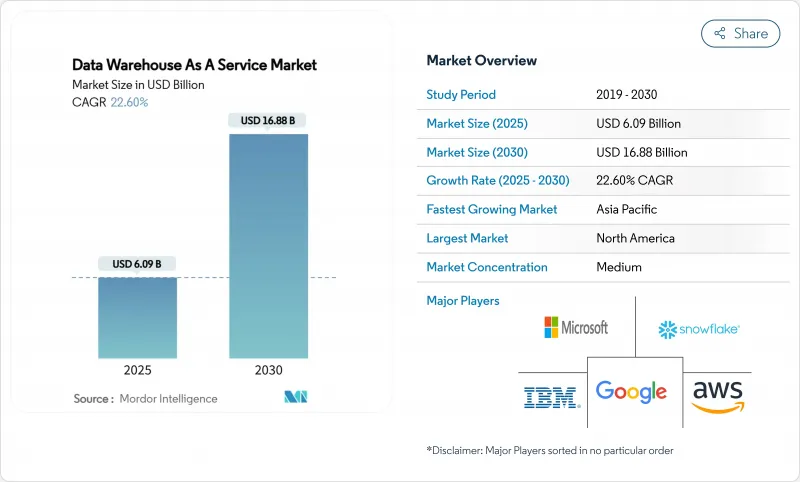
對現代雲端原生分析的強勁需求、不斷成長的企業人工智慧工作負載以及計量收費的成本效益是關鍵的成長要素。雖然目前公共雲端平台佔據了大部分市場佔有率,但隨著企業最佳化工作負載部署並避免被廠商鎖定,多重雲端和混合架構的成長速度正在超越整體水平。儘管大型企業仍然佔據大部分支出,但隨著自助服務工具降低了准入門檻,以及無伺服器擴展消除了容量規劃的需求,中小企業 (SME) 的採用率也在迅速提高。從業界來看,金融服務業正在加速採用雲端原生分析,而醫療保健和生命科學領域的採用速度最快,因為臨床和研究數據的整合加速了精準醫療計畫的發展。超大規模雲端服務供應商利用整合生態系統,而專業雲端服務供應商則透過多重雲端可移植性和內建機器學習功能來脫穎而出。
全球資料倉儲即服務市場趨勢與洞察
雲端遷移與即時分析熱潮
企業正從週期性批次報告轉向串流架構,以亞秒速度產生儀表板和預測模型。 ABB 將來自 40 個不同 ERP 系統的資料整合到單一 Snowflake 實例中,透過即時生產可視性節省了數百萬美元。邊緣閘道器在生產線附近過濾對時間敏感的遙測數據,而雲端資料倉儲則可執行複雜的連接和歷史趨勢分析,而不會出現容量瓶頸。這些低延遲管道支援自主資產最佳化、動態定價和即時欺詐管理。隨著連網設備的日益普及,即時分析將繼續成為一項重要的支出項目,從而推動對彈性 DWaaS 容量的需求,這種容量能夠隨資料攝取速率擴展,而不是採用固定節點。
人工智慧/機器學習主導的倉儲需求
現代資料倉儲層融合了結構化表和非結構化文件,從而可以在儲存層內進行模型訓練。 Snowflake 與 NVIDIA 合作,將專用 GPU 整合到運算叢集中,確保資料在推理加速過程中始終位於安全邊界內。 Databricks 正在整合 Lakehouse 儲存格式,使資料科學家能夠使用與儀表板相同的 SQL 端點,在Petabyte級日誌上建立特徵。由大規模語言模型驅動的自然語言查詢助手,使業務用戶能夠更便捷地存取分析功能,從而推動更廣泛的組織採用該技術,並提升資料倉儲即服務市場的計算消耗。
網路安全和隱私風險
歐洲的《一般資料保護規則)和亞洲的新在地化法規限制了跨國資料傳輸,並使跨國企業的雲端策略變得更加複雜。將敏感資產集中在第三方雲端對威脅行為者極具吸引力,迫使企業採用普遍加密、零信任存取和持續態勢監控。安全責任共擔模式本身可能會模糊責任範圍、延長採購週期並減緩採用速度,尤其對於缺乏專業雲端安全人才的團隊而言更是如此。
細分市場分析
到2024年,隨著企業優先考慮承包的可擴展性和全球可用性,公共雲端平台將佔據資料倉儲即服務市場規模的65.5%。 AWS憑藉其深度服務整合,將佔據全球約34%的收入佔有率,而微軟Azure在Office 365領域的穩固地位將使採購更加便捷。當主權法規禁止外部託管時,私有雲端實例仍將繼續存在,但高昂的營運成本限制了其成長。
預計到 2030 年,混合雲端和多重雲端的採用率將以 24.6% 的複合年成長率成長,這主要得益於企業透過將分析資源分散到不同的雲端服務供應商,避免被單一供應商鎖定,利用區域成本差異,並將敏感資料集放置在首選的自主平台上。 Google雲端的 BigQuery Omni 支援跨雲端查詢,無需實體資料移動,展現了強大的互通性,可降低出口費用和延遲損失。 Snowflake 的開放式 Polaris Catalog 透過標準化 AWS、Azure 和Google雲端之間的元資料,進一步簡化了遷移過程。
受複雜管治需求和跨部門分析設施的驅動,大型企業將在 2024 年佔據資料倉儲即服務市場佔有率的 62.2%。這些企業部署了高階安全層,支援數千個同時上線用戶,並將他們的資料倉儲與傳統的 ERP、CRM 和風險引擎整合。
同時,中小企業將成為營收成長的最大驅動力,到2030年將以26.4%的複合年成長率成長,這主要得益於無伺服器引擎消除了容量規劃的障礙。低程式碼資料導入連接器和自然語言查詢介面將使業務分析師無需專門的資料科學團隊即可啟動預測模型,從而縮小與大型企業的能力差距。學術研究表明,文化變革而非硬體預算是中小企業分析計畫成功的關鍵因素。
區域分析
2024年,北美將佔全球收入的39.6%,這得益於其豐富的資料中心容量、有利的雲端採購政策以及在技術、金融和醫療保健領域深厚的技能基礎。超大規模資料中心業者持續推出區域性人工智慧加速器和主權雲端區域,以滿足市場對高階分析服務的需求。以緬因州雲端遷移為例,聯邦和州政府機構正在進一步檢驗雲端倉庫在公共部門工作負載的可行性。
亞太地區是成長最快的地區,預計到2030年將以24.8%的複合年成長率成長,這得益於大規模超大規模資料中心建設和政府數位經濟藍圖的推動。新加坡政府科技局(GovTech)等公共部門的最佳實踐表明,明確的監管政策和政府支持的雲端培訓能夠縮短企業引進週期。
歐洲正努力在對分析技術的高需求與嚴格的主權法律之間尋求平衡。供應商正透過推出僅限歐盟用戶的區域、保密運算飛地和主權元資料服務來應對這項挑戰。跨國金融機構正在採用分散式資料網格架構,以便在遵守當地居住規定的同時,維持跨境風險分析。南美洲以及中東和非洲地區則提供了規模較小但不斷成長的機遇,這些機會與電子商務和智慧城市計劃的擴展密切相關。
其他福利:
- Excel格式的市場預測(ME)表
- 3個月的分析師支持
目錄
第1章 引言
- 市場定義與研究假設
- 調查範圍
第2章調查方法
第3章執行摘要
第4章 市場情勢
- 市場概覽
- 市場促進因素
- 雲端遷移與即時分析熱潮
- 人工智慧/機器學習驅動倉儲需求
- 金融服務業數位化優先藍圖
- 轉向基於消費的定價
- 邊緣到雲端的低延遲倉庫
- 綠色倉儲和碳排放彙報重點
- 市場限制
- 網路安全和隱私風險
- 不可預測的雲端成本
- 對供應商鎖定問題的擔憂
- 財務營運/數據可觀測性技能短缺
- 價值鏈分析
- 關鍵法規結構評估
- 關鍵相關人員影響評估
- 技術展望
- 波特五力分析
- 供應商的議價能力
- 消費者議價能力
- 新進入者的威脅
- 替代品的威脅
- 競爭對手之間的競爭
- 宏觀經濟因素的影響
第5章 市場規模與成長預測
- 按部署模式
- 公有雲
- 私有雲端
- 混合/多重雲端
- 按最終用戶公司規模分類
- 主要企業
- 小型企業
- 按最終用戶行業分類
- BFSI
- 政府和公共部門
- 醫療保健和生命科學
- 零售與電子商務
- 電訊和資訊技術
- 媒體與娛樂
- 製造業
- 按服務類型
- 企業資料倉儲即服務 (DWaaS)
- 營運資料儲存即服務
- 數據湖屋即服務
- 分析加速服務
- 按地區
- 北美洲
- 美國
- 加拿大
- 墨西哥
- 南美洲
- 巴西
- 阿根廷
- 其他南美洲
- 歐洲
- 德國
- 英國
- 法國
- 義大利
- 西班牙
- 俄羅斯
- 其他歐洲地區
- 亞太地區
- 中國
- 日本
- 印度
- 韓國
- 澳洲和紐西蘭
- 亞太其他地區
- 中東和非洲
- 中東
- 沙烏地阿拉伯
- 阿拉伯聯合大公國
- 土耳其
- 其他中東地區
- 非洲
- 南非
- 奈及利亞
- 埃及
- 其他非洲地區
- 北美洲
第6章 競爭情勢
- 市場集中度
- 策略趨勢
- 市佔率分析
- 公司簡介
- Amazon Web Services Inc.
- Microsoft Corporation
- Google LLC
- Snowflake Inc.
- IBM Corporation
- Oracle Corporation
- SAP SE
- Teradata Corp.
- Cloudera Inc.
- Databricks Inc.
- Micro Focus International plc
- Yellowbrick Data
- ClickHouse Inc.
- Dremio Corporation
- Alibaba Cloud
- Huawei Cloud
- Firebolt Analytics Ltd.
- Vertica(Micro Focus)
- Exasol AG
- Actian Corp.
第7章 市場機會與未來趨勢
- 閒置頻段與未滿足需求評估
The data warehouse as a service market size reached USD 6.09 billion in 2025 and is projected to climb to USD 16.88 billion by 2030, translating into a 22.6% CAGR over the forecast period.
Strong demand for modern, cloud-native analytics, rising enterprise artificial-intelligence workloads, and the cost efficiencies of pay-as-you-go pricing are the principal growth engines. Public-cloud platforms dominate current deployments, yet multi-cloud and hybrid architectures are outpacing overall expansion as firms hedge against lock-in while optimizing workload placement. Large enterprises still account for a majority of spending, but small and medium enterprises (SMEs) are increasing adoption rapidly as self-service tooling lowers entry barriers and serverless scaling eliminates capacity planning. Vertically, financial services set the adoption pace, whereas healthcare and life sciences log the fastest gains because unified clinical and research data accelerates precision-medicine programs. Competitive intensity remains moderate; hyperscale providers leverage integrated ecosystems while specialists differentiate through multi-cloud portability and built-in machine-learning features.
Global Data Warehouse As A Service Market Trends and Insights
Cloud Migration and Real-Time Analytics Boom
Enterprises are shifting from periodic batch reporting to streaming architectures that feed sub-second dashboards and predictive models. ABB consolidated data from 40 disparate ERP systems into a single Snowflake instance and unlocked multimillion-dollar savings through real-time production visibility . Edge gateways now filter time-sensitive telemetry close to manufacturing lines, while cloud data warehouses execute complex joins and historical trend analyses without capacity bottlenecks. These low-latency pipelines support autonomous-equipment optimization, dynamic pricing, and instantaneous fraud controls. As more connected devices proliferate, real-time analytics will remain a top spending priority, reinforcing demand for elastic DWaaS capacity that scales on ingestion rates rather than fixed nodes.
AI/ML-Driven Warehousing Demand
Modern data-warehouse layers blend structured tables with unstructured files, enabling model training inside the storage tier. Snowflake's collaboration with NVIDIA embeds specialized GPUs alongside compute clusters so data never leaves the security perimeter during inference acceleration . Databricks integrates lakehouse storage formats that let data scientists build features over petabyte-scale logs using the same SQL endpoints powering dashboards. Natural-language query assistants driven by large language models democratize analytics access for business users, fueling broader organizational adoption and increasing overall compute consumption across the data warehouse as a service market.
Cyber-Security and Privacy Risks
General Data Protection Regulation requirements in Europe and new localization statutes in Asia restrict cross-border data movement, complicating multinational cloud strategies. Consolidating sensitive assets inside third-party clouds heightens the appeal for threat actors, forcing enterprises to deploy pervasive encryption, zero-trust access and continuous posture monitoring. The shared-responsibility security model itself can blur accountability lines, especially for teams lacking dedicated cloud-security talent, thereby extending procurement cycles and slowing adoption.
Other drivers and restraints analyzed in the detailed report include:
- BFSI Digital-First Road-Maps
- Shift to Consumption-Based Pricing
- Unpredictable Cloud Cost Sprawl
For complete list of drivers and restraints, kindly check the Table Of Contents.
Segment Analysis
Public-cloud platforms held 65.5% of the data warehouse as a service market size in 2024 as enterprises prioritized turnkey scalability and global availability. AWS captured roughly 34% of worldwide revenue thanks to deep service integration, while Microsoft Azure benefited from established Office 365 footprints that eased procurement. Private-cloud instances persist where sovereignty mandates preclude external hosting, but higher operational overhead tempers growth.
Hybrid and multi-cloud deployments are projected to record a 24.6% CAGR through 2030 as firms distribute analytics across providers to avoid lock-in, exploit regional cost differentials and place sensitive datasets on preferred sovereign platforms. Google Cloud's BigQuery Omni allows cross-cloud querying without physical data moves, showing how interoperability features reduce egress fees and latency penalties . Snowflake's open Polaris Catalog further eases migration by standardizing metadata across AWS, Azure and Google Cloud.
Large organizations controlled 62.2% of the 2024 data warehouse as a service market share due to complex governance needs and multi-department analytics estates. They deploy advanced security layers, support thousands of concurrent users and integrate warehouses with legacy ERP, CRM and risk engines.
In contrast, SMEs will drive the highest incremental revenue, expanding at a 26.4% CAGR through 2030 as serverless engines remove capacity-planning hurdles. Low-code ingestion connectors and natural-language query interfaces allow business analysts to launch predictive models without dedicated data-science teams, narrowing capability gaps versus larger peers. Academic studies highlight cultural change as the primary success factor for SME analytics programs, not hardware budgets.
The Data Warehouse As A Service Market Report is Segmented by Deployment Model (Public Cloud, Private Cloud, Hybrid/Multi-cloud), End-User Enterprise Size (Large Enterprises, Small and Medium Enterprises), End-User Industry (BFSI, Government and Public Sector, and More), Service Type (Enterprise DWaaS, Operational Data-Store As A Service, and More), and Geography. The Market Forecasts are Provided in Terms of Value (USD).
Geography Analysis
North America accounted for 39.6% of global revenue in 2024, buoyed by abundant data-center capacity, favorable cloud procurement policies and a deep skills base across technology, finance and healthcare verticals. Hyperscalers continuously launch region-specific AI accelerators and sovereign-cloud zones, sustaining demand for premium analytics tiers. Federal and state agencies, exemplified by the State of Maine's cloud migration, further validate cloud warehouses for public-sector workloads .
Asia-Pacific is the fastest-growing region with a 24.8% CAGR through 2030, supported by massive hyperscale build-outs and government digital-economy roadmaps. Public-sector exemplars such as Singapore's GovTech highlight how regulatory clarity and state-sponsored cloud training shorten enterprise adoption cycles.
Europe balances high analytics demand with stringent sovereignty legislation. Vendors respond by launching EU-only regions, confidential computing enclaves and sovereign-metadata services. Multinational financial institutions implement distributed data-mesh architectures to comply with local residency rules while preserving cross-border risk analytics. South America plus the Middle East & Africa exhibit growing, albeit smaller, opportunity pools linked to e-commerce expansion and smart-city initiatives; however, infrastructure gaps and macro-economic volatility moderate near-term uptake.
- Amazon Web Services Inc.
- Microsoft Corporation
- Google LLC
- Snowflake Inc.
- IBM Corporation
- Oracle Corporation
- SAP SE
- Teradata Corp.
- Cloudera Inc.
- Databricks Inc.
- Micro Focus International plc
- Yellowbrick Data
- ClickHouse Inc.
- Dremio Corporation
- Alibaba Cloud
- Huawei Cloud
- Firebolt Analytics Ltd.
- Vertica (Micro Focus)
- Exasol AG
- Actian Corp.
Additional Benefits:
- The market estimate (ME) sheet in Excel format
- 3 months of analyst support
TABLE OF CONTENTS
1 INTRODUCTION
- 1.1 Market Definition and Study Assumptions
- 1.2 Scope of the Study
2 RESEARCH METHODOLOGY
3 EXECUTIVE SUMMARY
4 MARKET LANDSCAPE
- 4.1 Market Overview
- 4.2 Market Drivers
- 4.2.1 Cloud migration and real-time analytics boom
- 4.2.2 AI/ML-driven warehousing demand
- 4.2.3 BFSI digital-first road-maps
- 4.2.4 Shift to consumption-based pricing
- 4.2.5 Edge-to-cloud low-latency warehousing
- 4.2.6 Green warehousing and carbon reporting focus
- 4.3 Market Restraints
- 4.3.1 Cyber-security and privacy risks
- 4.3.2 Unpredictable cloud cost sprawl
- 4.3.3 Vendor lock-in concerns
- 4.3.4 Shortage of FinOps / data-observability skills
- 4.4 Value Chain Analysis
- 4.5 Evaluation of Critical Regulatory Framework
- 4.6 Impact Assessment of Key Stakeholders
- 4.7 Technological Outlook
- 4.8 Porter's Five Forces Analysis
- 4.8.1 Bargaining Power of Suppliers
- 4.8.2 Bargaining Power of Consumers
- 4.8.3 Threat of New Entrants
- 4.8.4 Threat of Substitutes
- 4.8.5 Intensity of Competitive Rivalry
- 4.9 Impact of Macro-economic Factors
5 MARKET SIZE AND GROWTH FORECASTS (VALUE)
- 5.1 By Deployment Model
- 5.1.1 Public Cloud
- 5.1.2 Private Cloud
- 5.1.3 Hybrid / Multi-cloud
- 5.2 By End-user Enterprise Size
- 5.2.1 Large Enterprises
- 5.2.2 Small and Medium Enterprises
- 5.3 By End-user Industry
- 5.3.1 BFSI
- 5.3.2 Government and Public Sector
- 5.3.3 Healthcare and Life Sciences
- 5.3.4 Retail and E-commerce
- 5.3.5 Telecom and IT
- 5.3.6 Media and Entertainment
- 5.3.7 Manufacturing
- 5.4 By Service Type
- 5.4.1 Enterprise DWaaS
- 5.4.2 Operational Data-store as a Service
- 5.4.3 Data Lakehouse as a Service
- 5.4.4 Analytics Acceleration Services
- 5.5 By Geography
- 5.5.1 North America
- 5.5.1.1 United States
- 5.5.1.2 Canada
- 5.5.1.3 Mexico
- 5.5.2 South America
- 5.5.2.1 Brazil
- 5.5.2.2 Argentina
- 5.5.2.3 Rest of South America
- 5.5.3 Europe
- 5.5.3.1 Germany
- 5.5.3.2 United Kingdom
- 5.5.3.3 France
- 5.5.3.4 Italy
- 5.5.3.5 Spain
- 5.5.3.6 Russia
- 5.5.3.7 Rest of Europe
- 5.5.4 Asia-Pacific
- 5.5.4.1 China
- 5.5.4.2 Japan
- 5.5.4.3 India
- 5.5.4.4 South Korea
- 5.5.4.5 Australia and New Zealand
- 5.5.4.6 Rest of Asia-Pacific
- 5.5.5 Middle East and Africa
- 5.5.5.1 Middle East
- 5.5.5.1.1 Saudi Arabia
- 5.5.5.1.2 United Arab Emirates
- 5.5.5.1.3 Turkey
- 5.5.5.1.4 Rest of Middle East
- 5.5.5.2 Africa
- 5.5.5.2.1 South Africa
- 5.5.5.2.2 Nigeria
- 5.5.5.2.3 Egypt
- 5.5.5.2.4 Rest of Africa
- 5.5.1 North America
6 COMPETITIVE LANDSCAPE
- 6.1 Market Concentration
- 6.2 Strategic Moves
- 6.3 Market Share Analysis
- 6.4 Company Profiles (includes Global level Overview, Market level overview, Core Segments, Financials as available, Strategic Information, Market Rank/Share for key companies, Products and Services, and Recent Developments)
- 6.4.1 Amazon Web Services Inc.
- 6.4.2 Microsoft Corporation
- 6.4.3 Google LLC
- 6.4.4 Snowflake Inc.
- 6.4.5 IBM Corporation
- 6.4.6 Oracle Corporation
- 6.4.7 SAP SE
- 6.4.8 Teradata Corp.
- 6.4.9 Cloudera Inc.
- 6.4.10 Databricks Inc.
- 6.4.11 Micro Focus International plc
- 6.4.12 Yellowbrick Data
- 6.4.13 ClickHouse Inc.
- 6.4.14 Dremio Corporation
- 6.4.15 Alibaba Cloud
- 6.4.16 Huawei Cloud
- 6.4.17 Firebolt Analytics Ltd.
- 6.4.18 Vertica (Micro Focus)
- 6.4.19 Exasol AG
- 6.4.20 Actian Corp.
7 MARKET OPPORTUNITIES AND FUTURE TRENDS
- 7.1 White-space and Unmet-need Assessment

 資料倉儲即服務 (DWaaS) 市場:市場規模、佔有率和趨勢分析(按部署方式、使用情況、公司規模、應用、最終用途和地區分類),細分市場預測(2026-2033 年)
 2026年全球資料倉儲即服務(DWaaS)市場報告
 全球資料倉儲即服務(DWaaS)市場:市場規模、佔有率、成長、依類型和應用劃分的行業分析、區域洞察和預測(2026–2034)
 資料倉儲即服務 (DWaaS) 市場規模、佔有率和成長分析(按部署模式、應用程式、組織規模、最終用戶產業和地區分類)—2026-2033 年產業預測
 資料倉儲即服務(DWaaS)市場規模、佔有率、趨勢及產業分析報告:依用途、部署、應用、垂直產業、地區,並預測2025-2034年市場規模