


 |
市場調查報告書
商品編碼
1851750
汽車點火器線圈:市場佔有率分析、行業趨勢、統計數據和成長預測(2025-2030 年)Automotive Ignition Coil - Market Share Analysis, Industry Trends & Statistics, Growth Forecasts (2025 - 2030) |
||||||

※ 本網頁內容可能與最新版本有所差異。詳細情況請與我們聯繫。
預計到 2025 年汽車點火器線圈市場規模將達到 112.6 億美元,到 2030 年將達到 139.1 億美元,年複合成長率為 4.32%。
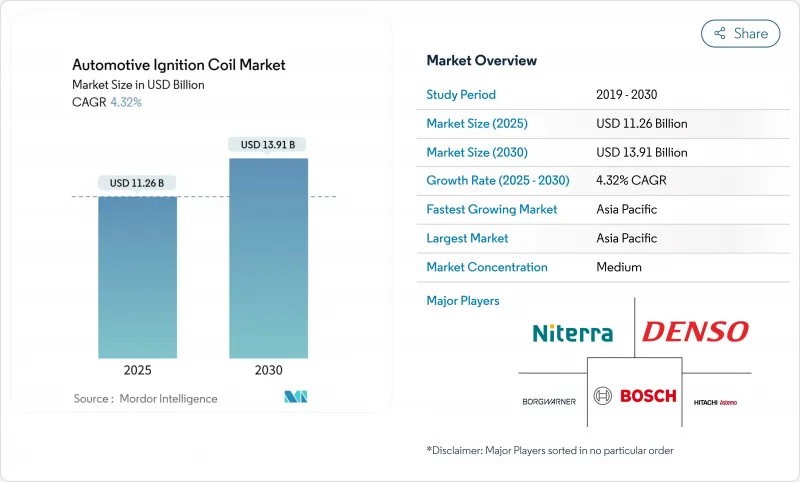
亞太地區輕型汽車產量不斷成長、點火線圈(COP)技術的持續主導地位以及舊款車型靈活的換代週期,都在支撐著汽車點火線圈市場的成長。汽車製造商正在針對小型化渦輪增壓引擎最佳化點火系統設計。同時,銅價上漲和稀土磁體供應風險擠壓了供應商的利潤空間,而純電動車(BEV)的普及則凸顯了長期需求的上限。這些相互矛盾的因素使得汽車點火器線圈市場處於傳統內燃機需求與快速電氣化未來發展之間的戰略十字路口。
全球汽車點火器線圈市場趨勢及洞察
全球乘用車和輕型商用車產量增加
全球汽車生產持續從低迷中復甦,尤其是在亞太地區,預計2024年上半年產業銷售額將成長7%。由於輕型商用車的電氣化進程比乘用車落後約五年,汽車點火器線圈市場受益於產量的增加。汽車製造商也正在推出保留內燃機(ICE)的48V輕度混合動力平台,這在降低排放的同時增加了對點火線圈的需求。為滿足歐7排放標準,對精確點火正時的重視也為支援單缸控制的COP組件提供了發展動力。這些因素共同推動了點火線圈市場的穩定成長。
老舊公園的維修需求
到2024年,美國的平均車齡將達到12.5年。老舊車輛需要更頻繁的保養,這催生了蓬勃發展的點火線圈售後市場。 Standard Motor Products公司已提供800種SKU,覆蓋率高達99%;而NGK的歐洲產品涵蓋420個零件編號,適用於87%的車型。獨立研討會依賴廣泛的兼容性,這使得售後市場成為一個利潤日益豐厚的管道。老舊車型報廢前的這段時間,至少在一個車型週期內,為售後市場提供了穩定的收入來源。
純電動車的普及將淘汰傳統的點火系統。
電動車省去了整個火花點火器裝置,維護成本最多可降低 40%。Denso預測,到 2035 年,純電動車將佔據全球產量的大部分,供應商的重心將轉向電池、逆變器和熱感管理模組。乘用車領域最初將出現最嚴重的下滑,而由於續航里程和負載容量的限制,重型商用車可能會落後。然而,這種發展方向的轉變將限制未來點火線圈的產量。
細分市場分析
缸內點火線圈系統被認為是汽車點火器線圈市場的主要成長引擎,預計到2024年將佔據51.33%的市場佔有率,複合年成長率(CAGR)為6.32%。這種設計無需高壓導線,降低了電磁損耗,並支援渦輪增壓引擎所需的先進爆震控制策略。缸體點火線圈和油軌組件在對成本敏感的車型中仍然具有競爭力,尤其是在新興國家的入門市場。
OEM廠商的案例研究也印證了這一轉變:博世在寶馬車型中引入了彈簧觸點式點火線圈(COP),以提高火星塞連接的可靠性;Denso的產品藍圖則將無分電器解決方案列為核心產品線。結合48V馬達和內燃機的混合動力傳動系統將需要每個汽缸配備一個點火線圈,這將使COP點火線圈在2030年之前保持領先地位。價格優勢、安裝簡單以及改進的引擎管理意味著COP點火線圈將繼續處於汽車點火器線圈市場的前沿。
由於製造流程成熟、可靠性高且成本低,單一火星塞設計預計在2024年將佔總銷售量的62.41%。然而,隨著高階汽車製造商追求更高的燃燒效率,雙火星塞裝置預計將實現5.97%的複合年成長率。鑑於巴西靈活燃料汽車中乙醇含量各不相同,多個點火點有利於火焰的穩定傳播。
博格華納的多火花點火系統展示了供應商如何透過延長點火持續時間或提供順序脈衝來最佳化燃燒。隨著監管機構收緊顆粒物排放限制,雙火花點火系統的價值將日益凸顯。然而,單火星點火系統龐大的裝置量以及與多種引擎混合氣的兼容性,將確保在整個預測期內,採用這種配置的汽車點火器線圈的市場規模仍將保持可觀。
區域分析
汽車點火器線圈市場由亞太地區主導,市佔率高達46.21%,年複合成長率達6.97%。預計到2024年,中國汽車產業銷售額將達到10兆元人民幣,其中國產品牌佔比高達61.9%,將推動強勁的線圈需求。日本製造商如NGK絕緣體正向全球出口先進的產品,而印度低成本的市場環境也吸引了大量投資,用於OEM供應和售後市場出口。北美市場雖然成熟,但盈利。平均車齡12.5年確保了售後市場的穩定需求,而美國環保署(EPA)嚴格的法規也保證了高階線圈在現有內燃機平台上的市場地位。
歐洲正努力在積極的純電動車政策和暫定的歐7排放標準之間尋求平衡。在電池平台規模化之前,汽車製造商必須安裝高功率點火線圈以滿足顆粒物排放法規的要求。 NGK 87%的售後市場覆蓋率使其能夠為老舊的汽油車和輕度混合動力車提供零件。南美洲的發展主要得益於巴西的靈活燃料生態系統,該國82%的輕型車輛使用乙醇混合燃料,這增加了點火線圈的應力,也對耐腐蝕設計提出了更高的要求。巴西的乙醇產量在2023年達到了353億公升。
中東和非洲的貢獻目前仍然較小,但隨著汽車普及率的提高,其佔有率將逐步成長。政治不穩定和貨幣波動使物流變得複雜,但日本和中國品牌在奈及利亞、埃及和南非的本地組裝正在創造線圈市場機會。整體而言,地理多樣性能夠緩衝單一地區市場衝擊對汽車點火器線圈市場的影響。
其他福利:
- Excel格式的市場預測(ME)表
- 3個月的分析師支持
目錄
第1章 引言
- 研究假設和市場定義
- 調查範圍
第2章調查方法
第3章執行摘要
第4章 市場情勢
- 市場概覽
- 市場促進因素
- 全球乘用車和輕型商用車產量增加
- 老化雪橇的售後市場更換需求
- 嚴格的廢氣排放法規推動了高性能線圈的發展
- 小型渦輪增壓汽油引擎需要COP線圈
- 新興市場的靈活燃料計劃需要堅固耐用的線圈
- 智慧診斷線圈在連網汽車中的應用現狀
- 市場限制
- 純電動車的普及將取代傳統的點火系統。
- 銅和稀土元素磁鐵的價格波動
- 48V混合動力架構減少了每輛車的線圈數量。
- 低壓等離子點火技術的出現
- 價值/供應鏈分析
- 技術展望
- 監管環境
- 波特五力模型
- 新進入者的威脅
- 買方的議價能力
- 供應商的議價能力
- 替代品的威脅
- 競爭對手之間的競爭
第5章 市場規模與成長預測
- 按類型
- 點火器線圈
- 缸內點火線圈(COP)
- 點火器線圈導軌
- 運行原理
- 單火花技術
- 雙火花技術
- 透過分銷管道
- OEM
- 售後市場
- 按車輛類型
- 搭乘用車
- 商用車輛
- 按地區
- 北美洲
- 美國
- 加拿大
- 北美其他地區
- 南美洲
- 巴西
- 阿根廷
- 其他南美洲
- 歐洲
- 德國
- 英國
- 法國
- 義大利
- 俄羅斯
- 其他歐洲地區
- 亞太地區
- 中國
- 日本
- 印度
- 韓國
- 澳洲
- 紐西蘭
- 亞太其他地區
- 中東和非洲
- 沙烏地阿拉伯
- 阿拉伯聯合大公國
- 埃及
- 土耳其
- 南非
- 其他中東和非洲地區
- 北美洲
第6章 競爭情勢
- 市場集中度
- 策略趨勢
- 市佔率分析
- 公司簡介
- NGK Spark Plug Co. Ltd(Niterra)
- Denso Corporation
- Robert Bosch GmbH
- Hitachi Astemo Ltd
- Diamond Electric Holdings Co. Ltd
- Taiwan Ignition System Co. Ltd
- BorgWarner Inc.(incl. Delphi Technologies)
- Eldor Corporation
- Valeo SA
- Continental AG
- Mitsubishi Electric Corporation
- Standard Motor Products Inc.
- Federal-Mogul(Tenneco)
- Mahle GmbH
- Walker Products Inc.
第7章 市場機會與未來展望
The automotive ignition coil market size is sized at USD 11.26 billion in 2025 and is forecast to touch USD 13.91 billion by 2030, advancing at a 4.32% CAGR.
Rising light-vehicle output in Asia Pacific, continued dominance of coil-on-plug (COP) technology, and a resilient replacement cycle in mature fleets collectively underpin growth. OEMs are fine-tuning ignition designs for turbocharged downsized engines that must comply with near-term Euro 7 limits, while the aftermarket benefits from the 12.5-year average vehicle age in the United States. At the same time, elevated copper prices and supply risks for rare-earth magnets are compressing supplier margins, and battery-electric-vehicle (BEV) penetration sets a clear upper bound on long-term demand. These crosscurrents place the automotive ignition coil market at a strategic pivot between legacy combustion needs and a rapidly electrifying future.
Global Automotive Ignition Coil Market Trends and Insights
Rising Global Production of Passenger and Light Commercial Vehicles
Vehicle volumes continue to rebound from pandemic lows, especially in Asia Pacific, where industry revenue climbed 7% in 1H 2024. Production upswings favor the automotive ignition coil market because light commercial electrification trails passenger adoption by roughly five years. Automakers are also rolling out 48V mild-hybrid platforms that keep internal-combustion engines (ICE) in play, extending coil demand while cutting emissions. The emphasis on precise ignition timing to satisfy Euro 7 creates tailwinds for COP assemblies that support individual-cylinder control. Together, these forces add a moderate uplift to the growth trajectory.
Aftermarket Replacement Demand From Ageing Parc
Average fleet age reached 12.5 years in the United States during 2024. Older vehicles require more frequent service, which supports a vibrant aftermarket for coils. Standard Motor Products already fields 800 SKUs with 99% coverage, while NGK's European range covers 420-part numbers that fit 87% of vehicles on the road. Independent workshops rely on broad compatibility, making the aftermarket an increasingly lucrative channel. The time buffer before legacy vehicles retire creates a durable revenue stream for at least one model cycle.
BEV Penetration Eliminates Conventional Ignition Systems
Electric cars remove the entire spark-ignition assembly, cutting maintenance costs by up to 40%. DENSO projects BEVs will dominate global production by 2035, prompting suppliers to pivot toward battery, inverter, and thermal-management modules . Passenger segments will see the sharpest drop first, while heavier commercial classes will transition later due to range and payload limits. Nonetheless, the directional shift places a ceiling on future coil volumes.
Other drivers and restraints analyzed in the detailed report include:
- Stringent Emission Norms Pushing High-Performance Coils
- Turbo-Charged Downsized Gasoline Engines Need COP Coils
- Price Volatility of Copper and Rare-Earth Magnets
For complete list of drivers and restraints, kindly check the Table Of Contents.
Segment Analysis
Coil-on-plug systems accounted for 51.33% of 2024 revenue, and their 6.32% CAGR positions them as the clear growth engine for the automotive ignition coil market. The design removes high-voltage leads, reduces electromagnetic loss, and supports advanced knock-control strategies demanded by turbocharged engines. Block coils and rail assemblies stay competitive in cost-sensitive models, especially in entry-level segments across emerging economies.
OEM case studies reinforce the shift: Bosch introduced a spring-contact COP for BMW models to improve spark-plug connection reliability, while DENSO's portfolio roadmap highlights distributor-less solutions as a core product line. Hybrid powertrains, which blend a 48 V e-motor with an ICE, still require one coil per cylinder, securing volume for COP units through 2030. Competitive pricing, simplified installation, and incremental engine-management gains will keep COP at the center of the automotive ignition coil market narrative.
Single-spark designs owned 62.41% of sales in 2024, reflecting mature manufacturing, proven reliability, and lower cost. Yet dual-spark units are tracking a 5.97% CAGR as premium OEMs chase further combustion efficiency. In Brazil's flex-fuel fleet, variable ethanol content makes multiple ignition points advantageous for stable flame propagation.
BorgWarner's multi-spark line illustrates how suppliers extend dwell time or deliver sequential pulses to optimize burn time. Dual-spark value scales when regulators tighten particulate limits. Even so, single-spark's sizeable installed base and compatibility with a broad engine mix mean that the automotive ignition coil market size for this configuration will remain substantial through the forecast horizon.
The Automotive Ignition Coil Market Report is Segmented by Type (Block Ignition Coils, Coil On Plug, and More), Operating Principle (Single Spark Technology and Dual Spark Technology), Distribution Channel (OEM and Aftermarket), Vehicle Type (Passenger Cars and Commercial Vehicles), and Geography (North America, South America, and More). The Market Forecasts are Provided in Terms of Value (USD).
Geography Analysis
Asia Pacific leads the automotive ignition coil market with 46.21% share and is on pace for 6.97% CAGR. China recorded auto-industry revenue of 10 trillion yuan in 2024, and domestic brands accounted for 61.9% of sales, driving strong local coil demand. Japanese manufacturers such as NGK ship advanced units worldwide, while India's low-cost base draws investment for OEM supply and aftermarket export. North America is a mature but profitable arena; the 12.5-year average fleet age secures steady aftermarket pull, and strict U.S. EPA rules keep premium coils relevant for remaining ICE platforms.
Europe balances aggressive BEV policy with interim Euro 7 compliance. Automakers must fit high-output coils to meet particulate limits until battery platforms scale, and NGK's 87% aftermarket coverage ensures part availability for aging gasoline and mild-hybrid fleets. South America is driven by Brazil's flex-fuel ecosystem, where 82% of the light-vehicle park runs on ethanol blends, a scenario that raises coil stress and boosts demand for corrosion-resistant designs; Brazil's ethanol output reached 35.3 billion liters in 2023 .
The Middle East and Africa remain smaller contributors yet record incremental gains as motorization rates climb. Political instability and currency volatility complicate logistics, but localized assembly by Japanese and Chinese brands is opening coil opportunities in Nigeria, Egypt, and South Africa. Overall, geographic diversity cushions the automotive ignition coil market against single-region shocks.
- NGK Spark Plug Co. Ltd (Niterra)
- Denso Corporation
- Robert Bosch GmbH
- Hitachi Astemo Ltd
- Diamond Electric Holdings Co. Ltd
- Taiwan Ignition System Co. Ltd
- BorgWarner Inc. (incl. Delphi Technologies)
- Eldor Corporation
- Valeo SA
- Continental AG
- Mitsubishi Electric Corporation
- Standard Motor Products Inc.
- Federal-Mogul (Tenneco)
- Mahle GmbH
- Walker Products Inc.
Additional Benefits:
- The market estimate (ME) sheet in Excel format
- 3 months of analyst support
TABLE OF CONTENTS
1 Introduction
- 1.1 Study Assumptions & Market Definition
- 1.2 Scope of the Study
2 Research Methodology
3 Executive Summary
4 Market Landscape
- 4.1 Market Overview
- 4.2 Market Drivers
- 4.2.1 Rising Global Production of Passenger and Light Commercial Vehicles
- 4.2.2 Aftermarket Replacement Demand From Ageing Parc
- 4.2.3 Stringent Emission Norms Pushing High-Performance Coils
- 4.2.4 Turbo-Charged Downsized Gasoline Engines Need COP Coils
- 4.2.5 Flex-Fuel Programs in Emerging Markets Require Robust Coils
- 4.2.6 Connected-Vehicle Smart-Diagnostic Coils Adoption
- 4.3 Market Restraints
- 4.3.1 BEV Penetration Eliminates Conventional Ignition Systems
- 4.3.2 Price Volatility of Copper and Rare-Earth Magnets
- 4.3.3 48 V Hybrid Architectures Cutting Coil Count per Vehicle
- 4.3.4 Emergence of Low-Tension Plasma Ignition Techs
- 4.4 Value / Supply-Chain Analysis
- 4.5 Technological Outlook
- 4.6 Regulatory Landscape
- 4.7 Porter's Five Forces
- 4.7.1 Threat of New Entrants
- 4.7.2 Bargaining Power of Buyers
- 4.7.3 Bargaining Power of Suppliers
- 4.7.4 Threat of Substitutes
- 4.7.5 Competitive Rivalry
5 Market Size & Growth Forecasts (Value (USD))
- 5.1 By Type
- 5.1.1 Block Ignition Coils
- 5.1.2 Coil-on-Plug (COP)
- 5.1.3 Ignition Coil Rail
- 5.2 By Operating Principle
- 5.2.1 Single Spark Technology
- 5.2.2 Dual Spark Technology
- 5.3 By Distribution Channel
- 5.3.1 OEM
- 5.3.2 Aftermarket
- 5.4 By Vehicle Type
- 5.4.1 Passenger Cars
- 5.4.2 Commercial Vehicles
- 5.5 By Geography
- 5.5.1 North America
- 5.5.1.1 United States
- 5.5.1.2 Canada
- 5.5.1.3 Rest of North America
- 5.5.2 South America
- 5.5.2.1 Brazil
- 5.5.2.2 Argentina
- 5.5.2.3 Rest of South America
- 5.5.3 Europe
- 5.5.3.1 Germany
- 5.5.3.2 United Kingdom
- 5.5.3.3 France
- 5.5.3.4 Italy
- 5.5.3.5 Russia
- 5.5.3.6 Rest of Europe
- 5.5.4 Asia Pacific
- 5.5.4.1 China
- 5.5.4.2 Japan
- 5.5.4.3 India
- 5.5.4.4 South Korea
- 5.5.4.5 Australia
- 5.5.4.6 New Zealand
- 5.5.4.7 Rest of Asia Pacific
- 5.5.5 Middle East and Africa
- 5.5.5.1 Saudi Arabia
- 5.5.5.2 United Arab Emirates
- 5.5.5.3 Egypt
- 5.5.5.4 Turkey
- 5.5.5.5 South Africa
- 5.5.5.6 Rest of Middle East and Africa
- 5.5.1 North America
6 Competitive Landscape
- 6.1 Market Concentration
- 6.2 Strategic Moves
- 6.3 Market Share Analysis
- 6.4 Company Profiles (Includes Global Level Overview, Market Level Overview, Core Segments, Financials as Available, Strategic Information, Market Rank/Share for Key Companies, Products and Services, SWOT Analysis, and Recent Developments)
- 6.4.1 NGK Spark Plug Co. Ltd (Niterra)
- 6.4.2 Denso Corporation
- 6.4.3 Robert Bosch GmbH
- 6.4.4 Hitachi Astemo Ltd
- 6.4.5 Diamond Electric Holdings Co. Ltd
- 6.4.6 Taiwan Ignition System Co. Ltd
- 6.4.7 BorgWarner Inc. (incl. Delphi Technologies)
- 6.4.8 Eldor Corporation
- 6.4.9 Valeo SA
- 6.4.10 Continental AG
- 6.4.11 Mitsubishi Electric Corporation
- 6.4.12 Standard Motor Products Inc.
- 6.4.13 Federal-Mogul (Tenneco)
- 6.4.14 Mahle GmbH
- 6.4.15 Walker Products Inc.
7 Market Opportunities & Future Outlook
- 7.1 White-space & Unmet-need Assessment

 汽車點火器線圈市場:依燃料類型、產品類型、車輛類型及銷售管道分類-2026-2032年全球市場預測
 2026年全球汽車點火線圈市場報告
 汽車點火器線圈市場:市場規模、佔有率、成長率、全球產業分析、按類型、應用和地區分類的分析以及未來預測(2026-2034 年)
 點火線圈市場 - 全球產業規模、佔有率、趨勢、機會、預測:按類型、按組件、按車輛類型、按地區和競爭對手分類,2021-2031年
 汽車點火器線圈市場規模、佔有率、成長分析(按類型、車輛類型、產品類型、材質、工作原理、最終用戶、銷售管道和地區分類)—產業預測(2026-2033年)
 全球汽車點火器線圈市場預測(至2032年):按類型、車型、銷售管道、引擎類型、運行原理、應用和地區分類
 點火器線圈市場(依產品類型和地區)
 全球點火器線圈市場:市場規模、佔有率、趨勢分析(按產品類型、最終用途和地區)、細分市場預測(2025-2030 年)汽車點火線圈售後市場 - 2019-2029 年全球產業規模、佔有率、趨勢、機會與預測,按車型、產品、工作原理、地區和競爭細分
 汽油車點火器線圈市場報告:趨勢、預測、競爭分析(至 2030 年)