


 |
市場調查報告書
商品編碼
1939665
小型風力發電機:市場佔有率分析、行業趨勢和統計數據、成長預測(2026-2031 年)Small Wind Turbine - Market Share Analysis, Industry Trends & Statistics, Growth Forecasts (2026 - 2031) |
||||||

※ 本網頁內容可能與最新版本有所差異。詳細情況請與我們聯繫。
The Small Wind Turbine Market was valued at USD 2.31 billion in 2025 and estimated to grow from USD 2.5 billion in 2026 to reach USD 3.69 billion by 2031, at a CAGR of 8.11% during the forecast period (2026-2031).
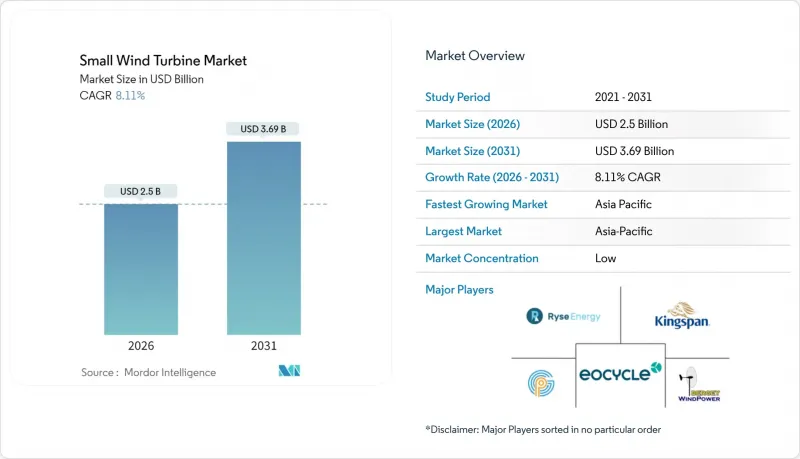
Growth is driven by policy incentives, vertical-axis technology advances, and rising use in telecom, agricultural, and distributed energy systems. Public funding programs in North America, the European Union, and Asia accelerate deployments, while machine-learning-enabled turbine optimization reduces lifetime energy costs and improves reliability. Corporate power purchase agreements expand demand for on-grid projects, and hybrid wind-solar systems extend the addressable market in regions with variable wind resources. Cost rivalry with rooftop solar remains a restraint in the sub-10 kW segment, but efficiency gains and new siting rules narrow the gap.
Global Small Wind Turbine Market Trends and Insights
Rapid Electrification of Remote Islands across the Caribbean
Remote island utilities are replacing diesel systems with hybrid renewable microgrids, including small wind turbines. Governments and multilateral lenders have earmarked concessional finance that reduces upfront project costs and broadens developer participation. Turbine suppliers that offer corrosion-resistant coatings and modular logistics packages gain a competitive advantage in these markets. The average installed capacity per site remains below 50 kW, aligning with 0-20 kW product lines. Steady trade winds support capacity factors above 35%, improving payback periods relative to solar-only designs. Island electrification programs adopt performance-based tariffs that reward high availability, reinforcing the value of digital monitoring platforms integrated into new turbine models.
Sub-5 kW Turbine Demand Surge from USDA Rural Energy Grants
The USD 180 million Rural Energy for America Program allocation in 2025 prioritizes micro wind systems for farms and rural small businesses. Grants cover up to 50% of capital costs, enabling paybacks under six years in regions with mean wind speeds above 6 m/s. The National Renewable Energy Laboratory's Competitiveness Improvement Project funds prototype certification that unlocks third-party financing, addressing historical bankability gaps. More than 400 farms are targeted, driving an incremental 25 MW of cumulative micro-class installations by 2027. Coupling turbines with barn-roof solar arrays allows producers to offset peak daytime loads and evening irrigation demand. Manufacturers that complete UL 6141 certification under the program qualify for preference in federal procurement.
Height-Based Zoning Restrictions in Urban Europe
Municipal height limits constrain turbine hub height to 10 m or less in many historic districts, curbing energy yield. Variance requests often require shadow-flicker and visual assessments that lengthen project timelines. Noise measurement rules rely on modeled rather than empirical data, adding engineering costs. Fragmented jurisdiction means identical projects face divergent rules between adjacent municipalities, discouraging developers from citywide rollouts. EU Wind Power Package guidance seeks harmonization, but local cultural heritage bodies retain veto power. Suppliers respond with stub-mast vertical-axis designs that fit below parapets, though lower swept area reduces annual output.
Other drivers and restraints analyzed in the detailed report include:
- China's Zero-Carbon Industrial Parks Mandating On-Site Renewables
- EU Rooftop-Renewables Directive Boosting Building-Integrated Wind
- High Levelized Cost of Energy versus Rooftop Solar in Sub-10 kW Segment
For complete list of drivers and restraints, kindly check the Table Of Contents.
Segment Analysis
Horizontal configurations retained 67.40% of 2025 revenue on proven aerodynamics and supply chain maturity. The segment dominated large-farm repowering and rural household replacements. Manufacturers standardize 2-20 kW models to meet USDA and Indian telecom bid specifications, leveraging volume economies. The small wind turbine market size for vertical axis units grew quickly from a lower base and is forecast to post 13.4% CAGR, outpacing horizontal units. Vertical turbines thrive in disrupted wind flows near rooftops and street-level poles, where omnidirectional blades capture multidirectional gusts. Genetic learning algorithms that modulate pitch through each rotation improve power coefficients by up to 0.45, close to Betz-limit benchmarks. Reduced moving parts allow ground-level gearboxes, cutting maintenance truck rolls by 30% and encouraging commercial fleet adopters.
Vertical axis suppliers partner with facade engineers to embed turbines into curtain walls, meeting EU innovative-technology quotas. Savonius and Darrieus hybrids with contra-rotating rotors minimize torque ripple, lowering the acoustic signature to within 35 dB at a 5 m distance. University of Tokyo field tests verify 15-year bearing life even under typhoon gusts, addressing durability perceptions. Developers structure leasing deals that bundle services and recycle obligations, satisfying circular economy rules in China and the EU. The narrative positions vertical turbines as complementary rather than disruptive, allowing mixed arrays that smooth site energy output.
Micro class 0-5 kW systems delivered 45.30% of the small wind turbine market share in 2025, supported by grant-funded installations on farms, cabins, and roadside sensors. Average selling price fell 6% year-on-year as electronics commoditized, yet post-installation service revenues rose. Medium 21-100 kW units expand at 10.83% CAGR through 2031, serving telecom towers, industrial parks, and data-center campuses. Developers favor IEC 61400-2-certified models that integrate fault ride-through and reactive power support, enabling grid connection without separate converters. At 60 kW size, unit cost per kW drops below USD 2,300, closing the gap to rooftop solar plus storage stacks.
The small wind turbine market size for 6-20 kW equipment grows steadily in peri-urban business estates where grid tariffs include demand charges. Farmers with high refrigeration loads choose 15 kW turbines to offset evening peaks. Historical adoption benefits from accumulated installer skillsets that shorten project lead times. Medium-class suppliers bundle extended warranties that guarantee 97% technical availability, unlocking low-cost debt from green banks. Interoperable SCADA links wind output to onsite battery dispatch, optimizing self-consumption and avoiding interconnection curtailments.
The Small Wind Turbine Market Report is Segmented by Axis Type (Horizontal Axis Wind Turbines and Vertical Axis Wind Turbines), Capacity Rating (0 To 5 KW, 6 To 20 KW, and 21-100 KW), Connectivity (Off-Grid, On-Grid, and Hybrid), Installation Location (Rooftop/Building-Integrated and Freestanding Tower), Application (Residential, Commercial, and More), and Geography (North America, Europe, Asia-Pacific, South America, and More).
Geography Analysis
Asia-Pacific dominated the small wind turbine market with a 47.30% share in 2025 and is growing at a 9.84% CAGR on the back of Chinese industrial decarbonization and Indian telecom electrification. China's mandate for 40% certified green factory output by 2030 compels economic zones to install rooftop and courtyard turbines, while Jiangsu's recycling standards promote circular supply chains. India's tower operators commit to renewable energy for backup power, and hybrid tenders specify 5 kW microturbines alongside PV and lithium packs. Japan maintains stringent acoustic rules yet supports vertical-axis demonstrations near rail corridors. ASEAN island states deploy community microgrids, and Vietnamese manufacturers export 10 kW turbines to regional fishing fleets.
Europe remains a mature base where regulatory clarity supports incremental growth. The Renewables Directive revision cuts permitting delays for projects below 50 kW, boosting urban adoption. Germany exempts sub-10 m turbines from planning approval in selected Lander, cutting soft costs by 25%. Nordic data-center PPAs underpin a robust on-grid pipeline; Norsk Hydro's 29-year 235 MW wind PPA exemplifies confidence in long-dated offtake. Denmark's stringent 39 dB noise cap influences product acoustics exported worldwide. The United Kingdom supports island onshore wind expansions, including micro-turbines for community benefit shares.
North America's policy landscape rejuvenates demand. The USDA's USD 180 million grant pool accelerates farm deployments, and NREL's USD 3.2 million competitiveness fund advances certification pathways. Canada's 247 MW order boom for Nordex utility-scale turbines raises component localization that benefits small wind suppliers through shared transport links. However, residential adoption lags due to rooftop solar price advantage. States such as New York pilot feed-in tariffs specific to small wind, while California trials microgrid tariffs that reward multi-technology systems. Mexico's rural electrification agency reopens tenders for a hybrid kit, including 1.5 kW wind units for off-grid clinics.
- Aeolos Wind Energy Ltd
- Bergey Windpower Co.
- City Windmills Holdings PLC
- Wind Energy Solutions BV
- SD Wind Energy Ltd
- UNITRON Energy Systems Pvt Ltd
- Northern Power Systems Inc.
- Shanghai Ghrepower Green Energy Co. Ltd
- TUGE Energia OU
- Ryse Energy
- Kingspan Group Plc (Wind Division)
- Eocycle Technologies Inc.
- XZERES Wind Corp.
- Fortis Wind Energy BV
- HY Energy Co. Ltd
- Endurance Wind Power Inc.
- Kliux Energies International
- Pika Energy (Generac)
- Envergate Energy AG
- Suzlon Energy Ltd
Additional Benefits:
- The market estimate (ME) sheet in Excel format
- 3 months of analyst support
TABLE OF CONTENTS
1 Introduction
- 1.1 Study Assumptions & Market Definition
- 1.2 Scope of the Study
2 Research Methodology
3 Executive Summary
4 Market Landscape
- 4.1 Market Overview
- 4.2 Market Drivers
- 4.2.1 Rapid Electrification of Remote Islands across the Caribbean
- 4.2.2 Sub-5 kW Turbine Demand Surge from U.S. USDA "Rural Energy for America" Grants
- 4.2.3 China's "Zero-Carbon Industrial Parks" Mandating On-site Renewables
- 4.2.4 EU Rooftop-Renewables Directive Boosting Building-Integrated Wind
- 4.2.5 Telecom Tower Hybridization Agenda in India & ASEAN
- 4.2.6 Increasing Corporate PPAs for Micro-Wind in Nordics' Data-Center Cluster
- 4.3 Market Restraints
- 4.3.1 Height-Based Zoning Restrictions in Urban Europe
- 4.3.2 Acoustic-Emission Standards Tightening in Japan
- 4.3.3 High LCOE versus Rooftop PV in North America <10 kW segment
- 4.3.4 Bankability Gaps due to Absence of Long-Term O&M Ecosystem in Africa
- 4.4 Supply-Chain Analysis
- 4.5 Regulatory Outlook
- 4.6 Technological Outlook
- 4.7 Porter's Five Forces
- 4.7.1 Bargaining Power of Suppliers
- 4.7.2 Bargaining Power of Buyers
- 4.7.3 Threat of New Entrants
- 4.7.4 Threat of Substitutes
- 4.7.5 Competitive Rivalry
- 4.8 Investment Analysis
5 Market Size & Growth Forecasts
- 5.1 By Axis Type
- 5.1.1 Horizontal Axis Wind Turbines (HAWT) (Upwind, and Downwind)
- 5.1.2 Vertical Axis Wind Turbines (VAWT) (Savonius, Darrieus and Giromill)
- 5.2 By Capacity Rating (kW)
- 5.2.1 0 to 5 kW (Micro)
- 5.2.2 6 to 20 kW (Small)
- 5.2.3 21 to 100 kW (Medium)
- 5.3 By Connectivity
- 5.3.1 Off-Grid
- 5.3.2 On-Grid
- 5.3.3 Hybrid (Wind + Battery/PV)
- 5.4 By Installation Location
- 5.4.1 Rooftop/Building-Integrated
- 5.4.2 Freestanding Tower (Ground-Mounted)
- 5.5 By Application
- 5.5.1 Residential
- 5.5.2 Commercial (Retail, Offices, Hotels)
- 5.5.3 Industrial and Warehousing
- 5.5.4 Agricultural and Aquaculture
- 5.5.5 Telecom Towers and Remote Monitoring Sites
- 5.6 By Geography
- 5.6.1 North America
- 5.6.1.1 United States
- 5.6.1.2 Canada
- 5.6.1.3 Mexico
- 5.6.2 Europe
- 5.6.2.1 United Kingdom
- 5.6.2.2 Germany
- 5.6.2.3 France
- 5.6.2.4 Spain
- 5.6.2.5 Nordic Countries
- 5.6.2.6 Russia
- 5.6.2.7 Rest of Europe
- 5.6.3 Asia-Pacific
- 5.6.3.1 China
- 5.6.3.2 India
- 5.6.3.3 Japan
- 5.6.3.4 South Korea
- 5.6.3.5 ASEAN Countries
- 5.6.3.6 Australia
- 5.6.3.7 Rest of Asia-Pacific
- 5.6.4 South America
- 5.6.4.1 Brazil
- 5.6.4.2 Argentina
- 5.6.4.3 Colombia
- 5.6.4.4 Rest of South America
- 5.6.5 Middle East and Africa
- 5.6.5.1 United Arab Emirates
- 5.6.5.2 Saudi Arabia
- 5.6.5.3 South Africa
- 5.6.5.4 Egypt
- 5.6.5.5 Rest of Middle East and Africa
- 5.6.1 North America
6 Competitive Landscape
- 6.1 Strategic Moves (M&A, Partnerships, PPAs)
- 6.2 Market Share Analysis (Market Rank/Share for key companies)
- 6.3 Company Profiles (includes Global level Overview, Market level overview, Core Segments, Financials as available, Strategic Information, Products & Services, and Recent Developments)
- 6.3.1 Aeolos Wind Energy Ltd
- 6.3.2 Bergey Windpower Co.
- 6.3.3 City Windmills Holdings PLC
- 6.3.4 Wind Energy Solutions BV
- 6.3.5 SD Wind Energy Ltd
- 6.3.6 UNITRON Energy Systems Pvt Ltd
- 6.3.7 Northern Power Systems Inc.
- 6.3.8 Shanghai Ghrepower Green Energy Co. Ltd
- 6.3.9 TUGE Energia OU
- 6.3.10 Ryse Energy
- 6.3.11 Kingspan Group Plc (Wind Division)
- 6.3.12 Eocycle Technologies Inc.
- 6.3.13 XZERES Wind Corp.
- 6.3.14 Fortis Wind Energy BV
- 6.3.15 HY Energy Co. Ltd
- 6.3.16 Endurance Wind Power Inc.
- 6.3.17 Kliux Energies International
- 6.3.18 Pika Energy (Generac)
- 6.3.19 Envergate Energy AG
- 6.3.20 Suzlon Energy Ltd
7 Market Opportunities & Future Outlook
- 7.1 White-space & Unmet-Need Assessment

 2026-2030年全球小型風力發電機市場
 小型風力發電機市場規模、佔有率和成長分析(按併網方式、軸型、容量、轉子類型、應用和地區分類)-2026-2033年產業預測
 小型風力發電機:全球市場佔有率和排名、總銷售量和需求預測(2025-2031年)
 小型風力發電機市場(按渦輪機類型、安裝類型、葉片材料、組件、容量和應用)—2025-2030 年全球預測
 全球可攜式風力發電機市場
 小型風力渦輪機市場機會、成長動力、產業趨勢分析及2025-2034年預測
 歐洲小型風力發電機-市場佔有率分析、產業趨勢與統計、成長預測(2025-2030 年)