


 |
市場調查報告書
商品編碼
1851498
酒石酸:市場佔有率分析、產業趨勢、統計數據和成長預測(2025-2030 年)Tartaric Acid - Market Share Analysis, Industry Trends & Statistics, Growth Forecasts (2025 - 2030) |
||||||

※ 本網頁內容可能與最新版本有所差異。詳細情況請與我們聯繫。
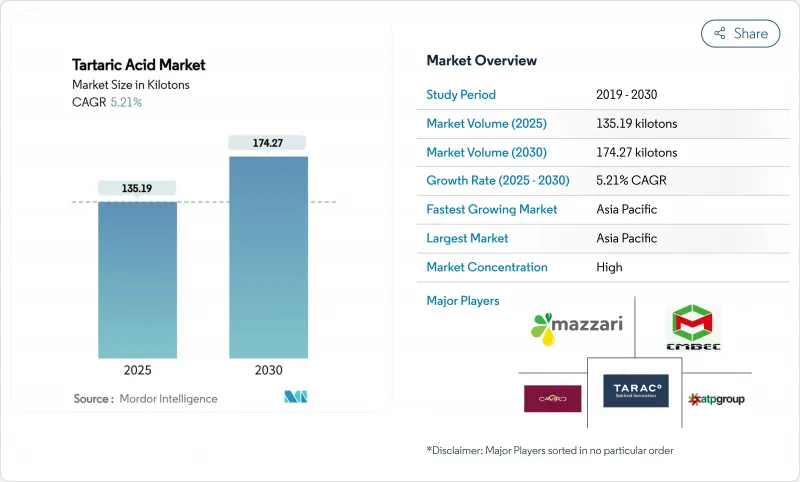
預計到 2025 年,酒石酸市場規模將達到 135.19 千噸,到 2030 年將達到 174.27 千噸,在預測期(2025-2030 年)內複合年成長率為 5.21%。
這種成長反映了酒石酸效用廣泛,從葡萄酒穩定劑到高級藥用輔料均有涉及。生產商能夠靈活地在葡萄提取和順丁烯二酸酐合成之間切換,從而緩解原料供應衝擊,增強供應韌性,支撐酒石酸市場。葡萄酒釀造中純度標準的提高、消費者對潔淨標示食品日益成長的偏好以及穩定的藥物製劑,都促進了酒石酸市場規模的擴大。同時,永續性的壓力也促使企業投資電滲析和其他節能工藝,在不影響天然酒石酸品質優勢的前提下,降低了合成酒石酸的生產成本。
全球酒石酸市場趨勢與洞察
葡萄酒生產需求不斷成長
全球葡萄酒產量正在下降,預計到2024年將降至2.26億百公升。然而,矛盾的是,隨著生產商對自有葡萄廢棄物收集的依賴性降低,對外部酒石酸的需求卻在增加。這種稀缺溢價使得歐洲天然葡萄種植者能夠獲得比人工合成葡萄高出15%至20%的價格。維吉尼亞州的一項試驗表明,在發酵前添加鉀基酒石酸比在發酵後添加能獲得更好的感官評分。氣候變遷導致葡萄鉀含量增加,進一步增加了對常規酸化的需求。國際葡萄與葡萄酒組織目前規定純度基準值為99.5%,有利於成熟的天然供應商。生產商也重視酒廠的醋酸液,其透過電滲析技術達到69.7%的純度,使其品質目標與循環經濟的要求一致。
對藥用輔料的需求不斷成長
酒石酸市場受益於其掌性特性,這些特性有助於藥物溶解、片劑崩壞和生物有效性。香蕉澱粉複合物在崩壞時間方面優於標準超級崩散劑。 FDA指南將酒石酸認定為GRAS(公認安全物質),降低了監管門檻。金屬蛋白酶抑制和抗菌活性的專利申請凸顯了其治療潛力。人口老化加速了瀉藥製劑的複合年成長率,達到6.06%。美國和歐盟每日攝取量限制240毫克/公斤的統一簡化了全球產品推廣流程。
仔細檢討合成殘留物法規
歐洲議會揭露的可追溯性漏洞將促使監管機構加強對中國合成植物藥的審查,從而增加遵循成本。歐洲食品安全局(EFSA)在2024年發布的意見中引入的重金屬限量要求需要更昂貴的提煉過程。結契約位素檢測,監管機構將能夠區分發酵和石油化學來源的產品,從而實施更嚴格的進口檢查。
細分市場分析
預計到2024年,天然級酒石酸市場將佔市場佔有率的72.19%,這主要得益於葡萄廢棄物的綜合處理。天然回收在歐洲很受歡迎,釀酒商直接提取酒石酸作為產品,降低了原料成本。合成酒石酸產能主要集中在中國,預計其年複合成長率將達到5.91%,因為順丁烯二酸酐提供了一種獨立於農業循環的生產途徑。永續的膜電滲析技術可降低30%的能耗,進而縮小成本差距。
合成酒石酸生產商標榜其產品純度穩定、全年供應,吸引那些重視產品規格可預測性的買家。天然系酒石酸供應商則憑藉有機認證優勢和在潔淨標示食品領域的高階定位與之抗衡。收購智利和阿根廷的Alvinesa公司,進一步推動了葡萄廢棄物的跨半球流動。儘管合成酒石酸在酒石酸市場佔據了相當大的佔有率,但由於監管機構更傾向於使用植物來源酒石酸進行有機認證,天然酒石酸仍可能佔據市場的大部分佔有率。
酒石酸市場報告按類型(天然酒石酸、合成酒石酸)、應用(防腐劑和添加劑、瀉藥、中間體、其他應用)、終端用戶行業(食品和飲料、製藥、化妝品、建築、其他終端用戶行業)和地區(亞太地區、北美、歐洲、南美、中東和非洲)進行細分。
區域分析
亞太地區在酒石酸市場佔據領先地位,2024年市佔率達46.52%,預計到2030年將以5.88%的複合年成長率持續成長。中國石化企業以極具競爭力的價格供應順丁烯二酸酐,使得合成樹脂的價格比歐洲產品低15-20%。印度和東南亞的製藥業進一步推動了對高純度酒石酸的需求。日本、韓國和新加坡等國的政府部門正在鼓勵低碳生產,推動電化學合成技術的試驗,以降低能源消耗。
歐洲憑藉著與葡萄酒產業相關的天然原料開採方式,保持著強勁的地位。義大利、西班牙和法國的葡萄加工中心確保了原料的持續供應,並保證了99.5%的純度標準。歐盟採用同位素分析的認證規則增強了國內供應商抵禦合成進口產品的能力。德國和斯堪的納維亞的下游食品飲料品牌高度重視經認證的有機原料,從而促進了區域內的原料流通。
北美是酒石酸市場中成熟且穩定的一個區域。美國透過學名藥生產和潔淨標示配方推動消費,而加拿大則專注於在已調理食品中使用天然成分。墨西哥糖果甜點和飲料出口的不斷成長也帶動了需求。美國農業部有機標準強制要求使用植物來源酸,促使買家轉向葡萄廢棄物加工商。區域性研究正在推動創新,例如蜂蟎生物防治,並為生產多元化開闢了新的途徑。
其他福利:
- Excel格式的市場預測(ME)表
- 3個月的分析師支持
目錄
第1章 引言
- 研究假設和市場定義
- 調查範圍
第2章調查方法
第3章執行摘要
第4章 市場情勢
- 市場概覽
- 市場促進因素
- 葡萄酒生產需求不斷成長
- 對藥用輔料的需求不斷成長
- 微膠囊技術在膳食補充劑的應用
- 潔淨標示食品中向天然香料的轉變
- 蜜蜂蟎生物防治製劑的新應用
- 市場限制
- 仔細檢討合成酒石酸殘留物的法規
- 是否有合適的替代品
- 替代有機酸的價格壓力
- 價值鏈分析
- 波特五力模型
- 供應商的議價能力
- 買方的議價能力
- 新進入者的威脅
- 替代品的威脅
- 競爭對手之間的競爭
第5章 市場規模與成長預測
- 按類型
- 天然酒石酸
- 合成酒石酸
- 透過使用
- 防腐劑和添加劑
- 瀉藥
- 中級
- 其他用途
- 按最終用戶行業分類
- 飲食
- 製藥
- 化妝品
- 建造
- 其他終端用戶產業
- 按地區
- 亞太地區
- 中國
- 印度
- 日本
- 韓國
- 泰國
- 印尼
- 越南
- 馬來西亞
- 菲律賓
- 亞太其他地區
- 北美洲
- 美國
- 加拿大
- 墨西哥
- 歐洲
- 德國
- 英國
- 法國
- 義大利
- 西班牙
- 俄羅斯
- 北歐國家
- 土耳其
- 其他歐洲地區
- 南美洲
- 巴西
- 阿根廷
- 哥倫比亞
- 南美洲其他地區
- 中東和非洲
- 沙烏地阿拉伯
- 阿拉伯聯合大公國
- 卡達
- 南非
- 奈及利亞
- 埃及
- 其他中東和非洲地區
- 亞太地區
第6章 競爭情勢
- 市場集中度
- 策略趨勢
- 市佔率(%)/排名分析
- 公司簡介
- Alvinesa Natural Ingredients
- Anhui Hailan Bio-technology Co., Ltd
- ATPGroup
- Australian Tartaric Products
- Caviro
- Changmao Biochemical Engineering Company Limited
- Distillerie Mazzari SpA
- Fuso Chemical Co., Ltd.
- Giovanni Randi SpA
- Industria Chimica Valenzana ICV SpA
- Merck KGaA
- Ningbo Jinzhan Biotechnology Co., Ltd.
- Tartaros Gonzalo Castello SL
- The Greatwall Bi0-Chemical Engineering Co., Ltd.
- The Tartaric Chemicals Corporation
- Vinicas
第7章 市場機會與未來展望
The Tartaric Acid Market size is estimated at 135.19 kilotons in 2025, and is expected to reach 174.27 kilotons by 2030, at a CAGR of 5.21% during the forecast period (2025-2030).
This progression mirrors the compound's broad utility, stretching from wine stabilization to advanced pharmaceutical excipients. Supply resilience anchors the tartaric acid market because producers can toggle between grape-derived recovery and maleic anhydride synthesis, cushioning raw-material shocks. Elevated purity specifications in wine making, rising clean-label food preferences, and steady pharmaceutical formulations are together widening the commercial base. At the same time, sustainability pressures spur investment in electrodialysis and other energy-saving processes that trim production costs for synthetic grades without eroding the quality edge held by natural variants.
Global Tartaric Acid Market Trends and Insights
Growing Demand for Wine Production
Lower global wine output, which fell to 226 million hectoliters in 2024, has paradoxically lifted demand for external tartaric acid supplies as producers rely less on in-house grape waste recovery. Scarcity premiums enable European natural producers to secure 15-20% higher prices over synthetic offerings. Trials in Virginia show that potassium-based tartaric additions before fermentation deliver superior sensory scores versus post-fermentation use. Climate-driven rises in grape potassium further increase routine acidification needs. The International Organisation of Vine and Wine now stipulates 99.5% purity, a threshold favoring established natural suppliers. Producers also valorize distillery vinasses, reaching 69.7% purity via electrodialysis, aligning quality goals with circular-economy mandates.
Rising Pharmaceutical Excipient Demand
The tartaric acid market benefits from the compound's chiral properties that aid drug dissolution, tablet disintegration, and bioavailability. Banana-starch complexes outperform standard super-disintegrants in disintegration time. FDA guidance treats tartaric acid as GRAS, lowering regulatory hurdles. Patent filings for metalloproteinase inhibition and antimicrobial actives underscore therapeutic potential. Growth in laxative formulations accelerates at 6.06% CAGR as aging populations seek gentle natural options. Harmonized daily-intake limits of 240 mg/kg in the United States and European Union streamline global product rollouts.
Regulatory Scrutiny on Synthetic Tartaric Acid Residues
Traceability gaps exposed by the European Parliament spur stricter oversight that raises compliance outlays for Chinese synthetic plants. Heavy-metal limits introduced in EFSA's 2024 opinion require costlier purification. Coupled with isotope testing, regulators can now discern fermentation-derived and petrochemical origins, tightening import inspections.
Other drivers and restraints analyzed in the detailed report include:
- Micro-Encapsulation Adoption in Nutraceuticals
- Shift toward Natural Acidity Regulators in Clean-Label Foods
- Availability of Suitable Substitutes
For complete list of drivers and restraints, kindly check the Table Of Contents.
Segment Analysis
The natural grade of the tartaric acid market commanded 72.19% share in 2024 on the strength of integrated grape-waste processing. Natural recovery thrives in Europe, where wine producers extract acid as a byproduct, slashing feedstock costs. Synthetic capacity, concentrated in China, is gaining pace at a 5.91% CAGR because maleic anhydride furnishes an agricultural-cycle-free route. Sustainable membrane electrodialysis cuts energy use by 30%, narrowing cost gaps.
Synthetic producers tout uniform purity and year-round availability, attracting buyers focused on predictable specifications. Natural suppliers counterbalance with organic certification advantages and premium positioning in clean-label foods. Alvinesa's acquisitions in Chile and Argentina underpin continuous grape-waste flows across hemispheres. As regulatory bodies favor plant-origin acids in organic labeling, natural volumes are likely to hold majority share even as synthetics gain numerical ground within the tartaric acid market.
The Tartaric Acid Market Report is Segmented by Type (Natural Tartaric Acid, Synthetic Tartaric Acid), Application (Preservative and Additive, Laxative, Intermediate, and Other Applications), End-User Industry (Food and Beverage, Pharmaceutical, Cosmetics, Construction, and Other End-User Industries), and Geography (Asia-Pacific, North America, Europe, South America, and Middle-East and Africa).
Geography Analysis
Asia-Pacific stands at the forefront of the tartaric acid market with 46.52% share in 2024 and a 5.88% CAGR outlook to 2030. China's integrated petrochemical complexes supply competitively priced maleic anhydride, allowing synthetics to undercut European offers by 15-20%. Pharmaceutical production in India and Southeast Asia further bulks demand for high-purity grades. Authorities in Japan, South Korea, and Singapore encourage low-carbon manufacturing, spurring trials in electrochemical synthesis that curb energy use.
Europe upholds a strong position anchored in natural extraction linked to its wine sector. Grape-processing hubs in Italy, Spain, and France enable continuous raw-material access and ensure compliance with the 99.5% purity threshold. EU authentication rules using isotope analysis strengthen domestic suppliers against synthetic imports. Downstream food and beverage brands within Germany and the Nordics value organically certified inputs, bolstering intra-regional flows.
North America forms a mature yet steady slice of the tartaric acid market. The United States drives consumption through generic drug production and clean-label formulations, while Canada emphasizes natural ingredients in ready meals. Mexico's expanding confectionery and beverage exports add incremental demand. USDA organic standards, which mandate plant-derived acids, direct buyers toward grape-waste processors. Regional research fosters innovations such as bee-mite biocontrol, hinting at fresh avenues for volume diversification.
- Alvinesa Natural Ingredients
- Anhui Hailan Bio-technology Co., Ltd
- ATPGroup
- Australian Tartaric Products
- Caviro
- Changmao Biochemical Engineering Company Limited
- Distillerie Mazzari S.p.A
- Fuso Chemical Co., Ltd.
- Giovanni Randi SpA
- Industria Chimica Valenzana I.C.V. SpA
- Merck KGaA
- Ningbo Jinzhan Biotechnology Co., Ltd.
- Tartaros Gonzalo Castello S.L.
- The Greatwall Bi0-Chemical Engineering Co., Ltd.
- The Tartaric Chemicals Corporation
- Vinicas
Additional Benefits:
- The market estimate (ME) sheet in Excel format
- 3 months of analyst support
TABLE OF CONTENTS
1 Introduction
- 1.1 Study Assumptions and Market Definition
- 1.2 Scope of the Study
2 Research Methodology
3 Executive Summary
4 Market Landscape
- 4.1 Market Overview
- 4.2 Market Drivers
- 4.2.1 Growing Demand for Wine Production
- 4.2.2 Rising Pharmaceutical Excipient Demand
- 4.2.3 Micro-Encapsulation Adoption in Nutraceuticals
- 4.2.4 Shift toward Natural Acidity Regulators in Clean-Label Foods
- 4.2.5 Emerging Use in Bee-Mite Biocontrol Formulations
- 4.3 Market Restraints
- 4.3.1 Regulatory Scrutiny on Synthetic Tartaric Acid Residues
- 4.3.2 Availability of Suitable Substitutes
- 4.3.3 Price Pressure from Alternative Organic Acids
- 4.4 Value Chain Analysis
- 4.5 Porter's Five Forces
- 4.5.1 Bargaining Power of Suppliers
- 4.5.2 Bargaining Power of Buyers
- 4.5.3 Threat of New Entrants
- 4.5.4 Threat of Substitutes
- 4.5.5 Competitive Rivalry
5 Market Size and Growth Forecasts (Volume)
- 5.1 By Type
- 5.1.1 Natural Tartaric Acid
- 5.1.2 Synthetic Tartaric Acid
- 5.2 By Application
- 5.2.1 Preservative and Additive
- 5.2.2 Laxative
- 5.2.3 Intermediate
- 5.2.4 Other Applications
- 5.3 By End-user Industry
- 5.3.1 Food and Beverage
- 5.3.2 Pharmaceutical
- 5.3.3 Cosmetics
- 5.3.4 Construction
- 5.3.5 Other End-user Industries
- 5.4 By Geography
- 5.4.1 Asia-Pacific
- 5.4.1.1 China
- 5.4.1.2 India
- 5.4.1.3 Japan
- 5.4.1.4 South Korea
- 5.4.1.5 Thailand
- 5.4.1.6 Indonesia
- 5.4.1.7 Vietnam
- 5.4.1.8 Malaysia
- 5.4.1.9 Philippines
- 5.4.1.10 Rest of Asia-Pacific
- 5.4.2 North America
- 5.4.2.1 United States
- 5.4.2.2 Canada
- 5.4.2.3 Mexico
- 5.4.3 Europe
- 5.4.3.1 Germany
- 5.4.3.2 United Kingdom
- 5.4.3.3 France
- 5.4.3.4 Italy
- 5.4.3.5 Spain
- 5.4.3.6 Russia
- 5.4.3.7 NORDIC Countries
- 5.4.3.8 Turkey
- 5.4.3.9 Rest of Europe
- 5.4.4 South America
- 5.4.4.1 Brazil
- 5.4.4.2 Argentina
- 5.4.4.3 Colombia
- 5.4.4.4 Rest of South America
- 5.4.5 Middle-East and Africa
- 5.4.5.1 Saudi Arabia
- 5.4.5.2 United Arab Emirates
- 5.4.5.3 Qatar
- 5.4.5.4 South Africa
- 5.4.5.5 Nigeria
- 5.4.5.6 Egypt
- 5.4.5.7 Rest of Middle-East and Africa
- 5.4.1 Asia-Pacific
6 Competitive Landscape
- 6.1 Market Concentration
- 6.2 Strategic Moves
- 6.3 Market Share(%)/Ranking Analysis
- 6.4 Company Profiles (includes Global level Overview, Market level overview, Core Segments, Financials as available, Strategic Information, Market Rank/Share for key companies, Products and Services, and Recent Developments)
- 6.4.1 Alvinesa Natural Ingredients
- 6.4.2 Anhui Hailan Bio-technology Co., Ltd
- 6.4.3 ATPGroup
- 6.4.4 Australian Tartaric Products
- 6.4.5 Caviro
- 6.4.6 Changmao Biochemical Engineering Company Limited
- 6.4.7 Distillerie Mazzari S.p.A
- 6.4.8 Fuso Chemical Co., Ltd.
- 6.4.9 Giovanni Randi SpA
- 6.4.10 Industria Chimica Valenzana I.C.V. SpA
- 6.4.11 Merck KGaA
- 6.4.12 Ningbo Jinzhan Biotechnology Co., Ltd.
- 6.4.13 Tartaros Gonzalo Castello S.L.
- 6.4.14 The Greatwall Bi0-Chemical Engineering Co., Ltd.
- 6.4.15 The Tartaric Chemicals Corporation
- 6.4.16 Vinicas
7 Market Opportunities and Future Outlook
- 7.1 White-space and unmet-need assessment
- 7.2 Adoption in niche applications (biocontrol, advanced materials)

 酒石酸市場:2026-2032年全球市場預測(依純度等級、形態、生產流程、應用及分銷通路分類)
 酒石酸市場報告:按應用和地區分類 2026-2034 年
 酒石酸市場-全球產業規模、佔有率、趨勢、機會及預測(依來源、類型、衍生物、應用、地區及競爭格局分類),2021-2031年
 酒石酸市場規模、佔有率及成長分析(按來源、類型、應用和地區分類)-2026-2033年產業預測
 全球酒石酸市場:表現及預測(2020-2031)
 酒石酸市場:預測(2025-2030)
 合成酒石酸市場:2024-2031年全球產業分析、規模、佔有率、成長、趨勢、預測酒石酸市場:全球產業分析,規模,佔有率,成長,趨勢,預測,2024年~2033年