


 |
市場調查報告書
商品編碼
1851242
塑膠瓶蓋和封蓋:市場佔有率分析、行業趨勢、統計數據和成長預測(2025-2030 年)Plastic Caps And Closures - Market Share Analysis, Industry Trends & Statistics, Growth Forecasts (2025 - 2030) |
||||||

※ 本網頁內容可能與最新版本有所差異。詳細情況請與我們聯繫。
預計到 2025 年塑膠瓶蓋和封蓋市場規模將達到 782 萬噸,到 2030 年將達到 989 萬噸,年複合成長率為 4.83%。
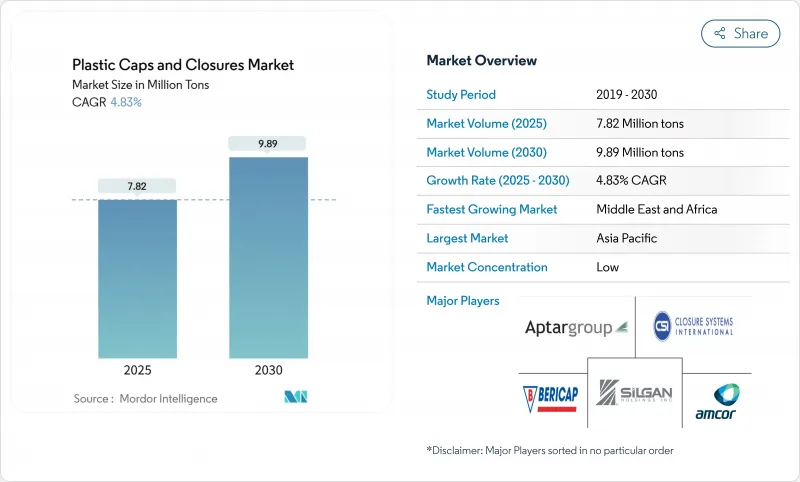
成長因素包括歐洲強制推行瓶蓋繫繩、東協地區無菌PET瓶裝生產線的普及,以及醫藥產業對兒童安全聚丙烯瓶蓋的快速需求。以安姆科和貝瑞全球合併為代表的產業整合正在重塑競爭動態,製造商競相遵守更嚴格的生產者延伸責任(EPR)收費系統。儘管丙烯和乙烯等原料價格波動構成直接不利因素,但對壓縮成型自動化和再生材料的持續投資正在緩解成本壓力。按地區分類,亞太地區佔最大佔有率,中東和非洲地區複合年成長率最高,而北美地區則利用了有利於高價值瓶蓋成型的嚴格安全法規。
全球塑膠瓶蓋及封蓋市場趨勢及洞察
歐盟一次性塑膠指令強制要求使用繫繩式封口。
2024年7月,歐盟將要求容量小於3公升的飲料容器必須配備繫繩式瓶蓋。領先的系統供應商已推出多種附件方案,可在不影響生產線速度的前提下連接瓶蓋,既能保護消費者的握持舒適度,又能助力實現減少浪費的目標。北美品牌商正在加州相關法規推出前試用這些解決方案,預示著全球正向附件技術轉型。
東協飲料工廠的無菌PET瓶裝生產線正在迅速增加。
新型無菌填充機可將保存期限延長至12個月,並減少60.1%的塑膠用量。越南和印尼的計劃展現了該計畫的規模,其中一家工廠的年封蓋需求量超過2萬噸,同時也實施了回收PET的舉措,以支持循環經濟目標。
丙烯和乙烯合約價格不穩定影響PP/PE利潤率
原物料價格波動正在侵蝕嚴重依賴聚丙烯和聚乙烯的瓶蓋製造商的利潤穩定性。為了因應成本衝擊,各公司正透過避險、摻混再生樹脂以及推進自動化專案來降低加工成本。
細分市場分析
由於螺旋蓋與高速飲料、食品和藥品生產線具有廣泛的兼容性,預計到2024年,螺旋蓋將佔據塑膠瓶蓋和瓶塞市場65.56%的佔有率。低廉的單位成本和可靠的密封性能將使其保持主導地位,預計到2030年將以6.45%的複合年成長率成長。調味品和個人護理用品更傾向於使用分配器包裝,因為定量控制和衛生措施能夠提升消費者的購買意願。防篡改和兒童安全蓋將受益於更嚴格的安全法規,這些法規正在改變非處方藥包裝的模式。
在啤酒和頂級烈酒,因為傳統和貨架展示至關重要。按扣式設計非常適合需要快速重新密封的家用化學品。日益成長的繫繩式瓶蓋要求正在推動所有螺紋蓋類型的重新計劃,使瓶蓋創新與合規性直接相關。採用輕質瓶的終端用戶傾向於選擇先進的螺紋規格,這些規格可以在不影響密封完整性的前提下減少樹脂用量,從而支持螺紋蓋在塑膠瓶蓋市場的長期發展前景。
到2024年,聚丙烯將佔據塑膠瓶蓋和封口市場56.23%的佔有率。其優異的耐化學性、熱穩定性和加工性能使其適用於食品和製藥行業。高密度聚苯乙烯用於製造需要抗衝擊性的工業化學品包裝,而低密度聚乙烯則用於製造軟性按扣式封口。聚對苯二甲酸乙二醇酯(PET)作為單一材料包裝材料,其應用日益廣泛,簡化了回收系統,並可實現符合歐盟法規的繫繩式設計。
隨著品牌投資調整生產者責任延伸率 (EPR) 並滿足消費者對永續性的期望,生物基和化學回收樹脂將以 7.95% 的複合年成長率成長。早期採用植物來源聚丙烯的商業化產品線凸顯了低碳瓶蓋的發展路徑。儘管供應鏈合格、顏色穩定性和成本平衡仍然是挑戰,但化學技術的不斷進步預計將在 2030 年以後加速塑膠瓶蓋行業的應用。
塑膠瓶蓋和封蓋市場按產品類型(螺旋蓋、分配蓋及其他)、原料(聚丙烯 (PP)、高密度聚苯乙烯(HDPE) 及其他)、製造流程(壓縮成型、射出成型、後成型熱電聯帶應用)、終端用戶產業(食品飲料及其他)和地區進行細分。市場規模和預測以銷售量(百萬噸)為單位。
區域分析
到2024年,亞太地區將佔全球銷售量的40.34%,這主要得益於中國的市場規模、日本的品質標準以及印度飲料和製藥業的蓬勃發展。東協地區無菌生產領域的投資熱潮將進一步推動區域內密封包裝的消費,而循環經濟政策正加速再生PET的普及應用。澳洲正積極與國際藥品安全法規接軌,協調區域貿易,並推動對兒童安全包裝和特殊包裝的需求。
到2030年,中東和非洲將以8.01%的複合年成長率實現最快成長。沙烏地阿拉伯和阿拉伯聯合大公國的多元化舉措將吸引包裝產業的外國投資,而土耳其將充分利用其戰略出口位置。奈及利亞不斷成長的人口和南非的製造業基礎將增加對飲料和家居用品瓶蓋的需求。鼓勵本地增值的區域改革將有助於提升塑膠瓶蓋市場的未來產能。
歐洲在應對監管阻力的同時,也抓住了永續性。瓶蓋固定化法規迫使生產線進行昂貴的維修,但也釋放了設計差異化的空間。德國在技術合規計劃主導,法國推廣高階設計,英國的生產者責任延伸(EPR)收費系統重塑了成本模式。西班牙和義大利利用其成熟的食品飲料出口來維持閉迴路需求。對循環經濟目標的關注正在加速向單一材料和再生材料瓶蓋的轉變,即使在宏觀經濟成長放緩的情況下,也能保持市場競爭力。
其他福利:
- Excel格式的市場預測(ME)表
- 3個月的分析師支持
目錄
第1章 引言
- 研究假設和市場定義
- 調查範圍
第2章調查方法
第3章執行摘要
第4章 市場情勢
- 市場概覽
- 市場促進因素
- 歐盟一次性塑膠指令強制要求使用帶有繫繩的瓶蓋。
- 東協飲料廠無菌PET瓶裝生產線的普及
- 美國和加拿大的製藥公司正在轉向兒科PP封堵術
- 拉丁美洲乳製品轉向使用帶有螺旋山形蓋頂紙盒
- 市場限制
- 丙烯和乙烯合約價格不穩定影響PP/PE利潤率
- 頂級烈酒中鋁ROPP替代率增加,塑膠蠶食效應
- 產業價值鏈分析
- 監理展望
- 技術展望
- 波特五力分析
- 新進入者的威脅
- 買方的議價能力
- 供應商的議價能力
- 替代品的威脅
- 競爭對手之間的競爭
第5章 市場規模與成長預測
- 依產品類型
- 螺絲扣
- 分裝封蓋
- 兒童安全鎖扣
- 防篡改封條
- 牙冠封閉
- ROPP(滾珠防盜)
- 按扣/按壓式閉合
- 按原料
- 聚丙烯(PP)
- 高密度聚苯乙烯(HDPE)
- 低密度聚乙烯(LDPE)
- 聚對苯二甲酸乙二醇酯(PET)
- 聚氯乙烯(PVC)
- 其他成分
- 透過製造技術
- 壓縮成型
- 射出成型
- 後模塑熱電波段應用
- 按最終用途行業分類
- 飲料
- 食物
- 製藥
- 個人護理和化妝品
- 家用和工業化學品
- 其他終端用戶產業
- 按地區
- 北美洲
- 美國
- 加拿大
- 墨西哥
- 歐洲
- 英國
- 德國
- 法國
- 義大利
- 西班牙
- 其他歐洲地區
- 亞太地區
- 中國
- 日本
- 印度
- 韓國
- 澳洲
- 亞太其他地區
- 中東和非洲
- 中東
- 阿拉伯聯合大公國
- 沙烏地阿拉伯
- 土耳其
- 其他中東地區
- 非洲
- 南非
- 奈及利亞
- 其他非洲地區
- 南美洲
- 巴西
- 阿根廷
- 其他南美洲
- 北美洲
第6章 競爭情勢
- 市場集中度
- 策略趨勢
- 市佔率分析
- 公司簡介
- Silgan Holdings Inc.
- Amcor PLC
- Crown Holdings Inc.
- AptarGroup Inc.
- BERICAP GmbH & Co. KG
- Guala Closures Group
- Closure Systems International
- United Caps
- Tecnocap SpA
- Blackhawk Molding Co.
- Evergreen Packaging LLC
- Tetra Pak International SA
- ALPLA Group
- Pact Group
- Ball Corporation
- Smurfit Westrock
- Gerresheimer AG
- O.Berk Company
- Karl H. Burkle GmbH(Burkle)
第7章 市場機會與未來展望
The plastic caps and closures market size reached 7.82 million tons in 2025 and is forecast to attain 9.89 million tons by 2030, advancing at a 4.83% CAGR.
Growth stems from tethered-cap mandates in Europe, surging aseptic PET bottling lines across ASEAN, and rapid pharmaceutical demand for child-resistant polypropylene closures. Consolidation, led by the Amcor-Berry Global combination, is reshaping competitive dynamics while manufacturers race to meet tougher Extended Producer Responsibility (EPR) fee structures. Raw-material volatility for propylene and ethylene remains a near-term headwind, yet sustained investment in compression-molding automation and recycled content is mitigating cost pressure. Across geographies, Asia-Pacific holds the largest share, Middle East and Africa records the fastest CAGR, and North America capitalizes on stringent safety regulations that favor high-value closure formats.
Global Plastic Caps And Closures Market Trends and Insights
EU Single-Use Plastics Directive Mandating Tethered Caps Adoption
The July 2024 EU requirement that beverage containers below 3 liters carry tethered closures rewired design norms and forced widespread capital upgrades. Leading system suppliers introduced multiple attachment concepts that keep caps connected without compromising line speeds, enhancing litter-reduction goals while safeguarding consumer ergonomics. Brand owners in North America are trialing the same solutions ahead of pending Californian rules, signalling a global pivot toward attachment technology.
Surge in Aseptic PET Bottling Lines Across ASEAN Beverage Plants
New aseptic fillers extend shelf life up to 12 months and use 60.1% less plastic, driving demand for lightweight yet sterile closures. Projects in Vietnam and Indonesia illustrate the scale, with single facilities adding more than 20,000 tons of annual closure demand tied to recycled PET initiatives that back circular-economy targets.
Volatile Propylene and Ethylene Contract Prices Impacting PP/PE Margins
Feedstock swings erode margin stability for closure manufacturers that rely heavily on polypropylene and polyethylene. Firms counter the cost shock through hedging, recycled-resin blends, and ongoing automation programs that compress conversion costs.
Other drivers and restraints analyzed in the detailed report include:
- Pharma Shift to Child-Resistant PP Closures in U.S. and Canada
- Latin American Dairy Pivot Toward Gable-Top Cartons with Screw Caps
- Rising Aluminum ROPP Substitution in Premium Spirits, Cannibalising Plastic
For complete list of drivers and restraints, kindly check the Table Of Contents.
Segment Analysis
Screw closures captured 65.56% of plastic caps and closures market share in 2024 thanks to universal compatibility with high-speed beverage, food, and pharmaceutical lines. Their low unit cost and dependable seal underpin enduring dominance, even as dispensing variants post a 6.45% CAGR through 2030. Dispensing formats gain favor in condiments and personal-care SKUs where portion control and hygiene boost consumer appeal. Tamper-evident and child-resistant formats benefit from stricter safety regulations that reshape over-the-counter drug packaging.
Crown and ROPP closures retain relevance in beer and premium spirits where tradition and shelf presence matter. Snap-on designs serve household chemicals seeking quick reclose functionality. Rising tethered-cap requirements are catalyzing redesign projects across all screw variants, linking closure innovation directly to compliance. End-users adopting light-weight bottles favor advanced thread profiles that cut resin use without compromising seal integrity, supporting the long-term outlook for screw formats in the plastic caps and closures market.
Polypropylene held 56.23% share of the plastic caps and closures market size in 2024. Its chemical resistance, heat stability, and processability secure its place in food and pharmaceutical applications. High-density polyethylene supports industrial chemical packs that need impact tolerance, while low-density polyethylene is used in flexible snap closures. PET variants grow as single-material packages simplify recycling systems and enable tethered designs compliant with EU rules.
Bio-based and chemically recycled resins expand at 7.95% CAGR. Brands invest to meet EPR fee modulation and consumer sustainability expectations. Early commercial lines running plant-based polypropylene highlight the pathway to lower-carbon closures. Supply chain qualification, color stability, and cost parity remain hurdles, yet scaling chemistry improvements portend faster adoption beyond 2030 in the plastic caps and closures industry.
Plastic Caps and Closures Market is Segmented by Product Type (Screw Closures, Dispensing Closures, and More), Raw Material (Polypropylene (PP), High-Density Polyethylene (HDPE), and More), Manufacturing Technology (Compression Molding, Injection Molding, and Post-Mold TE-Band Application), End-Use Industry (Beverages, Food, and More), and Geography. The Market Sizes and Forecasts are Provided in Terms of Volume (Million Tons).
Geography Analysis
Asia-Pacific accounted for 40.34% of global volumes in 2024, anchored by China's scale, Japan's quality standards, and India's expanding beverage and pharma sectors. ASEAN's aseptic investment wave further intensifies regional closure consumption, while circular-economy policies fast-track recycled PET uptake. Australia's alignment with international pharma safety rules harmonizes regional trade and drives demand for specialized child-resistant formats.
Middle East and Africa post the fastest 8.01% CAGR to 2030. Diversification initiatives in Saudi Arabia and the United Arab Emirates invite foreign investment in packaging, while Turkey leverages its strategic export location. Nigeria's population growth and South Africa's manufacturing base increase closure demand for beverages and household products. Regional reforms encouraging local value addition support future capacity builds in the plastic caps and closures market.
Europe balances regulatory headwinds and sustainability opportunities. Tethered-cap rules enforce expensive line retrofits yet unlock design differentiation. Germany leads technical compliance projects, France drives premium design, and the United Kingdom's EPR fee schedules reshape cost models. Spain and Italy utilize established food and beverage exports to sustain closure demand. Collective emphasis on circular-economy targets accelerates the shift toward mono-material and recycled-content caps, preserving market relevance despite slower macro growth.
- Silgan Holdings Inc.
- Amcor PLC
- Crown Holdings Inc.
- AptarGroup Inc.
- BERICAP GmbH & Co. KG
- Guala Closures Group
- Closure Systems International
- United Caps
- Tecnocap S.p.A.
- Blackhawk Molding Co.
- Evergreen Packaging LLC
- Tetra Pak International S.A.
- ALPLA Group
- Pact Group
- Ball Corporation
- Smurfit Westrock
- Gerresheimer AG
- O.Berk Company
- Karl H. Burkle GmbH (Burkle)
Additional Benefits:
- The market estimate (ME) sheet in Excel format
- 3 months of analyst support
TABLE OF CONTENTS
1 INTRODUCTION
- 1.1 Study Assumptions and Market Definition
- 1.2 Scope of the Study
2 RESEARCH METHODOLOGY
3 EXECUTIVE SUMMARY
4 MARKET LANDSCAPE
- 4.1 Market Overview
- 4.2 Market Drivers
- 4.2.1 EU Single-Use Plastics Directive Mandating Tethered Caps Adoption
- 4.2.2 Surge in Aseptic PET Bottling Lines Across ASEAN Beverage Plants
- 4.2.3 Pharma Shift to Child-Resistant PP Closures in U.S. and Canada
- 4.2.4 Latin American Dairy Pivot Toward Gable-Top Cartons with Screw Caps
- 4.3 Market Restraints
- 4.3.1 Volatile Propylene and Ethylene Contract Prices Impacting PP/PE Margins
- 4.3.2 Rising Aluminum ROPP Substitution in Premium Spirits, Cannibalising Plastic
- 4.4 Industry Value Chain Analysis
- 4.5 Regulatory Outlook
- 4.6 Technological Outlook
- 4.7 Porter's Five Forces Analysis
- 4.7.1 Threat of New Entrants
- 4.7.2 Bargaining Power of Buyers
- 4.7.3 Bargaining Power of Suppliers
- 4.7.4 Threat of Substitutes
- 4.7.5 Competitive Rivalry
5 MARKET SIZE AND GROWTH FORECASTS (VOLUME)
- 5.1 By Product Type
- 5.1.1 Screw Closures
- 5.1.2 Dispensing Closures
- 5.1.3 Child-Resistant Closures
- 5.1.4 Tamper-Evident Closures
- 5.1.5 Crown Closures
- 5.1.6 ROPP (Roll-On Pilfer-Proof)
- 5.1.7 Snap / Press-on Closures
- 5.2 By Raw Material
- 5.2.1 Polypropylene (PP)
- 5.2.2 High-Density Polyethylene (HDPE)
- 5.2.3 Low-Density Polyethylene (LDPE)
- 5.2.4 Polyethylene Terephthalate (PET)
- 5.2.5 Polyvinyl Chloride (PVC)
- 5.2.6 Other Raw Material
- 5.3 By Manufacturing Technology
- 5.3.1 Compression Molding
- 5.3.2 Injection Molding
- 5.3.3 Post-Mold TE-Band Application
- 5.4 By End-Use Industry
- 5.4.1 Beverages
- 5.4.2 Food
- 5.4.3 Pharmaceuticals
- 5.4.4 Personal Care and Cosmetics
- 5.4.5 Household and Industrial Chemicals
- 5.4.6 Other End-Use Industry
- 5.5 By Geography
- 5.5.1 North America
- 5.5.1.1 United States
- 5.5.1.2 Canada
- 5.5.1.3 Mexico
- 5.5.2 Europe
- 5.5.2.1 United Kingdom
- 5.5.2.2 Germany
- 5.5.2.3 France
- 5.5.2.4 Italy
- 5.5.2.5 Spain
- 5.5.2.6 Rest of Europe
- 5.5.3 Asia-Pacific
- 5.5.3.1 China
- 5.5.3.2 Japan
- 5.5.3.3 India
- 5.5.3.4 South Korea
- 5.5.3.5 Australia
- 5.5.3.6 Rest of Asia-Pacific
- 5.5.4 Middle East and Africa
- 5.5.4.1 Middle East
- 5.5.4.1.1 United Arab Emirates
- 5.5.4.1.2 Saudi Arabia
- 5.5.4.1.3 Turkey
- 5.5.4.1.4 Rest of Middle East
- 5.5.4.2 Africa
- 5.5.4.2.1 South Africa
- 5.5.4.2.2 Nigeria
- 5.5.4.2.3 Rest of Africa
- 5.5.5 South America
- 5.5.5.1 Brazil
- 5.5.5.2 Argentina
- 5.5.5.3 Rest of South America
- 5.5.1 North America
6 COMPETITIVE LANDSCAPE
- 6.1 Market Concentration
- 6.2 Strategic Moves
- 6.3 Market Share Analysis
- 6.4 Company Profiles (includes Global level Overview, Market level overview, Core Segments, Financials as available, Strategic Information, Market Rank/Share for key companies, Products and Services, and Recent Developments)
- 6.4.1 Silgan Holdings Inc.
- 6.4.2 Amcor PLC
- 6.4.3 Crown Holdings Inc.
- 6.4.4 AptarGroup Inc.
- 6.4.5 BERICAP GmbH & Co. KG
- 6.4.6 Guala Closures Group
- 6.4.7 Closure Systems International
- 6.4.8 United Caps
- 6.4.9 Tecnocap S.p.A.
- 6.4.10 Blackhawk Molding Co.
- 6.4.11 Evergreen Packaging LLC
- 6.4.12 Tetra Pak International S.A.
- 6.4.13 ALPLA Group
- 6.4.14 Pact Group
- 6.4.15 Ball Corporation
- 6.4.16 Smurfit Westrock
- 6.4.17 Gerresheimer AG
- 6.4.18 O.Berk Company
- 6.4.19 Karl H. Burkle GmbH (Burkle)
7 MARKET OPPORTUNITIES AND FUTURE OUTLOOK
- 7.1 White-Space and Unmet-Need Assessment

 2026年全球無內襯瓶蓋市場報告
 塑膠蓋子與封口裝置市場:2026-2032年全球市場預測(按產品類型、材料、製造流程、最終用途和分銷管道分類)
 塑膠瓶蓋及瓶蓋市場報告:按產品類型、原料、容器類型、技術、最終用途和地區分類(2026-2034 年)
 全球塑膠蓋子與封口裝置市場:市場規模、佔有率、成長和行業分析:按材料、產品類型、最終用途和地區分類的預測(至2034年)
 南美洲塑膠瓶蓋和封蓋:市場佔有率分析、行業趨勢和統計數據以及成長預測(2026-2031 年)美國塑膠瓶蓋和封蓋:市場佔有率分析、行業趨勢和統計數據、成長預測(2026-2031 年)
 全球塑膠瓶蓋和封蓋市場規模、佔有率、趨勢和成長分析報告(2026-2034年)2026年全球塑膠瓶蓋和封蓋市場報告
 塑膠瓶蓋和封蓋市場 - 全球產業規模、佔有率、趨勢、機會和預測(按產品類型、容器類型、原料、技術、最終用途行業、地區和競爭格局分類,2021-2031年)
 70mm塑膠瓶蓋市場規模、佔有率和趨勢分析報告:按材料、應用、地區和細分市場預測,2026-2033年