


 |
市場調查報告書
商品編碼
1851055
中國廢棄物管理:市場佔有率分析、行業趨勢、統計數據和成長預測(2025-2030 年)China Waste Management - Market Share Analysis, Industry Trends & Statistics, Growth Forecasts (2025 - 2030) |
||||||

※ 本網頁內容可能與最新版本有所差異。詳細情況請與我們聯繫。
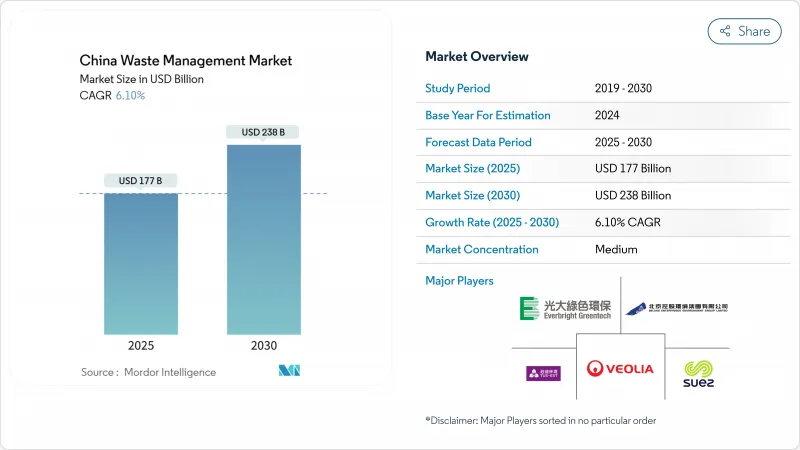
預計到 2025 年,中國廢棄物管理市場規模將達到 1,770 億美元,到 2030 年將達到 2,380 億美元,年複合成長率為 6.10%。
「美麗中國」規劃和國家碳中和路線圖中的政策承諾正在將廢棄物轉化為收入來源。二、三線城市的都市化、企業ESG(環境、社會和治理)責任要求以及資本市場對環境官民合作關係的需求,都在推動對綜合解決方案的持續需求。 「零廢棄城市」計畫引入的標準化框架提高了計劃的融資可行性,而人工智慧路線規劃和基於區塊鏈的廢棄物追蹤等數位技術則提升了營運效率。國內業者向東南亞和中東的國際擴張,凸顯了該產業正從純粹的市政服務模式向出口導向、技術密集的資源回收產業轉型。
中國廢棄物管理市場趨勢與洞察
擴大垃圾焚化發電能,並輔以上網電價補貼
全球1,010多家焚化廠佔全球總產能的近一半,但由於原料供應不穩定,許多焚化廠的運作負荷低於設計負荷。 2025年的改革將把上網電價補貼機制轉變為市場定價,同時整合綠色電力的再生能源憑證。一座熱效率為70.9%的焚化廠,其投資回收期約為4.8年,這意味著即使補貼有限,也能獲利。產能過剩正促使中國企業投資越南和海灣地區,輸出承包工程和維運技術。
由於都市化,二、三線城市的生活垃圾量迅速增加。
人口快速流動導致都市固態廢棄物成長速度超過基礎設施的處理能力。國家發展與改革委員會2024年的報告證實,農村地區的排放率已達90%,但都市化進程加快的地區仍面臨處理能力不足的問題。市場對可擴展、輕資產的系統需求日益成長,這些系統將智慧垃圾桶與模組化轉運站結合。在該國2030年實現所有都市區100%安全處置廢棄物的目標推動下,中南部城市正採用廢棄物垃圾焚化發電解決方案。技術供應商受益於將設備與數位化運維服務捆綁在一起的契約,這加快了部署週期並降低了前期投資風險。
地方政府財政限制了PPP付款。
預算緊張限制了中型城市為公私合營項目(PPP)提供年金擔保的能力,導致計劃執行延期並增加了交易對手風險。開發人員正透過輕資產服務模式和收益分成安排來應對這項挑戰,以減少市政現金支出,同時維持服務水準。此外,結合綠色債券和碳權額的混合融資工具也正在出現,以填補資金缺口。
細分市場分析
到2024年,生活廢棄物將佔中國廢棄物管理市場的40.8%,鞏固其在垃圾收集網路規劃中的核心地位。都市區家庭數量的持續成長和消費支出的增加將推動垃圾量從垃圾桶轉向垃圾車,迫使市政當局引入物聯網智慧垃圾桶,這些垃圾桶只有在裝滿80%時才會啟動收集,從而將路線效率提高30%。受電商包裝和外帶配送趨勢的推動,預計到2030年,電商廢棄物的複合年成長率將達到11.6%,成為所有排放來源中成長最快的。廣東和江蘇兩省的履約中心已經開始與專門從事紙板包裝和塑膠粉碎的第三方營運商簽訂契約,這表明隨著廢棄物流的集中化,服務專業化程度也在不斷提高。
更嚴格的居民垃圾分類規定要求在居民家門口進行四類分類:可回收物、食物廢棄物、危險廢棄物和剩餘廢棄物。這項監管措施推動了對顏色編碼垃圾桶和人工智慧視覺系統的需求,這些系統可在轉運站驗證分類的準確性。都市區公私合作計畫將收集、推廣和數據報告整合到一份合約中,使私人公司能夠獲得多年的收入可見度。同時,產業叢集正在將危險廢棄物管理外包給獲得認證的處理商,這些處理商提供從源頭到最終處置的全程可追溯性,從而將其服務範圍擴展到生活廢棄物之外。
中國廢棄物管理市場報告按來源(居民、商業、其他)、服務類型(處置/處理、其他)、廢棄物類型(城市固態廢棄物、工業危險廢棄物、其他)和地區(華東、華北、其他)排放。報告提供了上述所有細分市場的市場規模和預測(以美元計)。
其他福利:
- Excel格式的市場預測(ME)表
- 3個月的分析師支持
目錄
第1章 引言
- 研究假設和市場定義
- 調查範圍
第2章調查方法
第3章執行摘要
第4章 市場情勢
- 市場概覽
- 市場促進因素
- 都市化、三線城市生活垃圾量快速成長
- 零廢棄城市試點計畫在全國擴展
- 上網電價補貼政策提升了垃圾焚化發電能力
- 針對推廣工業廢棄物外包的公司的ESG指令
- 電子商務包裝廢棄物和一次性塑膠禁令的執行
- 資本市場較青睞環境友善公私合營項目;資本成本較低。
- 市場限制
- 地方政府財政限制了PPP付款。
- 人口稠密州的居民反對焚燒爐位置。
- 中小企業不遵守危險物品清單制度
- 碎片化的回收物流導致逆向運輸成本上升。
- 價值/供應鏈分析
- 監理展望
- 技術展望
- 產業吸引力—五力分析
- 買方的議價能力
- 供應商的議價能力
- 新進入者的威脅
- 替代品的威脅
- 競爭對手之間的競爭
- 中國廢棄物管理的物流支援與發展
- 中國廢棄物管理新興企業的策略
- 有效廢棄物管理的創新
第5章 市場規模與成長預測
- 按排放源
- 住房
- 商業(零售、辦公等)
- 產業
- 醫療(健康和醫藥)
- 建設與拆除
- 其他(設施、農業等)
- 按服務類型
- 收集、運輸、分類和分離
- 處置/處置
- 掩埋
- 回收和資源回收
- 焚燒和垃圾焚化發電
- 其他(化學處理、堆肥等)
- 其他(諮詢、審核、訓練等)
- 依廢棄物類型
- 都市固態廢棄物
- 工業用危險廢棄物
- 電子廢棄物
- 塑膠廢棄物
- 醫療廢棄物
- 建築和拆除廢棄物
- 農業廢棄物
- 其他特殊廢棄物(放射性廢棄物等)
- 按地區
- 中國東部
- 中國北方
- 華中地區
- 華南
- 其他
第6章 競爭情勢
- 市場集中度
- 策略趨勢
- 市佔率分析
- 公司簡介
- Veolia Environment SA(Veolia China)
- China Everbright Environment Group Ltd.
- Suez SA(SUEZ NWS)
- Beijing Enterprises Environment Group Ltd.
- Tus-Sound Environmental Resources Co., Ltd.
- Capital Environment Holdings Ltd.
- Canvest Environmental Protection Group Co., Ltd.
- Grandblue Environment Co., Ltd.
- Dynagreen Environmental Protection Group Co., Ltd.
- Shanghai Environment Group Co., Ltd.
- Shenzhen Energy Environmental Co., Ltd.
- China Jinjiang Environment Holding Co., Ltd.
- Weiming Environmental Protection Co., Ltd.
- CITIC Envirotech Ltd.
- Sound Global Ltd.
- Guangxi Bossco Environmental Protection Co., Ltd.
- Hangzhou Jinjiang Group Co., Ltd.
- Anhui Shengyun Environment-Protection Group Co., Ltd.
- C&G Environmental Protection Holdings Ltd.
- Resou Resources Recovery Co., Ltd.
第7章 市場機會與未來展望
目錄
第1章 引言
- 研究假設和市場定義
- 調查範圍
第2章調查方法
第3章執行摘要
第4章 市場情勢
- 市場概覽
- 市場促進因素
- 都市化、三線城市生活垃圾量快速成長
- 零廢棄城市試點計畫在全國擴展
- 上網電價補貼政策提升了垃圾焚化發電能力
- 針對推廣工業廢棄物外包的公司的ESG指令
- 電子商務包裝廢棄物和一次性塑膠禁令的執行
- 資本市場較青睞環境友善公私合營項目;資本成本較低。
- 市場限制
- 地方政府財政限制了PPP付款。
- 人口稠密州的居民反對焚燒爐位置。
- 中小企業不遵守危險物品清單制度
- 碎片化的回收物流導致逆向運輸成本上升。
- 價值/供應鏈分析
- 監理展望
- 技術展望
- 產業吸引力—五力分析
- 買方的議價能力
- 供應商的議價能力
- 新進入者的威脅
- 替代品的威脅
- 競爭對手之間的競爭
- 中國廢棄物管理的物流支援與發展
- 中國廢棄物管理新興企業的策略
- 有效廢棄物管理的創新
第5章 市場規模與成長預測
- 按排放源
- 住房
- 商業(零售、辦公等)
- 產業
- 醫療(健康和醫藥)
- 建設與拆除
- 其他(設施、農業等)
- 按服務類型
- 收集、運輸、分類和分離
- 處置/處置
- 掩埋
- 回收和資源回收
- 焚燒和垃圾焚化發電
- 其他(化學處理、堆肥等)
- 其他(諮詢、審核、訓練等)
- 依廢棄物類型
- 都市固態廢棄物
- 工業用危險廢棄物
- 電子廢棄物
- 塑膠廢棄物
- 醫療廢棄物
- 建築和拆除廢棄物
- 農業廢棄物
- 其他特殊廢棄物(放射性廢棄物等)
- 按地區
- 中國東部
- 中國北方
- 華中地區
- 華南
- 其他
第6章 競爭情勢
- 市場集中度
- 策略趨勢
- 市佔率分析
- 公司簡介
- Veolia Environment SA(Veolia China)
- China Everbright Environment Group Ltd.
- Suez SA(SUEZ NWS)
- Beijing Enterprises Environment Group Ltd.
- Tus-Sound Environmental Resources Co., Ltd.
- Capital Environment Holdings Ltd.
- Canvest Environmental Protection Group Co., Ltd.
- Grandblue Environment Co., Ltd.
- Dynagreen Environmental Protection Group Co., Ltd.
- Shanghai Environment Group Co., Ltd.
- Shenzhen Energy Environmental Co., Ltd.
- China Jinjiang Environment Holding Co., Ltd.
- Weiming Environmental Protection Co., Ltd.
- CITIC Envirotech Ltd.
- Sound Global Ltd.
- Guangxi Bossco Environmental Protection Co., Ltd.
- Hangzhou Jinjiang Group Co., Ltd.
- Anhui Shengyun Environment-Protection Group Co., Ltd.
- C&G Environmental Protection Holdings Ltd.
- Resou Resources Recovery Co., Ltd.
第7章 市場機會與未來展望
The China Waste Management Market is valued at USD 177 billion in 2025 and is projected to reach USD 238 billion by 2030, advancing at a 6.10% CAGR.
Policy commitments embedded in the Beautiful China blueprint and the national carbon-neutrality timetable are converting waste streams into revenue sources, as shown by waste-to-energy plants that now account for almost half of global installed capacity. Urbanization in tier-2 and tier-3 cities, corporate ESG mandates, and capital-market appetite for environmental public-private partnerships are reinforcing steady demand for integrated solutions. Standardized frameworks introduced through the zero-waste city program are improving project bankability, while digital technologies such as AI-enabled route planning and blockchain waste tracking strengthen operational performance. International expansion by domestic operators into Southeast Asia and the Middle East reveals a shift from a purely municipal service model toward an export-oriented, technology-rich resource recovery industry.
China Waste Management Market Trends and Insights
Expansion of Waste-to-Energy Capacity Backed by Feed-in Tariffs
More than 1,010 incineration plants form almost half of global capacity, yet many run below design load because of uneven feedstock supply. The 2025 reform moves feed-in tariffs toward market-based pricing while integrating green electricity certificates. Facilities achieving 70.9% thermal efficiency show payback periods near 4.8 years, enabling profitability with limited subsidies. Overcapacity is driving Chinese firms to invest in Vietnam and the Gulf states, exporting turnkey plants and O&M expertise.
Urbanization-driven MSW Volume Surge in Tier-2 and Tier-3 Cities
Rapid migration is lifting municipal solid waste output faster than infrastructure can keep pace. The 2024 National Development and Reform Commission report confirms 90% rural collection coverage, yet urbanizing districts still face capacity shortfalls. Demand is rising for scalable, asset-light systems that combine smart bins with modular transfer stations. Central and Southern cities are adopting waste-to-energy as a dual solution for waste and electricity, supported by a national goal of 100% safe disposal in all urban areas by 2030. Technology suppliers benefit from contracts that bundle equipment with digital O&M services, accelerating deployment cycles and reducing upfront capital risks.
Local-Government Fiscal Constraints Limiting PPP Payments
Budget pressures restrict the ability of mid-sized cities to guarantee PPP annuities, delaying project execution and raising counterparty risk. Developers respond with asset-light service models and revenue-sharing arrangements that reduce municipal cash outlay yet preserve service standards. Blended-finance vehicles incorporating green bonds and carbon credits are emerging to close funding gaps.
Other drivers and restraints analyzed in the detailed report include:
- Corporate ESG Mandates Driving Industrial Waste Outsourcing
- Zero-Waste City Program Scaling Nationwide
- Community Opposition to Incinerator Siting in Dense Provinces
For complete list of drivers and restraints, kindly check the Table Of Contents.
Segment Analysis
Residential waste contributed 40.8% of the Chinese waste management market in 2024, cementing its role as the backbone for collection network planning. Continuous urban household formation and rising consumer spending push bin-to-truck volumes upward, compelling municipalities to deploy IoT-enabled smart bins that trigger pickups only when 80% full, lifting route efficiency by 30%. Commercial waste, propelled by e-commerce packaging and food delivery trends, is forecast to register an 11.6% CAGR to 2030, the fastest among all sources. Retail fulfillment centers in Guangdong and Jiangsu have already contracted third-party operators for dedicated cardboard baling and plastics shredding, illustrating how service specialization follows waste-stream concentration.
Enhanced residential segregation rules require four-stream sorting that separates recyclables, food, hazardous, and residual waste at the doorstep. This regulatory push spurs demand for color-coded container fleets and AI vision systems that verify sorting accuracy at transfer stations. Urban neighborhood PPPs bundle collection, outreach, and data reporting under single contracts, creating multi-year revenue visibility for private firms. In parallel, industrial clusters outsource hazardous waste management to certified handlers offering cradle-to-grave manifest traceability, expanding service scope beyond household waste.
The Chinese Waste Management Market Report is Segmented by Source (Residential, Commercial, and More), by Service Type (Disposal/Treatment and More), by Waste Type (Municipal Solid Waste, Industrial Hazardous Waste, and More), and by Region (Eastern China, Northern China, and More). The Report Offers Market Size and Forecasts in Value (USD) for all the Above Segments.
List of Companies Covered in this Report:
- Veolia Environment SA (Veolia China)
- China Everbright Environment Group Ltd.
- Suez SA (SUEZ NWS)
- Beijing Enterprises Environment Group Ltd.
- Tus-Sound Environmental Resources Co., Ltd.
- Capital Environment Holdings Ltd.
- Canvest Environmental Protection Group Co., Ltd.
- Grandblue Environment Co., Ltd.
- Dynagreen Environmental Protection Group Co., Ltd.
- Shanghai Environment Group Co., Ltd.
- Shenzhen Energy Environmental Co., Ltd.
- China Jinjiang Environment Holding Co., Ltd.
- Weiming Environmental Protection Co., Ltd.
- CITIC Envirotech Ltd.
- Sound Global Ltd.
- Guangxi Bossco Environmental Protection Co., Ltd.
- Hangzhou Jinjiang Group Co., Ltd.
- Anhui Shengyun Environment-Protection Group Co., Ltd.
- C&G Environmental Protection Holdings Ltd.
- Resou Resources Recovery Co., Ltd.
Additional Benefits:
- The market estimate (ME) sheet in Excel format
- 3 months of analyst support
TABLE OF CONTENTS
1 Introduction
- 1.1 Study Assumptions & Market Definition
- 1.2 Scope of the Study
2 Research Methodology
3 Executive Summary
4 Market Landscape
- 4.1 Market Overview
- 4.2 Market Drivers
- 4.2.1 Urbanization-Driven MSW Volume Surge in Tier-2 & Tier-3 Cities
- 4.2.2 Zero-Waste City Pilot Program Scaling Nationwide
- 4.2.3 Expansion of Waste-to-Energy Capacity Backed by Feed-in Tariffs
- 4.2.4 Corporate ESG Mandates Driving Industrial Waste Outsourcing
- 4.2.5 E-commerce Packaging Waste & Single-Use Plastic Ban Enforcement
- 4.2.6 Capital-Market Preference for Environmental PPPs Lowering Cost of Capital
- 4.3 Market Restraints
- 4.3.1 Local-Government Fiscal Constraints Limiting PPP Payments
- 4.3.2 Community Opposition to Incinerator Siting in Dense Provinces
- 4.3.3 SME Non-Compliance with Hazardous-Waste Manifest System
- 4.3.4 Fragmented Recycling Logistics Inflating Reverse-Haul Costs
- 4.4 Value / Supply-Chain Analysis
- 4.5 Regulatory Outlook
- 4.6 Technological Outlook
- 4.7 Industry Attractiveness - Porter's Five Forces
- 4.7.1 Bargaining Power of Buyers
- 4.7.2 Bargaining Power of Suppliers
- 4.7.3 Threat of New Entrants
- 4.7.4 Threat of Substitutes
- 4.7.5 Competitive Rivalry
- 4.8 Logistics Support & Development in Chinese Waste Management
- 4.9 Strategies of Rising Start-ups in Chinese Waste Management
- 4.10 Technological Innovation in Effective Waste Management
5 Market Size & Growth Forecasts (Value, In USD Billion)
- 5.1 By Source
- 5.1.1 Residential
- 5.1.2 Commercial (Retail, Office, etc.)
- 5.1.3 Industrial
- 5.1.4 Medical (Health and Pharmaceutical)
- 5.1.5 Construction & Demolition
- 5.1.6 Others (Institutional, Agricultural, etc.)
- 5.2 By Service Type
- 5.2.1 Collection, Trasportation, Sorting & Seggregation
- 5.2.2 Disposal / Treatment
- 5.2.2.1 Landfill
- 5.2.2.2 Recycling & Resource Recovery
- 5.2.2.3 Incineration & Waste-to-Energy
- 5.2.2.4 Others (Chemical Treatment, Composting, etc.)
- 5.2.3 Others (Consulting, Audit & Training, etc.)
- 5.3 By Waste Type
- 5.3.1 Municipal Solid Waste
- 5.3.2 Industrial Hazardous Waste
- 5.3.3 E-waste
- 5.3.4 Plastic Waste
- 5.3.5 Biomedical Waste
- 5.3.6 Construction & Demolition Waste
- 5.3.7 Agricultural Waste
- 5.3.8 Other Specialized Waste (Radio Active, etc.)
- 5.4 By Region
- 5.4.1 Eastern China
- 5.4.2 Northern China
- 5.4.3 Central China
- 5.4.4 Southern China
- 5.4.5 Others
6 Competitive Landscape
- 6.1 Market Concentration
- 6.2 Strategic Moves
- 6.3 Market Share Analysis
- 6.4 Company Profiles {(includes Global-level Overview, Market-level Overview, Core Segments, Financials as available, Strategic Information, Products & Services, and Recent Developments)}
- 6.4.1 Veolia Environment SA (Veolia China)
- 6.4.2 China Everbright Environment Group Ltd.
- 6.4.3 Suez SA (SUEZ NWS)
- 6.4.4 Beijing Enterprises Environment Group Ltd.
- 6.4.5 Tus-Sound Environmental Resources Co., Ltd.
- 6.4.6 Capital Environment Holdings Ltd.
- 6.4.7 Canvest Environmental Protection Group Co., Ltd.
- 6.4.8 Grandblue Environment Co., Ltd.
- 6.4.9 Dynagreen Environmental Protection Group Co., Ltd.
- 6.4.10 Shanghai Environment Group Co., Ltd.
- 6.4.11 Shenzhen Energy Environmental Co., Ltd.
- 6.4.12 China Jinjiang Environment Holding Co., Ltd.
- 6.4.13 Weiming Environmental Protection Co., Ltd.
- 6.4.14 CITIC Envirotech Ltd.
- 6.4.15 Sound Global Ltd.
- 6.4.16 Guangxi Bossco Environmental Protection Co., Ltd.
- 6.4.17 Hangzhou Jinjiang Group Co., Ltd.
- 6.4.18 Anhui Shengyun Environment-Protection Group Co., Ltd.
- 6.4.19 C&G Environmental Protection Holdings Ltd.
- 6.4.20 Resou Resources Recovery Co., Ltd.
7 Market Opportunities & Future Outlook
- 7.1 White-Space & Unmet-Need Assessment

 2026年全球廢棄物管理軟體市場報告2026年全球放射性廢棄物管理系統市場報告2026年全球水務和廢棄物管理諮詢服務市場報告
 廢棄物管理市場分析及預測(至2035年):按類型、產品、服務、技術、應用、材料類型、製程及最終用戶分類
 南美洲廢棄物管理:市場佔有率分析、行業趨勢和統計數據、成長預測(2026-2031 年)新加坡廢棄物管理市場:市場佔有率分析、產業趨勢與統計、成長預測(2026-2031年)越南廢棄物管理:市場佔有率分析、產業趨勢與統計、成長預測(2026-2031)非洲廢棄物管理:市場佔有率分析、行業趨勢和統計數據、成長預測(2026-2031 年)
 全球多氟烷基物質(PFAS)廢棄物管理市場規模、佔有率、趨勢和成長分析報告(2026-2034年)
 廢棄物管理市場規模、佔有率和趨勢分析報告:按服務類型、廢棄物類型、地區和細分市場預測,2026-2033年