


 |
市場調查報告書
商品編碼
1850174
雲端廣告:市場佔有率分析、產業趨勢、統計數據和成長預測(2025-2030 年)Cloud Advertising - Market Share Analysis, Industry Trends & Statistics, Growth Forecasts (2025 - 2030) |
||||||

※ 本網頁內容可能與最新版本有所差異。詳細情況請與我們聯繫。
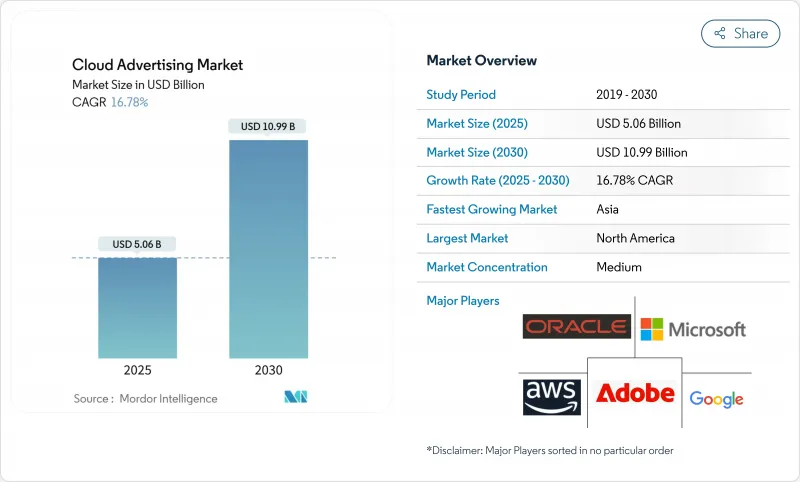
據估計,到 2025 年,雲端廣告市場價值將達到 50.6 億美元,預計到 2030 年將達到 109.9 億美元,複合年成長率為 16.8%。
隨著廣告商用彈性雲端服務取代本地部署架構,實現毫秒競標、即時分析和整合隱私控制,市場需求正在加速成長。每新增十億美元流入雲端工作負載,用於可觀測性、加密和GPU密集型執行個體的支出也在增加,基礎設施已成為直接的收入來源。管理身分圖譜、創新產生和宣傳活動衡量的工作負載擴大運行在獨立或邏輯隔離的區域,促使超大規模雲端服務供應商將潔淨室範本和客戶管理的金鑰打包到預留實例服務中。如今,採購流程中行銷、法務和IT部門的參與度更高,因為宣傳活動的敏捷性和合規性需要在一次談判中達成一致。
全球雲端廣告市場趨勢與洞察
利用公共雲端加速零售和媒體產業發展
一家經營大型電商平台的零售商於 2024 年將廣告投放代碼遷移到了公共雲端。一家電商平台報告稱,遷移到無伺服器 GPU 池後,Flash宣傳活動的啟動時間縮短了 43%,離峰時段的成本降低了兩位數,從而釋放了預算用於身臨其境型視訊格式。按小時推送的庫存感知促銷活動取代了每週一次的更新週期,這表明雲端運算經濟正在重塑商品行銷策略。
以隱私為中心的第一方資料潔淨室
歐洲的 GDPR 法規持續影響架構決策。 2025 年春季,一家跨國廣播公司將其受眾匹配功能遷移到了一個加密的 BigQuery 資料淨室,使廣告商無需訪問原始資料表即可衡量效果提升。如今,各大廣告代理商紛紛要求為新的競標提供類似的藍圖,這顯示資料淨室正逐漸成為一項預設要求,而非進階附加元件。
雲端出口費用上漲推高了整體擁有成本。
廣告主發現,當廣告曝光率日誌跨越多個雲端平台時,資料出口費用可能會在2024年損害投資報酬率。一家歐洲遊戲發行商透過將流量回傳至擁有專用光纖的託管資料中心,節省了七位數的成本,且未造成任何延遲損失。如今,財務團隊已將網路拓撲結構視為預算中的核心變數。
細分市場分析
混合雲端廣告市場預計到2030年將以24%的複合年成長率成長,凸顯了品牌在不放棄敏感身分圖譜的情況下對彈性運算的需求。一家全球航空公司運作了一個邊緣Kubernetes集群來處理乘客名單,同時將預測任務擴展到公共區域,以實現符合GDPR的重定向和即時收益管理。由於串流媒體服務透過使用預留的GPU區塊進行AV1編碼,將渲染成本降低了一半,到2024年,公有雲廣告將維持64%的雲端廣告市場佔有率。私有雲端在金融和醫療保健領域仍然非常重要,一家歐洲保險公司在將其細分模型遷移到私有OpenShift叢集後,減少了20%的監管工作量。
雲端廣告市場按部署類型(公共雲端廣告、私有雲端廣告、混合雲端廣告)、服務模式(軟體即服務 (SaaS) 廣告平台、廣告投放的基礎設施即服務 (IaaS) 及其他)、最終用戶產業(零售和電子商務、媒體和娛樂及其他)以及地區進行細分。市場預測以美元計價。
區域分析
2024年,北美將佔總收入的38%,這主要得益於密集的雲間連接,其平均競價競標往返時間不到120毫秒。 2025年各州推出的隱私權法將刺激對策略即程式碼工具的需求,從而使那些將合規性抽象化為聲明式範本的供應商受益。
預計亞太地區將以20%的複合年成長率從2025年到2030年實現最快成長。政府對資料中心建設的激勵措施、廣東省的可再生能源計劃以及印尼離島的低軌道連接,將使行動廣告覆蓋到以前無法觸及的受眾群體。
歐洲面臨一些最嚴格的隱私保護制度。一家泛歐連鎖超市於2025年透過主權雲端平台聯合了其加密的會員ID,以少量延遲為代價換取了合規性的確定性。該地區的廣告商也越來越接受這種表現的權衡,以降低監管風險。
拉丁美洲繼續呈現物流投資和廣告收入的良性循環:巴西履約專家將當日送達服務擴展到 55% 的都市區消費者,提高了贊助清單的點擊率,並使廣告收入超過了商品交易總額的成長。
中東和非洲將受惠於新建的陸地光纖線路和自主雲端建設。一家海灣航空公司於2025年在其阿布達比資料中心發起了一項阿拉伯語重定向行銷宣傳活動,該活動顯著提升了先前數位消費佔比較低的市場的預訂量。
其他福利:
- Excel格式的市場預測(ME)表
- 3個月的分析師支持
目錄
第1章 引言
- 研究假設和市場定義
- 調查範圍
第2章調查方法
第3章執行摘要
第4章 市場情勢
- 市場概覽
- 市場促進因素
- 零售媒體網路採用公共雲端
- 歐洲以隱私為中心的第一方資料無塵室
- 程序化影片廣告的蓬勃發展刺激了亞洲對雲端DSP的需求。
- 邊緣AI競標引擎需要富含GPU的IaaS。
- 生成式人工智慧創新套件推動了SaaS的普及
- 拉丁美洲中小企業電子商務發展
- 市場限制
- 雲端出口費用上漲推高了整體擁有成本。
- 區域資料主權義務
- 對廣告詐騙偵測延遲的擔憂
- Kubernetes/DevOps人才短缺
- 監理展望
- 技術展望
- 波特五力分析
- 供應商的議價能力
- 消費者議價能力
- 新進入者的威脅
- 競爭對手之間的競爭
- 替代品的威脅
第5章 市場規模與成長預測
- 依部署類型
- 公共雲端廣告
- 私有雲端廣告
- 混合雲端廣告
- 按服務模式
- 軟體即服務 (SaaS) 廣告平台
- 需求端平台(DSP)
- 供應端平台(SSP)
- 廣告交易平台
- 廣告投放的基礎設施即服務 (IaaS)
- 計算最佳化實例
- GPU加速執行個體
- 邊緣/內容傳遞網路
- 平台即服務 (PaaS) 行銷中介軟體
- 數據無塵室
- API管理與微服務
- AI/ML模型訓練平台
- 軟體即服務 (SaaS) 廣告平台
- 按最終用戶行業分類
- 零售與電子商務
- 媒體與娛樂
- 資訊科技與通訊
- 銀行、金融服務和保險(BFSI)
- 政府和公共部門
- 其他
- 按地區
- 北美洲
- 美國
- 加拿大
- 南美洲
- 巴西
- 阿根廷
- 其他南美洲
- 歐洲
- 德國
- 英國
- 法國
- 義大利
- 西班牙
- 其他歐洲地區
- 亞太地區
- 中國
- 日本
- 韓國
- 印度
- 澳洲
- 紐西蘭
- 亞太其他地區
- 中東和非洲
- 阿拉伯聯合大公國
- 沙烏地阿拉伯
- 南非
- 其他中東和非洲地區
- 北美洲
第6章 競爭情勢
- 策略發展
- 供應商定位分析
- 公司簡介
- Adobe Inc.
- Amazon Web Services Inc.
- Google LLC
- Microsoft Corporation
- Oracle Corporation
- IBM Corporation
- Salesforce Inc.
- Sprinklr Inc.
- SAP SE
- Meta Platforms Inc.
- Microsoft Advertising(Xandr)
- The Trade Desk Inc.
- InMobi Pte Ltd
- AppLovin Corporation
- PubMatic Inc.
- Criteo SA
- Magnite Inc.
- Zeta Global Holdings Corp.
- Yahoo Advertising
- Alibaba Cloud
第7章 市場機會與未來展望
The cloud advertising market size is estimated at USD 5.06 billion in 2025 and is forecast to reach USD 10.99 billion by 2030, reflecting a 16.8% CAGR.
Demand accelerates as advertisers trade on-premises stacks for elastic, AI-enabled cloud services that deliver millisecond bidding, real-time analytics, and integrated privacy controls. Each new billion flowing into cloud workloads lifts spending on observability, encryption, and GPU-rich instances, making infrastructure a direct revenue lever. Workloads that manage identity graphs, creative generation, and campaign measurement increasingly run in sovereign or logically isolated regions, pushing hyperscalers to bundle clean-room templates and customer-managed keys into reserved-instance offers. Procurement cycles now involve marketing, legal, and IT in equal measure because campaign agility and regulatory alignment have converged into one negotiation.
Global Cloud Advertising Market Trends and Insights
Public-Cloud Retail-Media Acceleration
Retailers operating large e-commerce storefronts shifted ad-serving code to public clouds in 2024. One marketplace cut flash-campaign launch times by 43% after moving to serverless GPU pools and reported double-digit off-peak cost savings, freeing budget for immersive video formats. Hourly inventory-aware promotions have replaced weekly refresh cycles, demonstrating how cloud economics reshape merchandising strategy.
Privacy-Centric First-Party Data Clean Rooms
Europe's GDPR continues to steer architecture decisions. In spring 2025, a multinational broadcaster migrated audience-matching to an encrypted BigQuery clean room, enabling advertisers to measure lift without accessing raw tables . Agencies now request similar blueprints in new tenders, indicating that clean rooms are becoming a default requirement rather than a premium add-on.
Rising Cloud Egress Fees Elevating TCO
Advertisers discovered in 2024 that data-out charges can erode ROI when impression logs traverse multiple clouds. A European gaming publisher cut seven-figure costs by repatriating traffic to a colocation facility with private fiber, without latency penalties. Finance teams now treat network topology as a core budget variable.
Other drivers and restraints analyzed in the detailed report include:
- Programmatic Video Expansion in Asia
- Edge-AI Bidding Engines
- Regional Data-Sovereignty Mandates
For complete list of drivers and restraints, kindly check the Table Of Contents.
Segment Analysis
Hybrid-cloud advertising market size is projected to grow at a 24% CAGR through 2030, underscoring brands' need for elastic compute without relinquishing sensitive identity graphs. A global airline ran edge Kubernetes clusters for passenger-list processing while bursting forecasting tasks to public zones, enabling GDPR-compliant retargeting and real-time yield management. Public-cloud advertising retained 64% cloud advertising market share in 2024 as a streaming service halved rendering costs by using reserved GPU blocks for AV1 encoding. Private-cloud deployments remain critical in finance and healthcare, with a European insurer cutting regulatory man-hours by 20% after migrating segmentation models to a private OpenShift cluster.
Cloud Advertising Market is Segmented by Deployment Type (Public Cloud Advertising, Private Cloud Advertising, Hybrid Cloud Advertising), Service Model (Software As A Service (SaaS) Advertising Platforms, Infrastructure As A Service (IaaS) for Ad Delivery, and More), End-User Industry (Retail and ECommerce, Media and Entertainment, and More), Geography. The Market Forecasts are Provided in Terms of Value (USD).
Geography Analysis
North America generated 38% of 2024 revenue, supported by dense inter-cloud connectivity that keeps median bid-request round-trip below 120 ms. State-level privacy laws introduced in 2025 spurred demand for policy-as-code tooling, rewarding vendors that abstract compliance into declarative templates.
Asia-Pacific is expected to record the fastest regional growth at 20% CAGR from 2025-2030. Government incentives for data-center construction, renewable energy projects in Guangdong, and low-earth-orbit connectivity across remote Indonesian islands together extend mobile-ad reach to previously unreachable audiences.
Europe faces the strictest privacy regime. A pan-European grocery chain federated encrypted loyalty IDs through sovereign clouds in 2025, trading minor latency overhead for compliance certainty. Advertisers across the region increasingly accept such performance tradeoffs to mitigate regulatory risk.
Latin America's virtuous cycle of logistics investment and advertising revenue continues. A Brazilian fulfilment specialist extended same-day delivery to 55% of urban consumers, boosting click-through rates on sponsored listings and enabling ad revenue to outpace GMV growth.
Middle East and Africa benefit from new terrestrial fiber routes and sovereign-cloud builds. A Gulf airline's Arabic-language retargeting campaign launched from an Abu Dhabi stack in 2025 generated incremental bookings in markets that previously under-indexed on digital spend.
- Adobe Inc.
- Amazon Web Services Inc.
- Google LLC
- Microsoft Corporation
- Oracle Corporation
- IBM Corporation
- Salesforce Inc.
- Sprinklr Inc.
- SAP SE
- Meta Platforms Inc.
- Microsoft Advertising (Xandr)
- The Trade Desk Inc.
- InMobi Pte Ltd
- AppLovin Corporation
- PubMatic Inc.
- Criteo SA
- Magnite Inc.
- Zeta Global Holdings Corp.
- Yahoo Advertising
- Alibaba Cloud
Additional Benefits:
- The market estimate (ME) sheet in Excel format
- 3 months of analyst support
TABLE OF CONTENTS
1 INTRODUCTION
- 1.1 Study Assumptions and Market Definition
- 1.2 Scope of the Study
2 RESEARCH METHODOLOGY
3 EXECUTIVE SUMMARY
4 MARKET LANDSCAPE
- 4.1 Market Overview
- 4.2 Market Drivers
- 4.2.1 Public Cloud Adoption by Retail-Media Networks
- 4.2.2 Privacy-Centric First-Party Data Clean Rooms in Europe
- 4.2.3 Programmatic Video Boom Fueling Cloud DSP Demand in Asia
- 4.2.4 Edge-AI Bidding Engines Requiring GPU-Rich IaaS
- 4.2.5 Generative-AI Creative Suites Driving SaaS Uptake
- 4.2.6 SMB eCommerce Expansion in Latin America
- 4.3 Market Restraints
- 4.3.1 Rising Cloud Egress Fees Elevating TCO
- 4.3.2 Regional Data-Sovereignty Mandates
- 4.3.3 Ad-Fraud Detection Latency Concerns
- 4.3.4 Kubernetes / DevOps Talent Shortage
- 4.4 Regulatory Outlook
- 4.5 Technological Outlook
- 4.6 Porter's Five Forces Analysis
- 4.6.1 Bargaining Power of Suppliers
- 4.6.2 Bargaining Power of Consumers
- 4.6.3 Threat of New Entrants
- 4.6.4 Intensity of Competitive Rivalry
- 4.6.5 Threat of Substitutes
5 MARKET SIZE AND GROWTH FORECASTS (VALUE)
- 5.1 By Deployment Type
- 5.1.1 Public Cloud Advertising
- 5.1.2 Private Cloud Advertising
- 5.1.3 Hybrid Cloud Advertising
- 5.2 By Service Model
- 5.2.1 Software as a Service (SaaS) Advertising Platforms
- 5.2.1.1 Demand-Side Platforms (DSP)
- 5.2.1.2 Supply-Side Platforms (SSP)
- 5.2.1.3 Ad Exchanges
- 5.2.2 Infrastructure as a Service (IaaS) for Ad Delivery
- 5.2.2.1 Compute-Optimized Instances
- 5.2.2.2 GPU-Accelerated Instances
- 5.2.2.3 Edge / Content Delivery Networks
- 5.2.3 Platform as a Service (PaaS) Marketing Middleware
- 5.2.3.1 Data Clean Rooms
- 5.2.3.2 API Management and Micro-services
- 5.2.3.3 AI / ML Model-Training Platforms
- 5.2.1 Software as a Service (SaaS) Advertising Platforms
- 5.3 By End-User Industry
- 5.3.1 Retail and eCommerce
- 5.3.2 Media and Entertainment
- 5.3.3 Information Technology and Telecom
- 5.3.4 Banking, Financial Services and Insurance (BFSI)
- 5.3.5 Government and Public Sector
- 5.3.6 Others
- 5.4 By Geography
- 5.4.1 North America
- 5.4.1.1 United States
- 5.4.1.2 Canada
- 5.4.2 South America
- 5.4.2.1 Brazil
- 5.4.2.2 Argentina
- 5.4.2.3 Rest of South America
- 5.4.3 Europe
- 5.4.3.1 Germany
- 5.4.3.2 United Kingdom
- 5.4.3.3 France
- 5.4.3.4 Italy
- 5.4.3.5 Spain
- 5.4.3.6 Rest of Europe
- 5.4.4 Asia-Pacific
- 5.4.4.1 China
- 5.4.4.2 Japan
- 5.4.4.3 South Korea
- 5.4.4.4 India
- 5.4.4.5 Australia
- 5.4.4.6 New Zealand
- 5.4.4.7 Rest of Asia-Pacific
- 5.4.5 Middle East and Africa
- 5.4.5.1 United Arab Emirates
- 5.4.5.2 Saudi Arabia
- 5.4.5.3 South Africa
- 5.4.5.4 Rest of Middle East and Africa
- 5.4.1 North America
6 COMPETITIVE LANDSCAPE
- 6.1 Strategic Developments
- 6.2 Vendor Positioning Analysis
- 6.3 Company Profiles (includes Global level Overview, Market level overview, Core Segments, Financials as available, Strategic Information, Products and Services, and Recent Developments)
- 6.3.1 Adobe Inc.
- 6.3.2 Amazon Web Services Inc.
- 6.3.3 Google LLC
- 6.3.4 Microsoft Corporation
- 6.3.5 Oracle Corporation
- 6.3.6 IBM Corporation
- 6.3.7 Salesforce Inc.
- 6.3.8 Sprinklr Inc.
- 6.3.9 SAP SE
- 6.3.10 Meta Platforms Inc.
- 6.3.11 Microsoft Advertising (Xandr)
- 6.3.12 The Trade Desk Inc.
- 6.3.13 InMobi Pte Ltd
- 6.3.14 AppLovin Corporation
- 6.3.15 PubMatic Inc.
- 6.3.16 Criteo SA
- 6.3.17 Magnite Inc.
- 6.3.18 Zeta Global Holdings Corp.
- 6.3.19 Yahoo Advertising
- 6.3.20 Alibaba Cloud
7 MARKET OPPORTUNITIES AND FUTURE OUTLOOK
- 7.1 White-Space and Unmet-Need Assessment


