


 |
市場調查報告書
商品編碼
1849903
銻:市場佔有率分析、產業趨勢、統計數據、成長預測(2025-2030 年)Antimony - Market Share Analysis, Industry Trends & Statistics, Growth Forecasts (2025 - 2030) |
||||||

※ 本網頁內容可能與最新版本有所差異。詳細情況請與我們聯繫。
預計到 2025 年銻市場規模將達到 98.15 千噸,到 2030 年將達到 105.76 千噸,預測期(2025-2030 年)複合年成長率為 1.5%。
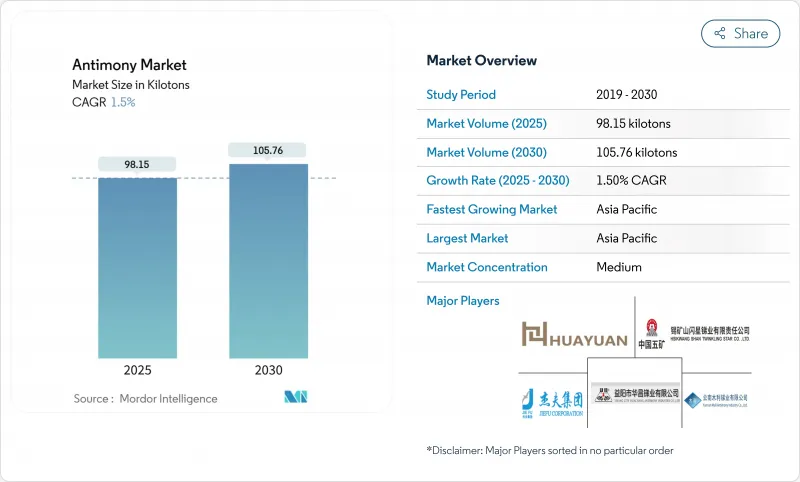
儘管銷售成長較為溫和,但背後的變化卻十分顯著:中國於2024年9月實施的出口限制擾亂了全球供應,導致價格飆升至每噸2.2萬美元,單日漲幅高達40%。下游產業正透過原料來源多元化、投資回收利用以及加速銻替代品的研發來應對這項挑戰。在歐洲,日益嚴格的法規對阻燃劑配方提出了更高的要求,而亞太地區電網級電池的快速普及則推動了需求成長。在日益嚴格的環境監管下,儲能技術的創新以及PET樹脂產量的復甦仍在持續刺激消費。
全球銻市場趨勢與洞察
塑膠產業需求不斷成長
建築、汽車和家電行業的防火安全法規持續推動聚合物向銻基阻燃系統的重大轉變。儘管在40%的測試飲料中,銻的浸出量超過了加州的公共衛生標準,但PET生產商仍然依賴銻催化劑來實現高反應速率和理想的顏色。監管壓力尚未催生出性能相近且成本更具競爭力的替代催化劑,這使得全球聚合物生產在中期內受到限制。塑膠產業佔銻消費量的48%,為銻的生產提供了基準支撐,並進一步推動了銻市場的成長。由於再生PET通常需要添加銻以維持聚合物的質量,因此向循環包裝的轉變反而增加了對銻的需求。
亞太地區電網級鉛酸蓄電池的快速擴張
中國、印度和東南亞的電力公司正在將間歇性可再生能源與採用銻鉛合金的成熟鉛酸電池系統相結合,這些合金經過最佳化,可延長循環壽命。電聲充電和合金調校技術降低了維護成本,提高了放電深度,使鉛酸電池在某些電網中更具競爭力。由於電池柵格合金通常含有1%至6%(重量比)的銻,這些計劃正在推動該地區銻的需求成長。在北美,公用事業公司對經濟高效的長期儲能的需求也為銻市場帶來了額外的結構性需求。
歐洲向無鹵阻燃劑的轉變
歐洲生產商正在逐步淘汰依賴銻協同作用的溴化阻燃劑,並以磷氮阻燃劑取而代之。歐洲化學品管理局的SVHC清單目前包含247種物質,這加大了對銻化合物及其下游鹵代化合物的審查力度。原始設備製造商(OEM)的偏好和生態標籤正在鞏固這一轉變,從長遠來看,這將從結構上削弱該地區對銻的需求,儘管全球市場仍然依賴鹵銻配方。
細分市場分析
到2024年,三氧化二銻將佔總銷售量的57%,成為阻燃母粒用銻化學品市場中最大的佔有率。預計三氧化二銻的消費量將以接近產業整體成長速度的速度成長,儘管面臨歐盟法規的不利影響,仍將保持主導。金屬錠和五氧化二銻的流通仍主要集中在特種玻璃和電池應用領域,呈現出低成長但穩定的現金流特徵。
相較之下,合金細分市場雖然僅佔1.66%的市場佔有率,但隨著銻改質鋅鎂鋁塗層在汽車領域的應用日益廣泛,該細分市場正呈現強勁成長動能。先導計畫已證實,該塗層能夠改善耐腐蝕性和微觀結構,從而延長車身面板的使用壽命。這個細分市場可望超越整體市場成長速度,並為銻市場中提供客製化合金化學成分的供應商帶來更高的利潤空間和更緊密的客戶關係。
2024年,輝銻礦將佔銻原料開採量的96.2%,佔銻原料市場的大部分佔有率。依賴這種單一硫化物礦物的加工會帶來集中的地緣政治風險,因為其主要礦床位於中國、俄羅斯和塔吉克斯坦。該礦石會產生富含砷的廢棄物,從而增加全球環境管理成本。
在中國以外地區探勘礦床的活動正在增加。美國銻業公司收購阿拉斯加斯蒂布奈特溪3,840英畝的礦區,旨在確保國內供應的穩定性。在澳洲和加拿大類似的多元化投資,反映出銻業正逐步調整策略,以降低銻市場對輝銻礦的依賴,並為未來十年或更長時間內更穩定的供應奠定基礎。
區域分析
到2024年,亞太地區將佔全球銻消費量的88%,反映出該地區在塑膠、電子和電池領域無可比擬的製造業深度。日本、韓國和印度的買家目前正在與替代供應商簽訂長期契約,以對沖供應風險。區域能源轉型將為鉛酸電池和高純度半導體化合物帶來新的結構性需求,從而推動銻市場保持緩慢但穩定的成長,預計到2030年年均複合成長率將達到1.53%。
北美82%的銻依賴進口,用於國防和關鍵基礎設施建設,雖然儲量雖小,但戰略意義重大。愛達荷州輝銻礦開採計畫的核准,將打造美國唯一獲得許可的原生礦床,預計礦場壽命期內產量將達1.48億磅。該計劃與阿拉斯加的銻礦計畫一道,開始逐步恢復部分銻市場供應鏈,可望緩解未來對進口的依賴。
歐洲自身也面臨監管上的挑戰。 REACH法規的合規成本以及向無鹵化學的轉型正在抑制三氧化矽的生產,而高性能玻璃、陶瓷和電子產品領域的需求則保持著一定的細分市場。正在進行的CoRAP評估帶來了不確定性,使得歐洲買家對大規模投資銻基化學品持謹慎態度。然而,汽車和航太應用領域維持了歐洲在全球銻市場的地位,特種阻燃劑的需求彌補了通用阻燃劑噸位的下降。
其他福利:
- Excel格式的市場預測(ME)表
- 3個月的分析師支持
目錄
第1章 引言
- 研究假設和市場定義
- 調查範圍
第2章調查方法
第3章執行摘要
第4章 市場情勢
- 市場概覽
- 市場促進因素
- 塑膠產業需求不斷成長
- 亞太地區電網級鉛酸蓄電池的快速擴張
- PET樹脂的繁榮增加了銻催化劑的消耗量
- 電子產業對銻的需求不斷成長
- 新興經濟體對建築和汽車的需求不斷成長
- 市場限制
- 中國不穩定的出口配額導致價格不穩定。
- 歐洲向無鹵阻燃劑的過渡
- 歐盟REACH法規對Sb2O3生產商的毒性合規成本
- 價值鏈分析
- 波特五力模型
- 供應商的議價能力
- 買方的議價能力
- 新進入者的威脅
- 替代品的威脅
- 競爭程度
第5章 市場規模及成長預測(銷售)
- 按類型
- 金屬錠
- 三氧化銻
- 五氧化二銻
- 合金
- 其他類型
- 依礦石類型
- 輝銻礦
- 其他
- 透過使用
- 阻燃劑
- 電池
- 催化劑
- 陶瓷和玻璃
- 其他用途
- 按最終用途行業分類
- 塑膠和聚合物
- 汽車與運輸
- 化學品和催化劑
- 電子和半導體
- 儲能與公用事業
- 其他行業
- 區域生產分析
- 中國
- 俄羅斯
- 澳洲
- 塔吉克
- 玻利維亞
- 緬甸
- 其他國家
- 區域消費分析
- 亞太地區
- 中國
- 印度
- 日本
- 韓國
- 印尼
- 亞太其他地區
- 北美洲
- 美國
- 加拿大
- 墨西哥
- 歐洲
- 德國
- 英國
- 法國
- 義大利
- 西班牙
- 其他歐洲地區
- 南美洲
- 巴西
- 阿根廷
- 智利
- 其他南美洲
- 中東和非洲
- 沙烏地阿拉伯
- 阿拉伯聯合大公國
- 南非
- 其他中東和非洲地區
- 亞太地區
第6章 競爭情勢
- 市場集中度
- 策略趨勢
- 市佔率(%)/排名分析
- 公司簡介
- AMG(AMG Advanced Metallurgical Group NV)
- Anhua Huayu Antimony Industry Co.
- Belmont Metals
- Campine NV
- Guangxi Huayuan Metal Chemical Co. Ltd
- Hsikwangshan Twinkling Star Co. Ltd
- Jiefu Corporation
- KOREAZINC
- Lambert Metals International Limited
- Mandalay Resources
- Nihon Seiko Co. Ltd
- Stibium Mining(Consolidated Murchison)
- Suzuhiro Chemical Co. Ltd
- Tri-Star Resources PLC
- United States Antimony Corporation
- Yiyang City Huachang Antimony Industry Co. Ltd
- Yunnan Muli Antimony Industry Co. Ltd
第7章 市場機會與未來展望
The Antimony Market size is estimated at 98.15 kilotons in 2025, and is expected to reach 105.76 kilotons by 2030, at a CAGR of 1.5% during the forecast period (2025-2030).
Expansion is modest in volume terms, yet underlying shifts are substantial: China's September 2024 export controls disrupted global supply, driving prices to USD 22,000 per ton and triggering a 40% single-day price jump. Downstream sectors are responding by searching for diversified raw-material sources, investing in recycling, and accelerating R&D on antimony substitutes. Regulatory tightening in Europe is pressuring flame-retardant formulations, while rapid grid-scale battery deployment in Asia-Pacific is reinforcing demand. Energy-storage innovation, coupled with a resurgence in PET resin output, continues to lift consumption even as environmental scrutiny intensifies.
Global Antimony Market Trends and Insights
Growing demand from the plastic industry
Fire-safety rules in construction, automotive, and consumer electronics continue to move large polymer volumes toward antimony-based flame-retardant systems. PET producers still rely on antimony catalysts that deliver high reaction rates and favorable color even though antimony leaching exceeds California public-health goals in 40% of tested beverages. Regulatory pressure has not yet produced a cost-competitive catalyst alternative with similar performance, so global polymer lines are locked in for the medium term. The plastics sector, already holding 48% of antimony consumption, is therefore underpinning the baseline offtake and supporting incremental growth in the antimony market. Ongoing transition to circular packaging paradoxically lifts demand because recycled PET often requires additional antimony to preserve polymer quality.
Rapid grid-scale lead-acid battery expansion in Asia-Pacific
Utilities in China, India, and Southeast Asia are pairing intermittent renewables with familiar lead-acid systems that now incorporate optimized antimony-lead alloys to extend cycle life. Electro-acoustic charging and alloy tweaks have reduced maintenance and improved depth-of-discharge, making lead-acid competitive for certain grid roles. These projects boost regional antimony pull-through because each battery grid alloy typically contains 1%-6% antimony by weight. Spillover procurement in North America is emerging as utilities seek cost-effective long-duration storage, adding a further layer of structural demand to the antimony market.
Shift toward halogen-free flame retardants in Europe
European producers are phasing out brominated systems that rely on antimony synergy, replacing them with phosphorus-nitrogen chemistries. The European Chemicals Agency's SVHC list now encompasses 247 substances, intensifying scrutiny on antimony compounds and downstream halogenated partners. OEM preferences and eco-labels are cementing this transition, which structurally erodes antimony demand in the region over the long run, even though global markets still rely on halogen-Sb formulations.
Other drivers and restraints analyzed in the detailed report include:
- PET resin boom boosting Sb-catalyst consumption
- Rising demand in the electronics industry
- EU-REACH toxicology compliance costs for Sb2O3 producers
For complete list of drivers and restraints, kindly check the Table Of Contents.
Segment Analysis
Antimony trioxide commanded 57% of 2024 volume, underpinning the largest slice of the antimony market size for chemicals used in flame-retardant masterbatches. Trioxide consumption climbs at a pace near the overall industry, sustaining leadership even under EU regulatory headwinds. Metal ingot and pentoxide streams remain oriented to specialized glass and battery uses, showing low growth yet stable cash-flow characteristics.
In contrast, the alloys segment-holding only 1.66% share-shows outsized momentum as antimony-modified Zn-Mg-Al coatings gain automotive acceptance. Pilot projects demonstrate corrosion-resistance and microstructural improvements that unlock lifespan benefits for exposed body panels. This niche should outpace base-market growth, offering premium margin potential and higher customer stickiness for suppliers that deliver tailored alloy chemistries within the antimony market.
Stibnite contributed 96.2% of mined feedstock in 2024, translating to the vast majority of the antimony market size at the raw-material level. Processing reliance on this single sulfide mineral concentrates geopolitical risk, given that dominant deposits lie in China, Russia, and Tajikistan. The ore generates arsenic-rich waste streams, elevating environmental-management costs worldwide.
The exploration of non-Chinese deposits is rising. United States Antimony Corporation's acquisition of 3,840 acres at Stibnite Creek in Alaska aims to underwrite domestic supply resilience. Similar diversification drives in Australia and Canada reflect a gradual pivot intended to dilute the stibnite concentration in the antimony market, laying groundwork for incremental security of supply over the decade.
The Antimony Market Report Segments the Industry by Type (Metal Ingot, Antimony Trioxide, and More), Ore Type (Stibnite and Others), Application (Flame Retardants, Batteries, and More), End-Use Industry (Plastics and Polymers, Automotive and Transportation, and More), and Geography (Asia-Pacific, North America, Europe, South America, and Middle East and Africa). The Market Forecasts are Provided in Terms of Volume (tons).
Geography Analysis
Asia-Pacific held 88% of antimony consumption in 2024, reflecting unmatched manufacturing depth in plastics, electronics, and batteries. Chinese export permits have upended regional trade flows; Japanese, South-Korean, and Indian buyers now lock in long-term contracts with alternative sources to hedge supply risk. Regional energy transitions add new structural demand for lead-acid storage and high-purity semiconductor compounds, keeping the antimony market on a modest yet consistent expansion path of 1.53% CAGR to 2030.
North America is smaller by volume yet strategically pivotal, importing 82% of antimony for defense and critical infrastructure. Approval of the Stibnite Mine plan in Idaho gives the United States its only permitted primary deposit, with an anticipated output of 148 million pounds across the life-of-mine. This project, alongside Alaskan claims, begins to re-shore part of the antimony market supply chain and could temper future import reliance.
Europe faces unique regulatory compression. REACH compliance costs and the shift toward halogen-free chemistry curb trioxide volumes, while high-performance glass, ceramics, and electronics preserve niche demand. Ongoing CoRAP evaluations inject uncertainty, making European buyers cautious about large-scale investments tied to antimony-based chemistries. Nonetheless, essential automotive and aerospace applications keep the region engaged in the global antimony market, with specialty segments offsetting losses in commoditized flame-retardant tonnage.
- AMG (AMG Advanced Metallurgical Group N.V.)
- Anhua Huayu Antimony Industry Co.
- Belmont Metals
- Campine NV
- Guangxi Huayuan Metal Chemical Co. Ltd
- Hsikwangshan Twinkling Star Co. Ltd
- Jiefu Corporation
- KOREAZINC
- Lambert Metals International Limited
- Mandalay Resources
- Nihon Seiko Co. Ltd
- Stibium Mining (Consolidated Murchison)
- Suzuhiro Chemical Co. Ltd
- Tri-Star Resources PLC
- United States Antimony Corporation
- Yiyang City Huachang Antimony Industry Co. Ltd
- Yunnan Muli Antimony Industry Co. Ltd
Additional Benefits:
- The market estimate (ME) sheet in Excel format
- 3 months of analyst support
TABLE OF CONTENTS
1 Introduction
- 1.1 Study Assumptions and Market Definition
- 1.2 Scope of the Study
2 Research Methodology
3 Executive Summary
4 Market Landscape
- 4.1 Market Overview
- 4.2 Market Drivers
- 4.2.1 Growing Demand from the Plastic Industry
- 4.2.2 Rapid Grid-Scale Lead-Acid Battery Expansion in Asia-Pacific
- 4.2.3 PET Resin Boom Boosting Sb-Catalyst Consumption
- 4.2.4 Rising Demand for Antimony in Electronics Industry
- 4.2.5 Rising Construction and Automotive Demand in Developing Economies
- 4.3 Market Restraints
- 4.3.1 Volatile Chinese Export Quotas Causing Price Instability
- 4.3.2 Shift Toward Halogen-Free Flame Retardants in Europe
- 4.3.3 EU-REACH Toxicology Compliance Costs for Sb2O3 Producers
- 4.4 Value Chain Analysis
- 4.5 Porter's Five Forces
- 4.5.1 Bargaining Power of Suppliers
- 4.5.2 Bargaining Power of Buyers
- 4.5.3 Threat of New Entrants
- 4.5.4 Threat of Substitutes
- 4.5.5 Degree of Competition
5 Market Size and Growth Forecasts ( Volume)
- 5.1 By Type
- 5.1.1 Metal Ingot
- 5.1.2 Antimony Trioxide
- 5.1.3 Antimony Pentoxide
- 5.1.4 Alloys
- 5.1.5 Other Types
- 5.2 By Ore type
- 5.2.1 Stibnite
- 5.2.2 Others
- 5.3 By Application
- 5.3.1 Flame Retardants
- 5.3.2 Batteries
- 5.3.3 Catalysts
- 5.3.4 Ceramics and Glass
- 5.3.5 Other Applications
- 5.4 By End-use Industry
- 5.4.1 Plastics and Polymers
- 5.4.2 Automotive and Transportation
- 5.4.3 Chemicals and Catalysts
- 5.4.4 Electronics and Semiconductor
- 5.4.5 Energy Storage and Utilities
- 5.4.6 Other Industries
- 5.5 By Geography - Production Analysis
- 5.5.1 China
- 5.5.2 Russia
- 5.5.3 Australia
- 5.5.4 Tajikistan
- 5.5.5 Bolivia
- 5.5.6 Myanmar
- 5.5.7 Other Countries
- 5.6 By Geography - Consumption Analysis
- 5.6.1 Asia-Pacific
- 5.6.1.1 China
- 5.6.1.2 India
- 5.6.1.3 Japan
- 5.6.1.4 South Korea
- 5.6.1.5 Indonesia
- 5.6.1.6 Rest of Asia-Pacific
- 5.6.2 North America
- 5.6.2.1 United States
- 5.6.2.2 Canada
- 5.6.2.3 Mexico
- 5.6.3 Europe
- 5.6.3.1 Germany
- 5.6.3.2 United Kingdom
- 5.6.3.3 France
- 5.6.3.4 Italy
- 5.6.3.5 Spain
- 5.6.3.6 Rest of Europe
- 5.6.4 South America
- 5.6.4.1 Brazil
- 5.6.4.2 Argentina
- 5.6.4.3 Chile
- 5.6.4.4 Rest of South America
- 5.6.5 Middle East and Africa
- 5.6.5.1 Saudi Arabia
- 5.6.5.2 United Arab Emirates
- 5.6.5.3 South Africa
- 5.6.5.4 Rest of Middle East and Africa
- 5.6.1 Asia-Pacific
6 Competitive Landscape
- 6.1 Market Concentration
- 6.2 Strategic Moves
- 6.3 Market Share (%)/Ranking Analysis
- 6.4 Company Profiles (includes Global and Market Overview, Core Segments, Financials, Strategic Info, Market Rank/Share, Products and Services, Recent Developments)
- 6.4.1 AMG (AMG Advanced Metallurgical Group N.V.)
- 6.4.2 Anhua Huayu Antimony Industry Co.
- 6.4.3 Belmont Metals
- 6.4.4 Campine NV
- 6.4.5 Guangxi Huayuan Metal Chemical Co. Ltd
- 6.4.6 Hsikwangshan Twinkling Star Co. Ltd
- 6.4.7 Jiefu Corporation
- 6.4.8 KOREAZINC
- 6.4.9 Lambert Metals International Limited
- 6.4.10 Mandalay Resources
- 6.4.11 Nihon Seiko Co. Ltd
- 6.4.12 Stibium Mining (Consolidated Murchison)
- 6.4.13 Suzuhiro Chemical Co. Ltd
- 6.4.14 Tri-Star Resources PLC
- 6.4.15 United States Antimony Corporation
- 6.4.16 Yiyang City Huachang Antimony Industry Co. Ltd
- 6.4.17 Yunnan Muli Antimony Industry Co. Ltd
7 Market Opportunities and Future Outlook
- 7.1 Recycling of Antimony from End-of-Life Lead-Acid Batteries
- 7.2 White-space and Unmet-need Assessment

 銻全球市場規模、佔有率、趨勢和成長分析報告(2026-2034)
 2026年全球銻市場報告
 掩蔽化合物市場依固化類型、技術、形態、通路、最終用途產業和應用分類-2026-2032年全球預測電子級砷化氫市場按混合類型、純度等級、應用、終端用戶產業和分銷管道分類-2026-2032年全球預測
 銻市場規模、佔有率及成長分析(按類型、應用、最終用途產業和地區分類)-產業預測(2026-2033 年)
 銻礦:全球市佔率及排名、總收入及需求預測(2025-2031年)全球銻市場預測(2025-2032 年):依產品類型、形態、純度、應用和用途分類
 2025-2033年銻市場報告(依產品類型、應用、最終用途產業和地區)
 Stivium 目標市場報告:趨勢、預測和競爭分析(至 2031 年)
 銻市場規模、佔有率、趨勢分析報告:按類型、按應用、按地區、細分市場預測,2024-2030