


 |
市場調查報告書
商品編碼
1849884
BPaaS(業務流程即服務):市場佔有率分析、產業趨勢、統計數據和成長預測(2025-2030 年)Business-Process-as-a-Service - Market Share Analysis, Industry Trends & Statistics, Growth Forecasts (2025 - 2030) |
||||||

※ 本網頁內容可能與最新版本有所差異。詳細情況請與我們聯繫。
預計到 2025 年,業務流程即服務 (BPaaS) 市場規模將達到 786.9 億美元,到 2030 年將達到 1,393 億美元,預測期(2025-2030 年)的複合年成長率為 12.10%。
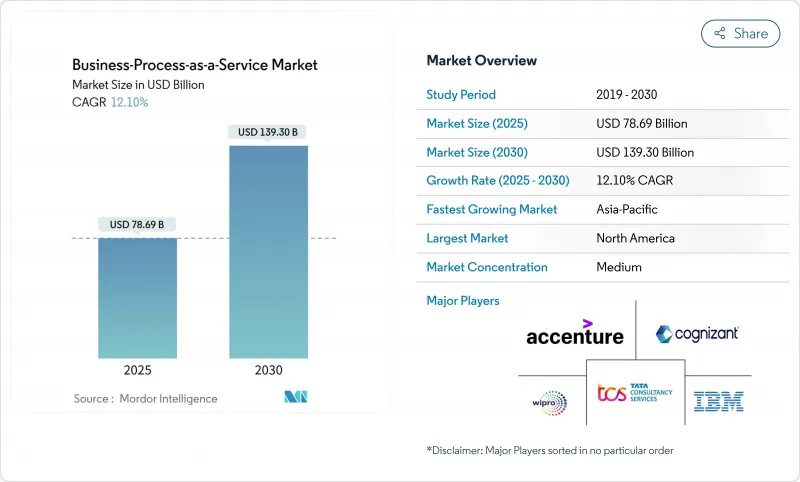
雲端原生交付模式的加速普及、人工智慧的快速發展以及監管機構對彈性營運日益成長的壓力,正在重塑企業策略。企業正在將固定成本轉化為可變成本,同時即時獲取先進的自動化、分析和特定產業最佳實踐——這些能力過去需要數年的資本投入才能實現。在近期供應鏈中斷事件後,企業對營運彈性的關注度顯著提升,這進一步鞏固了業務流程即服務 (BPaaS) 作為實現本地合規、標準化流程並同時實現全球擴展的首選途徑的地位。供應商正透過基於結果的商業模式、自主雲端選項和符合 ESG 標準的流程包來應對這一趨勢,所有這些都在深化業務流程即服務 (BPaaS) 市場在數位轉型專案中的策略角色。
全球業務流程即服務 (BPaaS) 市場趨勢與洞察
對雲端服務和標準化流程的需求不斷成長
向雲端平台的普遍轉型支援大規模流程標準化。目前,94% 的企業利用雲端解決方案來簡化工作流程、縮短部署週期並實現一致的管治。彈性資源分配支援快速因應需求變化,而無需進行新的資本決策。 IBM 指出,77% 的企業已經運行混合架構,這使它們能夠在多個雲端平台上統一核心流程,同時將策略性工作負載保留在首選的司法管轄區。標準化的雲端原生模組加速了銀行和保險業的合規營運,在這些行業中,統一的審核追蹤至關重要。因此,業務流程即服務 (BPaaS) 市場在各個尋求速度、彈性和全球覆蓋的行業中繼續保持著多年的成長動能。
降低營運成本和提高生產力的必要性
經濟逆風加劇了以基於消費的模式取代固定成本的壓力。業務流程即服務 (BPaaS) 將多年期授權合約、資料中心折舊免稅額和人事費用成本轉化為與實際使用量掛鉤的變動成本。 DXC Technology 的報告顯示,企業從傳統外包模式轉向 BPaaS 框架後,可節省 20% 至 30% 的成本。這些服務內建的流程自動化功能進一步提高了生產力,一些公司報告稱,其財務後勤部門營運效率提高了 40%。這些財務和營運方面的綜合優勢,使業務流程即服務 (BPaaS) 市場成為提升短期盈利和長期競爭力的實用工具。
人們越來越關注資料安全和隱私問題
業務流程即服務 (BPaaS) 的部署涉及分散式基礎設施,這可能會擴大威脅面。南非儲備銀行警告稱,如果控制措施薄弱,雲端處理會加劇營運風險和系統性風險。歐洲的 GDPR 和加州的 CCPA 法規對違規行為處以嚴厲的處罰,迫使服務提供者實施進階加密、身分管理和區域資料居住架構。即使更安全的平台不斷湧現,人們對業務流程即服務 (BPaaS) 市場的信心也在逐漸恢復,但日益嚴格的審查仍將暫時減緩決策週期,並限制敏感領域在短期內採用 BPaaS。
細分市場分析
到2024年,大型企業將佔據業務流程即服務 (BPaaS) 市場64.3%的佔有率,它們利用標準化的全球工作流程來簡化審核並減少平台重疊。這些企業通常會先外包財務和人力資源等非核心職能,然後在管治結構穩健後,擴展到客戶體驗和供應鏈分析領域。許多公司正在實施中間件層,將本地部署的ERP系統與公共雲端微服務結合,充分利用供應商的創新,同時保持策略資料控制。同時,新成立的企業級管治委員會根據基於結果的合約監控供應商的績效,以確保其與策略目標持續保持一致。
中小企業(SMB)歷來在市場中佔比偏低,如今卻成為成長最快的細分市場,預計複合年成長率(CAGR)將達到13.3%。雲端優先解決方案消除了資本支出、專業人才短缺和基礎設施維護等傳統障礙。總部位於日本的Kubel Co., Ltd.報告稱,其Chatwork平台到2024年9月將服務60.5萬家中小企業客戶,這印證了該細分市場的巨大需求。中小企業通常從單一流程模組入手,例如薪資核算、發票處理或服務台自動化,並在可靠性得到驗證後擴展到端到端套件。彈性定價模式在成長和景氣衰退時期都能提供重要的現金流彈性。因此,隨著供應商發布針對特定產業規性客製化的預先配置軟體包,預計到2030年,中小企業相關的業務流程即服務(BPaaS)市場規模將顯著成長。
人力資源管理在2024年佔總收入的24.1%,反映出全球普遍體認到,標準化招募、薪資核算和人才招聘流程能夠降低合規風險並提升員工體驗。許多供應商現在將人力資源模組與預測分析結合,用於預測離職率、識別技能差距並推薦學習內容。核算和財務流程也可以透過機器人發票核對、自動核對和人工智慧驅動的詐欺檢查來提高準確性並縮短週期時間。供應鏈和採購解決方案則能夠改善供應商協作並提升庫存可見度。
客戶服務與支援預計將以每年 14.6% 的速度成長,推動品牌向全通路互動轉型。人工智慧主導的聊天機器人和語音分析能夠以遠低於傳統客服中心的成本提供即時、個人化的回應。 Sutherland Global 的客戶案例提高了首次呼叫解決率,提升了淨推薦值 (NPS),減少了升級次數,同時縮短了平均回應時間。銷售和行銷業務流程即服務 (BPaaS) 對這些進步起到了補充作用,它將宣傳活動數據與前台分析同步,從而提高銷售線索品質。營運模組將工作流程引擎應用於現場服務調度、工廠維護計劃和品質保證。這些創新將支持 BPaaS(業務流程即服務)市場的持續擴張。
業務流程即服務 (BPaaS) 市場按組織規模(大型企業、中小企業)、流程類型(人力資源管理、核算與財務、其他)、部署模式(公共雲端BPaaS、私有雲端BPaaS、混合/多重雲端BPaaS)、最終用戶行業(銀行、金融服務和保險 (BFSI)、IT 和通訊、其他)以及地區進行細分。市場預測以美元計價。
區域分析
北美地區預計在2024年將佔全球收入的41.2%,這主要得益於早期雲端採用率高以及強大的供應商生態系統。金融機構正在利用業務流程即服務 (BPaaS) 來整合跨司法管轄區的合規文檔,而零售集團則在積極推動人工智慧驅動的客戶服務自動化。雲端基礎設施集中度顯著,英國競爭與市場管理局 (CMA) 估計,AWS 和微軟分別佔據北美基礎設施40-50%和30-40%的佔有率。這種主導地位促使 BPaaS 供應商與超大規模資料中心業者建立策略聯盟,以最佳化延遲並推動聯合市場推廣計畫。
預計亞太地區將在2025年至2030年間以12.8%的複合年成長率實現最快成長。印度、菲律賓和印尼等國政府正在推行「雲端優先」政策,以降低營運成本並改善公共服務。印度資料安全委員會預測,到2022年,該國的雲端市場規模將達到77億美元,凸顯了其基礎設施的成熟度。本地供應商正與全球企業合作,以滿足區域資料在地化的需求。面臨人手不足的挑戰,日本企業正在利用業務流程即服務(BPaaS)來實現日常任務的自動化,從而刺激製造業和零售業的需求。
在歐洲,嚴格的資料隱私規則正在引導企業選擇雲端服務方案,並推動其謹慎成長。 GDPR合規性正在影響合約條款、資料居住條款和責任共擔框架。預計2029年,德國的業務流程外包(BPO)市場規模將達213.2億美元,目前雲端服務採用率已達81%。金融機構傾向於混合模式,將本地主權雲與可擴展的公共資源結合,以滿足歐洲金融監管局(Eurofi)的監管指南。該地區強勁的ESG(環境、社會和治理)議程正在推動以永續發展為中心的業務流程即服務(BPaaS)解決方案的需求,這些解決方案能夠自動進行碳核算和社會影響報告。
其他好處
- Excel格式的市場預測(ME)表
- 3個月的分析師支持
目錄
第1章 引言
- 研究假設和市場定義
- 調查範圍
第2章調查方法
第3章執行摘要
第4章 市場情勢
- 市場概覽
- 市場促進因素
- 對雲端服務和標準化流程的需求不斷成長
- 需要降低營運成本並提高生產效率
- 業務流程即服務 (BPaaS) 中人工智慧/超自動化技術的快速應用
- 基於結果的業務流程即服務 (BPaaS)定價模式的擴展
- ESG相關報告要求推動永續性BPaaS
- 對產業專用的BPaaS解決方案的需求
- 市場限制
- 人們越來越關注資料安全和隱私問題
- 與原有核心系統整合的複雜性
- 供應商鎖定和有限的互通性
- 主權雲端要求限制了跨國業務流程即服務 (BPaaS)。
- 產業價值鏈分析
- 監管環境
- 技術展望
- 產業吸引力-波特五力分析
- 供應商的議價能力
- 買方的議價能力
- 新進入者的威脅
- 替代品的威脅
- 競爭對手之間的競爭
- 影響市場的宏觀經濟因素
第5章 市場規模與成長預測
- 按組織規模
- 主要企業
- 小型企業
- 透過流程
- 人力資源管理(HRM)
- 會計與財務
- 客戶服務與支援
- 銷售與行銷
- 供應鏈與採購
- 營運和其他橫向流程
- 按部署模式
- 公共雲端BPaaS
- 私有雲端BPaaS
- 混合/多重雲端BPaaS
- 按最終用戶行業分類
- BFSI
- 資訊科技和通訊
- 醫療保健和生命科學
- 零售與電子商務
- 製造業
- 政府和公共部門
- 其他終端用戶產業
- 按地區
- 北美洲
- 美國
- 加拿大
- 墨西哥
- 南美洲
- 巴西
- 阿根廷
- 智利
- 其他南美洲
- 歐洲
- 德國
- 英國
- 法國
- 義大利
- 西班牙
- 俄羅斯
- 其他歐洲地區
- 亞太地區
- 中國
- 日本
- 印度
- 韓國
- 澳洲
- 新加坡
- 馬來西亞
- 亞太其他地區
- 中東和非洲
- 中東
- 沙烏地阿拉伯
- 阿拉伯聯合大公國
- 土耳其
- 其他中東地區
- 非洲
- 南非
- 奈及利亞
- 埃及
- 其他非洲地區
- 北美洲
第6章 競爭情勢
- 市場集中度
- 策略趨勢
- 市佔率分析
- 公司簡介
- Accenture plc
- IBM Corporation
- Tata Consultancy Services(TCS)
- Cognizant Technology Solutions
- Wipro Limited
- HCL Technologies
- Capgemini SE
- Infosys Limited
- Genpact Ltd.
- Fujitsu Ltd.
- Oracle Corporation
- SAP SE
- Deloitte Touche Tohmatsu Limited
- NTT DATA
- CGI Inc.
- DXC Technology
- Tech Mahindra
- EXL Service Holdings
- ADP Inc.
- Alight Solutions
- Paychex Inc.
- UKG(Ultimate Kronos Group)
- TriNet Group
- Ceridian HCM
- WNS Global Services
- Sutherland Global Services
第7章 市場機會與未來趨勢
The Business-Process-as-a-Service Market size is estimated at USD 78.69 billion in 2025, and is expected to reach USD 139.30 billion by 2030, at a CAGR of 12.10% during the forecast period (2025-2030).
Accelerating adoption of cloud-native delivery models, rapid progress in artificial intelligence, and stronger regulatory pressure for resilient operations are reshaping organizational strategies. Enterprises are converting fixed costs into variable outlays while gaining immediate access to advanced automation, analytics, and industry-specific best practices-capabilities that once required years of capital investment. Intensifying focus on operational resilience after recent supply-chain disruptions has further positioned BPaaS as a preferred route for standardized processes that scale globally yet remain locally compliant. Vendors are responding through outcome-based commercial models, sovereign-cloud options, and ESG-linked process bundles, all of which deepen the strategic role of the Business-Process-as-a-Service market in digital transformation programs.
Global Business-Process-as-a-Service Market Trends and Insights
Growing Demand for Cloud Services and Standardized Processes
Universal migration toward cloud platforms underpins large-scale process standardization. Ninety-four percent of enterprises now leverage cloud solutions to streamline workflows, shorten deployment cycles, and ensure consistent governance. Elastic resource allocation supports rapid pivots in demand without forcing new capital decisions. IBM notes that 77% of firms already run hybrid architectures, enabling them to unify core processes over multiple clouds while keeping strategic workloads in preferred jurisdictions. Standardized, cloud-native modules accelerate compliance tasks in banking and insurance, where uniform audit trails are essential. As a result, the Business-Process-as-a-Service market experiences sustained multi-year momentum across sectors that demand speed, resilience, and global reach.
Need to Reduce Operational Cost and Boost Productivity
Economic headwinds intensify pressure to replace fixed costs with consumption-based models. BPaaS converts multi-year license contracts, data-center depreciation, and labor overhead into variable fees that align with actual usage. DXC Technology reports savings of 20-30% when organizations shift from traditional outsourcing to BPaaS frameworks. Process automation embedded in these services delivers additional productivity gains, with some enterprises citing 40% efficiency improvements in finance back-office tasks. These combined financial and operational benefits reinforce the Business-Process-as-a-Service market as a pragmatic lever for near-term profitability and long-term competitiveness.
Heightened Data-Security and Privacy Concerns
BPaaS deployments involve a distributed infrastructure that can enlarge the threat surface. The South African Reserve Bank cautions that cloud computing amplifies operational and systemic risks when controls are weak. European GDPR and California CCPA regulations impose severe penalties for non-compliance, compelling providers to implement sophisticated encryption, identity management, and regional data-residency architectures. Heightened scrutiny temporarily slows decision cycles, limiting short-term adoption in sensitive verticals even as security-enhanced platforms emerge to rebuild trust in the Business-Process-as-a-Service market.
Other drivers and restraints analyzed in the detailed report include:
- Rapid Adoption of AI / Hyper-automation in BPaaS
- Expansion of Outcome-based (Gain-share) BPaaS Pricing Models
- Integration Complexity with Legacy Core Systems
For complete list of drivers and restraints, kindly check the Table Of Contents.
Segment Analysis
Large Enterprises dominated 2024 with 64.3% of the Business-Process-as-a-Service market share, leveraging standardized global workflows to simplify audits and cut duplicative platforms. They often start by outsourcing non-core finance and HR tasks, then extend coverage to customer experience and supply-chain analytics once governance structures prove resilient. Integration remains a priority; many deploy middleware layers that blend on-premise ERPs with public-cloud microservices, preserving strategic data control while maximizing vendor innovation. In parallel, fresh enterprise-wide governance councils monitor vendor performance under outcome-based contracts, ensuring continuous alignment with strategic objectives.
SMEs, though historically under-represented, now display the strongest momentum with a forecast 13.3% CAGR. Cloud-first solutions remove traditional barriers such as capital outlay, specialist talent shortages, and infrastructure maintenance. Japan's Kubell Co. reports that its Chatwork platform served 605,000 SME clients by September 2024, underscoring the segment's pent-up demand. SMEs typically begin with single-process modules-payroll, invoicing, or help-desk automation-before scaling to end-to-end suites as reliability is proven. The elastic fee model offers crucial cash-flow flexibility during growth spurts or economic contractions. Consequently, the Business-Process-as-a-Service market size attributable to SMEs is projected to widen substantially through 2030 as providers release pre-configured bundles tailored for industry-specific compliance.
Human Resource Management retained 24.1% of 2024 revenue, reflecting global recognition that standardized recruitment, payroll, and talent-engagement workflows lower compliance risk and enhance employee experience. Many providers now pair HR modules with predictive analytics that forecast attrition, identify skill gaps, and recommend learning content. Accounting and Finance processes also gain traction as robotic invoice matching, automated reconciliations, and AI-driven fraud checks boost accuracy while shrinking cycle times. Supply Chain and Procurement solutions improve vendor collaboration and inventory visibility, critical in volatile logistics environments.
Customer Service and Support, forecast to rise 14.6% annually, leads growth as brands pivot to omnichannel engagement. AI-driven chatbots and voice analytics deliver instant, personalized responses at far lower cost than traditional call centers. Sutherland Global's deployments cut average response time while raising first-contact resolution, enhancing NPS scores, and reducing escalations. Sales and Marketing BPaaS complements these advances, synchronizing campaign data with front-office analytics to sharpen lead quality. Operations modules apply workflow engines to field-service dispatch, plant-maintenance scheduling, and quality assurance. Together, these innovations anchor sustained expansion of the Business-Process-as-a-Service market.
Business Process As A Service Market is Segmented by Organization Size (Large Enterprises and Small and Medium Enterprises), Process (Human Resource Management, Accounting and Finance, and More), Deployment Model (Public Cloud BPaaS, Private Cloud BPaaS, and Hybrid/Multi-Cloud BPaaS), End-User Industry (BFSI, IT and Telecommunications, and More), and Geography. The Market Forecasts are Provided in Terms of Value (USD).
Geography Analysis
North America generated 41.2% of 2024 revenue for the Business-Process-as-a-Service market, buoyed by early cloud uptake and deep provider ecosystems. Financial institutions use BPaaS to consolidate compliance documentation across jurisdictions, while retail groups pursue AI-led customer-service automation. Cloud infrastructure concentration is notable; the UK Competition and Markets Authority estimates AWS and Microsoft hold 40-50% and 30-40% of North American infrastructure, respectively. This dominance encourages BPaaS vendors to forge strategic alliances with hyperscalers for latency optimization and joint go-to-market programs.
Asia-Pacific is projected to record the fastest 12.8% CAGR between 2025 and 2030. Governments in India, the Philippines, and Indonesia promote "cloud first" mandates to reduce operating costs and improve citizen services. The Data Security Council of India notes that the national cloud market reached USD 7.70 billion by 2022, underscoring the readiness of foundational infrastructure. Indigenous providers partner with global players to address regional data-localization requirements. Japanese enterprises, challenged by labor shortages, lean on BPaaS to automate routine functions, stimulating demand across manufacturing and retail sectors.
Europe exhibits measured growth as stringent privacy rules guide deployment choices. GDPR compliance shapes contract terms, data-residency clauses, and shared-responsibility frameworks. Germany's BPO market, forecast to hit USD 21.32 billion by 2029, already registers 81% cloud adoption among firms. Financial institutions prefer hybrid models, pairing local sovereign clouds with scalable public resources to satisfy supervisory guidance outlined by Eurofi. The region's strong ESG agenda fuels demand for sustainability-centric BPaaS solutions that automate carbon accounting and social-impact reporting.
- Accenture plc
- IBM Corporation
- Tata Consultancy Services (TCS)
- Cognizant Technology Solutions
- Wipro Limited
- HCL Technologies
- Capgemini SE
- Infosys Limited
- Genpact Ltd.
- Fujitsu Ltd.
- Oracle Corporation
- SAP SE
- Deloitte Touche Tohmatsu Limited
- NTT DATA
- CGI Inc.
- DXC Technology
- Tech Mahindra
- EXL Service Holdings
- ADP Inc.
- Alight Solutions
- Paychex Inc.
- UKG (Ultimate Kronos Group)
- TriNet Group
- Ceridian HCM
- WNS Global Services
- Sutherland Global Services
Additional Benefits:
- The market estimate (ME) sheet in Excel format
- 3 months of analyst support
TABLE OF CONTENTS
1 INTRODUCTION
- 1.1 Study Assumptions and Market Definition
- 1.2 Scope of the Study
2 RESEARCH METHODOLOGY
3 EXECUTIVE SUMMARY
4 MARKET LANDSCAPE
- 4.1 Market Overview
- 4.2 Market Drivers
- 4.2.1 Growing demand for cloud services and standardized processes
- 4.2.2 Need to reduce operational cost and boost productivity
- 4.2.3 Rapid adoption of AI/hyper-automation in BPaaS
- 4.2.4 Expansion of outcome-based BPaaS pricing models
- 4.2.5 ESG-linked reporting mandates driving sustainability BPaaS
- 4.2.6 Demand for industry-specific BPaaS solutions
- 4.3 Market Restraints
- 4.3.1 Heightened data-security and privacy concerns
- 4.3.2 Integration complexity with legacy core systems
- 4.3.3 Vendor lock-in and interoperability limitations
- 4.3.4 Sovereign-cloud requirements restricting cross-border BPaaS
- 4.4 Industry Value Chain Analysis
- 4.5 Regulatory Landscape
- 4.6 Technological Outlook
- 4.7 Industry Attractiveness - Porter's Five Forces Analysis
- 4.7.1 Bargaining Power of Suppliers
- 4.7.2 Bargaining Power of Buyers
- 4.7.3 Threat of New Entrants
- 4.7.4 Threat of Substitutes
- 4.7.5 Intensity of Competitive Rivalry
- 4.8 Impact of Macroeconomic Factors on the Market
5 MARKET SIZE AND GROWTH FORECASTS (VALUES)
- 5.1 By Organization Size
- 5.1.1 Large Enterprises
- 5.1.2 Small and Medium Enterprises (SMEs)
- 5.2 By Process
- 5.2.1 Human Resource Management (HRM)
- 5.2.2 Accounting and Finance
- 5.2.3 Customer Service and Support
- 5.2.4 Sales and Marketing
- 5.2.5 Supply Chain and Procurement
- 5.2.6 Operations and Other Horizontal Processes
- 5.3 By Deployment Model
- 5.3.1 Public Cloud BPaaS
- 5.3.2 Private Cloud BPaaS
- 5.3.3 Hybrid/Multi-Cloud BPaaS
- 5.4 By End-user Industry
- 5.4.1 BFSI
- 5.4.2 IT and Telecommunications
- 5.4.3 Healthcare and Life Sciences
- 5.4.4 Retail and E-Commerce
- 5.4.5 Manufacturing
- 5.4.6 Government and Public Sector
- 5.4.7 Other End-user Industries
- 5.5 By Geography
- 5.5.1 North America
- 5.5.1.1 United States
- 5.5.1.2 Canada
- 5.5.1.3 Mexico
- 5.5.2 South America
- 5.5.2.1 Brazil
- 5.5.2.2 Argentina
- 5.5.2.3 Chile
- 5.5.2.4 Rest of South America
- 5.5.3 Europe
- 5.5.3.1 Germany
- 5.5.3.2 United Kingdom
- 5.5.3.3 France
- 5.5.3.4 Italy
- 5.5.3.5 Spain
- 5.5.3.6 Russia
- 5.5.3.7 Rest of Europe
- 5.5.4 Asia-Pacific
- 5.5.4.1 China
- 5.5.4.2 Japan
- 5.5.4.3 India
- 5.5.4.4 South Korea
- 5.5.4.5 Australia
- 5.5.4.6 Singapore
- 5.5.4.7 Malaysia
- 5.5.4.8 Rest of Asia-Pacific
- 5.5.5 Middle East and Africa
- 5.5.5.1 Middle East
- 5.5.5.1.1 Saudi Arabia
- 5.5.5.1.2 United Arab Emirates
- 5.5.5.1.3 Turkey
- 5.5.5.1.4 Rest of Middle East
- 5.5.5.2 Africa
- 5.5.5.2.1 South Africa
- 5.5.5.2.2 Nigeria
- 5.5.5.2.3 Egypt
- 5.5.5.2.4 Rest of Africa
- 5.5.1 North America
6 COMPETITIVE LANDSCAPE
- 6.1 Market Concentration
- 6.2 Strategic Moves
- 6.3 Market Share Analysis
- 6.4 Company Profiles (includes Global level Overview, Market level overview, Core Segments, Financials as available, Strategic Information, Market Rank/Share for key companies, Products and Services, and Recent Developments)
- 6.4.1 Accenture plc
- 6.4.2 IBM Corporation
- 6.4.3 Tata Consultancy Services (TCS)
- 6.4.4 Cognizant Technology Solutions
- 6.4.5 Wipro Limited
- 6.4.6 HCL Technologies
- 6.4.7 Capgemini SE
- 6.4.8 Infosys Limited
- 6.4.9 Genpact Ltd.
- 6.4.10 Fujitsu Ltd.
- 6.4.11 Oracle Corporation
- 6.4.12 SAP SE
- 6.4.13 Deloitte Touche Tohmatsu Limited
- 6.4.14 NTT DATA
- 6.4.15 CGI Inc.
- 6.4.16 DXC Technology
- 6.4.17 Tech Mahindra
- 6.4.18 EXL Service Holdings
- 6.4.19 ADP Inc.
- 6.4.20 Alight Solutions
- 6.4.21 Paychex Inc.
- 6.4.22 UKG (Ultimate Kronos Group)
- 6.4.23 TriNet Group
- 6.4.24 Ceridian HCM
- 6.4.25 WNS Global Services
- 6.4.26 Sutherland Global Services
7 MARKET OPPORTUNITIES AND FUTURE TRENDS
- 7.1 White-Space and Unmet-Need Assessment

 BPaaS(業務流程即服務)市場:2026年至2032年全球市場預測(依服務類型、部署類型、企業規模及產業分類)
 2026年全球業務流程管理(BPM)解決方案市場報告
 業務流程即服務 (BPaaS) 市場報告:按流程、部署類型、企業規模、產業和地區分類 (2026–2034)2026年全球業務流程即服務(BPaaS)市場報告
 業務流程即服務市場分析及至2035年預測:依類型、產品類型、服務、技術、組件、應用、流程、部署類型、最終用戶及功能分類
 業務流程即服務 (BPaaS) 市場 - 全球產業規模、佔有率、趨勢、機會與預測:按應用、部署模式、公司規模、垂直產業、地區和競爭格局預測,2021-2031 年
 BPaaS(業務流程即服務)市場-2025-2030 年預測
 業務營運服務市場報告:至2031年的趨勢、預測與競爭分析
 全球業務流程即服務市場規模研究(按業務流程、部署模型和區域預測)2022-2032
 BPaaS(業務流程即服務)的全球市場規模、佔有率和趨勢分析:按業務流程、組織規模、行業、地區、前景和預測,2024-2031 年