


 |
市場調查報告書
商品編碼
1844733
低溫塗料:市場佔有率分析、產業趨勢、統計數據和成長預測(2025-2030 年)Low Temperature Coatings - Market Share Analysis, Industry Trends & Statistics, Growth Forecasts (2025 - 2030) |
||||||

※ 本網頁內容可能與最新版本有所差異。詳細情況請與我們聯繫。
低溫塗料市場規模預計在 2025 年為 66.5 億美元,預計到 2030 年將達到 86.6 億美元,預測期內(2025-2030 年)的複合年成長率為 5.43%。
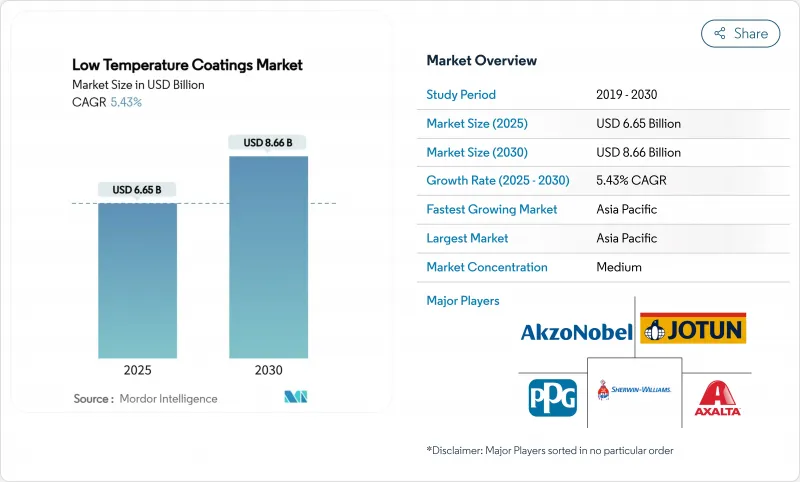
這項穩步進展反映了減少製程熱排放的監管壓力、允許使用較低固化溫度的能源價格上漲,以及能夠在接近 120°C 的溫度下充分發揮性能的技術進步。隨著工廠從 375°F 的烘烤週期過渡到在 285°F 下固化的配方,通常可節省高達 25% 的能源,從而提高產量並減少碳足跡。需求受到塑膠、複合材料和 3D 列印零件使用的增加以及電動車 (EV) 生產的快速成長的推動,這些零件在傳統烤箱條件下會變形,這需要熱穩定但固化緩慢的電池機殼。競爭適中,主要供應商利用樹脂化學、雷射輔助固化和策略性收購來捍衛市場佔有率,而利基市場參與者則瞄準超低烘烤領域,例如離岸風力發電維護和積層製造。原料成本(尤其是二氧化鈦)的變化以及沉積 25µm 以下超薄膜的技術挑戰仍然是主要阻力。
全球低溫塗料市場趨勢與洞察
固化溫度較低,節省能源
這一數字已在生產線上得到證實,在生產線上,固化峰值溫度從400°F(約220°C)降至325°F(約170°C),同時仍保持了耐腐蝕性。更短的爐內停留時間也提高了生產線速度並提升了資產利用率。加州和德國等能源成本較高的地區是首批採用此類配方的地區之一。由於水電費減少和過濾器維護頻率降低,通常一年內即可收回成本。減少範圍一排放有助於為未來的碳邊境定價做好準備。
電動車和電子設備中熱感基板的應用日益增多
電動車電池外殼和電子模組無法承受傳統烘烤過程固有的熱衝擊。在 130 度C下聚合的塗層可保護電介質、保留黏合層,並達到絕緣電阻目標,而不會破壞電池單元的化學性質。由於熱界面材料在 35°C 下粘合,因此塗裝車間現在在電池組裝下游加入了整合式低溫烘烤區。半導體封裝線也反映了這一趨勢,要求循環溫度不超過 150°C,以避免細間距基板翹曲。亞太地區憑藉其密集的電動車供應鏈處於領先地位,但北美超級工廠正在迅速指定相同的固化窗口。
我們實現超薄膜的能力受到限制
當粒徑低於25微米時,許多粉末化學品容易出現橘皮和孔隙,因為降低的烘箱溫度會限制流動和流平性。因此,汽車清漆工程不願將整個車型改裝,而是保留低溫烘烤生產線,用於能夠保持更高厚度的中塗。在135°C下提高交聯密度的催化劑組合雖然有幫助,但會增加配方成本。混合聚酯和奈米填充樹脂的研究仍在繼續,但距離取得重大突破仍需兩到四年。
細分分析
得益於其在建築耐久性方面的長期業績和極具競爭力的價格,聚酯體系將在2024年佔據40.12%的銷售額。聚酯與建築領域廣泛使用的鍍鋅鋼也具有良好的附著力,這鞏固了其在建築領域的主導地位。然而,在低溫塗料市場,聚氨酯在兼具柔韌性和耐化學性的應用領域中更具優勢。雙組分和封閉型異氰酸酯體係可在120°C下固化,從而開啟了聚酯無法企及的塑膠和複合材料類別。
由於電動車製造商指定電池蓋採用軟性介電層,聚氨酯的產量預計將以7.18%的複合年成長率成為所有樹脂中最快的。墨西哥聚氨酯消費量年增率高達5-7%,證實了全球聚氨酯消費量的強勁成長動能。水性雙組分聚氨酯混合材料符合VOC(揮發性有機化合物)法規,同時提供家電邊框所需的附著力。這些因素共同推動了聚氨酯在低溫塗料市場的崛起。
受規模經濟和製程熟悉度的推動,粉末技術在2024年的銷售額中佔比將達到72.14%。配方製造商已將固化閾值從十年前的180°C提高到今天的140°C,從而將每平方公尺的能耗降低了約三分之一。目前,最大的粉末供應商提供的雷射固化系統可在室溫下三分鐘內達到最佳物理性能,這項創新可望進一步提高生產線的生產效率。
UV/EB 固化技術發展迅速,預計到 2030 年複合年成長率將達到 7.45%。其無溶劑操作特性,加上 110°C 的低固化溫度,對中密度纖維板 (MDF) 家俱生產線和乙烯基地板材料工廠極具吸引力。當操作員需要立即處理物料以適應即時組裝區時,UV/EB 固化技術的應用將加速。這些特性拓寬了技術選擇,並促進了低溫塗料市場規模細分領域的良性競爭。
區域分析
預計到2024年,亞太地區將佔全球粉末塗料總收入的46.15%,複合年成長率為7.27%。中國龐大的粉末塗料叢集正受惠於家電和電動車的大規模生產,而印度的汽車生產和印尼的家電出口也將進一步拉動這個產業的發展。能源價格上漲以及各大城市VOC法規的收緊,進一步推動了低溫固化化學品的普及。
北美以以金額為準計算位居第二,其成長受到政策和技術領先地位的推動。美國能源局對雷射硬化粉末研究的資助加速了商業化進程,而加州的工藝熱法規則將實驗室突破轉化為實際購買。墨西哥正在投資360萬美元擴建其捲材塗層生產線,以加強其跨境供應鏈。
歐洲在創新方面與北美競爭,同時也引入了積極的碳定價政策。歐盟的《工業碳管理戰略》設定了明確的儲存目標,並且正在引導工業塗料製造商走向節能減排的方案。同時,在中東、非洲和南美洲,跨國客戶正在強制執行統一的規範,逐漸推動製造商採用低溫烘烤系統,從而擴大了整體低溫塗料的市場規模。
其他福利:
- Excel 格式的市場預測 (ME) 表
- 3個月的分析師支持
目錄
第1章 引言
- 研究假設和市場定義
- 調查範圍
第2章調查方法
第3章執行摘要
第4章 市場狀況
- 市場概況
- 市場促進因素
- 固化溫度較低,節省能源
- 擴大熱敏基板在電動車和電子設備的應用
- 製程熱碳定價加速採用
- 需要超低烘烤塗層的 3D 列印零件
- 離岸風力塔維護轉向低溫固化
- 市場限制
- 我們實現超薄膜的能力受到限制
- 與常溫固化UV/EB系統的競爭
- 複合基板上的熱衝擊缺陷
- 價值鏈分析
- 五力分析
- 供應商的議價能力
- 買方的議價能力
- 新進入者的威脅
- 替代品的威脅
- 競爭程度
第5章市場規模及成長預測
- 按樹脂
- 聚酯纖維
- 環氧樹脂
- 聚氨酯
- 丙烯酸纖維
- 其他樹脂
- 依技術
- 粉末
- 液體溶劑型
- 液體 - 水基
- UV/EB固化型
- 按基材
- 金屬
- 塑膠和複合材料
- 木頭
- 其他基材
- 按最終用戶產業
- 建築學
- 工業的
- 車
- 木頭
- 其他最終用戶產業
- 按地區
- 亞太地區
- 中國
- 日本
- 印度
- 韓國
- 東南亞國協
- 其他亞太地區
- 北美洲
- 美國
- 加拿大
- 墨西哥
- 歐洲
- 德國
- 英國
- 法國
- 義大利
- 西班牙
- 俄羅斯
- 北歐國家
- 其他歐洲國家
- 南美洲
- 巴西
- 阿根廷
- 南美洲其他地區
- 中東和非洲
- 沙烏地阿拉伯
- 南非
- 其他中東和非洲地區
- 亞太地區
第6章 競爭態勢
- 市場集中度
- 策略舉措
- 市佔率(%)/排名分析
- 公司簡介
- Akzo Nobel NV
- Allnex GmbH
- APV Engineered Coatings
- Asian Paints Limited
- Axalta Coating Systems LLC
- BASF
- Beckers Group
- Covestro AG
- Hempel A/S
- IGP Pulvertechnik AG
- Jotun
- Kansai Paint Co. Ltd.
- Nippon Paint Holdings Co. Ltd.
- PPG Industries, Inc.
- RPM International Inc.
- TCI Powder
- Teknos Group
- The Sherwin-Williams Company
- Tiger Coatings GmbH and Co. KG
第7章 市場機會與未來展望
The Low Temperature Coatings Market size is estimated at USD 6.65 billion in 2025, and is expected to reach USD 8.66 billion by 2030, at a CAGR of 5.43% during the forecast period (2025-2030).
The steady advance reflects regulatory pressure to trim process-heat emissions, rising energy prices that reward cooler cure profiles, and technological progress that now allows full performance at temperatures close to 120 °C. Energy savings of up to 25% have become common when plants shift from 375 °F bake cycles to formulations that cure at 285 °F, improving throughput and lowering carbon footprints. Demand is also boosted by the growing use of plastics, composites, and 3-D-printed parts that deform under conventional oven conditions, as well as the surge in electric vehicle (EV) production that requires thermally stable but gently cured battery enclosures. Competitive intensity is moderate: leading suppliers leverage resin chemistry, laser-assisted curing, and strategic acquisitions to defend share while niche players target ultra-low-bake segments such as offshore wind maintenance and additive manufacturing. Raw-material cost swings, notably titanium dioxide, and the technical difficulty of depositing ultra-thin films below 25 µm remain the principal headwinds.
Global Low Temperature Coatings Market Trends and Insights
Energy Savings from Reduced Cure Temperatures
Plants that retrofit to low-temperature powder systems save up to 25% in gas or electricity consumption, a figure confirmed by production lines that dropped cure peaks from 400 °F to 325 °F while maintaining corrosion resistance. Shorter oven residence also pushes line speeds higher, improving asset utilization. Regions with high energy tariffs such as California and Germany adopt these formulations first, yet the payoff is now similar elsewhere because carbon charges are widening. Payback is often achieved within one year thanks to slimmer utility bills and fewer filter-maintenance cycles. The move lowers scope 1 emissions, positioning users for future carbon-border fee regimes.
Growing Adoption for Heat-Sensitive Substrates in Electric Vehicles and Electronics
EV battery housings and electronic modules cannot tolerate the thermal shock typical of legacy bakes. Coatings that polymerize at 130 °C protect dielectrics, preserve adhesive layers, and meet insulation resistance targets without disturbing battery cell chemistries. Thermal interface materials are bonded at 35 °C, so paint shops now integrate integrated low-bake zones downstream of cell assembly. Semiconductor packaging lines mirror the trend by asking for sub-150 °C cycles that avoid warpage in fine-pitch boards. Asia-Pacific leads because of its EV supply-chain density, but North American gigafactories are rapidly specifying identical cure windows.
Limited Ability to Achieve Ultra-Thin Films
Below 25 µm, many powder chemistries suffer orange-peel and pore formation because lower oven temperatures restrict flow and leveling. Automotive clearcoat programs therefore hesitate to convert entire fleets, instead reserving low-bake lines for mid-coat layers where film build can remain thicker. Catalyst packages that accelerate crosslink density at 135 °C help but add formulation cost. Research into hybrid polyesters and nanofilled resins continues, yet large-scale breakthroughs remain two to four years away.
Other drivers and restraints analyzed in the detailed report include:
- Process-Heat Carbon Pricing Accelerating Adoption
- 3-D-Printed Parts Requiring Ultra-Low-Bake Coatings
- Competition from Ambient-Cure UV/EB Systems
For complete list of drivers and restraints, kindly check the Table Of Contents.
Segment Analysis
Polyester systems accounted for 40.12% of 2024 revenue, supported by a long record of architectural durability and competitive pricing. Polyesters also bond well to galvanized steel, a high-volume substrate in construction, which cements their baseline position. The low temperature coatings market nevertheless favors polyurethane for applications demanding both flexibility and chemical resistance. Two-component and blocked isocyanate chemistries cure at 120 °C, opening plastic and composite categories that polyesters cannot reach.
Polyurethane volumes are projected to expand at a 7.18% CAGR, the fastest among resins, as EV makers specify flexible dielectric layers for battery covers. Mexico's 5-7% annual growth in polyurethane consumption underscores global momentum. Water-borne 2K-PUR hybrids meet VOC caps yet still deliver the adhesion required for consumer electronics bezels. These factors together reinforce polyurethane's rise within the low temperature coatings market.
Powder technology held 72.14% of 2024 revenue owing to scale economics and process familiarity. Formulators have driven cure thresholds from 180 °C a decade ago to 140 °C today, slashing energy intake per square meter by roughly one-third. The largest powder suppliers now offer laser-cured systems that reach full properties in three minutes at room temperature, an innovation poised to lift line productivity further.
UV/EB curing is the sprinter, forecast at a 7.45% CAGR to 2030. It merges solvent-free operation with cure temperatures as low as 110 °C, which appeals to MDF furniture lines and vinyl flooring plants. Adoption accelerates whenever operators need instant handling to feed just-in-time assembly zones. These capabilities broaden technological choice and stimulate healthy rivalry inside the low temperature coatings market size segment, where UV/EB solutions already command double-digit shares in industrial wood.
The Low Temperature Coatings Market Report is Segmented by Resin (Polyester, Epoxy, and More), Technology (Powder, Liquid - Solvent-Borne, Liquid - Water-Borne, UV/EB-cured), Substrate (Metals, Plastics and Composites, Wood, Other Substrates), End-User Industry (Architectural, Industrial, and More), and Geography (Asia-Pacific, North America, and More). The Market Forecasts are Provided in Terms of Value (USD).
Geography Analysis
Asia-Pacific dominated the landscape with 46.15% of 2024 revenue and is projected to compound at 7.27% CAGR, the fastest regional clip. China's vast powder coating clusters benefit from high-volume appliance and EV production, while India's automotive buildouts and Indonesia's appliance exports supply additional pull. Rising energy tariffs and intensifying VOC rules in major cities further encourage the adoption of cooler-cure chemistries.
North America ranks second in value; its growth rests on both policy and technology leadership. The U.S. Department of Energy's funding for laser-cured powder research shortens commercialization timelines, and California's process-heat regulations translate lab breakthroughs into real purchasing commitments. Mexico adds momentum by expanding coil-coat lines with USD 3.6 million in new capacity, strengthening cross-border supply chains.
Europe matches North America for innovation yet differs by wielding aggressive carbon pricing. The EU Industrial Carbon Management strategy sets explicit storage targets, nudging industrial coaters toward energy-lean options. Meanwhile, manufacturers across the Middle East, Africa, and South America gradually migrate to low-bake systems as multinational customers enforce uniform specifications, enlarging the overall low temperature coatings market footprint.
- Akzo Nobel N.V.
- Allnex GmbH
- APV Engineered Coatings
- Asian Paints Limited
- Axalta Coating Systems LLC
- BASF
- Beckers Group
- Covestro AG
- Hempel A/S
- IGP Pulvertechnik AG
- Jotun
- Kansai Paint Co. Ltd.
- Nippon Paint Holdings Co. Ltd.
- PPG Industries, Inc.
- RPM International Inc.
- TCI Powder
- Teknos Group
- The Sherwin-Williams Company
- Tiger Coatings GmbH and Co. KG
Additional Benefits:
- The market estimate (ME) sheet in Excel format
- 3 months of analyst support
TABLE OF CONTENTS
1 Introduction
- 1.1 Study Assumptions and Market Definition
- 1.2 Scope of the Study
2 Research Methodology
3 Executive Summary
4 Market Landscape
- 4.1 Market Overview
- 4.2 Market Drivers
- 4.2.1 Energy savings from reduced cure temperatures
- 4.2.2 Growing adoption for heat-sensitive substrates in electronic vehicles and electronics
- 4.2.3 Process-heat carbon pricing accelerating adoption
- 4.2.4 3-D printed parts requiring ultra-low-bake coatings
- 4.2.5 Offshore wind tower maintenance shift to low-temp cures
- 4.3 Market Restraints
- 4.3.1 Limited ability to achieve ultra-thin films
- 4.3.2 Competition from ambient-cure UV/EB systems
- 4.3.3 Thermal-shock defects on composite substrates
- 4.4 Value Chain Analysis
- 4.5 Porter's Five Forces
- 4.5.1 Bargaining Power of Suppliers
- 4.5.2 Bargaining Power of Buyers
- 4.5.3 Threat of New Entrants
- 4.5.4 Threat of Substitute Products and Services
- 4.5.5 Degree of Competition
5 Market Size and Growth Forecasts (Value)
- 5.1 By Resin
- 5.1.1 Polyester
- 5.1.2 Epoxy
- 5.1.3 Polyurethane
- 5.1.4 Acrylic
- 5.1.5 Other Resins
- 5.2 By Technology
- 5.2.1 Powder
- 5.2.2 Liquid - Solvent-borne
- 5.2.3 Liquid - Water-borne
- 5.2.4 UV / EB-cured
- 5.3 By Substrate
- 5.3.1 Metals
- 5.3.2 Plastics and Composites
- 5.3.3 Wood
- 5.3.4 Other Substrates
- 5.4 By End-User Industry
- 5.4.1 Architectural
- 5.4.2 Industrial
- 5.4.3 Automotive
- 5.4.4 Wood
- 5.4.5 Other End-User Industries
- 5.5 By Geography
- 5.5.1 Asia-Pacific
- 5.5.1.1 China
- 5.5.1.2 Japan
- 5.5.1.3 India
- 5.5.1.4 South Korea
- 5.5.1.5 ASEAN Countries
- 5.5.1.6 Rest of Asia-Pacific
- 5.5.2 North America
- 5.5.2.1 United States
- 5.5.2.2 Canada
- 5.5.2.3 Mexico
- 5.5.3 Europe
- 5.5.3.1 Germany
- 5.5.3.2 United Kingdom
- 5.5.3.3 France
- 5.5.3.4 Italy
- 5.5.3.5 Spain
- 5.5.3.6 Russia
- 5.5.3.7 NORDIC Countries
- 5.5.3.8 Rest of Europe
- 5.5.4 South America
- 5.5.4.1 Brazil
- 5.5.4.2 Argentina
- 5.5.4.3 Rest of South America
- 5.5.5 Middle East and Africa
- 5.5.5.1 Saudi Arabia
- 5.5.5.2 South Africa
- 5.5.5.3 Rest of Middle East and Africa
- 5.5.1 Asia-Pacific
6 Competitive Landscape
- 6.1 Market Concentration
- 6.2 Strategic Moves
- 6.3 Market Share(%)/Ranking Analysis
- 6.4 Company Profiles (includes Global level Overview, Market level overview, Core Segments, Financials as available, Strategic Information, Market Rank/Share for key companies, Products and Services, and Recent Developments)
- 6.4.1 Akzo Nobel N.V.
- 6.4.2 Allnex GmbH
- 6.4.3 APV Engineered Coatings
- 6.4.4 Asian Paints Limited
- 6.4.5 Axalta Coating Systems LLC
- 6.4.6 BASF
- 6.4.7 Beckers Group
- 6.4.8 Covestro AG
- 6.4.9 Hempel A/S
- 6.4.10 IGP Pulvertechnik AG
- 6.4.11 Jotun
- 6.4.12 Kansai Paint Co. Ltd.
- 6.4.13 Nippon Paint Holdings Co. Ltd.
- 6.4.14 PPG Industries, Inc.
- 6.4.15 RPM International Inc.
- 6.4.16 TCI Powder
- 6.4.17 Teknos Group
- 6.4.18 The Sherwin-Williams Company
- 6.4.19 Tiger Coatings GmbH and Co. KG
7 Market Opportunities and Future Outlook
- 7.1 White-space and Unmet-need Assessment


