


 |
市場調查報告書
商品編碼
1844625
電子發現:市場佔有率分析、行業趨勢、統計數據和成長預測(2025-2030 年)Electronic Discovery - Market Share Analysis, Industry Trends & Statistics, Growth Forecasts (2025 - 2030) |
||||||

※ 本網頁內容可能與最新版本有所差異。詳細情況請與我們聯繫。
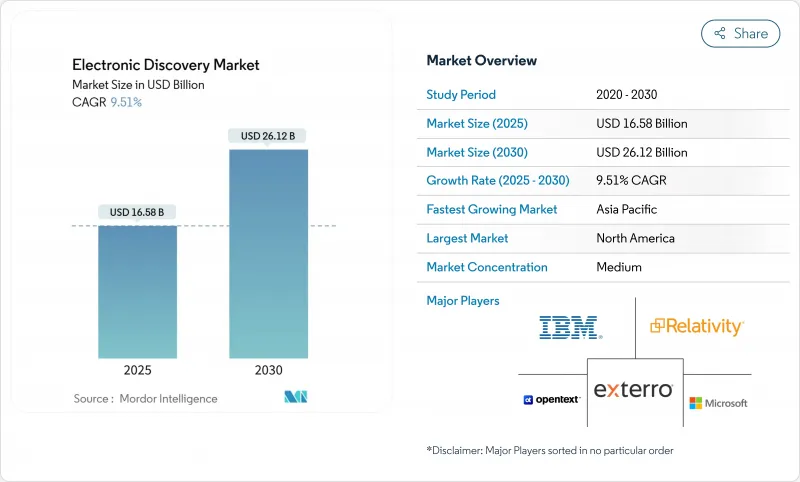
預計 2025 年電子數據展示市場規模將達到 165.8 億美元,到 2030 年將達到 261.2 億美元,預測期內複合年成長率為 9.51%。
高度數位化的法律流程、多格式數據的激增以及日益複雜的監管環境,迫使法律部門對取證工作流程進行現代化改造,並採用人工智慧支援的審查工具。大型律師事務所正在尋求高級分析技術來規避不斷上漲的訴訟成本,而小型企業則將業務外包給託管服務專家,以便在無需承擔全部基礎設施成本的情況下獲得類似的功能。向雲端優先架構的轉變,加上付費使用制的經濟模式以及混合辦公環境下日益成長的協作需求,正在推動技術的應用。北美在平台創新和案例法成熟度方面保持著規模優勢,而亞太地區的兩位數成長則反映了地方執法機制與跨境貿易的融合,為供應商創造了新的收益來源。隨著雲端原生企業的出現,競爭格局正在加劇,這些企業憑藉透明的定價、精簡的用戶體驗以及可解釋的人工智慧功能(以滿足新的受理標準)向現有企業發起挑戰。
全球電子取證市場趨勢與洞察
整合人工智慧和機器學習,提高審核效率
生成式人工智慧和大規模語言建模工具已將人工審核時間縮短高達 70%,使律師事務所能夠將員工重新部署到更高價值的辯護工作中。 CS Disco 的 Cecilia Assistant 解釋了對話分析如何在保留審核線索的同時減少重複標記。美國707 號規則的擬議修正案要求律師在 AI 輸出被採納之前,不僅要證明其準確性,還要證明其可靠性。因此,供應商正在投資透明的模型管治框架(例如可解釋的排名、校準指標和監管鏈日誌記錄),以在不犧牲採納度的情況下保持採用勢頭。隨著這些保證層的成熟,在效率和防禦性之間取得平衡的電子取證市場新參與企業可能會擴大其競爭優勢。
行動和雲端資料來源的激增
光是 Microsoft Teams 每年就要處理超過 1 兆頁數據,凸顯了數據發現團隊面臨的巨大挑戰。混合工作模式正在將證據儲存庫擴展到個人設備和消費者應用程式,迫使公司重新思考資訊管治的基本原理。雲端原生供應商正在使用 API 驅動的連接器解決複雜性,這些連接器直接從 Slack、Google Vault 和 Microsoft 365 中提取數據,從而自動化合法保留和收集工作流程。然而,隨著每個新的資料管道的出現,隱私侵犯的攻擊面也在擴大,導致客戶要求零知識加密和特定區域的資料駐留控制。因此,電子發現市場正傾向於在單一使用者介面下統一策略實施、聯合搜尋和人工智慧實體提取的平台。
中小企業整體擁有成本不斷上升
入門級處理費用高達每GB 15至30美元,再加上不斷成長的數據量,導致計劃總支出超出了許多中小企業的預算。雖然雲端許可降低了初始投資成本,但儲存、進階分析和專家評審等下游成本仍然很高。像KLDiscovery這樣負債累累的服務供應商的例子表明,隨著供應商試圖鞏固資產負債表,利潤壓力會如何透過定價產生連鎖反應。價格合理的自動化、透明的訂閱等級以及基於社區的培訓資源可能會削弱市場限制,但市場兩極分化依然存在,企業客戶傾向於全方位服務平台,而注重成本的用戶則默認使用基本的關鍵字搜尋。
細分分析
到2024年,託管服務將佔據電子發現市場佔有率的46.30%,反映出企業傾向將處理、託管和人工智慧模式調優等勞動密集型任務外包。供應商透過集中基礎設施和人才實現規模經濟,使客戶能夠將固定成本轉化為可變支出。預計諮詢和實施後服務將以10.15%的複合年成長率成長,吸引那些尋求管治藍圖以遏制多重雲端蔓延並負責任地整合人工智慧的組織。隨著發現需求擴展到行動聊天、雲端存檔和社交資訊流,企業將優先考慮透過單一服務等級協定實現端到端課責(法律保留、收集、分析和生產)。因此,電子發現行業正在獎勵那些銷售基於結果的服務包而不是按零碎任務定價的供應商。
託管專家還整合了資料最小化策略和特權審查模型等調查輔助功能。在證據採信日益嚴格的時代,這些差異化優勢縮短了審查週期,並增強了防禦能力。向高成長地區擴張的服務供應商,例如 Exterro 在清奈新設立的法醫實驗室,正在利用當地人才庫來擴展全天候支援服務並降低交付成本。
電子取證和早期案件評估套件將在2024年引領軟體類別,營收佔有率達34%。而人工智慧主導的審查和分析預計將以10.40%的複合年成長率在該領域保持最快成長。客戶正在將採購標準從原始處理能力轉向洞察速度——平台能夠多快地發現託管熱點、情緒樞紐和權限異常。 Relativity 雲端採用率達到75%表明,SaaS 交付如何加速功能部署,並擴展運算能力以應對密集的機器學習工作負載。同時,專注於合法保留和生產的單點解決方案供應商即使其平台透過整合 API 閘道並無縫整合到更廣泛的案件管理堆疊中進行整合,仍能保持其利基市場相關性。
伴隨人工智慧分析的興起,電子取證市場正日益受到可解釋性儀錶板和偏見測試通訊協定的保護。買家要求可配置的置信度閾值和支持法庭陳述的敘述性摘要。將透明人工智慧與精細成本追蹤工具相結合的供應商在風險和財務管理方面脫穎而出,吸引了注重預算的公司法律顧問。
區域分析
受既定法律先例、蓬勃發展的訴訟以及密集的服務供應商生態系統的推動,北美地區將在2024年貢獻41.20%的收入。總部位於該地區的市場領導者——微軟、IBM、OpenText和Relativity——已經制定了具有全球影響力的產品藍圖。然而,隨著雲端運算應用接近飽和以及律師事務所最終完成人工智慧部署,成長正在放緩。服務提供者目前正專注於預測結果模型和自動特權篩檢等增值模組,以捍衛其市場佔有率。
預計到2030年,亞太地區的複合年成長率將達到11.40%,這得益於企業責任立法的不斷擴展和跨境案件的增加。日本有限的取證條款以及律師-客戶保密特權的缺失,推動了對將本地資料處理與離岸分析中心相結合的混合工作流程的需求。澳洲、印度和新加坡在監管協調方面處於領先地位,旨在使本地資訊揭露規範與全球最佳實踐保持一致,從而加速平台的採用。亞太地區成功的供應商正在透過在地化使用者介面、提供區域資料中心以及培養國內事件回應團隊來解決主權問題。
在歐洲,隨著企業克服GDPR資料傳輸限制,資料採用率持續穩定提升。提供區域內託管、精細化同意管理和自動化PII編輯服務的供應商在競標中享有優先權。英國脫歐後法規的差異化要求建立一個模組化合規引擎,以便根據司法管轄區切換保留和刪除政策。拉丁美洲、中東和非洲地區仍在發展中,但與美國當局的監管合作正在加強,跨國公司更有可能在執法行動實施之前預先安裝揭露基礎設施。
其他福利:
- Excel 格式的市場預測 (ME) 表
- 3個月的分析師支持
目錄
第1章 引言
- 研究假設和市場定義
- 調查範圍
第2章調查方法
第3章執行摘要
第4章 市場狀況
- 市場概況
- 市場促進因素
- 行動和雲端資料來源的激增
- 嚴格的資料隱私法規(GDPR、CCPA 等)
- 加強公司內部調查
- 整合AI/ML,提高審核效率
- 協作平台(Slack、Teams)的興起導致資料複雜性增加
- 需要跨司法管轄區證據開示的跨境訴訟增多
- 市場限制
- 中小企業整體擁有成本不斷上升
- 缺乏熟練的電子取證專業人員
- 跨境資料傳輸的限制
- 對人工智慧模型透明度的擔憂影響其法律可採性
- 價值/供應鏈分析
- 監管狀況
- 技術展望
- 波特五力分析
- 新進入者的威脅
- 買方的議價能力
- 供應商的議價能力
- 替代品的威脅
- 競爭對手之間的競爭
- 投資分析
第5章市場規模及成長預測
- 按服務
- 專業服務
- 託管服務
- 諮詢和實施後服務
- 按軟體
- 電子取證與早期案件評估
- 合法保留和保存
- 資料處理與剔除
- 文件審查與分析
- 創作與呈現
- 按部署
- SaaS/雲
- 本地部署
- 託管/混合
- 按最終用戶
- 政府及公共機構
- BFSI
- 資訊科技/通訊
- 醫療保健和生命科學
- 能源與公共產業
- 運輸/物流
- 媒體與娛樂
- 零售與電子商務
- 其他最終用戶
- 按地區
- 北美洲
- 美國
- 加拿大
- 墨西哥
- 南美洲
- 巴西
- 阿根廷
- 南美洲其他地區
- 歐洲
- 德國
- 英國
- 法國
- 義大利
- 俄羅斯
- 其他歐洲國家
- 亞太地區
- 中國
- 日本
- 印度
- 韓國
- 澳洲和紐西蘭
- 其他亞太地區
- 中東和非洲
- 中東
- 阿拉伯聯合大公國
- 沙烏地阿拉伯
- 以色列
- 其他中東地區
- 非洲
- 南非
- 奈及利亞
- 其他非洲國家
- 北美洲
第6章 競爭態勢
- 市場集中度
- 策略舉措
- 市佔率分析
- 公司簡介
- IBM Corporation
- Microsoft Corporation
- OpenText Corporation
- Relativity ODA LLC
- Exterro Inc.
- Nuix Pty Ltd
- Micro Focus International plc
- Veritas Technologies LLC
- Logikcull.com Inc.
- CloudNine Discovery
- DISCO Inc.
- Everlaw Inc.
- ZyLAB Inc.
- FTI Consulting Inc.
- Deloitte Touche Tohmatsu Ltd.
- Kroll Ontrack LLC
- Xerox Holdings Corporation
- Catalyst Repository Systems Inc.
- Driven Inc.
- AccessData Group Inc.
- Guidance Software(OpenText)
- HaystackID LLC
第7章 市場機會與未來展望
The electronic discovery market size stood at USD 16.58 billion in 2025 and is projected to reach USD 26.12 billion in 2030, reflecting a 9.51% CAGR over the forecast period.
Heightened digitization of legal processes, the rapid rise in multi-format data, and mounting regulatory complexity are pushing legal departments to modernize discovery workflows and adopt AI-enabled review tools. Large enterprises view advanced analytics as a hedge against spiraling litigation costs, while small and mid-sized firms outsource to managed-service specialists to access comparable capabilities without bearing full infrastructure costs. Deployment preferences continue to swing toward cloud-first architectures, encouraged by pay-as-you-go economics and by heightened collaboration needs in hybrid work settings. North America retains scale advantages in platform innovation and case-law maturity, yet Asia-Pacific's double-digit expansion underscores how local enforcement regimes and cross-border commerce are converging to create fresh revenue pools for vendors. Competitive intensity is rising as cloud-native entrants challenge incumbents with transparent pricing, streamlined user experiences, and explainable AI features that address emerging admissibility standards.
Global Electronic Discovery Market Trends and Insights
AI/ML Integration Improving Review Efficiency
Generative AI and large-language-model tooling now slash human review hours by up to 70%, enabling law firms to redeploy staff toward higher-value advocacy. CS Disco's Cecilia assistant illustrates how conversational analytics curtail repetitive tagging while preserving audit trails . Courts are concurrently tightening evidentiary standards: proposed U.S. Rule 707 amendments will oblige counsel to demonstrate reliability, not just accuracy, before AI outputs become admissible. Vendors are therefore investing in transparent model governance frameworks-explainable ranking, calibration metrics, and chain-of-custody logging-to sustain adoption momentum without jeopardizing admissibility. As these assurance layers mature, electronic discovery market participants that marry efficiency with defensibility will widen their competitive moat.
Proliferation of Mobile and Cloud Data Sources
Microsoft Teams alone processes more than 1 trillion pages annually, underscoring the scale challenge facing discovery teams. Hybrid work patterns extend evidence repositories into personal devices and consumer apps, compelling enterprises to revisit information-governance baselines. Cloud-native vendors are countering complexity through API-driven connectors that pull data directly from Slack, Google Vault, and Microsoft 365, automating legal hold and collection workflows. Yet every new data pipe expands the attack surface for privacy breaches, so clients demand zero-knowledge encryption and region-specific data-residency controls. The electronic discovery market is therefore gravitating toward platforms that integrate policy enforcement, federated search, and AI-powered entity extraction under a single user interface.
Escalating Total Cost of Ownership for SMEs
Entry-level processing fees of USD 15-30 per GB intersect with rising data volumes, pushing overall project spend beyond many small-firm budgets. While cloud licensing reduces upfront capital outlay, downstream expenses-storage, advanced analytics, specialist review talent-remain material. Debt-laden service providers such as KLDiscovery illustrate how margin pressure can ripple through pricing as vendors seek to shore up balance sheets. Affordable automation, transparent subscription tiers, and community-based training resources could blunt the restraint, but market bifurcation persists, with enterprise clients gravitating to full-service platforms and cost-sensitive users defaulting to rudimentary keyword searches.
Other drivers and restraints analyzed in the detailed report include:
- Stringent Data-Privacy Regulations (GDPR, CCPA, etc.)
- Growth in Corporate Internal Investigations
- AI Model Transparency Concerns Affecting Legal Admissibility
For complete list of drivers and restraints, kindly check the Table Of Contents.
Segment Analysis
Managed services accounted for a 46.30% electronic discovery market share in 2024, reflecting corporate preference for outsourcing labor-intensive tasks such as processing, hosting, and AI model tuning. Providers achieve economies of scale by centralizing infrastructure and talent, letting clients convert fixed costs into variable spend. Advisory and post-implementation services, forecast at a 10.15% CAGR, attract organizations that need governance roadmaps to tame multicloud sprawl and to embed AI responsibly. As discovery requests span mobile chat, cloud archives, and social feeds, enterprises value end-to-end accountability-legal hold, collection, analytics, and production-under a single service-level agreement. The electronic discovery industry therefore rewards vendors that market outcome-based service bundles over piecemeal task pricing.
Managed specialists also integrate investigation accelerators such as data-minimization playbooks and privilege-screening models. These differentiators shorten review cycles and bolster defensibility in an era of stricter admissibility scrutiny. Providers expanding into high-growth geographies, exemplified by Exterro's new forensics lab in Chennai, leverage local talent pools to scale 24/7 support and lower delivery costs.
E-discovery and early case-assessment suites led the software category with 34% revenue share in 2024, yet AI-driven review and analytics is projected to rise at 10.40% CAGR, the fastest within the segment. Customers are shifting procurement criteria from raw processing horsepower toward insight velocity-how quickly a platform can surface custodial hot spots, sentiment pivots, or privilege anomalies. Relativity's move to a 75% cloud adoption ratio illustrates how SaaS delivery accelerates feature rollout and scales compute for intensive machine-learning workloads. Meanwhile, point-solution vendors that specialize in legal hold or production are embedding API gateways to integrate seamlessly into broader case-management stacks, preserving niche relevance even as platforms consolidate.
The electronic discovery market size attached to AI analytics is increasingly defended by explainability dashboards and bias-testing protocols. Buyers demand configurable confidence thresholds and narrative summaries that support courtroom presentation. Vendors that package transparent AI with granular cost-tracking tools differentiate on both risk and financial stewardship, appealing to corporate counsel under budget oversight.
The Electronic Discovery Market Report is Segmented by Service (Professional Services, Managed Services, Advisory & Post-Implementation Services), Software (E-Discovery and Early Case Assessment, Legal Hold and Preservation, and More), Deployment (SaaS/Cloud, On-Premise, Hosted/Hybrid), End User (Government and Public Sector, BFSI, and More), and Geography. The Market Forecasts are Provided in Terms of Value (USD).
Geography Analysis
North America contributed 41.20% revenue in 2024 on the strength of established case law, prolific litigation, and a dense ecosystem of service providers. Market leaders headquartered in the region-Microsoft, IBM, OpenText, and Relativity-set product roadmaps that ripple globally. Growth, however, is moderating as cloud adoption approaches saturation and law firms finalize AI rollouts. Providers now emphasize value-add modules such as predictive outcome modeling and automated privilege screening to defend wallet share.
Asia-Pacific is forecast to grow at 11.40% CAGR through 2030, buoyed by expanding corporate-liability statutes and increasing cross-border deal activity. Japan's limited discovery provisions and absence of attorney-client privilege create demand for hybrid workflows that blend local data processing with offshore analytics hubs. Australia, India, and Singapore spearhead regulatory harmonization that aligns local disclosure norms with global best practices, accelerating platform uptake. Vendors succeeding in APAC localize user interfaces, offer regional data centers, and cultivate in-country incident-response teams to satisfy sovereignty concerns.
Europe continues steady adoption while navigating GDPR-driven constraints on data transfer. Providers offering in-region hosting, fine-grained consent management, and automated PII redaction earn preference in competitive bids. Post-Brexit divergence in UK rules demands modular compliance engines capable of toggling retention and deletion policies per jurisdiction. Latin America and Middle East and Africa remain nascent, yet rising regulatory cooperation with U.S. agencies is tipping multinational corporations to pre-deploy discovery infrastructure before enforcement actions materialize.
- IBM Corporation
- Microsoft Corporation
- OpenText Corporation
- Relativity ODA LLC
- Exterro Inc.
- Nuix Pty Ltd
- Micro Focus International plc
- Veritas Technologies LLC
- Logikcull.com Inc.
- CloudNine Discovery
- DISCO Inc.
- Everlaw Inc.
- ZyLAB Inc.
- FTI Consulting Inc.
- Deloitte Touche Tohmatsu Ltd.
- Kroll Ontrack LLC
- Xerox Holdings Corporation
- Catalyst Repository Systems Inc.
- Driven Inc.
- AccessData Group Inc.
- Guidance Software (OpenText)
- HaystackID LLC
Additional Benefits:
- The market estimate (ME) sheet in Excel format
- 3 months of analyst support
TABLE OF CONTENTS
1 INTRODUCTION
- 1.1 Study Assumptions and Market Definition
- 1.2 Scope of the Study
2 RESEARCH METHODOLOGY
3 EXECUTIVE SUMMARY
4 MARKET LANDSCAPE
- 4.1 Market Overview
- 4.2 Market Drivers
- 4.2.1 Proliferation of mobile and cloud data sources
- 4.2.2 Stringent data-privacy regulations (GDPR, CCPA, etc.)
- 4.2.3 Growth in corporate internal investigations
- 4.2.4 AI/ML integration improving review efficiency
- 4.2.5 Rise of collaborative platforms (Slack, Teams) driving data complexity
- 4.2.6 Increasing cross-border litigation requiring multi-jurisdictional discovery
- 4.3 Market Restraints
- 4.3.1 Escalating total cost of ownership for SMEs
- 4.3.2 Shortage of skilled e-discovery professionals
- 4.3.3 Cross-border data-transfer restrictions
- 4.3.4 AI model transparency concerns affecting legal admissibility
- 4.4 Value / Supply-Chain Analysis
- 4.5 Regulatory Landscape
- 4.6 Technological Outlook
- 4.7 Porter's Five Forces Analysis
- 4.7.1 Threat of New Entrants
- 4.7.2 Bargaining Power of Buyers
- 4.7.3 Bargaining Power of Suppliers
- 4.7.4 Threat of Substitutes
- 4.7.5 Intensity of Competitive Rivalry
- 4.8 Investment Analysis
5 MARKET SIZE AND GROWTH FORECASTS (VALUE)
- 5.1 By Service
- 5.1.1 Professional Services
- 5.1.2 Managed Services
- 5.1.3 Advisory and Post-Implementation Services
- 5.2 By Software
- 5.2.1 E-discovery and Early Case Assessment
- 5.2.2 Legal Hold and Preservation
- 5.2.3 Data Processing and Culling
- 5.2.4 Document Review and Analysis
- 5.2.5 Production and Presentation
- 5.3 By Deployment
- 5.3.1 SaaS / Cloud
- 5.3.2 On-premise
- 5.3.3 Hosted / Hybrid
- 5.4 By End User
- 5.4.1 Government and Public Sector
- 5.4.2 BFSI
- 5.4.3 IT and Telecommunication
- 5.4.4 Healthcare and Life Sciences
- 5.4.5 Energy and Utilities
- 5.4.6 Transportation and Logistics
- 5.4.7 Media and Entertainment
- 5.4.8 Retail and E-commerce
- 5.4.9 Other End Users
- 5.5 By Geography
- 5.5.1 North America
- 5.5.1.1 United States
- 5.5.1.2 Canada
- 5.5.1.3 Mexico
- 5.5.2 South America
- 5.5.2.1 Brazil
- 5.5.2.2 Argentina
- 5.5.2.3 Rest of South America
- 5.5.3 Europe
- 5.5.3.1 Germany
- 5.5.3.2 United Kingdom
- 5.5.3.3 France
- 5.5.3.4 Italy
- 5.5.3.5 Russia
- 5.5.3.6 Rest of Europe
- 5.5.4 Asia Pacific
- 5.5.4.1 China
- 5.5.4.2 Japan
- 5.5.4.3 India
- 5.5.4.4 South Korea
- 5.5.4.5 Australia and New Zealand
- 5.5.4.6 Rest of Asia Pacific
- 5.5.5 Middle East and Africa
- 5.5.5.1 Middle East
- 5.5.5.1.1 United Arab Emirates
- 5.5.5.1.2 Saudi Arabia
- 5.5.5.1.3 Israel
- 5.5.5.1.4 Rest of Middle East
- 5.5.5.2 Africa
- 5.5.5.2.1 South Africa
- 5.5.5.2.2 Nigeria
- 5.5.5.2.3 Rest of Africa
- 5.5.1 North America
6 COMPETITIVE LANDSCAPE
- 6.1 Market Concentration
- 6.2 Strategic Moves
- 6.3 Market Share Analysis
- 6.4 Company Profiles {(includes Global level Overview, Market level overview, Core Segments, Financials as available, Strategic Information, Market Rank/Share for key companies, Products and Services, and Recent Developments)}
- 6.4.1 IBM Corporation
- 6.4.2 Microsoft Corporation
- 6.4.3 OpenText Corporation
- 6.4.4 Relativity ODA LLC
- 6.4.5 Exterro Inc.
- 6.4.6 Nuix Pty Ltd
- 6.4.7 Micro Focus International plc
- 6.4.8 Veritas Technologies LLC
- 6.4.9 Logikcull.com Inc.
- 6.4.10 CloudNine Discovery
- 6.4.11 DISCO Inc.
- 6.4.12 Everlaw Inc.
- 6.4.13 ZyLAB Inc.
- 6.4.14 FTI Consulting Inc.
- 6.4.15 Deloitte Touche Tohmatsu Ltd.
- 6.4.16 Kroll Ontrack LLC
- 6.4.17 Xerox Holdings Corporation
- 6.4.18 Catalyst Repository Systems Inc.
- 6.4.19 Driven Inc.
- 6.4.20 AccessData Group Inc.
- 6.4.21 Guidance Software (OpenText)
- 6.4.22 HaystackID LLC
7 MARKET OPPORTUNITIES AND FUTURE OUTLOOK
- 7.1 White-space and Unmet-Need Assessment

 搜尋軟體市場按組件、部署模式、組織規模、應用和產業垂直領域分類-全球預測,2025-2032年
 2025年全球電子取證市場報告電子取證市場按組件、組織規模、部署模式、用例和最終用戶產業分類-2025-2030 年全球預測
 全球醫療保健歸檔和電子取證市場美國電子取證市場規模、佔有率和趨勢分析報告:按組件、組織規模、部署模型、最終用途和細分市場預測,2025 年至 2030 年
 2025 年至 2033 年按組件、部署類型、最終用戶、垂直行業和地區分類的電子取證市場報告
 按組件、部署類型、公司規模、最終用戶和地區分類的電子取證軟體市場規模、佔有率和成長分析 - 產業預測,2024-2031 年
 全球醫療檔案和電子訊息披露市場(2024-2028)
 電子取證市場規模、佔有率和成長分析:按組成部分、組織規模、部署類型和地區 - 產業預測,2024-2031 年
 2024 年至 2031 年按組件、部署類型、組織規模、垂直和地區劃分的電子取證市場