


 |
市場調查報告書
商品編碼
1842679
元素分析:市場佔有率分析、行業趨勢、統計數據和成長預測(2025-2030 年)Elemental Analysis - Market Share Analysis, Industry Trends & Statistics, Growth Forecasts (2025 - 2030) |
||||||

※ 本網頁內容可能與最新版本有所差異。詳細情況請與我們聯繫。
預計 2025 年元素分析市場價值將達到 19.8 億美元,到 2030 年將擴大到 27 億美元,複合年成長率為 6.4%。
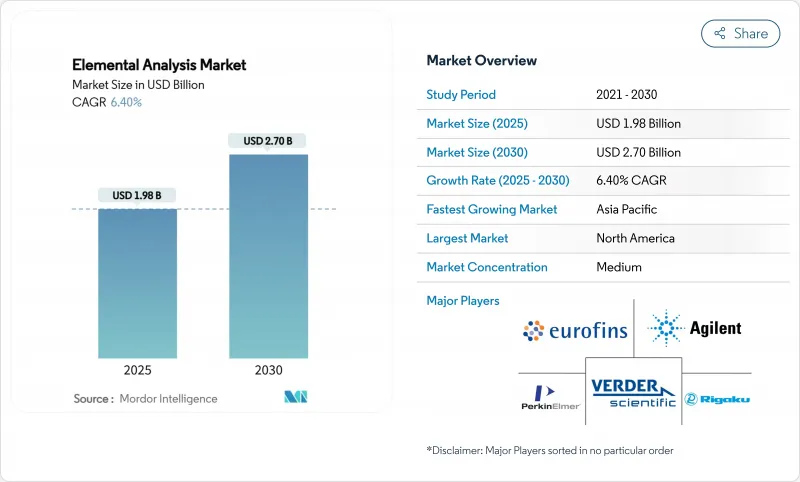
這一成長反映了半導體製造廠所需的品管從常規轉向超痕量表徵、嚴格的藥品雜質法規以及不斷擴展的環境法規。對人工智慧自動化、氦氣節約工作流程和混合多技術平台的投資增強了供應商的差異化。亞洲半導體產業的快速發展、全氟烷基化合物 (PFAS) 和亞硝胺法規的不斷完善以及充足的生命科學研發預算增強了長期需求。同時,資本密集度、技術純熟勞工短缺以及載氣市場的波動抑制了短期成長動能。
全球元素分析市場趨勢與洞察
增加生命科學領域的研發預算
預計到2024年,全球製藥和生物技術研發支出將超過2,000億美元,這將推動基於ICH Q3D指南的元素雜質檢測需求。賽默飛世爾科技公司多年來400至500億美元的併購計劃,凸顯了供應商對持續儀器需求的信心。預計製藥分析測試市場本身將從2025年的97.4億美元成長到2030年的145.8億美元,複合年成長率為8.41%,超過分析化學的整體支出。這些投資鞏固了ICP-MS、ICP-OES和燃燒分析儀的長期訂單訂單。自動化模組可以縮短週轉時間並降低每個樣品的成本,擴大與光譜儀捆綁銷售。供應商也正在部署合規性軟體,使彙報直接符合USP 232/233的限值要求。
全球藥典對元素雜質的限量要求嚴格
美國FDA 於 2024 年更新了亞硝胺,加強了微量金屬的分類系統,帶來了直接的合規壓力。 USP 將其藥物分析雜質庫擴展到 300 種原料藥的近 1,000 個 PAI,迫使實驗室擴展其多元素面板。 2025 年 3 月,FDA推出了化學污染物透明度工具,標誌著該機構繼續關注食品中的金屬監測。隨後,即用型校準標準和雲端基礎的參考庫迅速普及。儀器製造商擴大根據 21 CFR Part 11 對系統進行認證,以減少製藥商的驗證開銷。這些趨勢將元素分析市場與不斷發展的藥典指令緊密聯繫在一起。
資本和維護成本高
單四極ICP-MS 裝置的成本通常在 100,000 至 200,000 美元之間,而三重四極或高解析度型號的成本可能超過 400,000 美元,這對中型實驗室來說是一筆不小的初始投資負擔。氣體、電力和消耗品意味著 ICP-MS 的年運行成本約為 13,250 美元,是 ICP-OES 設定的兩倍以上。供應商通常建議簽訂全方位服務契約,每年支付購買價格的 10%,以涵蓋檢測器更換、預防性保養和軟體更新。即使資金籌措,諸如廢氣處理和清潔能源的設備升級等隱性成本也會使計劃預算額外增加 15-20%,減緩新興市場的採用。隨著氦氣價格上漲和供應收緊,實驗室面臨直接營運費用進一步增加的問題,迫使許多實驗室推遲儀器更新週期或轉向租賃模式。
細分分析
在USP 232/233合規性和半導體污染控制的推動下,無機分析將在2024年佔據元素分析市場佔有率的56.1%。 ICP-MS和ICP-OES平台將主導這一領域,用於檢測藥品和高純度化學品中亞納克/升級的砷、鉛和鎘。半導體代工廠要求對9N級製程化學品進行常規認證,這進一步鞏固了其設備部署。供應商正將重點轉向將無機金屬檢測與鹵素和硫映射選項相結合的混合系統,從而擴展該平台在QA實驗室中的效用。資本投資由延長的服務協議支撐,該協議保證基準漂移小於1 ppt,從而確保工廠長期的分析重現性。
有機元素分析雖然規模較小,但其複合年成長率高達 7.9%,高於整體元素分析市場。基於燃燒的 CHNSO 分析儀滿足了藥物開發對分子式確認的需求,目前配備了 90 位元自動取樣器,循環時間僅為五分鐘。食品安全實驗室正在採用相同的平台進行蛋白質、脂肪和水分的定量分析,從而將其客戶群擴展到製藥和石化行業之外。供應商正在引入雙爐配置,以同時測量高溫聚合物和低溫產品樣品,從而減少停機時間。耦合軟體可實現 LIMS元資料的無縫導入,從而減少運行後驗證。
區域分析
受美國食品藥物管理局 (FDA) 雜質指南、美國環保署 (EPA) PFAS 法規以及全球領先製藥公司生產的推動,北美地區將在 2024 年佔據銷售額的 35.7%。美國製藥公司佔全球臨床研發線的 40% 以上,將保持穩定的設備訂單,而加拿大的採礦業將推動用於品位控制的 XRF 訂單。在墨西哥,在島津新子公司的支持下,契約製造活動蓬勃發展,擴大了區域用戶群。
預計亞太地區將以7.5%的複合年成長率保持最快成長,這得益於各國政府對先進晶片製造廠和國內製藥產能的津貼。日本的2奈米中試線和印度1002億美元的半導體藍圖將擴大具有超微量純度規格的潛在元素分析市場。中國對材料自給自足的追求推動了對電感耦合等離子體質譜儀(ICP-MS)的需求,而韓國的電池超級工廠正在採購LIBS系統進行線上陰極測試。在澳大利亞,礦產出口支撐了用於散裝礦石篩檢的XRF銷售。
在嚴格的PFAS法規以及德國和法國強大的疫苗製造群的推動下,歐洲正經歷穩定成長。歐盟的電池回收指令旨在2030年將電池生產能力提高50倍,這將推動超微量金屬分析儀的訂單成長。英國正專注於氮氣加壓ICP-MS以降低氦氣的揮發性,而北歐國家則正在部署LIBS技術,以快速監測綠色鋼鐵中試工廠的爐渣。中東的銅礦計劃和南美的鋰鹵水計畫也正在開拓新的市場。
其他福利:
- Excel 格式的市場預測 (ME) 表
- 3個月的分析師支持
目錄
第1章 引言
- 研究假設和市場定義
- 調查範圍
第2章調查方法
第3章執行摘要
第4章 市場狀況
- 市場概況
- 市場促進因素
- 增加生命科學領域的研發資金
- 世界各地藥典中元素雜質法規日益嚴格
- 擴大食品和環境安全法規
- 尖端尖端的半導體級純度要求
- 人工智慧驅動的自動多元素映射提高了吞吐量
- 電池回收熱潮推動超微量金屬檢測
- 市場限制
- 高階光譜儀的資本與維護成本高
- 交叉訓練分析化學家短缺
- 複雜的樣品製備工作流程延長了周轉時間
- 全球氦氣短缺導致ICP-MS營運預算膨脹
- 供應鏈分析
- 監管狀況
- 技術展望
- 波特五力分析
- 新進入者的威脅
- 買方的議價能力
- 供應商的議價能力
- 替代品的威脅
- 競爭對手之間的競爭
第5章市場規模及成長預測
- 按類型
- 有機元素分析
- 無機元素分析
- 依技術
- 破壞性技術
- 電感耦合發射光譜學(ICP-AES)
- 電感耦合等離子體質譜法(ICP-MS)
- 燃燒分析(CHNS/O)
- 其他
- 無損檢測技術
- X光螢光螢光光譜(XRF)
- 傅立葉轉換紅外線光譜(FTIR)
- 雷射誘導擊穿光譜(LIBS)
- 其他
- 破壞性技術
- 按最終用戶
- 製藥和生物技術公司
- 研究和學術機構
- 環境與食品檢測實驗室
- 工業/製造業
- 其他
- 按地區
- 北美洲
- 美國
- 加拿大
- 墨西哥
- 歐洲
- 德國
- 英國
- 法國
- 義大利
- 西班牙
- 其他歐洲國家
- 亞太地區
- 中國
- 日本
- 印度
- 韓國
- 澳洲
- 其他亞太地區
- 中東和非洲
- GCC
- 南非
- 其他中東和非洲地區
- 南美洲
- 巴西
- 阿根廷
- 南美洲其他地區
- 北美洲
第6章 競爭態勢
- 市場集中度
- 市佔率分析
- 公司簡介{ }(英文)
- Thermo Fisher Scientific
- Agilent Technologies
- PerkinElmer
- Shimadzu Corporation
- Bruker Corporation
- Rigaku Corporation
- HORIBA Ltd
- Analytik Jena(Endress+Hauser)
- SPECTRO Analytical(AMETEK)
- Hitachi High-Tech Analytical Science
- Malvern Panalytical
- Elementar
- LECO Corporation
- Oxford Instruments
- Eurofins Scientific
- Element Materials Technology
- Verder Scientific(ELTRA)
- Anton Paar GmbH
- JEOL Ltd
- SciAps Inc.
- Micromeritics Instrument
- LECO Corporation
- Metrohm AG
第7章 市場機會與未來展望
The elemental analysis market was valued at USD 1.98 billion in 2025 and is forecast to expand to USD 2.7 billion by 2030, registering a 6.4% CAGR.
Growth reflects a shift from routine quality control toward ultra-trace characterization demanded by semiconductor fabs, stringent pharmaceutical impurity limits, and widening environmental regulations. Investments in AI-enabled automation, helium-saving workflows, and hybrid multi-technique platforms strengthen vendor differentiation. Rapid semiconductor buildouts across Asia, expanding PFAS and nitrosamine limits, and robust life-science R&D budgets reinforce long-term demand. Meanwhile, capital intensity, skilled-labor shortages, and volatile carrier-gas markets temper near-term momentum.
Global Elemental Analysis Market Trends and Insights
Growing R&D Funding in Life Sciences
Global pharma-biotech R&D spending crossed USD 200 billion in 2024, intensifying demand for elemental impurity testing under ICH Q3D guidelines. Thermo Fisher's multi-year USD 40-50 billion M&A pipeline underscores vendor confidence in sustained instrumentation demand. The pharmaceutical analytical-testing market itself is projected to rise from USD 9.74 billion in 2025 to USD 14.58 billion by 2030 at 8.41% CAGR, outpacing broader analytical chemistry spending. These investments solidify long-term orders for ICP-MS, ICP-OES, and combustion analyzers. Automation modules that shrink turnaround times and lower per-sample cost are increasingly bundled with spectrometers. Vendors also roll out compliance-ready software that aligns reporting directly with USP 232/233 limits.
Stringent Elemental-Impurity Limits in Global Pharmacopeias
The US FDA's 2024 nitrosamine update created immediate compliance pressure as it tightened classification systems for trace metals. USP expanded its pharmaceutical analytical impurity library to nearly 1,000 PAIs spanning 300 APIs, compelling laboratories to broaden multi-element panels. In March 2025, the FDA launched the Chemical Contaminants Transparency Tool, signaling a persistent agency focus on metals monitoring in foods. Rapid adoption of ready-to-use calibration standards and cloud-based reference libraries has followed. Instrument makers increasingly certify systems per 21 CFR Part 11 to reduce validation overhead for drug manufacturers. These trends keep the elemental analysis market firmly linked to evolving pharmacopeial directives.
High capital & maintenance costs
Single-quadrupole ICP-MS units typically list between USD 100,000 and USD 200,000, while triple-quadrupole or high-resolution models can exceed USD 400,000, placing a heavy upfront burden on mid-size laboratories. Annual operating expenses compound the challenge: gas, power, and consumables push yearly running costs for an ICP-MS to about USD 13,250, more than double the bill for an ICP-OES setup. Vendors generally recommend full-service contracts priced at 10% of the purchase value each year to cover detector replacement, preventive maintenance, and software updates. Even where financing spreads capital outlays, hidden costs such as facility upgrades for exhaust handling and clean power can add another 15-20% to project budgets, slowing adoption in emerging markets. As helium prices rise and supply tightens, labs face further escalation in direct operating expenditures, prompting many to postpone instrument refresh cycles or pivot to rental models.
Other drivers and restraints analyzed in the detailed report include:
- Expanding Food & Environmental Safety Regulations
- Semiconductor-Grade Purity Requirements for Advanced Chips
- Global Helium Shortages Inflating ICP-MS Operating Budgets
For complete list of drivers and restraints, kindly check the Table Of Contents.
Segment Analysis
Inorganic analysis captured 56.1% of the elemental analysis market share in 2024, buoyed by USP 232/233 compliance and semiconductor contamination control. ICP-MS and ICP-OES platforms dominate this segment, delivering sub-ng/L detection of As, Pb, and Cd in drug products and high-purity chemicals. Semiconductor foundries demand routine certification of 9N-grade process chemicals, further anchoring instrument placements. Vendor emphasis is shifting toward hybrid systems that bundle inorganic metals detection with options for halogen and sulfur mapping, extending platform utility across QA labs. Capital expenditure is sustained by extended service contracts that guarantee <1 ppt baseline drift, assuring fabs of long-term analytical reproducibility.
Organic elemental analysis, while smaller, is growing at 7.9% CAGR-faster than the overall elemental analysis market. Combustion-based CHNSO analyzers address drug-development needs for molecular formula confirmation and are now equipped with 90-position autosamplers offering 5-minute cycle times. Food-safety labs adopt the same platforms to quantify protein, fat, and moisture, expanding the customer base beyond pharma and petrochemicals. Vendors introduce dual oven configurations that measure high-temperature polymers alongside low-temperature agro-samples, reducing idle time. Coupled software allows seamless import of LIMS metadata, trimming post-run validation.
The Elemental Analysis Market is Segmented by Type (Organic Elemental Analysis and Inorganic Elemental Analysis), Technology (Destructive {ICP-AES, ICP-MS, and More} and Nondestructive {XRF, FTIR, and More), End User (Pharmaceutical & Biotechnology Companies, Research & Academic, and More), and Geography (North America, Europe, Asia Pacific, and More). The Market Sizes and Forecasts are Provided in Terms of Value (USD).
Geography Analysis
North America held 35.7% of revenue in 2024 on the strength of FDA impurity guidelines, EPA PFAS mandates, and world-leading pharma output.]US drugmakers account for over 40% of global clinical pipelines, sustaining steady instrument orders, while Canada's mining sector fuels XRF placements for grade control. Mexico's rising contract-manufacturing activity, supported by Shimadzu's new subsidiary, widens the regional user base.
Asia-Pacific is projected to deliver a 7.5% CAGR, the fastest worldwide, as governments subsidize advanced chip fabs and domestic drug production capabilities. Japan's 2-nm pilot lines and India's USD 100.2 billion semiconductor roadmap enlarge the addressable elemental analysis market through ultratrace purity specifications. China's push for materials self-sufficiency drives demand for ICP-MS, while South Korea's battery gigafactories purchase LIBS systems for inline cathode inspection. Australia's mining exports sustain XRF sales for bulk-ore screening.
Europe grows steadily on the back of stringent PFAS restrictions and strong vaccine manufacturing clusters in Germany and France. The EU's battery-recycling directive, targeting a 50-fold capacity increase by 2030, lifts orders for ultratrace metals analyzers. The United Kingdom emphasizes nitrogen-pressurized ICP-MS to mitigate helium volatility, and Nordic nations deploy LIBS for rapid slag monitoring in green-steel pilot plants. Eastern European mining expansions in Poland and Serbia add new sales channels, while Middle East copper projects and South American lithium brine operations open supplementary opportunities.
- Thermo Fisher Scientific
- Agilent Technologies
- PerkinElmer
- Shimadzu
- Bruker
- Rigaku
- HORIBA
- Analytik Jena (Endress+Hauser)
- SPECTRO Analytical (AMETEK)
- Hitachi High-Tech Analytical Science
- Malvern Panalytical
- Elementar
- LECO
- Oxford Instruments
- Eurofins
- Element Materials Technology
- Verder Scientific (ELTRA)
- Anton Paar
- JEOL
- SciAps Inc.
- Micromeritics Instrument
- LECO
- Metrohm
Additional Benefits:
- The market estimate (ME) sheet in Excel format
- 3 months of analyst support
TABLE OF CONTENTS
1 Introduction
- 1.1 Study Assumptions & Market Definition
- 1.2 Scope of the Study
2 Research Methodology
3 Executive Summary
4 Market Landscape
- 4.1 Market Overview
- 4.2 Market Drivers
- 4.2.1 Growing R&D Funding In Life Sciences
- 4.2.2 Stringent Elemental-Impurity Limits In Global Pharmacopeias
- 4.2.3 Expanding Food & Environmental Safety Regulations
- 4.2.4 Semiconductor-Grade Purity Requirements For Advanced Chips
- 4.2.5 AI-Enabled Automated Multi-Element Mapping Boosts Throughput
- 4.2.6 Battery-Recycling Boom Driving Ultratrace Metals Detection
- 4.3 Market Restraints
- 4.3.1 High Capital & Maintenance Costs Of High-End Spectrometers
- 4.3.2 Shortage Of Cross-Trained Analytical Chemists
- 4.3.3 Complex Sample-Prep Workflows Delay Turnaround Time
- 4.3.4 Global Helium Shortages Inflating ICP-MS Operating Budgets
- 4.4 Supply-Chain Analysis
- 4.5 Regulatory Landscape
- 4.6 Technological Outlook
- 4.7 Porter's Five Forces Analysis
- 4.7.1 Threat of New Entrants
- 4.7.2 Bargaining Power of Buyers
- 4.7.3 Bargaining Power of Suppliers
- 4.7.4 Threat of Substitutes
- 4.7.5 Competitive Rivalry
5 Market Size & Growth Forecasts (Value)
- 5.1 By Type
- 5.1.1 Organic Elemental Analysis
- 5.1.2 Inorganic Elemental Analysis
- 5.2 By Technology
- 5.2.1 Destructive Technologies
- 5.2.1.1 ICP-Atomic Emission Spectroscopy (ICP-AES)
- 5.2.1.2 ICP-Mass Spectrometry (ICP-MS)
- 5.2.1.3 Combustion Analysis (CHNS/O)
- 5.2.1.4 Others
- 5.2.2 Nondestructive Technologies
- 5.2.2.1 X-Ray Fluorescence Spectroscopy (XRF)
- 5.2.2.2 Fourier Transform Infrared Spectroscopy (FTIR)
- 5.2.2.3 Laser-Induced Breakdown Spectroscopy (LIBS)
- 5.2.2.4 Others
- 5.2.1 Destructive Technologies
- 5.3 By End User
- 5.3.1 Pharmaceutical & Biotechnology Companies
- 5.3.2 Research & Academic Institutions
- 5.3.3 Environmental & Food Testing Laboratories
- 5.3.4 Industrial & Manufacturing
- 5.3.5 Others
- 5.4 By Geography
- 5.4.1 North America
- 5.4.1.1 United States
- 5.4.1.2 Canada
- 5.4.1.3 Mexico
- 5.4.2 Europe
- 5.4.2.1 Germany
- 5.4.2.2 United Kingdom
- 5.4.2.3 France
- 5.4.2.4 Italy
- 5.4.2.5 Spain
- 5.4.2.6 Rest of Europe
- 5.4.3 Asia Pacific
- 5.4.3.1 China
- 5.4.3.2 Japan
- 5.4.3.3 India
- 5.4.3.4 South Korea
- 5.4.3.5 Australia
- 5.4.3.6 Rest of Asia Pacific
- 5.4.4 Middle East & Africa
- 5.4.4.1 GCC
- 5.4.4.2 South Africa
- 5.4.4.3 Rest of Middle East & Africa
- 5.4.5 South America
- 5.4.5.1 Brazil
- 5.4.5.2 Argentina
- 5.4.5.3 Rest of South America
- 5.4.1 North America
6 Competitive Landscape
- 6.1 Market Concentration
- 6.2 Market Share Analysis
- 6.3 Company Profiles {(includes Global level Overview, Market level overview, Core Segments, Financials as available, Strategic Information, Market Rank/Share for key companies, Products & Services, and Recent Developments)}
- 6.3.1 Thermo Fisher Scientific
- 6.3.2 Agilent Technologies
- 6.3.3 PerkinElmer
- 6.3.4 Shimadzu Corporation
- 6.3.5 Bruker Corporation
- 6.3.6 Rigaku Corporation
- 6.3.7 HORIBA Ltd
- 6.3.8 Analytik Jena (Endress+Hauser)
- 6.3.9 SPECTRO Analytical (AMETEK)
- 6.3.10 Hitachi High-Tech Analytical Science
- 6.3.11 Malvern Panalytical
- 6.3.12 Elementar
- 6.3.13 LECO Corporation
- 6.3.14 Oxford Instruments
- 6.3.15 Eurofins Scientific
- 6.3.16 Element Materials Technology
- 6.3.17 Verder Scientific (ELTRA)
- 6.3.18 Anton Paar GmbH
- 6.3.19 JEOL Ltd
- 6.3.20 SciAps Inc.
- 6.3.21 Micromeritics Instrument
- 6.3.22 LECO Corporation
- 6.3.23 Metrohm AG
7 Market Opportunities & Future Outlook
- 7.1 White-space & Unmet-Need Assessment


