


 |
市場調查報告書
商品編碼
1836590
玻璃磚:市場佔有率分析、行業趨勢、統計數據和成長預測(2025-2030 年)Glass Tiles - Market Share Analysis, Industry Trends & Statistics, Growth Forecasts (2025 - 2030) |
||||||

※ 本網頁內容可能與最新版本有所差異。詳細情況請與我們聯繫。
預計到 2025 年全球玻璃磚市場規模將達到 720.8 億美元,到 2030 年將達到 967.7 億美元,複合年成長率為 6.07%。
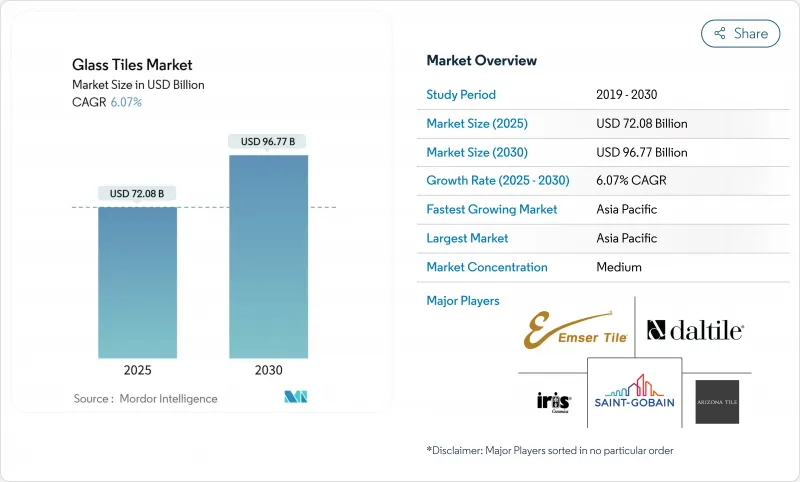
都市化加快、維修成本上升以及嚴格的綠建築標準,使得輕質低碳的覆層材料備受青睞,玻璃磚市場也因此成為住宅、商業和基礎建設計劃的首選解決方案。燒結技術因其能夠降低燒成溫度以減少能源消耗而發展勢頭強勁,而霧面飾面的設計趨勢則拓展了建築師的美學選擇。由於大型基礎設施規劃、一體化的供應鏈以及不斷成長的可支配收入,亞太地區在生產和消費方面均處於領先地位。
全球玻璃磚市場趨勢與洞察
房屋建設需求不斷成長
追求耐用美觀的廚房和浴室的屋主正在推動房屋改造,並增加優質材料的使用。預計到2025年3月,加拿大的建築投資將達到222億加元,年增5.4%,凸顯了住宅需求的韌性。住宅瓷磚佔據了51.04%的市場佔有率,反映出人們對高價值飾面的偏好,而非普通的陶瓷替代品。玻璃磚的耐污性和持久性使其在潮濕的房間中擁有長期價值,並符合買家對低生命週期成本的期望。因此,亞太和北美地區成熟住宅存量和豪華公寓計劃穩定的更換週期將使玻璃磚市場受益。
環保製造程序
監管機構和建築評級系統支持低碳材料,鼓勵製造商增加玻璃屑含量並轉向再生能源。 AGC Glass Europe 計畫在 2024 年回收 70 萬噸玻璃屑,到 2030 年達到 50% 的玻璃屑比例,減少 49 萬噸二氧化碳排放。 NSG Group 計劃在英國的新型綠色氫爐的支持下,到 2024 年實現 50% 的再生能源,到 2050 年實現碳中和。這些努力創造了品牌差異化並滿足歐洲和北美的規範標準,建築師選擇有助於 LEED 和 BREEAM 積分的產品。降低窯溫的燒結製程放大了這些環境效益,並指導從檢驗的脫碳藍圖的供應商購買。
原料和能源成本的波動;
玻璃生產是能源密集型,這使得製造商容易受到燃料價格上漲和電力短缺的影響。 《工程新聞記錄》報導,到 2024 年底,材料成本指數將上漲 3%,預計關稅和能源稅將推動 2025 年玻璃價格上漲 6-11%。預計鋼鐵價格將上漲 11.2%,從而增加熔爐維護成本並擠壓利潤率。歐洲天然氣現貨價格在 2024 年大幅上漲,暫時迫使產能限制和前置作業時間延長。這種波動可能會促使開發商在預算緊縮時轉向瓷磚,特別是在綠色建築獎勵較少的新興市場。對沖策略和現場再生能源對於玻璃磚製造商穩定營運費用至關重要。
報告中分析的其他促進因素和限制因素
- 擴大在豪華和高階建築計劃中的使用
- 高層建築維修對輕質玻璃磚的需求不斷成長
- 更便宜的陶瓷和瓷器替代品
細分分析
雖然到2024年,光滑/亮面產品將佔據56.09%的市場佔有率,但霧面飾面的成長速度最快,複合年成長率為7.16%。設計師重視低光澤表面,因為它能提供微妙的深度和現代美感。防指紋處理使霧面即使在人流量大的飯店大廳也能保持其純度,從而將用途擴展到浴室以外的領域。奈米蝕刻技術的進步使製造商能夠實現緞面般的外觀,同時保持亮面玻璃易於清潔的表面。霧面玻璃的價格通常高出10-15%,促使製造商將產能分配給這些SKU。混合數位印刷系統可在霧面背景上呈現金屬質感,滿足高階商業室內裝潢的需求。受亞太地區豪華公寓需求的推動,預計到2030年,霧面玻璃磚市場規模將超過150億美元。
光滑瓷磚在臨床環境、食品服務區和游泳池中仍然必不可少,因為其不透水的釉藥簡化了衛生操作。美國公共衛生法要求商用廚房的食品製備線後方必須安裝無孔牆體,這確保了對光面玻璃的基本需求。生產商正在將抗菌銀離子添加到透明釉藥中,以使其與陶瓷競爭對手區分開來。霧面瓷磚越來越受歡迎,但均衡的生產組合有助於緩解風格波動。整合式設施透過使用連續的爐區在不停止生產線的情況下在光面和啞光飾面之間切換來保持產量。總體而言,產品類型的多樣化使玻璃瓷磚市場免受時尚週期波動的影響,同時為經銷商提供了更廣泛的選擇。
到 2030 年,燒結產品的複合年成長率最高,為 7.25%,而熔融磚在 2024 年的佔有率將保持在 38.16%。燒結磚燒成溫度較低,減少了瓦斯消費量和二氧化碳排放。製造商正在將回收的碎玻璃屑加入燒結混合物中,以在不影響強度的情況下獲得 LEED 評分。雖然熔融磚由於成熟的窯爐基礎設施仍在批量生產中佔據主導地位,但不斷上漲的碳排放稅正在推高營運成本。鑄造磚和燒結磚用於手工馬賽克和文物修復,其手工製作的紋理證明了它們的高價是合理的。工業的一項研究展示了一種可用於玻璃磚熔爐的低溫回收路線,有可能進一步降低能源成本。建築師越來越要求產品具有環境聲明,而燒結磚供應商正在獲得公共資助計劃的優先供應商地位。因此,玻璃磚產業正在將資本投資引導到具有廢熱回收功能的連續燒結生產線中,從而加強了從傳統熔煉方式的轉變。
較低的熱預算可延長窯爐壽命並節省表面塗層研發的維護成本。自動化壓機和壓延設備可提高尺寸精度、方便現場應用並降低承包商的人事費用。玻璃磚市場正在採用燒結板來製造通風建築幕牆系統,其中輕量化結構和嚴格的公差至關重要。生產商在單一途徑中共燒彩虹色釉藥,與單獨的熔化過程相比,縮短了循環時間。生命週期分析表明,與熔融加工的產品相比,隱含碳減少了 25%,從而支持根據歐洲綠色政府採購法規進行採購。因此,預計到 2030 年,燒結技術將在玻璃磚市場上縮小與熔融型產品的差距。
區域分析
預計到2024年,亞太地區將佔據全球玻璃磚市場的52.18%,到2030年的複合年成長率將達到6.94%。中國地鐵建設計劃、印度智慧城市計劃以及日本在全球事件前夕的酒店業繁榮,都將支撐該地區強勁的採購勢頭。廣東和山東的一體化供應鏈使生產商能夠在地採購,從而降低物流成本並實現積極的出口定價。各國政府正在推動回收強制規定,這賦予了燒結磚製造商國內市場優勢,並增強了其區域領導地位。都市區家庭的快速成長也支撐了強勁的房屋翻新需求,使亞太地區成為跨國瓷磚品牌的戰略重點。
北美市場成熟且富有韌性。美國老舊住宅存量的更新需求推動了強勁的維修支出;而加拿大的建築投資也呈現出穩健的勢頭,截至2025年3月,已達到222億加元。紐約、芝加哥和多倫多的高層建築建築維修青睞輕質玻璃板,以最大程度地降低結構加強成本。墨西哥商業房地產的成長支撐了購物中心對背面玻璃壁畫的需求。嚴格的能源法規推動了低輻射鍍膜玻璃覆層的採用,這種覆層比陶瓷覆層具有功能優勢。因此,儘管面臨經濟逆風,玻璃磚市場仍保持其高階地位。
歐洲佔了很大佔有率,這得益於嚴格的脫碳政策以及富含玻璃屑的低碳玻璃。 AGC 的目標是到 2030 年將玻璃屑使用量降至 50%,同時透過混合熔爐試點計畫實現 75% 的排放,以滿足歐盟的稅收要求。德國和法國的公共部門正在競標需要環境產品聲明的交通樞紐維修,從而加快了從認證供應商的採購。英國和義大利正致力於文物建築的維修,玻璃馬賽克在不影響原貌的前提下,與修復後的美感相得益彰。儘管亞太地區的成長滯後,但穩定的公共部門支出和明確的監管政策支撐了歐洲對全球銷售的貢獻。
南美洲、中東和非洲地區展現出早期潛力。巴西沿海地區的飯店和度假村建設正在刺激對彩虹色泳池馬賽克的利基需求。沙烏地阿拉伯的大型計劃已指定大尺寸背光玻璃牆用於零售區,但供應鏈缺口和價格敏感度阻礙了其廣泛應用。經銷商正在投資區域倉庫以縮短前置作業時間,一旦經濟狀況穩定,玻璃磚市場將迎來更快的普及。
其他福利
- Excel 格式的市場預測 (ME) 表
- 3個月的分析師支持
目錄
第1章 引言
- 研究假設和市場定義
- 調查範圍
第2章調查方法
第3章執行摘要
第4章 市場狀況
- 市場概況
- 市場促進因素
- 房屋建設需求不斷成長
- 環保製造程序
- 擴大在豪華和高階建築計劃中的使用
- 高樓維修對輕質玻璃磚的需求不斷增加
- 在家居裝修和 DIY 市場越來越受歡迎
- 市場限制
- 原料和能源成本的波動;
- 陶瓷和瓷器的經濟實惠替代品
- 地震帶微裂縫的風險
- 價值鏈分析
- 五力分析
- 供應商的議價能力
- 買方的議價能力
- 新進入者的威脅
- 替代品的威脅
- 競爭程度
第5章 市場規模及成長預測(金額)
- 依產品類型
- 霧面飾面
- 光滑玻璃磚
- 按製造程序
- 史瑪蒂蒂爾
- 熔融磁磚
- 燒結磚
- 鑄磚
- 其他製造方法(塌陷/蝕刻瓷磚)
- 按用途
- 牆壁材料
- 地板材料
- 後擋板和檯面
- 戶外與環境
- 按最終用戶產業
- 住房
- 商業
- 基礎設施(交通、游泳池、建築幕牆)
- 按地區
- 亞太地區
- 中國
- 印度
- 日本
- 韓國
- 其他亞太地區
- 北美洲
- 美國
- 加拿大
- 墨西哥
- 歐洲
- 德國
- 英國
- 義大利
- 法國
- 其他歐洲國家
- 南美洲
- 巴西
- 阿根廷
- 其他南美
- 中東和非洲
- 沙烏地阿拉伯
- 南非
- 其他中東和非洲地區
- 亞太地區
第6章 競爭態勢
- 市場集中度
- 策略趨勢
- 市佔率(%)/排名分析
- 公司簡介
- American Olean
- Arizona Tile
- Artaic, LLC
- Bellavita Tile
- Crossville Inc.
- Daltile
- Emser Tile
- Fireclay Tile
- Hirsch Glass Corp.
- Iris Ceramica Group
- Lunada Bay Tile
- Maniscalco
- Marazzi Group Srl
- Mulia Inc.
- Oceanside Glass & Tile
- Roca Tile USA
- Saint-Gobain
- Sonoma Tilemakers
- Susan Jablon
第7章 市場機會與未來展望
The global glass tiles market size stands at USD 72.08 billion in 2025 and is projected to reach USD 96.77 billion by 2030, growing at a 6.07% CAGR.
Rising urbanization, premium renovation spending, and stricter green-building codes favor lightweight, low-carbon cladding materials, positioning the glass tiles market as a preferred solution in residential, commercial, and infrastructure projects. Sintered technology gains momentum because it trims firing temperatures and cuts energy use, while design trends toward matte finishes widen aesthetic options for architects. Asia-Pacific leads both production and consumption thanks to large-scale infrastructure programs, integrated supply chains, and growing disposable incomes.
Global Glass Tiles Market Trends and Insights
Rising Demand in Residential Construction
Renovation activity fuels premium material uptake as homeowners target kitchens and bathrooms where durability and aesthetics justify higher budgets. Canada's building construction investment reached CAD 22.2 billion in March 2025, and year-over-year growth of 5.4% underscores resilient housing demand . The residential share of 51.04% reflects this preference for higher-value finishes over commodity ceramic alternatives. Glass tiles' stain resistance and color permanence add long-term value in moisture-prone rooms, aligning with buyer expectations for low lifecycle costs. Consequently, the glass tiles market benefits from steady replacement cycles in mature housing stock and upscale condominium projects in Asia-Pacific and North America.
Eco-Friendly Manufacturing Processes
Regulators and building-rating schemes favor low-carbon materials, prompting manufacturers to increase cullet content and switch to renewable power. AGC Glass Europe recycled 700,000 tonnes of cullet in 2024 and targets a 50% cullet ratio by 2030, cutting 490,000 tonnes of CO2 emissions. NSG Group plans to reach 50% renewable electricity in 2024 and achieve carbon neutrality by 2050, supported by new green-hydrogen furnaces in the United Kingdom. These initiatives create brand differentiation and meet specification criteria in Europe and North America, where architects select products that contribute to LEED and BREEAM credits. Sintered processes that lower kiln temperatures amplify these environmental gains, steering procurement toward suppliers with verifiable decarbonization roadmaps.
Raw-Material & Energy Cost Volatility
Glass production is energy-intensive, making manufacturers vulnerable to fuel spikes and electricity shortages. Engineering News-Record reported a 3% increase in its Materials Cost Index by end-2024, with glass prices expected to climb 6-11% in 2025 due to tariffs and energy levies. Steel price inflation of 11.2% compounded furnace maintenance costs, squeezing margins. Spot natural-gas rates in Europe surged during 2024, temporarily forcing capacity curtailments and elongating lead times. Such volatility prompts developers to switch to ceramic tiles when budgets tighten, especially in emerging markets lacking green-building incentives. Hedging strategies and on-site renewable power become critical for glass tile producers to stabilize operating expenses.
Other drivers and restraints analyzed in the detailed report include:
- Growing Usage in Luxury and High-End Architectural Projects
- Increasing Demand for Lightweight Glass Tiles for High-Rise Retrofits
- Cheaper Ceramic & Porcelain Substitutes
For complete list of drivers and restraints, kindly check the Table Of Contents.
Segment Analysis
Smooth/glossy products held 56.09% share in 2024, yet matte finishes expand fastest at 7.16% CAGR. Designers appreciate low-glare surfaces that provide subtle depth and modern aesthetics. Anti-fingerprint treatments now preserve matte purity in high-traffic hotel lobbies, widening use cases beyond bathrooms. Advances in nano-etching allow manufacturers to retain the easy-clean surface of glossy glass while delivering a satin appearance. Matte variants often command price premiums of 10-15%, encouraging producers to allocate incremental capacity to these SKUs. Hybrid digital-print systems apply metallic accents onto matte backgrounds, satisfying luxury commercial interiors. The glass tiles market size for matte finishes is projected to exceed USD 15 billion by 2030, underpinned by upscale condominium demand in Asia-Pacific.
Smooth tiles remain essential in clinical settings, foodservice areas, and swimming pools because their impervious glaze simplifies sanitation. Public health codes in the United States mandate non-porous wall surfaces behind commercial kitchen prep lines, securing baseline demand for glossy glass. Producers bundle anti-microbial silver ions into clear glazes, differentiating from ceramic rivals. Although matte popularity rises, balanced production portfolios help mitigate style swings. Integrated facilities dedicate sequential furnace zones to alternate between gloss and matte runs without stopping the line, maintaining throughput. Overall, product-type diversification anchors the glass tiles market against fashion-cycle volatility while giving distributors a broader palette.
Sintered products register the highest 7.25% CAGR through 2030 while fused tiles retain 38.16% share in 2024. The glass tiles market rewards sintering because the process fires at lower temperatures, cutting gas consumption and CO2 emissions. Manufacturers embed recycled cullet into sintered blends without compromising strength, aligning with LEED scoring. Fused formats still dominate large-run production due to mature kiln infrastructure, but rising carbon taxes elevate operating costs. Cast and smalti tiles serve artisanal mosaics and heritage restorations where hand-crafted textures justify premium pricing. Research at the Saitama Institute of Technology shows low-temperature recycling routes that could transfer to glass tile furnaces and further reduce energy bills. As architects demand environmental product declarations, sintered suppliers gain preferred-vendor status in publicly funded projects. The glass tiles industry thus pivots capital expenditure toward continuous sinter lines equipped with waste-heat recovery, reinforcing the shift away from traditional fusion.
Lower thermal budgets extend kiln life, freeing maintenance outlays for surface-coating R&D. Automated pressing and calendaring equipment boosts dimensional accuracy, easing site installation and trimming labor spend for contractors. The glass tiles market sees sintered planks entering ventilated facade systems where lighter weight and tight tolerances are critical. Producers co-fire iridescent glazes in a single pass, reducing cycle time compared with separate fusing stages. Lifecycle analyses demonstrate up to 25% embodied-carbon savings relative to fused equivalents, supporting procurement under green-public-procurement rules in Europe. Consequently, sintered technology is forecast to narrow the glass tiles market share gap with fused formats before 2030.
The Glass Tiles Market Report Segments the Industry by Product Type (Matte-Finished, and Smooth Glass Tile), Manufacturing Process (Smalti Tiles, Fused Tiles, and More), Application (Wall Cladding, Flooring, and More), End-User Industry (Residential, Commercial, and More), and Geography (Asia-Pacific, North America, and More). The Market Forecasts are Provided in Terms of Value (USD).
Geography Analysis
Asia-Pacific held 52.18% share of the glass tiles market in 2024 and continues to grow at a 6.94% CAGR through 2030. China's metro-station construction pipeline, India's Smart Cities Mission, and Japan's hotel boom ahead of global events sustain robust regional purchasing. Integrated supply chains in Guangdong and Shandong provinces let producers source float glass, colorants, and packaging locally, cutting logistics costs and enabling aggressive export pricing. Governments promote recycled-content mandates, giving sintered producers a domestic advantage and bolstering regional leadership. Rapid urban household formation also supports steady residential renovation demand, making Asia-Pacific the strategic priority for multinational tile brands.
North America represents a mature yet resilient market. United States renovation outlays stay strong as aging housing stock needs updates, while Canada's CAD 22.2 billion construction investment in March 2025 signals healthy activity. High rise retrofits in New York, Chicago, and Toronto prefer lightweight glass panels to minimize structural reinforcement costs. Mexico's commercial real-estate growth underpins demand for back-painted glass murals in shopping centers. Stringent energy-codes catalyze adoption of low-emissivity coated glass cladding, offering a functional edge over ceramic alternatives. Consequently, the glass tiles market maintains premium positioning despite economic headwinds.
Europe commands significant share, anchored by strict decarbonization policies that align with cullet-rich, low-carbon glass. AGC's target of 50% cullet usage by 2030, together with hybrid-furnace pilots cutting emissions 75%, meets EU taxonomy requirements. Public authorities in Germany and France tender transit-hub refurbishments demanding environmental product declarations, accelerating procurement from certified suppliers. United Kingdom and Italy focus on heritage building upgrades, where glass mosaics complement restoration aesthetics without compromising authenticity. Although growth lags Asia-Pacific, stable public-sector spending and regulatory certainty underpin Europe's contribution to global revenue.
South America and Middle East and Africa offer early-stage potential. Brazil's hotel and resort construction along coastal corridors spurs niche demand for iridescent pool mosaics. Saudi Arabia's giga-projects specify large-format back-lit glass walls in retail districts, yet supply-chain gaps and price sensitivity limit widespread adoption. Distributors invest in regional warehouses to shorten lead times, positioning the glass tiles market for faster uptake as economic conditions stabilize.
- American Olean
- Arizona Tile
- Artaic, LLC
- Bellavita Tile
- Crossville Inc.
- Daltile
- Emser Tile
- Fireclay Tile
- Hirsch Glass Corp.
- Iris Ceramica Group
- Lunada Bay Tile
- Maniscalco
- Marazzi Group S.r.l.
- Mulia Inc.
- Oceanside Glass & Tile
- Roca Tile USA
- Saint-Gobain
- Sonoma Tilemakers
- Susan Jablon
Additional Benefits:
- The market estimate (ME) sheet in Excel format
- 3 months of analyst support
TABLE OF CONTENTS
1 Introduction
- 1.1 Study Assumptions & Market Definition
- 1.2 Scope of the Study
2 Research Methodology
3 Executive Summary
4 Market Landscape
- 4.1 Market Overview
- 4.2 Market Drivers
- 4.2.1 Rising demand in residential construction
- 4.2.2 Eco-friendly manufacturing processes
- 4.2.3 Growing usage in luxury and high-end architectural projects
- 4.2.4 Increasing demand for lightweight glass tiles for high-rise retrofits
- 4.2.5 Growing popularity in renovation and DIY market
- 4.3 Market Restraints
- 4.3.1 Raw-material & energy cost volatility
- 4.3.2 Cheaper ceramic & porcelain substitutes
- 4.3.3 Micro-cracking risk in seismic zones
- 4.4 Value Chain Analysis
- 4.5 Porter's Five Forces
- 4.5.1 Bargaining Power of Suppliers
- 4.5.2 Bargaining Power of Buyers
- 4.5.3 Threat of New Entrants
- 4.5.4 Threat of Substitutes
- 4.5.5 Degree of Competition
5 Market Size & Growth Forecasts (Value)
- 5.1 By Product Type
- 5.1.1 Matte-finished
- 5.1.2 Smooth glass tile
- 5.2 By Manufacturing Process
- 5.2.1 Smalti Tiles
- 5.2.2 Fused Tiles
- 5.2.3 Sintered Tiles
- 5.2.4 Cast Tiles
- 5.2.5 Other Manufacturing Processes (Slumped / Etched Tiles)
- 5.3 By Application
- 5.3.1 Wall Cladding
- 5.3.2 Flooring
- 5.3.3 Backsplashes and Countertops
- 5.3.4 Outdoor and Landscape
- 5.4 By End-User Industry
- 5.4.1 Residential
- 5.4.2 Commercial
- 5.4.3 Infrastructure (Transit, Pools, Facades)
- 5.5 By Geography
- 5.5.1 Asia-Pacific
- 5.5.1.1 China
- 5.5.1.2 India
- 5.5.1.3 Japan
- 5.5.1.4 South Korea
- 5.5.1.5 Rest of Asia-Pacific
- 5.5.2 North America
- 5.5.2.1 United States
- 5.5.2.2 Canada
- 5.5.2.3 Mexico
- 5.5.3 Europe
- 5.5.3.1 Germany
- 5.5.3.2 United Kingdom
- 5.5.3.3 Italy
- 5.5.3.4 France
- 5.5.3.5 Rest of Europe
- 5.5.4 South America
- 5.5.4.1 Brazil
- 5.5.4.2 Argentina
- 5.5.4.3 Rest of South America
- 5.5.5 Middle East and Africa
- 5.5.5.1 Saudi Arabia
- 5.5.5.2 South Africa
- 5.5.5.3 Rest of Middle East and Africa
- 5.5.1 Asia-Pacific
6 Competitive Landscape
- 6.1 Market Concentration
- 6.2 Strategic Moves
- 6.3 Market Share(%)/Ranking Analysis
- 6.4 Company Profiles (includes Global-level Overview, Market-level Overview, Core Segments, Financials as available, Strategic Information, Market Rank/Share, Products & Services, Recent Developments)
- 6.4.1 American Olean
- 6.4.2 Arizona Tile
- 6.4.3 Artaic, LLC
- 6.4.4 Bellavita Tile
- 6.4.5 Crossville Inc.
- 6.4.6 Daltile
- 6.4.7 Emser Tile
- 6.4.8 Fireclay Tile
- 6.4.9 Hirsch Glass Corp.
- 6.4.10 Iris Ceramica Group
- 6.4.11 Lunada Bay Tile
- 6.4.12 Maniscalco
- 6.4.13 Marazzi Group S.r.l.
- 6.4.14 Mulia Inc.
- 6.4.15 Oceanside Glass & Tile
- 6.4.16 Roca Tile USA
- 6.4.17 Saint-Gobain
- 6.4.18 Sonoma Tilemakers
- 6.4.19 Susan Jablon
7 Market Opportunities & Future Outlook
- 7.1 White-space & Unmet-need Assessment


