


 |
市場調查報告書
商品編碼
2043978
電源供應器(PSU):市場佔有率分析、產業趨勢與統計、成長預測(2026-2031)Power Supply Units (PSU) - Market Share Analysis, Industry Trends & Statistics, Growth Forecasts (2026 - 2031) |
||||||

※ 本網頁內容可能與最新版本有所差異。詳細情況請與我們聯繫。
預計電源單元 (PSU) 市場將從 2025 年的 358.6 億美元和 2026 年的 380.3 億美元成長到 2031 年的 521.9 億美元,2026 年至 2031 年的年複合成長率(CAGR)為 6.54%。
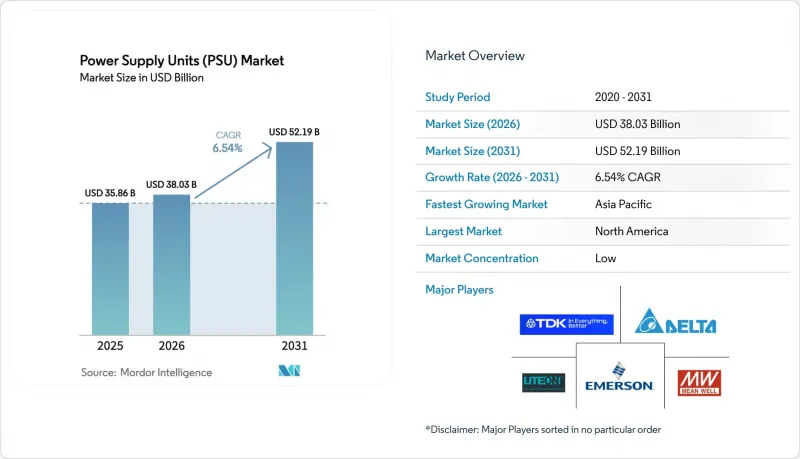
市場需求正從大規模生產的通用「磚頭式」電源轉向能夠滿足超大規模資料中心密度目標和電氣化要求的高價值拓撲結構。歐盟生態設計指令和加州第20號法規對空載效率的嚴格限制,正加速數位控制迴路和同步整流技術的應用。同時,英特爾的ATX 3.0規範正在為遊戲產業帶來重大變革,迫使廠商重新設計功耗超過600W的GPU的瞬態響應電路。鐵氧體磁芯和碳化矽晶圓等原料價格的波動,正在擴大垂直整合型成熟企業與無廠半導體公司之間的成本差距。
全球電源供應器(PSU)市場趨勢與洞察
超大規模和邊緣資料中心的快速擴張
超大規模營運商宣布,2025年將投資超過60億美元新建資料中心,每個資料中心都需要熱插拔模組化電源,這些電源在50%負載下效率需達到96%,並滿足5分鐘的維修時限。邊緣部署進一步推動了這項需求,因為5G基地台需要能夠承受-40°C至+70°C環境溫度的緊湊型電源。液冷機架的普及推動了人們對54V匯流排架構的興趣,該架構能夠降低電阻損耗,儘管亞馬遜網路服務(AWS)和Meta的先導計畫仍處於檢驗階段。隨著營運商尋求將正常運行運作貨幣化,整合數位遙測和預測性維護功能的機架供應商報告稱,其設計採用率更高。因此,電源市場正轉向高密度、資料中心專用平台,這些平台能夠提供更高的利潤率。
遊戲和工作站PC中ATX 3.0和PCIe 5.1的更新週期
ATX 3.0 標準引入了具有 200% 瞬態容差的 12V HPWR 連接器,徹底革新了發燒級 PC 生態系統。隨著 NVIDIA RTX 50 系列顯示卡的發布,符合該標準成為強制性要求。 Corsair 表示,2025 年第四季度,符合 ATX 3.0 標準的電源產品佔其出貨量的 70% 以上。面向 AI 渲染的工作站廠商正在採用雙路 12V 輸出,以平衡多 GPU 負載,同時避免超出 UL 62368-1 標準的限制。願意承擔重新設計成本的 OEM 廠商正在贏得遊戲玩家和內容創作者的認可,成為產業先鋒。儘管出貨量持平,但此次更新換代推高了平均售價,並重振了電源市場。
磁性材料和半導體原料價格的波動
2025年第一季2026年1月,碳化矽(SiC)MOSFET的平均售價仍比矽基MOSFET高出3至4倍,前置作業時間超過26週。與電動車電池需求相關的銅箔價格上漲,迫使印刷基板走線寬度重新設計,以控制元件成本。大型企業透過簽訂多年供應合約來規避風險,而中小型ODM企業則面臨利潤率壓力,並放緩了新產品的推出速度。此類價格波動正在削弱整個電源市場的盈利,尤其是在價格傳導能力有限的中端消費市場。
細分市場分析
由於交流-直流 (AC-DC) 電源產品具備符合通訊、工業和消費性設備安全標準的電氣隔離功能,預計到 2025 年,AC-DC 產品仍將佔據 62.35% 的電源市場佔有率。由於所有接入電網的設備仍需要初級轉換階段,因此這類「磚型」電源供應器的市場規模保持穩定。直流-直流 (DC-DC) 轉換器廣泛應用於電池供電系統,這類系統對轉換器的效率要求高達 95%,且高度必須小於 15 毫米。 DC-DC 轉換器的市場定位也保障了專業供應商的利潤率。受屋頂太陽能上網電價補貼政策以及新興國家不間斷電源 (UPS) 普及的推動,直流-交流 (DC-AC) 逆變器正以 7.83% 的複合年成長率 (CAGR) 穩步成長。
寬能隙半導體正在改寫成本績效曲線。基於氮化鎵(GaN)的筆記型電腦適配器在輸出功率相當的情況下,體積縮小了30%,這使其成為優先考慮便攜性的原始設備製造商(OEM)的賣點。直流-直流轉換器內部的碳化矽(SiC)二極體降低了100 kHz的開關損耗,使設計人員能夠在不使用更大散熱器的情況下提高功率密度。電動車充電器逆變器供應商正在採用三電平橋式拓樸結構來滿足嚴格的諧波限制。這些變化共同推高了平均售價,並在電源供應器市場商品化壓力日益成長的情況下,維持了健康的利潤率。
到2025年,機殼電源將佔電源(PSU)市場34.67%的佔有率,這主要得益於IP防護等級機殼能夠有效抵禦惡劣工業環境中的灰塵和液體侵蝕。然而,隨著超大規模營運商實施N+1冗餘以實現99.999%的可用性,機架式和模組化電源的市場佔有率正在不斷擴大。預計機架式和模組化設計將以7.13%的複合年成長率(CAGR)領先市場。在成本高於可維護性的市場中,開放式框架設計仍佔主導地位。儘管DIN導軌產品銷量較小,但由於其便捷的卡扣式安裝方式,在建築自動化仍然至關重要。
標準化的進步正在加速模組化轉型。 「開放式機架 V3」規範引入了免工具鎖扣和前置式電源倉,為熱通道封閉策略帶來了顯著優勢。整合到機架式 SKU 中的 PMBus 和 I2C 遙測功能可讓操作人員即時測量漣波和熱應力,這對於人工智慧驅動的設施管理至關重要。目前,機殼電源採用交錯升壓速率校正技術,使醫療設備OEM 廠商無需使用笨重的濾波器即可滿足 IEC 61000-3-2 諧波限值要求。這些技術進步正推動電源市場不斷發展,以適應可維護性和監管趨勢。
區域分析
預計到2025年,北美將佔全球銷售額的38.87%,主要得益於維吉尼亞、奧勒岡州和德克薩斯州超大規模資料中心的建設。亞馬遜網路服務(AWS)宣布了一項在俄亥俄州投資110億美元的擴張計劃,僅此一項就需要約200兆瓦的冗餘電源軌。加拿大太陽能和儲能產業的蓬勃發展正在推動逆變器需求,而直流連接資料中心的早期先導計畫則抑制了對交流輸入設計的長期需求。嚴格的UL和FCC認證為組件製造商提供了有利條件,這些認證構成了非關稅壁壘,維持了該地區電源產品市場的高平均售價。
亞太地區正處於最高成長軌道,預計2031年將達到8.09%的複合年成長率。中國500億元人民幣(70億美元)的補貼計畫正在推動氮化鎵(GaN)和碳化矽(SiC)製造的本土化,並縮短國內電源組件(PSU)組裝的前置作業時間。印度的生產連結獎勵計畫計畫(PLI)正推動清奈工廠滿足通訊和資料中心的訂單,預計到2025年,印度的電源組件進口量將下降18%。韓國部署的1200個超快速電動車充電樁正在提振對350kW機櫃的需求。同時,越南和泰國正在吸收來自中國的過剩組裝產能。該地區的這種重新平衡加劇了電源組件市場的競爭,並壓縮了價格區間。
效率仍是歐洲的關鍵考量因素,修訂後的生態設計指令將於2027年將可維修性評分與市場准入要求掛鉤。在德國,受汽車電氣化推動,工業電源的訂單增加了12%。英國正在升級其電網基礎設施,並敦促電力公司指定使用與智慧電網相容的逆變器。法國核能發電廠的維修催生了一個高階細分市場,對耐輻射電源的需求日益成長。同時,中東和非洲對超大規模園區和離網太陽能發電的投資,也帶動了對耐高溫和防塵組件的需求。標準的區域差異雖然使產品系列規劃變得複雜,但也為現有製造商提供了優勢,使其能夠維護多種認證產品,從而增強其在全球電源市場中的定價權。
其他好處:
- Excel格式的市場預測(ME)表
- 3個月的分析師支持
目錄
第1章:引言
- 市場分析與定義的前提條件
- 分析範圍
第2章 分析方法
第3章執行摘要
第4章 市場狀況
- 市場概覽
- 市場促進因素
- 超大規模/邊緣資料中心的快速擴張
- 遊戲和工作站PC中ATX 3.0和PCIe 5.1的更新週期
- 對通過 80 PLUS 認證的高效電源的需求不斷成長。
- 下一代資料中心向 48V 機架連接架構過渡
- 物聯網和智慧家居電子設備的普及
- 政府關於電子廢棄物的指令提倡模組化和可回收的電源單元設計。
- 市場限制因素
- 磁性材料和半導體原料價格的波動
- 由於直流設備的普及,交流-直流電源的銷量下降。
- 更嚴格的全球電磁干擾與安全認證成本
- 區域生態設計和EPS效率標籤的碎片化
- 產業供應鏈分析
- 監理情勢
- 技術展望
- 波特五力分析
- 供應商議價能力
- 買方的議價能力
- 新參與企業的威脅
- 替代品的威脅
- 競爭公司之間的競爭關係
- 對影響市場的宏觀經濟因素進行評估
第5章 市場規模與成長預測
- 依設備類型
- 交流-直流電源
- 直流-直流轉換器
- 直流-交流逆變器
- 按外形規格
- 開放式框架
- 密封型/底盤
- DIN導軌
- 磚
- 機架式/模組化
- 輸出範圍
- 小於 50 瓦
- 50~250 W
- 250~1,000 W
- 1000瓦或以上
- 按最終用戶行業分類
- 工業自動化和機械
- 通訊和電訊
- 家用電子電器和行動裝置
- 汽車(內燃機汽車(ICE)和電動車(EV))
- 交通運輸(鐵路、航空、船舶)
- 醫療設備及醫療設備
- LED照明
- 資料中心伺服器
- 國防/航太
- 按地區
- 北美洲
- 美國
- 加拿大
- 墨西哥
- 南美洲
- 巴西
- 阿根廷
- 南美洲其他地區
- 歐洲
- 德國
- 英國
- 法國
- 義大利
- 西班牙
- 其他歐洲地區
- 亞太地區
- 中國
- 日本
- 韓國
- 印度
- 東南亞
- 亞太其他地區
- 中東和非洲
- 中東
- 阿拉伯聯合大公國
- 沙烏地阿拉伯
- 土耳其
- 其他中東國家
- 非洲
- 南非
- 埃及
- 其他非洲地區
- 中東
- 北美洲
第6章 競爭情勢
- 市場集中度
- 策略趨勢
- 市佔率分析
- 公司簡介
- Delta Electronics Inc.
- Lite-On Technology Corporation
- TDK-Lambda Corporation
- MEAN WELL Enterprises Co., Ltd.
- Emerson Electric Co.
- ABB Ltd.
- Schneider Electric SE
- Siemens AG
- XP Power Limited
- Advanced Energy Industries, Inc.
- AcBel Polytech Inc.
- Murata Manufacturing Co., Ltd.
- CUI Inc.
- Artesyn Embedded Technologies
- Vicor Corporation
- Sea Sonic Electronics Co., Ltd.
- Thermaltake Technology Co., Ltd.
- Micro-Star International Co., Ltd.
- COSEL Co., Ltd.
- Bel Fuse Inc.
- FSP Technology Inc.
第7章 市場機會與未來展望
The power supply units (PSU) market size is projected to expand from USD 35.86 billion in 2025 and USD 38.03 billion in 2026 to USD 52.19 billion by 2031, registering a CAGR of 6.54% between 2026 to 2031.
Demand is shifting from high-volume commoditized bricks toward value-added topologies that meet hyperscale data-center density targets and electrification mandates. Tightened no-load efficiency limits under the European Ecodesign Directive and California's Title 20 are accelerating adoption of digital control loops and synchronous rectification. At the same time, Intel's ATX 3.0 specification has upended the gaming segment, forcing vendors to redesign transient-response circuitry for GPUs that exceed 600 W draw. Raw-material volatility in ferrite cores and silicon carbide wafers is widening the cost gap between vertically integrated incumbents and fab-less challengers.
Global Power Supply Units (PSU) Market Trends and Insights
Rapid Expansion of Hyperscale and Edge Data Centers
Hyperscale operators announced more than USD 6 billion of new facilities during 2025, each requiring PSUs that deliver 96% efficiency at 50% load and hot-swap modularity to meet five-minute repair windows. Edge deployments compound demand because 5G base stations need compact units that survive -40 °C to +70 °C ambient ranges. Liquid-cooled racks drive interest in 54 V bus architectures that cut resistive losses, although pilots at Amazon Web Services and Meta remain in validation. Suppliers with digital telemetry and predictive maintenance in their racks report higher design-win rates as operators monetize uptime. Consequently, the power supply units market is tilting toward high-density, data-center-specific platforms that command premium margins.
ATX 3.0 and PCIe 5.1 Upgrade Cycle in Gaming and Workstation PCs
The ATX 3.0 guide introduced the 12VHPWR connector with 200% transient tolerance, reshaping the enthusiast PC ecosystem. NVIDIA's RTX 50-series launch made compliance mandatory, and Corsair noted that ATX 3.0-ready units counted for over 70% of its Q4 2025 shipments. Workstation builders targeting AI rendering embrace dual-rail 12 V outputs that balance multi-GPU loads without breaching UL 62368-1 limits. OEMs willing to absorb redesign costs gain early-mover recognition among gamers and content creators. This refresh cycle bolsters average selling prices, lifting the power supply units market even as unit volumes stay flat.
Raw-Material Price Volatility for Magnetics and Semiconductors
Ferrite core prices surged 22% year-over-year in Q1 2025 because of supply disruptions at Asian producers. Silicon-carbide MOSFET average selling prices remain three to four times higher than silicon, with lead times extending beyond 26 weeks as of January 2026. Copper foil inflation, tied to EV battery demand, forces redesigns of printed-circuit-board trace widths to maintain bill-of-materials ceilings. Larger firms hedge through multi-year supply agreements, but smaller ODMs face margin compression that slows new-product introduction. Such volatility erodes profitability across the power supply units market, especially in mid-tier consumer segments where pass-through pricing is limited.
Other drivers and restraints analyzed in the detailed report include:
- Growing Demand for 80 PLUS-Certified Energy-Efficient PSUs
- Shift Toward 48 V Direct-to-Rack Architectures in Next-Gen Data Centers
- Rising Adoption of Native-DC Facilities Reducing AC-DC PSU Volumes
For complete list of drivers and restraints, kindly check the Table Of Contents.
Segment Analysis
AC-DC products retained 62.35% of the power supply units (PSU) market in 2025 as their galvanic isolation meets safety codes in telecom, industrial, and consumer gear. The power supply units market size for these bricks remains stable because every grid-connected device still needs a primary conversion stage. DC-DC converters populate battery-powered systems where 95% efficiency and sub-15 mm heights are mandatory; their niche role provides margin insulation for specialist vendors. DC-AC inverters are on a 7.83% CAGR trajectory, fueled by rooftop solar feed-in tariffs and UPS deployments in emerging economies.
Wide-bandgap semiconductors are rewriting cost-performance curves. GaN-based laptop adapters show 30% volume shrink at comparable wattage, a selling point for OEMs chasing portability. SiC diodes inside DC-DC converters cut switching losses at 100 kHz, letting designers raise power density without larger heat sinks. Inverter suppliers for electric-vehicle chargers adopt three-level bridge topologies to satisfy strict harmonic limits. Together, these shifts increase average selling prices, supporting healthy margins even as commoditization pressure grows within the power supply units market.
Enclosed chassis units delivered 34.67% of the power supply units (PSU) market in 2025, thanks to IP-rated shells that protect against dust and fluids in harsh industrial lines. The power supply units market share for rack-mount and modular systems, however, is expanding as hyperscale operators enforce N+1 redundancy to drive five-nines availability. Rack-mount and modular designs are expected to have the fastest CAGR of 7.13%. Open-frame designs still dominate the mass market, where cost outstrips maintainability. DIN-rail products, although small in volume, remain vital in building automation because clip-in installation reduces labor.
Standardization is accelerating the pivot to modularity. The Open Rack V3 spec introduced tool-less latches and front-access power bays, a boon for hot-aisle containment strategies. PMBus and I2C telemetry embedded in rack-mount SKUs give operators live readings of ripple and thermal stress, essential for AI-driven facility management. Enclosed supplies now ship with interleaved boost power-factor correction, letting medical OEMs pass IEC 61000-3-2 harmonic limits without bulky filters. These engineering advances keep the power supply units market aligned with serviceability and regulatory trends.
The Power Supply Units (PSU) Market Report is Segmented by Device Type (AC-DC Power Supplies, DC-DC Converters, and DC-AC Inverters), Form Factor (Open-Frame, Enclosed/Chassis, and More), Output-Power Range (Less Than 50 W, 50-250 W, and More), End-User Industry (Industrial Automation and Machinery, Communications and Telecom, and More), and Geography. The Market Forecasts are Provided in Terms of Value (USD).
Geography Analysis
North America contributed 38.87% of 2025 revenue, steered by hyperscale campus construction in Virginia, Oregon and Texas. Amazon Web Services disclosed an USD 11 billion Ohio expansion that alone demands roughly 200 MW of redundant rails. Canada's solar-plus-storage boom feeds inverter demand, yet early pilots of native-DC data centers temper long-term volume for AC-input designs. Component makers benefit from rigorous UL and FCC certifications that act as non-tariff barriers, preserving higher average selling prices in the region's power supply units market.
Asia-Pacific is on track for the fastest 8.09% CAGR through 2031. China's CNY 50 billion (USD 7 billion) subsidy package has begun localizing GaN and SiC fabrication, trimming lead times for domestic PSU assemblers. India's PLI scheme lowered PSU imports 18% in 2025 as Chennai factories scaled to telecom and data-center orders. South Korea's 1,200 ultra-fast EV chargers raise demand for 350 kW cabinets, while Vietnam and Thailand pick up assembly overflow from China. This regional re-balancing intensifies competition and compresses price tiers inside the power supply units market.
Europe remains efficiency-driven, with the revised Ecodesign Directive linking reparability scores to market access by 2027. Germany saw a 12% rise in industrial PSU orders, propelled by automotive electrification rollouts. The United Kingdom upgraded grid infrastructure, pushing utilities to specify smart-grid-compatible inverters. France's nuclear retrofits ask for radiation-hardened supplies, creating a niche premium tier. Meanwhile, Middle East and Africa investments in hyperscale campuses and off-grid solar spark need for high-temperature, dust-protected modules. Geographic divergence in standards complicates portfolio planning, but also shields incumbents who maintain multiple certified variants, reinforcing pricing power in the global power supply units market.
- Delta Electronics Inc.
- Lite-On Technology Corporation
- TDK-Lambda Corporation
- MEAN WELL Enterprises Co., Ltd.
- Emerson Electric Co.
- ABB Ltd.
- Schneider Electric SE
- Siemens AG
- XP Power Limited
- Advanced Energy Industries, Inc.
- AcBel Polytech Inc.
- Murata Manufacturing Co., Ltd.
- CUI Inc.
- Artesyn Embedded Technologies
- Vicor Corporation
- Sea Sonic Electronics Co., Ltd.
- Thermaltake Technology Co., Ltd.
- Micro-Star International Co., Ltd.
- COSEL Co., Ltd.
- Bel Fuse Inc.
- FSP Technology Inc.
Additional Benefits:
- The market estimate (ME) sheet in Excel format
- 3 months of analyst support
TABLE OF CONTENTS
1 INTRODUCTION
- 1.1 Study Assumptions and Market Definition
- 1.2 Scope of the Study
2 RESEARCH METHODOLOGY
3 EXECUTIVE SUMMARY
4 MARKET LANDSCAPE
- 4.1 Market Overview
- 4.2 Market Drivers
- 4.2.1 Rapid Expansion of Hyperscale and Edge Data Centers
- 4.2.2 ATX 3.0 and PCIe 5.1 Upgrade Cycle in Gaming and Workstation PCs
- 4.2.3 Growing Demand For 80 PLUS-Certified Energy-Efficient PSUs
- 4.2.4 Shift Toward 48 V Direct-To-Rack Architectures in Next-Gen Data Centers
- 4.2.5 Proliferation of IoT and Smart-Home Electronics
- 4.2.6 Government e-Waste Directives Driving Modular, Recyclable PSU Designs
- 4.3 Market Restraints
- 4.3.1 Raw-Material Price Volatility for Magnetics and Semiconductors
- 4.3.2 Rising Adoption of Native-DC Facilities Reducing AC-DC PSU Volumes
- 4.3.3 Stricter Global EMI and Safety Certification Costs
- 4.3.4 Fragmented Regional Eco-Design and EPS Efficiency Labeling
- 4.4 Industry Supply-Chain Analysis
- 4.5 Regulatory Landscape
- 4.6 Technological Outlook
- 4.7 Porter's Five Forces Analysis
- 4.7.1 Bargaining Power of Suppliers
- 4.7.2 Bargaining Power of Buyers
- 4.7.3 Threat of New Entrants
- 4.7.4 Threat of Substitutes
- 4.7.5 Intensity of Competitive Rivalry
- 4.8 Impact of Macroeconomic Factors on the Market
5 MARKET SIZE AND GROWTH FORECASTS (VALUE)
- 5.1 By Device Type
- 5.1.1 AC-DC power supplies
- 5.1.2 DC-DC converters
- 5.1.3 DC-AC inverters
- 5.2 By Form Factor
- 5.2.1 Open-frame
- 5.2.2 Enclosed / chassis
- 5.2.3 DIN-rail
- 5.2.4 Brick
- 5.2.5 Rack-mount / modular
- 5.3 By Output-Power Range
- 5.3.1 Less than 50 W
- 5.3.2 50 - 250 W
- 5.3.3 250 - 1 000 W
- 5.3.4 Above 1 000 W
- 5.4 By End-user Industry
- 5.4.1 Industrial Automation and Machinery
- 5.4.2 Communications and Telecom
- 5.4.3 Consumer Electronics and Mobile
- 5.4.4 Automotive (ICE and EV)
- 5.4.5 Transportation (Rail, Avionics, Marine)
- 5.4.6 Medical Devices and Healthcare
- 5.4.7 LED And Lighting
- 5.4.8 Data Centers and Servers
- 5.4.9 Defense and Aerospace
- 5.5 By Geography
- 5.5.1 North America
- 5.5.1.1 United States
- 5.5.1.2 Canada
- 5.5.1.3 Mexico
- 5.5.2 South America
- 5.5.2.1 Brazil
- 5.5.2.2 Argentina
- 5.5.2.3 Rest of South America
- 5.5.3 Europe
- 5.5.3.1 Germany
- 5.5.3.2 United Kingdom
- 5.5.3.3 France
- 5.5.3.4 Italy
- 5.5.3.5 Spain
- 5.5.3.6 Rest of Europe
- 5.5.4 Asia-Pacific
- 5.5.4.1 China
- 5.5.4.2 Japan
- 5.5.4.3 South Korea
- 5.5.4.4 India
- 5.5.4.5 Southeast Asia
- 5.5.4.6 Rest of Asia-Pacific
- 5.5.5 Middle East and Africa
- 5.5.5.1 Middle East
- 5.5.5.1.1 United Arab Emirates
- 5.5.5.1.2 Saudi Arabia
- 5.5.5.1.3 Turkey
- 5.5.5.1.4 Rest of Middle East
- 5.5.5.2 Africa
- 5.5.5.2.1 South Africa
- 5.5.5.2.2 Egypt
- 5.5.5.2.3 Rest of Africa
- 5.5.5.1 Middle East
- 5.5.1 North America
6 COMPETITIVE LANDSCAPE
- 6.1 Market Concentration
- 6.2 Strategic Moves
- 6.3 Market Share Analysis
- 6.4 Company Profiles (Includes Global Level Overview, Market Level Overview, Core Segments, Financials as Available, Strategic Information, Market Rank/Share, Products and Services, and Recent Developments)
- 6.4.1 Delta Electronics Inc.
- 6.4.2 Lite-On Technology Corporation
- 6.4.3 TDK-Lambda Corporation
- 6.4.4 MEAN WELL Enterprises Co., Ltd.
- 6.4.5 Emerson Electric Co.
- 6.4.6 ABB Ltd.
- 6.4.7 Schneider Electric SE
- 6.4.8 Siemens AG
- 6.4.9 XP Power Limited
- 6.4.10 Advanced Energy Industries, Inc.
- 6.4.11 AcBel Polytech Inc.
- 6.4.12 Murata Manufacturing Co., Ltd.
- 6.4.13 CUI Inc.
- 6.4.14 Artesyn Embedded Technologies
- 6.4.15 Vicor Corporation
- 6.4.16 Sea Sonic Electronics Co., Ltd.
- 6.4.17 Thermaltake Technology Co., Ltd.
- 6.4.18 Micro-Star International Co., Ltd.
- 6.4.19 COSEL Co., Ltd.
- 6.4.20 Bel Fuse Inc.
- 6.4.21 FSP Technology Inc.
7 MARKET OPPORTUNITIES AND FUTURE OUTLOOK
- 7.1 White-space and Unmet-need Assessment

 電化學絕緣市場規模、佔有率和成長分析:按組件、技術、應用、最終用途和地區分類-2026-2033年產業預測
 DIN導軌電源市場:依輸出類型、效率等級、認證及應用分類-2026-2032年全球市場預測
 GPU 電源基礎設施:市場佔有率分析、產業趨勢與統計、成長預測(2026-2031 年)
 直流電源系統市場規模、佔有率和成長分析:按系統類型、組件類型、最終用戶產業、額定功率、安裝類型、銷售管道和地區分類-2026-2033年產業預測
 全球電力測試系統市場:2026-2036 年
 全球電化學絕緣市場規模、佔有率、趨勢和成長分析報告(2026-2034年)GPU電源(PSU):市佔率分析、產業趨勢與統計數據以及成長預測(2026-2031)
 2026年全球船舶和碼頭連接系統市場報告全球可程式電源市場規模、佔有率、趨勢和成長分析報告(2026-2034)
 2026-2030年全球交流電源系統市場