


 |
市場調查報告書
商品編碼
2121641
聚烯(PO):市場佔有率分析、產業趨勢與統計、成長預測(2026-2031)Polyolefin (PO) - Market Share Analysis, Industry Trends & Statistics, Growth Forecasts (2026 - 2031) |
||||||

※ 本網頁內容可能與最新版本有所差異。詳細情況請與我們聯繫。
根據 Mordor Intelligence 預測,聚烯市場規模將從 2025 年的 2,404.9 億美元成長到 2026 年的 2,576.1 億美元,然後在 2031 年達到 3,633.9 億美元,2026 年至 2031 年的複合年成長率為 7.12%。
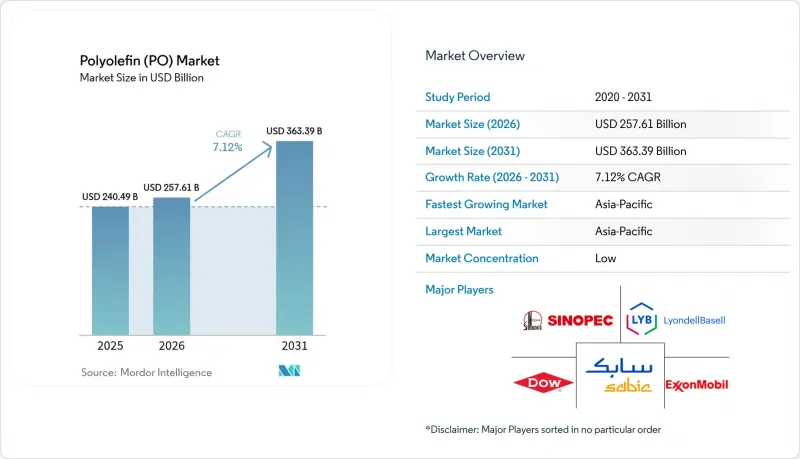
本報告按材料類型(聚乙烯 (PE) 和聚丙烯 (PP))、應用領域(薄膜和片材、射出成型成型、吹塑成型、擠壓塗布、纖維和拉菲草)以及地區(亞太地區、北美地區、歐洲地區、南美地區以及中東和非洲地區)進行細分。所有細分市場的市場規模和預測均以美元 (USD) 為單位。
全球聚烯(PO)市場趨勢與洞察
從硬質包裝過渡到軟質包裝
品牌擁有者正轉向更輕、更靈活的解決方案,以降低物流成本並達到所需的阻隔性能目標,這一轉變推動了聚烯市場對薄膜樹脂的需求成長。與傳統的硬質包裝相比,軟包裝所需的材料可減少高達70%,進而降低運輸排放氣體和倉儲空間。 2024年的供應鏈中斷表明,單層聚乙烯包裝袋的運輸效率高於玻璃或金屬容器,即使在港口擁擠的情況下也能確保商店的保存期限。薄膜加工商目前正在將奈米阻隔塗層應用於線性低密度聚乙烯(LLDPE)產品,實現以往只有多層複合才能達到的保存期限。計劃於2028年實施的歐盟「可回收設計」標準鼓勵採用這些單一材料結構,並將加速產品更新換代週期。
性價比高的室內裝潢產品和消費品的需求
印度、印尼和越南的中等收入家庭擴大選擇聚丙烯作為家具和家電的外層材料,因為它在保證足夠耐用性的同時,價格僅為工程塑膠的三分之一。由於聚丙烯加工範圍廣,原始設備製造商(OEM)正在縮短成型週期,並降低高昂電費工廠的電力消耗。汽車零件供應商也正在用聚烯共混物取代玻璃纖維增強ABS門板零件,這種共混物具有更高的抗衝擊性,無需使用昂貴的碳複合材料即可實現更輕的車身。此外,開發平臺還包括添加滑石粉的無規則共聚物,這種材料具有抗紫外線性能,使其適用於戶外消費品。
加強對一次性塑膠製品和碳排放稅的監管
歐盟將於2030年起禁止使用重量低於1.5公斤的輕型農業包裝袋,將導致聚乙烯薄膜需求量減少80萬噸,而聚乙烯薄膜則是該市場的主要需求來源。同時,碳排放稅的實施將使歐洲裂解裝置的現金成本每噸乙烯當量增加75美元,與稅負較低的地區的出口商相比,這將對歐洲出口商的淨收益造成壓力。為了延長產品的零售保存期限,生產商正在轉向回收率達35%的閉合迴路包裝,但要彌補因禁售產品造成的銷售量下滑,還需要一段時間。一些薄膜加工商為了規避課稅,正將分切捲材加工轉移到土耳其和埃及,改變了聚烯市場的貿易流量。
細分市場分析
聚乙烯憑藉其在包裝、建築和農業領域的強大地位,預計到2025年將佔據聚烯市場55.02%的佔有率。然而,聚丙烯預計將以8.02%的複合年成長率成長,到2031年將顯著擴大其在聚烯市場的佔有率。各種等級的線性低密度聚乙烯(LDPE)在薄壁薄膜加工商中的需求不斷成長,而高密度聚乙烯則用於清潔劑瓶和耐腐蝕管道,由於印度各地水利基礎設施建設的蓬勃發展,這些領域的需求也在不斷成長。低密度聚乙烯在設計上面臨可回收性的壓力,但它在液體紙盒的擠壓塗布領域仍然保持著強勁的地位。
茂金屬技術的創新使得超薄流鑄膜和高剛性聚丙烯無規共聚物的製備成為可能,其透明度接近聚碳酸酯。這些材料在拉伸和熱成型方面具有更大的柔韌性,有助於品牌商擺脫對聚苯乙烯和聚氯乙烯(PVC)的依賴。汽車製造商正在指定使用長纖維增強聚丙烯作為前端組件材料,隨著化學回收原料供應的增加,複合材料生產商的收入來源也從傳統的保險桿面板擴展到其他領域。聚乙烯和聚丙烯生產商也在努力獲得含有50%回收材料的產品的認證,從而增強客戶忠誠度並鞏固其在聚烯市場的佔有率。
區域分析
預計到2025年,亞太地區將佔據聚烯市場51.22%的佔有率,並將以8.21%的複合年成長率持續成長至2031年。中國物流和包裝的現代化、印度基礎設施建設的進步以及東南亞國協的消費熱潮都在推動需求的成長。雖然一體化煉油廠和化工廠的轉化成本較低,但諸如中國2026年對原生塑膠消費量設定上限等永續性措施預計將影響未來的產能選擇。
北美擁有第二大市場佔有率,這主要得益於其豐富的頁岩氣資源,而頁岩氣是生產具有成本競爭力的聚乙烯的原料。 2024年,由於電子商務履約的訂單和耐用消費品訂單的成長,該地區對聚乙烯的需求增加了7%,對聚丙烯的需求增加了4%。儘管墨西哥灣沿岸地區的樹脂出口在國內市場低迷時期對生產商起到了一定的支撐作用,但巴拿馬運河的堵塞迫使貨物繞道美國東海岸港口,導致運輸時間延長。
在歐洲,天然氣市場的動盪導致能源成本是美國的三倍。儘管如此,由於早期採用化學回收技術,該地區在循環聚合物貿易領域仍處於領先地位。生產商正致力於轉向利潤更高的特種等級產品,並與尋求可追溯再生材料的品牌所有者簽訂服務合約。在中東,自2020年以來,天然氣產量增加了15%,以具有競爭力的價格向亞洲和非洲供應樹脂。同時,在南美洲,對進口的高度依賴推高了當地價格,這促使巴西投資建造新的蒸汽裂解裝置。
其他好處:
- Excel格式的市場預測(ME)表
- 3個月的分析師支持
目錄
第1章:引言
- 研究假設和市場定義
- 調查範圍
第2章:調查方法
第3章執行摘要
第4章 市場狀況
- 市場概覽
- 市場促進因素
- 從硬質包裝過渡到軟質包裝
- 成本績效高的室內裝潢產品和消費品的需求
- 強制性循環經濟措施正在推動化學品回收再生用等級的發展。
- 對採用PP/POE複合材料的輕型電動車的需求日益成長
- 茂金屬催化劑的蓬勃發展推動了特殊等級 PE/PP 的實現。
- 市場限制因素
- 加強對一次性塑膠製品和碳排放稅的監管
- 全球供應過剩及巨型裂解裝置利潤率承壓
- 石腦油和丙烷原料價格波動
- 價值鏈分析
- 波特五力模型
第5章 市場規模與成長預測
- 材料類型
- 聚乙烯(PE)
- 高密度聚苯乙烯(HDPE)
- 低密度聚乙烯(LDPE)
- 線型低密度聚乙烯(LLDPE)
- 聚丙烯(PP)
- 聚乙烯(PE)
- 透過使用
- 薄膜
- 射出成型
- 吹塑成型
- 擠壓塗布
- 纖維和拉菲草
- 終端用戶產業
- 包裝
- 汽車和運輸業
- 電氣和電子設備
- 建築/施工
- 其他終端用戶產業
- 地區
- 亞太地區
- 中國
- 印度
- 日本
- 韓國
- 其他亞太國家
- 北美洲
- 美國
- 加拿大
- 墨西哥
- 歐洲
- 德國
- 英國
- 法國
- 義大利
- 其他歐洲國家
- 南美洲
- 巴西
- 阿根廷
- 其他南美國家
- 中東和非洲
- 沙烏地阿拉伯
- 南非
- 其他中東和非洲國家
- 亞太地區
第6章 競爭情勢
- 市場集中度
- 策略趨勢
- 市佔率和排名分析
- 公司簡介
- Arkema
- BASF
- Borealis GmbH
- Braskem
- Chevron Phillips Chemical Company LLC
- PetroChina Company Limited
- China Petrochemical Corporation
- Daelim Co., Ltd.
- Dow
- Exxon Mobil Corporation
- Formosa Plastics Corporation
- INEOS
- Japan Polypropylene Corporation
- LG Chem
- LyondellBasell Industries Holdings BV
- Mitsubishi Chemical Group Corporation
- Mitsui Chemicals India Pvt. Ltd.
- NOVA Chemicals
- PetroChina Co. Ltd.
- Reliance Industries Limited
- SABIC
- Sasol Ltd.
- Tosoh Corporation
- TotalEnergies
第7章 市場機會與未來展望
According to Mordor Intelligence, the polyolefin market size is expected to grow from USD 240.49 billion in 2025 to USD 257.61 billion in 2026 and is forecast to reach USD 363.39 billion by 2031 at 7.12% CAGR over 2026-2031.
This report is Segmented by Material Type (Polyethylene (PE) and Polypropylene (PP)), Application (Films and Sheets, Injection Molding, Blow Molding, Extrusion Coating, and Fibers and Raffia), and Geography (Asia-Pacific, North America, Europe, South America, and Middle East and Africa). The Market Size and Forecasts are Provided in Terms of Value (USD) for all the Above Segments.
Global Polyolefin (PO) Market Trends and Insights
Shift from Rigid to Flexible Packaging
Brand owners migrate to lighter, flexible solutions that meet barrier targets while cutting logistics costs, a shift translating into larger film resin requirements across the polyolefin market. Flexible formats use up to 70% less material than legacy rigid containers, trimming freight emissions and warehouse space. Supply-chain disruptions in 2024 showed that mono-polyethylene pouches travel more efficiently than glass or metal options, ensuring on-shelf availability even during port congestion. Film converters now layer nano-barrier coatings on linear-low-density grades, matching shelf life once available only from multilayer laminates. EU-level design-for-recycling criteria due by 2028 favor these mono-material structures and will accelerate the replacement cycle.
Demand for Cost-efficient Interior and Consumer Goods
Middle-income households in India, Indonesia, and Vietnam increasingly opt for polypropylene furniture and appliance casings that deliver acceptable durability at one-third the cost of engineering plastics. OEMs reduce molding cycle time thanks to the polymer's broad processing window, cutting electricity consumption in factories strained by high power tariffs. Automotive suppliers are also swapping glass-fiber reinforced ABS parts with impact-modified polyolefin blends for door panels, shaving vehicle mass without expensive carbon composites. The development pipeline further includes talc-filled random-copolymer grades that withstand UV exposure, making them suitable for outdoor consumer goods.
Stricter Single-use-plastic and Carbon-tax Regulations
The EU bans lightweight produce bags under 1.5 kg beginning in 2030, eliminating a 0.8 million-tonne demand stream for polyethylene film. Simultaneously, carbon levies lift cash costs at European crackers by USD 75 per tonne ethylene equivalent, compressing netbacks relative to exporters from tax-lighter regions. Producers pivot to closed-loop packaging with 35% recycled content to retain retail shelves, yet volumes lost in banned skews take time to replace. Some film converters relocate slit-roll finishing to Turkey and Egypt to avoid levy exposure, altering trade flows within the Polyolefin market.
Other drivers and restraints analyzed in the detailed report include:
- Circular-economy Mandates Driving Chemical-recycling Grades
- Surging EV Lightweighting Needs for PP/POE Compounds
- Global Oversupply and Margin Pressure from Mega-crackers
For complete list of drivers and restraints, kindly check the Table Of Contents.
Segment Analysis
Polyethylene accounted for 55.02 of % Polyolefin market share in 2025, thanks to its entrenched role in packaging, construction, and agriculture. Yet polypropylene is forecast to post an 8.02% CAGR, meaning its slice of the polyolefin market size will expand meaningfully by 2031. Linear-low-density variants prosper as converters of down-gauge film, while high-density grades serve detergent bottles and corrosion-resistant pipes demanded by the water infrastructure boom across India. Low-density polyethylene faces design-for-recycling pressure, but maintains a foothold in extrusion-coating for liquid cartons.
Metallocene innovations enable ultra-thin cast films and high-stiffness polypropylene random copolymers that approach polycarbonate clarity. These grades unlock stretching and thermoforming latitude, helping brand owners migrate from polystyrene and PVC. Automakers specify long-glass polypropylene for front-end carriers, broadening revenue for compounders beyond traditional bumper fascia as chemical-recycling feedstock supply scales, polyethylene and polypropylene producers aim to certify grades with 50% circular content, reinforcing customer loyalty and protecting share in the polyolefin market.
Complete Report Scope:
- By Material Type
- Polyethylene (PE)
- High-Density PE (HDPE)
- Low-Density PE (LDPE)
- Linear Low-Density PE (LLDPE)
- Polypropylene (PP)
- Polyethylene (PE)
- By Application
- Films and Sheets
- Injection Molding
- Blow Molding
- Extrusion Coating
- Fibers and Raffia
- End-user Industry
- Packaging
- Automotive and Transportation
- Electrical and Electronics
- Building and Construction
- Other End-user Industries
- Geography
- Asia-Pacific
- China
- India
- Japan
- South Korea
- Rest of Asia-Pacific
- North America
- United States
- Canada
- Mexico
- Europe
- Germany
- United Kingdom
- France
- Italy
- Rest of Europe
- South America
- Brazil
- Argentina
- Rest of South America
- Middle East and Africa
- Saudi Arabia
- South Africa
- Rest of Middle East and Africa
- Asia-Pacific
Geography Analysis
Asia-Pacific commanded 51.22% polyolefin market share in 2025 and is tracking an 8.21% CAGR through 2031. China's modernization of logistics packaging, India's infrastructure push, and ASEAN's consumer boom all funnel incremental demand. Integrated refining-to-chemicals sites grant low conversion cost, but sustainability measures-such as China's 2026 cap on virgin-plastic consumption-will influence future capacity choices.
North America is the second-largest slice because of abundant shale-based ethane that yields cost-advantaged polyethylene. Regional demand rose 7% for polyethylene and 4% for polypropylene in 2024 due to e-commerce fulfillment and recovering durable goods orders. Resin exports from the Gulf Coast cushion producers during domestic slowdowns, though Panama Canal congestion reroutes cargo via U.S. East Coast ports, stretching transit times.
Europe wrestles with energy costs triple those in the U.S. following gas market upheaval. Nonetheless, early adoption of chemical-recycling technology positions the bloc at the forefront of circular polymer commerce. Producers pivot toward higher-margin specialty grades and service contracts with brand owners seeking traceable recycled content. The Middle East leverages a 15% rise in gas output since 2020 to supply competitively priced resin into Asia and Africa, while South America's import reliance keeps local prices high, incentivizing Brazilian investments in new steam crackers.
- Arkema
- BASF
- Borealis GmbH
- Braskem
- Chevron Phillips Chemical Company LLC
- PetroChina Company Limited
- China Petrochemical Corporation
- Daelim Co., Ltd.
- Dow
- Exxon Mobil Corporation
- Formosa Plastics Corporation
- INEOS
- Japan Polypropylene Corporation
- LG Chem
- LyondellBasell Industries Holdings B.V.
- Mitsubishi Chemical Group Corporation
- Mitsui Chemicals India Pvt. Ltd.
- NOVA Chemicals
- PetroChina Co. Ltd.
- Reliance Industries Limited
- SABIC
- Sasol Ltd.
- Tosoh Corporation
- TotalEnergies
Additional Benefits:
- The market estimate (ME) sheet in Excel format
- 3 months of analyst support
TABLE OF CONTENTS
1 Introduction
- 1.1 Study Assumptions and Market Definition
- 1.2 Scope of the Study
2 Research Methodology
3 Executive Summary
4 Market Landscape
- 4.1 Market Overview
- 4.2 Market Drivers
- 4.2.1 Shift from Rigid to Flexible Packaging
- 4.2.2 Demand for Cost-efficient Interior and Consumer Goods
- 4.2.3 Circular-economy Mandates Driving Chemical-recycling Grades
- 4.2.4 Surging EV Lightweighting Needs for PP/POE Compounds
- 4.2.5 Metallocene-catalyst Boom Enabling Specialty PE/PP Grades
- 4.3 Market Restraints
- 4.3.1 Stricter Single-use-plastic and Carbon-tax Regulations
- 4.3.2 Global Oversupply and Margin Pressure from Mega-crackers
- 4.3.3 Volatility in Naphtha/propane Feedstock Prices
- 4.4 Value Chain Analysis
- 4.5 Porter's Five Forces
- 4.5.1 Bargaining Power of Suppliers
- 4.5.2 Bargaining Power of Buyers
- 4.5.3 Threat of New Entrants
- 4.5.4 Threat of Substitutes
- 4.5.5 Degree of Competition
5 Market Size and Growth Forecasts (Value)
- 5.1 By Material Type
- 5.1.1 Polyethylene (PE)
- 5.1.1.1 High-Density PE (HDPE)
- 5.1.1.2 Low-Density PE (LDPE)
- 5.1.1.3 Linear Low-Density PE (LLDPE)
- 5.1.2 Polypropylene (PP)
- 5.1.1 Polyethylene (PE)
- 5.2 By Application
- 5.2.1 Films and Sheets
- 5.2.2 Injection Molding
- 5.2.3 Blow Molding
- 5.2.4 Extrusion Coating
- 5.2.5 Fibers and Raffia
- 5.3 End-user Industry
- 5.3.1 Packaging
- 5.3.2 Automotive and Transportation
- 5.3.3 Electrical and Electronics
- 5.3.4 Building and Construction
- 5.3.5 Other End-user Industries
- 5.4 Geography
- 5.4.1 Asia-Pacific
- 5.4.1.1 China
- 5.4.1.2 India
- 5.4.1.3 Japan
- 5.4.1.4 South Korea
- 5.4.1.5 Rest of Asia-Pacific
- 5.4.2 North America
- 5.4.2.1 United States
- 5.4.2.2 Canada
- 5.4.2.3 Mexico
- 5.4.3 Europe
- 5.4.3.1 Germany
- 5.4.3.2 United Kingdom
- 5.4.3.3 France
- 5.4.3.4 Italy
- 5.4.3.5 Rest of Europe
- 5.4.4 South America
- 5.4.4.1 Brazil
- 5.4.4.2 Argentina
- 5.4.4.3 Rest of South America
- 5.4.5 Middle East and Africa
- 5.4.5.1 Saudi Arabia
- 5.4.5.2 South Africa
- 5.4.5.3 Rest of Middle East and Africa
- 5.4.1 Asia-Pacific
6 Competitive Landscape
- 6.1 Market Concentration
- 6.2 Strategic Moves
- 6.3 Market Share (%)/Ranking Analysis
- 6.4 Company Profiles (includes Global level Overview, Market level overview, Core Segments, Financials as available, Strategic Information, Market Rank/Share, Products and Services, Recent Developments)
- 6.4.1 Arkema
- 6.4.2 BASF
- 6.4.3 Borealis GmbH
- 6.4.4 Braskem
- 6.4.5 Chevron Phillips Chemical Company LLC
- 6.4.6 PetroChina Company Limited
- 6.4.7 China Petrochemical Corporation
- 6.4.8 Daelim Co., Ltd.
- 6.4.9 Dow
- 6.4.10 Exxon Mobil Corporation
- 6.4.11 Formosa Plastics Corporation
- 6.4.12 INEOS
- 6.4.13 Japan Polypropylene Corporation
- 6.4.14 LG Chem
- 6.4.15 LyondellBasell Industries Holdings B.V.
- 6.4.16 Mitsubishi Chemical Group Corporation
- 6.4.17 Mitsui Chemicals India Pvt. Ltd.
- 6.4.18 NOVA Chemicals
- 6.4.19 PetroChina Co. Ltd.
- 6.4.20 Reliance Industries Limited
- 6.4.21 SABIC
- 6.4.22 Sasol Ltd.
- 6.4.23 Tosoh Corporation
- 6.4.24 TotalEnergies
7 Market Opportunities and Future Outlook
- 7.1 White-space and Unmet-Need Assessment

 聚烯薄膜市場報告:趨勢、預測及競爭分析(至2035年)
 聚烯市場規模、佔有率、成長、全球產業分析、區域趨勢及2026年至2034年預測。
 聚烯市場-2026-2032年全球市場預測
 2026年全球聚烯塑性體(POP)市場報告
 聚烯市場分析及預測(至2035年):類型、產品、應用、技術、形式、材料類型、最終用戶、功能與工藝聚烯化合物市場(按聚合物類型、製程、應用和最終用途產業分類),全球預測(2026-2032年)
 聚烯市場規模、佔有率和成長分析(按類型、應用、最終用途和地區分類)-2026-2033年產業預測
 聚烯化合物的全球市場,規模,佔有率,趨勢,產業分析報告:各類聚合物,各應用領域,各地區 - 市場預測,2025年~2034年聚烯樹脂市場報告:趨勢、預測和競爭分析(至 2031 年)
 聚烯烴塑性體 (POP) 的全球市場分析:工廠產能、產量、生產效率、需求和供應、最終用戶行業、銷售渠道、區域需求、公司份額 (2015-2035)