


 |
市場調查報告書
商品編碼
2122424
金屬複合材料:市場佔有率分析、產業趨勢與統計、成長預測(2026-2031)Metal Matrix Composites - Market Share Analysis, Industry Trends & Statistics, Growth Forecasts (2026 - 2031) |
||||||

※ 本網頁內容可能與最新版本有所差異。詳細情況請與我們聯繫。
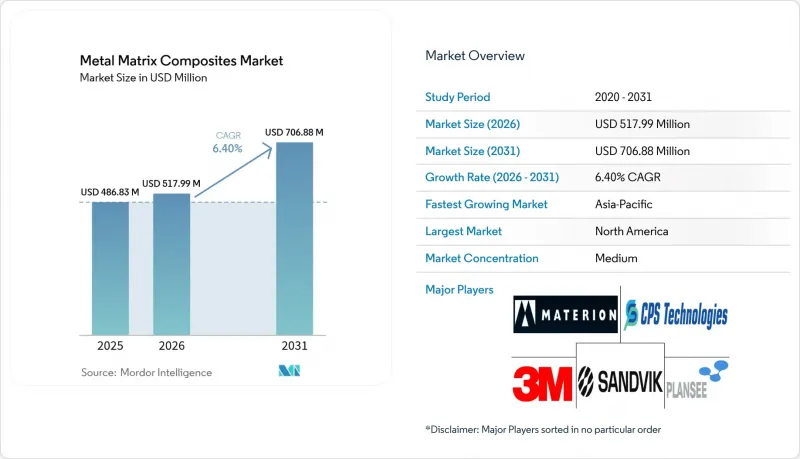
根據 Mordor Intelligence 預測,金屬複合材料的市場規模預計將從 2025 年的 4.8683 億美元成長到 2026 年的 5.1799 億美元,並將從 2026 年到 2031 年以 6.40% 的複合年成長率,到 2031 年達到 7.08 億美元。
本報告按類型(鋁、耐火材料、其他)、填充材(碳化矽、氧化鋁、其他)、終端用戶產業(汽車及機車、航太及國防、其他終端用戶產業)及地區(亞太、北美、歐洲、南美、中東和非洲)進行細分。市場預測以美元計價。
全球金屬複合材料市場趨勢及洞察
航太和國防領域對輕量材料的需求日益成長。
領先的航太製造商正在減輕結構重量以增加航程和負載容量,這促使鋁基和鈦基複合材料在機身蒙皮、飛彈彈體和衛星面板等領域得到更廣泛的應用。高超音速專案需要能夠承受極端溫度梯度的蒙皮,因此耐火基體材料成為認證流程的一部分。國防相關企業目前正指定使用金屬複合材料製造電子戰機殼,旨在透過減輕品質來提高關鍵任務的功率密度。 ECSS 和 MIL-HDBK-17 標準定義了測試方法並促進了認證,從而實現了飛行硬體的快速應用。洛克希德馬丁公司對 SupremEX™ 組件的長期投資凸顯了其對複合金屬的長期承諾。
電動車的快速普及推動了對先進溫度控管材料的需求。
在快速充電的電動車中,電池組和功率模組周圍會產生超過 100 W/cm²的局部熱通量。碳化矽增強鋁的散熱性能比傳統鋁高出 40% 至 60%,同時也能滿足電池組的品質限制。此外,逆變器底板也採用了鑽石或石墨烯增強銅基體,透過匹配熱膨脹係數來降低焊點疲勞。特斯拉和比亞迪等汽車製造商正在將這些複合材料應用於下一代散熱界面架構。 5G大型基地台的平行部署正在推動各產業對類似散熱解決方案的需求,從而導致認證供應商的訂單大幅成長。
複雜且成本高的製造程序
雷射粉末層熔融成型零件的製造成本可能比同等鑄造零件高出2到120倍,這限制了其在高附加價值應用領域的應用。星形鑄造生產線需要精確的溫度和氣氛控制,這需要大量資本投入的爐體設備和操作人員培訓。對孔隙率和增強體分佈進行無損檢測會增加檢測成本,而符合ASTM D3552-24標準也會產生額外的檢測費用。對於小規模製造商而言,投資此類基礎設施十分困難,導致區域供應多樣性有限,並阻礙了金屬複合材料市場的成長。
細分市場分析
預計到2025年,鋁材將佔銷售額的45.55%,並與航太和汽車產業現有的認證資料庫產生顯著的綜效。在金屬基質複合材料市場,鋁材因其輕質特性和導熱性(比鋼高出200%以上)而仍然是首選材料,這使得無需對模具進行重大改造即可整合煞車片和散熱器。耐火材料雖然目前規模仍較小,但以7.36%的複合年成長率成長。由於高超音速飛機蒙皮必須承受超過1000 度C的邊界層溫度,因此鉬基和鎢基系統是主要候選材料。
目前,積層製造工具路徑允許在鋁結構中嵌入梯度圖案增強材料,從而在保持芯部韌性的同時提高表面附近的硬度。 ASTM鋁基複合材料認證協議進一步簡化了航太領域的核准流程。雖然耐火材料系統的標準化程度仍然有限,但新型雷射覆層技術有望降低成本,從而在未來推動金屬複合材料產業的規模化生產和產品多樣化。
區域分析
預計到2025年,北美將佔總銷售額的32.40%,這主要得益於國防費用的優先性以及航太設備製造商(OEM)集中於美國西海岸和中西部地區。戰鬥機和航太專案的國內採購獎勵確保了區域需求,而《晶片製造和整合產品法案》(CHIPS Act)則為下一代晶圓製造工廠的複合材料散熱器提供了激勵措施。 Materion和Howmet皆採用垂直整合的業務模式,以降低增強材料供應衝擊的影響,並確保符合國際武器貿易條例(ITAR)的規定。
亞太地區預計到2031年將以7.22%的複合年成長率成長,主要得益於中國鋁產業鍊和具有成本競爭力的碳化矽生產,這將縮短汽車煞車供應商的前置作業時間。日本的精密加工產業正朝著汽車動力模組複合材料外殼的大規模生產方向發展,而韓國則在其不斷擴建的電池工廠中引入高導熱基板。區域自由貿易協定正在改善澳洲礬土和越南稀土元素計畫的准入,從而鞏固金屬基質複合材料市場的長期原料供應。
歐洲位於這兩個極端之間,憑藉其嚴格的排放氣體法規,推動了複合材料泡沫用於鐵路車輛的碰撞吸收箱,這表明該領域具有進一步拓展的潛力。儘管南美洲和中東市場仍在發展中,但它們擁有礬土和鈦礦蘊藏量,這些儲量預計將在2030年後建造一個區域性的複合複合材料生態系統。
其他好處:
- Excel格式的市場預測(ME)表
- 3個月的分析師支持
目錄
第1章:引言
- 研究假設和市場定義
- 調查範圍
第2章:調查方法
第3章執行摘要
第4章 市場狀況
- 市場概覽
- 市場促進因素
- 航太和國防領域對輕量材料的需求日益成長。
- 電動車的快速普及推動了對先進溫度控管材料需求的成長。
- 汽車產業正轉向使用碳化矽增強鋁製煞車和動力傳動系統零件
- 與傳統金屬相比,具有優異的機械性能和熱性能。
- 積層製造技術在複雜MMC散熱器的應用
- 市場限制因素
- 複雜且成本高的製造程序
- 陶瓷/石墨烯增強材料高成本
- 供應鏈規模和標準的差異
- 價值鏈分析
- 技術展望
- 波特五力模型
第5章 市場規模與成長預測
- 按類型
- 鋁
- 耐火材料
- 鎳
- 其他類型
- 填充類型
- 碳化矽
- 氧化鋁
- 碳化鈦
- 其他填充物
- 按最終用戶行業分類
- 汽車和機車
- 航太/國防
- 電氣和電子設備
- 工業機械
- 其他終端用戶產業
- 按地區
- 亞太地區
- 中國
- 印度
- 日本
- 韓國
- 東南亞國協
- 其他亞太國家
- 北美洲
- 美國
- 加拿大
- 墨西哥
- 歐洲
- 德國
- 英國
- 法國
- 義大利
- 俄羅斯
- 北歐國家
- 其他歐洲國家
- 南美洲
- 巴西
- 阿根廷
- 其他南美國家
- 中東和非洲
- 沙烏地阿拉伯
- 南非
- 其他中東和非洲國家
- 亞太地區
第6章 競爭情勢
- 市場集中度
- 策略趨勢
- 市佔率和排名分析
- 公司簡介
- 3A Composites
- 3M
- ADMA Products, Inc.
- CPS Technologies
- Cymat Technologies Ltd.
- Denka Company Limited
- DWA Aluminum Composites USA, Inc.
- GKN Powder Metallurgy
- Materion Corporation
- Mitsubishi Materials Corporation
- MTC Powder Solutions AB
- Plansee SE
- Sandvik AB
- Sumitomo Electric Industries, Ltd.
- TISICS Ltd.
第7章 市場機會與未來展望
According to Mordor Intelligence, the metal matrix composites market size is expected to grow from USD 486.83 million in 2025 to USD 517.99 million in 2026 and is forecast to reach USD 706.88 million by 2031 at 6.40% CAGR over 2026-2031.
This report is Segmented by Type (Aluminium, Refractory, and Other Types), Fillers (Silicon Carbide, Aluminium Oxide, and Other Fillers), End-User Industry (Automotive and Locomotive, Aerospace and Defence, and Other End-User Industries), and Geography (Asia-Pacific, North America, Europe, South America, and Middle East and Africa). The Market Forecasts are Provided in Terms of Value (USD).
Global Metal Matrix Composites Market Trends and Insights
Increasing Demand for Lightweight Materials in Aerospace and Defense
Aerospace primes reduce structural weight to extend range and payload, prompting aluminum- and titanium-matrix composites in fuselage skins, missile bodies, and satellite panels. Hypersonic programs require skins that survive extreme thermal gradients, pushing refractory matrices into qualification pipelines. Defense contractors now specify metal matrix composites for electronic-warfare enclosures where mass savings deliver mission-relevant power density gains. ECSS and MIL-HDBK-17 standards govern test methods and facilitate certification, enabling faster insertion into flight hardware. Lockheed Martin's historical investment in SupremEX(TM) components underscores long-term commitment to composite metals.
Rapid EV-Led Need for Advanced Thermal-Management Materials
Fast-charging electric vehicles generate localized heat fluxes exceeding 100 W/cm2 around battery tabs and power modules. Silicon-carbide-reinforced aluminum spreads heat 40-60% better than conventional aluminum while maintaining battery-pack mass budgets. Diamond- and graphene-enhanced copper matrices emerge for inverter baseplates where coefficient-of-thermal-expansion matching mitigates solder fatigue. Automakers such as Tesla and BYD embed these composites into next-generation thermal interface architectures. Parallel roll-out of 5G macro cells intensifies cross-industry demand for identical heat-spreader solutions, multiplying order volumes for qualified suppliers.
Complex and Costly Fabrication Processes
Laser powder-bed fusion builds can cost 2-120 times more than comparable cast parts, restricting use to high-value applications. Stir-casting lines require precise temperature and atmosphere control, demanding capital-intensive furnaces and operator training. Non-destructive evaluation of porosity and reinforcement distribution adds inspection overhead, while ASTM D3552-24 compliance introduces incremental testing expenses. Smaller fabricators struggle to fund such infrastructure, limiting regional supply diversity and restraining the metal matrix composites market.
Other drivers and restraints analyzed in the detailed report include:
- Automotive Shift Toward SiC-Reinforced Al Brake and Power-Train Parts
- Superior Mechanical and Thermal Properties vs. Conventional Metals
- High Cost of Ceramic/Graphene Reinforcements
For complete list of drivers and restraints, kindly check the Table Of Contents.
Segment Analysis
Aluminum captured 45.55% of 2025 revenue, underscoring their synergy with existing aerospace and automotive qualification databases. The metal matrix composites market demonstrates sustained preference for aluminum because it combines lightweight attributes with thermal conductivity that exceeds steel by >=200%, enabling brake and heat-sink integration without severe tooling changes. Refractory, though smaller, are growing at a 7.36% CAGR; hypersonic vehicle skins must endure more than 1,000 °C boundary-layer temperatures that position molybdenum- or tungsten-based systems as frontrunners.
Additive-manufacturing toolpaths now embed graded reinforcements inside aluminum structures, allowing increased near-surface hardness while retaining ductile cores. ASTM certification protocols for aluminum composites further smooth aerospace approval pathways. Conversely, refractory systems face limited standardization, but novel laser-cladding approaches promise cost decline, hinting at eventual volume penetration that will diversify the metal matrix composites industry.
Complete Report Scope:
- By Type
- Aluminium
- Refractory
- Nickel
- Other Types
- By Fillers
- Silicon Carbide
- Aluminium Oxide
- Titanium Carbide
- Other Fillers
- By End-user Industry
- Automotive and Locomotive
- Aerospace and Defence
- Electrical and Electronics
- Industrial Machinery
- Other End-user Industries
- By Geography
- Asia-Pacific
- China
- India
- Japan
- South Korea
- ASEAN Countries
- Rest of Asia-Pacific
- North America
- United States
- Canada
- Mexico
- Europe
- Germany
- United Kingdom
- France
- Italy
- Russia
- NORDIC Countries
- Rest of Europe
- South America
- Brazil
- Argentina
- Rest of South America
- Middle East and Africa
- Saudi Arabia
- South Africa
- Rest of Middle East and Africa
- Asia-Pacific
Geography Analysis
North America controlled 32.40% of 2025 revenue because of its defense spending priorities and aerospace OEM clustering around the U.S. West Coast and Midwest. Domestic content rules in fighter and space programs secure local demand, while CHIPS Act incentives support composite heat-spreaders inside next-generation wafer fabs. Materion and Howmet run vertically integrated operations, mitigating reinforcement supply shocks and ensuring compliance with ITAR regulations.
Asia-Pacific leads growth with a 7.22% CAGR forecast to 2031 as China's aluminum value chain and cost-competitive silicon-carbide production shorten lead times for automotive brake suppliers. Japan's precision-machining sector scales composite housings for vehicle power modules, and South Korea integrates high-thermal-conductivity baseplates into its expanding battery plants. Regional free-trade agreements improve access to Australian bauxite and Vietnamese rare-earth projects, anchoring long-term feedstock security for the metal matrix composites market.
Europe situates between the two poles, leveraging strict emissions standards to drive composite part integration in premium cars and Airbus platforms. Germany's Tier-1 suppliers pioneer friction-stir-processed panels that satisfy REACH guidelines. Eastern-European machine shops explore composite metal foams for railcar crash-boxes, hinting at broader adoption. South American and Middle Eastern markets remain nascent yet possess bauxite and titanium reserves that could seed localized composite ecosystems post-2030.
- 3A Composites
- 3M
- ADMA Products, Inc.
- CPS Technologies
- Cymat Technologies Ltd.
- Denka Company Limited
- DWA Aluminum Composites USA, Inc.
- GKN Powder Metallurgy
- Materion Corporation
- Mitsubishi Materials Corporation
- MTC Powder Solutions AB
- Plansee SE
- Sandvik AB
- Sumitomo Electric Industries, Ltd.
- TISICS Ltd.
Additional Benefits:
- The market estimate (ME) sheet in Excel format
- 3 months of analyst support
TABLE OF CONTENTS
1 Introduction
- 1.1 Study Assumptions and Market Definition
- 1.2 Scope of the Study
2 Research Methodology
3 Executive Summary
4 Market Landscape
- 4.1 Market Overview
- 4.2 Market Drivers
- 4.2.1 Increasing Demand for Lightweight Materials in Aerospace and Defence
- 4.2.2 Rapid EV-Led Need for Advanced Thermal-Management Materials
- 4.2.3 Automotive Shift Toward Sic-Reinforced Al Brake and Power-Train Parts
- 4.2.4 Superior Mechanical and Thermal Properties Vs. Conventional Metals
- 4.2.5 Additive-Manufacturing Adoption for Complex MMC Heat Sinks
- 4.3 Market Restraints
- 4.3.1 Complex and Costly Fabrication Processes
- 4.3.2 High Cost of Ceramic/Graphene Reinforcements
- 4.3.3 Supply-Chain Scale and Standards Gaps
- 4.4 Value Chain Analysis
- 4.5 Technological Outlook
- 4.6 Porter's Five Forces
- 4.6.1 Bargaining Power of Suppliers
- 4.6.2 Bargaining Power of Buyers
- 4.6.3 Threat of New Entrants
- 4.6.4 Threat of Substitutes
- 4.6.5 Degree of Competition
5 Market Size and Growth Forecasts (Value)
- 5.1 By Type
- 5.1.1 Aluminium
- 5.1.2 Refractory
- 5.1.3 Nickel
- 5.1.4 Other Types
- 5.2 By Fillers
- 5.2.1 Silicon Carbide
- 5.2.2 Aluminium Oxide
- 5.2.3 Titanium Carbide
- 5.2.4 Other Fillers
- 5.3 By End-user Industry
- 5.3.1 Automotive and Locomotive
- 5.3.2 Aerospace and Defence
- 5.3.3 Electrical and Electronics
- 5.3.4 Industrial Machinery
- 5.3.5 Other End-user Industries
- 5.4 By Geography
- 5.4.1 Asia-Pacific
- 5.4.1.1 China
- 5.4.1.2 India
- 5.4.1.3 Japan
- 5.4.1.4 South Korea
- 5.4.1.5 ASEAN Countries
- 5.4.1.6 Rest of Asia-Pacific
- 5.4.2 North America
- 5.4.2.1 United States
- 5.4.2.2 Canada
- 5.4.2.3 Mexico
- 5.4.3 Europe
- 5.4.3.1 Germany
- 5.4.3.2 United Kingdom
- 5.4.3.3 France
- 5.4.3.4 Italy
- 5.4.3.5 Russia
- 5.4.3.6 NORDIC Countries
- 5.4.3.7 Rest of Europe
- 5.4.4 South America
- 5.4.4.1 Brazil
- 5.4.4.2 Argentina
- 5.4.4.3 Rest of South America
- 5.4.5 Middle East and Africa
- 5.4.5.1 Saudi Arabia
- 5.4.5.2 South Africa
- 5.4.5.3 Rest of Middle East and Africa
- 5.4.1 Asia-Pacific
6 Competitive Landscape
- 6.1 Market Concentration
- 6.2 Strategic Moves
- 6.3 Market Share/Ranking Analysis
- 6.4 Company Profiles (includes Global level Overview, Market level overview, Core Segments, Financials as available, Strategic Information, Market Rank/Share for key companies, Products and Services, and Recent Developments)
- 6.4.1 3A Composites
- 6.4.2 3M
- 6.4.3 ADMA Products, Inc.
- 6.4.4 CPS Technologies
- 6.4.5 Cymat Technologies Ltd.
- 6.4.6 Denka Company Limited
- 6.4.7 DWA Aluminum Composites USA, Inc.
- 6.4.8 GKN Powder Metallurgy
- 6.4.9 Materion Corporation
- 6.4.10 Mitsubishi Materials Corporation
- 6.4.11 MTC Powder Solutions AB
- 6.4.12 Plansee SE
- 6.4.13 Sandvik AB
- 6.4.14 Sumitomo Electric Industries, Ltd.
- 6.4.15 TISICS Ltd.
7 Market Opportunities and Future Outlook
- 7.1 White-space and Unmet-need Assessment

 金屬複合材料市場預測至2034年-全球分析(按基體材料、增強材料、增強形式、製造流程、產品形式、複合材料結構、應用、終端用戶產業和地區分類)
 金屬複合材料市場:2026-2032年全球市場預測(按基體金屬類型、增強體形狀、增強材料、加工方法、應用和最終用途行業分類)
 金屬複合材料市場規模、佔有率和成長分析:按基體材料、增強材料、製造流程、應用、終端用戶產業、形狀和地區分類-2026-2033年產業預測
 金屬複合材料市場規模:按類型、增強材料、增強形式、製造技術、終端應用產業和地區分類(2026-2034 年)金屬複合軸承市場:按軸承類型、材料、分銷管道、結構和應用分類的全球預測,2026-2032年
 金屬陶瓷複合材料市場規模、佔有率和成長分析:按材料類型、應用、最終用戶、幾何形狀和地區分類-2026-2033年產業預測
 金屬複合材料市場規模、佔有率、成長及全球產業分析:按類型、應用和地區的洞察,2026-2034年預測
 金屬基複合材料全球市場報告(2026)
 航太金屬複合材料市場-全球產業規模、佔有率、趨勢、機會、預測:按應用、基體類型、增強體類型、地區和競爭格局分類,2021-2031年超輕金屬基複合材料市場預測至2032年:按材料類型、增強材料類型、製造流程、最終用戶和地區分類的全球分析