


 |
市場調查報告書
商品編碼
2122287
顯示面板:市場佔有率分析、產業趨勢與統計、成長預測(2026-2031)Display Panel - Market Share Analysis, Industry Trends & Statistics, Growth Forecasts (2026 - 2031) |
||||||

※ 本網頁內容可能與最新版本有所差異。詳細情況請與我們聯繫。
根據 Mordor Intelligence 預測,顯示面板市場規模將從 2025 年的 1,671.2 億美元和 2026 年的 1,727.3 億美元成長到 2031 年的 2,106.8 億美元,2026 年至 2031 年的複合年成長率為 4.05%。
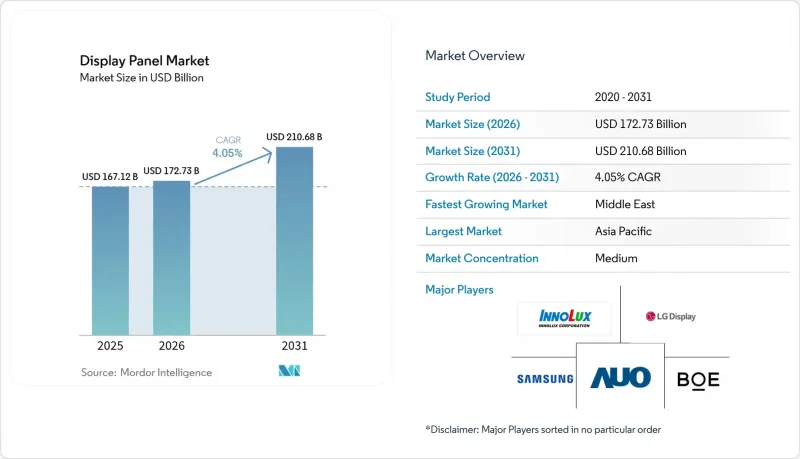
本報告按顯示類型(LCD、OLED、MicroLED、AMOLED、其他)、解析度(高清、4K、8K 及以上)、應用領域(智慧手機和平板電腦、PC 和筆記型電腦、電視、汽車和交通運輸、其他)、面板尺寸(6 英寸及以下、6.1-13 英寸、13.1-32 英寸、33-65 英寸、66 英寸及以上)和地區(歐洲、亞太地區、其他)進行細分。市場預測以美元計價。
全球顯示面板市場趨勢及洞察
超高清(4K以上)電視需求激增
2025年,印度和東南亞地區55吋電視的零售價跌破400美元,推動了4K電視的持續普及,並刺激了首次購買者的需求。同時,北美和歐洲的電視更換週期仍在持續。面板製造商最佳化了其10.5代液晶面板生產線,用於生產65吋4K面板,將單位面積成本降低到低於傳統8.5代生產線的水平。儘管8K面板的生產成本年減了18%至20%,但由於到2025年底串流平台上原生8K內容不足100部,該格式仍然是一個小眾市場,消費者需求疲軟。因此,各大品牌紛紛建置能夠交替生產4K和8K面板的生產線,以因應需求波動。這種雙格式柔軟性將使生產能夠在內容生態系統成熟時快速切換。
智慧型手機廠商轉向OLED和microLED
到2025年,主流旗艦智慧型手機將在其所有產品線中全面採用LTPO OLED技術,顯示器功耗將降低近五分之一,並鞏固主要OLED供應商的市佔率擴張。韓國和中國的第六代晶圓廠將實現6-7吋面板95%以上的良率,從而縮小與高階LCD的成本差距。商用microLED的先導計畫已從研發階段進入智慧型手錶和AR眼鏡領域的小規模生產階段,但由於2英寸以上面板的良率低於70%,且成本高出4-6倍,因此產量仍然有限。材料供應商的OLED發送器材料訂單積壓量強勁,顯示資本投資將持續到2027年。
對10.5代製造流程的高額資本投入
到2025年,每條10.5代液晶顯示器生產線的建造成本預計將達到30億至40億美元,比8.5代生產線高出約30%。中國主要企業同時在多個項目上投資超過120億美元,但多年的投資回收期和高昂的折舊免稅額成本阻礙了新進業者的競爭。擁有折舊免稅額良好的8.5代資產的企業在價格敏感型細分市場保持著20%至30%的成本優勢,這進一步加劇了市場兩極分化的格局,並預計到2025年,前五大液晶顯示器製造商的總合佔有率總和將達到78%。
細分市場分析
預計到2025年,OLED將佔40.74%的市佔率。這反映了OLED在高階智慧型手機、平板電腦和汽車顯示器領域的穩固地位,其卓越的能源效率和高對比度使其相對於LCD產品的價格溢價物有所值。 2025年,三星顯示和LG顯示器將為旗艦智慧型手機供應超過85%的OLED面板。這兩家公司均採用針對6.1-6.7吋尺寸最佳化的第六代晶圓廠,並運用LTPO技術,與上一代LTPS面板相比,功耗降低了18-22%。
微型LED技術正以4.35%的複合年成長率穩定發展,直至2031年,並逐步從實驗室原型階段邁向商業試點階段。這主要得益於PlayNitride和Porotech在2025年向一級OEM廠商交付了智慧型手錶和AR眼鏡應用的評估套件。然而,質量傳遞良率仍是限制因素,目前對角線尺寸大於2英吋的面板的質量傳遞良率低於70%,而成熟的OLED生產線的良率則超過95%。這導致微型LED的成本高出4-6倍,預計在可預見的未來,微型LED仍將局限於超高階市場。
隨著市場從高清轉向超高解析度轉變,市場格局日益兩極化。 4K 已實現主流化,而 8K 的普及仍受限於缺乏完善的生態系統。預計到 2025 年,4K 解析度將佔據 45.36% 的市場佔有率,這主要得益於已開發市場(已安裝超過 1.5 億台)的更換週期,以及新興市場(預計 55 吋機型在 2025 年下半年價格將降至 400 美元以下)的快速成長。
儘管由於第十代半晶圓廠良率的提高和效率的提升,8K面板的生產成本在2024年至2025年間下降了15%至20%,但零售價格仍然是同類4K面板的兩到三倍,這限制了其普及範圍,目前僅限於早期用戶和商用安裝。大多數市場的廣播基礎設施升級落後三到五年,到2025年,只有日本和韓國能夠部署8K地面電波廣播。這將進一步限制內容供應,並延緩8K在一般市場的廣泛應用。高清格式受益於全球超過10億台的穩定裝置量,預計在整個預測期內,即使向更高解析度的過渡不斷推進,對替換面板和售後維修的需求也將持續存在。
區域分析
預計到2025年,亞太地區的銷售額將達到831億美元,佔全球總銷售額的49.72%,這主要得益於中國Gen-8.6和Gen-10.5產能的提升,預計將使該地區年產能增加1500萬平方公尺。中國的市場主導地位源自於政府的資金籌措,這使得京東方科技集團和TCL華星光電在2024年至2025年間總合投資120億美元或更多用於Gen-10.5產能的擴張。由此形成的成本結構阻礙了新進入者的競爭,使那些能夠獲得補貼資金的成熟企業獲得了競爭優勢。在印度,根據生產連結獎勵計畫計畫(PLI),預計到2025年,顯示器製造領域的投資將超過30億美元。三星顯示器和Dixon Technologies宣布合作,將建立一家面向印度國內智慧型手機和電視市場的顯示模組組裝廠。
北美憑藉對高階電視和汽車顯示器的需求,保持著相當大的市場佔有率,但其國內面板產能有限,並依賴從亞洲進口,使其供應鏈面臨地緣政治和物流風險。歐洲也面臨類似的限制,除專業醫療產業外,國內面板製造能力極低。此外,將於2026年1月生效的關於偏光片的PFAS法規,迫使亞洲製造商應對複雜的監管挑戰,以維持市場進入。南美洲面臨基礎設施限制,巴西對顯示面板的進口關稅高達20-25%。雖然這鼓勵了本地組裝,但卻阻礙了對TFT和彩色濾光片生產等上游製程的投資。
非洲仍是一個新興市場,南非和埃及是區域分銷中心,但由於本地產能有限且價值鏈嚴重依賴進口,其成長速度與其他發展中地區相比受到限制。中東的成長主要集中在沙烏地阿拉伯的NEOM計畫和阿拉伯聯合大公國的杜拜矽谷綠洲,這兩個地區正在發展包括顯示器偵測和品質保證在內的電子製造群。這使得該地區能夠在組裝和模組整合方面獲得附加價值,儘管上游面板製造仍然集中在亞洲。
其他好處
- Excel格式的市場預測(ME)表
- 3個月的分析師支持
目錄
第1章:引言
- 研究假設和市場定義
- 調查範圍
第2章:調查方法
第3章執行摘要
第4章 市場狀況
- 市場概覽
- 市場促進因素
- 超高清(4K以上)電視需求激增
- 智慧型手機廠商轉向OLED和microLED
- 汽車駕駛座數位化浪潮
- 折疊式和可伸縮外形規格的創新
- 用於國防航空電子設備的無基板全像波導管顯示器。
- 歐盟區域性獎勵鼓勵回收無塵室玻璃
- 市場限制因素
- 對10.5代製造流程的高額資本投入
- 玻璃基板供應瓶頸問題依然存在。
- 氧化物和低溫聚合物氧化物背板技術領域人才短缺
- 與含 PFAS 的偏光片相關的環境監管風險
- 產業價值鏈分析
- 監理情勢
- 宏觀經濟因素的影響
- 波特五力分析
第5章 市場規模與成長預測
- 顯示類型
- LCD
- OLED
- 微型LED
- AMOLED
- 其他顯示類型
- 通過決議
- HD(HD/WQHD/FHD)
- 4K
- 8K 或更高
- 透過使用
- 智慧型手機和平板電腦
- 個人電腦和筆記型電腦
- 電視機
- 汽車和運輸業
- 穿戴式裝置和增強/虛擬實境
- 工業、醫療及其他
- 按面板尺寸
- 6吋或更小
- 6.1 至 13 英寸
- 13.1 至 32 英寸
- 33-65英寸
- 66吋或更大
- 按地區
- 北美洲
- 美國
- 加拿大
- 墨西哥
- 南美洲
- 巴西
- 阿根廷
- 其他南美國家
- 歐洲
- 德國
- 英國
- 法國
- 俄羅斯
- 其他歐洲國家
- 亞太地區
- 中國
- 日本
- 印度
- 韓國
- 東南亞
- 其他亞太國家
- 中東
- 沙烏地阿拉伯
- 阿拉伯聯合大公國
- 其他中東國家
- 非洲
- 南非
- 埃及
- 其他非洲地區
- 北美洲
第6章 競爭情勢
- 市場集中度
- 策略趨勢
- 市佔率分析
- 公司簡介
- Samsung Display Co., Ltd.
- LG Display Co., Ltd.
- BOE Technology Group Co., Ltd.
- AUO Corporation
- Innolux Corporation
- Japan Display Inc.
- Sharp Corporation
- TCL China Star Optoelectronics Technology Co., Ltd.
- Tianma Micro-electronics Co., Ltd.
- Visionox Technology Inc.
- Hisense Visual Technology Co., Ltd.
- Shenzhen Royole Technologies Co., Ltd.
- PlayNitride Inc.
- Kyocera Display Corporation
- Panasonic Holdings Corporation(Display Business)
- E Ink Holdings Inc.
- Universal Display Corporation
- Kopin Corporation
- Lumus Ltd.
- Tianma Japan, Ltd.
- Truly International Holdings Ltd.
- Giantplus Technology Co., Ltd.
- Ortustech Co., Ltd.
- EverDisplay Optronics(EDO)
- Microtips Technology, Inc.
第7章 市場機會與未來展望
According to Mordor Intelligence, the display panel market size is projected to expand from USD 167.12 billion in 2025 and USD 172.73 billion in 2026 to USD 210.68 billion by 2031, registering a 4.05% CAGR between 2026 and 2031.
This report is Segmented by Type of Display (LCD, OLED, Micro-LED, AMOLED, and More), Resolution (HD, 4K, and 8K and Above), Application (Smartphones and Tablets, PC and Laptop, Television, Automotive and Transportation, and More), Panel Size (<=6-Inch, 6. 1-13-Inch, 13. 1-32-Inch, 33-65-Inch, and >=66-Inch), and Geography (Europe, Asia-Pacific, and More). The Market Forecasts are Provided in Terms of Value (USD).
Global Display Panel Market Trends and Insights
Surging Demand for UHD (4K) Televisions
4K television penetration continued to rise in 2025 as retail pricing for 55-inch sets dipped below USD 400 in India and Southeast Asia, stimulating first-time purchases while replacement cycles persisted in North America and Europe. Panel makers optimized Gen-10.5 LCD lines for 65-inch 4K cuts, driving cost per area below legacy Gen-8.5 output. Although 8K panel production costs fell 18-20% year-over-year, the format remained a niche because streaming platforms offered under 100 native 8K titles as of late 2025, keeping consumer pull subdued. Brands therefore configured new production lines to alternate between 4K and 8K glass cuts to hedge demand swings. This dual-format flexibility permits rapid output shifts once content ecosystems mature.
Smartphone Pivot to OLED and Micro-LED
Mainstream flagship phones adopted LTPO OLED across entire model line-ups during 2025, trimming display power draw by nearly one-fifth and consolidating share gains for leading OLED suppliers. Gen-6 fabs in South Korea and China achieved yields above 95% on 6-7 inch panels, narrowing cost gaps with high-end LCD. Commercial Micro-LED pilots moved from R&D to limited production in the smartwatch and AR-glasses categories, yet yield rates below 70% for panels larger than 2 inches and a 4-6X cost premium kept volumes modest. Material suppliers logged strong order books for OLED emitter compounds, signaling sustained capital spending through 2027.
High Capex for Gen-10.5 Fabs
Gen-10.5 LCD lines required USD 3-4 billion per build-out in 2025, roughly 30% above Gen-8.5 equivalents. Chinese leaders financed simultaneous projects valued at over USD 12 billion, but multiyear payback horizons and elevated depreciation discouraged new entrants. Owners of depreciated Gen-8.5 assets maintained 20-30% cost advantages serving price-sensitive segments, reinforcing a two-tier market and lifting the combined share of the five largest LCD producers to 78% in 2025.
Other drivers and restraints analyzed in the detailed report include:
- Automotive Cockpit Digitization Wave
- Foldable and Rollable Form-Factor Innovation
- Persistent Glass Substrate Supply Bottlenecks
For complete list of drivers and restraints, kindly check the Table Of Contents.
Segment Analysis
OLED secured 40.74% market share in 2025, reflecting its entrenchment in premium smartphones, tablets, and automotive displays, where power efficiency and contrast ratios justify cost premiums over LCD alternatives. Samsung Display and LG Display supplied over 85% of OLED panels for flagship smartphones in 2025, leveraging Gen-6 fabs optimized for 6.1-6.7-inch formats that enable LTPO, reducing power consumption by 18-22% versus prior-generation LTPS panels.
Micro-LED is advancing at a 4.35% CAGR through 2031, transitioning from laboratory prototypes to commercial pilots as PlayNitride and Porotech shipped evaluation kits to tier-1 OEMs in 2025 for smartwatch and AR glasses applications. Mass transfer yield rates remain the binding constraint, currently below 70% for panels exceeding 2 inches diagonal versus 95%+ for mature OLED lines, sustaining a 4-6x cost premium that confines Micro-LED to ultra-premium segments in the near term.
The transition from HD to ultra-high-definition formats reveals a bifurcated market where 4K has achieved mainstream penetration while 8K remains constrained by ecosystem gaps. 4K resolution commanded 45.36% market share in 2025, sustained by replacement cycles in developed markets where installed bases exceed 150 million units and by penetration gains in emerging economies where 4K pricing fell below USD 400 for 55-inch models in late 2025.
8K panel production costs declined 15-20% between 2024 and 2025 due to yield improvements and Gen-10.5 fab efficiencies, yet retail pricing remains 2-3x higher than comparable 4K models, limiting adoption to early adopters and commercial installations. Broadcast infrastructure upgrades lag by 3-5 years in most markets, with only Japan and South Korea deploying 8K terrestrial broadcasts as of 2025, further constraining content supply and delaying mass-market adoption. HD formats benefit from entrenched installed bases exceeding 1 billion units globally, ensuring sustained demand for replacement panels and aftermarket repairs through the forecast period despite migration toward higher resolutions.
Complete Report Scope:
- Display Type
- LCD
- OLED
- Micro-LED
- AMOLED
- Other Display types
- By Resolution
- HD (HD/WQHD/FHD)
- 4K
- 8K and Above
- By Application
- Smartphones and Tablets
- PC and Laptop
- Television
- Automotive and Transportation
- Wearables and AR/VR
- Industrial, Medical and Others
- By Panel Size
- <=6-inch
- 6.1-13-inch
- 13.1-32-inch
- 33-65-inch
- >=66-inch
- By Geography
- North America
- United States
- Canada
- Mexico
- South America
- Brazil
- Argentina
- Rest of South America
- Europe
- Germany
- United Kingdom
- France
- Russia
- Rest of Europe
- Asia Pacific
- China
- Japan
- India
- South Korea
- South-East Asia
- Rest of Asia Pacific
- Middle East
- Saudi Arabia
- United Arab Emirates
- Rest of Middle East
- Africa
- South Africa
- Egypt
- Rest of Africa
- North America
Geography Analysis
Asia Pacific captured USD 83.1 billion, or 49.72% of 2025 revenue, as Chinese Gen-8.6 and Gen-10.5 capacity additions expanded annual output by 15 million square meters. China's dominance reflects state-backed financing that enabled BOE Technology Group and TCL CSOT to commit over USD 12 billion combined between 2024 and 2025 for Gen-10.5 capacity, creating cost structures that deter new entrants and favor incumbents with access to subsidized capital. India attracted over USD 3 billion in display manufacturing investments during 2025 under the Production-Linked Incentive (PLI) scheme, with Samsung Display and Dixon Technologies announcing partnerships to establish display module assembly facilities targeting domestic smartphone and television markets.
North America sustains a substantial share through premium television and automotive display demand, yet limited domestic panel production creates dependence on Asian imports that expose supply chains to geopolitical and logistics risks. Europe faces similar constraints with minimal domestic panel manufacturing capacity outside specialized medical and industrial segments, while PFAS restrictions on polarizer films, effective January 2026, add regulatory complexity that Asian manufacturers must navigate to maintain market access. South America confronts infrastructure limitations, with Brazil's import tariffs on display panels reaching 20-25% that incentivize local assembly but deter upstream investments in TFT and color filter production.
Africa remains an emerging market with South Africa and Egypt serving as regional distribution hubs, yet limited local manufacturing and import-dependent supply chains constrain growth relative to other developing regions. Middle East growth concentrates in Saudi Arabia's NEOM project and UAE's Dubai Silicon Oasis, which are developing electronics manufacturing clusters that include display testing and quality assurance capabilities, positioning the region to capture assembly and module integration value even as upstream panel fabrication remains in Asia.
- Samsung Display Co., Ltd.
- LG Display Co., Ltd.
- BOE Technology Group Co., Ltd.
- AUO Corporation
- Innolux Corporation
- Japan Display Inc.
- Sharp Corporation
- TCL China Star Optoelectronics Technology Co., Ltd.
- Tianma Micro-electronics Co., Ltd.
- Visionox Technology Inc.
- Hisense Visual Technology Co., Ltd.
- Shenzhen Royole Technologies Co., Ltd.
- PlayNitride Inc.
- Kyocera Display Corporation
- Panasonic Holdings Corporation (Display Business)
- E Ink Holdings Inc.
- Universal Display Corporation
- Kopin Corporation
- Lumus Ltd.
- Tianma Japan, Ltd.
- Truly International Holdings Ltd.
- Giantplus Technology Co., Ltd.
- Ortustech Co., Ltd.
- EverDisplay Optronics (EDO)
- Microtips Technology, Inc.
Additional Benefits:
- The market estimate (ME) sheet in Excel format
- 3 months of analyst support
TABLE OF CONTENTS
1 INTRODUCTION
- 1.1 Study Assumptions and Market Definition
- 1.2 Scope of the Study
2 RESEARCH METHODOLOGY
3 EXECUTIVE SUMMARY
4 MARKET LANDSCAPE
- 4.1 Market Overview
- 4.2 Market Drivers
- 4.2.1 Surging Demand for UHD (4K and Above) TVs
- 4.2.2 Smartphone OEM Pivot to OLED and Micro-LED
- 4.2.3 Automotive Cockpit Digitisation Wave
- 4.2.4 Foldable and Rollable Form-Factor Innovation
- 4.2.5 Substrate-Free Holographic Waveguide Displays for Defence Avionics
- 4.2.6 Localised EU Incentives for Clean-Room Glass Recycling
- 4.3 Market Restraints
- 4.3.1 High Capex for Gen-10.5 Fabs
- 4.3.2 Persistent Glass Substrate Supply Bottlenecks
- 4.3.3 Talent Scarcity in Oxide and LTPO Backplane Engineering
- 4.3.4 Environmental Regulation Risk on PFAS-Based Polariser Films
- 4.4 Industry Value Chain Analysis
- 4.5 Regulatory Landscape
- 4.6 Impact of Macroeconomic Factors
- 4.7 Porter's Five Forces Analysis
- 4.7.1 Bargaining Power of Suppliers
- 4.7.2 Bargaining Power of Consumers
- 4.7.3 Threat of New Entrants
- 4.7.4 Threat of Substitutes
- 4.7.5 Intensity of Competitive Rivalry
5 MARKET SIZE AND GROWTH FORECASTS (VALUE)
- 5.1 Display Type
- 5.1.1 LCD
- 5.1.2 OLED
- 5.1.3 Micro-LED
- 5.1.4 AMOLED
- 5.1.5 Other Display types
- 5.2 By Resolution
- 5.2.1 HD (HD/WQHD/FHD)
- 5.2.2 4K
- 5.2.3 8K and Above
- 5.3 By Application
- 5.3.1 Smartphones and Tablets
- 5.3.2 PC and Laptop
- 5.3.3 Television
- 5.3.4 Automotive and Transportation
- 5.3.5 Wearables and AR/VR
- 5.3.6 Industrial, Medical and Others
- 5.4 By Panel Size
- 5.4.1 <=6-inch
- 5.4.2 6.1-13-inch
- 5.4.3 13.1-32-inch
- 5.4.4 33-65-inch
- 5.4.5 >=66-inch
- 5.5 By Geography
- 5.5.1 North America
- 5.5.1.1 United States
- 5.5.1.2 Canada
- 5.5.1.3 Mexico
- 5.5.2 South America
- 5.5.2.1 Brazil
- 5.5.2.2 Argentina
- 5.5.2.3 Rest of South America
- 5.5.3 Europe
- 5.5.3.1 Germany
- 5.5.3.2 United Kingdom
- 5.5.3.3 France
- 5.5.3.4 Russia
- 5.5.3.5 Rest of Europe
- 5.5.4 Asia Pacific
- 5.5.4.1 China
- 5.5.4.2 Japan
- 5.5.4.3 India
- 5.5.4.4 South Korea
- 5.5.4.5 South-East Asia
- 5.5.4.6 Rest of Asia Pacific
- 5.5.5 Middle East
- 5.5.5.1 Saudi Arabia
- 5.5.5.2 United Arab Emirates
- 5.5.5.3 Rest of Middle East
- 5.5.6 Africa
- 5.5.6.1 South Africa
- 5.5.6.2 Egypt
- 5.5.6.3 Rest of Africa
- 5.5.1 North America
6 COMPETITIVE LANDSCAPE
- 6.1 Market Concentration
- 6.2 Strategic Moves
- 6.3 Market Share Analysis
- 6.4 Company Profiles (includes Global Level Overview, Market Level Overview, Core Segments, Financials as Available, Strategic Information, Market Rank/Share for Key Companies, Products and Services, and Recent Developments)
- 6.4.1 Samsung Display Co., Ltd.
- 6.4.2 LG Display Co., Ltd.
- 6.4.3 BOE Technology Group Co., Ltd.
- 6.4.4 AUO Corporation
- 6.4.5 Innolux Corporation
- 6.4.6 Japan Display Inc.
- 6.4.7 Sharp Corporation
- 6.4.8 TCL China Star Optoelectronics Technology Co., Ltd.
- 6.4.9 Tianma Micro-electronics Co., Ltd.
- 6.4.10 Visionox Technology Inc.
- 6.4.11 Hisense Visual Technology Co., Ltd.
- 6.4.12 Shenzhen Royole Technologies Co., Ltd.
- 6.4.13 PlayNitride Inc.
- 6.4.14 Kyocera Display Corporation
- 6.4.15 Panasonic Holdings Corporation (Display Business)
- 6.4.16 E Ink Holdings Inc.
- 6.4.17 Universal Display Corporation
- 6.4.18 Kopin Corporation
- 6.4.19 Lumus Ltd.
- 6.4.20 Tianma Japan, Ltd.
- 6.4.21 Truly International Holdings Ltd.
- 6.4.22 Giantplus Technology Co., Ltd.
- 6.4.23 Ortustech Co., Ltd.
- 6.4.24 EverDisplay Optronics (EDO)
- 6.4.25 Microtips Technology, Inc.
7 MARKET OPPORTUNITIES AND FUTURE OUTLOOK
- 7.1 White-Space and Unmet-Need Assessment

 顯示面板市場-2026-2032年全球市場預測
 顯示面板市場規模、佔有率和成長分析:按顯示技術、面板尺寸、應用、解析度、最終用戶、面板類型和地區分類-2026-2033年產業預測
 顯示面板市場預測至2034年-全球分析(依顯示技術、外形規格、解析度、面板尺寸、亮度等級、製造技術、應用、最終用戶、通路和地區分類)LTPS顯示面板市場按應用、最終用戶、螢幕大小、解析度、背光技術和觸控功能分類-2026-2032年全球預測無邊框顯示面板市場:按面板類型、面板技術、最終用途、解析度、分銷管道、應用和最終用戶分類-2026-2032年全球預測
 全球顯示面板市場
 顯示面板市場:2025-2030年預測
 智慧型手機顯示面板:全球市場佔有率分析、行業趨勢和統計、成長預測(2025-2030 年)