

 |
市場調查報告書
商品編碼
2183481
人類類器官市場:按產品、類型、培養方式、來源、疾病領域、應用和最終用戶分類-全球預測至2031年Human Organoids Market by Offering, Type, Culture Type, Source, Disease Area, Application, End User - Global Forecast to 2031 |
||||||


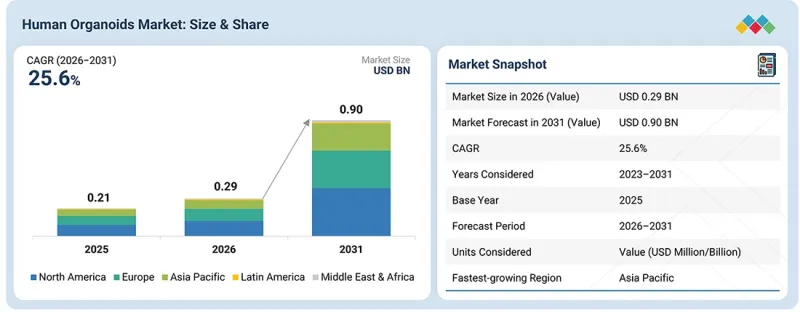
全球人類類器官市場預計將從 2026 年的 2.9 億美元成長到 2031 年的 9 億美元,複合年成長率為 25.6%。
隨著製藥公司和研究機構採用能夠複製人體組織生物學關鍵特徵的模型,全球人體類器官市場預計將在預測期內擴張。本研究涵蓋成品類器官模型、模型開發以及用於醫療和製藥應用的基於類器官的測試服務。
| 調查範圍 | |
|---|---|
| 調查期 | 2026-2031 |
| 基準年 | 2025 |
| 預測期 | 2026-2031 |
| 計算單位 | 金額(10億美元) |
| 部分 | 產品、原料、可用性、培養類型、疾病領域、應用和最終用戶 |
| 目標區域 | 北美、歐洲、亞太地區、拉丁美洲、中東和非洲 |
單獨出售的培養基、試劑、耗材和設備不包含在內。化妝品、獸醫、食品、農業和環境領域的應用也不包含在內。 FDA 2025 年 4 月發布的藍圖支持對檢驗的非動物測試方法進行評估,包括使用類器官進行毒性測試。對疾病特異性模型和可擴展篩選的需求正在為供應商創造商機。成本、專業知識、批次間差異以及組織機構的不成熟可能會限制其應用,因此需要仔細檢驗。
“即用型和可客製化的類器官模型有助於獲得與人類高度相關的研究系統。”
依產品供應情況,市場可細分為類器官模型及服務兩部分。模型部分包括即用型類器官成品和可自訂類器官。服務部分包括基於類器官模型的模型開發和測試。購買模型的科學研究人員可以在自己的實驗室進行實驗,而外包服務則提供專業的開發和篩選能力。丹納赫旗下的分子設備公司(美國)提供可用於檢測的類器官和客製化增殖服務。默克集團(德國)旗下的HUB Organoids(荷蘭)提供客製化模型開發和藥物篩選服務。模型品質、供體特徵和檢測相容性會影響製藥公司、研究機構和合約研究組織/合約研發生產組織(CRO/CRDMO)的購買決策。
“腸道和大腸的類器官模型滿足了消化器官系統研究和腫瘤篩檢的需求。”
本研究涵蓋肝臟、腸道/結腸、腎臟、胰臟、肺、心臟和其他類器官模型,並根據模型類型進行分類。其他模型包括腦、視網膜、乳腺和皮膚類器官。腸道和結腸模型使研究人員能夠在與患者相關的系統中研究上皮功能、疾病機制和藥物反應。美國 Molecular Devices 公司提供可用於檢測的結直腸癌和腸道類器官株,顯示已完成的模型可供商業性使用。腎臟類器官也支持腎臟疾病的研究,例如德國 Evotec 公司的 iPS 細胞衍生腎臟類器官技術。每種模型的需求量取決於組織功能、目標疾病的範圍以及其對預期實驗終點的適用性。
“在預測期內,亞太地區的類器官研究服務機會正在擴大。”
本次調查涵蓋北美、歐洲、亞太、拉丁美洲、中東和非洲。在亞太地區,隨著供應商利用人類類器官拓展藥物研發服務,新的機會正在出現。三星生物製劑(韓國)於2025年6月推出「三星類器官」(Samsung Organoids),透過患者來源的腫瘤類器官篩選,將其服務拓展至臨床前研究領域。藥明康德(中國)透過其子公司藥明生物,正在開發用於體外腫瘤篩選的異種移植類器官模型。這些能力滿足了對疾病相關模型和外包治療評估的需求。該地區的成長將取決於研發投入、患者來源樣本的獲取、模型的可重複性以及針對特定應用的類器官方法的檢驗。
人體類器官研究初步調查的主要受訪者類別如下:
- 受訪者組成:類器官模型和服務的提供者,以及製藥、生物技術和生物醫學研究機構的使用者。
- 公司類型:多元化生命科學公司、合約研究組織/合約研發生產組織、類器官開發專家、新創企業/中小企業
- 按職位分類:首席高階主管和總監、研發和業務經理、科學家及其他技術專家
- 按地區分類:北美、歐洲、亞太地區、拉丁美洲、中東和非洲
調查範圍
本報告按產品、模型類型、培養類型、來源、疾病領域、應用、最終用戶和地區對人類類器官市場進行細分。模型和服務的最終使用者分別進行評估。本研究涵蓋2023年至2024年的歷史資料(以2025年為基準年),並對2026年至2031年進行預測。報告檢驗了成長要素、阻礙因素因素、機會、挑戰、定價、資金籌措、技術進步、人工智慧應用和監管趨勢。競爭分析包括公司概況、收入和市場佔有率分析、公司估值矩陣、產品和策略發展。市場收入估算僅限於已完成的人類類器官模型以及模型開發和測試服務。通用培養耗材和設備不包含在市場估算中。
購買本報告的主要好處
本報告旨在幫助現有供應商和新參與企業評估成品類器官模型和研究服務的商機。報告還支持有關模型組合、治療重點、客戶群和地理擴張的決策。透過分析供應商能力、採購標準和准入壁壘,相關人員可以製定打入市場策略和合作策略。此外,該研究檢驗了標準化、可擴展生產和檢驗的測試方法如何影響市場需求和競爭地位。
本報告深入分析了以下幾點:
- 分析影響人類類器官市場的關鍵促進因素(對人類相關藥物篩選、患者衍生疾病模型和動物試驗的檢驗替代方案的需求)、阻礙因素(模型開發成本和專業知識)、機會(可擴展的類器官供應、個性化醫療研究和人工智慧驅動的模型標準化)以及挑戰(批次間差異、組織成熟度限制和實驗室間可重複性問題)。
- 產品開發/創新:深入了解已完成的類器官模型、模型開發和測試服務、自動化以及人工智慧驅動的類器官工作流程。
- 市場發展:評估研究涵蓋的六個地區和國家中人類類器官模型和服務的商業機會。
- 市場多元化:分析新興疾病模型、研究應用、未滿足的客戶需求、資金籌措和地理擴張機會。
- 競爭評估:對每家公司的市場定位、成長策略以及類器官產品的可用性進行評估。
目錄
第1章:引言
第2章執行摘要
第3章重要考察
- 人類類器官市場概覽
- 北美人類類器官市場:依產品類型和國家分類
- 人體類器官市場:區域成長機遇
- 人類類器官模型市場佔有率:依最終使用者分類(2026 年與 2031 年比較)(%)
- 人體類器官服務市場佔有率:依最終使用者分類(2026 年與 2031 年比較)(%)
第4章 市場概覽
- 市場動態
- 促進因素
- 抑制因子
- 機會
- 任務
- 未滿足的需求和未開發的領域
- 相互關聯的市場與跨產業機遇
- 一級/二級/三級主要公司的策略性舉措
第5章 產業趨勢
- 波特五力分析
- 新進入者的威脅
- 替代品的威脅
- 買方的議價能力
- 供應商的議價能力
- 競爭公司之間的競爭強度
- 宏觀經濟展望
- GDP趨勢與預測
- 全球人類類器官市場趨勢
- 價值鏈分析
- 生態系分析
- 主要人類類器官模型和服務供應商列表
- 主要類器官供應商的生產地點和產能趨勢
- 價格分析
- 按產品/服務分類的平均售價
- 2026-2027 年主要會議和活動
- 影響客戶業務的趨勢和顛覆性因素
- 投資和資金籌措場景
- 2025年美國關稅對全球人類類器官市場的影響。
- 價格影響分析
- 對該地區的影響
- 對終端用戶產業的影響
第6章:科技進步、人工智慧的影響、創新與未來應用
- 主要新興技術
- 人工智慧驅動的數位自動化和高通量類器官平台
- 相關技術
- 晶片器官/微生理系統
- 先進的球狀體和3D微組織模型
- 互補技術
- 空間轉錄組學與空間體學
- CRISPR/Cas基因編輯
- 技術和產品藍圖
- 專利分析
- 2015年至2025年人類類器官相關專利的主要申請人和權利持有人(公司)
- 未來應用
- 人工智慧/生成式人工智慧對全球人類類器官市場的影響
- 主要應用場景和市場潛力
- 全球人類類器官市場人工智慧應用案例研究
- 相互關聯的相鄰生態系及其對市場參與者的影響
- 全球人類類器官市場中客戶對生成式人工智慧應用的準備情況
第7章:監理情勢與永續發展舉措
- 區域法規和合規性
- 監管機構、政府機構和其他組織
- 業界標準
- 對永續性和監管政策措施的影響
- 認證、標籤和環境標準
第8章:顧客趨勢與購買行為
- 決策流程
- 買方相關人員和採購評估標準
- 採購過程中的關鍵相關人員
- 人類類器官模型的關鍵採購標準,依最終使用者分類。
- 實施障礙和內部挑戰
- 最終用戶未被滿足的需求
- 市場盈利
第9章:人類類器官市場:依產品供應情況分類
- 類器官模型
- 服務
第10章:人類類器官模型市場:依模型類型分類
- 肝臟模型
- 腸道和大腸模型
- 腎臟模型
- 胰臟模型
- 肺模型
- 心臟模型
- 其他類器官模型
第11章 人類類器官模型市場:依培養類型分類
- 利用細胞外基質/Matrigel進行培養
- 氣液界面培養
- 懸浮培養
- 其他文化類型
第12章:人類類器官模型市場:依來源分類
- 多功能細胞
- 成體幹細胞
- 胚胎幹細胞
- 其他來源
第13章 人類類器官市場:依疾病領域分類
- 腫瘤學
- 肝病/肝臟相關疾病
- 消化系統疾病
- 心血管疾病
- 感染疾病
- 神經系統疾病
- 其他疾病領域
第14章 人類類器官市場:依應用領域分類
- 藥物發現與篩選
- 藥物毒性和安全性測試
- 疾病建模
- 發育生物學
- 個人化醫療
- 再生醫學
- 其他用途
第15章:人類類器官模型市場:依最終使用者分類
- 製藥和生物技術公司
- 學術和研究機構
- CROS/CRDMOS
- 其他最終用戶
第16章 人類類器官服務市場:依最終使用者分類
- 製藥和生物技術公司
- 學術和研究機構
- CROS/CRDMOS
- 其他最終用戶
第17章 人類類器官市場:依地區分類
- 北美洲
- 美國
- 加拿大
- 歐洲
- 德國
- 英國
- 法國
- 義大利
- 西班牙
- 其他歐洲國家
- 亞太地區
- 中國
- 日本
- 印度
- 韓國
- 澳洲
- 亞太其他地區
- 拉丁美洲
- 巴西
- 墨西哥
- 其他拉丁美洲
- 中東和非洲
- 加大對生命科學研究的投資,以支持市場成長
第18章 競爭格局
- 主要參與企業的策略/優勢
- 人類類器官市場主要參與者策略概述
- 收入分析(2023-2025)
- 市佔率分析(2025 年)
- 企業估值矩陣:主要公司,2025 年
- 明星公司
- 新興領導者
- 玩家種類繁多
- 參與企業
- 主要公司企業企業發展狀況,2025 年
- 公司估值矩陣:新創企業/中小企業,2025 年
- 先進公司
- 應對力的公司
- 充滿活力的公司
- 起始點
- 2025年初創企業/中小企業競爭標竿分析
- 企業估值和財務指標
- 品牌比較分析
- 競爭格局
- 產品/服務推出
- 交易
- 其他趨勢
第19章:公司簡介
- 大公司
- MERCK KGAA
- DANAHER CORPORATION
- SAMSUNG BIOLOGICS
- WUXI APPTEC
- EVOTEC SE
- CHAMPIONS ONCOLOGY
- ACROBIOSYSTEMS
- BIOMORGAN LIMITED
- ORGANOID SCIENCES, INC.
- JSR CORPORATION
- THERMO FISHER SCIENTIFIC INC.
- BRUKER CORPORATION
- CHARLES RIVER LABORATORIES
- PHARMARON
- VIVOSIM LABS, INC.
- STEMCELL TECHNOLOGIES
- 其他主要公司
- SCREENIN3D
- DISCOVERY LIFE SCIENCES
- LIDE BIOTECH
- INNOSER
- CENSO BIOTECHNOLOGIES LTD
- CREATIVE BIOLABS
- PANDORUM TECHNOLOGIES PVT. LTD.
- INVITROCUE
- NEYROBLASTGX LLC
- DEXORGEN
- PIXLBIO
第20章:調查方法
第21章附錄
The global human organoids market is projected to reach USD 0.90 billion by 2031 from USD 0.29 billion in 2026, at a CAGR of 25.6%. The global human organoids market is expected to expand during the forecast period as pharmaceutical and research organizations adopt models that capture key features of human tissue biology. The study covers finished organoid models and model development and organoid-based testing services for medical and pharmaceutical applications.
| Scope of the Report | |
|---|---|
| Years Considered for the Study | 2026-2031 |
| Base Year | 2025 |
| Forecast Period | 2026-2031 |
| Units Considered | Value (USD billion) |
| Segments | Product, Source, Usability, Culture Method, Disease Area, Application, and End User |
| Regions covered | North America, Europe, Asia Pacific, Latin America, and the Middle East & Africa |
Separately sold media, reagents, consumables, and instruments are excluded, as are cosmetic, veterinary, food, agricultural, and environmental uses. The FDA's April 2025 roadmap supports evaluating validated non-animal methods, including organoid toxicity testing. Demand for disease-specific models and scalable screening creates opportunities for suppliers. Costs, specialized expertise, batch variability, and incomplete tissue maturation can limit adoption and require careful validation.
"Ready-to-use and customizable organoid models support access to human-relevant research systems."
Based on offerings, the market is segmented into organoid models and services. The models segment covers ready-to-use and customizable organoids supplied as finished products. Services include model development and organoid model-based testing. Researchers purchasing models can conduct experiments in their own laboratories, while outsourced services provide specialized development and screening capabilities. Molecular Devices (US), a Danaher company, supplies assay-ready organoids and custom expansion services. HUB Organoids (Netherlands), part of Merck KGaA (Germany), provides custom model development and drug screening. Model quality, donor characteristics, and assay suitability influence purchasing decisions across pharmaceutical companies, research institutes, and CROs/CRDMOs.
"Intestinal and colorectal organoid models address gastrointestinal research and oncology screening needs."
Based on model type, the study covers liver, intestinal & colorectal, kidney, pancreatic, lung, heart, and other organoid models. Other models include brain, retinal, breast, and skin organoids. Intestinal and colorectal models enable researchers to investigate epithelial function, disease mechanisms, and drug response in patient-relevant systems. Molecular Devices (US) offers assay-ready colorectal cancer and intestinal organoid lines, illustrating commercial access to finished models. Kidney organoids also support renal disease research, as demonstrated by Evotec's (Germany) iPSC-derived kidney organoid capabilities. Demand across model types depends on tissue function, disease coverage, and suitability for the intended experimental endpoints.
"Organoid research services are expanding opportunities in Asia Pacific during the forecast period."
The regional scope comprises North America, Europe, Asia Pacific, Latin America, the Middle East, and Africa. Asia Pacific offers opportunities as providers expand human organoid-based drug discovery services. Samsung Biologics (South Korea) launched Samsung Organoids in June 2025, extending its services into preclinical research through patient-derived tumor organoid screening. WuXi AppTec (China), through WuXi Biology, develops xenograft-derived organoid models for in vitro oncology screening. These capabilities support demand for disease-relevant models and outsourced therapeutic evaluation. Growth across the region will depend on research investment, access to patient material, model reproducibility, and validation of organoid methods for specific applications.
Primary research respondent categories for the human organoids study include:
- By Respondent: Supply-side providers of organoid models and services; demand-side users in pharmaceutical, biotechnology, and biomedical research organizations
- By Company Type: Diversified life science companies, CROs/CRDMOs, specialist organoid developers, and startups/SMEs
- By Designation: CXOs and directors, research and business managers, scientists, and other technical specialists
- By Region: North America, Europe, Asia Pacific, Latin America, the Middle East, and Africa
List of Companies Covered in the Study
- Thermo Fisher Scientific Inc.
- Danaher Corporation
- Merck KGaA
- Eurofins Scientific
- WuXi AppTec
- Charles River Laboratories
- Bruker Corporation
- Pharmaron
- Evotec
- ACROBiosystems
- Samsung Biologics
- Other Players
Research Coverage
This report categorizes the human organoids market by offering, model type, culture type, source, disease area, application, end user, and region. Model and service end users are assessed separately. The study covers historical years 2023-2024, base year 2025, and forecasts for 2026-2031. It examines drivers, restraints, opportunities, challenges, pricing, funding, technological advances, AI applications, and regulatory developments. Competitive coverage includes company profiles, revenue and market share analysis, company evaluation matrices, offering footprints, and strategic developments. Market revenue is restricted to finished human organoid models and model development and testing services. General culture supplies and instruments are excluded from the market estimates.
Key Benefits of Buying the Report
The report helps established suppliers and new entrants assess revenue opportunities across finished organoid models and research services. It supports decisions on model portfolios, therapeutic focus, customer groups, and geographic expansion. Analysis of supplier capabilities, buying criteria, and adoption barriers helps stakeholders develop market entry and partnership strategies. The study also examines how standardization, scalable production, and validated testing methods may affect demand and competitive positioning.
The report provides insights into the following pointers:
- Analysis of key drivers (demand for human-relevant drug screening, patient-derived disease models, and validated alternatives to animal testing), restraints (model development costs and specialized expertise), opportunities (scalable organoid supply, personalized medicine research, and AI-assisted model standardization), and challenges (batch variability, limited tissue maturation, and cross-laboratory reproducibility) affecting the human organoids market.
- Product Development/Innovation: Insights into finished organoid models, model development and testing services, automation, and AI-assisted organoid workflows.
- Market Development: Assessment of opportunities for human organoid models and services across six regions and the countries included in the study scope.
- Market Diversification: Analysis of emerging disease models, research applications, underserved customer needs, funding, and geographic expansion opportunities.
- Competitive Assessment: Assessment of market positioning, growth strategies, and organoid offerings of companies, including Merck KGaA (Germany), Danaher Corporation (US), Samsung Biologics (South Korea), WuXi AppTec (China), and Evotec (Germany).
TABLE OF CONTENTS
1 INTRODUCTION
- 1.1 STUDY OBJECTIVES
- 1.2 MARKET DEFINITION
- 1.3 STUDY SCOPE
- 1.3.1 MARKETS SEGMENTATION & REGIONS COVERED
- 1.3.2 INCLUSIONS & EXCLUSIONS
- 1.3.3 YEARS CONSIDERED
- 1.3.4 CURRENCY CONSIDERED
- 1.4 STAKEHOLDERS
- 1.5 SUMMARY OF CHANGES
2 EXECUTIVE SUMMARY
- 2.1 MARKET HIGHLIGHTS & KEY INSIGHTS
- 2.2 KEY MARKET PARTICIPANTS: MAPPING OF STRATEGIC DEVELOPMENTS
- 2.3 DISRUPTIVE TRENDS IN HUMAN ORGANOIDS MARKET
- 2.4 HIGH-GROWTH SEGMENTS
- 2.5 REGIONAL SNAPSHOT: MARKET SIZE, GROWTH RATE, AND FORECAST
3 PREMIUM INSIGHTS
- 3.1 HUMAN ORGANOIDS MARKET OVERVIEW
- 3.2 NORTH AMERICA: HUMAN ORGANOIDS MARKET, BY PRODUCT TYPE AND COUNTRY
- 3.3 HUMAN ORGANOIDS MARKET: GEOGRAPHIC GROWTH OPPORTUNITIES
- 3.4 HUMAN ORGANOIDS MODELS MARKET SHARE, BY END USER, 2026 VS 2031 (%)
- 3.5 HUMAN ORGANOIDS SERVICES MARKET SHARE, BY END USER, 2026 VS 2031 (%)
4 MARKET OVERVIEW
- 4.1 INTRODUCTION
- 4.2 MARKET DYNAMICS
- 4.2.1 DRIVERS
- 4.2.1.1 Growing demand for human-relevant drug testing and non-animal evidence
- 4.2.1.2 Expansion of standardized organoid supply and outsourced testing capacity
- 4.2.2 RESTRAINTS
- 4.2.2.1 High model establishment costs and lengthy experimental turnaround
- 4.2.3 OPPORTUNITIES
- 4.2.3.1 Patient-linked organoid screening for functional precision oncology
- 4.2.3.2 Expansion into immune and non-oncology organoid applications
- 4.2.4 CHALLENGES
- 4.2.4.1 Reproducibility and fit-for-purpose predictive validation
- 4.2.1 DRIVERS
- 4.3 UNMET NEEDS AND WHITE SPACES
- 4.4 INTERCONNECTED MARKETS AND CROSS-SECTOR OPPORTUNITIES
- 4.5 STRATEGIC MOVES BY TIER-1/2/3 PLAYERS
5 INDUSTRY TRENDS
- 5.1 PORTER'S FIVE FORCES ANALYSIS
- 5.1.1 THREAT OF NEW ENTRANTS
- 5.1.2 THREAT OF SUBSTITUTES
- 5.1.3 BARGAINING POWER OF BUYERS
- 5.1.4 BARGAINING POWER OF SUPPLIERS
- 5.1.5 INTENSITY OF COMPETITIVE RIVALRY
- 5.2 MACROECONOMIC OUTLOOK
- 5.2.1 INTRODUCTION
- 5.2.2 GDP TRENDS AND FORECAST
- 5.2.3 TRENDS IN THE GLOBAL HUMAN ORGANOIDS MARKET
- 5.3 VALUE CHAIN ANALYSIS
- 5.4 ECOSYSTEM ANALYSIS
- 5.4.1 LIST OF KEY HUMAN ORGANOID MODEL AND SERVICE PROVIDERS
- 5.4.2 PRODUCTION SITES AND CAPABILITY DEVELOPMENTS OF KEY ORGANOID PROVIDERS
- 5.5 PRICING ANALYSIS
- 5.5.1 AVERAGE SELLING PRICE, BY PRODUC/ SERVICE
- 5.6 KEY CONFERENCES & EVENTS, 2026-2027
- 5.7 TRENDS/DISRUPTIONS IMPACTING CUSTOMERS' BUSINESSES
- 5.8 INVESTMENT & FUNDING SCENARIO
- 5.9 IMPACT OF 2025 US TARIFFS-GLOBAL HUMAN ORGANOIDS MARKET
- 5.9.1 INTRODUCTION
- 5.9.2 PRICE IMPACT ANALYSIS
- 5.9.3 IMPACT ON REGIONS
- 5.9.3.1 North America
- 5.9.3.2 Europe
- 5.9.3.3 Asia Pacific
- 5.9.4 IMPACT ON END-USE INDUSTRIES
- 5.9.4.1 Pharmaceutical and Biotechnology Companies
- 5.9.4.2 Academic and Research Institutes
- 5.9.4.3 CROs/CRDMOs and Other Research End Users
6 TECHNOLOGICAL ADVANCEMENTS, AI-DRIVEN IMPACT, INNOVATIONS, AND FUTURE APPLICATIONS
- 6.1 KEY EMERGING TECHNOLOGIES
- 6.1.1 AI-ENABLED AND DIGITAL AUTOMATED AND HIGH-THROUGHPUT ORGANOID PLATFORMS
- 6.2 ADJACENT TECHNOLOGIES
- 6.2.1 ORGAN-ON-CHIP/MICROPHYSIOLOGICAL SYSTEMS
- 6.2.2 ADVANCED SPHEROID & 3D MICROTISSUE MODELS
- 6.3 COMPLEMENTARY TECHNOLOGIES
- 6.3.1 SPATIAL TRANSCRIPTOMICS AND SPATIAL OMICS
- 6.3.2 CRISPR/CAS GENOME EDITING
- 6.4 TECHNOLOGY/PRODUCT ROADMAP
- 6.5 PATENT ANALYSIS
- 6.5.1 TOP APPLICANTS/OWNERS (COMPANIES), FOR HUMAN ORGANOIDS PATENTS, 2015-2025
- 6.6 FUTURE APPLICATIONS
- 6.7 IMPACT OF AI/GEN AI ON THE GLOBAL HUMAN ORGANOIDS MARKET
- 6.7.1 TOP USE CASES AND MARKET POTENTIAL
- 6.7.2 CASE STUDIES OF AI IMPLEMENTATION IN THE GLOBAL HUMAN ORGANOIDS MARKET
- 6.7.3 INTERCONNECTED ADJACENT ECOSYSTEM AND IMPACT ON MARKET PLAYERS
- 6.7.4 CLIENTS' READINESS TO ADOPT GENERATIVE AI IN THE GLOBAL HUMAN ORGANOIDS MARKET
7 REGULATORY LANDSCAPE AND SUSTAINABILITY INITIATIVES
- 7.1 REGIONAL REGULATIONS AND COMPLIANCE
- 7.1.1 REGULATORY BODIES, GOVERNMENT AGENCIES, AND OTHER ORGANIZATIONS
- 7.1.2 INDUSTRY STANDARDS
- 7.2 SUSTAINABILITY IMPACT AND REGULATORY POLICY INITIATIVES
- 7.3 CERTIFICATIONS, LABELING, AND ECO-STANDARDS
8 CUSTOMER LANDSCAPE & BUYING BEHAVIOR
- 8.1 DECISION-MAKING PROCESS
- 8.2 BUYER STAKEHOLDERS AND BUYING EVALUATION CRITERIA
- 8.2.1 KEY STAKEHOLDERS IN BUYING PROCESS
- 8.2.2 KEY BUYING CRITERIA FOR HUMAN ORGANOID MODELS, BY END USER
- 8.3 ADOPTION BARRIERS & INTERNAL CHALLENGES
- 8.4 UNMET NEEDS FROM END USERS
- 8.5 MARKET PROFITABILITY
9 HUMAN ORGANOIDS MARKET, BY OFFERING
- 9.1 INTRODUCTION
- 9.2 ORGANOID MODELS
- 9.2.1 READY-TO-USE ORGANOID MODELS
- 9.2.1.1 Increasing demand for ready-to-use organoid models to drive market growth
- 9.2.2 CUSTOMIZABLE ORGANOID MODELS
- 9.2.2.1 Rising demand for customizable organoid models to support market growth
- 9.2.1 READY-TO-USE ORGANOID MODELS
- 9.3 SERVICES
- 9.3.1 MODEL DEVELOPMENT SERVICES
- 9.3.1.1 Rising demand for customized human organoid models to drive growth of model development services
- 9.3.2 ORGANOID MODEL-BASED TESTING SERVICES
- 9.3.1 MODEL DEVELOPMENT SERVICES
10 HUMAN ORGANOIDS MODELS MARKET, BY MODEL TYPE
- 10.1 INTRODUCTION
- 10.2 LIVER MODELS
- 10.2.1 RISING USE OF LIVER ORGANOID MODELS IN DRUG DISCOVERY AND TOXICITY TESTING TO DRIVE MARKET GROWTH
- 10.3 INTESTINAL & COLORECTAL MODELS
- 10.3.1 RISING USE OF INTESTINAL & COLORECTAL ORGANOID MODELS IN DISEASE MODELING AND DRUG SCREENING TO DRIVE MARKET GROWTH
- 10.4 KIDNEY MODELS
- 10.4.1 RISING USE OF KIDNEY ORGANOID MODELS IN DISEASE MODELING AND DRUG TOXICITY TESTING TO DRIVE MARKET GROWTH
- 10.5 PANCREATIC MODELS
- 10.5.1 RISING USE OF PANCREATIC ORGANOID MODELS IN DISEASE MODELING AND DRUG DISCOVERY TO DRIVE MARKET GROWTH
- 10.6 LUNG MODELS
- 10.6.1 RISING USE OF LUNG ORGANOID MODELS IN DISEASE MODELING AND DRUG SCREENING TO DRIVE MARKET GROWTH
- 10.7 HEART MODELS
- 10.7.1 RISING USE OF HEART ORGANOID MODELS IN CARDIOVASCULAR RESEARCH TO DRIVE MARKET GROWTH
- 10.8 OTHER ORGANOID MODELS
11 HUMAN ORGANOIDS MODELS MARKET, BY CULTURE TYPE
- 11.1 INTRODUCTION
- 11.2 ECM/MATRIGEL-BASED CULTURE
- 11.2.1 WIDESPREAD USE OF ECM/MATRIGEL-BASED CULTURE TO DRIVE HUMAN ORGANOIDS MARKET GROWTH
- 11.3 AIR-LIQUID INTERFACE CULTURE
- 11.3.1 INCREASING ADOPTION OF AIR-LIQUID INTERFACE CULTURE TO DRIVE MARKET GROWTH
- 11.4 SUSPENSION
- 11.4.1 RISING DEMAND FOR SCALABLE ORGANOID PRODUCTION TO DRIVE MARKET GROWTH
- 11.5 OTHER CULTURE TYPES
12 HUMAN ORGANOIDS MODELS MARKET, BY SOURCE
- 12.1 INTRODUCTION
- 12.2 PLURIPOTENT STEM CELLS
- 12.2.1 EXPANDING USE OF PLURIPOTENT STEM CELLS IN TISSUE-SPECIFIC ORGANOID DEVELOPMENT TO DRIVE MARKET GROWTH
- 12.3 ADULT STEM CELLS
- 12.3.1 RISING USE OF ADULT STEM CELLS FOR PHYSIOLOGICALLY RELEVANT ORGANOID MODELS TO DRIVE MARKET GROWTH
- 12.4 EMBRYONIC STEM CELLS
- 12.4.1 INCREASING USE OF EMBRYONIC STEM CELL-DERIVED ORGANOIDS IN DEVELOPMENTAL AND DISEASE RESEARCH TO SUPPORT MARKET GROWTH
- 12.5 OTHER SOURCES
13 HUMAN ORGANOIDS MARKET, BY DISEASE AREA
- 13.1 INTRODUCTION
- 13.2 ONCOLOGY
- 13.2.1 INCREASING ADOPTION OF TUMOR ORGANOIDS FOR DISEASE MODELING AND DRUG DEVELOPMENT TO DRIVE MARKET GROWTH
- 13.3 LIVER DISEASES/HEPATOLOGICAL DISORDERS
- 13.3.1 INCREASING ADOPTION OF LIVER ORGANOIDS FOR DISEASE MODELING AND DRUG DEVELOPMENT TO DRIVE MARKET GROWTH
- 13.4 GASTROINTESTINAL DISEASES
- 13.4.1 WIDE USAGE IN MODELING INFLAMMATORY BOWEL DISEASE AND MALIGNANCIES TO PROPEL MARKET
- 13.5 CARDIOVASCULAR DISEASES
- 13.5.1 RISING INCIDENCE OF CARDIOVASCULAR DISEASES TO DRIVE MARKET
- 13.6 INFECTIOUS DISEASES
- 13.6.1 USE OF ORGANOIDS IN DEVELOPING ANTIVIRAL DRUGS TO SUPPORT MARKET GROWTH
- 13.7 NEUROLOGICAL DISORDERS
- 13.7.1 GROWING INCIDENCE OF NEUROPSYCHIATRIC DISORDERS TO FUEL UPTAKE OF HUMAN ORGANOIDS
- 13.8 OTHER DISEASE AREAS
14 HUMAN ORGANOIDS MARKET, BY APPLICATION
- 14.1 INTRODUCTION
- 14.2 DRUG DISCOVERY & SCREENING
- 14.2.1 RISING USE OF HUMAN ORGANOIDS IN DRUG DISCOVERY AND SCREENING TO DRIVE MARKET GROWTH
- 14.3 DRUG TOXICITY & SAFETY TESTING
- 14.3.1 RISING USE OF HUMAN ORGANOIDS FOR DRUG TOXICITY AND SAFETY TESTING TO SUPPORT MARKET GROWTH
- 14.4 DISEASE MODELING
- 14.4.1 RISING APPLICATION OF HUMAN ORGANOIDS IN DISEASE MODELING TO DRIVE MARKET GROWTH
- 14.5 DEVELOPMENTAL BIOLOGY
- 14.5.1 INCREASING USE OF HUMAN ORGANOIDS IN DEVELOPMENTAL BIOLOGY TO SUPPORT MARKET GROWTH
- 14.6 PERSONALIZED MEDICINE
- 14.6.1 RISING ADOPTION OF PATIENT-DERIVED ORGANOIDS FOR PERSONALIZED MEDICINE TO DRIVE MARKET GROWTH
- 14.7 REGENERATIVE MEDICINE
- 14.7.1 EXPANDING APPLICATIONS OF HUMAN ORGANOIDS IN REGENERATIVE MEDICINE AND TISSUE ENGINEERING TO SUPPORT MARKET GROWTH
- 14.8 OTHER APPLICATIONS
15 HUMAN ORGANOID MODELS MARKET, BY END USER
- 15.1 INTRODUCTION
- 15.2 PHARMACEUTICAL & BIOTECHNOLOGY COMPANIES
- 15.2.1 INCREASING ADOPTION OF HUMAN ORGANOID MODELS BY PHARMACEUTICAL & BIOTECHNOLOGY COMPANIES TO DRIVE MARKET GROWTH
- 15.3 ACADEMIC & RESEARCH INSTITUTES
- 15.3.1 RISING USE OF HUMAN ORGANOIDS IN ACADEMIC AND RESEARCH INSTITUTES TO DRIVE MARKET GROWTH
- 15.4 CROS/CRDMOS
- 15.4.1 INCREASING OUTSOURCING OF RESEARCH ACTIVITIES TO DRIVE ADOPTION OF HUMAN ORGANOID MODELS BY CROS/CRDMOS
- 15.5 OTHER END USERS
16 HUMAN ORGANOID SERVICES MARKET, BY END USER
- 16.1 INTRODUCTION
- 16.2 PHARMACEUTICAL & BIOTECHNOLOGY COMPANIES
- 16.2.1 INCREASING OUTSOURCING OF ORGANOID DEVELOPMENT AND TESTING TO DRIVE MARKET GROWTH
- 16.3 ACADEMIC & RESEARCH INSTITUTES
- 16.3.1 RISING USE OF ORGANOID SERVICES IN ACADEMIC AND RESEARCH INSTITUTES TO DRIVE MARKET GROWTH
- 16.4 CROS/CRDMOS
- 16.4.1 INCREASING OUTSOURCING OF PRECLINICAL RESEARCH TO DRIVE ADOPTION OF ORGANOID SERVICES BY CROS/CRDMOS
- 16.5 OTHER END USERS
17 HUMAN ORGANOIDS MARKET, BY REGION
- 17.1 INTRODUCTION
- 17.2 NORTH AMERICA
- 17.2.1 US
- 17.2.1.1 Increasing adoption of human organoids in drug development to drive market growth
- 17.2.2 CANADA
- 17.2.2.1 Growing organoid research activities to support market growth in Canada
- 17.2.1 US
- 17.3 EUROPE
- 17.3.1 GERMANY
- 17.3.1.1 Strong pharmaceutical and research ecosystem to support market growth
- 17.3.2 UK
- 17.3.2.1 Increasing organoid research and drug discovery activities to drive market growth
- 17.3.3 FRANCE
- 17.3.3.1 Growing life sciences research and organoid applications to support market growth
- 17.3.4 ITALY
- 17.3.4.1 Expanding biomedical research to drive adoption of human organoids in Italy
- 17.3.5 SPAIN
- 17.3.5.1 Rising use of organoids in biomedical research to support market growth
- 17.3.6 REST OF EUROPE
- 17.3.6.1 Expanding organoid research across european countries to support market growth
- 17.3.1 GERMANY
- 17.4 ASIA PACIFIC
- 17.4.1 CHINA
- 17.4.1.1 Increasing pharmaceutical R&D and organoid research to drive market growth
- 17.4.2 JAPAN
- 17.4.2.1 Advancing regenerative medicine and drug research to support market growth
- 17.4.3 INDIA
- 17.4.3.1 Expanding pharmaceutical research and biotechnology activities to drive market growth
- 17.4.4 SOUTH KOREA
- 17.4.4.1 Growing biotechnology investments to support human organoid market growth
- 17.4.5 AUSTRALIA
- 17.4.5.1 Increasing biomedical research to support market growth in Australia
- 17.4.6 REST OF ASIA PACIFIC
- 17.4.6.1 Rising biotechnology research and drug development activities to support market growth
- 17.4.1 CHINA
- 17.5 LATIN AMERICA
- 17.5.1 BRAZIL
- 17.5.1.1 Growing biomedical research to support human organoid market growth
- 17.5.2 MEXICO
- 17.5.2.1 Expanding pharmaceutical research to drive market growth in Mexico
- 17.5.3 REST OF LATIN AMERICA
- 17.5.3.1 Expanding pharmaceutical research to drive market growth in Mexico
- 17.5.1 BRAZIL
- 17.6 MIDDLE EAST & AFRICA
- 17.6.1 GROWING INVESTMENTS IN LIFE SCIENCES RESEARCH TO SUPPORT MARKET GROWTH
18 COMPETITIVE LANDSCAPE
- 18.1 INTRODUCTION
- 18.2 KEY PLAYER STRATEGIES/RIGHT TO WIN
- 18.2.1 OVERVIEW OF STRATEGIES ADOPTED BY PLAYERS IN HUMAN ORGANOIDS MARKET
- 18.3 REVENUE ANALYSIS, 2023-2025
- 18.4 MARKET SHARE ANALYSIS, 2025
- 18.5 COMPANY EVALUATION MATRIX: KEY PLAYERS, 2025
- 18.5.1 STARS
- 18.5.2 EMERGING LEADERS
- 18.5.3 PERVASIVE PLAYERS
- 18.5.4 PARTICIPANTS
- 18.5.5 COMPANY FOOTPRINT, KEY PLAYERS, 2025
- 18.5.5.1 Company footprint
- 18.5.5.2 Region footprint
- 18.5.5.3 Offering footprint
- 18.5.5.4 Source footprint
- 18.5.5.5 Application footprint
- 18.6 COMPANY EVALUATION MATRIX: STARTUPS/SMES, 2025
- 18.6.1 PROGRESSIVE COMPANIES
- 18.6.2 RESPONSIVE COMPANIES
- 18.6.3 DYNAMIC COMPANIES
- 18.6.4 STARTING BLOCKS
- 18.6.5 COMPETITIVE BENCHMARKING OF STARTUP/SME PLAYERS, 2025
- 18.6.5.1 Detailed list of key startups/SMEs
- 18.6.5.2 Competitive benchmarking of key startups/SMEs
- 18.7 COMPANY VALUATION AND FINANCIAL METRICS
- 18.8 BRAND COMPARATIVE ANALYSIS
- 18.9 COMPETITIVE SCENARIO
- 18.9.1 PRODUCT/ SERVICE LAUNCHES
- 18.9.2 DEALS
- 18.9.3 OTHER DEVELOPMENTS
19 COMPANY PROFILES
- 19.1 KEY PLAYERS
- 19.1.1 MERCK KGAA
- 19.1.1.1 Business overview
- 19.1.1.2 Products/Services offered
- 19.1.1.3 Recent developments
- 19.1.1.3.1 Deals
- 19.1.1.3.2 Expansions
- 19.1.1.4 MnM view
- 19.1.1.4.1 Right to win
- 19.1.1.4.2 Strategic choices
- 19.1.1.4.3 Weaknesses and competitive threats
- 19.1.2 DANAHER CORPORATION
- 19.1.2.1 Business overview
- 19.1.2.2 Products/Services offered
- 19.1.2.3 Recent developments
- 19.1.2.3.1 Other developments
- 19.1.2.4 MnM view
- 19.1.2.4.1 Right to win
- 19.1.2.4.2 Strategic choices
- 19.1.2.4.3 Weaknesses and competitive threats
- 19.1.3 SAMSUNG BIOLOGICS
- 19.1.3.1 Business overview
- 19.1.3.2 Products/Services offered
- 19.1.3.3 Recent developments
- 19.1.3.3.1 Service launches
- 19.1.3.4 MnM view
- 19.1.3.4.1 Right to win
- 19.1.3.4.2 Strategic choices
- 19.1.3.4.3 Weaknesses and competitive threats
- 19.1.4 WUXI APPTEC
- 19.1.4.1 Business overview
- 19.1.4.2 Products/Services offered
- 19.1.4.3 Recent developments
- 19.1.4.3.1 Other developments
- 19.1.4.4 MnM view
- 19.1.4.4.1 Right to win
- 19.1.4.4.2 Strategic choices
- 19.1.4.4.3 Weaknesses and competitive threats
- 19.1.5 EVOTEC SE
- 19.1.5.1 Business overview
- 19.1.5.2 Products/Services offered
- 19.1.5.3 Recent developments
- 19.1.5.3.1 Deals
- 19.1.5.4 MnM view
- 19.1.5.4.1 Right to win
- 19.1.5.4.2 Strategic choices
- 19.1.5.4.3 Weaknesses and competitive threats
- 19.1.6 CHAMPIONS ONCOLOGY
- 19.1.6.1 Business overview
- 19.1.6.2 Products/Services offered
- 19.1.6.3 Recent developments
- 19.1.6.3.1 Other developments
- 19.1.7 ACROBIOSYSTEMS
- 19.1.7.1 Business overview
- 19.1.7.2 Products/Services offered
- 19.1.8 BIOMORGAN LIMITED
- 19.1.8.1 Business overview
- 19.1.8.2 Products/Services offered
- 19.1.8.3 Recent developments
- 19.1.8.3.1 Deals
- 19.1.9 ORGANOID SCIENCES, INC.
- 19.1.9.1 Business overview
- 19.1.9.2 Products/Services offered
- 19.1.9.3 Recent developments
- 19.1.9.3.1 Expansions
- 19.1.9.3.2 Other developments
- 19.1.10 JSR CORPORATION
- 19.1.10.1 Business overview
- 19.1.10.2 Products/Services offered
- 19.1.10.3 Recent developments
- 19.1.10.3.1 Deals
- 19.1.11 THERMO FISHER SCIENTIFIC INC.
- 19.1.11.1 Business overview
- 19.1.11.2 Products/Services offered
- 19.1.11.3 Recent developments
- 19.1.11.3.1 Product launches
- 19.1.11.3.2 Deals
- 19.1.12 BRUKER CORPORATION
- 19.1.12.1 Business overview
- 19.1.12.2 Products/Services offered
- 19.1.12.3 Recent developments
- 19.1.12.3.1 Product & service launches
- 19.1.12.3.2 Deals
- 19.1.13 CHARLES RIVER LABORATORIES
- 19.1.13.1 Business overview
- 19.1.13.2 Products/Services offered
- 19.1.14 PHARMARON
- 19.1.14.1 Business overview
- 19.1.14.2 Products/Services offered
- 19.1.15 VIVOSIM LABS, INC.
- 19.1.15.1 Business overview
- 19.1.15.2 Products/Services offered
- 19.1.15.3 Recent developments
- 19.1.15.3.1 Product launches
- 19.1.15.3.2 Deals
- 19.1.16 STEMCELL TECHNOLOGIES
- 19.1.16.1 Business overview
- 19.1.16.2 Products/Services offered
- 19.1.16.2.1 Expansions
- 19.1.1 MERCK KGAA
- 19.2 OTHER PLAYERS
- 19.2.1 SCREENIN3D
- 19.2.2 DISCOVERY LIFE SCIENCES
- 19.2.3 LIDE BIOTECH
- 19.2.4 INNOSER
- 19.2.5 CENSO BIOTECHNOLOGIES LTD
- 19.2.6 CREATIVE BIOLABS
- 19.2.7 PANDORUM TECHNOLOGIES PVT. LTD.
- 19.2.8 INVITROCUE
- 19.2.9 NEYROBLASTGX LLC
- 19.2.10 DEXORGEN
- 19.2.11 PIXLBIO
20 RESEARCH METHODOLOGY
- 20.1 RESEARCH DATA
- 20.2 RESEARCH APPROACH
- 20.2.1 SECONDARY DATA
- 20.2.1.1 Key secondary sources
- 20.2.1.2 Key data from secondary research
- 20.2.2 PRIMARY DATA
- 20.2.2.1 Key data from primary sources
- 20.2.2.2 Breakdown of primary interviews
- 20.2.1 SECONDARY DATA
- 20.3 MARKET SIZE ESTIMATION
- 20.3.1 GLOBAL HUMAN ORGANOIDS MARKET ESTIMATION, 2025
- 20.3.1.1 Approach 1: company revenue analysis-based estimation (bottom-up)
- 20.3.1.2 Approach 2: secondary research
- 20.3.1.3 Approach 3: primary research
- 20.3.1.4 Key industry insights
- 20.3.1.5 Approach 3: MnM repository analysis
- 20.3.2 SEGMENTAL MARKET SIZE ESTIMATION, 2025
- 20.3.1 GLOBAL HUMAN ORGANOIDS MARKET ESTIMATION, 2025
- 20.4 MARKET GROWTH RATE PROJECTIONS
- 20.4.1 CAGR PROJECTIONS
- 20.5 DATA TRIANGULATION
- 20.6 RESEARCH ASSUMPTIONS
- 20.7 RESEARCH LIMITATIONS
- 20.8 RISK ASSESSMENT
21 APPENDIX
- 21.1 DISCUSSION GUIDE
- 21.2 KNOWLEDGESTORE: MARKETSANDMARKETS' SUBSCRIPTION PORTAL
- 21.3 CUSTOMIZATION OPTIONS
- 21.4 RELATED REPORTS
- 21.5 AUTHOR DETAILS
List of Tables
- TABLE 1 HUMAN ORGANOIDS MARKET: INCLUSIONS & EXCLUSIONS
- TABLE 2 HUMAN ORGANOIDS MARKET: IMPACT ANALYSIS
- TABLE 3 GLOBAL HUMAN ORGANOIDS MARKET: PORTER'S FIVE FORCES ANALYSIS
- TABLE 4 GLOBAL HUMAN ORGANOIDS MARKET: KEY MODEL AND SERVICE PROVIDERS
- TABLE 5 GLOBAL HUMAN ORGANOIDS MARKET: PRODUCTION SITES AND CAPABILITY DEVELOPMENTS
- TABLE 6 AVERAGE SELLING PRICE OF HUMAN ORGANOIDS, BY PRODUCT/ SERVICE, 2025
- TABLE 7 GLOBAL HUMAN ORGANOIDS MARKET: KEY CONFERENCES & EVENTS, 2026-2027
- TABLE 8 HUMAN ORGANOIDS MARKET: INDICATIVE LIST OF PATENTS, 2024-2025
- TABLE 9 CASE STUDIES OF AI IMPLEMENTATION IN THE GLOBAL HUMAN ORGANOIDS MARKET
- TABLE 10 CLIENTS' READINESS TO ADOPT GENERATIVE AI IN THE GLOBAL HUMAN ORGANOIDS MARKET
- TABLE 11 HUMAN ORGANOIDS REGULATORY GUIDANCE/FRAMEWORK, BY OFFERING
- TABLE 12 NORTH AMERICA: REGULATORY BODIES, GOVERNMENT AGENCIES, AND OTHER ORGANIZATIONS
- TABLE 13 EUROPE: REGULATORY BODIES, GOVERNMENT AGENCIES, AND OTHER ORGANIZATIONS
- TABLE 14 ASIA PACIFIC: REGULATORY BODIES, GOVERNMENT AGENCIES, AND OTHER ORGANIZATIONS
- TABLE 15 REST OF THE WORLD: REGULATORY BODIES, GOVERNMENT AGENCIES, AND OTHER ORGANIZATIONS
- TABLE 16 ILLUSTRATIVE STAKEHOLDER INFLUENCE, BY MODEL TYPE (%)
- TABLE 17 ILLUSTRATIVE BUYING CRITERIA, BY END USER
- TABLE 18 HUMAN ORGANOIDS MARKET, BY OFFERING, 2023-2031 (USD MILLION)
- TABLE 19 HUMAN ORGANOIDS MODELS MARKET, BY TYPE, 2023-2031 (USD MILLION)
- TABLE 20 HUMAN ORGANOID MODELS MARKET, BY REGION, 2023-2031 (USD MILLION)
- TABLE 21 NORTH AMERICA: HUMAN ORGANOID MODELS MARKET, BY COUNTRY, 2023-2031 (USD MILLION)
- TABLE 22 EUROPE: HUMAN ORGANOID MODELS MARKET, BY COUNTRY, 2023-2031 (USD MILLION)
- TABLE 23 ASIA PACIFIC: HUMAN ORGANOID MODELS MARKET, BY COUNTRY, 2023-2031 (USD MILLION)
- TABLE 24 LATIN AMERICA: HUMAN ORGANOID MODELS MARKET, BY COUNTRY, 2023-2031 (USD MILLION)
- TABLE 25 READY-TO-USE HUMAN ORGANOID MODELS MARKET, BY REGION, 2023-2031 (USD MILLION)
- TABLE 26 NORTH AMERICA: READY-TO-USE HUMAN ORGANOID MODELS MARKET, BY COUNTRY, 2023-2031 (USD MILLION)
- TABLE 27 EUROPE: READY-TO-USE HUMAN ORGANOID MODELS MARKET, BY COUNTRY, 2023-2031 (USD MILLION)
- TABLE 28 ASIA PACIFIC: READY-TO-USE HUMAN ORGANOID MODELS MARKET, BY COUNTRY, 2023-2031 (USD MILLION)
- TABLE 29 LATIN AMERICA: READY-TO-USE HUMAN ORGANOID MODELS MARKET, BY COUNTRY, 2023-2031 (USD MILLION)
- TABLE 30 CUSTOMIZABLE HUMAN ORGANOID MODELS MARKET, BY REGION, 2023-2031 (USD MILLION)
- TABLE 31 NORTH AMERICA: CUSTOMIZABLE HUMAN ORGANOID MODELS MARKET, BY COUNTRY, 2023-2031 (USD MILLION)
- TABLE 32 EUROPE: CUSTOMIZABLE HUMAN ORGANOID MODELS MARKET, BY COUNTRY, 2023-2031 (USD MILLION)
- TABLE 33 ASIA PACIFIC: CUSTOMIZABLE HUMAN ORGANOID MODELS MARKET, BY COUNTRY, 2023-2031 (USD MILLION)
- TABLE 34 LATIN AMERICA: CUSTOMIZABLE HUMAN ORGANOID MODELS MARKET, BY COUNTRY, 2023-2031 (USD MILLION)
- TABLE 35 HUMAN ORGANOIDS SERVICES MARKET, BY SERVICE TYPE, 2023-2031 (USD MILLION)
- TABLE 36 HUMAN ORGANOID MODEL SERVICES MARKET, BY REGION, 2023-2031 (USD MILLION)
- TABLE 37 NORTH AMERICA: HUMAN ORGANOID MODEL SERVICES MARKET, BY COUNTRY, 2023-2031 (USD MILLION)
- TABLE 38 EUROPE: HUMAN ORGANOID MODEL SERVICES MARKET, BY COUNTRY, 2023-2031 (USD MILLION)
- TABLE 39 ASIA PACIFIC: HUMAN ORGANOID MODEL SERVICES MARKET, BY COUNTRY, 2023-2031 (USD MILLION)
- TABLE 40 LATIN AMERICA: HUMAN ORGANOID MODEL SERVICES MARKET, BY COUNTRY, 2023-2031 (USD MILLION)
- TABLE 41 HUMAN ORGANOID MODEL DEVELOPMENT SERVICES MARKET, BY REGION, 2023-2031 (USD MILLION)
- TABLE 42 NORTH AMERICA: HUMAN ORGANOID MODEL DEVELOPMENT SERVICES MARKET, BY COUNTRY, 2023-2031 (USD MILLION)
- TABLE 43 EUROPE: HUMAN ORGANOID MODEL DEVELOPMENT SERVICES MARKET, BY COUNTRY, 2023-2031 (USD MILLION)
- TABLE 44 ASIA PACIFIC: HUMAN ORGANOID MODEL DEVELOPMENT SERVICES MARKET, BY COUNTRY, 2023-2031 (USD MILLION)
- TABLE 45 LATIN AMERICA: HUMAN ORGANOID MODEL DEVELOPMENT SERVICES MARKET, BY COUNTRY, 2023-2031 (USD MILLION)
- TABLE 46 HUMAN ORGANOID MODEL-BASED TESTING SERVICES MARKET, BY REGION, 2023-2031 (USD MILLION)
- TABLE 47 NORTH AMERICA: HUMAN ORGANOID MODEL-BASED TESTING SERVICES MARKET, BY COUNTRY, 2023-2031 (USD MILLION)
- TABLE 48 EUROPE: HUMAN ORGANOID MODEL-BASED TESTING SERVICES MARKET, BY COUNTRY, 2023-2031 (USD MILLION)
- TABLE 49 ASIA PACIFIC: HUMAN ORGANOID MODEL-BASED TESTING SERVICES MARKET, BY COUNTRY, 2023-2031 (USD MILLION)
- TABLE 50 LATIN AMERICA: HUMAN ORGANOID MODEL-BASED TESTING SERVICES MARKET, BY COUNTRY, 2023-2031 (USD MILLION)
- TABLE 51 HUMAN ORGANOIDS MODELS MARKET, BY MODEL TYPE, 2023-2031 (USD MILLION)
- TABLE 52 LIVER MODELS MARKET, BY REGION, 2023-2031 (USD MILLION)
- TABLE 53 NORTH AMERICA: LIVER MODELS MARKET, BY COUNTRY, 2023-2031 (USD MILLION)
- TABLE 54 EUROPE: LIVER MODELS MARKET, BY COUNTRY, 2023-2031 (USD MILLION)
- TABLE 55 ASIA PACIFIC: LIVER MODELS MARKET, BY COUNTRY, 2023-2031 (USD MILLION)
- TABLE 56 LATIN AMERICA: LIVER MODELS MARKET, BY COUNTRY, 2023-2031 (USD MILLION)
- TABLE 57 INTESTINAL & COLORECTAL MODELS MARKET, BY REGION, 2023-2031 (USD MILLION)
- TABLE 58 NORTH AMERICA: INTESTINAL & COLORECTAL MODELS MARKET, BY COUNTRY, 2023-2031 (USD MILLION)
- TABLE 59 EUROPE: INTESTINAL & COLORECTAL MODELS MARKET, BY COUNTRY, 2023-2031 (USD MILLION)
- TABLE 60 ASIA PACIFIC: INTESTINAL & COLORECTAL MODELS MARKET, BY COUNTRY, 2023-2031 (USD MILLION)
- TABLE 61 LATIN AMERICA: INTESTINAL & COLORECTAL MODELS MARKET, BY COUNTRY, 2023-2031 (USD MILLION)
- TABLE 62 KIDNEY MODELS MARKET, BY REGION, 2023-2031 (USD MILLION)
- TABLE 63 NORTH AMERICA: KIDNEY MODELS MARKET, BY COUNTRY, 2023-2031 (USD MILLION)
- TABLE 64 EUROPE: KIDNEY MODELS MARKET, BY COUNTRY, 2023-2031 (USD MILLION)
- TABLE 65 ASIA PACIFIC: KIDNEY MODELS MARKET, BY COUNTRY, 2023-2031 (USD MILLION)
- TABLE 66 LATIN AMERICA: KIDNEY MODELS MARKET, BY COUNTRY, 2023-2031 (USD MILLION)
- TABLE 67 PANCREATIC MODELS MARKET, BY REGION, 2023-2031 (USD MILLION)
- TABLE 68 NORTH AMERICA: PANCREATIC MODELS MARKET, BY COUNTRY, 2023-2031 (USD MILLION)
- TABLE 69 EUROPE: PANCREATIC MODELS MARKET, BY COUNTRY, 2023-2031 (USD MILLION)
- TABLE 70 ASIA PACIFIC: PANCREATIC MODELS MARKET, BY COUNTRY, 2023-2031 (USD MILLION)
- TABLE 71 LATIN AMERICA: PANCREATIC MODELS MARKET, BY COUNTRY, 2023-2031 (USD MILLION)
- TABLE 72 LUNG MODELS MARKET, BY REGION, 2023-2031 (USD MILLION)
- TABLE 73 NORTH AMERICA: LUNG MODELS MARKET, BY COUNTRY, 2023-2031 (USD MILLION)
- TABLE 74 EUROPE: LUNG MODELS MARKET, BY COUNTRY, 2023-2031 (USD MILLION)
- TABLE 75 ASIA PACIFIC: LUNG MODELS MARKET, BY COUNTRY, 2023-2031 (USD MILLION)
- TABLE 76 LATIN AMERICA: LUNG MODELS MARKET, BY COUNTRY, 2023-2031 (USD MILLION)
- TABLE 77 HEART MODELS MARKET, BY REGION, 2023-2031 (USD MILLION)
- TABLE 78 NORTH AMERICA: HEART MODELS MARKET, BY COUNTRY, 2023-2031 (USD MILLION)
- TABLE 79 EUROPE: HEART MODELS MARKET, BY COUNTRY, 2023-2031 (USD MILLION)
- TABLE 80 ASIA PACIFIC: HEART MODELS MARKET, BY COUNTRY, 2023-2031 (USD MILLION)
- TABLE 81 LATIN AMERICA: HEART MODELS MARKET, BY COUNTRY, 2023-2031 (USD MILLION)
- TABLE 82 OTHER HUMAN ORGANOID MODELS MARKET, BY REGION, 2023-2031 (USD MILLION)
- TABLE 83 NORTH AMERICA: OTHER HUMAN ORGANOID MODELS MARKET, BY COUNTRY, 2023-2031 (USD MILLION)
- TABLE 84 EUROPE: OTHER HUMAN ORGANOID MODELS MARKET, BY COUNTRY, 2023-2031 (USD MILLION)
- TABLE 85 ASIA PACIFIC: OTHER HUMAN ORGANOID MODELS MARKET, BY COUNTRY, 2023-2031 (USD MILLION)
- TABLE 86 LATIN AMERICA: OTHER HUMAN ORGANOID MODELS MARKET, BY COUNTRY, 2023-2031 (USD MILLION)
- TABLE 87 HUMAN ORGANOIDS MODELS MARKET, BY CULTURE TYPE, 2023-2031 (USD MILLION)
- TABLE 88 HUMAN ORGANOID MODELS MARKET FOR ECM/MATRIGEL-BASED CULTURE, BY REGION, 2023-2031 (USD MILLION)
- TABLE 89 NORTH AMERICA: HUMAN ORGANOID MODELS MARKET FOR ECM/MATRIGEL-BASED CULTURE, BY COUNTRY, 2023-2031 (USD MILLION)
- TABLE 90 EUROPE: HUMAN ORGANOID MODELS MARKET FOR ECM/MATRIGEL-BASED CULTURE, BY COUNTRY, 2023-2031 (USD MILLION)
- TABLE 91 ASIA PACIFIC: HUMAN ORGANOID MODELS MARKET FOR ECM/MATRIGEL-BASED CULTURE, BY COUNTRY, 2023-2031 (USD MILLION)
- TABLE 92 LATIN AMERICA: HUMAN ORGANOID MODELS MARKET FOR ECM/MATRIGEL-BASED CULTURE, BY COUNTRY, 2023-2031 (USD MILLION)
- TABLE 93 HUMAN ORGANOID MODELS MARKET FOR AIR-LIQUID INTERFACE, BY REGION, 2023-2031 (USD MILLION)
- TABLE 94 NORTH AMERICA: HUMAN ORGANOID MODELS MARKET FOR AIR-LIQUID INTERFACE, BY COUNTRY, 2023-2031 (USD MILLION)
- TABLE 95 EUROPE: HUMAN ORGANOID MODELS MARKET FOR AIR-LIQUID INTERFACE, BY COUNTRY, 2023-2031 (USD MILLION)
- TABLE 96 ASIA PACIFIC: HUMAN ORGANOID MODELS MARKET FOR AIR-LIQUID INTERFACE, BY COUNTRY, 2023-2031 (USD MILLION)
- TABLE 97 LATIN AMERICA: HUMAN ORGANOID MODELS MARKET FOR AIR-LIQUID INTERFACE, BY COUNTRY, 2023-2031 (USD MILLION)
- TABLE 98 HUMAN ORGANOID MODELS MARKET FOR SUSPENSION, BY REGION, 2023-2031 (USD MILLION)
- TABLE 99 NORTH AMERICA: HUMAN ORGANOID MODELS MARKET FOR SUSPENSION, BY COUNTRY, 2023-2031 (USD MILLION)
- TABLE 100 EUROPE: HUMAN ORGANOID MODELS MARKET FOR SUSPENSION, BY COUNTRY, 2023-2031 (USD MILLION)
- TABLE 101 ASIA PACIFIC: HUMAN ORGANOID MODELS MARKET FOR SUSPENSION, BY COUNTRY, 2023-2031 (USD MILLION)
- TABLE 102 LATIN AMERICA: HUMAN ORGANOID MODELS MARKET FOR SUSPENSION, BY COUNTRY, 2023-2031 (USD MILLION)
- TABLE 103 HUMAN ORGANOID MODELS MARKET FOR OTHER CULTURE TYPES, BY REGION, 2023-2031 (USD MILLION)
- TABLE 104 NORTH AMERICA: HUMAN ORGANOID MODELS MARKET FOR OTHER CULTURE TYPES, BY COUNTRY, 2023-2031 (USD MILLION)
- TABLE 105 EUROPE: HUMAN ORGANOID MODELS MARKET FOR OTHER CULTURE TYPES, BY COUNTRY, 2023-2031 (USD MILLION)
- TABLE 106 ASIA PACIFIC: HUMAN ORGANOID MODELS MARKET FOR OTHER CULTURE TYPES, BY COUNTRY, 2023-2031 (USD MILLION)
- TABLE 107 LATIN AMERICA: HUMAN ORGANOID MODELS MARKET FOR OTHER CULTURE TYPES, BY COUNTRY, 2023-2031 (USD MILLION)
- TABLE 108 HUMAN ORGANOIDS MODELS MARKET, BY SOURCE, 2023-2031 (USD MILLION)
- TABLE 109 PLURIPOTENT STEM CELLS-BASED HUMAN ORGANOID MODELS MARKET, BY REGION, 2023-2031 (USD MILLION)
- TABLE 110 NORTH AMERICA: PLURIPOTENT STEM CELLS-BASED HUMAN ORGANOID MODELS MARKET, BY COUNTRY, 2023-2031 (USD MILLION)
- TABLE 111 EUROPE: PLURIPOTENT STEM CELLS-BASED HUMAN ORGANOID MODELS MARKET, BY COUNTRY, 2023-2031 (USD MILLION)
- TABLE 112 ASIA PACIFIC: PLURIPOTENT STEM CELLS-BASED HUMAN ORGANOID MODELS MARKET, BY COUNTRY, 2023-2031 (USD MILLION)
- TABLE 113 LATIN AMERICA: PLURIPOTENT STEM CELLS-BASED HUMAN ORGANOID MODELS MARKET, BY COUNTRY, 2023-2031 (USD MILLION)
- TABLE 114 ADULT STEM CELLS-BASED HUMAN ORGANOID MODELS MARKET, BY REGION, 2023-2031 (USD MILLION)
- TABLE 115 NORTH AMERICA: ADULT STEM CELLS-BASED HUMAN ORGANOID MODELS MARKET, BY COUNTRY, 2023-2031 (USD MILLION)
- TABLE 116 EUROPE: ADULT STEM CELLS-BASED HUMAN ORGANOID MODELS MARKET, BY COUNTRY, 2023-2031 (USD MILLION)
- TABLE 117 ASIA PACIFIC: ADULT STEM CELLS-BASED HUMAN ORGANOID MODELS MARKET, BY COUNTRY, 2023-2031 (USD MILLION)
- TABLE 118 LATIN AMERICA: ADULT STEM CELLS-BASED HUMAN ORGANOID MODELS MARKET, BY COUNTRY, 2023-2031 (USD MILLION)
- TABLE 119 EMBRYONIC STEM CELLS-BASED HUMAN ORGANOID MODELS MARKET, BY REGION, 2023-2031 (USD MILLION)
- TABLE 120 NORTH AMERICA: EMBRYONIC STEM CELLS-BASED HUMAN ORGANOID MODELS MARKET, BY COUNTRY, 2023-2031 (USD MILLION)
- TABLE 121 EUROPE: EMBRYONIC STEM CELLS-BASED HUMAN ORGANOID MODELS MARKET, BY COUNTRY, 2023-2031 (USD MILLION)
- TABLE 122 ASIA PACIFIC: EMBRYONIC STEM CELLS-BASED HUMAN ORGANOID MODELS MARKET, BY COUNTRY, 2023-2031 (USD MILLION)
- TABLE 123 LATIN AMERICA: EMBRYONIC STEM CELLS-BASED HUMAN ORGANOID MODELS MARKET, BY COUNTRY, 2023-2031 (USD MILLION)
- TABLE 124 OTHER HUMAN ORGANOID MODEL SOURCES MARKET, BY REGION, 2023-2031 (USD MILLION)
- TABLE 125 NORTH AMERICA: OTHER HUMAN ORGANOID MODEL SOURCES MARKET, BY COUNTRY, 2023-2031 (USD MILLION)
- TABLE 126 EUROPE: OTHER HUMAN ORGANOID MODEL SOURCES MARKET, BY COUNTRY, 2023-2031 (USD MILLION)
- TABLE 127 ASIA PACIFIC: OTHER HUMAN ORGANOID MODEL SOURCES MARKET, BY COUNTRY, 2023-2031 (USD MILLION)
- TABLE 128 LATIN AMERICA: OTHER HUMAN ORGANOID MODEL SOURCES MARKET, BY COUNTRY, 2023-2031 (USD MILLION)
- TABLE 129 HUMAN ORGANOIDS MARKET, BY DISEASE AREA, 2023-2031 (USD MILLION)
- TABLE 130 INCIDENCE OF CANCER CASES WORLDWIDE, IN 2022 VS 2045, BY CANCER TYPE
- TABLE 131 HUMAN ORGANOID MARKET FOR ONCOLOGY, BY REGION, 2023-2031 (USD MILLION)
- TABLE 132 NORTH AMERICA: HUMAN ORGANOID MARKET FOR ONCOLOGY, BY COUNTRY, 2023-2031 (USD MILLION)
- TABLE 133 EUROPE: HUMAN ORGANOID MARKET FOR ONCOLOGY, BY COUNTRY, 2023-2031 (USD MILLION)
- TABLE 134 ASIA PACIFIC: HUMAN ORGANOID MARKET FOR ONCOLOGY, BY COUNTRY, 2023-2031 (USD MILLION)
- TABLE 135 LATIN AMERICA: HUMAN ORGANOID MARKET FOR ONCOLOGY, BY COUNTRY, 2023-2031 (USD MILLION)
- TABLE 136 HUMAN ORGANOID MARKET FOR LIVER DISEASES/HEPATOLOGICAL DISORDERS, BY REGION, 2023-2031 (USD MILLION)
- TABLE 137 NORTH AMERICA: HUMAN ORGANOID MARKET FOR LIVER DISEASES/HEPATOLOGICAL DISORDERS, BY COUNTRY, 2023-2031 (USD MILLION)
- TABLE 138 EUROPE: HUMAN ORGANOID MARKET FOR LIVER DISEASES/HEPATOLOGICAL DISORDERS, BY COUNTRY, 2023-2031 (USD MILLION)
- TABLE 139 ASIA PACIFIC: HUMAN ORGANOID MARKET FOR LIVER DISEASES/HEPATOLOGICAL DISORDERS, BY COUNTRY, 2023-2031 (USD MILLION)
- TABLE 140 LATIN AMERICA: HUMAN ORGANOID MARKET FOR LIVER DISEASES/HEPATOLOGICAL DISORDERS, BY COUNTRY, 2023-2031 (USD MILLION)
- TABLE 141 HUMAN ORGANOID MARKET FOR GASTROINTESTINAL DISEASES, BY REGION, 2023-2031 (USD MILLION)
- TABLE 142 NORTH AMERICA: HUMAN ORGANOID MARKET FOR GASTROINTESTINAL DISEASES, BY COUNTRY, 2023-2031 (USD MILLION)
- TABLE 143 EUROPE: HUMAN ORGANOID MARKET FOR GASTROINTESTINAL DISEASES, BY COUNTRY, 2023-2031 (USD MILLION)
- TABLE 144 ASIA PACIFIC: HUMAN ORGANOID MARKET FOR GASTROINTESTINAL DISEASES, BY COUNTRY, 2023-2031 (USD MILLION)
- TABLE 145 LATIN AMERICA: HUMAN ORGANOID MARKET FOR GASTROINTESTINAL DISEASES, BY COUNTRY, 2023-2031 (USD MILLION)
- TABLE 146 HUMAN ORGANOID MARKET FOR CARDIOVASCULAR DISEASES, BY REGION, 2023-2031 (USD MILLION)
- TABLE 147 NORTH AMERICA: HUMAN ORGANOID MARKET FOR CARDIOVASCULAR DISEASES, BY COUNTRY, 2023-2031 (USD MILLION)
- TABLE 148 EUROPE: HUMAN ORGANOID MARKET FOR CARDIOVASCULAR DISEASES, BY COUNTRY, 2023-2031 (USD MILLION)
- TABLE 149 ASIA PACIFIC: HUMAN ORGANOID MARKET FOR CARDIOVASCULAR DISEASES, BY COUNTRY, 2023-2031 (USD MILLION)
- TABLE 150 LATIN AMERICA: HUMAN ORGANOID MARKET FOR CARDIOVASCULAR DISEASES, BY COUNTRY, 2023-2031 (USD MILLION)
- TABLE 151 HUMAN ORGANOID MARKET FOR INFECTIOUS DISEASES, BY REGION, 2023-2031 (USD MILLION)
- TABLE 152 NORTH AMERICA: HUMAN ORGANOID MARKET FOR INFECTIOUS DISEASES, BY COUNTRY, 2023-2031 (USD MILLION)
- TABLE 153 EUROPE: HUMAN ORGANOID MARKET FOR INFECTIOUS DISEASES, BY COUNTRY, 2023-2031 (USD MILLION)
- TABLE 154 ASIA PACIFIC: HUMAN ORGANOID MARKET FOR INFECTIOUS DISEASES, BY COUNTRY, 2023-2031 (USD MILLION)
- TABLE 155 LATIN AMERICA: HUMAN ORGANOID MARKET FOR INFECTIOUS DISEASES, BY COUNTRY, 2023-2031 (USD MILLION)
- TABLE 156 HUMAN ORGANOID MARKET FOR NEUROLOGICAL DISORDERS, BY REGION, 2023-2031 (USD MILLION)
- TABLE 157 NORTH AMERICA: HUMAN ORGANOID MARKET FOR NEUROLOGICAL DISORDERS, BY COUNTRY, 2023-2031 (USD MILLION)
- TABLE 158 EUROPE: HUMAN ORGANOID MARKET FOR NEUROLOGICAL DISORDERS, BY COUNTRY, 2023-2031 (USD MILLION)
- TABLE 159 ASIA PACIFIC: HUMAN ORGANOID MARKET FOR NEUROLOGICAL DISORDERS, BY COUNTRY, 2023-2031 (USD MILLION)
- TABLE 160 LATIN AMERICA: HUMAN ORGANOID MARKET FOR NEUROLOGICAL DISORDERS, BY COUNTRY, 2023-2031 (USD MILLION)
- TABLE 161 HUMAN ORGANOID MARKET FOR OTHER DISEASE AREAS, BY REGION, 2023-2031 (USD MILLION)
- TABLE 162 NORTH AMERICA: HUMAN ORGANOID MARKET FOR OTHER DISEASE AREAS, BY COUNTRY, 2023-2031 (USD MILLION)
- TABLE 163 EUROPE: HUMAN ORGANOID MARKET FOR OTHER DISEASE AREAS, BY COUNTRY, 2023-2031 (USD MILLION)
- TABLE 164 ASIA PACIFIC: HUMAN ORGANOID MARKET FOR OTHER DISEASE AREAS, BY COUNTRY, 2023-2031 (USD MILLION)
- TABLE 165 LATIN AMERICA: HUMAN ORGANOID MARKET FOR OTHER DISEASE AREAS, BY COUNTRY, 2023-2031 (USD MILLION)
- TABLE 166 HUMAN ORGANOIDS MARKET, BY APPLICATION, 2023-2031 (USD MILLION)
- TABLE 167 HUMAN ORGANOID MARKET FOR DRUG DISCOVERY & SCREENING, BY REGION, 2023-2031 (USD MILLION)
- TABLE 168 NORTH AMERICA: HUMAN ORGANOID MARKET FOR DRUG DISCOVERY & SCREENING, BY COUNTRY, 2023-2031 (USD MILLION)
- TABLE 169 EUROPE: HUMAN ORGANOID MARKET FOR DRUG DISCOVERY & SCREENING, BY COUNTRY, 2023-2031 (USD MILLION)
- TABLE 170 ASIA PACIFIC: HUMAN ORGANOID MARKET FOR DRUG DISCOVERY & SCREENING, BY COUNTRY, 2023-2031 (USD MILLION)
- TABLE 171 LATIN AMERICA: HUMAN ORGANOID MARKET FOR DRUG DISCOVERY & SCREENING, BY COUNTRY, 2023-2031 (USD MILLION)
- TABLE 172 HUMAN ORGANOID MARKET FOR DRUG TOXICITY & SAFETY TESTING, BY REGION, 2023-2031 (USD MILLION)
- TABLE 173 NORTH AMERICA: HUMAN ORGANOID MARKET FOR DRUG TOXICITY & SAFETY TESTING, BY COUNTRY, 2023-2031 (USD MILLION)
- TABLE 174 EUROPE: HUMAN ORGANOID MARKET FOR DRUG TOXICITY & SAFETY TESTING, BY COUNTRY, 2023-2031 (USD MILLION)
- TABLE 175 ASIA PACIFIC: HUMAN ORGANOID MARKET FOR DRUG TOXICITY & SAFETY TESTING, BY COUNTRY, 2023-2031 (USD MILLION)
- TABLE 176 LATIN AMERICA: HUMAN ORGANOID MARKET FOR DRUG TOXICITY & SAFETY TESTING, BY COUNTRY, 2023-2031 (USD MILLION)
- TABLE 177 HUMAN ORGANOID MARKET FOR DISEASE MODELING, BY REGION, 2023-2031 (USD MILLION)
- TABLE 178 NORTH AMERICA: HUMAN ORGANOID MARKET FOR DISEASE MODELING, BY COUNTRY, 2023-2031 (USD MILLION)
- TABLE 179 EUROPE: HUMAN ORGANOID MARKET FOR DISEASE MODELING, BY COUNTRY, 2023-2031 (USD MILLION)
- TABLE 180 ASIA PACIFIC: HUMAN ORGANOID MARKET FOR DISEASE MODELING, BY COUNTRY, 2023-2031 (USD MILLION)
- TABLE 181 LATIN AMERICA: HUMAN ORGANOID MARKET FOR DISEASE MODELING, BY COUNTRY, 2023-2031 (USD MILLION)
- TABLE 182 HUMAN ORGANOID MARKET FOR DEVELOPMENTAL BIOLOGY, BY REGION, 2023-2031 (USD MILLION)
- TABLE 183 NORTH AMERICA: HUMAN ORGANOID MARKET FOR DEVELOPMENTAL BIOLOGY, BY COUNTRY, 2023-2031 (USD MILLION)
- TABLE 184 EUROPE: HUMAN ORGANOID MARKET FOR DEVELOPMENTAL BIOLOGY, BY COUNTRY, 2023-2031 (USD MILLION)
- TABLE 185 ASIA PACIFIC: HUMAN ORGANOID MARKET FOR DEVELOPMENTAL BIOLOGY, BY COUNTRY, 2023-2031 (USD MILLION)
- TABLE 186 LATIN AMERICA: HUMAN ORGANOID MARKET FOR DEVELOPMENTAL BIOLOGY, BY COUNTRY, 2023-2031 (USD MILLION)
- TABLE 187 HUMAN ORGANOID MARKET FOR PERSONALIZED MEDICINE, BY REGION, 2023-2031 (USD MILLION)
- TABLE 188 NORTH AMERICA: HUMAN ORGANOID MARKET FOR PERSONALIZED MEDICINE, BY COUNTRY, 2023-2031 (USD MILLION)
- TABLE 189 EUROPE: HUMAN ORGANOID MARKET FOR PERSONALIZED MEDICINE, BY COUNTRY, 2023-2031 (USD MILLION)
- TABLE 190 ASIA PACIFIC: HUMAN ORGANOID MARKET FOR PERSONALIZED MEDICINE, BY COUNTRY, 2023-2031 (USD MILLION)
- TABLE 191 LATIN AMERICA: HUMAN ORGANOID MARKET FOR PERSONALIZED MEDICINE, BY COUNTRY, 2023-2031 (USD MILLION)
- TABLE 192 HUMAN ORGANOID MARKET FOR REGENERATIVE MEDICINE, BY REGION, 2023-2031 (USD MILLION)
- TABLE 193 NORTH AMERICA: HUMAN ORGANOID MARKET FOR REGENERATIVE MEDICINE, BY COUNTRY, 2023-2031 (USD MILLION)
- TABLE 194 EUROPE: HUMAN ORGANOID MARKET FOR REGENERATIVE MEDICINE, BY COUNTRY, 2023-2031 (USD MILLION)
- TABLE 195 ASIA PACIFIC: HUMAN ORGANOID MARKET FOR REGENERATIVE MEDICINE, BY COUNTRY, 2023-2031 (USD MILLION)
- TABLE 196 LATIN AMERICA: HUMAN ORGANOID MARKET FOR REGENERATIVE MEDICINE, BY COUNTRY, 2023-2031 (USD MILLION)
- TABLE 197 HUMAN ORGANOID MARKET FOR OTHER APPLICATIONS, BY REGION, 2023-2031 (USD MILLION)
- TABLE 198 NORTH AMERICA: HUMAN ORGANOID MARKET FOR OTHER APPLICATIONS, BY COUNTRY, 2023-2031 (USD MILLION)
- TABLE 199 EUROPE: HUMAN ORGANOID MARKET FOR OTHER APPLICATIONS, BY COUNTRY, 2023-2031 (USD MILLION)
- TABLE 200 ASIA PACIFIC: HUMAN ORGANOID MARKET FOR OTHER APPLICATIONS, BY COUNTRY, 2023-2031 (USD MILLION)
- TABLE 201 LATIN AMERICA: HUMAN ORGANOID MARKET FOR OTHER APPLICATIONS, BY COUNTRY, 2023-2031 (USD MILLION)
- TABLE 202 HUMAN ORGANOIDS MODELS MARKET, BY END USER, 2023-2031 (USD MILLION)
- TABLE 203 HUMAN ORGANOID MODELS MARKET FOR PHARMACEUTICAL & BIOTECHNOLOGY COMPANIES, BY REGION, 2023-2031 (USD MILLION)
- TABLE 204 NORTH AMERICA: HUMAN ORGANOID MODELS MARKET FOR PHARMACEUTICAL & BIOTECHNOLOGY COMPANIES, BY COUNTRY, 2023-2031 (USD MILLION)
- TABLE 205 EUROPE: HUMAN ORGANOID MODELS MARKET FOR PHARMACEUTICAL & BIOTECHNOLOGY COMPANIES, BY COUNTRY, 2023-2031 (USD MILLION)
- TABLE 206 ASIA PACIFIC: HUMAN ORGANOID MODELS MARKET FOR PHARMACEUTICAL & BIOTECHNOLOGY COMPANIES, BY COUNTRY, 2023-2031 (USD MILLION)
- TABLE 207 LATIN AMERICA: HUMAN ORGANOID MODELS MARKET FOR PHARMACEUTICAL & BIOTECHNOLOGY COMPANIES, BY COUNTRY, 2023-2031 (USD MILLION)
- TABLE 208 HUMAN ORGANOID MODELS MARKET FOR ACADEMIC & RESEARCH INSTITUTES, BY REGION, 2023-2031 (USD MILLION)
- TABLE 209 NORTH AMERICA: HUMAN ORGANOID MODELS MARKET FOR ACADEMIC & RESEARCH INSTITUTES, BY COUNTRY, 2023-2031 (USD MILLION)
- TABLE 210 EUROPE: HUMAN ORGANOID MODELS MARKET FOR ACADEMIC & RESEARCH INSTITUTES, BY COUNTRY, 2023-2031 (USD MILLION)
- TABLE 211 ASIA PACIFIC: HUMAN ORGANOID MODELS MARKET FOR ACADEMIC & RESEARCH INSTITUTES, BY COUNTRY, 2023-2031 (USD MILLION)
- TABLE 212 LATIN AMERICA: HUMAN ORGANOID MODELS MARKET FOR ACADEMIC & RESEARCH INSTITUTES, BY COUNTRY, 2023-2031 (USD MILLION)
- TABLE 213 HUMAN ORGANOID MODELS MARKET FOR CROS/CRDMOS, BY REGION, 2023-2031 (USD MILLION)
- TABLE 214 NORTH AMERICA: HUMAN ORGANOID MODELS MARKET FOR CROS/CRDMOS, BY COUNTRY, 2023-2031 (USD MILLION)
- TABLE 215 EUROPE: HUMAN ORGANOID MODELS MARKET FOR CROS/CRDMOS, BY COUNTRY, 2023-2031 (USD MILLION)
- TABLE 216 ASIA PACIFIC: HUMAN ORGANOID MODELS MARKET FOR CROS/CRDMOS, BY COUNTRY, 2023-2031 (USD MILLION)
- TABLE 217 LATIN AMERICA: HUMAN ORGANOID MODELS MARKET FOR CROS/CRDMOS, BY COUNTRY, 2023-2031 (USD MILLION)
- TABLE 218 HUMAN ORGANOID MODELS MARKET FOR OTHER END USERS, BY REGION, 2023-2031 (USD MILLION)
- TABLE 219 NORTH AMERICA: HUMAN ORGANOID MODELS MARKET FOR OTHER END USERS, BY COUNTRY, 2023-2031 (USD MILLION)
- TABLE 220 EUROPE: HUMAN ORGANOID MODELS MARKET FOR OTHER END USERS, BY COUNTRY, 2023-2031 (USD MILLION)
- TABLE 221 ASIA PACIFIC: HUMAN ORGANOID MODELS MARKET FOR OTHER END USERS, BY COUNTRY, 2023-2031 (USD MILLION)
- TABLE 222 LATIN AMERICA: HUMAN ORGANOID MODELS MARKET FOR OTHER END USERS, BY COUNTRY, 2023-2031 (USD MILLION)
- TABLE 223 HUMAN ORGANOID SERVICES MARKET, BY END USER, 2023-2031 (USD MILLION)
- TABLE 224 HUMAN ORGANOID SERVICES MARKET FOR PHARMACEUTICAL & BIOTECHNOLOGY COMPANIES, BY REGION, 2023-2031 (USD MILLION)
- TABLE 225 NORTH AMERICA: HUMAN ORGANOID SERVICES MARKET FOR PHARMACEUTICAL & BIOTECHNOLOGY COMPANIES, BY COUNTRY, 2023-2031 (USD MILLION)
- TABLE 226 EUROPE: HUMAN ORGANOID SERVICES MARKET FOR PHARMACEUTICAL & BIOTECHNOLOGY COMPANIES, BY COUNTRY, 2023-2031 (USD MILLION)
- TABLE 227 ASIA PACIFIC: HUMAN ORGANOID SERVICES MARKET FOR PHARMACEUTICAL & BIOTECHNOLOGY COMPANIES, BY COUNTRY, 2023-2031 (USD MILLION)
- TABLE 228 LATIN AMERICA: HUMAN ORGANOID SERVICES MARKET FOR PHARMACEUTICAL & BIOTECHNOLOGY COMPANIES, BY COUNTRY, 2023-2031 (USD MILLION)
- TABLE 229 HUMAN ORGANOID SERVICES MARKET FOR ACADEMIC & RESEARCH INSTITUTES, BY REGION, 2023-2031 (USD MILLION)
- TABLE 230 NORTH AMERICA: HUMAN ORGANOID SERVICES MARKET FOR ACADEMIC & RESEARCH INSTITUTES, BY COUNTRY, 2023-2031 (USD MILLION)
- TABLE 231 EUROPE: HUMAN ORGANOID SERVICES MARKET FOR ACADEMIC & RESEARCH INSTITUTES, BY COUNTRY, 2023-2031 (USD MILLION)
- TABLE 232 ASIA PACIFIC: HUMAN ORGANOID SERVICES MARKET FOR ACADEMIC & RESEARCH INSTITUTES, BY COUNTRY, 2023-2031 (USD MILLION)
- TABLE 233 LATIN AMERICA: HUMAN ORGANOID SERVICES MARKET FOR ACADEMIC & RESEARCH INSTITUTES, BY COUNTRY, 2023-2031 (USD MILLION)
- TABLE 234 HUMAN ORGANOID SERVICES MARKET FOR CROS/CRDMOS, BY REGION, 2023-2031 (USD MILLION)
- TABLE 235 NORTH AMERICA: HUMAN ORGANOID SERVICES MARKET FOR CROS/CRDMOS, BY COUNTRY, 2023-2031 (USD MILLION)
- TABLE 236 EUROPE: HUMAN ORGANOID SERVICES MARKET FOR CROS/CRDMOS, BY COUNTRY, 2023-2031 (USD MILLION)
- TABLE 237 ASIA PACIFIC: HUMAN ORGANOID SERVICES MARKET FOR CROS/CRDMOS, BY COUNTRY, 2023-2031 (USD MILLION)
- TABLE 238 LATIN AMERICA: HUMAN ORGANOID SERVICES MARKET FOR CROS/CRDMOS, BY COUNTRY, 2023-2031 (USD MILLION)
- TABLE 239 HUMAN ORGANOID SERVICES MARKET FOR OTHER END USERS, BY REGION, 2023-2031 (USD MILLION)
- TABLE 240 NORTH AMERICA: HUMAN ORGANOID SERVICES MARKET FOR OTHER END USERS, BY COUNTRY, 2023-2031 (USD MILLION)
- TABLE 241 EUROPE: HUMAN ORGANOID SERVICES MARKET FOR OTHER END USERS, BY COUNTRY, 2023-2031 (USD MILLION)
- TABLE 242 ASIA PACIFIC: HUMAN ORGANOID SERVICES MARKET FOR OTHER END USERS, BY COUNTRY, 2023-2031 (USD MILLION)
- TABLE 243 LATIN AMERICA: HUMAN ORGANOID SERVICES MARKET FOR OTHER END USERS, BY COUNTRY, 2023-2031 (USD MILLION)
- TABLE 244 HUMAN ORGANOIDS MARKET, BY REGION, 2023-2031 (USD MILLION)
- TABLE 245 NORTH AMERICA: HUMAN ORGANOIDS MARKET, BY COUNTRY, 2023-2031 (USD MILLION)
- TABLE 246 NORTH AMERICA: HUMAN ORGANOIDS MARKET, BY OFFERING, 2023-2031 (USD MILLION)
- TABLE 247 NORTH AMERICA: HUMAN ORGANOIDS MODELS MARKET, BY TYPE, 2023-2031 (USD MILLION)
- TABLE 248 NORTH AMERICA: HUMAN ORGANOIDS SERVICES MARKET, BY SERVICE TYPE, 2023-2031 (USD MILLION)
- TABLE 249 NORTH AMERICA: HUMAN ORGANOIDS MODELS MARKET, BY MODEL TYPE, 2023-2031 (USD MILLION)
- TABLE 250 NORTH AMERICA: HUMAN ORGANOIDS MODELS MARKET, BY CULTURE TYPE, 2023-2031 (USD MILLION)
- TABLE 251 NORTH AMERICA: HUMAN ORGANOIDS MODELS MARKET, BY SOURCE, 2023-2031 (USD MILLION)
- TABLE 252 NORTH AMERICA: HUMAN ORGANOIDS MARKET, BY DISEASE AREA, 2023-2031 (USD MILLION)
- TABLE 253 NORTH AMERICA: HUMAN ORGANOIDS MARKET, BY APPLICATION, 2023-2031 (USD MILLION)
- TABLE 254 NORTH AMERICA: HUMAN ORGANOIDS MODELS MARKET, BY END USER, 2023-2031 (USD MILLION)
- TABLE 255 NORTH AMERICA: HUMAN ORGANOID SERVICES MARKET, BY END USER, 2023-2031 (USD MILLION)
- TABLE 256 US: HUMAN ORGANOIDS MARKET, BY OFFERING, 2023-2031 (USD MILLION)
- TABLE 257 US: HUMAN ORGANOIDS MODELS MARKET, BY TYPE, 2023-2031 (USD MILLION)
- TABLE 258 US: HUMAN ORGANOIDS SERVICES MARKET, BY SERVICE TYPE, 2023-2031 (USD MILLION)
- TABLE 259 US: HUMAN ORGANOIDS MODELS MARKET, BY MODEL TYPE, 2023-2031 (USD MILLION)
- TABLE 260 US: HUMAN ORGANOIDS MODELS MARKET, BY CULTURE TYPE, 2023-2031 (USD MILLION)
- TABLE 261 US: HUMAN ORGANOIDS MODELS MARKET, BY SOURCE, 2023-2031 (USD MILLION)
- TABLE 262 US: HUMAN ORGANOIDS MARKET, BY DISEASE AREA, 2023-2031 (USD MILLION)
- TABLE 263 US: HUMAN ORGANOIDS MARKET, BY APPLICATION, 2023-2031 (USD MILLION)
- TABLE 264 US: HUMAN ORGANOIDS MODELS MARKET, BY END USER, 2023-2031 (USD MILLION)
- TABLE 265 US: HUMAN ORGANOID SERVICES MARKET, BY END USER, 2023-2031 (USD MILLION)
- TABLE 266 CANADA: HUMAN ORGANOIDS MARKET, BY OFFERING, 2023-2031 (USD MILLION)
- TABLE 267 CANADA: HUMAN ORGANOIDS MODELS MARKET, BY TYPE, 2023-2031 (USD MILLION)
- TABLE 268 CANADA: HUMAN ORGANOIDS SERVICES MARKET, BY SERVICE TYPE, 2023-2031 (USD MILLION)
- TABLE 269 CANADA: HUMAN ORGANOIDS MODELS MARKET, BY MODEL TYPE, 2023-2031 (USD MILLION)
- TABLE 270 CANADA: HUMAN ORGANOIDS MODELS MARKET, BY CULTURE TYPE, 2023-2031 (USD MILLION)
- TABLE 271 CANADA: HUMAN ORGANOIDS MODELS MARKET, BY SOURCE, 2023-2031 (USD MILLION)
- TABLE 272 CANADA: HUMAN ORGANOIDS MARKET, BY DISEASE AREA, 2023-2031 (USD MILLION)
- TABLE 273 CANADA: HUMAN ORGANOIDS MARKET, BY APPLICATION, 2023-2031 (USD MILLION)
- TABLE 274 CANADA: HUMAN ORGANOIDS MODELS MARKET, BY END USER, 2023-2031 (USD MILLION)
- TABLE 275 CANADA: HUMAN ORGANOID SERVICES MARKET, BY END USER, 2023-2031 (USD MILLION)
- TABLE 276 EUROPE: HUMAN ORGANOIDS MARKET, BY COUNTRY, 2023-2031 (USD MILLION)
- TABLE 277 EUROPE: HUMAN ORGANOIDS MARKET, BY OFFERING, 2023-2031 (USD MILLION)
- TABLE 278 EUROPE: HUMAN ORGANOIDS MODELS MARKET, BY TYPE, 2023-2031 (USD MILLION)
- TABLE 279 EUROPE: HUMAN ORGANOIDS SERVICES MARKET, BY SERVICE TYPE, 2023-2031 (USD MILLION)
- TABLE 280 EUROPE: HUMAN ORGANOIDS MODELS MARKET, BY MODEL TYPE, 2023-2031 (USD MILLION)
- TABLE 281 EUROPE: HUMAN ORGANOIDS MODELS MARKET, BY CULTURE TYPE, 2023-2031 (USD MILLION)
- TABLE 282 EUROPE: HUMAN ORGANOIDS MODELS MARKET, BY SOURCE, 2023-2031 (USD MILLION)
- TABLE 283 EUROPE: HUMAN ORGANOIDS MARKET, BY DISEASE AREA, 2023-2031 (USD MILLION)
- TABLE 284 EUROPE: HUMAN ORGANOIDS MARKET, BY APPLICATION, 2023-2031 (USD MILLION)
- TABLE 285 EUROPE: HUMAN ORGANOIDS MODELS MARKET, BY END USER, 2023-2031 (USD MILLION)
- TABLE 286 EUROPE: HUMAN ORGANOID SERVICES MARKET, BY END USER, 2023-2031 (USD MILLION)
- TABLE 287 GERMANY: HUMAN ORGANOIDS MARKET, BY OFFERING, 2023-2031 (USD MILLION)
- TABLE 288 GERMANY: HUMAN ORGANOIDS MODELS MARKET, BY TYPE, 2023-2031 (USD MILLION)
- TABLE 289 GERMANY: HUMAN ORGANOIDS SERVICES MARKET, BY SERVICE TYPE, 2023-2031 (USD MILLION)
- TABLE 290 GERMANY: HUMAN ORGANOIDS MODELS MARKET, BY MODEL TYPE, 2023-2031 (USD MILLION)
- TABLE 291 GERMANY: HUMAN ORGANOIDS MODELS MARKET, BY CULTURE TYPE, 2023-2031 (USD MILLION)
- TABLE 292 GERMANY: HUMAN ORGANOIDS MODELS MARKET, BY SOURCE, 2023-2031 (USD MILLION)
- TABLE 293 GERMANY: HUMAN ORGANOIDS MARKET, BY DISEASE AREA, 2023-2031 (USD MILLION)
- TABLE 294 GERMANY: HUMAN ORGANOIDS MARKET, BY APPLICATION, 2023-2031 (USD MILLION)
- TABLE 295 GERMANY: HUMAN ORGANOIDS MODELS MARKET, BY END USER, 2023-2031 (USD MILLION)
- TABLE 296 GERMANY: HUMAN ORGANOID SERVICES MARKET, BY END USER, 2023-2031 (USD MILLION)
- TABLE 297 UK: HUMAN ORGANOIDS MARKET, BY OFFERING, 2023-2031 (USD MILLION)
- TABLE 298 UK: HUMAN ORGANOIDS MODELS MARKET, BY TYPE, 2023-2031 (USD MILLION)
- TABLE 299 UK: HUMAN ORGANOIDS SERVICES MARKET, BY SERVICE TYPE, 2023-2031 (USD MILLION)
- TABLE 300 UK: HUMAN ORGANOIDS MODELS MARKET, BY MODEL TYPE, 2023-2031 (USD MILLION)
- TABLE 301 UK: HUMAN ORGANOIDS MODELS MARKET, BY CULTURE TYPE, 2023-2031 (USD MILLION)
- TABLE 302 UK: HUMAN ORGANOIDS MODELS MARKET, BY SOURCE, 2023-2031 (USD MILLION)
- TABLE 303 UK: HUMAN ORGANOIDS MARKET, BY DISEASE AREA, 2023-2031 (USD MILLION)
- TABLE 304 UK: HUMAN ORGANOIDS MARKET, BY APPLICATION, 2023-2031 (USD MILLION)
- TABLE 305 UK: HUMAN ORGANOIDS MODELS MARKET, BY END USER, 2023-2031 (USD MILLION)
- TABLE 306 UK: HUMAN ORGANOID SERVICES MARKET, BY END USER, 2023-2031 (USD MILLION)
- TABLE 307 FRANCE: HUMAN ORGANOIDS MARKET, BY OFFERING, 2023-2031 (USD MILLION)
- TABLE 308 FRANCE: HUMAN ORGANOIDS MODELS MARKET, BY TYPE, 2023-2031 (USD MILLION)
- TABLE 309 FRANCE: HUMAN ORGANOIDS SERVICES MARKET, BY SERVICE TYPE, 2023-2031 (USD MILLION)
- TABLE 310 FRANCE: HUMAN ORGANOIDS MODELS MARKET, BY MODEL TYPE, 2023-2031 (USD MILLION)
- TABLE 311 FRANCE: HUMAN ORGANOIDS MODELS MARKET, BY CULTURE TYPE, 2023-2031 (USD MILLION)
- TABLE 312 FRANCE: HUMAN ORGANOIDS MODELS MARKET, BY SOURCE, 2023-2031 (USD MILLION)
- TABLE 313 FRANCE: HUMAN ORGANOIDS MARKET, BY DISEASE AREA, 2023-2031 (USD MILLION)
- TABLE 314 FRANCE: HUMAN ORGANOIDS MARKET, BY APPLICATION, 2023-2031 (USD MILLION)
- TABLE 315 FRANCE: HUMAN ORGANOIDS MODELS MARKET, BY END USER, 2023-2031 (USD MILLION)
- TABLE 316 FRANCE: HUMAN ORGANOID SERVICES MARKET, BY END USER, 2023-2031 (USD MILLION)
- TABLE 317 ITALY: HUMAN ORGANOIDS MARKET, BY OFFERING, 2023-2031 (USD MILLION)
- TABLE 318 ITALY: HUMAN ORGANOIDS MODELS MARKET, BY TYPE, 2023-2031 (USD MILLION)
- TABLE 319 ITALY: HUMAN ORGANOIDS SERVICES MARKET, BY SERVICE TYPE, 2023-2031 (USD MILLION)
- TABLE 320 ITALY: HUMAN ORGANOIDS MODELS MARKET, BY MODEL TYPE, 2023-2031 (USD MILLION)
- TABLE 321 ITALY: HUMAN ORGANOIDS MODELS MARKET, BY CULTURE TYPE, 2023-2031 (USD MILLION)
- TABLE 322 ITALY: HUMAN ORGANOIDS MODELS MARKET, BY SOURCE, 2023-2031 (USD MILLION)
- TABLE 323 ITALY: HUMAN ORGANOIDS MARKET, BY DISEASE AREA, 2023-2031 (USD MILLION)
- TABLE 324 ITALY: HUMAN ORGANOIDS MARKET, BY APPLICATION, 2023-2031 (USD MILLION)
- TABLE 325 ITALY: HUMAN ORGANOIDS MODELS MARKET, BY END USER, 2023-2031 (USD MILLION)
- TABLE 326 ITALY: HUMAN ORGANOID SERVICES MARKET, BY END USER, 2023-2031 (USD MILLION)
- TABLE 327 SPAIN: HUMAN ORGANOIDS MARKET, BY OFFERING, 2023-2031 (USD MILLION)
- TABLE 328 SPAIN: HUMAN ORGANOIDS MODELS MARKET, BY TYPE, 2023-2031 (USD MILLION)
- TABLE 329 SPAIN: HUMAN ORGANOIDS SERVICES MARKET, BY SERVICE TYPE, 2023-2031 (USD MILLION)
- TABLE 330 SPAIN: HUMAN ORGANOIDS MODELS MARKET, BY MODEL TYPE, 2023-2031 (USD MILLION)
- TABLE 331 SPAIN: HUMAN ORGANOIDS MODELS MARKET, BY CULTURE TYPE, 2023-2031 (USD MILLION)
- TABLE 332 SPAIN: HUMAN ORGANOIDS MODELS MARKET, BY SOURCE, 2023-2031 (USD MILLION)
- TABLE 333 SPAIN: HUMAN ORGANOIDS MARKET, BY DISEASE AREA, 2023-2031 (USD MILLION)
- TABLE 334 SPAIN: HUMAN ORGANOIDS MARKET, BY APPLICATION, 2023-2031 (USD MILLION)
- TABLE 335 SPAIN: HUMAN ORGANOIDS MODELS MARKET, BY END USER, 2023-2031 (USD MILLION)
- TABLE 336 SPAIN: HUMAN ORGANOID SERVICES MARKET, BY END USER, 2023-2031 (USD MILLION)
- TABLE 337 REST OF EUROPE: HUMAN ORGANOIDS MARKET, BY OFFERING, 2023-2031 (USD MILLION)
- TABLE 338 REST OF EUROPE: HUMAN ORGANOIDS MODELS MARKET, BY TYPE, 2023-2031 (USD MILLION)
- TABLE 339 REST OF EUROPE: HUMAN ORGANOIDS SERVICES MARKET, BY SERVICE TYPE, 2023-2031 (USD MILLION)
- TABLE 340 REST OF EUROPE: HUMAN ORGANOIDS MODELS MARKET, BY MODEL TYPE, 2023-2031 (USD MILLION)
- TABLE 341 REST OF EUROPE: HUMAN ORGANOIDS MODELS MARKET, BY CULTURE TYPE, 2023-2031 (USD MILLION)
- TABLE 342 REST OF EUROPE: HUMAN ORGANOIDS MODELS MARKET, BY SOURCE, 2023-2031 (USD MILLION)
- TABLE 343 REST OF EUROPE: HUMAN ORGANOIDS MARKET, BY DISEASE AREA, 2023-2031 (USD MILLION)
- TABLE 344 REST OF EUROPE: HUMAN ORGANOIDS MARKET, BY APPLICATION, 2023-2031 (USD MILLION)
- TABLE 345 REST OF EUROPE: HUMAN ORGANOIDS MODELS MARKET, BY END USER, 2023-2031 (USD MILLION)
- TABLE 346 REST OF EUROPE: HUMAN ORGANOID SERVICES MARKET, BY END USER, 2023-2031 (USD MILLION)
- TABLE 347 ASIA PACIFIC: HUMAN ORGANOIDS MARKET, BY COUNTRY, 2023-2031 (USD MILLION)
- TABLE 348 ASIA PACIFIC: HUMAN ORGANOIDS MARKET, BY OFFERING, 2023-2031 (USD MILLION)
- TABLE 349 ASIA PACIFIC: HUMAN ORGANOIDS MODELS MARKET, BY TYPE, 2023-2031 (USD MILLION)
- TABLE 350 ASIA PACIFIC: HUMAN ORGANOIDS SERVICES MARKET, BY SERVICE TYPE, 2023-2031 (USD MILLION)
- TABLE 351 ASIA PACIFIC: HUMAN ORGANOIDS MODELS MARKET, BY MODEL TYPE, 2023-2031 (USD MILLION)
- TABLE 352 ASIA PACIFIC: HUMAN ORGANOIDS MODELS MARKET, BY CULTURE TYPE, 2023-2031 (USD MILLION)
- TABLE 353 ASIA PACIFIC: HUMAN ORGANOIDS MODELS MARKET, BY SOURCE, 2023-2031 (USD MILLION)
- TABLE 354 ASIA PACIFIC: HUMAN ORGANOIDS MARKET, BY DISEASE AREA, 2023-2031 (USD MILLION)
- TABLE 355 ASIA PACIFIC: HUMAN ORGANOIDS MARKET, BY APPLICATION, 2023-2031 (USD MILLION)
- TABLE 356 ASIA PACIFIC: HUMAN ORGANOIDS MODELS MARKET, BY END USER, 2023-2031 (USD MILLION)
- TABLE 357 ASIA PACIFIC: HUMAN ORGANOID SERVICES MARKET, BY END USER, 2023-2031 (USD MILLION)
- TABLE 358 CHINA: HUMAN ORGANOIDS MARKET, BY OFFERING, 2023-2031 (USD MILLION)
- TABLE 359 CHINA: HUMAN ORGANOIDS MODELS MARKET, BY TYPE, 2023-2031 (USD MILLION)
- TABLE 360 CHINA: HUMAN ORGANOIDS SERVICES MARKET, BY SERVICE TYPE, 2023-2031 (USD MILLION)
- TABLE 361 CHINA: HUMAN ORGANOIDS MODELS MARKET, BY MODEL TYPE, 2023-2031 (USD MILLION)
- TABLE 362 CHINA: HUMAN ORGANOIDS MODELS MARKET, BY CULTURE TYPE, 2023-2031 (USD MILLION)
- TABLE 363 CHINA: HUMAN ORGANOIDS MODELS MARKET, BY SOURCE, 2023-2031 (USD MILLION)
- TABLE 364 CHINA: HUMAN ORGANOIDS MARKET, BY DISEASE AREA, 2023-2031 (USD MILLION)
- TABLE 365 CHINA: HUMAN ORGANOIDS MARKET, BY APPLICATION, 2023-2031 (USD MILLION)
- TABLE 366 CHINA: HUMAN ORGANOIDS MODELS MARKET, BY END USER, 2023-2031 (USD MILLION)
- TABLE 367 CHINA: HUMAN ORGANOID SERVICES MARKET, BY END USER, 2023-2031 (USD MILLION)
- TABLE 368 JAPAN: HUMAN ORGANOIDS MARKET, BY OFFERING, 2023-2031 (USD MILLION)
- TABLE 369 JAPAN: HUMAN ORGANOIDS MODELS MARKET, BY TYPE, 2023-2031 (USD MILLION)
- TABLE 370 JAPAN: HUMAN ORGANOIDS SERVICES MARKET, BY SERVICE TYPE, 2023-2031 (USD MILLION)
- TABLE 371 JAPAN: HUMAN ORGANOIDS MODELS MARKET, BY MODEL TYPE, 2023-2031 (USD MILLION)
- TABLE 372 JAPAN: HUMAN ORGANOIDS MODELS MARKET, BY CULTURE TYPE, 2023-2031 (USD MILLION)
- TABLE 373 JAPAN: HUMAN ORGANOIDS MODELS MARKET, BY SOURCE, 2023-2031 (USD MILLION)
- TABLE 374 JAPAN: HUMAN ORGANOIDS MARKET, BY DISEASE AREA, 2023-2031 (USD MILLION)
- TABLE 375 JAPAN: HUMAN ORGANOIDS MARKET, BY APPLICATION, 2023-2031 (USD MILLION)
- TABLE 376 JAPAN: HUMAN ORGANOIDS MODELS MARKET, BY END USER, 2023-2031 (USD MILLION)
- TABLE 377 JAPAN: HUMAN ORGANOID SERVICES MARKET, BY END USER, 2023-2031 (USD MILLION)
- TABLE 378 INDIA: HUMAN ORGANOIDS MARKET, BY OFFERING, 2023-2031 (USD MILLION)
- TABLE 379 INDIA: HUMAN ORGANOIDS MODELS MARKET, BY TYPE, 2023-2031 (USD MILLION)
- TABLE 380 INDIA: HUMAN ORGANOIDS SERVICES MARKET, BY SERVICE TYPE, 2023-2031 (USD MILLION)
- TABLE 381 INDIA: HUMAN ORGANOIDS MODELS MARKET, BY MODEL TYPE, 2023-2031 (USD MILLION)
- TABLE 382 INDIA: HUMAN ORGANOIDS MODELS MARKET, BY CULTURE TYPE, 2023-2031 (USD MILLION)
- TABLE 383 INDIA: HUMAN ORGANOIDS MODELS MARKET, BY SOURCE, 2023-2031 (USD MILLION)
- TABLE 384 INDIA: HUMAN ORGANOIDS MARKET, BY DISEASE AREA, 2023-2031 (USD MILLION)
- TABLE 385 INDIA: HUMAN ORGANOIDS MARKET, BY APPLICATION, 2023-2031 (USD MILLION)
- TABLE 386 INDIA: HUMAN ORGANOIDS MODELS MARKET, BY END USER, 2023-2031 (USD MILLION)
- TABLE 387 INDIA: HUMAN ORGANOID SERVICES MARKET, BY END USER, 2023-2031 (USD MILLION)
- TABLE 388 SOUTH KOREA: HUMAN ORGANOIDS MARKET, BY OFFERING, 2023-2031 (USD MILLION)
- TABLE 389 SOUTH KOREA: HUMAN ORGANOIDS MODELS MARKET, BY TYPE, 2023-2031 (USD MILLION)
- TABLE 390 SOUTH KOREA: HUMAN ORGANOIDS SERVICES MARKET, BY SERVICE TYPE, 2023-2031 (USD MILLION)
- TABLE 391 SOUTH KOREA: HUMAN ORGANOIDS MODELS MARKET, BY MODEL TYPE, 2023-2031 (USD MILLION)
- TABLE 392 SOUTH KOREA: HUMAN ORGANOIDS MODELS MARKET, BY CULTURE TYPE, 2023-2031 (USD MILLION)
- TABLE 393 SOUTH KOREA: HUMAN ORGANOIDS MODELS MARKET, BY SOURCE, 2023-2031 (USD MILLION)
- TABLE 394 SOUTH KOREA: HUMAN ORGANOIDS MARKET, BY DISEASE AREA, 2023-2031 (USD MILLION)
- TABLE 395 SOUTH KOREA: HUMAN ORGANOIDS MARKET, BY APPLICATION, 2023-2031 (USD MILLION)
- TABLE 396 SOUTH KOREA: HUMAN ORGANOIDS MODELS MARKET, BY END USER, 2023-2031 (USD MILLION)
- TABLE 397 SOUTH KOREA: HUMAN ORGANOID SERVICES MARKET, BY END USER, 2023-2031 (USD MILLION)
- TABLE 398 AUSTRALIA: HUMAN ORGANOIDS MARKET, BY OFFERING, 2023-2031 (USD MILLION)
- TABLE 399 AUSTRALIA: HUMAN ORGANOIDS MODELS MARKET, BY TYPE, 2023-2031 (USD MILLION)
- TABLE 400 AUSTRALIA: HUMAN ORGANOIDS SERVICES MARKET, BY SERVICE TYPE, 2023-2031 (USD MILLION)
- TABLE 401 AUSTRALIA: HUMAN ORGANOIDS MODELS MARKET, BY MODEL TYPE, 2023-2031 (USD MILLION)
- TABLE 402 AUSTRALIA: HUMAN ORGANOIDS MODELS MARKET, BY CULTURE TYPE, 2023-2031 (USD MILLION)
- TABLE 403 AUSTRALIA: HUMAN ORGANOIDS MODELS MARKET, BY SOURCE, 2023-2031 (USD MILLION)
- TABLE 404 AUSTRALIA: HUMAN ORGANOIDS MARKET, BY DISEASE AREA, 2023-2031 (USD MILLION)
- TABLE 405 AUSTRALIA: HUMAN ORGANOIDS MARKET, BY APPLICATION, 2023-2031 (USD MILLION)
- TABLE 406 AUSTRALIA: HUMAN ORGANOIDS MODELS MARKET, BY END USER, 2023-2031 (USD MILLION)
- TABLE 407 AUSTRALIA: HUMAN ORGANOID SERVICES MARKET, BY END USER, 2023-2031 (USD MILLION)
- TABLE 408 REST OF ASIA PACIFIC: HUMAN ORGANOIDS MARKET, BY OFFERING, 2023-2031 (USD MILLION)
- TABLE 409 REST OF ASIA PACIFIC: HUMAN ORGANOIDS MODELS MARKET, BY TYPE, 2023-2031 (USD MILLION)
- TABLE 410 REST OF ASIA PACIFIC: HUMAN ORGANOIDS SERVICES MARKET, BY SERVICE TYPE, 2023-2031 (USD MILLION)
- TABLE 411 REST OF ASIA PACIFIC: HUMAN ORGANOIDS MODELS MARKET, BY MODEL TYPE, 2023-2031 (USD MILLION)
- TABLE 412 REST OF ASIA PACIFIC: HUMAN ORGANOIDS MODELS MARKET, BY CULTURE TYPE, 2023-2031 (USD MILLION)
- TABLE 413 REST OF ASIA PACIFIC: HUMAN ORGANOIDS MODELS MARKET, BY SOURCE, 2023-2031 (USD MILLION)
- TABLE 414 REST OF ASIA PACIFIC: HUMAN ORGANOIDS MARKET, BY DISEASE AREA, 2023-2031 (USD MILLION)
- TABLE 415 REST OF ASIA PACIFIC: HUMAN ORGANOIDS MARKET, BY APPLICATION, 2023-2031 (USD MILLION)
- TABLE 416 REST OF ASIA PACIFIC: HUMAN ORGANOIDS MODELS MARKET, BY END USER, 2023-2031 (USD MILLION)
- TABLE 417 REST OF ASIA PACIFIC: HUMAN ORGANOID SERVICES MARKET, BY END USER, 2023-2031 (USD MILLION)
- TABLE 418 LATIN AMERICA: HUMAN ORGANOIDS MARKET, BY COUNTRY, 2023-2031 (USD MILLION)
- TABLE 419 LATIN AMERICA: HUMAN ORGANOIDS MARKET, BY OFFERING, 2023-2031 (USD MILLION)
- TABLE 420 LATIN AMERICA: HUMAN ORGANOIDS MODELS MARKET, BY TYPE, 2023-2031 (USD MILLION)
- TABLE 421 LATIN AMERICA: HUMAN ORGANOIDS SERVICES MARKET, BY SERVICE TYPE, 2023-2031 (USD MILLION)
- TABLE 422 LATIN AMERICA: HUMAN ORGANOIDS MODELS MARKET, BY MODEL TYPE, 2023-2031 (USD MILLION)
- TABLE 423 LATIN AMERICA: HUMAN ORGANOIDS MODELS MARKET, BY CULTURE TYPE, 2023-2031 (USD MILLION)
- TABLE 424 LATIN AMERICA: HUMAN ORGANOIDS MODELS MARKET, BY SOURCE, 2023-2031 (USD MILLION)
- TABLE 425 LATIN AMERICA: HUMAN ORGANOIDS MARKET, BY DISEASE AREA, 2023-2031 (USD MILLION)
- TABLE 426 LATIN AMERICA: HUMAN ORGANOIDS MARKET, BY APPLICATION, 2023-2031 (USD MILLION)
- TABLE 427 LATIN AMERICA: HUMAN ORGANOIDS MODELS MARKET, BY END USER, 2023-2031 (USD MILLION)
- TABLE 428 LATIN AMERICA: HUMAN ORGANOID SERVICES MARKET, BY END USER, 2023-2031 (USD MILLION)
- TABLE 429 BRAZIL: HUMAN ORGANOIDS MARKET, BY OFFERING, 2023-2031 (USD MILLION)
- TABLE 430 BRAZIL: HUMAN ORGANOIDS MODELS MARKET, BY TYPE, 2023-2031 (USD MILLION)
- TABLE 431 BRAZIL: HUMAN ORGANOIDS SERVICES MARKET, BY SERVICE TYPE, 2023-2031 (USD MILLION)
- TABLE 432 BRAZIL: HUMAN ORGANOIDS MODELS MARKET, BY MODEL TYPE, 2023-2031 (USD MILLION)
- TABLE 433 BRAZIL: HUMAN ORGANOIDS MODELS MARKET, BY CULTURE TYPE, 2023-2031 (USD MILLION)
- TABLE 434 BRAZIL: HUMAN ORGANOIDS MODELS MARKET, BY SOURCE, 2023-2031 (USD MILLION)
- TABLE 435 BRAZIL: HUMAN ORGANOIDS MARKET, BY DISEASE AREA, 2023-2031 (USD MILLION)
- TABLE 436 BRAZIL: HUMAN ORGANOIDS MARKET, BY APPLICATION, 2023-2031 (USD MILLION)
- TABLE 437 BRAZIL: HUMAN ORGANOIDS MODELS MARKET, BY END USER, 2023-2031 (USD MILLION)
- TABLE 438 BRAZIL: HUMAN ORGANOID SERVICES MARKET, BY END USER, 2023-2031 (USD MILLION)
- TABLE 439 MEXICO: HUMAN ORGANOIDS MARKET, BY OFFERING, 2023-2031 (USD MILLION)
- TABLE 440 MEXICO: HUMAN ORGANOIDS MODELS MARKET, BY TYPE, 2023-2031 (USD MILLION)
- TABLE 441 MEXICO: HUMAN ORGANOIDS SERVICES MARKET, BY SERVICE TYPE, 2023-2031 (USD MILLION)
- TABLE 442 MEXICO: HUMAN ORGANOIDS MODELS MARKET, BY MODEL TYPE, 2023-2031 (USD MILLION)
- TABLE 443 MEXICO: HUMAN ORGANOIDS MODELS MARKET, BY CULTURE TYPE, 2023-2031 (USD MILLION)
- TABLE 444 MEXICO: HUMAN ORGANOIDS MODELS MARKET, BY SOURCE, 2023-2031 (USD MILLION)
- TABLE 445 MEXICO: HUMAN ORGANOIDS MARKET, BY DISEASE AREA, 2023-2031 (USD MILLION)
- TABLE 446 MEXICO: HUMAN ORGANOIDS MARKET, BY APPLICATION, 2023-2031 (USD MILLION)
- TABLE 447 MEXICO: HUMAN ORGANOIDS MODELS MARKET, BY END USER, 2023-2031 (USD MILLION)
- TABLE 448 MEXICO: HUMAN ORGANOID SERVICES MARKET, BY END USER, 2023-2031 (USD MILLION)
- TABLE 449 REST OF LATIN AMERICA: HUMAN ORGANOIDS MARKET, BY OFFERING, 2023-2031 (USD MILLION)
- TABLE 450 REST OF LATIN AMERICA: HUMAN ORGANOIDS MODELS MARKET, BY TYPE, 2023-2031 (USD MILLION)
- TABLE 451 REST OF LATIN AMERICA: HUMAN ORGANOIDS SERVICES MARKET, BY SERVICE TYPE, 2023-2031 (USD MILLION)
- TABLE 452 REST OF LATIN AMERICA: HUMAN ORGANOIDS MODELS MARKET, BY MODEL TYPE, 2023-2031 (USD MILLION)
- TABLE 453 REST OF LATIN AMERICA: HUMAN ORGANOIDS MODELS MARKET, BY CULTURE TYPE, 2023-2031 (USD MILLION)
- TABLE 454 REST OF LATIN AMERICA: HUMAN ORGANOIDS MODELS MARKET, BY SOURCE, 2023-2031 (USD MILLION)
- TABLE 455 REST OF LATIN AMERICA: HUMAN ORGANOIDS MARKET, BY DISEASE AREA, 2023-2031 (USD MILLION)
- TABLE 456 REST OF LATIN AMERICA: HUMAN ORGANOIDS MARKET, BY APPLICATION, 2023-2031 (USD MILLION)
- TABLE 457 REST OF LATIN AMERICA: HUMAN ORGANOIDS MODELS MARKET, BY END USER, 2023-2031 (USD MILLION)
- TABLE 458 REST OF LATIN AMERICA: HUMAN ORGANOID SERVICES MARKET, BY END USER, 2023-2031 (USD MILLION)
- TABLE 459 MIDDLE EAST & AFRICA: HUMAN ORGANOIDS MARKET, BY OFFERING, 2023-2031 (USD MILLION)
- TABLE 460 MIDDLE EAST & AFRICA: HUMAN ORGANOIDS MODELS MARKET, BY TYPE, 2023-2031 (USD MILLION)
- TABLE 461 MIDDLE EAST & AFRICA: HUMAN ORGANOIDS SERVICES MARKET, BY SERVICE TYPE, 2023-2031 (USD MILLION)
- TABLE 462 MIDDLE EAST & AFRICA: HUMAN ORGANOIDS MODELS MARKET, BY MODEL TYPE, 2023-2031 (USD MILLION)
- TABLE 463 MIDDLE EAST & AFRICA: HUMAN ORGANOIDS MODELS MARKET, BY CULTURE TYPE, 2023-2031 (USD MILLION)
- TABLE 464 MIDDLE EAST & AFRICA: HUMAN ORGANOIDS MODELS MARKET, BY SOURCE, 2023-2031 (USD MILLION)
- TABLE 465 MIDDLE EAST & AFRICA: HUMAN ORGANOIDS MARKET, BY DISEASE AREA, 2023-2031 (USD MILLION)
- TABLE 466 MIDDLE EAST & AFRICA: HUMAN ORGANOIDS MARKET, BY APPLICATION, 2023-2031 (USD MILLION)
- TABLE 467 MIDDLE EAST & AFRICA: HUMAN ORGANOIDS MODELS MARKET, BY END USER, 2023-2031 (USD MILLION)
- TABLE 468 MIDDLE EAST & AFRICA: HUMAN ORGANOID SERVICES MARKET, BY END USER, 2023-2031 (USD MILLION)
- TABLE 469 OVERVIEW OF STRATEGIES DEPLOYED BY KEY PLAYERS IN HUMAN ORGANOIDS MARKET
- TABLE 470 HUMAN ORGANOIDS MARKET: DEGREE OF COMPETITION
- TABLE 471 HUMAN ORGANOIDS MARKET: REGION FOOTPRINT
- TABLE 472 HUMAN ORGANOIDS MARKET: OFFERING FOOTPRINT
- TABLE 473 HUMAN ORGANOIDS MARKET: SOURCE FOOTPRINT
- TABLE 474 HUMAN ORGANOIDS MARKET: APPLICATION FOOTPRINT
- TABLE 475 HUMAN ORGANOIDS MARKET: DETAILED LIST OF KEY STARTUPS/SMES
- TABLE 476 HUMAN ORGANOIDS MARKET: COMPETITIVE BENCHMARKING OF KEY STARTUPS/SMES
- TABLE 477 HUMAN ORGANOIDS MARKET: PRODUCT/SERVICE LAUNCHES, JANUARY 2023-SEPTEMBER 2026
- TABLE 478 HUMAN ORGANOIDS MARKET: DEALS, JANUARY 2023-SEPTEMBER 2026
- TABLE 479 HUMAN ORGANOIDS MARKET: OTHER DEVELOPMENTS, JANUARY 2023-SEPTEMBER 2026
- TABLE 480 MERCK: COMPANY OVERVIEW
- TABLE 481 MERCK: PRODUCTS/SERVICES OFFERED
- TABLE 482 MERCK: DEALS, JANUARY 2023-SEPTEMBER 2026
- TABLE 483 MERCK: EXPANSIONS, JANUARY 2023-SEPTEMBER 2026
- TABLE 484 DANAHER CORPORATION: COMPANY OVERVIEW
- TABLE 485 DANAHER CORPORATION: PRODUCTS/SERVICES OFFERED
- TABLE 486 DANAHER CORPORATION: OTHER DEVELOPMENTS, JANUARY 2023-SEPTEMBER 2026
- TABLE 487 SAMSUNG BIOLOGICS: COMPANY OVERVIEW
- TABLE 488 SAMSUNG BIOLOGICS: PRODUCTS/SERVICES OFFERED
- TABLE 489 SAMSUNG BIOLOGICS: SERVICE LAUNCHES, JANUARY 2023-SEPTEMBER 2026
- TABLE 490 WUXI APPTEC: COMPANY OVERVIEW
- TABLE 491 WUXI APPTEC: PRODUCTS/SERVICES OFFERED
- TABLE 492 WUXI APPTEC: OTHER DEVELOPMENTS, JANUARY 2023-SEPTEMBER 2026
- TABLE 493 EVOTEC SE: COMPANY OVERVIEW
- TABLE 494 EVOTEC SE: PRODUCTS/SERVICES OFFERED
- TABLE 495 EVOTEC SE: DEALS, JANUARY 2023-SEPTEMBER 2026
- TABLE 496 CHAMPIONS ONCOLOGY: COMPANY OVERVIEW
- TABLE 497 CHAMPIONS ONCOLOGY: PRODUCTS/SERVICES OFFERED
- TABLE 498 CHAMPIONS ONCOLOGY: OTHER DEVELOPMENTS, JANUARY 2023-SEPTEMBER 2026
- TABLE 499 ACROBIOSYSTEMS: COMPANY OVERVIEW
- TABLE 500 ACROBIOSYSTEMS: PRODUCTS/SERVICES OFFERED
- TABLE 501 BIOMORGAN: COMPANY OVERVIEW
- TABLE 502 BIOMORGAN: PRODUCTS/SERVICES OFFERED
- TABLE 503 BIOMORGAN: DEALS, JANUARY 2023-SEPTEMBER 2026
- TABLE 504 ORGANOID SCIENCES, INC.: COMPANY OVERVIEW
- TABLE 505 ORGANOID SCIENCES, INC.: PRODUCTS/SERVICES OFFERED
- TABLE 506 ORGANOID SCIENCES, INC.: EXPANSIONS, JANUARY 2023-SEPTEMBER 2026
- TABLE 507 ORGANOID SCIENCES, INC.: OTHER DEVELOPMENTS, JANUARY 2023-SEPTEMBER 2026
- TABLE 508 JSR CORPORATION: COMPANY OVERVIEW
- TABLE 509 JSR CORPORATION: PRODUCTS/SERVICES OFFERED
- TABLE 510 JSR CORPORATION: DEALS, JANUARY 2023-SEPTEMBER 2026
- TABLE 511 THERMO FISHER SCIENTIFIC: COMPANY OVERVIEW
- TABLE 512 THERMO FISHER SCIENTIFIC: PRODUCTS/SERVICES OFFERED
- TABLE 513 THERMO FISHER SCIENTIFIC: PRODUCT LAUNCHES, JANUARY 2023-SEPTEMBER 2026
- TABLE 514 THERMO FISHER SCIENTIFIC: DEALS, JANUARY 2023-SEPTEMBER 2026
- TABLE 515 BRUKER CORPORATION: COMPANY OVERVIEW
- TABLE 516 BRUKER CORPORATION: PRODUCTS/SERVICES OFFERED
- TABLE 517 BRUKER CORPORATION: PRODUCT & SERVICE LAUNCHES, JANUARY 2023-SEPTEMBER 2026
- TABLE 518 BRUKER CORPORATION: DEALS, JANUARY 2023-SEPTEMBER 2026
- TABLE 519 CHARLES RIVER LABORATORIES: COMPANY OVERVIEW
- TABLE 520 CHARLES RIVER LABORATORIES: PRODUCTS/SERVICES OFFERED
- TABLE 521 PHARMARON: COMPANY OVERVIEW
- TABLE 522 PHARMARON: PRODUCTS/SERVICES OFFERED
- TABLE 523 VIVOSIM LABS, INC.: COMPANY OVERVIEW
- TABLE 524 VIVOSIM LABS, INC.: PRODUCTS/SERVICES OFFERED
- TABLE 525 VIVOSIM LABS, INC.: PRODUCT LAUNCHES, JANUARY 2023-SEPTEMBER 2026
- TABLE 526 VIVOSIM LABS, INC.: DEALS, JANUARY 2023-SEPTEMBER 2026
- TABLE 527 STEMCELL TECHNOLOGIES: COMPANY OVERVIEW
- TABLE 528 STEMCELL TECHNOLOGIES: PRODUCTS/SERVICES OFFERED
- TABLE 529 STEMCELL TECHNOLOGIES: EXPANSIONS, JANUARY 2023-SEPTEMBER 2026
- TABLE 530 IMPACT ANALYSIS OF SUPPLY-SIDE AND DEMAND-SIDE FACTORS
- TABLE 531 RISK ASSESSMENT: HUMAN ORGANOIDS MARKET
List of Figures
- FIGURE 1 HUMAN ORGANOIDS MARKET SEGMENTATION
- FIGURE 2 HUMAN ORGANOIDS MARKET: YEARS CONSIDERED
- FIGURE 3 MARKET SCENARIO
- FIGURE 4 GLOBAL HUMAN ORGANOID MODELS MARKET, 2023-2031
- FIGURE 5 GLOBAL HUMAN ORGANOID SERVICES MARKET, 2023-2031
- FIGURE 6 MAJOR STRATEGIES ADOPTED BY KEY PLAYERS IN HUMAN ORGANOIDS MARKET, 2023-2026
- FIGURE 7 DISRUPTIONS INFLUENCING GROWTH OF HUMAN ORGANOIDS MARKET
- FIGURE 8 HIGH-GROWTH SEGMENTS IN HUMAN ORGANOIDS MARKET, 2026-2031
- FIGURE 9 ASIA PACIFIC TO REGISTER HIGHEST CAGR IN HUMAN ORGANOID MODELS MARKET, IN TERMS OF VALUE, DURING FORECAST PERIOD
- FIGURE 10 ASIA PACIFIC TO REGISTER HIGHEST CAGR IN HUMAN ORGANOID SERVICES MARKET, IN TERMS OF VALUE, DURING FORECAST PERIOD
- FIGURE 11 INCREASING ADOPTION OF HUMAN ORGANOID MODELS IN DRUG DISCOVERY TO PROPEL THE HUMAN ORGANOIDS MARKET
- FIGURE 12 US AND SERVICES ACCOUNTED FOR LARGEST SHARE OF THE HUMAN ORGANOIDS MARKET IN NORTH AMERICA IN 2025
- FIGURE 13 ASIA PACIFIC LIKELY TO BE FASTEST-GROWING REGION DURING FORECAST PERIOD
- FIGURE 14 PHARMACEUTICAL & BIOTECHNOLOGY COMPANIES TO DOMINATE MARKET DURING FORECAST PERIOD
- FIGURE 15 PHARMACEUTICAL & BIOTECHNOLOGY COMPANIES TO DOMINATE MARKET DURING FORECAST PERIOD
- FIGURE 16 HUMAN ORGANOIDS MARKET: DRIVERS, RESTRAINTS, OPPORTUNITIES, AND CHALLENGES
- FIGURE 17 GLOBAL HUMAN ORGANOIDS MARKET: PORTER'S FIVE FORCES ANALYSIS
- FIGURE 18 GLOBAL HUMAN ORGANOID MODELS MARKET: VALUE CHAIN ANALYSIS
- FIGURE 19 GLOBAL HUMAN ORGANOIDS SERVICES MARKET: VALUE CHAIN ANALYSIS
- FIGURE 20 GLOBAL HUMAN ORGANOIDS MARKET: ECOSYSTEM ANALYSIS
- FIGURE 21 HUMAN ORGANOIDS MARKET: TRENDS/DISRUPTIONS IMPACTING CUSTOMER BUSINESS
- FIGURE 22 TOP APPLICANTS & OWNERS (COMPANIES) FOR HUMAN ORGANOIDS PATENTS, 2015-DECEMBER 2025
- FIGURE 23 IMPACT OF AI/GEN AI ON THE GLOBAL HUMAN ORGANOIDS MARKET
- FIGURE 24 ILLUSTRATIVE STAKEHOLDER INFLUENCE, BY OFFERING
- FIGURE 25 ILLUSTRATIVE BUYING PRIORITIES, BY END USER
- FIGURE 26 NORTH AMERICA: HUMAN ORGANOIDS MARKET SNAPSHOT
- FIGURE 27 ASIA PACIFIC: HUMAN ORGANOIDS MARKET SNAPSHOT
- FIGURE 28 REVENUE ANALYSIS OF KEY PLAYERS IN HUMAN ORGANOIDS MARKET (2023-2025)
- FIGURE 29 MARKET SHARE ANALYSIS OF KEY PLAYERS IN HUMAN ORGANOIDS MARKET (2025)
- FIGURE 30 HUMAN ORGANOIDS MARKET: COMPANY EVALUATION MATRIX (KEY PLAYERS), 2025
- FIGURE 31 HUMAN ORGANOIDS MARKET: COMPANY FOOTPRINT
- FIGURE 32 HUMAN ORGANOIDS MARKET: COMPANY EVALUATION MATRIX (STARTUPS/SMES), 2025
- FIGURE 33 EV/EBITDA OF KEY VENDORS
- FIGURE 34 YEAR-TO-DATE (YTD) PRICE TOTAL RETURN AND 5-YEAR STOCK BETA OF KEY VENDORS
- FIGURE 35 HUMAN ORGANOIDS MARKET: BRAND COMPARISON
- FIGURE 36 MERCK: COMPANY SNAPSHOT
- FIGURE 37 DANAHER CORPORATION: COMPANY SNAPSHOT
- FIGURE 38 SAMSUNG BIOLOGICS: COMPANY SNAPSHOT
- FIGURE 39 WUXI APPTEC: COMPANY SNAPSHOT
- FIGURE 40 EVOTEC SE: COMPANY SNAPSHOT
- FIGURE 41 ACROBIOSYSTEMS: COMPANY SNAPSHOT
- FIGURE 42 ORGANOID SCIENCES, INC.: COMPANY SNAPSHOT
- FIGURE 43 THERMO FISHER SCIENTIFIC: COMPANY SNAPSHOT
- FIGURE 44 BRUKER CORPORATION: COMPANY SNAPSHOT
- FIGURE 45 CHARLES RIVER LABORATORIES: COMPANY SNAPSHOT
- FIGURE 46 PHARMARON: COMPANY SNAPSHOT
- FIGURE 47 HUMAN ORGANOIDS MARKET: RESEARCH DESIGN METHODOLOGY
- FIGURE 48 HUMAN OGRANOIDS MARKET: BREAKDOWN OF PRIMARY INTERVIEWS
- FIGURE 49 GLOBAL HUMAN ORGANOIDS MARKET ESTIMATION, 2025
- FIGURE 50 HUMAN ORGANOIDS MARKET: COMPANY REVENUE ANALYSIS (BOTTOM-UP APPROACH) (2025)
- FIGURE 51 HUMAN ORGANOIDS MARKET: INSIGHTS FROM PRIMARIES
- FIGURE 52 SEGMENTAL MARKET SIZE ESTIMATION: TOP-DOWN APPROACH
- FIGURE 53 HUMAN ORGANOIDS MARKET: CAGR PROJECTIONS
- FIGURE 54 DATA TRIANGULATION METHODOLOGY

 2026-2030年全球人體類器官市場
 人體類器官市場分析與預測(至2035年):按類型、產品、服務、技術、組件、應用、製程、最終用戶和解決方案分類
 人類腸道類器官培養基市場:依應用、最終用戶、培養基類型及原料分類-2026-2032年全球預測腸道類器官培養基市場:依產品類型、細胞來源、技術、最終用戶和應用分類-2026-2032年全球預測
 人體類器官市場規模、佔有率和成長分析(按類器官類型、應用、最終用戶、技術和地區分類)-2026-2033年產業預測
 人體類器官市場-全球產業規模、佔有率、趨勢、機會與預測:按來源、器官類型、地區和競爭格局分類,2021-2031年
 人體類器官市場規模、佔有率、趨勢分析報告:按產品、來源、器官類型、應用、最終用途、地區、細分市場預測,2025-2030 年
 人體類器官市場:依器官類型、來源、應用、最終使用者、地區、機會、預測,2018-2032 年