

 |
市場調查報告書
商品編碼
2164988
化妝品顏料市場:按成分、類型、應用和地區分類-全球預測至2031年Cosmetic Pigments Market by Composition, Type, Application and Region - Global Forecast To 2031 |
||||||


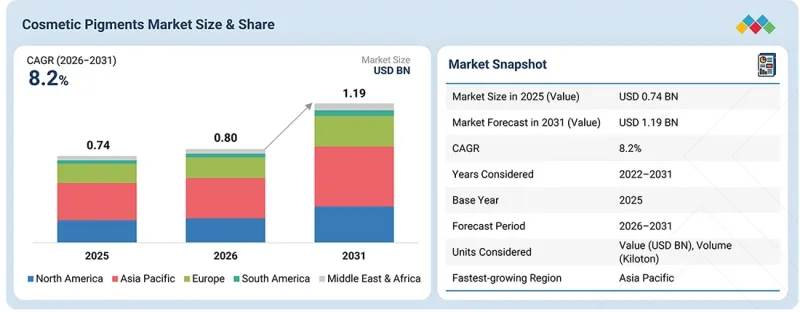
預計化妝品顏料市場將從 2026 年的 8 億美元成長到 2031 年的 11.9 億美元,預測期內的複合年成長率預計為 8.2%。
| 調查範圍 | |
|---|---|
| 調查期 | 2022-2031 |
| 基準年 | 2025 |
| 預測期 | 2026-2031 |
| 計算單位 | 金額(百萬美元) 數量(千噸) |
| 部分 | 類型、成分、用途和區域 |
| 目標區域 | 北美洲、歐洲、亞太地區、南美洲、中東和非洲 |
近年來,消費者購買的彩妝產品種類日益豐富,涵蓋臉部美妝、眼部彩妝、唇部產品、美甲產品以及護膚/個人保健產品。高階美妝產品,尤其是那些採用個人化彩妝和多功能配方的產品,正在推動對顏料的需求。隨著更複雜的化妝品配方不斷研發,能夠提供高性能顏料的顏料技術將變得愈發重要。
“在預測期內,無機顏料細分市場預計將佔據化妝品顏料市場最大的佔有率。”
從成分來看,無機顏料憑藉其優異的穩定性、高抗褪色性、長使用壽命以及在各種化妝品中呈現一致的色彩表現,佔據了最大的市場佔有率。無機顏料主要用於臉部美妝、眼部彩妝、美甲產品、護膚和其他化妝品領域。消費者對持久不褪色化妝品的需求日益成長,以及對各種產品類型中色彩表現可預測性和一致性的要求,正在推動無機顏料的消費。
“在預測期內,特效顏料細分市場預計將佔據化妝品顏料市場最大的佔有率。”
在預測期內,特效顏料預計將佔據最大的市場佔有率。這些顏料廣泛應用於臉部美妝、眼部彩妝、唇部彩妝、美甲等彩妝品。推動此細分市場成長的因素包括消費者對高階和新型美容產品的需求日益成長,以及對金屬光澤、閃光、珠光和其他非常規妝效的偏好不斷提高。
“在預測期內,臉部美妝彩妝預計將成為化妝品顏料市場中最大的應用領域。”
在預測期內,臉部彩妝預計將成為整個化妝品顏料市場中最大的應用領域。化妝品顏料廣泛應用於粉底、遮瑕膏、腮紅、美黑產品和其他臉部彩妝產品。推動化妝品顏料在臉部彩妝領域應用日益廣泛的關鍵因素包括:更廣泛的色號選擇、更佳的遮蓋力、更持久的產品以及臉部彩妝產品的創新。
“預計在預測期內,亞太地區將成為化妝品顏料市場最大的地區。”
預計到2031年,亞太地區的化妝品顏料市場將實現顯著的收入成長。中國、印度、日本和韓國等國家活躍的化妝品市場正在推動對創新高品質顏料解決方案的需求。越來越多的人使用美容產品、網路購物的普及以及高階美容產品的興起,都促進了對高科技、天然來源、獨特且光澤度高的顏料的需求成長。因此,對化妝品顏料的需求也不斷增加。
依公司規模分類:一級公司 - 40%,二級公司 - 30%,三級公司 - 30%
按職位:董事 -30%,經理 -20%,其他 -50%
區域細分:北美 -20%,歐洲 -10%,亞太地區 -40%,南美 -10%,中東和非洲 -20%
註:其他職位包括銷售經理、市場經理和產品經理。
第一級:超過10億美元;第二級:5億美元至10億美元;第三級:低於5億美元。
本研究對化妝品顏料市場的主要參與者進行了詳細的競爭分析,包括公司簡介、近期發展和主要市場策略。
調查範圍
本研究報告根據成分(有機顏料、無機顏料)、類型(特效顏料、表面處理顏料、奈米顏料、天然色素)和應用(臉部美妝、眼部彩妝、唇部產品、美甲產品、染髮產品、特殊應用產品及其他應用)對化妝品顏料市場進行細分。報告詳細分析了影響化妝品顏料市場成長的促進因素、阻礙因素、挑戰和成長機會。該報告還對主要行業參與者進行了深入分析,包括其業務概況、產品供應以及與化妝品顏料市場相關的關鍵策略,例如併購、產品發布、合作和業務擴張。此外,報告還對化妝品顏料市場生態系統中新興的新創公司進行了競爭分析。
購買本報告的理由
本報告為市場領導及新參與企業提供化妝品顏料市場整體及各細分市場最精確的銷售預測。它幫助相關人員了解競爭格局,獲得更深入的洞察以更好地定位自身業務,並制定合適的打入市場策略。此外,它還幫助相關人員了解市場趨勢,並獲取有關關鍵市場促進因素、限制因素、挑戰和機會的資訊。
本報告深入分析了以下幾點:
- 本報告深入分析了關鍵促進因素(彩妝和美容產品消費量的成長、對多樣化色調和創新妝效的需求不斷成長,以及高階多功能化妝品配方的日益普及)、制約因素(對化妝品顏料和著色劑的嚴格監管、顏料原料和特種礦物的價格波動以及先進顏料技術相關的高昂生產成本)、機遇高昂(對成本)、機遇高昂(對成本)、機遇高昂天然和潔淨標示化妝品顏料的需求不斷成長、高階美容產品對特種顏料的採用率不斷提高,以及新興國家化妝品製造和美容市場的擴張)和挑戰(保持不同批次產品色調和色彩表現的一致性、確保不同化妝品配方中顏料的穩定性以及滿足顏料生產中日益成長的永續性和環境要求)。
- 產品開發/創新:深入了解化妝品顏料市場的未來技術、研發活動以及產品/服務發布。
- 市場發展:盈利市場的全面資訊-本報告分析了各個地區的化妝品顏料市場。
- 市場多元化:提供有關化妝品顏料市場的新產品和服務、未開發地區、最新趨勢和投資的全面資訊。
- 競爭分析:我們對主要公司的市場佔有率、成長策略和服務產品進行了詳細評估。
目錄
第1章:引言
第2章執行摘要
第3章重要考察
- 化妝品顏料市場中極具吸引力的商機
- 化妝品顏料市場:依元素組成分類
- 化妝品顏料市場:按類型分類
- 化妝品顏料市場:依應用領域分類
- 化妝品顏料市場:按國家分類
第4章 市場概覽
- 市場動態
- 促進因素
- 抑制因子
- 機會
- 任務
- 未滿足的需求和未開發的領域
- 化妝品顏料市場尚未滿足的需求
- 未開發的市場機遇
- 相互關聯的市場與跨產業機遇
- 相互關聯的市場
- 跨產業機遇
- 新的經營模式與生態系轉型
- 新經營模式
- 生態系的轉變
- 1/2/3級玩家的策略舉措
- 關鍵發展和策略重點
- 波特五力分析
- 新進入者的威脅
- 替代品的威脅
- 供應商的議價能力
- 買方的議價能力
- 競爭公司之間的競爭強度
- 價值鏈分析
- 原物料供應商
- 製造商
- 經銷商
- 最終用戶
- 生態系分析
- 價格分析
- 各地區平均售價
- 主要公司平均售價
- 按類型分類的平均售價
- 總體經濟指標
- 全球GDP趨勢
- 2025年美國關稅對化妝品顏料市場的影響。
- 主要關稅稅率
- 價格影響分析
- 對國家和地區的影響
- 對終端用戶產業的影響
- 貿易分析
- 進口方案(HS編碼320417)
- 出口方案(HS編碼320417)
- 影響客戶業務的趨勢和顛覆性因素
- 投資和資金籌措場景
- 案例研究分析
- SUN CHEMICAL 開發了一種天然色素和氧化鐵的組合,用於製作光澤粉底。
- 敏感肌透研發表面處理顏料,以改善粉底的色彩還原度。
- 重要會議和活動
第5章:技術進步、人工智慧的影響、專利、創新與未來應用
- 技術分析
- 主要技術
- 互補技術
- 鄰近技術
- 技術和產品藍圖
- 短期(2026-2027 年)| 基礎設施建設和初步商業化
- 中期計劃(2027-2030 年)| 擴張與標準化
- 長期(2030-2035年及以後)| 大規模商業化與產業轉型
- 專利分析
- 專利的法律地位
- 管轄權分析
- 未來應用
- 多功能彩妝品
- 持久不脫妝的彩妝
- 生物基和永續著色劑
- 高級變色妝容
- 個人化訂製彩妝
- 人工智慧/生成式人工智慧對化妝品顏料市場的影響
- 主要應用場景和市場潛力
- 化妝品顏料加工的最佳實踐
- 人工智慧在化妝品顏料市場應用案例研究
- 相互關聯的相鄰生態系及其對市場參與者的影響
- 化妝品顏料市場中客戶對生成式人工智慧技術的接受程度
第6章:監理情勢與永續發展舉措
- 區域法規和合規性
- 監管機構、政府機構和其他組織
- 業界標準
- 永續發展計劃
- 監理政策和永續發展舉措的影響
- 認證、標籤和環境標準
第7章:顧客趨勢與購買行為
- 決策流程
- 主要相關人員和採購標準
- 採購過程中的關鍵相關人員
- 購買標準
- 實施障礙和內部挑戰
- 各終端用戶產業未滿足的需求
- 市場盈利
- 獲利潛力
- 成本趨勢
- 在關鍵終端用戶領域提高利潤率的機會
第8章 化妝品顏料市場:依元素組成分類
- 有機顏料
- 無機顏料
第9章 化妝品顏料市場:依類型分類
- 特效顏料
- 表面處理顏料
- 奈米顏料
- 天然色素
第10章 化妝品顏料市場:依應用領域分類
- 臉部化妝
- 眼妝
- 唇部產品
- 美甲產品
- 染髮產品
- 特殊用途產品
- 其他用途
第11章:化妝品顏料市場:依地區分類
- 亞太地區
- 中國
- 印度
- 日本
- 韓國
- 亞太其他地區
- 歐洲
- 德國
- 英國
- 法國
- 義大利
- 西班牙
- 其他歐洲國家
- 北美洲
- 美國
- 加拿大
- 墨西哥
- 中東和非洲
- 海灣合作理事會國家
- 南非
- 其他中東和非洲地區
- 南美洲
- 巴西
- 阿根廷
- 南美洲其他地區
第12章 競爭格局
- 主要參與企業的策略/優勢,2023-2026 年
- 2023-2025年收入分析
- 市佔率分析(2025 年)
- 企業估值和財務指標
- 品牌/產品對比
- 企業估值矩陣:主要公司,2025 年
- 明星公司
- 新興領導者
- 業務範圍廣泛的公司
- 參與企業
- 企業企業發展:主要公司,2025 年
- 公司估值矩陣:新創企業/中小企業,2025 年
- 先進公司
- 應對力的公司
- 充滿活力的公司
- 起始點
- 競爭標竿分析:新創企業/中小企業,2025 年
- 競爭格局
- 產品發布
- 交易
- 業務拓展
第13章:公司簡介
- 大公司
- SUDARSHAN CHEMICAL INDUSTRIES LIMITED
- DIC CORPORATION
- GLOBAL NEW MATERIAL INTERNATIONAL HOLDINGS LIMITED
- SENSIENT TECHNOLOGIES CORPORATION
- ALTANA
- KOBO PRODUCTS, INC.
- LANXESS
- KUNCAI
- GEOTECH
- VIBRANTZ
- 其他主要公司
- KOEL COLOURS PRIVATE LIMITED
- NEELIKON FOOD DYES AND CHEMICALS LIMITED
- KOLORTEK CO., LTD.
- DAYGLO COLOR CORP
- NIHON KOKEN KOGYO CO., LTD.
- OXERRA
- LI PIGMENTS
- ORCHEER SPECIAL EFFECT PIGMENT
- MIYOSHI KASEI, INC.
- SHANGHAI YUNZHU PIGMENT TECHNOLOGY CO., LTD
- VIPUL ORGANICS LTD.
- AJANTA COLOURS
- SHENGZHU PIGMENT
- SCHLENK SE
- SUNSHINE CHEMICALS
第14章調查方法
第15章附錄
The cosmetic pigments market is expected to reach USD 1.19 billion by 2031 from USD 0.80 billion in 2026, at a CAGR of 8.2% during the forecast period.
| Scope of the Report | |
|---|---|
| Years Considered for the Study | 2022-2031 |
| Base Year | 2025 |
| Forecast Period | 2026-2031 |
| Units Considered | Value (USD Million) Volume (Kiloton) |
| Segments | Type, Composition, Application, and Region |
| Regions covered | North America, Europe, Asia Pacific, South America, and Middle East & Africa |
Consumers nowadays are buying more makeup products like facial makeup, eye makeup, lip products, nail products, and skincare & personal care applications . Premium beauty products that feature personalized cosmetics as well as multifunctional formulations fuels the demand for pigments . With the continued development of more advanced cosmetic formulations, pigment technologies that provide high-performance pigments will become extremely significant.
"The inorganic segment is projected to account for the largest share of the cosmetic pigments market during the forecast period."
By composition, the inorganic pigments accounts for the largest market share due to their enhanced stability, excellent resistance to fading, long lifespan, and consistent color output across various cosmetic products. Inorganic pigments can be seen mostly in facial makeup, eye makeup, nail products , skincare, and other cosmetic areas. The rising need for cosmetics that last for a long period without fading, along with the need for color performance that is predictable and consistent on a range of product types, drives the consumption of inorganic pigments.
"The special-effect pigments segment is projected to account for the largest share in the cosmetic pigments market during the forecast period."
During the forecast period, the special-effect pigments segment is expected to hold the largest market share. They are used widely in face cosmetics, eye products, lip cosmetics, and nail art, as well for other color cosmetic products. The market for this segment is fueled by the increasing trend of consumers buying high-end and new types of beauty products, along with a growing tendency to wear makeup that looks metallic, glittery and has a pearlescent , and other unconventional finishes.
"Facial makeup is projected to be the largest application segment in the cosmetic pigments market during the forecast period."
During the forecast period, facial makeup is estimated to be the largest application of the overall cosmetic pigments market. Cosmetic pigments are widely used in foundation, cover-up, blush, face tan, and other facial products. The main factors behind the increased usage of cosmetic pigments in facial makeup applications are diverse shades availability, enhanced coverage, long-lasting products, and product innovation in facial makeup.
"Asia Pacific is projected to be the largest region in the cosmetic pigments market during the forecast period."
The cosmetic pigments market in Asia Pacific is expected to experience a considerable rise in revenue by 2031. Countries like China, India, Japan, and South Korea have a cosmetic market, fueling demand for innovative and high-quality pigment solutions. The increasing number of people who consume beauty products, growing online shopping, and upscale beauty presentations has increased the demand for high-tech natural, exclusive, and sparkling pigments. The result is a corresponding increase in the demand for cosmetic pigments.
By Company Type: Tier 1 - 40%, Tier 2 - 30%, and Tier 3 - 30%
By Designation: Directors - 30%, Managers - 20%, and Others - 50%
By Region: North America - 20%, Europe - 10%, Asia Pacific - 40%, South America - 10%, and Middle East & Africa - 20%
Notes: Others include sales, marketing, and product managers.
Tier 1: >USD 1 Billion; Tier 2: USD 500 million-1 Billion; and Tier 3: <USD 500 million
Companies Covered: Sudarshan Chemical Industries Limited (India), DIC Corporation (Japan), Sensient Cosmetic Technologies (US), Global New Material International Holdings Limited (China), ALTANA (Germany), Kobo Products (US), Kuncai Pigments (China), LANXESS (Germany), Geotech International (India), Neelikon Food Dyes and Chemicals Limited (India), and Vibrantz (US) are covered in the report.
The study includes an in-depth competitive analysis of these key players in the cosmetic pigments market, with their company profiles, recent developments, and key market strategies.
Research Coverage
This research report categorizes the cosmetic pigments market based on composition (Organic Pigments, Inorganic Pigments), type (Special-effect Pigments, Surface-treated Pigments, Nano Pigments, Natural Colorants), and application (Facial Makeup, Eye Makeup, Lip Products, Nail Products, Hair Color Products, Special-purpose Products, Other Applications). The report's scope covers detailed information regarding drivers, restraints, challenges, and opportunities influencing the growth of the cosmetic pigments market. A detailed analysis of the key industry players has been conducted to provide insights into their business overview, products offered, and key strategies, such as mergers, acquisitions, product launches, partnerships, and expansions, associated with the cosmetic pigments market. This report covers a competitive analysis of upcoming startups in the cosmetic pigments market ecosystem.
Reasons to Buy the Report
The report will offer market leaders/new entrants with information on the closest approximations of the revenue numbers for the overall cosmetic pigments market and the subsegments. This report will help stakeholders understand the competitive landscape, gain more insights into positioning their businesses better, and plan suitable go-to-market strategies. The report will help stakeholders understand the pulse of the market and provide them with information on key market drivers, restraints, challenges, and opportunities.
The report provides insights into the following points:
- Analysis of key drivers (Rising consumption of color cosmetics and beauty products, Growing demand for diverse shades and innovative cosmetic finishes, and Increasing adoption of premium and multifunctional cosmetic formulations), restraints (Stringent regulations governing cosmetic pigments and color additives, Volatility in prices of pigment raw materials and specialty minerals, and High production costs associated with advanced pigment technologies), opportunities (Growing demand for natural and clean-label cosmetic pigments, Increasing adoption of specialty pigments for premium beauty products, and Expansion of cosmetics manufacturing and beauty markets in emerging economies), challenges (Maintaining consistent shade and color performance across production batches, Ensuring pigment stability across different cosmetic formulations, and Meeting increasing sustainability and environmental requirements in pigment production).
- Product Development/Innovation: Detailed insights into upcoming technologies, research & development activities, and product & service launches in the cosmetic pigments market
- Market Development: Comprehensive information about profitable markets - the report analyzes the cosmetic pigments market across varied regions.
- Market Diversification: Exhaustive information about new products & services, untapped geographies, recent developments, and investments in the cosmetic pigments market.
- Competitive Assessment: In-depth assessment of market shares, growth strategies, and service offerings of leading players such as Sudarshan Chemical Industries Limited (India), DIC Corporation (Japan), Sensient Cosmetic Technologies (US), Global New Material International Holdings Limited (China), ALTANA (Germany), Kobo Products (US), Kuncai Pigments (China), LANXESS (Germany), Geotech International (India), Neelikon Food Dyes and Chemicals Limited (India), and Vibrantz (US), among others.
TABLE OF CONTENTS
1 INTRODUCTION
- 1.1 STUDY OBJECTIVES
- 1.2 MARKET DEFINITION
- 1.3 STUDY SCOPE
- 1.3.1 MARKETS COVERED AND REGIONAL SCOPE
- 1.3.2 INCLUSIONS AND EXCLUSIONS
- 1.3.3 YEARS CONSIDERED
- 1.4 CURRENCY CONSIDERED
- 1.5 UNIT CONSIDERED
- 1.6 STAKEHOLDERS
2 EXECUTIVE SUMMARY
- 2.1 KEY INSIGHTS AND MARKET HIGHLIGHTS
- 2.2 KEY MARKET PARTICIPANTS: MAPPING OF STRATEGIC DEVELOPMENTS
- 2.3 DISRUPTIVE TRENDS IN COSMETIC PIGMENTS MARKET
- 2.4 HIGH GROWTH SEGMENTS
- 2.5 REGIONAL SNAPSHOT: MARKET SIZE, GROWTH RATE, AND FORECAST
3 PREMIUM INSIGHTS
- 3.1 ATTRACTIVE OPPORTUNITIES FOR PLAYERS IN COSMETIC PIGMENTS MARKET
- 3.2 COSMETIC PIGMENTS MARKET, BY ELEMENTAL COMPOSITION
- 3.3 COSMETIC PIGMENTS MARKET, BY TYPE
- 3.4 COSMETIC PIGMENTS MARKET, BY APPLICATION
- 3.5 COSMETIC PIGMENTS MARKET, BY COUNTRY
4 MARKET OVERVIEW
- 4.1 INTRODUCTION
- 4.2 MARKET DYNAMICS
- 4.2.1 DRIVERS
- 4.2.1.1 Growing consumption of color cosmetics and makeup products
- 4.2.1.2 Rising demand for high-impact and special-effect finishes
- 4.2.1.3 Increasing demand for vegan and carmine-free color solutions
- 4.2.2 RESTRAINTS
- 4.2.2.1 Stringent regulatory requirements for cosmetic colorants
- 4.2.2.2 Application-specific limitations of cosmetic pigments
- 4.2.3 OPPORTUNITIES
- 4.2.3.1 Development of natural and plant-derived pigments
- 4.2.3.2 Biotechnology-enabled alternative colorants
- 4.2.3.3 Synthetic mica and advanced effect-pigment technologies
- 4.2.4 CHALLENGES
- 4.2.4.1 Achieving performance parity with conventional pigments
- 4.2.4.2 Maintaining batch-to-batch color consistency
- 4.2.1 DRIVERS
- 4.3 UNMET NEEDS AND WHITE SPACES
- 4.3.1 UNMET NEEDS IN COSMETIC PIGMENTS MARKET
- 4.3.2 WHITE SPACE OPPORTUNITIES
- 4.4 INTERCONNECTED MARKETS AND CROSS-SECTOR OPPORTUNITIES
- 4.4.1 INTERCONNECTED MARKETS
- 4.4.2 CROSS-SECTOR OPPORTUNITIES
- 4.5 EMERGING BUSINESS MODELS AND ECOSYSTEM SHIFTS
- 4.5.1 EMERGING BUSINESS MODELS
- 4.5.2 ECOSYSTEM SHIFTS
- 4.6 STRATEGIC MOVES BY TIER 1/2/3 PLAYERS
- 4.6.1 KEY MOVES AND STRATEGIC FOCUS
- 4.7 PORTER'S FIVE FORCES ANALYSIS
- 4.7.1 THREAT OF NEW ENTRANTS
- 4.7.2 THREAT OF SUBSTITUTES
- 4.7.3 BARGAINING POWER OF SUPPLIERS
- 4.7.4 BARGAINING POWER OF BUYERS
- 4.7.5 INTENSITY OF COMPETITIVE RIVALRY
- 4.8 VALUE CHAIN ANALYSIS
- 4.8.1 RAW MATERIAL SUPPLIERS
- 4.8.2 MANUFACTURERS
- 4.8.3 DISTRIBUTORS
- 4.8.4 END USERS
- 4.9 ECOSYSTEM ANALYSIS
- 4.10 PRICING ANALYSIS
- 4.10.1 AVERAGE SELLING PRICE, BY REGION
- 4.10.2 AVERAGE SELLING PRICE, BY KEY PLAYERS
- 4.10.3 AVERAGE SELLING PRICE, BY TYPE
- 4.11 MACROECONOMIC INDICATORS
- 4.11.1 GLOBAL GDP TRENDS
- 4.12 IMPACT OF 2025 US TARIFFS ON COSMETIC PIGMENTS MARKET
- 4.12.1 INTRODUCTION
- 4.12.2 KEY TARIFF RATES
- 4.12.3 PRICE IMPACT ANALYSIS
- 4.12.4 IMPACT ON COUNTRIES/REGIONS
- 4.12.4.1 North America
- 4.12.4.2 Europe
- 4.12.4.3 Asia Pacific
- 4.12.5 IMPACT ON END-USE INDUSTRIES
- 4.13 TRADE ANALYSIS
- 4.13.1 IMPORT SCENARIO (HS CODE 320417)
- 4.13.2 EXPORT SCENARIO (HS CODE 320417)
- 4.14 TRENDS/DISRUPTIONS IMPACTING CUSTOMER BUSINESS
- 4.15 INVESTMENT AND FUNDING SCENARIO
- 4.16 CASE STUDY ANALYSIS
- 4.16.1 SUN CHEMICAL DEVELOPS NATURAL COLORANT AND IRON OXIDE COMBINATION FOR RADIANT FOUNDATION
- 4.16.2 SENSIENT BEAUTY DEVELOPS SURFACE-TREATED PIGMENTS FOR IMPROVED FOUNDATION SHADE FIDELITY
- 4.17 KEY CONFERENCES & EVENTS
5 TECHNOLOGICAL ADVANCEMENTS, AI-DRIVEN IMPACT, PATENTS, INNOVATIONS, AND FUTURE APPLICATIONS
- 5.1 TECHNOLOGY ANALYSIS
- 5.1.1 KEY TECHNOLOGIES
- 5.1.1.1 Effect pigment & optical interference technology
- 5.1.1.2 Surface modification & functionalization technology
- 5.1.2 COMPLEMENTARY TECHNOLOGIES
- 5.1.2.1 Pigment dispersion & rheology technology
- 5.1.2.2 Color measurement & digital color-matching technology
- 5.1.3 ADJACENT TECHNOLOGIES
- 5.1.3.1 Synthetic mineral substrate technology
- 5.1.3.2 Biotechnology & bio-based colorant technology
- 5.1.1 KEY TECHNOLOGIES
- 5.2 TECHNOLOGY/PRODUCT ROADMAP
- 5.2.1 SHORT-TERM (2026-2027) | FOUNDATION & EARLY COMMERCIALIZATION
- 5.2.2 MID-TERM (2027-2030) | EXPANSION & STANDARDIZATION
- 5.2.3 LONG-TERM (2030-2035+) | MASS COMMERCIALIZATION & DISRUPTION
- 5.3 PATENT ANALYSIS
- 5.3.1 LEGAL STATUS OF PATENTS
- 5.3.2 JURISDICTION ANALYSIS
- 5.4 FUTURE APPLICATIONS
- 5.4.1 MULTIFUNCTIONAL COLOR COSMETICS
- 5.4.2 LONG-WEAR & TRANSFER-RESISTANT MAKEUP
- 5.4.3 BIO-BASED & SUSTAINABLE COLORANTS
- 5.4.4 ADVANCED EFFECT & COLOR-SHIFTING MAKEUP
- 5.4.5 PERSONALIZED & ON-DEMAND COLOR COSMETICS
- 5.5 IMPACT OF AI/GENERATIVE AI ON COSMETIC PIGMENTS MARKET
- 5.5.1 TOP USE CASES AND MARKET POTENTIAL
- 5.5.2 BEST PRACTICES IN COSMETIC PIGMENTS PROCESSING
- 5.5.3 CASE STUDIES OF AI IMPLEMENTATION IN COSMETIC PIGMENTS MARKET
- 5.5.4 INTERCONNECTED ADJACENT ECOSYSTEM AND IMPACT ON MARKET PLAYERS
- 5.5.5 CLIENTS' READINESS TO ADOPT GENERATIVE AI IN COSMETIC PIGMENTS MARKET
6 REGULATORY LANDSCAPE AND SUSTAINABILITY INITIATIVES
- 6.1 REGIONAL REGULATIONS AND COMPLIANCE
- 6.1.1 REGULATORY BODIES, GOVERNMENT AGENCIES, AND OTHER ORGANIZATIONS
- 6.1.2 INDUSTRY STANDARDS
- 6.2 SUSTAINABILITY INITIATIVES
- 6.3 IMPACT OF REGULATORY POLICIES AND SUSTAINABILITY INITIATIVES
- 6.4 CERTIFICATIONS, LABELING, AND ECO-STANDARDS
7 CUSTOMER LANDSCAPE & BUYER BEHAVIOR
- 7.1 INTRODUCTION
- 7.2 DECISION-MAKING PROCESS
- 7.3 KEY STAKEHOLDERS AND BUYING CRITERIA
- 7.3.1 KEY STAKEHOLDERS IN BUYING PROCESS
- 7.3.2 BUYING CRITERIA
- 7.4 ADOPTION BARRIERS & INTERNAL CHALLENGES
- 7.5 UNMET NEEDS IN VARIOUS END-USE INDUSTRIES
- 7.6 MARKET PROFITABILITY
- 7.6.1 REVENUE POTENTIAL
- 7.6.2 COST DYNAMICS
- 7.6.3 MARGIN OPPORTUNITIES IN KEY END-USE SECTORS
8 COSMETIC PIGMENTS MARKET, BY ELEMENTAL COMPOSITION
- 8.1 INTRODUCTION
- 8.2 ORGANIC PIGMENTS
- 8.2.1 RISING PREFERENCE FOR VIVID & DIVERSE COSMETIC SHADES DRIVES ORGANIC PIGMENT GROWTH
- 8.2.2 LAKES
- 8.2.2.1 Deliver vibrant shades & formulation versatility, driving market adoption
- 8.2.3 TONERS
- 8.2.3.1 Provide high color strength & shade intensity, driving demand
- 8.2.4 OTHER ORGANIC PIGMENTS
- 8.2.4.1 Enable differentiated shades & performance, driving market growth
- 8.3 INORGANIC PIGMENTS
- 8.3.1 MINERAL-BASED COLORANTS & FUNCTIONAL PROPERTIES SUPPORT INORGANIC PIGMENT DEMAND
- 8.3.2 TITANIUM DIOXIDE
- 8.3.2.1 High opacity & white coverage make titanium dioxide essential for cosmetic formulations
- 8.3.3 IRON OXIDE
- 8.3.3.1 Skin-tone versatility across makeup formulations drives iron oxide demand
- 8.3.4 CHROMIUM DIOXIDE
- 8.3.4.1 Stable green coloration expands chromium oxide use in eye & specialty cosmetics
- 8.3.5 ZINC OXIDE
- 8.3.5.1 Opacity & multifunctional protection support zinc oxide adoption in cosmetics
- 8.3.6 MICA
- 8.3.6.1 Light-reflective effects & silky aesthetics drive mica use in color cosmetics
- 8.3.7 ULTRAMARINES
- 8.3.7.1 Distinctive blue & violet shades support ultramarine use in eye cosmetics
- 8.3.8 OTHER INORGANIC PIGMENTS
- 8.3.8.1 Specialty mineral colorants & effect materials expand inorganic pigment applications
9 COSMETIC PIGMENTS MARKET, BY TYPE
- 9.1 INTRODUCTION
- 9.2 SPECIAL-EFFECT PIGMENTS
- 9.2.1 GROWING DEMAND FOR HIGH-IMPACT MAKEUP FINISHES TO DRIVE MARKET
- 9.3 SURFACE-TREATED PIGMENTS
- 9.3.1 INCREASING DEMAND FOR IMPROVED PIGMENT DISPERSION & FORMULATION COMPATIBILITY TO DRIVE MARKET
- 9.4 NANO PIGMENTS
- 9.4.1 GROWING DEMAND FOR LIGHTWEIGHT & NATURAL-LOOKING FORMULATIONS TO DRIVE MARKET
- 9.5 NATURAL COLORANTS
- 9.5.1 GROWING DEMAND FOR NATURALLY DERIVED INGREDIENTS TO DRIVE NATURAL COLORANTS MARKET
10 COSMETIC PIGMENTS MARKET, BY APPLICATION
- 10.1 INTRODUCTION
- 10.2 FACIAL MAKEUP
- 10.2.1 GROWING EMPHASIS ON PRECISE COMPLEXION MATCHING AND NATURAL-LOOKING COVERAGE TO DRIVE MARKET
- 10.3 EYE MAKEUP
- 10.3.1 RISING PREFERENCE FOR VIVID COLORS AND MULTIDIMENSIONAL EYE FINISHES TO DRIVE MARKET
- 10.4 LIP PRODUCTS
- 10.4.1 INCREASING DEMAND FOR HIGH-CHROMA SHADES AND CONSISTENT COLOR PERFORMANCE TO DRIVE MARKET
- 10.5 NAIL PRODUCTS
- 10.5.1 EXPANSION OF DECORATIVE NAIL STYLING AND EFFECT-RICH FINISHES TO DRIVE MARKET
- 10.6 HAIR COLOR PRODUCTS
- 10.6.1 INCREASING ADOPTION OF DIVERSE SHADES AND TARGETED COLOR CORRECTION TO DRIVE MARKET
- 10.7 SPECIAL-PURPOSE PRODUCTS
- 10.7.1 GREATER USE OF SPECIALIZED COLORATION AND DISTINCTIVE VISUAL EFFECTS TO DRIVE MARKET
- 10.8 OTHER APPLICATIONS
11 COSMETIC PIGMENTS MARKET, BY REGION
- 11.1 INTRODUCTION
- 11.2 ASIA PACIFIC
- 11.2.1 CHINA
- 11.2.1.1 Expanding domestic beauty consumption and online cosmetics retail to drive market
- 11.2.2 INDIA
- 11.2.2.1 Rising beauty consumption and expansion of organized color cosmetics to drive market
- 11.2.3 JAPAN
- 11.2.3.1 Recovery in cosmetics shipments and international expansion of makeup brands to drive market
- 11.2.4 SOUTH KOREA
- 11.2.4.1 Global K-beauty exports and rapid growth in color cosmetics to drive market
- 11.2.5 REST OF ASIA PACIFIC
- 11.2.1 CHINA
- 11.3 EUROPE
- 11.3.1 GERMANY
- 11.3.1.1 Strong domestic beauty consumption and rising demand for decorative cosmetics to drive market
- 11.3.2 UK
- 11.3.2.1 Large beauty consumption base and digitally driven makeup demand to drive market
- 11.3.3 FRANCE
- 11.3.3.1 Premium beauty consumption and strong cosmetics exports to drive market
- 11.3.4 ITALY
- 11.3.4.1 Strong makeup consumption and export-oriented cosmetics manufacturing to drive market
- 11.3.5 SPAIN
- 11.3.5.1 Growing color cosmetics consumption and expanding beauty exports to drive market
- 11.3.6 REST OF EUROPE
- 11.3.1 GERMANY
- 11.4 NORTH AMERICA
- 11.4.1 US
- 11.4.1.1 Premium makeup innovation and high-performance formulations to drive market
- 11.4.2 CANADA
- 11.4.2.1 Imported beauty products and regulatory-compliant formulations to drive market
- 11.4.3 MEXICO
- 11.4.3.1 Expanding beauty manufacturing and titanium dioxide pigment trade to drive market
- 11.4.1 US
- 11.5 MIDDLE EAST & AFRICA
- 11.5.1 GCC COUNTRIES
- 11.5.1.1 Saudi Arabia
- 11.5.1.1.1 Rising beauty expenditure and expansion of local cosmetics manufacturing to drive market
- 11.5.1.2 UAE
- 11.5.1.2.1 Premium beauty retail and regional distribution activity to drive market
- 11.5.1.3 Rest of GCC countries
- 11.5.1.1 Saudi Arabia
- 11.5.2 SOUTH AFRICA
- 11.5.2.1 Established beauty retail and growing demand for natural formulations to drive market
- 11.5.3 REST OF MIDDLE EAST & AFRICA
- 11.5.1 GCC COUNTRIES
- 11.6 SOUTH AMERICA
- 11.6.1 BRAZIL
- 11.6.1.1 Large beauty consumption and expanding color cosmetics demand to drive market
- 11.6.2 ARGENTINA
- 11.6.2.1 Recovering beauty consumption and expanding premium cosmetics demand to support market
- 11.6.3 REST OF SOUTH AMERICA
- 11.6.1 BRAZIL
12 COMPETITIVE LANDSCAPE
- 12.1 INTRODUCTION
- 12.2 KEY PLAYER STRATEGIES/RIGHT TO WIN, 2023-2026
- 12.3 REVENUE ANALYSIS, 2023-2025
- 12.4 MARKET SHARE ANALYSIS, 2025
- 12.5 COMPANY VALUATION AND FINANCIAL METRICS
- 12.6 BRAND/PRODUCT COMPARISON
- 12.7 COMPANY EVALUATION MATRIX: KEY PLAYERS, 2025
- 12.7.1 STARS
- 12.7.2 EMERGING LEADERS
- 12.7.3 PERVASIVE PLAYERS
- 12.7.4 PARTICIPANTS
- 12.7.5 COMPANY FOOTPRINT: KEY PLAYERS, 2025
- 12.7.5.1 Company footprint
- 12.7.5.2 Region footprint
- 12.7.5.3 Elemental composition footprint
- 12.7.5.4 Type footprint
- 12.7.5.5 Application footprint
- 12.8 COMPANY EVALUATION MATRIX: START-UPS/SMES, 2025
- 12.8.1 PROGRESSIVE COMPANIES
- 12.8.2 RESPONSIVE COMPANIES
- 12.8.3 DYNAMIC COMPANIES
- 12.8.4 STARTING BLOCKS
- 12.8.5 COMPETITIVE BENCHMARKING: START-UPS/SMES, 2025
- 12.8.5.1 List of start-ups/SMEs
- 12.8.5.2 Competitive benchmarking of start-ups/SMEs
- 12.9 COMPETITIVE SCENARIO
- 12.9.1 PRODUCT LAUNCHES
- 12.9.2 DEALS
- 12.9.3 EXPANSIONS
13 COMPANY PROFILES
- 13.1 KEY PLAYERS
- 13.1.1 SUDARSHAN CHEMICAL INDUSTRIES LIMITED
- 13.1.1.1 Business overview
- 13.1.1.2 Products/Solutions/Services offered
- 13.1.1.3 Recent developments
- 13.1.1.3.1 Deals
- 13.1.1.4 MnM view
- 13.1.1.4.1 Right to win
- 13.1.1.4.2 Strategic choices
- 13.1.1.4.3 Weaknesses and competitive threats
- 13.1.2 DIC CORPORATION
- 13.1.2.1 Business overview
- 13.1.2.2 Products/Solutions/Services offered
- 13.1.2.3 Recent developments
- 13.1.2.3.1 Product launches
- 13.1.2.3.2 Expansions
- 13.1.2.4 MnM view
- 13.1.2.4.1 Right to win
- 13.1.2.4.2 Strategic choices
- 13.1.2.4.3 Weaknesses and competitive threats
- 13.1.3 GLOBAL NEW MATERIAL INTERNATIONAL HOLDINGS LIMITED
- 13.1.3.1 Business overview
- 13.1.3.2 Products/Solutions/Services offered
- 13.1.3.3 Recent developments
- 13.1.3.3.1 Deals
- 13.1.3.4 MnM view
- 13.1.3.4.1 Right to win
- 13.1.3.4.2 Strategic choices
- 13.1.3.4.3 Weaknesses and competitive threats
- 13.1.4 SENSIENT TECHNOLOGIES CORPORATION
- 13.1.4.1 Business overview
- 13.1.4.2 Products/Solutions/Services offered
- 13.1.4.3 Recent developments
- 13.1.4.3.1 Deals
- 13.1.4.4 MnM view
- 13.1.4.4.1 Right to win
- 13.1.4.4.2 Strategic choices
- 13.1.4.4.3 Weaknesses and competitive threats
- 13.1.5 ALTANA
- 13.1.5.1 Business overview
- 13.1.5.2 Products/Solutions/Services offered
- 13.1.5.3 Recent developments
- 13.1.5.3.1 Product launches
- 13.1.5.3.2 Deals
- 13.1.5.4 MnM view
- 13.1.5.4.1 Right to win
- 13.1.5.4.2 Strategic choices
- 13.1.5.4.3 Weaknesses and competitive threats
- 13.1.6 KOBO PRODUCTS, INC.
- 13.1.6.1 Business overview
- 13.1.6.2 Products/Solutions/Services offered
- 13.1.6.3 MnM view
- 13.1.7 LANXESS
- 13.1.7.1 Business overview
- 13.1.7.2 Products/Solutions/Services offered
- 13.1.7.3 MnM view
- 13.1.8 KUNCAI
- 13.1.8.1 Business overview
- 13.1.8.2 Products/Solutions/Services offered
- 13.1.8.3 Recent developments
- 13.1.8.3.1 Product launches
- 13.1.8.4 MnM view
- 13.1.9 GEOTECH
- 13.1.9.1 Business overview
- 13.1.9.2 Products/Solutions/Services offered
- 13.1.9.3 MnM view
- 13.1.10 VIBRANTZ
- 13.1.10.1 Business overview
- 13.1.10.2 Products/Solutions/Services offered
- 13.1.10.3 MnM view
- 13.1.1 SUDARSHAN CHEMICAL INDUSTRIES LIMITED
- 13.2 OTHER PLAYERS
- 13.2.1 KOEL COLOURS PRIVATE LIMITED
- 13.2.2 NEELIKON FOOD DYES AND CHEMICALS LIMITED
- 13.2.3 KOLORTEK CO., LTD.
- 13.2.4 DAYGLO COLOR CORP
- 13.2.5 NIHON KOKEN KOGYO CO., LTD.
- 13.2.6 OXERRA
- 13.2.7 LI PIGMENTS
- 13.2.8 ORCHEER SPECIAL EFFECT PIGMENT
- 13.2.9 MIYOSHI KASEI, INC.
- 13.2.10 SHANGHAI YUNZHU PIGMENT TECHNOLOGY CO., LTD
- 13.2.11 VIPUL ORGANICS LTD.
- 13.2.12 AJANTA COLOURS
- 13.2.13 SHENGZHU PIGMENT
- 13.2.14 SCHLENK SE
- 13.2.15 SUNSHINE CHEMICALS
14 RESEARCH METHODOLOGY
- 14.1 RESEARCH DATA
- 14.1.1 SECONDARY DATA
- 14.1.1.1 List of secondary sources
- 14.1.1.2 Key data from secondary sources
- 14.1.2 PRIMARY DATA
- 14.1.2.1 List of primary interview participants-demand and supply sides
- 14.1.2.2 Key data from primary sources
- 14.1.2.3 Breakdown of primary interviews
- 14.1.2.4 Insights from industry experts
- 14.1.1 SECONDARY DATA
- 14.2 MARKET SIZE ESTIMATION
- 14.2.1 BOTTOM-UP APPROACH
- 14.2.2 TOP-DOWN APPROACH
- 14.3 FORECAST NUMBER CALCULATION
- 14.4 DATA TRIANGULATION
- 14.5 FACTOR ANALYSIS
- 14.6 RESEARCH ASSUMPTIONS
- 14.7 RESEARCH LIMITATIONS AND RISK ASSESSMENT
15 APPENDIX
- 15.1 DISCUSSION GUIDE
- 15.2 KNOWLEDGESTORE: MARKETSANDMARKETS' SUBSCRIPTION PORTAL
- 15.3 CUSTOMIZATION OPTIONS
- 15.4 RELATED REPORTS
- 15.5 AUTHOR DETAILS
List of Tables
- TABLE 1 COSMETIC PIGMENTS MARKET: IMPACT OF PORTER'S FIVE FORCES
- TABLE 2 COSMETIC PIGMENTS MARKET: ROLE OF COMPANIES IN ECOSYSTEM
- TABLE 3 AVERAGE SELLING PRICE TREND OF COSMETIC PIGMENTS, BY REGION, 2023-2025 (USD/KG)
- TABLE 4 AVERAGE SELLING PRICE RANGE OF COSMETIC PIGMENTS IN MAJOR END-USE INDUSTRY, BY KEY PLAYERS, 2025 (USD/KG)
- TABLE 5 AVERAGE SELLING PRICE TREND OF COSMETIC PIGMENTS, BY TYPE, 2023-2025 (USD/KG)
- TABLE 6 PROJECTED REAL GDP GROWTH (ANNUAL PERCENT CHANGE) OF KEY COUNTRIES, 2021-2030
- TABLE 7 US-ADJUSTED RECIPROCAL TARIFF RATES
- TABLE 8 IMPORT SCENARIO FOR HS CODE 320417-COMPLIANT PRODUCTS, BY COUNTRY, 2021-2025 (USD MILLION)
- TABLE 9 EXPORT SCENARIO FOR HS CODE 320417-COMPLIANT PRODUCTS, BY COUNTRY, 2021-2025 (USD MILLION)
- TABLE 10 COSMETIC PIGMENTS MARKET: CONFERENCES & EVENTS, 2026-2027
- TABLE 11 TOP USE CASES AND MARKET POTENTIAL
- TABLE 12 BEST PRACTICES: NOTABLE INDUSTRY PRACTICES BY LEADING COMPANIES
- TABLE 13 COSMETIC PIGMENTS MARKET: CASE STUDIES RELATED TO AI IMPLEMENTATION
- TABLE 14 INTERCONNECTED ADJACENT ECOSYSTEM AND IMPACT ON MARKET PLAYERS
- TABLE 15 NORTH AMERICA: LIST OF REGULATORY BODIES, GOVERNMENT AGENCIES, AND OTHER ORGANIZATIONS
- TABLE 16 ASIA PACIFIC: LIST OF REGULATORY BODIES, GOVERNMENT AGENCIES, AND OTHER ORGANIZATIONS
- TABLE 17 EUROPE: LIST OF REGULATORY BODIES, GOVERNMENT AGENCIES, AND OTHER ORGANIZATIONS
- TABLE 18 MIDDLE EAST & AFRICA: LIST OF REGULATORY BODIES, GOVERNMENT AGENCIES, AND OTHER ORGANIZATIONS
- TABLE 19 SOUTH AMERICA: LIST OF REGULATORY BODIES, GOVERNMENT AGENCIES, AND OTHER ORGANIZATIONS
- TABLE 20 GLOBAL STANDARDS IN COSMETIC PIGMENTS MARKET
- TABLE 21 CERTIFICATIONS, LABELING, AND ECO-STANDARDS IN COSMETIC PIGMENTS MARKET
- TABLE 22 INFLUENCE OF STAKEHOLDERS ON BUYING PROCESS FOR KEY APPLICATIONS (%)
- TABLE 23 KEY BUYING CRITERIA FOR KEY APPLICATIONS
- TABLE 24 COSMETIC PIGMENTS MARKET: UNMET NEEDS IN KEY END-USE SECTORS
- TABLE 25 COSMETIC PIGMENTS MARKET, BY ELEMENTAL COMPOSITION, 2022-2025 (USD MILLION)
- TABLE 26 COSMETIC PIGMENTS MARKET, BY ELEMENTAL COMPOSITION, 2026-2031 (USD MILLION)
- TABLE 27 COSMETIC PIGMENTS MARKET, BY ELEMENTAL COMPOSITION, 2022-2025 (TON)
- TABLE 28 COSMETIC PIGMENTS MARKET, BY ELEMENTAL COMPOSITION, 2026-2031 (TON)
- TABLE 29 COSMETIC PIGMENTS MARKET, BY TYPE, 2022-2025 (USD MILLION)
- TABLE 30 COSMETIC PIGMENTS MARKET, BY TYPE, 2026-2031 (USD MILLION)
- TABLE 31 COSMETIC PIGMENTS MARKET, BY TYPE, 2022-2025 (TON)
- TABLE 32 COSMETIC PIGMENTS MARKET, BY TYPE, 2026-2031 (TON)
- TABLE 33 COSMETIC PIGMENTS MARKET, BY APPLICATION, 2022-2025 (USD MILLION)
- TABLE 34 COSMETIC PIGMENTS MARKET, BY APPLICATION, 2026-2031 (USD MILLION)
- TABLE 35 COSMETIC PIGMENTS MARKET, BY APPLICATION, 2022-2025 (TON)
- TABLE 36 COSMETIC PIGMENTS MARKET, BY APPLICATION, 2026-2031 (TON)
- TABLE 37 COSMETIC PIGMENTS MARKET, BY REGION, 2022-2025 (USD MILLION)
- TABLE 38 COSMETIC PIGMENTS MARKET, BY REGION, 2026-2031 (USD MILLION)
- TABLE 39 COSMETIC PIGMENTS MARKET, BY REGION, 2022-2025 (TON)
- TABLE 40 COSMETIC PIGMENTS MARKET, BY REGION, 2026-2031 (TON)
- TABLE 41 ASIA PACIFIC: COSMETIC PIGMENTS MARKET, BY COUNTRY, 2022-2025 (USD MILLION)
- TABLE 42 ASIA PACIFIC: COSMETIC PIGMENTS MARKET, BY COUNTRY, 2026-2031 (USD MILLION)
- TABLE 43 ASIA PACIFIC: COSMETIC PIGMENTS MARKET, BY COUNTRY, 2022-2025 (TON)
- TABLE 44 ASIA PACIFIC: COSMETIC PIGMENTS MARKET, BY COUNTRY, 2026-2031 (TON)
- TABLE 45 ASIA PACIFIC: COSMETIC PIGMENTS MARKET, BY ELEMENTAL COMPOSITION, 2022-2025 (USD MILLION)
- TABLE 46 ASIA PACIFIC: COSMETIC PIGMENTS MARKET, BY ELEMENTAL COMPOSITION, 2026-2031 (USD MILLION)
- TABLE 47 ASIA PACIFIC: COSMETIC PIGMENTS MARKET, BY ELEMENTAL COMPOSITION, 2022-2025 (TON)
- TABLE 48 ASIA PACIFIC: COSMETIC PIGMENTS MARKET, BY ELEMENTAL COMPOSITION, 2026-2031 (TON)
- TABLE 49 ASIA PACIFIC: COSMETIC PIGMENTS MARKET, BY TYPE, 2022-2025 (USD MILLION)
- TABLE 50 ASIA PACIFIC: COSMETIC PIGMENTS MARKET, BY TYPE, 2026-2031 (USD MILLION)
- TABLE 51 ASIA PACIFIC: COSMETIC PIGMENTS MARKET, BY TYPE, 2022-2025 (TON)
- TABLE 52 ASIA PACIFIC: COSMETIC PIGMENTS MARKET, BY TYPE, 2026-2031 (TON)
- TABLE 53 ASIA PACIFIC: COSMETIC PIGMENTS MARKET, BY APPLICATION, 2022-2025 (USD MILLION)
- TABLE 54 ASIA PACIFIC: COSMETIC PIGMENTS MARKET, BY APPLICATION, 2026-2031 (USD MILLION)
- TABLE 55 ASIA PACIFIC: COSMETIC PIGMENTS MARKET, BY APPLICATION, 2022-2025 (TON)
- TABLE 56 ASIA PACIFIC: COSMETIC PIGMENTS MARKET, BY APPLICATION, 2026-2031 (TON)
- TABLE 57 CHINA: COSMETIC PIGMENTS MARKET, BY APPLICATION, 2022-2025 (USD MILLION)
- TABLE 58 CHINA: COSMETIC PIGMENTS MARKET, BY APPLICATION, 2026-2031 (USD MILLION)
- TABLE 59 CHINA: COSMETIC PIGMENTS MARKET, BY APPLICATION, 2022-2025 (TON)
- TABLE 60 CHINA: COSMETIC PIGMENTS MARKET, BY APPLICATION, 2026-2031 (TON)
- TABLE 61 INDIA: COSMETIC PIGMENTS MARKET, BY APPLICATION, 2022-2025 (USD MILLION)
- TABLE 62 INDIA: COSMETIC PIGMENTS MARKET, BY APPLICATION, 2026-2031 (USD MILLION)
- TABLE 63 INDIA: COSMETIC PIGMENTS MARKET, BY APPLICATION, 2022-2025 (TON)
- TABLE 64 INDIA: COSMETIC PIGMENTS MARKET, BY APPLICATION, 2026-2031 (TON)
- TABLE 65 JAPAN: COSMETIC PIGMENTS MARKET, BY APPLICATION, 2022-2025 (USD MILLION)
- TABLE 66 JAPAN: COSMETIC PIGMENTS MARKET, BY APPLICATION, 2026-2031 (USD MILLION)
- TABLE 67 JAPAN: COSMETIC PIGMENTS MARKET, BY APPLICATION, 2022-2025 (TON)
- TABLE 68 JAPAN: COSMETIC PIGMENTS MARKET, BY APPLICATION, 2026-2031 (TON)
- TABLE 69 SOUTH KOREA: COSMETIC PIGMENTS MARKET, BY APPLICATION, 2022-2025 (USD MILLION)
- TABLE 70 SOUTH KOREA: COSMETIC PIGMENTS MARKET, BY APPLICATION, 2026-2031 (USD MILLION)
- TABLE 71 SOUTH KOREA: COSMETIC PIGMENTS MARKET, BY APPLICATION, 2022-2025 (TON)
- TABLE 72 SOUTH KOREA: COSMETIC PIGMENTS MARKET, BY APPLICATION, 2026-2031 (TON)
- TABLE 73 REST OF ASIA PACIFIC: COSMETIC PIGMENTS MARKET, BY APPLICATION, 2022-2025 (USD MILLION)
- TABLE 74 REST OF ASIA PACIFIC: COSMETIC PIGMENTS MARKET, BY APPLICATION, 2026-2031 (USD MILLION)
- TABLE 75 REST OF ASIA PACIFIC: COSMETIC PIGMENTS MARKET, BY APPLICATION, 2022-2025 (TON)
- TABLE 76 REST OF ASIA PACIFIC: COSMETIC PIGMENTS MARKET, BY APPLICATION, 2026-2031 (TON)
- TABLE 77 EUROPE: COSMETIC PIGMENTS MARKET, BY COUNTRY, 2022-2025 (USD MILLION)
- TABLE 78 EUROPE: COSMETIC PIGMENTS MARKET, BY COUNTRY, 2026-2031 (USD MILLION)
- TABLE 79 EUROPE: COSMETIC PIGMENTS MARKET, BY COUNTRY, 2022-2025 (TON)
- TABLE 80 EUROPE: COSMETIC PIGMENTS MARKET, BY COUNTRY, 2026-2031 (TON)
- TABLE 81 EUROPE: COSMETIC PIGMENTS MARKET, BY ELEMENTAL COMPOSITION, 2022-2025 (USD MILLION)
- TABLE 82 EUROPE: COSMETIC PIGMENTS MARKET, BY ELEMENTAL COMPOSITION, 2026-2031 (USD MILLION)
- TABLE 83 EUROPE: COSMETIC PIGMENTS MARKET, BY ELEMENTAL COMPOSITION, 2022-2025 (TON)
- TABLE 84 EUROPE: COSMETIC PIGMENTS MARKET, BY ELEMENTAL COMPOSITION, 2026-2031 (TON)
- TABLE 85 EUROPE: COSMETIC PIGMENTS MARKET, BY TYPE, 2022-2025 (USD MILLION)
- TABLE 86 EUROPE: COSMETIC PIGMENTS MARKET, BY TYPE, 2026-2031 (USD MILLION)
- TABLE 87 EUROPE: COSMETIC PIGMENTS MARKET, BY TYPE, 2022-2025 (TON)
- TABLE 88 EUROPE: COSMETIC PIGMENTS MARKET, BY TYPE, 2026-2031 (TON)
- TABLE 89 EUROPE: COSMETIC PIGMENTS MARKET, BY APPLICATION, 2022-2025 (USD MILLION)
- TABLE 90 EUROPE: COSMETIC PIGMENTS MARKET, BY APPLICATION, 2026-2031 (USD MILLION)
- TABLE 91 EUROPE: COSMETIC PIGMENTS MARKET, BY APPLICATION, 2022-2025 (TON)
- TABLE 92 EUROPE: COSMETIC PIGMENTS MARKET, BY APPLICATION, 2026-2031 (TON)
- TABLE 93 GERMANY: COSMETIC PIGMENTS MARKET, BY APPLICATION, 2022-2025 (USD MILLION)
- TABLE 94 GERMANY: COSMETIC PIGMENTS MARKET, BY APPLICATION, 2026-2031 (USD MILLION)
- TABLE 95 GERMANY: COSMETIC PIGMENTS MARKET, BY APPLICATION, 2022-2025 (TON)
- TABLE 96 GERMANY: COSMETIC PIGMENTS MARKET, BY APPLICATION, 2026-2031 (TON)
- TABLE 97 UK: COSMETIC PIGMENTS MARKET, BY APPLICATION, 2022-2025 (USD MILLION)
- TABLE 98 UK: COSMETIC PIGMENTS MARKET, BY APPLICATION, 2026-2031 (USD MILLION)
- TABLE 99 UK: COSMETIC PIGMENTS MARKET, BY APPLICATION, 2022-2025 (TON)
- TABLE 100 UK: COSMETIC PIGMENTS MARKET, BY APPLICATION, 2026-2031 (TON)
- TABLE 101 FRANCE: COSMETIC PIGMENTS MARKET, BY APPLICATION, 2022-2025 (USD MILLION)
- TABLE 102 FRANCE: COSMETIC PIGMENTS MARKET, BY APPLICATION, 2026-2031 (USD MILLION)
- TABLE 103 FRANCE: COSMETIC PIGMENTS MARKET, BY APPLICATION, 2022-2025 (TON)
- TABLE 104 FRANCE: COSMETIC PIGMENTS MARKET, BY APPLICATION, 2026-2031 (TON)
- TABLE 105 ITALY: COSMETIC PIGMENTS MARKET, BY APPLICATION, 2022-2025 (USD MILLION)
- TABLE 106 ITALY: COSMETIC PIGMENTS MARKET, BY APPLICATION, 2026-2031 (USD MILLION)
- TABLE 107 ITALY: COSMETIC PIGMENTS MARKET, BY APPLICATION, 2022-2025 (TON)
- TABLE 108 ITALY: COSMETIC PIGMENTS MARKET, BY APPLICATION, 2026-2031 (TON)
- TABLE 109 SPAIN: COSMETIC PIGMENTS MARKET, BY APPLICATION, 2022-2025 (USD MILLION)
- TABLE 110 SPAIN: COSMETIC PIGMENTS MARKET, BY APPLICATION, 2026-2031 (USD MILLION)
- TABLE 111 SPAIN: COSMETIC PIGMENTS MARKET, BY APPLICATION, 2022-2025 (TON)
- TABLE 112 SPAIN: COSMETIC PIGMENTS MARKET, BY APPLICATION, 2026-2031 (TON)
- TABLE 113 REST OF EUROPE: COSMETIC PIGMENTS MARKET, BY APPLICATION, 2022-2025 (USD MILLION)
- TABLE 114 REST OF EUROPE: COSMETIC PIGMENTS MARKET, BY APPLICATION, 2026-2031 (USD MILLION)
- TABLE 115 REST OF EUROPE: COSMETIC PIGMENTS MARKET, BY APPLICATION, 2022-2025 (TON)
- TABLE 116 REST OF EUROPE: COSMETIC PIGMENTS MARKET, BY APPLICATION, 2026-2031 (TON)
- TABLE 117 NORTH AMERICA: COSMETIC PIGMENTS MARKET, BY COUNTRY, 2022-2025 (USD MILLION)
- TABLE 118 NORTH AMERICA: COSMETIC PIGMENTS MARKET, BY COUNTRY, 2026-2031 (USD MILLION)
- TABLE 119 NORTH AMERICA: COSMETIC PIGMENTS MARKET, BY COUNTRY, 2022-2025 (TON)
- TABLE 120 NORTH AMERICA: COSMETIC PIGMENTS MARKET, BY COUNTRY, 2026-2031 (TON)
- TABLE 121 NORTH AMERICA: COSMETIC PIGMENTS MARKET, BY ELEMENTAL COMPOSITION, 2022-2025 (USD MILLION)
- TABLE 122 NORTH AMERICA: COSMETIC PIGMENTS MARKET, BY ELEMENTAL COMPOSITION, 2026-2031 (USD MILLION)
- TABLE 123 NORTH AMERICA: COSMETIC PIGMENTS MARKET, BY ELEMENTAL COMPOSITION, 2022-2025 (TON)
- TABLE 124 NORTH AMERICA: COSMETIC PIGMENTS MARKET, BY ELEMENTAL COMPOSITION, 2026-2031 (TON)
- TABLE 125 NORTH AMERICA: COSMETIC PIGMENTS MARKET, BY TYPE, 2022-2025 (USD MILLION)
- TABLE 126 NORTH AMERICA: COSMETIC PIGMENTS MARKET, BY TYPE, 2026-2031 (USD MILLION)
- TABLE 127 NORTH AMERICA: COSMETIC PIGMENTS MARKET, BY TYPE, 2022-2025 (TON)
- TABLE 128 NORTH AMERICA: COSMETIC PIGMENTS MARKET, BY TYPE, 2026-2031 (TON)
- TABLE 129 NORTH AMERICA: COSMETIC PIGMENTS MARKET, BY APPLICATION, 2022-2025 (USD MILLION)
- TABLE 130 NORTH AMERICA: COSMETIC PIGMENTS MARKET, BY APPLICATION, 2026-2031 (USD MILLION)
- TABLE 131 NORTH AMERICA: COSMETIC PIGMENTS MARKET, BY APPLICATION, 2022-2025 (TON)
- TABLE 132 NORTH AMERICA: COSMETIC PIGMENTS MARKET, BY APPLICATION, 2026-2031 (TON)
- TABLE 133 US: COSMETIC PIGMENTS MARKET, BY APPLICATION, 2022-2025 (USD MILLION)
- TABLE 134 US: COSMETIC PIGMENTS MARKET, BY APPLICATION, 2026-2031 (USD MILLION)
- TABLE 135 US: COSMETIC PIGMENTS MARKET, BY APPLICATION, 2022-2025 (TON)
- TABLE 136 US: COSMETIC PIGMENTS MARKET, BY APPLICATION, 2026-2031 (TON)
- TABLE 137 CANADA: COSMETIC PIGMENTS MARKET, BY APPLICATION, 2022-2025 (USD MILLION)
- TABLE 138 CANADA: COSMETIC PIGMENTS MARKET, BY APPLICATION, 2026-2031 (USD MILLION)
- TABLE 139 CANADA: COSMETIC PIGMENTS MARKET, BY APPLICATION, 2022-2025 (TON)
- TABLE 140 CANADA: COSMETIC PIGMENTS MARKET, BY APPLICATION, 2026-2031 (TON)
- TABLE 141 MEXICO: COSMETIC PIGMENTS MARKET, BY APPLICATION, 2022-2025 (USD MILLION)
- TABLE 142 MEXICO: COSMETIC PIGMENTS MARKET, BY APPLICATION, 2026-2031 (USD MILLION)
- TABLE 143 MEXICO: COSMETIC PIGMENTS MARKET, BY APPLICATION, 2022-2025 (TON)
- TABLE 144 MEXICO: COSMETIC PIGMENTS MARKET, BY APPLICATION, 2026-2031 (TON)
- TABLE 145 MIDDLE EAST & AFRICA: COSMETIC PIGMENTS MARKET, BY COUNTRY, 2022-2025 (USD MILLION)
- TABLE 146 MIDDLE EAST & AFRICA: COSMETIC PIGMENTS MARKET, BY COUNTRY, 2026-2031 (USD MILLION)
- TABLE 147 MIDDLE EAST & AFRICA: COSMETIC PIGMENTS MARKET, BY COUNTRY, 2022-2025 (TON)
- TABLE 148 MIDDLE EAST & AFRICA: COSMETIC PIGMENTS MARKET, BY COUNTRY, 2026-2031 (TON)
- TABLE 149 MIDDLE EAST & AFRICA: COSMETIC PIGMENTS MARKET, BY ELEMENTAL COMPOSITION, 2022-2025 (USD MILLION)
- TABLE 150 MIDDLE EAST & AFRICA: COSMETIC PIGMENTS MARKET, BY ELEMENTAL COMPOSITION, 2026-2031 (USD MILLION)
- TABLE 151 MIDDLE EAST & AFRICA: COSMETIC PIGMENTS MARKET, BY ELEMENTAL COMPOSITION, 2022-2025 (TON)
- TABLE 152 MIDDLE EAST & AFRICA: COSMETIC PIGMENTS MARKET, BY ELEMENTAL COMPOSITION, 2026-2031 (TON)
- TABLE 153 MIDDLE EAST & AFRICA: COSMETIC PIGMENTS MARKET, BY TYPE, 2022-2025 (USD MILLION)
- TABLE 154 MIDDLE EAST & AFRICA: COSMETIC PIGMENTS MARKET, BY TYPE, 2026-2031 (USD MILLION)
- TABLE 155 MIDDLE EAST & AFRICA: COSMETIC PIGMENTS MARKET, BY TYPE, 2022-2025 (TON)
- TABLE 156 MIDDLE EAST & AFRICA: COSMETIC PIGMENTS MARKET, BY TYPE, 2026-2031 (TON)
- TABLE 157 MIDDLE EAST & AFRICA: COSMETIC PIGMENTS MARKET, BY APPLICATION, 2022-2025 (USD MILLION)
- TABLE 158 MIDDLE EAST & AFRICA: COSMETIC PIGMENTS MARKET, BY APPLICATION, 2026-2031 (USD MILLION)
- TABLE 159 MIDDLE EAST & AFRICA: COSMETIC PIGMENTS MARKET, BY APPLICATION, 2022-2025 (TON)
- TABLE 160 MIDDLE EAST & AFRICA: COSMETIC PIGMENTS MARKET, BY APPLICATION, 2026-2031 (TON)
- TABLE 161 SAUDI ARABIA: COSMETIC PIGMENTS MARKET, BY APPLICATION, 2022-2025 (USD MILLION)
- TABLE 162 SAUDI ARABIA: COSMETIC PIGMENTS MARKET, BY APPLICATION, 2026-2031 (USD MILLION)
- TABLE 163 SAUDI ARABIA: COSMETIC PIGMENTS MARKET, BY APPLICATION, 2022-2025 (TON)
- TABLE 164 SAUDI ARABIA: COSMETIC PIGMENTS MARKET, BY APPLICATION, 2026-2031 (TON)
- TABLE 165 UAE: COSMETIC PIGMENTS MARKET, BY APPLICATION, 2022-2025 (USD MILLION)
- TABLE 166 UAE: COSMETIC PIGMENTS MARKET, BY APPLICATION, 2026-2031 (USD MILLION)
- TABLE 167 UAE: COSMETIC PIGMENTS MARKET, BY APPLICATION, 2022-2025 (TON)
- TABLE 168 UAE: COSMETIC PIGMENTS MARKET, BY APPLICATION, 2026-2031 (TON)
- TABLE 169 REST OF GCC COUNTRIES: COSMETIC PIGMENTS MARKET, BY APPLICATION, 2022-2025 (USD MILLION)
- TABLE 170 REST OF GCC COUNTRIES: COSMETIC PIGMENTS MARKET, BY APPLICATION, 2026-2031 (USD MILLION)
- TABLE 171 REST OF GCC COUNTRIES: COSMETIC PIGMENTS MARKET, BY APPLICATION, 2022-2025 (TON)
- TABLE 172 REST OF GCC COUNTRIES: COSMETIC PIGMENTS MARKET, BY APPLICATION, 2026-2031 (TON)
- TABLE 173 SOUTH AFRICA: COSMETIC PIGMENTS MARKET, BY APPLICATION, 2022-2025 (USD MILLION)
- TABLE 174 SOUTH AFRICA: COSMETIC PIGMENTS MARKET, BY APPLICATION, 2026-2031 (USD MILLION)
- TABLE 175 SOUTH AFRICA: COSMETIC PIGMENTS MARKET, BY APPLICATION, 2022-2025 (TON)
- TABLE 176 SOUTH AFRICA: COSMETIC PIGMENTS MARKET, BY APPLICATION, 2026-2031 (TON)
- TABLE 177 REST OF MIDDLE EAST & AFRICA: COSMETIC PIGMENTS MARKET, BY APPLICATION, 2022-2025 (USD MILLION)
- TABLE 178 REST OF MIDDLE EAST & AFRICA: COSMETIC PIGMENTS MARKET, BY APPLICATION, 2026-2031 (USD MILLION)
- TABLE 179 REST OF MIDDLE EAST & AFRICA: COSMETIC PIGMENTS MARKET, BY APPLICATION, 2022-2025 (TON)
- TABLE 180 REST OF MIDDLE EAST & AFRICA: COSMETIC PIGMENTS MARKET, BY APPLICATION, 2026-2031 (TON)
- TABLE 181 SOUTH AMERICA: COSMETIC PIGMENTS MARKET, BY COUNTRY, 2022-2025 (USD MILLION)
- TABLE 182 SOUTH AMERICA: COSMETIC PIGMENTS MARKET, BY COUNTRY, 2026-2031 (USD MILLION)
- TABLE 183 SOUTH AMERICA: COSMETIC PIGMENTS MARKET, BY COUNTRY, 2022-2025 (TON)
- TABLE 184 SOUTH AMERICA: COSMETIC PIGMENTS MARKET, BY COUNTRY, 2026-2031 (TON)
- TABLE 185 SOUTH AMERICA: COSMETIC PIGMENTS MARKET, BY ELEMENTAL COMPOSITION, 2022-2025 (USD MILLION)
- TABLE 186 SOUTH AMERICA: COSMETIC PIGMENTS MARKET, BY ELEMENTAL COMPOSITION, 2026-2031 (USD MILLION)
- TABLE 187 SOUTH AMERICA: COSMETIC PIGMENTS MARKET, BY ELEMENTAL COMPOSITION, 2022-2025 (TON)
- TABLE 188 SOUTH AMERICA: COSMETIC PIGMENTS MARKET, BY ELEMENTAL COMPOSITION, 2026-2031 (TON)
- TABLE 189 SOUTH AMERICA: COSMETIC PIGMENTS MARKET, BY TYPE, 2022-2025 (USD MILLION)
- TABLE 190 SOUTH AMERICA: COSMETIC PIGMENTS MARKET, BY TYPE, 2026-2031 (USD MILLION)
- TABLE 191 SOUTH AMERICA: COSMETIC PIGMENTS MARKET, BY TYPE, 2022-2025 (TON)
- TABLE 192 SOUTH AMERICA: COSMETIC PIGMENTS MARKET, BY TYPE, 2026-2031 (TON)
- TABLE 193 SOUTH AMERICA: COSMETIC PIGMENTS MARKET, BY APPLICATION, 2022-2025 (USD MILLION)
- TABLE 194 SOUTH AMERICA: COSMETIC PIGMENTS MARKET, BY APPLICATION, 2026-2031 (USD MILLION)
- TABLE 195 SOUTH AMERICA: COSMETIC PIGMENTS MARKET, BY APPLICATION, 2022-2025 (TON)
- TABLE 196 SOUTH AMERICA: COSMETIC PIGMENTS MARKET, BY APPLICATION, 2026-2031 (TON)
- TABLE 197 BRAZIL: COSMETIC PIGMENTS MARKET, BY APPLICATION, 2022-2025 (USD MILLION)
- TABLE 198 BRAZIL: COSMETIC PIGMENTS MARKET, BY APPLICATION, 2026-2031 (USD MILLION)
- TABLE 199 BRAZIL: COSMETIC PIGMENTS MARKET, BY APPLICATION, 2022-2025 (TON)
- TABLE 200 BRAZIL: COSMETIC PIGMENTS MARKET, BY APPLICATION, 2026-2031 (TON)
- TABLE 201 ARGENTINA: COSMETIC PIGMENTS MARKET, BY APPLICATION, 2022-2025 (USD MILLION)
- TABLE 202 ARGENTINA: COSMETIC PIGMENTS MARKET, BY APPLICATION, 2026-2031 (USD MILLION)
- TABLE 203 ARGENTINA: COSMETIC PIGMENTS MARKET, BY APPLICATION, 2022-2025 (TON)
- TABLE 204 ARGENTINA: COSMETIC PIGMENTS MARKET, BY APPLICATION, 2026-2031 (TON)
- TABLE 205 REST OF SOUTH AMERICA: COSMETIC PIGMENTS MARKET, BY APPLICATION, 2022-2025 (USD MILLION)
- TABLE 206 REST OF SOUTH AMERICA: COSMETIC PIGMENTS MARKET, BY APPLICATION, 2026-2031 (USD MILLION)
- TABLE 207 REST OF SOUTH AMERICA: COSMETIC PIGMENTS MARKET, BY APPLICATION, 2022-2025 (TON)
- TABLE 208 REST OF SOUTH AMERICA: COSMETIC PIGMENTS MARKET, BY APPLICATION, 2026-2031 (TON)
- TABLE 209 KEY PLAYER STRATEGIES/RIGHT TO WIN, 2023-2026
- TABLE 210 COSMETIC PIGMENTS MARKET: DEGREE OF COMPETITION
- TABLE 211 REGION FOOTPRINT
- TABLE 212 ELEMENTAL COMPOSITION FOOTPRINT
- TABLE 213 TYPE FOOTPRINT
- TABLE 214 APPLICATION FOOTPRINT
- TABLE 215 LIST OF START-UPS/SMES
- TABLE 216 COMPETITIVE BENCHMARKING OF STARTUPS/SMES
- TABLE 217 COSMETIC PIGMENTS MARKET: PRODUCT LAUNCHES, JANUARY 2023-JULY 2026
- TABLE 218 COSMETIC PIGMENTS MARKET: DEALS, JANUARY 2023-JULY 2026
- TABLE 219 COSMETIC PIGMENTS MARKET: EXPANSIONS, JANUARY 2023-JULY 2026
- TABLE 220 SUDARSHAN CHEMICAL INDUSTRIES LIMITED: COMPANY OVERVIEW
- TABLE 221 SUDARSHAN CHEMICAL INDUSTRIES LIMITED: PRODUCTS/SOLUTIONS/SERVICES OFFERED
- TABLE 222 SUDARSHAN CHEMICAL INDUSTRIES LIMITED: DEALS, JANUARY 2023-JULY 2026
- TABLE 223 DIC CORPORATION: COMPANY OVERVIEW
- TABLE 224 DIC CORPORATION: PRODUCTS/SOLUTIONS/SERVICES OFFERED
- TABLE 225 DIC CORPORATION: PRODUCT LAUNCHES, JANUARY 2023-JULY 2026
- TABLE 226 DIC CORPORATION: EXPANSIONS, JANUARY 2023-JULY 2026
- TABLE 227 GLOBAL NEW MATERIAL INTERNATIONAL HOLDINGS LIMITED: COMPANY OVERVIEW
- TABLE 228 GLOBAL NEW MATERIAL INTERNATIONAL HOLDINGS LIMITED: PRODUCTS/SOLUTIONS/SERVICES OFFERED
- TABLE 229 GLOBAL NEW MATERIAL INTERNATIONAL HOLDINGS LIMITED: DEALS, JANUARY 2023-JULY 2026
- TABLE 230 SENSIENT TECHNOLOGIES CORPORATION: COMPANY OVERVIEW
- TABLE 231 SENSIENT TECHNOLOGIES CORPORATION: PRODUCTS/SOLUTIONS/SERVICES OFFERED
- TABLE 232 SENSIENT TECHNOLOGIES CORPORATION: DEALS, JANUARY 2023-JULY 2026
- TABLE 233 ALTANA: COMPANY OVERVIEW
- TABLE 234 ALTANA: PRODUCTS/SOLUTIONS/SERVICES OFFERED
- TABLE 235 ALTANA: PRODUCT LAUNCHES, JANUARY 2023-JULY 2026
- TABLE 236 ALTANA: DEALS, JANUARY 2023-JULY 2026
- TABLE 237 KOBO PRODUCTS, INC.: COMPANY OVERVIEW
- TABLE 238 KOBO PRODUCTS, INC.: PRODUCTS/SOLUTIONS/SERVICES OFFERED
- TABLE 239 LANXESS: COMPANY OVERVIEW
- TABLE 240 LANXESS: PRODUCTS/SOLUTIONS/SERVICES OFFERED
- TABLE 241 KUNCAI: COMPANY OVERVIEW
- TABLE 242 KUNCAI: PRODUCTS/SOLUTIONS/SERVICES OFFERED
- TABLE 243 KUNCAI: PRODUCT LAUNCHES, JANUARY 2023-JULY 2026
- TABLE 244 GEOTECH: COMPANY OVERVIEW
- TABLE 245 GEOTECH: PRODUCTS/SOLUTIONS/SERVICES OFFERED
- TABLE 246 VIBRANTZ: COMPANY OVERVIEW
- TABLE 247 VIBRANTZ: PRODUCTS/SOLUTIONS/SERVICES OFFERED
- TABLE 248 KOEL COLOURS PRIVATE LIMITED: COMPANY OVERVIEW
- TABLE 249 NEELIKON FOOD DYES AND CHEMICALS LIMITED: COMPANY OVERVIEW
- TABLE 250 KOLORTEK CO., LTD.: COMPANY OVERVIEW
- TABLE 251 DAYGLO COLOR CORP: COMPANY OVERVIEW
- TABLE 252 NIHON KOKEN KOGYO CO., LTD.: COMPANY OVERVIEW
- TABLE 253 OXERRA: COMPANY OVERVIEW
- TABLE 254 LI PIGMENTS: COMPANY OVERVIEW
- TABLE 255 ORCHEER SPECIAL EFFECT PIGMENT: COMPANY OVERVIEW
- TABLE 256 MIYOSHI KASEI, INC.: COMPANY OVERVIEW
- TABLE 257 SHANGHAI YUNZHU PIGMENT TECHNOLOGY CO., LTD: COMPANY OVERVIEW
- TABLE 258 VIPUL ORGANICS LTD.: COMPANY OVERVIEW
- TABLE 259 AJANTA COLOURS: COMPANY OVERVIEW
- TABLE 260 SHENGZHU PIGMENT: COMPANY OVERVIEW
- TABLE 261 SCHLENK SE: COMPANY OVERVIEW
- TABLE 262 SUNSHINE CHEMICALS: COMPANY OVERVIEW
List of Figures
- FIGURE 1 COSMETIC PIGMENTS MARKET SEGMENTATION
- FIGURE 2 KEY INSIGHTS AND MARKET HIGHLIGHTS
- FIGURE 3 COSMETIC PIGMENTS MARKET, 2026-2031
- FIGURE 4 MAJOR STRATEGIES ADOPTED BY KEY PLAYERS IN COSMETIC PIGMENTS MARKET, 2022-2026
- FIGURE 5 DISRUPTIONS INFLUENCING GROWTH OF COSMETIC PIGMENTS MARKET
- FIGURE 6 HIGH-GROWTH SEGMENTS IN COSMETIC PIGMENTS MARKET, 2026-2031
- FIGURE 7 ASIA PACIFIC TO REGISTER HIGHEST CAGR IN COSMETIC PIGMENTS MARKET DURING FORECAST PERIOD
- FIGURE 8 ASIA PACIFIC TO OFFER ATTRACTIVE OPPORTUNITIES FOR MARKET PLAYERS DURING FORECAST PERIOD
- FIGURE 9 ORGANIC PIGMENTS TO LEAD MARKET DURING FORECAST PERIOD
- FIGURE 10 SPECIAL-EFFECT PIGMENTS SEGMENT TO LEAD MARKET DURING FORECAST PERIOD
- FIGURE 11 FACIAL MAKEUP SEGMENT TO ACCOUNT FOR LARGEST MARKET SHARE DURING FORECAST PERIOD
- FIGURE 12 INDIA TO WITNESS HIGHEST CAGR DURING FORECAST PERIOD
- FIGURE 13 COSMETIC PIGMENTS MARKET: DRIVERS, RESTRAINTS, OPPORTUNITIES, AND CHALLENGES
- FIGURE 14 COSMETIC PIGMENTS MARKET: PORTER'S FIVE FORCES ANALYSIS
- FIGURE 15 COSMETIC PIGMENTS MARKET: VALUE CHAIN ANALYSIS
- FIGURE 16 COSMETIC PIGMENTS MARKET: ECOSYSTEM ANALYSIS
- FIGURE 17 AVERAGE SELLING PRICE TREND, BY REGION, 2023-2025, USD/KG
- FIGURE 18 AVERAGE SELLING PRICE TREND, BY TYPE, 2023-2025
- FIGURE 19 IMPORT SCENARIO FOR HS CODE 320417-COMPLIANT PRODUCTS, BY COUNTRY, 2021-2025
- FIGURE 20 EXPORT SCENARIO FOR HS CODE 320417-COMPLIANT PRODUCTS, BY COUNTRY, 2021-2025
- FIGURE 21 RISING DEMAND FOR SUSTAINABLE INGREDIENTS & ADVANCED EFFECTS IS RESHAPING CLIENT REQUIREMENTS
- FIGURE 22 COSMETIC PIGMENTS MARKET: INVESTMENT AND FUNDING SCENARIO, 2021-2025
- FIGURE 23 PATENTS APPLIED AND GRANTED, 2016-2025
- FIGURE 24 PATENT ANALYSIS, BY LEGAL STATUS
- FIGURE 25 TOP JURISDICTION, BY DOCUMENT
- FIGURE 26 COSMETIC PIGMENTS MARKET: DECISION-MAKING FACTORS
- FIGURE 27 INFLUENCE OF STAKEHOLDERS ON BUYING PROCESS FOR KEY APPLICATIONS
- FIGURE 28 KEY BUYING CRITERIA FOR TOP THREE APPLICATIONS
- FIGURE 29 ADOPTION BARRIERS & INTERNAL CHALLENGES
- FIGURE 30 ORGANIC PIGMENTS TO ACCOUNT FOR LARGEST SHARE OF COSMETIC PIGMENTS MARKET DURING FORECAST PERIOD
- FIGURE 31 SPECIAL-EFFECT PIGMENTS TO ACCOUNT FOR LARGEST SHARE OF COSMETIC PIGMENTS MARKET DURING FORECAST PERIOD
- FIGURE 32 FACIAL MAKEUP TO ACCOUNT FOR LARGEST SHARE OF COSMETIC PIGMENTS MARKET DURING FORECAST PERIOD
- FIGURE 33 INDIA TO REGISTER HIGHEST GROWTH
- FIGURE 34 ASIA PACIFIC: COSMETIC PIGMENTS MARKET SNAPSHOT
- FIGURE 35 EUROPE: COSMETIC PIGMENTS MARKET SNAPSHOT
- FIGURE 36 NORTH AMERICA: COSMETIC PIGMENTS MARKET SNAPSHOT
- FIGURE 37 REVENUE ANALYSIS OF TOP LISTED/PUBLIC PLAYER, 2023-2025
- FIGURE 38 MARKET SHARE ANALYSIS OF KEY PLAYERS, 2025
- FIGURE 39 COMPANY VALUATION (USD BILLION)
- FIGURE 40 FINANCIAL METRICS (EV/EBITDA)
- FIGURE 41 BRAND/PRODUCT COMPARISON
- FIGURE 42 COMPANY EVALUATION MATRIX (KEY PLAYERS), 2025
- FIGURE 43 COMPANY FOOTPRINT
- FIGURE 44 COMPANY EVALUATION MATRIX (START-UPS/SMES), 2025
- FIGURE 45 SUDARSHAN CHEMICAL INDUSTRIES LIMITED: COMPANY SNAPSHOT
- FIGURE 46 DIC CORPORATION: COMPANY SNAPSHOT
- FIGURE 47 GLOBAL NEW MATERIAL INTERNATIONAL HOLDINGS LIMITED: COMPANY SNAPSHOT
- FIGURE 48 SENSIENT TECHNOLOGIES CORPORATION: COMPANY SNAPSHOT
- FIGURE 49 ALTANA: COMPANY SNAPSHOT
- FIGURE 50 LANXESS: COMPANY SNAPSHOT
- FIGURE 51 COSMETIC PIGMENTS MARKET: RESEARCH DESIGN
- FIGURE 52 COSMETIC PIGMENTS MARKET: BOTTOM-UP APPROACH
- FIGURE 53 COSMETIC PIGMENTS MARKET: TOP-DOWN APPROACH
- FIGURE 54 MARKET SIZE ESTIMATION NOTES
- FIGURE 55 DEMAND-SIDE FORECAST PROJECTIONS
- FIGURE 56 COSMETIC PIGMENTS MARKET: DATA TRIANGULATION


