

 |
市場調查報告書
商品編碼
2149766
碳捕獲、利用與儲存(CCUS)市場:按服務、技術、終端用戶產業和地區分類-全球預測至2031年Carbon Capture, Utilization, and Storage Market by Service (Capture, Storage, Utilization, Transportation), Technology (Chemical Looping, Solvents & Sorbents, Membranes), End-use Industry, and Region - Global Forecast to 2031 |
||||||


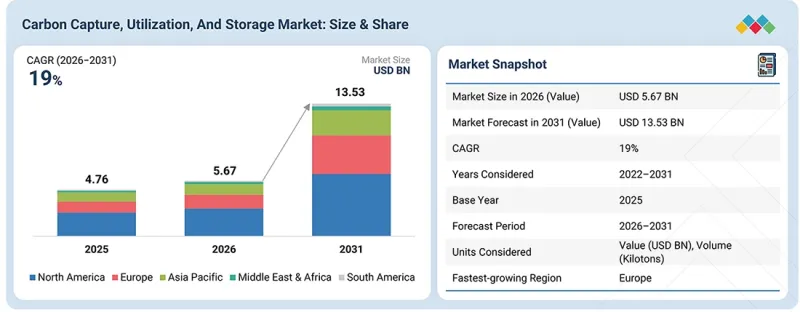
碳捕獲、利用和儲存(CCUS) 市場預計將從 2026 年的 56.7 億美元成長到 2031 年的 135.3 億美元,複合年成長率為 19.0%。
| 調查範圍 | |
|---|---|
| 調查期 | 2022-2031 |
| 基準年 | 2025 |
| 預測期 | 2026-2031 |
| 計算單位 | 金額(百萬/十億美元) |
| 部分 | 按服務、技術、終端用戶產業和地區分類 |
| 目標區域 | 亞太地區、北美地區、歐洲、中東和非洲地區、南美地區 |
碳捕獲、利用與儲存(CCUS)市場的成長主要得益於各產業為減少溫室氣體排放和實現淨零排放目標而加大力度。嚴格的排放法規、碳定價機制、政府獎勵以及對脫碳基礎設施的投資,都為CCUS儲存的應用提供了支持。對低碳工業流程的需求不斷成長,尤其是在水泥、鋼鐵、化學和發電等減排難度較大的產業,進一步推動了CCUS解決方案的應用。此外,CCUS技術的進步提高了營運效率並降低了成本,而共享二氧化碳運輸和儲存基礎設施的建設則為大規模CCUS計畫的部署提供了可能。人們對利用捕獲的二氧化碳進行提高石油提高採收率(EOR)、生產合成燃料、化學品和其他應用的興趣日益濃厚,也為市場擴張創造了更多機會。
「在整個預測期內,我們預計催收服務將佔據最大的市場佔有率(按價值計算)。”
碳捕獲服務預計將佔據最大的市場佔有率,因為它是二氧化碳利用和儲存的主要切入點,發揮著至關重要的作用。二氧化碳捕獲是價值鏈中資本密集度最高、技術要求最高的環節,需要先進的燃燒後捕獲、燃燒前捕獲和富氧燃燒技術。電力、水泥、鋼鐵和化學製造等行業對碳捕獲服務的日益普及,正在推動碳捕獲、利用與儲存(CCUS)市場的成長。日益嚴格的脫碳法規的訂定,以及對雄心勃勃的減排目標和低碳標籤日益成長的需求,預計將顯著增加對二氧化碳捕集服務的需求。
“從以金額為準來看,預計化學循環技術在預測期內將實現最高的複合年成長率。”
在預測期內,化學循環法預計將在碳捕獲、利用與儲存(CCUS)市場中實現最高的複合年成長率。此細分市場的成長主要得益於發電和工業設施對經濟高效且節能的碳捕獲製程日益成長的需求。化學循環法利用金屬氧化物提供燃料燃燒所需的氧氣,無需昂貴的溶劑再生即可有效分離二氧化碳。這降低了能量損失,提高了熱效率,並使其與包括煤炭、天然氣和生質能在內的多種燃料相容。中試到商業規模示範項目的投資增加、日益嚴格的環境標準以及氫氣等高價值產品的聯產潛力,都推動了該細分市場的成長。此外,對能夠降低營運成本的可擴展脫碳解決方案日益成長的需求,預計也將推動碳捕獲、利用與儲存(CCUS)市場的成長。
“從以金額為準來看,預計在預測期內,發電行業的複合年成長率將位居第二。”
從終端用戶領域來看,預計在預測期內,發電領域將成為碳捕獲、利用與儲存(CCUS)市場中複合年成長率第二高的領域。該領域的成長主要得益於燃煤和燃氣電廠減排需求的不斷成長,而這些電廠正是碳捕獲設施維修的主要目標。 CCUS服務/技術具有顯著優勢,能夠在快速、大規模減排的同時,確保低碳基本負載電力供應,並促進可再生能源的併網。儘管許多政府提供稅額扣抵、補貼和財政支持以加速電廠脫碳,但電力營運商仍在投資CCUS,以在嚴格的氣候政策和淨零排放目標下維持資產的永續性。此外,對可無縫整合到火力發電資產中的高擴充性脫碳解決方案的需求不斷成長,預計也將推動碳捕獲、利用與儲存市場的成長。
“就市場規模而言,預計歐洲在預測期內將實現最高的複合年成長率。”
從區域來看,預計歐洲碳捕獲、利用與儲存(CCUS)市場在預測期內將實現最高的複合年成長率。這一區域成長主要得益於嚴格的環境政策,這些政策強制要求電力、水泥、鋼鐵和化學等產業廣泛採用相關技術,其中包括歐盟綠色交易和具有法律約束力的2050年淨零排放目標。歐洲受益於慷慨的政府資助、歐盟排放交易體系(EU ETS)下健全的碳定價機制,以及諸如「北極光」(Northern Lights)和「波爾托斯」(Porthos)等跨國合作舉措。此外,對綜合捕獲、運輸和儲存舉措的投資不斷增加,以及成熟的產業格局和致力於脫碳的創新舉措,也推動了該地區的成長。另外,對標準化法規結構和通用跨境碳網路日益成長的需求預計也將推動歐洲碳捕獲、利用與儲存(CCUS)市場的成長。
本研究透過對全球產業專家的訪談進行檢驗。原始資訊分為以下三類:
- 按公司類型分類:一級供應商 - 60%,二級供應商 - 20%,三級供應商 - 20%
- 按職位分類:C級主管 -33%,總監 -33%,經理 -34%
- 區域細分:北美 -25%,歐洲 -25%,亞太地區 -20%,中東和非洲 -20%,南美 -10%
本報告對以下公司進行了全面分析:
調查範圍
本研究報告按服務(捕獲、利用、儲存和儲存)、技術(化學鍊式反應、溶劑和吸附劑、膜分離及其他技術)、終端用戶行業(石油和天然氣、發電、化工和石化、水泥、鋼鐵及其他終端用戶行業)以及地區(北美、歐洲、亞太、中東和非洲以及南美)對碳捕獲、利用和南美(CCUS)市場進行了細分。該報告還涵蓋了影響碳捕獲、利用和儲存市場成長的關鍵促進因素,以及限制因素、挑戰和機會。對主要行業參與者的全面評估揭示了他們的業務概況、產品和服務、策略以及近期市場發展。此外,報告說明了全球和區域碳捕獲、利用和儲存市場主要參與者的競爭格局。
購買本報告的理由
本報告為市場領導和新參與企業提供最準確的整體市場及其細分市場的收入估算。它幫助相關人員了解競爭格局,深入了解自身業務定位,並制定合適的打入市場策略。此外,它還幫助相關人員了解市場趨勢,並提供有關關鍵市場促進因素、限制因素、挑戰和機會的資訊。
本報告深入分析了以下幾點:
- 對關鍵促進因素(全球日益關注脫碳和嚴格的二氧化碳減排義務、提高石油採收率(EOR)應用中對商業性二氧化碳利用的需求不斷成長,以及由於更嚴格的環境法規而擴大天然氣的應用)、阻礙因素(捕碳封存(CCS)基礎設施的資本密集型和高運營成本,以及與長期地質儲存的完整性和二氧化碳相關的完整性和二氧化碳相關的完整性和二氧化碳相關的完整性。題)、機會(CCUS專案管道的擴張和亞太市場的商業性部署、先進碳捕獲技術的研發和投資加速,以及CCUS與大規模清潔氫氣和氨生產項目的整合)和挑戰(高額的初始資本要求阻礙了大規模CCUS部署,以及需要最佳化捕獲總體效率和減少能源損失以降低總體捕獲成本)的分析正在影響了大規模CC、利用和儲存。
- 產品開發/創新:對全球碳捕獲、利用和儲存市場的新興 CCUS 技術、研發活動、技術進步和產品發布進行詳細分析。
- 市場發展:本報告全面分析了一個極具吸引力且高成長的市場。報告重點分析了北美、歐洲、亞太、中東和非洲以及南美等主要地區和國家的碳捕獲、利用和封存市場,以及石油天然氣、發電、化學和石化、水泥、鋼鐵和其他儲存行業的碳捕獲、利用和封存市場。
- 市場多元化:碳捕獲、利用與儲存(CCUS)市場的服務、未開發地區、近期趨勢和投資的全面訊息
- 競爭分析:對主要參與者的市場佔有率、成長策略和產品陣容進行詳細評估。
目錄
第1章:引言
第2章執行摘要
第3章重要考察
- 碳捕獲、利用和儲存(CCUS) 市場為企業提供了極具吸引力的機會。
- 碳捕獲、利用與儲存(CCUS)市場:依最終用戶產業與地區分類
- 碳捕獲、利用與儲存(CCUS) 市場:依服務分類
- 碳捕獲、利用與儲存(CCUS)市場:依國家分類
第4章 市場概覽
- 市場動態
- 促進因素
- 抑制因子
- 機會
- 任務
- 未滿足的需求和未開發的領域
- 碳捕獲、利用和儲存(CCUS)市場中尚未滿足的需求
- 未開發領域的機遇
- 相互關聯的市場與跨產業機遇
- 相互關聯的市場
- 跨產業機遇
- 新的經營模式與生態系轉型
- 新經營模式
- 生態系的轉變
- 一級/二級/三級主要公司的策略性舉措
- 主要進展和戰略重點
第5章 產業趨勢
- 波特五力分析
- 新進入者的威脅
- 替代品的威脅
- 供應商的議價能力
- 買方的議價能力
- 競爭公司之間的競爭
- 總體經濟指標
- GDP趨勢與預測
- 工業和能源領域的全球趨勢
- 價值鏈分析
- 生態系分析
- 價格分析
- 主要公司平均售價
- 各地區二氧化碳捕集、利用及儲存(CCUS)平均售價趨勢
- 貿易分析
- 進口方案(HS編碼281121)
- 出口方案(HS編碼281121)
- 2026-2027 年主要會議和活動
- 影響客戶業務的趨勢和變化
- 投資和資金籌措場景
- 案例研究分析
- EQUINOR 與殼牌和道達爾能源合作,開發跨境北極光二氧化碳運輸和儲存網路。
- 西方石油公司(1POINTFIVE)在北美安裝 STRATOS 直接空氣回收(DAC)設施。
- 海德堡材料公司實施 Brevik CCS 項目,以實現水泥生產的脫碳。
- 2025年美國關稅對碳捕獲、利用與儲存(CCUS)市場的影響
- 主要關稅稅率
- 價格影響分析
- 對國家和地區的影響
- 對終端用戶產業的影響
第6章:透過科技、專利、數位化與人工智慧的應用實現策略轉型
- 主要新興技術
- 恢復技術
- 交通運輸技術
- 使用的技術
- 互補技術
- 氣體分離與淨化技術
- 液化和相變技術
- 技術和產品藍圖
- 短期(2025-2027 年)| 基礎設施建設和初步商業化
- 中期計劃(2028-2030 年)| 擴張與標準化
- 長期(2031-2035年及以後)| 大規模商業化與產業轉型
- 專利分析
- 調查方法
- 文件類型
- 洞察力
- 專利的法律地位
- 管轄權分析
- 主要申請人
- 加州大學專利列表
- 未來應用
- 發電與能源系統:石化燃料和生質能源能源發電廠的點源碳捕獲
- 難以減少排放的重工業:水泥、鋼鐵和化學製造中的二氧化碳捕集和礦化。
- 直接從大氣中捕獲和去除:大氣二氧化碳捕獲和負排放技術
- 低碳氫化合物生產:將碳捕獲、利用與封存技術整合到蒸氣甲烷重整(SMR)和合成燃料合成。
- 二氧化碳的循環利用與地下儲存:碳礦化、提高採收率和封存到深層鹹水含水層。
- 人工智慧/生成式人工智慧對碳捕獲、利用和儲存市場的影響
- 主要應用場景和市場潛力
- CCUS流程和系統最佳化的最佳實踐
- CCUS市場人工智慧應用案例研究
- 相互關聯的鄰近生態系及其對市場相關人員的影響
- CCUS市場中客戶對生成式人工智慧應用的準備情況
- 成功案例和實際應用
- SLB:利用人工智慧和數位孿生技術進行碳儲存篩檢和MMV
- AKER 碳捕獲:利用人工智慧最佳化模組化流程
第7章 永續性和監管情勢
- 區域法規和合規性
- 監管機構、政府機構和其他組織
- 業界標準
- 永續發展計劃
- 碳捕獲、利用與封存(CCUS)技術的碳影響及環境應用
- 對永續性和監管政策措施的影響
- 認證、標籤和環境標準
第8章:顧客趨勢與購買行為
- 決策流程
- 買方相關人員和採購評估標準
- 採購過程中的關鍵相關人員
- 購買標準
- 實施障礙和內部挑戰
- 各種應用中尚未滿足的需求
- 市場盈利
- 獲利潛力
- 成本趨勢
- 透過應用實現利潤率機會
第9章 碳捕獲、利用與儲存(CCUS)市場:依服務分類
- 收集
- 運輸
- 使用
- 儲存
第10章:碳捕獲、利用與儲存(CCUS)市場:依技術分類
- 化學環路法
- 溶劑和吸附劑
- 電影
- 其他技術
第11章:碳捕獲、利用與儲存(CCUS)市場:依最終用途產業分類
- 石油和天然氣
- 發電
- 化工/石油化工
- 水泥
- 鋼
- 其他終端用戶產業
第12章 碳捕獲、利用與儲存(CCUS)市場:依地區分類
- 北美洲
- 美國
- 加拿大
- 墨西哥
- 歐洲
- 荷蘭
- 義大利
- 法國
- 英國
- 挪威
- 其他歐洲國家
- 亞太地區
- 中國
- 日本
- 印度
- 澳洲
- 亞太其他地區
- 中東和非洲
- 海灣合作理事會國家
- 其他中東和非洲地區
- 南美洲
- 巴西
- 阿根廷
- 南美洲其他地區
第13章 競爭格局
- 概述
- 主要參與企業的策略/優勢
- 收入分析
- 市佔率分析
- 品牌/產品比較分析
- 品牌比較分析
- 企業估值矩陣:主要公司,2025 年
- 星星
- 新興領導者
- 玩家種類繁多
- 參與企業
- 企業企業發展:主要公司,2025 年
- 公司估值矩陣:新創企業/中小企業,2025 年
- 先進公司
- 應對力的公司
- 充滿活力的公司
- 起始點
- 主要新創企業/中小企業的競爭標竿分析
- CCUS供應商的企業估值與財務指標
- 競爭格局
- 交易
- 業務拓展
- 其他趨勢
第14章:公司簡介
- 大公司
- FLUOR CORPORATION
- EXXON MOBIL CORPORATION
- SHELL PLC
- EQUINOR ASA
- TOTALENERGIES SE
- LINDE PLC
- MITSUBISHI HEAVY INDUSTRIES, LTD.
- JGC HOLDINGS CORPORATION
- SCHLUMBERGER LIMITED
- AKER SOLUTIONS
- HONEYWELL INTERNATIONAL
- HITACHI, LTD.
- SIEMENS AG
- GE VERNOVA
- HALLIBURTON
- OTHER KEY MARKET PLAYERS
- CLIMEWORKS AG
- CARBON CLEAN SOLUTIONS
- OCCIDENTAL
- GREEN MINERALS BV
- CARBICRETE
- CARBONFREE
- SVANTE TECHNOLOGIES INC.
- GREEN POWER INTERNATIONAL PVT. LTD.
- WOLF MIDSTREAM
- BABCOCK &WILCOX
第15章:調查方法
第16章附錄
The carbon capture, utilization, and storage market is projected to grow from USD 5.67 billion in 2026 and is projected to reach USD 13.53 billion by 2031, registering a CAGR of 19.0%.
| Scope of the Report | |
|---|---|
| Years Considered for the Study | 2022-2031 |
| Base Year | 2025 |
| Forecast Period | 2026-2031 |
| Units Considered | Value (USD Million/Billion) |
| Segments | by Service, Technology, End-use Industry, and Region |
| Regions covered | Asia Pacific, North America, Europe, Middle East & Africa, South America |
The growth of the carbon capture, utilization, and storage market is driven by increasing efforts to reduce greenhouse gas emissions and achieve net-zero targets across industries. The adoption of carbon capture, utilization, and storage (CCUS) services is supported by stringent emission regulations, carbon pricing mechanisms, government incentives, and investments in decarbonization infrastructure. Rising demand for low-carbon industrial processes, particularly in hard-to-abate sectors such as cement, steel, chemicals, and power generation, is further encouraging the deployment of CCUS solutions. In addition, advancements in CCUS technologies are improving operational efficiency and reducing costs, while the development of shared CO2 transportation and storage infrastructure is enabling the deployment of large-scale CCUS projects. Growing interest in utilizing captured CO2 for enhanced oil recovery, synthetic fuels, chemicals, and other applications is also creating additional opportunities for market expansion.
"Capture services are expected to hold the largest market share, in terms of value, throughout the forecast period."
Capture services are expected to hold the largest market share, driven by their essential role as the primary gateway for carbon dioxide utilization and storage. Capturing CO2 is the most capital-intensive and technical phase in the value chain, requiring advanced post-combustion, pre-combustion, and oxy-fuel technologies. Growth in the adoption of capture services across power generation, cement, steel, and chemical production is driving the carbon capture, utilization, and storage market. The implementation of stringent decarbonization regulations, alongside ambitious emission reduction targets and an increasing demand for low-carbon labeling, is anticipated to significantly elevate the demand for carbon capture services.
"In terms of value, chemical looping technology is expected to register the highest CAGR during the forecast period."
Chemical looping technology is expected to witness the highest CAGR in the carbon capture, utilization, and storage market during the forecast period. The segment's growth is driven by rising demand for cost-effective and energy-efficient capture processes across power generation and industrial facilities. Chemical looping utilizes metal oxides to transfer oxygen for fuel combustion, inherently separating CO2 without the need for expensive solvent regeneration. This offers low energy penalties, high thermal efficiency, and compatibility with diverse fuels such as coal, natural gas, and biomass. Increasing investments in pilot-to-commercial scale demonstrations, strict environmental norms, and potential co-production of valuable outputs, such as hydrogen, are contributing to the segment's growth. Moreover, rising demand for scalable decarbonization solutions that lower operational expenses is likely to contribute to the growth of the carbon capture, utilization, and storage market.
"In terms of value, the power generation end-use industry is expected to register the second-highest CAGR during the forecast period."
By end-use industry, the power generation segment is expected to witness the second-highest CAGR in the carbon capture, utilization, and storage market over the forecast period. The segmental growth is driven by rising demand for emission reduction in coal- and gas-fired power plants, which are primary candidates for retrofitting with carbon capture equipment. CCUS services/technologies offer significant advantages by enabling rapid, high-volume emission cuts while ensuring low-carbon baseload power alongside renewable energy integration. Several governments are providing tax credits, subsidies, and funding schemes to accelerate electricity decarbonization, while utility providers are investing in CCUS to maintain asset viability under strict climate policies and net-zero goals. Moreover, rising demand for scalable decarbonization solutions that can seamlessly integrate into thermal power generation assets is likely to contribute to the growth of the carbon capture, utilization, and storage market.
"In terms of value, Europe is projected to register the highest CAGR during the forecast period."
By region, Europe is expected to witness the highest CAGR in the carbon capture, utilization, and storage market over the forecast period. The regional growth is driven by stringent environmental policies, including the EU Green Deal and legally binding 2050 net-zero targets, which mandate widespread adoption across power, cement, steel, and chemicals industries. Europe benefits from robust state funding, strong carbon pricing mechanisms under the EU Emissions Trading System (EU ETS), and collaborative cross-border initiatives such as Northern Lights and Porthos. Increasing investments in integrated capture, transport, and storage infrastructure, along with a mature industrial landscape and dedicated low-carbon innovation initiatives, are contributing to the region's growth. Furthermore, rising demand for standardized regulatory frameworks and shared cross-border carbon networks is likely to contribute to the growth of the carbon capture, utilization, and storage market in Europe.
This study has been validated through primary interviews with industry experts globally. The primary sources have been divided into the following three categories:
- By Company Type: Tier 1 - 60%, Tier 2 - 20%, and Tier 3 - 20%
- By Designation: C-level Executives - 33%, Directors - 33%, and Managers - 34%
- By Region: North America - 25%, Europe - 25%, Asia Pacific - 20%, Middle East & Africa - 20%, and South America - 10%
The report provides a comprehensive analysis of the following companies:
Prominent companies in this market include Fluor Corporation (US), Exxon Mobil Corporation (US), Linde plc (UK), Shell Plc. (UK), Mitsubishi Heavy Industries, Ltd. (Japan), JGC Holdings Corporation (Japan), Schlumberger Limited (US), Aker Solutions (Norway), Honeywell International (US), Equinor ASA (Norway), TotalEnergies SE (France), Hitachi Ltd. (Japan), Siemens AG (Germany), GE Vernova (US), and Halliburton (US), among others.
Research Coverage
This research report categorizes the carbon capture, utilization, and storage market by service (capture, utilization, storage, transportation), technology (chemical looping, solvents & sorbents, membranes, other technologies), end-use industry (oil & gas, power generation, chemicals & petrochemicals, cement, iron & steel, other end-use industries), and region (North America, Europe, Asia Pacific, the Middle East & Africa, and South America). The report covers the major driving factors impacting carbon capture, utilization, and storage market growth, along with restraints, challenges, and opportunities. A comprehensive assessment of key industry players highlights their business profiles, products & services, strategies, and recent developments in the market. The report also provides a competitive landscape of key global and regional players in the carbon capture, utilization, and storage market.
Reasons to Buy this Report
The report will help market leaders/new entrants in this market with information on the closest approximations of revenue for the overall market and its subsegments. This report will help stakeholders understand the competitive landscape, gain insights into their business positioning, and plan suitable go-to-market strategies. The report also helps stakeholders understand the market pulse and provides information on key market drivers, restraints, challenges, and opportunities.
The report provides insights into the following pointers:
- Analysis of key drivers (Rising global focus on decarbonization and strict CO2 emissions reduction mandate, Increasing demand for commercial CO2 utilization in enhanced oil recovery (EOR) applications, Rising natural gas adoption amid increasingly stringent environmental regulations), restraints (Capital-intensive nature and high operational costs of carbon capture and storage infrastructure, Environmental and safety concerns associated with long-term geological storage integrity and potential CO2 leakage), opportunities (Expanding CCUS project pipelines and commercial deployment across Asia Pacific markets, Accelerating R&D and investments in advanced carbon capture technologies, Integration of CCUS with large-scale clean hydrogen and ammonia production projects), and challenges (Significant upfront capital requirements creating barriers to large-scale CCUS deployment, Need to optimize capture efficiency and lower energy penalties to reduce overall capturing costs) influencing the growth of the carbon capture, utilization, and storage market
- Product Development/Innovation: Detailed insights into emerging CCUS technologies, R&D activities, advancements, and product launches across the global carbon capture, utilization, and storage market
- Market Development: Comprehensive information on attractive and high-growth markets, with the report analyzing the carbon capture, utilization, and storage market across key regions and countries, including North America, Europe, Asia Pacific, Middle East & Africa, and South America, and across oil & gas, power generation, chemicals & petrochemicals, cement, iron & steel, and other end-use industries.
- Market Diversification: Exhaustive information on services, untapped geographies, recent developments, and investments in the carbon capture, utilization, and storage market
- Competitive Assessment: In-depth assessment of market shares, growth strategies, and product offerings of leading players such as Fluor Corporation (US), Exxon Mobil Corporation (US), Linde plc (UK), Shell Plc (UK), Mitsubishi Heavy Industries, Ltd. (Japan), JGC Holdings Corporation (Japan), Schlumberger Limited (US), Aker Solutions (Norway), Honeywell International (US), Equinor ASA (Norway), TotalEnergies SE (France), Hitachi Ltd. (Japan), Siemens AG (Germany), GE Vernova (US), and Halliburton (US), among others
TABLE OF CONTENTS
1 INTRODUCTION
- 1.1 STUDY OBJECTIVES
- 1.2 MARKET DEFINITION
- 1.3 STUDY SCOPE
- 1.3.1 MARKETS COVERED AND REGIONAL SCOPE
- 1.3.2 INCLUSIONS AND EXCLUSIONS
- 1.3.3 YEARS CONSIDERED
- 1.3.4 CURRENCY CONSIDERED
- 1.3.5 UNITS CONSIDERED
- 1.4 LIMITATIONS
- 1.5 STAKEHOLDERS
- 1.6 SUMMARY OF CHANGES
2 EXECUTIVE SUMMARY
- 2.1 KEY INSIGHTS AND MARKET HIGHLIGHTS
- 2.2 KEY MARKET PARTICIPANTS: SHARE INSIGHTS AND STRATEGIC DEVELOPMENTS
- 2.3 DISRUPTIVE TRENDS SHAPING MARKET
- 2.4 HIGH-GROWTH SEGMENTS & EMERGING FRONTIERS
- 2.5 SNAPSHOT: GLOBAL MARKET SIZE, GROWTH RATE, AND FORECAST
3 PREMIUM INSIGHTS
- 3.1 ATTRACTIVE OPPORTUNITIES FOR PLAYERS IN CARBON CAPTURE, UTILIZATION, AND STORAGE MARKET
- 3.2 CARBON CAPTURE, UTILIZATION, AND STORAGE MARKET, BY END-USE INDUSTRY AND REGION
- 3.3 CARBON CAPTURE, UTILIZATION, AND STORAGE MARKET, BY SERVICE
- 3.4 CARBON CAPTURE, UTILIZATION, AND STORAGE MARKET, BY COUNTRY
4 MARKET OVERVIEW
- 4.1 INTRODUCTION
- 4.2 MARKET DYNAMICS
- 4.2.1 DRIVERS
- 4.2.1.1 Rising global focus on decarbonization and strict CO2 emissions reduction mandates
- 4.2.1.2 Increasing demand for commercial CO2 utilization in enhanced oil recovery (EOR) operations
- 4.2.1.3 Growing transition toward natural gas driven by heightened environmental regulations
- 4.2.2 RESTRAINTS
- 4.2.2.1 CAPITAL-INTENSIVE NATURE AND HIGH OPERATIONAL COSTS OF CARBON CAPTURE AND STORAGE INFRASTRUCTURE
- 4.2.2.2 Environmental and safety risks regarding long-term geological storage site integrity and leakage
- 4.2.3 OPPORTUNITIES
- 4.2.3.1 Ongoing investments and R&D in next-generation, high-efficiency capture technologies
- 4.2.3.2 Expanding project pipeline and commercial deployment across high-growth Asia Pacific markets
- 4.2.3.3 Strategic integration with large-capacity clean hydrogen and ammonia production projects
- 4.2.4 CHALLENGES
- 4.2.4.1 Need to optimize capture efficiency and lower energy penalties to reduce overall capture costs
- 4.2.4.2 Substantial initial CAPEX requirements creating high barriers to entry for large-scale adoption
- 4.2.1 DRIVERS
- 4.3 UNMET NEEDS AND WHITE SPACES
- 4.3.1 UNMET NEEDS IN CARBON CAPTURE, UTILIZATION, AND STORAGE MARKET
- 4.3.2 WHITE SPACE OPPORTUNITIES
- 4.4 INTERCONNECTED MARKETS AND CROSS-SECTOR OPPORTUNITIES
- 4.4.1 INTERCONNECTED MARKETS
- 4.4.2 CROSS-SECTOR OPPORTUNITIES
- 4.5 EMERGING BUSINESS MODELS AND ECOSYSTEM SHIFTS
- 4.5.1 EMERGING BUSINESS MODELS
- 4.5.2 ECOSYSTEM SHIFTS
- 4.6 STRATEGIC MOVES BY TIER-1/2/3 PLAYERS
- 4.6.1 KEY MOVES AND STRATEGIC FOCUS
5 INDUSTRY TRENDS
- 5.1 PORTER'S FIVE FORCES ANALYSIS
- 5.1.1 THREAT OF NEW ENTRANTS
- 5.1.2 THREAT OF SUBSTITUTES
- 5.1.3 BARGAINING POWER OF SUPPLIERS
- 5.1.4 BARGAINING POWER OF BUYERS
- 5.1.5 INTENSITY OF COMPETITIVE RIVALRY
- 5.2 MACROECONOMIC INDICATORS
- 5.2.1 INTRODUCTION
- 5.2.2 GDP TRENDS AND FORECAST
- 5.2.3 TRENDS IN GLOBAL INDUSTRIAL & ENERGY SECTOR
- 5.3 VALUE CHAIN ANALYSIS
- 5.4 ECOSYSTEM ANALYSIS
- 5.5 PRICING ANALYSIS
- 5.5.1 AVERAGE SELLING PRICE, BY KEY PLAYERS
- 5.5.2 AVERAGE SELLING PRICE TREND OF CARBON CAPTURE, UTILIZATION, AND STORAGE, BY REGION
- 5.6 TRADE ANALYSIS
- 5.6.1 IMPORT SCENARIO (HS CODE 281121)
- 5.6.2 EXPORT SCENARIO (HS CODE 281121)
- 5.7 KEY CONFERENCES AND EVENTS, 2026-2027
- 5.8 TRENDS/DISRUPTIONS IMPACTING CUSTOMER BUSINESS
- 5.9 INVESTMENT AND FUNDING SCENARIO
- 5.10 CASE STUDY ANALYSIS
- 5.10.1 EQUINOR PARTNERS WITH SHELL AND TOTALENERGIES TO DEVELOP NORTHERN LIGHTS CROSS-BORDER CO2 TRANSPORT AND STORAGE NETWORK
- 5.10.2 OCCIDENTAL PETROLEUM (1POINTFIVE) DEPLOYS STRATOS DIRECT AIR CAPTURE (DAC) FACILITY IN NORTH AMERICA
- 5.10.3 HEIDELBERG MATERIALS IMPLEMENTS BREVIK CCS PROJECT FOR CEMENT MANUFACTURING DECARBONIZATION
- 5.11 IMPACT OF 2025 US TARIFF ON CARBON CAPTURE, UTILIZATION, AND STORAGE MARKET
- 5.11.1 INTRODUCTION
- 5.11.2 KEY TARIFF RATES
- 5.11.3 PRICE IMPACT ANALYSIS
- 5.11.4 IMPACT ON COUNTRIES/REGIONS
- 5.11.4.1 US
- 5.11.4.2 Europe
- 5.11.4.3 Asia Pacific
- 5.11.5 IMPACT ON END-USE INDUSTRIES
6 STRATEGIC DISRUPTION THROUGH TECHNOLOGY, PATENTS, DIGITAL, AND AI ADOPTIONS
- 6.1 KEY EMERGING TECHNOLOGIES
- 6.1.1 CAPTURE TECHNOLOGIES
- 6.1.1.1 POST-COMBUSTION CAPTURE
- 6.1.1.2 PRE-COMBUSTION CAPTURE
- 6.1.1.3 OXY-FUEL COMBUSTION
- 6.1.1.4 DIRECT AIR CAPTURE (DAC)
- 6.1.2 TRANSPORT TECHNOLOGIES
- 6.1.2.1 Pipeline transport
- 6.1.2.2 SHIP-BASED TRANSPORT
- 6.1.3 UTILIZATION TECHNOLOGIES
- 6.1.3.1 Direct utilization
- 6.1.3.2 Carbon mineralization
- 6.1.1 CAPTURE TECHNOLOGIES
- 6.2 COMPLEMENTARY TECHNOLOGIES
- 6.2.1 GAS SEPARATION & PURIFICATION
- 6.2.2 LIQUEFACTION & PHASE CHANGE TECHNOLOGIES
- 6.3 TECHNOLOGY/PRODUCT ROADMAP
- 6.3.1 SHORT-TERM (2025-2027) | FOUNDATION & EARLY COMMERCIALIZATION
- 6.3.2 MID-TERM (2028-2030) | EXPANSION & STANDARDIZATION
- 6.3.3 LONG-TERM (2031-2035+) | MASS COMMERCIALIZATION & DISRUPTION
- 6.4 PATENT ANALYSIS
- 6.4.1 INTRODUCTION
- 6.4.2 METHODOLOGY
- 6.4.3 DOCUMENT TYPE
- 6.4.4 INSIGHTS
- 6.4.5 LEGAL STATUS OF PATENTS
- 6.4.6 JURISDICTION ANALYSIS
- 6.4.7 TOP APPLICANTS
- 6.4.8 LIST OF PATENTS BY UNIVERSITY OF CALIFORNIA
- 6.5 FUTURE APPLICATIONS
- 6.5.1 POWER GENERATION & ENERGY SYSTEMS: POINT-SOURCE CARBON CAPTURE FOR FOSSIL-FUEL AND BIOENERGY POWER PLANTS
- 6.5.2 HARD-TO-ABATE HEAVY INDUSTRIES: CARBON CAPTURE & MINERALIZATION FOR CEMENT, STEEL, AND CHEMICAL MANUFACTURING
- 6.5.3 DIRECT AIR CAPTURE (DAC) & ATMOSPHERIC REMOVAL: AMBIENT AIR CO2 CAPTURE & NEGATIVE-EMISSION TECHNOLOGIES
- 6.5.4 LOW-CARBON HYDROGEN & FUEL PRODUCTION: CCUS INTEGRATION IN STEAM METHANE REFORMING (SMR) AND SYNTHETIC FUEL SYNTHESIS
- 6.5.5 CIRCULAR CO2 UTILIZATION & GEOLOGICAL STORAGE: CARBON MINERALIZATION, EOR, AND DEEP SALINE AQUIFER SEQUESTRATION
- 6.6 IMPACT OF AI/GEN AI ON CARBON CAPTURE, UTILIZATION, AND STORAGE MARKET
- 6.6.1 TOP USE CASES AND MARKET POTENTIAL
- 6.6.2 BEST PRACTICES IN CCUS PROCESS & SYSTEM OPTIMIZATION
- 6.6.3 CASE STUDIES OF AI IMPLEMENTATION IN CCUS MARKET
- 6.6.4 INTERCONNECTED ADJACENT ECOSYSTEM AND IMPACT ON MARKET PLAYERS
- 6.6.5 CLIENTS' READINESS TO ADOPT GENERATIVE AI IN CCUS MARKET
- 6.7 SUCCESS STORIES AND REAL-WORLD APPLICATIONS
- 6.7.1 SLB: AI & DIGITAL-TWIN-BASED CARBON STORAGE SCREENING & MMV
- 6.7.2 AKER CARBON CAPTURE: AI-POWERED MODULAR PROCESS OPTIMIZATION
7 SUSTAINABILITY AND REGULATORY LANDSCAPE
- 7.1 REGIONAL REGULATIONS AND COMPLIANCE
- 7.1.1 REGULATORY BODIES, GOVERNMENT AGENCIES, AND OTHER ORGANIZATIONS
- 7.1.2 INDUSTRY STANDARDS
- 7.2 SUSTAINABILITY INITIATIVES
- 7.2.1 CARBON IMPACT AND ECO-APPLICATIONS OF CCUS TECHNOLOGIES
- 7.2.1.1 Carbon impact reduction
- 7.2.1.2 Eco-Applications
- 7.2.1 CARBON IMPACT AND ECO-APPLICATIONS OF CCUS TECHNOLOGIES
- 7.3 SUSTAINABILITY IMPACT AND REGULATORY POLICY INITIATIVES
- 7.4 CERTIFICATIONS, LABELING, ECO-STANDARDS
8 CUSTOMER LANDSCAPE & BUYER BEHAVIOR
- 8.1 DECISION-MAKING PROCESS
- 8.2 BUYER STAKEHOLDERS AND BUYING EVALUATION CRITERIA
- 8.2.1 KEY STAKEHOLDERS IN BUYING PROCESS
- 8.2.2 BUYING CRITERIA
- 8.3 ADOPTION BARRIERS & INTERNAL CHALLENGES
- 8.4 UNMET NEEDS FROM VARIOUS APPLICATIONS
- 8.5 MARKET PROFITABILITY
- 8.5.1 REVENUE POTENTIAL
- 8.5.2 COST DYNAMICS
- 8.5.3 MARGIN OPPORTUNITIES, BY APPLICATION
9 CARBON CAPTURE, UTILIZATION, AND STORAGE MARKET, BY SERVICE
- 9.1 INTRODUCTION
- 9.2 CAPTURE
- 9.2.1 PRIMARY MECHANISMS AND OPERATIONAL SCOPE
- 9.2.2 CAPTURE, BY TECHNOLOGY
- 9.2.2.1 Post-combustion
- 9.2.2.1.1 High separation efficiency up to 99% across diverse separation media
- 9.2.2.2 Oxy-fuel
- 9.2.2.2.1 Simplified CO2 separation via high-purity flue gas streams and advanced chemical looping
- 9.2.2.3 Pre-combustion
- 9.2.2.3.1 Concentrated stream CO2 separation prior to air dilution and hydrogen production
- 9.2.2.4 Bio-energy CCS (BECCS)
- 9.2.2.4.1 Atmospheric Carbon removal and long-term geologic storage stability exceeding 1,000 years
- 9.2.2.5 Direct Air Capture
- 9.2.2.5.1 Escalating global demand for negative emission technologies drives scaled commercialization of DAC frameworks
- 9.2.2.1 Post-combustion
- 9.3 TRANSPORTATION
- 9.3.1 PIPELINE INFRASTRUCTURE DOMINATES MIDSTREAM LOGISTICS DRIVEN BY SUPERIOR COST-EFFICIENCY AND LOW EMISSIONS
- 9.4 UTILIZATION
- 9.4.1 ENHANCED OIL RECOVERY AND COMMERCIAL FEEDSTOCK INNOVATIONS DRIVE MARKET SCALING
- 9.5 STORAGE
- 9.5.1 DEEP GEOLOGICAL FORMATIONS REPRESENT THE PRIMARY VECTOR FOR PERMANENT CARBON SEQUESTRATION
- 9.5.2 STORAGE SERVICE, BY TECHNOLOGY
- 9.5.3 GEOLOGICAL STORAGE
- 9.5.3.1 Depleted Oil & Gas Reservoirs
- 9.5.3.1.1 Most efficient and commercially proven storage vector
- 9.5.3.2 Un-Mineable Coal Beds
- 9.5.3.2.1 Simultaneous carbon trapping and enhanced coal bed methane recovery
- 9.5.3.3 Saline Aquifers
- 9.5.3.3.1 High storage potential constrained by subsurface mapping requirements
- 9.5.3.1 Depleted Oil & Gas Reservoirs
- 9.5.4 DEEP OCEAN STORAGE
- 9.5.4.1 Environmental risks and ecological concerns restrain large-scale ocean sequestration deployment
10 CARBON CAPTURE, UTILIZATION, AND STORAGE MARKET, BY TECHNOLOGY
- 10.1 INTRODUCTION
- 10.2 CHEMICAL LOOPING
- 10.2.1 ECONOMIC SUPERIORITY AND OPERATIONAL DYNAMICS IN CCUS DEPLOYMENT
- 10.3 SOLVENTS & SORBENTS
- 10.3.1 PROVEN RETROFITTING SOLUTIONS DRIVING HIGH CAPTURE EFFICIENCY
- 10.4 MEMBRANES
- 10.4.1 HIGHLY EFFICIENT, CONTINUOUS CARBON CAPTURE TECHNOLOGY
- 10.5 OTHER TECHNOLOGIES
- 10.5.1 ADVANCED AND HYBRID TECHNOLOGIES ENHANCING CAPTURE EFFICIENCY AND OPERATIONAL FLEXIBILITY
11 CARBON CAPTURE, UTILIZATION, AND STORAGE MARKET, BY END-USE INDUSTRY
- 11.1 INTRODUCTION
- 11.2 OIL & GAS
- 11.2.1 NATURAL GAS PROCESSING AND REFINING ABATEMENT DRIVE SECTOR DOMINANCE
- 11.3 POWER GENERATION
- 11.3.1 POINT-SOURCE RETROFITTING OF FOSSIL FUEL POWER PLANTS DRIVES SECTOR EXPANSION
- 11.4 CHEMICAL & PETROCHEMICAL
- 11.4.1 AMMONIA AND PETROCHEMICAL SYNTHESIS FEEDSTOCKS CONTRIBUTE TO SECTOR ADOPTION
- 11.5 CEMENT
- 11.5.1 REGULATORY PRESSURES AND PROCESS EMISSION ABATEMENT DRIVE TECHNOLOGY ADOPTION
- 11.6 IRON & STEEL
- 11.6.1 HIGH EMISSIONS FOOTPRINT AND DRI PROCESS INTEGRATION DRIVE SECTOR CCUS ADOPTION
- 11.7 OTHER END-USE INDUSTRIES
12 CARBON CAPTURE, UTILIZATION, AND STORAGE MARKET, BY REGION
- 12.1 INTRODUCTION
- 12.2 NORTH AMERICA
- 12.2.1 US
- 12.2.1.1 Federal Policy Support and Advanced Infrastructure Expansion
- 12.2.2 CANADA
- 12.2.2.1 Regulatory Mandates and Carbon Storage Potential to Drive Expansion
- 12.2.3 MEXICO
- 12.2.3.1 Offshore Storage Infrastructure and Emissions Mandates to Drive Expansion
- 12.2.1 US
- 12.3 EUROPE
- 12.3.1 NETHERLANDS
- 12.3.1.1 Advancing Offshore Infrastructure and R&D Capabilities in the Netherlands CCUS Market
- 12.3.2 ITALY
- 12.3.2.1 Policy Frameworks and Offshore Infrastructure Driving Italy CCUS Expansion
- 12.3.3 FRANCE
- 12.3.3.1 Industrial Decarbonization Strategy and Project Announcements Accelerating France CCUS Market
- 12.3.4 UK
- 12.3.4.1 Government Mandates and Industrial Cluster Deployment Accelerating UK CCUS Expansion
- 12.3.5 NORWAY
- 12.3.5.1 Offshore Storage Leadership and State-Backed Infrastructure Driving Norway CCUS Market
- 12.3.6 REST OF EUROPE
- 12.3.6.1 Regional Diversification and Industrial Decarbonization Driving Rest of Europe CCUS Growth
- 12.3.1 NETHERLANDS
- 12.4 ASIA PACIFIC
- 12.4.1 CHINA
- 12.4.1.1 Strategic Collaborations and Policy Frameworks Accelerating China CCUS Market Expansion
- 12.4.2 JAPAN
- 12.4.2.1 Robust Industrial Base and Advanced Technology Providers Driving Japan CCUS Market Growth
- 12.4.3 INDIA
- 12.4.3.1 Industrialization and Emission Regulations Driving India CCUS Market Expansion
- 12.4.4 AUSTRALIA
- 12.4.4.1 Strategic Government Support and Geological Advantage Accelerating Australia CCUS Market Expansion
- 12.4.5 REST OF ASIA PACIFIC
- 12.4.5.1 Policy Frameworks and Sustainability Commitments Driving Rest of Asia Pacific CCUS Market Growth
- 12.4.1 CHINA
- 12.5 MIDDLE EAST & AFRICA
- 12.5.1 GCC COUNTRIES
- 12.5.1.1 UAE
- 12.5.1.1.1 Commercial Project Deployment and EOR Integration Driving UAE CCUS Market
- 12.5.1.2 Saudi Arabia
- 12.5.1.2.1 Strategic Project Deployment and Commercial Scaling Driving Saudi Arabia CCUS Market
- 12.5.1.3 Rest of GCC Countries
- 12.5.1.3.1 Hydrocarbon Industry Decarbonization and Infrastructure Expansion Driving Rest of GCC CCUS Market
- 12.5.1.1 UAE
- 12.5.2 REST OF MIDDLE EAST & AFRICA
- 12.5.1 GCC COUNTRIES
- 12.6 SOUTH AMERICA
- 12.6.1 BRAZIL
- 12.6.1.1 Decarbonization Mandates and Pre-Salt Field Reinjection Driving Brazil CCUS Market
- 12.6.2 ARGENTINA
- 12.6.2.1 Vaca Muerta Expansion and Gas Infrastructure Driving Argentina CCUS Market
- 12.6.3 REST OF SOUTH AMERICA
- 12.6.1 BRAZIL
13 COMPETITIVE LANDSCAPE
- 13.1 OVERVIEW
- 13.2 KEY PLAYER STRATEGIES/RIGHT TO WIN
- 13.3 REVENUE ANALYSIS
- 13.4 MARKET SHARE ANALYSIS
- 13.5 BRAND/PRODUCT COMPARATIVE ANALYSIS
- 13.5.1 BRAND COMPARATIVE ANALYSIS
- 13.5.1.1 Fluor Econamine FG Plus
- 13.5.1.2 Exxon Mobil Corporation - CCUS
- 13.5.1.3 Equinor ASA
- 13.5.1.4 Mitsubishi KM-CDR
- 13.5.1 BRAND COMPARATIVE ANALYSIS
- 13.6 COMPANY EVALUATION MATRIX: KEY PLAYERS, 2025
- 13.6.1 STARS
- 13.6.2 EMERGING LEADERS
- 13.6.3 PERVASIVE PLAYERS
- 13.6.4 PARTICIPANTS
- 13.6.5 COMPANY FOOTPRINT: KEY PLAYERS, 2025
- 13.6.5.1 Company footprint
- 13.6.5.2 Region footprint
- 13.6.5.3 Service footprint
- 13.6.5.4 End-use Industry footprint
- 13.7 COMPANY EVALUATION MATRIX: STARTUPS/SMES, 2025
- 13.7.1 PROGRESSIVE COMPANIES
- 13.7.2 RESPONSIVE COMPANIES
- 13.7.3 DYNAMIC COMPANIES
- 13.7.4 STARTING BLOCKS
- 13.7.5 COMPETITIVE BENCHMARKING OF KEY STARTUPS/SMES
- 13.7.5.1 Detailed list of key startups/SMEs
- 13.7.5.2 Competitive benchmarking of key startups/SMEs
- 13.8 VALUATION AND FINANCIAL METRICS OF CCUS VENDORS
- 13.9 COMPETITIVE SCENARIO
- 13.9.1 DEALS
- 13.9.2 EXPANSIONS
- 13.9.3 OTHER DEVELOPMENT
14 COMPANY PROFILES
- 14.1 KEY PLAYERS
- 14.1.1 FLUOR CORPORATION
- 14.1.1.1 Business overview
- 14.1.1.2 Products offered
- 14.1.1.3 Recent developments
- 14.1.1.3.1 Deals
- 14.1.1.3.2 Other developments
- 14.1.1.4 MnM view
- 14.1.1.4.1 Right to win
- 14.1.1.4.2 Strategic choices
- 14.1.1.4.3 Weaknesses and competitive threats
- 14.1.2 EXXON MOBIL CORPORATION
- 14.1.2.1 Business overview
- 14.1.2.2 Products offered
- 14.1.2.3 Recent developments
- 14.1.2.3.1 Deals
- 14.1.2.3.2 Expansions
- 14.1.2.3.3 Other developments
- 14.1.2.4 MnM view
- 14.1.2.4.1 Right to win
- 14.1.2.4.2 Strategic choices
- 14.1.2.4.3 Weaknesses and competitive threats
- 14.1.3 SHELL PLC
- 14.1.3.1 Business overview
- 14.1.3.2 Products offered
- 14.1.3.3 Recent developments
- 14.1.3.3.1 Deals
- 14.1.3.3.2 Expansions
- 14.1.3.3.3 Other Developments
- 14.1.3.4 MnM view
- 14.1.3.4.1 Right to win
- 14.1.3.4.2 Strategic choices
- 14.1.3.4.3 Weaknesses and competitive threats
- 14.1.4 EQUINOR ASA
- 14.1.4.1 Business overview
- 14.1.4.2 Products offered
- 14.1.4.3 Recent developments
- 14.1.4.3.1 Deals
- 14.1.4.3.2 Expansions
- 14.1.4.3.3 Other developments
- 14.1.4.4 MnM view
- 14.1.4.4.1 Right to win
- 14.1.4.4.2 Strategic choices
- 14.1.4.4.3 Weaknesses and competitive threats
- 14.1.5 TOTALENERGIES SE
- 14.1.5.1 Business overview
- 14.1.5.2 Products offered
- 14.1.5.3 Recent Developments
- 14.1.5.3.1 Deals
- 14.1.5.3.2 Expansions
- 14.1.5.3.3 Other developments
- 14.1.5.4 MnM view
- 14.1.5.4.1 Right to win
- 14.1.5.4.2 Strategic choices
- 14.1.5.4.3 Weaknesses and competitive threats
- 14.1.6 LINDE PLC
- 14.1.6.1 Business overview
- 14.1.6.2 Products offered
- 14.1.6.3 Recent developments
- 14.1.6.3.1 Deals
- 14.1.6.3.2 Expansions
- 14.1.6.4 MnM view
- 14.1.6.4.1 Right to win
- 14.1.6.4.2 Strategic choices
- 14.1.6.4.3 Weaknesses and competitive threats
- 14.1.7 MITSUBISHI HEAVY INDUSTRIES, LTD.
- 14.1.7.1 Business overview
- 14.1.7.2 Products offered
- 14.1.7.3 Recent developments
- 14.1.7.3.1 Deals
- 14.1.7.3.2 Expansions
- 14.1.7.3.3 Other developments
- 14.1.7.4 MnM view
- 14.1.7.4.1 Right to win
- 14.1.7.4.2 Strategic choices
- 14.1.7.4.3 Weaknesses and competitive threats
- 14.1.8 JGC HOLDINGS CORPORATION
- 14.1.8.1 Business overview
- 14.1.8.2 Products offered
- 14.1.8.3 Recent developments
- 14.1.8.3.1 Deals
- 14.1.8.3.2 Expansions
- 14.1.8.3.3 Other developments
- 14.1.8.4 MnM view
- 14.1.8.4.1 Right to win
- 14.1.8.4.2 Strategic choices
- 14.1.8.4.3 Weaknesses and competitive threats
- 14.1.9 SCHLUMBERGER LIMITED
- 14.1.9.1 Business overview
- 14.1.9.2 Products offered
- 14.1.9.3 Recent developments
- 14.1.9.3.1 Deals
- 14.1.9.3.2 Expansions
- 14.1.9.3.3 Other developments
- 14.1.9.4 MnM view
- 14.1.9.4.1 Right to win
- 14.1.9.4.2 Strategic choices
- 14.1.9.4.3 Weaknesses and competitive threats
- 14.1.10 AKER SOLUTIONS
- 14.1.10.1 Business overview
- 14.1.10.2 Products offered
- 14.1.10.3 Recent developments
- 14.1.10.3.1 Expansions
- 14.1.10.3.2 Other developments
- 14.1.10.4 MnM view
- 14.1.10.4.1 Right to win
- 14.1.10.4.2 Strategic choices
- 14.1.10.4.3 Weaknesses and competitive threats
- 14.1.11 HONEYWELL INTERNATIONAL
- 14.1.11.1 Business overview
- 14.1.11.2 Products offered
- 14.1.11.3 Recent developments
- 14.1.11.3.1 Deals
- 14.1.11.3.2 Expansions
- 14.1.11.3.3 Other developments
- 14.1.11.4 MnM view
- 14.1.11.4.1 Right to win
- 14.1.11.4.2 Strategic choices
- 14.1.11.4.3 Weaknesses and competitive threats
- 14.1.12 HITACHI, LTD.
- 14.1.12.1 Business overview
- 14.1.12.2 Products offered
- 14.1.12.3 Recent Developments
- 14.1.12.3.1 Deals
- 14.1.12.3.2 Expansions
- 14.1.12.3.3 Other developments
- 14.1.12.4 MnM view
- 14.1.12.4.1 Right to win
- 14.1.12.4.2 Strategic choices
- 14.1.12.4.3 Weaknesses and competitive threats
- 14.1.13 SIEMENS AG
- 14.1.13.1 Business overview
- 14.1.13.2 Products offered
- 14.1.13.3 Recent Developments
- 14.1.13.3.1 Deals
- 14.1.13.3.2 Expansions
- 14.1.13.3.3 Other developments
- 14.1.13.4 MnM view
- 14.1.13.4.1 Right to win
- 14.1.13.4.2 Strategic choices
- 14.1.13.4.3 Weaknesses and competitive threats
- 14.1.14 GE VERNOVA
- 14.1.14.1 Business overview
- 14.1.14.2 Products offered
- 14.1.14.3 Recent Developments
- 14.1.14.3.1 Deals
- 14.1.14.3.2 Other developments
- 14.1.14.4 MnM view
- 14.1.14.4.1 Right to win
- 14.1.14.4.2 Strategic choices
- 14.1.14.4.3 Weaknesses and competitive threats
- 14.1.15 HALLIBURTON
- 14.1.15.1 Business overview
- 14.1.15.2 Products offered
- 14.1.15.3 MnM view
- 14.1.15.3.1 Right to win
- 14.1.15.3.2 Strategic choices
- 14.1.15.3.3 Weaknesses and competitive threats
- 14.1.1 FLUOR CORPORATION
- 14.2 OTHER KEY MARKET PLAYERS
- 14.2.1 CLIMEWORKS AG
- 14.2.2 CARBON CLEAN SOLUTIONS
- 14.2.3 OCCIDENTAL
- 14.2.4 GREEN MINERALS B.V.
- 14.2.5 CARBICRETE
- 14.2.6 CARBONFREE
- 14.2.7 SVANTE TECHNOLOGIES INC.
- 14.2.8 GREEN POWER INTERNATIONAL PVT. LTD.
- 14.2.9 WOLF MIDSTREAM
- 14.2.10 BABCOCK & WILCOX
15 RESEARCH METHODOLOGY
- 15.1 RESEARCH DATA
- 15.1.1 SECONDARY DATA
- 15.1.2 PRIMARY DATA
- 15.1.2.1 Key primary interview participants
- 15.2 MARKET SIZE ESTIMATION
- 15.2.1 BOTTOM-UP APPROACH
- 15.2.2 TOP-DOWN APPROACH
- 15.3 BASE NUMBER CALCULATION
- 15.4 FORECAST NUMBER CALCULATION
- 15.5 DATA TRIANGULATION
- 15.6 RESEARCH LIMITATIONS AND RISK ASSESSMENT
16 APPENDIX
- 16.1 DISCUSSION GUIDE
- 16.2 KNOWLEDGESTORE: MARKETSANDMARKETS' SUBSCRIPTION PORTAL
- 16.3 CUSTOMIZATION OPTIONS
- 16.4 RELATED REPORTS
- 16.5 AUTHOR DETAILS
List of Tables
- TABLE 1 EMISSION REDUCTION TARGETS OF MAJOR COUNTRIES
- TABLE 2 KEY BLUE HYDROGEN/AMMONIA AND ENABLING CCS PROJECTS
- TABLE 3 CARBON CAPTURE, UTILIZATION, AND STORAGE MARKET: PORTER'S FIVE FORCES ANALYSIS
- TABLE 4 GDP PERCENTAGE CHANGE, BY KEY COUNTRY, 2021-2029
- TABLE 5 CARBON CAPTURE, UTILIZATION, AND STORAGE MARKET: ROLE OF COMPANIES IN ECOSYSTEM
- TABLE 6 AVERAGE SELLING PRICE OF CARBON CCUS OFFERED BY KEY PLAYERS, BY SERVICE, 2025 (USD/KG)
- TABLE 7 AVERAGE SELLING PRICE TREND OF CARBON CAPTURE, UTILIZATION, AND STORAGE, BY REGION, 2023-2025 (USD/KG)
- TABLE 8 IMPORT DATA FOR HS CODE 281121-COMPLIANT PRODUCTS, 2021-2025 (USD THOUSAND)
- TABLE 9 EXPORT DATA FOR HS CODE 281121-COMPLIANT PRODUCTS, 2021-2025 (USD THOUSAND)
- TABLE 10 CARBON CAPTURE, UTILIZATION, AND STORAGE MARKET: LIST OF KEY CONFERENCES AND EVENTS, 2026-2027
- TABLE 11 US-ADJUSTED RECIPROCAL TARIFF RATES
- TABLE 12 EXPECTED CHANGE IN PRICES AND IMPACT OF TARIFFS ON END-USE MARKET
- TABLE 13 CARBON CAPTURE, UTILIZATION, AND STORAGE MARKET: TOTAL NUMBER OF PATENTS, 2015-2025
- TABLE 14 TOP USE CASES AND MARKET POTENTIAL
- TABLE 15 BEST PRACTICES: USE CASES OF COMPANIES IMPLEMENTING AI
- TABLE 16 CCUS MARKET: CASE STUDIES RELATED TO AI IMPLEMENTATION
- TABLE 17 INTERCONNECTED ADJACENT ECOSYSTEM AND IMPACT ON MARKET PLAYERS
- TABLE 18 NORTH AMERICA: REGULATORY BODIES, GOVERNMENT AGENCIES, AND OTHER ORGANIZATIONS
- TABLE 19 EUROPE: REGULATORY BODIES, GOVERNMENT AGENCIES, AND OTHER ORGANIZATIONS
- TABLE 20 ASIA PACIFIC: REGULATORY BODIES, GOVERNMENT AGENCIES, AND OTHER ORGANIZATIONS
- TABLE 21 ROW: REGULATORY BODIES, GOVERNMENT AGENCIES, AND OTHER ORGANIZATIONS
- TABLE 22 GLOBAL STANDARDS IN CARBON CAPTURE, UTILIZATION, AND STORAGE (CCUS) MARKET
- TABLE 23 CERTIFICATIONS, LABELING, ECO-STANDARDS IN CCUS MARKET
- TABLE 24 INFLUENCE OF STAKEHOLDERS ON BUYING PROCESS, BY APPLICATION (%)
- TABLE 25 KEY BUYING CRITERIA, BY APPLICATION
- TABLE 26 UNMET NEEDS IN CARBON CAPTURE, UTILIZATION, AND STORAGE (CCUS) MARKET, BY APPLICATION
- TABLE 27 CARBON CAPTURE, UTILIZATION, AND STORAGE MARKET, BY SERVICE, 2021-2025 (KILOTON)
- TABLE 28 CARBON CAPTURE, UTILIZATION, AND STORAGE MARKET, BY SERVICE, 2026-2031 (KILOTON)
- TABLE 29 CARBON CAPTURE, UTILIZATION, AND STORAGE MARKET, BY SERVICE, 2021-2025 (USD MILLION)
- TABLE 30 CARBON CAPTURE, UTILIZATION, AND STORAGE MARKET, BY SERVICE, 2026-2031 (USD MILLION)
- TABLE 31 CAPTURE: CARBON CAPTURE, UTILIZATION, AND STORAGE MARKET, BY REGION 2021-2025 (KILOTON)
- TABLE 32 CAPTURE: CARBON CAPTURE, UTILIZATION, AND STORAGE MARKET, BY REGION, 2026-2031 (KILOTON)
- TABLE 33 CAPTURE: CARBON CAPTURE, UTILIZATION, AND STORAGE MARKET, BY REGION, 2021-2025 (USD MILLION)
- TABLE 34 CAPTURE: CARBON CAPTURE, UTILIZATION, AND STORAGE MARKET, BY REGION, 2026-2031 (USD MILLION)
- TABLE 35 TRANSPORTATION: CARBON CAPTURE, UTILIZATION, AND STORAGE MARKET, BY REGION, 2021-2025 (KILOTON)
- TABLE 36 TRANSPORTATION: CARBON CAPTURE, UTILIZATION, AND STORAGE MARKET, BY REGION, 2026-2031 (KILOTON)
- TABLE 37 TRANSPORTATION: CARBON CAPTURE, UTILIZATION, AND STORAGE MARKET, BY REGION, 2021-2025 (USD MILLION)
- TABLE 38 TRANSPORTATION: CARBON CAPTURE, UTILIZATION, AND STORAGE MARKET, BY REGION, 2026-2031 (USD MILLION)
- TABLE 39 UTILIZATION: CARBON CAPTURE, UTILIZATION, AND STORAGE MARKET, BY REGION, 2021-2025 (KILOTON)
- TABLE 40 UTILIZATION: CARBON CAPTURE, UTILIZATION, AND STORAGE MARKET, BY REGION, 2026-2031 (KILOTON)
- TABLE 41 UTILIZATION: CARBON CAPTURE, UTILIZATION, AND STORAGE MARKET, BY REGION, 2021-2025 (USD MILLION)
- TABLE 42 UTILIZATION: CARBON CAPTURE, UTILIZATION, AND STORAGE MARKET, BY REGION, 2026-2031 (USD MILLION)
- TABLE 43 STORAGE: CARBON CAPTURE, UTILIZATION, AND STORAGE MARKET, BY REGION, 2021-2025 (KILOTON)
- TABLE 44 STORAGE: CARBON CAPTURE, UTILIZATION, AND STORAGE MARKET, BY REGION, 2026-2031 (KILOTON)
- TABLE 45 STORAGE: CARBON CAPTURE, UTILIZATION, AND STORAGE MARKET, BY REGION, 2021-2025 (USD MILLION)
- TABLE 46 STORAGE: CARBON CAPTURE, UTILIZATION, AND STORAGE MARKET, BY REGION, 2026-2031 (USD MILLION)
- TABLE 47 CARBON CAPTURE, UTILIZATION, AND STORAGE MARKET, BY TECHNOLOGY, 2021-2025 (KILOTON)
- TABLE 48 CARBON CAPTURE, UTILIZATION, AND STORAGE MARKET, BY TECHNOLOGY, 2026-2031 (KILOTON)
- TABLE 49 CARBON CAPTURE, UTILIZATION, AND STORAGE MARKET, BY TECHNOLOGY, 2021-2025 (USD MILLION)
- TABLE 50 CARBON CAPTURE, UTILIZATION, AND STORAGE MARKET, BY TECHNOLOGY, 2026-2031 (USD MILLION)
- TABLE 51 CHEMICAL LOOPING: CARBON CAPTURE, UTILIZATION, AND STORAGE MARKET, BY REGION, 2021-2025 (KILOTON)
- TABLE 52 CHEMICAL LOOPING: CARBON CAPTURE, UTILIZATION, AND STORAGE MARKET, BY REGION, 2026-2031 (KILOTON)
- TABLE 53 CHEMICAL LOOPING: CARBON CAPTURE, UTILIZATION, AND STORAGE MARKET, BY REGION, 2021-2025 (USD MILLION)
- TABLE 54 CHEMICAL LOOPING: CARBON CAPTURE, UTILIZATION, AND STORAGE MARKET, BY REGION, 2026-2031 (USD MILLION)
- TABLE 55 SOLVENTS & SORBENTS: CARBON CAPTURE, UTILIZATION, AND STORAGE MARKET, BY REGION, 2021-2025 (KILOTON)
- TABLE 56 SOLVENTS & SORBENTS: CARBON CAPTURE, UTILIZATION, AND STORAGE MARKET, BY REGION, 2026-2031 (KILOTON)
- TABLE 57 SOLVENTS & SORBENTS: CARBON CAPTURE, UTILIZATION, AND STORAGE MARKET, BY REGION, 2021-2025 (USD MILLION)
- TABLE 58 SOLVENTS & SORBENTS: CARBON CAPTURE, UTILIZATION, AND STORAGE MARKET, BY REGION, 2026-2031 (USD MILLION)
- TABLE 59 MEMBRANES: CARBON CAPTURE, UTILIZATION, AND STORAGE MARKET, BY REGION, 2021-2025 (KILOTON)
- TABLE 60 MEMBRANES: CARBON CAPTURE, UTILIZATION, AND STORAGE MARKET, BY REGION, 2026-2031 (KILOTON)
- TABLE 61 MEMBRANES: CARBON CAPTURE, UTILIZATION, AND STORAGE MARKET, BY REGION, 2021-2025 (USD MILLION)
- TABLE 62 MEMBRANES: CARBON CAPTURE, UTILIZATION, AND STORAGE MARKET, BY REGION, 2026-2031 (USD MILLION)
- TABLE 63 OTHER TECHNOLOGIES: CARBON CAPTURE, UTILIZATION, AND STORAGE MARKET, BY REGION, 2021-2025 (KILOTON)
- TABLE 64 OTHER TECHNOLOGIES: CARBON CAPTURE, UTILIZATION, AND STORAGE MARKET, BY REGION, 2026-2031 (KILOTON)
- TABLE 65 OTHER TECHNOLOGIES: CARBON CAPTURE, UTILIZATION, AND STORAGE MARKET, BY REGION, 2021-2025 (USD MILLION)
- TABLE 66 OTHER TECHNOLOGIES: CARBON CAPTURE, UTILIZATION, AND STORAGE MARKET, BY REGION, 2026-2031 (USD MILLION)
- TABLE 67 CARBON CAPTURE, UTILIZATION, AND STORAGE MARKET, BY END-USE INDUSTRY, 2021-2025 (KILOTON)
- TABLE 68 CARBON CAPTURE, UTILIZATION, AND STORAGE MARKET, BY END-USE INDUSTRY, 2026-2031 (KILOTON)
- TABLE 69 CARBON CAPTURE, UTILIZATION, AND STORAGE MARKET, BY END-USE INDUSTRY, 2021-2025 (USD MILLION)
- TABLE 70 CARBON CAPTURE, UTILIZATION, AND STORAGE MARKET, BY END-USE INDUSTRY, 2026-2031 (USD MILLION)
- TABLE 71 OIL & GAS: CARBON CAPTURE, UTILIZATION, AND STORAGE MARKET, BY REGION, 2021-2025 (KILOTON)
- TABLE 72 OIL & GAS: CARBON CAPTURE, UTILIZATION, AND STORAGE MARKET, BY REGION, 2026-2031 (KILOTON)
- TABLE 73 OIL & GAS: CARBON CAPTURE, UTILIZATION, AND STORAGE MARKET, BY REGION, 2021-2025 (USD MILLION)
- TABLE 74 OIL & GAS: CARBON CAPTURE, UTILIZATION, AND STORAGE MARKET, BY REGION, 2026-2031 (USD MILLION)
- TABLE 75 POWER GENERATION: CARBON CAPTURE, UTILIZATION, AND STORAGE MARKET, BY REGION, 2021-2025 (KILOTON)
- TABLE 76 POWER GENERATION: CARBON CAPTURE, UTILIZATION, AND STORAGE MARKET, BY REGION, 2026-2031 (KILOTON)
- TABLE 77 POWER GENERATION: CARBON CAPTURE, UTILIZATION, AND STORAGE MARKET, BY REGION, 2021-2025 (USD MILLION)
- TABLE 78 POWER GENERATION: CARBON CAPTURE, UTILIZATION, AND STORAGE MARKET, BY REGION, 2026-2031 (USD MILLION)
- TABLE 79 CHEMICAL & PETROCHEMICAL: CARBON CAPTURE, UTILIZATION, AND STORAGE MARKET, BY REGION, 2021-2025 (KILOTON)
- TABLE 80 CHEMICAL & PETROCHEMICAL: CARBON CAPTURE, UTILIZATION, AND STORAGE MARKET, BY REGION, 2026-2031 (KILOTON)
- TABLE 81 CHEMICAL & PETROCHEMICAL: CARBON CAPTURE, UTILIZATION, AND STORAGE MARKET, BY REGION, 2021-2025 (USD MILLION)
- TABLE 82 CHEMICAL & PETROCHEMICAL: CARBON CAPTURE, UTILIZATION, AND STORAGE MARKET, BY REGION, 2026-2031 (USD MILLION)
- TABLE 83 CEMENT: CARBON CAPTURE, UTILIZATION, AND STORAGE MARKET, BY REGION, 2021-2025 (KILOTON)
- TABLE 84 CEMENT: CARBON CAPTURE, UTILIZATION, AND STORAGE MARKET, BY REGION, 2026-2031 (KILOTON)
- TABLE 85 CEMENT: CARBON CAPTURE, UTILIZATION, AND STORAGE MARKET, BY REGION, 2021-2025 (USD MILLION)
- TABLE 86 CEMENT: CARBON CAPTURE, UTILIZATION, AND STORAGE MARKET, BY REGION, 2026-2031 (USD MILLION)
- TABLE 87 IRON & STEEL: CARBON CAPTURE, UTILIZATION, AND STORAGE MARKET, BY REGION, 2021-2025 (KILOTON)
- TABLE 88 IRON & STEEL: CARBON CAPTURE, UTILIZATION, AND STORAGE MARKET, BY REGION, 2026-2031 (KILOTON)
- TABLE 89 IRON & STEEL: CARBON CAPTURE, UTILIZATION, AND STORAGE MARKET, BY REGION, 2021-2025 (USD MILLION)
- TABLE 90 IRON & STEEL: CARBON CAPTURE, UTILIZATION, AND STORAGE MARKET, BY REGION, 2026-2031 (USD MILLION)
- TABLE 91 OTHER END-USE INDUSTRIES: CARBON CAPTURE, UTILIZATION, AND STORAGE MARKET, BY REGION, 2021-2025 (KILOTON)
- TABLE 92 OTHER END-USE INDUSTRIES: CARBON CAPTURE, UTILIZATION, AND STORAGE MARKET, BY REGION, 2026-2031 (KILOTON)
- TABLE 93 OTHER END-USE INDUSTRIES: CARBON CAPTURE, UTILIZATION, AND STORAGE MARKET, BY REGION, 2021-2025 (USD MILLION)
- TABLE 94 OTHER END-USE INDUSTRIES: CARBON CAPTURE, UTILIZATION, AND STORAGE MARKET, BY REGION, 2026-2031 (USD MILLION)
- TABLE 95 CARBON CAPTURE, UTILIZATION, AND STORAGE MARKET, BY REGION, 2021-2025 (KILOTONS)
- TABLE 96 CARBON CAPTURE, UTILIZATION, AND STORAGE MARKET, BY REGION, 2026-2031 (KILOTONS)
- TABLE 97 CARBON CAPTURE, UTILIZATION, AND STORAGE MARKET, BY REGION, 2021-2025 (USD MILLION)
- TABLE 98 CARBON CAPTURE, UTILIZATION, AND STORAGE MARKET, BY REGION, 2026-2031 (USD MILLION)
- TABLE 99 NORTH AMERICA: CARBON CAPTURE, UTILIZATION, AND STORAGE MARKET, BY SERVICE, 2021-2025 (KILOTON)
- TABLE 100 NORTH AMERICA: CARBON CAPTURE, UTILIZATION, AND STORAGE MARKET, BY SERVICE, 2026-2031 (KILOTON)
- TABLE 101 NORTH AMERICA: CARBON CAPTURE, UTILIZATION, AND STORAGE MARKET, BY SERVICE, 2021-2025 (USD MILLION)
- TABLE 102 NORTH AMERICA: CARBON CAPTURE, UTILIZATION, AND STORAGE MARKET, BY SERVICE, 2026-2031 (USD MILLION)
- TABLE 103 NORTH AMERICA: CARBON CAPTURE, UTILIZATION, AND STORAGE MARKET, BY TECHNOLOGY, 2021-2025 (KILOTON)
- TABLE 104 NORTH AMERICA: CARBON CAPTURE, UTILIZATION, AND STORAGE MARKET, BY TECHNOLOGY, 2026-2031 (KILOTON)
- TABLE 105 NORTH AMERICA: CARBON CAPTURE, UTILIZATION, AND STORAGE MARKET, BY TECHNOLOGY, 2021-2025 (USD MILLION)
- TABLE 106 NORTH AMERICA: CARBON CAPTURE, UTILIZATION, AND STORAGE MARKET, BY TECHNOLOGY, 2026-2031 (USD MILLION)
- TABLE 107 NORTH AMERICA: CARBON CAPTURE, UTILIZATION, AND STORAGE MARKET, BY END-USE INDUSTRY, 2021-2025 (KILOTON)
- TABLE 108 NORTH AMERICA: CARBON CAPTURE, UTILIZATION, AND STORAGE MARKET, BY END-USE INDUSTRY, 2026-2031 (KILOTON)
- TABLE 109 NORTH AMERICA: CARBON CAPTURE, UTILIZATION, AND STORAGE MARKET, BY END-USE INDUSTRY, 2021-2025 (USD MILLION)
- TABLE 110 NORTH AMERICA: CARBON CAPTURE, UTILIZATION, AND STORAGE MARKET, BY END-USE INDUSTRY, 2026-2031 (USD MILLION)
- TABLE 111 NORTH AMERICA: CARBON CAPTURE, UTILIZATION, AND STORAGE MARKET, BY COUNTRY, 2021-2025 (KILOTON)
- TABLE 112 NORTH AMERICA: CARBON CAPTURE, UTILIZATION, AND STORAGE MARKET, BY COUNTRY, 2026-2031 (KILOTON)
- TABLE 113 NORTH AMERICA: CARBON CAPTURE, UTILIZATION, AND STORAGE MARKET, BY COUNTRY, 2021-2025 (USD MILLION)
- TABLE 114 NORTH AMERICA: CARBON CAPTURE, UTILIZATION, AND STORAGE MARKET, BY COUNTRY, 2026-2031 (USD MILLION)
- TABLE 115 US: CARBON CAPTURE, UTILIZATION, AND STORAGE MARKET, BY END-USE INDUSTRY, 2021-2025 (KILOTON)
- TABLE 116 US: CARBON CAPTURE, UTILIZATION, AND STORAGE MARKET, BY END-USE INDUSTRY, 2026-2031 (KILOTON)
- TABLE 117 US: CARBON CAPTURE, UTILIZATION, AND STORAGE MARKET, BY END-USE INDUSTRY, 2021-2025 (USD MILLION)
- TABLE 118 US: CARBON CAPTURE, UTILIZATION, AND STORAGE MARKET, BY END-USE INDUSTRY, 2026-2031 (USD MILLION)
- TABLE 119 CANADA: CARBON CAPTURE, UTILIZATION, AND STORAGE MARKET, BY END-USE INDUSTRY, 2021-2025 (KILOTON)
- TABLE 120 CANADA: CARBON CAPTURE, UTILIZATION, AND STORAGE MARKET, BY END-USE INDUSTRY, 2026-2031 (KILOTON)
- TABLE 121 CANADA: CARBON CAPTURE, UTILIZATION, AND STORAGE MARKET, BY END-USE INDUSTRY, 2021-2025 (USD MILLION)
- TABLE 122 CANADA: CARBON CAPTURE, UTILIZATION, AND STORAGE MARKET, BY END-USE INDUSTRY, 2026-2031 (USD MILLION)
- TABLE 123 MEXICO: CARBON CAPTURE, UTILIZATION, AND STORAGE MARKET, BY END-USE INDUSTRY, 2021-2025 (USD MILLION)
- TABLE 124 MEXICO: CARBON CAPTURE, UTILIZATION, AND STORAGE MARKET, BY END-USE INDUSTRY, 2026-2031 (USD MILLION)
- TABLE 125 MEXICO: CARBON CAPTURE, UTILIZATION, AND STORAGE MARKET, BY END-USE INDUSTRY, 2021-2025 (USD MILLION)
- TABLE 126 MEXICO: CARBON CAPTURE, UTILIZATION, AND STORAGE MARKET, BY END-USE INDUSTRY, 2026-2031 (USD MILLION)
- TABLE 127 EUROPE: CARBON CAPTURE, UTILIZATION, AND STORAGE MARKET, BY SERVICE, 2021-2025 (KILOTON)
- TABLE 128 EUROPE: CARBON CAPTURE, UTILIZATION, AND STORAGE MARKET, BY SERVICE, 2026-2031 (KILOTON)
- TABLE 129 EUROPE: CARBON CAPTURE, UTILIZATION, AND STORAGE MARKET, BY SERVICE, 2021-2025 (USD MILLION)
- TABLE 130 EUROPE: CARBON CAPTURE, UTILIZATION, AND STORAGE MARKET, BY SERVICE, 2026-2031 (USD MILLION)
- TABLE 131 EUROPE: CARBON CAPTURE, UTILIZATION, AND STORAGE MARKET, BY TECHNOLOGY, 2021-2025 (KILOTON)
- TABLE 132 EUROPE: CARBON CAPTURE, UTILIZATION, AND STORAGE MARKET, BY TECHNOLOGY, 2026-2031 (KILOTON)
- TABLE 133 EUROPE: CARBON CAPTURE, UTILIZATION, AND STORAGE MARKET, BY TECHNOLOGY, 2021-2025 (USD MILLION)
- TABLE 134 EUROPE: CARBON CAPTURE, UTILIZATION, AND STORAGE MARKET, BY TECHNOLOGY, 2026-2031 (USD MILLION)
- TABLE 135 EUROPE: CARBON CAPTURE, UTILIZATION, AND STORAGE MARKET, BY END-USE INDUSTRY, 2021-2025 (KILOTON)
- TABLE 136 EUROPE: CARBON CAPTURE, UTILIZATION, AND STORAGE MARKET, BY END-USE INDUSTRY, 2026-2031 (KILOTON)
- TABLE 137 EUROPE: CARBON CAPTURE, UTILIZATION, AND STORAGE MARKET, BY END-USE INDUSTRY, 2021-2025 (USD MILLION)
- TABLE 138 EUROPE: CARBON CAPTURE, UTILIZATION, AND STORAGE MARKET, BY END-USE INDUSTRY, 2026-2031 (USD MILLION)
- TABLE 139 EUROPE: CARBON CAPTURE, UTILIZATION, AND STORAGE MARKET, BY COUNTRY, 2021-2025 (KILOTON)
- TABLE 140 EUROPE: CARBON CAPTURE, UTILIZATION, AND STORAGE MARKET, BY COUNTRY, 2026-2031 (KILOTON)
- TABLE 141 EUROPE: CARBON CAPTURE, UTILIZATION, AND STORAGE MARKET, BY COUNTRY, 2021-2025 (USD MILLION)
- TABLE 142 EUROPE: CARBON CAPTURE, UTILIZATION, AND STORAGE MARKET, BY COUNTRY, 2026-2031 (USD MILLION)
- TABLE 143 NETHERLANDS: CARBON CAPTURE, UTILIZATION, AND STORAGE MARKET, BY END-USE INDUSTRY, 2021-2025 (KILOTON)
- TABLE 144 NETHERLANDS: CARBON CAPTURE, UTILIZATION, AND STORAGE MARKET, BY END-USE INDUSTRY, 2026-2031 (KILOTON)
- TABLE 145 NETHERLANDS: CARBON CAPTURE, UTILIZATION, AND STORAGE MARKET, BY END-USE INDUSTRY, 2021-2025 (USD MILLION)
- TABLE 146 NETHERLANDS: CARBON CAPTURE, UTILIZATION, AND STORAGE MARKET, BY END-USE INDUSTRY, 2026-2031 (USD MILLION)
- TABLE 147 ITALY: CARBON CAPTURE, UTILIZATION, AND STORAGE MARKET, BY END-USE INDUSTRY, 2021-2025 (USD MILLION)
- TABLE 148 ITALY: CARBON CAPTURE, UTILIZATION, AND STORAGE MARKET, BY END-USE INDUSTRY, 2026-2031 (USD MILLION)
- TABLE 149 ITALY: CARBON CAPTURE, UTILIZATION, AND STORAGE MARKET, BY END-USE INDUSTRY, 2021-2025 (MILLION SQUARE METERS)
- TABLE 150 ITALY: CARBON CAPTURE, UTILIZATION, AND STORAGE MARKET, BY END-USE INDUSTRY, 2026-2031 (MILLION SQUARE METERS)
- TABLE 151 FRANCE: CARBON CAPTURE, UTILIZATION, AND STORAGE MARKET, BY END-USE INDUSTRY, 2021-2025 (KILOTON)
- TABLE 152 FRANCE: CARBON CAPTURE, UTILIZATION, AND STORAGE MARKET, BY END-USE INDUSTRY, 2026-2031 (KILOTON)
- TABLE 153 FRANCE: CARBON CAPTURE, UTILIZATION, AND STORAGE MARKET, BY END-USE INDUSTRY, 2021-2025 (USD MILLION)
- TABLE 154 FRANCE: CARBON CAPTURE, UTILIZATION, AND STORAGE MARKET, BY END-USE INDUSTRY, 2026-2031 (USD MILLION)
- TABLE 155 UK: CARBON CAPTURE, UTILIZATION, AND STORAGE MARKET, BY END-USE INDUSTRY, 2021-2025 (KILOTON)
- TABLE 156 UK: CARBON CAPTURE, UTILIZATION, AND STORAGE MARKET, BY END-USE INDUSTRY, 2026-2031 (KILOTON)
- TABLE 157 UK: CARBON CAPTURE, UTILIZATION, AND STORAGE MARKET, BY END-USE INDUSTRY, 2021-2025 (USD MILLION)
- TABLE 158 UK: CARBON CAPTURE, UTILIZATION, AND STORAGE MARKET, BY END-USE INDUSTRY, 2026-2031 (USD MILLION)
- TABLE 159 NORWAY: CARBON CAPTURE, UTILIZATION, AND STORAGE MARKET, BY END-USE INDUSTRY, 2021-2025 (KILOTON)
- TABLE 160 NORWAY: CARBON CAPTURE, UTILIZATION, AND STORAGE MARKET, BY END-USE INDUSTRY, 2026-2031 (KILOTON)
- TABLE 161 NORWAY: CARBON CAPTURE, UTILIZATION, AND STORAGE MARKET, BY END-USE INDUSTRY, 2021-2025 (USD MILLION)
- TABLE 162 NORWAY: CARBON CAPTURE, UTILIZATION, AND STORAGE MARKET, BY END-USE INDUSTRY, 2026-2031 (USD MILLION)
- TABLE 163 REST OF EUROPE: CARBON CAPTURE, UTILIZATION, AND STORAGE MARKET, BY END-USE INDUSTRY, 2021-2025 (KILOTON)
- TABLE 164 REST OF EUROPE: CARBON CAPTURE, UTILIZATION, AND STORAGE MARKET, BY END-USE INDUSTRY, 2026-2031 (KILOTON)
- TABLE 165 REST OF EUROPE: CARBON CAPTURE, UTILIZATION, AND STORAGE MARKET, BY END-USE INDUSTRY, 2021-2025 (USD MILLION)
- TABLE 166 REST OF EUROPE: CARBON CAPTURE, UTILIZATION, AND STORAGE MARKET, BY END-USE INDUSTRY, 2026-2031 (USD MILLION)
- TABLE 167 ASIA PACIFIC: CARBON CAPTURE, UTILIZATION, AND STORAGE MARKET, BY SERVICE, 2021-2025 (KILOTON)
- TABLE 168 ASIA PACIFIC: CARBON CAPTURE, UTILIZATION, AND STORAGE MARKET, BY SERVICE, 2026-2031 (KILOTON)
- TABLE 169 ASIA PACIFIC: CARBON CAPTURE, UTILIZATION, AND STORAGE MARKET, BY SERVICE, 2021-2025 (USD MILLION)
- TABLE 170 ASIA PACIFIC: CARBON CAPTURE, UTILIZATION, AND STORAGE MARKET, BY SERVICE, 2026-2031 (USD MILLION)
- TABLE 171 ASIA PACIFIC: CARBON CAPTURE, UTILIZATION, AND STORAGE MARKET, BY TECHNOLOGY, 2021-2025 (KILOTON)
- TABLE 172 ASIA PACIFIC: CARBON CAPTURE, UTILIZATION, AND STORAGE MARKET, BY TECHNOLOGY, 2026-2031 (KILOTON)
- TABLE 173 ASIA PACIFIC: CARBON CAPTURE, UTILIZATION, AND STORAGE MARKET, BY TECHNOLOGY, 2021-2025 (USD MILLION)
- TABLE 174 ASIA PACIFIC: CARBON CAPTURE, UTILIZATION, AND STORAGE MARKET, BY TECHNOLOGY, 2026-2031 (USD MILLION)
- TABLE 175 ASIA PACIFIC: CARBON CAPTURE, UTILIZATION, AND STORAGE MARKET, BY END-USE INDUSTRY, 2021-2025 (KILOTON)
- TABLE 176 ASIA PACIFIC: CARBON CAPTURE, UTILIZATION, AND STORAGE MARKET, BY END-USE INDUSTRY, 2026-2031 (KILOTON)
- TABLE 177 ASIA PACIFIC: CARBON CAPTURE, UTILIZATION, AND STORAGE MARKET, BY END-USE INDUSTRY, 2021-2025 (USD MILLION)
- TABLE 178 ASIA PACIFIC: CARBON CAPTURE, UTILIZATION, AND STORAGE MARKET, BY END-USE INDUSTRY, 2026-2031 (USD MILLION)
- TABLE 179 ASIA PACIFIC: CARBON CAPTURE, UTILIZATION, AND STORAGE MARKET, BY COUNTRY, 2021-2025 (KILOTON)
- TABLE 180 ASIA PACIFIC: CARBON CAPTURE, UTILIZATION, AND STORAGE MARKET, BY COUNTRY, 2026-2031 (KILOTON)
- TABLE 181 ASIA PACIFIC: CARBON CAPTURE, UTILIZATION, AND STORAGE MARKET, BY COUNTRY, 2021-2025 (USD MILLION)
- TABLE 182 ASIA PACIFIC: CARBON CAPTURE, UTILIZATION, AND STORAGE MARKET, BY COUNTRY, 2026-2031 (USD MILLION)
- TABLE 183 CHINA: CARBON CAPTURE, UTILIZATION, AND STORAGE MARKET, BY END-USE INDUSTRY, 2021-2025 (KILOTON)
- TABLE 184 CHINA: CARBON CAPTURE, UTILIZATION, AND STORAGE MARKET, BY END-USE INDUSTRY, 2026-2031 (KILOTON)
- TABLE 185 CHINA: CARBON CAPTURE, UTILIZATION, AND STORAGE MARKET, BY END-USE INDUSTRY, 2021-2025 (USD MILLION)
- TABLE 186 CHINA: CARBON CAPTURE, UTILIZATION, AND STORAGE MARKET, BY END-USE INDUSTRY, 2026-2031 (USD MILLION)
- TABLE 187 JAPAN: CARBON CAPTURE, UTILIZATION, AND STORAGE MARKET, BY END-USE INDUSTRY, 2021-2025 (KILOTON)
- TABLE 188 JAPAN: CARBON CAPTURE, UTILIZATION, AND STORAGE MARKET, BY END-USE INDUSTRY, 2026-2031 (KILOTON)
- TABLE 189 JAPAN: CARBON CAPTURE, UTILIZATION, AND STORAGE MARKET, BY END-USE INDUSTRY, 2021-2025 (USD MILLION)
- TABLE 190 JAPAN: CARBON CAPTURE, UTILIZATION, AND STORAGE MARKET, BY END-USE INDUSTRY, 2026-2031 (USD MILLION)
- TABLE 191 INDIA: CARBON CAPTURE, UTILIZATION, AND STORAGE MARKET, BY END-USE INDUSTRY, 2021-2025 (KILOTON)
- TABLE 192 INDIA: CARBON CAPTURE, UTILIZATION, AND STORAGE MARKET, BY END-USE INDUSTRY, 2026-2031 (KILOTON)
- TABLE 193 INDIA: CARBON CAPTURE, UTILIZATION, AND STORAGE MARKET, BY END-USE INDUSTRY, 2021-2025 (USD MILLION)
- TABLE 194 INDIA: CARBON CAPTURE, UTILIZATION, AND STORAGE MARKET, BY END-USE INDUSTRY, 2026-2031 (USD MILLION)
- TABLE 195 AUSTRALIA: CARBON CAPTURE, UTILIZATION, AND STORAGE MARKET, BY END-USE INDUSTRY, 2021-2025 (KILOTON)
- TABLE 196 AUSTRALIA: CARBON CAPTURE, UTILIZATION, AND STORAGE MARKET, BY END-USE INDUSTRY, 2026-2031 (KILOTON)
- TABLE 197 AUSTRALIA: CARBON CAPTURE, UTILIZATION, AND STORAGE MARKET, BY END-USE INDUSTRY, 2021-2025 (USD MILLION)
- TABLE 198 AUSTRALIA: CARBON CAPTURE, UTILIZATION, AND STORAGE MARKET, BY END-USE INDUSTRY, 2026-2031 (USD MILLION)
- TABLE 199 REST OF ASIA PACIFIC: CARBON CAPTURE, UTILIZATION, AND STORAGE MARKET, BY END-USE INDUSTRY, 2021-2025 (KILOTON)
- TABLE 200 REST OF ASIA PACIFIC: CARBON CAPTURE, UTILIZATION, AND STORAGE MARKET, BY END-USE INDUSTRY, 2026-2031 (KILOTON)
- TABLE 201 REST OF ASIA PACIFIC: CARBON CAPTURE, UTILIZATION, AND STORAGE MARKET, BY END-USE INDUSTRY, 2021-2025 (USD MILLION)
- TABLE 202 REST OF ASIA PACIFIC: CARBON CAPTURE, UTILIZATION, AND STORAGE MARKET, BY END-USE INDUSTRY, 2026-2031 (USD MILLION)
- TABLE 203 MIDDLE EAST & AFRICA: CARBON CAPTURE, UTILIZATION, AND STORAGE MARKET, BY SERVICE, 2021-2025 (KILOTON)
- TABLE 204 MIDDLE EAST & AFRICA: CARBON CAPTURE, UTILIZATION, AND STORAGE MARKET, BY SERVICE, 2026-2031 (KILOTON)
- TABLE 205 MIDDLE EAST & AFRICA: CARBON CAPTURE, UTILIZATION, AND STORAGE MARKET, BY SERVICE, 2021-2025 (USD MILLION)
- TABLE 206 MIDDLE EAST & AFRICA: CARBON CAPTURE, UTILIZATION, AND STORAGE MARKET, BY SERVICE, 2026-2031 (USD MILLION)
- TABLE 207 MIDDLE EAST & AFRICA: CARBON CAPTURE, UTILIZATION, AND STORAGE MARKET, BY TECHNOLOGY, 2021-2025 (KILOTON)
- TABLE 208 MIDDLE EAST & AFRICA: CARBON CAPTURE, UTILIZATION, AND STORAGE MARKET, BY TECHNOLOGY, 2026-2031 (KILOTON)
- TABLE 209 MIDDLE EAST & AFRICA: CARBON CAPTURE, UTILIZATION, AND STORAGE MARKET, BY TECHNOLOGY, 2021-2025 (USD MILLION)
- TABLE 210 MIDDLE EAST & AFRICA: CARBON CAPTURE, UTILIZATION, AND STORAGE MARKET, BY TECHNOLOGY, 2026-2031 (USD MILLION)
- TABLE 211 MIDDLE EAST & AFRICA: CARBON CAPTURE, UTILIZATION, AND STORAGE MARKET, BY END-USE INDUSTRY, 2021-2025 (KILOTON)
- TABLE 212 MIDDLE EAST & AFRICA: CARBON CAPTURE, UTILIZATION, AND STORAGE MARKET, BY END-USE INDUSTRY, 2026-2031 (KILOTON)
- TABLE 213 MIDDLE EAST & AFRICA: CARBON CAPTURE, UTILIZATION, AND STORAGE MARKET, BY END-USE INDUSTRY, 2021-2025 (USD MILLION)
- TABLE 214 MIDDLE EAST & AFRICA: CARBON CAPTURE, UTILIZATION, AND STORAGE MARKET, BY END-USE INDUSTRY, 2026-2031 (USD MILLION)
- TABLE 215 MIDDLE EAST & AFRICA: CARBON CAPTURE, UTILIZATION, AND STORAGE MARKET, BY COUNTRY, 2021-2025 (KILOTON)
- TABLE 216 MIDDLE EAST & AFRICA: CARBON CAPTURE, UTILIZATION, AND STORAGE MARKET, BY COUNTRY, 2026-2031 (KILOTON)
- TABLE 217 MIDDLE EAST & AFRICA: CARBON CAPTURE, UTILIZATION, AND STORAGE MARKET, BY COUNTRY, 2021-2025 (USD MILLION)
- TABLE 218 MIDDLE EAST & AFRICA: CARBON CAPTURE, UTILIZATION, AND STORAGE MARKET, BY COUNTRY, 2026-2031 (USD MILLION)
- TABLE 219 UAE: CARBON CAPTURE, UTILIZATION, AND STORAGE MARKET, BY END-USE INDUSTRY, 2021-2025 (KILOTON)
- TABLE 220 UAE: CARBON CAPTURE, UTILIZATION, AND STORAGE MARKET, BY END-USE INDUSTRY, 2026-2031 (KILOTON)
- TABLE 221 UAE: CARBON CAPTURE, UTILIZATION, AND STORAGE MARKET, BY END-USE INDUSTRY, 2021-2025 (USD MILLION)
- TABLE 222 UAE: CARBON CAPTURE, UTILIZATION, AND STORAGE MARKET, BY END-USE INDUSTRY, 2026-2031 (USD MILLION)
- TABLE 223 SAUDI ARABIA: CARBON CAPTURE, UTILIZATION, AND STORAGE MARKET, BY END-USE INDUSTRY, 2021-2025 (KILOTON)
- TABLE 224 SAUDI ARABIA: CARBON CAPTURE, UTILIZATION, AND STORAGE MARKET, BY END-USE INDUSTRY, 2026-2031 (KILOTON)
- TABLE 225 SAUDI ARABIA: CARBON CAPTURE, UTILIZATION, AND STORAGE MARKET, BY END-USE INDUSTRY, 2021-2025 (USD MILLION)
- TABLE 226 SAUDI ARABIA: CARBON CAPTURE, UTILIZATION, AND STORAGE MARKET, BY END-USE INDUSTRY, 2026-2031 (USD MILLION)
- TABLE 227 REST OF GCC COUNTRIES: CARBON CAPTURE, UTILIZATION, AND STORAGE MARKET, BY END-USE INDUSTRY, 2021-2025 (KILOTON)
- TABLE 228 REST OF GCC COUNTRIES: CARBON CAPTURE, UTILIZATION, AND STORAGE MARKET, BY END-USE INDUSTRY, 2026-2031 (KILOTON)
- TABLE 229 REST OF GCC COUNTRIES: CARBON CAPTURE, UTILIZATION, AND STORAGE MARKET, BY END-USE INDUSTRY, 2021-2025 (USD MILLION)
- TABLE 230 REST OF GCC COUNTRIES: CARBON CAPTURE, UTILIZATION, AND STORAGE MARKET, BY END-USE INDUSTRY, 2026-2031 (USD MILLION)
- TABLE 231 REST OF MIDDLE EAST & AFRICA: CARBON CAPTURE, UTILIZATION, AND STORAGE MARKET, BY END-USE INDUSTRY, 2021-2025 (KILOTON)
- TABLE 232 REST OF MIDDLE EAST & AFRICA: CARBON CAPTURE, UTILIZATION, AND STORAGE MARKET, BY END-USE INDUSTRY, 2026-2031 (KILOTON)
- TABLE 233 REST OF MIDDLE EAST & AFRICA: CARBON CAPTURE, UTILIZATION, AND STORAGE MARKET, BY END-USE INDUSTRY, 2021-2025 (USD MILLION)
- TABLE 234 REST OF MIDDLE EAST & AFRICA: CARBON CAPTURE, UTILIZATION, AND STORAGE MARKET, BY END-USE INDUSTRY, 2026-2031 (USD MILLION)
- TABLE 235 SOUTH AMERICA: CARBON CAPTURE, UTILIZATION, AND STORAGE MARKET, BY SERVICE, 2021-2025 (KILOTON)
- TABLE 236 SOUTH AMERICA: CARBON CAPTURE, UTILIZATION, AND STORAGE MARKET, BY SERVICE, 2026-2031 (KILOTON)
- TABLE 237 SOUTH AMERICA: CARBON CAPTURE, UTILIZATION, AND STORAGE MARKET, BY SERVICE, 2021-2025 (USD MILLION)
- TABLE 238 SOUTH AMERICA: CARBON CAPTURE, UTILIZATION, AND STORAGE MARKET, BY SERVICE, 2026-2031 (USD MILLION)
- TABLE 239 SOUTH AMERICA: CARBON CAPTURE, UTILIZATION, AND STORAGE MARKET, BY TECHNOLOGY, 2021-2025 (KILOTON)
- TABLE 240 SOUTH AMERICA: CARBON CAPTURE, UTILIZATION, AND STORAGE MARKET, BY TECHNOLOGY, 2026-2031 (KILOTON)
- TABLE 241 SOUTH AMERICA: CARBON CAPTURE, UTILIZATION, AND STORAGE MARKET, BY TECHNOLOGY, 2021-2025 (USD MILLION)
- TABLE 242 SOUTH AMERICA: CARBON CAPTURE, UTILIZATION, AND STORAGE MARKET, BY TECHNOLOGY, 2026-2031 (USD MILLION)
- TABLE 243 SOUTH AMERICA: CARBON CAPTURE, UTILIZATION, AND STORAGE MARKET, BY END-USE INDUSTRY, 2021-2025 (KILOTON)
- TABLE 244 SOUTH AMERICA: CARBON CAPTURE, UTILIZATION, AND STORAGE MARKET, BY END-USE INDUSTRY, 2026-2031 (KILOTON)
- TABLE 245 SOUTH AMERICA: CARBON CAPTURE, UTILIZATION, AND STORAGE MARKET, BY END-USE INDUSTRY, 2021-2025 (USD MILLION)
- TABLE 246 SOUTH AMERICA: CARBON CAPTURE, UTILIZATION, AND STORAGE MARKET, BY END-USE INDUSTRY, 2026-2031 (USD MILLION)
- TABLE 247 SOUTH AMERICA: CARBON CAPTURE, UTILIZATION, AND STORAGE MARKET, BY COUNTRY, 2021-2025 (KILOTON)
- TABLE 248 SOUTH AMERICA: CARBON CAPTURE, UTILIZATION, AND STORAGE MARKET, BY COUNTRY, 2026-2031 (KILOTON)
- TABLE 249 SOUTH AMERICA: CARBON CAPTURE, UTILIZATION, AND STORAGE MARKET, BY COUNTRY, 2021-2025 (USD MILLION)
- TABLE 250 SOUTH AMERICA: CARBON CAPTURE, UTILIZATION, AND STORAGE MARKET, BY COUNTRY, 2026-2031 (USD MILLION)
- TABLE 251 BRAZIL: CARBON CAPTURE, UTILIZATION, AND STORAGE MARKET, BY END-USE INDUSTRY, 2021-2025 (KILOTON)
- TABLE 252 BRAZIL: CARBON CAPTURE, UTILIZATION, AND STORAGE MARKET, BY END-USE INDUSTRY, 2026-2031 (KILOTON)
- TABLE 253 BRAZIL: CARBON CAPTURE, UTILIZATION, AND STORAGE MARKET, BY END-USE INDUSTRY, 2021-2025 (USD MILLION)
- TABLE 254 BRAZIL: CARBON CAPTURE, UTILIZATION, AND STORAGE MARKET, BY END-USE INDUSTRY, 2026-2031 (USD MILLION)
- TABLE 255 ARGENTINA: CARBON CAPTURE, UTILIZATION, AND STORAGE MARKET, BY END-USE INDUSTRY, 2021-2025 (KILOTON)
- TABLE 256 ARGENTINA: CARBON CAPTURE, UTILIZATION, AND STORAGE MARKET, BY END-USE INDUSTRY, 2026-2031 (KILOTON)
- TABLE 257 ARGENTINA: CARBON CAPTURE, UTILIZATION, AND STORAGE MARKET, BY END-USE INDUSTRY, 2021-2025 (USD MILLION)
- TABLE 258 ARGENTINA: CARBON CAPTURE, UTILIZATION, AND STORAGE MARKET, BY END-USE INDUSTRY, 2026-2031 (USD MILLION)
- TABLE 259 REST OF SOUTH AMERICA: CARBON CAPTURE, UTILIZATION, AND STORAGE MARKET, BY END-USE INDUSTRY, 2021-2025 (KILOTON)
- TABLE 260 REST OF SOUTH AMERICA: CARBON CAPTURE, UTILIZATION, AND STORAGE MARKET, BY END-USE INDUSTRY, 2026-2031 (KILOTON)
- TABLE 261 REST OF SOUTH AMERICA: CARBON CAPTURE, UTILIZATION, AND STORAGE MARKET, BY END-USE INDUSTRY, 2021-2025 (USD MILLION)
- TABLE 262 REST OF SOUTH AMERICA: CARBON CAPTURE, UTILIZATION, AND STORAGE MARKET, BY END-USE INDUSTRY, 2026-2031 (USD MILLION)
- TABLE 263 STRATEGIES ADOPTED BY CCUS SERVICE PROVIDERS
- TABLE 264 DEGREE OF COMPETITION: CCUS MARKET
- TABLE 265 CCUS MARKET: REGION FOOTPRINT
- TABLE 266 CCUS MARKET: SERVICE FOOTPRINT
- TABLE 267 CCUS MARKET: END-USE INDUSTRY FOOTPRINT
- TABLE 268 CCUS MARKET: DETAILED LIST OF KEY STARTUPS/SMES
- TABLE 269 CCUS MARKET: COMPETITIVE BENCHMARKING OF KEY STARTUPS/SMES
- TABLE 270 CCUS MARKET: DEALS, JANUARY 2020- JULY 2026
- TABLE 271 CCUS MARKET: EXPANSIONS, JANUARY 2020-JULY 2026
- TABLE 272 CCUS MARKET: OTHER DEVELOPMENT, JANUARY 2020-JULY 2026
- TABLE 273 FLUOR CORPORATION: COMPANY OVERVIEW
- TABLE 274 FLUOR CORPORATION: PRODUCTS OFFERED
- TABLE 275 FLUOR CORPORATION: DEALS
- TABLE 276 FLUOR CORPORATION: OTHER DEVELOPMENTS
- TABLE 277 EXXON MOBIL CORPORATION: COMPANY OVERVIEW
- TABLE 278 EXXON MOBIL CORPORATION: PRODUCTS OFFERED
- TABLE 279 EXXON MOBIL CORPORATION: DEALS
- TABLE 280 EXXON MOBIL CORPORATION: EXPANSIONS
- TABLE 281 EXXON MOBIL CORPORATION: OTHER DEVELOPMENTS
- TABLE 282 SHELL PLC: COMPANY OVERVIEW
- TABLE 283 SHELL PLC: DEALS
- TABLE 284 SHELL PLC: EXPANSIONS
- TABLE 285 SHELL PLC: OTHER DEVELOPMENTS
- TABLE 286 EQUINOR ASA: COMPANY OVERVIEW
- TABLE 287 EQUINOR ASA: PRODUCTS OFFERED
- TABLE 288 EQUINOR ASA: DEALS
- TABLE 289 EQUINOR ASA: EXPANSIONS
- TABLE 290 EQUINOR ASA: OTHER DEVELOPMENTS
- TABLE 291 TOTALENERGIES SE: COMPANY OVERVIEW
- TABLE 292 TOTALENERGIES SE: PRODUCTS OFFERED
- TABLE 293 TOTALENERGIES SE: DEALS
- TABLE 294 TOTALENERGIES SE: EXPANSIONS
- TABLE 295 TOTALENERGIES SE: OTHER DEVELOPMENTS
- TABLE 296 LINDE PLC: COMPANY OVERVIEW
- TABLE 297 LINDE PLC: PRODUCTS OFFERED
- TABLE 298 LINDE PLC: DEALS
- TABLE 299 LINDE PLC: EXPANSIONS
- TABLE 300 MITSUBISHI HEAVY INDUSTRIES, LTD.: COMPANY OVERVIEW
- TABLE 301 MITSUBISHI HEAVY INDUSTRIES, LTD.: DEALS
- TABLE 302 MITSUBISHI HEAVY INDUSTRIES, LTD.: EXPANSIONS
- TABLE 303 MITSUBISHI HEAVY INDUSTRIES, LTD.: OTHER DEVELOPMENTS
- TABLE 304 JGC HOLDINGS CORPORATION: COMPANY OVERVIEW
- TABLE 305 JGC HOLDINGS CORPORATION: PRODUCTS OFFERED
- TABLE 306 JGC HOLDINGS CORPORATION: DEALS
- TABLE 307 JGC HOLDINGS CORPORATION: EXPANSIONS
- TABLE 308 JGC HOLDINGS CORPORATION: OTHER DEVELOPMENTS
- TABLE 309 SCHLUMBERGER LIMITED: COMPANY OVERVIEW
- TABLE 310 SCHLUMBERGER LIMITED: PRODUCTS OFFERED
- TABLE 311 SCHLUMBERGER LIMITED: DEALS
- TABLE 312 SCHLUMBERGER LIMITED: EXPANSIONS
- TABLE 313 SCHLUMBERGER LIMITED: OTHER DEVELOPMENTS
- TABLE 314 AKER SOLUTIONS: COMPANY OVERVIEW
- TABLE 315 AKER SOLUTIONS: PRODUCTS OFFERED
- TABLE 316 AKER SOLUTIONS: DEALS
- TABLE 317 AKER SOLUTIONS: EXPANSIONS
- TABLE 318 AKER SOLUTIONS: OTHER DEVELOPMENTS
- TABLE 319 HONEYWELL INTERNATIONAL: COMPANY OVERVIEW
- TABLE 320 HONEYWELL INTERNATIONAL: PRODUCTS OFFERED
- TABLE 321 HONEYWELL INTERNATIONAL: DEALS
- TABLE 322 HONEYWELL INTERNATIONAL: EXPANSIONS
- TABLE 323 HONEYWELL INTERNATIONAL: OTHER DEVELOPMENTS
- TABLE 324 HITACHI, LTD.: COMPANY OVERVIEW
- TABLE 325 HITACHI, LTD.: PRODUCTS OFFERED
- TABLE 326 HITACHI, LTD.: DEALS
- TABLE 327 HITACHI LTD.: EXPANSIONS
- TABLE 328 HITACHI LTD.: OTHER DEVELOPMENTS
- TABLE 329 SIEMENS AG: COMPANY OVERVIEW
- TABLE 330 SIEMENS AG: PRODUCTS OFFERED
- TABLE 331 SIEMENS AG: DEALS
- TABLE 332 SIEMENS AG: EXPANSIONS
- TABLE 333 SIEMENS AG: OTHER DEVELOPMENTS
- TABLE 334 GE VERNOVA: COMPANY OVERVIEW
- TABLE 335 GE VERNOVA: PRODUCTS OFFERED
- TABLE 336 GE VERNOVA: DEALS
- TABLE 337 GE VERNOVA: OTHER DEVELOPMENTS
- TABLE 338 HALLIBURTON: COMPANY OVERVIEW
- TABLE 339 HALLIBURTON: PRODUCTS OFFERED
- TABLE 340 CLIMEWORKS AG: COMPANY OVERVIEW
- TABLE 341 CARBON CLEAN SOLUTIONS: COMPANY OVERVIEW
- TABLE 342 OCCIDENTAL: COMPANY OVERVIEW
- TABLE 343 GREEN MINERALS B.V.: COMPANY OVERVIEW
- TABLE 344 CARBICRETE: COMPANY OVERVIEW
- TABLE 345 CARBONFREE: COMPANY OVERVIEW
- TABLE 346 SVANTE TECHNOLOGIES INC.: COMPANY OVERVIEW
- TABLE 347 GREEN POWER INTERNATIONAL PVT. LTD.: COMPANY OVERVIEW
- TABLE 348 WOLF MIDSTREAM: COMPANY OVERVIEW
- TABLE 349 BABCOCK & WILCOX: COMPANY OVERVIEW
- TABLE 350 LIST OF PRIMARY INTERVIEW PARTICIPANTS
List of Figures
- FIGURE 1 CARBON CAPTURE, UTILIZATION, AND STORAGE MARKET: SEGMENTATION AND REGIONAL SCOPE
- FIGURE 2 KEY INSIGHTS AND MARKET HIGHLIGHTS
- FIGURE 3 CARBON CAPTURE, UTILIZATION, AND STORAGE MARKET, 2026-2031
- FIGURE 4 MAJOR STRATEGIES ADOPTED BY KEY PLAYERS IN CARBON CAPTURE, UTILIZATION, AND STORAGE (CCUS) MARKET (2022-2025)
- FIGURE 5 DISRUPTIVE TRENDS IMPACTING GROWTH OF CARBON CAPTURE, UTILIZATION, AND STORAGE MARKET
- FIGURE 6 HIGH-GROWTH SEGMENTS AND EMERGING FRONTIERS IN CARBON CAPTURE, UTILIZATION, AND STORAGE MARKET, 2026-2031
- FIGURE 7 EUROPE TO BE FASTEST-GROWING REGION IN GLOBAL CARBON CAPTURE, UTILIZATION, AND STORAGE MARKET
- FIGURE 8 RISING INDUSTRIAL DECARBONIZATION MANDATES AND CARBON PRICING DRIVING GLOBAL CCUS MARKET
- FIGURE 9 OIL & GAS AND NORTH AMERICA ACCOUNTED FOR LARGEST MARKET SHARE IN 2025
- FIGURE 10 CAPTURE ACCOUNTED FOR LARGEST SHARE OF CCUS MARKET IN 2025
- FIGURE 11 NETHERLANDS AND NORWAY TO REGISTER HIGHEST CAGR DURING FORECAST PERIOD
- FIGURE 12 CARBON CAPTURE, UTILIZATION, AND STORAGE MARKET: DRIVERS, RESTRAINTS, OPPORTUNITIES, AND CHALLENGES
- FIGURE 13 CARBON CAPTURE, UTILIZATION, AND STORAGE MARKET: PORTER'S FIVE FORCES ANALYSIS
- FIGURE 14 CARBON CAPTURE, UTILIZATION, AND STORAGE MARKET: VALUE CHAIN ANALYSIS
- FIGURE 15 CARBON CAPTURE, UTILIZATION, AND STORAGE MARKET: KEY PARTICIPANTS IN ECOSYSTEM
- FIGURE 16 CARBON CAPTURE, UTILIZATION, AND STORAGE MARKET: ECOSYSTEM ANALYSIS
- FIGURE 17 AVERAGE SELLING PRICE TREND OF CARBON CAPTURE, UTILIZATION, AND STORAGE, BY REGION, 2023-2025
- FIGURE 18 IMPORT SCENARIO FOR HS CODE 281121-COMPLIANT PRODUCTS, BY KEY COUNTRIES, 2021-2025
- FIGURE 19 EXPORT SCENARIO FOR HS CODE 281121-COMPLIANT PRODUCTS, BY KEY COUNTRIES, 2021-2025
- FIGURE 20 TRENDS/DISRUPTIONS INFLUENCING CUSTOMER BUSINESS
- FIGURE 21 CCUS MARKET: INVESTMENT AND FUNDING SCENARIO, 2021-2025
- FIGURE 22 PATENT ANALYSIS, BY DOCUMENT TYPE, 2015-2025
- FIGURE 23 PATENT PUBLICATION TRENDS, 2015-2025
- FIGURE 24 CARBON CAPTURE, UTILIZATION, AND STORAGE MARKET: LEGAL STATUS OF PATENTS, 2015-2025
- FIGURE 25 JURISDICTION OF US REGISTERED HIGHEST SHARE OF PATENTS, 2015-2025
- FIGURE 26 TOP PATENT APPLICANTS, 2015-2025
- FIGURE 27 FUTURE APPLICATIONS OF CARBON CAPTURE, UTILIZATION, AND STORAGE
- FIGURE 28 CARBON CAPTURE, UTILIZATION, AND STORAGE MARKET: DECISION-MAKING FACTORS
- FIGURE 29 INFLUENCE OF STAKEHOLDERS ON BUYING PROCESS, BY APPLICATION
- FIGURE 30 KEY BUYING CRITERIA, BY APPLICATION
- FIGURE 31 ADOPTION BARRIERS & INTERNAL CHALLENGES
- FIGURE 32 CAPTURE SERVICE TO DOMINATE CARBON CAPTURE, UTILIZATION, AND STORAGE MARKET, 2026-2031 (USD MILLION)
- FIGURE 33 CHEMICAL LOOPING TO DOMINATE CARBON CAPTURE, UTILIZATION, AND STORAGE MARKET
- FIGURE 34 OIL& GAS TO DOMINATE CARBON CAPTURE, UTILIZATION,
- FIGURE 35 AND STORAGE MARKET, BY END-USE INDUSTRY, 2026-2031 (USD MILLION)
- FIGURE 36 NETHERLANDS AND NORWAY TO REGISTER HIGHEST GROWTH DURING FORECAST PERIOD
- FIGURE 37 NORTH AMERICA: CARBON CAPTURE, UTILIZATION, AND STORAGE MARKET SNAPSHOT
- FIGURE 38 EUROPE: CARBON CAPTURE, UTILIZATION, AND STORAGE MARKET SNAPSHOT
- FIGURE 39 ASIA PACIFIC: CARBON CAPTURE, UTILIZATION, AND STORAGE MARKET SNAPSHOT
- FIGURE 40 CCUS MARKET: REVENUE ANALYSIS OF KEY PLAYERS, 2020-2025 (USD MILLION)
- FIGURE 41 CCUS MARKET SHARE ANALYSIS, 2025
- FIGURE 42 CCUS MARKET: TOP TRENDING BRAND/PRODUCT ANALYSIS
- FIGURE 43 BRAND COMPARATIVE ANALYSIS, BY CCUS SERVICES
- FIGURE 44 CCUS MARKET: COMPANY EVALUATION MATRIX (KEY PLAYERS), 2025
- FIGURE 45 CCUS MARKET: COMPANY FOOTPRINT
- FIGURE 46 CCUS MARKET: COMPANY EVALUATION MATRIX (STARTUPS/SMES), 2025
- FIGURE 47 CCUS MARKET: EV/EBITDA OF KEY VENDORS
- FIGURE 48 YEAR-TO-DATE (YTD) PRICE TOTAL RETURN AND 5-YEAR STOCK BETA OF KEY VENDORS
- FIGURE 49 PROMINENT CCUS SERVICE PROVIDER FIRMS IN 2025 (USD BILLION)
- FIGURE 50 FLUOR CORPORATION: COMPANY SNAPSHOT
- FIGURE 51 EXXON MOBIL CORPORATION: COMPANY SNAPSHOT
- FIGURE 52 SHELL PLC: COMPANY SNAPSHOT
- FIGURE 53 EQUINOR ASA: COMPANY SNAPSHOT
- FIGURE 54 TOTALENERGIES SE: COMPANY SNAPSHOT
- FIGURE 55 LINDE PLC: COMPANY SNAPSHOT
- FIGURE 56 MITSUBISHI HEAVY INDUSTRIES, LTD.: COMPANY SNAPSHOT
- FIGURE 57 JGC HOLDINGS CORPORATION: COMPANY SNAPSHOT
- FIGURE 58 SCHLUMBERGER LIMITED: COMPANY SNAPSHOT
- FIGURE 59 AKER SOLUTIONS: COMPANY SNAPSHOT
- FIGURE 60 HONEYWELL INTERNATIONAL: COMPANY SNAPSHOT
- FIGURE 61 HITACHI, LTD.: COMPANY SNAPSHOT
- FIGURE 62 SIEMENS AG: COMPANY SNAPSHOT
- FIGURE 63 GE VERNOVA: COMPANY SNAPSHOT
- FIGURE 64 HALLIBURTON: COMPANY SNAPSHOT
- FIGURE 65 CARBON CAPTURE, UTILIZATION, AND STORAGE MARKET: RESEARCH DESIGN
- FIGURE 66 KEY DATA FROM SECONDARY SOURCES
- FIGURE 67 KEY DATA FROM PRIMARY SOURCES
- FIGURE 68 BREAKDOWN OF INTERVIEWS WITH EXPERTS
- FIGURE 69 KEY INDUSTRY INSIGHTS
- FIGURE 70 MARKET SIZE ESTIMATION METHODOLOGY: BOTTOM-UP APPROACH & TOP-DOWN APPROACH
- FIGURE 71 APPROACH 1: TOP-DOWN PENETRATION-BASED MARKET ESTIMATION ANALYSIS
- FIGURE 72 APPROACH 2: SUPPLY-SIDE ANALYSIS
- FIGURE 73 CARBON CAPTURE, UTILIZATION, AND STORAGE MARKET: DATA TRIANGULATION
- FIGURE 74 FACTOR ANALYSIS
- FIGURE 75 RESEARCH ASSUMPTIONS

 2026年全球二氧化碳捕集、利用與儲存市場報告
 碳利用技術市場預測至2034年-按利用通路、碳源、轉換技術、產品形式、最終用戶和地區分類的全球分析碳礦化市場預測至2034年-全球原料、礦物種類、專案規模、技術、應用、最終用戶及區域分析
 二氧化碳捕集、利用與儲存(CCUS)市場:按捕獲技術、應用、服務、國家和地區分類-全球產業分析、市場規模、市場佔有率及2026年至2033年預測
 二氧化碳捕集、利用與儲存(CCUS)市場-2026-2032年全球市場預測
 Frost Radar™:碳利用技術,2026 年全球二氧化碳捕集、利用與儲存(CCUS)市場(2027-2047 年)2026年全球碳利用市場報告
 二氧化碳捕集、利用與儲存市場-全球產業規模、佔有率、趨勢、機會與預測:按技術、應用、地區和競爭格局分類,2021-2031年
 二氧化碳捕集、利用和儲存市場 - 全球和區域分析:按應用、產品和區域 - 分析和預測(2025-2034)