

 |
市場調查報告書
商品編碼
2132649
全球牙科服務機構市場:按服務類型、最終用戶和地區分類-預測至2031年Dental Service Organization Market by Service Type (Human Resources, Marketing and Branding, Accounting, Medical Supplies Procurement, and Other Services), by End User (Oral Surgeons, Endodontists, and Other Dental Specialists) - Global Forecast to 2031 |
||||||


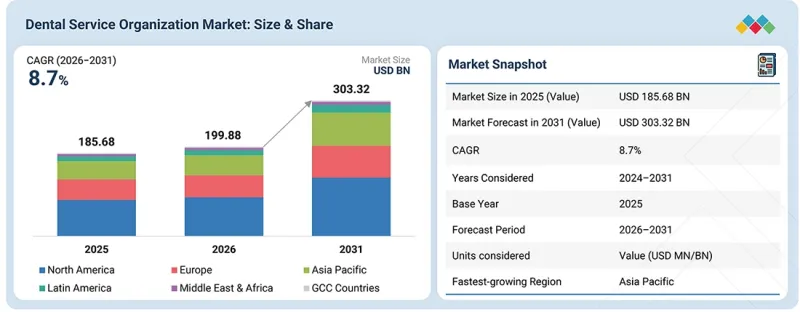
預計到 2031 年,牙科服務機構的市場規模將達到 3,033.2 億美元,而 2026 年為 1,998.8 億美元,預測期內的複合年成長率為 8.7%。
| 調查範圍 | |
|---|---|
| 調查期 | 2026-2031 |
| 基準年 | 2025 |
| 預測期 | 2026-2031 |
| 計算單位 | 金額(10億美元) |
| 部分 | 按服務類型、按最終用戶、按地區 |
| 目標區域 | 北美、歐洲、亞太地區、拉丁美洲、中東和非洲(海灣合作理事會國家、其他中東和非洲國家) |
全球牙科服務機構市場的主要驅動力是牙醫加入牙科服務機構人數的增加、行政工作的日益複雜化以及獨立牙科診所在人才招聘方面面臨的挑戰。牙科護理需求的成長、牙科支出的增加以及目標牙科市場的擴大,都顯著提高了對高效診所管理和集中化業務支援服務的需求。牙科服務機構提供廣泛的非臨床服務,包括人力資源、行銷和品牌推廣、核算、醫療用品採購和行政支持,從而減輕了成員牙醫的營運負擔,使他們能夠專注於患者照護。
隨著牙科技術的進步,數位化牙科、人工智慧(AI)、雲端臨床管理系統、電子健康記錄和數位影像等技術的日益普及,牙科服務機構在提升臨床效率方面發揮越來越重要的作用。這些技術使牙科服務機構能夠規範管理流程、增強患者參與度、最佳化預約和計費,並加強成員診所之間的協作。此外,對集中採購和規模經濟日益成長的需求也促使牙科診所加入牙科服務機構,以降低營運成本並提高資源利用率。
此外,牙醫對合作模式益處的認知不斷提高,包括獲得行政運營、人力資源管理、技術基礎設施、行銷支援以及協商採購合約方面的專業知識,都對市場成長產生了積極影響。牙科診所網路的擴張、分散的牙科服務行業的整合以及對牙科診所投資的增加,進一步推動了牙科服務組織模式的普及。牙科護理需求的成長、營運挑戰的增加、技術的進步以及對高效診所管理日益成長的需求,都在促進全球牙科服務組織市場的擴張。
“按服務類型分類,到 2025 年,人力資源服務將在全球牙科服務機構市場中佔據最大的市場佔有率。”
這項優勢源自於牙醫診所在人才招募方面面臨的日益嚴峻的挑戰,以及對集中式人力資源管理日益成長的需求。牙科服務機構提供的人力資源服務包括招聘、員工入職、薪酬福利管理、人才規劃、培訓和員工保留支持,使合作牙科診所能夠高效管理員工隊伍,同時減輕行政負擔。越來越多的牙醫加入牙科服務機構,進一步加速了對集中式人力資源服務的需求。隨著牙科服務機構透過加入和收購診所來擴展其網路,在多個地點招募、管理和留住牙醫、牙科保健員、牙科助理和行政人員的需求也隨之增加。此外,合格牙科專業競爭加劇和人事費用上漲,促使牙科診所利用牙科服務機構的人力資源管理能力。這些因素,加上日益複雜的行政流程以及牙科診所對提高營運效率日益成長的需求,共同促成了人力資源部門在全球牙科服務機構市場中的主導地位。
“按最終用戶分類,到 2025 年,口腔外科醫生將在全球牙科服務機構市場中佔據最大佔有率。”
口腔顎顏面外科診所之所以佔據主導地位,主要原因在於它們需要大量資源,包括專業人員、手術設施、設備以及患者協調。這些診所通常需要接收轉診患者進行複雜的牙科和臉部手術,這增加了營運和管理負擔。牙科服務機構(DSO)可以透過集中採購、人員配備、財務管理、排班和技術支援來滿足這些需求。 DSO模式能夠整合合作診所的各項功能,這正是其對口腔顎顏面外科診所極具吸引力的原因所在。
“在預測期內,美國預計將在北美牙科服務機構(DSO)市場中實現最高的複合年成長率。”
在預測期內,美國預計將成為北美牙科服務機構市場中複合年成長率最高的國家。這一成長主要受以下幾個關鍵因素驅動:牙醫加入牙科服務機構的人數不斷增加、行政工作的日益複雜化以及牙科診所在人才招聘方面面臨的挑戰日益嚴峻。美國龐大且高度發達的牙科保健市場、不斷成長的牙科保健支出以及成熟牙科服務機構的強大影響力,都進一步推動了市場擴張。此外,獨立牙科診所的整合以及臨床管理、人力資源、行銷、核算和採購服務的日益集中化,也加速了美國對牙科服務機構模式的需求。同時,數位化牙科、人工智慧 (AI)、雲端臨床管理系統和其他技術驅動型解決方案的日益普及,提高了營運效率,並促進了牙科服務機構網路的擴張。對於牙醫而言,減少行政負擔、獲得集中化業務支持、實現規模經濟以及應對人手不足的需求不斷成長,也推動了牙科服務機構會員人數的增加。所有這些因素共同促成了美國成為北美規模最大、成長最快的牙科服務機構市場。
全球牙科服務機構市場的主要參與者包括 Heartland Dental(美國)、The Aspen Group - TAG(美國)、Q and M Dental Group(新加坡)和 PDS Health(美國)。
調查範圍:
本報告分析了牙科服務機構市場,並根據服務類型、最終用戶和地區進行細分,估算了市場規模和未來成長潛力。此外,報告還對市場主要參與者進行了競爭分析,說明了每家公司的概況、產品、近期發展和關鍵市場策略。
購買本報告的理由
本報告為牙科服務機構市場的市場領導和新參與企業提供了寶貴的見解,並給出了最準確的市場收入預測。它幫助相關人員了解競爭格局,進行適當的業務定位,並制定有效的打入市場策略。此外,該報告還指出了關鍵的市場促進因素、限制、挑戰和機遇,幫助相關人員全面了解當前的市場趨勢。
本報告深入分析了以下幾點:
- 關鍵促進因素(牙科服務機構 (DSO) 的牙醫註冊人數增加、牙科診所行政任務日益複雜化和人才招聘挑戰、牙科保健支出增加以及目標牙科保健市場擴大)、阻礙因素(監管限制和各州 DSO 所有權的差異、對臨床自主權和牙醫控制權的擔憂)、機遇(DSO 對牙科行業的影響,以及人工智慧和科學技術的普及為其他普及和集中式 DSO平台創造了機會)和挑戰(在人事費用上升、報銷壓力和診所層面利潤率下降的情況下保持盈利)。
- 市場滲透率:本報告詳細介紹了全球牙科服務機構 (DSO) 市場主要參與者提供的產品。報告涵蓋服務類型、最終用戶和地區等細分市場。
- 產品改進與創新:全面介紹全球牙科服務機構市場的新產品發布和預測趨勢。
- 市場發展:我們按服務類型、最終用戶和地區提供盈利成長市場的詳細見解和分析。
- 市場多元化:提供有關全球牙科服務機構市場的新產品發布、市場擴張、最新發展和投資的全面資訊。
- 競爭評估:對全球牙科服務機構市場中主要競爭對手的市場佔有率、成長策略、產品線和能力進行全面評估。
目錄
第1章:引言
第2章執行摘要
第3章重要考察
第4章 市場概覽
- 市場動態
- 促進因素
- 抑制因子
- 機會
- 任務
- 未滿足的需求和未開發的領域
- 相互關聯的市場與跨產業機遇
- 一級/二級/三級公司的策略性舉措
第5章:技術進步、人工智慧的影響、專利、創新與未來應用
- 主要新興技術
- 互補技術
- 鄰近技術
- 技術/產品藍圖
- 專利分析
- 人工智慧/生成式人工智慧對牙科服務機構市場的影響
- 成功案例和實際應用
第6章 監理情勢
- 當地法規和合規性
- 對永續性的承諾
第7章 產業趨勢
- 波特五力分析
- 宏觀經濟展望
- 價值鏈分析
- 生態系分析
- 供應鏈分析
- 價格分析
- 2026-2027 年主要會議和活動
- 影響客戶業務的趨勢/顛覆性因素
- 投資和資金籌措場景
- 案例研究分析
- 美國關稅在2025年的影響概述
第8章:顧客趨勢與購買行為
- 決策流程
- 買方相關人員和採購評估標準
- 實施障礙和內部挑戰
- 各個終端用戶產業尚未滿足的需求
第9章:牙科服務機構市場(按服務類型分類)
- 人力資源
- 行銷與品牌推廣
- 會計
- 醫療用品採購
- 其他
第10章:牙科服務機構市場(按最終用戶分類)
- 口腔外科醫師
- 牙髓病專家
- 其他
第11章:牙科服務機構市場(按地區分類)
- 歐洲
- 德國
- 義大利
- 西班牙
- 法國
- 英國
- 其他
- 北美洲
- 美國
- 加拿大
- 亞太地區
- 韓國
- 日本
- 中國
- 印度
- 澳洲
- 其他
- 拉丁美洲
- 巴西
- 墨西哥
- 其他
- 中東和非洲
- 海灣合作理事會國家
第12章 競爭格局
- 主要公司的策略/優勢
- 牙科服務機構市佔率分析(以診所數量計)
- 品牌/產品對比
- 企業估值矩陣:主要公司,2025 年
- 公司估值矩陣:新創企業/中小企業(2025 年)
- 競爭格局
第13章:公司簡介
- 大公司
- HEARTLAND DENTAL
- THE ASPEN GROUP-TAG
- PDS HEALTH
- MB2 DENTAL
- SMILE BRANDS INC.
- Q & M DENTAL GROUP
- COLOSSEUM DENTAL GROUP
- AFFORDABLE CARE
- DENTAL CARE ALLIANCE
- SGA DENTAL PARTNERS
- 其他公司
- NORTH AMERICAN DENTAL GROUP
- SPECIALTY DENTAL BRANDS
- US ORAL SURGERY MANAGEMENT
- SPECIALTY1 PARTNERS
- D4C DENTAL BRANDS
- GREAT EXPRESSIONS DENTAL CENTERS
- SONRAVA HEALTH
- SAGE DENTAL
- MORTENSON DENTAL PARTNERS
- DENTAL365/PREMIER CARE DENTAL MANAGEMENT
- GUARDIAN DENTISTRY PARTNERS
- PEPPERPOINTE PARTNERSHIPS
- 42 NORTH DENTAL
- ROCK DENTAL BRANDS
- BENEVIS
第14章調查方法
第15章附錄
The dental service organization market is projected to reach USD 303.32 billion by 2031 from USD 199.88 billion in 2026, at a CAGR of 8.7% during the forecast period.
| Scope of the Report | |
|---|---|
| Years Considered for the Study | 2026-2031 |
| Base Year | 2025 |
| Forecast Period | 2026-2031 |
| Units Considered | Value (USD billion) |
| Segments | By service type, end user, and region |
| Regions covered | North America, Europe, Asia Pacific, Latin America, Middle East & Africa (GCC Countries, Rest of Middle East & Africa) |
The global dental service organization market is largely driven by the growing affiliation of dentists with dental service organizations, rising administrative complexity, and staffing challenges across independent dental practices. Increasing demand for dental care, rising dental care expenditures, and the expansion of the addressable dental care market have significantly increased the need for efficient practice management and centralized business support services. Dental service organizations provide a broad range of non-clinical services, including human resources, marketing and branding, accounting, medical supplies procurement, and administrative support, enabling affiliated dentists to reduce operational burdens and focus on patient care.
Advancements in dental technology and the growing adoption of digital dentistry, artificial intelligence, cloud-based practice management systems, electronic health records, and digital imaging have further strengthened the role of dental service organizations in improving practice efficiency. These technologies enable dental service organizations to standardize administrative processes, enhance patient engagement, optimize scheduling and billing, and improve coordination among affiliated dental practices. Furthermore, the growing need for centralized procurement and economies of scale has encouraged dental practices to affiliate with dental service organizations to reduce operating costs and improve resource utilization.
Additionally, raising dentists' awareness of the benefits of affiliation, including access to administrative expertise, workforce management, technology infrastructure, marketing support, and negotiated procurement arrangements, has positively influenced market growth. The expansion of dental practice networks, the consolidation of the fragmented dental services industry, and growing investments in dental practices have further supported the adoption of dental service organization models. The combination of rising demand for dental care, increasing operational challenges, technological advancements, and the growing need for efficient practice management is driving the global expansion of the dental service organization market.
"By service type, human resources held the largest market share in the global dental service organization market in 2025".
This dominance stems from the rising staffing challenges faced by dental practices and the growing need for centralized workforce management. Human resource services provided by dental service organizations include recruitment, employee onboarding, payroll and benefits administration, workforce planning, training, and employee retention, enabling affiliated dental practices to manage their workforce efficiently while reducing administrative burdens. The growing affiliation of dentists with dental service organizations has further accelerated demand for centralized human resource services. As dental service organizations expand their networks through practice affiliations and acquisitions, the need to recruit, manage, and retain dentists, dental hygienists, dental assistants, and administrative staff across multiple locations has increased. Additionally, growing competition for qualified dental professionals and rising labor costs have encouraged dental practices to leverage the workforce management capabilities of dental service organizations. These factors, combined with the increasing administrative complexity of dental practices and the need to improve operational efficiency, have contributed to the leading position of the Human Resources segment in the global dental service organization market.
"By end user, oral surgeons held the largest share in the global dental service organization market in 2025"
The dominance of this segment is largely due to the high resource requirements of oral and maxillofacial practices, including specialized personnel, surgical facilities, equipment, and patient coordination. These practices often handle referrals for advanced dental and facial procedures, which increase operational and administrative demands. DSOs can address these needs through centralized purchasing, staffing, financial management, scheduling, and technology support. The ability to consolidate these functions across affiliated practices makes the DSO model particularly attractive to oral and maxillofacial practices.
"The US is expected to grow at the highest CAGR in the North American dental service organization market during the forecast period."
The US is expected to post the highest CAGR in the North American dental service organization market over the forecast period. This growth is driven by several key factors, including the increasing affiliation of dentists with dental service organizations, rising administrative complexity, and growing staffing challenges across dental practices. The country's large, highly developed dental care market, rising dental care expenditures, and the strong presence of established dental service organizations further support market expansion. Additionally, the growing consolidation of independent dental practices and the increasing adoption of centralized practice management, human resources, marketing, accounting, and procurement services are accelerating demand for dental service organization models across the US. Furthermore, the growing use of digital dentistry, artificial intelligence, cloud-based practice management systems, and other technology-enabled solutions is improving operational efficiency and supporting the expansion of dental service organization networks. The growing need among dentists to reduce administrative workloads, access centralized business support, achieve economies of scale, and address workforce shortages is driving increased affiliation with dental service organizations. Collectively, these factors position the US as the leading and fastest-growing market for dental service organizations in North America.
A breakdown of the primary participants (on the supply side) in the dental service organization market referenced in this report is provided below:
- By Company Type: Tier 1 (35%), Tier 2 (40%), and Tier 3 (25%)
- By Designation: C-level Executives (45%), Directors (35%), and Others (20%)
- By Region: North America (27%), Europe (25%), Asia Pacific (30%), Latin America (8%), and the Middle East & Africa (10%)
The leading players in the global dental service organization market include Heartland Dental (US), The Aspen Group - TAG (US), Q and M Dental Group (Singapore), and PDS Health (US).
Research Coverage:
The report analyzes the dental service organization market, estimating its size and future growth potential across segments by service type, end user, and region. Additionally, the report features a competitive analysis of key players in the market, including their company profiles, product offerings, recent developments, and key market strategies.
Reasons to Buy the Report
The report provides valuable insights for both market leaders and new entrants in the dental service organization market, offering the most accurate revenue estimates. It helps stakeholders understand the competitive landscape, enabling them to better position their businesses and develop effective go-to-market strategies. Additionally, the report highlights key market drivers, restraints, challenges, and opportunities, giving stakeholders a comprehensive understanding of current market trends.
This report provides insights into the following pointers:
- Analysis of key drivers (increasing affiliation of dentists with dental service organizations, rising administrative complexity and staffing challenges in dental practices, growing dental care expenditure and expansion of the addressable dental care market), restraints (regulatory restrictions and state-level variations in DSO ownership, concerns regarding clinical autonomy and dentist control), opportunities (impact of DSOs on dental industry, Increasing Adoption of AI and digital technologies creates opportunities for centralized DSO platforms), and challenges (maintaining profitability amid rising labor costs, reimbursement pressure, and practice-level margin compression)
- Market Penetration: It includes extensive information on the products offered by the major players in the global dental service organization market. The report covers segments such as service type, end user, and region.
- Product Enhancement/Innovation: Comprehensive details about new product launches and anticipated trends in the global dental service organization market
- Market Development: Thorough knowledge and analysis of the profitable rising markets by service type, end user, and region
- Market Diversification: Comprehensive information about newly launched products, expanding markets, current advancements, and investments in the global dental service organization market.
- Competitive Assessment: A comprehensive assessment of market shares, growth strategies, product offerings, and capabilities of key competitors in the global dental service organization market.
TABLE OF CONTENTS
1 INTRODUCTION
- 1.1 STUDY OBJECTIVES
- 1.2 MARKET DEFINITION
- 1.3 STUDY SCOPE
- 1.3.1 MARKET SEGMENTATION AND REGIONAL SCOPE
- 1.3.2 INCLUSIONS AND EXCLUSIONS
- 1.4 YEARS CONSIDERED
- 1.5 CURRENCY CONSIDERED
- 1.6 KEY STAKEHOLDERS
2 EXECUTIVE SUMMARY
- 2.1 KEY MARKET PARTICIPANTS: SHARE INSIGHTS AND DEVELOPMENTS
- 2.2 DISRUPTIVE TRENDS SHAPING MARKET
- 2.3 HIGH-GROWTH SEGMENTS & EMERGING FRONTIERS
- 2.4 REGIONAL SNAPSHOT: MARKET SIZE, GROWTH RATE, AND FORECAST
3 PREMIUM INSIGHTS
- 3.1 ATTRACTIVE OPPORTUNITIES FOR PLAYERS IN DENTAL SERVICE ORGANIZATION MARKET
- 3.2 ASIA PACIFIC: DENTAL SERVICE ORGANIZATION MARKET, BY SERVICE TYPE AND COUNTRY
- 3.3 DENTAL SERVICE ORGANIZATION MARKET: GEOGRAPHIC GROWTH OPPORTUNITIES
- 3.4 REGIONAL MIX: DENTAL SERVICE ORGANIZATION MARKET (2024-2031)
- 3.5 DENTAL SERVICE ORGANIZATION MARKET: DEVELOPED VS. DEVELOPING MARKETS
4 MARKET OVERVIEW
- 4.1 INTRODUCTION
- 4.2 MARKET DYNAMICS
- 4.2.1 DRIVERS
- 4.2.1.1 Increasing affiliation of dentists with dental service organizations
- 4.2.1.2 Rising administrative complexity and staffing challenges in dental practices
- 4.2.1.3 Growing dental care expenditure and expansion of addressable dental care market
- 4.2.2 RESTRAINTS
- 4.2.2.1 Regulatory restrictions and state-level variations in DSO ownership
- 4.2.2.2 Concerns regarding clinical autonomy and dentist control
- 4.2.3 OPPORTUNITIES
- 4.2.3.1 Impact of DSOs on dental industry
- 4.2.3.2 Increasing adoption of AI and digital technologies creates opportunities for centralized DSO platforms
- 4.2.4 CHALLENGES
- 4.2.4.1 Maintaining profitability amid rising labor costs, reimbursement pressure, and practice-level margin compression
- 4.2.1 DRIVERS
- 4.3 UNMET NEEDS AND WHITE SPACES
- 4.3.1 UNMET NEEDS
- 4.3.2 WHITE SPACE OPPORTUNITIES
- 4.4 INTERCONNECTED MARKETS AND CROSS-SECTOR OPPORTUNITIES
- 4.4.1 CROSS-SECTOR OPPORTUNITIES
- 4.5 STRATEGIC MOVES BY TIER- 1/2/3 PLAYERS
5 TECHNOLOGICAL ADVANCEMENTS, AI-DRIVEN IMPACT, PATENTS, INNOVATIONS, AND FUTURE APPLICATIONS
- 5.1 KEY EMERGING TECHNOLOGIES
- 5.1.1 ARTIFICIAL INTELLIGENCE (AI)-ENABLED PRACTICE MANAGEMENT & PREDICTIVE ANALYTICS
- 5.1.2 AI-ENABLED REVENUE CYCLE & ADMINISTRATIVE AUTOMATION
- 5.2 COMPLEMENTARY TECHNOLOGIES
- 5.2.1 DIGITAL IMAGING & INTRAORAL SCANNING TECHNOLOGIES
- 5.3 ADJACENT TECHNOLOGIES
- 5.3.1 3D PRINTING & DIGITAL MANUFACTURING TECHNOLOGIES
- 5.3.2 TELEDENTISTRY & REMOTE PATIENT MONITORING
- 5.4 TECHNOLOGY/PRODUCT ROADMAP
- 5.4.1 SHORT-TERM | RECENT TECHNOLOGIES | FOUNDATION & EARLY COMMERCIALIZATION
- 5.4.2 MID-TERM (2027-2030) | EXPANSION & STANDARDIZATION
- 5.4.3 LONG-TERM (2030-2035+) | MASS COMMERCIALIZATION & DISRUPTION
- 5.5 PATENT ANALYSIS
- 5.5.1 PATENT PUBLICATION TRENDS FOR DENTAL SERVICE ORGANIZATION
- 5.5.2 INSIGHTS: JURISDICTION AND TOP APPLICANT ANALYSIS
- 5.6 IMPACT OF AI/GEN AI ON DENTAL SERVICE ORGANIZATION MARKET
- 5.6.1 TOP USE CASES AND MARKET POTENTIAL
- 5.6.2 INTERCONNECTED ADJACENT ECOSYSTEMS AND IMPACT ON MARKET PLAYERS
- 5.6.3 CLIENTS' READINESS TO ADOPT GENERATIVE AI IN DENTAL SERVICE ORGANIZATION MARKET
- 5.7 SUCCESS STORIES AND REAL-WORLD APPLICATIONS
- 5.7.1 HEARTLAND DENTAL: AI-ENABLED CLINICAL WORKFLOW
- 5.7.2 DENTAL CARE ALLIANCE: STANDARDIZED DIGITAL PREVENTIVE CARE WORKFLOW
- 5.7.3 PDS HEALTH: SCALED DIGITAL DENTISTRY & SAME-DAY RESTORATIVE WORKFLOW
6 REGULATORY LANDSCAPE
- 6.1 REGIONAL REGULATIONS AND COMPLIANCE
- 6.1.1 US
- 6.1.2 EUROPEAN UNION
- 6.1.3 CHINA
- 6.1.4 REGULATORY BODIES, GOVERNMENT AGENCIES, AND OTHER ORGANIZATIONS
- 6.2 SUSTAINABILITY INITIATIVES
- 6.2.1 ENVIRONMENTAL SUSTAINABILITY IN DENTAL SERVICE ORGANIZATIONS
- 6.2.2 DIGITAL-EFFICIENT DSO INFRASTRUCTURE
- 6.2.3 CIRCULAR ECONOMY AND SUSTAINABLE PROCUREMENT IN DSO OPERATIONS
- 6.2.4 CERTIFICATIONS, LABELING, AND ECO-STANDARDS
7 INDUSTRY TRENDS
- 7.1 PORTER'S FIVE FORCES ANALYSIS
- 7.1.1 THREAT FROM NEW ENTRANTS
- 7.1.2 THREAT FROM SUBSTITUTES
- 7.1.3 BARGAINING POWER OF SUPPLIERS
- 7.1.4 BARGAINING POWER OF BUYERS
- 7.1.5 INTENSITY OF COMPETITIVE RIVALRY
- 7.2 MACROECONOMIC OUTLOOK
- 7.2.1 INTRODUCTION
- 7.2.2 GDP TRENDS AND FORECAST
- 7.2.3 TRENDS IN DENTAL SERVICE ORGANIZATION MARKET
- 7.3 VALUE CHAIN ANALYSIS
- 7.4 ECOSYSTEM ANALYSIS
- 7.5 SUPPLY CHAIN ANALYSIS
- 7.6 PRICING ANALYSIS
- 7.6.1 AVERAGE SYSTEM COST - DENTAL SERVICE ORGANIZATION (DSO)
- 7.6.2 AVERAGE COST RANGE OF DENTAL SERVICE ORGANIZATION (DSO), BY REGION, 2023-2025 (USD)
- 7.6.3 AVERAGE SELLING PRICE OF DENTAL SERVICE ORGANIZATION, BY KEY PLAYERS, 2023-2025
- 7.7 KEY CONFERENCES & EVENTS, 2026-2027
- 7.8 TRENDS/DISRUPTIONS IMPACTING CUSTOMER BUSINESS
- 7.9 INVESTMENT & FUNDING SCENARIO
- 7.10 CASE STUDY ANALYSIS
- 7.11 IMPACT OF 2025 US TARIFF - OVERVIEW
- 7.11.1 INTRODUCTION
- 7.11.2 KEY TARIFF RATES
- 7.11.3 PRICE IMPACT ANALYSIS
- 7.11.4 IMPACT ON REGION
- 7.11.4.1 US
- 7.11.4.2 Europe
- 7.11.4.3 Asia Pacific
- 7.11.5 IMPACT ON END-USE INDUSTRIES
8 CUSTOMER LANDSCAPE & BUYER BEHAVIOR
- 8.1 DECISION-MAKING PROCESS
- 8.2 BUYER STAKEHOLDERS AND BUYING EVALUATION CRITERIA
- 8.2.1 INFLUENCE OF KEY STAKEHOLDERS
- 8.2.2 BUYING CRITERIA
- 8.3 ADOPTION BARRIERS & INTERNAL CHALLENGES
- 8.4 UNMET NEEDS FROM VARIOUS END-USE INDUSTRIES
9 DENTAL SERVICE ORGANIZATION MARKET, BY SERVICE TYPE
- 9.1 INTRODUCTION
- 9.2 HUMAN RESOURCES
- 9.2.1 RISING DENTAL WORKFORCE REQUIREMENTS STRENGTHENING DEMAND FOR CENTRALIZED HUMAN RESOURCE SERVICES
- 9.3 MARKETING & BRANDING
- 9.3.1 GROWING DENTAL SERVICE SPENDING AND INCREASING COMPETITION STRENGTHENING DEMAND
- 9.4 ACCOUNTING
- 9.4.1 INCREASING FINANCIAL COMPLEXITY ACROSS DENTAL PRACTICES FUELING DEMAND FOR CENTRALIZED ACCOUNTING SERVICES
- 9.5 MEDICAL SUPPLIES PROCUREMENT
- 9.5.1 CENTRALIZED PROCUREMENT AND GROWING DENTAL SERVICE ACTIVITY STRENGTHENING DEMAND
- 9.6 OTHERS
- 9.6.1 INCREASING DIGITALIZATION AND WORKFORCE DEVELOPMENT TO SUPPORT MARKET GROWTH
- 9.7 DSO SCALE DRIVEN BY BOTH PRACTICE FOOTPRINT AND DENTIST NETWORK DEPTH
10 DENTAL SERVICE ORGANIZATION MARKET, BY END USER
- 10.1 INTRODUCTION
- 10.2 ORAL SURGEONS
- 10.2.1 GROWING DEMAND FOR COMPLEX DENTAL PROCEDURES STRENGTHENS ORAL SURGEONS' AFFILIATION WITH DSOS
- 10.3 ENDODONTISTS
- 10.3.1 RISING DEMAND FOR SPECIALIZED ROOT CANAL CARE SUPPORTING MARKET GROWTH
- 10.4 OTHER DENTAL SPECIALISTS
- 10.4.1 GROWING DEMAND FOR SPECIALIZED DENTAL CARE INCREASING DSO AFFILIATION ACROSS KEY DENTAL SPECIALTIES
11 DENTAL SERVICE ORGANIZATION MARKET, BY REGION
- 11.1 INTRODUCTION
- 11.2 EUROPE
- 11.2.1 GERMANY
- 11.2.1.1 Expanding dental practice scale and rising operating costs creating opportunities for DSO Expansion
- 11.2.2 ITALY
- 11.2.2.1 Large private dental provider base and growing healthcare expenditure to support market growth
- 11.2.3 SPAIN
- 11.2.3.1 Large private dental workforce and high out-of-pocket dental spending create opportunities for market players
- 11.2.4 FRANCE
- 11.2.4.1 High dental care spending and established private practice base to propel market growth
- 11.2.5 UK
- 11.2.5.1 Large dental workforce and rising healthcare expenditure to support growth
- 11.2.6 REST OF EUROPE
- 11.2.1 GERMANY
- 11.3 NORTH AMERICA
- 11.3.1 US
- 11.3.1.1 Dentist affiliation, workforce challenges, and rising dental spending to drive market
- 11.3.2 CANADA
- 11.3.2.1 Expanding dental coverage to drive market growth
- 11.3.1 US
- 11.4 ASIA PACIFIC
- 11.4.1 SOUTH KOREA
- 11.4.1.1 Rising dental care demand to support market growth
- 11.4.2 JAPAN
- 11.4.2.1 Rising dental care needs and workforce pressures to support market growth
- 11.4.3 CHINA
- 11.4.3.1 Expanding dental care access to propel market growth
- 11.4.4 INDIA
- 11.4.4.1 Expanding dental care access to support market expansion
- 11.4.5 AUSTRALIA
- 11.4.5.1 Rising dental care demand to drive market growth
- 11.4.6 REST OF ASIA PACIFIC
- 11.4.1 SOUTH KOREA
- 11.5 LATIN AMERICA
- 11.5.1 BRAZIL
- 11.5.1.1 Expanding oral healthcare infrastructure to favor market growth
- 11.5.2 MEXICO
- 11.5.2.1 Expanding oral healthcare access to fuel market
- 11.5.3 REST OF LATIN AMERICA
- 11.5.1 BRAZIL
- 11.6 MIDDLE EAST & AFRICA
- 11.6.1 RISING HEALTHCARE INVESTMENTS TO AID MARKET GROWTH
- 11.7 GCC COUNTRIES
- 11.7.1 PRIVATE HEALTHCARE EXPANSION TO SUPPORT MARKET GROWTH
12 COMPETITIVE LANDSCAPE
- 12.1 INTRODUCTION
- 12.2 KEY PLAYERS' STRATEGIES/RIGHT TO WIN
- 12.3 DENTAL SERVICE ORGANIZATION MARKET SHARE ANALYSIS, BY NUMBER OF PRACTICES
- 12.4 BRAND/PRODUCT COMPARISON
- 12.5 COMPANY EVALUATION MATRIX: KEY PLAYERS, 2025
- 12.5.1 STARS
- 12.5.2 EMERGING LEADERS
- 12.5.3 PERVASIVE PLAYERS
- 12.5.4 PARTICIPANTS
- 12.5.5 COMPANY FOOTPRINT: KEY PLAYERS, 2025
- 12.5.5.1 Company footprint
- 12.5.5.2 Region footprint
- 12.5.5.3 Service type footprint
- 12.5.5.4 End user footprint
- 12.6 COMPANY EVALUATION MATRIX: STARTUPS/SMES (2025)
- 12.6.1 PROGRESSIVE COMPANIES
- 12.6.2 RESPONSIVE COMPANIES
- 12.6.3 DYNAMIC COMPANIES
- 12.6.4 STARTING BLOCKS
- 12.6.5 COMPETITIVE BENCHMARKING: STARTUPS/SMES, 2025
- 12.6.5.1 Detailed list of key startups/SMEs
- 12.6.5.2 Dental service organization market: Competitive benchmarking of key startups/SMEs
- 12.7 COMPETITIVE SCENARIO
- 12.7.1 SERVICE LAUNCHES AND APPROVALS
- 12.7.2 DEALS
- 12.7.3 EXPANSIONS
13 COMPANY PROFILES
- 13.1 KEY PLAYERS
- 13.1.1 HEARTLAND DENTAL
- 13.1.1.1 Business overview
- 13.1.1.2 Services offered
- 13.1.1.3 Recent developments
- 13.1.1.3.1 Product launches & approvals
- 13.1.1.3.2 Deals
- 13.1.1.3.3 Expansions
- 13.1.1.4 MnM view
- 13.1.1.4.1 Right to win
- 13.1.1.4.2 Strategic choices
- 13.1.1.4.3 Weaknesses and competitive threats
- 13.1.2 THE ASPEN GROUP - TAG
- 13.1.2.1 Business overview
- 13.1.2.2 Services offered
- 13.1.2.3 Recent developments
- 13.1.2.3.1 Service launches & approvals
- 13.1.2.3.2 Deals
- 13.1.2.3.3 Expansions
- 13.1.2.4 MnM view
- 13.1.2.4.1 Right to win
- 13.1.2.4.2 Strategic choices
- 13.1.2.4.3 Weaknesses and competitive threats
- 13.1.3 PDS HEALTH
- 13.1.3.1 Business overview
- 13.1.3.2 Services offered
- 13.1.3.3 Recent developments
- 13.1.3.3.1 Product launches & approvals
- 13.1.3.3.2 Deals
- 13.1.3.3.3 Expansions
- 13.1.3.4 MnM view
- 13.1.3.4.1 Right to win
- 13.1.3.4.2 Strategic choices
- 13.1.3.4.3 Weaknesses and competitive threats
- 13.1.4 MB2 DENTAL
- 13.1.4.1 Business overview
- 13.1.4.2 Services offered
- 13.1.4.3 Recent developments
- 13.1.4.3.1 Service launches & approvals
- 13.1.4.3.2 Deals
- 13.1.4.4 MnM view
- 13.1.4.4.1 Right to win
- 13.1.4.4.2 Strategic choices
- 13.1.4.4.3 Weaknesses and competitive threats
- 13.1.5 SMILE BRANDS INC.
- 13.1.5.1 Business overview
- 13.1.5.2 Services offered
- 13.1.5.3 Recent developments
- 13.1.5.3.1 Deals
- 13.1.5.4 MnM view
- 13.1.5.4.1 Right to win
- 13.1.5.4.2 Strategic choices
- 13.1.5.4.3 Weaknesses and competitive threats
- 13.1.6 Q & M DENTAL GROUP
- 13.1.6.1 Business overview
- 13.1.6.2 Services offered
- 13.1.6.3 Recent developments
- 13.1.6.3.1 Service launches & approvals
- 13.1.6.3.2 Deals
- 13.1.7 COLOSSEUM DENTAL GROUP
- 13.1.7.1 Business overview
- 13.1.7.2 Products offered
- 13.1.7.3 Recent developments
- 13.1.7.3.1 Deals
- 13.1.8 AFFORDABLE CARE
- 13.1.8.1 Business overview
- 13.1.8.2 Services offered
- 13.1.8.3 Recent developments
- 13.1.8.3.1 Expansions
- 13.1.9 DENTAL CARE ALLIANCE
- 13.1.9.1 Business overview
- 13.1.9.2 Services offered
- 13.1.9.3 Recent developments
- 13.1.9.3.1 Service launches & approvals
- 13.1.9.3.2 Deals
- 13.1.9.3.3 Expansions
- 13.1.10 SGA DENTAL PARTNERS
- 13.1.10.1 Business overview
- 13.1.10.2 Services offered
- 13.1.10.3 Recent developments
- 13.1.10.3.1 Deals
- 13.1.1 HEARTLAND DENTAL
- 13.2 OTHER PLAYERS
- 13.2.1 NORTH AMERICAN DENTAL GROUP
- 13.2.2 SPECIALTY DENTAL BRANDS
- 13.2.3 U.S. ORAL SURGERY MANAGEMENT
- 13.2.4 SPECIALTY1 PARTNERS
- 13.2.5 D4C DENTAL BRANDS
- 13.2.6 GREAT EXPRESSIONS DENTAL CENTERS
- 13.2.7 SONRAVA HEALTH
- 13.2.8 SAGE DENTAL
- 13.2.9 MORTENSON DENTAL PARTNERS
- 13.2.10 DENTAL365/PREMIER CARE DENTAL MANAGEMENT
- 13.2.11 GUARDIAN DENTISTRY PARTNERS
- 13.2.12 PEPPERPOINTE PARTNERSHIPS
- 13.2.13 42 NORTH DENTAL
- 13.2.14 ROCK DENTAL BRANDS
- 13.2.15 BENEVIS
14 RESEARCH METHODOLOGY
- 14.1 RESEARCH APPROACH
- 14.1.1 SECONDARY DATA
- 14.1.1.1 Key data from secondary sources
- 14.1.2 PRIMARY DATA
- 14.1.2.1 Key data from primary sources
- 14.1.2.2 Key industry insights
- 14.1.1 SECONDARY DATA
- 14.2 MARKET SIZE ESTIMATION
- 14.3 MARKET BREAKDOWN AND DATA TRIANGULATION
- 14.4 MARKET SHARE ESTIMATION
- 14.5 ASSUMPTIONS
- 14.6 LIMITATIONS
- 14.6.1 METHODOLOGY-RELATED LIMITATIONS
- 14.6.2 SCOPE-RELATED LIMITATIONS
- 14.7 RISK ASSESSMENT
15 APPENDIX
- 15.1 DISCUSSION GUIDE
- 15.2 KNOWLEDGESTORE: MARKETSANDMARKETS' SUBSCRIPTION PORTAL
- 15.3 CUSTOMIZATION OPTIONS
- 15.4 RELATED REPORTS
- 15.5 AUTHOR DETAILS
List of Tables
- TABLE 1 STANDARD CURRENCY CONVERSION RATES, 2021-2024
- TABLE 2 LIST OF SOME RECENT DEALS BACKED BY PRIVATE EQUITY IN US, 2021-2023
- TABLE 3 DENTAL SERVICE ORGANIZATION MARKET: UNMET NEEDS
- TABLE 4 INTERCONNECTED MARKETS
- TABLE 5 STRATEGIC MOVES BY TIER- 1/2/3 PLAYERS
- TABLE 6 LIST OF PATENTS IN DENTAL SERVICE ORGANIZATION (2022-2025)
- TABLE 7 TOP USE CASES AND MARKET POTENTIAL
- TABLE 8 INTERCONNECTED ADJACENT ECOSYSTEMS AND IMPACT ON MARKET PLAYERS
- TABLE 9 NORTH AMERICA: REGULATORY BODIES, GOVERNMENT AGENCIES, AND OTHER ORGANIZATIONS
- TABLE 10 EUROPE: REGULATORY BODIES, GOVERNMENT AGENCIES, AND OTHER ORGANIZATIONS
- TABLE 11 ASIA PACIFIC: REGULATORY BODIES, GOVERNMENT AGENCIES, AND OTHER ORGANIZATIONS
- TABLE 12 LATIN AMERICA: REGULATORY BODIES, GOVERNMENT AGENCIES, AND OTHER ORGANIZATIONS
- TABLE 13 MIDDLE EAST & AFRICA: REGULATORY BODIES, GOVERNMENT AGENCIES, AND OTHER ORGANIZATIONS
- TABLE 14 DENTAL SERVICE ORGANIZATION MARKET: IMPACT OF PORTER'S FIVE FORCES
- TABLE 15 GDP PERCENTAGE CHANGE, BY KEY COUNTRIES, 2021-2030
- TABLE 16 DENTAL SERVICE ORGANIZATION MARKET: ROLE OF COMPANIES IN ECOSYSTEM
- TABLE 17 DENTAL SERVICE ORGANIZATION MARKET: KEY CONFERENCES & EVENTS (2026-2027)
- TABLE 18 CASE STUDY 1: AI-ENABLED DENTAL DIAGNOSTICS IMPROVES PRACTICE WORKFLOW
- TABLE 19 CASE STUDY 2: SCALED DIGITAL DENTISTRY IMPROVES TREATMENT CONVENIENCE
- TABLE 20 CASE STUDY 3: STANDARDIZED TECHNOLOGY DEPLOYMENT IMPROVES PATIENT & CLINICIAN EXPERIENCE
- TABLE 21 US ADJUSTED RECIPROCAL TARIFF RATES
- TABLE 22 KEY PRODUCT-RELATED TARIFFS EFFECTIVE ON DENTAL PRODUCTS
- TABLE 23 INFLUENCE OF STAKEHOLDERS ON BUYING PROCESS FOR DENTAL SERVICE ORGANIZATION
- TABLE 24 KEY BUYING CRITERIA FOR TOP TWO END USERS
- TABLE 25 DENTAL SERVICE ORGANIZATION MARKET: UNMET NEEDS/END USER EXPECTATIONS
- TABLE 26 DENTAL SERVICE ORGANIZATION MARKET, BY SERVICE TYPE, 2024-2031 (USD MILLION)
- TABLE 27 DENTAL SERVICE ORGANIZATION MARKET FOR HUMAN RESOURCES, BY COUNTRY, 2024-2031 (USD MILLION)
- TABLE 28 DENTAL SERVICE ORGANIZATION MARKET FOR MARKETING & BRANDING, BY COUNTRY, 2024-2031 (USD MILLION)
- TABLE 29 DENTAL SERVICE ORGANIZATION MARKET FOR ACCOUNTING, BY COUNTRY, 2024-2031 (USD MILLION)
- TABLE 30 DENTAL SERVICE ORGANIZATION MARKET FOR MEDICAL SUPPLIES PROCUREMENT, BY COUNTRY, 2024-2031 (USD MILLION)
- TABLE 31 DENTAL SERVICE ORGANIZATION MARKET FOR OTHERS SEGMENT, BY COUNTRY, 2024-2031 (USD MILLION)
- TABLE 32 DSO PRACTICE FOOTPRINT VS. DENTIST NETWORK
- TABLE 33 DENTAL SERVICE ORGANIZATION MARKET, BY END USER, 2024-2031 (USD MILLION)
- TABLE 34 DENTAL SERVICE ORGANIZATION MARKET FOR ORAL SURGEONS, BY COUNTRY, 2024-2031 (USD MILLION)
- TABLE 35 DENTAL SERVICE ORGANIZATION MARKET FOR ENDODONTISTS, BY COUNTRY, 2024-2031 (USD MILLION)
- TABLE 36 DENTAL SERVICE ORGANIZATION MARKET FOR OTHER DENTAL SPECIALISTS, BY COUNTRY, 2024-2031 (USD MILLION)
- TABLE 37 DENTAL SERVICE ORGANIZATION MARKET, BY REGION, 2024-2031 (USD MILLION)
- TABLE 38 EUROPE: DENTAL SERVICE ORGANIZATION MARKET, BY COUNTRY, 2024-2031 (USD MILLION)
- TABLE 39 EUROPE: DENTAL SERVICE ORGANIZATION MARKET, BY SERVICE, 2024-2031 (USD MILLION)
- TABLE 40 EUROPE: DENTAL SERVICE ORGANIZATION MARKET, BY END USER, 2024-2031 (USD MILLION)
- TABLE 41 GERMANY: DENTAL SERVICE ORGANIZATION MARKET, BY SERVICE TYPE, 2024-2031 (USD MILLION)
- TABLE 42 GERMANY: DENTAL SERVICE ORGANIZATION MARKET, BY END USER, 2024-2031 (USD MILLION)
- TABLE 43 ITALY: DENTAL SERVICE ORGANIZATION MARKET, BY SERVICE TYPE, 2024-2031 (USD MILLION)
- TABLE 44 ITALY: DENTAL SERVICE ORGANIZATION MARKET, BY END USER, 2024-2031 (USD MILLION)
- TABLE 45 SPAIN: DENTAL SERVICE ORGANIZATION MARKET, BY SERVICE TYPE, 2024-2031 (USD MILLION)
- TABLE 46 SPAIN: DENTAL SERVICE ORGANIZATION MARKET, BY END USER, 2024-2031 (USD MILLION)
- TABLE 47 FRANCE: DENTAL SERVICE ORGANIZATION MARKET, BY SERVICE TYPE, 2024-2031 (USD MILLION)
- TABLE 48 FRANCE: DENTAL SERVICE ORGANIZATION MARKET, BY END USER, 2024-2031 (USD MILLION)
- TABLE 49 UK: DENTAL SERVICE ORGANIZATION MARKET, BY SERVICE TYPE, 2024-2031 (USD MILLION)
- TABLE 50 UK: DENTAL SERVICE ORGANIZATION MARKET, BY END USER, 2024-2031 (USD MILLION)
- TABLE 51 REST OF EUROPE: DENTAL SERVICE ORGANIZATION MARKET, BY SERVICE TYPE, 2024-2031 (USD MILLION)
- TABLE 52 REST OF EUROPE: DENTAL SERVICE ORGANIZATION MARKET, BY END USER, 2024-2031 (USD MILLION)
- TABLE 53 NORTH AMERICA: DENTAL SERVICE ORGANIZATION MARKET, BY COUNTRY, 2024-2031 (USD MILLION)
- TABLE 54 NORTH AMERICA: DENTAL SERVICE ORGANIZATION MARKET, BY SERVICE TYPE, 2024-2031 (USD MILLION)
- TABLE 55 NORTH AMERICA: DENTAL SERVICE ORGANIZATION MARKET, BY END USER, 2024-2031 (USD MILLION)
- TABLE 56 US: DENTAL SERVICE ORGANIZATION MARKET, BY SERVICE TYPE, 2024-2031 (USD MILLION)
- TABLE 57 US: DENTAL SERVICE ORGANIZATION MARKET, BY END USER, 2024-2031 (USD MILLION)
- TABLE 58 CANADA: DENTAL SERVICE ORGANIZATION MARKET, BY SERVICE TYPE, 2024-2031 (USD MILLION)
- TABLE 59 CANADA: DENTAL SERVICE ORGANIZATION MARKET, BY END USER, 2024-2031 (USD MILLION)
- TABLE 60 ASIA PACIFIC: DENTAL SERVICE ORGANIZATION MARKET, BY COUNTRY, 2024-2031 (USD MILLION)
- TABLE 61 ASIA PACIFIC: DENTAL SERVICE ORGANIZATION MARKET, BY SERVICE TYPE, 2024-2031 (USD MILLION)
- TABLE 62 ASIA PACIFIC: DENTAL SERVICE ORGANIZATION MARKET, BY END USER, 2024-2031 (USD MILLION)
- TABLE 63 SOUTH KOREA: DENTAL SERVICE ORGANIZATION MARKET, BY SERVICE TYPE, 2024-2031 (USD MILLION)
- TABLE 64 SOUTH KOREA: DENTAL SERVICE ORGANIZATION MARKET, BY END USER, 2024-2031 (USD MILLION)
- TABLE 65 JAPAN: DENTAL SERVICE ORGANIZATION MARKET, BY SERVICE TYPE, 2024-2031 (USD MILLION)
- TABLE 66 JAPAN: DENTAL SERVICE ORGANIZATION MARKET, BY END USER, 2024-2031 (USD MILLION)
- TABLE 67 CHINA: DENTAL SERVICE ORGANIZATION MARKET, BY SERVICE TYPE, 2024-2031 (USD MILLION)
- TABLE 68 CHINA: DENTAL SERVICE ORGANIZATION MARKET, BY END USER, 2024-2031 (USD MILLION)
- TABLE 69 INDIA: DENTAL SERVICE ORGANIZATION MARKET, BY SERVICE TYPE, 2024-2031 (USD MILLION)
- TABLE 70 INDIA: DENTAL SERVICE ORGANIZATION MARKET, BY END USER, 2024-2031 (USD MILLION)
- TABLE 71 AUSTRALIA: DENTAL SERVICE ORGANIZATION MARKET, BY SERVICE TYPE, 2024-2031 (USD MILLION)
- TABLE 72 AUSTRALIA: DENTAL SERVICE ORGANIZATION MARKET, BY END USER, 2024-2031 (USD MILLION)
- TABLE 73 REST OF ASIA PACIFIC: DENTAL SERVICE ORGANIZATION MARKET, BY SERVICE TYPE, 2024-2031 (USD MILLION)
- TABLE 74 REST OF ASIA PACIFIC: DENTAL SERVICE ORGANIZATION MARKET, BY END USER, 2024-2031 (USD MILLION)
- TABLE 75 LATIN AMERICA: DENTAL SERVICE ORGANIZATION MARKET, BY COUNTRY, 2024-2031 (USD MILLION)
- TABLE 76 LATIN AMERICA: DENTAL SERVICE ORGANIZATION MARKET, BY SERVICE TYPE, 2024-2031 (USD MILLION)
- TABLE 77 LATIN AMERICA: DENTAL SERVICE ORGANIZATION MARKET, BY END USER, 2024-2031 (USD MILLION)
- TABLE 78 BRAZIL: DENTAL SERVICE ORGANIZATION MARKET, BY SERVICE TYPE, 2024-2031 (USD MILLION)
- TABLE 79 BRAZIL: DENTAL SERVICE ORGANIZATION MARKET, BY END USER, 2024-2031 (USD MILLION)
- TABLE 80 MEXICO: DENTAL SERVICE ORGANIZATION MARKET, BY SERVICE TYPE, 2024-2031 (USD MILLION)
- TABLE 81 MEXICO: DENTAL SERVICE ORGANIZATION MARKET, BY END USER, 2024-2031 (USD MILLION)
- TABLE 82 REST OF LATIN AMERICA: DENTAL SERVICE ORGANIZATION MARKET, BY SERVICE TYPE, 2024-2031 (USD MILLION)
- TABLE 83 REST OF LATIN AMERICA: DENTAL SERVICE ORGANIZATION MARKET, BY END USER, 2024-2031 (USD MILLION)
- TABLE 84 MIDDLE EAST & AFRICA: DENTAL SERVICE ORGANIZATION MARKET, BY SERVICE TYPE, 2024-2031 (USD MILLION)
- TABLE 85 MIDDLE EAST & AFRICA: DENTAL SERVICE ORGANIZATION MARKET, BY END USER, 2024-2031 (USD MILLION)
- TABLE 86 GCC COUNTRIES: DENTAL SERVICE ORGANIZATION MARKET, BY SERVICE TYPE, 2024-2031 (USD MILLION)
- TABLE 87 GCC COUNTRIES: DENTAL SERVICE ORGANIZATION MARKET, BY END USER, 2024-2031 (USD MILLION)
- TABLE 88 OVERVIEW OF STRATEGIES DEPLOYED BY KEY PLAYERS IN DENTAL SERVICE ORGANIZATION MARKET, JANUARY 2022-JULY 2026
- TABLE 89 DENTAL SERVICE ORGANIZATION MARKET: REGION FOOTPRINT
- TABLE 90 DENTAL SERVICE ORGANIZATION MARKET: SERVICE TYPE FOOTPRINT
- TABLE 91 DENTAL SERVICE ORGANIZATION MARKET: END USER FOOTPRINT
- TABLE 92 DENTAL SERVICE ORGANIZATION MARKET: DETAILED LIST OF KEY STARTUPS/SMES
- TABLE 93 DENTAL SERVICE ORGANIZATION MARKET: COMPETITIVE BENCHMARKING OF KEY STARTUPS/SMES
- TABLE 94 DENTAL SERVICE ORGANIZATION MARKET: SERVICE LAUNCHES, JANUARY 2022-JULY 2026
- TABLE 95 DENTAL SERVICE ORGANIZATION MARKET: DEALS, JANUARY 2022-JULY 2026
- TABLE 96 DENTAL SERVICE ORGANIZATION MARKET: EXPANSIONS, JANUARY 2022-JULY 2026
- TABLE 97 HEARTLAND DENTAL: COMPANY OVERVIEW
- TABLE 98 HEARTLAND DENTAL: SERVICE OFFERED
- TABLE 99 HEARTLAND DENTAL: PRODUCT LAUNCHES & APPROVALS, JANUARY 2022-JULY 2026
- TABLE 100 HEARTLAND DENTAL: DEALS, JANUARY 2022-JULY 2026
- TABLE 101 HEARTLAND DENTAL: EXPANSIONS, JANUARY 2022-JULY 2026
- TABLE 102 THE ASPEN GROUP - TAG: COMPANY OVERVIEW
- TABLE 103 THE ASPEN GROUP: SERVICE OFFERED
- TABLE 104 THE ASPEN GROUP: SERVICE LAUNCHES & APPROVALS, JANUARY 2022-JULY 2026
- TABLE 105 THE ASPEN GROUP: DEALS, JANUARY 2022-JULY 2026
- TABLE 106 THE ASPEN GROUP: EXPANSIONS, JANUARY 2022-JULY 2026
- TABLE 107 PDS HEALTH: COMPANY OVERVIEW
- TABLE 108 PDS HEALTH: SERVICE OFFERED
- TABLE 109 PDS HEALTH: SERVICE LAUNCHES & APPROVALS, JANUARY 2022-JULY 2026
- TABLE 110 PDS HEALTH: DEALS, JANUARY 2022-JULY 2026
- TABLE 111 PDS HEALTH: EXPANSIONS, JANUARY 2022-JULY 2026
- TABLE 112 MB2 DENTAL: COMPANY OVERVIEW
- TABLE 113 MB2 DENTAL: SERVICES OFFERED
- TABLE 114 MB2 DENTAL: SERVICE LAUNCHES & APPROVALS, JANUARY 2022-JULY 2026
- TABLE 115 MB2 DENTAL: DEALS, JANUARY 2022-JULY 2026
- TABLE 116 SMILE BRANDS, INC.: COMPANY OVERVIEW
- TABLE 117 SMILE BRANDS, INC.: SERVICE OFFERED
- TABLE 118 SMILE BRANDS, INC.: DEALS, JANUARY 2022-JULY 2026
- TABLE 119 Q AND M DENTAL GROUP: COMPANY OVERVIEW
- TABLE 120 Q & M DENTAL GROUP: SERVICE OFFERED
- TABLE 121 Q & M DENTAL GROUP: SERVICE LAUNCHES & APPROVALS, JANUARY 2022-JULY 2026
- TABLE 122 Q & M DENTAL GROUP: DEALS, JANUARY 2022-JULY 2026
- TABLE 123 COLOSSEUM DENTAL GROUP: COMPANY OVERVIEW
- TABLE 124 COLOSSEUM DENTAL GROUP: SERVICE OFFERED
- TABLE 125 COLOSSEUM DENTAL GROUP: DEALS, JANUARY 2021-JULY 2026
- TABLE 126 AFFORDABLE CARE: COMPANY OVERVIEW
- TABLE 127 AFFORDABLE CARE: SERVICE OFFERED
- TABLE 128 AFFORDABLE CARE: EXPANSIONS, JANUARY 2022-JULY 2026
- TABLE 129 DENTAL CARE ALLIANCE: COMPANY OVERVIEW
- TABLE 130 DENTAL CARE ALLIANCE: SERVICE OFFERED
- TABLE 131 DENTAL CARE ALLIANCE: SERVICE LAUNCHES & APPROVALS, JANUARY 2022-JULY 2026
- TABLE 132 DENTAL CARE ALLIANCE: DEALS, JANUARY 2022-JULY 2026
- TABLE 133 DENTAL CARE ALLIANCE: EXPANSIONS, JANUARY 2022-JULY 2026
- TABLE 134 SGA DENTAL PARTNERS: COMPANY OVERVIEW
- TABLE 135 SGA DENTAL PARTNERS: SERVICE OFFERED
- TABLE 136 SGA DENTAL PARTNERS: DEALS, JANUARY 2022-JULY 2026
- TABLE 137 RISK ASSESSMENT: DENTAL SERVICE ORGANISATIONS MARKET
List of Figures
- FIGURE 1 KEY INSIGHTS AND MARKET HIGHLIGHTS
- FIGURE 2 DENTAL SERVICE ORGANIZATION MARKET, 2024-2031
- FIGURE 3 MAJOR STRATEGIES ADOPTED BY KEY PLAYERS IN DENTAL SERVICE ORGANIZATIONS MARKET
- FIGURE 4 DISRUPTIVE TRENDS IMPACTING GROWTH OF DENTAL SERVICE ORGANIZATION MARKET
- FIGURE 5 HIGH-GROWTH SEGMENTS AND EMERGING FRONTIERS IN DENTAL SERVICE ORGANIZATIONS MARKET, 2025
- FIGURE 6 ASIA PACIFIC TO REGISTER HIGHEST GROWTH DURING FORECAST PERIOD
- FIGURE 7 DSO AFFILIATION AND DENTAL PRACTICE CONSOLIDATION DRIVING MARKET GROWTH
- FIGURE 8 JAPAN ACCOUNTED FOR LARGEST SHARE OF ASIA PACIFIC MARKET IN 2025
- FIGURE 9 INDIA TO REGISTER HIGHEST GROWTH RATE DURING FORECAST PERIOD
- FIGURE 10 NORTH AMERICA TO DOMINATE DENTAL SERVICE ORGANIZATION MARKET DURING FORECAST PERIOD
- FIGURE 11 DEVELOPING MARKETS TO REGISTER HIGHER GROWTH RATES DURING FORECAST PERIOD
- FIGURE 12 DENTAL SERVICE ORGANIZATION MARKET: DRIVERS, RESTRAINTS, OPPORTUNITIES, AND CHALLENGES
- FIGURE 13 GLOBAL PATENT PUBLICATION TRENDS (JANUARY 2015-MARCH 2026)
- FIGURE 14 TOP APPLICANTS & OWNERS (COMPANIES/INSTITUTIONS) OF DENTAL SERVICE ORGANIZATION PATENTS (JANUARY 2015-DECEMBER 2025)
- FIGURE 15 TOP APPLICANTS OF DENTAL SERVICE ORGANIZATION, BY COUNTRY/REGION (2015-2025)
- FIGURE 16 DENTAL SERVICE ORGANIZATION MARKET: PORTER'S FIVE FORCES ANALYSIS
- FIGURE 17 DENTAL SERVICE ORGANIZATION MARKET: VALUE CHAIN ANALYSIS
- FIGURE 18 DENTAL SERVICE ORGANIZATION MARKET: ECOSYSTEM ANALYSIS
- FIGURE 19 DENTAL SERVICE ORGANIZATION MARKET: SUPPLY CHAIN ANALYSIS
- FIGURE 20 TRENDS/DISRUPTIONS IMPACTING CUSTOMER BUSINESS
- FIGURE 21 INVESTMENT/VENTURE CAPITAL SCENARIO IN DENTAL SERVICE ORGANIZATION MARKET, 2021-2025
- FIGURE 22 INFLUENCE OF STAKEHOLDERS ON BUYING PROCESS FOR TOP END USERS
- FIGURE 23 KEY BUYING CRITERIA FOR TOP TWO END USERS
- FIGURE 24 INDIA TO REGISTER HIGHEST GROWTH IN DENTAL SERVICE ORGANIZATION MARKET DURING FORECAST PERIOD
- FIGURE 25 NORTH AMERICA: DENTAL SERVICE ORGANIZATION MARKET SNAPSHOT
- FIGURE 26 ASIA PACIFIC: DENTAL SERVICE ORGANIZATION MARKET SNAPSHOT
- FIGURE 27 MARKET SHARE ANALYSIS OF DENTAL SERVICE ORGANIZATION, BY NUMBER OF PRACTICES (2025)
- FIGURE 28 DENTAL SERVICE ORGANIZATION MARKET: BRAND/PRODUCT COMPARISON
- FIGURE 29 DENTAL SERVICE ORGANIZATION MARKET: COMPANY EVALUATION MATRIX, KEY PLAYERS (2025)
- FIGURE 30 DENTAL SERVICE ORGANIZATION MARKET: COMPANY FOOTPRINT
- FIGURE 31 DENTAL SERVICE ORGANIZATION MARKET: COMPANY EVALUATION MATRIX (STARTUPS/SMES), 2025
- FIGURE 32 Q & M DENTAL GROUP: COMPANY SNAPSHOT (2025)
- FIGURE 33 DENTAL SERVICE ORGANIZATION MARKET: RESEARCH DESIGN
- FIGURE 34 LIST OF PRIMARY SOURCES
- FIGURE 35 BREAKDOWN OF PRIMARY INTERVIEWS: SUPPLY-SIDE AND DEMAND-SIDE PARTICIPANTS
- FIGURE 36 BREAKDOWN OF PRIMARY INTERVIEWS (SUPPLY-SIDE): BY COMPANY TYPE, DESIGNATION, AND REGION
- FIGURE 37 BREAKDOWN OF PRIMARY INTERVIEWS (DEMAND-SIDE): BY END USER, DESIGNATION, AND REGION
- FIGURE 38 MARKET SIZE ESTIMATION: REVENUE SHARE ANALYSIS
- FIGURE 39 REVENUE SHARE ANALYSIS ILLUSTRATION: HEARTLAND DENTAL (2025)
- FIGURE 40 CAGR PROJECTIONS FROM DRIVERS, RESTRAINTS, OPPORTUNITIES, AND CHALLENGES ANALYSIS (2026-2031)
- FIGURE 41 CAGR PROJECTIONS: SUPPLY-SIDE ANALYSIS
- FIGURE 42 DENTAL SERVICE ORGANIZATION MARKET: DATA TRIANGULATION

 牙周病治療服務市場-全球市場預測(2026-2032年)牙科服務市場-2026-2032年全球市場預測
 2026-2030年全球牙周牙科服務市場
 牙科服務市場:按服務、最終用戶和地區分類
 2026年全球牙科服務機構市場報告
 牙科服務市場規模、佔有率、成長及全球產業分析:按類型、應用和地區的洞察,2026-2034年的預測全球牙科服務市場規模、佔有率、趨勢和成長分析報告(2026-2034年)全球牙科服務機構市場規模、佔有率、趨勢和成長分析報告(2026-2034)
 牙科服務市場規模、佔有率和成長分析(按手術、服務、性別、最終用戶和地區分類)—2026-2033年產業預測
 全球牙科行政服務市場:市場規模、佔有率、趨勢分析(按服務、最終用途和地區分類)、細分市場預測(2025-2033 年)