


 |
市場調查報告書
商品編碼
2126317
全球實驗室冷凍庫市場:按產品、應用、最終用戶和地區分類-預測至2031年Laboratory Freezers Market by Modality, Application, End User and Region - Global Forecast to 2031 |
||||||


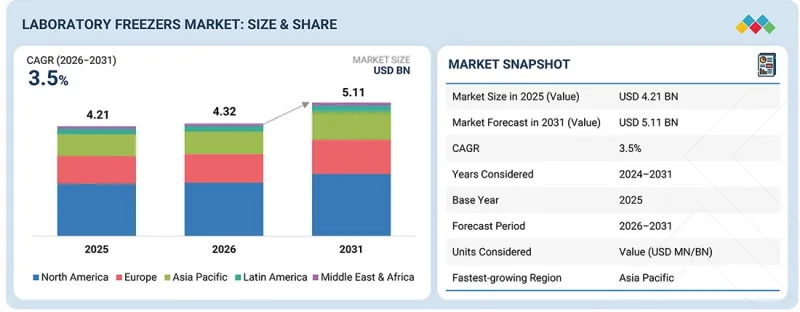
預計到 2031 年,全球科學研究用冷凍庫市場規模將達到 51.1 億美元,而 2026 年為 43.2 億美元,2026 年至 2031 年的年複合成長率(CAGR)為 3.5%。
| 調查範圍 | |
|---|---|
| 調查期 | 2026-2031 |
| 基準年 | 2025 |
| 預測期 | 2026-2031 |
| 計算單位 | 金額(10億美元) |
| 部分 | 按產品、按應用、按最終用戶、按地區 |
| 目標區域 | 北美、歐洲、亞太地區、拉丁美洲、中東和非洲 |
實驗室冷凍庫市場的主要驅動力是日益成長的對疫苗、生物樣本、試劑、血液成分、細胞株、組織和其他溫度敏感材料進行可靠溫控的需求。製藥和生物技術研究、疫苗開發、臨床診斷、生物樣本庫、基因組生物銀行以及細胞和基因治療的快速發展,正在加速實驗室、醫院、診斷檢查室、製藥公司和生物樣本庫對先進實驗室冷凍庫的採用。此外,關於檢體完整性和冷鏈合規性的嚴格法規和品質要求,也促使終端用戶採用配備精確溫度控制、連續監測、自動資料登錄、遠端警報和備份系統的冷凍庫。
此外,醫療和生命科學基礎設施投資的增加、生物檢體資料庫的擴建以及對低溫儲存需求的成長,都支撐著市場成長。同時,製造商正採用節能壓縮機、環保冷媒、改進的隔熱材料、自動化庫存管理以及物聯網監控系統,以降低營運成本、最大限度地減少檢體遺失風險並提高實驗室工作流程效率,這些因素共同推動了實驗室冷凍庫市場的持續成長。
“按產品類別分類,預計到 2025 年,冷藏庫將在實驗室冷凍庫市場佔據最大的市場佔有率。”
從產品角度來看,實驗室冷凍庫市場可細分為冷凍庫、冷藏庫和冷凍保存系統。冷藏庫佔據最大的市場佔有率,因為它們廣泛用於疫苗、試劑、培養基、藥品、血液樣本和其他溫度敏感材料的常規儲存,溫度通常控制在 2 度C至 8 度C之間。醫院、診斷檢查室、血庫、藥房、研究機構以及製藥和生物技術公司的廣泛應用推動了其強勁且持續的需求。與超低溫冷凍庫和冷凍保存系統相比,實驗室冷藏庫的初始成本和運作成本更低,更易於維護,更適用於常規實驗室工作流程。此外,診斷檢測、疫苗接種計劃、臨床研究和藥品生產的擴展,以及對溫度穩定性、連續監測、自動資料登錄和法規遵從性的嚴格要求,都鞏固了該細分市場的主導地位。節能環保、具備物聯網功能、具有遠端警報和備用控制功能的冷藏庫的日益普及,預計將進一步推動該領域的成長。
“按應用領域分類,藥品和疫苗儲存領域在實驗室冷凍庫市場中佔據最大佔有率。”
從應用領域來看,實驗室冷凍庫市場可細分為環境檢測、遺傳物質儲存、藥品和疫苗儲存、生物樣本和庫存管理以及其他應用。其中,藥品和疫苗儲存領域佔據最大的市場佔有率,這主要得益於疫苗、生物製藥、藥品、活性藥物成分、試劑和臨床試驗材料等大量需要溫度控制的物質供應。疫苗生產和免疫接種計劃的擴展、生物製藥和特藥產量的成長以及藥物研發和臨床試驗的拓展,都極大地推動了對實驗室冷藏庫和冷凍庫的需求。此外,關於溫度穩定性、連續監測、資料登錄、警報系統、緊急電源和冷鏈合規性的嚴格監管要求,也促使製藥公司、醫院、藥房、實驗室和配銷中心投資可靠的儲存設備。在研發、生產、品管和分銷等工作流程中反覆出現的藥品儲存需求,進一步鞏固了該領域在市場中的主導地位。
按最終用戶分類,製藥和生物技術公司在預測期內佔據最大佔有率。
按最終用戶分類,實驗室冷凍庫市場可細分為醫院、臨床和病理檢查室、製藥和生物技術公司、學術和研究機構、藥房和診所,以及細胞和組織庫。製藥和生物技術公司佔據最大的市場佔有率,因為它們在藥物發現、疫苗開發、生物製藥生產、臨床試驗、品管和商業化生產的整個過程中都需要大量的溫控儲存環境。這些公司儲存大量的溫度敏感材料,包括疫苗、生物製藥、細胞株、遺傳物質、試劑、活性藥物成分、參考物質和臨床試驗樣本。生物製藥研發投入的增加、生物製藥和生物相似藥產品線的擴展以及細胞和基因療法的發展,進一步推動了對冷藏庫、超低溫冷凍庫和冷凍保存系統的需求。此外,關於檢體完整性、溫度監控、資料登錄、警報管理、備份系統和儲存驗證的嚴格監管要求,也鞏固了該細分市場在市場中的主導地位。
“預計亞太地區實驗室冷凍庫市場將呈現最高的成長率。”
實驗室冷凍庫市場涵蓋五個區域:北美、歐洲、亞太、拉丁美洲以及中東和非洲。亞太地區預計將保持最高的成長率,這主要得益於製藥和生物技術製造、疫苗生產、臨床研究、診斷檢測和生物銀行活動的快速擴張。醫療保健支出不斷成長、政府對生命科學基礎設施的投資以及新建實驗室、醫院和冷鏈設施,都推動了對實驗室冷藏庫、超低溫冷凍庫和冷凍保存系統的需求。此外,生物製藥、生物相似藥以及細胞和基因治療產品的生產擴張,尤其是在中國、印度、日本和韓國,也促進了該地區市場的發展。另外,人們對檢體完整性的日益重視、更嚴格的溫度控制要求以及節能型、數位化互聯儲存系統的日益普及,也預計將加速亞太地區市場的成長。
實驗室冷凍庫市場的主要參與者包括 Thermo Fisher Scientific(美國)、海爾生物醫療(中國)、PHC Holdings(日本)、Eppendorf AG(德國)和 Avantor(美國)。
調查範圍
本研究報告從產品、應用、最終用戶和地區四個維度分析了實驗室冷凍庫市場。研究檢驗了市場擴張的促進因素,分析了該行業當前面臨的前景和狀況,並提供了包括市場領導和中小企業在內的詳細資訊。此外,報告也基於五個區域和微觀市場分析,對各細分市場的收入進行了估算。
購買本報告的理由
本報告為市場領導和新參與企業提供了關於實驗室冷凍庫市場及其細分市場整體收入預測的寶貴資訊。它幫助相關人員了解競爭格局,更有效地進行市場定位,並制定合適的打入市場策略。此外,該報告還深入分析了市場動態,包括關鍵的市場促進因素和挑戰。
本報告就以下幾點提供了富有洞察力的數據:
- 市場滲透率:對實驗室冷凍庫市場主要參與者提供的產品系列進行詳細分析。
- 產品開發/創新:深入洞察實驗室冷凍庫市場的未來技術趨勢、研發活動以及產品/服務發布。
- 市場發展:關於盈利成長領域的深刻洞察數據
- 市場多元化:實驗室冷凍庫市場近期趨勢與發展詳情
- 競爭分析:對主要競爭對手的產品、成長策略、銷售預測和市場類別進行全面評估。
目錄
第1章:引言
第2章執行摘要
第3章重要考察
第4章 市場概覽
- 市場動態
- 促進因素
- 抑制因子
- 機會
- 任務
第5章 產業趨勢
- 波特五力分析
- 總體經濟指標
- 供應鏈分析
- 價值鏈分析
- 生態系分析
- 價格分析
- 貿易分析
- 2026-2027 年主要會議和活動
- 影響客戶業務的趨勢/顛覆性因素
- 投資和資金籌措場景
- 案例研究分析
- 2025年美國關稅對實驗室冷凍庫市場的影響。
第6章:透過採用技術、專利、數位技術和人工智慧實現策略顛覆
- 主要新興技術
- 互補技術
- 專利分析
- 人工智慧/生成式人工智慧對實驗室冷凍庫市場的影響
- 成功案例和實際應用
第7章 監理情勢
- 監管趨勢
- 主要監管機構、政府機構和其他組織
- 業界標準
第8章:顧客趨勢與購買行為
- 決策流程
- 主要相關人員和採購標準
- 實施障礙和內部挑戰
- 終端用戶的各種未滿足需求
第9章:實驗室冷凍庫市場(依產品分類)
- 冷凍庫
- 冷藏庫
- 冷凍保存系統
第10章:實驗室冷凍庫市場(按應用領域分類)
- 環境測試
- 遺傳物質的保存
- 藥品和疫苗的儲存
- 生物樣本和庫存管理
- 其他
第11章:實驗室冷凍庫市場(按最終用戶分類)
- 醫院
- 臨床檢查室和病理檢查室
- 製藥和生物技術公司
- 學術和研究機構
- 藥房和診所
- 細胞和組織庫
- 環境研究所
- 法醫研究所
- 食品和飲料公司
- 其他
第12章:實驗室冷凍庫市場(按地區分類)
- 北美洲
- 美國
- 加拿大
- 歐洲
- 德國
- 英國
- 法國
- 義大利
- 西班牙
- 其他
- 亞太地區
- 日本
- 中國
- 印度
- 澳洲
- 韓國
- 其他
- 拉丁美洲
- 巴西
- 墨西哥
- 其他
- 中東和非洲
- 海灣合作理事會國家
- 其他
第13章 競爭格局
- 2023-2026年主要參與企業的競爭策略/優勢
- 2021-2025年收入分析
- 2025年市佔率分析
- 企業估值和財務指標
- 品牌/產品對比
- 企業估值矩陣:主要公司,2025 年
- 公司估值矩陣:新創企業/中小企業,2025 年
- 競爭格局
第14章:公司簡介
- 主要參與企業
- THERMO FISHER SCIENTIFIC INC.
- HAIER BIOMEDICAL
- PHC HOLDINGS CORPORATION
- EPPENDORF SE
- AVANTOR, INC.
- HELMER SCIENTIFIC
- FOLLETT PRODUCTS, LLC
- LIEBHERR
- FELIX STORCH, INC.
- CUSTOM BIOGENIC SYSTEMS
- BLUE STAR LIMITED
- PHILIPP KIRSCH GMBH
- 其他公司
- SO-LOW ENVIRONMENTAL EQUIPMENT CO. LTD
- JEIO TECH
- STERICOX INDIA PRIVATE LIMITED
- THALHEIMER KUHLUNG FEZO
- B MEDICAL SYSTEMS
- STANDEX INTERNATIONAL CORPORATION
- EVERMED SRL
- ARCTIKO
- VESTFROST SOLUTIONS
- KW TECNILABO
- COLE PARMER
- ZHONGKE MEILING CRYOGENICS COMPANY LIMITED
- ESAW INDIA
第15章:調查方法
第16章附錄
The global laboratory freezers market is projected to reach USD 5.11 billion by 2031 from USD 4.32 billion in 2026, at a CAGR of 3.5% from 2026 to 2031.
| Scope of the Report | |
|---|---|
| Years Considered for the Study | 2026-2031 |
| Base Year | 2025 |
| Forecast Period | 2026-2031 |
| Units Considered | Value (USD billion) |
| Segments | Product, Application, End User, and Region |
| Regions covered | North America, Europe, the Asia Pacific, Latin America, and the Middle East & Africa |
The laboratory freezers market is primarily driven by the increasing need for reliable, temperature-controlled storage of vaccines, biological samples, reagents, blood components, cell lines, tissues, and other temperature-sensitive materials. The rapid expansion of pharmaceutical and biotechnology research, vaccine development, clinical diagnostics, biobanking, genomics, and cell and gene therapy is accelerating the adoption of advanced laboratory freezers across research institutes, hospitals, diagnostic laboratories, pharmaceutical companies, and biobanks. In addition, stringent regulatory and quality requirements for maintaining sample integrity and cold-chain compliance are encouraging end users to adopt freezers equipped with precise temperature control, continuous monitoring, automated data logging, remote alarms, and backup systems.
Furthermore, increasing investments in healthcare and life-science infrastructure, the expansion of biorepositories, and growing demand for ultra-low-temperature storage are supporting market growth. Manufacturers are also introducing energy-efficient compressors, environmentally sustainable refrigerants, improved insulation, automated inventory management, and IoT-enabled monitoring systems to reduce operating costs, minimize sample-loss risks, and enhance laboratory workflow efficiency, thereby driving sustained growth of the laboratory freezers market.
"By product, refrigerators accounted for the largest share of the laboratory freezers market in 2025."
By product, the laboratory freezers market is segmented into freezers, refrigerators, and cryopreservation systems. Refrigerators account for the largest market share due to their widespread use for the routine storage of vaccines, reagents, culture media, pharmaceutical products, blood samples, and other temperature-sensitive materials at controlled temperatures, typically between 2°C and 8°C. Their extensive installation across hospitals, diagnostic laboratories, blood banks, pharmacies, research institutes, and pharmaceutical and biotechnology companies generates strong and recurring demand. Compared with ultra-low-temperature freezers and cryopreservation systems, laboratory refrigerators offer lower acquisition and operating costs, simpler maintenance, and broader applicability in everyday laboratory workflows. Furthermore, expanding diagnostic testing, vaccine programs, clinical research, and pharmaceutical production-along with stringent requirements for temperature stability, continuous monitoring, automated data logging, and regulatory compliance are supporting the segment's leading position. Growing adoption of energy-efficient, environmentally sustainable, and IoT-enabled refrigerators with remote alarms and backup controls is expected to further drive segment growth.
"By application, the pharmaceutical & vaccine storage segment accounted for the largest share of the laboratory freezers market."
By application, the laboratory freezers market is segmented into environmental testing, genetic material storage, pharmaceutical & vaccine storage, biological samples & inventory management, and other applications. The pharmaceutical & vaccine storage segment accounted for the largest market share owing to the substantial volume of temperature-sensitive vaccines, biologics, drugs, active pharmaceutical ingredients, reagents, and clinical-trial materials requiring controlled storage. The expansion of vaccine manufacturing and immunization programs, increasing production of biologics and specialty medicines, and growth in pharmaceutical research and clinical trials are creating strong demand for laboratory refrigerators and freezers. Furthermore, stringent regulatory requirements for temperature stability, continuous monitoring, data logging, alarm systems, backup power, and cold-chain compliance encourage pharmaceutical manufacturers, hospitals, pharmacies, research laboratories, and distribution centers to invest in reliable storage equipment. The recurring need to store pharmaceutical products across research, production, quality-control, and distribution workflows further reinforces the segment's leading market position.
By end user, pharmaceutical & biotechnology companies accounted for the largest share in the forecast period.
By end user, the laboratory freezers market is segmented into hospitals, clinical & pathology laboratories, pharmaceutical & biotechnology companies, academic & research institutes, pharmacies & physicians' offices, and cell & tissue banks. Pharmaceutical & biotechnology companies accounted for the largest market share due to their extensive requirement for controlled-temperature storage across drug discovery, vaccine development, biologics manufacturing, clinical trials, quality control, and commercial production. These companies store substantial volumes of temperature-sensitive materials, including vaccines, biologics, cell lines, genetic material, reagents, active pharmaceutical ingredients, reference standards, and clinical-trial samples. Rising investment in biopharmaceutical R&D, expanding biologics and biosimilar pipelines, and the development of cell and gene therapies are further increasing demand for refrigerators, ultra-low-temperature freezers, and cryopreservation systems. Moreover, stringent regulatory requirements for sample integrity, temperature monitoring, data logging, alarm management, backup systems, and storage validation support the segment's leading market position.
"The Asia Pacific market is projected to show the highest growth rate in the laboratory freezers market."
The laboratory freezers market spans five major regions: North America, Europe, Asia Pacific, Latin America, and the Middle East & Africa. Asia Pacific is projected to register the highest growth rate, driven by the rapid expansion of pharmaceutical and biotechnology manufacturing, vaccine production, clinical research, diagnostic testing, and biobanking activities. Increasing healthcare expenditure, government investments in life-science infrastructure, and the establishment of new research laboratories, hospitals, and cold-chain facilities are strengthening demand for laboratory refrigerators, ultra-low-temperature freezers, and cryopreservation systems. The region is also benefiting from the growing production of biologics, biosimilars, and cell and gene therapies, particularly in China, India, Japan, and South Korea. Furthermore, increasing awareness of sample integrity, stricter temperature-control requirements, and rising adoption of energy-efficient and digitally connected storage systems are expected to accelerate regional market growth.
A breakdown of the primary participants referred to for this report is provided below:
- By Company Type: Tier 1 (45%), Tier 2 (35%), and Tier 3 (20%)
- By Designation: Directors (50%), Managers (30%), and Others (20%)
- By Region: North America (37%), Europe (25%), Asia Pacific (30%), Latin America (5%), and the Middle East & Africa (3%)
The major players in the laboratory freezers market include Thermo Fisher Scientific (US), Haier Biomedical (China), PHC Holdings (Japan), Eppendorf AG (Germany), and Avantor (US), among others
Research Coverage
The research report examines the laboratory freezers market by product, application, end user, and region. This research covers factors driving market expansion, analyzes prospects and parameters faced by industries today, and provides specifics on the competitive landscape, considering market leaders and small and medium enterprises. This research also estimates the revenue of different market segments by considering five regions and micromarket analysis
Reasons to Buy the Report
The report will provide market leaders and new entrants with valuable information regarding the revenue estimates for the overall laboratory freezers market and its subsegments. It will help stakeholders understand the competitive landscape, allowing them to position their businesses more effectively and develop appropriate go-to-market strategies. Additionally, the report offers insights into the market dynamics, including key drivers, restraints, challenges, and opportunities.
This report provides insightful data on the following pointers:
- Market Penetration: In-depth coverage of product portfolios offered by the top players in the laboratory freezers market
- Product Development/Innovation: Detailed insights into upcoming technologies, research & development activities, and product & service launches in the laboratory freezers market
- Market Development: Insightful data on profitable developing areas
- Market Diversification: Details about recent developments and advancements in the laboratory freezers market
- Competitive Assessment: Extensive assessment of the products, growth tactics, revenue projections, and market categories of the top competitors
TABLE OF CONTENTS
1 INTRODUCTION
- 1.1 STUDY OBJECTIVES
- 1.2 MARKET DEFINITION
- 1.3 MARKET SCOPE
- 1.3.1 MARKET SEGMENTATION AND REGIONAL SCOPE
- 1.3.2 INCLUSIONS AND EXCLUSIONS
- 1.3.3 YEARS CONSIDERED
- 1.4 CURRENCY CONSIDERED
- 1.5 STAKEHOLDERS
- 1.6 SUMMARY OF CHANGES
2 EXECUTIVE SUMMARY
- 2.1 MARKET HIGHLIGHTS AND KEY INSIGHTS
- 2.2 DISRUPTIVE TRENDS IN LABORATORY FREEZERS MARKET
- 2.3 HIGH GROWTH SEGMENTS
- 2.4 REGIONAL SNAPSHOT: MARKET SIZE, GROWTH RATE, AND FORECAST
3 PREMIUM INSIGHTS
- 3.1 LABORATORY FREEZERS MARKET OVERVIEW
- 3.2 NORTH AMERICA: LABORATORY FREEZERS MARKET, BY COUNTRY AND PRODUCT, 2025
- 3.3 GEOGRAPHIC SNAPSHOT OF LABORATORY FREEZERS MARKET
4 MARKET OVERVIEW
- 4.1 INTRODUCTION
- 4.2 MARKET DYNAMICS
- 4.2.1 DRIVERS
- 4.2.1.1 Expanding life science research and temperature-sensitive biologics storage
- 4.2.1.2 Expanding vaccine and biopharmaceutical production drives demand for validated frozen-storage infrastructure
- 4.2.2 RESTRAINTS
- 4.2.2.1 High capital and lifecycle costs of advanced freezers
- 4.2.2.2 Tightening refrigerant regulations that increase compliance costs
- 4.2.3 OPPORTUNITIES
- 4.2.3.1 Transition to natural-refrigerant and HFC-free cooling technologies
- 4.2.3.2 Growing clinical-trial activity to expand decentralized sample-storage requirements
- 4.2.4 CHALLENGES
- 4.2.4.1 Maintaining temperature uniformity and sample integrity
- 4.2.4.2 Stringent validation and documentation requirements
- 4.2.1 DRIVERS
5 INDUSTRY TRENDS
- 5.1 PORTER'S FIVE FORCES ANALYSIS
- 5.1.1 BARGAINING POWER OF BUYERS
- 5.1.2 BARGAINING POWER OF SUPPLIERS
- 5.1.3 THREAT OF NEW ENTRANTS
- 5.1.4 THREAT OF SUBSTITUTES
- 5.1.5 INTENSITY OF COMPETITIVE RIVALRY
- 5.2 MACROECONOMIC INDICATORS
- 5.2.1 GDP TRENDS AND FORECAST
- 5.2.2 TRENDS IN GLOBAL LABORATORY FREEZERS INDUSTRY
- 5.3 SUPPLY CHAIN ANALYSIS
- 5.3.1 PROMINENT COMPANIES
- 5.3.2 SMALL AND MEDIUM-SIZED ENTERPRISES
- 5.3.3 END USERS
- 5.4 VALUE CHAIN ANALYSIS
- 5.4.1 RESEARCH & DEVELOPMENT
- 5.4.2 RAW MATERIAL PROCUREMENT & PRODUCT DEVELOPMENT
- 5.4.3 MARKETING, SALES, AND DISTRIBUTION
- 5.5 ECOSYSTEM ANALYSIS
- 5.6 PRICING ANALYSIS
- 5.6.1 AVERAGE SELLING PRICE OF LABORATORY FREEZERS, BY KEY PLAYER, 2025
- 5.6.2 AVERAGE SELLING PRICE OF PRODUCT, BY KEY PLAYER, 2023-2025 (USD)
- 5.6.3 AVERAGE SELLING PRICE TREND, BY REGION, 2025
- 5.7 TRADE ANALYSIS
- 5.7.1 IMPORT DATA FOR HS CODE 841840
- 5.7.2 IMPORT DATA FOR FREEZERS OF THE UPRIGHT TYPE, OF A CAPACITY <= 900 L (HS CODE 841840)
- 5.7.3 EXPORT DATA FOR FREEZERS OF THE UPRIGHT TYPE, OF A CAPACITY <= 900 L (HS CODE 841840)
- 5.8 KEY CONFERENCES & EVENTS, 2026-2027
- 5.9 TRENDS/DISRUPTIONS IMPACTING CUSTOMER BUSINESS
- 5.9.1 DIGITAL MONITORING, SUSTAINABILITY, AND EXPANDING APPLICATIONS TRANSFORM MARKET
- 5.10 INVESTMENT & FUNDING SCENARIO
- 5.11 CASE STUDY ANALYSIS
- 5.11.1 CASE STUDY
- 5.12 IMPACT OF 2025 US TARIFF ON LABORATORY FREEZERS MARKET
- 5.12.1 INTRODUCTION
- 5.12.2 KEY TARIFF RATES
- 5.12.3 KEY TARIFF RATES
- 5.12.4 PRICE IMPACT ANALYSIS
- 5.12.5 IMPACT ON COUNTRY/REGION
- 5.12.5.1 US
- 5.12.5.2 Europe
- 5.12.5.3 Asia Pacific
- 5.12.6 IMPACT ON END USERS
6 STRATEGIC DISRUPTION THROUGH TECHNOLOGY, PATENTS, DIGITAL, AND AI ADOPTION
- 6.1 KEY EMERGING TECHNOLOGIES
- 6.1.1 NATURAL/ECO-FRIENDLY REFRIGERANTS
- 6.1.2 SMART/IOT-ENABLED FREEZERS
- 6.2 COMPLEMENTARY TECHNOLOGIES
- 6.2.1 TEMPERATURE-CONTROLLED TRANSPORT SYSTEMS
- 6.2.2 BUILDING-MANAGEMENT-SYSTEM INTEGRATION
- 6.2.3 ROBOTIC AND AUTOMATED SAMPLE-STORAGE SYSTEMS
- 6.3 PATENT ANALYSIS
- 6.4 IMPACT OF AI/GEN AI ON LABORATORY FREEZERS MARKET
- 6.4.1 TOP USE CASES AND MARKET POTENTIAL
- 6.4.2 BEST PRACTICES IN LABORATORY FREEZERS
- 6.4.3 CASE STUDIES OF AI IMPLEMENTATION IN LABORATORY FREEZERS MARKET
- 6.4.4 INTERCONNECTED ADJACENT ECOSYSTEMS AND IMPACT ON MARKET PLAYERS
- 6.4.5 CLIENTS' READINESS TO ADOPT GENERATIVE AI IN LABORATORY FREEZERS MARKET
- 6.5 SUCCESS STORIES AND REAL-WORLD APPLICATIONS
7 REGULATORY LANDSCAPE
- 7.1 REGULATORY TRENDS
- 7.1.1 NORTH AMERICA
- 7.1.1.1 US
- 7.1.1.2 Canada
- 7.1.2 EUROPE
- 7.1.3 ASIA PACIFIC
- 7.1.3.1 Japan
- 7.1.3.2 China
- 7.1.3.3 India
- 7.1.1 NORTH AMERICA
- 7.2 KEY REGULATORY BODIES, GOVERNMENT AGENCIES, AND OTHER ORGANIZATIONS
- 7.2.1 NORTH AMERICA
- 7.2.2 EUROPE
- 7.2.3 ASIA PACIFIC
- 7.2.4 LATIN AMERICA
- 7.2.5 MIDDLE EAST & AFRICA
- 7.3 INDUSTRY STANDARDS
8 CUSTOMER LANDSCAPE AND BUYER BEHAVIOR
- 8.1 DECISION-MAKING PROCESS
- 8.2 KEY STAKEHOLDERS & BUYING CRITERIA
- 8.2.1 KEY STAKEHOLDERS IN BUYING PROCESS
- 8.2.2 KEY BUYING CRITERIA
- 8.3 ADOPTION BARRIERS AND INTERNAL CHALLENGES
- 8.4 UNMET NEEDS OF VARIOUS END USERS
9 LABORATORY FREEZERS MARKET, BY PRODUCT
- 9.1 INTRODUCTION
- 9.2 FREEZERS
- 9.2.1 ULTRA-LOW-TEMPERATURE FREEZERS
- 9.2.1.1 Expanding biobanking and cell & gene therapy pipelines drive demand
- 9.2.2 GENERAL-PURPOSE FREEZERS
- 9.2.2.1 Increased clinical and diagnostic test volume to drive market growth
- 9.2.3 PLASMA FREEZERS
- 9.2.3.1 Rising blood component demand and trauma care needs sustain segment growth
- 9.2.4 ENZYME FREEZERS
- 9.2.4.1 Expansion of biotechnology research and enzyme-based diagnostics to drive demand
- 9.2.5 EXPLOSION-PROOF FREEZERS
- 9.2.5.1 Tightening laboratory safety codes accelerate adoption of hazardous-location freezer design
- 9.2.6 FLAMMABLE MATERIAL FREEZERS
- 9.2.6.1 Expanding chemical inventories in research and pharma labs boost demand for dedicated flammable storage
- 9.2.1 ULTRA-LOW-TEMPERATURE FREEZERS
- 9.3 REFRIGERATORS
- 9.3.1 BLOOD BANK REFRIGERATORS
- 9.3.1.1 Growing blood donation networks and trauma caseloads fuel demand
- 9.3.2 CHROMATOGRAPHY REFRIGERATORS
- 9.3.2.1 Precision temperature control for analytical workflows expand segment
- 9.3.3 EXPLOSION-PROOF REFRIGERATORS
- 9.3.3.1 Hazardous-location certification needs enhance demand in R&D labs
- 9.3.4 FLAMMABLE MATERIAL REFRIGERATORS
- 9.3.4.1 Stricter chemical safety compliance drives lab upgrades
- 9.3.5 LABORATORY REFRIGERATORS
- 9.3.5.1 Energy-efficient lab refrigerator to grow market
- 9.3.6 PHARMACY REFRIGERATORS
- 9.3.6.1 Expansion of pharmacy-based vaccination services drives purpose-built cold storage demand
- 9.3.1 BLOOD BANK REFRIGERATORS
- 9.4 CRYOPRESERVATION SYSTEMS
- 9.4.1 NEED FOR APPROPRIATE CRYOPRESERVATION STORAGE SYSTEMS TO ENSURE SAMPLE INTEGRITY BOOSTS SEGMENT GROWTH
10 LABORATORY FREEZERS MARKET, BY APPLICATION
- 10.1 INTRODUCTION
- 10.2 ENVIRONMENTAL TESTING
- 10.2.1 REFORMS IN ENVIRONMENTAL TESTING NORMS TO DRIVE DEMAND
- 10.3 GENETIC MATERIAL STORAGE
- 10.3.1 INCREASED RESEARCH INVESTMENTS IN OMICS RESEARCH TO DRIVE MARKET GROWTH
- 10.4 PHARMACEUTICAL & VACCINE STORAGE
- 10.4.1 TEMPERATURE-SENSITIVE REQUIREMENTS IN DRUG AND VACCINE MANUFACTURING TO DRIVE SEGMENT
- 10.5 BIOLOGICAL SAMPLES & INVENTORY MANAGEMENT
- 10.5.1 GROWTH IN SAMPLE VOLUME TO DRIVE DEMAND FOR REFRIGERATORS
- 10.6 OTHER APPLICATIONS
- 10.6.1 RAPID-RESPONSE COLD STORAGE DRIVING REPLACEMENT DEMAND ACROSS BLOOD BANKS AND TRANSFUSION SERVICES
11 LABORATORY FREEZERS MARKET, BY END USER
- 11.1 INTRODUCTION
- 11.2 HOSPITALS
- 11.2.1 RAPID-RESPONSE COLD STORAGE DRIVES REPLACEMENT DEMAND ACROSS EMERGENCY, ONCOLOGY, AND SURGICAL CARE
- 11.3 CLINICAL & PATHOLOGY LABORATORIES
- 11.3.1 DIGITAL PATHOLOGY AND AUTOMATION TO DRIVE MARKET GROWTH IN CLINICAL LABORATORIES
- 11.4 PHARMACEUTICAL & BIOTECHNOLOGY COMPANIES
- 11.4.1 GMP-COMPLIANT ULTRA-LOW TEMPERATURE STORAGE SCALING TO DRIVE GROWTH
- 11.5 ACADEMIC & RESEARCH INSTITUTES
- 11.5.1 GREEN-LAB AND ENERGY-REDUCTION INITIATIVES RESHAPING FREEZER PROCUREMENT AND OPERATING PRACTICES
- 11.6 PHARMACIES & PHYSICIANS' OFFICES
- 11.6.1 COMPLIANCE REQUIREMENTS FOR CHILDREN'S VACCINES TO BOOST SEGMENT
- 11.7 CELL & TISSUE BANKS
- 11.7.1 INCREASED ADOPTION OF FREEZERS IN MOLECULAR DIAGNOSTICS TO DRIVE MARKET EXPANSION
- 11.8 ENVIRONMENTAL LABS
- 11.8.1 INCREASED ADOPTION DUE TO STRICTER ENVIRONMENTAL MONITORING PROGRAMS
- 11.9 FORENSIC LABS
- 11.9.1 COLD-CASE RETESTING AND DNA EVIDENCE INTEGRITY REINFORCE LONG-TERM FROZEN STORAGE PROTOCOLS
- 11.10 FOOD & BEVERAGE COMPANIES
- 11.10.1 STRICT QUALITY CONTROL REQUIREMENTS TO DRIVE DEMAND
- 11.11 OTHER END USERS
- 11.11.1 LONG-TERM SAMPLE PRESERVATION TO DRIVE MARKET GROWTH IN OTHER END USERS
12 LABORATORY FREEZERS MARKET, BY REGION
- 12.1 INTRODUCTION
- 12.2 NORTH AMERICA
- 12.2.1 US
- 12.2.1.1 Established biopharma & R&D landscape to drive replacement cycle
- 12.2.2 CANADA
- 12.2.2.1 Growth in pharmaceutical R&D sector to grow demand for cold storage technologies
- 12.2.1 US
- 12.3 EUROPE
- 12.3.1 GERMANY
- 12.3.1.1 Strong local manufacturing footprints and established research infrastructure to drive market growth
- 12.3.2 UK
- 12.3.2.1 UKRI investments and national research infrastructure to fuel lab freezers adoption
- 12.3.3 FRANCE
- 12.3.3.1 Large research & development base to grow demand for cold storage samples
- 12.3.4 ITALY
- 12.3.4.1 Industry-academia partnership to drive market growth
- 12.3.5 SPAIN
- 12.3.5.1 Large clinical research base to drive freezer demand
- 12.3.6 REST OF EUROPE
- 12.3.1 GERMANY
- 12.4 ASIA PACIFIC
- 12.4.1 JAPAN
- 12.4.1.1 Increased investments in pharma manufacturing to drive market
- 12.4.2 CHINA
- 12.4.2.1 National GeneBank expansion and localized manufacturing scale to drive market growth
- 12.4.3 INDIA
- 12.4.3.1 National phenome and genome project to scale up demand for cold storage equipment
- 12.4.4 AUSTRALIA
- 12.4.4.1 Strong biobank network to drive demand cold storage options in Australia
- 12.4.5 SOUTH KOREA
- 12.4.5.1 Academic and medical institutes to drive demand for laboratory refrigeration solutions
- 12.4.6 REST OF ASIA PACIFIC
- 12.4.1 JAPAN
- 12.5 LATIN AMERICA
- 12.5.1 BRAZIL
- 12.5.1.1 Fiocruz biobank network and regional manufacturing base - key drivers
- 12.5.2 MEXICO
- 12.5.2.1 Expansion in biopharmaceutical sector to boost market
- 12.5.3 REST OF LATIN AMERICA
- 12.5.1 BRAZIL
- 12.6 MIDDLE EAST & AFRICA
- 12.6.1 GCC COUNTRIES
- 12.6.1.1 Government-led investments to grow market in GCC countries
- 12.6.2 REST OF MIDDLE EAST & AFRICA
- 12.6.1 GCC COUNTRIES
13 COMPETITIVE LANDSCAPE
- 13.1 INTRODUCTION
- 13.2 KEY PLAYER COMPETITIVE STRATEGIES/RIGHT TO WIN, 2023-2026
- 13.2.1 OVERVIEW OF STRATEGIES ADOPTED BY KEY PLAYERS IN LABORATORY FREEZERS MARKET
- 13.3 REVENUE ANALYSIS, 2021-2025
- 13.4 MARKET SHARE ANALYSIS, 2025
- 13.4.1 MARKET RANKING OF KEY PLAYERS, 2025
- 13.5 COMPANY VALUATION AND FINANCIAL METRICS
- 13.5.1 FINANCIAL METRICS
- 13.5.2 COMPANY VALUATION
- 13.6 BRAND/PRODUCT COMPARISON
- 13.7 COMPANY EVALUATION MATRIX: KEY PLAYERS, 2025
- 13.7.1 STARS
- 13.7.2 EMERGING LEADERS
- 13.7.3 PERVASIVE PLAYERS
- 13.7.4 PARTICIPANTS
- 13.7.5 COMPANY FOOTPRINT: KEY PLAYERS, 2025
- 13.7.5.1 Company footprint
- 13.7.5.2 Region footprint
- 13.7.5.3 Product footprint
- 13.7.5.4 Application footprint
- 13.7.5.5 End user footprint
- 13.8 COMPANY EVALUATION MATRIX: STARTUPS/SMES, 2025
- 13.8.1 PROGRESSIVE COMPANIES
- 13.8.2 RESPONSIVE COMPANIES
- 13.8.3 DYNAMIC COMPANIES
- 13.8.4 STARTING BLOCKS
- 13.8.5 COMPETITIVE BENCHMARKING: STARTUPS/SMES, 2025
- 13.8.5.1 Detailed list of key startups/SMEs
- 13.8.5.2 Competitive benchmarking of key startups/SMEs
- 13.9 COMPETITIVE SCENARIO
- 13.9.1 PRODUCT LAUNCHES
- 13.9.2 DEALS
- 13.9.3 EXPANSIONS
14 COMPANY PROFILES
- 14.1 KEY PLAYERS
- 14.1.1 THERMO FISHER SCIENTIFIC INC.
- 14.1.1.1 Business overview
- 14.1.1.2 Products offered
- 14.1.1.3 Recent developments
- 14.1.1.3.1 Product launches
- 14.1.1.3.2 Expansions
- 14.1.1.4 MnM view
- 14.1.1.4.1 Right to win
- 14.1.1.4.2 Strategic choices
- 14.1.1.4.3 Weaknesses & competitive threats
- 14.1.2 HAIER BIOMEDICAL
- 14.1.2.1 Business overview
- 14.1.2.2 Products offered
- 14.1.2.3 Recent developments
- 14.1.2.3.1 Product launches
- 14.1.2.3.2 Deals
- 14.1.2.4 MnM view
- 14.1.2.4.1 Right to win
- 14.1.2.4.2 Strategic choices
- 14.1.2.4.3 Weaknesses & competitive threats
- 14.1.3 PHC HOLDINGS CORPORATION
- 14.1.3.1 Business overview
- 14.1.3.2 Products offered
- 14.1.3.3 Recent developments
- 14.1.3.3.1 Product launches
- 14.1.3.4 MnM view
- 14.1.3.4.1 Right to win
- 14.1.3.4.2 Strategic choices
- 14.1.3.4.3 Weaknesses & competitive threats
- 14.1.4 EPPENDORF SE
- 14.1.4.1 Business overview
- 14.1.4.2 Products offered
- 14.1.4.3 Recent developments
- 14.1.4.3.1 Product launches & approvals
- 14.1.4.3.2 Deals
- 14.1.4.3.3 Expansions
- 14.1.4.4 MnM view
- 14.1.4.4.1 Right to win
- 14.1.4.4.2 Strategic choices
- 14.1.4.4.3 Weaknesses & competitive threats
- 14.1.5 AVANTOR, INC.
- 14.1.5.1 Business overview
- 14.1.5.2 Products offered
- 14.1.5.3 Recent developments
- 14.1.5.3.1 Deals
- 14.1.6 HELMER SCIENTIFIC
- 14.1.6.1 Business overview
- 14.1.6.2 Products offered
- 14.1.6.3 Recent developments
- 14.1.6.3.1 Product launches & approvals
- 14.1.7 FOLLETT PRODUCTS, LLC
- 14.1.7.1 Business overview
- 14.1.7.2 Products offered
- 14.1.8 LIEBHERR
- 14.1.8.1 Business overview
- 14.1.8.2 Products offered
- 14.1.8.3 Recent developments
- 14.1.8.3.1 Product launches & approvals
- 14.1.9 FELIX STORCH, INC.
- 14.1.9.1 Business overview
- 14.1.9.2 Products offered
- 14.1.10 CUSTOM BIOGENIC SYSTEMS
- 14.1.10.1 Business overview
- 14.1.10.2 Products offered
- 14.1.11 BLUE STAR LIMITED
- 14.1.11.1 Business overview
- 14.1.11.2 Products offered
- 14.1.12 PHILIPP KIRSCH GMBH
- 14.1.12.1 Business overview
- 14.1.12.2 Products offered
- 14.1.1 THERMO FISHER SCIENTIFIC INC.
- 14.2 OTHER PLAYERS
- 14.2.1 SO-LOW ENVIRONMENTAL EQUIPMENT CO. LTD
- 14.2.2 JEIO TECH
- 14.2.3 STERICOX INDIA PRIVATE LIMITED
- 14.2.4 THALHEIMER KUHLUNG FEZO
- 14.2.5 B MEDICAL SYSTEMS
- 14.2.6 STANDEX INTERNATIONAL CORPORATION
- 14.2.7 EVERMED S.R.L
- 14.2.8 ARCTIKO
- 14.2.9 VESTFROST SOLUTIONS
- 14.2.10 KW TECNILABO
- 14.2.11 COLE PARMER
- 14.2.12 ZHONGKE MEILING CRYOGENICS COMPANY LIMITED
- 14.2.13 ESAW INDIA
15 RESEARCH METHODOLOGY
- 15.1 RESEARCH DATA
- 15.1.1 SECONDARY RESEARCH
- 15.1.1.1 Key secondary sources
- 15.1.1.2 Key data from secondary sources
- 15.1.2 PRIMARY RESEARCH
- 15.1.2.1 Key primary sources
- 15.1.2.2 Key supply- and demand-side participants
- 15.1.2.3 Breakdown of primary interviews
- 15.1.2.4 Key primary insights
- 15.1.1 SECONDARY RESEARCH
- 15.2 MARKET SIZE ESTIMATION METHODOLOGY
- 15.2.1 REVENUE MAPPING-BASED MARKET ESTIMATION
- 15.2.2 END-USER-BASED MAPPING MARKET ESTIMATION
- 15.3 GROWTH FORECASTING MODEL
- 15.4 DATA TRIANGULATION AND MARKET BREAKDOWN
- 15.5 RESEARCH ASSUMPTIONS
- 15.6 RESEARCH LIMITATIONS
- 15.7 RISK ANALYSIS
16 APPENDIX
- 16.1 DISCUSSION GUIDE
- 16.2 KNOWLEDGESTORE: MARKETSANDMARKETS' SUBSCRIPTION PORTAL
- 16.3 CUSTOMIZATION OPTIONS
- 16.4 RELATED REPORTS
- 16.5 AUTHOR DETAILS
List of Tables
- TABLE 1 LABORATORY FREEZERS MARKET: INCLUSIONS AND EXCLUSIONS OF STUDY
- TABLE 2 IMPACT OF PORTER'S FIVE FORCES ON LABORATORY FREEZERS MARKET
- TABLE 3 AVERAGE SELLING PRICE OF LABORATORY FREEZERS, BY REGION, 2023-2025 (USD)
- TABLE 4 IMPORT DATA FOR FREEZERS OF THE UPRIGHT TYPE (HS CODE 841840), BY COUNTRY, 2021-2025 (USD MILLION)
- TABLE 5 EXPORT DATA FOR FREEZERS OF THE UPRIGHT TYPE (HS CODE 841840), BY COUNTRY, 2021-2025 (USD MILLION)
- TABLE 6 LABORATORY FREEZERS MARKET: KEY CONFERENCES AND EVENTS, 2026-2027
- TABLE 7 CASE STUDY 1: REMOTE MONITORING IMPROVES ULT FREEZER FLEET MANAGEMENT
- TABLE 8 CASE STUDY 2: PHCBI'S -86°C ULT FREEZER SUPPORTS LONG-TERM SAMPLE STORAGE FOR SEPSIS RESEARCH
- TABLE 9 US ADJUSTED RECIPROCAL TARIFF RATES
- TABLE 10 LABORATORY FREEZERS MARKET: KEY PATENT REGISTRATIONS, 2025-2026
- TABLE 11 CASE STUDY 1: AI-BASED THERMAL MODELING FOR ULTRA-LOW-TEMPERATURE FREEZERS
- TABLE 12 CASE STUDY 2: AI- AND CLOUD-ENABLED MONITORING FOR ULT FREEZERS
- TABLE 13 INTERCONNECTED ADJACENT ECOSYSTEMS AND IMPACT ON MARKET PLAYERS
- TABLE 14 MEDICAL DEVICE CLASSIFICATION BY US FDA
- TABLE 15 US: MEDICAL DEVICE REGULATORY APPROVAL PROCESS
- TABLE 16 CANADA: MEDICAL DEVICE REGULATORY APPROVAL PROCESS
- TABLE 17 JAPAN: MEDICAL DEVICE CLASSIFICATION UNDER PHARMACEUTICAL AND MEDICAL DEVICE AGENCY
- TABLE 18 CHINA: CLASSIFICATION OF MEDICAL DEVICES
- TABLE 19 NORTH AMERICA: KEY REGULATORY BODIES, GOVERNMENT AGENCIES, AND OTHER ORGANIZATIONS
- TABLE 20 EUROPE: KEY REGULATORY BODIES, GOVERNMENT AGENCIES, AND OTHER ORGANIZATIONS
- TABLE 21 ASIA PACIFIC: KEY REGULATORY BODIES, GOVERNMENT AGENCIES, AND OTHER ORGANIZATIONS
- TABLE 22 LATIN AMERICA: KEY REGULATORY BODIES, GOVERNMENT AGENCIES, AND OTHER ORGANIZATIONS
- TABLE 23 MIDDLE EAST & AFRICA: KEY REGULATORY BODIES, GOVERNMENT AGENCIES, AND OTHER ORGANIZATIONS
- TABLE 24 INDUSTRY STANDARDS FOR LABORATORY FREEZERS MARKET
- TABLE 25 INFLUENCE OF KEY STAKEHOLDERS ON BUYING PROCESS IN LABORATORY FREEZERS MARKET, BY PRODUCT (%)
- TABLE 26 KEY BUYING CRITERIA FOR LABORATORY FREEZER PRODUCTS
- TABLE 27 LABORATORY FREEZERS MARKET, BY PRODUCT, 2024-2031 (USD MILLION)
- TABLE 28 FREEZERS MARKET, BY TYPE, 2024-2031 (USD MILLION)
- TABLE 29 FREEZERS MARKET, BY REGION, 2024-2031 (USD MILLION)
- TABLE 30 ULTRA-LOW-TEMPERATURE FREEZERS MARKET, BY REGION, 2024-2031 (USD MILLION)
- TABLE 31 GENERAL-PURPOSE FREEZERS MARKET, BY REGION, 2024-2031 (USD MILLION)
- TABLE 32 PLASMA FREEZERS MARKET, BY REGION, 2024-2031 (USD MILLION)
- TABLE 33 ENZYME FREEZERS MARKET, BY REGION, 2024-2031 (USD MILLION)
- TABLE 34 EXPLOSION-PROOF FREEZERS MARKET, BY REGION, 2024-2031 (USD MILLION)
- TABLE 35 FLAMMABLE MATERIAL FREEZERS MARKET, BY REGION, 2024-2031 (USD MILLION)
- TABLE 36 REFRIGERATORS MARKET, BY TYPE, 2024-2031 (USD MILLION)
- TABLE 37 REFRIGERATORS MARKET, BY REGION, 2024-2031 (USD MILLION)
- TABLE 38 BLOOD BANK REFRIGERATORS MARKET, BY REGION, 2024-2031 (USD MILLION)
- TABLE 39 CHROMATOGRAPHY REFRIGERATORS MARKET, BY REGION, 2024-2031 (USD MILLION)
- TABLE 40 EXPLOSION-PROOF REFRIGERATORS MARKET, BY REGION, 2024-2031 (USD MILLION)
- TABLE 41 FLAMMABLE MATERIAL REFRIGERATORS MARKET, BY REGION, 2024-2031 (USD MILLION)
- TABLE 42 LABORATORY REFRIGERATORS MARKET, BY REGION, 2024-2031 (USD MILLION)
- TABLE 43 PHARMACY REFRIGERATORS MARKET, BY REGION, 2024-2031 (USD MILLION)
- TABLE 44 CRYOPRESERVATION SYSTEMS MARKET, BY REGION, 2024-2031 (USD MILLION)
- TABLE 45 LABORATORY FREEZERS MARKET, BY APPLICATION, 2024-2031 (USD MILLION)
- TABLE 46 LABORATORY FREEZERS MARKET FOR ENVIRONMENTAL TESTING, BY REGION, 2024-2031 (USD MILLION)
- TABLE 47 LABORATORY FREEZERS MARKET FOR GENETIC MATERIAL STORAGE, BY REGION, 2024-2031 (USD MILLION)
- TABLE 48 LABORATORY FREEZERS MARKET FOR PHARMACEUTICAL & VACCINE STORAGE, BY REGION, 2024-2031 (USD MILLION)
- TABLE 49 LABORATORY FREEZERS MARKET FOR BIOLOGICAL SAMPLES & INVENTORY MANAGEMENT, BY REGION, 2024-2031 (USD MILLION)
- TABLE 50 LABORATORY FREEZERS MARKET FOR OTHER APPLICATIONS, BY REGION, 2024-2031 (USD MILLION)
- TABLE 51 LABORATORY FREEZERS MARKET, BY END USER, 2024-2031 (USD MILLION)
- TABLE 52 LABORATORY FREEZERS MARKET FOR HOSPITALS, BY REGION, 2024-2031 (USD MILLION)
- TABLE 53 LABORATORY FREEZERS MARKET FOR CLINICAL & PATHOLOGY LABORATORIES, BY REGION, 2024-2031 (USD MILLION)
- TABLE 54 LABORATORY FREEZERS MARKET FOR PHARMACEUTICAL & BIOTECHNOLOGY COMPANIES, BY REGION, 2024-2031 (USD MILLION)
- TABLE 55 LABORATORY FREEZERS MARKET FOR ACADEMIC & RESEARCH INSTITUTES, BY REGION, 2024-2031 (USD MILLION)
- TABLE 56 LABORATORY FREEZERS MARKET FOR PHARMACIES & PHYSICIANS' OFFICES, BY REGION, 2024-2031 (USD MILLION)
- TABLE 57 LABORATORY FREEZERS MARKET FOR CELL & TISSUE BANKS, BY REGION, 2024-2031 (USD MILLION)
- TABLE 58 LABORATORY FREEZERS MARKET FOR ENVIRONMENTAL LABS, BY REGION, 2024-2031 (USD MILLION)
- TABLE 59 LABORATORY FREEZERS MARKET FOR FORENSIC LABS, BY REGION, 2024-2031 (USD MILLION)
- TABLE 60 LABORATORY FREEZERS MARKET FOR FOOD & BEVERAGE COMPANIES, BY REGION, 2024-2031 (USD MILLION)
- TABLE 61 LABORATORY FREEZERS MARKET FOR OTHER END USERS, BY REGION, 2024-2031 (USD MILLION)
- TABLE 62 LABORATORY FREEZERS MARKET, BY REGION, 2024-2031 (USD MILLION)
- TABLE 63 NORTH AMERICA: LABORATORY FREEZERS MARKET, BY COUNTRY, 2024-2031 (USD MILLION)
- TABLE 64 NORTH AMERICA: LABORATORY FREEZERS MARKET, BY TYPE, 2024-2031 (USD MILLION)
- TABLE 65 NORTH AMERICA: FREEZERS MARKET, BY TYPE, 2024-2031 (USD MILLION)
- TABLE 66 NORTH AMERICA: REFRIGERATORS MARKET, BY TYPE, 2024-2031 (USD MILLION)
- TABLE 67 NORTH AMERICA: LABORATORY FREEZERS MARKET, BY END USER, 2024-2031 (USD MILLION)
- TABLE 68 NORTH AMERICA: LABORATORY FREEZERS MARKET, BY APPLICATION, 2024-2031 (USD MILLION)
- TABLE 69 US: LABORATORY FREEZERS MARKET, BY TYPE, 2024-2031 (USD MILLION)
- TABLE 70 CANADA: LABORATORY FREEZERS MARKET, BY TYPE, 2024-2031 (USD MILLION)
- TABLE 71 EUROPE: LABORATORY FREEZERS MARKET, BY COUNTRY, 2024-2031 (USD MILLION)
- TABLE 72 EUROPE: LABORATORY FREEZERS MARKET, BY TYPE, 2024-2031 (USD MILLION)
- TABLE 73 EUROPE: FREEZERS MARKET, BY TYPE, 2024-2031 (USD MILLION)
- TABLE 74 EUROPE: REFRIGERATORS MARKET, BY TYPE, 2024-2031 (USD MILLION)
- TABLE 75 EUROPE: LABORATORY FREEZERS MARKET, BY END USER, 2024-2031 (USD MILLION)
- TABLE 76 EUROPE: LABORATORY FREEZERS MARKET, BY APPLICATION, 2024-2031 (USD MILLION)
- TABLE 77 GERMANY: LABORATORY FREEZERS MARKET, BY TYPE, 2024-2031 (USD MILLION)
- TABLE 78 UK: LABORATORY FREEZERS MARKET, BY TYPE, 2024-2031 (USD MILLION)
- TABLE 79 FRANCE: LABORATORY FREEZERS MARKET, BY TYPE, 2024-2031 (USD MILLION)
- TABLE 80 ITALY: LABORATORY FREEZERS MARKET, BY TYPE, 2024-2031 (USD MILLION)
- TABLE 81 SPAIN: LABORATORY FREEZERS MARKET, BY TYPE, 2024-2031 (USD MILLION)
- TABLE 82 REST OF EUROPE: LABORATORY FREEZERS MARKET, BY TYPE, 2024-2031 (USD MILLION)
- TABLE 83 ASIA PACIFIC: LABORATORY FREEZERS MARKET, BY COUNTRY, 2024-2031 (USD MILLION)
- TABLE 84 ASIA PACIFIC: LABORATORY FREEZERS MARKET, BY TYPE, 2024-2031 (USD MILLION)
- TABLE 85 ASIA PACIFIC: FREEZERS MARKET, BY TYPE, 2024-2031 (USD MILLION)
- TABLE 86 ASIA PACIFIC: REFRIGERATORS MARKET, BY TYPE, 2024-2031 (USD MILLION)
- TABLE 87 ASIA PACIFIC: LABORATORY FREEZERS MARKET, BY END USER, 2024-2031 (USD MILLION)
- TABLE 88 ASIA PACIFIC: LABORATORY FREEZERS MARKET, BY APPLICATION, 2024-2031 (USD MILLION)
- TABLE 89 JAPAN: LABORATORY FREEZERS MARKET, BY TYPE, 2024-2031 (USD MILLION)
- TABLE 90 CHINA: LABORATORY FREEZERS MARKET, BY TYPE, 2024-2031 (USD MILLION)
- TABLE 91 INDIA: LABORATORY FREEZERS MARKET, BY TYPE, 2024-2031 (USD MILLION)
- TABLE 92 AUSTRALIA: LABORATORY FREEZERS MARKET, BY TYPE, 2024-2031 (USD MILLION)
- TABLE 93 SOUTH KOREA: LABORATORY FREEZERS MARKET, BY TYPE, 2024-2031 (USD MILLION)
- TABLE 94 REST OF ASIA PACIFIC: LABORATORY FREEZERS MARKET, BY TYPE, 2024-2031 (USD MILLION)
- TABLE 95 LATIN AMERICA: LABORATORY FREEZERS MARKET, BY COUNTRY, 2024-2031 (USD MILLION)
- TABLE 96 LATIN AMERICA: LABORATORY FREEZERS MARKET, BY TYPE, 2024-2031 (USD MILLION)
- TABLE 97 LATIN AMERICA: FREEZERS MARKET, BY TYPE, 2024-2031 (USD MILLION)
- TABLE 98 LATIN AMERICA: REFRIGERATORS MARKET, BY TYPE, 2024-2031 (USD MILLION)
- TABLE 99 LATIN AMERICA: LABORATORY FREEZERS MARKET, BY END USER, 2024-2031 (USD MILLION)
- TABLE 100 LATIN AMERICA: LABORATORY FREEZERS MARKET, BY APPLICATION, 2024-2031 (USD MILLION)
- TABLE 101 BRAZIL: LABORATORY FREEZERS MARKET, BY TYPE, 2024-2031 (USD MILLION)
- TABLE 102 MEXICO: LABORATORY FREEZERS MARKET, BY TYPE, 2024-2031 (USD MILLION)
- TABLE 103 REST OF LATIN AMERICA: LABORATORY FREEZERS MARKET, BY TYPE, 2024-2031 (USD MILLION)
- TABLE 104 MIDDLE EAST & AFRICA: LABORATORY FREEZERS MARKET, BY COUNTRY, 2024-2031 (USD MILLION)
- TABLE 105 MIDDLE EAST & AFRICA: LABORATORY FREEZERS MARKET, BY TYPE, 2024-2031 (USD MILLION)
- TABLE 106 MIDDLE EAST & AFRICA: FREEZERS MARKET, BY TYPE, 2024-2031 (USD MILLION)
- TABLE 107 MIDDLE EAST & AFRICA: REFRIGERATORS MARKET, BY TYPE, 2024-2031 (USD MILLION)
- TABLE 108 MIDDLE EAST & AFRICA: LABORATORY FREEZERS MARKET, BY END USER, 2024-2031 (USD MILLION)
- TABLE 109 MIDDLE EAST & AFRICA: LABORATORY FREEZERS MARKET, BY APPLICATION, 2024-2031 (USD MILLION)
- TABLE 110 GCC COUNTRIES: LABORATORY FREEZERS MARKET, BY TYPE, 2024-2031 (USD MILLION)
- TABLE 111 REST OF MIDDLE EAST & AFRICA: LABORATORY FREEZERS MARKET, BY TYPE, 2024-2031 (USD MILLION)
- TABLE 112 OVERVIEW OF STRATEGIES DEPLOYED BY KEY PLAYERS IN LABORATORY FREEZERS MARKET, 2023-2026
- TABLE 113 LABORATORY FREEZERS MARKET: DEGREE OF COMPETITION
- TABLE 114 LABORATORY FREEZERS MARKET: REGION FOOTPRINT
- TABLE 115 LABORATORY FREEZERS MARKET: PRODUCT FOOTPRINT
- TABLE 116 LABORATORY FREEZERS MARKET: APPLICATION FOOTPRINT
- TABLE 117 LABORATORY FREEZERS MARKET: END USER FOOTPRINT
- TABLE 118 LABORATORY FREEZERS MARKET: DETAILED LIST OF KEY STARTUPS/SMES
- TABLE 119 LABORATORY FREEZERS MARKET: COMPETITIVE BENCHMARKING OF KEY STARTUPS/SMES, BY PRODUCT
- TABLE 120 LABORATORY FREEZERS MARKET: COMPETITIVE BENCHMARKING OF KEY STARTUPS/SMES, BY REGION
- TABLE 121 LABORATORY FREEZERS MARKET: PRODUCT LAUNCHES, JANUARY 2023-JUNE 2026
- TABLE 122 LABORATORY FREEZERS MARKET: DEALS, JANUARY 2023-JUNE 2026
- TABLE 123 LABORATORY FREEZERS MARKET: EXPANSIONS, JANUARY 2023-JUNE 2026
- TABLE 124 THERMO FISHER SCIENTIFIC INC.: BUSINESS OVERVIEW
- TABLE 125 THERMO FISHER SCIENTIFIC INC: PRODUCTS OFFERED
- TABLE 126 THERMO FISHER SCIENTIFIC, INC: PRODUCT LAUNCHES, JANUARY 2023-JUNE 2026
- TABLE 127 THERMO FISHER SCIENTIFIC, INC: EXPANSIONS, JANUARY 2023-JUNE 2026
- TABLE 128 HAIER BIOMEDICAL: COMPANY OVERVIEW
- TABLE 129 HAIER BIOMEDICAL: PRODUCTS OFFERED
- TABLE 130 HAIER BIOMEDICAL: PRODUCT LAUNCHES, JANUARY 2023-JUNE 2026
- TABLE 131 HAIER BIOMEDICAL: DEALS, JANUARY 2023-JUNE 2026
- TABLE 132 PHC HOLDINGS CORPORATION: BUSINESS OVERVIEW
- TABLE 133 PHC HOLDINGS CORPORATION: PRODUCTS OFFERED
- TABLE 134 PHC HOLDINGS CORPORATION: PRODUCT LAUNCHES & APPROVALS, JANUARY 2023-JUNE 2026
- TABLE 135 EPPENDORF SE: COMPANY OVERVIEW
- TABLE 136 EPPENDORF SE: PRODUCTS OFFERED
- TABLE 137 EPPENDORF SE: PRODUCT LAUNCHES & APPROVALS, JANUARY 2023-JUNE 2026
- TABLE 138 EPPENDORF SE: DEALS, JANUARY 2023-JUNE 2026
- TABLE 139 EPPENDORF SE: EXPANSIONS, JANUARY 2023-JUNE 2026
- TABLE 140 AVANTOR, INC.: COMPANY OVERVIEW
- TABLE 141 AVANTOR, INC.: PRODUCTS OFFERED
- TABLE 142 AVANTOR, INC.: DEALS, JANUARY 2023-JUNE 2026
- TABLE 143 HELMER SCIENTIFIC: COMPANY OVERVIEW
- TABLE 144 HELMER SCIENTIFIC: PRODUCTS OFFERED
- TABLE 145 HELMER SCIENTIFIC: PRODUCT LAUNCHES & APPROVALS, JANUARY 2023-JUNE 2026
- TABLE 146 FOLLETT SCIENTIFIC: COMPANY OVERVIEW
- TABLE 147 FOLLETT SCIENTIFIC: PRODUCTS OFFERED
- TABLE 148 LIEBHERR: COMPANY OVERVIEW
- TABLE 149 LIEBHERR: PRODUCTS OFFERED
- TABLE 150 LIEBHERR : PRODUCT LAUNCHES & APPROVALS, JANUARY 2023-JUNE 2026
- TABLE 151 FELIX STORCH, INC.: COMPANY OVERVIEW
- TABLE 152 FELIX STORCH, INC.: PRODUCTS OFFERED
- TABLE 153 CUSTOM BIOGENIC SYSTEMS: COMPANY OVERVIEW
- TABLE 154 CUSTOM BIOGENIC SYSTEMS : PRODUCTS OFFERED
- TABLE 155 BLUE STAR LIMITED: COMPANY OVERVIEW
- TABLE 156 BLUE STAR LIMITED: PRODUCTS OFFERED
- TABLE 157 PHILIPP KIRSCH GMBH : COMPANY OVERVIEW
- TABLE 158 PHILIPP KIRSCH GMBH : PRODUCTS OFFERED
- TABLE 159 SO-LOW ENVIRONMENTAL EQUIPMENT CO. LTD: COMPANY OVERVIEW
- TABLE 160 JEIO TECH: COMPANY OVERVIEW
- TABLE 161 STERICOX INDIA PRIVATE LIMITED: COMPANY OVERVIEW
- TABLE 162 THALHEIMER KUHLUNG FEZO: COMPANY OVERVIEW
- TABLE 163 B MEDICAL SYSTEMS : COMPANY OVERVIEW
- TABLE 164 STANDEX INTERNATIONAL CORPORATION: COMPANY OVERVIEW
- TABLE 165 EVERMED S.R.L: COMPANY OVERVIEW
- TABLE 166 ARCTIKO: COMPANY OVERVIEW
- TABLE 167 VESTFROST SOLUTIONS: COMPANY OVERVIEW
- TABLE 168 KW TECNILABO: COMPANY OVERVIEW
- TABLE 169 COLE PARMER: COMPANY OVERVIEW
- TABLE 170 ZHONGKE MEILING CRYOGENICS COMPANY LIMITED: COMPANY OVERVIEW
- TABLE 171 ESAW INDIA: COMPANY OVERVIEW
- TABLE 172 LABORATORY FREEZERS MARKET: RISK ANALYSIS
List of Figures
- FIGURE 1 LABORATORY FREEZERS MARKET SEGMENTATION AND REGIONAL SCOPE
- FIGURE 2 LABORATORY FREEZERS MARKET: YEARS CONSIDERED
- FIGURE 3 MARKET SCENARIO
- FIGURE 4 GLOBAL LABORATORY FREEZERS MARKET, 2024-2031
- FIGURE 5 MAJOR STRATEGIES ADOPTED BY KEY PLAYERS IN LABORATORY FREEZERS MARKET, 2023-2025
- FIGURE 6 DISRUPTIONS INFLUENCING GROWTH OF LABORATORY FREEZERS MARKET
- FIGURE 7 HIGH-GROWTH SEGMENTS IN LABORATORY FREEZERS MARKET, 2026-2031
- FIGURE 8 ASIA PACIFIC TO REGISTER HIGHEST CAGR IN LABORATORY FREEZERS MARKET DURING FORECAST PERIOD
- FIGURE 9 EXPANSION OF BIOPHARMACEUTICAL RESEARCH AND COLD-STORAGE REQUIREMENTS TO DRIVE MARKET
- FIGURE 10 US AND FREEZERS ACCOUNTED FOR LARGEST SHARE IN NORTH AMERICA IN 2025
- FIGURE 11 CHINA TO REGISTER HIGHEST GROWTH RATE DURING FORECAST PERIOD
- FIGURE 12 LABORATORY FREEZERS MARKET: DRIVERS, RESTRAINTS, OPPORTUNITIES, AND CHALLENGES
- FIGURE 13 IMPACT OF PORTER'S FIVE FORCES ON LABORATORY FREEZERS MARKET
- FIGURE 14 LABORATORY FREEZERS MARKET: SUPPLY CHAIN ANALYSIS
- FIGURE 15 LABORATORY FREEZERS MARKET: VALUE CHAIN ANALYSIS
- FIGURE 16 LABORATORY FREEZERS MARKET: ECOSYSTEM ANALYSIS
- FIGURE 17 AVERAGE SELLING PRICE OF LABORATORY FREEZERS, BY REGION, 2025 (USD THOUSAND)
- FIGURE 18 IMPORT SCENARIO FOR HS CODE 841840, 2021-2025 (USD MILLION)
- FIGURE 19 EXPORT SCENARIO FOR HS CODE 841840, 2021-2025 (USD MILLION)
- FIGURE 20 LABORATORY FREEZERS MARKET: TRENDS/DISRUPTIONS IMPACTING CUSTOMER BUSINESS
- FIGURE 21 FUNDING SCENARIO AND NUMBER OF DEALS IN LABORATORY FREEZERS MARKET, 2019-2023
- FIGURE 22 NUMBER OF INVESTOR DEALS, BY KEY PLAYER, 2019-2023
- FIGURE 23 VALUE OF INVESTOR DEALS, BY KEY PLAYER, 2019-2023 (USD MILLION)
- FIGURE 24 LABORATORY FREEZERS MARKET: PATENT ANALYSIS, 2015-2025
- FIGURE 25 INFLUENCE OF STAKEHOLDERS ON BUYING PROCESS, BY PRODUCT
- FIGURE 26 KEY BUYING CRITERIA FOR LABORATORY FREEZER PRODUCTS
- FIGURE 27 NORTH AMERICA: LABORATORY FREEZERS MARKET SNAPSHOT
- FIGURE 28 ASIA PACIFIC: LABORATORY FREEZERS MARKET SNAPSHOT
- FIGURE 29 REVENUE ANALYSIS OF KEY PLAYERS IN LABORATORY FREEZERS MARKET, 2021-2025 (USD MILLION)
- FIGURE 30 SHARE ANALYSIS OF KEY PLAYERS IN LABORATORY FREEZERS MARKET, 2025
- FIGURE 31 RANKING OF KEY PLAYERS IN LABORATORY FREEZERS MARKET, 2025
- FIGURE 32 EV/EBITDA OF TOP KEY PLAYERS (2026)
- FIGURE 33 YEAR-TO-DATE (YTD) PRICE TOTAL RETURN AND 5-YEAR STOCK BETA OF TOP THREE PLAYERS (2026)
- FIGURE 34 LABORATORY FREEZERS: BRAND/PRODUCT COMPARATIVE ANALYSIS
- FIGURE 35 LABORATORY FREEZERS MARKET: COMPANY EVALUATION MATRIX (KEY PLAYERS), 2025
- FIGURE 36 LABORATORY FREEZERS MARKET: COMPANY FOOTPRINT
- FIGURE 37 LABORATORY FREEZERS MARKET: COMPANY EVALUATION MATRIX (STARTUPS/SMES), 2025
- FIGURE 38 THERMO FISHER SCIENTIFIC INC.: COMPANY SNAPSHOT (2025)
- FIGURE 39 HAIER BIOMEDICAL: COMPANY SNAPSHOT (2025)
- FIGURE 40 PHC HOLDINGS CORPORATION: COMPANY SNAPSHOT (2025)
- FIGURE 41 EPPENDORF SE: COMPANY SNAPSHOT (2025)
- FIGURE 42 AVANTOR, INC.: COMPANY SNAPSHOT (2025)
- FIGURE 43 FOLLETT PRODUCTS, LLC: COMPANY SNAPSHOT (2025)
- FIGURE 44 LIEBHERR: COMPANY SNAPSHOT (2025)
- FIGURE 45 BLUE STAR LIMITED: COMPANY SNAPSHOT (2025)
- FIGURE 46 LABORATORY FREEZERS MARKET: RESEARCH DATA
- FIGURE 47 LABORATORY FREEZERS MARKET: RESEARCH DESIGN
- FIGURE 48 LABORATORY FREEZERS MARKET: KEY SECONDARY SOURCES
- FIGURE 49 LABORATORY FREEZERS MARKET: KEY DATA FROM SECONDARY SOURCES
- FIGURE 50 LABORATORY FREEZERS MARKET: KEY PRIMARY SOURCES (DEMAND AND SUPPLY SIDES)
- FIGURE 51 LABORATORY FREEZERS MARKET: KEY SUPPLY- AND DEMAND-SIDE PARTICIPANTS
- FIGURE 52 BREAKDOWN OF PRIMARY INTERVIEWS: BY COMPANY TYPE, DESIGNATION, AND REGION
- FIGURE 53 LABORATORY FREEZERS MARKET: KEY INSIGHTS FROM PRIMARY EXPERTS
- FIGURE 54 RESEARCH METHODOLOGY: HYPOTHESIS BUILDING
- FIGURE 55 LABORATORY FREEZERS MARKET: COMPANY REVENUE ESTIMATION, 2025
- FIGURE 56 LABORATORY FREEZERS MARKET: MARKET SIZE ESTIMATION METHODOLOGY
- FIGURE 57 LABORATORY FREEZERS MARKET: GROWTH PROJECTIONS BASED ON REVENUE IMPACT OF KEY MACRO INDICATORS
- FIGURE 58 DATA TRIANGULATION


