


 |
市場調查報告書
商品編碼
2112295
全球拋棄式醫用感測器市場:按產品、類型、應用、最終用戶和地區分類-預測至2031年Disposable Medical Sensors Market by Product, Type, Application, And End User - Global Forecast to 2031 |
||||||


預計到 2031 年,拋棄式醫療感測器的市場規模將達到 161.3 億美元,而 2026 年為 118.6 億美元,預測期內的複合年成長率為 6.4%。
| 調查範圍 | |
|---|---|
| 調查期 | 2026-2031 |
| 基準年 | 2025 |
| 預測期 | 2026-2031 |
| 計算單位 | 金額(10億美元) |
| 部分 | 按產品、類型、應用程式、最終用戶和地區分類。 |
| 目標區域 | 北美、歐洲、亞太地區、拉丁美洲、中東和非洲 |
拋棄式醫療感測器市場的主要驅動力是慢性病、感染疾病和文明病的日益普遍,這導致對精準、快速和連續監測解決方案的需求不斷成長。病患監測系統、即時診斷、穿戴式醫療設備和居家醫療解決方案的日益普及,顯著提升了對一次性感測器技術的需求。包括生物感測器、穿戴式感測器、試紙感測器和微型監測設備在內的一次性感測器技術的進步,提高了診斷的準確性、可靠性和易用性。這些創新使得一次性感測器技術能夠應用於更廣泛的領域,例如血糖監測、傳染病檢查、心電圖監測、呼吸護理以及其他臨床和居家醫療環境。此外,對感染預防的日益重視、降低交叉感染風險以及一次性醫療設備的優勢,也推動了醫療專業人員對一次性感測器的採用。
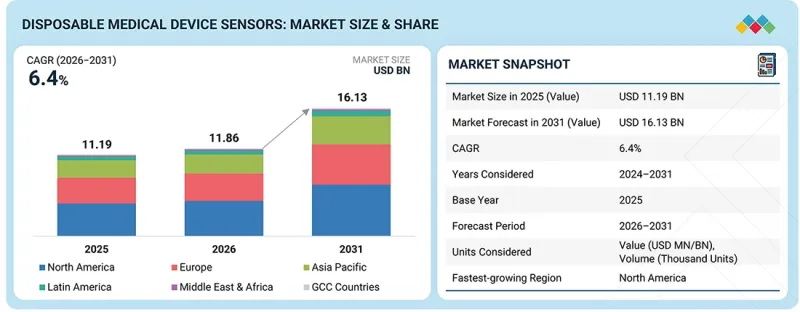
此外,患者和醫療專業人員對疾病早期檢測、遠端患者監護和拋棄式醫療解決方案的認知不斷提高,以及醫療基礎設施和診斷設施的擴建,都對市場成長產生了積極影響。不斷成長的醫療需求、技術的進步以及數位化和分散式醫療解決方案的日益普及,正在推動全球對一次性醫療感測器的需求。
“按類型分類,生物感測器在拋棄式醫療感測器市場中佔據最大的市場佔有率。”
按類型分類,生物感測器在拋棄式醫療感測器市場中佔據最大市場佔有率。這一主導地位歸功於生物感測器在各種診斷和監測應用中的廣泛應用,包括血糖值監測、傳染病檢查、妊娠檢測、藥物和酒精篩檢以及連續血糖監測(CGM)系統。生物感測器在實現生物參數的快速、準確和微創檢測方面發揮著至關重要的作用,使其在臨床和居家醫療中都極具價值。糖尿病、感染疾病和其他慢性疾病的日益普遍進一步加速了對配備生物感測器的一次性醫療設備的需求。此外,生物感測器技術的進步,例如靈敏度的提高、小型化以及與數位健康平台的整合,正在增強其便利性並擴展其應用範圍,使其能夠應用於包括即時診斷和遠端患者監護的廣泛領域。這些因素共同促成了生物感測器在拋棄式醫療感測器市場中的主導地位。
“按類型分類,條形感測器預計將佔據拋棄式醫療感測器市場的最大佔有率。”
按類型分類,試紙感測器預計將佔據拋棄式醫療感測器市場最大的佔有率。這一主導地位源於其在診斷應用中的廣泛使用,尤其是在血糖值監測、傳染病檢查、妊娠檢測和其他快速即時檢測方面。試紙感測器具有許多優勢,包括價格實惠、易於使用、便攜、快速獲取結果以及檢體量少,使其非常適合臨床和居家醫療環境。糖尿病和感染疾病在全球範圍內日益普遍,顯著推動了對血糖監測試紙和診斷試紙的需求成長。此外,自我監測設備、分散式診斷解決方案和居家醫療技術的日益普及,以及感測器精度和性能的不斷提高,預計將進一步促進試紙感測器細分市場的成長,並鞏固其在拋棄式醫療感測器市場中的主導地位。
“在預測期內,美國有望成為北美拋棄式醫療感測器市場中複合年成長率最高的國家。”
在預測期內,美國預計將成為北美拋棄式醫療感測器市場中複合年成長率最高的國家。這一成長主要受以下幾個關鍵因素驅動:糖尿病、心血管疾病和呼吸系統疾病等慢性病盛行率的不斷上升,導致對持續監測和診斷解決方案的需求強勁。美國先進的醫療基礎設施、創新醫療技術的高普及率以及主要醫療設備製造商的強大影響力,進一步推動了市場擴張。此外,穿戴式醫療設備、遠端患者監護系統和即時診斷解決方案的日益普及,也加速了醫院、診所和居家醫療機構對一次性感測器的需求。同時,人們對感染預防意識的提高、一次性醫療設備的優勢以及有利的報銷政策,也促進了美國拋棄式醫療感測器市場的快速發展。這些因素共同作用,使美國成為北美拋棄式醫療感測器市場中規模最大、成長最快的市場。
拋棄式醫療感測器市場的主要參與者包括雅培實驗室(美國)、羅氏製藥有限公司(瑞士)、美敦力(愛爾蘭)和通用電氣醫療技術公司(美國)。
調查範圍:
本報告對拋棄式醫療感測器市場進行了分析,重點在於評估市場規模以及在產品、應用、類型、最終用戶和地區等各個細分市場的未來成長潛力。此外,報告還對市場主要參與者進行了競爭分析,內容涵蓋公司簡介、產品線、近期發展動態和關鍵市場策略。
購買本報告的理由
本報告為拋棄式醫療感測器市場的市場領導和新參與企業提供了寶貴的洞察,並給出了最準確的銷售預測。它幫助相關人員了解競爭格局,更好地定位自身業務,並制定有效的打入市場策略。此外,該報告還指出了關鍵的市場促進因素、限制、挑戰和機遇,幫助相關人員全面了解當前的市場趨勢。
本報告深入分析了以下幾點:
- 本報告深入分析了關鍵促進因素(對醫院感染和污染日益成長的擔憂、目標疾病發病率的增加、對居家醫療設備的需求不斷成長以及拋棄式醫療感測器技術的重大技術進步)、阻礙因素(嚴格的監管要求、產品檢驗和高昂的合規成本,以及對環境問題和一次性醫療廢棄物擴張日益成長的監管壓力)、機遇(新興經濟體遠端患者監護(MRP)和居家醫療的擴展)和挑戰(連網醫療設備在資料外洩方面的脆弱性)。
- 市場滲透率:本報告詳細介紹了全球一次性醫療設備感測器市場主要參與者提供的產品。報告涵蓋產品、類型、應用程式、最終用戶和地區等多個細分市場。
- 產品增強與創新:全面介紹全球拋棄式醫療感測器市場的新產品發布和預期趨勢。
- 市場發展:我們提供按產品、類型、應用、最終用戶和地區分類的盈利成長市場的深入見解和分析。
- 市場多元化:提供全球拋棄式醫療感測器市場的新產品發布、市場擴張、當前發展和投資的全面資訊。
- 競爭分析:對全球一次性醫療設備感測器市場主要競爭對手的市場佔有率、成長策略、產品線和能力進行全面評估。
目錄
第1章:引言
第2章執行摘要
第3章重要考察
第4章 市場概覽
- 市場動態
- 促進因素
- 抑制因子
- 機會
- 任務
- 未滿足的需求和未開發的領域
- 相互關聯的市場與跨產業機遇
- 一級/二級/三級公司的策略性舉措
第5章 產業趨勢
- 波特五力分析
- 宏觀經濟展望
- 價值鏈分析
- 生態系分析
- 供應鏈分析
- 價格分析
- 貿易分析
- 2026年至2027年將舉辦的主要會議和活動
- 影響我們客戶公司業務的趨勢/變化
- 投資和資金籌措場景
- 案例研究分析
- 美國關稅對一次性醫療設備感測器市場的影響
第6章:技術進步、人工智慧的影響、專利、創新與未來應用
- 主要新興技術
- 互補技術
- 鄰近技術
- 技術/產品藍圖
- 專利分析
- 人工智慧/生成式人工智慧對拋棄式醫療感測器市場的影響
- 成功案例和實際應用
第7章:監理情勢與永續性舉措
- 當地法規和合規性
- 監管機構、政府機構和其他組織
- 對永續性的承諾
第8章:顧客趨勢與購買行為
- 決策流程
- 買方相關人員和採購評估標準
- 實施障礙和內部挑戰
- 各個終端用戶產業尚未滿足的需求
第9章:拋棄式醫用感測器市場(依產品分類)
- 生物感測器
- 壓力感測器
- 溫度感測器
- 加速計
- 影像感測器
- 其他
第10章:拋棄式醫用感測器市場(按類型分類)
- 條形感測器
- 穿戴式感測器
- 侵入式感測器
- 可吞嚥感測器
第11章:拋棄式醫用感測器市場(按應用領域分類)
- 診斷測試
- 病患監測
- 治療方法
- 影像
第12章:拋棄式醫用感測器市場(按最終用戶分類)
- 醫院和診所
- 居家護理設施
- 診斷檢查室
- 其他
第13章:拋棄式醫用感測器市場(按地區分類)
- 北美洲
- 北美宏觀經濟展望
- 美國
- 加拿大
- 歐洲
- 歐洲宏觀經濟展望
- 德國
- 法國
- 英國
- 義大利
- 西班牙
- 其他
- 亞太地區
- 亞太地區宏觀經濟展望
- 中國
- 日本
- 印度
- 澳洲
- 韓國
- 其他
- 拉丁美洲
- 拉丁美洲宏觀經濟展望
- 巴西
- 墨西哥
- 其他
- 中東和非洲
- 感染疾病高發是推動市場成長的主要因素。
- 中東和非洲宏觀經濟展望
- 海灣合作理事會國家
- 醫療保健現代化和糖尿病患者數量的增加正在推動市場成長。
- 海灣合作理事會國家宏觀經濟展望
第14章 競爭格局
- 主要參與企業的策略/優勢
- 2021-2025年收入分析
- 市佔率分析(2025 年)
- 企業估值和財務指標
- 企業估值矩陣:主要公司,2025 年
- 公司估值矩陣:新創企業/中小企業(2025 年)
- 主要公司研發支出(一次性醫療設備感測器市場)
- 競爭格局
第15章:公司簡介
- 主要參與企業
- ABBOTT LABORATORIES
- F. HOFFMANN-LA ROCHE LTD.
- MEDTRONIC PLC
- LIFESCAN IP HOLDINGS, LLC
- TEXAS INSTRUMENTS
- TE CONNECTIVITY
- HONEYWELL INTERNATIONAL, INC.
- NXP SEMICONDUCTORS NV
- STMICROELECTRONICS NV
- ANALOG DEVICES, INC.
- ICU MEDICAL, INC.(SMITHS MEDICAL)
- KONINKLIJKE PHILIPS NV
- GE HEALTHCARE
- OMNIVISION
- LIFESIGNALS
- 其他公司
- SENSIRION AG
- AMPHENOL CORPORATION
- NUOVA GMBH
- STARBOARD MEDICAL, INC.
- SHENZHEN MED-LINK ELECTRONICS TECH CO., LTD.
- MEDICAL SENSORS INDIA PVT. LTD.
- GENTAG, INC.
- VITALCONNECT, INC.
- CONMED CORPORATION
- SSI ELECTRONICS
第16章調查方法
第17章附錄
The disposable medical device sensors market is projected to reach USD 16.13 billion by 2031 from USD 11.86 billion in 2026, at a CAGR of 6.4% during the forecast period.
| Scope of the Report | |
|---|---|
| Years Considered for the Study | 2026-2031 |
| Base Year | 2025 |
| Forecast Period | 2026-2031 |
| Units Considered | Value (USD billion) |
| Segments | By product, type, application, end user, and region |
| Regions covered | North America, Europe, APAC, LATAM, MEA |
The disposable medical device sensors market is largely driven by the increasing prevalence of chronic diseases, infectious diseases, and lifestyle-related disorders, which has created a growing demand for accurate, rapid, and continuous monitoring solutions. The rising adoption of patient monitoring systems, point-of-care diagnostics, wearable healthcare devices, and home-based medical care solutions has significantly increased the demand for disposable sensor technologies. Advancements in disposable sensor technologies, including biosensors, wearable sensors, strip sensors, and miniaturized monitoring devices, have improved diagnostic accuracy, reliability, and ease of use. These innovations have enabled broader applications in glucose monitoring, infectious disease testing, cardiac monitoring, respiratory care, and other clinical and home healthcare settings. Furthermore, the growing emphasis on infection prevention, reduced risk of cross-contamination, and the advantages of single-use medical devices have strengthened the adoption of disposable sensors among healthcare providers.
Additionally, increasing awareness among patients and healthcare professionals regarding early disease detection, remote patient monitoring, and personalized healthcare solutions, along with the expansion of healthcare infrastructure and diagnostic facilities, has positively influenced market growth. The combination of rising healthcare needs, technological advancements, and increasing adoption of digital and decentralized healthcare solutions is driving the global demand for disposable medical device sensors.
"By type, biosensors held the largest market share in the disposable medical device sensors market."
By type, biosensors held the largest market share in the disposable medical device sensors market. This dominance can be attributed to the widespread adoption of biosensors across various diagnostic and monitoring applications, including glucose monitoring, infectious disease testing, pregnancy testing, drug and alcohol screening, and continuous glucose monitoring (CGM) systems. Biosensors play a critical role in enabling rapid, accurate, and minimally invasive detection of biological parameters, making them highly valuable in both clinical and home healthcare settings. The increasing prevalence of diabetes, infectious diseases, and other chronic conditions has further accelerated the demand for biosensor-based disposable medical devices. Additionally, advancements in biosensor technologies, including improved sensitivity, miniaturization, and integration with digital health platforms, have enhanced their usability and expanded their applications across point-of-care diagnostics and remote patient monitoring. These factors have contributed to the leading position of the biosensors segment in the disposable medical device sensors market.
"By type, strip sensors are expected to hold the largest share in the disposable medical device sensors market."
By type, strip sensors are expected to hold the largest share in the disposable medical device sensors market. This dominance is attributed to their extensive use in diagnostic applications, particularly glucose monitoring, infectious disease testing, pregnancy testing, and other rapid point-of-care testing procedures. Strip sensors offer several advantages, including affordability, ease of use, portability, quick turnaround time, and minimal sample requirements, making them highly suitable for both clinical and home-based healthcare settings. The increasing global prevalence of diabetes and infectious diseases has significantly contributed to the rising demand for glucose test strips and diagnostic test strips. Additionally, the growing adoption of self-monitoring devices, decentralized diagnostic solutions, and home healthcare technologies, along with continuous advancements in sensor accuracy and performance, is expected to further support the growth and leading position of the strip sensors segment in the disposable medical device sensors market.
"The US is expected to grow at the highest CAGR in the North American disposable medical device sensors market during the forecast period."
The US is expected to grow at the highest CAGR in the North American disposable medical device sensors market during the forecast period. This growth is driven by several key factors, including the increasing prevalence of chronic diseases such as diabetes, cardiovascular disorders, and respiratory conditions, which are creating a strong demand for continuous monitoring and diagnostic solutions. The country's advanced healthcare infrastructure, high adoption of innovative medical technologies, and strong presence of leading medical device manufacturers are further supporting market expansion. Additionally, the growing adoption of wearable medical devices, remote patient monitoring systems, and point-of-care diagnostic solutions is accelerating the demand for disposable sensors across hospitals, clinics, and home healthcare settings. Furthermore, increasing awareness regarding infection prevention, the benefits of single-use medical devices, and favorable reimbursement policies are contributing to the rapid adoption of disposable medical device sensors in the US market. Collectively, these factors position the US as the leading and fastest-growing market for disposable medical device sensors in North America.
A breakdown of the primary participants (on the supply side) for the disposable medical device sensors market referenced in this report is provided below:
- By Company Type: Tier 1 (35%), Tier 2 (40%), and Tier 3 (25%)
- By Designation: C-level Executives (45%), Directors (35%), and Others (20%)
- By Region: North America (27%), Europe (25%), Asia Pacific (30%), Latin America (8%), and the Middle East & Africa (10%)
The prominent players operating in the disposable medical device sensors market are Abbott Laboratories (US), F. Hoffmann-La Roche Ltd (Switzerland), Medtronic (Ireland), and GE HealthCare Technologies Inc. (US).
Research Coverage:
The report provides an analysis of the disposable medical device sensors market, focusing on estimating its size and future growth potential across segments such as product, application, type, end user, and region. Additionally, the report features a competitive analysis of key players in the market, including their company profiles, product offerings, recent developments, and key market strategies.
Reasons to Buy the Report
The report provides valuable insights for both market leaders and new entrants in the disposable medical device sensors market, offering the most accurate revenue estimates. It helps stakeholders understand the competitive landscape, enabling them to better position their businesses and develop effective go-to-market strategies. Additionally, the report highlights key market drivers, restraints, challenges, and opportunities, giving stakeholders a comprehensive understanding of current market trends.
This report provides insights into the following pointers:
- Analysis of key drivers (Rising concerns over hospital-acquired infections and contamination, Increasing incidence of target conditions, Growing demand for home-based medical care devices, Significant Technological Advancements in Disposable Medical Sensor Technologies), restraints (Stringent Regulatory Requirements, Product Validation, and High Compliance Costs, Environmental Concerns and Increasing Regulatory Pressure on Single-Use Medical Waste), opportunities (Expanding Healthcare Infrastructure and Rising Disease Burden in Emerging Economies, Expansion of Remote Patient Monitoring (RPM) and Home Healthcare), and challenges (Vulnerability of connected medical devices in terms of data leakages).
- Market Penetration: It includes extensive information on the products offered by the major players in the global disposable medical device sensors market. The report includes various segments, such as product, type, application, end user, and region.
- Product Enhancement/Innovation: Comprehensive details about new product launches and anticipated trends in the global disposable medical device sensors market.
- Market Development: Thorough knowledge and analysis of the profitable rising markets by product, type, application, end user, and region.
- Market Diversification: Comprehensive information about newly launched products, expanding markets, current advancements, and investments in the global disposable medical device sensors market.
- Competitive Assessment: A comprehensive assessment of market shares, growth strategies, product offerings, and capabilities of key competitors in the global disposable medical device sensors market.
TABLE OF CONTENTS
1 INTRODUCTION
- 1.1 STUDY OBJECTIVES
- 1.2 MARKET DEFINITION
- 1.3 STUDY SCOPE
- 1.3.1 MARKET SEGMENTATION AND REGIONS CONSIDERED
- 1.3.2 INCLUSIONS AND EXCLUSIONS
- 1.3.3 YEARS CONSIDERED
- 1.3.4 CURRENCY CONSIDERED
- 1.4 KEY STAKEHOLDERS
- 1.5 SUMMARY OF CHANGES
2 EXECUTIVE SUMMARY
- 2.1 KEY MARKET PARTICIPANTS: SHARE INSIGHTS AND DEVELOPMENTS
- 2.2 DISRUPTIVE TRENDS SHAPING MARKET
- 2.3 HIGH-GROWTH SEGMENTS & EMERGING FRONTIERS
- 2.4 SNAPSHOT: GLOBAL MARKET SIZE, GROWTH RATE, AND FORECAST
3 PREMIUM INSIGHTS
- 3.1 DISPOSABLE MEDICAL DEVICE SENSORS MARKET OVERVIEW
- 3.2 ASIA PACIFIC: DISPOSABLE MEDICAL DEVICE SENSORS MARKET, BY TYPE AND COUNTRY, (2025)
- 3.3 DISPOSABLE MEDICAL DEVICE SENSORS MARKET: GEOGRAPHIC GROWTH OPPORTUNITIES
- 3.4 DISPOSABLE MEDICAL DEVICE SENSORS MARKET, REGIONAL MIX, 2024-2031
- 3.5 DISPOSABLE MEDICAL DEVICE SENSORS MARKET: EMERGING ECONOMIES VS. DEVELOPED MARKETS
4 MARKET OVERVIEW
- 4.1 INTRODUCTION
- 4.2 MARKET DYNAMICS
- 4.2.1 DRIVERS
- 4.2.1.1 Rising concerns over hospital-acquired infections and contamination
- 4.2.1.2 Increasing incidence of target conditions
- 4.2.1.3 Growing demand for home-based medical care devices
- 4.2.1.4 Advancements in sensor technologies
- 4.2.2 RESTRAINTS
- 4.2.2.1 Stringent regulatory requirements, product validation, and high compliance costs
- 4.2.2.2 Environmental concerns and increasing regulatory pressure on single-use medical waste
- 4.2.3 OPPORTUNITIES
- 4.2.3.1 Expanding healthcare infrastructure and rising disease burden in emerging economies
- 4.2.3.2 Expansion of remote patient monitoring and home healthcare
- 4.2.4 CHALLENGES
- 4.2.4.1 Vulnerability of connected medical devices in terms of data leakages
- 4.2.1 DRIVERS
- 4.3 UNMET NEEDS AND WHITE SPACES
- 4.3.1 UNMET NEEDS
- 4.3.2 WHITE SPACE OPPORTUNITIES
- 4.4 INTERCONNECTED MARKETS AND CROSS-SECTOR OPPORTUNITIES
- 4.4.1 INTERCONNECTED MARKETS
- 4.4.2 CROSS-SECTOR OPPORTUNITIES
- 4.5 STRATEGIC MOVES BY TIER- 1/2/3 PLAYERS
5 INDUSTRY TRENDS
- 5.1 PORTER'S FIVE FORCES ANALYSIS
- 5.1.1 THREAT OF NEW ENTRANTS
- 5.1.2 THREAT OF SUBSTITUTES
- 5.1.3 BARGAINING POWER OF SUPPLIERS
- 5.1.4 BARGAINING POWER OF BUYERS
- 5.1.5 INTENSITY OF COMPETITIVE RIVALRY
- 5.2 MACROECONOMIC OUTLOOK
- 5.2.1 INTRODUCTION
- 5.2.2 GDP TRENDS AND FORECAST
- 5.2.3 TRENDS IN DISPOSABLE MEDICAL DEVICE SENSORS MARKET
- 5.3 VALUE CHAIN ANALYSIS
- 5.4 ECOSYSTEM ANALYSIS
- 5.5 SUPPLY CHAIN ANALYSIS
- 5.6 PRICING ANALYSIS
- 5.6.1 AVERAGE SELLING PRICE, BY PRODUCT, 2023-2025
- 5.6.2 AVERAGE SELLING PRICE, BY REGION, 2023-2025
- 5.6.3 AVERAGE SELLING PRICE, BY KEY PLAYER, 2023-2025
- 5.7 TRADE ANALYSIS
- 5.7.1 IMPORT SCENARIO (HS CODE 901819)
- 5.7.2 EXPORT SCENARIO (HS CODE 901819)
- 5.8 KEY CONFERENCES & EVENTS DURING 2026-2027
- 5.9 TRENDS/DISRUPTIONS IMPACTING CUSTOMERS' BUSINESSES
- 5.10 INVESTMENT & FUNDING SCENARIO
- 5.11 CASE STUDY ANALYSIS
- 5.12 IMPACT OF US TARIFFS-DISPOSABLE MEDICAL DEVICE SENSORS MARKET
- 5.12.1 INTRODUCTION
- 5.12.2 KEY TARIFF RATES
- 5.12.3 PRICE IMPACT ANALYSIS
- 5.12.3.1 US
- 5.12.3.2 Europe
- 5.12.3.3 Asia Pacific
- 5.12.3.4 Impact on end-user industries
6 TECHNOLOGICAL ADVANCEMENTS, AI-DRIVEN IMPACT, PATENTS, INNOVATIONS, AND FUTURE APPLICATIONS
- 6.1 KEY EMERGING TECHNOLOGIES
- 6.1.1 AI-ENABLED WEARABLE BIOSENSORS & INTELLIGENT PATIENT MONITORING
- 6.1.2 FLEXIBLE ELECTRONICS & NEXT-GENERATION PRINTED BIOSENSORS
- 6.2 COMPLEMENTARY TECHNOLOGIES
- 6.2.1 INTERNET OF MEDICAL THINGS (IOMT) & REMOTE PATIENT MONITORING PLATFORMS
- 6.3 ADJACENT TECHNOLOGIES
- 6.3.1 MEMS & ADVANCED SEMICONDUCTOR TECHNOLOGIES
- 6.3.2 CLOUD COMPUTING, ARTIFICIAL INTELLIGENCE, AND DIGITAL HEALTH PLATFORMS
- 6.4 TECHNOLOGY/PRODUCT ROADMAP
- 6.4.1 SHORT-TERM |RECENT TECHNOLOGIES| FOUNDATION & EARLY COMMERCIALIZATION
- 6.4.2 MID-TERM (2027-2030) | EXPANSION & STANDARDIZATION
- 6.4.3 LONG-TERM (2030-2035+) | MASS COMMERCIALIZATION & DISRUPTION
- 6.5 PATENT ANALYSIS
- 6.5.1 PATENT PUBLICATION TRENDS FOR DISPOSABLE MEDICAL SENSORS
- 6.5.2 INSIGHTS: JURISDICTION AND TOP APPLICANT ANALYSIS
- 6.5.3 TOP APPLICANTS & OWNERS (COMPANIES/INSTITUTIONS) FOR DISPOSABLE MEDICAL SENSORS PATENTS (JANUARY 2015-DECEMBER 2025)
- 6.5.4 TOP APPLICANT COUNTRIES/REGIONS PATENTS FOR DISPOSABLE MEDICAL SENSORS (JANUARY 2015-DECEMBER 2025)
- 6.6 IMPACT OF AI/GEN AI ON DISPOSABLE MEDICAL SENSORS MARKET
- 6.6.1 TOP USE CASES AND MARKET POTENTIAL
- 6.6.2 INTERCONNECTED ADJACENT ECOSYSTEMS AND IMPACT ON MARKET PLAYERS
- 6.6.3 CLIENTS' READINESS TO ADOPT GENERATIVE AI IN DISPOSABLE MEDICAL SENSORS MARKET
- 6.7 SUCCESS STORIES AND REAL-WORLD APPLICATIONS
- 6.7.1 ABBOTT: REVOLUTIONIZING CONTINUOUS GLUCOSE MONITORING WITH FREESTYLE LIBRE
- 6.7.2 DEXCOM: AI-ENABLED CONTINUOUS GLUCOSE MONITORING FOR PERSONALIZED DIABETES CARE
- 6.7.3 ICS COOL ENERGY: MASIMO REDUCES CROSS-CONTAMINATION AND IMPROVES INFECTION PREVENTION WITH LNCS SENSORS
7 REGULATORY LANDSCAPE AND SUSTAINABILITY INITIATIVES
- 7.1 REGIONAL REGULATIONS AND COMPLIANCE
- 7.1.1 US
- 7.1.2 EUROPEAN UNION
- 7.1.3 CHINA
- 7.1.4 LATIN AMERICA
- 7.1.5 MIDDLE EAST & AFRICA
- 7.2 REGULATORY BODIES, GOVERNMENT AGENCIES, AND OTHER ORGANIZATIONS
- 7.3 SUSTAINABILITY INITIATIVES
- 7.3.1 ENVIRONMENTAL SUSTAINABILITY IN DISPOSABLE MEDICAL SENSOR SYSTEMS
- 7.3.2 SUSTAINABLE MANUFACTURING & CIRCULAR ECONOMY INITIATIVES
- 7.3.3 DIGITAL HEALTH, REMOTE PATIENT MONITORING & SUSTAINABILITY
- 7.3.4 CERTIFICATIONS, LABELING, AND ECO-STANDARDS
8 CUSTOMER LANDSCAPE & BUYER BEHAVIOR
- 8.1 DECISION-MAKING PROCESS
- 8.2 BUYER STAKEHOLDERS AND BUYING EVALUATION CRITERIA
- 8.2.1 INFLUENCE OF KEY STAKEHOLDERS
- 8.2.2 BUYING CRITERIA
- 8.3 ADOPTION BARRIERS & INTERNAL CHALLENGES
- 8.4 UNMET NEEDS FROM VARIOUS END-USE INDUSTRIES
9 DISPOSABLE MEDICAL DEVICE SENSORS MARKET, BY PRODUCT
- 9.1 INTRODUCTION
- 9.2 BIOSENSORS
- 9.2.1 INCREASING NUMBER OF TARGET DISEASES AND RISING HEALTH AWARENESS TO PROPEL MARKET GROWTH
- 9.3 PRESSURE SENSORS
- 9.3.1 TECHNOLOGICAL ADVANCEMENTS IN PRESSURE SENSORS TO BOOST MARKET GROWTH
- 9.4 TEMPERATURE SENSORS
- 9.4.1 COST-EFFECTIVENESS OF TEMPERATURE SENSORS TO DRIVE DEMAND
- 9.5 ACCELEROMETERS
- 9.5.1 RISING GERIATRIC POPULATION TO SUPPORT MARKET GROWTH
- 9.6 IMAGE SENSORS
- 9.6.1 INNOVATIONS IN IMAGE SENSORS TO BOOST MARKET GROWTH
- 9.7 OTHER SENSORS
10 DISPOSABLE MEDICAL DEVICE SENSORS MARKET, BY TYPE
- 10.1 INTRODUCTION
- 10.2 STRIP SENSORS
- 10.2.1 RISING NUMBER OF DIABETIC PATIENTS TO SUPPORT MARKET GROWTH
- 10.3 WEARABLE SENSORS
- 10.3.1 TECHNOLOGICAL ADVANCEMENTS AND INNOVATIONS IN WEARABLE DEVICES TO BOOST MARKET GROWTH
- 10.4 INVASIVE SENSORS
- 10.4.1 INCREASED PREFERENCE FOR WEARABLE DEVICES MAY NEGATIVELY IMPACT MARKET FOR INVASIVE SENSORS
- 10.5 INGESTIBLE SENSORS
- 10.5.1 TECHNOLOGICAL ADVANCEMENTS IN INGESTIBLE SENSORS TO DRIVE END-USER DEMAND
11 DISPOSABLE MEDICAL DEVICE SENSORS MARKET, BY APPLICATION
- 11.1 INTRODUCTION
- 11.2 DIAGNOSTIC TESTING
- 11.2.1 BLOOD GLUCOSE TEST STRIP SENSORS
- 11.2.1.1 High prevalence of diabetes to drive market growth
- 11.2.2 PREGNANCY TEST STRIP SENSORS
- 11.2.2.1 Increasing demand for testing strips for home use to drive market growth
- 11.2.3 INFECTIOUS DISEASE TEST STRIP SENSORS
- 11.2.3.1 High burden of infectious diseases to propel market growth
- 11.2.4 DRUG & ALCOHOL TEST STRIP SENSORS
- 11.2.4.1 Market growth may be restrained as most tests are not available over the counter
- 11.2.1 BLOOD GLUCOSE TEST STRIP SENSORS
- 11.3 PATIENT MONITORING
- 11.3.1 CARDIAC MONITORS
- 11.3.1.1 Sedentary lifestyles causing an increase in cardiovascular disease prevalence-a key factor driving market growth
- 11.3.2 PULSE OXIMETERS
- 11.3.2.1 Growing need for continuous oxygen monitoring to boost demand for pulse oximeters
- 11.3.3 CONTINUOUS BLOOD PRESSURE MONITORS
- 11.3.3.1 Increasing prevalence of hypertension to drive market growth
- 11.3.4 CGM DEVICES
- 11.3.4.1 Increased preference for home-use devices to drive growth in this market segment
- 11.3.5 SMART PILLS
- 11.3.5.1 Ease of use and reduced expenditure associated with smart pills to drive market growth
- 11.3.6 OTHER PATIENT MONITORING DEVICES
- 11.3.1 CARDIAC MONITORS
- 11.4 THERAPEUTICS
- 11.4.1 DIALYSIS DEVICE SENSORS
- 11.4.1.1 Rising urology disorders to drive market growth
- 11.4.2 CARDIAC CATHETER SENSORS
- 11.4.2.1 High prevalence of cardiac diseases to boost market growth
- 11.4.3 INSULIN PUMP SENSORS
- 11.4.3.1 High cost of insulin pumps can limit market growth
- 11.4.1 DIALYSIS DEVICE SENSORS
- 11.5 IMAGING
- 11.5.1 CAPSULE ENDOSCOPE SENSORS
- 11.5.1.1 Capsule endoscopes are easy to use and cost-effective-key factors driving market growth
- 11.5.2 DISPOSABLE ENDOSCOPE SENSORS
- 11.5.2.1 Growing preference for single-use endoscopes and rising endoscopic procedures to drive market growth
- 11.5.1 CAPSULE ENDOSCOPE SENSORS
12 DISPOSABLE MEDICAL DEVICE SENSORS MARKET, BY END USER
- 12.1 INTRODUCTION
- 12.2 HOSPITALS & CLINICS
- 12.2.1 INCREASING PATIENT MONITORING NEEDS AND INFECTION CONTROL MEASURES SUPPORT THE MARKET GROWTH
- 12.3 HOME CARE SETTINGS
- 12.3.1 RISING ADOPTION OF REMOTE PATIENT MONITORING AND HOME-BASED HEALTHCARE TO BOOST THE MARKET GROWTH
- 12.4 DIAGNOSTIC LABS
- 12.4.1 GROWING DEMAND FOR ACCURATE DIAGNOSTICS AND POCT ACCELERATES ADOPTION
- 12.5 OTHER END USERS
13 DISPOSABLE MEDICAL DEVICE SENSORS MARKET, BY REGION
- 13.1 INTRODUCTION
- 13.2 NORTH AMERICA
- 13.2.1 MACROECONOMIC OUTLOOK FOR NORTH AMERICA
- 13.2.2 US
- 13.2.2.1 Increasing funding and investments in medical sensors to drive market growth
- 13.2.3 CANADA
- 13.2.3.1 High prevalence of HAIs is a major factor driving the demand for disposable medical device sensors in Canada
- 13.3 EUROPE
- 13.3.1 MACROECONOMIC OUTLOOK FOR EUROPE
- 13.3.2 GERMANY
- 13.3.2.1 Increasing demand for safer diagnostic devices to drive market growth in Germany
- 13.3.3 FRANCE
- 13.3.3.1 Growing geriatric population to increase demand for disposable medical device sensors
- 13.3.4 UK
- 13.3.4.1 Rising incidence of target diseases to support market growth
- 13.3.5 ITALY
- 13.3.5.1 Rising age-related disorders to aid market growth in Italy
- 13.3.6 SPAIN
- 13.3.6.1 Aging population and healthcare innovation to support market growth in Spain
- 13.3.7 REST OF EUROPE
- 13.4 ASIA PACIFIC
- 13.4.1 MACROECONOMIC OUTLOOK FOR ASIA PACIFIC
- 13.4.2 CHINA
- 13.4.2.1 Government initiatives to develop innovative healthcare products to propel market growth
- 13.4.3 JAPAN
- 13.4.3.1 High prevalence of HAIs to create demand for disposable medical device sensors
- 13.4.4 INDIA
- 13.4.4.1 High burden of chronic diseases to support market growth
- 13.4.5 AUSTRALIA
- 13.4.5.1 High burden of chronic diseases to support market growth
- 13.4.6 SOUTH KOREA
- 13.4.6.1 High burden of chronic diseases to support market growth
- 13.4.7 REST OF ASIA PACIFIC
- 13.5 LATIN AMERICA
- 13.5.1 MACROECONOMIC OUTLOOK FOR LATIN AMERICA
- 13.5.2 BRAZIL
- 13.5.2.1 Growing healthcare burden and aging population to support market growth
- 13.5.3 MEXICO
- 13.5.3.1 Rising diabetes burden and healthcare demand to support market growth
- 13.5.4 REST OF LATIN AMERICA
- 13.6 MIDDLE EAST & AFRICA
- 13.6.1 HIGH PREVALENCE OF INFECTIOUS DISEASES TO BOOST MARKET GROWTH
- 13.6.2 MACROECONOMIC OUTLOOK FOR MIDDLE EAST & AFRICA
- 13.7 GCC COUNTRIES
- 13.7.1 HEALTHCARE MODERNIZATION AND HIGH DIABETES BURDEN TO DRIVE THE MARKET GROWTH
- 13.7.2 MACROECONOMIC OUTLOOK FOR GCC COUNTRIES
14 COMPETITIVE LANDSCAPE
- 14.1 INTRODUCTION
- 14.2 KEY PLAYER STRATEGIES/RIGHT TO WIN
- 14.2.1 OVERVIEW OF STRATEGIES ADOPTED BY KEY PLAYERS IN DISPOSABLE MEDICAL DEVICE SENSORS MARKET
- 14.3 REVENUE ANALYSIS, 2021-2025
- 14.4 MARKET SHARE ANALYSIS (2025)
- 14.5 COMPANY VALUATION AND FINANCIAL METRICS
- 14.5.1 COMPANY VALUATION
- 14.5.2 FINANCIAL METRICS
- 14.5.3 BRAND/PRODUCT COMPARISON
- 14.6 COMPANY EVALUATION MATRIX: KEY PLAYERS, 2025
- 14.6.1 STARS
- 14.6.2 EMERGING LEADERS
- 14.6.3 PERVASIVE PLAYERS
- 14.6.4 PARTICIPANTS
- 14.6.5 COMPANY FOOTPRINT: KEY PLAYERS, 2025
- 14.6.5.1 Company footprint
- 14.6.5.2 Region footprint
- 14.6.5.3 Type footprint
- 14.6.5.4 Application footprint
- 14.6.5.5 Product footprint
- 14.6.5.6 End-user footprint
- 14.7 COMPANY EVALUATION MATRIX: STARTUPS/SMES (2025)
- 14.7.1 PROGRESSIVE COMPANIES
- 14.7.2 RESPONSIVE COMPANIES
- 14.7.3 DYNAMIC COMPANIES
- 14.7.4 STARTING BLOCKS
- 14.7.5 COMPETITIVE BENCHMARKING: STARTUPS/SMES, 2025
- 14.7.5.1 Detailed list of key startups/SMEs
- 14.7.5.2 Competitive benchmarking of key startups/SMEs
- 14.8 R&D EXPENDITURE OF KEY PLAYERS (DISPOSABLE MEDICAL DEVICE SENSORS MARKET)
- 14.9 COMPETITIVE SCENARIO
- 14.9.1 PRODUCT LAUNCHES & APPROVALS
- 14.9.2 DEALS
- 14.9.3 EXPANSIONS
15 COMPANY PROFILES
- 15.1 INTRODUCTION
- 15.2 KEY PLAYERS
- 15.2.1 ABBOTT LABORATORIES
- 15.2.1.1 Business overview
- 15.2.1.2 Products offered
- 15.2.1.3 Recent developments
- 15.2.1.3.1 Product approvals
- 15.2.1.3.2 Deals
- 15.2.1.3.3 Expansions
- 15.2.1.3.4 Other developments
- 15.2.1.4 MnM view
- 15.2.1.4.1 Right to win
- 15.2.1.4.2 Strategic choices made
- 15.2.1.4.3 Weaknesses and competitive threats
- 15.2.2 F. HOFFMANN-LA ROCHE LTD.
- 15.2.2.1 Business overview
- 15.2.2.2 Products offered
- 15.2.2.3 Recent developments
- 15.2.2.3.1 Product launches & approvals
- 15.2.2.3.2 Deals
- 15.2.2.3.3 Expansions
- 15.2.2.4 MnM view
- 15.2.2.4.1 Right to win
- 15.2.2.4.2 Strategic choices made
- 15.2.2.4.3 Weaknesses and competitive threats
- 15.2.3 MEDTRONIC PLC
- 15.2.3.1 Business Overview
- 15.2.3.2 Products offered
- 15.2.3.3 Recent developments
- 15.2.3.3.1 Product launches & approvals
- 15.2.3.3.2 Deals
- 15.2.3.3.3 Expansions
- 15.2.3.4 MnM view
- 15.2.3.4.1 Right to win
- 15.2.3.4.2 Strategic choices made
- 15.2.3.4.3 Weaknesses and competitive threats
- 15.2.4 LIFESCAN IP HOLDINGS, LLC
- 15.2.4.1 Business overview
- 15.2.4.2 Products offered
- 15.2.4.3 Recent developments
- 15.2.4.3.1 Deals
- 15.2.4.4 MnM view
- 15.2.4.4.1 Right to win
- 15.2.4.4.2 Strategic choices made
- 15.2.4.4.3 Weaknesses and competitive threats
- 15.2.5 TEXAS INSTRUMENTS
- 15.2.5.1 Business overview
- 15.2.5.2 Products offered
- 15.2.5.3 Recent developments
- 15.2.5.3.1 Expansions
- 15.2.5.4 MnM view
- 15.2.5.4.1 Right to win
- 15.2.5.4.2 Strategic choices made
- 15.2.5.4.3 Weaknesses and competitive threats
- 15.2.6 TE CONNECTIVITY
- 15.2.6.1 Business overview
- 15.2.6.2 Products offered
- 15.2.6.3 Recent developments
- 15.2.6.3.1 Product launches
- 15.2.6.3.2 Deals
- 15.2.6.3.3 Expansions
- 15.2.7 HONEYWELL INTERNATIONAL, INC.
- 15.2.7.1 Business overview
- 15.2.7.2 Products offered
- 15.2.7.3 Recent developments
- 15.2.7.3.1 Product launches
- 15.2.7.3.2 Deals
- 15.2.8 NXP SEMICONDUCTORS N.V.
- 15.2.8.1 Business overview
- 15.2.8.2 Products offered
- 15.2.9 STMICROELECTRONICS N.V.
- 15.2.9.1 Business overview
- 15.2.9.2 Products offered
- 15.2.9.3 Recent developments
- 15.2.9.3.1 Product launches
- 15.2.9.3.2 Deals
- 15.2.10 ANALOG DEVICES, INC.
- 15.2.10.1 Business overview
- 15.2.10.2 Products offered
- 15.2.11 ICU MEDICAL, INC. (SMITHS MEDICAL)
- 15.2.11.1 Business overview
- 15.2.11.2 Products offered
- 15.2.11.3 Recent developments
- 15.2.11.3.1 Deals
- 15.2.12 KONINKLIJKE PHILIPS N.V.
- 15.2.12.1 Business overview
- 15.2.12.2 Products offered
- 15.2.12.3 Recent developments
- 15.2.12.3.1 Deals
- 15.2.12.3.2 Expansions
- 15.2.13 GE HEALTHCARE
- 15.2.13.1 Business overview
- 15.2.13.2 Products offered
- 15.2.14 OMNIVISION
- 15.2.14.1 Business overview
- 15.2.14.2 Products offered
- 15.2.14.3 Recent developments
- 15.2.14.3.1 Product launches
- 15.2.15 LIFESIGNALS
- 15.2.15.1 Business overview
- 15.2.15.2 Products offered
- 15.2.15.3 Recent developments
- 15.2.15.3.1 Product approvals
- 15.2.1 ABBOTT LABORATORIES
- 15.3 OTHER PLAYERS
- 15.3.1 SENSIRION AG
- 15.3.2 AMPHENOL CORPORATION
- 15.3.3 NUOVA GMBH
- 15.3.4 STARBOARD MEDICAL, INC.
- 15.3.5 SHENZHEN MED-LINK ELECTRONICS TECH CO., LTD.
- 15.3.6 MEDICAL SENSORS INDIA PVT. LTD.
- 15.3.7 GENTAG, INC.
- 15.3.8 VITALCONNECT, INC.
- 15.3.9 CONMED CORPORATION
- 15.3.10 SSI ELECTRONICS
16 RESEARCH METHODOLOGY
- 16.1 RESEARCH DATA
- 16.1.1 SECONDARY DATA
- 16.1.1.1 Key data from secondary sources
- 16.1.2 PRIMARY DATA
- 16.1.2.1 Key data from primary sources
- 16.1.2.2 Key industry insights
- 16.1.1 SECONDARY DATA
- 16.2 MARKET SIZE ESTIMATION
- 16.3 MARKET BREAKDOWN AND DATA TRIANGULATION
- 16.4 MARKET SHARE ESTIMATION
- 16.5 RESEARCH ASSUMPTIONS
- 16.6 RESEARCH LIMITATIONS
- 16.6.1 SCOPE-RELATED LIMITATIONS
- 16.6.2 METHODOLOGY-RELATED LIMITATIONS
- 16.7 RISK ASSESSMENT
17 APPENDIX
- 17.1 DISCUSSION GUIDE
- 17.2 KNOWLEDGESTORE: MARKETSANDMARKETS' SUBSCRIPTION PORTAL
- 17.3 CUSTOMIZATION OPTIONS
- 17.4 RELATED REPORTS
- 17.5 AUTHOR DETAILS
List of Tables
- TABLE 1 STANDARD CURRENCY CONVERSION RATES, 2018-2022
- TABLE 2 DISPOSABLE MEDICAL DEVICE SENSORS MARKET: UNMET NEEDS
- TABLE 3 STRATEGIC MOVES BY PLAYERS IN DISPOSABLE MEDICAL DEVICE SENSORS MARKET
- TABLE 4 PORTER'S FIVE FORCES ANALYSIS: DISPOSABLE MEDICAL DEVICE SENSORS MARKET
- TABLE 5 GDP PERCENTAGE CHANGE, BY KEY COUNTRIES, 2021-2030
- TABLE 6 DISPOSABLE MEDICAL DEVICE SENSORS MARKET: ROLE IN ECOSYSTEM
- TABLE 7 AVERAGE SELLING PRICE OF DISPOSABLE MEDICAL DEVICE SENSOR EQUIPMENT AND SYSTEMS, BY PRODUCT, 2023-2025 (USD)
- TABLE 8 AVERAGE SELLING PRICE OF DISPOSABLE MEDICAL DEVICE SENSOR EQUIPMENT AND SYSTEMS, BY REGION, 2023-2025 (USD)
- TABLE 9 AVERAGE SELLING PRICE OF DISPOSABLE MEDICAL DEVICE SENSOR EQUIPMENT AND SYSTEMS, BY KEY PLAYER, 2023-2025 (USD)
- TABLE 10 IMPORT DATA FOR DISPOSABLE MEDICAL DEVICE SENSORS (HS CODE 901819), BY COUNTRY, 2021-2024 (USD THOUSAND)
- TABLE 11 EXPORT DATA FOR DISPOSABLE MEDICAL DEVICE SENSORS (HS CODE 901819), BY COUNTRY, 2021-2024 (USD THOUSAND)
- TABLE 12 DISPOSABLE MEDICAL DEVICE SENSORS MARKET: KEY CONFERENCES & EVENTS (2026-2027)
- TABLE 13 CASE STUDY 1: ABBOTT'S FREESTYLE LIBRE ENABLES IMPROVED GLUCOSE MANAGEMENT THROUGH CONTINUOUS GLUCOSE MONITORING
- TABLE 14 CASE STUDY 2: MASIMO DISPOSABLE PULSE OXIMETRY SENSORS IMPROVE PATIENT MONITORING IN CRITICAL CARE
- TABLE 15 CASE STUDY 3: DEXCOM G7 ENHANCES REMOTE DIABETES MANAGEMENT THROUGH NEXT-GENERATION DISPOSABLE CONTINUOUS GLUCOSE MONITORING
- TABLE 16 US ADJUSTED RECIPROCAL TARIFF RATES
- TABLE 17 KEY PRODUCT-RELATED TARIFFS EFFECTIVE FOR DISPOSABLE MEDICAL DEVICE SENSORS PRODUCTS
- TABLE 18 LIST OF PATENTS IN DISPOSABLE MEDICAL SENSORS MARKET (2022-2025)
- TABLE 19 TOP USE CASES AND MARKET POTENTIAL
- TABLE 20 INTERCONNECTED ADJACENT ECOSYSTEMS AND IMPACT ON MARKET PLAYERS
- TABLE 21 NORTH AMERICA: REGULATORY BODIES, GOVERNMENT AGENCIES, AND OTHER ORGANIZATIONS
- TABLE 22 EUROPE: LIST OF REGULATORY BODIES, GOVERNMENT AGENCIES, AND OTHER ORGANIZATIONS
- TABLE 23 ASIA PACIFIC: LIST OF REGULATORY BODIES, GOVERNMENT AGENCIES, AND OTHER ORGANIZATIONS
- TABLE 24 LATIN AMERICA: REGULATORY BODIES, GOVERNMENT AGENCIES, AND OTHER ORGANIZATIONS
- TABLE 25 MIDDLE EAST & AFRICA: REGULATORY BODIES, GOVERNMENT AGENCIES, AND OTHER ORGANIZATIONS
- TABLE 26 INFLUENCE OF STAKEHOLDERS ON BUYING PROCESS FOR DISPOSABLE MEDICAL SENSORS
- TABLE 27 KEY BUYING CRITERIA FOR TOP TWO END USERS
- TABLE 28 DISPOSABLE MEDICAL DEVICE SENSORS MARKET: UNMET NEEDS/ END-USER EXPECTATIONS
- TABLE 29 DISPOSABLE MEDICAL DEVICE SENSORS MARKET, BY PRODUCT, 2024-2031 (USD MILLION)
- TABLE 30 BIOSENSORS MARKET, BY COUNTRY, 2024-2031 (USD MILLION)
- TABLE 31 BIOSENSORS MARKET, BY REGION, 2024-2031 (THOUSAND UNITS)
- TABLE 32 PRESSURE SENSORS MARKET, BY COUNTRY, 2024-2031 (USD MILLION)
- TABLE 33 PRESSURE SENSORS MARKET, BY REGION, 2024-2031 (THOUSAND UNITS)
- TABLE 34 TEMPERATURE SENSORS MARKET, BY COUNTRY, 2024-2031 (USD MILLION)
- TABLE 35 TEMPERATURE SENSORS MARKET, BY REGION, 2024-2031 (THOUSAND UNITS)
- TABLE 36 ACCELEROMETERS MARKET, BY COUNTRY, 2024-2031 (USD MILLION)
- TABLE 37 ACCELEROMETERS MARKET, BY REGION, 2024-2031 (THOUSAND UNITS)
- TABLE 38 IMAGE SENSORS MARKET, BY COUNTRY, 2024-2031 (USD MILLION)
- TABLE 39 IMAGE SENSORS MARKET, BY REGION, 2024-2031 (THOUSAND UNITS)
- TABLE 40 OTHER DISPOSABLE SENSORS MARKET, BY COUNTRY, 2024-2031 (USD MILLION)
- TABLE 41 DISPOSABLE MEDICAL DEVICE SENSORS MARKET, BY TYPE, 2024-2031 (USD MILLION)
- TABLE 42 STRIP SENSORS MARKET, BY COUNTRY, 2024-2031 (USD MILLION)
- TABLE 43 WEARABLE SENSORS MARKET, BY COUNTRY, 2024-2031 (USD MILLION)
- TABLE 44 INVASIVE SENSORS MARKET, BY COUNTRY, 2024-2031 (USD MILLION)
- TABLE 45 INGESTIBLE SENSORS MARKET, BY COUNTRY, 2024-2031(USD MILLION)
- TABLE 46 DISPOSABLE MEDICAL DEVICE SENSORS MARKET, BY APPLICATION, 2024-2031 (USD MILLION)
- TABLE 47 DISPOSABLE MEDICAL DEVICE SENSORS MARKET FOR DIAGNOSTIC TESTING, BY DEVICE TYPE, 2024-2031 (USD MILLION)
- TABLE 48 DISPOSABLE MEDICAL DEVICE SENSORS MARKET FOR DIAGNOSTIC TESTING, BY COUNTRY, 2024-2031 (USD MILLION)
- TABLE 49 BLOOD GLUCOSE TEST STRIP SENSORS MARKET, BY COUNTRY, 2024-2031 (USD MILLION)
- TABLE 50 PREGNANCY TEST STRIP SENSORS MARKET, BY COUNTRY, 2024-2031 (USD MILLION)
- TABLE 51 INFECTIOUS DISEASE TEST STRIP SENSORS MARKET, BY COUNTRY, 2024-2031 (USD MILLION)
- TABLE 52 DRUG & ALCOHOL TEST STRIP SENSORS MARKET, BY COUNTRY, 2024-2031 (USD MILLION)
- TABLE 53 DISPOSABLE MEDICAL DEVICE SENSORS MARKET FOR PATIENT MONITORING, BY DEVICE TYPE, 2024-2031 (USD MILLION)
- TABLE 54 DISPOSABLE MEDICAL DEVICE SENSORS MARKET FOR PATIENT MONITORING, BY COUNTRY, 2024-2031 (USD MILLION)
- TABLE 55 CARDIAC MONITORS MARKET, BY COUNTRY, 2024-2031 (USD MILLION)
- TABLE 56 PULSE OXIMETERS MARKET, BY COUNTRY, 2024-2031 (USD MILLION)
- TABLE 57 CONTINUOUS BLOOD PRESSURE MONITORS MARKET, BY COUNTRY, 2024-2031 (USD MILLION)
- TABLE 58 CGM DEVICES MARKET, BY COUNTRY, 2024-2031 (USD MILLION)
- TABLE 59 SMART PILLS MARKET, BY COUNTRY, 2024-2031 (USD MILLION)
- TABLE 60 OTHER PATIENT MONITORING DEVICES MARKET, BY COUNTRY, 2024-2031 (USD MILLION)
- TABLE 61 DISPOSABLE MEDICAL DEVICE SENSORS MARKET FOR THERAPEUTICS, BY DEVICE TYPE, 2024-2031 (USD MILLION)
- TABLE 62 DISPOSABLE MEDICAL DEVICE SENSORS MARKET FOR THERAPEUTICS, BY COUNTRY, 2024-2031 (USD MILLION)
- TABLE 63 DIALYSIS DEVICE SENSORS MARKET, BY COUNTRY, 2024-2031 (USD MILLION)
- TABLE 64 CARDIAC CATHETER SENSORS MARKET, BY COUNTRY, 2024-2031 (USD MILLION)
- TABLE 65 INSULIN PUMP SENSORS MARKET, BY COUNTRY, 2024-2031 (USD MILLION)
- TABLE 66 DISPOSABLE MEDICAL DEVICE SENSORS MARKET FOR IMAGING, BY DEVICE TYPE, 2024-2031 (USD MILLION)
- TABLE 67 DISPOSABLE MEDICAL DEVICE SENSORS MARKET FOR IMAGING, BY COUNTRY, 2024-2031 (USD MILLION)
- TABLE 68 CAPSULE ENDOSCOPE SENSORS MARKET, BY COUNTRY, 2024-2031 (USD MILLION)
- TABLE 69 DISPOSABLE ENDOSCOPE SENSORS MARKET, BY COUNTRY, 2024-2031 (USD MILLION)
- TABLE 70 DISPOSABLE MEDICAL DEVICE SENSORS MARKET, BY END USER, 2024-2031 (USD MILLION)
- TABLE 71 DISPOSABLE MEDICAL DEVICE SENSORS MARKET FOR HOSPITALS & CLINICS, BY COUNTRY, 2024-2031 (USD MILLION)
- TABLE 72 DISPOSABLE MEDICAL DEVICE SENSORS MARKET FOR HOME CARE SETTINGS, BY COUNTRY, 2024-2031 (USD MILLION)
- TABLE 73 DISPOSABLE MEDICAL DEVICE SENSORS MARKET FOR DIAGNOSTIC LABS, BY COUNTRY, 2024-2031 (USD MILLION)
- TABLE 74 DISPOSABLE MEDICAL DEVICE SENSORS MARKET FOR OTHER END USERS, BY COUNTRY, 2024-2031 (USD MILLION)
- TABLE 75 DISPOSABLE MEDICAL DEVICE SENSORS MARKET, BY REGION, 2024-2031 (USD MILLION)
- TABLE 76 NORTH AMERICA: DISPOSABLE MEDICAL DEVICE SENSORS MARKET, BY COUNTRY, 2024-2031 (USD MILLION)
- TABLE 77 NORTH AMERICA: DISPOSABLE MEDICAL DEVICE SENSORS MARKET, BY PRODUCT, 2024-2031 (USD MILLION)
- TABLE 78 NORTH AMERICA: DISPOSABLE MEDICAL DEVICE SENSORS MARKET, BY TYPE, 2024-2031 (USD MILLION)
- TABLE 79 NORTH AMERICA: DISPOSABLE MEDICAL DEVICE SENSORS MARKET, BY APPLICATION, 2024-2031 (USD MILLION)
- TABLE 80 NORTH AMERICA: DISPOSABLE MEDICAL DEVICE SENSORS MARKET FOR DIAGNOSTIC TESTING, BY DEVICE TYPE, 2024-2031 (USD MILLION)
- TABLE 81 NORTH AMERICA: DISPOSABLE MEDICAL DEVICE SENSORS MARKET FOR THERAPEUTICS, BY DEVICE TYPE, 2024-2031 (USD MILLION)
- TABLE 82 NORTH AMERICA: DISPOSABLE MEDICAL DEVICE SENSORS MARKET FOR PATIENT MONITORING, BY DEVICE TYPE, 2024-2031 (USD MILLION)
- TABLE 83 NORTH AMERICA: DISPOSABLE MEDICAL DEVICE SENSORS MARKET FOR IMAGING, BY DEVICE TYPE, 2024-2031 (USD MILLION)
- TABLE 84 NORTH AMERICA: DISPOSABLE MEDICAL DEVICE SENSORS, BY END USER, 2024-2031 (USD MILLION)
- TABLE 85 US: DISPOSABLE MEDICAL DEVICE SENSORS MARKET, BY PRODUCT, 2024-2031 (USD MILLION)
- TABLE 86 US: DISPOSABLE MEDICAL DEVICE SENSORS MARKET, BY TYPE, 2024-2031 (USD MILLION)
- TABLE 87 US: DISPOSABLE MEDICAL DEVICE SENSORS MARKET, BY APPLICATION, 2024-2031 (USD MILLION)
- TABLE 88 US: DISPOSABLE MEDICAL DEVICE SENSORS MARKET FOR DIAGNOSTIC TESTING, BY DEVICE TYPE, 2024-2031 (USD MILLION)
- TABLE 89 US: DISPOSABLE MEDICAL DEVICE SENSORS MARKET FOR THERAPEUTICS, BY DEVICE TYPE, 2024-2031 (USD MILLION)
- TABLE 90 US: DISPOSABLE MEDICAL DEVICE SENSORS MARKET FOR PATIENT MONITORING, BY DEVICE TYPE, 2024-2031 (USD MILLION)
- TABLE 91 US: DISPOSABLE MEDICAL DEVICE SENSORS MARKET FOR IMAGING, BY DEVICE TYPE, 2024-2031 (USD MILLION)
- TABLE 92 US: DISPOSABLE MEDICAL DEVICE SENSORS, BY END USER, 2024-2031 (USD MILLION)
- TABLE 93 CANADA: DISPOSABLE MEDICAL DEVICE SENSORS MARKET, BY PRODUCT, 2024-2031 (USD MILLION)
- TABLE 94 CANADA: DISPOSABLE MEDICAL DEVICE SENSORS MARKET, BY TYPE, 2024-2031 (USD MILLION)
- TABLE 95 CANADA: DISPOSABLE MEDICAL DEVICE SENSORS MARKET, BY APPLICATION, 2024-2031 (USD MILLION)
- TABLE 96 CANADA: DISPOSABLE MEDICAL DEVICE SENSORS MARKET FOR DIAGNOSTIC TESTING, BY DEVICE TYPE, 2024-2031 (USD MILLION)
- TABLE 97 CANADA: DISPOSABLE MEDICAL DEVICE SENSORS MARKET FOR THERAPEUTICS, BY DEVICE TYPE, 2024-2031 (USD MILLION)
- TABLE 98 CANADA: DISPOSABLE MEDICAL DEVICE SENSORS MARKET FOR PATIENT MONITORING, BY DEVICE TYPE, 2024-2031 (USD MILLION)
- TABLE 99 CANADA: DISPOSABLE MEDICAL DEVICE SENSORS MARKET FOR IMAGING, BY DEVICE TYPE, 2024-2031 (USD MILLION)
- TABLE 100 CANADA: DISPOSABLE MEDICAL DEVICE SENSORS, BY END USER, 2024-2031 (USD MILLION)
- TABLE 101 EUROPE: DISPOSABLE MEDICAL DEVICE SENSORS MARKET, BY COUNTRY, 2024-2031 (USD MILLION)
- TABLE 102 EUROPE: DISPOSABLE MEDICAL DEVICE SENSORS MARKET, BY PRODUCT, 2024-2031 (USD MILLION)
- TABLE 103 EUROPE: DISPOSABLE MEDICAL DEVICE SENSORS MARKET, BY TYPE, 2024-2031 (USD MILLION)
- TABLE 104 EUROPE: DISPOSABLE MEDICAL DEVICE SENSORS MARKET, BY APPLICATION, 2024-2031 (USD MILLION)
- TABLE 105 EUROPE: DISPOSABLE MEDICAL DEVICE SENSORS MARKET FOR DIAGNOSTIC TESTING, BY DEVICE TYPE, 2024-2031 (USD MILLION)
- TABLE 106 EUROPE: DISPOSABLE MEDICAL DEVICE SENSORS MARKET FOR THERAPEUTICS, BY DEVICE TYPE, 2024-2031 (USD MILLION)
- TABLE 107 EUROPE: DISPOSABLE MEDICAL DEVICE SENSORS MARKET FOR PATIENT MONITORING, BY DEVICE TYPE, 2024-2031 (USD MILLION)
- TABLE 108 EUROPE: DISPOSABLE MEDICAL DEVICE SENSORS MARKET FOR IMAGING, BY DEVICE TYPE, 2024-2031 (USD MILLION)
- TABLE 109 EUROPE: DISPOSABLE MEDICAL DEVICE SENSORS MARKET, BY END USER, 2024-2031 (USD MILLION)
- TABLE 110 GERMANY: DISPOSABLE MEDICAL DEVICE SENSORS MARKET, BY PRODUCT, 2024-2031 (USD MILLION)
- TABLE 111 GERMANY: DISPOSABLE MEDICAL DEVICE SENSORS MARKET, BY TYPE, 2024-2031 (USD MILLION)
- TABLE 112 GERMANY: DISPOSABLE MEDICAL DEVICE SENSORS MARKET, BY APPLICATION, 2024-2031 (USD MILLION)
- TABLE 113 GERMANY: DISPOSABLE MEDICAL DEVICE SENSORS MARKET FOR DIAGNOSTIC TESTING, BY DEVICE TYPE, 2024-2031 (USD MILLION)
- TABLE 114 GERMANY: DISPOSABLE MEDICAL DEVICE SENSORS MARKET FOR THERAPEUTICS, BY DEVICE TYPE, 2024-2031 (USD MILLION)
- TABLE 115 GERMANY: DISPOSABLE MEDICAL DEVICE SENSORS MARKET FOR PATIENT MONITORING, BY DEVICE TYPE, 2024-2031 (USD MILLION)
- TABLE 116 GERMANY: DISPOSABLE MEDICAL DEVICE SENSORS MARKET FOR IMAGING, BY DEVICE TYPE, 2024-2031 (USD MILLION)
- TABLE 117 GERMANY: DISPOSABLE MEDICAL DEVICE SENSORS MARKET, BY END USER, 2024-2031 (USD MILLION)
- TABLE 118 FRANCE: DISPOSABLE MEDICAL DEVICE SENSORS MARKET, BY PRODUCT, 2024-2031 (USD MILLION)
- TABLE 119 FRANCE: DISPOSABLE MEDICAL DEVICE SENSORS MARKET, BY TYPE, 2024-2031 (USD MILLION)
- TABLE 120 FRANCE: DISPOSABLE MEDICAL DEVICE SENSORS MARKET, BY APPLICATION, 2024-2031 (USD MILLION)
- TABLE 121 FRANCE: DISPOSABLE MEDICAL DEVICE SENSORS MARKET FOR DIAGNOSTIC TESTING, BY DEVICE TYPE, 2024-2031 (USD MILLION)
- TABLE 122 FRANCE: DISPOSABLE MEDICAL DEVICE SENSORS MARKET FOR THERAPEUTICS, BY DEVICE TYPE, 2024-2031 (USD MILLION)
- TABLE 123 FRANCE: DISPOSABLE MEDICAL DEVICE SENSORS MARKET FOR PATIENT MONITORING, BY DEVICE TYPE, 2024-2031 (USD MILLION)
- TABLE 124 FRANCE: DISPOSABLE MEDICAL DEVICE SENSORS MARKET FOR IMAGING, BY DEVICE TYPE, 2024-2031 (USD MILLION)
- TABLE 125 FRANCE: DISPOSABLE MEDICAL DEVICE SENSORS MARKET, BY END USER, 2024-2031 (USD MILLION)
- TABLE 126 UK: DISPOSABLE MEDICAL DEVICE SENSORS MARKET, BY PRODUCT, 2024-2031 (USD MILLION)
- TABLE 127 UK: DISPOSABLE MEDICAL DEVICE SENSORS MARKET, BY TYPE, 2024-2031 (USD MILLION)
- TABLE 128 UK: DISPOSABLE MEDICAL DEVICE SENSORS MARKET, BY APPLICATION, 2024-2031 (USD MILLION)
- TABLE 129 UK: DISPOSABLE MEDICAL DEVICE SENSORS MARKET FOR DIAGNOSTIC TESTING, BY DEVICE TYPE, 2024-2031 (USD MILLION)
- TABLE 130 UK: DISPOSABLE MEDICAL DEVICE SENSORS MARKET FOR THERAPEUTICS, BY DEVICE TYPE, 2024-2031 (USD MILLION)
- TABLE 131 UK: DISPOSABLE MEDICAL DEVICE SENSORS MARKET FOR PATIENT MONITORING, BY DEVICE TYPE, 2024-2031 (USD MILLION)
- TABLE 132 UK: DISPOSABLE MEDICAL DEVICE SENSORS MARKET FOR IMAGING, BY DEVICE TYPE, 2024-2031 (USD MILLION)
- TABLE 133 UK: DISPOSABLE MEDICAL DEVICE SENSORS MARKET, BY END USER, 2024-2031 (USD MILLION)
- TABLE 134 ITALY: DISPOSABLE MEDICAL DEVICE SENSORS MARKET, BY PRODUCT, 2024-2031 (USD MILLION)
- TABLE 135 ITALY: DISPOSABLE MEDICAL DEVICE SENSORS MARKET, BY TYPE, 2024-2031 (USD MILLION)
- TABLE 136 ITALY: DISPOSABLE MEDICAL DEVICE SENSORS MARKET, BY APPLICATION, 2024-2031 (USD MILLION)
- TABLE 137 ITALY: DISPOSABLE MEDICAL DEVICE SENSORS MARKET FOR DIAGNOSTIC TESTING, BY DEVICE TYPE, 2024-2031 (USD MILLION)
- TABLE 138 ITALY: DISPOSABLE MEDICAL DEVICE SENSORS MARKET FOR THERAPEUTICS, BY DEVICE TYPE, 2024-2031 (USD MILLION)
- TABLE 139 ITALY: DISPOSABLE MEDICAL DEVICE SENSORS MARKET FOR PATIENT MONITORING, BY DEVICE TYPE, 2024-2031 (USD MILLION)
- TABLE 140 ITALY: DISPOSABLE MEDICAL DEVICE SENSORS MARKET FOR IMAGING, BY DEVICE TYPE, 2024-2031 (USD MILLION)
- TABLE 141 ITALY: DISPOSABLE MEDICAL DEVICE SENSORS MARKET, BY END USER, 2024-2031 (USD MILLION)
- TABLE 142 SPAIN: DISPOSABLE MEDICAL DEVICE SENSORS MARKET, BY PRODUCT, 2024-2031 (USD MILLION)
- TABLE 143 SPAIN: DISPOSABLE MEDICAL DEVICE SENSORS MARKET, BY TYPE, 2024-2031 (USD MILLION)
- TABLE 144 SPAIN: DISPOSABLE MEDICAL DEVICE SENSORS MARKET, BY APPLICATION, 2024-2031 (USD MILLION)
- TABLE 145 SPAIN: DISPOSABLE MEDICAL DEVICE SENSORS MARKET FOR DIAGNOSTIC TESTING, BY DEVICE TYPE, 2024-2031 (USD MILLION)
- TABLE 146 SPAIN: DISPOSABLE MEDICAL DEVICE SENSORS MARKET FOR THERAPEUTICS, BY DEVICE TYPE, 2024-2031 (USD MILLION)
- TABLE 147 SPAIN: DISPOSABLE MEDICAL DEVICE SENSORS MARKET FOR PATIENT MONITORING, BY DEVICE TYPE, 2024-2031 (USD MILLION)
- TABLE 148 SPAIN: DISPOSABLE MEDICAL DEVICE SENSORS MARKET FOR IMAGING, BY DEVICE TYPE, 2024-2031 (USD MILLION)
- TABLE 149 SPAIN: DISPOSABLE MEDICAL DEVICE SENSORS MARKET, BY END USER, 2024-2031 (USD MILLION)
- TABLE 150 REST OF EUROPE: DISPOSABLE MEDICAL DEVICE SENSORS MARKET, BY PRODUCT, 2024-2031 (USD MILLION)
- TABLE 151 REST OF EUROPE: DISPOSABLE MEDICAL DEVICE SENSORS MARKET, BY TYPE, 2024-2031 (USD MILLION)
- TABLE 152 REST OF EUROPE: DISPOSABLE MEDICAL DEVICE SENSORS MARKET, BY APPLICATION, 2024-2031 (USD MILLION)
- TABLE 153 REST OF EUROPE: DISPOSABLE MEDICAL DEVICE SENSORS MARKET FOR DIAGNOSTIC TESTING, BY DEVICE TYPE, 2024-2031 (USD MILLION)
- TABLE 154 REST OF EUROPE: DISPOSABLE MEDICAL DEVICE SENSORS MARKET FOR THERAPEUTICS, BY DEVICE TYPE, 2024-2031 (USD MILLION)
- TABLE 155 REST OF EUROPE: DISPOSABLE MEDICAL DEVICE SENSORS MARKET FOR PATIENT MONITORING, BY DEVICE TYPE, 2024-2031 (USD MILLION)
- TABLE 156 REST OF EUROPE: DISPOSABLE MEDICAL DEVICE SENSORS MARKET FOR IMAGING, BY DEVICE TYPE, 2024-2031 (USD MILLION)
- TABLE 157 REST OF EUROPE: DISPOSABLE MEDICAL DEVICE SENSORS MARKET, BY END USER, 2024-2031 (USD MILLION)
- TABLE 158 ASIA PACIFIC: DISPOSABLE MEDICAL DEVICE SENSORS MARKET, BY COUNTRY, 2024-2031 (USD MILLION)
- TABLE 159 ASIA PACIFIC: DISPOSABLE MEDICAL DEVICE SENSORS MARKET, BY PRODUCT, 2024-2031 (USD MILLION)
- TABLE 160 ASIA PACIFIC: DISPOSABLE MEDICAL DEVICE SENSORS MARKET, BY TYPE, 2024-2031 (USD MILLION)
- TABLE 161 ASIA PACIFIC: DISPOSABLE MEDICAL DEVICE SENSORS MARKET, BY APPLICATION, 2024-2031 (USD MILLION)
- TABLE 162 ASIA PACIFIC: DISPOSABLE MEDICAL DEVICE SENSORS MARKET FOR DIAGNOSTIC TESTING, BY DEVICE TYPE, 2024-2031 (USD MILLION)
- TABLE 163 ASIA PACIFIC: DISPOSABLE MEDICAL DEVICE SENSORS MARKET FOR THERAPEUTICS, BY DEVICE TYPE, 2024-2031 (USD MILLION)
- TABLE 164 ASIA PACIFIC: DISPOSABLE MEDICAL DEVICE SENSORS MARKET FOR PATIENT MONITORING, BY DEVICE TYPE, 2024-2031 (USD MILLION)
- TABLE 165 ASIA PACIFIC: DISPOSABLE MEDICAL DEVICE SENSORS MARKET FOR IMAGING, BY DEVICE TYPE, 2024-2031 (USD MILLION)
- TABLE 166 ASIA PACIFIC: DISPOSABLE MEDICAL DEVICE SENSORS MARKET, BY END USER, 2024-2031 (USD MILLION)
- TABLE 167 CHINA: DISPOSABLE MEDICAL DEVICE SENSORS MARKET, BY PRODUCT, 2024-2031 (USD MILLION)
- TABLE 168 CHINA: DISPOSABLE MEDICAL DEVICE SENSORS MARKET, BY TYPE, 2024-2031 (USD MILLION)
- TABLE 169 CHINA: DISPOSABLE MEDICAL DEVICE SENSORS MARKET, BY APPLICATION, 2024-2031 (USD MILLION)
- TABLE 170 CHINA: DISPOSABLE MEDICAL DEVICE SENSORS MARKET FOR DIAGNOSTIC TESTING, BY DEVICE TYPE, 2024-2031 (USD MILLION)
- TABLE 171 CHINA: DISPOSABLE MEDICAL DEVICE SENSORS MARKET FOR THERAPEUTICS, BY DEVICE TYPE, 2024-2031 (USD MILLION)
- TABLE 172 CHINA: DISPOSABLE MEDICAL DEVICE SENSORS MARKET FOR PATIENT MONITORING, BY DEVICE TYPE, 2024-2031 (USD MILLION)
- TABLE 173 CHINA: DISPOSABLE MEDICAL DEVICE SENSORS MARKET FOR IMAGING, BY DEVICE TYPE, 2024-2031 (USD MILLION)
- TABLE 174 CHINA: DISPOSABLE MEDICAL DEVICE SENSORS MARKET, BY END USER, 2024-2031 (USD MILLION)
- TABLE 175 JAPAN: DISPOSABLE MEDICAL DEVICE SENSORS MARKET, BY PRODUCT, 2024-2031 (USD MILLION)
- TABLE 176 JAPAN: DISPOSABLE MEDICAL DEVICE SENSORS MARKET, BY TYPE, 2024-2031 (USD MILLION)
- TABLE 177 JAPAN: DISPOSABLE MEDICAL DEVICE SENSORS MARKET, BY APPLICATION, 2024-2031 (USD MILLION)
- TABLE 178 JAPAN: DISPOSABLE MEDICAL DEVICE SENSORS MARKET FOR DIAGNOSTIC TESTING, BY DEVICE TYPE, 2024-2031 (USD MILLION)
- TABLE 179 JAPAN: DISPOSABLE MEDICAL DEVICE SENSORS MARKET FOR THERAPEUTICS, BY DEVICE TYPE, 2024-2031 (USD MILLION)
- TABLE 180 JAPAN: DISPOSABLE MEDICAL DEVICE SENSORS MARKET FOR PATIENT MONITORING, BY DEVICE TYPE, 2024-2031 (USD MILLION)
- TABLE 181 JAPAN: DISPOSABLE MEDICAL DEVICE SENSORS MARKET FOR IMAGING, BY DEVICE TYPE, 2024-2031 (USD MILLION)
- TABLE 182 JAPAN: DISPOSABLE MEDICAL DEVICE SENSORS MARKET, BY END USER, 2024-2031 (USD MILLION)
- TABLE 183 INDIA: DISPOSABLE MEDICAL DEVICE SENSORS MARKET, BY PRODUCT, 2024-2031 (USD MILLION)
- TABLE 184 INDIA: DISPOSABLE MEDICAL DEVICE SENSORS MARKET, BY TYPE, 2024-2031 (USD MILLION)
- TABLE 185 INDIA: DISPOSABLE MEDICAL DEVICE SENSORS MARKET, BY APPLICATION, 2024-2031 (USD MILLION)
- TABLE 186 INDIA: DISPOSABLE MEDICAL DEVICE SENSORS MARKET FOR DIAGNOSTIC TESTING, BY DEVICE TYPE, 2024-2031 (USD MILLION)
- TABLE 187 INDIA: DISPOSABLE MEDICAL DEVICE SENSORS MARKET FOR THERAPEUTICS, BY DEVICE TYPE, 2024-2031 (USD MILLION)
- TABLE 188 INDIA: DISPOSABLE MEDICAL DEVICE SENSORS MARKET FOR PATIENT MONITORING, BY DEVICE TYPE, 2024-2031 (USD MILLION)
- TABLE 189 INDIA: DISPOSABLE MEDICAL DEVICE SENSORS MARKET FOR IMAGING, BY DEVICE TYPE, 2024-2031 (USD MILLION)
- TABLE 190 INDIA: DISPOSABLE MEDICAL DEVICE SENSORS MARKET, BY END USER, 2024-2031 (USD MILLION)
- TABLE 191 AUSTRALIA: DISPOSABLE MEDICAL DEVICE SENSORS MARKET, BY PRODUCT, 2024-2031 (USD MILLION)
- TABLE 192 AUSTRALIA: DISPOSABLE MEDICAL DEVICE SENSORS MARKET, BY TYPE, 2024-2031 (USD MILLION)
- TABLE 193 AUSTRALIA: DISPOSABLE MEDICAL DEVICE SENSORS MARKET, BY APPLICATION, 2024-2031 (USD MILLION)
- TABLE 194 AUSTRALIA: DISPOSABLE MEDICAL DEVICE SENSORS MARKET FOR DIAGNOSTIC TESTING, BY DEVICE TYPE, 2024-2031 (USD MILLION)
- TABLE 195 AUSTRALIA: DISPOSABLE MEDICAL DEVICE SENSORS MARKET FOR THERAPEUTICS, BY DEVICE TYPE, 2024-2031 (USD MILLION)
- TABLE 196 AUSTRALIA: DISPOSABLE MEDICAL DEVICE SENSORS MARKET FOR PATIENT MONITORING, BY DEVICE TYPE, 2024-2031 (USD MILLION)
- TABLE 197 AUSTRALIA: DISPOSABLE MEDICAL DEVICE SENSORS MARKET FOR IMAGING, BY DEVICE TYPE, 2024-2031 (USD MILLION)
- TABLE 198 AUSTRALIA: DISPOSABLE MEDICAL DEVICE SENSORS MARKET, BY END USER, 2024-2031 (USD MILLION)
- TABLE 199 SOUTH KOREA: DISPOSABLE MEDICAL DEVICE SENSORS MARKET, BY PRODUCT, 2024-2031 (USD MILLION)
- TABLE 200 SOUTH KOREA: DISPOSABLE MEDICAL DEVICE SENSORS MARKET, BY TYPE, 2024-2031 (USD MILLION)
- TABLE 201 SOUTH KOREA: DISPOSABLE MEDICAL DEVICE SENSORS MARKET, BY APPLICATION, 2024-2031 (USD MILLION)
- TABLE 202 SOUTH KOREA: DISPOSABLE MEDICAL DEVICE SENSORS MARKET FOR DIAGNOSTIC TESTING, BY DEVICE TYPE, 2024-2031 (USD MILLION)
- TABLE 203 SOUTH KOREA: DISPOSABLE MEDICAL DEVICE SENSORS MARKET FOR THERAPEUTICS, BY DEVICE TYPE, 2024-2031 (USD MILLION)
- TABLE 204 SOUTH KOREA: DISPOSABLE MEDICAL DEVICE SENSORS MARKET FOR PATIENT MONITORING, BY DEVICE TYPE, 2024-2031 (USD MILLION)
- TABLE 205 SOUTH KOREA: DISPOSABLE MEDICAL DEVICE SENSORS MARKET FOR IMAGING, BY DEVICE TYPE, 2024-2031 (USD MILLION)
- TABLE 206 SOUTH KOREA: DISPOSABLE MEDICAL DEVICE SENSORS MARKET, BY END USER, 2024-2031 (USD MILLION)
- TABLE 207 REST OF ASIA PACIFIC: DISPOSABLE MEDICAL DEVICE SENSORS MARKET, BY PRODUCT, 2024-2031 (USD MILLION)
- TABLE 208 REST OF ASIA PACIFIC: DISPOSABLE MEDICAL DEVICE SENSORS MARKET, BY TYPE, 2024-2031 (USD MILLION)
- TABLE 209 REST OF ASIA PACIFIC: DISPOSABLE MEDICAL DEVICE SENSORS MARKET, BY APPLICATION, 2024-2031 (USD MILLION)
- TABLE 210 REST OF ASIA PACIFIC: DISPOSABLE MEDICAL DEVICE SENSORS MARKET FOR DIAGNOSTIC TESTING, BY DEVICE TYPE, 2024-2031 (USD MILLION)
- TABLE 211 REST OF ASIA PACIFIC: DISPOSABLE MEDICAL DEVICE SENSORS MARKET FOR THERAPEUTICS, BY DEVICE TYPE, 2024-2031 (USD MILLION)
- TABLE 212 REST OF ASIA PACIFIC: DISPOSABLE MEDICAL DEVICE SENSORS MARKET FOR PATIENT MONITORING, BY DEVICE TYPE, 2024-2031 (USD MILLION)
- TABLE 213 REST OF ASIA PACIFIC: DISPOSABLE MEDICAL DEVICE SENSORS MARKET FOR IMAGING, BY DEVICE TYPE, 2024-2031 (USD MILLION)
- TABLE 214 REST OF ASIA PACIFIC: DISPOSABLE MEDICAL DEVICE SENSORS MARKET, BY END USER, 2024-2031 (USD MILLION)
- TABLE 215 LATIN AMERICA: DISPOSABLE MEDICAL DEVICE SENSORS MARKET, BY COUNTRY, 2024-2031 (USD MILLION)
- TABLE 216 LATIN AMERICA: DISPOSABLE MEDICAL DEVICE SENSORS MARKET, BY PRODUCT, 2024-2031 (USD MILLION)
- TABLE 217 LATIN AMERICA: DISPOSABLE MEDICAL DEVICE SENSORS MARKET, BY TYPE, 2024-2031 (USD MILLION)
- TABLE 218 LATIN AMERICA: DISPOSABLE MEDICAL DEVICE SENSORS MARKET, BY APPLICATION, 2024-2031 (USD MILLION)
- TABLE 219 LATIN AMERICA: DISPOSABLE MEDICAL DEVICE SENSORS MARKET FOR DIAGNOSTIC TESTING, BY DEVICE TYPE, 2024-2031 (USD MILLION)
- TABLE 220 LATIN AMERICA: DISPOSABLE MEDICAL DEVICE SENSORS MARKET FOR THERAPEUTICS, BY DEVICE TYPE, 2024-2031 (USD MILLION)
- TABLE 221 LATIN AMERICA: DISPOSABLE MEDICAL DEVICE SENSORS MARKET FOR PATIENT MONITORING, BY DEVICE TYPE, 2024-2031 (USD MILLION)
- TABLE 222 LATIN AMERICA: DISPOSABLE MEDICAL DEVICE SENSORS MARKET FOR IMAGING, BY DEVICE TYPE, 2024-2031 (USD MILLION)
- TABLE 223 LATIN AMERICA: DISPOSABLE MEDICAL DEVICE SENSORS MARKET, BY END USER, 2024-2031 (USD MILLION)
- TABLE 224 BRAZIL: DISPOSABLE MEDICAL DEVICE SENSORS MARKET, BY PRODUCT, 2024-2031 (USD MILLION)
- TABLE 225 BRAZIL: DISPOSABLE MEDICAL DEVICE SENSORS MARKET, BY TYPE, 2024-2031 (USD MILLION)
- TABLE 226 BRAZIL: DISPOSABLE MEDICAL DEVICE SENSORS MARKET, BY APPLICATION, 2024-2031 (USD MILLION)
- TABLE 227 BRAZIL: DISPOSABLE MEDICAL DEVICE SENSORS MARKET FOR DIAGNOSTIC TESTING, BY DEVICE TYPE, 2024-2031 (USD MILLION)
- TABLE 228 BRAZIL: DISPOSABLE MEDICAL DEVICE SENSORS MARKET FOR THERAPEUTICS, BY DEVICE TYPE, 2024-2031 (USD MILLION)
- TABLE 229 BRAZIL: DISPOSABLE MEDICAL DEVICE SENSORS MARKET FOR PATIENT MONITORING, BY DEVICE TYPE, 2024-2031 (USD MILLION)
- TABLE 230 BRAZIL: DISPOSABLE MEDICAL DEVICE SENSORS MARKET FOR IMAGING, BY DEVICE TYPE, 2024-2031 (USD MILLION)
- TABLE 231 BRAZIL: DISPOSABLE MEDICAL DEVICE SENSORS MARKET, BY END USER, 2024-2031 (USD MILLION)
- TABLE 232 MEXICO: DISPOSABLE MEDICAL DEVICE SENSORS MARKET, BY PRODUCT, 2024-2031 (USD MILLION)
- TABLE 233 MEXICO: DISPOSABLE MEDICAL DEVICE SENSORS MARKET, BY TYPE, 2024-2031 (USD MILLION)
- TABLE 234 MEXICO: DISPOSABLE MEDICAL DEVICE SENSORS MARKET, BY APPLICATION, 2024-2031 (USD MILLION)
- TABLE 235 MEXICO: DISPOSABLE MEDICAL DEVICE SENSORS MARKET FOR DIAGNOSTIC TESTING, BY DEVICE TYPE, 2024-2031 (USD MILLION)
- TABLE 236 MEXICO: DISPOSABLE MEDICAL DEVICE SENSORS MARKET FOR THERAPEUTICS, BY DEVICE TYPE, 2024-2031 (USD MILLION)
- TABLE 237 MEXICO: DISPOSABLE MEDICAL DEVICE SENSORS MARKET FOR PATIENT MONITORING, BY DEVICE TYPE, 2024-2031 (USD MILLION)
- TABLE 238 MEXICO: DISPOSABLE MEDICAL DEVICE SENSORS MARKET FOR IMAGING, BY DEVICE TYPE, 2024-2031 (USD MILLION)
- TABLE 239 MEXICO: DISPOSABLE MEDICAL DEVICE SENSORS MARKET, BY END USER, 2024-2031 (USD MILLION)
- TABLE 240 REST OF LATIN AMERICA: DISPOSABLE MEDICAL DEVICE SENSORS MARKET, BY PRODUCT, 2024-2031 (USD MILLION)
- TABLE 241 REST OF LATIN AMERICA: DISPOSABLE MEDICAL DEVICE SENSORS MARKET, BY TYPE, 2024-2031 (USD MILLION)
- TABLE 242 REST OF LATIN AMERICA: DISPOSABLE MEDICAL DEVICE SENSORS MARKET, BY APPLICATION, 2024-2031 (USD MILLION)
- TABLE 243 REST OF LATIN AMERICA: DISPOSABLE MEDICAL DEVICE SENSORS MARKET FOR DIAGNOSTIC TESTING, BY DEVICE TYPE, 2024-2031 (USD MILLION)
- TABLE 244 REST OF LATIN AMERICA: DISPOSABLE MEDICAL DEVICE SENSORS MARKET FOR THERAPEUTICS, BY DEVICE TYPE, 2024-2031 (USD MILLION)
- TABLE 245 REST OF LATIN AMERICA: DISPOSABLE MEDICAL DEVICE SENSORS MARKET FOR PATIENT MONITORING, BY DEVICE TYPE, 2024-2031 (USD MILLION)
- TABLE 246 REST OF LATIN AMERICA: DISPOSABLE MEDICAL DEVICE SENSORS MARKET FOR IMAGING, BY DEVICE TYPE, 2024-2031 (USD MILLION)
- TABLE 247 REST OF LATIN AMERICA: DISPOSABLE MEDICAL DEVICE SENSORS MARKET, BY END USER, 2024-2031 (USD MILLION)
- TABLE 248 MIDDLE EAST & AFRICA: DISPOSABLE MEDICAL DEVICE SENSORS MARKET, BY PRODUCT, 2024-2031 (USD MILLION)
- TABLE 249 MIDDLE EAST & AFRICA: DISPOSABLE MEDICAL DEVICE SENSORS MARKET, BY TYPE, 2024-2031 (USD MILLION)
- TABLE 250 MIDDLE EAST & AFRICA: DISPOSABLE MEDICAL DEVICE SENSORS MARKET, BY APPLICATION, 2024-2031 (USD MILLION)
- TABLE 251 MIDDLE EAST & AFRICA: DISPOSABLE MEDICAL DEVICE SENSORS MARKET FOR DIAGNOSTIC TESTING, BY DEVICE TYPE, 2024-2031 (USD MILLION)
- TABLE 252 MIDDLE EAST & AFRICA: DISPOSABLE MEDICAL DEVICE SENSORS MARKET FOR THERAPEUTICS, BY DEVICE TYPE, 2024-2031 (USD MILLION)
- TABLE 253 MIDDLE EAST & AFRICA: DISPOSABLE MEDICAL DEVICE SENSORS MARKET FOR PATIENT MONITORING, BY DEVICE TYPE, 2024-2031 (USD MILLION)
- TABLE 254 MIDDLE EAST & AFRICA: DISPOSABLE MEDICAL DEVICE SENSORS MARKET FOR IMAGING, BY DEVICE TYPE, 2024-2031 (USD MILLION)
- TABLE 255 MIDDLE EAST & AFRICA: DISPOSABLE MEDICAL DEVICE SENSORS MARKET, BY END USER, 2024-2031 (USD MILLION)
- TABLE 256 GCC COUNTRIES: DISPOSABLE MEDICAL DEVICE SENSORS MARKET, BY PRODUCT, 2024-2031 (USD MILLION)
- TABLE 257 GCC COUNTRIES: DISPOSABLE MEDICAL DEVICE SENSORS MARKET, BY TYPE, 2024-2031 (USD MILLION)
- TABLE 258 GCC COUNTRIES: DISPOSABLE MEDICAL DEVICE SENSORS MARKET, BY APPLICATION, 2024-2031 (USD MILLION)
- TABLE 259 GCC COUNTRIES: DISPOSABLE MEDICAL DEVICE SENSORS MARKET FOR DIAGNOSTIC TESTING, BY DEVICE TYPE, 2024-2031 (USD MILLION)
- TABLE 260 GCC COUNTRIES: DISPOSABLE MEDICAL DEVICE SENSORS MARKET FOR THERAPEUTICS, BY DEVICE TYPE, 2024-2031 (USD MILLION)
- TABLE 261 GCC COUNTRIES: DISPOSABLE MEDICAL DEVICE SENSORS MARKET FOR PATIENT MONITORING, BY DEVICE TYPE, 2024-2031 (USD MILLION)
- TABLE 262 GCC COUNTRIES: DISPOSABLE MEDICAL DEVICE SENSORS MARKET FOR IMAGING, BY DEVICE TYPE, 2024-2031 (USD MILLION)
- TABLE 263 GCC COUNTRIES: DISPOSABLE MEDICAL DEVICE SENSORS MARKET, BY END USER, 2024-2031 (USD MILLION)
- TABLE 264 OVERVIEW OF STRATEGIES DEPLOYED BY KEY PLAYERS IN DISPOSABLE MEDICAL DEVICE SENSORS MARKET, JANUARY 2022 - JUNE 2026
- TABLE 266 DISPOSABLE MEDICAL DEVICE SENSORS MARKET: REGION FOOTPRINT
- TABLE 267 DISPOSABLE MEDICAL DEVICE SENSORS MARKET: TYPE FOOTPRINT
- TABLE 268 DISPOSABLE MEDICAL DEVICE SENSORS MARKET: APPLICATION FOOTPRINT
- TABLE 269 DISPOSABLE MEDICAL DEVICE SENSORS MARKET: PRODUCT FOOTPRINT
- TABLE 270 DISPOSABLE MEDICAL DEVICE SENSORS MARKET: END-USER FOOTPRINT
- TABLE 271 DISPOSABLE MEDICAL DEVICE SENSORS MARKET: DETAILED LIST OF KEY STARTUPS/SMES
- TABLE 272 DISPOSABLE MEDICAL DEVICE SENSORS MARKET: COMPETITIVE BENCHMARKING OF KEY STARTUPS/SMES
- TABLE 273 DISPOSABLE MEDICAL DEVICE SENSORS MARKET: PRODUCT LAUNCHES & APPROVALS, JANUARY 2022- JUNE 2026
- TABLE 274 DISPOSABLE MEDICAL DEVICE SENSORS MARKET: DEALS, JANUARY 2020-JUNE 2026
- TABLE 275 DISPOSABLE MEDICAL DEVICE SENSORS MARKET: EXPANSIONS, JANUARY 2022- JUNE 2026
- TABLE 276 ABBOTT LABORATORIES: COMPANY OVERVIEW
- TABLE 277 ABBOTT LABORATORIES: PRODUCTS OFFERED
- TABLE 278 ABBOTT LABORATORIES: PRODUCT APPROVALS, JANUARY 2022-JUNE 2026
- TABLE 279 ABBOTT LABORATORIES: DEALS, JANUARY 2022-JUNE 2026
- TABLE 280 ABBOTT LABORATORIES: EXPANSIONS, JANUARY 2022-JUNE 2026
- TABLE 281 ABBOTT LABORATORIES: OTHER DEVELOPMENTS, JANUARY 2022 - JUNE 2026
- TABLE 282 F. HOFFMANN-LA ROCHE LTD.: COMPANY OVERVIEW
- TABLE 283 F. HOFFMANN-LA ROCHE LTD.: PRODUCTS OFFERED
- TABLE 284 F. HOFFMANN-LA ROCHE LTD.: PRODUCT LAUNCHES & APPROVALS, JANUARY 2022-JUNE 2026
- TABLE 285 F. HOFFMANN-LA ROCHE LTD: DEALS, JANUARY 2022-JUNE 2026
- TABLE 286 F. HOFFMANN-LA ROCHE LTD.: EXPANSIONS, JANUARY 2022-JUNE 2026
- TABLE 287 MEDTRONIC PLC: COMPANY OVERVIEW
- TABLE 288 MEDTRONIC PLC: PRODUCTS OFFERED
- TABLE 289 MEDTRONIC PLC: PRODUCT LAUNCHES & APPROVALS, JANUARY 2022-JUNE 2026
- TABLE 290 MEDTRONIC PLC: DEALS, JANUARY 2022-JUNE 2026
- TABLE 291 MEDTRONIC PLC: EXPANSIONS, JANUARY 2022-JUNE 2026
- TABLE 292 LIFESCAN IP HOLDINGS, LLC: COMPANY OVERVIEW
- TABLE 293 LIFESCAN IP HOLDINGS, LLC: PRODUCTS OFFERED
- TABLE 294 LIFESCAN IP HOLDINGS, LLC: DEALS, JANUARY 2022-JUNE 2026
- TABLE 295 TEXAS INSTRUMENTS: COMPANY OVERVIEW
- TABLE 296 TEXAS INSTRUMENTS: PRODUCTS OFFERED
- TABLE 297 TEXAS INSTRUMENTS: EXPANSIONS, JANUARY 2022-JUNE 2026
- TABLE 298 TE CONNECTIVITY: COMPANY OVERVIEW
- TABLE 299 TE CONNECTIVITY: PRODUCTS OFFERED
- TABLE 300 TE CONNECTIVITY: PRODUCT LAUNCHES, JANUARY 2022-JUNE 2026
- TABLE 301 TE CONNECTIVITY: DEALS, JANUARY 2022-JUNE 2026
- TABLE 302 TE CONNECTIVITY: EXPANSIONS, JANUARY 2022-JUNE 2026
- TABLE 303 HONEYWELL INTERNATIONAL, INC.: COMPANY OVERVIEW
- TABLE 304 HONEYWELL INTERNATIONAL, INC.: PRODUCTS OFFERED
- TABLE 305 HONEYWELL INTERNATIONAL, INC.: PRODUCT LAUNCHES, JANUARY 2022-JUNE 2026
- TABLE 306 HONEYWELL INTERNATIONAL, INC: DEALS, JANUARY 2022-JUNE 2026
- TABLE 307 NXP SEMICONDUCTORS N.V.: COMPANY OVERVIEW
- TABLE 308 NXP SEMICONDUCTORS N.V.: PRODUCTS OFFERED
- TABLE 309 STMICROELECTRONICS N.V.: COMPANY OVERVIEW
- TABLE 310 STMICROELECTRONICS N.V.: PRODUCTS OFFERED
- TABLE 311 STMICROELECTRONICS N.V.: PRODUCT LAUNCHES, JANUARY 2022-JUNE 2026
- TABLE 312 STMICROELECTRONICS N.V.: DEALS, JANUARY 2022-JUNE 2026
- TABLE 313 ANALOG DEVICES, INC.: COMPANY OVERVIEW
- TABLE 314 ANALOG DEVICES, INC.: PRODUCTS OFFERED
- TABLE 315 ICU MEDICAL, INC.: COMPANY OVERVIEW
- TABLE 316 ICU MEDICAL, INC.: PRODUCTS OFFERED
- TABLE 317 ICU MEDICAL, INC.: DEALS, JANUARY 2022-JUNE 2026
- TABLE 318 KONINKLIJKE PHILIPS N.V.: COMPANY OVERVIEW
- TABLE 319 KONINKLIJKE PHILIPS N.V.: PRODUCTS OFFERED
- TABLE 320 KONINKLIJKE PHILIPS N.V.: DEALS, JANUARY 2022-JUNE 2026
- TABLE 321 KONINKLIJKE PHILIPS N.V.: EXPANSIONS, JANUARY 2022-JUNE 2026
- TABLE 322 GE HEALTHCARE: COMPANY OVERVIEW
- TABLE 323 GE HEALTHCARE: PRODUCTS OFFERED
- TABLE 324 OMNIVISION: COMPANY OVERVIEW
- TABLE 325 OMNIVISION: PRODUCTS OFFERED
- TABLE 326 OMNIVISION: PRODUCT LAUNCHES, JANUARY 2022-JUNE 2026
- TABLE 327 LIFESIGNALS: COMPANY OVERVIEW
- TABLE 328 LIFESIGNALS: PRODUCTS OFFERED
- TABLE 329 LIFESIGNALS: PRODUCT APPROVALS, JANUARY 2022-JUNE 2026
- TABLE 330 DISPOSABLE MEDICAL DEVICE SENSORS MARKET: RISK ASSESSMENT
List of Figures
- FIGURE 1 KEY INSIGHTS AND MARKET HIGHLIGHTS
- FIGURE 2 DISPOSABLE MEDICAL DEVICE SENSORS MARKET, 2024- 2031
- FIGURE 3 MAJOR STRATEGIES ADOPTED BY KEY PLAYERS IN DISPOSABLE MEDICAL DEVICE SENSORS MARKET
- FIGURE 4 DISRUPTIVE TRENDS IMPACTING GROWTH OF DISPOSABLE MEDICAL DEVICE SENSORS MARKET
- FIGURE 5 HIGH-GROWTH SEGMENTS AND EMERGING FRONTIERS IN DISPOSABLE MEDICAL DEVICE SENSORS MARKET, 2025
- FIGURE 6 NORTH AMERICA TO REGISTER HIGHEST GROWTH DURING FORECAST PERIOD
- FIGURE 7 RISING PREVALENCE OF CHRONIC DISEASES TO DRIVE MARKET
- FIGURE 8 STRIP SENSORS SEGMENT ACCOUNTED FOR LARGEST SHARE IN ASIA PACIFIC MARKET IN 2025
- FIGURE 9 US TO REGISTER HIGHEST GROWTH DURING FORECAST PERIOD
- FIGURE 10 NORTH AMERICA WILL CONTINUE TO DOMINATE DISPOSABLE MEDICAL DEVICE SENSORS MARKET DURING FORECAST PERIOD
- FIGURE 11 DEVELOPED MARKETS TO REGISTER HIGHER GROWTH DURING FORECAST PERIOD
- FIGURE 12 DRIVERS, RESTRAINTS, OPPORTUNITIES, AND CHALLENGES IN DISPOSABLE MEDICAL DEVICE SENSORS MARKET
- FIGURE 13 PORTER'S FIVE FORCES ANALYSIS: DISPOSABLE MEDICAL DEVICE SENSORS MARKET
- FIGURE 14 DISPOSABLE MEDICAL DEVICE SENSORS MARKET: VALUE CHAIN ANALYSIS
- FIGURE 15 DISPOSABLE MEDICAL DEVICE SENSORS MARKET: ECOSYSTEM ANALYSIS
- FIGURE 16 DISPOSABLE MEDICAL DEVICE SENSORS MARKET: SUPPLY CHAIN ANALYSIS
- FIGURE 17 DISPOSABLE MEDICAL DEVICE SENSORS: TRENDS/DISRUPTIONS INFLUENCING CUSTOMERS' BUSINESSES
- FIGURE 18 INVESTMENT/VENTURE CAPITAL SCENARIO IN DISPOSABLE MEDICAL DEVICE SENSORS MARKET, 2019-2025
- FIGURE 19 GLOBAL PATENT PUBLICATION TRENDS (JANUARY 2015-MARCH 2026)
- FIGURE 20 INFLUENCE OF STAKEHOLDERS ON BUYING PROCESS FOR TOP PRODUCTS
- FIGURE 21 KEY BUYING CRITERIA FOR TOP TWO END USERS
- FIGURE 22 DISPOSABLE MEDICAL DEVICE SENSORS MARKET: GEOGRAPHIC GROWTH OPPORTUNITIES, 2026-2031
- FIGURE 23 NORTH AMERICA: DISPOSABLE MEDICAL DEVICE SENSORS MARKET SNAPSHOT
- FIGURE 24 ASIA PACIFIC: DISPOSABLE MEDICAL DEVICE SENSORS MARKET SNAPSHOT
- FIGURE 25 REVENUE ANALYSIS OF KEY PLAYERS IN DISPOSABLE MEDICAL DEVICE SENSORS MARKET, 2021-2025
- FIGURE 26 DISPOSABLE MEDICAL DEVICE SENSORS MARKET SHARE, BY KEY PLAYER, 2025
- FIGURE 27 EV/EBITDA OF KEY VENDORS
- FIGURE 28 YEAR-TO-DATE (YTD) PRICE TOTAL RETURN AND 5-YEAR STOCK BETA OF KEY VENDORS
- FIGURE 29 DISPOSABLE MEDICAL DEVICE SENSORS MARKET: BRAND/PRODUCT COMPARATIVE ANALYSIS
- FIGURE 30 DISPOSABLE MEDICAL DEVICE SENSORS MARKET: GLOBAL COMPANY EVALUATION MATRIX
- FIGURE 31 DISPOSABLE MEDICAL DEVICE SENSORS MARKET: COMPANY FOOTPRINT
- FIGURE 32 DISPOSABLE MEDICAL DEVICE SENSORS MARKET: COMPANY EVALUATION MATRIX FOR SMES/START-UPS
- FIGURE 33 ABBOTT LABORATORIES: COMPANY SNAPSHOT (2025)
- FIGURE 34 F. HOFFMANN-LA ROCHE LTD.: COMPANY SNAPSHOT (2025)
- FIGURE 35 MEDTRONIC PLC: COMPANY SNAPSHOT (2025)
- FIGURE 36 TEXAS INSTRUMENTS: COMPANY SNAPSHOT (2025)
- FIGURE 37 TE CONNECTIVITY: COMPANY SNAPSHOT (2025)
- FIGURE 38 HONEYWELL INTERNATIONAL, INC.: COMPANY SNAPSHOT (2025)
- FIGURE 39 NXP SEMICONDUCTORS N.V.: COMPANY SNAPSHOT (2025)
- FIGURE 40 STMICROELECTRONICS N.V.: COMPANY SNAPSHOT (2025)
- FIGURE 41 ANALOG DEVICES, INC.: COMPANY SNAPSHOT (2025)
- FIGURE 42 ICU MEDICAL, INC.: COMPANY SNAPSHOT (2025)
- FIGURE 43 KONINKLIJKE PHILIPS N.V.: COMPANY SNAPSHOT (2025)
- FIGURE 44 GE HEALTHCARE: COMPANY SNAPSHOT (2025)
- FIGURE 45 RESEARCH DESIGN
- FIGURE 46 PRIMARY SOURCES
- FIGURE 47 BREAKDOWN OF PRIMARY INTERVIEWS: SUPPLY-SIDE AND DEMAND-SIDE PARTICIPANTS
- FIGURE 48 BREAKDOWN OF PRIMARY INTERVIEWS (SUPPLY SIDE): BY COMPANY TYPE, DESIGNATION, AND REGION
- FIGURE 49 BREAKDOWN OF PRIMARY INTERVIEWS (DEMAND SIDE): BY END USER, DESIGNATION, AND REGION
- FIGURE 50 SUPPLY-SIDE MARKET SIZE ESTIMATION: REVENUE SHARE ANALYSIS
- FIGURE 51 REVENUE SHARE ANALYSIS ILLUSTRATION: ABBOTT LABORATORIES
- FIGURE 52 SUPPLY-SIDE MARKET SIZE ESTIMATION: DISPOSABLE MEDICAL DEVICE SENSORS MARKET (2025)
- FIGURE 53 BOTTOM-UP APPROACH
- FIGURE 54 TOP-DOWN APPROACH
- FIGURE 55 CAGR PROJECTIONS FROM DRIVERS, RESTRAINTS, OPPORTUNITIES, AND CHALLENGES ANALYSIS, 2026-2031
- FIGURE 56 CAGR PROJECTIONS: SUPPLY-SIDE ANALYSIS
- FIGURE 57 DATA TRIANGULATION METHODOLOGY

 一次性醫療設備感測器市場-2026-2032年全球市場預測一次性醫用感測器市場:按產品類型、技術、應用和最終用戶分類-2026-2032年全球市場預測
 一次性醫用感測器市場-全球產業規模、佔有率、趨勢、機會、預測:按應用、產品、類型、地區和競爭格局分類,2021-2031年
 一次性醫用感測器市場報告:按產品類型、安裝類型、應用、最終用戶和地區分類(2026-2034 年)
 2026年全球一次性醫用感測器市場報告血氧飽和度探頭市場:按技術、產品類型、感測器類型、分銷管道、最終用戶和應用分類-全球預測,2026-2032年2026年全球一次性醫療設備感測器市場報告
 2026-2034年全球一次性醫療感測器市場規模、佔有率、趨勢和成長分析報告
 一次性醫用感測器市場規模、佔有率和成長分析(按產品類型、應用、安裝類型、最終用戶和地區分類)—2026-2033年產業預測一次性醫療設備感測器市場(2026-2032):按產品類型、應用、最終用戶和地區分類