

 |
市場調查報告書
商品編碼
2109031
全球無電池感測器市場:按能源採集能力、能源來源、感測器類型、應用、產業和地區分類-預測至2032年Battery-free Sensors Market by Sensor Type (Temperature, Humidity/Moisture, Pressure, Motion & Position, Gas, Biosensors, Light Sensors), Energy Harvesting Capacity, Energy Source, Application, End User, and Region - Global Forecast to 2032 |
||||||


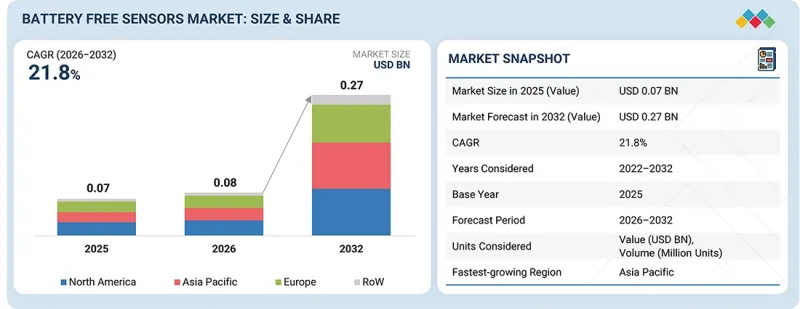
預計到 2032 年,無電池感測器的市場規模將達到 2.7 億美元,而 2026 年為 8,000 萬美元,複合年成長率為 21.8%。
| 調查範圍 | |
|---|---|
| 調查期 | 2022-2032 |
| 基準年 | 2025 |
| 預測期 | 2026-2032 |
| 計算單位 | 金額(10億美元),數量(100萬次調用) |
| 部分 | 按能源採集能力、能源來源、感測器類型、應用、產業和地區分類。 |
| 目標區域 | 北美、歐洲、亞太地區、中東和非洲以及拉丁美洲 |
“按最終用戶分類,預計在預測期內,製造業將佔據無電池感測器市場最大的佔有率。”
預計製造業將佔據無電池感測器市場最大的佔有率,這主要得益於無線感測技術在設備監控、流程最佳化和提高生產效率方面的應用日益廣泛。無電池感測器無需更換電池即永續監測溫度、振動、壓力、濕度和機器狀態等關鍵參數,從而降低維護成本並最大限度地減少停機時間。它們也非常適合現代化製造工廠,因為它們可以在難以到達的位置和惡劣的工業環境中運作。製造商正在擴大這些感測器的部署,以提高資產可靠性、加強品管並支援生產線上的預測性維護策略。此外,智慧工廠、連網生產系統和自動化製造流程的日益普及也推動了對免維護感測解決方案的需求。能源採集技術和超低功耗電子技術的進步進一步提高了感測器的性能和部署柔軟性,鞏固了製造業在全球無電池感測器市場的主導地位。
“從應用領域來看,預計在預測期內,生物感測器領域將在無電池感測器市場中實現最高的複合年成長率。”
受市場對連續、非侵入性、免維護健康監測解決方案日益成長的需求驅動,生物感測器領域預計將在無電池感測器市場中實現最高的複合年成長率。無電池生物感測器非常適合穿戴式醫療設備、植入式感測器、智慧型貼片和即時診斷系統,因為它們無需頻繁更換電池即可即時測量生理參數。其緊湊的尺寸、輕巧的設計以及從環境能源來源中回收能量的能力,提高了患者的舒適度,並支持長期監測應用。對預防醫學、遠端患者監護、個人化醫療和疾病早期檢測的日益重視,進一步加速了無電池生物感測技術的應用。軟性電子產品、生物相容性材料、超低功耗積體電路和無線通訊技術的不斷進步,正在提高感測器的精度、可靠性和運作效率。此外,對數位醫療基礎設施和下一代醫療設備的投資增加,預計將推動其快速商業化,使生物感測器在預測期內成為全球無電池感測器市場中成長最快的應用領域。
“在預測期內,亞太地區有望在全球無電池感測器市場中實現最高的複合年成長率。”
亞太地區預計將在全球無電池感測器市場中佔據最高的複合年成長率,這主要得益於中國、日本、韓國和印度等主要經濟體的快速工業化、電子製造業的擴張以及對智慧基礎設施投資的增加。該地區正崛起為全球半導體製造、感測器生產和能源採集技術研發中心,推動了先進無電池感測解決方案的商業化。無線感測器在製造業、物流、醫療保健、農業、交通運輸和智慧建築等領域的日益普及,進一步加速了市場成長。此外,政府大力推動數位化製造、永續技術和互聯基礎建設,也促進了免維護感測解決方案的普及。對工業4.0、智慧城市和環境監測項目的投資增加,以及對低維護、高能源效率感測器網路日益成長的需求,都創造了巨大的成長機會。超低功耗電子、微機電系統(MEMS)和能源採集技術的持續進步,預計將進一步鞏固該地區的市場地位,使亞太地區在預測期內成為無電池感測器市場成長最快的地區。
我們對無電池感測器市場的關鍵行業專家進行了廣泛的一手訪談,並透過二手研究收集數據,確定並檢驗了各個細分市場和子細分市場的規模。本報告中一手訪談的對象構成如下:
無電池感測器市場以多家成熟的技術供應商為特徵,這些供應商專注於能源採集、被動式無線感測、RFID/NFC技術和超低功耗感測器解決方案。主要市場參與企業包括美國半導體元件工業公司(Semiconductor Components Industries, LLC)、德國EnOcean GmbH、英國Inductosense Ltd.、以色列Wiliot Ltd.和美國Axzon Inc.。這些公司透過持續的產品創新、策略聯盟、研發投入以及先進無電池感測技術的商業化來鞏固其市場地位,同時滿足工業、醫療、物流和智慧基礎設施等領域對免維護無線感測解決方案日益成長的需求。
本研究對無電池感測器市場的主要參與者進行了詳細的競爭分析,涵蓋公司簡介、近期發展、產品創新、儲能技術進步和關鍵市場策略。
調查範圍:
本報告對無電池感測器市場進行了細分,並按感測器類型、能源來源、應用、能源採集能力和最終用戶預測了市場規模。報告還分析了影響產業成長的關鍵市場促進因素、限制因素、機會和挑戰。除了對亞太地區、北美、歐洲和其他地區進行詳細的區域評估外,報告還提供了針對主要市場的具體國家分析。此外,該研究還包括全球無電池感測器生態系統中主要參與者的價值鏈分析和競爭格局評估。
購買本報告的主要好處:
- 該分析包括關鍵促進因素(物聯網設備生態系統的指數級成長創造了對免維護感測的結構性需求,以及工業 4.0 和工業物聯網的加速採用需要在惡劣環境下使用自供電感測器節點)、限制因素(初始系統成本高且投資回報不確定性,以及資源受限節點中的網路安全和數據完整性漏洞)、阻礙因素(初始系統成本聯網和投資回報不確定,以及資源受限節點中的網路安全和環境功能漏洞)、環境網路(聯網和 5G連接基礎設施的擴展,以及永續智慧建築和節能基礎設施的日益普及)和挑戰(先進感測器材料製造的可擴展性和成本障礙,以及通訊標準的碎片化和與舊有系統的整合)。
- 產品開發/創新:深入了解新興的無電池感測技術、能源採集技術(射頻、光伏、壓電、熱電、NFC)、超低功耗半導體和MEMS技術、無線通訊協定、正在進行的研發活動以及無電池感測器市場的新產品發布。
- 市場趨勢:高成長市場的綜合資訊-本報告分析了北美、歐洲、亞太地區和其他地區(RoW)的無電池感測器市場。
- 市場多元化:提供有關下一代無電池感測技術、新興應用領域、策略投資、技術合作和業務拓展的全面資訊。
- 競爭評估:本報告詳細評估了半導體元件工業有限責任公司(美國)、EnOcean GmbH(德國)、Inductosense(英國)、Wiliot Ltd.(以色列)和Axzon(美國)等領先公司的市場佔有率和成長策略,並分析了每家公司的產品系列、策略聯盟、研發活動、產品發布和業務努力。
目錄
第1章:引言
第2章執行摘要
第3章重要考察
第4章 市場概覽
- 市場動態
- 促進因素
- 抑制因子
- 機會
- 任務
- 相互關聯的市場與跨產業機遇
- 一級/二級/三級公司的策略性舉措
第5章 產業趨勢
- 波特五力分析
- 宏觀經濟展望
- 價值鏈分析
- 生態系分析
- 價格分析
- 貿易分析
- 2026-2027 年主要會議和活動
- 影響客戶業務的趨勢/顛覆性因素
- 2022-2026年投資及資金籌措狀況
- 案例研究分析
- 美國關稅對無電池感測器市場的影響
第6章:技術進步、人工智慧的影響、專利、創新與未來應用
- 主要新興技術
- 互補技術
- 技術藍圖
- 專利分析
- 人工智慧/生成式人工智慧對無電池感測器市場的影響
第7章:監理情勢與永續性舉措
- 當地法規和合規性
- 對永續性的承諾
- 監理政策對永續性舉措的影響
第8章:顧客趨勢與購買行為
- 決策流程
- 採購過程中的關鍵相關人員及其評估標準
- 實施障礙和內部挑戰
- 各行業尚未滿足的需求
第9章:無電池感測器的通訊技術
- RFID
- NFC
- BLE
- ZIGBEE
- LORAWAN
- 其他
第10章:無電池感測器市場(依能源採集能力分類)
- 高的
- 中等的
- 低的
第11章:無電池感測器市場(按能源來源分類)
- 光能
- 振動能
- 射頻 (RF) 能量
- 熱能
第12章:無電池感測器市場(按感測器類型分類)
- 溫度感測器
- 濕度/水分感測器
- 壓力感測器
- 動作感測器和位置感應器
- 光感應器
- 氣體感測器
- 生物感測器
- 其他
第13章:無電池感測器市場(按應用領域分類)
- 食品品質監測
- 供應鏈管理
- 狀態監控
- 建築自動化
- 環境監測
- 健康監測
- 農業監測
- 其他
第14章:無電池感測器市場(按行業分類)
- 製造業
- 物流/運輸
- 衛生保健
- 石油和天然氣
- 食品/飲料
- 航太/國防
- 能源
- 智慧建築
- 其他
第15章:無電池感測器市場(按地區分類)
- 北美洲
- 美國
- 加拿大
- 墨西哥
- 歐洲
- 德國
- 英國
- 法國
- 義大利
- 西班牙
- 其他
- 亞太地區
- 中國
- 日本
- 印度
- 韓國
- 其他
- 其他地區
- 中東
- 非洲
- 南美洲
第16章 競爭格局
- 概述
- 主要參與企業的競爭策略/優勢,2024-2026 年
- 2025年市佔率分析
- 企業估值和財務指標
- 品牌對比
- 企業估值矩陣:主要公司,2025 年
- 公司估值矩陣:新創企業/中小企業,2025 年
- 競爭格局
第17章:公司簡介
- 主要參與企業
- SEMICONDUCTOR COMPONENTS INDUSTRIES, LLC
- WILIOT LTD.
- ENOCEAN GMBH
- INDUCTOSENSE
- AXZON
- MURATA MANUFACTURING CO., LTD.
- POWERCAST CORPORATION
- ENERGOUS CORPORATION
- EVERACTIVE
- THERMOKON SENSORTECHNIK GMBH
- 其他公司
- ESCOM ENHANCED SOLUTIONS
- SHENZHEN RICHRFID TECHNOLOGY CO., LTD.
- PHASE IV ENGINEERING INC.
- E-PEAS SA
- INSTA GMBH
- BALLUFF GMBH
- GREENTEG AG
- KLISKATEK SL
- GAO TEK & GAO GROUP INC.
- DRACULA TECHNOLOGIES
- STMICROELECTRONICS
- METALCRAFT, INC.
- NXP SEMICONDUCTORS
- INFINEON TECHNOLOGIES AG
- TEXAS INSTRUMENTS INCORPORATED
第18章:調查方法
第19章附錄
The battery-free sensors market is projected to reach USD 0.27 billion by 2032 from USD 0.08 billion in 2026, growing at a CAGR of 21.8%.
| Scope of the Report | |
|---|---|
| Years Considered for the Study | 2022-2032 |
| Base Year | 2025 |
| Forecast Period | 2026-2032 |
| Units Considered | Value (USD BN), Volume (Million Units) |
| Segments | by Sensor Type, Energy Harvesting Capacity, Energy Source, Application, End User, and Region |
| Regions covered | North America, Europe, Asia Pacific, Middle East & Africa, and Latin America |
"Based on end user, the manufacturing segment is expected to account for the largest share of the battery-free sensors market during the forecast period."
The manufacturing segment is expected to hold the largest share of the battery-free sensors market due to the increasing adoption of wireless sensing technologies for equipment monitoring, process optimization, and production efficiency. Battery-free sensors enable continuous monitoring of critical parameters such as temperature, vibration, pressure, humidity, and machine health without requiring battery replacement, thereby reducing maintenance costs and minimizing production downtime. Their ability to operate in hard-to-reach and harsh industrial environments makes them well suited for modern manufacturing facilities. Manufacturers are increasingly deploying these sensors to improve asset reliability, enhance quality control, and support predictive maintenance strategies across production lines. In addition, the growing implementation of smart factories, connected production systems, and automated manufacturing processes is driving demand for maintenance-free sensing solutions. Advancements in energy harvesting technologies and ultra-low-power electronics are further improving sensor performance and deployment flexibility, reinforcing the dominance of the manufacturing segment in the global battery-free sensors market.
"Based on application, the biosensors segment is expected to register the highest CAGR in the battery-free sensors market during the forecast period"
The biosensors segment is expected to witness the highest CAGR in the battery-free sensors market owing to the increasing demand for continuous, non-invasive, and maintenance-free health monitoring solutions. Battery-free biosensors enable real-time measurement of physiological parameters without frequent battery replacement, making them well suited for wearable medical devices, implantable sensors, smart patches, and point-of-care diagnostic systems. Their compact size, lightweight design, and ability to harvest energy from ambient sources improve patient comfort and support long-term monitoring applications. Growing emphasis on preventive healthcare, remote patient monitoring, personalized medicine, and early disease detection is further accelerating the adoption of battery-free biosensing technologies. Continuous advancements in flexible electronics, biocompatible materials, ultra-low-power integrated circuits, and wireless communication technologies are enhancing sensor accuracy, reliability, and operational efficiency. In addition, increasing investments in digital healthcare infrastructure and next-generation medical devices are expected to drive rapid commercialization, making biosensors the fastest-growing application segment in the global battery-free sensors market during the forecast period.
"Asia Pacific is expected to register the highest CAGR in the global battery-free sensors market during the forecast period"
The Asia Pacific region is expected to witness the highest CAGR in the global battery-free sensors market due to rapid industrialization, expanding electronics manufacturing, and increasing investments in smart infrastructure across major economies such as China, Japan, South Korea, and India. The region has emerged as a global hub for semiconductor manufacturing, sensor production, and energy harvesting technology development, supporting the commercialization of advanced battery-free sensing solutions. Growing adoption of wireless sensors across manufacturing, logistics, healthcare, agriculture, transportation, and smart buildings is further accelerating market growth. In addition, government initiatives promoting digital manufacturing, sustainable technologies, and connected infrastructure are encouraging the deployment of maintenance-free sensing solutions. Rising investments in Industry 4.0, smart cities, and environmental monitoring projects, coupled with increasing demand for low-maintenance and energy-efficient sensor networks, are creating significant growth opportunities. Continuous technological advancements in ultra-low-power electronics, MEMS, and energy harvesting technologies are expected to further strengthen the region's position, making Asia Pacific the fastest-growing market for battery-free sensors during the forecast period.
Extensive primary interviews were conducted with key industry experts in the battery-free sensors market to determine and verify the market size for various segments and subsegments gathered through secondary research. The breakdown of primary participants for the report is shown below.
The study contains insights from various industry experts, from component suppliers to Tier 1 companies and OEMs. The break-up of the primaries is as follows:
- By Company Type - Tier 1 - 40%, Tier 2 - 35%, and Tier 3 - 25%
- By Designation - C-level Executives - 33%, Directors - 38%, and Others - 29%
- By Region - North America - 30%, Europe - 40%, Asia Pacific - 20%, and RoW - 10%
The battery-free sensors market is characterized by the presence of several established technology providers specializing in energy harvesting, passive wireless sensing, RFID/NFC technologies, and ultra-low-power sensor solutions. Key market participants include Semiconductor Components Industries, LLC (US), EnOcean GmbH (Germany), Inductosense Ltd. (UK), Wiliot Ltd. (Israel), and Axzon Inc. (US). These companies compete through continuous product innovation, strategic partnerships, research and development investments, and the commercialization of advanced battery-free sensing technologies to strengthen their market position and address the growing demand for maintenance-free wireless sensing solutions across industrial, healthcare, logistics, and smart infrastructure applications.
The study includes an in-depth competitive analysis of these key players in the battery-free sensors market, covering their company profiles, recent developments, product innovations, storage technology advancements, and key market strategies.
Study Coverage:
The report segments the battery-free sensors market and forecasts its size by sensor type (temperature sensors, humidity/moisture sensors, pressure sensors, motion and position sensors, light sensors, biosensors, gas sensors, other sensors), by energy source (light energy, vibration energy, radio frequency (RF) energy, thermal energy), application (food quality monitoring, supply chain management, condition monitoring, building automation, environmental monitoring, healthcare monitoring, agriculture monitoring, other applications), energy harvesting capacity (low energy harvesting capacity, medium energy harvesting capacity, high energy harvesting capacity), and end user (manufacturing, aerospace & defense, logistics & transportation, energy, healthcare, oil & gas, food & beverages, smart building, other end Users). The report also analyses key market drivers, restraints, opportunities, and challenges influencing industry growth. It provides a detailed regional assessment across Asia Pacific, North America, Europe, and RoW, along with country-level insights for major markets. In addition, the study includes value chain analysis and competitive landscape assessment of leading players operating in the global battery-free sensor ecosystem.
Key Benefits of Buying the Report:
- Analysis of key drivers (Exponential growth of IoT device ecosystems creating structural demand for maintenance-free sensing, Accelerating industry 4.0 and IIoT adoption demanding self-powered sensor nodes in harsh environments ), restraints (Elevated upfront system cost and return-on-investment uncertainty, Cybersecurity and data integrity vulnerabilities in resource-constrained nodes), opportunities (Expansion of ambient IoT and 5G-enabled connected infrastructure, Increasing adoption of sustainable smart buildings and energy-efficient infrastructure), challenges (Manufacturing scalability and cost barriers for advanced transducer materials, Fragmented communication standards and legacy system integration).
- Product Development/Innovation: Detailed insights into emerging battery-free sensing technologies, advancements in energy harvesting techniques (RF, photovoltaic, piezoelectric, thermoelectric, and NFC), ultra-low-power semiconductor and MEMS technologies, wireless communication protocols, ongoing research and development activities, and new product launches in the battery-free sensors market.
- Market Development: Comprehensive information about high-growth markets-the report analyzes the battery-free sensors market across North America, Europe, Asia Pacific, and RoW.
- Market Diversification: Exhaustive information on next-generation battery-free sensing technologies, emerging application areas, strategic investments, technology partnerships, and expansion.
- Competitive Assessment: In-depth assessment of market shares and growth strategies of leading players, such as Semiconductor Components Industries, LLC (US), EnOcean GmbH (Germany), Inductosense (UK), Wiliot Ltd. (Israel), and Axzon (US), along with analysis of their product portfolios, strategic partnerships, research and development activities, product launches, and business expansion initiatives.
TABLE OF CONTENTS
1 INTRODUCTION
- 1.1 STUDY OBJECTIVES
- 1.2 MARKET DEFINITION
- 1.3 STUDY SCOPE
- 1.3.1 MARKET SEGMENTATION AND REGIONAL SCOPE
- 1.3.2 YEARS CONSIDERED
- 1.3.3 INCLUSIONS AND EXCLUSIONS
- 1.4 CURRENCY CONSIDERED
- 1.5 UNITS CONSIDERED
- 1.6 STAKEHOLDERS
- 1.7 SUMMARY OF CHANGES
2 EXECUTIVE SUMMARY
- 2.1 MARKET HIGHLIGHTS AND KEY INSIGHTS
- 2.2 KEY MARKET PARTICIPANTS: MAPPING OF STRATEGIC DEVELOPMENTS
- 2.3 DISRUPTIVE TRENDS IN BATTERY-FREE SENSORS MARKET
- 2.4 HIGH-GROWTH SEGMENTS
- 2.5 REGIONAL SNAPSHOT: MARKET SIZE, GROWTH RATE, AND FORECAST
3 PREMIUM INSIGHTS
- 3.1 ATTRACTIVE OPPORTUNITIES FOR PLAYERS IN BATTERY-FREE SENSORS MARKET
- 3.2 BATTERY-FREE SENSORS MARKET, BY INDUSTRY
- 3.3 BATTERY-FREE SENSORS MARKET, BY APPLICATION
- 3.4 BATTERY-FREE SENSORS MARKET, BY ENERGY HARVESTING CAPACITY
- 3.5 BATTERY-FREE SENSORS MARKET, BY SENSOR TYPE
- 3.6 BATTERY-FREE SENSORS MARKET, BY ENERGY SOURCE
- 3.7 BATTERY-FREE SENSORS MARKET, BY REGION
- 3.8 BATTERY-FREE SENSORS MARKET, BY GEOGRAPHY
4 MARKET OVERVIEW
- 4.1 INTRODUCTION
- 4.2 MARKET DYNAMICS
- 4.2.1 DRIVERS
- 4.2.1.1 Exponential growth of industrial IoT device ecosystems
- 4.2.1.2 Rapid transition toward Industry 4.0 technologies
- 4.2.1.3 Regulatory pressure on battery waste and E-sustainability
- 4.2.2 RESTRAINTS
- 4.2.2.1 Limited and intermittent ambient energy harvesting output
- 4.2.2.2 Absence of universally accepted standards for energy harvesting technologies
- 4.2.2.3 Elevated upfront cost and return-on-investment uncertainty
- 4.2.2.4 Cybersecurity and data integrity vulnerabilities in resource-constrained devices
- 4.2.3 OPPORTUNITIES
- 4.2.3.1 Expansion of ambient IoT and 5G networks
- 4.2.3.2 Increasing development of smart and energy-efficient buildings
- 4.2.3.3 Rising deployment of connected asset monitoring systems
- 4.2.4 CHALLENGES
- 4.2.4.1 Intermittent and unpredictable ambient energy supply
- 4.2.4.2 Issues in scaling production while maintaining consistent performance and competitive costs
- 4.2.4.3 Fragmented communication standards and legacy system integration
- 4.2.1 DRIVERS
- 4.3 INTERCONNECTED MARKETS AND CROSS-SECTOR OPPORTUNITIES
- 4.4 STRATEGIC MOVES BY TIER-1/2/3 PLAYERS
5 INDUSTRY TRENDS
- 5.1 INTRODUCTION
- 5.2 PORTER'S FIVE FORCES ANALYSIS
- 5.2.1 THREAT OF NEW ENTRANTS
- 5.2.2 THREAT OF SUBSTITUTES
- 5.2.3 BARGAINING POWER OF SUPPLIERS
- 5.2.4 BARGAINING POWER OF BUYERS
- 5.2.5 INTENSITY OF COMPETITIVE RIVALRY
- 5.3 MACROECONOMIC OUTLOOK
- 5.3.1 INTRODUCTION
- 5.3.2 GDP TRENDS AND FORECAST
- 5.3.3 TRENDS IN GLOBAL MANUFACTURING INDUSTRY
- 5.3.4 TRENDS IN GLOBAL HEALTHCARE INDUSTRY
- 5.4 VALUE CHAIN ANALYSIS
- 5.5 ECOSYSTEM ANALYSIS
- 5.6 PRICING ANALYSIS
- 5.6.1 AVERAGE SELLING PRICE TREND OF BATTERY-FREE SENSORS, BY KEY PLAYER, 2022-2025
- 5.6.2 AVERAGE SELLING PRICE TREND OF BATTERY-FREE SENSORS, BY REGION, 2022-2025
- 5.7 TRADE ANALYSIS
- 5.7.1 IMPORT SCENARIO (HS CODE 9026)
- 5.7.2 EXPORT SCENARIO (HS CODE 9026)
- 5.8 KEY CONFERENCES AND EVENTS, 2026-2027
- 5.9 TRENDS/DISRUPTIONS IMPACTING CUSTOMER BUSINESS
- 5.10 INVESTMENT AND FUNDING SCENARIO, 2022-2026
- 5.11 CASE STUDY ANALYSIS
- 5.11.1 WILIOT ENABLES ROYAL MAIL TO DIGITALIZE LOGISTICS THROUGH BATTERY-FREE IOT PIXELS
- 5.11.2 ENOCEAN HELPS SUMITOMO HEAVY INDUSTRIES SUPPORT BATTERY-FREE INDUSTRIAL IOT MONITORING USING WIRELESS SENSORS
- 5.11.3 WILIOT IMPROVES COLD CHAIN VISIBILITY FOR GLOBAL GROCERY RETAILER THROUGH BATTERY-FREE IOT PIXELS
- 5.11.4 MURATA MANUFACTURING ALLOWS ELECTRONICS MANUFACTURING FACILITY TO ENHANCE ENERGY MANAGEMENT THROUGH WIRELESS SENSING
- 5.11.5 INDUCTOSENSE ENABLES PETROINEOS REFINING TO SUPPORT CONTINUOUS CORROSION MONITORING USING BATTERY-FREE WAND WIRELESS ULTRASONIC SENSORS
- 5.12 IMPACT OF US TARIFFS - BATTERY-FREE SENSORS MARKET
- 5.12.1 INTRODUCTION
- 5.12.2 KEY TARIFF RATES
- 5.12.3 PRICE IMPACT ANALYSIS
- 5.12.4 IMPACT ON COUNTRIES/REGIONS
- 5.12.4.1 US
- 5.12.4.2 Europe
- 5.12.4.3 Asia Pacific
- 5.12.5 IMPACT ON INDUSTRIES
6 TECHNOLOGICAL ADVANCEMENTS, AI-DRIVEN IMPACT, PATENTS, INNOVATIONS, AND FUTURE APPLICATIONS
- 6.1 KEY EMERGING TECHNOLOGIES
- 6.1.1 PIEZOELECTRIC MICROELECTROMECHANICAL SYSTEMS
- 6.1.2 TRIBOELECTRIC NANOGENERATORS
- 6.1.3 NEAR-FIELD COMMUNICATION AND RADIO FREQUENCY ENERGY HARVESTING
- 6.2 COMPLEMENTARY TECHNOLOGIES
- 6.2.1 BACKSCATTER COMMUNICATION
- 6.2.2 DIGITAL TWIN
- 6.2.3 ULTRA-LOW-POWER EDGE AI INFERENCE
- 6.3 TECHNOLOGY ROADMAP
- 6.3.1 SHORT-TERM (2025-2027): COMMERCIAL EXPANSION OF BATTERY-FREE SENSING
- 6.3.2 MID-TERM (2027-2030): INTELLIGENT AND SCALABLE BATTERY-FREE SENSOR NETWORKS
- 6.3.3 LONG-TERM (2030-2035): AUTONOMOUS SELF-POWERED SENSOR ECOSYSTEMS
- 6.4 PATENT ANALYSIS
- 6.5 IMPACT OF AI/GEN ON BATTERY-FREE SENSORS MARKET
- 6.5.1 TOP USE CASES AND MARKET POTENTIAL
- 6.5.2 BEST PRACTICES FOLLOWED BY OEMS IN BATTERY-FREE SENSORS MARKET
- 6.5.3 CASE STUDIES RELATED TO AI/GEN AI IMPLEMENTATION IN BATTERY-FREE SENSORS MARKET
- 6.5.4 INTERCONNECTED ECOSYSTEM AND IMPACT ON MARKET PLAYERS
- 6.5.5 CLIENTS' READINESS TO ADOPT AI/GEN AI-INTEGRATED BATTERY-FREE SENSORS
7 REGULATORY LANDSCAPE AND SUSTAINABILITY INITIATIVES
- 7.1 INTRODUCTION
- 7.2 REGIONAL REGULATIONS AND COMPLIANCE
- 7.2.1 REGULATORY BODIES, GOVERNMENT AGENCIES, AND OTHER ORGANIZATIONS
- 7.2.2 INDUSTRY STANDARDS
- 7.2.2.1 RFID Air Interface Standards (ISO/IEC 18000 Series, EPCglobal Gen2/ISO 18000-63)
- 7.2.2.2 Near Field Communication (NFC) Standards (ISO/IEC 14443, ISO/IEC 15693, NFC Forum Specifications)
- 7.2.2.3 Low-Power Wireless Communication Standards (IEEE 802.15.4, Zigbee, Thread)
- 7.2.2.4 Bluetooth Low Energy (BLE) Standards (Bluetooth Core Specification)
- 7.2.2.5 Radio Equipment, Electromagnetic Compatibility, and Safety Standards (IEC 62368-1, IEC 61000 Series, ETSI EN 300 220)
- 7.2.3 INDUSTRY FRAMEWORKS AND RATING ORGANIZATIONS
- 7.3 SUSTAINABILITY INITIATIVES
- 7.3.1 ENERGY HARVESTING AND BATTERY ELIMINATION
- 7.3.2 E-WASTE REDUCTION AND CIRCULAR ECONOMY
- 7.3.3 LOW-POWER SEMICONDUCTOR DESIGN AND ENERGY-EFFICIENT ELECTRONICS
- 7.3.4 SUSTAINABLE MANUFACTURING AND RESPONSIBLE MATERIAL SOURCING
- 7.3.5 SMART RESOURCE MONITORING AND ENVIRONMENTAL OPTIMIZATION
- 7.4 IMPACT OF REGULATORY POLICIES ON SUSTAINABILITY INITIATIVES
- 7.4.1 ENERGY EFFICIENCY AND ELECTRONIC WASTE REDUCTION POLICIES
- 7.4.2 HAZARDOUS SUBSTANCE AND CIRCULAR ECONOMY POLICIES
- 7.4.3 WIRELESS CONNECTIVITY, CYBERSECURITY, AND SUSTAINABLE IOT POLICIES
8 CUSTOMER LANDSCAPE AND BUYER BEHAVIOR
- 8.1 INTRODUCTION
- 8.2 DECISION-MAKING PROCESS
- 8.3 KEY STAKEHOLDERS INVOLVED IN BUYING PROCESS AND THEIR EVALUATION CRITERIA
- 8.3.1 KEY STAKEHOLDERS IN BUYING PROCESS
- 8.3.2 BUYING CRITERIA
- 8.4 ADOPTION BARRIERS AND INTERNAL CHALLENGES
- 8.5 UNMET NEEDS OF VARIOUS INDUSTRIES
9 COMMUNICATION TECHNOLOGIES FOR BATTERY-FREE SENSORS
- 9.1 INTRODUCTION
- 9.2 RFID
- 9.3 NFC
- 9.4 BLE
- 9.5 ZIGBEE
- 9.6 LORAWAN
- 9.7 OTHER COMMUNICATION TECHNOLOGIES
10 BATTERY-FREE SENSORS MARKET, BY ENERGY HARVESTING CAPACITY
- 10.1 INTRODUCTION
- 10.2 HIGH
- 10.2.1 RELIABILITY, CONTINUOUS MONITORING, AND REDUCED MAINTENANCE ATTRIBUTES TO BOLSTER SEGMENTAL GROWTH
- 10.3 MEDIUM
- 10.3.1 ABILITY TO BALANCE ENERGY AVAILABILITY AND OPERATIONAL EFFICIENCY IN COMMERCIAL IOT APPLICATIONS TO FUEL SEGMENTAL GROWTH
- 10.4 LOW
- 10.4.1 USE TO REDUCE BATTERY WASTE, SIMPLIFY INSTALLATION, AND SUPPORT LONG-TERM SUSTAINABILITY INITIATIVES TO SPUR DEMAND
11 BATTERY-FREE SENSORS MARKET, BY ENERGY SOURCE
- 11.1 INTRODUCTION
- 11.2 LIGHT ENERGY
- 11.2.1 CONTINUOUS IMPROVEMENTS IN PV CELL EFFICIENCY AND ADOPTION OF SMART BUILDINGS TO AUGMENT SEGMENTAL GROWTH
- 11.3 VIBRATION ENERGY
- 11.3.1 HIGH EMPHASIS ON AUTOMATION, PREDICTIVE MAINTENANCE, AND INDUSTRY 4.0 INITIATIVES TO FOSTER SEGMENTAL GROWTH
- 11.4 RADIO FREQUENCY (RF) ENERGY
- 11.4.1 RISING ADOPTION OF REAL-TIME VISIBILITY SOLUTIONS THROUGHOUT SUPPLY CHAINS TO ACCELERATE SEGMENTAL GROWTH
- 11.5 THERMAL ENERGY
- 11.5.1 INCREASING INVESTMENT IN PREDICTIVE MAINTENANCE AND INFRASTRUCTURE MONITORING TO EXPEDITE SEGMENTAL GROWTH
12 BATTERY-FREE SENSORS MARKET, BY SENSOR TYPE
- 12.1 INTRODUCTION
- 12.2 TEMPERATURE SENSORS
- 12.2.1 MAINTENANCE-FREE OPERATION, COMPACT DESIGN, AND LONG SERVICE LIFE TO FACILITATE SEGMENTAL GROWTH
- 12.3 HUMIDITY/MOISTURE SENSORS
- 12.3.1 SUITABILITY FOR LARGE-SCALE IIOT DEPLOYMENTS AND DIFFICULT-TO-ACCESS LOCATIONS TO FUEL SEGMENTAL GROWTH
- 12.4 PRESSURE SENSORS
- 12.4.1 ADVANCES IN ULTRA-LOW-POWER MEMS SENSING AND ENERGY-HARVESTING TECHNOLOGIES TO BOOST SEGMENTAL GROWTH
- 12.5 MOTION & POSITION SENSORS
- 12.5.1 FOCUS ON IMPROVING ENERGY EFFICIENCY, SECURITY, AND SPACE UTILIZATION TO CONTRIBUTE TO SEGMENTAL GROWTH
- 12.6 LIGHT SENSORS
- 12.6.1 ADVANCES IN ULTRA-LOW-POWER OPTICAL SENSING, ENERGY HARVESTING, AND WIRELESS COMMUNICATION PROTOCOLS TO DRIVE MARKET
- 12.7 GAS SENSORS
- 12.7.1 EMPHASIS ON WORKER SAFETY, REGULATORY COMPLIANCE, AND OPERATIONAL EFFICIENCY TO BOLSTER SEGMENTAL GROWTH
- 12.8 BIOSENSORS
- 12.8.1 COMPACT DESIGN, MAINTENANCE-FREE OPERATION, AND ABILITY TO ENABLE CONTINUOUS HEALTH MONITORING TO SPUR DEMAND
- 12.9 OTHER SENSORS
13 BATTERY-FREE SENSORS MARKET, BY APPLICATION
- 13.1 INTRODUCTION
- 13.2 FOOD QUALITY MONITORING
- 13.2.1 STRONG FOCUS ON MONITORING CRITICAL ENVIRONMENTAL PARAMETERS AND COMPLYING WITH STANDARDS TO FUEL SEGMENTAL GROWTH
- 13.3 SUPPLY CHAIN MANAGEMENT
- 13.3.1 RISING EMPHASIS ON IMPROVING ASSET VISIBILITY AND ENHANCING INVENTORY MANAGEMENT TO FOSTER SEGMENTAL GROWTH
- 13.4 CONDITION MONITORING
- 13.4.1 INCREASING NEED TO REDUCE MAINTENANCE COSTS AND MINIMIZE UNPLANNED DOWNTIME TO AUGMENT SEGMENTAL GROWTH
- 13.5 BUILDING AUTOMATION
- 13.5.1 GROWING ADOPTION OF NET-ZERO ENERGY INITIATIVES AND IOT-ENABLED BUILDING MANAGEMENT SYSTEMS TO DRIVE MARKET
- 13.6 ENVIRONMENTAL MONITORING
- 13.6.1 STRONG FOCUS ON SUPPORTING RESOURCE MANAGEMENT, CLIMATE MONITORING, AND REGULATORY COMPLIANCE TO FUEL SEGMENTAL GROWTH
- 13.7 HEALTHCARE MONITORING
- 13.7.1 GROWING POPULARITY OF CONNECTED HEALTHCARE SYSTEMS TO ACCELERATE SEGMENTAL GROWTH
- 13.8 AGRICULTURE MONITORING
- 13.8.1 RISING NEED TO OPTIMIZE RESOURCE UTILIZATION AND SUPPORT SUSTAINABLE FARMING PRACTICES TO BOLSTER SEGMENTAL GROWTH
- 13.9 OTHER APPLICATIONS
14 BATTERY-FREE SENSORS MARKET, BY INDUSTRY
- 14.1 INTRODUCTION
- 14.2 MANUFACTURING
- 14.2.1 RAPID TRANSITION TOWARD INTELLIGENT, DATA-DRIVEN PRODUCTION ENVIRONMENTS TO ACCELERATE SEGMENTAL GROWTH
- 14.3 LOGISTICS & TRANSPORTATION
- 14.3.1 HIGH EMPHASIS ON MANAGING WAREHOUSE INVENTORY AND TRACKING SHIPMENTS TO FUEL SEGMENTAL GROWTH
- 14.4 HEALTHCARE
- 14.4.1 GROWING FOCUS ON IMPROVING PATIENT OUTCOMES AND OPERATIONAL EFFICIENCY TO EXPEDITE SEGMENTAL GROWTH
- 14.5 OIL & GAS
- 14.5.1 HIGH INVESTMENT IN DIGITAL TECHNOLOGIES, ASSET INTEGRITY MANAGEMENT, AND PREDICTIVE MAINTENANCE SOLUTIONS TO DRIVE MARKET
- 14.6 FOOD & BEVERAGES
- 14.6.1 STRONG FOCUS ON IMPROVING SUPPLY CHAIN EFFICIENCY AND REDUCING LOSSES TO CONTRIBUTE TO SEGMENTAL GROWTH
- 14.7 AEROSPACE & DEFENSE
- 14.7.1 INCREASING INVESTMENT IN ADVANCED PLATFORMS AND INTELLIGENT SURVEILLANCE SYSTEMS TO AUGMENT SEGMENTAL GROWTH
- 14.8 ENERGY
- 14.8.1 RAPID INDUSTRIALIZATION, ELECTRIC VEHICLE ADOPTION, AND DIGITAL INFRASTRUCTURE EXPANSION TO FUEL SEGMENTAL GROWTH
- 14.9 SMART BUILDING
- 14.9.1 RISING EMPHASIS ON ACHIEVING GLOBAL DECARBONIZATION GOALS TO ACCELERATE SEGMENTAL GROWTH
- 14.10 OTHER INDUSTRIES
15 BATTERY FREE SENSORS MARKET, BY REGION
- 15.1 INTRODUCTION
- 15.2 NORTH AMERICA
- 15.2.1 US
- 15.2.1.1 Growing adoption of IIoT and industrial automation to contribute to market growth
- 15.2.2 CANADA
- 15.2.2.1 Rising emphasis on strengthening advanced manufacturing ecosystem to bolster market growth
- 15.2.3 MEXICO
- 15.2.3.1 Rapid industrialization, increasing FDI, and expanding manufacturing activities to fuel market growth
- 15.2.1 US
- 15.3 EUROPE
- 15.3.1 GERMANY
- 15.3.1.1 Rising deployment of Industry 4.0 technologies to strengthen industrial digitalization to drive market
- 15.3.2 UK
- 15.3.2.1 Increasing investment in smart buildings, industrial digitalization, and sustainable infrastructure to foster market growth
- 15.3.3 FRANCE
- 15.3.3.1 Government investments in semiconductor technologies, industrial digitalization, and sustainable manufacturing to expedite market growth
- 15.3.4 ITALY
- 15.3.4.1 Rapid industrial digitalization, automation, and energy efficiency to accelerate market growth
- 15.3.5 SPAIN
- 15.3.5.1 Mounting adoption of IIoT, connected infrastructure, and intelligent building management systems to boost market growth
- 15.3.6 REST OF EUROPE
- 15.3.1 GERMANY
- 15.4 ASIA PACIFIC
- 15.4.1 CHINA
- 15.4.1.1 Large-scale smart factory deployments and investments in semiconductor technologies to foster market growth
- 15.4.2 JAPAN
- 15.4.2.1 Rapid advancements in Society 5.0 and smart manufacturing to expedite market growth
- 15.4.3 INDIA
- 15.4.3.1 Expanding smart manufacturing initiatives and government investments in electronics manufacturing to fuel market growth
- 15.4.4 SOUTH KOREA
- 15.4.4.1 Rising support for smart manufacturing and semiconductor innovation to augment market growth
- 15.4.5 REST OF ASIA PACIFIC
- 15.4.1 CHINA
- 15.5 ROW
- 15.5.1 MIDDLE EAST
- 15.5.1.1 Increasing investment in smart cities, renewable energy, and intelligent infrastructure to bolster market growth
- 15.5.1.2 GCC countries
- 15.5.1.3 Rest of Middle East
- 15.5.2 AFRICA
- 15.5.2.1 Increasing investment in digitalization, smart infrastructure, renewable energy, and connected IoT technologies to drive market
- 15.5.3 SOUTH AMERICA
- 15.5.3.1 Rising industrial automation, digital transformation, and smart infrastructure development to fuel market growth
- 15.5.1 MIDDLE EAST
16 COMPETITIVE LANDSCAPE
- 16.1 OVERVIEW
- 16.2 KEY PLAYER COMPETITIVE STRATEGIES/RIGHT TO WIN, 2024-2026
- 16.3 MARKET SHARE ANALYSIS, 2025
- 16.4 COMPANY VALUATION AND FINANCIAL METRICS
- 16.5 BRAND COMPARISON
- 16.5.1 SEMICONDUCTOR COMPONENTS INDUSTRIES, LLC (US)
- 16.5.2 WILIOT LTD. (ISRAEL)
- 16.5.3 ENOCEAN GMBH (GERMANY)
- 16.5.4 INDUCTOSENSE LTD. (UK)
- 16.5.5 AXZON INC. (US)
- 16.6 COMPANY EVALUATION MATRIX: KEY PLAYERS, 2025
- 16.6.1 STARS
- 16.6.2 EMERGING LEADERS
- 16.6.3 PERVASIVE PLAYERS
- 16.6.4 PARTICIPANTS
- 16.6.5 COMPANY FOOTPRINT: KEY PLAYERS, 2025
- 16.6.5.1 Company footprint
- 16.6.5.2 Region footprint
- 16.6.5.3 Sensor type footprint
- 16.6.5.4 Application footprint
- 16.6.5.5 Industry footprint
- 16.7 COMPANY EVALUATION MATRIX: STARTUPS/SMES, 2025
- 16.7.1 PROGRESSIVE COMPANIES
- 16.7.2 RESPONSIVE COMPANIES
- 16.7.3 DYNAMIC COMPANIES
- 16.7.4 STARTING BLOCKS
- 16.7.5 COMPETITIVE BENCHMARKING: STARTUPS/SMES, 2025
- 16.7.5.1 Detailed list of key startups/SMEs
- 16.7.5.2 Competitive benchmarking of key startups/SMEs
- 16.8 COMPETITIVE SCENARIO
- 16.8.1 PRODUCT LAUNCHES
- 16.8.2 DEALS
17 COMPANY PROFILES
- 17.1 KEY PLAYERS
- 17.1.1 SEMICONDUCTOR COMPONENTS INDUSTRIES, LLC
- 17.1.1.1 Business overview
- 17.1.1.2 Products/Solutions/Services offered
- 17.1.1.3 MnM view
- 17.1.1.3.1 Key strengths/Right to win
- 17.1.1.3.2 Strategic choices
- 17.1.1.3.3 Weaknesses/Competitive threats
- 17.1.2 WILIOT LTD.
- 17.1.2.1 Business overview
- 17.1.2.2 Products/Solutions/Services offered
- 17.1.2.3 Recent developments
- 17.1.2.3.1 Product launches
- 17.1.2.3.2 Deals
- 17.1.2.4 MnM view
- 17.1.2.4.1 Key strengths/Right to win
- 17.1.2.4.2 Strategic choices
- 17.1.2.4.3 Weaknesses/Competitive threats
- 17.1.3 ENOCEAN GMBH
- 17.1.3.1 Business overview
- 17.1.3.2 Products/Solutions/Services offered
- 17.1.3.3 Recent developments
- 17.1.3.3.1 Product launches
- 17.1.3.3.2 Deals
- 17.1.3.4 MnM view
- 17.1.3.4.1 Key strengths/Right to win
- 17.1.3.4.2 Strategic choices
- 17.1.3.4.3 Weaknesses/Competitive threats
- 17.1.4 INDUCTOSENSE
- 17.1.4.1 Business overview
- 17.1.4.2 Products/Solutions/Services offered
- 17.1.4.3 Recent developments
- 17.1.4.3.1 Product launches
- 17.1.4.4 MnM view
- 17.1.4.4.1 Key strengths/Right to win
- 17.1.4.4.2 Strategic choices
- 17.1.4.4.3 Weaknesses/Competitive threats
- 17.1.5 AXZON
- 17.1.5.1 Business overview
- 17.1.5.2 Products/Solutions/Services offered
- 17.1.5.3 Recent developments
- 17.1.5.3.1 Product launches
- 17.1.5.4 MnM view
- 17.1.5.4.1 Key strengths/Right to win
- 17.1.5.4.2 Strategic choices
- 17.1.5.4.3 Weaknesses/Competitive threats
- 17.1.6 MURATA MANUFACTURING CO., LTD.
- 17.1.6.1 Business overview
- 17.1.6.2 Products/Solutions/Services offered
- 17.1.6.3 Recent developments
- 17.1.6.3.1 Deals
- 17.1.7 POWERCAST CORPORATION
- 17.1.7.1 Business overview
- 17.1.7.2 Products/Solutions/Services offered
- 17.1.7.3 Recent developments
- 17.1.7.3.1 Product launches
- 17.1.7.3.2 Deals
- 17.1.8 ENERGOUS CORPORATION
- 17.1.8.1 Business overview
- 17.1.8.2 Products/Solutions/Services offered
- 17.1.8.3 Recent developments
- 17.1.8.3.1 Product launches
- 17.1.8.3.2 Deals
- 17.1.9 EVERACTIVE
- 17.1.9.1 Business overview
- 17.1.9.2 Products/Solutions/Services offered
- 17.1.10 THERMOKON SENSORTECHNIK GMBH
- 17.1.10.1 Business overview
- 17.1.10.2 Products/Solutions/Services offered
- 17.1.1 SEMICONDUCTOR COMPONENTS INDUSTRIES, LLC
- 17.2 OTHER PLAYERS
- 17.2.1 ESCOM ENHANCED SOLUTIONS
- 17.2.2 SHENZHEN RICHRFID TECHNOLOGY CO., LTD.
- 17.2.3 PHASE IV ENGINEERING INC.
- 17.2.4 E-PEAS SA
- 17.2.5 INSTA GMBH
- 17.2.6 BALLUFF GMBH
- 17.2.7 GREENTEG AG
- 17.2.8 KLISKATEK S.L.
- 17.2.9 GAO TEK & GAO GROUP INC.
- 17.2.10 DRACULA TECHNOLOGIES
- 17.2.11 STMICROELECTRONICS
- 17.2.12 METALCRAFT, INC.
- 17.2.13 NXP SEMICONDUCTORS
- 17.2.14 INFINEON TECHNOLOGIES AG
- 17.2.15 TEXAS INSTRUMENTS INCORPORATED
18 RESEARCH METHODOLOGY
- 18.1 RESEARCH DATA
- 18.1.1 SECONDARY AND PRIMARY RESEARCH
- 18.1.2 SECONDARY DATA
- 18.1.2.1 List of key secondary sources
- 18.1.2.2 Key data from secondary sources
- 18.1.3 PRIMARY DATA
- 18.1.3.1 List of primary interview participants
- 18.1.3.2 Breakdown of primary interviews
- 18.1.3.3 Key data from primary sources
- 18.1.3.4 Key industry insights
- 18.2 MARKET SIZE ESTIMATION
- 18.2.1 BOTTOM-UP APPROACH
- 18.2.1.1 Approach to arrive at market size using bottom-up analysis (demand side)
- 18.2.2 TOP-DOWN APPROACH
- 18.2.2.1 Approach to arrive at market size using top-down analysis (supply side)
- 18.2.1 BOTTOM-UP APPROACH
- 18.3 DATA TRIANGULATION
- 18.4 RESEARCH ASSUMPTIONS
- 18.5 RESEARCH LIMITATIONS
- 18.6 RISK ANALYSIS
19 APPENDIX
- 19.1 INSIGHTS FROM INDUSTRY EXPERTS
- 19.2 DISCUSSION GUIDE
- 19.3 KNOWLEDGESTORE: MARKETSANDMARKETS' SUBSCRIPTION PORTAL
- 19.4 CUSTOMIZATION OPTIONS
- 19.5 RELATED REPORTS
- 19.6 AUTHOR DETAILS
List of Tables
- TABLE 1 BATTERY-FREE SENSORS MARKET: INCLUSIONS AND EXCLUSIONS
- TABLE 2 BATTERY-FREE SENSORS MARKET: SUMMARY OF CHANGES
- TABLE 3 STRATEGIC FOCUS OF TIER-1/2/3 PLAYERS
- TABLE 4 IMPACT OF PORTER'S FIVE FORCES
- TABLE 5 GDP PERCENTAGE CHANGE, BY KEY COUNTRY, 2021-2029
- TABLE 6 ROLE OF COMPANIES IN BATTERY-FREE SENSORS ECOSYSTEM
- TABLE 7 AVERAGE SELLING PRICE TREND OF BATTERY-FREE SENSORS PROVIDED BY KEY PLAYERS, 2022-2025 (USD)
- TABLE 8 AVERAGE SELLING PRICE TREND OF BATTERY-FREE SENSORS, BY REGION, 2022-2025 (USD)
- TABLE 9 IMPORT DATA FOR HS CODE 9026-COMPLIANT PRODUCTS, BY COUNTRY, 2021-2025 (USD MILLION)
- TABLE 10 EXPORT DATA FOR HS CODE 9026-COMPLIANT PRODUCTS, BY COUNTRY, 2021-2025 (USD MILLION)
- TABLE 11 LIST OF KEY CONFERENCES AND EVENTS, 2026-2027
- TABLE 12 WILIOT IMPROVES ASSET VISIBILITY USING BATTERY-FREE SENSORS
- TABLE 13 ENOCEAN SUPPORTS MAINTENANCE-FREE PLANT MONITORING USING WIRELESS SENSORS
- TABLE 14 WILIOT ENHANCES BATTERY-FREE TEMPERATURE MONITORING THROUGH BATTERY-FREE IOT PIXELS
- TABLE 15 MURATA MANUFACTURING ENABLES BATTERY-FREE MONITORING USING WIRELESS SENSING SOLUTION
- TABLE 16 INDUCTOSENSE IMPROVES ASSET INTEGRITY IN OIL & GAS FACILITIES USING BATTERY-FREE ULTRASONIC SENSORS
- TABLE 17 US-ADJUSTED RECIPROCAL TARIFF RATES
- TABLE 18 LIST OF KEY PATENTS, JANUARY 2025-DECEMBER 2025
- TABLE 19 USE CASES AND MARKET POTENTIAL
- TABLE 20 BEST PRACTICES ADOPTED BY MARKET PLAYERS
- TABLE 21 CASE STUDIES RELATED TO AI/GEN AI IMPLEMENTATION
- TABLE 22 INTERCONNECTED ECOSYSTEM AND INFLUENCE ON BATTERY-FREE SENSORS MARKET PLAYERS
- TABLE 23 CLIENTS' READINESS TO INTEGRATE AI/GEN AI IN BATTERY-FREE SENSORS
- TABLE 24 NORTH AMERICA: REGULATORY BODIES, GOVERNMENT AGENCIES, AND OTHER ORGANIZATIONS
- TABLE 25 ASIA PACIFIC: REGULATORY BODIES, GOVERNMENT AGENCIES, AND OTHER ORGANIZATIONS
- TABLE 26 EUROPE: REGULATORY BODIES, GOVERNMENT AGENCIES, AND OTHER ORGANIZATIONS
- TABLE 27 ROW: REGULATORY BODIES, GOVERNMENT AGENCIES, AND OTHER ORGANIZATIONS
- TABLE 28 BUSINESS IMPACT OF MAJOR FRAMEWORKS
- TABLE 29 INFLUENCE OF STAKEHOLDERS ON BUYING PROCESS TOP THREE INDUSTRIES (%)
- TABLE 30 BUYING CRITERIA FOR TOP THREE INDUSTRIES
- TABLE 31 UNMET NEEDS, BY INDUSTRY
- TABLE 32 BATTERY-FREE SENSORS MARKET, BY ENERGY HARVESTING CAPACITY, 2022-2025 (USD MILLION)
- TABLE 33 BATTERY-FREE SENSORS MARKET, BY ENERGY HARVESTING CAPACITY, 2026-2032 (USD MILLION)
- TABLE 34 HIGH: BATTERY-FREE SENSORS MARKET, BY INDUSTRY, 2022-2025 (USD MILLION)
- TABLE 35 HIGH: BATTERY-FREE SENSORS MARKET, BY INDUSTRY, 2026-2032 (USD MILLION)
- TABLE 36 MEDIUM: BATTERY-FREE SENSORS MARKET, BY INDUSTRY, 2022-2025 (USD MILLION)
- TABLE 37 MEDIUM: BATTERY-FREE SENSORS MARKET, BY INDUSTRY, 2026-2032 (USD MILLION)
- TABLE 38 LOW: BATTERY-FREE SENSORS MARKET, BY INDUSTRY, 2022-2025 (USD MILLION)
- TABLE 39 LOW: BATTERY-FREE SENSORS MARKET, BY INDUSTRY, 2026-2032 (USD MILLION)
- TABLE 40 BATTERY-FREE SENSORS MARKET, BY ENERGY SOURCE, 2022-2025 (USD MILLION)
- TABLE 41 BATTERY-FREE SENSORS MARKET, BY ENERGY SOURCE, 2026-2032 (USD MILLION)
- TABLE 42 BATTERY-FREE SENSORS MARKET, BY SENSOR TYPE, 2022-2025 (USD MILLION)
- TABLE 43 BATTERY-FREE SENSORS MARKET, BY SENSOR TYPE, 2026-2032 (USD MILLION)
- TABLE 44 TEMPERATURE SENSORS: BATTERY-FREE SENSORS MARKET, BY INDUSTRY, 2022-2025 (USD MILLION)
- TABLE 45 TEMPERATURE SENSORS: BATTERY-FREE SENSORS MARKET, BY INDUSTRY, 2026-2032 (USD MILLION)
- TABLE 46 TEMPERATURE SENSORS: BATTERY-FREE SENSOR MARKET, BY REGION, 2022-2025 (USD MILLION)
- TABLE 47 TEMPERATURE SENSORS: BATTERY-FREE SENSOR MARKET, BY REGION, 2026-2032 (USD MILLION)
- TABLE 48 TEMPERATURE SENSORS: BATTERY-FREE SENSOR MARKET IN NORTH AMERICA, BY COUNTRY, 2022-2025 (USD MILLION)
- TABLE 49 TEMPERATURE SENSORS: BATTERY-FREE SENSOR MARKET IN NORTH AMERICA, BY COUNTRY, 2026-2032 (USD MILLION)
- TABLE 50 TEMPERATURE SENSORS: BATTERY-FREE SENSOR MARKET IN EUROPE, BY COUNTRY, 2022-2025 (USD MILLION)
- TABLE 51 TEMPERATURE SENSORS: BATTERY-FREE SENSOR MARKET IN EUROPE, BY COUNTRY, 2026-2032 (USD MILLION)
- TABLE 52 TEMPERATURE SENSORS: BATTERY-FREE SENSOR MARKET IN ASIA PACIFIC, BY COUNTRY, 2022-2025 (USD MILLION)
- TABLE 53 TEMPERATURE SENSORS: BATTERY-FREE SENSOR MARKET IN ASIA PACIFIC, BY COUNTRY, 2026-2032 (USD MILLION)
- TABLE 54 TEMPERATURE SENSORS: BATTERY-FREE SENSOR MARKET IN ROW, BY REGION, 2022-2025 (USD MILLION)
- TABLE 55 TEMPERATURE SENSORS: BATTERY-FREE SENSOR MARKET IN ROW, BY REGION, 2026-2032 (USD MILLION)
- TABLE 56 HUMIDITY/MOISTURE SENSORS: BATTERY-FREE SENSORS MARKET, BY INDUSTRY, 2022-2025 (USD MILLION)
- TABLE 57 HUMIDITY/MOISTURE SENSORS: BATTERY-FREE SENSORS MARKET, BY INDUSTRY, 2026-2032 (USD MILLION)
- TABLE 58 HUMIDITY/MOISTURE SENSORS: BATTERY-FREE SENSOR MARKET, BY REGION, 2022-2025 (USD MILLION)
- TABLE 59 HUMIDITY/MOISTURE SENSORS: BATTERY-FREE SENSOR MARKET, BY REGION, 2026-2032 (USD MILLION)
- TABLE 60 HUMIDITY/MOISTURE SENSORS: BATTERY-FREE SENSOR MARKET IN NORTH AMERICA, BY COUNTRY, 2022-2025 (USD MILLION)
- TABLE 61 HUMIDITY/MOISTURE SENSORS: BATTERY-FREE SENSOR MARKET IN NORTH AMERICA, BY COUNTRY, 2026-2032 (USD MILLION)
- TABLE 62 HUMIDITY/MOISTURE SENSORS: BATTERY-FREE SENSOR MARKET IN EUROPE, BY COUNTRY, 2022-2025 (USD MILLION)
- TABLE 63 HUMIDITY/MOISTURE SENSORS: BATTERY-FREE SENSOR MARKET IN EUROPE, BY COUNTRY, 2026-2032 (USD MILLION)
- TABLE 64 HUMIDITY/MOISTURE SENSORS: BATTERY-FREE SENSOR MARKET IN ASIA PACIFIC, BY COUNTRY, 2022-2025 (USD MILLION)
- TABLE 65 HUMIDITY/MOISTURE SENSORS: BATTERY-FREE SENSOR MARKET IN ASIA PACIFIC, BY COUNTRY, 2026-2032 (USD MILLION)
- TABLE 66 HUMIDITY/MOISTURE SENSORS: BATTERY-FREE SENSOR MARKET IN ROW, BY REGION, 2022-2025 (USD MILLION)
- TABLE 67 HUMIDITY/MOISTURE SENSORS: BATTERY-FREE SENSOR MARKET IN ROW, BY REGION 2026-2032 (USD MILLION)
- TABLE 68 PRESSURE SENSORS: BATTERY-FREE SENSORS MARKET, BY INDUSTRY, 2022-2025 (USD MILLION)
- TABLE 69 PRESSURE SENSORS: BATTERY-FREE SENSORS MARKET, BY INDUSTRY, 2026-2032 (USD MILLION)
- TABLE 70 PRESSURE SENSORS: BATTERY-FREE SENSOR MARKET, BY REGION, 2022-2025 (USD MILLION)
- TABLE 71 PRESSURE SENSORS: BATTERY-FREE SENSOR MARKET, BY REGION, 2026-2032 (USD MILLION)
- TABLE 72 PRESSURE SENSORS: BATTERY-FREE SENSOR MARKET IN NORTH AMERICA, BY COUNTRY, 2022-2025 (USD MILLION)
- TABLE 73 PRESSURE SENSORS: BATTERY-FREE SENSOR MARKET IN NORTH AMERICA, BY COUNTRY, 2026-2032 (USD MILLION)
- TABLE 74 PRESSURE SENSORS: BATTERY-FREE SENSOR MARKET IN EUROPE, BY COUNTRY, 2022-2025 (USD MILLION)
- TABLE 75 PRESSURE SENSORS: BATTERY-FREE SENSOR MARKET IN EUROPE, BY COUNTRY, 2026-2032 (USD MILLION)
- TABLE 76 PRESSURE SENSORS: BATTERY-FREE SENSOR MARKET IN ASIA PACIFIC, BY COUNTRY, 2022-2025 (USD MILLION)
- TABLE 77 PRESSURE SENSORS: BATTERY-FREE SENSOR MARKET IN ASIA PACIFIC, BY COUNTRY, 2026-2032 (USD MILLION)
- TABLE 78 PRESSURE SENSORS: BATTERY-FREE SENSOR MARKET IN ROW, BY REGION, 2022-2025 (USD MILLION)
- TABLE 79 PRESSURE SENSORS: BATTERY-FREE SENSOR MARKET IN ROW, BY REGION, 2026-2032 (USD MILLION)
- TABLE 80 MOTION & POSITION SENSORS: BATTERY-FREE SENSORS MARKET, BY INDUSTRY, 2022-2025 (USD MILLION)
- TABLE 81 MOTION & POSITION SENSORS: BATTERY-FREE SENSORS MARKET, BY INDUSTRY, 2026-2032 (USD MILLION)
- TABLE 82 MOTION & POSITION SENSORS: BATTERY-FREE SENSOR MARKET, BY REGION, 2022-2025 (USD MILLION)
- TABLE 83 MOTION & POSITION SENSORS: BATTERY-FREE SENSOR MARKET, BY REGION, 2026-2032 (USD MILLION)
- TABLE 84 MOTION & POSITION SENSORS: BATTERY-FREE SENSOR MARKET IN NORTH AMERICA, BY COUNTRY, 2022-2025 (USD MILLION)
- TABLE 85 MOTION & POSITION SENSORS: BATTERY-FREE SENSOR MARKET IN NORTH AMERICA, BY COUNTRY, 2026-2032 (USD MILLION)
- TABLE 86 MOTION & POSITION SENSORS: BATTERY-FREE SENSOR MARKET IN EUROPE, BY COUNTRY, 2022-2025 (USD MILLION)
- TABLE 87 MOTION & POSITION SENSORS: BATTERY-FREE SENSOR MARKET IN EUROPE, BY COUNTRY, 2026-2032 (USD MILLION)
- TABLE 88 MOTION & POSITION SENSORS: BATTERY-FREE SENSOR MARKET IN ASIA PACIFIC, BY COUNTRY, 2022-2025 (USD MILLION)
- TABLE 89 MOTION & POSITION SENSORS: BATTERY-FREE SENSOR MARKET IN ASIA PACIFIC, BY COUNTRY, 2026-2032 (USD MILLION)
- TABLE 90 MOTION & POSITION SENSORS: BATTERY-FREE SENSOR MARKET IN ROW, BY REGION, 2022-2025 (USD MILLION)
- TABLE 91 MOTION & POSITION SENSORS: BATTERY-FREE SENSOR MARKET IN ROW, BY REGION, 2026-2032 (USD MILLION)
- TABLE 92 LIGHT SENSORS: BATTERY-FREE SENSORS MARKET, BY INDUSTRY, 2022-2025 (USD MILLION)
- TABLE 93 LIGHT SENSORS: BATTERY-FREE SENSORS MARKET, BY INDUSTRY, 2026-2032 (USD MILLION)
- TABLE 94 LIGHT SENSORS: BATTERY-FREE SENSOR MARKET, BY REGION, 2022-2025 (USD MILLION)
- TABLE 95 LIGHT SENSORS: BATTERY-FREE SENSOR MARKET, BY REGION, 2026-2032 (USD MILLION)
- TABLE 96 LIGHT SENSORS: BATTERY-FREE SENSOR MARKET IN NORTH AMERICA, BY COUNTRY, 2022-2025 (USD MILLION)
- TABLE 97 LIGHT SENSORS: BATTERY-FREE SENSOR MARKET IN NORTH AMERICA, BY COUNTRY, 2026-2032 (USD MILLION)
- TABLE 98 LIGHT SENSORS: BATTERY-FREE SENSOR MARKET IN EUROPE, BY COUNTRY, 2022-2025 (USD MILLION)
- TABLE 99 LIGHT SENSORS: BATTERY-FREE SENSOR MARKET IN EUROPE, BY COUNTRY, 2026-2032 (USD MILLION)
- TABLE 100 LIGHT SENSORS: BATTERY-FREE SENSOR MARKET IN ASIA PACIFIC, BY COUNTRY, 2022-2025 (USD MILLION)
- TABLE 101 LIGHT SENSORS: BATTERY-FREE SENSOR MARKET IN ASIA PACIFIC, BY COUNTRY, 2026-2032 (USD MILLION)
- TABLE 102 LIGHT SENSORS: BATTERY-FREE SENSOR MARKET IN ROW, BY REGION, 2022-2025 (USD MILLION)
- TABLE 103 LIGHT SENSORS: BATTERY-FREE SENSOR MARKET IN ROW, BY REGION, 2026-2032 (USD MILLION)
- TABLE 104 GAS SENSORS: BATTERY-FREE SENSORS MARKET, BY INDUSTRY, 2022-2025 (USD MILLION)
- TABLE 105 GAS SENSORS: BATTERY-FREE SENSORS MARKET, BY INDUSTRY, 2026-2032 (USD MILLION)
- TABLE 106 GAS SENSORS: BATTERY-FREE SENSOR MARKET, BY REGION, 2022-2025 (USD MILLION)
- TABLE 107 GAS SENSORS: BATTERY-FREE SENSOR MARKET, BY REGION, 2026-2032 (USD MILLION)
- TABLE 108 GAS SENSORS: BATTERY-FREE SENSOR MARKET IN NORTH AMERICA, BY COUNTRY, 2022-2025 (USD MILLION)
- TABLE 109 GAS SENSORS: BATTERY-FREE SENSOR MARKET IN NORTH AMERICA, BY COUNTRY, 2026-2032 (USD MILLION)
- TABLE 110 GAS SENSORS: BATTERY-FREE SENSOR MARKET IN EUROPE, BY COUNTRY, 2022-2025 (USD MILLION)
- TABLE 111 GAS SENSORS: BATTERY-FREE SENSOR MARKET IN EUROPE, BY COUNTRY, 2026-2032 (USD MILLION)
- TABLE 112 GAS SENSORS: BATTERY-FREE SENSOR MARKET IN ASIA PACIFIC, BY COUNTRY, 2022-2025 (USD MILLION)
- TABLE 113 GAS SENSORS: BATTERY-FREE SENSOR MARKET IN ASIA PACIFIC, BY COUNTRY, 2026-2032 (USD MILLION)
- TABLE 114 GAS SENSORS: BATTERY-FREE SENSOR MARKET IN ROW, BY REGION, 2022-2025 (USD MILLION)
- TABLE 115 GAS SENSORS: BATTERY-FREE SENSOR MARKET IN ROW, BY REGION, 2026-2032 (USD MILLION)
- TABLE 116 BIOSENSORS: BATTERY-FREE SENSORS MARKET, BY INDUSTRY, 2022-2025 (USD MILLION)
- TABLE 117 BIOSENSORS: BATTERY-FREE SENSORS MARKET, BY INDUSTRY, 2026-2032 (USD MILLION)
- TABLE 118 BIOSENSORS: BATTERY-FREE SENSOR MARKET, BY REGION, 2022-2025 (USD MILLION)
- TABLE 119 BIOSENSORS: BATTERY-FREE SENSOR MARKET, BY REGION, 2026-2032 (USD MILLION)
- TABLE 120 BIOSENSORS: BATTERY-FREE SENSOR MARKET IN NORTH AMERICA, BY COUNTRY, 2022-2025 (USD MILLION)
- TABLE 121 BIOSENSORS: BATTERY-FREE SENSOR MARKET IN NORTH AMERICA, BY COUNTRY, 2026-2032 (USD MILLION)
- TABLE 122 BIOSENSORS: BATTERY-FREE SENSOR MARKET IN EUROPE, BY COUNTRY, 2022-2025 (USD MILLION)
- TABLE 123 BIOSENSORS: BATTERY-FREE SENSOR MARKET IN EUROPE, BY COUNTRY, 2026-2032 (USD MILLION)
- TABLE 124 BIOSENSORS: BATTERY-FREE SENSOR MARKET IN ASIA PACIFIC, BY COUNTRY, 2022-2025 (USD MILLION)
- TABLE 125 BIOSENSORS: BATTERY-FREE SENSOR MARKET IN ASIA PACIFIC, BY COUNTRY, 2026-2032 (USD MILLION)
- TABLE 126 BIOSENSORS: BATTERY-FREE SENSOR MARKET IN ROW, BY REGION, 2022-2025 (USD MILLION)
- TABLE 127 BIOSENSORS: BATTERY-FREE SENSOR MARKET IN ROW, BY REGION, 2026-2032 (USD MILLION)
- TABLE 128 OTHER SENSORS: BATTERY-FREE SENSORS MARKET, BY INDUSTRY, 2022-2025 (USD MILLION)
- TABLE 129 OTHER SENSORS: BATTERY-FREE SENSORS MARKET, BY INDUSTRY, 2026-2032 (USD MILLION)
- TABLE 130 OTHER SENSORS: BATTERY-FREE SENSOR MARKET, BY REGION, 2022-2025 (USD MILLION)
- TABLE 131 OTHER SENSORS: BATTERY-FREE SENSOR MARKET, BY REGION, 2026-2032 (USD MILLION)
- TABLE 132 OTHER SENSORS: BATTERY-FREE SENSOR MARKET IN NORTH AMERICA, BY COUNTRY, 2022-2025 (USD MILLION)
- TABLE 133 OTHER SENSORS: BATTERY-FREE SENSOR MARKET IN NORTH AMERICA, BY COUNTRY, 2026-2032 (USD MILLION)
- TABLE 134 OTHER SENSORS: BATTERY-FREE SENSOR MARKET IN EUROPE, BY COUNTRY, 2022-2025 (USD MILLION)
- TABLE 135 OTHER SENSORS: BATTERY-FREE SENSOR MARKET IN EUROPE, BY COUNTRY, 2026-2032 (USD MILLION)
- TABLE 136 OTHER SENSORS: BATTERY-FREE SENSOR MARKET IN ASIA PACIFIC, BY COUNTRY, 2022-2025 (USD MILLION)
- TABLE 137 OTHER SENSORS: BATTERY-FREE SENSOR MARKET IN ASIA PACIFIC, BY COUNTRY, 2026-2032 (USD MILLION)
- TABLE 138 OTHER SENSORS: BATTERY-FREE SENSOR MARKET IN ROW, BY REGION, 2022-2025 (USD MILLION)
- TABLE 139 OTHER SENSORS: BATTERY-FREE SENSOR MARKET IN ROW, BY REGION, 2026-2032 (USD MILLION)
- TABLE 140 BATTERY-FREE SENSORS MARKET, BY APPLICATION, 2022-2025 (USD MILLION)
- TABLE 141 BATTERY-FREE SENSORS MARKET, BY APPLICATION, 2026-2032 (USD MILLION)
- TABLE 142 BATTERY-FREE SENSORS MARKET, BY INDUSTRY, 2022-2025 (USD MILLION)
- TABLE 143 BATTERY-FREE SENSORS MARKET, BY INDUSTRY, 2026-2032 (USD MILLION)
- TABLE 144 MANUFACTURING: BATTERY-FREE SENSORS MARKET, BY ENERGY HARVESTING CAPACITY, 2022-2025 (USD MILLION)
- TABLE 145 MANUFACTURING: BATTERY-FREE SENSORS MARKET, BY ENERGY HARVESTING CAPACITY, 2026-2032 (USD MILLION)
- TABLE 146 MANUFACTURING: BATTERY-FREE SENSORS MARKET, BY SENSOR TYPE, 2022-2025 (USD MILLION)
- TABLE 147 MANUFACTURING: BATTERY-FREE SENSORS MARKET, BY SENSOR TYPE, 2026-2032 (USD MILLION)
- TABLE 148 LOGISTICS & TRANSPORTATION: BATTERY-FREE SENSORS MARKET, BY ENERGY HARVESTING CAPACITY, 2022-2025 (USD MILLION)
- TABLE 149 LOGISTICS & TRANSPORTATION: BATTERY-FREE SENSORS MARKET, BY ENERGY HARVESTING CAPACITY, 2026-2032 (USD MILLION)
- TABLE 150 LOGISTICS & TRANSPORTATION: BATTERY-FREE SENSORS MARKET, BY SENSOR TYPE, 2022-2025 (USD MILLION)
- TABLE 151 LOGISTICS & TRANSPORTATION: BATTERY-FREE SENSORS MARKET, BY SENSOR TYPE, 2026-2032 (USD MILLION)
- TABLE 152 HEALTHCARE: BATTERY-FREE SENSORS MARKET, BY ENERGY HARVESTING CAPACITY, 2022-2025 (USD MILLION)
- TABLE 153 HEALTHCARE: BATTERY-FREE SENSORS MARKET, BY ENERGY HARVESTING CAPACITY, 2026-2032 (USD MILLION)
- TABLE 154 HEALTHCARE: BATTERY-FREE SENSORS MARKET, BY SENSOR TYPE, 2022-2025 (USD MILLION)
- TABLE 155 HEALTHCARE: BATTERY-FREE SENSORS MARKET, BY SENSOR TYPE, 2026-2032 (USD MILLION)
- TABLE 156 OIL & GAS: BATTERY-FREE SENSORS MARKET, BY ENERGY HARVESTING CAPACITY, 2022-2025 (USD MILLION)
- TABLE 157 OIL & GAS: BATTERY-FREE SENSORS MARKET, BY ENERGY HARVESTING CAPACITY, 2026-2032 (USD MILLION)
- TABLE 158 OIL & GAS: BATTERY-FREE SENSORS MARKET, BY SENSOR TYPE, 2022-2025 (USD MILLION)
- TABLE 159 OIL & GAS: BATTERY-FREE SENSORS MARKET, BY SENSOR TYPE, 2026-2032 (USD MILLION)
- TABLE 160 FOOD & BEVERAGES: BATTERY-FREE SENSORS MARKET, BY ENERGY HARVESTING CAPACITY, 2022-2025 (USD MILLION)
- TABLE 161 FOOD & BEVERAGES: BATTERY-FREE SENSORS MARKET, BY ENERGY HARVESTING CAPACITY, 2026-2032 (USD MILLION)
- TABLE 162 FOOD & BEVERAGES: BATTERY-FREE SENSORS MARKET, BY SENSOR TYPE, 2022-2025 (USD MILLION)
- TABLE 163 FOOD & BEVERAGES: BATTERY-FREE SENSORS MARKET, BY SENSOR TYPE, 2026-2032 (USD MILLION)
- TABLE 164 AEROSPACE & DEFENSE: BATTERY-FREE SENSORS MARKET, BY ENERGY HARVESTING CAPACITY, 2022-2025 (USD MILLION)
- TABLE 165 AEROSPACE & DEFENSE: BATTERY-FREE SENSORS MARKET, BY ENERGY HARVESTING CAPACITY, 2026-2032 (USD MILLION)
- TABLE 166 AEROSPACE & DEFENSE: BATTERY-FREE SENSORS MARKET, BY SENSOR TYPE, 2022-2025 (USD MILLION)
- TABLE 167 AEROSPACE & DEFENSE: BATTERY-FREE SENSORS MARKET, BY SENSOR TYPE, 2026-2032 (USD MILLION)
- TABLE 168 ENERGY: BATTERY-FREE SENSORS MARKET, BY ENERGY HARVESTING CAPACITY, 2022-2025 (USD MILLION)
- TABLE 169 ENERGY: BATTERY-FREE SENSORS MARKET, BY ENERGY HARVESTING CAPACITY, 2026-2032 (USD MILLION)
- TABLE 170 ENERGY: BATTERY-FREE SENSORS MARKET, BY SENSOR TYPE, 2022-2025 (USD MILLION)
- TABLE 171 ENERGY: BATTERY-FREE SENSORS MARKET, BY SENSOR TYPE, 2026-2032 (USD MILLION)
- TABLE 172 SMART BUILDING: BATTERY-FREE SENSORS MARKET, BY ENERGY HARVESTING CAPACITY, 2022-2025 (USD MILLION)
- TABLE 173 SMART BUILDING: BATTERY-FREE SENSORS MARKET, BY ENERGY HARVESTING CAPACITY, 2026-2032 (USD MILLION)
- TABLE 174 SMART BUILDING: BATTERY-FREE SENSORS MARKET, BY SENSOR TYPE, 2022-2025 (USD MILLION)
- TABLE 175 SMART BUILDING: BATTERY-FREE SENSORS MARKET, BY SENSOR TYPE, 2026-2032 (USD MILLION)
- TABLE 176 OTHER INDUSTRIES: BATTERY-FREE SENSORS MARKET, BY ENERGY HARVESTING CAPACITY, 2022-2025 (USD MILLION)
- TABLE 177 OTHER INDUSTRIES: BATTERY-FREE SENSORS MARKET, BY ENERGY HARVESTING CAPACITY, 2026-2032 (USD MILLION)
- TABLE 178 OTHER INDUSTRIES: BATTERY-FREE SENSORS MARKET, BY SENSOR TYPE, 2022-2025 (USD MILLION)
- TABLE 179 OTHER INDUSTRIES: BATTERY-FREE SENSORS MARKET, BY SENSOR TYPE, 2026-2032 (USD MILLION)
- TABLE 180 BATTERY-FREE SENSORS MARKET, BY REGION, 2022-2025 (USD MILLION)
- TABLE 181 BATTERY-FREE SENSORS MARKET, BY REGION, 2026-2032 (USD MILLION)
- TABLE 182 NORTH AMERICA: BATTERY-FREE SENSORS MARKET, BY COUNTRY, 2022-2025 (USD MILLION)
- TABLE 183 NORTH AMERICA: BATTERY-FREE SENSORS MARKET, BY COUNTRY, 2026-2032 (USD MILLION)
- TABLE 184 NORTH AMERICA: BATTERY-FREE SENSORS MARKET, BY SENSOR TYPE, 2022-2025 (USD MILLION)
- TABLE 185 NORTH AMERICA: BATTERY-FREE SENSORS MARKET, BY SENSOR TYPE, 2026-2032 (USD MILLION)
- TABLE 186 EUROPE: BATTERY-FREE SENSORS MARKET, BY COUNTRY, 2022-2025 (USD MILLION)
- TABLE 187 EUROPE: BATTERY-FREE SENSORS MARKET, BY COUNTRY, 2026-2032 (USD MILLION)
- TABLE 188 EUROPE: BATTERY-FREE SENSORS MARKET, BY SENSOR TYPE, 2022-2025 (USD MILLION)
- TABLE 189 EUROPE: BATTERY-FREE SENSORS MARKET, BY SENSOR TYPE, 2026-2032 (USD MILLION)
- TABLE 190 ASIA PACIFIC: BATTERY-FREE SENSORS MARKET, BY COUNTRY, 2022-2025 (USD MILLION)
- TABLE 191 ASIA PACIFIC: BATTERY-FREE SENSORS MARKET, BY COUNTRY, 2026-2032 (USD MILLION)
- TABLE 192 ASIA PACIFIC: BATTERY-FREE SENSORS MARKET, BY SENSOR TYPE, 2022-2025 (USD MILLION)
- TABLE 193 ASIA PACIFIC: BATTERY-FREE SENSORS MARKET, BY SENSOR TYPE, 2026-2032 (USD MILLION)
- TABLE 194 ROW: BATTERY-FREE SENSORS MARKET, BY REGION, 2022-2025 (USD MILLION)
- TABLE 195 ROW: BATTERY-FREE SENSORS MARKET, BY REGION, 2026-2032 (USD MILLION)
- TABLE 196 ROW: BATTERY-FREE SENSORS MARKET, BY SENSOR TYPE, 2022-2025 (USD MILLION)
- TABLE 197 ROW: BATTERY-FREE SENSORS MARKET, BY SENSOR TYPE, 2026-2032 (USD MILLION)
- TABLE 198 MIDDLE EAST: BATTERY-FREE SENSORS MARKET, BY COUNTRY, 2022-2025 (USD MILLION)
- TABLE 199 MIDDLE EAST: BATTERY-FREE SENSORS MARKET, BY COUNTRY, 2026-2032 (USD MILLION)
- TABLE 200 BATTERY-FREE SENSORS MARKET: OVERVIEW OF STRATEGIES ADOPTED BY KEY PLAYERS, JANUARY 2024-MAY 2026
- TABLE 201 BATTERY-FREE SENSORS MARKET: DEGREE OF COMPETITION, 2025
- TABLE 202 BATTERY-FREE SENSORS MARKET: REGION FOOTPRINT
- TABLE 203 BATTERY-FREE SENSORS MARKET: SENSOR TYPE FOOTPRINT
- TABLE 204 BATTERY-FREE SENSORS MARKET: APPLICATION FOOTPRINT
- TABLE 205 BATTERY-FREE SENSORS MARKET: INDUSTRY FOOTPRINT
- TABLE 206 INDUSTRIAL ROBOTICS MARKET: DETAILED LIST OF KEY STARTUPS/SMES
- TABLE 207 BATTERY-FREE SENSORS MARKET: COMPETITIVE BENCHMARKING OF KEY STARTUPS/SMES (1/2)
- TABLE 208 BATTERY-FREE SENSORS MARKET: COMPETITIVE BENCHMARKING OF KEY STARTUPS/SMES(2/2)
- TABLE 209 BATTERY-FREE SENSORS MARKET: PRODUCT LAUNCHES, JANUARY 2024-MAY 2026
- TABLE 210 BATTERY-FREE SENSORS MARKET: DEALS, JANUARY 2024-MAY 2026
- TABLE 211 SEMICONDUCTOR COMPONENTS INDUSTRIES, LLC: COMPANY OVERVIEW
- TABLE 212 SEMICONDUCTOR COMPONENTS INDUSTRIES, LLC: PRODUCTS/SOLUTIONS/SERVICES OFFERED
- TABLE 213 WILIOT LTD.: COMPANY OVERVIEW
- TABLE 214 WILIOT LTD.: PRODUCTS/SOLUTIONS/SERVICES OFFERED
- TABLE 215 WILIOT LTD.: PRODUCT LAUNCHES
- TABLE 216 WILIOT LTD.: DEALS
- TABLE 217 ENOCEAN GMBH: COMPANY OVERVIEW
- TABLE 218 ENOCEAN GMBH: PRODUCT/SOLUTIONS/SERVICES OFFERED
- TABLE 219 ENOCEAN GMBH: PRODUCT LAUNCHES
- TABLE 220 ENOCEAN GMBH: DEALS
- TABLE 221 INDUCTOSENSE: COMPANY OVERVIEW
- TABLE 222 INDUCTOSENSE: PRODUCTS/SOLUTIONS/SERVICES OFFERED
- TABLE 223 INDUCTOSENSE: PRODUCT LAUNCHES
- TABLE 224 AXZON: COMPANY OVERVIEW
- TABLE 225 AXZON: PRODUCTS/SOLUTIONS/SERVICES OFFERED
- TABLE 226 AXZON: PRODUCT LAUNCHES
- TABLE 227 MURATA MANUFACTURING CO., LTD: COMPANY OVERVIEW
- TABLE 228 MURATA MANUFACTURING CO., LTD.: PRODUCTS/SOLUTIONS/SERVICES OFFERED
- TABLE 229 MURATA MANUFACTURING CO., LTD.: DEALS
- TABLE 230 POWERCAST CORPORATION: COMPANY OVERVIEW
- TABLE 231 POWERCAST CORPORATION: PRODUCTS/SOLUTIONS/SERVICES OFFERED
- TABLE 232 POWERCAST CORPORATION: PRODUCT LAUNCHES
- TABLE 233 POWERCAST CORPORATION: DEALS
- TABLE 234 ENERGOUS CORPORATION: COMPANY OVERVIEW
- TABLE 235 ENERGOUS CORPORATION: PRODUCTS/SOLUTIONS/SERVICES OFFERED
- TABLE 236 ENERGOUS CORPORATION: PRODUCT LAUNCHES
- TABLE 237 ENERGOUS CORPORATION: DEALS
- TABLE 238 EVERACTIVE: COMPANY OVERVIEW
- TABLE 239 EVERACTIVE: PRODUCTS/SOLUTIONS/SERVICES OFFERED
- TABLE 240 THERMOKON SENSORTECHNIK GMBH: COMPANY OVERVIEW
- TABLE 241 THERMOKON SENSORTECHNIK GMBH: PRODUCTS/SOLUTIONS/ SERVICES OFFERED
- TABLE 242 ESCOM ENHANCED SOLUTIONS: COMPANY OVERVIEW
- TABLE 243 SHENZHEN RICHRFID TECHNOLOGY CO., LTD.: COMPANY OVERVIEW
- TABLE 244 PHASE IV ENGINEERING INC.: COMPANY OVERVIEW
- TABLE 245 E-PEAS SA: COMPANY OVERVIEW
- TABLE 246 INSTA GMBH: COMPANY OVERVIEW
- TABLE 247 BALLUFF GMBH: COMPANY OVERVIEW
- TABLE 248 GREENTEG AG : COMPANY OVERVIEW
- TABLE 249 KLISKATEK S.L.: COMPANY OVERVIEW
- TABLE 250 GAO TEK & GAO GROUP INC.: COMPANY OVERVIEW
- TABLE 251 DRACULA TECHNOLOGIES: COMPANY OVERVIEW
- TABLE 252 STMICROELECTRONICS: COMPANY OVERVIEW
- TABLE 253 METALCRAFT, INC.: COMPANY OVERVIEW
- TABLE 254 NXP SEMICONDUCTORS.: COMPANY OVERVIEW
- TABLE 255 INFINEON TECHNOLOGIES AG: COMPANY OVERVIEW
- TABLE 256 TEXAS INSTRUMENTS INCORPORATED: COMPANY OVERVIEW
- TABLE 257 MAJOR SECONDARY SOURCES
- TABLE 258 KEY PARTICIPANTS IN PRIMARY INTERVIEWS
- TABLE 259 DATA CAPTURED FROM PRIMARY SOURCES
- TABLE 260 BATTERY-FREE SENSORS MARKET: RESEARCH ASSUMPTIONS
- TABLE 261 BATTERY-FREE SENSORS MARKET: RISK ANALYSIS
List of Figures
- FIGURE 1 BATTERY-FREE SENSORS MARKET SEGMENTATION AND REGIONAL SCOPE
- FIGURE 2 BATTERY-FREE SENSORS MARKET: DURATION COVERED
- FIGURE 3 MARKET SCENARIO
- FIGURE 4 BATTERY-FREE SENSORS MARKET SIZE, 2022-2032
- FIGURE 5 MAJOR STRATEGIES ADOPTED BY KEY PLAYERS IN BATTERY-FREE SENSORS MARKET, 2024-2026
- FIGURE 6 DISRUPTIONS INFLUENCING GROWTH OF BATTERY-FREE SENSORS MARKET
- FIGURE 7 HIGH-GROWTH SEGMENTS IN BATTERY-FREE SENSORS MARKET, 2026-2032
- FIGURE 8 ASIA PACIFIC TO RECORD HIGHEST CAGR DURING FORECAST PERIOD
- FIGURE 9 ADVANCEMENTS IN ENERGY HARVESTING AND ULTRA-LOW-POWER WIRELESS TECHNOLOGIES TO DRIVE MARKET
- FIGURE 10 MANUFACTURING SEGMENT TO DOMINATE MARKET FROM 2026 TO 2032
- FIGURE 11 CONDITION MONITORING SEGMENT TO CAPTURE LARGEST MARKET SHARE IN 2032
- FIGURE 12 HIGH SEGMENT TO RECORD HIGHEST CAGR BETWEEN 2026 AND 2032
- FIGURE 13 TEMPERATURE SENSORS SEGMENT TO DOMINATE MARKET DURING FORECAST PERIOD
- FIGURE 14 LIGHT ENERGY SEGMENT TO RECORD HIGHEST CAGR DURING FORECAST PERIOD
- FIGURE 15 ASIA PACIFIC TO HOLD LARGEST SHARE OF BATTERY-FREE SENSORS MARKET IN 2032
- FIGURE 16 INDIA TO REGISTER HIGHEST CAGR IN GLOBAL MARKET FROM 2026 TO 2032
- FIGURE 17 DRIVERS, RESTRAINTS, OPPORTUNITIES, AND CHALLENGES
- FIGURE 18 IMPACT ANALYSIS: DRIVERS
- FIGURE 19 IMPACT ANALYSIS: RESTRAINTS
- FIGURE 20 IMPACT ANALYSIS: OPPORTUNITIES
- FIGURE 21 IMPACT ANALYSIS: CHALLENGES
- FIGURE 22 PORTER'S FIVE FORCES ANALYSIS
- FIGURE 23 BATTERY-FREE SENSORS VALUE CHAIN ANALYSIS
- FIGURE 24 BATTERY-FREE SENSORS ECOSYSTEM
- FIGURE 25 AVERAGE SELLING PRICE TREND OF BATTERY-FREE SENSORS OFFERED BY KEY PLAYERS, 2022-2025
- FIGURE 26 ASP TREND OF BATTERY-FREE SENSORS, BY REGION, 2022-2025
- FIGURE 27 IMPORT SCENARIO FOR HS CODE 9026-COMPLIANT PRODUCTS TOP FIVE COUNTRIES, 2021-2025
- FIGURE 28 EXPORT SCENARIO FOR HS CODE 9026-COMPLIANT PRODUCTS TOP FIVE COUNTRIES, 2021-2025
- FIGURE 29 TRENDS/DISRUPTIONS INFLUENCING CUSTOMER BUSINESS
- FIGURE 30 INVESTMENT AND FUNDING SCENARIO, 2022-2026
- FIGURE 31 PATENTS APPLIED AND GRANTED, 2016-2025
- FIGURE 32 DECISION-MAKING FACTORS IN BATTERY-FREE SENSORS MARKET
- FIGURE 33 INFLUENCE OF STAKEHOLDERS ON BUYING PROCESS FOR TOP THREE INDUSTRIES
- FIGURE 34 KEY BUYING CRITERIA FOR TOP THREE INDUSTRIES
- FIGURE 35 BATTERY-FREE SENSOR ADOPTION BARRIERS AND INTERNAL CHALLENGES
- FIGURE 36 HIGH SEGMENT TO CAPTURE LARGEST MARKET SHARE IN 2026 AND 2032
- FIGURE 37 BATTERY-FREE SENSORS MARKET, BY ENERGY SOURCE
- FIGURE 38 LIGHT ENERGY SEGMENT TO RECORD HIGHEST CAGR DURING FORECAST PERIOD
- FIGURE 39 BATTERY-FREE SENSORS MARKET, BY SENSOR TYPE
- FIGURE 40 BIOSENSORS SEGMENT TO RECORD HIGHEST CAGR FROM 2026 TO 2032
- FIGURE 41 BATTERY-FREE SENSORS MARKET, BY APPLICATION
- FIGURE 42 HEALTHCARE MONITORING SEGMENT TO EXHIBIT HIGHEST CAGR BETWEEN 2026 AND 2032
- FIGURE 43 BATTERY-FREE SENSORS MARKET, BY INDUSTRY
- FIGURE 44 MANUFACTURING SEGMENT TO DOMINATE BATTERY-FREE SENSORS MARKET FROM 2026 TO 2032
- FIGURE 45 ASIA PACIFIC TO REGISTER HIGHEST CAGR IN BATTERY-FREE SENSORS MARKET BETWEEN 2026 AND 2032
- FIGURE 46 NORTH AMERICA: BATTERY-FREE SENSORS MARKET SNAPSHOT
- FIGURE 47 EUROPE: BATTERY-FREE SENSORS MARKET SNAPSHOT
- FIGURE 48 ASIA PACIFIC: BATTERY-FREE SENSORS MARKET SNAPSHOT
- FIGURE 49 MARKET SHARE ANALYSIS OF COMPANIES OFFERING BATTERY-FREE SENSORS, 2025
- FIGURE 50 COMPANY VALUATION
- FIGURE 51 FINANCIAL METRICS (EV/EBITDA)
- FIGURE 52 BRAND COMPARISON
- FIGURE 53 BATTERY-FREE SENSORS MARKET: COMPANY EVALUATION MATRIX (KEY PLAYERS), 2025
- FIGURE 54 BATTERY-FREE SENSORS MARKET: COMPANY FOOTPRINT
- FIGURE 55 BATTERY-FREE SENSORS MARKET: COMPANY EVALUATION MATRIX (STARTUPS/SMES), 2025
- FIGURE 56 SEMICONDUCTOR COMPONENTS INDUSTRIES, LLC: COMPANY SNAPSHOT
- FIGURE 57 MURATA MANUFACTURING CO., LTD.: COMPANY SNAPSHOT
- FIGURE 58 ENERGOUS CORPORATION.: COMPANY SNAPSHOT
- FIGURE 59 BATTERY-FREE SENSORS MARKET: RESEARCH DESIGN
- FIGURE 60 BATTERY-FREE SENSORS MARKET: RESEARCH APPROACH
- FIGURE 61 DATA CAPTURED FROM SECONDARY SOURCES
- FIGURE 62 PRIMARY INTERVIEW BREAKDOWN, BY COMPANY TYPE, DESIGNATION, AND REGION
- FIGURE 63 INSIGHTS GATHERED FROM EXPERTS
- FIGURE 64 BATTERY-FREE SENSORS MARKET: BOTTOM-UP APPROACH
- FIGURE 65 BATTERY-FREE SENSORS MARKET: TOP-DOWN APPROACH
- FIGURE 66 BATTERY-FREE SENSORS MARKET: DATA TRIANGULATION
- FIGURE 67 BATTERY-FREE SENSORS MARKET: INSIGHTS FROM INDUSTRY EXPERTS

 無電池感測器市場-2026-2032年全球市場預測無電池無線感測器市場:2026-2032年全球市場預測(按感測器類型、通訊協定、安裝配置、通訊範圍、能源採集方式、應用和最終用戶分類)
 無電池感測器市場規模、佔有率、成長及全球產業分析:按類型、應用和地區分類的洞察,2026-2034 年預測
 無電池感測器市場分析及預測(至2035年):按類型、產品類型、技術、組件、應用、部署類型、最終用戶、功能和安裝類型分類
 無電池感測器的全球市場
 無電池感測器市場規模、佔有率和趨勢分析報告:按感測器類型、頻率、最終用途、地區和細分市場預測,2025 年至 2033 年
 無電池無線感測器市場,按感測器類型、頻率、行業和地區 - 2024-2032 年行業分析、市場規模、市場佔有率和預測
 到 2030 年無電池感測器市場預測:按感測器類型、通訊方法、頻率、能源採集技術、最終用戶和地區進行全球分析