


 |
市場調查報告書
商品編碼
2101329
全球腹膜透析市場(至 2031 年):按產品(腹膜透析袋/裝置)、治療方法(CAPD)、適應症(末期腎功能衰竭)和最終用戶(醫院)分類Peritoneal Dialysis Market by Offering (Peritoneal Dialysis Solution Bags, Machines), Modality (Continuous Ambulatory Peritoneal Dialysis Center(CAPD)), Disease Indication (End-Stage Renal Disease), End User (Hospitals)- Global Forecast to 2031 |
||||||


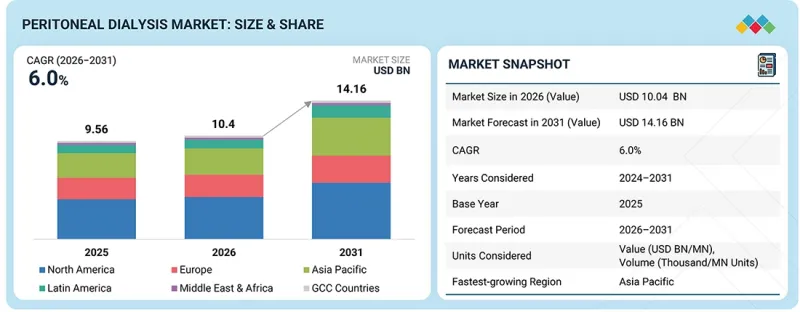
腹膜透析市場預計在預測期內將以 6.0% 的複合年成長率成長,從 2026 年的 100.4 億美元成長到 2031 年的 141.6 億美元。
| 調查範圍 | |
|---|---|
| 調查期 | 2026-2031 |
| 基準年 | 2025 |
| 預測期 | 2026-2031 |
| 單元 | 金額(美元) |
| 部分 | 產品與服務、治療方案、適應症、最終使用者、地區 |
| 目標區域 | 北美、歐洲、亞太地區及其他地區 |
已開發市場有利的醫療保健政策顯著擴大了腹膜透析的覆蓋範圍。許多國家現在都提供居家治療的報銷計畫。在大多數情況下,美國、加拿大和其他一些歐洲國家已經實施了相關政策,承認腹膜透析比院內血液透析更具成本效益,並能為患者帶來更多好處。這些政策報銷了腹膜透析治療費用的很大一部分,從而降低了治療門檻。因此,腹膜透析可以成為患者更經濟實惠且更容易獲得的治療選擇。鑑於腹膜透析的柔軟性來促進腹膜透析的更廣泛應用。同樣,其他已開發市場也在推廣居家透析,因為它能夠減少住院次數、改善病患預後並減輕醫療機構的負擔。對於老年人和臥床不起的患者而言,腹膜透析的經濟支持至關重要,因為它可以減少行動限制,使他們更容易獲得個人化治療,從而提高生活品質。
“末期腎功能衰竭(ESRD)細分市場佔據最大的市場佔有率,預計在預測期內將以最高的複合年成長率成長。”
大多數醫療系統都鼓勵患者選擇居家腹膜透析,以減少末期腎臟病(ESRD)患者的住院次數,並降低整體醫療成本。對醫療服務提供者而言,引進居家腹膜透析可以減少病患在院透析的需求,從而保障醫院資源,並最大限度地減少醫院和醫護人員面臨的問題。居家腹膜透析也能讓患者自主管理治療,進而提升生活品質。此外,居家腹膜透析的其他優點還包括降低交通成本、減少感染風險以及更容易獲得持續治療。因此,居家腹膜透析對於醫療系統而言是一種經濟實惠且極具吸引力的治療選擇。
“居家醫療行業佔據最大的市場佔有率,預計在預測期內將以最高的複合年成長率成長。”
可攜式且操作簡單的透析設備的廣泛普及,進一步提升了居家透析的安全性和便利性。最新的腹膜透析機擁有直覺的介面、自動化功能和緊湊的設計,讓患者無需依賴過多的醫學知識即可輕鬆使用。因此,患者能夠更輕鬆地進行獨立舒適的居家透析,對醫療專業人員的依賴也隨之降低。即時監測和自動警報等安全措施也得到了改進,能夠及早發現問題並及時應對,避免風險的發生。這些創新增強了患者自主管理治療的信心,從而整體了治療順從性。
“預計北美在預測期內將經歷顯著成長。”
截至2023年,亞太地區預計將在預測期內保持最高的複合年成長率,而北美地區預計到2025年將佔據最大的市場佔有率。北美之所以成為腹膜透析最大的區域市場,原因之一是該地區的醫護人員接受過良好的培訓,能夠有效地管理這項治療。這確保了需要接受治療的患者能夠獲得全面的指導,從而安全有效地在家中進行透析。此外,這些專業人員透過有效的監測及時介入,旨在改善治療效果並最大限度地減少併發症。該地區的專業培訓計畫和持續的專業發展進一步支持了高品質的醫療服務。醫護人員的這種專業水平無疑促進了腹膜透析在北美的成功引入和廣泛應用。
本報告檢視了全球腹膜透析市場,提供了市場概述、影響市場成長的各種因素分析、技術和專利趨勢、法律制度、案例研究、歷史和預測市場規模、按各個細分市場和地區/主要國家進行的詳細分析、競爭格局以及主要公司的概況。
目錄
第1章:引言
第2章執行摘要
第3章重要考察
第4章 市場概覽
- 市場動態
- 促進因素
- 抑制因子
- 機會
- 任務
- 未滿足的需求和閒置頻段
- 相關市場和跨行業商機
- 一、二、三級企業的策略趨勢
第5章 產業趨勢
- 波特五力分析
- 宏觀經濟展望
- GDP趨勢與預測
- 腹膜透析產業的全球趨勢
- 全球醫療和腎臟護理行業趨勢
- 供應鏈分析
- 價值鏈分析
- 生態系分析
- 價格分析
- 貿易分析
- 2026-2027 年主要會議和活動
- 影響客戶業務的趨勢/顛覆性因素
- 投資和資金籌措場景
- 案例研究分析
- 2025年美國關稅對腹膜透析市場的影響
- 治療數據分析
第6章:技術進步、人工智慧的影響、專利、創新與未來應用
- 主要新興技術
- 互補技術
- 遠端監控系統
- 技術/產品藍圖
- 短期(2025-2027 年)| 基礎設施建設和初步商業化
- 中期計劃(2027-2030 年)| 擴張與標準化
- 長期(2030-2035年及以後)|大規模商業化與顛覆性變革
- 專利分析
- 未來應用
- 人工智慧驅動的遠端腹膜透析管理和預測醫學
- 智慧腹膜透析生態系統
- 用於腹膜透析的先進耗材和生物相容性溶液
- 人工智慧/生成式人工智慧對腹膜透析市場的影響
第7章 監理情勢
- 當地法規和合規性
第8章:顧客趨勢與購買行為
- 決策流程
- 相關人員及購買評估標準
- 實施障礙和內部挑戰
- 各個終端用戶產業尚未滿足的需求
- 市場盈利
第9章 腹膜透析市場:依服務細分
- 腹膜透析產品
- 腹膜透析液袋
- 腹膜透析機
- 腹膜透析導管
- 腹膜透析運輸套裝
- 其他
- 腹膜透析服務
第10章 腹膜透析市場:依治療方法分類
- 持續性移動式腹膜透析(CAPD)
- 自動腹膜透析(APD)
第11章 腹膜透析市場:依適應症分類
- 末期腎功能衰竭
- 急性腎損傷
- 其他
第12章 腹膜透析市場:依最終使用者分類
- 居家醫療設施
- 醫院及獨立透析中心
- 其他
第13章 腹膜透析市場:依地區分類
- 北美洲
- 美國
- 加拿大
- 歐洲
- 德國
- 英國
- 法國
- 義大利
- 西班牙
- 其他
- 亞太地區
- 日本
- 中國
- 印度
- 澳洲
- 韓國
- 其他
- 拉丁美洲
- 巴西
- 墨西哥
- 其他
- 中東和非洲
- 海灣合作理事會國家
第14章 競爭格局
- 概述
- 主要企業策略/領先公司
- 收入分析
- 市佔率分析
- 企業估值矩陣:主要公司
- 公司估值矩陣:新創企業/中小企業
- 企業估值和財務指標
- 品牌/產品對比
- 競爭格局
第15章:公司簡介
- 大公司
- FRESENIUS MEDICAL CARE AG
- VANTIVE
- DAVITA INC.
- TERUMO CORPORATION
- BECTON, DICKINSON AND COMPANY
- UTAH MEDICAL PRODUCTS, INC.
- MOZARC MEDICAL
- DIAVERUM AB
- MEDIONICS
- NEWSOL TECHNOLOGIES INC.
- APOLLO DIALYSIS PVT. LTD.
- US RENAL CARE, INC.
- NORTHWEST KIDNEY CENTERS
- RELAVO
- MITRA INDUSTRIES PVT. LTD.
- 其他公司
- JMS CO., LTD.
- AMECATH
- POLYMEDICURE
- HUAREN PHARMACEUTICAL
- AWAK TECHNOLOGIES
- INNOVATIVE RENAL CARE
- ROMSONS
- SSEM MTHEMBU MEDICAL (PTY) LTD.
- RENAX BIOMEDICAL TECHNOLOGY CO., LTD.
- ADVIN HEALTH CARE
第16章調查方法
第17章附錄
The peritoneal dialysis market is projected to reach USD 14.16 billion by 2031 from USD 10.04 billion in 2026 at a CAGR of 6.0% during the forecast period.
| Scope of the Report | |
|---|---|
| Years Considered for the Study | 2026-2031 |
| Base Year | 2025 |
| Forecast Period | 2026-2031 |
| Units Considered | Value (USD billion) |
| Segments | Offerings, Modality, Disease Indication, End user, and Region |
| Regions covered | North America, Europe, APAC, RoW |
Favorable healthcare policies in developed markets have greatly increased access to peritoneal dialysis, as many now offer reimbursement for home-based treatments. In most cases, the United States, Canada, and several other European countries have implemented policies that acknowledge the cost-effectiveness and greater benefits of peritoneal dialysis over in-center hemodialysis for patients. Such policies reduce barriers to treatment by providing reimbursement for a significant portion of PD-associated treatment costs. This could make PD a much more affordable and accessible form of therapy for patients, and reimbursement programs encourage healthcare providers to recommend PD for its flexibility and practicality, especially for those preferring home management of treatment. For instance, in the United States, Medicare's ESRD program encourages wider adoption by providing reimbursements for home dialysis. Likewise, other developed markets are also following and encouraging home dialysis since it reduces hospital admissions, improves patient outcomes, and reduces burdens on healthcare facilities. The financial support that comes with PD has become a reason for the aged and bedridden patients who have been able to live better as a result of reduced immobilization and enhanced personal care.
"The end-stage renal disease segment holds the largest market share in the global peritoneal dialysis market and is expected to grow at the highest CAGR during the forecast period."
Most healthcare systems promote home dialysis options to reduce hospital visits for end-stage renal disease (ESRD), thereby reducing overall healthcare costs. Health care providers would benefit from home peritoneal dialysis by reducing the need for in-center dialysis, thereby conserving hospital facility capacity and minimizing the problems it poses for both facilities and personnel. Home dialysis will also improve patients' lives by giving them control over their treatment. An added advantage of home-based PD is that it is very economical since it saves transportation costs, minimizes susceptibility to infection, and encourages continuity of care, which makes it an attractive modality for health care systems.
"The home care settings segment accounted for the largest market share in the global peritoneal dialysis market and is expected to grow at the highest CAGR during the forecast period."
Portable, user-friendly dialysis equipment has further improved the safety and ease of treatment for patients in the home setting. Modern peritoneal dialysis machines are well-designed, with intuitive interfaces, automation, and compact size, making them devices that patients can use with relative ease without relying heavily on medical knowledge. Thus, independent, comfortable home-based dialysis has reduced patients' dependence on healthcare professionals. Safety measures have improved with live monitoring and automatic alarms that enhance outcomes best dealt with early, before dangers occur. With those innovations, patients' confidence in managing their care improved, while treatment compliance generally increased.
"North America is expected to witness a substantial growth rate during the forecast period."
The peritoneal dialysis market is segmented into North America, Europe, Asia Pacific, Latin America, and the Middle East & Africa by region. In 2023, the Asia Pacific region is projected to exhibit the highest CAGR during the forecast period. However, North America accounted for the largest market share of the peritoneal dialysis market in 2025. North America is the largest regional market for peritoneal dialysis, partly because healthcare providers in the region have been trained to manage this treatment. This places them in a better position to ensure that patients requiring the treatment receive a holistic education on how to carry out procedures safely and effectively at home. Moreover, these professionals provide timely interventions through effective monitoring, thereby improving outcomes and reducing complications as much as possible. Specialized training programs and ongoing professional development in the region further underpin quality care. Such professionalism among healthcare professionals has indeed contributed to success in the introduction and spread of peritoneal dialysis in North America.
A breakdown of the primary participants (supply-side) for the peritoneal dialysis market referred to in this report is provided below:
- By Company Type: Tier 1:34%, Tier 2: 38%, and Tier 3: 28%
- By Designation: C-level: 26%, Director Level: 35%, and Others: 39%
- By Region: North America: 17%, Europe: 39%, Asia Pacific: 28%, Latin America: 8%, Middle East & Africa: 3%, GCC Countries: 5%
Prominent players in the peritoneal dialysis market are market Vantive (US), Fresenius Medical Care AG (Germany), Mozarc Medical (US), Davita Inc. (US), Becton, Dickinson and Company (US), Utah Medical Products, Inc. (US), Terumo Corporation (Japan), Diaverum AB (Sweden), Medionics (Canada), Newsol Technologies (Canada), Apollo Dialysis Pvt Ltd (India), U.S. Renal Care, Inc. (US), Northwest Kidney Centers (US), Relavo (US), Mitra Industries Pvt Ltd (India), JMS Co., Ltd. (Japan), among others.
Research Coverage
The report evaluates the peritoneal dialysis market and estimates the market size and future growth potential of this market based on various segments, including offerings, modality, disease indication, end user, and region. The report also includes a competitive analysis of the major players in this market, along with company profiles, product offerings, recent developments, and key market strategies.
Reasons to Buy the Report
The report will assist market leaders and new entrants with data on the nearest approximations of revenue numbers for the overall market, the peritoneal dialysis market, and the subsegments. The report will assist stakeholders in understanding the competitive landscape and gain further insights into better positioning their businesses and making appropriate go-to-market strategies. The report helps stakeholders understand the market pulse and provides data on key drivers, barriers, and opportunities in the market.
This report provides insights into the following points:
- Analysis of key drivers Drivers (rising prevalence of chronic kidney diseases, growing prevalence of diabetes and hypertension, and technological advancements and increased investment in R&D) restraints (underutilization of peritoneal dialysis in low-income and lower-middle-income countries (LLMICs)) opportunities (increasing growth opportunities in emerging economies, and surge in demand for home dialysis treatment), and challenges (growing incidence of treated kidney failure, and shortage of skilled nephrologists in low-income and lower-middle-income countries (LLMICs)).
- Product Enhancement/Innovation: Comprehensive details about product launches and anticipated trends in the global peritoneal dialysis market
- Market Development: Thorough knowledge and analysis of the profitable rising markets by offerings, modality, disease indication, end user, and region.
- Market Diversification: Comprehensive information about newly launched products, expanding markets, current advancements, and investments in the global peritoneal dialysis market
- Competitive Assessment: Thorough evaluation of the market shares, growth plans, offerings, and capacities of the major competitors in the global peritoneal dialysis market
TABLE OF CONTENTS
1 INTRODUCTION
- 1.1 STUDY OBJECTIVES
- 1.2 MARKET DEFINITION
- 1.2.1 INCLUSIONS AND EXCLUSIONS
- 1.3 STUDY SCOPE
- 1.3.1 SEGMENTS COVERED
- 1.4 YEARS CONSIDERED
- 1.5 CURRENCY USED
- 1.6 STAKEHOLDERS
- 1.7 LIMITATIONS
- 1.8 SUMMARY OF CHANGES
2 EXECUTIVE SUMMARY
- 2.1 KEY INSIGHTS AND MARKET HIGHLIGHTS
- 2.2 KEY MARKET PARTICIPANTS: SHARE INSIGHTS AND START DEVELOPMENTS
- 2.3 DISRUPTIVE TRENDS SHAPING MARKET
- 2.4 HIGH-GROWTH SEGMENTS & EMERGING FRONTIERS
- 2.5 SNAPSHOT: GLOBAL MARKET SIZE, GROWTH RATE, AND FORECAST
3 PREMIUM INSIGHTS
- 3.1 PERITONEAL DIALYSIS MARKET OVERVIEW
- 3.2 NORTH AMERICA: PERITONEAL DIALYSIS MARKET, BY PRODUCT AND COUNTRY
- 3.3 PERITONEAL DIALYSIS MARKET: GEOGRAPHIC GROWTH OPPORTUNITIES
- 3.4 PERITONEAL DIALYSIS MARKET, BY REGION
- 3.5 PERITONEAL DIALYSIS MARKET: DEVELOPED MARKETS VS. EMERGING ECONOMIES
4 MARKET OVERVIEW
- 4.1 INTRODUCTION
- 4.2 MARKET DYNAMICS
- 4.2.1 DRIVERS
- 4.2.1.1 Rising prevalence of chronic kidney diseases
- 4.2.1.2 Growing prevalence of diabetes and hypertension
- 4.2.1.3 Technological advancements and increased investment in R&D
- 4.2.2 RESTRAINTS
- 4.2.2.1 Underutilization of peritoneal dialysis in low-income and lower-middle-income countries (LLMICs)
- 4.2.3 OPPORTUNITIES
- 4.2.3.1 Increasing growth opportunities in emerging economies
- 4.2.3.2 Surge in demand for home dialysis treatment
- 4.2.4 CHALLENGES
- 4.2.4.1 Shortage of skilled nephrologists in low-income and lower-middle-income countries (LLMICs)
- 4.2.4.2 High risk of peritonitis as a barrier to peritoneal dialysis adoption
- 4.2.1 DRIVERS
- 4.3 UNMET NEEDS AND WHITE SPACES
- 4.3.1 UNMET NEEDS IN PATIENT MONITORING DEVICES MARKET
- 4.3.2 WHITE SPACE OPPORTUNITIES
- 4.4 INTERCONNECTED MARKETS AND CROSS-SECTOR OPPORTUNITIES
- 4.4.1 INTERCONNECTED MARKETS
- 4.4.2 CROSS-SECTOR OPPORTUNTIES
- 4.5 STRATEGIC MOVES BY TIER-1/2/3 PLAYERS
5 INDUSTRY TRENDS
- 5.1 PORTER'S FIVE FORCES ANALYSIS
- 5.1.1 THREAT OF NEW ENTRANTS
- 5.1.2 THREAT OF SUBSTITUTES
- 5.1.3 BARGAINING POWER OF SUPPLIERS
- 5.1.4 BARGAINING POWER OF BUYERS
- 5.1.5 INTENSITY OF COMPETITIVE RIVALRY
- 5.2 MACROECONOMIC OUTLOOK
- 5.2.1 INTRODUCTION
- 5.2.2 GDP TRENDS AND FORECAST
- 5.2.3 TRENDS IN GLOBAL PERITONEAL DIALYSIS INDUSTRY
- 5.2.4 TRENDS IN GLOBAL HEALTHCARE & RENAL CARE INDUSTRY
- 5.3 SUPPLY CHAIN ANALYSIS
- 5.4 VALUE CHAIN ANALYSIS
- 5.5 ECOSYSTEM ANALYSIS
- 5.6 PRICING ANALYSIS
- 5.6.1 AVERAGE SELLING PRICE TREND, BY PRODUCT
- 5.6.2 AVERAGE SELLING PRICE OF PERITONEAL DIALYSIS PRODUCTS AND CONSUMABLES, BY KEY PLAYER
- 5.6.3 AVERAGE SELLING PRICE TREND OF PERITONEAL DIALYSIS MACHINES, BY REGION
- 5.7 TRADE ANALYSIS
- 5.7.1 IMPORT SCENARIO (HS CODE 9018)
- 5.7.2 EXPORT DATA (HS CODE 9018)
- 5.8 KEY CONFERENCES & EVENTS, 2026-2027
- 5.9 TRENDS/DISRUPTIONS IMPACTING CUSTOMER BUSINESS
- 5.10 INVESTMENT AND FUNDING SCENARIO
- 5.11 CASE STUDY ANALYSIS
- 5.11.1 EXPANDING HOME-BASED PERITONEAL DIALYSIS THROUGH REMOTE PATIENT MONITORING
- 5.11.2 ENHANCING HOME PERITONEAL DIALYSIS MANAGEMENT WITH DIGITAL CONNECTIVITY
- 5.11.3 IMPROVING HOME DIALYSIS OUTCOMES THROUGH CONNECTED CARE
- 5.12 IMPACT OF 2025 US TARIFFS - PERITONEAL DIALYSIS MARKET
- 5.12.1 INTRODUCTION
- 5.12.2 KEY TARIFF RATES
- 5.12.3 PRICE IMPACT ANALYSIS
- 5.12.4 IMPACT ON COUNTRIES/REGIONS
- 5.12.4.1 North America
- 5.12.4.2 Europe
- 5.12.4.3 Asia Pacific
- 5.12.5 END-USE INDUSTRY IMPACT
- 5.13 PROCEDURE DATA ANALYSIS
- 5.13.1 PREVALENCE DATA FOR TREATED KIDNEY FAILURE
6 TECHNOLOGICAL ADVANCEMENTS, AI-DRIVEN IMPACT, PATENTS, INNOVATIONS, AND FUTURE APPLICATIONS
- 6.1 KEY EMERGING TECHNOLOGIES
- 6.2 COMPLEMENTARY TECHNOLOGIES
- 6.2.1 REMOTE MONITORING SYSTEMS
- 6.3 TECHNOLOGY/PRODUCT ROADMAP
- 6.3.1 SHORT-TERM (2025-2027) | FOUNDATION & EARLY COMMERCIALIZATION
- 6.3.2 MID-TERM (2027-2030) | EXPANSION & STANDARDIZATION
- 6.3.3 LONG-TERM (2030-2035+) | MASS COMMERCIALIZATION & DISRUPTION
- 6.4 PATENT ANALYSIS
- 6.4.1 INSIGHTS: JURISDICTION AND TOP APPLICANT ANALYSIS
- 6.5 FUTURE APPLICATIONS
- 6.5.1 AI-ENABLED REMOTE PERITONEAL DIALYSIS MANAGEMENT & PREDICTIVE CARE
- 6.5.2 SMART PERITONEAL DIALYSIS ECOSYSTEMS
- 6.5.3 ADVANCED PERITONEAL DIALYSIS CONSUMABLES & BIOCOMPATIBLE SOLUTIONS
- 6.6 IMPACT OF AI/GEN AI ON PERITONEAL DIALYSIS MARKET
- 6.6.1 TOP USE CASES AND MARKET POTENTIAL
- 6.6.2 CASE STUDIES OF AI IMPLEMENTATION IN PERITONEAL DIALYSIS MARKET
- 6.6.3 INTERCONNECTED ADJACENT ECOSYSTEM AND IMPACT ON MARKET PLAYERS
- 6.6.4 CLIENTS' READINESS TO ADOPT GENERATIVE AI IN PERITONEAL DIALYSIS MARKET
7 REGULATORY LANDSCAPE
- 7.1 REGIONAL REGULATIONS AND COMPLIANCE
- 7.1.1 REGULATORY BODIES, GOVERNMENT AGENCIES, AND OTHER ORGANIZATIONS
- 7.1.2 INDUSTRY STANDARDS
8 CUSTOMER LANDSCAPE & BUYER BEHAVIOR
- 8.1 DECISION-MAKING PROCESS
- 8.2 BUYER STAKEHOLDERS AND BUYING EVALUATION CRITERIA
- 8.2.1 KEY STAKEHOLDERS IN BUYING PROCESS
- 8.2.2 KEY BUYING CRITERIA
- 8.3 ADOPTION BARRIERS & INTERNAL CHALLENGES
- 8.4 UNMET NEEDS FROM VARIOUS END-USE INDUSTRIES
- 8.5 MARKET PROFITABILITY
- 8.5.1 REVENUE POTENTIAL
- 8.5.2 COST DYNAMICS
- 8.5.3 MARGIN OPPORTUNITIES IN KEY APPLICATIONS
9 PERITONEAL DIALYSIS MARKET, BY OFFERING
- 9.1 INTRODUCTION
- 9.2 PERITONEAL DIALYSIS PRODUCTS
- 9.2.1 PERITONEAL DIALYSIS SOLUTION BAGS
- 9.2.1.1 High demand for solutions to boost segmental growth
- 9.2.2 PERITONEAL DIALYSIS MACHINES
- 9.2.2.1 Rising prevalence of chronic diseases in emerging economies to boost adoption
- 9.2.3 PERITONEAL DIALYSIS CATHETERS
- 9.2.3.1 Favorable reimbursement policies to support market growth
- 9.2.4 PERITONEAL DIALYSIS TRANSFER SETS
- 9.2.4.1 Product recalls to limit market growth
- 9.2.5 OTHER PERITONEAL DIALYSIS PRODUCTS
- 9.2.1 PERITONEAL DIALYSIS SOLUTION BAGS
- 9.3 PERITONEAL DIALYSIS SERVICES
- 9.3.1 BETTER PRIVACY AND INCREASED COMFORT OF AT-HOME DIALYSIS TREATMENT TO DRIVE MARKET
10 PERITONEAL DIALYSIS MARKET, BY MODALITY
- 10.1 INTRODUCTION
- 10.2 CONTINUOUS AMBULATORY PERITONEAL DIALYSIS (CAPD)
- 10.2.1 SUPERIOR CLEARANCE OF HIGH-MOLECULAR-WEIGHT SUBSTANCES TO DRIVE MARKET
- 10.3 AUTOMATED PERITONEAL DIALYSIS (APD)
- 10.3.1 RISK OF RAPID DECLINE IN RESIDUAL RENAL FUNCTIONS TO LIMIT ADOPTION
11 PERITONEAL DIALYSIS MARKET, BY DISEASE INDICATION
- 11.1 INTRODUCTION
- 11.2 END-STAGE RENAL DISEASE
- 11.2.1 GROWING GERIATRIC POPULATION AND INCREASING PREVALENCE OF DIABETES TO DRIVE MARKET
- 11.3 ACUTE KIDNEY INJURY
- 11.3.1 INCREASING HOSPITALIZATIONS TO PROPEL MARKET GROWTH
- 11.4 OTHER DISEASES
12 PERITONEAL DIALYSIS MARKET, BY END USER
- 12.1 INTRODUCTION
- 12.2 HOME CARE SETTINGS
- 12.2.1 LOWER COST AND SHORTER HOSPITAL STAYS TO AID MARKET GROWTH
- 12.3 HOSPITALS & INDEPENDENT DIALYSIS CENTERS
- 12.3.1 IMPROVED FACILITIES AND INCREASED GOVERNMENT SUPPORT TO DRIVE MARKET
- 12.4 OTHER END USERS
13 PERITONEAL DIALYSIS MARKET, BY REGION
- 13.1 INTRODUCTION
- 13.1.1 PERITONEAL DIALYSIS PREVALENCE DATA
- 13.1.2 PERITONEAL DIALYSIS PROCEDURE DATA
- 13.2 NORTH AMERICA
- 13.2.1 US
- 13.2.1.1 US to account for largest market share during study period
- 13.2.2 CANADA
- 13.2.2.1 Shortage of dialysis facilities and increased treatment cost to limit market
- 13.2.1 US
- 13.3 EUROPE
- 13.3.1 GERMANY
- 13.3.1.1 Rising number of end-stage renal disease (ESRD) patients to boost market growth
- 13.3.2 UK
- 13.3.2.1 Increased number of new dialysis centers and technological advancements to support market growth
- 13.3.3 FRANCE
- 13.3.3.1 Low cost of peritoneal dialysis and consistent reimbursement policies to drive market growth
- 13.3.4 ITALY
- 13.3.4.1 Increasing research activities and growing patient population with acute renal failure to augment market growth
- 13.3.5 SPAIN
- 13.3.5.1 Favorable reimbursement scenario to boost market growth
- 13.3.6 REST OF EUROPE
- 13.3.1 GERMANY
- 13.4 ASIA PACIFIC
- 13.4.1 JAPAN
- 13.4.1.1 High prevalence of end-stage renal disease (ESRD) and large geriatric population to support market growth
- 13.4.2 CHINA
- 13.4.2.1 Increasing prevalence of diabetes and hypertension to drive market
- 13.4.3 INDIA
- 13.4.3.1 Favorable government initiatives and high prevalence of kidney disease to fuel market growth
- 13.4.4 AUSTRALIA
- 13.4.4.1 Increasing government initiatives about renal care to support market growth
- 13.4.5 SOUTH KOREA
- 13.4.5.1 Growing geriatric population with chronic kidney disease to propel market growth
- 13.4.6 REST OF ASIA PACIFIC
- 13.4.1 JAPAN
- 13.5 LATIN AMERICA
- 13.5.1 BRAZIL
- 13.5.1.1 Brazil to account for largest share of Latin American market during forecast period
- 13.5.2 MEXICO
- 13.5.2.1 Increasing patient population and growing middle class population to boost market growth
- 13.5.3 REST OF LATIN AMERICA
- 13.5.1 BRAZIL
- 13.6 MIDDLE EAST & AFRICA
- 13.6.1 GROWING DEMAND FOR CONVENIENT AND ACCESSIBLE RENAL CARE TO PROPEL GROWTH
- 13.7 GCC COUNTRIES
- 13.7.1 HIGHER DISPOSABLE INCOME AND INCREASED GOVERNMENT HEALTHCARE EXPENDITURE TO PROPEL MARKET GROWTH
14 COMPETITIVE LANDSCAPE
- 14.1 OVERVIEW
- 14.2 KEY PLAYER STRATEGY/RIGHT TO WIN
- 14.3 REVENUE ANALYSIS
- 14.4 MARKET SHARE ANALYSIS
- 14.5 COMPANY EVALUATION MATRIX: KEY PLAYERS, 2025
- 14.5.1 STARS
- 14.5.2 EMERGING LEADERS
- 14.5.3 PERVASIVE PLAYERS
- 14.5.4 PARTICIPANTS
- 14.5.5 COMPANY FOOTPRINT: KEY PLAYERS, 2025
- 14.5.5.1 Company footprint
- 14.5.5.2 Region footprint
- 14.5.5.3 Offering footprint
- 14.5.5.4 Modality footprint
- 14.5.5.5 Disease indication footprint
- 14.5.5.6 End-user footprint
- 14.6 COMPANY EVALUATION MATRIX: STARTUPS/SMES, 2025
- 14.6.1 PROGRESSIVE COMPANIES
- 14.6.2 RESPONSIVE COMPANIES
- 14.6.3 DYNAMIC COMPANIES
- 14.6.4 STARTING BLOCKS
- 14.6.5 COMPETITIVE BENCHMARKING: STARTUPS/SMES, 2025
- 14.6.5.1 Detailed list of key start-up/SME players
- 14.6.5.2 Competitive benchmarking of key startup/SME players
- 14.7 COMPANY VALUATION & FINANCIAL METRICS
- 14.8 BRAND/PRODUCT COMPARISON
- 14.9 COMPETITIVE SCENARIO
- 14.9.1 PRODUCT APPROVALS
- 14.9.2 DEALS
- 14.9.3 EXPANSIONS
- 14.9.3.1 Other developments
15 COMPANY PROFILES
- 15.1 KEY PLAYERS
- 15.1.1 FRESENIUS MEDICAL CARE AG
- 15.1.1.1 Business overview
- 15.1.1.2 Products & services offered
- 15.1.1.3 Recent developments
- 15.1.1.3.1 Deals
- 15.1.1.4 MnM view
- 15.1.1.4.1 Right to win
- 15.1.1.4.2 Strategic choices
- 15.1.1.4.3 Weaknesses & competitive threats
- 15.1.2 VANTIVE
- 15.1.2.1 Business overview
- 15.1.2.2 Products & services offered
- 15.1.2.3 Recent developments
- 15.1.2.3.1 Deals
- 15.1.2.4 MnM view
- 15.1.2.4.1 Right to win
- 15.1.2.4.2 Strategic choices
- 15.1.2.4.3 Weaknesses & competitive threats
- 15.1.3 DAVITA INC.
- 15.1.3.1 Business overview
- 15.1.3.2 Products & services offered
- 15.1.3.3 Recent developments
- 15.1.3.3.1 Deals
- 15.1.3.3.2 Expansions
- 15.1.3.4 Other developments
- 15.1.3.5 MnM view
- 15.1.3.5.1 Right to win
- 15.1.3.5.2 Strategic choices
- 15.1.3.5.3 Weaknesses & competitive threats
- 15.1.4 TERUMO CORPORATION
- 15.1.4.1 Business overview
- 15.1.4.2 Products & services offered
- 15.1.4.3 Recent developments
- 15.1.4.3.1 Product approvals
- 15.1.4.3.2 Deals
- 15.1.4.3.3 Expansions
- 15.1.4.4 MnM view
- 15.1.4.4.1 Right to win
- 15.1.4.4.2 Strategic choices
- 15.1.4.4.3 Weaknesses & competitive threats
- 15.1.5 BECTON, DICKINSON AND COMPANY
- 15.1.5.1 Business overview
- 15.1.5.2 Products & services offered
- 15.1.5.3 Recent developments
- 15.1.5.3.1 Expansions
- 15.1.5.4 MnM view
- 15.1.5.4.1 Right to win
- 15.1.5.4.2 Strategic choices
- 15.1.5.4.3 Weaknesses & competitive threats
- 15.1.6 UTAH MEDICAL PRODUCTS, INC.
- 15.1.6.1 Business overview
- 15.1.6.2 Products & services offered
- 15.1.7 MOZARC MEDICAL
- 15.1.7.1 Business overview
- 15.1.7.2 Products & services offered
- 15.1.8 DIAVERUM AB
- 15.1.8.1 Business overview
- 15.1.8.2 Products & services offered
- 15.1.9 MEDIONICS
- 15.1.9.1 Business overview
- 15.1.9.2 Products & services offered
- 15.1.10 NEWSOL TECHNOLOGIES INC.
- 15.1.10.1 Business overview
- 15.1.10.2 Products & services offered
- 15.1.11 APOLLO DIALYSIS PVT. LTD.
- 15.1.11.1 Business overview
- 15.1.11.2 Products & services offered
- 15.1.12 U.S. RENAL CARE, INC.
- 15.1.12.1 Business overview
- 15.1.12.2 Products & services offered
- 15.1.13 NORTHWEST KIDNEY CENTERS
- 15.1.13.1 Business overview
- 15.1.13.2 Products & services offered
- 15.1.13.3 Recent developments
- 15.1.13.3.1 Deals
- 15.1.13.3.2 Expansions
- 15.1.14 RELAVO
- 15.1.14.1 Business overview
- 15.1.14.2 Products & services offered
- 15.1.15 MITRA INDUSTRIES PVT. LTD.
- 15.1.15.1 Business overview
- 15.1.15.2 Products & services offered
- 15.1.1 FRESENIUS MEDICAL CARE AG
- 15.2 OTHER PLAYERS
- 15.2.1 JMS CO., LTD.
- 15.2.2 AMECATH
- 15.2.3 POLYMEDICURE
- 15.2.4 HUAREN PHARMACEUTICAL
- 15.2.5 AWAK TECHNOLOGIES
- 15.2.6 INNOVATIVE RENAL CARE
- 15.2.7 ROMSONS
- 15.2.8 SSEM MTHEMBU MEDICAL (PTY) LTD.
- 15.2.9 RENAX BIOMEDICAL TECHNOLOGY CO., LTD.
- 15.2.10 ADVIN HEALTH CARE
16 RESEARCH METHODOLOGY
- 16.1 RESEARCH DATA
- 16.1.1 SECONDARY DATA
- 16.1.2 PRIMARY DATA
- 16.2 MARKET SIZE ESTIMATION
- 16.2.1 REVENUE MAPPING-BASED MARKET ESTIMATION
- 16.2.2 COMPANY PRESENTATIONS AND PRIMARY INTERVIEWS
- 16.2.3 USAGE-BASED MARKET ESTIMATION
- 16.2.4 PRIMARY RESEARCH VALIDATION
- 16.3 GROWTH FORECAST ESTIMATION
- 16.4 DATA TRIANGULATION
- 16.5 STUDY ASSUMPTIONS
- 16.6 RISK ASSESSMENT
- 16.7 RESEARCH LIMITATIONS
17 APPENDIX
- 17.1 KNOWLEDGESTORE: MARKETSANDMARKETS' SUBSCRIPTION PORTAL
- 17.2 CUSTOMIZATION OPTIONS
- 17.3 RELATED REPORTS
- 17.4 AUTHOR DETAILS
List of Tables
- TABLE 1 INCLUSIONS AND EXCLUSIONS
- TABLE 2 STANDARD USD CURRENCY CONVERSION RATES
- TABLE 3 NUMBER OF PEOPLE AGED 65 YEARS OR OVER, BY REGION, 2022 VS. 2050
- TABLE 4 UTILIZATION OF KIDNEY REPLACEMENT THERAPIES (PERITONEAL DIALYSIS VS. HEMODIALYSIS)
- TABLE 5 COST OF KIDNEY REPLACEMENT THERAPIES
- TABLE 6 STRATEGIC MOVES BY TIER-1/2/3 PLAYERS
- TABLE 7 PERITONEAL DIALYSIS MARKET: PORTER'S FIVE FORCES
- TABLE 8 GDP PERCENTAGE CHANGE, BY KEY COUNTRY, 2021-2030
- TABLE 9 AVERAGE SELLING PRICE OF PERITONEAL DIALYSIS PRODUCTS AND CONSUMABLES, BY KEY PLAYER, 2025 (USD)
- TABLE 10 AVERAGE SELLING PRICE TREND OF PERITONEAL DIALYSIS MACHINES, BY REGION, 2023-2025 (USD)
- TABLE 11 IMPORT DATA FOR PERITONEAL DIALYSIS PRODUCTS UNDER HS CODE 9018, BY COUNTRY, 2021-2025 (USD THOUSAND)
- TABLE 12 EXPORT DATA FOR PERITONEAL DIALYSIS UNDER HS CODE 9018, BY COUNTRY, 2021-2025 (USD THOUSAND)
- TABLE 13 PERITONEAL DIALYSIS MARKET: DETAILED LIST OF KEY CONFERENCES & EVENTS, 2026-2027
- TABLE 14 US-ADJUSTED RECIPROCAL TARIFF RATES
- TABLE 15 KEY PRODUCT-RELATED TARIFF EFFECTIVE FOR PERITONEAL DIALYSIS
- TABLE 16 PREVALENCE DATA, BY COUNTRY, 2021-2023 (PMP)
- TABLE 17 NUMBER OF PERITONEAL DIALYSIS PATIENTS, BY REGION, 2019-2023
- TABLE 18 NUMBER OF PERITONEAL DIALYSIS PATIENTS, BY REGION, 2024-2029
- TABLE 19 PROCEDURE DATA FOR PERITONEAL DIALYSIS, BY COUNTRY, 2019-2023
- TABLE 20 PROCEDURE DATA FOR PERITONEAL DIALYSIS, BY COUNTRY, 2024-2029
- TABLE 21 TOP USE CASES AND MARKET POTENTIAL
- TABLE 22 PERITONEAL DIALYSIS MARKET: CASE STUDIES RELATED TO AI IMPLEMENTATION
- TABLE 23 INTERCONNECTED ADJACENT ECOSYSTEM AND IMPACT ON MARKET PLAYERS
- TABLE 24 NORTH AMERICA: REGULATORY BODIES, GOVERNMENT AGENCIES, AND OTHER ORGANIZATIONS
- TABLE 25 EUROPE: REGULATORY BODIES, GOVERNMENT AGENCIES, AND OTHER ORGANIZATIONS
- TABLE 26 ASIA PACIFIC: REGULATORY BODIES, GOVERNMENT AGENCIES, AND OTHER ORGANIZATIONS
- TABLE 27 LATIN AMERICA: REGULATORY BODIES, GOVERNMENT AGENCIES, AND OTHER ORGANIZATIONS
- TABLE 28 MIDDLE EAST & AFRICA: REGULATORY BODIES, GOVERNMENT AGENCIES, AND OTHER ORGANIZATIONS
- TABLE 29 GLOBAL STANDARDS IN PERITONEAL DIALYSIS MARKET
- TABLE 30 INFLUENCE OF KEY STAKEHOLDERS ON BUYING PROCESS FOR PERITONEAL DIALYSIS PRODUCTS
- TABLE 31 BUYING CRITERIA FOR PERITONEAL DIALYSIS PRODUCTS
- TABLE 32 PERITONEAL DIALYSIS MARKET: UNMET NEEDS/END-USER EXPECTATIONS
- TABLE 33 PERITONEAL DIALYSIS MARKET, BY OFFERING, 2024-2031 (USD MILLION)
- TABLE 34 PERITONEAL DIALYSIS PRODUCTS MARKET, BY TYPE, 2024-2031 (USD MILLION)
- TABLE 35 PERITONEAL DIALYSIS PRODUCTS MARKET, BY REGION/COUNTRY, 2024-2031 (USD MILLION)
- TABLE 36 AVERAGE VOLUME OF EXCHANGE, BY REGION, 2021-2025 (MILLION LITERS)
- TABLE 37 AVERAGE VOLUME OF EXCHANGE, BY REGION, 2027-2031 (MILLION LITERS)
- TABLE 38 PERITONEAL DIALYSIS SOLUTION BAGS MARKET, BY COUNTRY, 2024-2031 (USD MILLION)
- TABLE 39 PERITONEAL DIALYSIS SOLUTION BAGS MARKET, BY REGION, 2024-2031 (THOUSAND UNITS)
- TABLE 40 PERITONEAL DIALYSIS MACHINES MARKET, BY COUNTRY, 2024-2031 (USD MILLION)
- TABLE 41 PERITONEAL DIALYSIS MACHINES MARKET, BY REGION, 2024-2031 (THOUSAND UNITS)
- TABLE 42 PERITONEAL DIALYSIS CATHETERS MARKET, BY COUNTRY, 2024-2031 (USD MILLION)
- TABLE 43 PERITONEAL DIALYSIS TRANSFER SETS MARKET, BY COUNTRY, 2024-2031 (USD MILLION)
- TABLE 44 OTHER PERITONEAL DIALYSIS PRODUCTS MARKET, BY COUNTRY, 2024-2031 (USD MILLION)
- TABLE 45 PERITONEAL DIALYSIS SERVICES MARKET, BY COUNTRY, 2024-2031 (USD MILLION)
- TABLE 46 PERITONEAL DIALYSIS MARKET, BY MODALITY, 2024-2031 (USD MILLION)
- TABLE 47 CONTINUOUS AMBULATORY PERITONEAL DIALYSIS (CAPD) MARKET, BY COUNTRY, 2024-2031 (USD MILLION)
- TABLE 48 AMBULATORY PERITONEAL DIALYSIS (APD) MARKET, BY COUNTRY, 2024-2031 (USD MILLION)
- TABLE 49 PERITONEAL DIALYSIS MARKET, BY DISEASE INDICATION, 2024-2031 (USD MILLION)
- TABLE 50 PERITONEAL DIALYSIS MARKET FOR END-STAGE RENAL DISEASE, BY REGION, 2024-2031 (USD MILLION)
- TABLE 51 PERITONEAL DIALYSIS MARKET FOR ACUTE KIDNEY INJURY, BY REGION, 2024-2031 (USD MILLION)
- TABLE 52 PERITONEAL DIALYSIS MARKET FOR OTHER DISEASES, BY COUNTRY, 2024-2031 (USD MILLION)
- TABLE 53 PERITONEAL DIALYSIS MARKET, BY END USER, 2024-2031 (USD MILLION)
- TABLE 54 PERITONEAL DIALYSIS MARKET FOR HOME CARE SETTINGS, BY COUNTRY, 2024-2031 (USD MILLION)
- TABLE 55 PERITONEAL DIALYSIS MARKET FOR HOSPITALS & INDEPENDENT DIALYSIS CENTERS, BY COUNTRY, 2024-2031 (USD MILLION)
- TABLE 56 PERITONEAL DIALYSIS MARKET FOR OTHER END USERS, BY COUNTRY, 2024-2031 (USD MILLION)
- TABLE 57 PERITONEAL DIALYSIS PREVALENCE DATA, BY COUNTRY, 2021-2025
- TABLE 58 PERITONEAL DIALYSIS PREVALENCE DATA, BY COUNTRY, 2026-2031
- TABLE 59 PERITONEAL DIALYSIS PROCEDURE DATA, BY REGION, 2021-2025 (MILLION PROCEDURES)
- TABLE 60 PERITONEAL DIALYSIS PROCEDURE DATA, BY REGION, 2025-2031 (MILLION PROCEDURES)
- TABLE 61 PERITONEAL DIALYSIS MARKET, BY REGION, 2024-2031 (USD MILLION)
- TABLE 62 NORTH AMERICA: PERITONEAL DIALYSIS MARKET, BY COUNTRY, 2024-2031 (USD MILLION)
- TABLE 63 NORTH AMERICA: PERITONEAL DIALYSIS MARKET, BY OFFERING, 2024-2031 (USD MILLION)
- TABLE 64 NORTH AMERICA: PERITONEAL DIALYSIS PRODUCTS MARKET, BY TYPE, 2024-2031 (USD MILLION)
- TABLE 65 NORTH AMERICA: PERITONEAL DIALYSIS MARKET, BY MODALITY, 2024-2031 (USD MILLION)
- TABLE 66 NORTH AMERICA: PERITONEAL DIALYSIS MARKET, BY DISEASE INDICATION, 2024-2031 (USD MILLION)
- TABLE 67 NORTH AMERICA: PERITONEAL DIALYSIS MARKET, BY END USER, 2024-2031 (USD MILLION)
- TABLE 68 US: PERITONEAL DIALYSIS MARKET, BY OFFERING, 2024-2031 (USD MILLION)
- TABLE 69 US: PERITONEAL DIALYSIS PRODUCTS MARKET, BY TYPE, 2024-2031 (USD MILLION)
- TABLE 70 US: PERITONEAL DIALYSIS MARKET, BY MODALITY, 2024-2031 (USD MILLION)
- TABLE 71 US: PERITONEAL DIALYSIS MARKET, BY DISEASE INDICATION, 2024-2031 (USD MILLION)
- TABLE 72 US: PERITONEAL DIALYSIS MARKET, BY END USER, 2024-2031 (USD MILLION)
- TABLE 73 CANADA: PERITONEAL DIALYSIS MARKET, BY OFFERING, 2024-2031 (USD MILLION)
- TABLE 74 CANADA: PERITONEAL DIALYSIS PRODUCTS MARKET, BY TYPE, 2024-2031 (USD MILLION)
- TABLE 75 CANADA: PERITONEAL DIALYSIS MARKET, BY MODALITY, 2024-2031 (USD MILLION)
- TABLE 76 CANADA: PERITONEAL DIALYSIS MARKET, BY DISEASE INDICATION, 2024-2031 (USD MILLION)
- TABLE 77 CANADA: PERITONEAL DIALYSIS MARKET, BY END USER, 2024-2031 (USD MILLION)
- TABLE 78 EUROPE: PERITONEAL DIALYSIS MARKET, BY COUNTRY, 2024-2031 (USD MILLION)
- TABLE 79 EUROPE: PERITONEAL DIALYSIS MARKET, BY OFFERING, 2024-2031 (USD MILLION)
- TABLE 80 EUROPE: PERITONEAL DIALYSIS PRODUCTS MARKET, BY TYPE, 2024-2031 (USD MILLION)
- TABLE 81 EUROPE: PERITONEAL DIALYSIS MARKET, BY MODALITY, 2024-2031 (USD MILLION)
- TABLE 82 EUROPE: PERITONEAL DIALYSIS MARKET, BY DISEASE INDICATION, 2024-2031 (USD MILLION)
- TABLE 83 EUROPE: PERITONEAL DIALYSIS MARKET, BY END USER, 2024-2031 (USD MILLION)
- TABLE 84 GERMANY: PERITONEAL DIALYSIS MARKET, BY OFFERING, 2024-2031 (USD MILLION)
- TABLE 85 GERMANY: PERITONEAL DIALYSIS PRODUCTS MARKET, BY TYPE, 2024-2031 (USD MILLION)
- TABLE 86 GERMANY: PERITONEAL DIALYSIS MARKET, BY MODALITY, 2024-2031 (USD MILLION)
- TABLE 87 GERMANY: PERITONEAL DIALYSIS MARKET, BY DISEASE INDICATION, 2024-2031 (USD MILLION)
- TABLE 88 GERMANY: PERITONEAL DIALYSIS MARKET, BY END USER, 2024-2031 (USD MILLION)
- TABLE 89 UK: PERITONEAL DIALYSIS MARKET, BY OFFERING, 2024-2031 (USD MILLION)
- TABLE 90 UK: PERITONEAL DIALYSIS PRODUCTS MARKET, BY TYPE, 2024-2031 (USD MILLION)
- TABLE 91 UK: PERITONEAL DIALYSIS MARKET, BY MODALITY, 2024-2031 (USD MILLION)
- TABLE 92 UK: PERITONEAL DIALYSIS MARKET, BY DISEASE INDICATION, 2024-2031 (USD MILLION)
- TABLE 93 UK: PERITONEAL DIALYSIS MARKET, BY END USER, 2024-2031 (USD MILLION)
- TABLE 94 FRANCE: PERITONEAL DIALYSIS MARKET, BY OFFERING, 2024-2031 (USD MILLION)
- TABLE 95 FRANCE: PERITONEAL DIALYSIS PRODUCTS MARKET, BY TYPE, 2024-2031 (USD MILLION)
- TABLE 96 FRANCE: PERITONEAL DIALYSIS MARKET, BY MODALITY, 2024-2031 (USD MILLION)
- TABLE 97 FRANCE: PERITONEAL DIALYSIS MARKET, BY DISEASE INDICATION, 2024-2031 (USD MILLION)
- TABLE 98 FRANCE: PERITONEAL DIALYSIS MARKET, BY END USER, 2024-2031 (USD MILLION)
- TABLE 99 ITALY: PERITONEAL DIALYSIS MARKET, BY OFFERING, 2024-2031 (USD MILLION)
- TABLE 100 ITALY: PERITONEAL DIALYSIS PRODUCTS MARKET, BY TYPE, 2024-2031 (USD MILLION)
- TABLE 101 ITALY: PERITONEAL DIALYSIS MARKET, BY MODALITY, 2024-2031 (USD MILLION)
- TABLE 102 ITALY: PERITONEAL DIALYSIS MARKET, BY DISEASE INDICATION, 2024-2031 (USD MILLION)
- TABLE 103 ITALY: PERITONEAL DIALYSIS MARKET, BY END USER, 2024-2031 (USD MILLION)
- TABLE 104 SPAIN: PERITONEAL DIALYSIS MARKET, BY OFFERING, 2024-2031 (USD MILLION)
- TABLE 105 SPAIN: PERITONEAL DIALYSIS PRODUCTS MARKET, BY TYPE, 2024-2031 (USD MILLION)
- TABLE 106 SPAIN: PERITONEAL DIALYSIS MARKET, BY MODALITY, 2024-2031 (USD MILLION)
- TABLE 107 SPAIN: PERITONEAL DIALYSIS MARKET, BY DISEASE INDICATION, 2024-2031 (USD MILLION)
- TABLE 108 SPAIN: PERITONEAL DIALYSIS MARKET, BY END USER, 2024-2031 (USD MILLION)
- TABLE 109 REST OF EUROPE: PERITONEAL DIALYSIS MARKET, BY OFFERING, 2024-2031 (USD MILLION)
- TABLE 110 REST OF EUROPE: PERITONEAL DIALYSIS PRODUCTS MARKET, BY TYPE, 2024-2031 (USD MILLION)
- TABLE 111 REST OF EUROPE: PERITONEAL DIALYSIS MARKET, BY MODALITY, 2024-2031 (USD MILLION)
- TABLE 112 REST OF EUROPE: PERITONEAL DIALYSIS MARKET, BY DISEASE INDICATION, 2024-2031 (USD MILLION)
- TABLE 113 REST OF EUROPE: PERITONEAL DIALYSIS MARKET, BY END USER, 2024-2031 (USD MILLION)
- TABLE 114 ASIA PACIFIC: PERITONEAL DIALYSIS MARKET, BY COUNTRY, 2024-2031 (USD MILLION)
- TABLE 115 ASIA PACIFIC: PERITONEAL DIALYSIS MARKET, BY OFFERING, 2024-2031 (USD MILLION)
- TABLE 116 ASIA PACIFIC: PERITONEAL DIALYSIS PRODUCTS MARKET, BY TYPE, 2024-2031 (USD MILLION)
- TABLE 117 ASIA PACIFIC: PERITONEAL DIALYSIS MARKET, BY MODALITY, 2024-2031 (USD MILLION)
- TABLE 118 ASIA PACIFIC: PERITONEAL DIALYSIS MARKET, BY DISEASE INDICATION, 2024-2031 (USD MILLION)
- TABLE 119 ASIA PACIFIC: PERITONEAL DIALYSIS MARKET, BY END USER, 2024-2031 (USD MILLION)
- TABLE 120 JAPAN: PERITONEAL DIALYSIS MARKET, BY OFFERING, 2024-2031 (USD MILLION)
- TABLE 121 JAPAN: PERITONEAL DIALYSIS PRODUCTS MARKET, BY TYPE, 2024-2031 (USD MILLION)
- TABLE 122 JAPAN: PERITONEAL DIALYSIS MARKET, BY MODALITY, 2024-2031 (USD MILLION)
- TABLE 123 JAPAN: PERITONEAL DIALYSIS MARKET, BY DISEASE INDICATION, 2024-2031 (USD MILLION)
- TABLE 124 JAPAN: PERITONEAL DIALYSIS MARKET, BY END USER, 2024-2031 (USD MILLION)
- TABLE 125 CHINA: PERITONEAL DIALYSIS MARKET, BY OFFERING, 2024-2031 (USD MILLION)
- TABLE 126 CHINA: PERITONEAL DIALYSIS PRODUCTS MARKET, BY TYPE, 2024-2031 (USD MILLION)
- TABLE 127 CHINA: PERITONEAL DIALYSIS MARKET, BY MODALITY, 2024-2031 (USD MILLION)
- TABLE 128 CHINA: PERITONEAL DIALYSIS MARKET, BY DISEASE INDICATION, 2024-2031 (USD MILLION)
- TABLE 129 CHINA: PERITONEAL DIALYSIS MARKET, BY END USER, 2024-2031 (USD MILLION)
- TABLE 130 INDIA: PERITONEAL DIALYSIS MARKET, BY OFFERING, 2024-2031 (USD MILLION)
- TABLE 131 INDIA: PERITONEAL DIALYSIS PRODUCTS MARKET, BY TYPE, 2024-2031 (USD MILLION)
- TABLE 132 INDIA: PERITONEAL DIALYSIS MARKET, BY MODALITY, 2024-2031 (USD MILLION)
- TABLE 133 INDIA: PERITONEAL DIALYSIS MARKET, BY DISEASE INDICATION, 2024-2031 (USD MILLION)
- TABLE 134 INDIA: PERITONEAL DIALYSIS MARKET, BY END USER, 2024-2031 (USD MILLION)
- TABLE 135 AUSTRALIA: PERITONEAL DIALYSIS MARKET, BY OFFERING, 2024-2031 (USD MILLION)
- TABLE 136 AUSTRALIA: PERITONEAL DIALYSIS PRODUCTS MARKET, BY TYPE, 2024-2031 (USD MILLION)
- TABLE 137 AUSTRALIA: PERITONEAL DIALYSIS MARKET, BY MODALITY, 2024-2031 (USD MILLION)
- TABLE 138 AUSTRALIA: PERITONEAL DIALYSIS MARKET, BY DISEASE INDICATION, 2024-2031 (USD MILLION)
- TABLE 139 AUSTRALIA: PERITONEAL DIALYSIS MARKET, BY END USER, 2024-2031 (USD MILLION)
- TABLE 140 SOUTH KOREA: PERITONEAL DIALYSIS MARKET, BY OFFERING, 2024-2031 (USD MILLION)
- TABLE 141 SOUTH KOREA: PERITONEAL DIALYSIS PRODUCTS MARKET, BY TYPE, 2024-2031 (USD MILLION)
- TABLE 142 SOUTH KOREA: PERITONEAL DIALYSIS MARKET, BY MODALITY, 2024-2031 (USD MILLION)
- TABLE 143 SOUTH KOREA: PERITONEAL DIALYSIS MARKET, BY DISEASE INDICATION, 2024-2031 (USD MILLION)
- TABLE 144 SOUTH KOREA: PERITONEAL DIALYSIS MARKET, BY END USER, 2024-2031 (USD MILLION)
- TABLE 145 REST OF ASIA PACIFIC: PERITONEAL DIALYSIS MARKET, BY OFFERING, 2024-2031 (USD MILLION)
- TABLE 146 REST OF ASIA PACIFIC: PERITONEAL DIALYSIS PRODUCTS MARKET, BY TYPE, 2024-2031 (USD MILLION)
- TABLE 147 REST OF ASIA PACIFIC: PERITONEAL DIALYSIS MARKET, BY MODALITY, 2024-2031 (USD MILLION)
- TABLE 148 REST OF ASIA PACIFIC: PERITONEAL DIALYSIS MARKET, BY DISEASE INDICATION, 2024-2031 (USD MILLION)
- TABLE 149 REST OF ASIA PACIFIC: PERITONEAL DIALYSIS MARKET, BY END USER, 2024-2031 (USD MILLION)
- TABLE 150 LATIN AMERICA: PERITONEAL DIALYSIS MARKET, BY COUNTRY, 2024-2031 (USD MILLION)
- TABLE 151 LATIN AMERICA: PERITONEAL DIALYSIS MARKET, BY OFFERING, 2024-2031 (USD MILLION)
- TABLE 152 LATIN AMERICA: PERITONEAL DIALYSIS PRODUCTS MARKET, BY TYPE, 2024-2031 (USD MILLION)
- TABLE 153 LATIN AMERICA: PERITONEAL DIALYSIS MARKET, BY MODALITY, 2024-2031 (USD MILLION)
- TABLE 154 LATIN AMERICA: PERITONEAL DIALYSIS MARKET, BY DISEASE INDICATION, 2024-2031 (USD MILLION)
- TABLE 155 LATIN AMERICA: PERITONEAL DIALYSIS MARKET, BY END USER, 2024-2031 (USD MILLION)
- TABLE 156 BRAZIL: PERITONEAL DIALYSIS MARKET, BY OFFERING, 2024-2031 (USD MILLION)
- TABLE 157 BRAZIL: PERITONEAL DIALYSIS PRODUCTS MARKET, BY TYPE, 2024-2031 (USD MILLION)
- TABLE 158 BRAZIL: PERITONEAL DIALYSIS MARKET, BY MODALITY, 2024-2031 (USD MILLION)
- TABLE 159 BRAZIL: PERITONEAL DIALYSIS MARKET, BY DISEASE INDICATION, 2024-2031 (USD MILLION)
- TABLE 160 BRAZIL: PERITONEAL DIALYSIS MARKET, BY END USER, 2024-2031 (USD MILLION)
- TABLE 161 MEXICO: PERITONEAL DIALYSIS MARKET, BY OFFERING, 2024-2031 (USD MILLION)
- TABLE 162 MEXICO: PERITONEAL DIALYSIS PRODUCTS MARKET, BY TYPE, 2024-2031 (USD MILLION)
- TABLE 163 MEXICO: PERITONEAL DIALYSIS MARKET, BY MODALITY, 2024-2031 (USD MILLION)
- TABLE 164 MEXICO: PERITONEAL DIALYSIS MARKET, BY DISEASE INDICATION, 2024-2031 (USD MILLION)
- TABLE 165 MEXICO: PERITONEAL DIALYSIS MARKET, BY END USER, 2024-2031 (USD MILLION)
- TABLE 166 REST OF LATIN AMERICA: PERITONEAL DIALYSIS MARKET, BY OFFERING, 2024-2031 (USD MILLION)
- TABLE 167 REST OF LATIN AMERICA: PERITONEAL DIALYSIS PRODUCTS MARKET, BY TYPE, 2024-2031 (USD MILLION)
- TABLE 168 REST OF LATIN AMERICA: PERITONEAL DIALYSIS MARKET, BY MODALITY, 2024-2031 (USD MILLION)
- TABLE 169 REST OF LATIN AMERICA: PERITONEAL DIALYSIS MARKET, BY DISEASE INDICATION, 2024-2031 (USD MILLION)
- TABLE 170 REST OF LATIN AMERICA: PERITONEAL DIALYSIS MARKET, BY END USER, 2024-2031 (USD MILLION)
- TABLE 171 MIDDLE EAST & AFRICA: PERITONEAL DIALYSIS MARKET, BY OFFERING, 2024-2031 (USD MILLION)
- TABLE 172 MIDDLE EAST & AFRICA: PERITONEAL DIALYSIS PRODUCTS MARKET, BY TYPE, 2024-2031 (USD MILLION)
- TABLE 173 MIDDLE EAST & AFRICA: PERITONEAL DIALYSIS MARKET, BY MODALITY, 2024-2031 (USD MILLION)
- TABLE 174 MIDDLE EAST & AFRICA: PERITONEAL DIALYSIS MARKET, BY DISEASE INDICATION, 2024-2031 (USD MILLION)
- TABLE 175 MIDDLE EAST & AFRICA: PERITONEAL DIALYSIS MARKET, BY END USER, 2024-2031 (USD MILLION)
- TABLE 176 GCC COUNTRIES: PERITONEAL DIALYSIS MARKET, BY OFFERING, 2024-2031 (USD MILLION)
- TABLE 177 GCC COUNTRIES: PERITONEAL DIALYSIS PRODUCTS MARKET, BY TYPE, 2024-2031 (USD MILLION)
- TABLE 178 GCC COUNTRIES: PERITONEAL DIALYSIS MARKET, BY MODALITY, 2024-2031 (USD MILLION)
- TABLE 179 GCC COUNTRIES: PERITONEAL DIALYSIS MARKET, BY DISEASE INDICATION, 2024-2031 (USD MILLION)
- TABLE 180 GCC COUNTRIES: PERITONEAL DIALYSIS MARKET, BY END USER, 2024-2031 (USD MILLION)
- TABLE 181 KEY DEVELOPMENTS IN PERITONEAL DIALYSIS MARKET, JANUARY 2021-JULY 2026
- TABLE 182 PERITONEAL DIALYSIS MARKET: DEGREE OF COMPETITION
- TABLE 183 PERITONEAL DIALYSIS MARKET: REGION FOOTPRINT, 2025
- TABLE 184 PERITONEAL DIALYSIS MARKET: OFFERING FOOTPRINT, 2025
- TABLE 185 PERITONEAL DIALYSIS MARKET: MODALITY FOOTPRINT, 2025
- TABLE 186 PERITONEAL DIALYSIS MARKET: DISEASE INDICATION FOOTPRINT, 2025
- TABLE 187 PERITONEAL DIALYSIS MARKET: END-USER FOOTPRINT, 2025
- TABLE 188 PERITONEAL DIALYSIS MARKET: DETAILED LIST OF KEY START-UP/SME PLAYERS, 2025
- TABLE 189 PERITONEAL DIALYSIS MARKET: COMPETITIVE BENCHMARKING OF KEY STARTUP/ SME PLAYERS, 2025
- TABLE 190 PERITONEAL DIALYSIS MARKET: PRODUCT APPROVALS, JANUARY 2021-JULY 2026
- TABLE 191 PERITONEAL DIALYSIS MARKET: DEALS, JANUARY 2021-JULY 2026
- TABLE 192 PERITONEAL DIALYSIS MARKET: EXPANSIONS, JANUARY 2021-JULY 2026
- TABLE 193 PERITONEAL DIALYSIS MARKET: OTHER DEVELOPMENTS, JANUARY 2021-JULY 2026
- TABLE 194 FRESENIUS MEDICAL CARE AG: COMPANY OVERVIEW
- TABLE 195 FRESENIUS MEDICAL CARE AG: PRODUCTS & SERVICES OFFERED
- TABLE 196 FRESENIUS MEDICAL CARE AG: DEALS
- TABLE 197 VANTIVE: COMPANY OVERVIEW
- TABLE 198 VANTIVE: PRODUCTS & SERVICES OFFERED
- TABLE 199 VANTIVE: DEALS
- TABLE 200 DAVITA INC.: COMPANY OVERVIEW
- TABLE 201 DAVITA INC.: PRODUCTS & SERVICES OFFERED
- TABLE 202 DAVITA INC.: DEALS
- TABLE 203 DAVITA INC.: EXPANSIONS
- TABLE 204 DAVITA INC.: OTHER DEVELOPMENTS
- TABLE 205 TERUMO CORPORATION: COMPANY OVERVIEW
- TABLE 206 TERUMO CORPORATION: PRODUCTS & SERVICES OFFERED
- TABLE 207 TERUMO CORPORATION: PRODUCT APPROVALS
- TABLE 208 TERUMO CORPORATION: DEALS
- TABLE 209 TERUMO CORPORATION: EXPANSIONS
- TABLE 210 BECTON, DICKINSON AND COMPANY: COMPANY OVERVIEW
- TABLE 211 BECTON, DICKINSON AND COMPANY: PRODUCTS & SERVICES OFFERED
- TABLE 212 BECTON, DICKINSON AND COMPANY: EXPANSIONS
- TABLE 213 UTAH MEDICAL PRODUCTS, INC.: COMPANY OVERVIEW
- TABLE 214 UTAH MEDICAL PRODUCTS, INC.: PRODUCTS & SERVICES OFFERED
- TABLE 215 MOZARC MEDICAL: COMPANY OVERVIEW
- TABLE 216 MOZARC MEDICAL: PRODUCTS & SERVICES OFFERED
- TABLE 217 DIAVERUM AB: COMPANY OVERVIEW
- TABLE 218 DIAVERUM AB: PRODUCTS & SERVICES OFFERED
- TABLE 219 MEDIONICS: COMPANY OVERVIEW
- TABLE 220 MEDIONICS: PRODUCTS & SERVICES OFFERED
- TABLE 221 NEWSOL TECHNOLOGIES INC.: COMPANY OVERVIEW
- TABLE 222 NEWSOL TECHNOLOGIES INC.: PRODUCTS & SERVICES OFFERED
- TABLE 223 APOLLO DIALYSIS PVT. LTD.: COMPANY OVERVIEW
- TABLE 224 APOLLO DIALYSIS PVT. LTD.: PRODUCTS & SERVICES OFFERED
- TABLE 225 U.S. RENAL CARE, INC.: COMPANY OVERVIEW
- TABLE 226 U.S. RENAL CARE, INC.: PRODUCTS & SERVICES OFFERED
- TABLE 227 NORTHWEST KIDNEY CENTERS: COMPANY OVERVIEW
- TABLE 228 NORTHWEST KIDNEY CENTERS: PRODUCTS & SERVICES OFFERED
- TABLE 229 NORTHWEST KIDNEY CENTERS: DEALS
- TABLE 230 NORTHWEST KIDNEY CENTERS: EXPANSIONS
- TABLE 231 RELAVO: COMPANY OVERVIEW
- TABLE 232 RELAVO: PRODUCTS & SERVICES OFFERED
- TABLE 233 MITRA INDUSTRIES PVT. LTD.: COMPANY OVERVIEW
- TABLE 234 MITRA INDUSTRIES PVT. LTD.: PRODUCTS & SERVICES OFFERED
- TABLE 235 STUDY ASSUMPTIONS
- TABLE 236 RISK ASSESSMENT
List of Figures
- FIGURE 1 PERITONEAL DIALYSIS MARKET SEGMENTATION
- FIGURE 2 STUDY YEARS CONSIDERED
- FIGURE 3 KEY INSIGHTS AND MARKET HIGHLIGHTS
- FIGURE 4 PERITONEAL DIALYSIS MARKET, 2024-2031 (USD MILLION)
- FIGURE 5 MAJOR STRATEGIES ADOPTED BY KEY PLAYERS IN PERITONEAL DIALYSIS MARKET
- FIGURE 6 DISRUPTIVE TRENDS IMPACTING GROWTH OF PERITONEAL DIALYSIS MARKET
- FIGURE 7 HIGH-GROWTH SEGMENTS AND EMERGING FRONTIERS IN PERITONEAL DIALYSIS MARKET, 2026
- FIGURE 8 ASIA PACIFIC TO REGISTER HIGHEST GROWTH DURING FORECAST PERIOD
- FIGURE 9 STRINGENT REGULATORY FRAMEWORK TO DRIVE MARKET GROWTH
- FIGURE 10 HOMECARE SEGMENT TO ACCOUNT FOR LARGEST SHARE OF NORTH AMERICAN MARKET IN 2025
- FIGURE 11 INDIA TO REGISTER HIGHEST GROWTH RATE FROM 2026 TO 2031
- FIGURE 12 NORTH AMERICA TO ACCOUNT FOR LARGEST MARKET SHARE TILL 2031
- FIGURE 13 EMERGING ECONOMIES TO REGISTER HIGHER GROWTH RATE
- FIGURE 14 PERITONEAL DIALYSIS MARKET: DRIVERS, RESTRAINTS, OPPORTUNITIES, AND CHALLENGES
- FIGURE 15 CANADA: NUMBER OF END-STAGE RENAL DISEASE PATIENTS, BY AGE GROUP (2025)
- FIGURE 16 US: REPORTED CAUSES OF END-STAGE RENAL DISEASE (2025)
- FIGURE 17 SHORTAGES OF NEPHROLOGISTS IN LOW-INCOME AND LOWER-MIDDLE-INCOME COUNTRIES (LLMICS)
- FIGURE 18 PERITONEAL DIALYSIS MARKET: PORTER'S FIVE FORCES ANALYSIS
- FIGURE 19 PERITONEAL DIALYSIS MARKET: SUPPLY CHAIN ANALYSIS
- FIGURE 20 PERITONEAL DIALYSIS MARKET: VALUE CHAIN ANALYSIS
- FIGURE 21 PERITONEAL DIALYSIS MARKET: ECOSYSTEM ANALYSIS
- FIGURE 22 AVERAGE SELLING PRICE TREND OF PERITONEAL DIALYSIS MACHINES, BY REGION, 2023-2025 (USD)
- FIGURE 23 TRENDS/DISRUPTIONS IMPACTING CUSTOMER BUSINESS
- FIGURE 24 PERITONEAL DIALYSIS MARKET: INVESTMENT & FUNDING SCENARIO, 2019-2023
- FIGURE 25 NUMBER OF PATENTS PUBLISHED, JANUARY 2016-JULY 2026
- FIGURE 26 TOP APPLICANT COUNTRIES/REGIONS FOR PERITONEAL DIALYSIS (JANUARY 2016- JULY 2026)
- FIGURE 27 INFLUENCE OF STAKEHOLDERS ON BUYING PROCESS FOR PERITONEAL DIALYSIS PRODUCTS
- FIGURE 28 KEY BUYING CRITERIA FOR PERITONEAL DIALYSIS PRODUCTS
- FIGURE 29 NORTH AMERICA: PERITONEAL DIALYSIS MARKET SNAPSHOT
- FIGURE 30 ASIA PACIFIC: PERITONEAL DIALYSIS MARKET SNAPSHOT
- FIGURE 31 REVENUE ANALYSIS OF TOP PLAYERS IN PERITONEAL DIALYSIS MARKET, 2023-2025 (USD MILLION)
- FIGURE 32 MARKET SHARE ANALYSIS OF KEY PLAYERS, 2025
- FIGURE 33 PERITONEAL DIALYSIS MARKET: COMPANY EVALUATION MATRIX (KEY PLAYERS), 2025
- FIGURE 34 PERITONEAL DIALYSIS MARKET: COMPANY FOOTPRINT, 2025
- FIGURE 35 PERITONEAL DIALYSIS MARKET: COMPANY EVALUATION MATRIX (START-UPS/SMES), 2025
- FIGURE 36 EV/EBITDA OF KEY VENDORS, 2026
- FIGURE 37 YEAR-TO-DATE (YTD) PRICE TOTAL RETURN AND 5-YEAR STOCK BETA OF KEY VENDORS, 2026
- FIGURE 38 BRAND/PRODUCT COMPARATIVE ANALYSIS
- FIGURE 39 FRESENIUS MEDICAL CARE AG: COMPANY SNAPSHOT
- FIGURE 40 DAVITA INC.: COMPANY SNAPSHOT
- FIGURE 41 TERUMO CORPORATION: COMPANY SNAPSHOT
- FIGURE 42 BECTON, DICKINSON AND COMPANY: COMPANY SNAPSHOT
- FIGURE 43 UTAH MEDICAL PRODUCTS, INC.: COMPANY SNAPSHOT
- FIGURE 44 RESEARCH DESIGN: PERITONEAL DIALYSIS MARKET
- FIGURE 45 INDICATIVE LIST OF SECONDARY SOURCES
- FIGURE 46 LIST OF KEY PRIMARY SOURCES
- FIGURE 47 KEY INDUSTRY INSIGHTS
- FIGURE 48 BREAKDOWN OF PRIMARY INTERVIEWS: SUPPLY-SIDE AND DEMAND-SIDE PARTICIPANTS
- FIGURE 49 BREAKDOWN OF PRIMARY INTERVIEWS, BY COMPANY TYPE, DESIGNATION, AND REGION
- FIGURE 50 MARKET SIZE ESTIMATION: REVENUE SHARE ANALYSIS
- FIGURE 51 REVENUE SHARE ANALYSIS ILLUSTRATION
- FIGURE 52 SUPPLY-SIDE MARKET SIZE ESTIMATION: PERITONEAL DIALYSIS MARKET (2025)
- FIGURE 53 ESTIMATION OF PERITONEAL DIALYSIS PROCEDURES, BY COUNTRY/REGION
- FIGURE 54 MARKET SIZE ESTIMATION: PERITONEAL DIALYSIS MARKET, BY PRODUCT UTILIZATION METHODOLOGY
- FIGURE 55 MARKET SIZE ESTIMATION: PERITONEAL DIALYSIS SERVICES MARKET, BY REVENUE MAPPING METHODOLOGY
- FIGURE 56 PERITONEAL DIALYSIS: AVERAGE VOLUME EXCHANGE ESTIMATION MODEL
- FIGURE 57 CAGR PROJECTIONS FROM ANALYSIS OF DRIVERS, RESTRAINTS, OPPORTUNITIES, AND CHALLENGES (2026-2031)
- FIGURE 58 CAGR PROJECTIONS: SUPPLY-SIDE ANALYSIS
- FIGURE 59 DATA TRIANGULATION METHODOLOGY

 血液透析及腹膜透析市場-2026-2032年全球市場預測腹膜透析市場:按產品類型、療法、患者類型、應用和最終用戶分類-2026-2032年全球市場預測
 腹膜透析市場規模及預測(2021-2034年),全球及區域佔有率、趨勢和成長機會分析報告:按產品、透析類型、適應症、最終用戶和地區分類
 全球血液透析和腹膜透析市場:按產品/服務、應用、最終用戶和地區分類-預測至2031年
 血液透析和腹膜透析市場規模、佔有率和趨勢分析報告:按類型、產品類型、應用、地區和細分市場分類(2026-2033 年)
 腹膜透析市場規模、佔有率和成長分析:按設備類型、產品類型、最終用戶、調查方法和地區分類-2026-2033年產業預測
 持續性移動式腹膜透析(CAPD)市場規模及預測(2021-2034年),全球及區域佔有率、趨勢和成長機會分析報告:按產品類型、最終用戶和地區分類
 自動化腹膜透析市場規模及預測(2021-2034年),全球及區域佔有率、趨勢和成長機會分析報告:按產品、最終用戶和地區分類
 腹膜透析市場報告:按治療方法、產品類型、最終用戶和地區分類(2026-2034 年)
 腹膜透析市場:按產品類型、應用、最終用戶和地區分類