


 |
市場調查報告書
商品編碼
2076885
全球軟體定義汽車 (SDV) 市場(至 2035 年):按 SDV 類型(SDV/半 SDV)、電子電氣架構(域集中式/區域式)、車輛類型(乘用車/輕型商用車)、產品類別(硬體/軟體)、應用(進階駕駛輔助系統/遠端資訊處理/按需功能)和地區分類Software Defined Vehicle Market by SDV Type (SDV, Semi-SDV), E/E Architecture (Domain Centralized, Zonal), Vehicle Type (PC, LCV), Offering (Hardware, Software), Application (ADAS, Telematics, Feature on Demand), and Region - Global Forecast to 2035 |
||||||


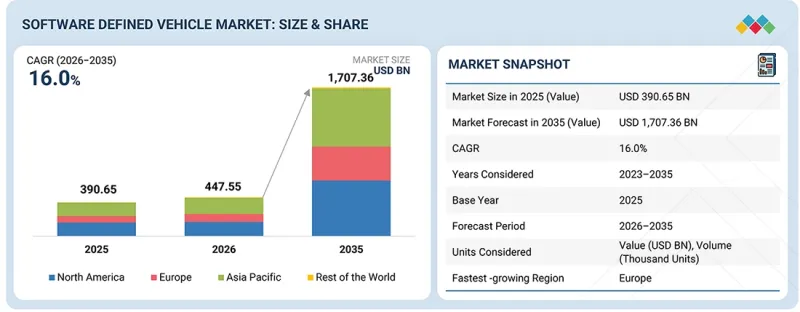
軟體定義汽車 (SDV) 市場預計將從 2026 年的 4,475.5 億美元成長到 2035 年的 1.70736 兆美元,複合年成長率為 16.0%。
由於集中式車輛運算、空中(OTA)軟體更新、連網服務和人工智慧功能的日益普及,以及向需要持續軟體管理的電動車(EV)平台的轉變,該市場正在迅速成長。
| 調查範圍 | |
|---|---|
| 調查期 | 2026-2033 |
| 基準年 | 2025 |
| 預測期 | 2026-2033 |
| 單元 | 美元 |
| 部分 | SDV 類型、電子電氣架構、車輛類型、服務類別、應用、區域 |
| 目標區域 | 亞太地區、北美地區、歐洲地區及其他地區 |
汽車製造商正日益將車輛視為可升級的數位化平台,從而能夠在車輛的整個生命週期內添加新功能、提升性能、更新網路安全補丁以及提供訂閱服務。特斯拉、Rivian、Stellantis 和小米等領先的汽車製造商正在大力投資軟體定義車輛(SDV)架構,而高通和 Wayve 等公司的合作也正在加速人工智慧賦能汽車平臺的開發。從分散式電子控制單元(ECU)轉向分區集中式架構的轉變,進一步提升了可擴展性,降低了硬體複雜性,並實現了軟體定義功能的快速部署。
“透過軟體功能實現盈利,正在為汽車製造商創造一種新的、持續的收入來源。”
按需功能訂閱正成為SDV市場的主要獲利模式,讓客戶在購車後透過軟體啟動、升級或個人化車輛功能。這一成長的促進因素包括:空中下載(OTA)更新的日益普及、對個人化車載體驗日益成長的需求、集中式運算架構的興起,以及汽車製造商對持續產生收入的重視。應用領域涵蓋高級資訊娛樂系統、性能升級、數位鑰匙服務、停車輔助、遠端車輛功能和高級駕駛輔助功能。
寶馬集團、梅賽德斯-奔馳集團、奧迪股份公司、大眾集團、特斯拉、蔚來汽車和小鵬汽車等主要汽車製造商正在積極拓展按需功能的供應。例如,BMW集團於2025年6月為其Neue Klasse生態系統新增了可升級的軟體功能。這反映了汽車產業正朝著持續可升級且能創造收益的汽車平臺轉型。
“集中式運算正在加速硬體的普及。”
在軟體驅動型車輛(SDV)市場中,硬體部分是最大的細分市場,這主要得益於高效能運算平台、先進感測器、汽車聯網汽車、自動駕駛汽車和軟體密集型車輛至關重要。高級駕駛輔助系統(ADAS)、人工智慧驅動功能、電動車以及即時數據處理的日益普及,正在推動對高性能車輛運算基礎設施和下一代電子系統的需求。
例如,2025年1月,本田汽車發布了Honda 0系列平台,該平台採用集中式運算架構,專為未來的軟體定義汽車(SDV)應用而設計。此外,2026年3月,大眾汽車集團和Rivian檢驗了一種包含集中式電腦和區域控制器的下一代車輛架構。這表明,業界正在加大對先進SDV硬體平台的投資。
“OEM製造商加大軟體投資以及人工智慧賦能的汽車平臺正在加速北美地區SDV的普及。”
北美正崛起為SDV市場的重要參與者,這主要得益於集中式車輛運算領域的投資增加、空中下載(OTA)更新的快速部署、人工智慧驅動的ADAS功能的日益普及,以及汽車製造商與軟體技術公司之間的緊密合作。該地區受益於SDV領域領先創新者的存在、先進的雲端基礎設施以及消費者對永續升級車輛功能日益成長的需求。汽車製造商正逐步從以硬體為中心的車輛開發轉向以軟體主導的架構,以支援互聯服務、功能貨幣化和自動駕駛能力。
例如,福特汽車公司於2025年8月發布了通用電動車平台,旨在支援軟體定義電動車,實現空中下載(OTA)更新和免手持駕駛功能。通用汽車公司於2025年5月推進了其下一代軟體平台策略,以提升車輛更新能力,並在其所有車型中提供更廣泛的軟體服務。
本報告考察了全球軟體定義汽車(SDV)市場,提供了市場概述、影響市場成長的各種因素分析、技術和專利趨勢、法律制度、案例研究、歷史和預測市場規模、按細分市場、地區/主要國家/地區進行的詳細分析、競爭格局以及主要公司的概況。
目錄
第1章:引言
第2章執行摘要
第3章重要考察
第4章 市場概覽
- 市場動態
- 促進因素
- 抑制因子
- 機會
- 任務
- 未滿足的需求和閒置頻段
第5章 產業趨勢
- 總體經濟指標
- GDP趨勢與預測
- 聯網汽車市場的發展趨勢
- 全球汽車和運輸業的趨勢
- 供應鏈分析
- 生態系分析
- 價格分析
- 貿易分析
- 2026-2027 年主要會議和活動
- 影響客戶業務的趨勢/顛覆性因素
- 投資和資金籌措場景
- 案例研究分析
- 以色列-伊朗戰爭的影響
- 歐盟-印度自由貿易協定的影響
第6章:軟體定義車輛架構與OEM廠商競爭分析
- 軟體定義汽車和電子電氣架構的關鍵趨勢
- 趨勢
- 近期投資
- 軟體定義車輛提供者分析
- 主要汽車製造商採取的策略
- 軟體定義汽車生態系中的科技公司比較
- 車輛車身平台對比
- 電子/電氣架構的部署
- 內部
- 外包
- 共同開發
- OEM-向け特色(訂閱定價)
- 自動駕駛水平變化對軟體定義車輛的影響
- 人工智慧應用範例
- ADAS
- 數位駕駛座
- 車輛電腦
- 其他
第7章:軟體定義車輛開發的OEM生態系統
- 北美原始設備製造商
- TESLA
- FORD
- RIVIAN
- LUCID MOTORS
- POLESTAR
- GENERAL MOTORS
- 歐洲OEM製造商
- STELLANTIS
- VOLKSWAGEN
- BMW
- MERCEDES-BENZ
- JAGUAR LAND ROVER
- RENAULT
- NISSAN
- VOLVO
- 亞洲OEM廠商
- BYD
- NIO
- XIAOMI
- LI AUTO
- ZEEKR
- GEELY
- HYUNDAI-KIA-GENESIS
- IM MOTORS
- CHANGAN
- CHERY
- TOYOTA
- MAHINDRA & MAHINDRA
- GWM
第8章:技術進步、人工智慧的影響、專利、創新與未來應用
- 主要技術
- 中央高效能運算中心
- 區域控制器
- OTA 更新
- 互補技術
- 車對車通訊(V2X)
- 車輛雲平台
- 自動駕駛軟體堆疊
- 技術/產品藍圖
- 軟體貨幣化和數位收入模式
- SDV生態系統和策略夥伴關係
- 人工智慧、網路安全與自主智慧的融合
- 人工智慧/生成式人工智慧的影響
- 專利分析
- 未來應用
第9章:監理情勢與永續性舉措
- 當地法規和合規性
- 對永續性的承諾
第10章:顧客趨勢與購買行為
- 決策流程
- 主要相關人員和採購標準
- 實施障礙和內部挑戰
- 最終用戶未被滿足的需求
第11章 軟體定義汽車(SDV)市場:按類型分類
- SDV
- 半SDV
- 關鍵見解
第12章 軟體定義汽車(SDV)市場:依車輛類型分類
- 搭乘用車
- 輕型商用車
- 關鍵見解
第13章 軟體定義汽車(SDV)市場:依電子/電氣架構分類
- 領域中心架構
- 區域控制架構
第14章 軟體定義汽車(SDV)市場:依產品細分市場分類
- 軟體
- 硬體
- 關鍵見解
第15章 軟體定義汽車(SDV)市場:依應用領域分類
- ADAS
- 車載資訊系統
- 按需功能
第16章 軟體定義汽車(SDV)市場:按地區分類
- 亞太地區
- 中國
- 印度
- 日本
- 韓國
- 歐洲
- 德國
- 法國
- 義大利
- 西班牙
- 英國
- 北美洲
- 美國
- 加拿大
- 世界其他地區
- 巴西
- 南非
第17章 競爭格局
- 概述
- 主要公司/主要企業的策略
- 市佔率分析
- 收入分析
- 企業估值和財務指標
- 品牌/產品對比
- 公司估值矩陣:OEM公司
- 企業評估矩陣:技術供應商
- 競爭格局
第18章:公司簡介
- 主要原始設備製造商
- TESLA
- LI AUTO INC.
- XIAOMI
- ZEEKR
- XPENG INC.
- NIO
- RIVIAN
- POLESTAR
- SAIC
- VOLKSWAGEN
- HYUNDAI MOTOR COMPANY
- FORD MOTOR COMPANY
- GENERAL MOTORS
- RENAULT GROUP
- TOYOTA MOTOR CORPORATION
- STELLANTIS NV
- MERCEDES-BENZ GROUP AG
- BYD
- BMW GROUP
- 主要技術提供商
- NVIDIA CORPORATION
- QUALCOMM TECHNOLOGIES
- BLACKBERRY LIMITED
- VECTOR INFORMATIK GMBH
- AMAZON WEB SERVICES
- MICROSOFT
- APEX.AI
- MOBILEYE
- TENCENT
- ALIBABA
- HORIZON ROBOTICS
- TATA TECHNOLOGIES
- KPIT TECHNOLOGIES
第19章:調查方法
第20章附錄
The software defined vehicle (SDV) market is projected to grow from USD 447.55 billion in 2026 to USD 1,707.36 billion by 2035 at a CAGR of 16.0%. The market is growing rapidly due to increasing adoption of centralized vehicle computing, over-the-air (OTA) software updates, connected services, AI-driven features, and the shift toward electric vehicle platforms that require continuous software management.
| Scope of the Report | |
|---|---|
| Years Considered for the Study | 2026-2033 |
| Base Year | 2025 |
| Forecast Period | 2026-2033 |
| Units Considered | USD Billion |
| Segments | by SDV Type, E/E Architecture, Vehicle Type, Offering, Application, and Region |
| Regions covered | Asia Pacific, North America, Europe, and Rest of the World |
Automakers are increasingly treating vehicles as upgradable digital platforms, enabling new features, performance enhancements, cybersecurity updates, and subscription-based services throughout the vehicle lifecycle. Leading OEMs such as Tesla, Rivian, Stellantis, and Xiaomi are investing heavily in SDV architectures, while partnerships such as Qualcomm and Wayve are accelerating AI-enabled vehicle platforms. The transition from distributed ECUs to zonal and centralized architectures is further improving scalability, reducing hardware complexity, and enabling faster deployment of software-defined functionalities.
"Software-enabled feature monetization is creating new recurring revenue streams for automakers."
Feature-on-demand subscriptions are becoming a key monetization model in the SDV market, enabling customers to activate, upgrade, or personalize vehicle features via software after purchase. Growth is being driven by increasing adoption of over-the-air updates, rising demand for personalized vehicle experiences, centralized computing architectures, and automakers' focus on recurring revenue generation. Applications include premium infotainment, performance upgrades, digital key services, parking assistance, remote vehicle functions, and advanced driver assistance features. Major OEMs such as BMW Group, Mercedes-Benz Group, Audi AG, Volkswagen Group, Tesla, NIO, and XPENG are actively expanding feature on demand offerings. For instance, in June 2025, BMW Group expanded its Neue Klasse ecosystem with upgradeable software-based functionalities, reflecting the industry's shift toward continuously upgradeable and revenue-generating vehicle platforms.
"Centralized computing is accelerating hardware adoption."
The hardware segment is the largest offering in the software defined vehicle market due to increasing deployment of high-performance computing platforms, advanced sensors, automotive semiconductors, zonal controllers, and centralized vehicle architectures required to support connected, autonomous, and software-intensive vehicles. Growing adoption of ADAS, AI-driven functionalities, electric vehicles, and real-time data processing is driving demand for powerful vehicle computing infrastructure and next-generation electronic systems. For instance, in January 2025, Honda Motor Co., Ltd. unveiled its Honda 0 Series platform featuring centralized computing architecture designed for future SDVs, while in March 2026, Volkswagen Group and Rivian validated a next-generation vehicle architecture incorporating centralized computers and zonal controllers, highlighting growing industry investment in advanced SDV hardware platforms.
"Increasing OEM software investments and AI-enabled vehicle platforms are accelerating SDV adoption in North America"
North America is emerging in the software defined vehicle market due to increasing investments in centralized vehicle computing, rapid deployment of over-the-air updates, growing adoption of AI-enabled ADAS functions, and strong collaboration between automakers and software technology companies. The region is benefiting from the presence of leading SDV innovators, advanced cloud infrastructure, and rising consumer demand for continuously upgradable vehicle features. Automakers are increasingly transitioning from hardware-centric vehicle development toward software-driven architectures that support connected services, feature monetization, and autonomous driving capabilities. For instance, in August 2025, Ford Motor Company announced its Universal EV platform designed to support software-defined electric vehicles with over-the-air updates and hands-free driving capabilities. In May 2025, General Motors advanced its next-generation software platform strategy to improve vehicle update capabilities and enable a broader range of software-based services across its vehicle portfolio.
In-depth interviews were conducted with CEOs, marketing directors, other innovation and technology directors, and executives from various key organizations operating in this market.
- By Company Type: Tier I - 20%, Tier II - 40%, OEMs - 40%
- By Designation: CXOs - 20%, Directors - 30%, Others - 50%
- By Country: Asia Pacific - 40%, North America - 20%, Europe - 30%, and Rest of the World - 10%
The software defined vehicle market is dominated by global players, such as Tesla (US), Li Auto Inc. (China), NIO (China), Rivian (US), and XPENG Inc. (China). These players have been adopting various strategies to sustain their positions in the market. Major strategies adopted are product launches, deals, and expansions. These strategies have been analyzed to understand the positions of these companies in the market. Manufacturers focus on maintaining their strategic position in the market by offering advanced software defined vehicle solutions to meet evolving regulatory and consumer demands.
Research Coverage:
The report covers the software defined vehicle market by SDV type (SDV, semi-SDV), E/E architecture (domain-centralized architecture, zonal architecture), vehicle type (passenger car, light commercial vehicle), offering (hardware, software), application ( ADAS, telematics, feature on demand), and region (Asia Pacific, Europe, North America, and Rest of the World). It covers the competitive landscape and company profiles of the major players in the software defined vehicle market ecosystem.
The study also includes an in-depth competitive analysis of the key players in the market, along with their company profiles, key observations related to product and business offerings, recent developments, and key market strategies.
Key Benefits of Buying the Report:
- This report will help market leaders/new entrants in this market with information on the closest approximations of revenue numbers for the software defined vehicle market ecosystem and its subsegments.
- The report will help market leaders/new entrants with software defined vehicle architecture & OEM competitive analysis and OEM ecosystem for E/E architecture development
- This report will help stakeholders understand the competitive landscape and gain more insights to better position their businesses and plan suitable go-to-market strategies.
- This report will also help stakeholders understand the market's pulse and provide information on key market drivers, restraints, challenges, and opportunities.
The report provides insight into the following pointers:
- Analysis of key drivers (reduced recall and manufacturing cost, paid ADAS and autonomous driving subscriptions, Increasing EV adoption requiring software driven vehicle control), restraints (ECU integration complexity from legacy to zonal architecture, slow OTA rollout due to safety validation requirements, OEM supplier divide in software led control), opportunities (feature-on-demand monetization, In vehicle app ecosystem development) and challenges (cybersecurity risks in connected vehicle systems, real-time AI processing constraints in vehicles)
- Product Development/Innovation: Detailed insights into upcoming technologies, research & development activities, and product launches in the software defined vehicle market
- Market Development: Comprehensive information about lucrative markets (the report analyses the software defined vehicle market across varied regions)
- Market Diversification: Exhaustive information about new products, untapped geographies, recent developments, and investments in the software defined vehicle market
- Competitive Assessment: In-depth assessment of market ranking, growth strategies, and service offerings of leading players like Tesla (US), Li Auto Inc. (China), NIO (China), Rivian (US), and XPENG Inc. (China) in the software defined vehicle market
TABLE OF CONTENTS
1 INTRODUCTION
- 1.1 STUDY OBJECTIVES
- 1.2 MARKET DEFINITION
- 1.2.1 DEFINITION BY GENERAL MOTORS
- 1.2.2 DEFINITION BY RENAULT
- 1.3 STUDY SCOPE
- 1.3.1 MARKET SEGMENTATION AND REGIONAL SCOPE
- 1.3.2 INCLUSIONS AND EXCLUSIONS
- 1.3.3 YEARS CONSIDERED
- 1.4 CURRENCY CONSIDERED
- 1.5 UNIT CONSIDERED
- 1.6 STAKEHOLDERS
- 1.7 SUMMARY OF CHANGES
2 EXECUTIVE SUMMARY
- 2.1 MARKET HIGHLIGHTS AND KEY INSIGHTS
- 2.2 KEY MARKET PARTICIPANTS: MAPPING OF STRATEGIC DEVELOPMENTS
- 2.3 DISRUPTIVE TRENDS SHAPING MARKET
- 2.4 HIGH-GROWTH SEGMENTS
- 2.5 REGIONAL SNAPSHOT: MARKET SIZE, GROWTH RATE, AND FORECAST
3 PREMIUM INSIGHTS
- 3.1 ATTRACTIVE OPPORTUNITIES FOR PLAYERS IN SOFTWARE DEFINED VEHICLE MARKET
- 3.2 SOFTWARE DEFINED VEHICLE MARKET, BY TYPE
- 3.3 SOFTWARE DEFINED VEHICLE MARKET, BY VEHICLE TYPE
- 3.4 SOFTWARE DEFINED VEHICLE MARKET, BY OFFERING
4 MARKET OVERVIEW
- 4.1 INTRODUCTION
- 4.2 MARKET DYNAMICS
- 4.2.1 DRIVERS
- 4.2.1.1 Reduced recall rate and development complexities
- 4.2.1.2 Rise of paid ADAS and autonomous driving subscriptions
- 4.2.1.3 Heightened EV adoption requiring software-driven vehicle control
- 4.2.2 RESTRAINTS
- 4.2.2.1 Complexity of transitioning from distributed ECU-based architecture to zonal architecture
- 4.2.2.2 Slow OTA rollout due to safety validation requirements
- 4.2.2.3 Interoperability constraint due to fragmented software ownership
- 4.2.3 OPPORTUNITIES
- 4.2.3.1 New revenue streams from feature-on-demand models
- 4.2.3.2 Development of in-vehicle app ecosystems
- 4.2.4 CHALLENGES
- 4.2.4.1 Cybersecurity risks in connected vehicle systems
- 4.2.4.2 Real-time AI processing limitations
- 4.2.1 DRIVERS
- 4.3 UNMET NEEDS AND WHITE SPACES
- 4.3.1 RELIABLE PERFORMANCE UNDER REAL-WORLD CONDITIONS
- 4.3.2 SIMPLIFIED ORCHESTRATION IN SOFTWARE-DEFINED INFRASTRUCTURE
- 4.3.3 LIMITED ECOSYSTEM INTEGRATION AND DATA USAGE IN SOFTWARE-DEFINED STACKS
5 INDUSTRY TRENDS
- 5.1 MACROECONOMIC INDICATORS
- 5.1.1 GDP TRENDS AND FORECAST
- 5.1.2 TRENDS IN CONNECTED VEHICLE MARKET
- 5.1.3 TRENDS IN GLOBAL AUTOMOTIVE AND TRANSPORTATION INDUSTRY
- 5.2 SUPPLY CHAIN ANALYSIS
- 5.3 ECOSYSTEM ANALYSIS
- 5.3.1 OEMS
- 5.3.2 TIER-1 HARDWARE PROVIDERS
- 5.3.3 TIER-2 PLAYERS
- 5.3.4 CHIP PROVIDERS
- 5.3.5 SOFTWARE PROVIDERS
- 5.3.6 CLOUD PROVIDERS
- 5.4 PRICING ANALYSIS
- 5.4.1 AVERAGE SELLING PRICE TREND, BY KEY PLAYER, 2023-2025
- 5.4.2 AVERAGE SELLING PRICE TREND, BY REGION, 2023-2025
- 5.5 TRADE ANALYSIS
- 5.5.1 IMPORT SCENARIO (HS CODE 8703)
- 5.5.2 EXPORT SCENARIO (HS CODE 8703)
- 5.6 KEY CONFERENCES AND EVENTS, 2026-2027
- 5.7 TRENDS/DISRUPTIONS IMPACTING CUSTOMER BUSINESS
- 5.8 INVESTMENT AND FUNDING SCENARIO
- 5.9 CASE STUDY ANALYSIS
- 5.9.1 CUBIC TELECOM'S ROLE IN TRANSFORMING VEHICLE ARCHITECTURE
- 5.9.2 IMPLEMENTING VIRTUAL TESTING ENVIRONMENT WITH RED HAT
- 5.9.3 VOLKSWAGEN'S STRATEGIC FOCUS ON SOFTWARE INNOVATION
- 5.9.4 STANDARDIZING OTA UPDATES WITH ESYNC ALLIANCE
- 5.9.5 CONTINENTAL AUTOMOTIVE EDGE PLATFORM IN COLLABORATION WITH AWS
- 5.9.6 REVOLUTIONIZING AUTOMOTIVE SOFTWARE DEVELOPMENT WITH BLACKBERRY IVY AND AWS
- 5.9.7 AWS AND BLACKBERRY'S APPROACH TO MODERNIZING VEHICLE SOFTWARE
- 5.9.8 NVIDIA'S DRIVE PLATFORM POWERS VOLVO'S AUTONOMOUS VISION
- 5.9.9 TESLA'S JOURNEY INTO SOFTWARE DEFINED VEHICLES
- 5.9.10 BMW'S STRATEGIC SHIFT IN AUTOMOTIVE SOFTWARE
- 5.10 IMPACT OF ISRAEL-IRAN WAR
- 5.10.1 ENERGY MARKET DISRUPTION
- 5.10.2 OPERATING COST IMPACT
- 5.10.3 MARKET DEMAND SHIFT
- 5.10.4 SUPPLY CHAIN AND LOCALIZATION IMPACT
- 5.10.5 STRATEGIC MARKET OUTLOOK
- 5.11 IMPACT OF EU-INDIA FTA
- 5.11.1 EU TARIFFS
6 SOFTWARE DEFINED VEHICLE ARCHITECTURE AND OEM COMPETITIVE ANALYSIS
- 6.1 KEY TRENDS IN SOFTWARE DEFINED VEHICLES AND E/E ARCHITECTURE
- 6.1.1 TRENDS
- 6.1.2 RECENT INVESTMENTS
- 6.2 SOFTWARE DEFINED VEHICLE PROVIDER ANALYSIS
- 6.2.1 STRATEGIES FOLLOWED BY KEY LEGACY OEMS
- 6.2.2 COMPARISON OF TECH PLAYERS IN SOFTWARE DEFINED VEHICLE ECOSYSTEM
- 6.2.3 VEHICLE BODY PLATFORM COMPARISON
- 6.3 E/E ARCHITECTURE DEPLOYMENT
- 6.3.1 IN-HOUSE
- 6.3.2 OUTSOURCED
- 6.3.3 CO-DEVELOPMENT
- 6.4 OEM FEATURE OFFERING, BY SUBSCRIPRTION PRICING
- 6.5 LEVEL OF AUTONOMY SHIFT IMPACT ON SOFTWARE DEFINED VEHICLES
- 6.6 AI USE CASES
- 6.6.1 ADAS
- 6.6.2 DIGITAL COCKPIT
- 6.6.3 VEHICLE COMPUTE
- 6.6.4 OTHERS
7 OEM ECOSYSTEM FOR SOFTWARE DEFINED VEHICLE DEVELOPMENT
- 7.1 NORTH AMERICAN OEMS
- 7.1.1 TESLA
- 7.1.1.1 Tesla: Technology Roadmap
- 7.1.1.2 Tesla: Features Available on Demand and Pricing
- 7.1.2 FORD
- 7.1.2.1 FORD: Technology Roadmap
- 7.1.2.2 FORD: Technology Shift
- 7.1.2.3 FORD: Features Available on Demand and Pricing
- 7.1.3 RIVIAN
- 7.1.3.1 Rivian: Technology Roadmap
- 7.1.3.2 Rivian: Technology Shift
- 7.1.3.3 Rivian: Features Available on Demand and Pricing
- 7.1.4 LUCID MOTORS
- 7.1.4.1 Lucid Motors: Technology Roadmap
- 7.1.4.2 Lucid Motors: Features Available on Demand and Pricing
- 7.1.5 POLESTAR
- 7.1.5.1 Polestar: Technology Roadmap
- 7.1.5.2 Polestar: Features Available on Demand and Pricing
- 7.1.6 GENERAL MOTORS
- 7.1.6.1 General Motors: Technology Roadmap
- 7.1.6.2 General Motors: Technology Shift
- 7.1.6.3 General Motors: Features Available on Demand and Pricing
- 7.1.1 TESLA
- 7.2 EUROPEAN OEMS
- 7.2.1 STELLANTIS
- 7.2.1.1 Stellantis: Technology Roadmap
- 7.2.1.2 Stellantis: Technology Shift
- 7.2.1.3 Stellantis: Features Available on Demand and Pricing
- 7.2.2 VOLKSWAGEN
- 7.2.2.1 Volkswagen: Technology Roadmap
- 7.2.2.2 Volkswagen: Technology Shift
- 7.2.2.3 Volkswagen: Features Available on Demand and Pricing
- 7.2.3 BMW
- 7.2.3.1 BMW: Technology Roadmap
- 7.2.3.2 BMW: Technology Shift
- 7.2.3.3 BMW: Features Available on Demand and Pricing
- 7.2.4 MERCEDES-BENZ
- 7.2.4.1 Mercedes-Benz: Technology Roadmap
- 7.2.4.2 Mercedes-Benz: Technology Shift
- 7.2.4.3 Mercedes-Benz: Features Available on Demand and Pricing
- 7.2.5 JAGUAR LAND ROVER
- 7.2.5.1 Jaguar Land Rover: Technology Roadmap
- 7.2.5.2 Jaguar Land Rover: Technology Shift
- 7.2.5.3 Jaguar Land Rover: Features Available on Demand and Pricing
- 7.2.6 RENAULT
- 7.2.6.1 Renault: Technology Roadmap
- 7.2.6.2 Renault: Technology Shift
- 7.2.6.3 Renault: Features Available on Demand and Pricing
- 7.2.7 NISSAN
- 7.2.7.1 Nissan: Technology Roadmap
- 7.2.7.2 Nissan: Technology Shift
- 7.2.7.3 Nissan: Features Available on Demand and Pricing
- 7.2.8 VOLVO
- 7.2.8.1 Volvo: Technology Roadmap
- 7.2.8.2 Volvo: Technology Shift
- 7.2.8.3 Volvo: Features Available on Demand and Pricing
- 7.2.1 STELLANTIS
- 7.3 ASIAN OEMS
- 7.3.1 BYD
- 7.3.1.1 BYD: Technology Roadmap
- 7.3.1.2 BYD: Technology Shift
- 7.3.1.3 BYD: Features Available on Demand and Pricing
- 7.3.2 NIO
- 7.3.2.1 NIO: Technology Roadmap
- 7.3.2.2 NIO: Features Available on Demand and Pricing
- 7.3.3 XIAOMI
- 7.3.3.1 Xiaomi: Technology Roadmap
- 7.3.3.2 Xiaomi: Features Available on Demand and Pricing
- 7.3.4 LI AUTO
- 7.3.4.1 Li Auto: Technology Roadmap
- 7.3.4.2 Li Auto: Features Available on Demand and Pricing
- 7.3.5 ZEEKR
- 7.3.5.1 Zeekr: Technology Roadmap
- 7.3.5.2 Zeekr: Features Available on Demand and Pricing
- 7.3.6 GEELY
- 7.3.6.1 Geely: Technology Roadmap
- 7.3.6.2 Geely: Technology Shift
- 7.3.6.3 Geely: Features Available on Demand and Pricing
- 7.3.7 HYUNDAI-KIA-GENESIS
- 7.3.7.1 Hyundai-Kia Genesis: Technology Roadmap
- 7.3.7.2 Hyundai-Kia Genesis: Technology Shift
- 7.3.7.3 Hyundai-Kia Genesis: Features Available on Demand and Pricing
- 7.3.8 IM MOTORS
- 7.3.8.1 IM Motors: Technology Roadmap
- 7.3.8.2 IM Motors: Technology Shift
- 7.3.8.3 IM Motors: Features Available on Demand and Pricing
- 7.3.9 CHANGAN
- 7.3.9.1 Changan: Technology Roadmap
- 7.3.9.2 Changan: Technology Shift
- 7.3.9.3 Changan: Features Available on Demand and Pricing
- 7.3.10 CHERY
- 7.3.10.1 Chery: Technology Roadmap
- 7.3.10.2 Chery: Technology Shift
- 7.3.10.3 Chery: Features Available on Demand and Pricing
- 7.3.11 TOYOTA
- 7.3.11.1 Toyota: Technology Roadmap
- 7.3.11.2 Toyota: Technology Shift
- 7.3.11.3 Toyota: Features Available on Demand and Pricing
- 7.3.12 MAHINDRA & MAHINDRA
- 7.3.12.1 Mahindra & Mahindra: Technology Roadmap
- 7.3.12.2 Mahindra & Mahindra: Technology Shift
- 7.3.12.3 Mahindra & Mahindra: Features Available on Demand and Pricing
- 7.3.13 GWM
- 7.3.13.1 GWM: Technology Roadmap
- 7.3.13.2 GWM: Technology Shift
- 7.3.13.3 GWM: Features Available on Demand and Pricing
- 7.3.1 BYD
8 TECHNOLOGICAL ADVANCEMENTS, AI-DRIVEN IMPACT, PATENTS, INNOVATIONS, AND FUTURE APPLICATIONS
- 8.1 KEY TECHNOLOGIES
- 8.1.1 CENTRAL HPC
- 8.1.2 ZONAL CONTROLLERS
- 8.1.3 OTA UPDATES
- 8.2 COMPLEMENTARY TECHNOLOGIES
- 8.2.1 VEHICLE TO EVERYTHING (V2X) COMMUNICATION
- 8.2.2 VEHICLE CLOUD PLATFORMS
- 8.2.3 AUTONOMOUS DRIVING SOFTWARE STACKS
- 8.3 TECHNOLOGY/PRODUCT ROADMAP
- 8.4 SOFTWARE MONETIZATION & DIGITAL REVENUE MODELS
- 8.5 SDV ECOSYSTEM & STRATEGIC PARTNERSHIPS
- 8.6 AI, CYBERSECURITY & AUTONOMOUS INTELLIGENCE INTEGRATION
- 8.7 IMPACT OF AI/GEN AI
- 8.7.1 TOP USE CASES AND MARKET POTENTIAL
- 8.7.2 BEST PRACTICES
- 8.7.3 CASE STUDIES RELATED TO AI IMPLEMENTATION
- 8.7.3.1 TESLA'S FLEET LEARNING AI PLATFORM
- 8.7.3.2 MERCEDES-BENZ'S AI-POWERED MBUX VIRTUAL ASSISTANT
- 8.7.3.3 BMW'S AI-DRIVEN PERSONALIZATION PLATFORM
- 8.7.3.4 NIO'S NOMI AI COMPANION ECOSYSTEM
- 8.7.3.5 XPENG'S XNGP AI AUTONOMOUS DRIVING SYSTEM
- 8.7.4 CLIENTS' READINESS TO ADOPT AI
- 8.8 PATENT ANALYSIS
- 8.9 FUTURE APPLICATIONS
- 8.9.1 AI-DRIVEN VEHICLE PERSONALIZATION AND DIGITAL COMPANIONS
- 8.9.2 ON-DEMAND FEATURE ACTIVATION AND SOFTWARE MONETIZATION
- 8.9.3 IN-CABIN INTELLIGENCE AND USER INTERACTION
9 REGULATORY LANDSCAPE AND SUSTAINABILITY INITIATIVES
- 9.1 REGIONAL REGULATIONS AND COMPLIANCE
- 9.1.1 REGULATORY BODIES, GOVERNMENT AGENCIES, AND OTHER ORGANIZATIONS
- 9.1.2 INDUSTRY STANDARDS
- 9.2 SUSTAINABILITY INITIATIVES
- 9.2.1 CARBON IMPACT AND ECO-APPLICATIONS
- 9.2.2 CERTIFICATIONS, LABELING, AND ECO-STANDARDS
10 CUSTOMER LANDSCAPE AND BUYING BEHAVIOR
- 10.1 DECISION-MAKING PROCESS
- 10.2 KEY STAKEHOLDERS AND BUYING CRITERIA
- 10.2.1 KEY STAKEHOLDERS IN BUYING PROCESS
- 10.2.2 BUYING CRITERIA
- 10.3 ADOPTION BARRIERS AND INTERNAL CHALLENGES
- 10.4 UNMEET NEEDS OF END USERS
11 SOFTWARE DEFINED VEHICLE MARKET, BY TYPE
- 11.1 INTRODUCTION
- 11.2 SDV
- 11.2.1 INCREASING FLEXIBILITY AND AGILITY THROUGH OTA UPDATES TO DRIVE MARKET
- 11.3 SEMI-SDV
- 11.3.1 KEY ROLE AS TRANSITIONAL PHASE TOWARD ADVANCED ZONAL CONTROL ARCHITECTURE TO DRIVE MARKET
- 11.4 PRIMARY INSIGHTS
12 SOFTWARE DEFINED VEHICLE MARKET, BY VEHICLE TYPE
- 12.1 INTRODUCTION
- 12.2 PASSENGER CAR
- 12.2.1 CONSUMER EXPECTATIONS FOR SEAMLESS, TECH-DRIVEN EXPERIENCES TO DRIVE MARKET
- 12.3 LIGHT COMMERCIAL VEHICLE
- 12.3.1 MOVE TOWARD ELECTRIFICATION AND STRICTER EMISSIONS AND SAFETY REGULATIONS TO DRIVE MARKET
- 12.4 PRIMARY INSIGHTS
13 SOFTWARE DEFINED VEHICLE MARKET, BY E/E ARCHITECTURE
- 13.1 INTRODUCTION
- 13.2 DOMAIN-CENTRALIZED ARCHITECTURE
- 13.3 ZONAL CONTROL ARCHITECTURE
14 SOFTWARE DEFINED VEHICLE MARKET, BY OFFERING
- 14.1 INTRODUCTION
- 14.2 SOFTWARE
- 14.2.1 GROWING DEMAND FOR CONNECTED VEHICLE SERVICES TO DRIVE MARKET
- 14.3 HARDWARE
- 14.3.1 SURGE IN COMPUTING DEMAND TO DRIVE MARKET
- 14.4 PRIMARY INSIGHTS
15 SOFTWARE DEFINED VEHICLE MARKET, BY APPLICATION
- 15.1 INTRODUCTION
- 15.2 ADAS
- 15.2.1 OEM SHIFT FROM LEVELS L0 TO L3
- 15.3 TELEMATICS
- 15.4 FEATURE-ON-DEMAND
16 SOFTWARE DEFINED VEHICLE MARKET, BY REGION
- 16.1 INTRODUCTION
- 16.2 ASIA PACIFIC
- 16.2.1 CHINA
- 16.2.1.1 Stiff OEM competition and state support for intelligent connected vehicles to drive market
- 16.2.2 INDIA
- 16.2.2.1 Mass market digitalization and substantial investments in connected EV platforms to drive market
- 16.2.3 JAPAN
- 16.2.3.1 Emphasis on long-term software integration and platform-level investments to drive market
- 16.2.4 SOUTH KOREA
- 16.2.4.1 Global leadership in consumer electronics, semiconductor manufacturing, and 5G connectivity to drive market
- 16.2.1 CHINA
- 16.3 EUROPE
- 16.3.1 GERMANY
- 16.3.1.1 Concentration of global automotive OEMs and Tier-1 suppliers and large-scale investments in high-performance vehicle computing to drive market
- 16.3.2 FRANCE
- 16.3.2.1 National software ecosystem development and EV digitalization to drive market
- 16.3.3 ITALY
- 16.3.3.1 Significant presence of premium automotive manufacturers to drive market
- 16.3.4 SPAIN
- 16.3.4.1 EV manufacturing expansion and automotive digital transformation to drive market
- 16.3.5 UK
- 16.3.5.1 Strong automotive engineering capabilities and advanced connected mobility ecosystem to drive market
- 16.3.1 GERMANY
- 16.4 NORTH AMERICA
- 16.4.1 US
- 16.4.1.1 Leadership in automotive software development and strong presence of technology companies to drive market
- 16.4.2 CANADA
- 16.4.2.1 Expansion of automotive software engineering and connected mobility investments to drive market
- 16.4.1 US
- 16.5 REST OF THE WORLD
- 16.5.1 BRAZIL
- 16.5.1.1 Connected vehicle production and OEM investments to drive market
- 16.5.2 SOUTH AFRICA
- 16.5.2.1 Robust automotive manufacturing capabilities and growing adoption of connected vehicle technologies to drive market
- 16.5.1 BRAZIL
17 COMPETITIVE LANDSCAPE
- 17.1 OVERVIEW
- 17.2 KEY PLAYERS STRATEGIES/RIGHT TO WIN, 2023-2026
- 17.3 MARKET SHARE ANALYSIS, 2025
- 17.4 REVENUE ANALYSIS, 2021-2025
- 17.5 COMPANY VALUATION AND FINANCIAL METRICS
- 17.6 BRAND/PRODUCT COMPARISON
- 17.7 COMPANY EVALUATION MATRIX: OEMS, 2025
- 17.7.1 STARS
- 17.7.2 EMERGING LEADERS
- 17.7.3 PERVASIVE PLAYERS
- 17.7.4 PARTICIPANTS
- 17.7.5 COMPANY FOOTPRINT
- 17.7.5.1 Company footprint
- 17.7.5.2 Region footprint
- 17.7.5.3 Vehicle type footprint
- 17.7.5.4 E/E architecture footprint
- 17.8 COMPANY EVALUATION MATRIX: TECHNOLOGY PROVIDERS, 2025
- 17.8.1 PROGRESSIVE COMPANIES
- 17.8.2 RESPONSIVE COMPANIES
- 17.8.3 DYNAMIC COMPANIES
- 17.8.4 STARTING BLOCKS
- 17.9 COMPETITIVE SCENARIO
- 17.9.1 PRODUCT LAUNCHES/DEVELOPMENTS
- 17.9.2 DEALS
- 17.9.3 EXPANSIONS
- 17.9.4 OTHERS
18 COMPANY PROFILES
- 18.1 KEY OEMS
- 18.1.1 TESLA
- 18.1.1.1 Business overview
- 18.1.1.2 Products offered
- 18.1.1.3 Recent developments
- 18.1.1.3.1 Product launches/developments
- 18.1.1.3.2 Deals
- 18.1.1.4 MnM view
- 18.1.1.4.1 Key strengths
- 18.1.1.4.2 Strategic choices
- 18.1.1.4.3 Weaknesses and competitive threats
- 18.1.2 LI AUTO INC.
- 18.1.2.1 Business overview
- 18.1.2.2 Products offered
- 18.1.2.3 Recent developments
- 18.1.2.3.1 Product launches/developments
- 18.1.2.3.2 Deals
- 18.1.2.3.3 Others
- 18.1.2.4 MnM view
- 18.1.2.4.1 Key strengths
- 18.1.2.4.2 Strategic choices
- 18.1.2.4.3 Weaknesses and competitive threats
- 18.1.3 XIAOMI
- 18.1.3.1 Business overview
- 18.1.3.2 Products offered
- 18.1.3.3 Recent developments
- 18.1.3.3.1 Product launches/developments
- 18.1.3.3.2 Deals
- 18.1.3.3.3 Others
- 18.1.3.4 MnM view
- 18.1.3.4.1 Key strengths
- 18.1.3.4.2 Strategic choices
- 18.1.3.4.3 Weaknesses and competitive threats
- 18.1.4 ZEEKR
- 18.1.4.1 Business overview
- 18.1.4.2 Products offered
- 18.1.4.3 Recent developments
- 18.1.4.3.1 Product launches/developments
- 18.1.4.3.2 Deals
- 18.1.4.3.3 Expansions
- 18.1.4.3.4 Others
- 18.1.4.4 MnM view
- 18.1.4.4.1 Key strengths
- 18.1.4.4.2 Strategic choices
- 18.1.4.4.3 Weaknesses and competitive threats
- 18.1.5 XPENG INC.
- 18.1.5.1 Business overview
- 18.1.5.2 Products offered
- 18.1.5.3 Recent developments
- 18.1.5.3.1 Product launches/developments
- 18.1.5.3.2 Deals
- 18.1.5.3.3 Others
- 18.1.5.4 MnM view
- 18.1.5.4.1 Key strengths
- 18.1.5.4.2 Strategic choices
- 18.1.5.4.3 Weaknesses and competitive threats
- 18.1.6 NIO
- 18.1.6.1 Business overview
- 18.1.6.2 Products offered
- 18.1.6.3 Recent developments
- 18.1.6.3.1 Product launches/developments
- 18.1.6.3.2 Deals
- 18.1.6.3.3 Expansions
- 18.1.6.3.4 Others
- 18.1.7 RIVIAN
- 18.1.7.1 Business overview
- 18.1.7.2 Products offered
- 18.1.7.3 Recent developments
- 18.1.7.3.1 Product launches/developments
- 18.1.7.3.2 Deals
- 18.1.7.4 MnM view
- 18.1.7.4.1 Key strengths
- 18.1.7.4.2 Strategic choices
- 18.1.7.4.3 Weaknesses and competitive threats
- 18.1.8 POLESTAR
- 18.1.8.1 Business overview
- 18.1.8.2 Products offered
- 18.1.8.3 Recent developments
- 18.1.8.3.1 Product launches/developments
- 18.1.8.3.2 Deals
- 18.1.9 SAIC
- 18.1.9.1 Business overview
- 18.1.9.2 Products offered
- 18.1.9.3 Recent developments
- 18.1.9.3.1 Product launches/developments
- 18.1.9.3.2 Deals
- 18.1.9.3.3 Others
- 18.1.10 VOLKSWAGEN
- 18.1.10.1 Business overview
- 18.1.10.2 Products offered
- 18.1.10.3 Recent developments
- 18.1.10.3.1 Product launches/developments
- 18.1.10.3.2 Deals
- 18.1.10.3.3 Expansions
- 18.1.11 HYUNDAI MOTOR COMPANY
- 18.1.11.1 Business overview
- 18.1.11.2 Products offered
- 18.1.11.3 Recent developments
- 18.1.11.3.1 Product launches/developments
- 18.1.11.3.2 Deals
- 18.1.11.3.3 Expansions
- 18.1.12 FORD MOTOR COMPANY
- 18.1.12.1 Business overview
- 18.1.12.2 Products offered
- 18.1.12.3 Recent developments
- 18.1.12.3.1 Product launches/developments
- 18.1.12.3.2 Deals
- 18.1.12.3.3 Expansions
- 18.1.12.3.4 Others
- 18.1.13 GENERAL MOTORS
- 18.1.13.1 Business overview
- 18.1.13.2 Products offered
- 18.1.13.3 Recent developments
- 18.1.13.3.1 Product launches/developments
- 18.1.13.3.2 Deals
- 18.1.13.3.3 Expansions
- 18.1.14 RENAULT GROUP
- 18.1.14.1 Business overview
- 18.1.14.2 Products offered
- 18.1.14.3 Recent developments
- 18.1.14.3.1 Product launches/developments
- 18.1.14.3.2 Deals
- 18.1.14.3.3 Expansions
- 18.1.15 TOYOTA MOTOR CORPORATION
- 18.1.15.1 Business overview
- 18.1.15.2 Products offered
- 18.1.15.3 Recent developments
- 18.1.15.3.1 Product launches/developments
- 18.1.15.3.2 Deals
- 18.1.15.3.3 Expansions
- 18.1.16 STELLANTIS N.V.
- 18.1.16.1 Business overview
- 18.1.16.2 Products offered
- 18.1.16.3 Recent developments
- 18.1.16.3.1 Product launches/developments
- 18.1.16.3.2 Deals
- 18.1.16.3.3 Expansions
- 18.1.17 MERCEDES-BENZ GROUP AG
- 18.1.17.1 Business overview
- 18.1.17.2 Products offered
- 18.1.17.3 Recent developments
- 18.1.17.3.1 Product launches/developments
- 18.1.17.3.2 Deals
- 18.1.17.3.3 Expansions
- 18.1.18 BYD
- 18.1.18.1 Business overview
- 18.1.18.2 Products offered
- 18.1.18.3 Recent developments
- 18.1.18.3.1 Product launches/developments
- 18.1.18.3.2 Deals
- 18.1.19 BMW GROUP
- 18.1.19.1 Business overview
- 18.1.19.2 Products offered
- 18.1.19.3 Recent developments
- 18.1.19.3.1 Product launches/developments
- 18.1.19.3.2 Deals
- 18.1.19.3.3 Expansions
- 18.1.1 TESLA
- 18.2 KEY TECHNOLOGY PROVIDERS
- 18.2.1 NVIDIA CORPORATION
- 18.2.2 QUALCOMM TECHNOLOGIES
- 18.2.3 BLACKBERRY LIMITED
- 18.2.4 VECTOR INFORMATIK GMBH
- 18.2.5 GOOGLE
- 18.2.6 AMAZON WEB SERVICES
- 18.2.7 MICROSOFT
- 18.2.8 APEX.AI
- 18.2.9 MOBILEYE
- 18.2.10 TENCENT
- 18.2.11 ALIBABA
- 18.2.12 HORIZON ROBOTICS
- 18.2.13 TATA TECHNOLOGIES
- 18.2.14 KPIT TECHNOLOGIES
19 RESEARCH METHODOLOGY
- 19.1 RESEARCH DATA
- 19.1.1 SECONDARY DATA
- 19.1.1.1 List of secondary sources
- 19.1.1.2 Key data from secondary sources
- 19.1.2 PRIMARY DATA
- 19.1.2.1 Primary interview participants
- 19.1.2.2 Breakdown of primary interviews
- 19.1.2.3 List of primary sources
- 19.1.1 SECONDARY DATA
- 19.2 MARKET SIZE ESTIMATION
- 19.2.1 BOTTOM-UP APPROACH
- 19.3 DATA TRIANGULATION
- 19.4 FACTOR ANALYSIS
- 19.5 RESEARCH ASSUMPTIONS
- 19.6 RISK ANALYSIS
- 19.7 RESEARCH LIMITATIONS
20 APPENDIX
- 20.1 INSIGHTS FROM INDUSTRY EXPERTS
- 20.2 DISCUSSION GUIDE
- 20.3 KNOWLEDGESTORE: MARKETSANDMARKETS' SUBSCRIPTION PORTAL
- 20.4 CUSTOMIZATION OPTIONS
- 20.4.1 FURTHER BREAKDOWN OF SOFTWARE DEFINED VEHICLE MARKET, BY VEHICLE TYPE, AT COUNTRY LEVEL (FOR COUNTRIES PRESENT IN REPORT)
- 20.4.2 ADDITIONAL COUNTRIES (APART FROM THOSE ALREADY CONSIDERED IN REPORT)
- 20.4.3 COMPANY INFORMATION
- 20.5 RELATED REPORTS
- 20.6 AUTHOR DETAILS
List of Tables
- TABLE 1 MARKET DEFINITION, BY VEHICLE TYPE
- TABLE 2 MARKET DEFINITION, BY TYPE
- TABLE 3 MARKET DEFINITION, BY E/E ARCHITECTURE
- TABLE 4 MARKET DEFINITION, BY OFFERING
- TABLE 5 MARKET DEFINITION, BY APPLICATION
- TABLE 6 USD EXCHANGE RATES
- TABLE 7 ADAS AND AUTONOMOUS DRIVING SUBSCRIPTION PRICING BY OEMS, 2026
- TABLE 8 BATTERY ELECTRIC PASSENGER CAR SALES, 2021-2025 (THOUSAND UNITS)
- TABLE 9 PLUG-IN HYBRID ELECTRIC PASSENGER CAR SALES, 2021-2025 (THOUSAND UNITS)
- TABLE 10 ECU INTEGRATION COMPLEXITY IN SDV VEHICLES
- TABLE 11 INTEROPERABILITY CONSTRAINTS FOR OEMS
- TABLE 12 IN-VEHICLE APP ECOSYSTEM
- TABLE 13 IMPACT OF MARKET DYNAMICS
- TABLE 14 GDP PERCENTAGE CHANGE, BY COUNTRY, 2021-2031
- TABLE 15 ROLE OF COMPANIES IN ECOSYSTEM
- TABLE 16 AVERAGE SELLING PRICE TREND, BY KEY PLAYER, 2023-2025 (USD)
- TABLE 17 AVERAGE SELLING PRICE TREND, BY REGION, 2023-2025 (USD)
- TABLE 18 IMPORT DATA FOR HS CODE 8703-COMPLIANT PRODUCTS, BY COUNTRY, 2022-2025 (USD BILLION)
- TABLE 19 EXPORT DATA FOR HS CODE 8703-COMPLIANT PRODUCTS, BY COUNTRY, 2022-2025 (USD BILLION)
- TABLE 20 KEY CONFERENCES AND EVENTS, 2026-2027
- TABLE 21 KEY TRENDS IN SOFTWARE DEFINED VEHICLES AND E/E ARCHITECTURE
- TABLE 22 RECENT INVESTMENTS BY OEMS, BY 2026
- TABLE 23 COMPUTE PLATFORM PROVIDERS
- TABLE 24 CLOUD PROVIDERS
- TABLE 25 REFERENCE OS AND SOFTWARE SUITE PROVIDERS
- TABLE 26 OEM E/E ARCHITECTURE DEVELOPMENT
- TABLE 27 SUBSCRIPTION PRICING MODELS BY OEMS
- TABLE 28 TESLA: SOFTWARE DEFINED VEHICLE FUNCTIONALITY
- TABLE 29 FORD: SOFTWARE DEFINED VEHICLE FUNCTIONALITY
- TABLE 30 RIVIAN: SOFTWARE DEFINED VEHICLE FUNCTIONALITY
- TABLE 31 LUCID MOTORS: SOFTWARE DEFINED VEHICLE FUNCTIONALITY
- TABLE 32 POLESTAR: SOFTWARE DEFINED VEHICLE FUNCTIONALITY
- TABLE 33 GENERAL MOTORS: SOFTWARE DEFINED VEHICLE FUNCTIONALITY
- TABLE 34 STELLANTIS: SOFTWARE DEFINED VEHICLE FUNCTIONALITY
- TABLE 35 VOLKSWAGEN: SOFTWARE DEFINED VEHICLE FUNCTIONALITY
- TABLE 36 BMW: SOFTWARE DEFINED VEHICLE FUNCTIONALITY
- TABLE 37 MERCEDES-BENZ: SOFTWARE DEFINED VEHICLE FUNCTIONALITY
- TABLE 38 JAGUAR LAND ROVER: SOFTWARE DEFINED VEHICLE FUNCTIONALITY
- TABLE 39 RENAULT: SOFTWARE DEFINED VEHICLE FUNCTIONALITY
- TABLE 40 NISAAN: SOFTWARE DEFINED VEHICLE FUNCTIONALITY
- TABLE 41 VOLVO: SOFTWARE DEFINED VEHICLE FUNCTIONALITY
- TABLE 42 BYD: SOFTWARE DEFINED VEHICLE FUNCTIONALITY
- TABLE 43 NIO: SOFTWARE DEFINED VEHICLE FUNCTIONALITY
- TABLE 44 XIAOMI: SOFTWARE DEFINED VEHICLE FUNCTIONALITY
- TABLE 45 LI AUTO: SOFTWARE DEFINED VEHICLE FUNCTIONALITY
- TABLE 46 ZEEKR: SOFTWARE DEFINED VEHICLE FUNCTIONALITY
- TABLE 47 GEELY: SOFTWARE DEFINED VEHICLE FUNCTIONALITY
- TABLE 48 HYUNDAI-KIA-GENESIS: SOFTWARE DEFINED VEHICLE FUNCTIONALITY
- TABLE 49 IM MOTORS: SOFTWARE DEFINED VEHICLE FUNCTIONALITY
- TABLE 50 CHANGAN: SOFTWARE DEFINED VEHICLE FUNCTIONALITY
- TABLE 51 CHERY: SOFTWARE DEFINED VEHICLE FUNCTIONALITY
- TABLE 52 TOYOTA: SOFTWARE DEFINED VEHICLE FUNCTIONALITY
- TABLE 53 MAHINDRA & MAHINDRA: SOFTWARE DEFINED VEHICLE FUNCTIONALITY
- TABLE 54 GWM: SOFTWARE DEFINED VEHICLE FUNCTIONALITY
- TABLE 55 OEMS PROVIDING OTA UPDATES
- TABLE 56 SOFTWARE MONETIZATION STRATEGIES ACROSS LEADING SDV OEMS
- TABLE 57 REVENUE OPPORTUNITIES ACROSS LEADING SDV OEMS
- TABLE 58 KEY OEM AND SOFTWARE COMPANY PARTNERSHIPS
- TABLE 59 AI, CYBERSECURITY, AND AUTONOMOUS INTELLIGENCE ENABLEMENT FRAMEWORK FOR SOFTWARE DEFINED VEHICLES
- TABLE 60 KEY AI/GEN AI SOFTWARE DEFINED VEHICLE USE CASES
- TABLE 61 BEST PRACTICES FOLLOWED BY LEADING MANUFACTURERS
- TABLE 62 AI ADOPTION READINESS ASSESSMENT
- TABLE 63 PATENT ANALYSIS
- TABLE 64 NORTH AMERICA: REGULATORY BODIES, GOVERNMENT AGENCIES, AND OTHER ORGANIZATIONS
- TABLE 65 EUROPE: REGULATORY BODIES, GOVERNMENT AGENCIES, AND OTHER ORGANIZATIONS
- TABLE 66 ASIA PACIFIC: REGULATORY BODIES, GOVERNMENT AGENCIES, AND OTHER ORGANIZATIONS
- TABLE 67 GLOBAL INDUSTRY STANDARDS
- TABLE 68 CERTIFICATIONS, LABELING, AND ECO-STANDARDS
- TABLE 69 INFLUENCE OF STAKEHOLDERS ON BUYING PROCESS, BY TYPE
- TABLE 70 KEY BUYING CRITERIA, BY TYPE
- TABLE 71 SOFTWARE DEFINED VEHICLE MARKET, BY TYPE, 2023-2025 (THOUSAND UNITS)
- TABLE 72 SOFTWARE DEFINED VEHICLE MARKET, BY TYPE, 2026-2035 (THOUSAND UNITS)
- TABLE 73 SOFTWARE DEFINED VEHICLE MARKET, BY TYPE, 2023-2025 (USD BILLION)
- TABLE 74 SOFTWARE DEFINED VEHICLE MARKET, BY TYPE, 2026-2035 (USD BILLION)
- TABLE 75 SOFTWARE DEFINED VEHICLE MARKET, BY REGION, 2023-2025 (THOUSAND UNITS)
- TABLE 76 SOFTWARE DEFINED VEHICLE MARKET, BY REGION, 2026-2035 (THOUSAND UNITS)
- TABLE 77 SOFTWARE DEFINED VEHICLE MARKET, BY REGION, 2023-2025 (USD BILLION)
- TABLE 78 SOFTWARE DEFINED VEHICLE MARKET, BY REGION, 2026-2035 (USD BILLION)
- TABLE 79 SEMI-SDV MARKET, BY REGION, 2023-2025 (THOUSAND UNITS)
- TABLE 80 SEMI-SDV MARKET, BY REGION, 2026-2035 (THOUSAND UNITS)
- TABLE 81 SEMI-SDV MARKET, BY REGION, 2023-2025 (USD BILLION)
- TABLE 82 SEMI-SDV MARKET, BY REGION, 2026-2035 (USD BILLION)
- TABLE 83 SOFTWARE DEFINED VEHICLE MARKET, BY VEHICLE TYPE, 2023-2025 (THOUSAND UNITS)
- TABLE 84 SOFTWARE DEFINED VEHICLE MARKET, BY VEHICLE TYPE, 2026-2035 (THOUSAND UNITS)
- TABLE 85 SOFTWARE DEFINED VEHICLE MARKET, BY VEHICLE TYPE, 2023-2025 (USD BILLION)
- TABLE 86 SOFTWARE DEFINED VEHICLE MARKET, BY VEHICLE TYPE, 2026-2035 (USD BILLION)
- TABLE 87 PASSENGER CAR: SOFTWARE DEFINED VEHICLE MARKET, BY REGION, 2023-2025 (THOUSAND UNITS)
- TABLE 88 PASSENGER CAR: SOFTWARE DEFINED VEHICLE MARKET, BY REGION, 2026-2035 (THOUSAND UNITS)
- TABLE 89 PASSENGER CAR: SOFTWARE DEFINED VEHICLE MARKET, BY REGION, 2023-2025 (USD BILLION)
- TABLE 90 PASSENGER CAR: SOFTWARE DEFINED VEHICLE MARKET, BY REGION, 2026-2035 (USD BILLION)
- TABLE 91 LIGHT COMMERCIAL VEHICLE: SOFTWARE DEFINED VEHICLE MARKET, BY REGION, 2023-2025 (THOUSAND UNITS)
- TABLE 92 LIGHT COMMERCIAL VEHICLE: SOFTWARE DEFINED VEHICLE MARKET, BY REGION, 2026-2035 (THOUSAND UNITS)
- TABLE 93 LIGHT COMMERCIAL VEHICLE: SOFTWARE DEFINED VEHICLE MARKET, BY REGION, 2023-2025 (USD BILLION)
- TABLE 94 LIGHT COMMERCIAL VEHICLE: SOFTWARE DEFINED VEHICLE MARKET, BY REGION, 2026-2035 (USD BILLION)
- TABLE 95 SOFTWARE DEFINED VEHICLE MARKET, BY OFFERING, 2023-2025 (USD BILLION)
- TABLE 96 SOFTWARE DEFINED VEHICLE MARKET, BY OFFERING, 2026-2035 (USD BILLION)
- TABLE 97 SOFTWARE DEFINED VEHICLE SOFTWARE MARKET, BY REGION, 2023-2025 (USD BILLION)
- TABLE 98 SOFTWARE DEFINED VEHICLE SOFTWARE MARKET, BY REGION, 2026-2035 (USD BILLION)
- TABLE 99 SOFTWARE DEFINED VEHICLE HARDWARE MARKET, BY REGION, 2023-2025 (USD BILLION)
- TABLE 100 SOFTWARE DEFINED VEHICLE HARDWARE MARKET, BY REGION, 2026-2035 (USD BILLION)
- TABLE 101 OEM SHIFT FROM LEVELS L0 TO L3
- TABLE 102 SOFTWARE DEFINED VEHICLE MARKET, BY REGION, 2023-2025 (THOUSAND UNITS)
- TABLE 103 SOFTWARE DEFINED VEHICLE MARKET, BY REGION, 2026-2035 (THOUSAND UNITS)
- TABLE 104 SOFTWARE DEFINED VEHICLE MARKET, BY REGION, 2023-2025 (USD BILLION)
- TABLE 105 SOFTWARE DEFINED VEHICLE MARKET, BY REGION, 2026-2035 (USD BILLION)
- TABLE 106 ASIA PACIFIC: SOFTWARE DEFINED VEHICLE MARKET, BY COUNTRY, 2023-2025 (THOUSAND UNITS)
- TABLE 107 ASIA PACIFIC: SOFTWARE DEFINED VEHICLE MARKET, BY COUNTRY, 2026-2035 (THOUSAND UNITS)
- TABLE 108 ASIA PACIFIC: SOFTWARE DEFINED VEHICLE MARKET, BY COUNTRY, 2023-2025 (USD BILLION)
- TABLE 109 ASIA PACIFIC: SOFTWARE DEFINED VEHICLE MARKET, BY COUNTRY, 2026-2035 (USD BILLION)
- TABLE 110 CHINA: SOFTWARE DEFINED VEHICLE MARKET, BY VEHICLE TYPE, 2023-2025 (THOUSAND UNITS)
- TABLE 111 CHINA: SOFTWARE DEFINED VEHICLE MARKET, BY VEHICLE TYPE, 2026-2035 (THOUSAND UNITS)
- TABLE 112 CHINA: SOFTWARE DEFINED VEHICLE MARKET, BY VEHICLE TYPE, 2023-2025 (USD BILLION)
- TABLE 113 CHINA: SOFTWARE DEFINED VEHICLE MARKET, BY VEHICLE TYPE, 2026-2035 (USD BILLION)
- TABLE 114 INDIA: SOFTWARE DEFINED VEHICLE MARKET, BY VEHICLE TYPE, 2023-2025 (THOUSAND UNITS)
- TABLE 115 INDIA: SOFTWARE DEFINED VEHICLE MARKET, BY VEHICLE TYPE, 2026-2035 (THOUSAND UNITS)
- TABLE 116 INDIA: SOFTWARE DEFINED VEHICLE MARKET, BY VEHICLE TYPE, 2023-2025 (USD BILLION)
- TABLE 117 INDIA: SOFTWARE DEFINED VEHICLE MARKET, BY VEHICLE TYPE, 2026-2035 (USD BILLION)
- TABLE 118 JAPAN: SOFTWARE DEFINED VEHICLE MARKET, BY VEHICLE TYPE, 2023-2025 (THOUSAND UNITS)
- TABLE 119 JAPAN: SOFTWARE DEFINED VEHICLE MARKET, BY VEHICLE TYPE, 2026-2035 (THOUSAND UNITS)
- TABLE 120 JAPAN: SOFTWARE DEFINED VEHICLE MARKET, BY VEHICLE TYPE, 2023-2025 (USD BILLION)
- TABLE 121 JAPAN: SOFTWARE DEFINED VEHICLE MARKET, BY VEHICLE TYPE, 2026-2035 (USD BILLION)
- TABLE 122 SOUTH KOREA: SOFTWARE DEFINED VEHICLE MARKET, BY VEHICLE TYPE, 2023-2025 (THOUSAND UNITS)
- TABLE 123 SOUTH KOREA: SOFTWARE DEFINED VEHICLE MARKET, BY VEHICLE TYPE, 2026-2035 (THOUSAND UNITS)
- TABLE 124 SOUTH KOREA: SOFTWARE DEFINED VEHICLE MARKET, BY VEHICLE TYPE, 2023-2025 (USD BILLION)
- TABLE 125 SOUTH KOREA: SOFTWARE DEFINED VEHICLE MARKET, BY VEHICLE TYPE, 2026-2035 (USD BILLION)
- TABLE 126 EUROPE: SOFTWARE DEFINED VEHICLE MARKET, BY COUNTRY, 2023-2025 (THOUSAND UNITS)
- TABLE 127 EUROPE: SOFTWARE DEFINED VEHICLE MARKET, BY COUNTRY, 2026-2035 (THOUSAND UNITS)
- TABLE 128 EUROPE: SOFTWARE DEFINED VEHICLE MARKET, BY COUNTRY, 2023-2025 (USD BILLION)
- TABLE 129 EUROPE: SOFTWARE DEFINED VEHICLE MARKET, BY COUNTRY, 2026-2035 (USD BILLION)
- TABLE 130 GERMANY: SOFTWARE DEFINED VEHICLE MARKET, BY VEHICLE TYPE, 2023-2025 (THOUSAND UNITS)
- TABLE 131 GERMANY: SOFTWARE DEFINED VEHICLE MARKET, BY VEHICLE TYPE, 2026-2035 (THOUSAND UNITS)
- TABLE 132 GERMANY: SOFTWARE DEFINED VEHICLE MARKET, BY VEHICLE TYPE, 2023-2025 (USD BILLION)
- TABLE 133 GERMANY: SOFTWARE DEFINED VEHICLE MARKET, BY VEHICLE TYPE, 2026-2035 (USD BILLION)
- TABLE 134 FRANCE: SOFTWARE DEFINED VEHICLE MARKET, BY VEHICLE TYPE, 2023-2025 (THOUSAND UNITS)
- TABLE 135 FRANCE: SOFTWARE DEFINED VEHICLE MARKET, BY VEHICLE TYPE, 2026-2035 (THOUSAND UNITS)
- TABLE 136 FRANCE: SOFTWARE DEFINED VEHICLE MARKET, BY VEHICLE TYPE, 2023-2025 (USD BILLION)
- TABLE 137 FRANCE: SOFTWARE DEFINED VEHICLE MARKET, BY VEHICLE TYPE, 2026-2035 (USD BILLION)
- TABLE 138 ITALY: SOFTWARE DEFINED VEHICLE MARKET, BY VEHICLE TYPE, 2023-2025 (THOUSAND UNITS)
- TABLE 139 ITALY: SOFTWARE DEFINED VEHICLE MARKET, BY VEHICLE TYPE, 2026-2035 (THOUSAND UNITS)
- TABLE 140 ITALY: SOFTWARE DEFINED VEHICLE MARKET, BY VEHICLE TYPE, 2023-2025 (USD BILLION)
- TABLE 141 ITALY: SOFTWARE DEFINED VEHICLE MARKET, BY VEHICLE TYPE, 2026-2035 (USD BILLION)
- TABLE 142 SPAIN: SOFTWARE DEFINED VEHICLE MARKET, BY VEHICLE TYPE, 2023-2025 (THOUSAND UNITS)
- TABLE 143 SPAIN: SOFTWARE DEFINED VEHICLE MARKET, BY VEHICLE TYPE, 2026-2035 (THOUSAND UNITS)
- TABLE 144 SPAIN: SOFTWARE DEFINED VEHICLE MARKET, BY VEHICLE TYPE, 2023-2025 (USD BILLION)
- TABLE 145 SPAIN: SOFTWARE DEFINED VEHICLE MARKET, BY VEHICLE TYPE, 2026-2035 (USD BILLION)
- TABLE 146 UK: SOFTWARE DEFINED VEHICLE MARKET, BY VEHICLE TYPE, 2023-2025 (THOUSAND UNITS)
- TABLE 147 UK: SOFTWARE DEFINED VEHICLE MARKET, BY VEHICLE TYPE, 2026-2035 (THOUSAND UNITS)
- TABLE 148 UK: SOFTWARE DEFINED VEHICLE MARKET, BY VEHICLE TYPE, 2023-2025 (USD BILLION)
- TABLE 149 UK: SOFTWARE DEFINED VEHICLE MARKET, BY VEHICLE TYPE, 2026-2035 (USD BILLION)
- TABLE 150 NORTH AMERICA: SOFTWARE DEFINED VEHICLE MARKET, BY COUNTRY, 2023-2025 (THOUSAND UNITS)
- TABLE 151 NORTH AMERICA: SOFTWARE DEFINED VEHICLE MARKET, BY COUNTRY, 2026-2035 (THOUSAND UNITS)
- TABLE 152 NORTH AMERICA: SOFTWARE DEFINED VEHICLE MARKET, BY COUNTRY, 2023-2025 (USD BILLION)
- TABLE 153 NORTH AMERICA: SOFTWARE DEFINED VEHICLE MARKET, BY COUNTRY, 2026-2035 (USD BILLION)
- TABLE 154 US: SOFTWARE DEFINED VEHICLE MARKET, BY VEHICLE TYPE, 2023-2025 (THOUSAND UNITS)
- TABLE 155 US: SOFTWARE DEFINED VEHICLE MARKET, BY VEHICLE TYPE, 2026-2035 (THOUSAND UNITS)
- TABLE 156 US: SOFTWARE DEFINED VEHICLE MARKET, BY VEHICLE TYPE, 2023-2025 (USD BILLION)
- TABLE 157 US: SOFTWARE DEFINED VEHICLE MARKET, BY VEHICLE TYPE, 2026-2035 (USD BILLION)
- TABLE 158 CANADA: SOFTWARE DEFINED VEHICLE MARKET, BY VEHICLE TYPE, 2023-2025 (THOUSAND UNITS)
- TABLE 159 CANADA: SOFTWARE DEFINED VEHICLE MARKET, BY VEHICLE TYPE, 2026-2035 (THOUSAND UNITS)
- TABLE 160 CANADA: SOFTWARE DEFINED VEHICLE MARKET, BY VEHICLE TYPE, 2023-2025 (USD BILLION)
- TABLE 161 CANADA: SOFTWARE DEFINED VEHICLE MARKET, BY VEHICLE TYPE, 2026-2035 (USD BILLION)
- TABLE 162 REST OF THE WORLD: SOFTWARE DEFINED VEHICLE MARKET, BY COUNTRY, 2023-2025 (THOUSAND UNITS)
- TABLE 163 REST OF THE WORLD: SOFTWARE DEFINED VEHICLE MARKET, BY COUNTRY, 2026-2035 (THOUSAND UNITS)
- TABLE 164 REST OF THE WORLD: SOFTWARE DEFINED VEHICLE MARKET, BY COUNTRY, 2023-2025 (USD BILLION)
- TABLE 165 REST OF THE WORLD: SOFTWARE DEFINED VEHICLE MARKET, BY COUNTRY, 2026-2035 (USD BILLION)
- TABLE 166 BRAZIL: SOFTWARE DEFINED VEHICLE MARKET, BY VEHICLE TYPE, 2023-2025 (THOUSAND UNITS)
- TABLE 167 BRAZIL: SOFTWARE DEFINED VEHICLE MARKET, BY VEHICLE TYPE, 2026-2035 (THOUSAND UNITS)
- TABLE 168 BRAZIL: SOFTWARE DEFINED VEHICLE MARKET, BY VEHICLE TYPE, 2023-2025 (USD BILLION)
- TABLE 169 BRAZIL: SOFTWARE DEFINED VEHICLE MARKET, BY VEHICLE TYPE, 2026-2035 (USD BILLION)
- TABLE 170 SOUTH AFRICA: SOFTWARE DEFINED VEHICLE MARKET, BY VEHICLE TYPE, 2023-2025 (THOUSAND UNITS)
- TABLE 171 SOUTH AFRICA: SOFTWARE DEFINED VEHICLE MARKET, BY VEHICLE TYPE, 2026-2035 (THOUSAND UNITS)
- TABLE 172 SOUTH AFRICA: SOFTWARE DEFINED VEHICLE MARKET, BY VEHICLE TYPE, 2023-2025 (USD BILLION)
- TABLE 173 SOUTH AFRICA: SOFTWARE DEFINED VEHICLE MARKET, BY VEHICLE TYPE, 2026-2035 (USD BILLION)
- TABLE 174 KEY PLAYER STRATEGIES/RIGHT TO WIN, 2023-2026
- TABLE 175 MARKET SHARE ANALYSIS OF KEY PLAYERS, 2025
- TABLE 176 REGION FOOTPRINT
- TABLE 177 VEHICLE TYPE FOOTPRINT
- TABLE 178 E/E ARCHITECTURE FOOTPRINT
- TABLE 179 SOFTWARE DEFINED VEHICLE MARKET: PRODUCT LAUNCHES/DEVELOPMENTS, 2023-2026
- TABLE 180 SOFTWARE DEFINED VEHICLE MARKET: DEALS, 2023-2026
- TABLE 181 SOFTWARE DEFINED VEHICLE MARKET: EXPANSIONS, 2023-2026
- TABLE 182 SOFTWARE DEFINED VEHICLE MARKET: OTHERS, 2023-2026
- TABLE 183 TESLA: COMPANY OVERVIEW
- TABLE 184 TESLA: PRODUCTS OFFERED
- TABLE 185 TESLA: PRODUCT LAUNCHES/DEVELOPMENTS
- TABLE 186 TESLA: DEALS
- TABLE 187 LI AUTO INC.: COMPANY OVERVIEW
- TABLE 188 LI AUTO INC.: PRODUCTS OFFERED
- TABLE 189 LI AUTO INC.: PRODUCT LAUNCHES/DEVELOPMENTS
- TABLE 190 LI AUTO INC.: DEALS
- TABLE 191 LI AUTO INC.: OTHERS
- TABLE 192 XIAOMI: COMPANY OVERVIEW
- TABLE 193 XIAOMI: PRODUCTS OFFERED
- TABLE 194 XIAOMI: PRODUCT LAUNCHES/DEVELOPMENTS
- TABLE 195 XIAOMI: DEALS
- TABLE 196 XIAOMI: OTHERS
- TABLE 197 ZEEKR: COMPANY OVERVIEW
- TABLE 198 ZEEKR: PRODUCTS OFFERED
- TABLE 199 ZEEKR: PRODUCT LAUNCHES/DEVELOPMENTS
- TABLE 200 ZEEKR: DEALS
- TABLE 201 ZEEKR: EXPANSIONS
- TABLE 202 ZEEKR: OTHERS
- TABLE 203 XPENG INC.: COMPANY OVERVIEW
- TABLE 204 XPENG INC.: PRODUCTS OFFERED
- TABLE 205 XPENG INC.: PRODUCT LAUNCHES/DEVELOPMENTS
- TABLE 206 XPENG INC.: DEALS
- TABLE 207 XPENG INC.: OTHERS
- TABLE 208 NIO: COMPANY OVERVIEW
- TABLE 209 NIO: PRODUCTS OFFERED
- TABLE 210 NIO: PRODUCT LAUNCHES/DEVELOPMENTS
- TABLE 211 NIO: DEALS
- TABLE 212 NIO: EXPANSIONS
- TABLE 213 NIO: OTHERS
- TABLE 214 RIVIAN: COMPANY OVERVIEW
- TABLE 215 RIVIAN: PRODUCTS OFFERED
- TABLE 216 RIVIAN: PRODUCT LAUNCHES/DEVELOPMENTS
- TABLE 217 RIVIAN: DEALS
- TABLE 218 POLESTAR: COMPANY OVERVIEW
- TABLE 219 POLESTAR: PRODUCTS OFFERED
- TABLE 220 POLESTAR: PRODUCT LAUNCHES/DEVELOPMENTS
- TABLE 221 POLESTAR: DEALS
- TABLE 222 SAIC: COMPANY OVERVIEW
- TABLE 223 SAIC: PRODUCTS OFFERED
- TABLE 224 SAIC: PRODUCT LAUNCHES/DEVELOPMENTS
- TABLE 225 SAIC: DEALS
- TABLE 226 SAIC: OTHERS
- TABLE 227 VOLKSWAGEN: COMPANY OVERVIEW
- TABLE 228 VOLKSWAGEN: PRODUCTS OFFERED
- TABLE 229 VOLKSWAGEN: PRODUCT LAUNCHES/DEVELOPMENTS
- TABLE 230 VOLKSWAGEN: DEALS
- TABLE 231 VOLKSWAGEN: EXPANSIONS
- TABLE 232 HYUNDAI MOTOR COMPANY: COMPANY OVERVIEW
- TABLE 233 HYUNDAI MOTOR COMPANY: PRODUCTS OFFERED
- TABLE 234 HYUNDAI MOTOR COMPANY: PRODUCT LAUNCHES/DEVELOPMENTS
- TABLE 235 HYUNDAI MOTOR COMPANY: DEALS
- TABLE 236 HYUNDAI MOTOR COMPANY: EXPANSIONS
- TABLE 237 FORD MOTOR COMPANY: COMPANY OVERVIEW
- TABLE 238 FORD MOTOR COMPANY: PRODUCTS OFFERED
- TABLE 239 FORD MOTOR COMPANY: PRODUCT LAUNCHES/DEVELOPMENTS
- TABLE 240 FORD MOTOR COMPANY: DEALS
- TABLE 241 FORD MOTOR COMPANY: EXPANSIONS
- TABLE 242 FORD MOTOR COMPANY: OTHERS
- TABLE 243 GENERAL MOTORS: COMPANY OVERVIEW
- TABLE 244 GENERAL MOTORS: PRODUCTS OFFERED
- TABLE 245 GENERAL MOTORS: PRODUCT LAUNCHES/DEVELOPMENTS
- TABLE 246 GENERAL MOTORS: DEALS
- TABLE 247 GENERAL MOTORS: EXPANSIONS
- TABLE 248 RENAULT GROUP: COMPANY OVERVIEW
- TABLE 249 RENAULT GROUP: PRODUCTS OFFERED
- TABLE 250 RENAULT GROUP: PRODUCT LAUNCHES/DEVELOPMENTS
- TABLE 251 RENAULT GROUP: DEALS
- TABLE 252 RENAULT GROUP: EXPANSIONS
- TABLE 253 TOYOTA MOTOR CORPORATION: COMPANY OVERVIEW
- TABLE 254 TOYOTA MOTOR CORPORATION: PRODUCTS OFFERED
- TABLE 255 TOYOTA MOTOR CORPORATION: PRODUCT LAUNCHES/DEVELOPMENTS
- TABLE 256 TOYOTA MOTOR CORPORATION: DEALS
- TABLE 257 TOYOTA MOTOR CORPORATION: EXPANSIONS
- TABLE 258 STELLANTIS N.V.: COMPANY OVERVIEW
- TABLE 259 STELLANTIS N.V.: PRODUCTS OFFERED
- TABLE 260 STELLANTIS N.V.: PRODUCT LAUNCHES/DEVELOPMENTS
- TABLE 261 STELLANTIS N.V.: DEALS
- TABLE 262 STELLANTIS N.V.: EXPANSIONS
- TABLE 263 MERCEDES-BENZ GROUP AG: COMPANY OVERVIEW
- TABLE 264 MERCEDES-BENZ GROUP AG: PRODUCTS OFFERED
- TABLE 265 MERCEDES-BENZ GROUP AG: PRODUCT LAUNCHES/DEVELOPMENTS
- TABLE 266 MERCEDES-BENZ GROUP AG: DEALS
- TABLE 267 MERCEDES-BENZ GROUP AG: EXPANSIONS
- TABLE 268 BYD: COMPANY OVERVIEW
- TABLE 269 BYD: PRODUCTS OFFERED
- TABLE 270 BYD: PRODUCT LAUNCHES/DEVELOPMENTS
- TABLE 271 BYD: DEALS
- TABLE 272 BMW GROUP: COMPANY OVERVIEW
- TABLE 273 BMW GROUP: PRODUCTS OFFERED
- TABLE 274 BMW GROUP: PRODUCT LAUNCHES/DEVELOPMENTS
- TABLE 275 BMW GROUP: DEALS
- TABLE 276 BMW GROUP: EXPANSIONS
- TABLE 277 NVIDIA CORPORATION: COMPANY OVERVIEW
- TABLE 278 QUALCOMM TECHNOLOGIES: COMPANY OVERVIEW
- TABLE 279 BLACKBERRY LIMITED: COMPANY OVERVIEW
- TABLE 280 VECTOR INFORMATIK GMBH: COMPANY OVERVIEW
- TABLE 281 GOOGLE: COMPANY OVERVIEW
- TABLE 282 AMAZON WEB SERVICES: COMPANY OVERVIEW
- TABLE 283 MICROSOFT: COMPANY OVERVIEW
- TABLE 284 APEX.AI: COMPANY OVERVIEW
- TABLE 285 MOBILEYE: COMPANY OVERVIEW
- TABLE 286 TENCENT: COMPANY OVERVIEW
- TABLE 287 ALIBABA: COMPANY OVERVIEW
- TABLE 288 HORIZON ROBOTICS: COMPANY OVERVIEW
- TABLE 289 TATA TECHNOLOGIES: COMPANY OVERVIEW
- TABLE 290 KPIT TECHNOLOGIES: COMPANY OVERVIEW
List of Figures
- FIGURE 1 MARKET SCENARIO
- FIGURE 2 SOFTWARE DEFINED VEHICLE MARKET, 2023-2035
- FIGURE 3 MAJOR STRATEGIES ADOPTED BY KEY PLAYERS IN SOFTWARE DEFINED VEHICLE MARKET
- FIGURE 4 DISRUPTIONS INFLUENCING GROWTH OF SOFTWARE DEFINED VEHICLE MARKET
- FIGURE 5 HIGH-GROWTH SEGMENTS IN SOFTWARE DEFINED VEHICLE MARKET
- FIGURE 6 EUROPE TO GROW FASTER THAN OTHER REGIONS DURING FORECAST PERIOD
- FIGURE 7 ELEVATED DEMAND FOR BETTER DRIVING EXPERIENCE AND OEM PLANS FOR ALTERNATIVE REVENUE STREAMS TO DRIVE MARKET
- FIGURE 8 SEMI-SDV SEGMENT TO BE LARGER THAN SDV SEGMENT DURING FORECAST PERIOD
- FIGURE 9 PASSENGER CARS TO SECURE LEADING POSITION DURING FORECAST PERIOD
- FIGURE 10 SOFTWARE SEGMENT TO RECORD FASTER GROWTH DURING FORECAST PERIOD
- FIGURE 11 INTEGRATED COMPONENTS OF SOFTWARE DEFINED VEHICLES
- FIGURE 12 SOFTWARE DEFINED VEHICLE MARKET DYNAMICS
- FIGURE 13 RECALL COMPLETION RATES, BY COMPONENT
- FIGURE 14 WARRANTY ISSUES, BY SUBSYSTEM: AVERAGE ISSUES PER 1000 VEHICLES
- FIGURE 15 SHIFT FROM DISTRIBUTED ECUS TO CENTRALIZED VEHICLE INTELLIGENCE
- FIGURE 16 OTA VALIDATION
- FIGURE 17 REVENUE STREAMS FROM FEATURE-ON-DEMAND BY KEY OEMS
- FIGURE 18 SHARE OF SDV AND SEMI SDV IN TOTAL PASSENGER CAR SALES
- FIGURE 19 SUPPLY CHAIN ANALYSIS
- FIGURE 20 ECOSYSTEM ANALYSIS
- FIGURE 21 AVERAGE SELLING PRICE TREND, BY KEY PLAYER, 2023-2025 (USD)
- FIGURE 22 AVERAGE SELLING PRICE TREND, BY REGION, 2023-2025 (USD)
- FIGURE 23 IMPORT DATA FOR HS CODE 8703-COMPLIANT PRODUCTS, BY COUNTRY, 2022-2025 (USD BILLION)
- FIGURE 24 EXPORT DATA FOR HS CODE 8703-COMPLIANT PRODUCTS, BY COUNTRY, 2022-2025 (USD BILLION)
- FIGURE 25 TRENDS/DISRUPTIONS IMPACTING CUSTOMER BUSINESS
- FIGURE 26 INVESTMENT SCENARIO, 2022-2026 (USD MILLION)
- FIGURE 27 CRUDE OIL PRICE SURGE FOLLOWING ISRAEL-IRAN CONFLICT, 2026
- FIGURE 28 INCREASE IN PETROL PRICES ACROSS KEY COUNTRIES, 2026
- FIGURE 29 DIRECT IMPACT OF ISRAEL-IRAN CONFLICT ON AUTOMOTIVE INDUSTRY
- FIGURE 30 INDIRECT IMPACT OF ISRAEL-IRAN CONFLICT ON AUTOMOTIVE INDUSTRY
- FIGURE 31 INDUSTRIES IMPACTED BY EU-INDIA FTA
- FIGURE 32 IMPACT ON IMPORT DUTY FOR EUROPEAN VEHICLES DUE TO EU-INDIA FTA
- FIGURE 33 IMPACT ON OEMS AND SUPPLIERS IN INDIA DUE TO EU-INDIA FTA
- FIGURE 34 IMPACT ON AUTOMOTIVE COMPONENT TRADE DUE TO EU-INDIA FTA
- FIGURE 35 KEY TRENDS IN SOFTWARE DEFINED VEHICLES AND E/E ARCHITECTURE
- FIGURE 36 STRATEGIES FOLLOWED BY KEY LEGACY OEMS
- FIGURE 37 OEMS' SHIFT TOWARD SOFTWARE DEFINED VEHICLES
- FIGURE 38 E/E ARCHITECTURE COMPARISON
- FIGURE 39 EVOLUTION OF E/E ARCHITECTURE
- FIGURE 40 TESLA: VEHICLE ROADMAP FOR NEXT-GENERATION SDV
- FIGURE 41 FORD: VEHICLE ROADMAP FOR NEXT-GENERATION SDV
- FIGURE 42 RIVIAN: VEHICLE ROADMAP FOR NEXT-GENERATION SDV
- FIGURE 43 GENERAL MOTORS: VEHICLE ROADMAP FOR NEXT-GENERATION SDV
- FIGURE 44 STELLANTIS: VEHICLE ROADMAP FOR NEXT-GENERATION SDV
- FIGURE 45 VOLKSWAGEN: VEHICLE ROADMAP FOR NEXT-GENERATION SDV
- FIGURE 46 BMW: VEHICLE ROADMAP FOR NEXT-GENERATION SDV
- FIGURE 47 MERCEDES-BENZ: VEHICLE ROADMAP FOR NEXT-GENERATION SDV
- FIGURE 48 JAGUAR LAND ROVER: VEHICLE ROADMAP FOR NEXT-GENERATION SDV
- FIGURE 49 RENAULT: VEHICLE ROADMAP FOR NEXT-GENERATION SDV
- FIGURE 50 BYD: VEHICLE ROADMAP FOR NEXT-GENERATION SDV
- FIGURE 51 NIO: VEHICLE ROADMAP FOR NEXT-GENERATION SDV
- FIGURE 52 XIAOMI: VEHICLE ROADMAP FOR NEXT-GENERATION SDV
- FIGURE 53 GEELY: VEHICLE ROADMAP FOR NEXT-GENERATION SDV
- FIGURE 54 HYUNDAI: VEHICLE ROADMAP FOR NEXT-GENERATION SDV
- FIGURE 55 TOYOTA: VEHICLE ROADMAP FOR NEXT-GENERATION SDV
- FIGURE 56 MAHINDRA & MAHINDRA: VEHICLE ROADMAP FOR NEXT-GENERATION SDV
- FIGURE 57 CENTRAL HIGH-PERFORMANCE COMPUTING IN SOFTWARE DEFINED VEHICLES
- FIGURE 58 NXP SEMICONDUCTORS: ZONE CONTROL POC
- FIGURE 59 OTA FIRMWARE UPDATE THROUGH DEVICE MANAGEMENT SYSTEM
- FIGURE 60 TECHNOLOGY ROADMAP
- FIGURE 61 LIFETIME VEHICLE REVENUE EXPANSION MODEL IN SDVS
- FIGURE 62 AI ENABLED AUTONOMOUS INTELLIGENCE ARCHITECTURE FOR SOFTWARE DEFINED VEHICLES
- FIGURE 63 PATENT ANALYSIS
- FIGURE 64 INFLUENCE OF STAKEHOLDERS ON BUYING PROCESS, BY TYPE
- FIGURE 65 KEY BUYING CRITERIA, BY TYPE
- FIGURE 66 SOFTWARE DEFINED VEHICLE MARKET, BY TYPE, 2026 VS. 2035 (USD BILLION)
- FIGURE 67 SOFTWARE DEFINED VEHICLE MARKET, BY VEHICLE TYPE, 2026 VS. 2035 (USD BILLION)
- FIGURE 68 TRANSFORMATION IN AUTOMOTIVE ARCHITECTURE
- FIGURE 69 SOFTWARE DEFINED VEHICLE MARKET, BY OFFERING, 2026 VS. 2035 (USD BILLION)
- FIGURE 70 SOFTWARE DEFINED VEHICLE MARKET, BY REGION, 2026 VS. 2035 (USD BILLION)
- FIGURE 71 ASIA PACIFIC: SOFTWARE DEFINED VEHICLE MARKET SNAPSHOT
- FIGURE 72 EUROPE: SOFTWARE DEFINED VEHICLE MARKET SNAPSHOT
- FIGURE 73 NORTH AMERICA: SOFTWARE DEFINED VEHICLE MARKET SNAPSHOT
- FIGURE 74 REST OF THE WORLD: SOFTWARE DEFINED VEHICLE MARKET SNAPSHOT
- FIGURE 75 MARKET SHARE ANALYSIS OF KEY PLAYERS, 2025
- FIGURE 76 REVENUE ANALYSIS OF TOP LISTED/PUBLIC PLAYERS, 2021-2025 (USD BILLION)
- FIGURE 77 COMPANY VALUATION (USD BILLION)
- FIGURE 78 FINANCIAL METRICS (EV/EBITDA)
- FIGURE 79 BRAND/PRODUCT COMPARISON
- FIGURE 80 COMPANY EVALUATION MATRIX (OEMS), 2025
- FIGURE 81 COMPANY FOOTPRINT
- FIGURE 82 COMPANY EVALUATION MATRIX (TECHNOLOGY PROVIDERS), 2025
- FIGURE 83 TESLA: COMPANY SNAPSHOT
- FIGURE 84 LI AUTO INC.: COMPANY SNAPSHOT
- FIGURE 85 XIAOMI: COMPANY SNAPSHOT
- FIGURE 86 ZEEKR: COMPANY SNAPSHOT
- FIGURE 87 XPENG INC.: COMPANY SNAPSHOT
- FIGURE 88 NIO: COMPANY SNAPSHOT
- FIGURE 89 RIVIAN: COMPANY SNAPSHOT
- FIGURE 90 POLESTAR: COMPANY SNAPSHOT
- FIGURE 91 SAIC: COMPANY SNAPSHOT
- FIGURE 92 VOLKSWAGEN: COMPANY SNAPSHOT
- FIGURE 93 HYUNDAI MOTOR COMPANY: COMPANY SNAPSHOT
- FIGURE 94 FORD MOTOR COMPANY: COMPANY SNAPSHOT
- FIGURE 95 GENERAL MOTORS: COMPANY SNAPSHOT
- FIGURE 96 RENAULT GROUP: COMPANY SNAPSHOT
- FIGURE 97 TOYOTA MOTOR CORPORATION: COMPANY SNAPSHOT
- FIGURE 98 STELLANTIS N.V.: COMPANY SNAPSHOT
- FIGURE 99 STELLANTIS N.V.: VEHICLE PLATFORMS
- FIGURE 100 MERCEDES-BENZ GROUP AG: COMPANY SNAPSHOT
- FIGURE 101 BYD: COMPANY SNAPSHOT
- FIGURE 102 BMW GROUP: COMPANY SNAPSHOT
- FIGURE 103 QUALCOMM TECHNOLOGIES INC.: SNAPDRAGON DIGITAL CHASSIS
- FIGURE 104 RESEARCH DESIGN
- FIGURE 105 RESEARCH DESIGN MODEL
- FIGURE 106 KEY INDUSTRY INSIGHTS
- FIGURE 107 MARKET SIZE ESTIMATION: HYPOTHESIS BUILDING
- FIGURE 108 BOTTOM-UP APPROACH
- FIGURE 109 DATA TRIANGULATION
- FIGURE 110 GROWTH PROJECTIONS FROM DEMAND-SIDE DRIVERS
- FIGURE 111 DEMAND AND SUPPLY-SIDE FACTOR ANALYSIS

 軟體定義汽車 (SDV) 市場預測至 2034 年——全球分析(按產品、電子電氣架構、SDV 類型、車輛類型、推進系統、自動駕駛等級、應用、最終用戶和地區分類)
 軟體定義汽車(SDV)市場分析及至2035年預測:類型、產品、服務、技術、組件、應用、部署、最終用戶、功能汽車軟體定義車輛 (SDV) 平台市場預測至 2034 年—按平台層、車輛類型、車輛架構、應用和區域分類的全球分析
 軟體定義汽車(SDV)市場:市場機會、成長促進因素、產業趨勢分析及未來預測(2026-2035)
 軟體定義汽車市場(2026):OEM軟體開發與供應鏈部署策略研究報告SDV處理器市場預測至2034年-按處理器類型、車輛類型、應用和地區分類的全球分析
 軟體定義汽車 (SDV) 市場:按組件、連接性、動力傳動系統、電子/電氣架構、車輛類型和最終用戶分類-2026-2032 年全球市場預測
 2026年全球軟體定義汽車市場報告
 軟體定義汽車(SDV)市場:依推進系統、SDV類型和地區分類
 軟體定義汽車(SDV)市場:策略洞察與預測(2026-2031年)