

 |
市場調查報告書
商品編碼
2034856
全球預測性維護市場:按產品/服務、資產類型、部署模式、監控技術、技術、最終用戶和地區分類-預測至2031年Predictive Maintenance Market by Monitoring Infrastructure, Software - Global Forecast to 2031 |
||||||


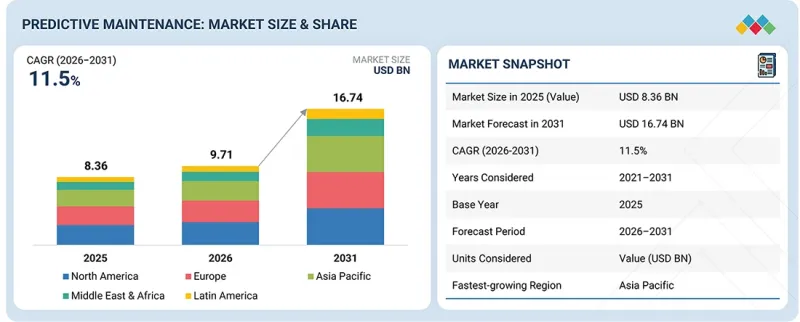
預測性維護市場預計將從 2026 年的 97.1 億美元成長到 2031 年的 167.4 億美元,預測期內複合年成長率為 11.5%。
隨著監管機構對工業安全、營運透明度和資產可靠性的日益重視,先進預測性維護平台在製造業、能源和基礎設施領域的應用正在加速。工業運營商必須維護嚴格的設備監控和維護記錄,以確保符合營運安全和可靠性標準。
| 調查範圍 | |
|---|---|
| 調查期 | 2021-2031 |
| 基準年 | 2025 |
| 預測期 | 2026-2031 |
| 目標單元 | 金額(10億美元) |
| 部分 | 按產品/服務、資產類型、部署模式、監控技術、技術、最終用戶、區域 |
| 目標區域 | 北美、歐洲、亞太地區、中東和非洲以及拉丁美洲 |
技術供應商正在強調預測維修系統如何利用互聯感測器、物聯網網路和高級分析技術,持續評估設備健康狀況並識別潛在故障的早期徵兆。這些解決方案使企業能夠從被動維護轉向數據驅動的資產監控策略,從而提高設備運轉率和營運視覺性。隨著各產業不斷推動數位轉型,企業正在部署智慧維護平台,以增強設備監控、支援安全措施合規性並改善大規模工業環境中的決策。
預測性維護市場的供應商正在透過建立統一的資產性能管理生態系統來擴展平台功能,該生態系統整合了人工智慧、工業IoT資料流和高級分析技術。領先的技術供應商正在結合機器學習模型、振動監測和運行數據分析,以產生精準的設備健康洞察和預測性維護警報。這些系統使維修團隊能夠識別效能異常、主動安排服務活動,並協調地理位置分散的設施的維護作業。透過將運作智慧整合到集中式維護平台中,企業可以實現更高的資產可視性、最佳化的維護計劃和更強的生產連續性。隨著互聯工業環境的不斷發展,預測性維護解決方案對於提高設備可靠性、最大限度地減少營運中斷以及在現代工業營運中實現數據驅動的維護策略至關重要。
“按行業分類,製造業預計將成為市場的主要驅動力。”
隨著各行業將設備可靠性、生產連續性和在複雜工業環境中最佳化資產性能列為優先事項,製造業正日益採用預測性維護技術。透過將狀態監測感測器、工業IoT網路和高級分析平台與工廠設備整合,製造商能夠持續監控機器狀態和運作效能。這些系統能夠及早發現異常情況,使維護團隊能夠在故障發生前安排維護活動。這種方法可以減少意外停機時間,提高資產利用率,並提升製造工廠的整體生產效率。人工智慧驅動的診斷和即時運行儀錶板進一步增強了維護計劃和決策能力。隨著製造商加速數位轉型和智慧工廠計畫的推進,預測性維護解決方案在這一終端用戶領域的應用正在快速成長。
“預計在預測期內,人工智慧驅動的預測性維護平台將以最高的複合年成長率成長。”
隨著各行業日益重視智慧資產監控、營運連續性和複雜生產環境中的主動設備維護,企業正擴大採用人工智慧驅動的預測性維護平台軟體。透過將機器學習模型與工業IoT感測器、雲端基礎設施和資產效能管理應用程式結合,企業可以持續洞察機器狀態和運作模式。這些平台分析歷史和即時設備數據,以檢測異常行為、預測潛在故障並幫助制定維護計劃。這種方法可以提高資產運轉率、減少意外停機時間並加強整個工業運作的維護策略。隨著全球數位化製造和互聯工廠計畫的加速推進,人工智慧驅動的預測性維護平台的應用正在迅速擴展。
“預計到 2026 年,北美將佔據最大的市場佔有率,而亞太地區預計在預測期內將呈現最高的成長率。”
北美在預測性維護市場佔據最大佔有率,這主要得益於關鍵產業對工業IoT技術、先進分析平台和成熟數位基礎設施的廣泛應用。美國和加拿大的企業正擴大採用人工智慧驅動的維護解決方案,以監控設備效能、偵測異常情況並防止意外的營運中斷。工業運營商正在整合互聯感測器、雲端平台和機器學習模型,以提高資產可視性並最佳化維護計劃。此外,該地區還受益於領先的技術供應商和工業自動化公司,這些公司支援在製造業、能源和交通運輸等行業大規模部署智慧維護系統。
亞太地區是預測性維護市場成長最快的地區,這主要得益於新興經濟體快速的工業化進程、不斷擴大的製造業產能以及加速的數位轉型。中國、印度、日本和東南亞的各行各業正擴大採用互聯資產監控解決方案,以提高營運效率並減少與維護相關的停機時間。企業正擴大採用基於物聯網的監控平台、先進的分析工具和人工智慧驅動的診斷功能來管理大規模工業設備。隨著對智慧工廠、數位基礎設施和工業自動化投資的不斷增加,對能夠實現數據驅動的資產管理並提高各種工業環境下生產可靠性的預測性維護平台的需求也日益成長。
本報告包含研究成果以及領先的預測性維護軟體和服務公司的詳細公司簡介。預測性維護市場的主要參與者包括:西門子(德國)、ABB(瑞士)、施耐德電氣(法國)、艾默生電氣(美國)、羅克韋爾自動化(美國)、霍尼韋爾(美國)、日立(日本)、SKF(瑞典)、福祿克公司(美國)、IBM(美國)、SAP(德國)、SAP(德國) Institute(美國)、微軟(美國)、AWS(美國)、Google(美國)、PTC(美國)、C3.AI(美國)、Augury(美國)、Uptake(美國)、Upkeep(美國)、Limble CMMS(美國)、Maintainx(美國)、Tractian(美國)、Samsara(美國)、Bentley)。
調查範圍
本研究報告涵蓋預測性維護市場,並按交付模式、技術、監控方法、部署模式、資產類型、最終用戶和地區進行細分。交付服務細分市場分為監控基礎設施、軟體和服務。監控基礎設施細分市場進一步細分為感測器和感測設備、成像和檢測設備、邊緣監控基礎設施以及連接硬體。軟體細分市場包括資產效能管理平台、工業IoT平台、人工智慧驅動的預測性維護平台、數位雙胞胎平台、維護管理應用程式以及視覺化和分析軟體。服務細分市場進一步細分為諮詢服務、預測性維護策略諮詢、系統整合服務、資料科學和人工智慧服務以及託管預測性維護服務。技術細分市場分為工業IoT(IoT)、人工智慧和機器學習、數位雙胞胎技術、邊緣運算和邊緣人工智慧、工業資料平台以及用於設備檢測的電腦視覺。工業資料平台細分市場分為工業資料湖和工業資料架構平台。監測技術細分市場分為工業振動監測、熱監測(紅外線熱成像)、聲學和超音波監測、油液及潤滑劑分析、電氣性能分析、視覺檢測和多模態感測器融合監測。視覺檢測細分市場又分為電腦視覺檢測和無人機檢測。部署模式細分市場分為雲端部署、本地部署、邊緣部署和混合部署。雲端部署細分市場又分為公共雲端和私有雲端。資產類型細分市場分為旋轉機械、馬達、暖通空調系統、工業機器人及自動化設備、車輛及交通運輸資產及發電設備。旋轉機械細分市場又分為泵浦、壓縮機及馬達及渦輪機。馬達細分市場又分為變壓器、開關設備和配電系統。車輛及交通運輸資產細分市場分為軌道運輸資產、航空資產及商用車輛。發電設備細分市場又分為風力發電機、燃氣渦輪機和蒸氣渦輪。終端用戶細分市場分為製造業、個人製造、流程製造、能源與公共產業、石油與天然氣、運輸與物流、採礦與機械、電訊、醫療保健、智慧基礎設施與建築、資料中心基礎設施、其他終端用戶。個人製造細分市場又分為汽車、電子與半導體、工業機械。流程製造細分市場分為化學、製藥以及食品飲料。能源與公共產業細分市場分為發電、輸電與配電、可再生能源。石油與天然氣細分市場分為上游、中游和下游。運輸與物流細分市場分為鐵路、航空、港口與航運。醫療保健細分市場分為醫療設備維護和醫院基礎設施。智慧基礎設施與建築細分市場分為商業建築和智慧城市基礎設施。區域細分市場包括北美、歐洲、亞太、中東和非洲以及拉丁美洲。
本報告詳細介紹了影響預測性維護市場成長的關鍵因素,包括促進因素、限制因素、挑戰和機會。報告深入分析了主要行業參與者,涵蓋其業務概況、解決方案和服務、關鍵策略、協議、夥伴關係關係、產品和服務推出、併購以及預測性維護市場的最新發展。此外,報告還對預測性維護市場生態系統中的新興新創公司進行了競爭分析。
購買本報告的主要好處
本報告為市場領導和新參與企業提供關於預測性維護市場及其細分市場整體收入的最準確估算。這有助於相關人員了解競爭格局,改善業務,並獲得更深入的洞察,從而製定合適的打入市場策略。此外,本報告還有助於了解市場趨勢,並提供有關關鍵促進因素、限制、挑戰和機會的資訊。
本報告深入分析了以下幾點:
對關鍵促進因素(減少設備停機時間和維護成本的需求日益成長,以及在工業運營中擴大物聯網設備監控的應用)、挑戰(將預測性維護解決方案與傳統工業系統整合,以及確保預測性維護模型中的數據準確性和可靠性) 、機會(擴大採用邊緣運算進行設備資料的高速處理,以及在預測性維護分析中擴大人工智慧和機器學習的應用)和阻礙因素(部署和基礎設施成本高昂,以及跨多個設備系統的資料管理和整合方面的挑戰)的分析。
產品開發與創新:深入了解預測性維護市場的未來技術、研發活動以及產品/服務發布。
市場發展:提供各地區盈利市場的全面資訊及預測性維護市場分析。
市場多元化:提供預測性維護市場的新產品和服務、未開發的市場、最新趨勢和投資機會的全面資訊。
競爭格局分析涵蓋了西門子(德國)、ABB(瑞士)、施耐德電氣(法國)、艾默生電氣(美國)、羅克韋爾自動化(美國)、霍尼韋爾(美國)、日立(日本)、SKF(瑞典)、福祿克公司(美國)、IBM(美國)、SAP(德國)、甲骨文Institute(美國)、微軟(美國)、AWS(美國)、Google(美國)、PTC(美國)、C3.AI(美國)、Augury(美國)、Uptake(美國)、Upkeep(美國)、Limble CMMS(美國)、Maintainx(美國)、Tractian(美國)、Samsara(美國)、Bentley(瑞典)(瑞典)等(瑞典公司)。此外,本報告還深入分析了預測性維護市場的關鍵促進因素、限制、挑戰和機遇,幫助相關人員了解該市場的發展趨勢。
目錄
第1章:引言
第2章執行摘要
第3章重要考察
第4章 市場概覽
- 市場動態
- 促進因素
- 抑制因子
- 機會
- 任務
- 未滿足的需求和未開發的領域
- 相互關聯的市場與跨產業機遇
- 一級/二級/三級公司的策略性舉措
第5章 產業趨勢
- 預測性維護的發展歷程:
- 波特五力分析
- 宏觀經濟展望
- 供應鏈分析
- 生態系分析
- 價格分析
- 貿易分析
- 2025-2026 年主要會議和活動
- 影響客戶業務的趨勢和變化
- 投資和資金籌措場景
- 案例研究分析
- 美國關稅對2025年預測性維護市場的影響
第6章 策略顛覆:專利、數位化與人工智慧的運用
- 主要技術
- 互補技術
- 鄰近技術
- 技術藍圖
- 專利分析
- 人工智慧對預測性維護市場的影響
第7章 監理情勢
- 當地法規和合規性
- 監管機構、政府機構和其他組織
- 主要法規
- 業界標準
第8章:顧客趨勢與購買行為
- 決策流程
- 採購過程中的關鍵相關人員及其評估標準
- 實施障礙和內部挑戰
- 各行業終端用戶未被滿足的需求
第9章:預測性維護市場(依產品/服務分類)
- 監控基礎設施
- 軟體
- 服務
第10章:預測性維護市場(依資產類型分類)
- 旋轉機械
- 電氣設備
- 暖通空調系統
- 工業機器人和自動化設備
- 車輛和運輸資產
- 發電設備
第11章:預測性維護市場(依實施模式分類)
- 雲端部署
- 本地部署
- 邊緣開發
- 混合部署
第12章:預測性維護市場(依監控技術分類)
- 工業振動監測
- 熱監測(紅外線熱成像)
- 聲學和超音波監測
- 油品及潤滑分析
- 電子簽章分析
- 目視檢查
- 多模態感測器融合監測
第13章:預測性維修市場(依技術分類)
- 工業IoT(IIoT)
- 人工智慧和機器學習
- 數位雙胞胎技術
- 邊緣運算和邊緣人工智慧
- 工業數據平台
- 電腦視覺
第14章:預測性維護市場(依最終用戶分類)
- 製造業
- 能源與公共產業
- 石油和天然氣
- 運輸/物流
- 採礦和機械
- 電訊
- 衛生保健
- 智慧基礎設施與智慧建築
- 資料中心基礎設施
- 其他
第15章:預測性維護市場(按地區分類)
- 北美洲
- 北美:預測性維護的市場促進因素
- 美國
- 加拿大
- 歐洲
- 歐洲:預測性維護的市場促進因素
- 英國
- 德國
- 法國
- 義大利
- 其他
- 亞太地區
- 亞太地區:預測性維護的市場促進因素
- 中國
- 印度
- 日本
- ASEAN
- 其他
- 中東和非洲
- 中東和非洲:預測性維護的市場促進因素
- 沙烏地阿拉伯王國
- 阿拉伯聯合大公國
- 土耳其
- 南非
- 其他
- 拉丁美洲
- 拉丁美洲:預測性維護的市場促進因素
- 巴西
- 墨西哥
- 其他
第16章 競爭格局
- 概述
- 主要參與企業的策略,2021-2025年
- 2021-2025年收入分析
- 2025年市佔率分析
- 品牌比較分析
- 公司評估矩陣:主要軟體供應商
- 企業評估矩陣:其他主要軟體供應商
- 企業評估矩陣:監控基礎設施供應商
- 企業估值和財務指標
- 競爭格局
第17章:公司簡介
- 主要參與企業
- ABB
- HONEYWELL
- SIEMENS
- SCHNEIDER ELECTRIC
- ROCKWELL AUTOMATION
- IBM
- SAP
- ORACLE
- C3.AI
- GE VERNOVA
- SKF
- MICROSOFT
- AMAZON WEB SERVICE
- EMERSON ELECTRIC
- HITACHI
- FLUKE CORPORATION
- INFOR
- IFS
- SAS INSTITUTE
- UPTAKE
- UPKEEP
- PTC
- AUGURY
- LIMBLE CMMS
- MAINTAINX
- FRACTAL
- TRACTIAN
- SAMSARA
- BENTLEY SYSTEMS
- HEXAGON AB
- ASPEN TECHNOLOGY
- DINGO
- SENSEMORE
第18章:調查方法
第19章附錄
The predictive maintenance market is expected to grow from USD 9.71 billion in 2026 to USD 16.74 billion by 2031, growing at a CAGR of 11.5% during the forecast period. Regulatory focus on industrial safety, operational transparency, and asset reliability are accelerating the adoption of advanced predictive maintenance platforms across manufacturing, energy, and infrastructure sectors. Industrial operators are required to maintain strict equipment monitoring and maintenance documentation to ensure operational safety and compliance with reliability standards.
| Scope of the Report | |
|---|---|
| Years Considered for the Study | 2021-2031 |
| Base Year | 2025 |
| Forecast Period | 2026-2031 |
| Units Considered | Value (USD Billion) |
| Segments | Offering, technology, monitoring technique, asset type, end user, and region |
| Regions covered | North America, Europe, Asia Pacific, the Middle East & Africa, and Latin America |
Technology providers highlight that predictive maintenance systems leverage connected sensors, IoT networks, and advanced analytics to continuously assess equipment condition and identify early indicators of potential failure. These solutions enable organizations to transition from reactive maintenance to data-driven asset-monitoring strategies that improve equipment uptime and operational visibility. As industries expand digital transformation initiatives, companies are implementing intelligent maintenance platforms that strengthen equipment oversight, support compliance with safety practices, and enhance decision-making across large industrial environments.
Vendors in the predictive maintenance market are expanding platform capabilities by integrating artificial intelligence, industrial IoT data streams, and advanced analytics into unified asset performance management ecosystems. Leading technology providers combine machine learning models, vibration monitoring, and operational data analytics to generate accurate equipment health insights and predictive alerts. These systems enable maintenance teams to identify performance deviations, proactively schedule service activities, and coordinate maintenance operations across geographically distributed facilities. By consolidating operational intelligence within centralized maintenance platforms, organizations gain improved asset visibility, optimized maintenance planning, and enhanced production continuity. As connected industrial environments continue to evolve, predictive maintenance solutions are becoming critical for improving equipment reliability, minimizing operational disruptions, and enabling data-driven maintenance strategies across modern industrial operations.
"By vertical, the manufacturing segment is expected to dominate the market."
Manufacturing organizations are increasingly implementing predictive maintenance technologies as industries prioritize equipment reliability, production continuity, and the optimization of asset performance across complex industrial environments. By integrating condition monitoring sensors, industrial IoT networks, and advanced analytics platforms with factory equipment, manufacturers gain continuous visibility into machine health and operational performance. These systems enable early detection of anomalies, allowing maintenance teams to schedule service activities before failures occur. This approach reduces unplanned downtime, improves asset utilization, and strengthens production efficiency across manufacturing facilities. AI-driven diagnostics and real-time operational dashboards further enhance maintenance planning and decision-making. As manufacturers accelerate digital transformation and smart factory initiatives, the adoption of predictive maintenance solutions in this end-user segment continues to grow rapidly.
"By offering, the AI-driven predictive maintenance platform is projected to grow at the highest CAGR during the forecast period."
Organizations are increasingly deploying AI-driven predictive maintenance platform software as industries emphasize intelligent asset supervision, operational continuity, and proactive equipment servicing across complex production environments. By combining machine learning models with industrial IoT sensors, cloud infrastructure, and asset performance applications, enterprises obtain continuous insight into machine condition and operational patterns. These platforms analyze historical and streaming equipment data to detect irregular behavior, anticipate potential failures, and inform maintenance planning. The approach improves asset availability, limits unexpected disruptions, and strengthens maintenance strategy across industrial operations. As digital manufacturing and connected factory initiatives accelerate globally, the adoption of AI-enabled predictive maintenance platforms is expanding rapidly.
"North America will have the largest market share in 2026, and Asia Pacific is slated to grow at the highest rate during the forecast period."
North America holds the leading share of the predictive maintenance market due to strong adoption of industrial IoT technologies, advanced analytics platforms, and mature digital infrastructure across key industries. Enterprises across the US and Canada increasingly deploy AI-enabled maintenance solutions to monitor equipment performance, detect anomalies, and prevent unexpected operational disruptions. Industrial operators are integrating connected sensors, cloud platforms, and machine learning models to improve asset visibility and optimize maintenance scheduling. The region also benefits from the presence of major technology providers and industrial automation companies that support large-scale deployment of intelligent maintenance systems across manufacturing, energy, and transportation sectors.
Asia Pacific represents the fastest-growing region in the predictive maintenance market, driven by rapid industrialization, expanding manufacturing capacity, and accelerating digital transformation initiatives across emerging economies. Industries across China, India, Japan, and Southeast Asia are adopting connected asset monitoring solutions to improve operational efficiency and reduce maintenance-related downtime. Organizations are increasingly implementing IoT-based monitoring platforms, advanced analytics tools, and AI-driven diagnostics to manage large industrial equipment fleets. Growing investments in smart factories, digital infrastructure, and industrial automation are strengthening demand for predictive maintenance platforms that enable data-driven asset management and improved production reliability across diverse industrial environments.
Breakdown of Primaries
In-depth interviews were conducted with chief executive officers (CEOs), innovation and technology directors, system integrators, and executives from various key organizations operating in the predictive maintenance market.
- By Company: Tier I - 34%, Tier II - 43%, and Tier III - 23%
- By Designation: C Level - 50%, Director Level - 30%, and others - 20%
- By Region: North America - 25%, Europe - 30%, Asia Pacific - 30%, Middle East & Africa - 10%, and Latin America - 5%
The report includes the study and in-depth company profiles of key players offering predictive maintenance software and services. The major players in the predictive maintenance market include Siemens (Germany), ABB (Switzerland), Schneider Electric (France), Emerson Electric (US), Rockwell Automation (US), Honeywell (US), Hitachi (Japan), SKF (Sweden), Fluke Corporation (US), IBM (US), SAP (Germany), Oracle (US), Infor (US), IFS (Sweden), SAS Institute (US), Microsoft (US), AWS (US), Google (US), PTC (US), C3.AI (US), Augury (US), Uptake (US), Upkeep (US), Limble CMMS (US), Maintainx (US), Tractian (US), Samsara (US), Bentley Systems (US), and Hexagon AB (Sweden).
Research Coverage
This research report covers the predictive maintenance market and is segmented by offering, technology, monitoring technique, deployment mode, asset type, end user, and region. The offering segment is split into monitoring infrastructure, software, and services. The monitoring infrastructure sub-segment is bifurcated into sensors & sensing devices, imaging & inspection devices, edge monitoring infrastructure, and connectivity hardware. The software sub-segment includes asset performance management platforms, industrial IoT platforms, AI-driven predictive maintenance platforms, digital twin platforms, maintenance management applications, and visualization & analytics software. The services sub-segment is further split into consulting services, predictive maintenance strategy consulting, system integration services, data science & AI services, and managed predictive maintenance services. The technology segment is split into industrial Internet of Things (IoT), artificial intelligence and machine learning, digital twin technology, edge computing & edge AI, industrial data platforms, and computer vision for equipment inspection. The industrial data platforms sub-segment is categorized into industrial data lakes and industrial data fabric platforms. The monitoring technique segment is split into industrial vibration monitoring, thermal monitoring (infrared thermography), acoustic & ultrasonic monitoring, oil & lubrication analysis, electrical signature analysis, visual inspection, and multimodal sensor fusion monitoring. The visual inspection sub-segment is categorized into computer vision inspection and drone-based inspection. The deployment mode segment is split into cloud, on-premises, edge, and hybrid deployments. The cloud deployment sub-segment is categorized into public cloud and private cloud. The asset type segment is split into rotating equipment, electrical equipment, HVAC systems, industrial robots & automation equipment, fleet & transportation assets, and power generation equipment. The rotating equipment sub-segment is categorized into pumps, compressors, motors & turbines. The electrical equipment sub-segment is categorized into transformers, switchgear, and power distribution systems. The fleet & transportation assets sub-segment is categorized into rail assets, aviation assets, and commercial vehicle fleets. The power generation equipment sub-segment is categorized into wind turbines, gas turbines, and steam turbines. The end-user segment is divided into manufacturing, discrete manufacturing, process manufacturing, energy & utilities, oil & gas, transportation & logistics, mining & machinery, telecommunications, healthcare, smart infrastructure & buildings, data centers infrastructure, and other end users. The discrete manufacturing sub-segment is categorized into automotive, electronics & semiconductor, and industrial machinery. The process manufacturing sub-segment is categorized into chemicals, pharmaceuticals, and food & beverages. The energy & utilities sub-segment is categorized into power generation, transmission & distribution, and renewable energy. The oil & gas sub-segment is categorized into upstream, midstream, and downstream. The transportation & logistics sub-segment is categorized into railways, aviation, and ports & shipping. The healthcare sub-segment is categorized into medical equipment maintenance and hospital infrastructure. The smart infrastructure & buildings sub-segment is categorized into commercial buildings and smart city infrastructure. The regional segment comprises North America, Europe, Asia Pacific, the Middle East & Africa, and Latin America.
The report's scope encompasses detailed information on the major factors, including drivers, restraints, challenges, and opportunities, that influence the growth of the Predictive maintenance market. A detailed analysis of key industry players has been conducted to provide insights into their business overview, solutions and services, key strategies, contracts, partnerships, agreements, product & service launches, mergers and acquisitions, and recent developments in the predictive maintenance market. This report provides a competitive analysis of emerging startups in the predictive maintenance market ecosystem.
Key Benefits of Buying the Report
The report will provide market leaders and new entrants with information on the closest approximations of the revenue numbers for the overall predictive maintenance market and its subsegments. It would help stakeholders understand the competitive landscape and gain more insights to better their business and plan suitable go-to-market strategies. It also helps stakeholders understand the market pulse and provides information on key drivers, restraints, challenges, and opportunities.
The report provides insights into the following pointers:
Analysis of key drivers (Increasing need to reduce equipment downtime and maintenance costs, Increasing adoption of IoT-enabled equipment monitoring in industrial operations), challenges (Integration of predictive maintenance solutions with legacy industrial systems, Ensuring data accuracy and reliability for predictive maintenance models), opportunities (Growing adoption of edge computing for faster equipment data processing, Growing use of AI and machine learning for predictive maintenance analytics), and restraints (High implementation and infrastructure setup costs, Data management and integration challenges across multiple equipment systems).
Product Development/Innovation: Detailed insights into upcoming technologies, research & development activities, and product & service launches in the predictive maintenance market
Market Development: Comprehensive information about lucrative markets, analysis of the predictive maintenance market across varied regions
Market Diversification: Exhaustive information about new products & services, untapped geographies, recent developments, and investments in the predictive maintenance market
Competitive Assessment: In-depth assessment of market shares, growth strategies and service offerings of Siemens (Germany), ABB (Switzerland), Schneider Electric (France), Emerson Electric (US), Rockwell Automation (US), Honeywell (US), Hitachi (Japan), SKF (Sweden), Fluke Corporation (US), IBM (US), SAP (Germany), Oracle (US), Infor (US), IFS (Sweden), SAS Institute (US), Microsoft (US), AWS (US), Google (US), PTC (US), C3.AI (US), Augury (US), Uptake (US), Upkeep (US), Limble CMMS (US), Maintainx (US), Tractian (US), Samsara (US), Bentley Systems (US), Hexagon AB (Sweden) among others, in the predictive maintenance market. The report also helps stakeholders understand the pulse of the predictive maintenance market, providing insights into key drivers, restraints, challenges, and opportunities
TABLE OF CONTENTS
1 INTRODUCTION
- 1.1 STUDY OBJECTIVES
- 1.2 MARKET DEFINITION
- 1.2.1 INCLUSIONS AND EXCLUSIONS
- 1.3 MARKET SCOPE
- 1.3.1 MARKET SEGMENTATION
- 1.3.2 YEARS CONSIDERED
- 1.3.3 CURRENCY CONSIDERED
- 1.4 STAKEHOLDERS
- 1.5 SUMMARY OF CHANGES
2 EXECUTIVE SUMMARY
- 2.1 MARKET HIGHLIGHTS AND KEY INSIGHTS
- 2.2 KEY MARKET PARTICIPANTS: MAPPING OF STRATEGIC DEVELOPMENTS
- 2.3 DISRUPTIVE TRENDS IN PREDICTIVE MAINTENANCE MARKET
- 2.4 HIGH GROWTH SEGMENTS
- 2.5 REGIONAL SNAPSHOT: MARKET SIZE, GROWTH RATE, AND FORECAST
3 PREMIUM INSIGHTS
- 3.1 ATTRACTIVE OPPORTUNITIES IN PREDICTIVE MAINTENANCE MARKET
- 3.2 PREDICTIVE MAINTENANCE MARKET, BY REGION
- 3.3 PREDICTIVE MAINTENANCE MARKET: TOP THREE ASSET TYPES
- 3.4 NORTH AMERICA: PREDICTIVE MAINTENANCE MARKET, BY OFFERING AND DEPLOYMENT MODE
- 3.5 PREDICTIVE MAINTENANCE MARKET, BY REGION
4 MARKET OVERVIEW
- 4.1 INTRODUCTION
- 4.2 MARKET DYNAMICS
- 4.2.1 DRIVERS
- 4.2.1.1 Explosion of IIoT and real-time data ecosystems enabling continuous asset visibility
- 4.2.1.2 Compelling operational ROI driven by reduction in unplanned downtime and maintenance costs
- 4.2.1.3 Advancements in AI and machine learning improving prediction accuracy and enabling scalable deployment
- 4.2.2 RESTRAINTS
- 4.2.2.1 High upfront investment across hardware, software, and system integration limiting adoption
- 4.2.2.2 Data quality and availability limitations reducing reliability of predictive maintenance outcomes
- 4.2.3 OPPORTUNITIES
- 4.2.3.1 Digital twins and advanced simulation enabling predictive and prescriptive maintenance evolution
- 4.2.3.2 Edge AI and distributed architectures enabling real-time, low-latency predictive maintenance
- 4.2.3.3 Expansion of predictive maintenance into asset-intensive industries beyond manufacturing
- 4.2.4 CHALLENGES
- 4.2.4.1 Data silos across enterprise systems limiting unified asset visibility and insights
- 4.2.4.2 Model reliability and explainability challenges reducing trust in predictive maintenance systems
- 4.2.1 DRIVERS
- 4.3 UNMET NEEDS AND WHITE SPACES
- 4.3.1 UNMET NEEDS IN PREDICTIVE MAINTENANCE MARKET
- 4.3.2 WHITE SPACE OPPORTUNITIES
- 4.4 INTERCONNECTED MARKETS AND CROSS-SECTOR OPPORTUNITIES
- 4.4.1 INTERCONNECTED MARKETS
- 4.4.2 CROSS-SECTOR OPPORTUNITIES
- 4.5 STRATEGIC MOVES BY TIER-1/2/3 PLAYERS
- 4.5.1 STRATEGIC MOVES BY TIER-1/2/3 PLAYERS
5 INDUSTRY TRENDS
- 5.1 EVOLUTION OF PREDICTIVE MAINTENANCE: EVOLUTION OF PREDICTIVE MAINTENANCE
- 5.2 PORTER'S FIVE FORCES ANALYSIS
- 5.2.1 THREAT OF NEW ENTRANTS
- 5.2.2 THREAT OF SUBSTITUTES
- 5.2.3 BARGAINING POWER OF SUPPLIERS
- 5.2.4 BARGAINING POWER OF BUYERS
- 5.2.5 INTENSITY OF COMPETITIVE RIVALRY
- 5.3 MACROECONOMIC OUTLOOK
- 5.3.1 INTRODUCTION
- 5.3.2 GDP TRENDS AND FORECAST
- 5.3.3 TRENDS IN INDUSTRIAL IOT (IIOT) INDUSTRY
- 5.3.4 TRENDS IN AI & MACHINE LEARNING INDUSTRY
- 5.4 SUPPLY CHAIN ANALYSIS
- 5.5 ECOSYSTEM ANALYSIS
- 5.5.1 MONITORING INFRASTRUCTURE PROVIDERS
- 5.5.1.1 Sensor and Sensing Devices
- 5.5.1.2 Imaging and Inspection Devices
- 5.5.1.3 Edge Monitoring Infrastructure
- 5.5.1.4 Connectivity Hardware
- 5.5.2 SOFTWARE PROVIDERS
- 5.5.2.1 Industrial Data Platforms & Connectivity
- 5.5.2.2 Digital Twin Software
- 5.5.2.3 Maintenance Management Application
- 5.5.2.4 Visualization and Analytics Software
- 5.5.2.5 Asset Performance Management Platform
- 5.5.3 SERVICE PROVIDERS
- 5.5.3.1 Consulting Services
- 5.5.3.2 Integration and Deployment Services
- 5.5.3.3 Data, AI, and Modeling Services
- 5.5.3.4 Managed Predictive Maintenance Services
- 5.5.1 MONITORING INFRASTRUCTURE PROVIDERS
- 5.6 PRICING ANALYSIS
- 5.6.1 AVERAGE SELLING PRICE OF OFFERINGS, BY KEY PLAYER, 2025
- 5.6.2 AVERAGE SELLING PRICE OF ASSET TYPE, 2025
- 5.7 TRADE ANALYSIS
- 5.7.1 IMPORT SCENARIO (HS CODE 9031)
- 5.7.2 EXPORT SCENARIO (HS CODE 9031)
- 5.8 KEY CONFERENCES AND EVENTS, 2025-2026
- 5.9 TRENDS & DISRUPTIONS IMPACTING CUSTOMER BUSINESS
- 5.10 INVESTMENT AND FUNDING SCENARIO
- 5.11 CASE STUDY ANALYSIS
- 5.11.1 OMV STRENGTHENED REFINERY ASSET RELIABILITY WITH PREDICTIVE MAINTENANCE ENABLED DIGITAL TRANSFORMATION BY IBM
- 5.11.2 SIEMENS STRENGTHENED ASSET RELIABILITY FOR BLUESCOPE WITH SENSEYE PREDICTIVE MAINTENANCE
- 5.11.3 ENGIE DIGITAL ENHANCED POWER PLANT RELIABILITY WITH AWS-ENABLED PREDICTIVE MAINTENANCE
- 5.11.4 C3.AI IMPROVED US AIR FORCE MISSION READINESS WITH AI-ENABLED PREDICTIVE MAINTENANCE
- 5.11.5 TATA POWER ENHANCED FLEET-WIDE ASSET RELIABILITY WITH AVEVA PREDICTIVE ANALYTICS
- 5.12 IMPACT OF 2025 US TARIFF - PREDICTIVE MAINTENANCE MARKET
- 5.12.1 INTRODUCTION
- 5.12.1.1 Tariff/Trade Policy Updates (April 2025 to February 2026)
- 5.12.2 KEY TARIFF RATES
- 5.12.3 PRICE IMPACT ANALYSIS
- 5.12.3.1 Strategic shifts and emerging trends
- 5.12.4 IMPACT ON COUNTRY/REGION
- 5.12.4.1 US
- 5.12.4.2 China
- 5.12.4.3 Europe
- 5.12.4.4 Asia Pacific (excluding China)
- 5.12.5 IMPACT ON END-USE INDUSTRIES
- 5.12.5.1 Manufacturing
- 5.12.5.2 Energy & Utilities
- 5.12.5.3 Oil & Gas
- 5.12.5.4 Transportation & Logistics
- 5.12.5.5 Mining & Heavy Machinery
- 5.12.5.6 Telecommunications
- 5.12.5.7 Healthcare
- 5.12.5.8 Smart Infrastructure & Buildings
- 5.12.5.9 Data Centers
- 5.12.5.10 Other End Users
- 5.12.1 INTRODUCTION
6 STRATEGIC DISRUPTION: PATENTS, DIGITAL, AND AI ADOPTION
- 6.1 KEY TECHNOLOGIES
- 6.1.1 SENSING INSTRUMENTATION
- 6.1.2 INDUSTRIAL INTERNET OF THINGS
- 6.1.3 STREAM PROCESSING
- 6.1.4 DATA ENGINEERING
- 6.1.5 PREDICTIVE ANALYTICS
- 6.2 COMPLEMENTARY TECHNOLOGIES
- 6.2.1 BIG DATA
- 6.2.2 CLOUD COMPUTING
- 6.2.3 DATA VISUALIZATION
- 6.3 ADJACENT TECHNOLOGIES
- 6.3.1 MACHINE LEARNING
- 6.3.2 ARTIFICIAL INTELLIGENCE (AI)
- 6.3.3 DIGITAL TWIN
- 6.3.4 EDGE COMPUTING
- 6.4 TECHNOLOGY ROADMAP
- 6.4.1 SHORT TERM (2025-2027): FOUNDATION AND CONNECTIVITY PHASE
- 6.4.2 MID TERM (2028-2030): CONVERGENCE AND AUTOMATION PHASE
- 6.4.3 LONG TERM (2031-2035): AUTONOMOUS AND COGNITIVE INTEROPERABILITY PHASE
- 6.5 PATENT ANALYSIS
- 6.5.1 METHODOLOGY
- 6.5.2 PATENTS FILED, BY DOCUMENT TYPE, 2016-2026
- 6.5.3 INNOVATION AND PATENT APPLICATIONS
- 6.6 IMPACT OF AI ON PREDICTIVE MAINTENANCE MARKET
- 6.6.1 BEST PRACTICES IN PREDICTIVE MAINTENANCE MARKET
- 6.6.2 CASE STUDIES RELATED TO AI IMPLEMENTATION IN PREDICTIVE MAINTENANCE MARKET
- 6.6.3 INTERCONNECTED ECOSYSTEM AND IMPACT ON MARKET PLAYERS IN AI-DRIVEN PREDICTIVE MAINTENANCE
- 6.6.4 CLIENTS' READINESS TO ADOPT AI-INTEGRATED PREDICTIVE MAINTENANCE
7 REGULATORY LANDSCAPE
- 7.1 REGIONAL REGULATIONS AND COMPLIANCE
- 7.1.1 REGULATORY BODIES, GOVERNMENT AGENCIES, AND OTHER ORGANIZATIONS
- 7.1.2 KEY REGULATIONS
- 7.1.2.1 North America
- 7.1.2.1.1 Integrated Aircraft Health Management System (US)
- 7.1.2.1.2 On-Condition Piston Engine Maintenance Programs (Canada)
- 7.1.2.2 Europe
- 7.1.2.2.1 Continuing Airworthiness Rules (European Union)
- 7.1.2.2.2 PREDICT Predictive Maintenance Methods (Germany)
- 7.1.2.2.3 Operational Technology Security Principles (United Kingdom)
- 7.1.2.2.4 Industrial and Critical Infrastructure Cybersecurity Guidance (France)
- 7.1.2.3 Asia Pacific
- 7.1.2.3.1 RM&D Predictive Maintenance Regime for Lifts (Singapore)
- 7.1.2.3.2 Remote Diagnostic and Predictive Maintenance System for Signaling Equipment (India)
- 7.1.2.3.3 Cyber/Physical Security Guidelines for Factory Systems (Japan)
- 7.1.2.4 Middle East & Africa
- 7.1.2.4.1 Standard for Development and Implementation of Maintenance Basis (South Africa)
- 7.1.2.4.2 ITTI Use-Case Guide - Predictive Maintenance for Shopfloor Machinery (UAE)
- 7.1.2.4.3 AI/ML Medical Devices Guidance (Saudi Arabia)
- 7.1.2.5 Latin America
- 7.1.2.5.1 Aerodrome Safety Management - Predictive Approach (Brazil)
- 7.1.2.5.2 NOM-020-ASEA-2024 (Mexico)
- 7.1.2.1 North America
- 7.1.3 INDUSTRY STANDARDS
8 CUSTOMER LANDSCAPE & BUYER BEHAVIOR
- 8.1 DECISION-MAKING PROCESS
- 8.2 KEY STAKEHOLDERS INVOLVED IN BUYING PROCESS AND THEIR EVALUATION CRITERIA
- 8.2.1 KEY STAKEHOLDERS IN BUYING PROCESS
- 8.2.2 BUYING CRITERIA
- 8.3 ADOPTION BARRIERS & INTERNAL CHALLENGES
- 8.4 UNMET NEEDS FROM VARIOUS INDUSTRY END USERS
9 PREDICTIVE MAINTENANCE MARKET, BY OFFERING
- 9.1 INTRODUCTION
- 9.1.1 OFFERING: PREDICTIVE MAINTENANCE MARKET DRIVERS
- 9.2 MONITORING INFRASTRUCTURE
- 9.2.1 SENSOR & SENSING DEVICES
- 9.2.1.1 Enabling Real-time Asset Health Monitoring Through Integrated Sensor Intelligence
- 9.2.1.2 Vibration Sensors
- 9.2.1.3 Temperature Sensors
- 9.2.1.4 Pressure Sensors
- 9.2.1.5 Acoustic/Ultrasonic Sensors
- 9.2.1.6 Electrical Current Sensors
- 9.2.2 IMAGING & INSPECTION DEVICES
- 9.2.2.1 Enhancing Asset Visibility and Fault Diagnostics Through Advanced Inspection Intelligence
- 9.2.2.2 Thermal Imaging Cameras
- 9.2.2.3 Visual Inspection Cameras
- 9.2.2.4 Acoustic Imaging Devices
- 9.2.3 EDGE MONITORING INFRASTRUCTURE
- 9.2.3.1 Strengthening Real-time Asset Intelligence Through Advanced Edge Analytics Infrastructure
- 9.2.3.2 Edge Gateways
- 9.2.3.3 Industrial Data Acquisition Systems
- 9.2.3.4 Embedded Monitoring controllers
- 9.2.4 CONNECTIVITY HARDWARE
- 9.2.4.1 Strengthening Industrial Asset Connectivity Through Secure Data Transmission Infrastructure
- 9.2.4.2 Industrial Routers
- 9.2.4.3 IIOT Communication Modules
- 9.2.1 SENSOR & SENSING DEVICES
- 9.3 SOFTWARE
- 9.3.1 ASSET PERFORMANCE MANAGEMENT (APM) PLATFORMS
- 9.3.1.1 Strengthening Asset Reliability and Lifecycle Intelligence Through Advanced Predictive Analytics Platforms
- 9.3.1.2 Asset Health Monitoring
- 9.3.1.3 Reliability & Performance Analytics
- 9.3.1.4 Failure Prediction & Diagnostics
- 9.3.1.5 Prescriptive Maintenance
- 9.3.1.6 AI/ML-driven Predictive Models
- 9.3.2 INDUSTRIAL DATA PLATFORMS & CONNECTIVITY
- 9.3.2.1 Strengthening Real-time Asset Intelligence Through Unified Industrial Data Connectivity
- 9.3.2.2 Device & Asset Connectivity
- 9.3.2.3 Industrial Data Ingestion
- 9.3.2.4 Industrial Data Management & Contextualization
- 9.3.3 DIGITAL TWIN SOFTWARE
- 9.3.3.1 Advancing Real-time Asset Simulation and Lifecycle Intelligence Through Unified Operational Modeling
- 9.3.3.2 Asset Digital Twin Modeling
- 9.3.3.3 Simulation & Scenario Analysis
- 9.3.3.4 Operational Digital Twin Environments
- 9.3.4 MAINTENANCE MANAGEMENT APPLICATIONS
- 9.3.4.1 Driving Proactive Asset Reliability and Lifecycle Decisions Through Intelligent Maintenance Platforms
- 9.3.4.2 Condition Monitoring Applications
- 9.3.4.3 Maintenance Planning and Scheduling
- 9.3.4.4 Work Order Automation Systems
- 9.3.5 VISUALIZATION & ANALYTICS SOFTWARE
- 9.3.5.1 Enabling Real-time Asset Intelligence and Performance Decisions Through Unified Visualization Analytics
- 9.3.5.2 Asset Monitoring Dashboards
- 9.3.5.3 Industrial Analytics Tools
- 9.3.1 ASSET PERFORMANCE MANAGEMENT (APM) PLATFORMS
- 9.4 SERVICES
- 9.4.1 CONSULTING SERVICES
- 9.4.1.1 Accelerating Reliability Transformation Through Expert-led Predictive Maintenance Advisory and Deployment Services
- 9.4.1.2 Reliability Engineering Consulting
- 9.4.1.3 Predictive Maintenance Strategy Consulting
- 9.4.1.4 Asset Criticality Assessment
- 9.4.2 INTEGRATION AND DEPLOYMENT SERVICES
- 9.4.2.1 Accelerating Enterprise-scale Predictive Maintenance Deployment Through Seamless System Integration and Operational Enablement
- 9.4.2.2 Industrial Platform Implementation
- 9.4.2.3 Platform Configuration and Customization
- 9.4.2.4 Edge-To-Cloud Integration
- 9.4.2.5 Enterprise System Integration
- 9.4.2.6 Data Integration and Preparation
- 9.4.3 DATA, AI & MODELING SERVICES
- 9.4.3.1 Advancing Enterprise-scale Predictive Intelligence Through AI-driven Modeling and Data Science Enablement
- 9.4.3.2 Predictive Model Development
- 9.4.3.3 Data Engineering Services
- 9.4.3.4 AI Model Optimization
- 9.4.3.5 Physics-based & Hybrid Model Development
- 9.4.4 MANAGED PREDICTIVE MAINTENANCE SERVICES
- 9.4.4.1 Driving Continuous Asset Reliability Through Managed Monitoring, AI Insights, and Service Execution
- 9.4.4.2 Remote Asset Monitoring
- 9.4.4.3 Predictive Maintenance as a Service
- 9.4.4.4 Performance Optimization Services
- 9.4.1 CONSULTING SERVICES
10 PREDICTIVE MAINTENANCE MARKET, BY ASSET TYPE
- 10.1 INTRODUCTION
- 10.1.1 ASSET TYPE: PREDICTIVE MAINTENANCE MARKET DRIVERS
- 10.2 ROTATING EQUIPMENT
- 10.2.1 DRIVING ASSET RELIABILITY THROUGH ADVANCED VIBRATION-BASED CONDITION INTELLIGENCE
- 10.2.2 PUMPS
- 10.2.3 COMPRESSORS
- 10.2.4 MOTORS
- 10.2.5 TURBINES
- 10.3 ELECTRICAL EQUIPMENT
- 10.3.1 ADVANCING ELECTRICAL ASSET RELIABILITY THROUGH CONTINUOUS THERMAL CONDITION MONITORING
- 10.3.2 TRANSFORMERS
- 10.3.3 SWITCHGEAR
- 10.3.4 POWER DISTRIBUTION SYSTEMS
- 10.4 HVAC SYSTEMS
- 10.4.1 IMPROVING HVAC ASSET EFFICIENCY THROUGH CONTINUOUS THERMAL, ACOUSTIC, AND PERFORMANCE ANALYTICS
- 10.5 INDUSTRIAL ROBOTS & AUTOMATION EQUIPMENT
- 10.5.1 ENABLING CONTINUOUS OPERATION THROUGH PREDICTIVE ROBOTIC ASSET INTELLIGENCE
- 10.6 FLEET & TRANSPORTATION ASSETS
- 10.6.1 ADVANCING ASSET AVAILABILITY THROUGH PREDICTIVE FLEET HEALTH MONITORING
- 10.6.2 RAIL ASSETS
- 10.6.3 AVIATION ASSETS
- 10.6.4 COMMERCIAL VEHICLE FLEETS
- 10.7 POWER GENERATION EQUIPMENT
- 10.7.1 IMPROVING GENERATION RELIABILITY THROUGH MULTI-SENSOR CONDITION INTELLIGENCE
- 10.7.2 WIND TURBINES
- 10.7.3 GAS TURBINES
- 10.7.4 STEAM TURBINES
11 PREDICTIVE MAINTENANCE MARKET, BY DEPLOYMENT MODE
- 11.1 INTRODUCTION
- 11.1.1 DEPLOYMENT MODE: PREDICTIVE MAINTENANCE MARKET DRIVERS
- 11.2 CLOUD DEPLOYMENT
- 11.2.1 ACCELERATING PREDICTIVE MAINTENANCE OUTCOMES THROUGH SCALABLE CLOUD ANALYTICS AND CENTRALIZED ASSET VISIBILITY
- 11.2.2 PUBLIC CLOUD
- 11.2.3 PRIVATE CLOUD
- 11.3 ON-PREMISES DEPLOYMENT
- 11.3.1 STRENGTHENING LOW-LATENCY FAILURE DIAGNOSTICS THROUGH LOCALIZED AI PROCESSING AND ASSET CONTROL
- 11.4 EDGE DEPLOYMENT
- 11.4.1 ADVANCING INSTANT FAILURE RESPONSE THROUGH REAL-TIME EDGE ANALYTICS AND LOCAL ASSET PROCESSING
- 11.5 HYBRID DEPLOYMENT
- 11.5.1 OPTIMIZING RESPONSE SPEED AND ENTERPRISE INTELLIGENCE THROUGH SYNCHRONIZED EDGE-TO-CLOUD ANALYTICS
12 PREDICTIVE MAINTENANCE MARKET, BY MONITORING TECHNIQUE
- 12.1 INTRODUCTION
- 12.1.1 MONITORING TECHNIQUE: PREDICTIVE MAINTENANCE MARKET DRIVERS
- 12.2 INDUSTRIAL VIBRATION MONITORING
- 12.2.1 STRENGTHENING FAILURE PREDICTION ACCURACY THROUGH CONTINUOUS VIBRATION DIAGNOSTICS
- 12.3 THERMAL MONITORING (INFRARED THERMOGRAPHY)
- 12.3.1 ENHANCING EARLY FAULT DETECTION THROUGH CONTINUOUS THERMAL INTELLIGENCE AND HOTSPOT ANALYTICS
- 12.4 ACOUSTIC & ULTRASONIC MONITORING
- 12.4.1 ANOMALY DETECTION THROUGH HIGH-FREQUENCY ACOUSTIC DIAGNOSTICS AND ULTRASOUND
- 12.5 OIL & LUBRICATION ANALYSIS
- 12.5.1 IMPROVING ASSET LIFE THROUGH LUBRICANT HEALTH INSIGHTS
- 12.6 ELECTRICAL SIGNATURE ANALYSIS
- 12.6.1 ENABLING EARLY ELECTRICAL FAULT DETECTION
- 12.7 VISUAL INSPECTION
- 12.7.1 IMPROVING DEFECT IDENTIFICATION THROUGH AI-ENABLED VISUAL ASSET INSPECTION
- 12.7.2 COMPUTER VISION INSPECTION
- 12.7.3 DRONE-BASED INSPECTION
- 12.8 MULTIMODEL SENSOR FUSION MONITORING
- 12.8.1 ENHANCING FAILURE ACCURACY THROUGH MULTI-SENSOR INTELLIGENCE
13 PREDICTIVE MAINTENANCE MARKET, BY TECHNOLOGY
- 13.1 INTRODUCTION
- 13.1.1 TECHNOLOGY: PREDICTIVE MAINTENANCE MARKET DRIVERS
- 13.2 INDUSTRIAL INTERNET OF THINGS (IIOT)
- 13.2.1 DRIVING REAL-TIME ASSET INTELLIGENCE THROUGH CONNECTED SENSOR NETWORKS AND AI-LED CONDITION MONITORING
- 13.3 ARTIFICIAL INTELLIGENCE & MACHINE LEARNING
- 13.3.1 ENABLING PREDICTIVE FAILURE INTELLIGENCE THROUGH AI-DRIVEN ANOMALY DETECTION AND REMAINING LIFE MODELLING
- 13.4 DIGITAL TWIN TECHNOLOGY
- 13.4.1 STRENGTHENING ASSET LIFE-CYCLE VISIBILITY THROUGH REAL-TIME VIRTUAL MODELLING AND FAILURE SIMULATION
- 13.5 EDGE COMPUTING & EDGE AI
- 13.5.1 ADVANCING LOW-LATENCY FAILURE RESPONSE THROUGH ON-SITE INTELLIGENCE AND REAL-TIME ASSET ANALYTICS
- 13.6 INDUSTRIAL DATA PLATFORMS
- 13.6.1 UNIFYING MULTI-SOURCE ASSET INTELLIGENCE THROUGH SCALABLE DATA INGESTION AND ANALYTICS ORCHESTRATION
- 13.6.2 INDUSTRIAL DATA LAKES
- 13.6.3 INDUSTRIAL DATA FABRIC PLATFORMS
- 13.7 COMPUTER VISION
- 13.7.1 ENHANCING DEFECT DETECTION AND VISUAL ASSET DIAGNOSTICS THROUGH AI-LED IMAGE ANALYTICS
14 PREDICTIVE MAINTENANCE MARKET, BY END USER
- 14.1 INTRODUCTION
- 14.1.1 END USER: PREDICTIVE MAINTENANCE MARKET DRIVERS
- 14.2 MANUFACTURING
- 14.2.1 DISCRETE MANUFACTURING
- 14.2.1.1 Strengthening line uptime through intelligent machine health orchestration
- 14.2.1.2 Automotive
- 14.2.1.3 Electronics & semiconductor
- 14.2.1.4 Industrial machinery
- 14.2.1.5 Others
- 14.2.2 PROCESS MANUFACTURING
- 14.2.2.1 Driving continuous process reliability through real-time asset condition intelligence
- 14.2.2.2 Chemicals
- 14.2.2.3 Pharmaceuticals
- 14.2.2.4 Food & beverage
- 14.2.2.5 Others
- 14.2.1 DISCRETE MANUFACTURING
- 14.3 ENERGY & UTILITIES
- 14.3.1 OPTIMIZING POWER ASSET RELIABILITY THROUGH CONTINUOUS CONDITION INTELLIGENCE
- 14.3.2 POWER GENERATION
- 14.3.3 TRANSMISSION & DISTRIBUTION
- 14.3.4 RENEWABLE ENERGY
- 14.4 OIL & GAS
- 14.4.1 IMPROVING CRITICAL EQUIPMENT INTEGRITY THROUGH CONTINUOUS ASSET HEALTH INTELLIGENCE
- 14.4.2 UPSTREAM
- 14.4.3 MIDSTREAM
- 14.4.4 DOWNSTREAM
- 14.5 TRANSPORTATION & LOGISTICS
- 14.5.1 DRIVING FLEET AND NETWORK CONTINUITY THROUGH REAL-TIME MOBILITY ASSET INTELLIGENCE
- 14.5.2 RAILWAY
- 14.5.3 AVIATION
- 14.5.4 PORTS & SHIPPING
- 14.6 MINING & MACHINERY
- 14.6.1 REINFORCING HEAVY EQUIPMENT UPTIME THROUGH CONTINUOUS MACHINE HEALTH INTELLIGENCE
- 14.7 TELECOMMUNICATIONS
- 14.7.1 SAFEGUARDING NETWORK AVAILABILITY THROUGH AI-DRIVEN INFRASTRUCTURE HEALTH INTELLIGENCE
- 14.8 HEALTHCARE
- 14.8.1 ENSURING CLINICAL EQUIPMENT RELIABILITY THROUGH CONTINUOUS ASSET PERFORMANCE INTELLIGENCE
- 14.8.2 MEDICAL EQUIPMENT MAINTENANCE
- 14.8.3 HOSPITAL INFRASTRUCTURE
- 14.9 SMART INFRASTRUCTURE & BUILDINGS
- 14.9.1 ELEVATING FACILITY RESILIENCE THROUGH INTELLIGENT BUILDING ASSET ANALYTICS
- 14.9.2 COMMERCIAL BUILDINGS
- 14.9.3 SMART CITY INFRASTRUCTURE
- 14.10 DATA CENTERS INFRASTRUCTURE
- 14.10.1 SAFEGUARDING MISSION-CRITICAL UPTIME THROUGH REAL-TIME FACILITY ASSET INTELLIGENCE
- 14.11 OTHER END USERS
15 PREDICTIVE MAINTENANCE MARKET, BY REGION
- 15.1 INTRODUCTION
- 15.2 NORTH AMERICA
- 15.2.1 NORTH AMERICA: PREDICTIVE MAINTENANCE MARKET DRIVERS
- 15.2.2 US
- 15.2.2.1 Industrial-scale Asset Digitalization and Enterprise Analytics Driving Predictive Maintenance Leadership in US
- 15.2.3 CANADA
- 15.2.3.1 Asset Reliability Focus in Resource-driven Economy Strengthening Predictive Maintenance Adoption in Canada
- 15.3 EUROPE
- 15.3.1 EUROPE: PREDICTIVE MAINTENANCE MARKET DRIVERS
- 15.3.2 UK
- 15.3.2.1 Industrial Automation Depth and Infrastructure Modernization Driving Predictive Maintenance Adoption in UK
- 15.3.3 GERMANY
- 15.3.3.1 Engineering Precision and Industry 4.0 Integration Accelerating Predictive Maintenance Adoption in Germany
- 15.3.4 FRANCE
- 15.3.4.1 Infrastructure Modernization and Energy System Criticality Accelerating Predictive Maintenance Maturity in France
- 15.3.5 ITALY
- 15.3.5.1 Industrial SME Base and Asset Efficiency Imperatives Driving Predictive Maintenance Adoption in Italy
- 15.3.6 REST OF EUROPE
- 15.4 ASIA PACIFIC
- 15.4.1 ASIA PACIFIC: PREDICTIVE MAINTENANCE MARKET DRIVERS
- 15.4.2 CHINA
- 15.4.2.1 Industrial Digitalization Momentum in China Driving Predictive Maintenance Scale Across Heavy Industries
- 15.4.3 INDIA
- 15.4.3.1 Industrial Digitalization and Cost Optimization Imperatives Driving Predictive Maintenance Adoption in India
- 15.4.4 JAPAN
- 15.4.4.1 Precision Manufacturing Excellence and Automation Leadership Advancing Predictive Maintenance Adoption in Japan
- 15.4.5 ASEAN
- 15.4.5.1 Infrastructure Modernization and Smart Industry Initiatives Accelerating Predictive Maintenance Adoption Across ASEAN
- 15.4.6 REST OF ASIA PACIFIC
- 15.5 MIDDLE EAST & AFRICA
- 15.5.1 MIDDLE EAST & AFRICA: PREDICTIVE MAINTENANCE MARKET DRIVERS
- 15.5.2 KINGDOM OF SAUDI ARABIA
- 15.5.2.1 Energy Asset Optimization and Vision-led Industrial Transformation Accelerating Predictive Maintenance Adoption in Saudi Arabia
- 15.5.3 UAE
- 15.5.3.1 Digital-first Infrastructure and Smart Economy Initiatives Positioning UAE as a High-value Predictive Maintenance Hub
- 15.5.4 TURKEY
- 15.5.4.1 Industrial Diversification and Manufacturing Digitalization Strengthening Predictive Maintenance Adoption in Turkey
- 15.5.5 SOUTH AFRICA
- 15.5.5.1 Resource-driven Industrial Reliability Needs Accelerating Predictive Maintenance Adoption in South Africa
- 15.5.6 REST OF MIDDLE EAST & AFRICA
- 15.6 LATIN AMERICA
- 15.6.1 LATIN AMERICA: PREDICTIVE MAINTENANCE MARKET DRIVERS
- 15.6.2 BRAZIL
- 15.6.2.1 Industrial Digitalization in Resource-intensive Sectors Driving Predictive Maintenance Uptake in Brazil
- 15.6.3 MEXICO
- 15.6.3.1 Industrial Modernization Across Energy, Manufacturing, and Infrastructure Strengthening Predictive Maintenance Demand in Mexico
- 15.6.4 REST OF LATIN AMERICA
16 COMPETITIVE LANDSCAPE
- 16.1 OVERVIEW
- 16.2 KEY PLAYER STRATEGIES, 2021-2025
- 16.3 REVENUE ANALYSIS, 2021-2025
- 16.4 MARKET SHARE ANALYSIS, 2025
- 16.4.1 MARKET RANKING ANALYSIS, 2025
- 16.5 BRAND COMPARATIVE ANALYSIS
- 16.5.1 BRAND COMPARATIVE ANALYSIS (SOFTWARE)
- 16.5.2 BRAND COMPARATIVE ANALYSIS (MONITORING INFRASTRUCTURE)
- 16.6 COMPANY EVALUATION MATRIX: KEY SOFTWARE VENDORS
- 16.6.1 STARS
- 16.6.2 EMERGING LEADERS
- 16.6.3 PERVASIVE PLAYERS
- 16.6.4 PARTICIPANTS
- 16.6.5 COMPANY FOOTPRINT: KEY SOFTWARE VENDORS, 2025
- 16.6.5.1 Company footprint
- 16.6.5.2 Regional footprint
- 16.6.5.3 Offering footprint
- 16.6.5.4 Technology footprint
- 16.6.5.5 Monitoring Technique footprint
- 16.6.5.6 End user footprint
- 16.7 COMPANY EVALUATION MATRIX: OTHER KEY SOFTWARE VENDORS
- 16.7.1 PROGRESSIVE COMPANIES
- 16.7.2 RESPONSIVE COMPANIES
- 16.7.3 DYNAMIC COMPANIES
- 16.7.4 STARTING BLOCKS
- 16.7.5 COMPETITIVE BENCHMARKING: OTHER KEY SOFTWARE VENDORS, 2025
- 16.7.5.1 Detailed list of other key software vendors
- 16.7.5.2 Competitive benchmarking of other key software vendors
- 16.8 COMPANY EVALUATION MATRIX: MONITORING INFRASTRUCTURE VENDORS
- 16.8.1 STARS
- 16.8.2 EMERGING LEADERS
- 16.8.3 PERVASIVE PLAYERS
- 16.8.4 PARTICIPANTS
- 16.8.5 COMPANY FOOTPRINT: MONITORING INFRASTRUCTURE VENDORS, 2025
- 16.8.5.1 Company footprint
- 16.8.5.2 Regional footprint
- 16.8.5.3 Offering footprint
- 16.8.5.4 Technology footprint
- 16.8.5.5 Monitoring technique footprint
- 16.8.5.6 End user footprint
- 16.9 COMPANY VALUATION AND FINANCIAL METRICS
- 16.10 COMPETITIVE SCENARIO
- 16.10.1 PRODUCT LAUNCHES AND ENHANCEMENTS
- 16.10.2 DEALS
17 COMPANY PROFILES
- 17.1 INTRODUCTION
- 17.2 KEY PLAYERS
- 17.2.1 ABB
- 17.2.1.1 Business overview
- 17.2.1.2 Products/Solutions/Services offered
- 17.2.1.3 Recent developments
- 17.2.1.3.1 Product launches & enhancements
- 17.2.1.3.2 Deals
- 17.2.1.4 MnM view
- 17.2.1.4.1 Key strengths
- 17.2.1.4.2 Strategic choices
- 17.2.1.4.3 Weaknesses and competitive threats
- 17.2.2 HONEYWELL
- 17.2.2.1 Business overview
- 17.2.2.2 Products/Solutions/Services offered
- 17.2.2.3 Recent developments
- 17.2.2.3.1 Product launches & enhancements
- 17.2.2.3.2 Deals
- 17.2.2.4 MnM view
- 17.2.2.4.1 Key strengths
- 17.2.2.4.2 Strategic choices
- 17.2.2.4.3 Weaknesses and competitive threats
- 17.2.3 SIEMENS
- 17.2.3.1 Business overview
- 17.2.3.2 Products/Solutions/Services offered
- 17.2.3.3 Recent developments
- 17.2.3.3.1 Product launches & enhancements
- 17.2.3.3.2 Deals
- 17.2.3.4 MnM view
- 17.2.3.4.1 Key strengths
- 17.2.3.4.2 Strategic choices
- 17.2.3.4.3 Weaknesses and competitive threats
- 17.2.4 SCHNEIDER ELECTRIC
- 17.2.4.1 Business overview
- 17.2.4.2 Products/Solutions/Services offered
- 17.2.4.3 Recent developments
- 17.2.4.3.1 Product launches & enhancements
- 17.2.4.3.2 Deals
- 17.2.4.4 MnM view
- 17.2.4.4.1 Key strengths
- 17.2.4.4.2 Strategic choices
- 17.2.4.4.3 Weaknesses and competitive threats
- 17.2.5 ROCKWELL AUTOMATION
- 17.2.5.1 Business overview
- 17.2.5.2 Products/Solutions/Services offered
- 17.2.5.3 Recent developments
- 17.2.5.3.1 Product launches & enhancements
- 17.2.5.3.2 Deals
- 17.2.5.4 MnM view
- 17.2.5.4.1 Key strengths
- 17.2.5.4.2 Strategic choices
- 17.2.5.4.3 Weaknesses and competitive threats
- 17.2.6 IBM
- 17.2.6.1 Business overview
- 17.2.6.2 Products/Solutions/Services offered
- 17.2.6.3 Recent developments
- 17.2.6.3.1 Product launches & enhancements
- 17.2.6.3.2 Deals
- 17.2.6.4 MnM view
- 17.2.6.4.1 Key strengths
- 17.2.6.4.2 Strategic choices
- 17.2.6.4.3 Weaknesses and competitive threats
- 17.2.7 SAP
- 17.2.7.1 Business overview
- 17.2.7.2 Products/Solutions/Services offered
- 17.2.7.3 Recent developments
- 17.2.7.3.1 Product launches & enhancements
- 17.2.7.3.2 Deals
- 17.2.7.4 MnM view
- 17.2.7.4.1 Key strengths
- 17.2.7.4.2 Strategic choices
- 17.2.7.4.3 Weaknesses and competitive threats
- 17.2.8 ORACLE
- 17.2.8.1 Business overview
- 17.2.8.2 Products/Solutions/Services offered
- 17.2.8.3 Recent developments
- 17.2.8.3.1 Product launches & enhancements
- 17.2.8.3.2 Deals
- 17.2.8.4 MnM view
- 17.2.8.4.1 Key strengths
- 17.2.8.4.2 Strategic choices
- 17.2.8.4.3 Weaknesses and competitive threats
- 17.2.9 C3.AI
- 17.2.9.1 Business overview
- 17.2.9.2 Products/Solutions/Services offered
- 17.2.9.3 Recent developments
- 17.2.9.3.1 Product launches & enhancements
- 17.2.9.3.2 Deals
- 17.2.9.4 MnM view
- 17.2.9.4.1 Key strengths
- 17.2.9.4.2 Strategic choices
- 17.2.9.4.3 Weaknesses and competitive threats
- 17.2.10 GE VERNOVA
- 17.2.10.1 Business overview
- 17.2.10.2 Products/Solutions/Services offered
- 17.2.10.3 Recent developments
- 17.2.10.3.1 Product launches & enhancements
- 17.2.10.3.2 Deals
- 17.2.10.4 MnM view
- 17.2.10.4.1 Key strengths
- 17.2.10.4.2 Strategic choices
- 17.2.10.4.3 Weaknesses and competitive threats
- 17.2.11 SKF
- 17.2.12 MICROSOFT
- 17.2.13 AMAZON WEB SERVICE
- 17.2.14 EMERSON ELECTRIC
- 17.2.15 HITACHI
- 17.2.16 FLUKE CORPORATION
- 17.2.17 INFOR
- 17.2.18 IFS
- 17.2.19 SAS INSTITUTE
- 17.2.20 UPTAKE
- 17.2.21 UPKEEP
- 17.2.22 PTC
- 17.2.23 AUGURY
- 17.2.24 LIMBLE CMMS
- 17.2.25 MAINTAINX
- 17.2.26 FRACTAL
- 17.2.27 TRACTIAN
- 17.2.28 SAMSARA
- 17.2.29 BENTLEY SYSTEMS
- 17.2.30 HEXAGON AB
- 17.2.31 ASPEN TECHNOLOGY
- 17.2.32 DINGO
- 17.2.33 SENSEMORE
- 17.2.1 ABB
18 RESEARCH METHODOLOGY
- 18.1 RESEARCH DATA
- 18.1.1 SECONDARY DATA
- 18.1.2 PRIMARY DATA
- 18.1.2.1 Breakup of primary profiles
- 18.1.2.2 Key industry insights
- 18.2 MARKET BREAKUP AND DATA TRIANGULATION
- 18.3 MARKET SIZE ESTIMATION
- 18.3.1 TOP-DOWN APPROACH
- 18.3.2 BOTTOM-UP APPROACH
- 18.4 MARKET FORECAST
- 18.5 RESEARCH ASSUMPTIONS
- 18.6 STUDY LIMITATIONS
19 APPENDIX
- 19.1 DISCUSSION GUIDE
- 19.2 KNOWLEDGESTORE: MARKETSANDMARKETS' SUBSCRIPTION PORTAL
- 19.3 CUSTOMIZATION OPTIONS
- 19.4 RELATED REPORTS
- 19.5 AUTHOR DETAILS
List of Tables
- TABLE 1 UNITED STATES DOLLAR EXCHANGE RATE, 2021-2025
- TABLE 2 IMPACT OF PORTER'S FIVE FORCES ON PREDICTIVE MAINTENANCE MARKET
- TABLE 3 GDP PERCENTAGE CHANGE, BY KEY COUNTRY, 2021-2029
- TABLE 4 PREDICTIVE MAINTENANCE MARKET: ROLE OF COMPANIES IN ECOSYSTEM
- TABLE 5 AVERAGE SELLING PRICE OF OFFERINGS, BY KEY PLAYER, 2025
- TABLE 6 AVERAGE SELLING PRICE OF ASSET TYPE, 2025
- TABLE 7 IMPORT DATA FOR HS CODE HS CODE 9031, 2021-2025 (USD MILLION)
- TABLE 8 EXPORT DATA FOR HS CODE 9031, BY COUNTRY, 2021-2025 (USD MILLION)
- TABLE 9 PREDICTIVE MAINTENANCE MARKET: LIST OF CONFERENCES AND EVENTS, 2025-2026
- TABLE 10 TARIFF/TRADE POLICY UPDATES (APRIL 2025 TO FEBRUARY 2026)
- TABLE 11 US ADJUSTED RECIPROCAL TARIFF RATES
- TABLE 12 PATENTS FILED, 2016-2026
- TABLE 13 LIST OF TOP PATENTS IN PREDICTIVE MAINTENANCE MARKET, 2025-2026
- TABLE 14 TOP USE CASES AND MARKET POTENTIAL
- TABLE 15 BEST PRACTICES: COMPANIES IMPLEMENTING USE CASES
- TABLE 16 AWS ENABLED SKODA TO PREDICT AND PREVENT PRODUCTION LINE BREAKDOWNS
- TABLE 17 SIEMENS IMPROVED INDUSTRIAL ROBOT RELIABILITY WITH SENSEYE PREDICTIVE MAINTENANCE
- TABLE 18 AUGURY HELPED DUPONT DRIVE HIGH ROI THROUGH PREDICTIVE MAINTENANCE
- TABLE 19 NORTH AMERICA: REGULATORY BODIES, GOVERNMENT AGENCIES, AND OTHER ORGANIZATIONS
- TABLE 20 EUROPE: REGULATORY BODIES, GOVERNMENT AGENCIES, AND OTHER ORGANIZATIONS
- TABLE 21 ASIA PACIFIC: REGULATORY BODIES, GOVERNMENT AGENCIES, AND OTHER ORGANIZATIONS
- TABLE 22 MIDDLE EAST & AFRICA: REGULATORY BODIES, GOVERNMENT AGENCIES, AND OTHER ORGANIZATIONS
- TABLE 23 LATIN AMERICA: REGULATORY BODIES, GOVERNMENT AGENCIES, AND OTHER ORGANIZATIONS
- TABLE 24 GLOBAL INDUSTRY STANDARDS FOR PREDICTIVE MAINTENANCE MARKET
- TABLE 25 INFLUENCE OF STAKEHOLDERS ON BUYING PROCESS FOR TOP THREE END USERS
- TABLE 26 KEY BUYING CRITERIA FOR TOP THREE END USERS
- TABLE 27 UNMET NEEDS IN PREDICTIVE MAINTENANCE MARKET, BY END USER
- TABLE 28 PREDICTIVE MAINTENANCE MARKET, BY OFFERING, 2021-2025 (USD MILLION)
- TABLE 29 PREDICTIVE MAINTENANCE MARKET, BY OFFERING, 2026-2031 (USD MILLION)
- TABLE 30 PREDICTIVE MAINTENANCE MARKET, BY MONITORING INFRASTRUCTURE, 2021-2025 (USD MILLION)
- TABLE 31 PREDICTIVE MAINTENANCE MARKET, BY MONITORING INFRASTRUCTURE, 2026-2031 (USD MILLION)
- TABLE 32 SENSOR & SENSING DEVICES: PREDICTIVE MAINTENANCE MARKET, BY REGION, 2021-2025 (USD MILLION)
- TABLE 33 SENSOR & SENSING DEVICES: PREDICTIVE MAINTENANCE MARKET, BY REGION, 2026-2031 (USD MILLION)
- TABLE 34 IMAGING & INSPECTION DEVICES: PREDICTIVE MAINTENANCE MARKET, BY REGION, 2021-2025 (USD MILLION)
- TABLE 35 IMAGING & INSPECTION DEVICES: PREDICTIVE MAINTENANCE MARKET, BY REGION, 2026-2031 (USD MILLION)
- TABLE 36 EDGE MONITORING INFRASTRUCTURE: PREDICTIVE MAINTENANCE MARKET, BY REGION, 2021-2025 (USD MILLION)
- TABLE 37 EDGE MONITORING INFRASTRUCTURE: PREDICTIVE MAINTENANCE MARKET, BY REGION, 2026-2031 (USD MILLION)
- TABLE 38 CONNECTIVITY HARDWARE: PREDICTIVE MAINTENANCE MARKET, BY REGION, 2021-2025 (USD MILLION)
- TABLE 39 CONNECTIVITY HARDWARE: PREDICTIVE MAINTENANCE MARKET, BY REGION, 2026-2031 (USD MILLION)
- TABLE 40 PREDICTIVE MAINTENANCE MARKET, BY SOFTWARE, 2021-2025 (USD MILLION)
- TABLE 41 PREDICTIVE MAINTENANCE MARKET, BY SOFTWARE, 2026-2031 (USD MILLION)
- TABLE 42 ASSET PERFORMANCE MANAGEMENT (APM) PLATFORMS: PREDICTIVE MAINTENANCE MARKET, BY REGION, 2021-2025 (USD MILLION)
- TABLE 43 ASSET PERFORMANCE MANAGEMENT (APM) PLATFORMS: PREDICTIVE MAINTENANCE MARKET, BY REGION, 2026-2031 (USD MILLION)
- TABLE 44 INDUSTRIAL DATA PLATFORMS & CONNECTIVITY: PREDICTIVE MAINTENANCE MARKET, BY REGION, 2021-2025 (USD MILLION)
- TABLE 45 INDUSTRIAL DATA PLATFORMS & CONNECTIVITY: PREDICTIVE MAINTENANCE MARKET, BY REGION, 2026-2031 (USD MILLION)
- TABLE 46 DIGITAL TWIN SOFTWARE: PREDICTIVE MAINTENANCE MARKET, BY REGION, 2021-2025 (USD MILLION)
- TABLE 47 DIGITAL TWIN SOFTWARE: PREDICTIVE MAINTENANCE MARKET, BY REGION, 2026-2031 (USD MILLION)
- TABLE 48 MAINTENANCE MANAGEMENT APPLICATIONS: PREDICTIVE MAINTENANCE MARKET, BY REGION, 2021-2025 (USD MILLION)
- TABLE 49 MAINTENANCE MANAGEMENT APPLICATIONS: PREDICTIVE MAINTENANCE MARKET, BY REGION, 2026-2031 (USD MILLION)
- TABLE 50 VISUALIZATION & ANALYTICS SOFTWARE: PREDICTIVE MAINTENANCE MARKET, BY REGION, 2021-2025 (USD MILLION)
- TABLE 51 VISUALIZATION & ANALYTICS SOFTWARE: PREDICTIVE MAINTENANCE MARKET, BY REGION, 2026-2031 (USD MILLION)
- TABLE 52 PREDICTIVE MAINTENANCE MARKET, BY SERVICE, 2021-2025 (USD MILLION)
- TABLE 53 PREDICTIVE MAINTENANCE MARKET, BY SERVICE, 2026-2031 (USD MILLION)
- TABLE 54 CONSULTING SERVICES: PREDICTIVE MAINTENANCE MARKET, BY REGION, 2021-2025 (USD MILLION)
- TABLE 55 CONSULTING SERVICES: PREDICTIVE MAINTENANCE MARKET, BY REGION, 2026-2031 (USD MILLION)
- TABLE 56 INTEGRATION AND DEPLOYMENT SERVICES: PREDICTIVE MAINTENANCE MARKET, BY REGION, 2021-2025 (USD MILLION)
- TABLE 57 INTEGRATION AND DEPLOYMENT SERVICES: PREDICTIVE MAINTENANCE MARKET, BY REGION, 2026-2031 (USD MILLION)
- TABLE 58 DATA, AI & MODELING SERVICES: PREDICTIVE MAINTENANCE MARKET, BY REGION, 2021-2025 (USD MILLION)
- TABLE 59 DATA, AI & MODELING SERVICES: PREDICTIVE MAINTENANCE MARKET, BY REGION, 2026-2031 (USD MILLION)
- TABLE 60 MANAGED PREDICTIVE MAINTENANCE SERVICES: PREDICTIVE MAINTENANCE MARKET, BY REGION, 2021-2025 (USD MILLION)
- TABLE 61 MANAGED PREDICTIVE MAINTENANCE SERVICES: PREDICTIVE MAINTENANCE MARKET, BY REGION, 2026-2031 (USD MILLION)
- TABLE 62 PREDICTIVE MAINTENANCE MARKET, BY ASSET TYPE, 2021-2025 (USD MILLION)
- TABLE 63 PREDICTIVE MAINTENANCE MARKET, BY ASSET TYPE, 2026-2031 (USD MILLION)
- TABLE 64 ROTATING EQUIPMENT: PREDICTIVE MAINTENANCE MARKET, BY REGION, 2021-2025 (USD MILLION)
- TABLE 65 ROTATING EQUIPMENT: PREDICTIVE MAINTENANCE MARKET, BY REGION, 2026-2031 (USD MILLION)
- TABLE 66 ELECTRICAL EQUIPMENT: PREDICTIVE MAINTENANCE MARKET, BY REGION, 2021-2025 (USD MILLION)
- TABLE 67 ELECTRICAL EQUIPMENT: PREDICTIVE MAINTENANCE MARKET, BY REGION, 2026-2031 (USD MILLION)
- TABLE 68 HVAC SYSTEMS: PREDICTIVE MAINTENANCE MARKET, BY REGION, 2021-2025 (USD MILLION)
- TABLE 69 HVAC SYSTEMS: PREDICTIVE MAINTENANCE MARKET, BY REGION, 2026-2031 (USD MILLION)
- TABLE 70 INDUSTRIAL ROBOTS & AUTOMATION EQUIPMENT: PREDICTIVE MAINTENANCE MARKET, BY REGION, 2021-2025 (USD MILLION)
- TABLE 71 INDUSTRIAL ROBOTS & AUTOMATION EQUIPMENT: PREDICTIVE MAINTENANCE MARKET, BY REGION, 2026-2031 (USD MILLION)
- TABLE 72 FLEET & TRANSPORTATION ASSETS: PREDICTIVE MAINTENANCE MARKET, BY REGION, 2021-2025 (USD MILLION)
- TABLE 73 FLEET & TRANSPORTATION ASSETS: PREDICTIVE MAINTENANCE MARKET, BY REGION, 2026-2031 (USD MILLION)
- TABLE 74 POWER GENERATION EQUIPMENT: PREDICTIVE MAINTENANCE MARKET, BY REGION, 2021-2025 (USD MILLION)
- TABLE 75 POWER GENERATION EQUIPMENT: PREDICTIVE MAINTENANCE MARKET, BY REGION, 2026-2031 (USD MILLION)
- TABLE 76 PREDICTIVE MAINTENANCE MARKET, BY DEPLOYMENT MODE, 2021-2025 (USD MILLION)
- TABLE 77 PREDICTIVE MAINTENANCE MARKET, BY DEPLOYMENT MODE, 2026-2031 (USD MILLION)
- TABLE 78 CLOUD DEPLOYMENT: PREDICTIVE MAINTENANCE MARKET, BY REGION, 2021-2025 (USD MILLION)
- TABLE 79 CLOUD DEPLOYMENT: PREDICTIVE MAINTENANCE MARKET, BY REGION, 2026-2031 (USD MILLION)
- TABLE 80 ON-PREMISES DEPLOYMENT: PREDICTIVE MAINTENANCE MARKET, BY REGION, 2021-2025 (USD MILLION)
- TABLE 81 ON-PREMISES DEPLOYMENT: PREDICTIVE MAINTENANCE MARKET, BY REGION, 2026-2031 (USD MILLION)
- TABLE 82 EDGE DEPLOYMENT: PREDICTIVE MAINTENANCE MARKET, BY REGION, 2021-2025 (USD MILLION)
- TABLE 83 EDGE DEPLOYMENT: PREDICTIVE MAINTENANCE MARKET, BY REGION, 2026-2031 (USD MILLION)
- TABLE 84 HYBRID DEPLOYMENT: PREDICTIVE MAINTENANCE MARKET, BY REGION, 2021-2025 (USD MILLION)
- TABLE 85 HYBRID DEPLOYMENT: PREDICTIVE MAINTENANCE MARKET, BY REGION, 2026-2031 (USD MILLION)
- TABLE 86 PREDICTIVE MAINTENANCE MARKET, BY MONITORING TECHNIQUE, 2021-2025 (USD MILLION)
- TABLE 87 PREDICTIVE MAINTENANCE MARKET, BY MONITORING TECHNIQUE, 2026-2031 (USD MILLION)
- TABLE 88 INDUSTRIAL VIBRATION MONITORING: PREDICTIVE MAINTENANCE MARKET, BY REGION, 2021-2025 (USD MILLION)
- TABLE 89 INDUSTRIAL VIBRATION MONITORING: PREDICTIVE MAINTENANCE MARKET, BY REGION, 2026-2031 (USD MILLION)
- TABLE 90 THERMAL MONITORING: PREDICTIVE MAINTENANCE MARKET, BY REGION, 2021-2025 (USD MILLION)
- TABLE 91 THERMAL MONITORING: PREDICTIVE MAINTENANCE MARKET, BY REGION, 2026-2031 (USD MILLION)
- TABLE 92 ACOUSTIC & ULTRASONIC MONITORING: PREDICTIVE MAINTENANCE MARKET, BY REGION, 2021-2025 (USD MILLION)
- TABLE 93 ACOUSTIC & ULTRASONIC MONITORING: PREDICTIVE MAINTENANCE MARKET, BY REGION, 2026-2031 (USD MILLION)
- TABLE 94 OIL & LUBRICATION ANALYSIS: PREDICTIVE MAINTENANCE MARKET, BY REGION, 2021-2025 (USD MILLION)
- TABLE 95 OIL & LUBRICATION ANALYSIS: PREDICTIVE MAINTENANCE MARKET, BY REGION, 2026-2031 (USD MILLION)
- TABLE 96 ELECTRICAL SIGNATURE ANALYSIS: PREDICTIVE MAINTENANCE MARKET, BY REGION, 2021-2025 (USD MILLION)
- TABLE 97 ELECTRICAL SIGNATURE ANALYSIS: PREDICTIVE MAINTENANCE MARKET, BY REGION, 2026-2031 (USD MILLION)
- TABLE 98 VISUAL INSPECTION: PREDICTIVE MAINTENANCE MARKET, BY REGION, 2021-2025 (USD MILLION)
- TABLE 99 VISUAL INSPECTION: PREDICTIVE MAINTENANCE MARKET, BY REGION, 2026-2031 (USD MILLION)
- TABLE 100 MULTIMODEL SENSOR FUSION MONITORING: PREDICTIVE MAINTENANCE MARKET, BY REGION, 2021-2025 (USD MILLION)
- TABLE 101 MULTIMODEL SENSOR FUSION MONITORING: PREDICTIVE MAINTENANCE MARKET, BY REGION, 2026-2031 (USD MILLION)
- TABLE 102 PREDICTIVE MAINTENANCE MARKET, BY TECHNOLOGY, 2021-2025 (USD MILLION)
- TABLE 103 PREDICTIVE MAINTENANCE MARKET, BY TECHNOLOGY, 2026-2031 (USD MILLION)
- TABLE 104 INDUSTRIAL INTERNET OF THINGS (IIOT): PREDICTIVE MAINTENANCE MARKET, BY REGION, 2021-2025 (USD MILLION)
- TABLE 105 INDUSTRIAL INTERNET OF THINGS (IIOT): PREDICTIVE MAINTENANCE MARKET, BY REGION, 2026-2031 (USD MILLION)
- TABLE 106 ARTIFICIAL INTELLIGENCE & MACHINE LEARNING: PREDICTIVE MAINTENANCE MARKET, BY REGION, 2021-2025 (USD MILLION)
- TABLE 107 ARTIFICIAL INTELLIGENCE & MACHINE LEARNING: PREDICTIVE MAINTENANCE MARKET, BY REGION, 2026-2031 (USD MILLION)
- TABLE 108 DIGITAL TWIN TECHNOLOGY: PREDICTIVE MAINTENANCE MARKET, BY REGION, 2021-2025 (USD MILLION)
- TABLE 109 DIGITAL TWIN TECHNOLOGY: PREDICTIVE MAINTENANCE MARKET, BY REGION, 2026-2031 (USD MILLION)
- TABLE 110 EDGE COMPUTING & EDGE AI: PREDICTIVE MAINTENANCE MARKET, BY REGION, 2021-2025 (USD MILLION)
- TABLE 111 EDGE COMPUTING & EDGE AI: PREDICTIVE MAINTENANCE MARKET, BY REGION, 2026-2031 (USD MILLION)
- TABLE 112 INDUSTRIAL DATA PLATFORMS: PREDICTIVE MAINTENANCE MARKET, BY REGION, 2021-2025 (USD MILLION)
- TABLE 113 INDUSTRIAL DATA PLATFORMS: PREDICTIVE MAINTENANCE MARKET, BY REGION, 2026-2031 (USD MILLION)
- TABLE 114 COMPUTER VISION: PREDICTIVE MAINTENANCE MARKET, BY REGION, 2021-2025 (USD MILLION)
- TABLE 115 COMPUTER VISION: PREDICTIVE MAINTENANCE MARKET, BY REGION, 2026-2031 (USD MILLION)
- TABLE 116 PREDICTIVE MAINTENANCE MARKET, BY END USER, 2021-2025 (USD MILLION)
- TABLE 117 PREDICTIVE MAINTENANCE MARKET, BY END USER, 2026-2031 (USD MILLION)
- TABLE 118 PREDICTIVE MAINTENANCE MARKET, BY MANUFACTURING, 2021-2025 (USD MILLION)
- TABLE 119 PREDICTIVE MAINTENANCE MARKET, BY MANUFACTURING, 2026-2031 (USD MILLION)
- TABLE 120 DISCRETE MANUFACTURING: PREDICTIVE MAINTENANCE MARKET, BY REGION, 2021-2025 (USD MILLION)
- TABLE 121 DISCRETE MANUFACTURING: PREDICTIVE MAINTENANCE MARKET, BY REGION, 2026-2031 (USD MILLION)
- TABLE 122 PROCESS MANUFACTURING: PREDICTIVE MAINTENANCE MARKET, BY REGION, 2021-2025 (USD MILLION)
- TABLE 123 PROCESS MANUFACTURING: PREDICTIVE MAINTENANCE MARKET, BY REGION, 2026-2031 (USD MILLION)
- TABLE 124 ENERGY & UTILITIES: PREDICTIVE MAINTENANCE MARKET, BY REGION, 2021-2025 (USD MILLION)
- TABLE 125 ENERGY & UTILITIES: PREDICTIVE MAINTENANCE MARKET, BY REGION, 2026-2031 (USD MILLION)
- TABLE 126 OIL & GAS: PREDICTIVE MAINTENANCE MARKET, BY REGION, 2021-2025 (USD MILLION)
- TABLE 127 OIL & GAS: PREDICTIVE MAINTENANCE MARKET, BY REGION, 2026-2031 (USD MILLION)
- TABLE 128 TRANSPORTATION & LOGISTICS: PREDICTIVE MAINTENANCE MARKET, BY REGION, 2021-2025 (USD MILLION)
- TABLE 129 TRANSPORTATION & LOGISTICS: PREDICTIVE MAINTENANCE MARKET, BY REGION, 2026-2031 (USD MILLION)
- TABLE 130 MINING & MACHINERY: PREDICTIVE MAINTENANCE MARKET, BY REGION, 2021-2025 (USD MILLION)
- TABLE 131 MINING & MACHINERY: PREDICTIVE MAINTENANCE MARKET, BY REGION, 2026-2031 (USD MILLION)
- TABLE 132 TELECOMMUNICATIONS: PREDICTIVE MAINTENANCE MARKET, BY REGION, 2021-2025 (USD MILLION)
- TABLE 133 TELECOMMUNICATIONS: PREDICTIVE MAINTENANCE MARKET, BY REGION, 2026-2031 (USD MILLION)
- TABLE 134 HEALTHCARE: PREDICTIVE MAINTENANCE MARKET, BY REGION, 2021-2025 (USD MILLION)
- TABLE 135 HEALTHCARE: PREDICTIVE MAINTENANCE MARKET, BY REGION, 2026-2031 (USD MILLION)
- TABLE 136 SMART INFRASTRUCTURE & BUILDINGS: PREDICTIVE MAINTENANCE MARKET, BY REGION, 2021-2025 (USD MILLION)
- TABLE 137 SMART INFRASTRUCTURE & BUILDINGS: PREDICTIVE MAINTENANCE MARKET, BY REGION, 2026-2031 (USD MILLION)
- TABLE 138 DATA CENTERS INFRASTRUCTURE: PREDICTIVE MAINTENANCE MARKET, BY REGION, 2021-2025 (USD MILLION)
- TABLE 139 DATA CENTERS INFRASTRUCTURE: PREDICTIVE MAINTENANCE MARKET, BY REGION, 2026-2031 (USD MILLION)
- TABLE 140 OTHER END USERS: PREDICTIVE MAINTENANCE MARKET, BY REGION, 2021-2025 (USD MILLION)
- TABLE 141 OTHER END USERS: PREDICTIVE MAINTENANCE MARKET, BY REGION, 2026-2031 (USD MILLION)
- TABLE 142 PREDICTIVE MAINTENANCE MARKET, BY REGION, 2021-2025 (USD MILLION)
- TABLE 143 PREDICTIVE MAINTENANCE MARKET, BY REGION, 2026-2031 (USD MILLION)
- TABLE 144 NORTH AMERICA: PREDICTIVE MAINTENANCE MARKET, BY OFFERING, 2021-2025 (USD MILLION)
- TABLE 145 NORTH AMERICA: PREDICTIVE MAINTENANCE MARKET, BY OFFERING, 2026-2031 (USD MILLION)
- TABLE 146 NORTH AMERICA: PREDICTIVE MAINTENANCE MARKET, BY MONITORING INFRASTRUCTURE, 2021-2025 (USD MILLION)
- TABLE 147 NORTH AMERICA: PREDICTIVE MAINTENANCE MARKET, BY MONITORING INFRASTRUCTURE, 2026-2031 (USD MILLION)
- TABLE 148 NORTH AMERICA: PREDICTIVE MAINTENANCE MARKET, BY SOFTWARE, 2021-2025 USD MILLION)
- TABLE 149 NORTH AMERICA: PREDICTIVE MAINTENANCE MARKET, BY SOFTWARE, 2026-2031 (USD MILLION)
- TABLE 150 NORTH AMERICA: PREDICTIVE MAINTENANCE MARKET, BY SERVICE, 2021-2025 USD MILLION)
- TABLE 151 NORTH AMERICA: PREDICTIVE MAINTENANCE MARKET, BY SERVICE, 2026-2031 (USD MILLION)
- TABLE 152 NORTH AMERICA: PREDICTIVE MAINTENANCE MARKET, BY TECHNOLOGY, 2021-2025 (USD MILLION)
- TABLE 153 NORTH AMERICA: PREDICTIVE MAINTENANCE MARKET, BY TECHNOLOGY, 2026-2031 (USD MILLION)
- TABLE 154 NORTH AMERICA: PREDICTIVE MAINTENANCE MARKET, BY MONITORING TECHNIQUE, 2021-2025 (USD MILLION)
- TABLE 155 NORTH AMERICA: PREDICTIVE MAINTENANCE MARKET, BY MONITORING TECHNIQUE, 2026-2031 (USD MILLION)
- TABLE 156 NORTH AMERICA: PREDICTIVE MAINTENANCE MARKET, BY DEPLOYMENT MODE, 2021-2025 (USD MILLION)
- TABLE 157 NORTH AMERICA: PREDICTIVE MAINTENANCE MARKET, BY DEPLOYMENT MODE, 2026-2031 (USD MILLION)
- TABLE 158 NORTH AMERICA: PREDICTIVE MAINTENANCE MARKET, BY ASSET TYPE, 2021-2025 (USD MILLION)
- TABLE 159 NORTH AMERICA: PREDICTIVE MAINTENANCE MARKET, BY ASSET TYPE, 2026-2031 (USD MILLION)
- TABLE 160 NORTH AMERICA: PREDICTIVE MAINTENANCE MARKET, BY END USER, 2021-2025 (USD MILLION)
- TABLE 161 NORTH AMERICA: PREDICTIVE MAINTENANCE MARKET, BY END USER, 2026-2031 (USD MILLION)
- TABLE 162 NORTH AMERICA: PREDICTIVE MAINTENANCE MARKET, BY MANUFACTURING, 2021-2025 (USD MILLION)
- TABLE 163 NORTH AMERICA: PREDICTIVE MAINTENANCE MARKET, BY MANUFACTURING, 2026-2031 (USD MILLION)
- TABLE 164 NORTH AMERICA: PREDICTIVE MAINTENANCE MARKET, BY COUNTRY, 2021-2025 (USD MILLION)
- TABLE 165 NORTH AMERICA: PREDICTIVE MAINTENANCE MARKET, BY COUNTRY, 2026-2031 (USD MILLION)
- TABLE 166 US: PREDICTIVE MAINTENANCE MARKET, BY OFFERING, 2021-2025 (USD MILLION)
- TABLE 167 US: PREDICTIVE MAINTENANCE MARKET, BY OFFERING, 2026-2031 (USD MILLION)
- TABLE 168 US: PREDICTIVE MAINTENANCE MARKET, BY MONITORING INFRASTRUCTURE, 2021-2025 (USD MILLION)
- TABLE 169 US: PREDICTIVE MAINTENANCE MARKET, BY MONITORING INFRASTRUCTURE, 2026-2031 (USD MILLION)
- TABLE 170 US: PREDICTIVE MAINTENANCE MARKET, BY SOFTWARE, 2021-2025 USD MILLION)
- TABLE 171 US: PREDICTIVE MAINTENANCE MARKET, BY SOFTWARE, 2026-2031 (USD MILLION)
- TABLE 172 US: PREDICTIVE MAINTENANCE MARKET, BY SERVICE, 2021-2025 USD MILLION)
- TABLE 173 US: PREDICTIVE MAINTENANCE MARKET, BY SERVICE, 2026-2031 (USD MILLION)
- TABLE 174 US: PREDICTIVE MAINTENANCE MARKET, BY TECHNOLOGY, 2021-2025 (USD MILLION)
- TABLE 175 US: PREDICTIVE MAINTENANCE MARKET, BY TECHNOLOGY, 2026-2031 (USD MILLION)
- TABLE 176 US: PREDICTIVE MAINTENANCE MARKET, BY MONITORING TECHNIQUE, 2021-2025 (USD MILLION)
- TABLE 177 US: PREDICTIVE MAINTENANCE MARKET, BY MONITORING TECHNIQUE, 2026-2031 (USD MILLION)
- TABLE 178 US: PREDICTIVE MAINTENANCE MARKET, BY DEPLOYMENT MODE, 2021-2025 (USD MILLION)
- TABLE 179 US: PREDICTIVE MAINTENANCE MARKET, BY DEPLOYMENT MODE, 2026-2031 (USD MILLION)
- TABLE 180 US: PREDICTIVE MAINTENANCE MARKET, BY ASSET TYPE, 2021-2025 (USD MILLION)
- TABLE 181 US: PREDICTIVE MAINTENANCE MARKET, BY ASSET TYPE, 2026-2031 (USD MILLION)
- TABLE 182 US: PREDICTIVE MAINTENANCE MARKET, BY END USER, 2021-2025 (USD MILLION)
- TABLE 183 US: PREDICTIVE MAINTENANCE MARKET, BY END USER, 2026-2031 (USD MILLION)
- TABLE 184 US: PREDICTIVE MAINTENANCE MARKET, BY MANUFACTURING, 2021-2025 (USD MILLION)
- TABLE 185 US: PREDICTIVE MAINTENANCE MARKET, BY MANUFACTURING, 2026-2031 (USD MILLION)
- TABLE 186 CANADA: PREDICTIVE MAINTENANCE MARKET, BY OFFERING, 2021-2025 (USD MILLION)
- TABLE 187 CANADA: PREDICTIVE MAINTENANCE MARKET, BY OFFERING, 2026-2031 (USD MILLION)
- TABLE 188 CANADA: PREDICTIVE MAINTENANCE MARKET, BY MONITORING INFRASTRUCTURE, 2021-2025 (USD MILLION)
- TABLE 189 CANADA: PREDICTIVE MAINTENANCE MARKET, BY MONITORING INFRASTRUCTURE, 2026-2031 (USD MILLION)
- TABLE 190 CANADA: PREDICTIVE MAINTENANCE MARKET, BY SOFTWARE, 2021-2025 USD MILLION)
- TABLE 191 CANADA: PREDICTIVE MAINTENANCE MARKET, BY SOFTWARE, 2026-2031 (USD MILLION)
- TABLE 192 CANADA: PREDICTIVE MAINTENANCE MARKET, BY SERVICE, 2021-2025 USD MILLION)
- TABLE 193 CANADA: PREDICTIVE MAINTENANCE MARKET, BY SERVICE, 2026-2031 (USD MILLION)
- TABLE 194 CANADA: PREDICTIVE MAINTENANCE MARKET, BY TECHNOLOGY, 2021-2025 (USD MILLION)
- TABLE 195 CANADA: PREDICTIVE MAINTENANCE MARKET, BY TECHNOLOGY, 2026-2031 (USD MILLION)
- TABLE 196 CANADA: PREDICTIVE MAINTENANCE MARKET, BY MONITORING TECHNIQUE, 2021-2025 (USD MILLION)
- TABLE 197 CANADA: PREDICTIVE MAINTENANCE MARKET, BY MONITORING TECHNIQUE, 2026-2031 (USD MILLION)
- TABLE 198 CANADA: PREDICTIVE MAINTENANCE MARKET, BY DEPLOYMENT MODE, 2021-2025 (USD MILLION)
- TABLE 199 CANADA: PREDICTIVE MAINTENANCE MARKET, BY DEPLOYMENT MODE, 2026-2031 (USD MILLION)
- TABLE 200 CANADA: PREDICTIVE MAINTENANCE MARKET, BY ASSET TYPE, 2021-2025 (USD MILLION)
- TABLE 201 CANADA: PREDICTIVE MAINTENANCE MARKET, BY ASSET TYPE, 2026-2031 (USD MILLION)
- TABLE 202 CANADA: PREDICTIVE MAINTENANCE MARKET, BY END USER, 2021-2025 (USD MILLION)
- TABLE 203 CANADA: PREDICTIVE MAINTENANCE MARKET, BY END USER, 2026-2031 (USD MILLION)
- TABLE 204 CANADA: PREDICTIVE MAINTENANCE MARKET, BY MANUFACTURING, 2021-2025 (USD MILLION)
- TABLE 205 CANADA: PREDICTIVE MAINTENANCE MARKET, BY MANUFACTURING, 2026-2031 (USD MILLION)
- TABLE 206 EUROPE: PREDICTIVE MAINTENANCE MARKET, BY OFFERING, 2021-2025 (USD MILLION)
- TABLE 207 EUROPE: PREDICTIVE MAINTENANCE MARKET, BY OFFERING, 2026-2031 (USD MILLION)
- TABLE 208 EUROPE: PREDICTIVE MAINTENANCE MARKET, BY MONITORING INFRASTRUCTURE, 2021-2025 (USD MILLION)
- TABLE 209 EUROPE: PREDICTIVE MAINTENANCE MARKET, BY MONITORING INFRASTRUCTURE, 2026-2031 (USD MILLION)
- TABLE 210 EUROPE: PREDICTIVE MAINTENANCE MARKET, BY SOFTWARE, 2021-2025 USD MILLION)
- TABLE 211 EUROPE: PREDICTIVE MAINTENANCE MARKET, BY SOFTWARE, 2026-2031 (USD MILLION)
- TABLE 212 EUROPE: PREDICTIVE MAINTENANCE MARKET, BY SERVICE, 2021-2025 USD MILLION)
- TABLE 213 EUROPE: PREDICTIVE MAINTENANCE MARKET, BY SERVICE, 2026-2031 (USD MILLION)
- TABLE 214 EUROPE: PREDICTIVE MAINTENANCE MARKET, BY TECHNOLOGY, 2021-2025 (USD MILLION)
- TABLE 215 EUROPE: PREDICTIVE MAINTENANCE MARKET, BY TECHNOLOGY, 2026-2031 (USD MILLION)
- TABLE 216 EUROPE: PREDICTIVE MAINTENANCE MARKET, BY MONITORING TECHNIQUE, 2021-2025 (USD MILLION)
- TABLE 217 EUROPE: PREDICTIVE MAINTENANCE MARKET, BY MONITORING TECHNIQUE, 2026-2031 (USD MILLION)
- TABLE 218 EUROPE: PREDICTIVE MAINTENANCE MARKET, BY DEPLOYMENT MODE, 2021-2025 (USD MILLION)
- TABLE 219 EUROPE: PREDICTIVE MAINTENANCE MARKET, BY DEPLOYMENT MODE, 2026-2031 (USD MILLION)
- TABLE 220 EUROPE: PREDICTIVE MAINTENANCE MARKET, BY ASSET TYPE, 2021-2025 (USD MILLION)
- TABLE 221 EUROPE: PREDICTIVE MAINTENANCE MARKET, BY ASSET TYPE, 2026-2031 (USD MILLION)
- TABLE 222 EUROPE: PREDICTIVE MAINTENANCE MARKET, BY END USER, 2021-2025 (USD MILLION)
- TABLE 223 EUROPE: PREDICTIVE MAINTENANCE MARKET, BY END USER, 2026-2031 (USD MILLION)
- TABLE 224 EUROPE: PREDICTIVE MAINTENANCE MARKET, BY MANUFACTURING, 2021-2025 (USD MILLION)
- TABLE 225 EUROPE: PREDICTIVE MAINTENANCE MARKET, BY MANUFACTURING, 2026-2031 (USD MILLION)
- TABLE 226 EUROPE: PREDICTIVE MAINTENANCE MARKET, BY COUNTRY, 2021-2025 (USD MILLION)
- TABLE 227 EUROPE: PREDICTIVE MAINTENANCE MARKET, BY COUNTRY, 2026-2031 (USD MILLION)
- TABLE 228 UK: PREDICTIVE MAINTENANCE MARKET, BY OFFERING, 2021-2025 (USD MILLION)
- TABLE 229 UK: PREDICTIVE MAINTENANCE MARKET, BY OFFERING, 2026-2031 (USD MILLION)
- TABLE 230 UK: PREDICTIVE MAINTENANCE MARKET, BY MONITORING INFRASTRUCTURE, 2021-2025 (USD MILLION)
- TABLE 231 UK: PREDICTIVE MAINTENANCE MARKET, BY MONITORING INFRASTRUCTURE, 2026-2031 (USD MILLION)
- TABLE 232 UK: PREDICTIVE MAINTENANCE MARKET, BY SOFTWARE, 2021-2025 USD MILLION)
- TABLE 233 UK: PREDICTIVE MAINTENANCE MARKET, BY SOFTWARE, 2026-2031 (USD MILLION)
- TABLE 234 UK: PREDICTIVE MAINTENANCE MARKET, BY SERVICE, 2021-2025 USD MILLION)
- TABLE 235 UK: PREDICTIVE MAINTENANCE MARKET, BY SERVICE, 2026-2031 (USD MILLION)
- TABLE 236 UK: PREDICTIVE MAINTENANCE MARKET, BY TECHNOLOGY, 2021-2025 (USD MILLION)
- TABLE 237 UK: PREDICTIVE MAINTENANCE MARKET, BY TECHNOLOGY, 2026-2031 (USD MILLION)
- TABLE 238 UK: PREDICTIVE MAINTENANCE MARKET, BY MONITORING TECHNIQUE, 2021-2025 (USD MILLION)
- TABLE 239 UK: PREDICTIVE MAINTENANCE MARKET, BY MONITORING TECHNIQUE, 2026-2031 (USD MILLION)
- TABLE 240 UK: PREDICTIVE MAINTENANCE MARKET, BY DEPLOYMENT MODE, 2021-2025 (USD MILLION)
- TABLE 241 UK: PREDICTIVE MAINTENANCE MARKET, BY DEPLOYMENT MODE, 2026-2031 (USD MILLION)
- TABLE 242 UK: PREDICTIVE MAINTENANCE MARKET, BY ASSET TYPE, 2021-2025 (USD MILLION)
- TABLE 243 UK: PREDICTIVE MAINTENANCE MARKET, BY ASSET TYPE, 2026-2031 (USD MILLION)
- TABLE 244 UK: PREDICTIVE MAINTENANCE MARKET, BY END USER, 2021-2025 (USD MILLION)
- TABLE 245 UK: PREDICTIVE MAINTENANCE MARKET, BY END USER, 2026-2031 (USD MILLION)
- TABLE 246 UK: PREDICTIVE MAINTENANCE MARKET, BY MANUFACTURING, 2021-2025 (USD MILLION)
- TABLE 247 UK: PREDICTIVE MAINTENANCE MARKET, BY MANUFACTURING, 2026-2031 (USD MILLION)
- TABLE 248 GERMANY: PREDICTIVE MAINTENANCE MARKET, BY OFFERING, 2021-2025 (USD MILLION)
- TABLE 249 GERMANY: PREDICTIVE MAINTENANCE MARKET, BY OFFERING, 2026-2031 (USD MILLION)
- TABLE 250 GERMANY: PREDICTIVE MAINTENANCE MARKET, BY MONITORING INFRASTRUCTURE, 2021-2025 (USD MILLION)
- TABLE 251 GERMANY: PREDICTIVE MAINTENANCE MARKET, BY MONITORING INFRASTRUCTURE, 2026-2031 (USD MILLION)
- TABLE 252 GERMANY: PREDICTIVE MAINTENANCE MARKET, BY SOFTWARE, 2021-2025 USD MILLION)
- TABLE 253 GERMANY: PREDICTIVE MAINTENANCE MARKET, BY SOFTWARE, 2026-2031 (USD MILLION)
- TABLE 254 GERMANY: PREDICTIVE MAINTENANCE MARKET, BY SERVICE, 2021-2025 USD MILLION)
- TABLE 255 GERMANY: PREDICTIVE MAINTENANCE MARKET, BY SERVICE, 2026-2031 (USD MILLION)
- TABLE 256 GERMANY: PREDICTIVE MAINTENANCE MARKET, BY TECHNOLOGY, 2021-2025 (USD MILLION)
- TABLE 257 GERMANY: PREDICTIVE MAINTENANCE MARKET, BY TECHNOLOGY, 2026-2031 (USD MILLION)
- TABLE 258 GERMANY: PREDICTIVE MAINTENANCE MARKET, BY MONITORING TECHNIQUE, 2021-2025 (USD MILLION)
- TABLE 259 GERMANY: PREDICTIVE MAINTENANCE MARKET, BY MONITORING TECHNIQUE, 2026-2031 (USD MILLION)
- TABLE 260 GERMANY: PREDICTIVE MAINTENANCE MARKET, BY DEPLOYMENT MODE, 2021-2025 (USD MILLION)
- TABLE 261 GERMANY: PREDICTIVE MAINTENANCE MARKET, BY DEPLOYMENT MODE, 2026-2031 (USD MILLION)
- TABLE 262 GERMANY: PREDICTIVE MAINTENANCE MARKET, BY ASSET TYPE, 2021-2025 (USD MILLION)
- TABLE 263 GERMANY: PREDICTIVE MAINTENANCE MARKET, BY ASSET TYPE, 2026-2031 (USD MILLION)
- TABLE 264 GERMANY: PREDICTIVE MAINTENANCE MARKET, BY END USER, 2021-2025 (USD MILLION)
- TABLE 265 GERMANY: PREDICTIVE MAINTENANCE MARKET, BY END USER, 2026-2031 (USD MILLION)
- TABLE 266 GERMANY: PREDICTIVE MAINTENANCE MARKET, BY MANUFACTURING, 2021-2025 (USD MILLION)
- TABLE 267 GERMANY: PREDICTIVE MAINTENANCE MARKET, BY MANUFACTURING, 2026-2031 (USD MILLION)
- TABLE 268 FRANCE: PREDICTIVE MAINTENANCE MARKET, BY OFFERING, 2021-2025 (USD MILLION)
- TABLE 269 FRANCE: PREDICTIVE MAINTENANCE MARKET, BY OFFERING, 2026-2031 (USD MILLION)
- TABLE 270 FRANCE: PREDICTIVE MAINTENANCE MARKET, BY MONITORING INFRASTRUCTURE, 2021-2025 (USD MILLION)
- TABLE 271 FRANCE: PREDICTIVE MAINTENANCE MARKET, BY MONITORING INFRASTRUCTURE, 2026-2031 (USD MILLION)
- TABLE 272 FRANCE: PREDICTIVE MAINTENANCE MARKET, BY SOFTWARE, 2021-2025 USD MILLION)
- TABLE 273 FRANCE: PREDICTIVE MAINTENANCE MARKET, BY SOFTWARE, 2026-2031 (USD MILLION)
- TABLE 274 FRANCE: PREDICTIVE MAINTENANCE MARKET, BY SERVICE, 2021-2025 USD MILLION)
- TABLE 275 FRANCE: PREDICTIVE MAINTENANCE MARKET, BY SERVICE, 2026-2031 (USD MILLION)
- TABLE 276 FRANCE: PREDICTIVE MAINTENANCE MARKET, BY TECHNOLOGY, 2021-2025 (USD MILLION)
- TABLE 277 FRANCE: PREDICTIVE MAINTENANCE MARKET, BY TECHNOLOGY, 2026-2031 (USD MILLION)
- TABLE 278 FRANCE: PREDICTIVE MAINTENANCE MARKET, BY MONITORING TECHNIQUE, 2021-2025 (USD MILLION)
- TABLE 279 FRANCE: PREDICTIVE MAINTENANCE MARKET, BY MONITORING TECHNIQUE, 2026-2031 (USD MILLION)
- TABLE 280 FRANCE: PREDICTIVE MAINTENANCE MARKET, BY DEPLOYMENT MODE, 2021-2025 (USD MILLION)
- TABLE 281 FRANCE: PREDICTIVE MAINTENANCE MARKET, BY DEPLOYMENT MODE, 2026-2031 (USD MILLION)
- TABLE 282 FRANCE: PREDICTIVE MAINTENANCE MARKET, BY ASSET TYPE, 2021-2025 (USD MILLION)
- TABLE 283 FRANCE: PREDICTIVE MAINTENANCE MARKET, BY ASSET TYPE, 2026-2031 (USD MILLION)
- TABLE 284 FRANCE: PREDICTIVE MAINTENANCE MARKET, BY END USER, 2021-2025 (USD MILLION)
- TABLE 285 FRANCE: PREDICTIVE MAINTENANCE MARKET, BY END USER, 2026-2031 (USD MILLION)
- TABLE 286 FRANCE: PREDICTIVE MAINTENANCE MARKET, BY MANUFACTURING, 2021-2025 (USD MILLION)
- TABLE 287 FRANCE: PREDICTIVE MAINTENANCE MARKET, BY MANUFACTURING, 2026-2031 (USD MILLION)
- TABLE 288 ITALY: PREDICTIVE MAINTENANCE MARKET, BY OFFERING, 2021-2025 (USD MILLION)
- TABLE 289 ITALY: PREDICTIVE MAINTENANCE MARKET, BY OFFERING, 2026-2031 (USD MILLION)
- TABLE 290 ITALY: PREDICTIVE MAINTENANCE MARKET, BY MONITORING INFRASTRUCTURE, 2021-2025 (USD MILLION)
- TABLE 291 ITALY: PREDICTIVE MAINTENANCE MARKET, BY MONITORING INFRASTRUCTURE, 2026-2031 (USD MILLION)
- TABLE 292 ITALY: PREDICTIVE MAINTENANCE MARKET, BY SOFTWARE, 2021-2025 USD MILLION)
- TABLE 293 ITALY: PREDICTIVE MAINTENANCE MARKET, BY SOFTWARE, 2026-2031 (USD MILLION)
- TABLE 294 ITALY: PREDICTIVE MAINTENANCE MARKET, BY SERVICE, 2021-2025 USD MILLION)
- TABLE 295 ITALY: PREDICTIVE MAINTENANCE MARKET, BY SERVICE, 2026-2031 (USD MILLION)
- TABLE 296 ITALY: PREDICTIVE MAINTENANCE MARKET, BY TECHNOLOGY, 2021-2025 (USD MILLION)
- TABLE 297 ITALY: PREDICTIVE MAINTENANCE MARKET, BY TECHNOLOGY, 2026-2031 (USD MILLION)
- TABLE 298 ITALY: PREDICTIVE MAINTENANCE MARKET, BY MONITORING TECHNIQUE, 2021-2025 (USD MILLION)
- TABLE 299 ITALY: PREDICTIVE MAINTENANCE MARKET, BY MONITORING TECHNIQUE, 2026-2031 (USD MILLION)
- TABLE 300 ITALY: PREDICTIVE MAINTENANCE MARKET, BY DEPLOYMENT MODE, 2021-2025 (USD MILLION)
- TABLE 301 ITALY: PREDICTIVE MAINTENANCE MARKET, BY DEPLOYMENT MODE, 2026-2031 (USD MILLION)
- TABLE 302 ITALY: PREDICTIVE MAINTENANCE MARKET, BY ASSET TYPE, 2021-2025 (USD MILLION)
- TABLE 303 ITALY: PREDICTIVE MAINTENANCE MARKET, BY ASSET TYPE, 2026-2031 (USD MILLION)
- TABLE 304 ITALY: PREDICTIVE MAINTENANCE MARKET, BY END USER, 2021-2025 (USD MILLION)
- TABLE 305 ITALY: PREDICTIVE MAINTENANCE MARKET, BY END USER, 2026-2031 (USD MILLION)
- TABLE 306 ITALY: PREDICTIVE MAINTENANCE MARKET, BY MANUFACTURING, 2021-2025 (USD MILLION)
- TABLE 307 ITALY: PREDICTIVE MAINTENANCE MARKET, BY MANUFACTURING, 2026-2031 (USD MILLION)
- TABLE 308 REST OF EUROPE: PREDICTIVE MAINTENANCE MARKET, BY OFFERING, 2021-2025 (USD MILLION)
- TABLE 309 REST OF EUROPE: PREDICTIVE MAINTENANCE MARKET, BY OFFERING, 2026-2031 (USD MILLION)
- TABLE 310 REST OF EUROPE: PREDICTIVE MAINTENANCE MARKET, BY MONITORING INFRASTRUCTURE, 2021-2025 (USD MILLION)
- TABLE 311 REST OF EUROPE: PREDICTIVE MAINTENANCE MARKET, BY MONITORING INFRASTRUCTURE, 2026-2031 (USD MILLION)
- TABLE 312 REST OF EUROPE: PREDICTIVE MAINTENANCE MARKET, BY SOFTWARE, 2021-2025 USD MILLION)
- TABLE 313 REST OF EUROPE: PREDICTIVE MAINTENANCE MARKET, BY SOFTWARE, 2026-2031 (USD MILLION)
- TABLE 314 REST OF EUROPE: PREDICTIVE MAINTENANCE MARKET, BY SERVICE, 2021-2025 USD MILLION)
- TABLE 315 REST OF EUROPE: PREDICTIVE MAINTENANCE MARKET, BY SERVICE, 2026-2031 (USD MILLION)
- TABLE 316 REST OF EUROPE: PREDICTIVE MAINTENANCE MARKET, BY TECHNOLOGY, 2021-2025 (USD MILLION)
- TABLE 317 REST OF EUROPE: PREDICTIVE MAINTENANCE MARKET, BY TECHNOLOGY, 2026-2031 (USD MILLION)
- TABLE 318 REST OF EUROPE: PREDICTIVE MAINTENANCE MARKET, BY MONITORING TECHNIQUE, 2021-2025 (USD MILLION)
- TABLE 319 REST OF EUROPE: PREDICTIVE MAINTENANCE MARKET, BY MONITORING TECHNIQUE, 2026-2031 (USD MILLION)
- TABLE 320 REST OF EUROPE: PREDICTIVE MAINTENANCE MARKET, BY DEPLOYMENT MODE, 2021-2025 (USD MILLION)
- TABLE 321 REST OF EUROPE: PREDICTIVE MAINTENANCE MARKET, BY DEPLOYMENT MODE, 2026-2031 (USD MILLION)
- TABLE 322 REST OF EUROPE: PREDICTIVE MAINTENANCE MARKET, BY ASSET TYPE, 2021-2025 (USD MILLION)
- TABLE 323 REST OF EUROPE: PREDICTIVE MAINTENANCE MARKET, BY ASSET TYPE, 2026-2031 (USD MILLION)
- TABLE 324 REST OF EUROPE: PREDICTIVE MAINTENANCE MARKET, BY END USER, 2021-2025 (USD MILLION)
- TABLE 325 REST OF EUROPE: PREDICTIVE MAINTENANCE MARKET, BY END USER, 2026-2031 (USD MILLION)
- TABLE 326 REST OF EUROPE: PREDICTIVE MAINTENANCE MARKET, BY MANUFACTURING, 2021-2025 (USD MILLION)
- TABLE 327 REST OF EUROPE: PREDICTIVE MAINTENANCE MARKET, BY MANUFACTURING, 2026-2031 (USD MILLION)
- TABLE 328 ASIA PACIFIC: PREDICTIVE MAINTENANCE MARKET, BY OFFERING, 2021-2025 (USD MILLION)
- TABLE 329 ASIA PACIFIC: PREDICTIVE MAINTENANCE MARKET, BY OFFERING, 2026-2031 (USD MILLION)
- TABLE 330 ASIA PACIFIC: PREDICTIVE MAINTENANCE MARKET, BY MONITORING INFRASTRUCTURE, 2021-2025 (USD MILLION)
- TABLE 331 ASIA PACIFIC: PREDICTIVE MAINTENANCE MARKET, BY MONITORING INFRASTRUCTURE, 2026-2031 (USD MILLION)
- TABLE 332 ASIA PACIFIC: PREDICTIVE MAINTENANCE MARKET, BY SOFTWARE, 2021-2025 USD MILLION)
- TABLE 333 ASIA PACIFIC: PREDICTIVE MAINTENANCE MARKET, BY SOFTWARE, 2026-2031 (USD MILLION)
- TABLE 334 ASIA PACIFIC: PREDICTIVE MAINTENANCE MARKET, BY SERVICE, 2021-2025 USD MILLION)
- TABLE 335 ASIA PACIFIC: PREDICTIVE MAINTENANCE MARKET, BY SERVICE, 2026-2031 (USD MILLION)
- TABLE 336 ASIA PACIFIC: PREDICTIVE MAINTENANCE MARKET, BY TECHNOLOGY, 2021-2025 (USD MILLION)
- TABLE 337 ASIA PACIFIC: PREDICTIVE MAINTENANCE MARKET, BY TECHNOLOGY, 2026-2031 (USD MILLION)
- TABLE 338 ASIA PACIFIC: PREDICTIVE MAINTENANCE MARKET, BY MONITORING TECHNIQUE, 2021-2025 (USD MILLION)
- TABLE 339 ASIA PACIFIC: PREDICTIVE MAINTENANCE MARKET, BY MONITORING TECHNIQUE, 2026-2031 (USD MILLION)
- TABLE 340 ASIA PACIFIC: PREDICTIVE MAINTENANCE MARKET, BY DEPLOYMENT MODE, 2021-2025 (USD MILLION)
- TABLE 341 ASIA PACIFIC: PREDICTIVE MAINTENANCE MARKET, BY DEPLOYMENT MODE, 2026-2031 (USD MILLION)
- TABLE 342 ASIA PACIFIC: PREDICTIVE MAINTENANCE MARKET, BY ASSET TYPE, 2021-2025 (USD MILLION)
- TABLE 343 ASIA PACIFIC: PREDICTIVE MAINTENANCE MARKET, BY ASSET TYPE, 2026-2031 (USD MILLION)
- TABLE 344 ASIA PACIFIC: PREDICTIVE MAINTENANCE MARKET, BY END USER, 2021-2025 (USD MILLION)
- TABLE 345 ASIA PACIFIC: PREDICTIVE MAINTENANCE MARKET, BY END USER, 2026-2031 (USD MILLION)
- TABLE 346 ASIA PACIFIC: PREDICTIVE MAINTENANCE MARKET, BY MANUFACTURING, 2021-2025 (USD MILLION)
- TABLE 347 ASIA PACIFIC: PREDICTIVE MAINTENANCE MARKET, BY MANUFACTURING, 2026-2031 (USD MILLION)
- TABLE 348 ASIA PACIFIC: PREDICTIVE MAINTENANCE MARKET, BY COUNTRY, 2021-2025 (USD MILLION)
- TABLE 349 ASIA PACIFIC: PREDICTIVE MAINTENANCE MARKET, BY COUNTRY, 2026-2031 (USD MILLION)
- TABLE 350 CHINA: PREDICTIVE MAINTENANCE MARKET, BY OFFERING, 2021-2025 (USD MILLION)
- TABLE 351 CHINA: PREDICTIVE MAINTENANCE MARKET, BY OFFERING, 2026-2031 (USD MILLION)
- TABLE 352 CHINA: PREDICTIVE MAINTENANCE MARKET, BY MONITORING INFRASTRUCTURE, 2021-2025 (USD MILLION)
- TABLE 353 CHINA: PREDICTIVE MAINTENANCE MARKET, BY MONITORING INFRASTRUCTURE, 2026-2031 (USD MILLION)
- TABLE 354 CHINA: PREDICTIVE MAINTENANCE MARKET, BY SOFTWARE, 2021-2025 USD MILLION)
- TABLE 355 CHINA: PREDICTIVE MAINTENANCE MARKET, BY SOFTWARE, 2026-2031 (USD MILLION)
- TABLE 356 CHINA: PREDICTIVE MAINTENANCE MARKET, BY SERVICE, 2021-2025 USD MILLION)
- TABLE 357 CHINA: PREDICTIVE MAINTENANCE MARKET, BY SERVICE, 2026-2031 (USD MILLION)
- TABLE 358 CHINA: PREDICTIVE MAINTENANCE MARKET, BY TECHNOLOGY, 2021-2025 (USD MILLION)
- TABLE 359 CHINA: PREDICTIVE MAINTENANCE MARKET, BY TECHNOLOGY, 2026-2031 (USD MILLION)
- TABLE 360 CHINA: PREDICTIVE MAINTENANCE MARKET, BY MONITORING TECHNIQUE, 2021-2025 (USD MILLION)
- TABLE 361 CHINA: PREDICTIVE MAINTENANCE MARKET, BY MONITORING TECHNIQUE, 2026-2031 (USD MILLION)
- TABLE 362 CHINA: PREDICTIVE MAINTENANCE MARKET, BY DEPLOYMENT MODE, 2021-2025 (USD MILLION)
- TABLE 363 CHINA: PREDICTIVE MAINTENANCE MARKET, BY DEPLOYMENT MODE, 2026-2031 (USD MILLION)
- TABLE 364 CHINA: PREDICTIVE MAINTENANCE MARKET, BY ASSET TYPE, 2021-2025 (USD MILLION)
- TABLE 365 CHINA: PREDICTIVE MAINTENANCE MARKET, BY ASSET TYPE, 2026-2031 (USD MILLION)
- TABLE 366 CHINA: PREDICTIVE MAINTENANCE MARKET, BY END USER, 2021-2025 (USD MILLION)
- TABLE 367 CHINA: PREDICTIVE MAINTENANCE MARKET, BY END USER, 2026-2031 (USD MILLION)
- TABLE 368 CHINA: PREDICTIVE MAINTENANCE MARKET, BY MANUFACTURING, 2021-2025 (USD MILLION)
- TABLE 369 CHINA: PREDICTIVE MAINTENANCE MARKET, BY MANUFACTURING, 2026-2031 (USD MILLION)
- TABLE 370 INDIA: PREDICTIVE MAINTENANCE MARKET, BY OFFERING, 2021-2025 (USD MILLION)
- TABLE 371 INDIA: PREDICTIVE MAINTENANCE MARKET, BY OFFERING, 2026-2031 (USD MILLION)
- TABLE 372 INDIA: PREDICTIVE MAINTENANCE MARKET, BY MONITORING INFRASTRUCTURE, 2021-2025 (USD MILLION)
- TABLE 373 INDIA: PREDICTIVE MAINTENANCE MARKET, BY MONITORING INFRASTRUCTURE, 2026-2031 (USD MILLION)
- TABLE 374 INDIA: PREDICTIVE MAINTENANCE MARKET, BY SOFTWARE, 2021-2025 USD MILLION)
- TABLE 375 INDIA: PREDICTIVE MAINTENANCE MARKET, BY SOFTWARE, 2026-2031 (USD MILLION)
- TABLE 376 INDIA: PREDICTIVE MAINTENANCE MARKET, BY SERVICE, 2021-2025 USD MILLION)
- TABLE 377 INDIA: PREDICTIVE MAINTENANCE MARKET, BY SERVICE, 2026-2031 (USD MILLION)
- TABLE 378 INDIA: PREDICTIVE MAINTENANCE MARKET, BY TECHNOLOGY, 2021-2025 (USD MILLION)
- TABLE 379 INDIA: PREDICTIVE MAINTENANCE MARKET, BY TECHNOLOGY, 2026-2031 (USD MILLION)
- TABLE 380 INDIA: PREDICTIVE MAINTENANCE MARKET, BY MONITORING TECHNIQUE, 2021-2025 (USD MILLION)
- TABLE 381 INDIA: PREDICTIVE MAINTENANCE MARKET, BY MONITORING TECHNIQUE, 2026-2031 (USD MILLION)
- TABLE 382 INDIA: PREDICTIVE MAINTENANCE MARKET, BY DEPLOYMENT MODE, 2021-2025 (USD MILLION)
- TABLE 383 INDIA: PREDICTIVE MAINTENANCE MARKET, BY DEPLOYMENT MODE, 2026-2031 (USD MILLION)
- TABLE 384 INDIA: PREDICTIVE MAINTENANCE MARKET, BY ASSET TYPE, 2021-2025 (USD MILLION)
- TABLE 385 INDIA: PREDICTIVE MAINTENANCE MARKET, BY ASSET TYPE, 2026-2031 (USD MILLION)
- TABLE 386 INDIA: PREDICTIVE MAINTENANCE MARKET, BY END USER, 2021-2025 (USD MILLION)
- TABLE 387 INDIA: PREDICTIVE MAINTENANCE MARKET, BY END USER, 2026-2031 (USD MILLION)
- TABLE 388 INDIA: PREDICTIVE MAINTENANCE MARKET, BY MANUFACTURING, 2021-2025 (USD MILLION)
- TABLE 389 INDIA: PREDICTIVE MAINTENANCE MARKET, BY MANUFACTURING, 2026-2031 (USD MILLION)
- TABLE 390 JAPAN: PREDICTIVE MAINTENANCE MARKET, BY OFFERING, 2021-2025 (USD MILLION)
- TABLE 391 JAPAN: PREDICTIVE MAINTENANCE MARKET, BY OFFERING, 2026-2031 (USD MILLION)
- TABLE 392 JAPAN: PREDICTIVE MAINTENANCE MARKET, BY MONITORING INFRASTRUCTURE, 2021-2025 (USD MILLION)
- TABLE 393 JAPAN: PREDICTIVE MAINTENANCE MARKET, BY MONITORING INFRASTRUCTURE, 2026-2031 (USD MILLION)
- TABLE 394 JAPAN: PREDICTIVE MAINTENANCE MARKET, BY SOFTWARE, 2021-2025 USD MILLION)
- TABLE 395 JAPAN: PREDICTIVE MAINTENANCE MARKET, BY SOFTWARE, 2026-2031 (USD MILLION)
- TABLE 396 JAPAN: PREDICTIVE MAINTENANCE MARKET, BY SERVICE, 2021-2025 USD MILLION)
- TABLE 397 JAPAN: PREDICTIVE MAINTENANCE MARKET, BY SERVICE, 2026-2031 (USD MILLION)
- TABLE 398 JAPAN: PREDICTIVE MAINTENANCE MARKET, BY TECHNOLOGY, 2021-2025 (USD MILLION)
- TABLE 399 JAPAN: PREDICTIVE MAINTENANCE MARKET, BY TECHNOLOGY, 2026-2031 (USD MILLION)
- TABLE 400 JAPAN: PREDICTIVE MAINTENANCE MARKET, BY MONITORING TECHNIQUE, 2021-2025 (USD MILLION)
- TABLE 401 JAPAN: PREDICTIVE MAINTENANCE MARKET, BY MONITORING TECHNIQUE, 2026-2031 (USD MILLION)
- TABLE 402 JAPAN: PREDICTIVE MAINTENANCE MARKET, BY DEPLOYMENT MODE, 2021-2025 (USD MILLION)
- TABLE 403 JAPAN: PREDICTIVE MAINTENANCE MARKET, BY DEPLOYMENT MODE, 2026-2031 (USD MILLION)
- TABLE 404 JAPAN: PREDICTIVE MAINTENANCE MARKET, BY ASSET TYPE, 2021-2025 (USD MILLION)
- TABLE 405 JAPAN: PREDICTIVE MAINTENANCE MARKET, BY ASSET TYPE, 2026-2031 (USD MILLION)
- TABLE 406 JAPAN: PREDICTIVE MAINTENANCE MARKET, BY END USER, 2021-2025 (USD MILLION)
- TABLE 407 JAPAN: PREDICTIVE MAINTENANCE MARKET, BY END USER, 2026-2031 (USD MILLION)
- TABLE 408 JAPAN: PREDICTIVE MAINTENANCE MARKET, BY MANUFACTURING, 2021-2025 (USD MILLION)
- TABLE 409 JAPAN: PREDICTIVE MAINTENANCE MARKET, BY MANUFACTURING, 2026-2031 (USD MILLION)
- TABLE 410 ASEAN: PREDICTIVE MAINTENANCE MARKET, BY OFFERING, 2021-2025 (USD MILLION)
- TABLE 411 ASEAN: PREDICTIVE MAINTENANCE MARKET, BY OFFERING, 2026-2031 (USD MILLION)
- TABLE 412 ASEAN: PREDICTIVE MAINTENANCE MARKET, BY MONITORING INFRASTRUCTURE, 2021-2025 (USD MILLION)
- TABLE 413 ASEAN: PREDICTIVE MAINTENANCE MARKET, BY MONITORING INFRASTRUCTURE, 2026-2031 (USD MILLION)
- TABLE 414 ASEAN: PREDICTIVE MAINTENANCE MARKET, BY SOFTWARE, 2021-2025 USD MILLION)
- TABLE 415 ASEAN: PREDICTIVE MAINTENANCE MARKET, BY SOFTWARE, 2026-2031 (USD MILLION)
- TABLE 416 ASEAN: PREDICTIVE MAINTENANCE MARKET, BY SERVICE, 2021-2025 USD MILLION)
- TABLE 417 ASEAN: PREDICTIVE MAINTENANCE MARKET, BY SERVICE, 2026-2031 (USD MILLION)
- TABLE 418 ASEAN: PREDICTIVE MAINTENANCE MARKET, BY TECHNOLOGY, 2021-2025 (USD MILLION)
- TABLE 419 ASEAN: PREDICTIVE MAINTENANCE MARKET, BY TECHNOLOGY, 2026-2031 (USD MILLION)
- TABLE 420 ASEAN: PREDICTIVE MAINTENANCE MARKET, BY MONITORING TECHNIQUE, 2021-2025 (USD MILLION)
- TABLE 421 ASEAN: PREDICTIVE MAINTENANCE MARKET, BY MONITORING TECHNIQUE, 2026-2031 (USD MILLION)
- TABLE 422 ASEAN: PREDICTIVE MAINTENANCE MARKET, BY DEPLOYMENT MODE, 2021-2025 (USD MILLION)
- TABLE 423 ASEAN: PREDICTIVE MAINTENANCE MARKET, BY DEPLOYMENT MODE, 2026-2031 (USD MILLION)
- TABLE 424 ASEAN: PREDICTIVE MAINTENANCE MARKET, BY ASSET TYPE, 2021-2025 (USD MILLION)
- TABLE 425 ASEAN: PREDICTIVE MAINTENANCE MARKET, BY ASSET TYPE, 2026-2031 (USD MILLION)
- TABLE 426 ASEAN: PREDICTIVE MAINTENANCE MARKET, BY END USER, 2021-2025 (USD MILLION)
- TABLE 427 ASEAN: PREDICTIVE MAINTENANCE MARKET, BY END USER, 2026-2031 (USD MILLION)
- TABLE 428 ASEAN: PREDICTIVE MAINTENANCE MARKET, BY MANUFACTURING, 2021-2025 (USD MILLION)
- TABLE 429 ASEAN: PREDICTIVE MAINTENANCE MARKET, BY MANUFACTURING, 2026-2031 (USD MILLION)
- TABLE 430 REST OF ASIA PACIFIC: PREDICTIVE MAINTENANCE MARKET, BY OFFERING, 2021-2025 (USD MILLION)
- TABLE 431 REST OF ASIA PACIFIC: PREDICTIVE MAINTENANCE MARKET, BY OFFERING, 2026-2031 (USD MILLION)
- TABLE 432 REST OF ASIA PACIFIC: PREDICTIVE MAINTENANCE MARKET, BY MONITORING INFRASTRUCTURE, 2021-2025 (USD MILLION)
- TABLE 433 REST OF ASIA PACIFIC: PREDICTIVE MAINTENANCE MARKET, BY MONITORING INFRASTRUCTURE, 2026-2031 (USD MILLION)
- TABLE 434 REST OF ASIA PACIFIC: PREDICTIVE MAINTENANCE MARKET, BY SOFTWARE, 2021-2025 USD MILLION)
- TABLE 435 REST OF ASIA PACIFIC: PREDICTIVE MAINTENANCE MARKET, BY SOFTWARE, 2026-2031 (USD MILLION)
- TABLE 436 REST OF ASIA PACIFIC: PREDICTIVE MAINTENANCE MARKET, BY SERVICE, 2021-2025 USD MILLION)
- TABLE 437 REST OF ASIA PACIFIC: PREDICTIVE MAINTENANCE MARKET, BY SERVICE, 2026-2031 (USD MILLION)
- TABLE 438 REST OF ASIA PACIFIC: PREDICTIVE MAINTENANCE MARKET, BY TECHNOLOGY, 2021-2025 (USD MILLION)
- TABLE 439 REST OF ASIA PACIFIC: PREDICTIVE MAINTENANCE MARKET, BY TECHNOLOGY, 2026-2031 (USD MILLION)
- TABLE 440 REST OF ASIA PACIFIC: PREDICTIVE MAINTENANCE MARKET, BY MONITORING TECHNIQUE, 2021-2025 (USD MILLION)
- TABLE 441 REST OF ASIA PACIFIC: PREDICTIVE MAINTENANCE MARKET, BY MONITORING TECHNIQUE, 2026-2031 (USD MILLION)
- TABLE 442 REST OF ASIA PACIFIC: PREDICTIVE MAINTENANCE MARKET, BY DEPLOYMENT MODE, 2021-2025 (USD MILLION)
- TABLE 443 REST OF ASIA PACIFIC: PREDICTIVE MAINTENANCE MARKET, BY DEPLOYMENT MODE, 2026-2031 (USD MILLION)
- TABLE 444 REST OF ASIA PACIFIC: PREDICTIVE MAINTENANCE MARKET, BY ASSET TYPE, 2021-2025 (USD MILLION)
- TABLE 445 REST OF ASIA PACIFIC: PREDICTIVE MAINTENANCE MARKET, BY ASSET TYPE, 2026-2031 (USD MILLION)
- TABLE 446 REST OF ASIA PACIFIC: PREDICTIVE MAINTENANCE MARKET, BY END USER, 2021-2025 (USD MILLION)
- TABLE 447 REST OF ASIA PACIFIC: PREDICTIVE MAINTENANCE MARKET, BY END USER, 2026-2031 (USD MILLION)
- TABLE 448 REST OF ASIA PACIFIC: PREDICTIVE MAINTENANCE MARKET, BY MANUFACTURING, 2021-2025 (USD MILLION)
- TABLE 449 REST OF ASIA PACIFIC: PREDICTIVE MAINTENANCE MARKET, BY MANUFACTURING, 2026-2031 (USD MILLION)
- TABLE 450 MIDDLE EAST & AFRICA: PREDICTIVE MAINTENANCE MARKET, BY OFFERING, 2021-2025 (USD MILLION)
- TABLE 451 MIDDLE EAST & AFRICA: PREDICTIVE MAINTENANCE MARKET, BY OFFERING, 2026-2031 (USD MILLION)
- TABLE 452 MIDDLE EAST & AFRICA: PREDICTIVE MAINTENANCE MARKET, BY MONITORING INFRASTRUCTURE, 2021-2025 (USD MILLION)
- TABLE 453 MIDDLE EAST & AFRICA: PREDICTIVE MAINTENANCE MARKET, BY MONITORING INFRASTRUCTURE, 2026-2031 (USD MILLION)
- TABLE 454 MIDDLE EAST & AFRICA: PREDICTIVE MAINTENANCE MARKET, BY SOFTWARE, 2021-2025 USD MILLION)
- TABLE 455 MIDDLE EAST & AFRICA: PREDICTIVE MAINTENANCE MARKET, BY SOFTWARE, 2026-2031 (USD MILLION)
- TABLE 456 MIDDLE EAST & AFRICA: PREDICTIVE MAINTENANCE MARKET, BY SERVICE, 2021-2025 USD MILLION)
- TABLE 457 MIDDLE EAST & AFRICA: PREDICTIVE MAINTENANCE MARKET, BY SERVICE, 2026-2031 (USD MILLION)
- TABLE 458 MIDDLE EAST & AFRICA: PREDICTIVE MAINTENANCE MARKET, BY TECHNOLOGY, 2021-2025 (USD MILLION)
- TABLE 459 MIDDLE EAST & AFRICA: PREDICTIVE MAINTENANCE MARKET, BY TECHNOLOGY, 2026-2031 (USD MILLION)
- TABLE 460 MIDDLE EAST & AFRICA: PREDICTIVE MAINTENANCE MARKET, BY MONITORING TECHNIQUE, 2021-2025 (USD MILLION)
- TABLE 461 MIDDLE EAST & AFRICA: PREDICTIVE MAINTENANCE MARKET, BY MONITORING TECHNIQUE, 2026-2031 (USD MILLION)
- TABLE 462 MIDDLE EAST & AFRICA: PREDICTIVE MAINTENANCE MARKET, BY DEPLOYMENT MODE, 2021-2025 (USD MILLION)
- TABLE 463 MIDDLE EAST & AFRICA: PREDICTIVE MAINTENANCE MARKET, BY DEPLOYMENT MODE, 2026-2031 (USD MILLION)
- TABLE 464 MIDDLE EAST & AFRICA: PREDICTIVE MAINTENANCE MARKET, BY ASSET TYPE, 2021-2025 (USD MILLION)
- TABLE 465 MIDDLE EAST & AFRICA: PREDICTIVE MAINTENANCE MARKET, BY ASSET TYPE, 2026-2031 (USD MILLION)
- TABLE 466 MIDDLE EAST & AFRICA: PREDICTIVE MAINTENANCE MARKET, BY END USER, 2021-2025 (USD MILLION)
- TABLE 467 MIDDLE EAST & AFRICA: PREDICTIVE MAINTENANCE MARKET, BY END USER, 2026-2031 (USD MILLION)
- TABLE 468 MIDDLE EAST & AFRICA: PREDICTIVE MAINTENANCE MARKET, BY MANUFACTURING, 2021-2025 (USD MILLION)
- TABLE 469 MIDDLE EAST & AFRICA: PREDICTIVE MAINTENANCE MARKET, BY MANUFACTURING, 2026-2031 (USD MILLION)
- TABLE 470 MIDDLE EAST & AFRICA: GEOSPATIAL INTELLIGENCE (GEOAI) MARKET, BY COUNTRY, 2021-2025 (USD MILLION)
- TABLE 471 MIDDLE EAST & AFRICA: GEOSPATIAL INTELLIGENCE (GEOAI) MARKET, BY COUNTRY, 2026-2031 (USD MILLION)
- TABLE 472 KINGDOM OF SAUDI ARABIA: PREDICTIVE MAINTENANCE MARKET, BY OFFERING, 2021-2025 (USD MILLION)
- TABLE 473 KINGDOM OF SAUDI ARABIA: PREDICTIVE MAINTENANCE MARKET, BY OFFERING, 2026-2031 (USD MILLION)
- TABLE 474 KINGDOM OF SAUDI ARABIA: PREDICTIVE MAINTENANCE MARKET, BY MONITORING INFRASTRUCTURE, 2021-2025 (USD MILLION)
- TABLE 475 KINGDOM OF SAUDI ARABIA: PREDICTIVE MAINTENANCE MARKET, BY MONITORING INFRASTRUCTURE, 2026-2031 (USD MILLION)
- TABLE 476 KINGDOM OF SAUDI ARABIA: PREDICTIVE MAINTENANCE MARKET, BY SOFTWARE, 2021-2025 USD MILLION)
- TABLE 477 KINGDOM OF SAUDI ARABIA: PREDICTIVE MAINTENANCE MARKET, BY SOFTWARE, 2026-2031 (USD MILLION)
- TABLE 478 KINGDOM OF SAUDI ARABIA: PREDICTIVE MAINTENANCE MARKET, BY SERVICE, 2021-2025 USD MILLION)
- TABLE 479 KINGDOM OF SAUDI ARABIA: PREDICTIVE MAINTENANCE MARKET, BY SERVICE, 2026-2031 (USD MILLION)
- TABLE 480 KINGDOM OF SAUDI ARABIA: PREDICTIVE MAINTENANCE MARKET, BY TECHNOLOGY, 2021-2025 (USD MILLION)
- TABLE 481 KINGDOM OF SAUDI ARABIA: PREDICTIVE MAINTENANCE MARKET, BY TECHNOLOGY, 2026-2031 (USD MILLION)
- TABLE 482 KINGDOM OF SAUDI ARABIA: PREDICTIVE MAINTENANCE MARKET, BY MONITORING TECHNIQUE, 2021-2025 (USD MILLION)
- TABLE 483 KINGDOM OF SAUDI ARABIA: PREDICTIVE MAINTENANCE MARKET, BY MONITORING TECHNIQUE, 2026-2031 (USD MILLION)
- TABLE 484 KINGDOM OF SAUDI ARABIA: PREDICTIVE MAINTENANCE MARKET, BY DEPLOYMENT MODE, 2021-2025 (USD MILLION)
- TABLE 485 KINGDOM OF SAUDI ARABIA: PREDICTIVE MAINTENANCE MARKET, BY DEPLOYMENT MODE, 2026-2031 (USD MILLION)
- TABLE 486 KINGDOM OF SAUDI ARABIA: PREDICTIVE MAINTENANCE MARKET, BY ASSET TYPE, 2021-2025 (USD MILLION)
- TABLE 487 KINGDOM OF SAUDI ARABIA: PREDICTIVE MAINTENANCE MARKET, BY ASSET TYPE, 2026-2031 (USD MILLION)
- TABLE 488 KINGDOM OF SAUDI ARABIA: PREDICTIVE MAINTENANCE MARKET, BY END USER, 2021-2025 (USD MILLION)
- TABLE 489 KINGDOM OF SAUDI ARABIA: PREDICTIVE MAINTENANCE MARKET, BY END USER, 2026-2031 (USD MILLION)
- TABLE 490 KINGDOM OF SAUDI ARABIA: PREDICTIVE MAINTENANCE MARKET, BY MANUFACTURING, 2021-2025 (USD MILLION)
- TABLE 491 KINGDOM OF SAUDI ARABIA: PREDICTIVE MAINTENANCE MARKET, BY MANUFACTURING, 2026-2031 (USD MILLION)
- TABLE 492 UAE: PREDICTIVE MAINTENANCE MARKET, BY OFFERING, 2021-2025 (USD MILLION)
- TABLE 493 UAE: PREDICTIVE MAINTENANCE MARKET, BY OFFERING, 2026-2031 (USD MILLION)
- TABLE 494 UAE: PREDICTIVE MAINTENANCE MARKET, BY MONITORING INFRASTRUCTURE, 2021-2025 (USD MILLION)
- TABLE 495 UAE: PREDICTIVE MAINTENANCE MARKET, BY MONITORING INFRASTRUCTURE, 2026-2031 (USD MILLION)
- TABLE 496 UAE: PREDICTIVE MAINTENANCE MARKET, BY SOFTWARE, 2021-2025 USD MILLION)
- TABLE 497 UAE: PREDICTIVE MAINTENANCE MARKET, BY SOFTWARE, 2026-2031 (USD MILLION)
- TABLE 498 UAE: PREDICTIVE MAINTENANCE MARKET, BY SERVICE, 2021-2025 USD MILLION)
- TABLE 499 UAE: PREDICTIVE MAINTENANCE MARKET, BY SERVICE, 2026-2031 (USD MILLION)
- TABLE 500 UAE: PREDICTIVE MAINTENANCE MARKET, BY TECHNOLOGY, 2021-2025 (USD MILLION)
- TABLE 501 UAE: PREDICTIVE MAINTENANCE MARKET, BY TECHNOLOGY, 2026-2031 (USD MILLION)
- TABLE 502 UAE: PREDICTIVE MAINTENANCE MARKET, BY MONITORING TECHNIQUE, 2021-2025 (USD MILLION)
- TABLE 503 UAE: PREDICTIVE MAINTENANCE MARKET, BY MONITORING TECHNIQUE, 2026-2031 (USD MILLION)
- TABLE 504 UAE: PREDICTIVE MAINTENANCE MARKET, BY DEPLOYMENT MODE, 2021-2025 (USD MILLION)
- TABLE 505 UAE: PREDICTIVE MAINTENANCE MARKET, BY DEPLOYMENT MODE, 2026-2031 (USD MILLION)
- TABLE 506 UAE: PREDICTIVE MAINTENANCE MARKET, BY ASSET TYPE, 2021-2025 (USD MILLION)
- TABLE 507 UAE: PREDICTIVE MAINTENANCE MARKET, BY ASSET TYPE, 2026-2031 (USD MILLION)
- TABLE 508 UAE: PREDICTIVE MAINTENANCE MARKET, BY END USER, 2021-2025 (USD MILLION)
- TABLE 509 UAE: PREDICTIVE MAINTENANCE MARKET, BY END USER, 2026-2031 (USD MILLION)
- TABLE 510 UAE: PREDICTIVE MAINTENANCE MARKET, BY MANUFACTURING, 2021-2025 (USD MILLION)
- TABLE 511 UAE: PREDICTIVE MAINTENANCE MARKET, BY MANUFACTURING, 2026-2031 (USD MILLION)
- TABLE 512 TURKEY: PREDICTIVE MAINTENANCE MARKET, BY OFFERING, 2021-2025 (USD MILLION)
- TABLE 513 TURKEY: PREDICTIVE MAINTENANCE MARKET, BY OFFERING, 2026-2031 (USD MILLION)
- TABLE 514 TURKEY: PREDICTIVE MAINTENANCE MARKET, BY MONITORING INFRASTRUCTURE, 2021-2025 (USD MILLION)
- TABLE 515 TURKEY: PREDICTIVE MAINTENANCE MARKET, BY MONITORING INFRASTRUCTURE, 2026-2031 (USD MILLION)
- TABLE 516 TURKEY: PREDICTIVE MAINTENANCE MARKET, BY SOFTWARE, 2021-2025 USD MILLION)
- TABLE 517 TURKEY: PREDICTIVE MAINTENANCE MARKET, BY SOFTWARE, 2026-2031 (USD MILLION)
- TABLE 518 TURKEY: PREDICTIVE MAINTENANCE MARKET, BY SERVICE, 2021-2025 USD MILLION)
- TABLE 519 TURKEY: PREDICTIVE MAINTENANCE MARKET, BY SERVICE, 2026-2031 (USD MILLION)
- TABLE 520 TURKEY: PREDICTIVE MAINTENANCE MARKET, BY TECHNOLOGY, 2021-2025 (USD MILLION)
- TABLE 521 TURKEY: PREDICTIVE MAINTENANCE MARKET, BY TECHNOLOGY, 2026-2031 (USD MILLION)
- TABLE 522 TURKEY: PREDICTIVE MAINTENANCE MARKET, BY MONITORING TECHNIQUE, 2021-2025 (USD MILLION)
- TABLE 523 TURKEY: PREDICTIVE MAINTENANCE MARKET, BY MONITORING TECHNIQUE, 2026-2031 (USD MILLION)
- TABLE 524 TURKEY: PREDICTIVE MAINTENANCE MARKET, BY DEPLOYMENT MODE, 2021-2025 (USD MILLION)
- TABLE 525 TURKEY: PREDICTIVE MAINTENANCE MARKET, BY DEPLOYMENT MODE, 2026-2031 (USD MILLION)
- TABLE 526 TURKEY: PREDICTIVE MAINTENANCE MARKET, BY ASSET TYPE, 2021-2025 (USD MILLION)
- TABLE 527 TURKEY: PREDICTIVE MAINTENANCE MARKET, BY ASSET TYPE, 2026-2031 (USD MILLION)
- TABLE 528 TURKEY: PREDICTIVE MAINTENANCE MARKET, BY END USER, 2021-2025 (USD MILLION)
- TABLE 529 TURKEY: PREDICTIVE MAINTENANCE MARKET, BY END USER, 2026-2031 (USD MILLION)
- TABLE 530 TURKEY: PREDICTIVE MAINTENANCE MARKET, BY MANUFACTURING, 2021-2025 (USD MILLION)
- TABLE 531 TURKEY: PREDICTIVE MAINTENANCE MARKET, BY MANUFACTURING, 2026-2031 (USD MILLION)
- TABLE 532 SOUTH AFRICA: PREDICTIVE MAINTENANCE MARKET, BY OFFERING, 2021-2025 (USD MILLION)
- TABLE 533 SOUTH AFRICA: PREDICTIVE MAINTENANCE MARKET, BY OFFERING, 2026-2031 (USD MILLION)
- TABLE 534 SOUTH AFRICA: PREDICTIVE MAINTENANCE MARKET, BY MONITORING INFRASTRUCTURE, 2021-2025 (USD MILLION)
- TABLE 535 SOUTH AFRICA: PREDICTIVE MAINTENANCE MARKET, BY MONITORING INFRASTRUCTURE, 2026-2031 (USD MILLION)
- TABLE 536 SOUTH AFRICA: PREDICTIVE MAINTENANCE MARKET, BY SOFTWARE, 2021-2025 USD MILLION)
- TABLE 537 SOUTH AFRICA: PREDICTIVE MAINTENANCE MARKET, BY SOFTWARE, 2026-2031 (USD MILLION)
- TABLE 538 SOUTH AFRICA: PREDICTIVE MAINTENANCE MARKET, BY SERVICE, 2021-2025 USD MILLION)
- TABLE 539 SOUTH AFRICA: PREDICTIVE MAINTENANCE MARKET, BY SERVICE, 2026-2031 (USD MILLION)
- TABLE 540 SOUTH AFRICA: PREDICTIVE MAINTENANCE MARKET, BY TECHNOLOGY, 2021-2025 (USD MILLION)
- TABLE 541 SOUTH AFRICA: PREDICTIVE MAINTENANCE MARKET, BY TECHNOLOGY, 2026-2031 (USD MILLION)
- TABLE 542 SOUTH AFRICA: PREDICTIVE MAINTENANCE MARKET, BY MONITORING TECHNIQUE, 2021-2025 (USD MILLION)
- TABLE 543 SOUTH AFRICA: PREDICTIVE MAINTENANCE MARKET, BY MONITORING TECHNIQUE, 2026-2031 (USD MILLION)
- TABLE 544 SOUTH AFRICA: PREDICTIVE MAINTENANCE MARKET, BY DEPLOYMENT MODE, 2021-2025 (USD MILLION)
- TABLE 545 SOUTH AFRICA: PREDICTIVE MAINTENANCE MARKET, BY DEPLOYMENT MODE, 2026-2031 (USD MILLION)
- TABLE 546 SOUTH AFRICA: PREDICTIVE MAINTENANCE MARKET, BY ASSET TYPE, 2021-2025 (USD MILLION)
- TABLE 547 SOUTH AFRICA: PREDICTIVE MAINTENANCE MARKET, BY ASSET TYPE, 2026-2031 (USD MILLION)
- TABLE 548 SOUTH AFRICA: PREDICTIVE MAINTENANCE MARKET, BY END USER, 2021-2025 (USD MILLION)
- TABLE 549 SOUTH AFRICA: PREDICTIVE MAINTENANCE MARKET, BY END USER, 2026-2031 (USD MILLION)
- TABLE 550 SOUTH AFRICA: PREDICTIVE MAINTENANCE MARKET, BY MANUFACTURING, 2021-2025 (USD MILLION)
- TABLE 551 SOUTH AFRICA: PREDICTIVE MAINTENANCE MARKET, BY MANUFACTURING, 2026-2031 (USD MILLION)
- TABLE 552 REST OF MIDDLE EAST & AFRICA: PREDICTIVE MAINTENANCE MARKET, BY OFFERING, 2021-2025 (USD MILLION)
- TABLE 553 REST OF MIDDLE EAST & AFRICA: PREDICTIVE MAINTENANCE MARKET, BY OFFERING, 2026-2031 (USD MILLION)
- TABLE 554 REST OF MIDDLE EAST & AFRICA: PREDICTIVE MAINTENANCE MARKET, BY MONITORING INFRASTRUCTURE, 2021-2025 (USD MILLION)
- TABLE 555 REST OF MIDDLE EAST & AFRICA: PREDICTIVE MAINTENANCE MARKET, BY MONITORING INFRASTRUCTURE, 2026-2031 (USD MILLION)
- TABLE 556 REST OF MIDDLE EAST & AFRICA: PREDICTIVE MAINTENANCE MARKET, BY SOFTWARE, 2021-2025 USD MILLION)
- TABLE 557 REST OF MIDDLE EAST & AFRICA: PREDICTIVE MAINTENANCE MARKET, BY SOFTWARE, 2026-2031 (USD MILLION)
- TABLE 558 REST OF MIDDLE EAST & AFRICA: PREDICTIVE MAINTENANCE MARKET, BY SERVICE, 2021-2025 USD MILLION)
- TABLE 559 REST OF MIDDLE EAST & AFRICA: PREDICTIVE MAINTENANCE MARKET, BY SERVICE, 2026-2031 (USD MILLION)
- TABLE 560 REST OF MIDDLE EAST & AFRICA: PREDICTIVE MAINTENANCE MARKET, BY TECHNOLOGY, 2021-2025 (USD MILLION)
- TABLE 561 REST OF MIDDLE EAST & AFRICA: PREDICTIVE MAINTENANCE MARKET, BY TECHNOLOGY, 2026-2031 (USD MILLION)
- TABLE 562 REST OF MIDDLE EAST & AFRICA: PREDICTIVE MAINTENANCE MARKET, BY MONITORING TECHNIQUE, 2021-2025 (USD MILLION)
- TABLE 563 REST OF MIDDLE EAST & AFRICA: PREDICTIVE MAINTENANCE MARKET, BY MONITORING TECHNIQUE, 2026-2031 (USD MILLION)
- TABLE 564 REST OF MIDDLE EAST & AFRICA: PREDICTIVE MAINTENANCE MARKET, BY DEPLOYMENT MODE, 2021-2025 (USD MILLION)
- TABLE 565 REST OF MIDDLE EAST & AFRICA: PREDICTIVE MAINTENANCE MARKET, BY DEPLOYMENT MODE, 2026-2031 (USD MILLION)
- TABLE 566 REST OF MIDDLE EAST & AFRICA: PREDICTIVE MAINTENANCE MARKET, BY ASSET TYPE, 2021-2025 (USD MILLION)
- TABLE 567 REST OF MIDDLE EAST & AFRICA: PREDICTIVE MAINTENANCE MARKET, BY ASSET TYPE, 2026-2031 (USD MILLION)
- TABLE 568 REST OF MIDDLE EAST & AFRICA: PREDICTIVE MAINTENANCE MARKET, BY END USER, 2021-2025 (USD MILLION)
- TABLE 569 REST OF MIDDLE EAST & AFRICA: PREDICTIVE MAINTENANCE MARKET, BY END USER, 2026-2031 (USD MILLION)
- TABLE 570 REST OF MIDDLE EAST & AFRICA: PREDICTIVE MAINTENANCE MARKET, BY MANUFACTURING, 2021-2025 (USD MILLION)
- TABLE 571 REST OF MIDDLE EAST & AFRICA: PREDICTIVE MAINTENANCE MARKET, BY MANUFACTURING, 2026-2031 (USD MILLION)
- TABLE 572 LATIN AMERICA: PREDICTIVE MAINTENANCE MARKET, BY OFFERING, 2021-2025 (USD MILLION)
- TABLE 573 LATIN AMERICA: PREDICTIVE MAINTENANCE MARKET, BY OFFERING, 2026-2031 (USD MILLION)
- TABLE 574 LATIN AMERICA: PREDICTIVE MAINTENANCE MARKET, BY MONITORING INFRASTRUCTURE, 2021-2025 (USD MILLION)
- TABLE 575 LATIN AMERICA: PREDICTIVE MAINTENANCE MARKET, BY MONITORING INFRASTRUCTURE, 2026-2031 (USD MILLION)
- TABLE 576 LATIN AMERICA: PREDICTIVE MAINTENANCE MARKET, BY SOFTWARE, 2021-2025 USD MILLION)
- TABLE 577 LATIN AMERICA: PREDICTIVE MAINTENANCE MARKET, BY SOFTWARE, 2026-2031 (USD MILLION)
- TABLE 578 LATIN AMERICA: PREDICTIVE MAINTENANCE MARKET, BY SERVICE, 2021-2025 USD MILLION)
- TABLE 579 LATIN AMERICA: PREDICTIVE MAINTENANCE MARKET, BY SERVICE, 2026-2031 (USD MILLION)
- TABLE 580 LATIN AMERICA: PREDICTIVE MAINTENANCE MARKET, BY TECHNOLOGY, 2021-2025 (USD MILLION)
- TABLE 581 LATIN AMERICA: PREDICTIVE MAINTENANCE MARKET, BY TECHNOLOGY, 2026-2031 (USD MILLION)
- TABLE 582 LATIN AMERICA: PREDICTIVE MAINTENANCE MARKET, BY MONITORING TECHNIQUE, 2021-2025 (USD MILLION)
- TABLE 583 LATIN AMERICA: PREDICTIVE MAINTENANCE MARKET, BY MONITORING TECHNIQUE, 2026-2031 (USD MILLION)
- TABLE 584 LATIN AMERICA: PREDICTIVE MAINTENANCE MARKET, BY DEPLOYMENT MODE, 2021-2025 (USD MILLION)
- TABLE 585 LATIN AMERICA: PREDICTIVE MAINTENANCE MARKET, BY DEPLOYMENT MODE, 2026-2031 (USD MILLION)
- TABLE 586 LATIN AMERICA: PREDICTIVE MAINTENANCE MARKET, BY ASSET TYPE, 2021-2025 (USD MILLION)
- TABLE 587 LATIN AMERICA: PREDICTIVE MAINTENANCE MARKET, BY ASSET TYPE, 2026-2031 (USD MILLION)
- TABLE 588 LATIN AMERICA: PREDICTIVE MAINTENANCE MARKET, BY END USER, 2021-2025 (USD MILLION)
- TABLE 589 LATIN AMERICA: PREDICTIVE MAINTENANCE MARKET, BY END USER, 2026-2031 (USD MILLION)
- TABLE 590 LATIN AMERICA: PREDICTIVE MAINTENANCE MARKET, BY MANUFACTURING, 2021-2025 (USD MILLION)
- TABLE 591 LATIN AMERICA: PREDICTIVE MAINTENANCE MARKET, BY MANUFACTURING, 2026-2031 (USD MILLION)
- TABLE 592 LATIN AMERICA: GEOSPATIAL INTELLIGENCE (GEOAI) MARKET, BY COUNTRY, 2021-2025 (USD MILLION)
- TABLE 593 LATIN AMERICA: GEOSPATIAL INTELLIGENCE (GEOAI) MARKET, BY COUNTRY, 2026-2031 (USD MILLION)
- TABLE 594 BRAZIL: PREDICTIVE MAINTENANCE MARKET, BY OFFERING, 2021-2025 (USD MILLION)
- TABLE 595 BRAZIL: PREDICTIVE MAINTENANCE MARKET, BY OFFERING, 2026-2031 (USD MILLION)
- TABLE 596 BRAZIL: PREDICTIVE MAINTENANCE MARKET, BY MONITORING INFRASTRUCTURE, 2021-2025 (USD MILLION)
- TABLE 597 BRAZIL: PREDICTIVE MAINTENANCE MARKET, BY MONITORING INFRASTRUCTURE, 2026-2031 (USD MILLION)
- TABLE 598 BRAZIL: PREDICTIVE MAINTENANCE MARKET, BY SOFTWARE, 2021-2025 USD MILLION)
- TABLE 599 BRAZIL: PREDICTIVE MAINTENANCE MARKET, BY SOFTWARE, 2026-2031 (USD MILLION)
- TABLE 600 BRAZIL: PREDICTIVE MAINTENANCE MARKET, BY SERVICE, 2021-2025 USD MILLION)
- TABLE 601 BRAZIL: PREDICTIVE MAINTENANCE MARKET, BY SERVICE, 2026-2031 (USD MILLION)
- TABLE 602 BRAZIL: PREDICTIVE MAINTENANCE MARKET, BY TECHNOLOGY, 2021-2025 (USD MILLION)
- TABLE 603 BRAZIL: PREDICTIVE MAINTENANCE MARKET, BY TECHNOLOGY, 2026-2031 (USD MILLION)
- TABLE 604 BRAZIL: PREDICTIVE MAINTENANCE MARKET, BY MONITORING TECHNIQUE, 2021-2025 (USD MILLION)
- TABLE 605 BRAZIL: PREDICTIVE MAINTENANCE MARKET, BY MONITORING TECHNIQUE, 2026-2031 (USD MILLION)
- TABLE 606 BRAZIL: PREDICTIVE MAINTENANCE MARKET, BY DEPLOYMENT MODE, 2021-2025 (USD MILLION)
- TABLE 607 BRAZIL: PREDICTIVE MAINTENANCE MARKET, BY DEPLOYMENT MODE, 2026-2031 (USD MILLION)
- TABLE 608 BRAZIL: PREDICTIVE MAINTENANCE MARKET, BY ASSET TYPE, 2021-2025 (USD MILLION)
- TABLE 609 BRAZIL: PREDICTIVE MAINTENANCE MARKET, BY ASSET TYPE, 2026-2031 (USD MILLION)
- TABLE 610 BRAZIL: PREDICTIVE MAINTENANCE MARKET, BY END USER, 2021-2025 (USD MILLION)
- TABLE 611 BRAZIL: PREDICTIVE MAINTENANCE MARKET, BY END USER, 2026-2031 (USD MILLION)
- TABLE 612 BRAZIL: PREDICTIVE MAINTENANCE MARKET, BY MANUFACTURING, 2021-2025 (USD MILLION)
- TABLE 613 BRAZIL: PREDICTIVE MAINTENANCE MARKET, BY MANUFACTURING, 2026-2031 (USD MILLION)
- TABLE 614 MEXICO: PREDICTIVE MAINTENANCE MARKET, BY OFFERING, 2021-2025 (USD MILLION)
- TABLE 615 MEXICO: PREDICTIVE MAINTENANCE MARKET, BY OFFERING, 2026-2031 (USD MILLION)
- TABLE 616 MEXICO: PREDICTIVE MAINTENANCE MARKET, BY MONITORING INFRASTRUCTURE, 2021-2025 (USD MILLION)
- TABLE 617 MEXICO: PREDICTIVE MAINTENANCE MARKET, BY MONITORING INFRASTRUCTURE, 2026-2031 (USD MILLION)
- TABLE 618 MEXICO: PREDICTIVE MAINTENANCE MARKET, BY SOFTWARE, 2021-2025 USD MILLION)
- TABLE 619 MEXICO: PREDICTIVE MAINTENANCE MARKET, BY SOFTWARE, 2026-2031 (USD MILLION)
- TABLE 620 MEXICO: PREDICTIVE MAINTENANCE MARKET, BY SERVICE, 2021-2025 USD MILLION)
- TABLE 621 MEXICO: PREDICTIVE MAINTENANCE MARKET, BY SERVICE, 2026-2031 (USD MILLION)
- TABLE 622 MEXICO: PREDICTIVE MAINTENANCE MARKET, BY TECHNOLOGY, 2021-2025 (USD MILLION)
- TABLE 623 MEXICO: PREDICTIVE MAINTENANCE MARKET, BY TECHNOLOGY, 2026-2031 (USD MILLION)
- TABLE 624 MEXICO: PREDICTIVE MAINTENANCE MARKET, BY MONITORING TECHNIQUE, 2021-2025 (USD MILLION)
- TABLE 625 MEXICO: PREDICTIVE MAINTENANCE MARKET, BY MONITORING TECHNIQUE, 2026-2031 (USD MILLION)
- TABLE 626 MEXICO: PREDICTIVE MAINTENANCE MARKET, BY DEPLOYMENT MODE, 2021-2025 (USD MILLION)
- TABLE 627 MEXICO: PREDICTIVE MAINTENANCE MARKET, BY DEPLOYMENT MODE, 2026-2031 (USD MILLION)
- TABLE 628 MEXICO: PREDICTIVE MAINTENANCE MARKET, BY ASSET TYPE, 2021-2025 (USD MILLION)
- TABLE 629 MEXICO: PREDICTIVE MAINTENANCE MARKET, BY ASSET TYPE, 2026-2031 (USD MILLION)
- TABLE 630 MEXICO: PREDICTIVE MAINTENANCE MARKET, BY END USER, 2021-2025 (USD MILLION)
- TABLE 631 MEXICO: PREDICTIVE MAINTENANCE MARKET, BY END USER, 2026-2031 (USD MILLION)
- TABLE 632 MEXICO: PREDICTIVE MAINTENANCE MARKET, BY MANUFACTURING, 2021-2025 (USD MILLION)
- TABLE 633 MEXICO: PREDICTIVE MAINTENANCE MARKET, BY MANUFACTURING, 2026-2031 (USD MILLION)
- TABLE 634 REST OF LATIN AMERICA: PREDICTIVE MAINTENANCE MARKET, BY OFFERING, 2021-2025 (USD MILLION)
- TABLE 635 REST OF LATIN AMERICA: PREDICTIVE MAINTENANCE MARKET, BY OFFERING, 2026-2031 (USD MILLION)
- TABLE 636 REST OF LATIN AMERICA: PREDICTIVE MAINTENANCE MARKET, BY MONITORING INFRASTRUCTURE, 2021-2025 (USD MILLION)
- TABLE 637 REST OF LATIN AMERICA: PREDICTIVE MAINTENANCE MARKET, BY MONITORING INFRASTRUCTURE, 2026-2031 (USD MILLION)
- TABLE 638 REST OF LATIN AMERICA: PREDICTIVE MAINTENANCE MARKET, BY SOFTWARE, 2021-2025 USD MILLION)
- TABLE 639 REST OF LATIN AMERICA: PREDICTIVE MAINTENANCE MARKET, BY SOFTWARE, 2026-2031 (USD MILLION)
- TABLE 640 REST OF LATIN AMERICA: PREDICTIVE MAINTENANCE MARKET, BY SERVICE, 2021-2025 USD MILLION)
- TABLE 641 REST OF LATIN AMERICA: PREDICTIVE MAINTENANCE MARKET, BY SERVICE, 2026-2031 (USD MILLION)
- TABLE 642 REST OF LATIN AMERICA: PREDICTIVE MAINTENANCE MARKET, BY TECHNOLOGY, 2021-2025 (USD MILLION)
- TABLE 643 REST OF LATIN AMERICA: PREDICTIVE MAINTENANCE MARKET, BY TECHNOLOGY, 2026-2031 (USD MILLION)
- TABLE 644 REST OF LATIN AMERICA: PREDICTIVE MAINTENANCE MARKET, BY MONITORING TECHNIQUE, 2021-2025 (USD MILLION)
- TABLE 645 REST OF LATIN AMERICA: PREDICTIVE MAINTENANCE MARKET, BY MONITORING TECHNIQUE, 2026-2031 (USD MILLION)
- TABLE 646 REST OF LATIN AMERICA: PREDICTIVE MAINTENANCE MARKET, BY DEPLOYMENT MODE, 2021-2025 (USD MILLION)
- TABLE 647 REST OF LATIN AMERICA: PREDICTIVE MAINTENANCE MARKET, BY DEPLOYMENT MODE, 2026-2031 (USD MILLION)
- TABLE 648 REST OF LATIN AMERICA: PREDICTIVE MAINTENANCE MARKET, BY ASSET TYPE, 2021-2025 (USD MILLION)
- TABLE 649 REST OF LATIN AMERICA: PREDICTIVE MAINTENANCE MARKET, BY ASSET TYPE, 2026-2031 (USD MILLION)
- TABLE 650 REST OF LATIN AMERICA: PREDICTIVE MAINTENANCE MARKET, BY END USER, 2021-2025 (USD MILLION)
- TABLE 651 REST OF LATIN AMERICA: PREDICTIVE MAINTENANCE MARKET, BY END USER, 2026-2031 (USD MILLION)
- TABLE 652 REST OF LATIN AMERICA: PREDICTIVE MAINTENANCE MARKET, BY MANUFACTURING, 2021-2025 (USD MILLION)
- TABLE 653 REST OF LATIN AMERICA: PREDICTIVE MAINTENANCE MARKET, BY MANUFACTURING, 2026-2031 (USD MILLION)
- TABLE 654 OVERVIEW OF STRATEGIES ADOPTED BY KEY PREDICTIVE MAINTENANCE VENDORS, 2021-2025
- TABLE 655 PREDICTIVE MAINTENANCE MARKET: DEGREE OF COMPETITION
- TABLE 656 PREDICTIVE MAINTENANCE MARKET: REGIONAL FOOTPRINT (24 VENDORS)
- TABLE 657 PREDICTIVE MAINTENANCE MARKET: OFFERING FOOTPRINT (24 VENDORS)
- TABLE 658 PREDICTIVE MAINTENANCE MARKET: TECHNOLOGY FOOTPRINT (24 VENDORS)
- TABLE 659 PREDICTIVE MAINTENANCE MARKET: MONITORING TECHNIQUE FOOTPRINT (24 VENDORS)
- TABLE 660 PREDICTIVE MAINTENANCE MARKET: END USER FOOTPRINT (24 VENDORS)
- TABLE 661 PREDICTIVE MAINTENANCE MARKET: OTHER KEY SOFTWARE VENDORS, 2025
- TABLE 662 PREDICTIVE MAINTENANCE MARKET: COMPETITIVE BENCHMARKING OF OTHER KEY SOFTWARE VENDORS
- TABLE 663 PREDICTIVE MAINTENANCE MARKET: REGIONAL FOOTPRINT (15 VENDORS)
- TABLE 664 PREDICTIVE MAINTENANCE MARKET: OFFERING FOOTPRINT (15 VENDORS)
- TABLE 665 PREDICTIVE MAINTENANCE MARKET: TECHNOLOGY FOOTPRINT (15 VENDORS)
- TABLE 666 PREDICTIVE MAINTENANCE MARKET: MONITORING TECHNIQUE FOOTPRINT (15 VENDORS)
- TABLE 667 PREDICTIVE MAINTENANCE MARKET: END USER FOOTPRINT (15 VENDORS)
- TABLE 668 PREDICTIVE MAINTENANCE MARKET: PRODUCT LAUNCHES AND ENHANCEMENTS, 2022-2026
- TABLE 669 PREDICTIVE MAINTENANCE MARKET: DEALS, 2022-2026
- TABLE 670 ABB: COMPANY OVERVIEW
- TABLE 671 ABB: PRODUCTS/SOLUTIONS/SERVICES OFFERED
- TABLE 672 ABB: PRODUCT LAUNCHES & ENHANCEMENTS
- TABLE 673 ABB: DEALS
- TABLE 674 HONEYWELL: COMPANY OVERVIEW
- TABLE 675 HONEYWELL: PRODUCTS/SOLUTIONS/SERVICES OFFERED
- TABLE 676 HONEYWELL: PRODUCT LAUNCHES & ENHANCEMENTS
- TABLE 677 HONEYWELL: DEALS
- TABLE 678 SIEMENS: COMPANY OVERVIEW
- TABLE 679 SIEMENS: PRODUCTS/SOLUTIONS/SERVICES OFFERED
- TABLE 680 SIEMENS: PRODUCT LAUNCHES & ENHANCEMENTS
- TABLE 681 SIEMENS: DEALS
- TABLE 682 SCHNEIDER ELECTRIC: COMPANY OVERVIEW
- TABLE 683 SCHNEIDER ELECTRIC: PRODUCTS/SOLUTIONS/SERVICES OFFERED
- TABLE 684 SCHNEIDER ELECTRIC: PRODUCT LAUNCHES & ENHANCEMENTS
- TABLE 685 SCHNEIDER ELECTRIC: DEALS
- TABLE 686 ROCKWELL AUTOMATION: COMPANY OVERVIEW
- TABLE 687 ROCKWELL AUTOMATION: PRODUCTS/SOLUTIONS/SERVICES OFFERED
- TABLE 688 ROCKWELL AUTOMATION: PRODUCT LAUNCHES & ENHANCEMENTS
- TABLE 689 ROCKWELL AUTOMATION: DEALS
- TABLE 690 IBM: COMPANY OVERVIEW
- TABLE 691 IBM: PRODUCTS/SOLUTIONS/SERVICES OFFERED
- TABLE 692 IBM: PRODUCT LAUNCHES & ENHANCEMENTS
- TABLE 693 IBM: DEALS
- TABLE 694 SAP: COMPANY OVERVIEW
- TABLE 695 SAP: PRODUCTS/SOLUTIONS/SERVICES OFFERED
- TABLE 696 SAP: PRODUCT LAUNCHES & ENHANCEMENTS
- TABLE 697 SAP: DEALS
- TABLE 698 ORACLE: COMPANY OVERVIEW
- TABLE 699 ORACLE: PRODUCTS/SOLUTIONS/SERVICES OFFERED
- TABLE 700 ORACLE: PRODUCT LAUNCHES & ENHANCEMENTS
- TABLE 701 ORACLE: DEALS
- TABLE 702 C3.AI: COMPANY OVERVIEW
- TABLE 703 C3.AI: PRODUCTS/SOLUTIONS/SERVICES OFFERED
- TABLE 704 C3.AI: PRODUCT LAUNCHES & ENHANCEMENTS
- TABLE 705 C3.AI: DEALS
- TABLE 706 GE VERNOVA: COMPANY OVERVIEW
- TABLE 707 GE VERNOVA: PRODUCTS/SOLUTIONS/SERVICES OFFERED
- TABLE 708 GE VERNOVA: PRODUCT LAUNCHES & ENHANCEMENTS
- TABLE 709 GE VERNOVA: DEALS
- TABLE 710 PRIMARY INTERVIEWS
- TABLE 711 FACTOR ANALYSIS
List of Figures
- FIGURE 1 MARKET SCENARIO
- FIGURE 2 GLOBAL PREDICTIVE MAINTENANCE MARKET, 2021 - 2031
- FIGURE 3 MAJOR STRATEGIES ADOPTED BY KEY PLAYERS IN PREDICTIVE MAINTENANCE MARKET, 2021-2026
- FIGURE 4 DISRUPTIONS INFLUENCING GROWTH OF PREDICTIVE MAINTENANCE MARKET
- FIGURE 5 HIGH-GROWTH SEGMENTS IN PREDICTIVE MAINTENANCE MARKET, 2026-2031
- FIGURE 6 ASIA PACIFIC TO REGISTER HIGHEST CAGR IN PREDICTIVE MAINTENANCE MARKET DURING FORECAST PERIOD
- FIGURE 7 ACCELERATING ADOPTION OF AI-DRIVEN AND INTEGRATED PREDICTIVE MAINTENANCE SOLUTIONS POSITIONING MARKET AS CRITICAL ENABLER OF ASSET RELIABILITY AND OPERATIONAL EFFICIENCY GLOBALLY
- FIGURE 8 ASIA PACIFIC TO DEPICT HIGHEST CAGR IN PREDICTIVE MAINTENANCE MARKET DURING FORECAST PERIOD
- FIGURE 9 MULTIMODAL SENSOR FUSION MONITORING SEGMENT TO ACCOUNT FOR HIGHEST GROWTH RATE DURING FORECAST PERIOD
- FIGURE 10 SOFTWARE AND CLOUD TO BE LARGEST SHAREHOLDERS IN NORTH AMERICAN PREDICTIVE MAINTENANCE MARKET IN 2026
- FIGURE 11 NORTH AMERICA TO HOLD LARGEST MARKET SHARE IN 2026
- FIGURE 12 PREDICTIVE MAINTENANCE MARKET: DRIVERS, RESTRAINTS, OPPORTUNITIES, AND CHALLENGES
- FIGURE 13 PREDICTIVE MAINTENANCE MARKET: PORTER'S FIVE FORCES ANALYSIS
- FIGURE 14 PREDICTIVE MAINTENANCE MARKET: SUPPLY CHAIN ANALYSIS
- FIGURE 15 PREDICTIVE MAINTENANCE MARKET: ECOSYSTEM ANALYSIS
- FIGURE 16 IMPORT DATA FOR HS CODE 9031, BY COUNTRY, 2021-2025 (USD MILLION)
- FIGURE 17 EXPORT DATA FOR HS CODE 9031, BY COUNTRY, 2021-2025 (USD MILLION)
- FIGURE 18 TRENDS/DISRUPTIONS IMPACTING CUSTOMER BUSINESS
- FIGURE 19 LEADING PREDICTIVE MAINTENANCE VENDORS, BY FUNDING VALUE (MILLION) AND FUNDING ROUND, UNTIL 2026
- FIGURE 20 NUMBER OF PATENTS GRANTED, 2016-2026
- FIGURE 21 REGIONAL ANALYSIS OF PATENTS GRANTED, 2016-2025
- FIGURE 22 PREDICTIVE MAINTENANCE MARKET DECISION-MAKING FACTORS
- FIGURE 23 INFLUENCE OF STAKEHOLDERS ON BUYING PROCESS FOR TOP THREE END USERS
- FIGURE 24 KEY BUYING CRITERIA FOR TOP THREE END USERS
- FIGURE 25 ADOPTION BARRIERS & INTERNAL CHALLENGES: PREDICTIVE MAINTENANCE MARKET
- FIGURE 26 SOFTWARE SEGMENT TO ACCOUNT FOR LARGEST MARKET
- FIGURE 27 SENSORS & SENSING DEVICES SEGMENT TO ACCOUNT FOR LARGEST MARKET
- FIGURE 28 APM PLATFORMS SEGMENT TO ACCOUNT FOR LARGEST MARKET SHARE
- FIGURE 29 MANAGED SERVICES TO REGISTER HIGHEST CAGR DURING FORECAST PERIOD
- FIGURE 30 INDUSTRIAL ROBOTS & AUTOMATION EQUIPMENT TO REGISTER HIGHEST CAGR DURING FORECAST PERIOD
- FIGURE 31 CLOUD DEPLOYMENT MODE TO REGISTER HIGHEST CAGR DURING FORECAST PERIOD
- FIGURE 32 VISUAL INSPECTION TO REGISTER HIGHEST CAGR DURING FORECAST PERIOD
- FIGURE 33 ARTIFICIAL INTELLIGENCE & MACHINE LEARNING TO REGISTER HIGHEST CAGR DURING FORECAST PERIOD
- FIGURE 34 DATA CENTERS INFRASTRUCTURE TO REGISTER HIGHEST CAGR DURING FORECAST PERIOD
- FIGURE 35 PROCESS MANUFACTURING TO REGISTER HIGHER CAGR DURING FORECAST PERIOD
- FIGURE 36 ASIA PACIFIC TO LEAD IN TERMS OF MARKET GROWTH
- FIGURE 37 INDIA TO WITNESS FASTEST GROWTH DURING FORECAST PERIOD
- FIGURE 38 NORTH AMERICA: PREDICTIVE MAINTENANCE MARKET SNAPSHOT
- FIGURE 39 ASIA PACIFIC: PREDICTIVE MAINTENANCE MARKET SNAPSHOT
- FIGURE 40 TOP FIVE PUBLIC PLAYERS DOMINATING MARKET FOR LAST FIVE YEARS
- FIGURE 41 SHARE OF LEADING COMPANIES IN PREDICTIVE MAINTENANCE MARKET, 2025
- FIGURE 42 BRAND COMPARATIVE ANALYSIS (SOFTWARE)
- FIGURE 43 BRAND COMPARATIVE ANALYSIS (MONITORING INFRASTRUCTURE)
- FIGURE 44 PREDICTIVE MAINTENANCE MARKET: COMPANY EVALUATION MATRIX (KEY SOFTWARE VENDORS), 2025
- FIGURE 45 PREDICTIVE MAINTENANCE MARKET: COMPANY FOOTPRINT (24 VENDORS)
- FIGURE 46 PREDICTIVE MAINTENANCE MARKET: COMPANY EVALUATION MATRIX (OTHER KEY SOFTWARE VENDORS), 2025
- FIGURE 47 PREDICTIVE MAINTENANCE MARKET: COMPANY EVALUATION MATRIX (MONITORING INFRASTRUCTURE VENDORS), 2025
- FIGURE 48 PREDICTIVE MAINTENANCE MARKET: COMPANY FOOTPRINT (15 VENDORS)
- FIGURE 49 FINANCIAL METRICS OF KEY VENDORS
- FIGURE 50 YEAR-TO-DATE (YTD) PRICE TOTAL RETURN AND 5-YEAR STOCK BETA OF KEY VENDORS
- FIGURE 51 ABB: COMPANY SNAPSHOT
- FIGURE 52 HONEYWELL: COMPANY SNAPSHOT
- FIGURE 53 SIEMENS: COMPANY SNAPSHOT
- FIGURE 54 SCHNEIDER ELECTRIC: COMPANY SNAPSHOT
- FIGURE 55 ROCKWELL AUTOMATION: COMPANY SNAPSHOT
- FIGURE 56 IBM: COMPANY SNAPSHOT
- FIGURE 57 SAP: COMPANY SNAPSHOT
- FIGURE 58 ORACLE: COMPANY SNAPSHOT
- FIGURE 59 C3.AI: COMPANY SNAPSHOT
- FIGURE 60 GE VERNOVA: COMPANY SNAPSHOT
- FIGURE 61 PREDICTIVE MAINTENANCE MARKET: RESEARCH DESIGN
- FIGURE 62 DATA TRIANGULATION
- FIGURE 63 PREDICTIVE MAINTENANCE MARKET: TOP-DOWN AND BOTTOM-UP APPROACHES
- FIGURE 64 MARKET SIZE ESTIMATION METHODOLOGY - APPROACH 1, BOTTOM-UP (SUPPLY-SIDE): REVENUE FROM SOLUTIONS & SERVICES OF PREDICTIVE MAINTENANCE MARKET
- FIGURE 65 MARKET SIZE ESTIMATION METHODOLOGY - APPROACH 2, BOTTOM-UP (SUPPLY-SIDE): COLLECTIVE REVENUE FROM ALL OFFERINGS OF PREDICTIVE MAINTENANCE MARKET
- FIGURE 66 MARKET SIZE ESTIMATION METHODOLOGY - APPROACH 3, BOTTOM-UP (SUPPLY-SIDE): COLLECTIVE REVENUE FROM ALL OFFERINGS OF PREDICTIVE MAINTENANCE MARKET
- FIGURE 67 MARKET SIZE ESTIMATION METHODOLOGY - APPROACH 4, BOTTOM-UP (DEMAND SIDE), SHARE OF PREDICTIVE MAINTENANCE THROUGH OVERALL PREDICTIVE MAINTENANCE SPENDING

 2026-2030年全球人工智慧物聯網系統市場
 預測性維護感測器市場預測至2034年—按感測器類型、組件、部署模式、應用、最終用戶和地區分類的全球分析
 生產監控市場規模、佔有率和成長分析:按組件、部署模式、應用、最終用戶、銷售管道和地區分類-2026年至2033年產業預測人工智慧預測性維護市場預測至2034年—按組件、部署模式、組織規模、應用、最終用戶和地區分類的全球分析
 2026-2030年全球離岸風力渦輪機維護機器人市場
 製造業預測性維護市場:按組件、技術、資料類型、方法論、應用和最終用戶產業分類-2026-2032年全球市場預測
 2026年全球預測性維護市場報告2026年全球營運預測性維護市場報告製造業維護機器人市場:依產品、經營模式、部署方式、應用和產業分類-全球預測,2026-2032年
 預測性維護市場報告:按組件、方法、部署模型、組織規模、產業和地區分類(2026-2034 年)