


 |
市場調查報告書
商品編碼
1972230
全球飼料添加劑市場:按類型、功能、最終用戶、動物種類、來源、形態和地區分類-預測至2031年Feed Additives Market by Type (Amino Acids, Phosphates, Vitamins, Acidifiers, Carotenoids, Enzymes, Antioxidants, Antibiotics, Phytogenics, Probiotics, and Others), Source, Form, Livestock, End Users, Function, and Region - Global Forecast to 2031 |
||||||


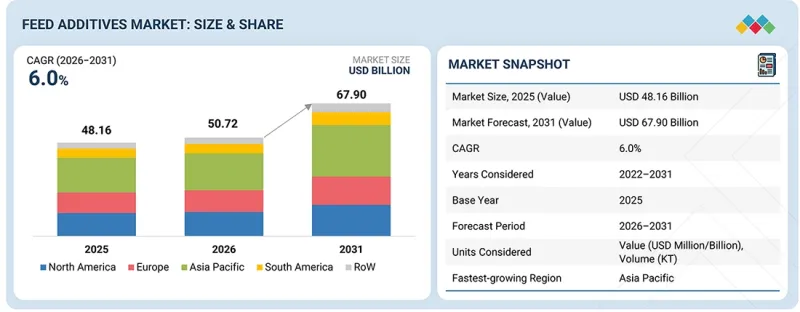
全球飼料添加劑市場預計在 2026 年達到 507.2 億美元,預計從 2026 年到 2031 年將以 6.0% 的複合年成長率成長,到 2031 年達到 679 億美元。
在對優質動物性蛋白質需求不斷成長、人們對最佳化動物營養的意識日益增強以及畜牧業抗生素使用監管日益嚴格的推動下,該市場持續穩步擴張。胺基酸、酵素、益生菌、維生素、礦物質、抗氧化劑和黴菌毒素吸附劑等飼料添加劑在提高飼料轉換率、改善腸道健康、增強免疫力以及最大限度地提高動物整體生產力方面發揮著至關重要的作用。
| 調查範圍 | |
|---|---|
| 調查期 | 2022-2031 |
| 基準年 | 2025 |
| 預測期 | 2026-2031 |
| 目標單元 | 價值(百萬美元/十億美元)和數量(千噸) |
| 部分 | 按類型、功能、最終用戶、牲畜類型、產地、形態和地區 |
| 目標區域 | 北美、歐洲、亞太地區、南美及其他地區 |
此外,畜牧業和水產養殖業的快速產業化,尤其是在新興經濟體,正在加速科學配方飼料解決方案。精準營養、客製化預混合料配方以及旨在減少甲烷排放和提高永續性的功能性添加劑的開發,進一步增強了市場的成長前景。
然而,原料價格波動、區域法規的複雜性以及對添加劑安全性和環境影響日益嚴格的審查,都對市場擴張構成了重大挑戰。開發新型添加劑的高昂研發成本以及向天然和非基因改造成分的轉變也給生產商帶來了沉重負擔。儘管有這些限制,但對綜合畜牧業投資的增加、飼料和寵物食品行業的擴張,以及對無抗生素和高性能飼料解決方案日益成長的需求,預計將創造巨大的成長機會。此外,微膠囊技術、植物性添加劑和精準飼餵系統的創新有望提高產品功效,從而使飼料添加劑生產商能夠在不斷發展的全球市場中站穩腳跟。
據美國凱敏工業公司(Kemin Industries, Inc.)稱,氨基酸對動物的生長、健康和生產性能至關重要。它們是蛋白質的組成單元,並支持重要的生理功能。為了使動物健康生長並保持良好的健康狀況,飼料必須含有適量且均衡的必需胺基酸。動物體內蛋白質的合成取決於特定胺基酸的供應情況。即使飼料中僅缺乏一種必需胺基酸,動物也無法合成生長、修復和正常功能所需的特定蛋白質。必需氨基酸無法在體內合成足夠的量,必須透過飼料補充。這些胺基酸包括苯丙胺酸、纈氨酸、蘇氨酸、色氨酸、異亮氨酸、甲硫胺酸、組氨酸、精氨酸(在某些情況下)、亮氨酸和離胺酸。
現代畜牧業面臨高昂的飼料成本和嚴格的生產目標。添加離胺酸、甲硫胺酸、蘇氨酸和色氨酸等氨基酸可以在不影響生產性能的前提下降低粗蛋白含量。這有助於提高飼料轉換率、促進生長並減少氮的廢棄物。這些顯著的生產力和成本優勢正強勁地推動著胺基酸類飼料添加劑在全球市場的成長。
根據Alltech發布的《2025年農業食品展望》,肉雞飼料產量增加至3.854億噸(去年同期為4.248億噸),蛋雞飼料產量增加至1.73億噸(去年同期為1.907億噸)。肉雞飼料是最大的細分市場,佔全球飼料總量的27.6%。作為一種低成本蛋白質來源,肉雞在亞太和拉丁美洲的需求持續成長。儘管存在高致病性禽流感(HPAI)的問題,但由於價格適中和出口需求,預計肉雞產量將穩定成長。蛋雞產量成長放緩至1.4%,但在亞太、拉丁美洲和非洲的需求支撐下,仍維持正成長。家禽飼料的穩定成長直接推動了飼料添加劑市場的發展。家禽養殖業需要不斷提高生產效率。生產者依靠氨基酸、酵素、維生素和腸道健康產品來保護雞群並維持飼料轉換率。隨著家禽飼料消耗的成長,對飼料添加劑的需求也顯著擴大。這正是家禽養殖業佔據飼料添加劑市場最大佔有率的主要原因。
亞太地區擁有龐大的畜牧業和水產養殖業,對動物性蛋白質的需求正在迅速成長。根據Alltech發布的《2025年農業食品展望》,亞太地區仍是全球最大的飼料生產地。其主導地位得益於強勁的家禽、生豬和水產養殖業。龐大的人口和不斷成長的收入推動了對價格適中的肉類和魚類的需求。中國、印度、越南、印尼和泰國等國家持續擴大飼料生產以滿足此需求。這些市場的大多數農場都採用商業性集約化養殖模式。飼料產量的增加意味著飼料添加劑用量的增加。生產商正在添加胺基酸、酵素、維生素、礦物質和腸道健康產品,以提高飼料利用率並保障動物健康。他們專注於促進生長和穩定生產。隨著亞太地區畜牧業和水產養殖業的持續成長,預計該地區將在整個預測期內保持其在全球飼料添加劑市場的強勢地位。
市場上的主要企業包括:嘉吉公司(美國)、ADM公司(美國)、國際香料香精公司(美國)、贏創工業集團(德國)、BASF公司(德國)、帝斯曼-菲美尼希公司(瑞士)、奧泰克公司(美國)、味之素紐卡國協會(日本)、諾沃內西斯集團(瑞士)、Jubrean(法國公司)(Birvia)、Bilvia) Global公司(巴西)、Volac International有限公司(英國)、凱敏工業公司(美國)、拉勒芒公司(加拿大)、本托利公司(美國)、Neospark藥品和化學品私人有限公司(印度)、諾瓦斯國際公司(美國)和Global Nutrition International公司(法國)。
調查範圍
本研究報告按類型、功能、最終用戶、牲畜類型、來源、形式和地區對飼料添加劑市場進行分類。
本報告詳細概述了影響飼料添加劑產業成長的關鍵因素,包括促進因素、限制因素、挑戰和機會。報告深入分析了飼料添加劑市場的主要參與企業,包括他們的營業內容、服務、關鍵策略、協議、合作關係、產品發布、併購以及近期發展動態。此外,該報告還對飼料添加劑市場生態系統中新興的新創Start-Ups進行了競爭考察。報告還探討了特定產業趨勢,例如技術分析、生態系統和市場製圖以及專利和監管環境。
購買本報告的理由
本報告為市場領導和新參與企業提供飼料添加劑市場及其細分市場最準確的收入估計值。這有助於相關人員了解競爭格局,更好地定位自身業務,並深入了解市場動態,從而製定合適的打入市場策略。此外,本報告還幫助相關人員掌握市場趨勢,並提供關鍵市場促進因素、限制因素、挑戰和機會的資訊。
本報告深入分析了以下幾點:
- 分析影響飼料添加劑市場成長的關鍵促進因素(畜產品需求和消費量不斷成長)、限制因素(各國禁用抗生素)、機會(轉向天然生長促進劑)和挑戰(亞洲公司生產的飼料飼料產品的品管)。
- 產品開發/創新:對飼料添加劑市場的研究開發活動和新產品發布進行詳細分析。
- 市場開發:提供盈利市場的全面資訊,進行區域飼料添加劑分析。
- 市場多元化:全面介紹飼料添加劑市場的新產品來源、未開發的市場、近期趨勢和投資狀況。
- 競爭格局分析-嘉吉公司(美國)、ADM公司(美國)、國際香料香精公司(美國)、贏創工業集團(德國)、BASF公司(德國)、帝斯曼-菲美尼希公司(瑞士)、奧泰克公司(美國)、味之素株式會社(日本)、諾沃內西斯集團(丹麥科)、安迪蘇特集團(丹麥)(法國有限公司) Global公司(巴西)、Volac International有限公司(英國)、凱敏工業公司(美國)、拉勒芒公司(加拿大)、本托利公司(美國)、Neospark藥品和化學品私人有限公司(印度)、諾瓦斯國際公司(美國)、Global Nutrition International公司(法國)以及飼料添加劑市場的其他主要企業。
目錄
第1章:引言
第2章執行摘要
第3章重要考察
第4章 市場概覽
- 市場動態
- 促進因素
- 抑制因子
- 機會
- 任務
- 未滿足的需求和差距
- 相互關聯的市場與跨產業機遇
- 參與企業一級/二級/三級市場的策略性舉措
第5章 產業趨勢
- 波特五力分析
- 宏觀經濟展望
- 價值鏈分析
- 生態系分析/市場地圖
- 價格分析
- 貿易分析
- 2026-2027 年主要會議和活動
- 影響買家的趨勢/困惑
- 投資和資金籌措場景
- 案例研究分析
- 2025年美國關稅的影響-飼料添加劑市場
第6章:技術進步、人工智慧的影響、專利、創新與未來應用
- 技術分析
- 專利分析
- 未來應用
- 人工智慧對飼料添加劑市場的影響
- 成功案例及其在現實世界中的應用
第7章永續性和監管情勢
- 當地法規和合規性
- 對永續性的承諾
- 對永續性和監管政策措施的影響
- 認證、標籤和環境標準
第8章:顧客趨勢與購買行為
- 決策流程
- 主要相關人員和採購標準
- 招募障礙和內部挑戰
- 供應鏈中各個應用產業尚未滿足的需求
- 市場盈利
- 獲利潛力
第9章:飼料添加劑市場(按類型分類)
- 胺基酸
- 磷酸鹽
- 維他命
- 氧化劑
- 類胡蘿蔔素
- 酵素
- 黴菌毒素解毒劑
- 調味劑和甜味劑
- 抗生素
- 礦物
- 抗氧化劑
- 非蛋白質氮
- 植物來源成分
- 防腐劑
- 益生菌
第10章飼料添加劑市場(依功能分類)
- 腸道健康
- 偏好增強劑
- 促進生長
- 支持免疫系統
- 提高飼料轉換率
- 其他
第11章:飼料添加劑市場(按最終用戶分類)
- 商業飼料生產商
- 綜合性畜禽生產公司
- 水產飼料製造業
- 寵物食品製造業
- 飼料預混合料製造業
- 商業農場(農場飼料混合物)
第12章飼料添加劑市場(依牲畜類型分類)
- 家禽
- 反芻動物
- 豬
- 水生動物
- 其他
第13章飼料添加劑市場(依產地分類)
- 合成
- 自然
第14章飼料添加劑市場(依形式)
- 乾燥
- 液體
第15章飼料添加劑市場(按地區分類)
- 北美洲
- 美國
- 加拿大
- 墨西哥
- 歐洲
- 西班牙
- 俄羅斯
- 德國
- 法國
- 義大利
- 英國
- 其他
- 亞太地區
- 中國
- 印度
- 日本
- 泰國
- 印尼
- 其他
- 南美洲
- 巴西
- 阿根廷
- 南美洲其他地區
- 其他地區
- 中東
- 非洲
第16章 競爭格局
- 概述
- 主要參與企業的競爭策略/優勢
- 2022-2024年收入分析
- 2025年市佔率分析
- 品牌/產品對比
- 企業估值和財務指標
- 企業估值矩陣:主要參與企業,2025 年
- 公司估值矩陣:Start-Ups/中小企業,2025 年
- 競爭格局與趨勢
第17章:公司簡介
- 主要參與企業
- CARGILL, INCORPORATED
- ADM
- INTERNATIONAL FLAVORS & FRAGRANCES INC.
- EVONIK INDUSTRIES AG
- BASF SE
- DSM-FIRMENICH
- ALLTECH
- AJINOMOTO CO., INC.
- NOVONESIS GROUP
- ADISSEO
- JUBILANT INGREVIA LIMITED
- NUTRECO
- BRF GLOBAL
- VOLAC INTERNATIONAL LTD.
- KEMIN INDUSTRIES, INC.
- LALLEMAND INC.
- BENTOLI
- NEOSPARK DRUGS AND CHEMICALS PRIVATE LIMITED
- NOVUS INTERNATIONAL, INC.
- GLOBAL NUTRITION INTERNATIONAL
- 其他公司
- VITALAC
- TEX BIOSCIENCES(P)LTD.
- CENTAFARM SRL
- NUQO FEED ADDITIVES
- PHYTOBIOTICS FUTTERZUSATZSTOFFE GMBH
第18章:調查方法
第19章 鄰近市場與相關市場
第20章附錄
The global feed additives market is estimated at USD 50.72 billion in 2026 and is projected to reach USD 67.90 billion by 2031, at a CAGR of 6.0% between 2026 and 2031. The market is witnessing steady expansion, driven by increasing demand for high-quality animal protein, growing awareness regarding animal nutrition optimization, and stricter regulations on antibiotic usage in livestock production. Feed additives, including amino acids, enzymes, probiotics, vitamins, minerals, antioxidants, and mycotoxin binders, play a critical role in enhancing feed conversion ratios, improving gut health, boosting immunity, and maximizing overall animal performance.
| Scope of the Report | |
|---|---|
| Years Considered for the Study | 2022-2031 |
| Base Year | 2025 |
| Forecast Period | 2026-2031 |
| Units Considered | Value (USD Million/Billion) and Volume (KT) |
| Segments | By Type, livestock, source, form, function, end user, and region |
| Regions covered | North America, Europe, Asia Pacific, South America, and Rest of the World (RoW) |
Additionally, rapid industrialization of livestock and aquaculture sectors, particularly in emerging economies, is accelerating the adoption of scientifically formulated feed solutions. Advancements in precision nutrition, customized premix formulations, and functional additives aimed at reducing methane emissions and improving sustainability are further strengthening market growth prospects.
However, vVolatility in raw material prices, regulatory complexities across regions, and increasing scrutiny over additive safety and environmental impact pose notable challenges to market expansion. High R&D costs associated with novel additive development and the shift toward natural and non-GMO ingredients also add pressure on manufacturers. Despite these constraints, rising investments in integrated livestock operations, expansion of aquafeed and pet food industries, and the growing trend toward antibiotic-free and performance-enhancing feed solutions are expected to create substantial growth opportunities. Furthermore, innovations in microencapsulation technologies, phytogenic additives, and precision feeding systems are likely to enhance product efficacy, thereby enabling feed additive manufacturers to secure a stronger foothold in the evolving global market.
"Amino Aacids type of feed additives isare expected projected to hold account for a dominant market share during the forecast period."
According to insights by Kemin Industries, Inc. (US), amino acids are essential for animal growth, health, and performance. They are the building blocks of protein and support key body functions. Animals need the right proper levels and balance of essential amino acids in their feed to grow well and stay healthy. An animal's protein production depends on the availability of specific amino acids in the body. If even one essential amino acid is lacking in the diet, the animal cannot produce certain specific proteins needed for growth, repair, and normal functions. Essential amino acids must be supplied through feed because the body cannot produce them in adequate amounts. These include phenylalanine, valine, threonine, tryptophan, isoleucine, methionine, histidine, arginine (in some cases), leucine, and lysine..
In modern livestock systems, feed cost is high, and performance targets are strict. Adding amino acids like lysine, methionine, threonine, and tryptophan helps produce lower crude protein levels without affecting results. This improves feed conversion, supports better growth, and reduces nitrogen waste. These clear performance and cost benefits are strongly driving the growth of the amino acids type within the global feed additives market.
"Among livestock, poultry is estimated to hold a strong market share in the feed additives market."
As per the Alltech Agri Food Outlook 2025, poultry feed output increased for broilers to 385.4 million metric tons (424.8 million tons) and for layers to 173.0 million metric tons (190.7 million tons). Broiler feed is the largest segment and holds 27.6% of total global feed volume. Broiler meat remains a low-cost protein option, which supports demand in Asia Pacific and Latin America. Even with highly pathogenic avian influenza (HPAI) issues, broiler volumes are expected to see steady growth due to affordability and export demand. Layer growth stayed positive despite a slower 1.4% rise, supported by demand in Asia Pacific, Latin America, and Africa. This steady rise in poultry feed directly supports the feed additives market. Poultry farming is highly performance-driven. Producers depend on amino acids, enzymes, vitamins, and gut health products to protect flocks and maintain feed efficiency. As poultry feed volumes grow, there is a significant growth in demand for feed additives. This is a key reason the poultry segment holds the highest share in the feed additives market.
"Asia Pacific is set to lead the global feed additives market during the forecast period."
Asia Pacific has a large livestock and aquaculture sector with fast-growing demand for animal protein. According to the Alltech Agri Food Outlook 2025, Asia Pacific remained the largest feed producer in the world. The region leads because it has strong poultry, swine, and aquaculture sectors. Large populations and rising incomes increase demand for affordable meat and fish. Countries such as China, India, Vietnam, Indonesia, and Thailand continue to expand feed production to meet this demand. Most farms in these markets run on commercial and intensive systems. Higher feed production means higher use of feed additives. Producers add amino acids, enzymes, vitamins, minerals, and gut health products to improve feed use and protect animal health. They focus on better growth and steady output. As livestock and aquaculture continue to grow in the Asia Pacific, the region keeps its strong position in the global feed additives market during the forecast period.
- By Company Type: Tier 1 - 30%, Tier 2 - 25%, and Tier 3 - 45%
- By Designation: CXOs - 25%, Managers - 35%, Others - 40%
- By Region: North America - 20%, Europe - 30%, Asia Pacific - 35%, South America - 10%, and Rest of the World - 5%
Prominent companies in the market include Cargill, Incorporated (US), ADM (US), International Flavors & Fragrances Inc. (US), Evonik Industries AG (Germany), BASF SE (Germany), DSM-Firmenich (Switzerland), Alltech (US), Ajinomoto Co., Inc. (Japan), Novonesis Group (Denmark), Adisseo (France), Jubilant Ingrevia Ltd (India), Nutreco (Netherlands), BRF Global (Brazil), Volac International Ltd. (England), Kemin Industries, Inc. (US), Lallemand Inc. (Canada), Bentoli (US), Neospark Drugs and Chemicals Pvt. Ltd. (India), Novus International, Inc. (US), and Global Nutrition International (France).
Research Coverage
This research report categorizes the feed additives market by type (amino acids, phosphates, vitamins, acidifiers, carotenoids, enzymes, mycotoxin detoxifiers, flavors and sweeteners, antibiotics, minerals, antioxidants, nonprotein nitrogen, phytogenic, preservatives, and probiotics), by livestock (poultry, ruminants, swine, aquatic animals, and other livestock), by form (dry and liquid), by source (natural and synthetic), by function (qualitative) (gut health, palatability enhancers, growth boosters, immune system support, feed efficiency improvement, other functions), by end user (commercial feed manufacturers, integrated livestock and poultry production companies, aquafeed manufacturing industry, pet food manufacturing industry, feed premix manufacturing facility, large commercial farms [on farm feed mixing]) and region (North America, Europe, Asia Pacific, South America, and Rest of the World).
The report's scope encompasses detailed information on the major factors, including drivers, restraints, challenges, and opportunities, that influence the growth of the Feed Additives industry. A thorough analysis of the key industry players has been done to provide insights into their business, services, key strategies, contracts, partnerships, agreements, product launches, mergers & acquisitions, and recent developments associated with the Feed Additives market. This report provides a competitive analysis of emerging startups in the Feed Additives market ecosystem. Furthermore, the study covers industry-specific trends, including technology analysis, ecosystem & market mapping, and patent & regulatory landscape, among others.
Reasons to Buy This Report
The report provides market leaders/new entrants with information on the closest approximations of revenue numbers for the overall feed additives and their subsegments. It will help stakeholders understand the competitive landscape and gain more insights to better position their businesses and plan suitable go-to-market strategies. The report also helps stakeholders understand the pulse of the market and provides them with information on key market drivers, restraints, challenges, and opportunities.
The report provides insights into the following pointers:
- Analysis of key drivers (increase in demand and consumption of livestock-based products), restraints (ban on antibiotics in different nations), opportunities (shift toward natural growth promoters), and challenges (quality control of genetic feed additive products manufactured by Asian companies) influencing the growth of the feed additives market
- Product Development/Innovation: Detailed insights into research & development activities and new product launches in the feed additives market
- Market Development: Comprehensive information about lucrative markets, analysis of feed additives across varied regions
- Market Diversification: Exhaustive information about new product sources, untapped geographies, recent developments, and investments in the feed additives market
- Competitive Assessment: In-depth assessment of market shares, growth strategies, product offerings, brand/product comparison, and product footprints of leading players such as Cargill, Incorporated (US), ADM (US), International Flavors & Fragrances Inc. (US), Evonik Industries AG (Germany), BASF SE (Germany), DSM-Firmenich (Switzerland), Alltech (US), Ajinomoto Co., Inc. (Japan), Novonesis Group (Denmark), Adisseo (France), Jubilant Ingrevia Ltd (India), Nutreco (Netherlands), BRF Global (Brazil), Volac International Ltd. (UK), Kemin Industries, Inc. (US), Lallemand Inc. (Canada), Bentoli (US), Neospark Drugs and Chemicals Pvt. Ltd. (India), Novus International, Inc. (US), Global Nutrition International (France) and other players in the feed additive market
TABLE OF CONTENTS
1 INTRODUCTION
- 1.1 STUDY OBJECTIVES
- 1.2 MARKET DEFINITION
- 1.3 STUDY SCOPE AND SEGMENTATION
- 1.3.1 MARKETS COVERED
- 1.3.2 REGIONAL SCOPE
- 1.3.3 INCLUSIONS AND EXCLUSIONS
- 1.3.4 YEARS CONSIDERED
- 1.3.5 UNITS CONSIDERED
- 1.3.5.1 Currency/value unit
- 1.3.5.2 Volume unit
- 1.4 STAKEHOLDERS
- 1.5 SUMMARY OF CHANGES
2 EXECUTIVE SUMMARY
- 2.1 MARKET HIGHLIGHTS AND KEY INSIGHTS
- 2.2 KEY MARKET PARTICIPANTS: MAPPING OF STRATEGIC DEVELOPMENTS
- 2.3 DISRUPTIVE TRENDS IN FEED ADDITIVES MARKET
- 2.4 HIGH GROWTH SEGMENTS
- 2.5 REGIONAL SNAPSHOT: MARKET SIZE, GROWTH RATE, AND FORECAST
3 PREMIUM INSIGHTS
- 3.1 ATTRACTIVE OPPORTUNITIES FOR PLAYERS IN FEED ADDITIVES MARKET
- 3.2 FEED ADDITIVES MARKET, BY TYPE AND REGION
- 3.3 FEED ADDITIVES MARKET: TOP THREE TYPES
- 3.4 FEED ADDITIVES MARKET, BY LIVESTOCK
- 3.5 FEED ADDITIVES MARKET, BY FORM
- 3.6 FEED ADDITIVES MARKET, BY SOURCE
- 3.7 FEED ADDITIVES MARKET, BY COUNTRY
4 MARKET OVERVIEW
- 4.1 INTRODUCTION
- 4.2 MARKET DYNAMICS
- 4.2.1 DRIVERS
- 4.2.1.1 Increase in demand and consumption of livestock-based products
- 4.2.1.2 Growth in feed production
- 4.2.1.3 Rise in awareness about feed quality
- 4.2.1.4 Standardization of meat products owing to disease outbreaks
- 4.2.1.5 Implementation of innovative animal husbandry practices to improve meat quality
- 4.2.2 RESTRAINTS
- 4.2.2.1 Ban on antibiotics in different nations
- 4.2.2.2 Volatile raw material prices
- 4.2.2.3 Stringent regulatory framework
- 4.2.3 OPPORTUNITIES
- 4.2.3.1 Shift toward natural growth promoters
- 4.2.3.2 Increase in demand for nutritional supplements for monogastric animals
- 4.2.3.3 Growth of precision livestock farming driving demand for advanced feed additives
- 4.2.3.4 Growing demand for natural and clean-label feed additives
- 4.2.4 CHALLENGES
- 4.2.4.1 Quality control of genetic feed additive products manufactured by Asian companies
- 4.2.4.2 Sustainability of feed and livestock chain
- 4.2.1 DRIVERS
- 4.3 UNMET NEEDS AND WHITE SPACES
- 4.3.1 UNMET NEEDS IN FEED ADDITIVES MARKET
- 4.3.2 WHITE SPACE OPPORTUNITIES
- 4.4 INTERCONNECTED MARKETS AND CROSS-SECTOR OPPORTUNITIES
- 4.4.1 INTERCONNECTED MARKETS
- 4.4.2 CROSS-SECTOR OPPORTUNITIES
- 4.5 STRATEGIC MOVES BY TIER-1/2/3 PLAYERS
5 INDUSTRY TRENDS
- 5.1 PORTER'S FIVE FORCES ANALYSIS
- 5.1.1 INTENSITY OF COMPETITIVE RIVALRY
- 5.1.2 BARGAINING POWER OF SUPPLIERS
- 5.1.3 BARGAINING POWER OF BUYERS
- 5.1.4 THREAT OF SUBSTITUTES
- 5.1.5 THREAT OF NEW ENTRANTS
- 5.2 MACROECONOMICS OUTLOOK
- 5.2.1 INTRODUCTION
- 5.2.2 GROWTH OPPORTUNITIES IN DEVELOPING REGIONS
- 5.2.3 KEY ECONOMIC AND SECTORAL FORCES INFLUENCING GLOBAL FEED ADDITIVES MARKET IN 2025
- 5.3 VALUE CHAIN ANALYSIS
- 5.3.1 RESEARCH AND PRODUCT DEVELOPMENT
- 5.3.2 RAW MATERIAL SOURCING
- 5.3.3 PRODUCTION
- 5.3.4 QUALITY CONTROL & SAFETY
- 5.3.5 DISTRIBUTION & LOGISTICS
- 5.3.6 MARKETING & SALES
- 5.3.7 END USERS
- 5.4 ECOSYSTEM ANALYSIS/MARKET MAP
- 5.4.1 DEMAND SIDE
- 5.4.2 SUPPLY SIDE
- 5.5 PRICING ANALYSIS
- 5.5.1 INTRODUCTION
- 5.5.2 INDICATIVE PRICE TREND AMONG MARKET PLAYERS
- 5.5.3 AVERAGE SELLING PRICE TREND, BY REGION
- 5.6 TRADE ANALYSIS
- 5.6.1 IMPORT SCENARIO OF HS CODE 230990
- 5.6.2 EXPORT SCENARIO OF HS CODE 230990
- 5.7 KEY CONFERENCES AND EVENTS, 2026-2027
- 5.8 TRENDS/DISRUPTIONS IMPACTING BUYERS
- 5.9 INVESTMENT & FUNDING SCENARIO
- 5.10 CASE STUDY ANALYSIS
- 5.10.1 EVONIK VLAND BIOTECH JOINT VENTURE STRENGTHENS GUT HEALTH SOLUTIONS IN CHINA
- 5.10.2 DSM-FIRMENICH STRENGTHENS MYCOTOXIN RISK MANAGEMENT WITH NEW FEED ADDITIVE PLANT IN INDIA
- 5.10.3 ADM AQUATRAX (PICHIA GUILLIERMONDII) ENHANCES IMMUNE RESPONSE AND GROWTH PERFORMANCE IN SHRIMP
- 5.10.4 CARGILL ACQUIRES DELACON TO LEAD GLOBAL PHYTOGENIC FEED ADDITIVES MARKET
- 5.11 IMPACT OF 2025 US TARIFF - FEED ADDITIVES MARKET
- 5.11.1 INTRODUCTION
- 5.11.2 PRICE IMPACT ANALYSIS
- 5.11.3 IMPACT ON COUNTRIES/REGIONS
- 5.11.3.1 US
- 5.11.3.2 Europe
- 5.11.3.3 Asia Pacific
- 5.11.4 IMPACT ON END USE INDUSTRIES
6 TECHNOLOGY ADVANCEMENTS, AI-DRIVEN IMPACT, PATENTS, INNOVATIONS, AND FUTURE APPLICATIONS
- 6.1 TECHNOLOGY ANALYSIS
- 6.1.1 KEY TECHNOLOGIES
- 6.1.1.1 Fermentation & bioprocessing
- 6.1.1.2 Chemical synthesis
- 6.1.1.3 Premix blending technology
- 6.1.1.4 Microencapsulation technology for feed
- 6.1.2 COMPLEMENTARY TECHNOLOGY
- 6.1.2.1 Feed pelleting technology
- 6.1.2.2 Precision & micro-dosing systems
- 6.1.2.3 Animal health monitoring systems
- 6.1.3 ADJACENT TECHNOLOGIES
- 6.1.3.1 Precision nutrition
- 6.1.3.2 Extrusion processing technology
- 6.1.4 TECHNOLOGY/PRODUCT ROADMAP
- 6.1.4.1 Short-term | Foundation & early commercialization
- 6.1.4.2 Mid-term | Expansion & standardization
- 6.1.4.3 Long-term | Precision nutrition
- 6.1.1 KEY TECHNOLOGIES
- 6.2 PATENT ANALYSIS
- 6.3 FUTURE APPLICATIONS
- 6.3.1 ASPARAGOPSIS SEAWEED-BASED METHANE REDUCTION ADDITIVE BY FUTUREFEED (CSIRO)
- 6.3.2 NANO-MINERALS AS NEXT-GENERATION SOLUTION FOR SUSTAINABLE POULTRY NUTRITION
- 6.3.3 HIGH-DOSE (SUPER-DOSING) PHYTASE FOR ENHANCED NUTRIENT UTILIZATION IN POULTRY
- 6.3.4 OPTIMIZING NITROGEN EFFICIENCY IN DAIRY COWS THROUGH RUMEN-PROTECTED ESSENTIAL AMINO ACID SUPPLEMENTATION
- 6.3.5 PHYTOGENIC ADDITIVES AND ORGANIC ACIDS AS ANTIBIOTIC ALTERNATIVES IN BROILER PRODUCTION
- 6.4 IMPACT OF GENERATIVE AI ON FEED ADDITIVES MARKET
- 6.4.1 INTRODUCTION
- 6.4.2 TOP USE CASES AND MARKET POTENTIAL
- 6.4.3 BEST PRACTICES IN FEED ADDITIVES
- 6.4.4 CASE STUDIES OF AI IMPLEMENTATION IN FEED ADDITIVES MARKET
- 6.4.5 INTERCONNECTED ADJACENT ECOSYSTEM AND IMPACT ON MARKET PLAYERS
- 6.4.6 CLIENTS' READINESS TO ADOPT GENERATIVE AI FEED ADDITIVES
- 6.5 SUCCESS STORIES AND REAL-WORLD APPLICATIONS
7 SUSTAINABILITY AND REGULATORY LANDSCAPE
- 7.1 REGIONAL REGULATIONS AND COMPLIANCE
- 7.1.1 REGULATORY BODIES, GOVERNMENT AGENCIES, AND OTHER ORGANIZATIONS
- 7.1.2 INDUSTRY STANDARDS
- 7.1.3 LABELING REQUIREMENTS AND CLAIMS
- 7.1.4 ANTICIPATED REGULATORY CHANGES IN NEXT 5-10 YEARS
- 7.1.4.1 Mandatory validation of efficacy, safety & environmental impact
- 7.1.4.2 Global harmonization of feed additive classifications & approval pathways
- 7.1.4.3 Strengthened contaminant, residue & antimicrobial control regulations
- 7.1.4.4 Digital labeling, traceability & supply chain transparency
- 7.2 SUSTAINABILITY INITIATIVES
- 7.2.1 SUSTAINABLE SOURCING
- 7.2.2 CARBON FOOTPRINT REDUCTION INITIATIVES
- 7.2.3 CIRCULAR ECONOMY APPROACHES
- 7.3 SUSTAINABILITY IMPACT AND REGULATORY POLICY INITIATIVES
- 7.4 CERTIFICATIONS, LABELING, ECO-STANDARDS
8 CUSTOMER LANDSCAPE AND BUYER BEHAVIOR
- 8.1 DECISION-MAKING PROCESS
- 8.2 KEY STAKEHOLDERS & BUYING CRITERIA
- 8.2.1 KEY STAKEHOLDERS IN BUYING PROCESS
- 8.2.2 BUYING CRITERIA
- 8.3 ADOPTION BARRIERS AND INTERNAL CHALLENGES
- 8.4 UNMET NEEDS OF VARIOUS APPLICATION INDUSTRIES ACROSS SUPPLY CHAIN
- 8.5 MARKET PROFITABILITY
- 8.6 REVENUE POTENTIAL
- 8.6.1 COST DYNAMICS
- 8.6.2 MARGIN OPPORTUNITIES, BY TYPE
9 FEED ADDITIVES MARKET, BY TYPE
- 9.1 INTRODUCTION
- 9.2 AMINO ACIDS
- 9.2.1 METHIONINE
- 9.2.1.1 Ability to tailor amino acid supplements for livestock to drive market
- 9.2.2 LYSINE
- 9.2.2.1 Relatively high value and digestibility of lysine to boost market
- 9.2.3 THREONINE
- 9.2.3.1 Role in providing optimal protein synthesis to boost market
- 9.2.4 TRYPTOPHAN
- 9.2.4.1 Ability to improve protein utilization and stress reduction in livestock to drive market
- 9.2.5 OTHER AMINO ACIDS
- 9.2.1 METHIONINE
- 9.3 PHOSPHATES
- 9.3.1 DICALCIUM PHOSPHATE
- 9.3.1.1 Role in regulating energy metabolism and maintaining adequate dietary levels for livestock to drive market
- 9.3.2 MONOCALCIUM PHOSPHATE
- 9.3.2.1 Ability to prevent abnormal development of bones in livestock to propel market
- 9.3.3 MON0-DICALCIUM PHOSPHATE
- 9.3.3.1 Enhancement of functioning of immune system to drive market
- 9.3.4 DEFLUORINATED PHOSPHATE
- 9.3.4.1 Role in reducing fluorine content in animal feed to boost market
- 9.3.5 TRICALCIUM PHOSPHATE
- 9.3.5.1 Role in enhancement of immune system and energy regulation of livestock to drive market
- 9.3.6 OTHER PHOSPHATES
- 9.3.1 DICALCIUM PHOSPHATE
- 9.4 VITAMINS
- 9.4.1 FAT-SOLUBLE VITAMINS
- 9.4.1.1 Role of vitamins as key constituent of metabolic functions to drive market
- 9.4.2 WATER-SOLUBLE VITAMINS
- 9.4.2.1 Significance of water-soluble vitamins for optimum growth and development of livestock to drive market
- 9.4.1 FAT-SOLUBLE VITAMINS
- 9.5 ACIDIFIERS
- 9.5.1 PROPIONIC ACID
- 9.5.1.1 Role in silage production and prevention of fertility disorders in livestock to drive market
- 9.5.2 FORMIC ACID
- 9.5.2.1 Role in consistent feed formulations and feed preservation to drive market
- 9.5.3 CITRIC ACID
- 9.5.3.1 Importance of citric acid in enhancing immunity of vaccinated broilers to boost market
- 9.5.4 LACTIC ACID
- 9.5.4.1 Significance of lactic acid in improving animal health and productivity to drive market
- 9.5.5 SORBIC ACID
- 9.5.5.1 Importance of sorbic acid in feed preservation to drive market
- 9.5.6 MALIC ACID
- 9.5.6.1 Role as cost-efficient preservative and acidity regulator to drive market
- 9.5.7 BENZOIC ACID
- 9.5.7.1 Strong antimicrobial properties and low pungency to drive market
- 9.5.8 OTHER ACIDIFIERS
- 9.5.1 PROPIONIC ACID
- 9.6 CAROTENOIDS
- 9.6.1 ASTAXANTHIN
- 9.6.1.1 Health benefits of astaxanthin to fuel market growth
- 9.6.2 CANTHAXANTHIN
- 9.6.2.1 Role of canthaxanthin in providing consistent egg color to boost market
- 9.6.3 LUTEIN
- 9.6.3.1 Health benefits of lutein and improvement of feed palatability to drive market
- 9.6.4 BETA CAROTENE
- 9.6.4.1 Improvement of reproductive performance of ruminants and protection against oxidative stress to accelerate market growth
- 9.6.5 OTHER CAROTENOIDS
- 9.6.1 ASTAXANTHIN
- 9.7 ENZYMES
- 9.7.1 PHYTASE
- 9.7.1.1 Low cost and nutritional benefits to boost growth
- 9.7.2 CARBOHYDRASE
- 9.7.2.1 Significance in improvement of digestibility of carbohydrates in feed ingredients to drive market
- 9.7.3 PROTEASE
- 9.7.3.1 Role in reduction of dietary protein levels of livestock to drive market
- 9.7.4 OTHER ENZYMES
- 9.7.1 PHYTASE
- 9.8 MYCOTOXIN DETOXIFIERS
- 9.8.1 BINDERS
- 9.8.1.1 Increase in awareness regarding benefits of binders to drive market
- 9.8.2 MODIFIERS
- 9.8.2.1 Enhancement of feed by conversion of mycotoxin into less toxic compounds to drive market
- 9.8.1 BINDERS
- 9.9 FLAVORS & SWEETENERS
- 9.9.1 FEED FLAVORS
- 9.9.1.1 Rise in focus on improving livestock performance to drive market
- 9.9.2 FEED SWEETENERS
- 9.9.2.1 Role of sweeteners to mask undesired taste of feed to drive market
- 9.9.1 FEED FLAVORS
- 9.10 ANTIBIOTICS
- 9.10.1 TETRACYCLINE
- 9.10.1.1 Role in improvement of egg production and feed efficiency to drive market
- 9.10.2 PENICILLIN
- 9.10.2.1 Significance of penicillin as antibiotic to drive market
- 9.10.3 OTHER ANTIBIOTICS
- 9.10.1 TETRACYCLINE
- 9.11 MINERALS
- 9.11.1 POTASSIUM
- 9.11.1.1 Regulation of metabolism of proteins and carbohydrates to boost market
- 9.11.2 CALCIUM
- 9.11.2.1 Role of calcium in strengthening bones and improving eggshell quality to drive market
- 9.11.3 PHOSPHORUS
- 9.11.3.1 Vital role of phosphorus in egg production and prevention of skeletal deformities to drive market
- 9.11.4 MAGNESIUM
- 9.11.4.1 Necessity of magnesium for bone growth and stability to drive market
- 9.11.5 SODIUM
- 9.11.5.1 Role of sodium in regulation of acid-base equilibrium and maintenance of osmotic pressure to drive market
- 9.11.6 IRON
- 9.11.6.1 Significance of iron in formation of hemoglobin and myoglobin to drive market
- 9.11.7 ZINC
- 9.11.7.1 Role of zinc in development of immune system and reproductive capacity to drive market
- 9.11.8 COPPER
- 9.11.8.1 Health benefits of copper and vital role in cellular respiration to boost market
- 9.11.9 MANGANESE
- 9.11.9.1 Role in efficient functioning of mitochondria in cells and prevention of oxidative stress to drive market
- 9.11.10 OTHER MINERALS
- 9.11.1 POTASSIUM
- 9.12 ANTIOXIDANTS
- 9.12.1 SYNTHETIC ANTIOXIDANTS
- 9.12.1.1 Role in protection of fat-soluble vitamins against oxidative degradation to drive market
- 9.12.2 NATURAL ANTIOXIDANTS
- 9.12.2.1 Fewer side effects than synthetic antioxidants to drive market
- 9.12.1 SYNTHETIC ANTIOXIDANTS
- 9.13 NON-PROTEIN NITROGEN
- 9.13.1 UREA
- 9.13.1.1 Low cost and easy availability to drive market
- 9.13.2 AMMONIA
- 9.13.2.1 Role of ammonia in improving digestibility and increasing feed intake to drive market
- 9.13.3 OTHER NON-PROTEIN NITROGEN ADDITIVES
- 9.13.1 UREA
- 9.14 PHYTOGENICS
- 9.14.1 ESSENTIAL OILS
- 9.14.1.1 Role in improvement of gut health and healthy digestion in poultry to boost market
- 9.14.2 FLAVONOIDS
- 9.14.2.1 Improvement of gut health and heart stress control in livestock to boost market
- 9.14.3 SAPONINS
- 9.14.3.1 Role of saponins in suppressing intestinal and ruminal ammonia production to drive market
- 9.14.4 OLEORESINS
- 9.14.4.1 Role of oleoresins in imparting color, flavor, and aroma to livestock feed to drive market
- 9.14.5 OTHER PHYTOGENICS
- 9.14.1 ESSENTIAL OILS
- 9.15 PRESERVATIVES
- 9.15.1 MOLD INHIBITORS
- 9.15.1.1 Role of mold inhibitors in preventing mold growth and contamination to drive market
- 9.15.2 ANTICAKING AGENTS
- 9.15.2.1 Significance of anticaking agents in preventing accumulation of feed nutrients to drive market
- 9.15.1 MOLD INHIBITORS
- 9.16 PROBIOTICS
- 9.16.1 BACTERIA
- 9.16.1.1 Bacterial Probiotics Enhancing animal yield through gut health optimization
- 9.16.1.2 Lactobacillus
- 9.16.1.2.1 Potential to replace antibiotic growth promoters to drive market
- 9.16.1.3 Bifidobacteria
- 9.16.1.3.1 Benefits to adult livestock, such as controlling pH level of large intestine to accelerate market growth
- 9.16.1.4 Streptococcus
- 9.16.1.4.1 Usage in manufacture of various feed probiotic products to drive market
- 9.16.1.5 Bacillus
- 9.16.1.5.1 Bacillus probiotics: Stable, spore-powered solutions for superior animal performance
- 9.16.2 YEAST & FUNGI
- 9.16.2.1 Role in increased production of milk in dairy cattle to drive market
- 9.16.1 BACTERIA
10 FEED ADDITIVES MARKET, BY FUNCTION
- 10.1 INTRODUCTION
- 10.2 GUT HEALTH
- 10.2.1 INCREASED DEMAND FOR HEALTHY GUT MICROBIOTA TO IMPROVE DIGESTION AND PREVENT GASTROINTESTINAL DISEASES
- 10.3 PALATABILITY ENHANCERS
- 10.3.1 IMPROVED TASTE, SMELL, AND OVERALL APPEAL OF ANIMAL FEED TO DRIVE DEMAND
- 10.4 GROWTH BOOSTERS
- 10.4.1 RISING DEMAND FOR MEAT TO DRIVE DEMAND FOR GROWTH BOOSTERS
- 10.5 IMMUNE SYSTEM SUPPORT
- 10.5.1 INCREASED DISEASE INCIDENCES TO DRIVE DEMAND
- 10.6 FEED EFFICIENCY IMPROVEMENT
- 10.6.1 OPTIMIZING ANIMAL PERFORMANCE THROUGH SMARTER FEED UTILIZATION
- 10.7 OTHER FUNCTIONS
11 FEED ADDITIVES MARKET, BY END USER
- 11.1 INTRODUCTION
- 11.2 COMMERCIAL FEED MANUFACTURERS
- 11.3 INTEGRATED LIVESTOCK AND POULTRY PRODUCTION COMPANIES
- 11.4 AQUAFEED MANUFACTURING INDUSTRY
- 11.5 PET FOOD MANUFACTURING INDUSTRY
- 11.6 FEED PREMIX MANUFACTURING INDUSTRY
- 11.7 COMMERCIAL FARMS (ON FARM FEED MIXING)
12 FEED ADDITIVES MARKET, BY LIVESTOCK
- 12.1 INTRODUCTION
- 12.2 POULTRY
- 12.2.1 RISE IN DEMAND FOR HIGH-QUALITY CHICKEN AND EGGS TO DRIVE MARKET
- 12.2.2 BROILERS
- 12.2.3 LAYERS
- 12.2.4 BREEDERS
- 12.3 RUMINANTS
- 12.3.1 INCREASE IN CONSUMPTION OF DAIRY PRODUCTS AND BEEF TO DRIVE DEMAND
- 12.3.2 CALF
- 12.3.3 DAIRY
- 12.3.4 BEEF
- 12.3.5 OTHER RUMINANTS
- 12.4 SWINE
- 12.4.1 RISE IN PORK TRADE AND CONCERNS OVER MEAT SAFETY TO BOOST MARKET
- 12.4.2 STARTERS
- 12.4.3 GROWERS
- 12.4.4 SOWS
- 12.5 AQUATIC ANIMALS
- 12.5.1 INCREASE IN AQUAFEED PRODUCTION TO DRIVE MARKET
- 12.5.2 FISH
- 12.5.3 CRUSTACEANS
- 12.5.4 MOLLUSKS
- 12.5.5 OTHER AQUATIC ANIMALS
- 12.6 OTHER LIVESTOCK
13 FEED ADDITIVES MARKET, BY SOURCE
- 13.1 INTRODUCTION
- 13.2 SYNTHETIC
- 13.2.1 COST-EFFECTIVENESS AND HIGH STABILITY PROPERTIES TO PROPEL GROWTH
- 13.3 NATURAL
- 13.3.1 CONCERNS REGARDING ANTIBIOTIC RESISTANCE TO DRIVE MARKET FOR NATURAL ADDITIVES
14 FEED ADDITIVES MARKET, BY FORM
- 14.1 INTRODUCTION
- 14.2 DRY
- 14.2.1 CONVENIENCE IN STORAGE, HANDLING, AND TRANSPORTATION TO DRIVE MARKET
- 14.3 LIQUID
- 14.3.1 UNIFORM MIXING AND PRECISE DOSING OF LIQUID FEED ADDITIVES TO PROPEL MARKET
15 FEED ADDITIVES MARKET, BY REGION
- 15.1 INTRODUCTION
- 15.2 NORTH AMERICA
- 15.2.1 US
- 15.2.1.1 Increasing trend of precision feeding techniques to boost demand for effective feed additives
- 15.2.2 CANADA
- 15.2.2.1 Rise in demand for meat and lenient regulations pertaining to use of growth promoters to boost market
- 15.2.3 MEXICO
- 15.2.3.1 Significant rise in livestock production to drive feed additive consumption in Mexico
- 15.2.1 US
- 15.3 EUROPE
- 15.3.1 SPAIN
- 15.3.1.1 Higher preference for meat and dairy products to boost market
- 15.3.2 RUSSIA
- 15.3.2.1 Increasing feed production rate to drive market
- 15.3.3 GERMANY
- 15.3.3.1 Technological advancements in livestock management to drive market
- 15.3.4 FRANCE
- 15.3.4.1 High domestic demand for meat products to drive market
- 15.3.5 ITALY
- 15.3.5.1 Focus on improving animal health and nutrition to drive market
- 15.3.6 UK
- 15.3.6.1 Rising demand for high-quality meat and dairy products to boost market
- 15.3.7 REST OF EUROPE
- 15.3.1 SPAIN
- 15.4 ASIA PACIFIC
- 15.4.1 CHINA
- 15.4.1.1 Large feed production to drive market
- 15.4.2 INDIA
- 15.4.2.1 Increased consumption of meat and dairy products to drive market
- 15.4.3 JAPAN
- 15.4.3.1 Increasing consumer demand for premium animal-based products to drive market
- 15.4.4 THAILAND
- 15.4.4.1 Export opportunities in poultry and aquaculture industry to drive market
- 15.4.5 INDONESIA
- 15.4.5.1 High demand for feed due to growing poultry sector to drive market
- 15.4.6 REST OF ASIA PACIFIC
- 15.4.1 CHINA
- 15.5 SOUTH AMERICA
- 15.5.1 BRAZIL
- 15.5.1.1 Brazil's thriving meat export industry to drive market
- 15.5.2 ARGENTINA
- 15.5.2.1 High consumption of meat and thriving livestock industry to drive market
- 15.5.3 REST OF SOUTH AMERICA
- 15.5.1 BRAZIL
- 15.6 REST OF THE WORLD (ROW)
- 15.6.1 MIDDLE EAST
- 15.6.1.1 Rising demand for animal-based products to drive market
- 15.6.2 AFRICA
- 15.6.2.1 Increase in disease outbreaks to drive market
- 15.6.1 MIDDLE EAST
16 COMPETITIVE LANDSCAPE
- 16.1 OVERVIEW
- 16.2 KEY PLAYER COMPETITIVE STRATEGIES/RIGHT TO WIN
- 16.3 REVENUE ANALYSIS, 2022-2024
- 16.4 MARKET SHARE ANALYSIS, 2025
- 16.5 BRAND/PRODUCT COMPARISON
- 16.5.1 CARGILL, INCORPORATED (DELACON)
- 16.5.2 ADM (PANCOSMA)
- 16.5.3 NUTRECO (SELKO)
- 16.5.4 ADISSEO (RHODIMET)
- 16.5.5 DSM-FIRMENICH (MYCOFIX)
- 16.6 COMPANY VALUATION AND FINANCIAL METRICS
- 16.6.1 COMPANY VALUATION
- 16.6.2 EV/EBITDA
- 16.7 COMPANY EVALUATION MATRIX: KEY PLAYERS, 2025
- 16.7.1 STARS
- 16.7.2 EMERGING LEADERS
- 16.7.3 PERVASIVE PLAYERS
- 16.7.4 PARTICIPANTS
- 16.7.5 COMPANY FOOTPRINT: KEY PLAYERS, 2025
- 16.7.5.1 Company footprint
- 16.7.5.2 Regional footprint
- 16.7.5.3 Type footprint
- 16.7.5.4 Livestock footprint
- 16.7.5.5 Form footprint
- 16.7.5.6 Source footprint
- 16.8 COMPANY EVALUATION MATRIX: STARTUPS/SMES, 2025
- 16.8.1 PROGRESSIVE COMPANIES
- 16.8.2 RESPONSIVE COMPANIES
- 16.8.3 DYNAMIC COMPANIES
- 16.8.4 STARTING BLOCKS
- 16.8.5 COMPETITIVE BENCHMARKING: KEY STARTUPS/SMES, 2025
- 16.8.5.1 Detailed list of key startups/SMEs
- 16.8.5.2 Competitive benchmarking of key startups/SMEs
- 16.9 COMPETITIVE SCENARIO AND TRENDS
- 16.9.1 PRODUCT LAUNCHES
- 16.9.2 DEALS
- 16.9.3 EXPANSIONS
- 16.9.4 OTHER DEVELOPMENTS
17 COMPANY PROFILES
- 17.1 KEY PLAYERS
- 17.1.1 CARGILL, INCORPORATED
- 17.1.1.1 Business overview
- 17.1.1.2 Products/Solutions/Services offered
- 17.1.1.3 Recent developments
- 17.1.1.3.1 Deals
- 17.1.1.3.2 Expansions
- 17.1.1.3.3 Product launches
- 17.1.1.4 MnM view
- 17.1.1.4.1 Key strengths
- 17.1.1.4.2 Strategic choices
- 17.1.1.4.3 Weaknesses & competitive threats
- 17.1.2 ADM
- 17.1.2.1 Business overview
- 17.1.2.2 Products/Solutions/Services offered
- 17.1.2.3 Recent developments
- 17.1.2.3.1 Product launches
- 17.1.2.3.2 Deals
- 17.1.2.3.3 Expansions
- 17.1.2.4 MnM view
- 17.1.2.4.1 Key strengths
- 17.1.2.4.2 Strategic choices
- 17.1.2.4.3 Weaknesses & competitive threats
- 17.1.3 INTERNATIONAL FLAVORS & FRAGRANCES INC.
- 17.1.3.1 Business overview
- 17.1.3.2 Products/Solutions/Services offered
- 17.1.3.3 Recent developments
- 17.1.3.3.1 Product launches
- 17.1.3.3.2 Expansions
- 17.1.3.4 MnM view
- 17.1.3.4.1 Key strengths
- 17.1.3.4.2 Strategic choices
- 17.1.3.4.3 Weaknesses & competitive threats
- 17.1.4 EVONIK INDUSTRIES AG
- 17.1.4.1 Business overview
- 17.1.4.2 Products/Solutions/Services offered
- 17.1.4.3 Recent developments
- 17.1.4.3.1 Product launches
- 17.1.4.3.2 Deals
- 17.1.4.3.3 Expansions
- 17.1.4.4 MnM view
- 17.1.4.4.1 Key strengths
- 17.1.4.4.2 Strategic choices
- 17.1.4.4.3 Weaknesses & competitive threats
- 17.1.5 BASF SE
- 17.1.5.1 Business overview
- 17.1.5.2 Products/Solutions/Services offered
- 17.1.5.3 Recent developments
- 17.1.5.3.1 Product launches
- 17.1.5.3.2 Deals
- 17.1.5.4 MnM view
- 17.1.5.4.1 Key strengths
- 17.1.5.4.2 Strategic choices
- 17.1.5.4.3 Weaknesses & competitive threats
- 17.1.6 DSM-FIRMENICH
- 17.1.6.1 Business overview
- 17.1.6.2 Products/Solutions/Services offered
- 17.1.6.3 Recent developments
- 17.1.6.3.1 Product launches
- 17.1.6.3.2 Deals
- 17.1.6.3.3 Expansions
- 17.1.6.4 MnM view
- 17.1.6.4.1 Key strengths
- 17.1.6.4.2 Strategic choices
- 17.1.6.4.3 Weaknesses & competitive threats
- 17.1.7 ALLTECH
- 17.1.7.1 Business overview
- 17.1.7.2 Products/Solutions/Services offered
- 17.1.7.3 Recent developments
- 17.1.7.3.1 Product launches
- 17.1.7.3.2 Deals
- 17.1.7.4 MnM view
- 17.1.7.4.1 Key strengths
- 17.1.7.4.2 Strategic choices
- 17.1.7.4.3 Weaknesses & competitive threats
- 17.1.8 AJINOMOTO CO., INC.
- 17.1.8.1 Business overview
- 17.1.8.2 Products/Solutions/Services offered
- 17.1.8.3 Recent developments
- 17.1.8.3.1 Deals
- 17.1.8.4 MnM view
- 17.1.9 NOVONESIS GROUP
- 17.1.9.1 Business overview
- 17.1.9.2 Products/Solutions/Services offered
- 17.1.9.3 Recent developments
- 17.1.9.3.1 Deals
- 17.1.9.4 MnM view
- 17.1.10 ADISSEO
- 17.1.10.1 Business overview
- 17.1.10.2 Products/Solutions/Services offered
- 17.1.10.3 Recent developments
- 17.1.10.3.1 Deals
- 17.1.10.4 MnM view
- 17.1.11 JUBILANT INGREVIA LIMITED
- 17.1.11.1 Business overview
- 17.1.11.2 Products/Solutions/Services offered
- 17.1.11.3 Recent developments
- 17.1.11.3.1 Expansions
- 17.1.11.4 MnM view
- 17.1.12 NUTRECO
- 17.1.12.1 Business overview
- 17.1.12.2 Products/Solutions/Services offered
- 17.1.12.3 Recent developments
- 17.1.12.3.1 Deals
- 17.1.12.3.2 Expansions
- 17.1.12.4 MnM view
- 17.1.13 BRF GLOBAL
- 17.1.13.1 Business overview
- 17.1.13.2 Products/Solutions/Services offered
- 17.1.13.3 Recent developments
- 17.1.13.3.1 Deals
- 17.1.13.4 MnM view
- 17.1.14 VOLAC INTERNATIONAL LTD.
- 17.1.14.1 Business overview
- 17.1.14.2 Products/Solutions/Services offered
- 17.1.14.3 Recent developments
- 17.1.14.3.1 Expansions
- 17.1.14.3.2 Other developments
- 17.1.14.4 MnM view
- 17.1.15 KEMIN INDUSTRIES, INC.
- 17.1.15.1 Business overview
- 17.1.15.2 Products/Solutions/Services offered
- 17.1.15.3 Recent developments
- 17.1.15.3.1 Product launches
- 17.1.15.3.2 Deals
- 17.1.15.3.3 Expansions
- 17.1.15.4 MnM view
- 17.1.16 LALLEMAND INC.
- 17.1.16.1 Business overview
- 17.1.16.2 Products/Solutions/Services offered
- 17.1.16.3 Recent developments
- 17.1.16.3.1 Product launches
- 17.1.16.3.2 Deals
- 17.1.16.4 MnM view
- 17.1.17 BENTOLI
- 17.1.17.1 Business overview
- 17.1.17.2 Products/Solutions/Services offered
- 17.1.17.3 Recent developments
- 17.1.17.3.1 Deals
- 17.1.17.4 MnM view
- 17.1.18 NEOSPARK DRUGS AND CHEMICALS PRIVATE LIMITED
- 17.1.18.1 Business overview
- 17.1.18.2 Products/Solutions/Services offered
- 17.1.18.3 MnM view
- 17.1.19 NOVUS INTERNATIONAL, INC.
- 17.1.19.1 Business overview
- 17.1.19.2 Products/Solutions/Services offered
- 17.1.19.3 Recent developments
- 17.1.19.3.1 Deals
- 17.1.19.3.2 Other developments
- 17.1.19.4 MnM view
- 17.1.20 GLOBAL NUTRITION INTERNATIONAL
- 17.1.20.1 Business overview
- 17.1.20.2 Products/Solutions/Services offered
- 17.1.20.3 MnM view
- 17.1.1 CARGILL, INCORPORATED
- 17.2 OTHER PLAYERS
- 17.2.1 VITALAC
- 17.2.2 TEX BIOSCIENCES (P) LTD.
- 17.2.3 CENTAFARM SRL
- 17.2.4 NUQO FEED ADDITIVES
- 17.2.5 PHYTOBIOTICS FUTTERZUSATZSTOFFE GMBH
18 RESEARCH METHODOLOGY
- 18.1 RESEARCH DATA
- 18.1.1 SECONDARY DATA
- 18.1.2 PRIMARY DATA
- 18.1.2.1 Breakdown of primary profiles
- 18.1.2.2 Key insights from industry experts
- 18.2 MARKET SIZE ESTIMATION
- 18.2.1 TOP-DOWN APPROACH
- 18.2.2 SUPPLY-SIDE ANALYSIS
- 18.2.3 BOTTOM-UP APPROACH (DEMAND SIDE)
- 18.3 DATA TRIANGULATION
- 18.4 RESEARCH ASSUMPTIONS
- 18.5 RESEARCH LIMITATIONS AND RISK ASSESSMENT
19 ADJACENT & RELATED MARKETS
- 19.1 INTRODUCTION
- 19.2 STUDY LIMITATIONS
- 19.3 AQUAFEED MARKET
- 19.3.1 MARKET DEFINITION
- 19.3.2 MARKET OVERVIEW
- 19.4 COMPOUND FEED MARKET
- 19.4.1 MARKET DEFINITION
- 19.4.2 MARKET OVERVIEW
20 APPENDIX
- 20.1 DISCUSSION GUIDE
- 20.2 KNOWLEDGESTORE: MARKETSANDMARKETS' SUBSCRIPTION PORTAL
- 20.3 CUSTOMIZATION OPTIONS
- 20.4 RELATED REPORTS
- 20.5 AUTHOR DETAILS
List of Tables
- TABLE 1 INCLUSIONS AND EXCLUSIONS
- TABLE 2 USD EXCHANGE RATES, 2020-2024
- TABLE 3 KEY MOVES AND STRATEGIC FOCUS
- TABLE 4 FEED ADDITIVES MARKET: PORTER'S FIVE FORCES ANALYSIS
- TABLE 5 FEED ADDITIVES MARKET ECOSYSTEM
- TABLE 6 INDICATIVE PRICE TREND AMONG MARKET PLAYERS FOR FEED ADDITIVE TYPE (USD/TON)
- TABLE 7 AVERAGE SELLING PRICE TREND (ASP) OF FEED ADDITIVES, BY REGION, 2022-2025 (USD/TON)
- TABLE 8 IMPORT SCENARIO FOR HS CODE: 230990, BY COUNTRY, 2020-2024 (TONS)
- TABLE 9 EXPORT SCENARIO FOR HS CODE: 230990, BY COUNTRY, 2020-2024 (TONS)
- TABLE 10 FEED ADDITIVES MARKET: LIST OF KEY CONFERENCES AND EVENTS, 2026-2027
- TABLE 11 LIST OF MAJOR PATENTS PERTAINING TO FEED ADDITIVES MARKET, 2020-2026
- TABLE 12 TOP USE CASES AND MARKET POTENTIAL
- TABLE 13 BEST PRACTICES: COMPANIES IMPLEMENTING USE CASES
- TABLE 14 FEED ADDITIVES MARKET: CASE STUDIES RELATED TO GEN AI IMPLEMENTATION
- TABLE 15 INTERCONNECTED ADJACENT ECOSYSTEM AND IMPACT ON MARKET PLAYERS
- TABLE 16 NORTH AMERICA: LIST OF REGULATORY BODIES, GOVERNMENT AGENCIES, AND OTHER ORGANIZATIONS
- TABLE 17 EUROPE: LIST OF REGULATORY BODIES, GOVERNMENT AGENCIES, AND OTHER ORGANIZATIONS
- TABLE 18 ASIA PACIFIC: LIST OF REGULATORY BODIES, GOVERNMENT AGENCIES, AND OTHER ORGANIZATIONS
- TABLE 19 SOUTH AMERICA: LIST OF REGULATORY BODIES, GOVERNMENT AGENCIES, AND OTHER ORGANIZATIONS
- TABLE 20 GLOBAL INDUSTRY STANDARDS IN FEED ADDITIVES MARKET
- TABLE 21 LABELING REQUIREMENTS AND CLAIMS IN FEED ADDITIVES MARKET
- TABLE 22 CERTIFICATIONS, LABELING, AND ECO-STANDARDS IN FEED ADDITIVES MARKET
- TABLE 23 INFLUENCE OF STAKEHOLDERS ON BUYING PROCESS FOR FEED ADDITIVE SOURCES
- TABLE 24 KEY BUYING CRITERIA FOR FEED ADDITIVE SOURCES
- TABLE 25 UNMET NEEDS IN FEED ADDITIVES MARKET: APPLICATION INDUSTRIES ACROSS SUPPLY CHAIN
- TABLE 26 COST DYNAMICS IN FEED ADDITIVES MARKET
- TABLE 27 MARGIN OPPORTUNITIES IN FEED ADDITIVES MARKET, BY TYPE
- TABLE 28 FEED ADDITIVES MARKET, BY TYPE, 2022-2025 (USD MILLION)
- TABLE 29 FEED ADDITIVES MARKET, BY TYPE, 2026-2031 (USD MILLION)
- TABLE 30 FEED ADDITIVES MARKET, BY TYPE, 2022-2025 (KT)
- TABLE 31 FEED ADDITIVES MARKET, BY TYPE, 2026-2031 (KT)
- TABLE 32 FEED AMINO ACIDS MARKET, BY TYPE, 2022-2025 (USD MILLION)
- TABLE 33 FEED AMINO ACIDS MARKET, BY TYPE, 2026-2031 (USD MILLION)
- TABLE 34 FEED AMINO ACIDS MARKET, BY REGION, 2022-2025 (USD MILLION)
- TABLE 35 FEED AMINO ACIDS MARKET, BY REGION, 2026-2031 (USD MILLION)
- TABLE 36 FEED AMINO ACIDS MARKET, BY REGION, 2022-2025 (KT)
- TABLE 37 FEED AMINO ACIDS MARKET, BY REGION, 2026-2031 (KT)
- TABLE 38 FEED PHOSPHATES MARKET, BY TYPE, 2022-2025 (USD MILLION)
- TABLE 39 FEED PHOSPHATES MARKET, BY TYPE, 2026-2031 (USD MILLION)
- TABLE 40 FEED PHOSPHATES MARKET, BY REGION, 2022-2025 (USD MILLION)
- TABLE 41 FEED PHOSPHATES MARKET, BY REGION, 2026-2031 (USD MILLION)
- TABLE 42 FEED PHOSPHATES MARKET, BY REGION, 2022-2025 (KT)
- TABLE 43 FEED PHOSPHATES MARKET, BY REGION, 2026-2031 (KT)
- TABLE 44 FEED VITAMINS MARKET, BY TYPE, 2022-2025 (USD MILLION)
- TABLE 45 FEED VITAMINS MARKET, BY TYPE, 2026-2031 (USD MILLION)
- TABLE 46 FEED VITAMINS MARKET, BY REGION, 2022-2025 (USD MILLION)
- TABLE 47 FEED VITAMINS MARKET, BY REGION, 2026-2031 (USD MILLION)
- TABLE 48 FEED VITAMINS MARKET, BY REGION, 2022-2025 (KT)
- TABLE 49 FEED VITAMINS MARKET, BY REGION, 2026-2031 (KT)
- TABLE 50 FEED ACIDIFIERS MARKET, BY TYPE, 2022-2025 (USD MILLION)
- TABLE 51 FEED ACIDIFIERS MARKET, BY TYPE, 2026-2031 (USD MILLION)
- TABLE 52 FEED ACIDIFIERS MARKET, BY REGION, 2022-2025 (USD MILLION)
- TABLE 53 FEED ACIDIFIERS MARKET, BY REGION, 2026-2031 (USD MILLION)
- TABLE 54 FEED ACIDIFIERS MARKET, BY REGION, 2022-2025 (KT)
- TABLE 55 FEED ACIDIFIERS MARKET, BY REGION, 2026-2031 (KT)
- TABLE 56 FEED CAROTENOIDS MARKET, BY TYPE, 2022-2025 (USD MILLION)
- TABLE 57 FEED CAROTENOIDS MARKET, BY TYPE, 2026-2031 (USD MILLION)
- TABLE 58 FEED CAROTENOIDS MARKET, BY REGION, 2022-2025 (USD MILLION)
- TABLE 59 FEED CAROTENOIDS MARKET, BY REGION, 2026-2031 (USD MILLION)
- TABLE 60 FEED CAROTENOIDS MARKET, BY REGION, 2022-2025 (KT)
- TABLE 61 FEED CAROTENOIDS MARKET, BY REGION, 2026-2031 (KT)
- TABLE 62 FEED ENZYMES MARKET, BY TYPE, 2022-2025 (USD MILLION)
- TABLE 63 FEED ENZYMES MARKET, BY TYPE, 2026-2031 (USD MILLION)
- TABLE 64 FEED ENZYMES MARKET, BY REGION, 2022-2025 (USD MILLION)
- TABLE 65 FEED ENZYMES MARKET, BY REGION, 2026-2031 (USD MILLION)
- TABLE 66 FEED ENZYMES MARKET, BY REGION, 2022-2025 (KT)
- TABLE 67 FEED ENZYMES MARKET, BY REGION, 2026-2031 (KT)
- TABLE 68 FEED MYCOTOXIN DETOXIFIERS MARKET, BY TYPE, 2022-2025 (USD MILLION)
- TABLE 69 FEED MYCOTOXIN DETOXIFIERS MARKET, BY TYPE, 2026-2031 (USD MILLION)
- TABLE 70 FEED MYCOTOXIN DETOXIFIERS MARKET, BY REGION, 2022-2025 (USD MILLION)
- TABLE 71 FEED MYCOTOXIN DETOXIFIERS MARKET, BY REGION, 2026-2031 (USD MILLION)
- TABLE 72 FEED MYCOTOXIN DETOXIFIERS MARKET, BY REGION, 2022-2025 (KT)
- TABLE 73 FEED MYCOTOXIN DETOXIFIERS MARKET, BY REGION, 2026-2031 (KT)
- TABLE 74 FEED FLAVORS & SWEETENERS MARKET, BY TYPE, 2022-2025 (USD MILLION)
- TABLE 75 FEED FLAVORS & SWEETENERS MARKET, BY TYPE, 2026-2031 (USD MILLION)
- TABLE 76 FEED FLAVORS & SWEETENERS MARKET, BY REGION, 2022-2025 (USD MILLION)
- TABLE 77 FEED FLAVORS & SWEETENERS MARKET, BY REGION, 2026-2031 (USD MILLION)
- TABLE 78 FEED FLAVORS & SWEETENERS MARKET, BY REGION, 2022-2025 (KT)
- TABLE 79 FEED FLAVORS & SWEETENERS MARKET, BY REGION, 2026-2031 (KT)
- TABLE 80 FEED ANTIBIOTICS MARKET, BY TYPE, 2022-2025 (USD MILLION)
- TABLE 81 FEED ANTIBIOTICS MARKET, BY TYPE, 2026-2031 (USD MILLION)
- TABLE 82 FEED ANTIBIOTICS MARKET, BY REGION, 2022-2025 (USD MILLION)
- TABLE 83 FEED ANTIBIOTICS MARKET, BY REGION, 2026-2031 (USD MILLION)
- TABLE 84 FEED ANTIBIOTICS MARKET, BY REGION, 2022-2025 (KT)
- TABLE 85 FEED ANTIBIOTICS MARKET, BY REGION, 2026-2031 (KT)
- TABLE 86 FEED MINERALS MARKET, BY TYPE, 2022-2025 (USD MILLION)
- TABLE 87 FEED MINERALS MARKET, BY TYPE, 2026-2031 (USD MILLION)
- TABLE 88 FEED MINERALS MARKET, BY REGION, 2022-2025 (USD MILLION)
- TABLE 89 FEED MINERALS MARKET, BY REGION, 2026-2031 (USD MILLION)
- TABLE 90 FEED MINERALS MARKET, BY REGION, 2022-2025 (KT)
- TABLE 91 FEED MINERALS MARKET, BY REGION, 2026-2031 (KT)
- TABLE 92 FEED ANTIOXIDANTS MARKET, BY TYPE, 2022-2025 (USD MILLION)
- TABLE 93 FEED ANTIOXIDANTS MARKET, BY TYPE, 2026-2031 (USD MILLION)
- TABLE 94 FEED ANTIOXIDANTS MARKET, BY REGION, 2022-2025 (USD MILLION)
- TABLE 95 FEED ANTIOXIDANTS MARKET, BY REGION, 2026-2031 (USD MILLION)
- TABLE 96 FEED ANTIOXIDANTS MARKET, BY REGION, 2022-2025 (KT)
- TABLE 97 FEED ANTIOXIDANTS MARKET, BY REGION, 2026-2031 (KT)
- TABLE 98 FEED NON-PROTEIN NITROGEN MARKET, BY TYPE, 2022-2025 (USD MILLION)
- TABLE 99 FEED NON-PROTEIN NITROGEN MARKET, BY TYPE, 2026-2031 (USD MILLION)
- TABLE 100 FEED NON-PROTEIN NITROGEN MARKET, BY REGION, 2022-2025 (USD MILLION)
- TABLE 101 FEED NON-PROTEIN NITROGEN MARKET, BY REGION, 2026-2031 (USD MILLION)
- TABLE 102 FEED NON-PROTEIN NITROGEN MARKET, BY REGION, 2022-2025 (KT)
- TABLE 103 FEED NON-PROTEIN NITROGEN MARKET, BY REGION, 2026-2031 (KT)
- TABLE 104 FEED PHYTOGENICS MARKET, BY TYPE, 2022-2025 (USD MILLION)
- TABLE 105 FEED PHYTOGENICS MARKET, BY TYPE, 2026-2031 (USD MILLION)
- TABLE 106 FEED PHYTOGENICS MARKET, BY REGION, 2022-2025 (USD MILLION)
- TABLE 107 FEED PHYTOGENICS MARKET, BY REGION, 2026-2031 (USD MILLION)
- TABLE 108 FEED PHYTOGENICS MARKET, BY REGION, 2022-2025 (KT)
- TABLE 109 FEED PHYTOGENICS MARKET, BY REGION, 2026-2031 (KT)
- TABLE 110 FEED PRESERVATIVES MARKET, BY TYPE, 2022-2025 (USD MILLION)
- TABLE 111 FEED PRESERVATIVES MARKET, BY TYPE, 2026-2031 (USD MILLION)
- TABLE 112 FEED PRESERVATIVES MARKET, BY REGION, 2022-2025 (USD MILLION)
- TABLE 113 FEED PRESERVATIVES MARKET, BY REGION, 2026-2031 (USD MILLION)
- TABLE 114 FEED PRESERVATIVES MARKET, BY REGION, 2022-2025 (KT)
- TABLE 115 FEED PRESERVATIVES MARKET, BY REGION, 2026-2031 (KT)
- TABLE 116 FEED PROBIOTICS MARKET, BY TYPE, 2022-2025 (USD MILLION)
- TABLE 117 FEED PROBIOTICS MARKET, BY TYPE, 2026-2031 (USD MILLION)
- TABLE 118 FEED PROBIOTICS MARKET, BY BACTERIA TYPE, 2022-2025 (USD MILLION)
- TABLE 119 FEED PROBIOTICS MARKET, BY BACTERIA TYPE, 2026-2031 (USD MILLION)
- TABLE 120 FEED PROBIOTICS MARKET, BY REGION, 2022-2025 (USD MILLION)
- TABLE 121 FEED PROBIOTICS MARKET, BY REGION, 2026-2031 (USD MILLION)
- TABLE 122 FEED PROBIOTICS MARKET, BY REGION, 2022-2025 (KT)
- TABLE 123 FEED PROBIOTICS MARKET, BY REGION, 2026-2031 (KT)
- TABLE 124 FEED ADDITIVES MARKET, BY LIVESTOCK, 2022-2025 (USD MILLION)
- TABLE 125 FEED ADDITIVES MARKET, BY LIVESTOCK, 2026-2031 (USD MILLION)
- TABLE 126 POULTRY FEED ADDITIVES MARKET, BY TYPE, 2022-2025 (USD MILLION)
- TABLE 127 POULTRY FEED ADDITIVES MARKET, BY TYPE, 2026-2031 (USD MILLION)
- TABLE 128 POULTRY FEED ADDITIVES MARKET, BY REGION, 2022-2025 (USD MILLION)
- TABLE 129 POULTRY FEED ADDITIVES MARKET, BY REGION, 2026-2031 (USD MILLION)
- TABLE 130 RUMINANT FEED ADDITIVES MARKET, BY TYPE, 2022-2025 (USD MILLION)
- TABLE 131 RUMINANT FEED ADDITIVES MARKET, BY TYPE, 2026-2031 (USD MILLION)
- TABLE 132 RUMINANT FEED ADDITIVES MARKET, BY REGION, 2022-2025 (USD MILLION)
- TABLE 133 RUMINANT FEED ADDITIVES MARKET, BY REGION, 2026-2031 (USD MILLION)
- TABLE 134 SWINE FEED ADDITIVES MARKET, BY TYPE, 2022-2025 (USD MILLION)
- TABLE 135 SWINE FEED ADDITIVES MARKET, BY TYPE, 2026-2031 (USD MILLION)
- TABLE 136 SWINE FEED ADDITIVES MARKET, BY REGION, 2022-2025 (USD MILLION)
- TABLE 137 SWINE FEED ADDITIVES MARKET, BY REGION, 2026-2031 (USD MILLION)
- TABLE 138 AQUAFEED ADDITIVES MARKET, BY TYPE, 2022-2025 (USD MILLION)
- TABLE 139 AQUAFEED ADDITIVES MARKET, BY TYPE, 2026-2031 (USD MILLION)
- TABLE 140 AQUAFEED ADDITIVES MARKET, BY REGION, 2022-2025 (USD MILLION)
- TABLE 141 AQUAFEED ADDITIVES MARKET, BY REGION, 2026-2031 (USD MILLION)
- TABLE 142 OTHER LIVESTOCK FEED ADDITIVES MARKET, BY REGION, 2022-2025 (USD MILLION)
- TABLE 143 OTHER LIVESTOCK FEED ADDITIVES MARKET, BY REGION, 2026-2031 (USD MILLION)
- TABLE 144 FEED ADDITIVES MARKET, BY SOURCE, 2022-2025 (USD MILLION)
- TABLE 145 FEED ADDITIVES MARKET, BY SOURCE, 2026-2031 (USD MILLION)
- TABLE 146 SYNTHETIC FEED ADDITIVES MARKET, BY REGION, 2022-2025 (USD MILLION)
- TABLE 147 SYNTHETIC FEED ADDITIVES MARKET, BY REGION, 2026-2031 (USD MILLION)
- TABLE 148 NATURAL FEED ADDITIVES MARKET, BY REGION, 2022-2025 (USD MILLION)
- TABLE 149 NATURAL FEED ADDITIVES MARKET, BY REGION, 2026-2031 (USD MILLION)
- TABLE 150 FEED ADDITIVES MARKET, BY FORM, 2022-2025 (USD MILLION)
- TABLE 151 FEED ADDITIVES MARKET, BY FORM, 2026-2031 (USD MILLION)
- TABLE 152 DRY FEED ADDITIVES MARKET, BY REGION, 2022-2025 (USD MILLION)
- TABLE 153 DRY FEED ADDITIVES MARKET, BY REGION, 2026-2031 (USD MILLION)
- TABLE 154 LIQUID FEED ADDITIVES MARKET, BY REGION, 2022-2025 (USD MILLION)
- TABLE 155 LIQUID FEED ADDITIVES MARKET, BY REGION, 2026-2031 (USD MILLION)
- TABLE 156 FEED ADDITIVES MARKET, BY REGION, 2022-2025 (USD MILLION)
- TABLE 157 FEED ADDITIVES MARKET, BY REGION, 2026-2031 (USD MILLION)
- TABLE 158 FEED ADDITIVES MARKET, BY REGION, 2022-2025 (KT)
- TABLE 159 FEED ADDITIVES MARKET, BY REGION, 2026-2031 (KT)
- TABLE 160 NORTH AMERICA: FEED ADDITIVES MARKET, BY COUNTRY, 2022-2025 (USD MILLION)
- TABLE 161 NORTH AMERICA: FEED ADDITIVES MARKET, BY COUNTRY, 2026-2031 (USD MILLION)
- TABLE 162 NORTH AMERICA: FEED ADDITIVES MARKET, BY TYPE, 2022-2025 (USD MILLION)
- TABLE 163 NORTH AMERICA: FEED ADDITIVES MARKET, BY TYPE, 2026-2031 (USD MILLION)
- TABLE 164 NORTH AMERICA: FEED ADDITIVES MARKET, BY TYPE, 2022-2025 (KT)
- TABLE 165 NORTH AMERICA: FEED ADDITIVES MARKET, BY TYPE, 2026-2031 (KT)
- TABLE 166 NORTH AMERICA: FEED ADDITIVES MARKET, BY LIVESTOCK, 2022-2025 (USD MILLION)
- TABLE 167 NORTH AMERICA: FEED ADDITIVES MARKET, BY LIVESTOCK, 2026-2031 (USD MILLION)
- TABLE 168 NORTH AMERICA: FEED ADDITIVES MARKET, BY FORM, 2022-2025 (USD MILLION)
- TABLE 169 NORTH AMERICA: FEED ADDITIVES MARKET, BY FORM, 2026-2031 (USD MILLION)
- TABLE 170 NORTH AMERICA: FEED ADDITIVES MARKET, BY SOURCE, 2022-2025 (USD MILLION)
- TABLE 171 NORTH AMERICA: FEED ADDITIVES MARKET, BY SOURCE, 2026-2031 (USD MILLION)
- TABLE 172 US: FEED ADDITIVES MARKET, BY LIVESTOCK, 2022-2025 (USD MILLION)
- TABLE 173 US: FEED ADDITIVES MARKET, BY LIVESTOCK, 2026-2031 (USD MILLION)
- TABLE 174 CANADA: FEED ADDITIVES MARKET, BY LIVESTOCK, 2022-2025 (USD MILLION)
- TABLE 175 CANADA: FEED ADDITIVES MARKET, BY LIVESTOCK, 2026-2031 (USD MILLION)
- TABLE 176 MEXICO: FEED ADDITIVES MARKET, BY LIVESTOCK, 2022-2025 (USD MILLION)
- TABLE 177 MEXICO: FEED ADDITIVES MARKET, BY LIVESTOCK, 2026-2031 (USD MILLION)
- TABLE 178 EUROPE: FEED ADDITIVES MARKET, BY COUNTRY, 2022-2025 (USD MILLION)
- TABLE 179 EUROPE: FEED ADDITIVES MARKET, BY COUNTRY, 2026-2031 (USD MILLION)
- TABLE 180 EUROPE: FEED ADDITIVES MARKET, BY TYPE, 2022-2025 (USD MILLION)
- TABLE 181 EUROPE: FEED ADDITIVES MARKET, BY TYPE, 2026-2031 (USD MILLION)
- TABLE 182 EUROPE: FEED ADDITIVES MARKET, BY TYPE, 2022-2025 (KT)
- TABLE 183 EUROPE: FEED ADDITIVES MARKET, BY TYPE, 2026-2031 (KT)
- TABLE 184 EUROPE: FEED ADDITIVES MARKET, BY LIVESTOCK, 2022-2025 (USD MILLION)
- TABLE 185 EUROPE: FEED ADDITIVES MARKET, BY LIVESTOCK, 2026-2031 (USD MILLION)
- TABLE 186 EUROPE: FEED ADDITIVES MARKET, BY FORM, 2022-2025 (USD MILLION)
- TABLE 187 EUROPE: FEED ADDITIVES MARKET, BY FORM, 2026-2031 (USD MILLION)
- TABLE 188 EUROPE: FEED ADDITIVES MARKET, BY SOURCE, 2022-2025 (USD MILLION)
- TABLE 189 EUROPE: FEED ADDITIVES MARKET, BY SOURCE, 2026-2031 (USD MILLION)
- TABLE 190 SPAIN: FEED ADDITIVES MARKET, BY LIVESTOCK, 2022-2025 (USD MILLION)
- TABLE 191 SPAIN: FEED ADDITIVES MARKET, BY LIVESTOCK, 2026-2031 (USD MILLION)
- TABLE 192 RUSSIA: FEED ADDITIVES MARKET, BY LIVESTOCK, 2022-2025 (USD MILLION)
- TABLE 193 RUSSIA: FEED ADDITIVES MARKET, BY LIVESTOCK, 2026-2031 (USD MILLION)
- TABLE 194 GERMANY: FEED ADDITIVES MARKET, BY LIVESTOCK, 2022-2025 (USD MILLION)
- TABLE 195 GERMANY: FEED ADDITIVES MARKET, BY LIVESTOCK, 2026-2031 (USD MILLION)
- TABLE 196 FRANCE: FEED ADDITIVES MARKET, BY LIVESTOCK, 2022-2025 (USD MILLION)
- TABLE 197 FRANCE: FEED ADDITIVES MARKET, BY LIVESTOCK, 2026-2031 (USD MILLION)
- TABLE 198 ITALY: FEED ADDITIVES MARKET, BY LIVESTOCK, 2022-2025 (USD MILLION)
- TABLE 199 ITALY: FEED ADDITIVES MARKET, BY LIVESTOCK, 2026-2031 (USD MILLION)
- TABLE 200 UK: FEED ADDITIVES MARKET, BY LIVESTOCK, 2022-2025 (USD MILLION)
- TABLE 201 UK: FEED ADDITIVES MARKET, BY LIVESTOCK, 2026-2031 (USD MILLION)
- TABLE 202 REST OF EUROPE: FEED ADDITIVES MARKET, BY LIVESTOCK, 2022-2025 (USD MILLION)
- TABLE 203 REST OF EUROPE: FEED ADDITIVES MARKET, BY LIVESTOCK, 2026-2031 (USD MILLION)
- TABLE 204 ASIA PACIFIC: FEED ADDITIVES MARKET, BY COUNTRY, 2022-2025 (USD MILLION)
- TABLE 205 ASIA PACIFIC: FEED ADDITIVES MARKET, BY COUNTRY, 2026-2031 (USD MILLION)
- TABLE 206 ASIA PACIFIC: FEED ADDITIVES MARKET, BY TYPE, 2022-2025 (USD MILLION)
- TABLE 207 ASIA PACIFIC: FEED ADDITIVES MARKET, BY TYPE, 2026-2031 (USD MILLION)
- TABLE 208 ASIA PACIFIC: FEED ADDITIVES MARKET, BY TYPE, 2022-2025 (KT)
- TABLE 209 ASIA PACIFIC: FEED ADDITIVES MARKET, BY TYPE, 2026-2031 (KT)
- TABLE 210 ASIA PACIFIC: FEED ADDITIVES MARKET, BY LIVESTOCK, 2022-2025 (USD MILLION)
- TABLE 211 ASIA PACIFIC: FEED ADDITIVES MARKET, BY LIVESTOCK, 2026-2031 (USD MILLION)
- TABLE 212 ASIA PACIFIC: FEED ADDITIVES MARKET, BY FORM, 2022-2025 (USD MILLION)
- TABLE 213 ASIA PACIFIC: FEED ADDITIVES MARKET, BY FORM, 2026-2031 (USD MILLION)
- TABLE 214 ASIA PACIFIC: FEED ADDITIVES MARKET, BY SOURCE, 2022-2025 (USD MILLION)
- TABLE 215 ASIA PACIFIC: FEED ADDITIVES MARKET, BY SOURCE, 2026-2031 (USD MILLION)
- TABLE 216 CHINA: FEED ADDITIVES MARKET, BY LIVESTOCK, 2022-2025 (USD MILLION)
- TABLE 217 CHINA: FEED ADDITIVES MARKET, BY LIVESTOCK, 2026-2031 (USD MILLION)
- TABLE 218 INDIA: FEED ADDITIVES MARKET, BY LIVESTOCK, 2022-2025 (USD MILLION)
- TABLE 219 INDIA: FEED ADDITIVES MARKET, BY LIVESTOCK, 2026-2031 (USD MILLION)
- TABLE 220 JAPAN: FEED ADDITIVES MARKET, BY LIVESTOCK, 2022-2025 (USD MILLION)
- TABLE 221 JAPAN: FEED ADDITIVES MARKET, BY LIVESTOCK, 2026-2031 (USD MILLION)
- TABLE 222 THAILAND: FEED ADDITIVES MARKET, BY LIVESTOCK, 2022-2025 (USD MILLION)
- TABLE 223 THAILAND: FEED ADDITIVES MARKET, BY LIVESTOCK, 2026-2031 (USD MILLION)
- TABLE 224 INDONESIA: FEED ADDITIVES MARKET, BY LIVESTOCK, 2022-2025 (USD MILLION)
- TABLE 225 INDONESIA: FEED ADDITIVES MARKET, BY LIVESTOCK, 2026-2031 (USD MILLION)
- TABLE 226 REST OF ASIA PACIFIC: FEED ADDITIVES MARKET, BY LIVESTOCK, 2022-2025 (USD MILLION)
- TABLE 227 REST OF ASIA PACIFIC: FEED ADDITIVES MARKET, BY LIVESTOCK, 2026-2031 (USD MILLION)
- TABLE 228 SOUTH AMERICA: FEED ADDITIVES MARKET, BY COUNTRY, 2022-2025 (USD MILLION)
- TABLE 229 SOUTH AMERICA: FEED ADDITIVES MARKET, BY COUNTRY, 2026-2031 (USD MILLION)
- TABLE 230 SOUTH AMERICA: FEED ADDITIVES MARKET, BY TYPE, 2022-2025 (USD MILLION)
- TABLE 231 SOUTH AMERICA: FEED ADDITIVES MARKET, BY TYPE, 2026-2031 (USD MILLION)
- TABLE 232 SOUTH AMERICA: FEED ADDITIVES MARKET, BY TYPE, 2022-2025 (KT)
- TABLE 233 SOUTH AMERICA: FEED ADDITIVES MARKET, BY TYPE, 2026-2031 (KT)
- TABLE 234 SOUTH AMERICA: FEED ADDITIVES MARKET, BY LIVESTOCK, 2022-2025 (USD MILLION)
- TABLE 235 SOUTH AMERICA: FEED ADDITIVES MARKET, BY LIVESTOCK, 2026-2031 (USD MILLION)
- TABLE 236 SOUTH AMERICA: FEED ADDITIVES MARKET, BY FORM, 2022-2025 (USD MILLION)
- TABLE 237 SOUTH AMERICA: FEED ADDITIVES MARKET, BY FORM, 2026-2031 (USD MILLION)
- TABLE 238 SOUTH AMERICA: FEED ADDITIVES MARKET, BY SOURCE, 2022-2025 (USD MILLION)
- TABLE 239 SOUTH AMERICA: FEED ADDITIVES MARKET, BY SOURCE, 2026-2031 (USD MILLION)
- TABLE 240 BRAZIL: FEED ADDITIVES MARKET, BY LIVESTOCK, 2022-2025 (USD MILLION)
- TABLE 241 BRAZIL: FEED ADDITIVES MARKET, BY LIVESTOCK, 2026-2031 (USD MILLION)
- TABLE 242 ARGENTINA: FEED ADDITIVES MARKET, BY LIVESTOCK, 2022-2025 (USD MILLION)
- TABLE 243 ARGENTINA: FEED ADDITIVES MARKET, BY LIVESTOCK, 2026-2031 (USD MILLION)
- TABLE 244 REST OF SOUTH AMERICA: FEED ADDITIVES MARKET, BY LIVESTOCK, 2022-2025 (USD MILLION)
- TABLE 245 REST OF SOUTH AMERICA: FEED ADDITIVES MARKET, BY LIVESTOCK, 2026-2031 (USD MILLION)
- TABLE 246 ROW: FEED ADDITIVES MARKET, BY REGION, 2022-2025 (USD MILLION)
- TABLE 247 ROW: FEED ADDITIVES MARKET, BY REGION, 2026-2031 (USD MILLION)
- TABLE 248 ROW: FEED ADDITIVES MARKET, BY TYPE, 2022-2025 (USD MILLION)
- TABLE 249 ROW: FEED ADDITIVES MARKET, BY TYPE, 2026-2031 (USD MILLION)
- TABLE 250 ROW: FEED ADDITIVES MARKET, BY TYPE, 2022-2025 (KT)
- TABLE 251 ROW: FEED ADDITIVES MARKET, BY TYPE, 2026-2031 (KT)
- TABLE 252 ROW: FEED ADDITIVES MARKET, BY LIVESTOCK, 2022-2025 (USD MILLION)
- TABLE 253 ROW: FEED ADDITIVES MARKET, BY LIVESTOCK, 2026-2031 (USD MILLION)
- TABLE 254 ROW: FEED ADDITIVES MARKET, BY FORM, 2022-2025 (USD MILLION)
- TABLE 255 ROW: FEED ADDITIVES MARKET, BY FORM, 2026-2031 (USD MILLION)
- TABLE 256 ROW: FEED ADDITIVES MARKET, BY SOURCE, 2022-2025 (USD MILLION)
- TABLE 257 ROW: FEED ADDITIVES MARKET, BY SOURCE, 2026-2031 (USD MILLION)
- TABLE 258 MIDDLE EAST: FEED ADDITIVES MARKET, BY LIVESTOCK, 2022-2025 (USD MILLION)
- TABLE 259 MIDDLE EAST: FEED ADDITIVES MARKET, BY LIVESTOCK, 2026-2031 (USD MILLION)
- TABLE 260 AFRICA: FEED ADDITIVES MARKET, BY LIVESTOCK, 2022-2025 (USD MILLION)
- TABLE 261 AFRICA: FEED ADDITIVES MARKET, BY LIVESTOCK, 2026-2031 (USD MILLION)
- TABLE 262 OVERVIEW OF STRATEGIES ADOPTED BY KEY FEED ADDITIVE MARKET PLAYERS, 2021-2026
- TABLE 263 FEED ADDITIVES MARKET: DEGREE OF COMPETITION, 2025
- TABLE 264 FEED ADDITIVES MARKET: REGIONAL FOOTPRINT, 2025
- TABLE 265 FEED ADDITIVES MARKET: TYPE FOOTPRINT, 2025
- TABLE 266 FEED ADDITIVES MARKET: LIVESTOCK FOOTPRINT, 2025
- TABLE 267 FEED ADDITIVES MARKET: FORM FOOTPRINT, 2025
- TABLE 268 FEED ADDITIVES MARKET: SOURCE FOOTPRINT, 2025
- TABLE 269 FEED ADDITIVES MARKET: DETAILED LIST OF KEY STARTUPS/SMES, 2025
- TABLE 270 FEED ADDITIVES MARKET: COMPETITIVE BENCHMARKING OF KEY STARTUPS/SMES, 2025
- TABLE 271 FEED ADDITIVES MARKET: PRODUCT LAUNCHES, 2022-JANUARY 2026
- TABLE 272 FEED ADDITIVES MARKET: DEALS, 2022-JANUARY 2026
- TABLE 273 FEED ADDITIVES MARKET: EXPANSIONS, 2022-JANUARY 2026
- TABLE 274 FEED ADDITIVES MARKET: OTHER DEALS/DEVELOPMENTS, 2022-JANUARY 2026
- TABLE 275 CARGILL, INCORPORATED: COMPANY OVERVIEW
- TABLE 276 CARGILL, INCORPORATED: PRODUCTS/SOLUTIONS/SERVICES OFFERED
- TABLE 277 CARGILL, INCORPORATED: DEALS
- TABLE 278 CARGILL, INCORPORATED: EXPANSIONS
- TABLE 279 CARGILL, INCORPORATED: PRODUCT LAUNCHES
- TABLE 280 ADM: COMPANY OVERVIEW
- TABLE 281 ADM: PRODUCTS/SOLUTIONS/SERVICES OFFERED
- TABLE 282 ADM: PRODUCT LAUNCHES
- TABLE 283 ADM: DEALS
- TABLE 284 ADM: EXPANSIONS
- TABLE 285 INTERNATIONAL FLAVORS & FRAGRANCES INC.: COMPANY OVERVIEW
- TABLE 286 INTERNATIONAL FLAVORS & FRAGRANCES INC.: PRODUCTS/SOLUTIONS/SERVICES OFFERED
- TABLE 287 INTERNATIONAL FLAVORS & FRAGRANCES INC.: PRODUCT LAUNCHES
- TABLE 288 INTERNATIONAL FLAVORS & FRAGRANCES INC.: EXPANSIONS
- TABLE 289 EVONIK INDUSTRIES AG: COMPANY OVERVIEW
- TABLE 290 EVONIK INDUSTRIES AG: PRODUCTS/SOLUTIONS/SERVICES OFFERED
- TABLE 291 EVONIK INDUSTRIES AG: PRODUCT LAUNCHES
- TABLE 292 EVONIK INDUSTRIES AG: DEALS
- TABLE 293 EVONIK INDUSTRIES AG: EXPANSIONS
- TABLE 294 BASF SE: COMPANY OVERVIEW
- TABLE 295 BASF SE: PRODUCTS/SOLUTIONS/SERVICES OFFERED
- TABLE 296 BASF SE: PRODUCT LAUNCHES
- TABLE 297 BASF SE: DEALS
- TABLE 298 DSM-FIRMENICH: COMPANY OVERVIEW
- TABLE 299 DSM-FIRMENICH: PRODUCTS/SOLUTIONS/SERVICES OFFERED
- TABLE 300 DSM-FIRMENICH: PRODUCT LAUNCHES
- TABLE 301 DSM-FIRMENICH: DEALS
- TABLE 302 DSM-FIRMENICH: EXPANSIONS
- TABLE 303 ALLTECH: COMPANY OVERVIEW
- TABLE 304 ALLTECH: PRODUCTS/SOLUTIONS/SERVICES OFFERED
- TABLE 305 ALLTECH: PRODUCT LAUNCHES
- TABLE 306 ALLTECH: DEALS
- TABLE 307 AJINOMOTO CO., INC.: COMPANY OVERVIEW
- TABLE 308 AJINOMOTO CO., INC.: PRODUCTS/SOLUTIONS/SERVICES OFFERED
- TABLE 309 AJINOMOTO CO., INC.: DEALS
- TABLE 310 NOVONESIS GROUP: COMPANY OVERVIEW
- TABLE 311 NOVONESIS GROUP: PRODUCTS/SOLUTIONS/SERVICES OFFERED
- TABLE 312 NOVONESIS GROUP: DEALS
- TABLE 313 ADISSEO: COMPANY OVERVIEW
- TABLE 314 ADISSEO: PRODUCTS/SOLUTIONS/SERVICES OFFERED
- TABLE 315 ADISSEO: DEALS
- TABLE 316 JUBILANT INGREVIA LIMITED: COMPANY OVERVIEW
- TABLE 317 JUBILANT INGREVIA LIMITED: PRODUCTS/SOLUTIONS/SERVICES OFFERED
- TABLE 318 JUBILANT INGREVIA LIMITED: EXPANSIONS
- TABLE 319 NUTRECO: COMPANY OVERVIEW
- TABLE 320 NUTRECO: PRODUCTS/SOLUTIONS/SERVICES OFFERED
- TABLE 321 NUTRECO: DEALS
- TABLE 322 NUTRECO: EXPANSIONS
- TABLE 323 BRF GLOBAL: COMPANY OVERVIEW
- TABLE 324 BRF GLOBAL: PRODUCTS/SOLUTIONS/SERVICES OFFERED
- TABLE 325 BRF GLOBAL: DEALS
- TABLE 326 VOLAC INTERNATIONAL LTD.: COMPANY OVERVIEW
- TABLE 327 VOLAC INTERNATIONAL LTD.: PRODUCTS/SOLUTIONS/SERVICES OFFERED
- TABLE 328 VOLAC INTERNATIONAL LTD.: EXPANSIONS
- TABLE 329 VOLAC INTERNATIONAL LTD.: OTHER DEVELOPMENTS
- TABLE 330 KEMIN INDUSTRIES, INC.: COMPANY OVERVIEW
- TABLE 331 KEMIN INDUSTRIES, INC.: PRODUCTS/SOLUTIONS/SERVICES OFFERED
- TABLE 332 KEMIN INDUSTRIES, INC.: PRODUCT LAUNCHES
- TABLE 333 KEMIN INDUSTRIES, INC.: DEALS
- TABLE 334 KEMIN INDUSTRIES, INC.: EXPANSIONS
- TABLE 335 LALLEMAND INC.: COMPANY OVERVIEW
- TABLE 336 LALLEMAND INC.: PRODUCTS/SOLUTIONS/SERVICES OFFERED
- TABLE 337 LALLEMAND INC.: PRODUCT LAUNCHES
- TABLE 338 LALLEMAND INC.: DEALS
- TABLE 339 BENTOLI: COMPANY OVERVIEW
- TABLE 340 BENTOLI: PRODUCTS/SOLUTIONS/SERVICES OFFERED
- TABLE 341 BENTOLI: DEALS
- TABLE 342 NEOSPARK DRUGS AND CHEMICALS PRIVATE LIMITED: COMPANY OVERVIEW
- TABLE 343 NEOSPARK DRUGS AND CHEMICALS PRIVATE LIMITED: PRODUCTS/SOLUTIONS/SERVICES OFFERED
- TABLE 344 NOVUS INTERNATIONAL, INC.: COMPANY OVERVIEW
- TABLE 345 NOVUS INTERNATIONAL, INC.: PRODUCTS/SOLUTIONS/SERVICES OFFERED
- TABLE 346 NOVUS INTERNATIONAL, INC.: DEALS
- TABLE 347 NOVUS INTERNATIONAL, INC.: OTHER DEALS/DEVELOPMENTS
- TABLE 348 GLOBAL NUTRITION INTERNATIONAL: COMPANY OVERVIEW
- TABLE 349 GLOBAL NUTRITION INTERNATIONAL: PRODUCTS/SOLUTIONS/SERVICES OFFERED
- TABLE 350 VITALAC: COMPANY OVERVIEW
- TABLE 351 TEX BIOSCIENCES (P) LTD.
- TABLE 352 CENTAFARM SRL: COMPANY OVERVIEW
- TABLE 353 NUQO FEED ADDITIVES: COMPANY OVERVIEW
- TABLE 354 PHYTOBIOTICS FUTTERZUSATZSTOFFE GMBH: COMPANY OVERVIEW
- TABLE 355 KEY DATA FROM PRIMARY SOURCES
- TABLE 356 MARKETS ADJACENT TO FEED ADDITIVES MARKET
- TABLE 357 AQUAFEED MARKET, BY FORM, 2020-2023 (USD MILLION)
- TABLE 358 AQUAFEED MARKET, BY FORM, 2024-2029 (USD MILLION)
- TABLE 359 COMPOUND FEED MARKET, BY SOURCE, 2018-2022 (USD MILLION)
- TABLE 360 COMPOUND FEED MARKET, BY FORM, 2024-2029 (USD MILLION)
List of Figures
- FIGURE 1 FEED ADDITIVES MARKET SEGMENTATION
- FIGURE 2 STUDY YEARS CONSIDERED
- FIGURE 3 MARKET SCENARIO
- FIGURE 4 GLOBAL FEED ADDITIVES MARKET, 2022-2031 (USD BILLION)
- FIGURE 5 MAJOR STRATEGIES ADOPTED BY KEY PLAYERS IN FEED ADDITIVES MARKET, 2021-JANUARY 2026
- FIGURE 6 DISRUPTIONS INFLUENCING GROWTH OF FEED ADDITIVES MARKET
- FIGURE 7 HIGH-GROWTH SEGMENTS IN FEED ADDITIVES MARKET
- FIGURE 8 ASIA PACIFIC TO REGISTER HIGHEST CAGR DURING FORECAST PERIOD
- FIGURE 9 FOCUS ON ANIMAL HEALTH AND PRODUCTIVITY TO CREATE LUCRATIVE OPPORTUNITIES FOR MARKET PLAYERS
- FIGURE 10 AMINO ACIDS SEGMENT AND ASIA PACIFIC TO ACCOUNT FOR LARGEST MARKET SHARES IN 2026
- FIGURE 11 AMINO ACIDS SEGMENT TO LEAD MARKET IN 2026
- FIGURE 12 POULTRY SEGMENT TO LEAD MARKET IN 2026
- FIGURE 13 DRY SEGMENT TO DOMINATE MARKET IN 2026
- FIGURE 14 SYNTHETIC SEGMENT TO DOMINATE MARKET IN 2026
- FIGURE 15 CHINA TO DOMINATE MARKET IN 2026
- FIGURE 16 DRIVERS, RESTRAINTS, OPPORTUNITIES, AND CHALLENGES IN FEED ADDITIVES MARKET
- FIGURE 17 COMPARISON OF GLOBAL LIVESTOCK AND FISH PRODUCTION IN TERMS OF PROTEIN, 2020-2022 VS. PROJECTIONS FOR 2032 (METRIC TONS)
- FIGURE 18 GLOBAL MEAT PRODUCTION IN CARCASS WEIGHT EQUIVALENT 2020-2022 VS. 2032 (METRIC TONS)
- FIGURE 19 GLOBAL FEED PRODUCTION, 2020-2024 (MILLION TONS)
- FIGURE 20 REGIONAL FEED PRODUCTION, 2024 (MILLION TONS)
- FIGURE 21 LEADING FEED PRODUCING COUNTRIES, 2024 (MILLION TONS)
- FIGURE 22 PORTER'S FIVE FORCES ANALYSIS: FEED ADDITIVES MARKET
- FIGURE 23 VALUE CHAIN ANALYSIS OF FEED ADDITIVES MARKET: RAW MATERIAL SOURCING AND MANUFACTURING TO BE KEY CONTRIBUTORS
- FIGURE 24 ECOSYSTEM MAP
- FIGURE 25 INDICATIVE PRICE TREND AMONG MARKET PLAYERS, BY TYPE (USD/TON)
- FIGURE 26 AVERAGE SELLING PRICE TREND, BY REGION, 2022-2025 (USD/TON)
- FIGURE 27 IMPORT OF HS CODE 230990, BY KEY COUNTRY, 2020-2024 (TONS)
- FIGURE 28 EXPORT OF HS CODE 230990, BY KEY COUNTRY, 2020-2024 (TONS)
- FIGURE 29 TRENDS/DISRUPTIONS IMPACTING BUYERS IN FEED ADDITIVES MARKET
- FIGURE 30 INVESTMENT & FUNDING SCENARIO, 2020-2024 (USD MILLION)
- FIGURE 31 NUMBER OF PATENTS GRANTED BETWEEN 2015 AND 2026
- FIGURE 32 REGIONAL ANALYSIS OF PATENTS GRANTED FOR FEED ADDITIVES
- FIGURE 33 FUTURE APPLICATIONS
- FIGURE 34 FEED ADDITIVES MARKET DECISION-MAKING FACTORS
- FIGURE 35 INFLUENCE OF STAKEHOLDERS ON BUYING PROCESS FOR FEED ADDITIVE SOURCES
- FIGURE 36 INFLUENCE OF STAKEHOLDERS ON BUYING PROCESS FOR FEED ADDITIVE SOURCES
- FIGURE 37 ADOPTION BARRIERS AND INTERNAL CHALLENGES
- FIGURE 38 FEED ADDITIVES MARKET, BY TYPE, 2026 VS. 2031 (USD MILLION)
- FIGURE 39 FEED ADDITIVES MARKET, BY LIVESTOCK, 2026 VS. 2031 (USD MILLION)
- FIGURE 40 FEED ADDITIVES MARKET, BY SOURCE, 2026 VS. 2031 (USD MILLION)
- FIGURE 41 FEED ADDITIVES MARKET, BY FORM, 2026 VS. 2031 (USD MILLION)
- FIGURE 42 FEED ADDITIVES MARKET, BY KEY COUNTRY, 2026-2031 (USD MILLION)
- FIGURE 43 NORTH AMERICA: FEED ADDITIVES MARKET SNAPSHOT
- FIGURE 44 ASIA PACIFIC: FEED ADDITIVES MARKET SNAPSHOT
- FIGURE 45 REVENUE ANALYSIS FOR KEY COMPANIES, 2022-2024 (USD BILLION)
- FIGURE 46 SHARE OF LEADING COMPANIES IN FEED ADDITIVES MARKET, 2025
- FIGURE 47 FEED ADDITIVES MARKET: BRAND/PRODUCT COMPARISON
- FIGURE 48 COMPANY VALUATION FOR MAJOR PLAYERS IN FEED ADDITIVES MARKET, 2024
- FIGURE 49 EV/EBITDA OF KEY COMPANIES, 2024
- FIGURE 50 FEED ADDITIVES MARKET: COMPANY EVALUATION MATRIX (KEY PLAYERS), 2025
- FIGURE 51 FEED ADDITIVES MARKET: COMPANY FOOTPRINT, 2025
- FIGURE 52 FEED ADDITIVES MARKET: COMPANY EVALUATION MATRIX (STARTUPS/SMES), 2025
- FIGURE 53 CARGILL, INCORPORATED: COMPANY SNAPSHOT
- FIGURE 54 ADM: COMPANY SNAPSHOT
- FIGURE 55 INTERNATIONAL FLAVORS & FRAGRANCES INC.: COMPANY SNAPSHOTS
- FIGURE 56 EVONIK INDUSTRIES AG: COMPANY SNAPSHOTS
- FIGURE 57 BASF SE: COMPANY SNAPSHOT
- FIGURE 58 DSM-FIRMENICH: COMPANY SNAPSHOTS
- FIGURE 59 AJINOMOTO CO., INC.: COMPANY SNAPSHOT
- FIGURE 60 NOVONESIS GROUP: COMPANY SNAPSHOT
- FIGURE 61 ADISSEO: SNAPSHOT
- FIGURE 62 JUBILANT INGREVIA LIMITED: COMPANY SNAPSHOT
- FIGURE 63 BRF GLOBAL: COMPANY SNAPSHOT
- FIGURE 64 FEED ADDITIVES MARKET: RESEARCH DESIGN
- FIGURE 65 KEY DATA FROM SECONDARY SOURCES
- FIGURE 66 BREAKDOWN OF PRIMARY INTERVIEWS, BY COMPANY TYPE, DESIGNATION, AND REGION
- FIGURE 67 MARKET SIZE ESTIMATION METHODOLOGY: TOP-DOWN APPROACH
- FIGURE 68 SUPPLY-SIDE ANALYSIS: SOURCES OF INFORMATION AT EVERY STEP
- FIGURE 69 FEED ADDITIVES MARKET SIZE ESTIMATION: BOTTOM-UP APPROACH
- FIGURE 70 DATA TRIANGULATION

 特種飼料添加劑市場:2026-2032年全球市場預測(依產品種類、目標動物種類、成分、劑型、最終用戶及通路分類)飼料添加劑市場:按類型、劑型、畜種、成分、功能、最終用戶和分銷管道分類-2026-2032年全球市場預測
 全球特種飼料添加劑市場
 印度飼料添加劑:市場佔有率分析、產業趨勢與統計及成長預測(2026-2031)飼料添加劑諾西肽預混合料:市場佔有率分析、產業趨勢和統計數據以及成長預測(2026-2031)飼料用甲硫胺酸添加劑:市場佔有率分析、產業趨勢與統計及成長預測(2026-2031)
 飼料添加劑市場規模、佔有率和成長分析(按類型、畜種、成分、形態、功能和地區分類)—產業預測(2026-2033 年)
 特種飼料添加劑市場(按類型、動物、產地、形態、功能、製造技術和地區分類)-預測至2030年
 飼料添加劑市場-全球產業規模、佔有率、趨勢、機會及預測(按成分類型、牲畜、形態、地區和競爭情況細分,2020-2030 年)
 中國飼料添加劑市場:依產品種類、牲畜、來源、形式、最終用戶、地區、機會、預測,2017-2031年