


 |
市場調查報告書
商品編碼
1891772
全球胚胎著床前基因檢測市場按產品/服務、技術、流程、應用和週期類型分類-預測至2030年Preimplantation Genetic Testing Market by Product & Service (Reagents, Consumables, Instruments, Software), Technology (NGS, PCR, SNP, CGH), Procedure (Screening, Diagnosis), Application (Aneuploidy, HLA Typing), Type of cycle - Global Forecast to 2030 |
||||||


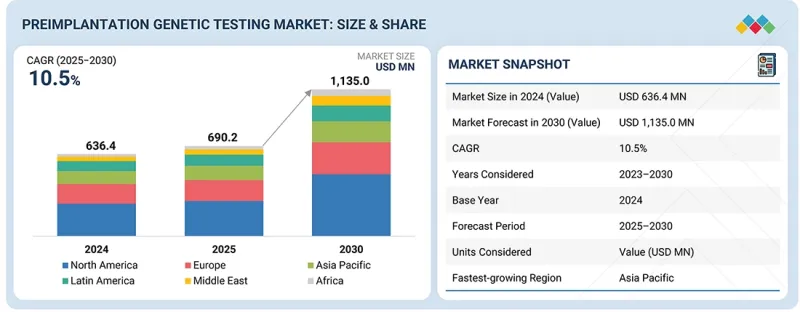
全球胚胎著床前基因檢測市場預計將從 2025 年的 6.902 億美元成長到 2030 年的 11.35 億美元,預測期內複合年成長率為 10.5%。
推動市場成長的主要因素包括遺傳疾病的日益普遍、人們對早期基因診斷的認知不斷提高以及全球範圍內體外受精(IVF)手術的日益普及。
| 調查範圍 | |
|---|---|
| 調查期 | 2024-2033 |
| 基準年 | 2024 |
| 預測期 | 2025-2030 |
| 單元 | 100萬美元 |
| 部分 | 處理類型、技術、產品服務、應用程式、週期類型、最終用戶 |
| 目標區域 | 北美、歐洲、亞太地區、拉丁美洲、中東和非洲 |
胚胎著床前遺傳學檢測的需求也得益於次世代定序(NGS)和聚合酵素鏈鎖反應(PCR)技術的進步,這些技術提高了檢測的準確性和效率。此外,晚育趨勢和胚胎染色體異常風險的增加也促進了市場擴張。然而,體外受精(IVF)和基因檢測的高昂費用,以及倫理和監管方面的挑戰,仍然是該技術廣泛應用的障礙。
“預計在預測期內,非整倍體檢測應用領域將以最高的複合年成長率成長。”
這一成長主要受染色體異常盛行率上升(尤其是在高齡生產女性)以及體外受精(IVF)過程中對精準胚胎篩檢需求不斷成長的推動。非整倍體檢測能夠發現染色體數目異常,從而提高胚胎著床率並降低流產風險。次世代定序(NGS)和微陣列比較基因組雜合(aCGH)等先進基因組檢測方法的整合進一步提高了檢測的準確性和效率。此外,人們對基因篩檢益處的認知不斷提高以及輔助生殖技術的廣泛應用,也推動了全球非整倍體檢測市場的強勁成長。
“試劑和耗材領域佔據最大的市場佔有率。”
這項優點源自於它們在檢測過程所有階段(包括樣本製備、擴增和分析)的重複使用。體外受精 (IVF) 技術和基因檢測的興起顯著增加了對高品質試劑、檢測試劑盒和耗材的需求,這些試劑、檢測試劑盒和耗材能夠提供準確、可重複且一致的結果。此外,次世代定序(NGS)、聚合酵素鏈鎖反應(PCR) 和基於晶片的平台技術的進步,使得開發用於高通量、精準胚胎分析的專用試劑成為可能。主要市場參與者的持續產品創新,以及生育診所和研究實驗室對基因篩檢的廣泛應用,進一步推動了該領域的成長。這些產品的完整性和重複使用性鞏固了它們在全球胚胎著床前基因檢測市場的主導地位。
“預計美國在預測期內將以最高的複合年成長率成長。”
由於多種因素的影響,美國預計將成為胚胎著床前遺傳學檢測市場成長最快的國家。美國擁有眾多大型體外受精(IVF)診所、先進的基因組實驗室以及完善的醫療保健體系,這些都大大促進了該國市場的成長。此外,不孕症的上升、平均孕婦年齡的成長以及人們對基因篩檢方案日益成長的認知,也推動了美國對胚胎著床前遺傳學檢測的需求。優惠的報銷政策、政府對生殖健康的支持以及對基因組研究的持續投入,也進一步推動了市場的擴張。
此外,次世代定序(NGS) 和聚合酵素鏈鎖反應(PCR) 技術在體外受精 (IVF) 流程中的日益普及,提高了檢測的準確性和效率。輔助生殖技術的普及以及人們對個人化生殖醫學日益成長的需求,持續推動胚胎胚胎著床前遺傳學檢測在全部區域的應用。美國健全的法規結構確保了檢測的可靠性和臨床有效性,增強了人們對胚胎著床前遺傳學檢測解決方案的信心,並幫助北美保持主導地位。
本報告分析了全球胚胎著床前基因檢測市場,提供了關鍵促進因素和限制因素、競爭格局和未來趨勢的資訊。
目錄
第1章 引言
第2章執行摘要
第3章 主要發現
- 北美胚胎著床前基因檢測市場(按產品/服務和國家分類)
- 胚胎著床前基因檢測市場:地域成長機遇
- 按產品/服務分類的胚胎著床前基因檢測市場佔有率(2025 年和 2030 年)
- 按最終用戶分類的胚胎著床前基因檢測市場佔有率(2024 年)
第4章 市場概覽
- 市場動態
- 促進要素
- 抑制因素
- 機會
- 任務
- 未滿足的需求和閒置頻段
- 相互關聯的市場與跨產業機遇
- 一級/二級/三級公司的策略性舉措
第5章 產業趨勢
- 影響客戶業務的趨勢/顛覆性因素
- 宏觀經濟展望
- GDP趨勢與預測
- 醫療產業的全球趨勢
- 全球製藥業研究趨勢
- 案例研究分析
- 定價分析
- 按最終用戶分類的胚胎著床前基因檢測產品平均售價趨勢(2022-2024 年)
- 主要企業胚胎著床前基因檢測產品平均售價趨勢(2022-2024 年)
- 依手術類型分類的胚胎著床前基因檢測產品平均售價趨勢(2022-2024 年)
- 2022-2024年各地區胚胎胚胎著床前基因檢測設備及耗材平均售價趨勢
- 貿易分析
- HS編碼3822的進口資料(2020-2024年)
- HS編碼3822的出口資料(2020-2024年)
- HS編碼9018的進口資料(2020-2024年)
- HS編碼9018出口資料(2020-2024)
- 價值鏈分析
- 生態系分析
- 波特五力分析
- 重大會議和活動(2025-2026)
- 投資和資金籌措方案
- 2025年美國關稅對胚胎著床前基因檢測市場的影響
- 主要關稅稅率
- 價格影響分析
- 對各個地區產生重大影響
- 對終端用戶產業的影響
第6章:技術進步、人工智慧影響、專利、創新與未來應用
- 技術分析
- 主要技術
- 互補技術
- 技術藍圖
- 專利分析
- 調查方法
- 按文件類型分類的專利申請編號
- 主要專利列表
- 未來應用
- 人工智慧/生成式人工智慧對胚胎著床前基因檢測市場的影響
- 主要應用案例和市場潛力
- 人工智慧輔助胚胎選擇和基因篩檢最佳實踐
- 人工智慧在胚胎著床前基因檢測市場的應用案例研究
- 相互關聯的相鄰生態系及其對市場參與者的影響
- 客戶對胚胎著床前基因檢測市場中生成式人工智慧的接受程度
第7章永續性與監管環境
- 地方法規和合規性
- 監管機構、政府機構和其他組織
- 業界標準
- 永續性影響和監管政策舉措
- 認證、標籤和環境標準
第8章:顧客狀況與購買行為
- 決策流程
- 買方相關利益者和採購評估標準
- 採購過程中的關鍵相關利益者
- 主要採購標準
- 招募障礙和內部挑戰
- 來自各個終端使用者產業的未滿足需求
第9章胚胎著床前遺傳學檢測市場(按產品和服務分類)
- 試劑和耗材
- 裝置
- 軟體和服務
第10章 依手術類型分類的胚胎著床前基因檢測市場
- 胚胎著床前遺傳學篩檢
- 胚胎著床前遺傳學診斷
第11章 按技術胚胎著床前基因檢測市場
- 次世代定序
- 聚合酵素鏈鎖反應
- 螢光原位雜合反應
- 比較基因組雜合反應
- 單核苷酸多態性
第12章 按應用分類的胚胎著床前基因檢測市場
- 非整倍體檢測
- 染色體結構異常
- 單基因疾病
- X連鎖疾病
- HLA型檢測
- 性別認同
第13章 依週期類型分類的胚胎著床前基因檢測市場
- 新鮮/非捐贈者
- 冷凍/非捐贈者
- 新鮮捐贈者
- 冷凍捐贈者
第14章 依最終用戶分類的胚胎著床前基因檢測市場
- 不孕不育診所
- 診斷檢查室
- 醫院
- 其他最終用戶
第15章 區域性胚胎著床前基因檢測市場
- 北美洲
- 美國
- 加拿大
- 歐洲
- 德國
- 英國
- 法國
- 義大利
- 西班牙
- 其他歐洲
- 亞太地區
- 中國
- 日本
- 印度
- 澳洲
- 韓國
- 亞太其他地區
- 拉丁美洲
- 巴西
- 墨西哥
- 其他拉丁美洲
- 中東
- 海灣合作理事會國家
- 其他中東地區
- 非洲
第16章 競爭格局
- 胚胎著床前基因檢測市場主要企業所採取策略概述
- 收入分析(2020-2024)
- 市佔率分析(2024 年)
- 公司估值和財務指標
- 品牌/產品對比
- ILLUMINA, INC.
- THERMO FISHER SCIENTIFIC INC.
- AGILENT TECHNOLOGIES, INC.
- 企業評估矩陣:主要企業(2024)
- 公司評估矩陣:Start-Ups/中小企業(2024 年)
- 競爭場景
第17章:公司簡介
- 主要企業
- ILLUMINA, INC.
- THERMO FISHER SCIENTIFIC INC.
- AGILENT TECHNOLOGIES, INC.
- REVVITY
- COOPERCOMPANIES
- ABBOTT
- TAKARA BIO INC.
- QIAGEN
- VITROLIFE
- OXFORD NANOPORE TECHNOLOGIES PLC
- 其他公司
- OXFORD GENE TECHNOLOGY IP LIMITED
- YIKON GENOMICS
- SHIVA SCIENTIFIC
- NANJING SUPERYEARS GENE TECHNOLOGY CO., LTD.
- MEDICOVER GENETICS
- MEDGENOME
- FULGENT GENETICS
- INVICTA SP. Z OO
- GENEA PTY LIMITED
- SCIGENE CORPORATION
- BIOARRAY SL
- UNIMED BIOTECH(SHANGHAI)CO., LTD.
- GENEMIND BIOSCIENCES CO., LTD.
- BERRY GENOMICS
- BANGKOK GENOMICS INNOVATION
第18章附錄
The preimplantation genetic testing market is expected to reach USD 1,135.0 million by 2030, up from USD 690.2 million in 2025, at a CAGR of 10.5% during the forecast period. The market growth is primarily driven by the increasing prevalence of genetic disorders, growing awareness regarding early genetic diagnosis, and the rising adoption of in-vitro fertilization (IVF) procedures worldwide.
| Scope of the Report | |
|---|---|
| Years Considered for the Study | 2024-2033 |
| Base Year | 2024 |
| Forecast Period | 2025-2030 |
| Units Considered | Value (USD million) |
| Segments | Procedure Type, Technology, Product & Service, Application, Type of Cycle, End User |
| Regions covered | North America, Europe, the Asia Pacific, Latin America, the Middle East, and Africa |
The demand for preimplantation genetic testing is also supported by advancements in next-generation sequencing (NGS) and polymerase chain reaction (PCR) technologies that enhance testing accuracy and efficiency. Moreover, the growing trend toward delayed pregnancies and the rising risk of chromosomal abnormalities in embryos are contributing to the market expansion. However, the high costs associated with IVF and genetic testing procedures, along with ethical and regulatory challenges, continue to hinder widespread adoption.
"The aneuploidy application segment is expected to grow at the highest CAGR during the forecast period."
The aneuploidy application segment is projected to grow at the highest CAGR in the preimplantation genetic testing market during the forecast period. This growth is primarily driven by the rising incidence of chromosomal abnormalities, particularly among women of advanced maternal age, and the increasing demand for accurate embryo screening in IVF procedures. Aneuploidy enables the detection of abnormal chromosome numbers, helping improve implantation rates and reduce the risk of miscarriage. The integration of advanced genomic tools such as next-generation sequencing (NGS) and array-based comparative genomic hybridization (aCGH) has further enhanced test precision and efficiency. Additionally, growing awareness of genetic screening benefits and the rising adoption of assisted reproductive technologies are contributing to the strong growth of the aneuploidy segment globally.
"The reagents and consumables segment holds the largest share of the market."
The reagents and consumables segment holds the largest share of the preimplantation genetic testing market. This dominance is due to their repeated use at every stage of the testing process, including sample preparation, amplification, and analysis. The increasing number of IVF procedures and genetic tests has greatly boosted the demand for high-quality reagents, assay kits, and consumables that provide accuracy, reproducibility, and consistent results. Additionally, advances in next-generation sequencing (NGS), polymerase chain reaction (PCR), and array-based platforms have enabled the development of specialized reagents for high-throughput and precise embryo analysis. Ongoing product innovations by major market players, along with the growing use of genetic screening in fertility clinics and research labs, further drive segment growth. The essential and recurring nature of these products secures their leading role in the global preimplantation genetic testing market.
"The US is expected to grow at the highest CAGR during the forecast period."
The US is expected to have the highest growth rate in the preimplantation genetic testing market, driven by several key factors. The strong presence of leading IVF clinics, advanced genomic labs, and a well-established healthcare system significantly contributes to market growth in the country. Additionally, the increasing rate of infertility, rising average maternal age, and growing awareness of genetic screening options are boosting demand for preimplantation genetic testing in the US. Favorable reimbursement policies, supportive government initiatives for reproductive health, and ongoing investments in genomic research further drive market expansion.
Furthermore, the growing integration of next-generation sequencing (NGS) and polymerase chain reaction (PCR) technologies in IVF procedures is improving testing accuracy and efficiency. Increasing access to assisted reproductive technologies, along with the rising preference for personalized reproductive care, continues to drive the adoption of preimplantation genetic testing across the region. The US's robust regulatory framework ensures test reliability and clinical validity, bolstering confidence in preimplantation genetic testing solutions and reinforcing North America's leading position in the global market.
The primary interviews conducted for this report can be categorized as follows:
- By Respondent: Tier 1 - 25%, Tier 2 - 35%, and Tier 3 - 40%
- By Designation: Managers - 45%, CXOs and Directors - 30%, and Executives - 25%
- By Region: North America - 35%, Europe - 25%, Asia Pacific - 15%, Latin America - 10%, the Middle East - 10%, and Africa - 5%
Illumina, Inc. (US), Thermo Fisher Scientific Inc. (US), Agilent Technologies, Inc. (US), Revvity (US), CooperCompanies (US), Abbott (US), Takara Bio Inc. (Japan), QIAGEN (Germany), Vitrolife (Sweden), Oxford Nanopore Technologies plc (UK), Oxford Gene Technology IP Limited (UK), Yikon Genomics (China), Shiva Scientific (India), Nanjing Superyears Gene Technology Co. Ltd. (China), Medicover Genetics (Germany), MedGenome (India), Fulgent Genetics (US), Invicta (Poland), Genea Pty Limited (Australia), SciGene Corporation (US), Bioarray S.L. (Spain), Unimed Biotech (Shanghai) Co., Ltd. (China), GeneMind Biosciences Co. Ltd. (China), Berry Genomics (China), and Bangkok Genomics Innovation (Thailand) are some of the key companies offering preimplantation genetic testing products.
Research Coverage
This research report categorizes the preimplantation genetic testing market by procedure type (preimplantation genetic screening, preimplantation genetic diagnosis), technology (next-generation sequencing, polymerase chain reaction, fluorescence in situ hybridization, comparative genomic hybridization, single-nucleotide polymorphism), product & service (reagents & consumables, instruments, software & services), application (aneuploidy, structural chromosomal abnormalities [translocations, deletions, duplications, inversions], single gene disorders, X-linked disorders, HLA typing, gender identification), type of cycle (fresh non-donor, frozen non-donor, fresh donor, frozen donor), end user (fertility clinics, hospitals, diagnostic laboratories, other end users), and region (North America, Europe, Asia Pacific, Latin America, Middle East, And Africa).
The report's scope encompasses detailed information about the primary factors, including drivers, restraints, challenges, and opportunities, that influence the growth of the preimplantation genetic testing market. A comprehensive analysis of key industry players has been performed to provide insights into their business overview, product portfolio, key strategies, new product launches, acquisitions, and recent developments related to the preimplantation genetic testing market. This report also includes a competitive analysis of emerging startups in the preimplantation genetic testing industry ecosystem.
Key Benefits of Buying the Report
The report will assist market leaders and new entrants by providing revenue estimates for the overall market and its subsegments. It will also help stakeholders better understand the competitive landscape and gain more insights to position their businesses effectively and develop suitable go-to-market strategies. This report will enable stakeholders to grasp the market's pulse and offer information on key market drivers, restraints, opportunities, and challenges.
The report provides insights into the following pointers:
- Analysis of key drivers (decline in fertility, rise of fertility tourism in emerging economies, increasing number of fertility clinics and IVF centers, increasing public-private investments to develop novel diagnostic techniques, and high risk of chromosomal abnormalities with advancing maternal age), restraints (high procedural cost in preimplantation genetic testing and unfavorable government regulations and healthcare reforms for IVF procedures), opportunities (improving healthcare infrastructure and rising medical tourism in emerging economies and use of fertility treatments by single parents and same-sex couples), and challenges (socio-ethical concerns surrounding preimplantation genetic testing and procedural limitations with advancing age) influencing the market growth
- Product Development/Innovation: Detailed insights into newly launched products and technological assessment of the preimplantation genetic testing market
- Market Development: Comprehensive information about lucrative markets and analysis of the market across varied regions
- Market Diversification: Exhaustive information about new products, untapped geographies, recent developments, and investments in the preimplantation genetic testing market
- Competitive Assessment: In-depth assessment of market shares, growth strategies, and product offerings of leading players, including Illumina, Inc. (US), Thermo Fisher Scientific Inc. (US), and Agilent Technologies, Inc. (US), Revvity (US), CooperCompanies (US), and Abbott (US), among others offering products and services for preimplantation genetic testing market. Other companies include MedGenome (India), Fulgent Genetics (US), Invicta (Poland), Genea Pty Limited (Australia), SciGene Corporation (US), Bioarray S.L. (Spain), Unimed Biotech (Shanghai) Co., Ltd (China), and GeneMind Biosciences Co., Ltd. (China), among others, for the preimplantation genetic testing market
TABLE OF CONTENTS
1 INTRODUCTION
- 1.1 STUDY OBJECTIVES
- 1.2 MARKET DEFINITION
- 1.3 STUDY SCOPE
- 1.3.1 MARKET SEGMENTATION & REGIONAL SCOPE
- 1.3.2 INCLUSIONS & EXCLUSIONS
- 1.3.3 YEARS CONSIDERED
- 1.3.4 CURRENCY CONSIDERED
- 1.4 STAKEHOLDERS
- 1.5 SUMMARY OF CHANGES
2 EXECUTIVE SUMMARY
- 2.1 KEY INSIGHTS & MARKET HIGHLIGHTS
- 2.2 KEY MARKET PARTICIPANTS: INSIGHTS & STRATEGIC DEVELOPMENTS
- 2.3 DISRUPTIVE TRENDS SHAPING PREIMPLANTATION GENETIC TESTING MARKET
- 2.4 HIGH-GROWTH SEGMENTS & EMERGING FRONTIERS
- 2.5 GLOBAL PREIMPLANTATION GENETIC TESTING MARKET SNAPSHOT
3 PREMIUM INSIGHTS
- 3.1 NORTH AMERICA: PREIMPLANTATION GENETIC TESTING MARKET, BY PRODUCT & SERVICE AND COUNTRY
- 3.2 PREIMPLANTATION GENETIC TESTING MARKET: GEOGRAPHIC GROWTH OPPORTUNITIES
- 3.3 PREIMPLANTATION GENETIC TESTING MARKET SHARE, BY PRODUCT & SERVICE, 2025 VS. 2030 (%)
- 3.4 PREIMPLANTATION GENETIC TESTING MARKET SHARE, BY END USER, 2024 (%)
4 MARKET OVERVIEW
- 4.1 INTRODUCTION
- 4.2 MARKET DYNAMICS
- 4.2.1 DRIVERS
- 4.2.1.1 Decline in fertility rates
- 4.2.1.2 Expanding network of fertility clinics and IVF centers
- 4.2.1.3 Rising incidence of chromosomal abnormalities associated with advancing maternal age
- 4.2.2 RESTRAINTS
- 4.2.2.1 High procedural cost
- 4.2.2.2 Stringent regulatory frameworks governing IVF and genetic testing procedures
- 4.2.3 OPPORTUNITIES
- 4.2.3.1 Expanding acceptance of fertility treatments among single parents and same-sex couples
- 4.2.4 CHALLENGES
- 4.2.4.1 Socio-ethical concerns regarding embryo screening and selection
- 4.2.1 DRIVERS
- 4.3 UNMET NEEDS & WHITE SPACES
- 4.4 INTERCONNECTED MARKETS & CROSS-SECTOR OPPORTUNITIES
- 4.5 STRATEGIC MOVIES BY TIER-1/2/3 PLAYERS
5 INDUSTRY TRENDS
- 5.1 TRENDS/DISRUPTIONS IMPACTING CUSTOMER'S BUSINESS
- 5.2 MACROECONOMIC OUTLOOK
- 5.2.1 GDP TRENDS & FORECAST
- 5.2.2 R&D TRENDS IN GLOBAL HEALTHCARE INDUSTRY
- 5.2.3 R&D TRENDS IN GLOBAL PHARMA INDUSTRY
- 5.3 CASE STUDY ANALYSIS
- 5.3.1 PGT-M FOR RPGRIP1L VARIANT-ENABLED BY MINIGENE ASSAY
- 5.3.2 PERSISTENT FETAL MOSAICISM AFTER TRANSFER OF PGT-A MOSAIC EMBRYO
- 5.3.3 CRYPTIC REARRANGEMENTS RESOLVED BY OGM TO GUIDE PGT-SR
- 5.4 PRICING ANALYSIS
- 5.4.1 AVERAGE SELLING PRICE TREND OF PREIMPLANTATION GENETIC TESTING PRODUCTS, BY END USER, 2022-2024
- 5.4.2 AVERAGE SELLING PRICE TREND OF PREIMPLANTATION GENETIC TESTING PRODUCTS, BY KEY PLAYER, 2022-2024
- 5.4.3 AVERAGE SELLING PRICE TREND OF PREIMPLANTATION GENETIC TESTING PRODUCTS, BY PROCEDURE TYPE, 2022-2024
- 5.4.4 AVERAGE SELLING PRICE TREND OF PREIMPLANTATION GENETIC TESTING INSTRUMENTS AND CONSUMABLES, BY REGION, 2022-2024
- 5.5 TRADE ANALYSIS
- 5.5.1 IMPORT DATA FOR HS CODE 3822, 2020-2024
- 5.5.2 EXPORT DATA FOR HS CODE 3822, 2020-2024
- 5.5.3 IMPORT DATA FOR HS CODE 9018, 2020-2024
- 5.5.4 EXPORT DATA FOR HS CODE 9018, 2020-2024
- 5.6 VALUE CHAIN ANALYSIS
- 5.7 ECOSYSTEM ANALYSIS
- 5.7.1 ROLE IN ECOSYSTEM
- 5.8 PORTER'S FIVE FORCES ANALYSIS
- 5.8.1 INTENSITY OF COMPETITIVE RIVALRY
- 5.8.2 BARGAINING POWER OF SUPPLIERS
- 5.8.3 BARGAINING POWER OF BUYERS
- 5.8.4 THREAT OF SUBSTITUTES
- 5.8.5 THREAT OF NEW ENTRANTS
- 5.9 KEY CONFERENCES & EVENTS, 2025-2026
- 5.10 INVESTMENT & FUNDING SCENARIO
- 5.11 IMPACT OF 2025 US TARIFF ON PREIMPLANTATION GENETIC TESTING MARKET
- 5.11.1 KEY TARIFF RATES
- 5.11.2 PRICE IMPACT ANALYSIS
- 5.11.3 KEY IMPACTS ON VARIOUS REGIONS
- 5.11.3.1 US
- 5.11.3.2 Europe
- 5.11.3.3 Asia Pacific
- 5.11.4 END-USE INDUSTRY IMPACT
- 5.11.4.1 Fertility clinics
- 5.11.4.2 Hospitals
- 5.11.4.3 Diagnostic laboratories
6 TECHNOLOGICAL ADVANCEMENTS, AI-DRIVEN IMPACT, PATENTS, INNOVATIONS, AND FUTURE APPLICATIONS
- 6.1 TECHNOLOGY ANALYSIS
- 6.1.1 KEY TECHNOLOGIES
- 6.1.1.1 Laser-assisted TE biopsy
- 6.1.1.2 Whole genome amplification
- 6.1.2 COMPLEMENTARY TECHNOLOGIES
- 6.1.2.1 Micromanipulation
- 6.1.1 KEY TECHNOLOGIES
- 6.2 TECHNOLOGY ROADMAP
- 6.3 PATENT ANALYSIS
- 6.3.1 METHODOLOGY
- 6.3.2 NUMBER OF PATENTS FILED, BY DOCUMENT TYPE
- 6.3.3 LIST OF KEY PATENTS
- 6.4 FUTURE APPLICATIONS
- 6.5 IMPACT OF AI/GEN AI ON PREIMPLANTATION GENETIC TESTING MARKET
- 6.5.1 TOP USE CASES AND MARKET POTENTIAL
- 6.5.2 BEST PRACTICES IN AI-ENABLED EMBRYO SELECTION AND GENETIC SCREENING
- 6.5.3 CASE STUDIES OF AI IMPLEMENTATION IN PREIMPLANTATION GENETIC TESTING MARKET
- 6.5.4 INTERCONNECTED ADJACENT ECOSYSTEM AND IMPACT ON MARKET PLAYERS
- 6.5.5 CLIENTS' READINESS TO ADOPT GENERATIVE AI IN PREIMPLANTATION GENETIC TESTING MARKET
7 SUSTAINABILITY & REGULATORY LANDSCAPE
- 7.1 REGIONAL REGULATIONS & COMPLIANCE
- 7.1.1 REGULATORY BODIES, GOVERNMENT AGENCIES & OTHER ORGANIZATIONS
- 7.1.2 INDUSTRY STANDARDS
- 7.1.2.1 North America
- 7.1.2.1.1 US
- 7.1.2.1.2 Canada
- 7.1.2.2 Europe
- 7.1.2.3 Asia Pacific
- 7.1.2.3.1 Japan
- 7.1.2.3.2 China
- 7.1.2.3.3 India
- 7.1.2.4 Latin America
- 7.1.2.4.1 Brazil
- 7.1.2.1 North America
- 7.2 SUSTAINABILITY IMPACT & REGULATORY POLICY INITIATIVES
- 7.3 CERTIFICATIONS, LABELING, AND ECO-STANDARDS
8 CUSTOMER LANDSCAPE & BUYER BEHAVIOUR
- 8.1 DECISION-MAKING PROCESS
- 8.2 BUYER STAKEHOLDERS & BUYING EVALUATION CRITERIA
- 8.2.1 KEY STAKEHOLDERS IN BUYING PROCESS
- 8.2.2 KEY BUYING CRITERIA
- 8.3 ADOPTION BARRIERS & INTERNAL CHALLENGES
- 8.4 UNMET NEEDS FROM VARIOUS END-USE INDUSTRIES
9 PREIMPLANTATION GENETIC TESTING MARKET, BY PRODUCT & SERVICE
- 9.1 INTRODUCTION
- 9.2 REAGENTS & CONSUMABLES
- 9.2.1 EXPANSION OF ADVANCED GENOMIC TECHNOLOGIES TO PROMOTE MARKET GROWTH
- 9.3 INSTRUMENTS
- 9.3.1 ONGOING TECHNOLOGICAL ADVANCEMENTS AND INCREASING FERTILITY CLINICS TO PROPEL MARKET GROWTH
- 9.4 SOFTWARE & SERVICES
- 9.4.1 RISING AWARENESS ABOUT DATA ANALYSIS TO DRIVE MARKET
10 PREIMPLANTATION GENETIC TESTING MARKET, BY PROCEDURE TYPE
- 10.1 INTRODUCTION
- 10.2 PREIMPLANTATION GENETIC SCREENING
- 10.2.1 INCREASING MATERNAL AGE TO AID MARKET GROWTH
- 10.3 PREIMPLANTATION GENETIC DIAGNOSIS
- 10.3.1 RISING AWARENESS ABOUT CHROMOSOMAL ABNORMALITIES IN FETUSES TO SUPPORT MARKET GROWTH
11 PREIMPLANTATION GENETIC TESTING MARKET, BY TECHNOLOGY
- 11.1 INTRODUCTION
- 11.2 NEXT-GENERATION SEQUENCING
- 11.2.1 IMPROVED TECHNOLOGY FOR DETECTING STRUCTURAL ABNORMALITIES TO FUEL MARKET GROWTH
- 11.3 POLYMERASE CHAIN REACTION
- 11.3.1 INCREASED USAGE IN CLINICAL AND RESEARCH APPLICATIONS AND HIGH PREVALENCE OF GENETIC DISEASES TO SUPPORT MARKET
- 11.4 FLUORESCENCE IN SITU HYBRIDIZATION
- 11.4.1 ADVANCES IN FLUORESCENCE MICROSCOPY AND DIGITAL IMAGING TO AUGMENT MARKET GROWTH
- 11.5 COMPARATIVE GENOMIC HYBRIDIZATION
- 11.5.1 LOW COST, LESS LABOR REQUIREMENT, AND ONGOING TECHNOLOGICAL ADVANCEMENTS TO DRIVE MARKET
- 11.6 SINGLE-NUCLEOTIDE POLYMORPHISM
- 11.6.1 HIGH-RESOLUTION ACCURACY AND VALIDATED CLINICAL PERFORMANCE TO BOOST MARKET GROWTH
12 PREIMPLANTATION GENETIC TESTING MARKET, BY APPLICATION
- 12.1 INTRODUCTION
- 12.2 ANEUPLOIDY
- 12.2.1 HIGH ANEUPLOIDY INCIDENCE AND RAPID INNOVATION TO ACCELERATE MARKET GROWTH
- 12.3 STRUCTURAL CHROMOSOMAL ABNORMALITIES
- 12.3.1 TRANSLOCATIONS
- 12.3.1.1 Rising incidence of translocation chromosomal abnormalities during IVF treatments to drive segment
- 12.3.2 DELETIONS
- 12.3.2.1 Advancements in genetic testing to boost segment growth
- 12.3.3 DUPLICATIONS
- 12.3.3.1 Rising cases of duplication of chromosomal abnormalities and increasing maternal age to drive segment
- 12.3.4 INVERSIONS
- 12.3.4.1 Risk of unexplained male-factor infertility and multiple miscarriages to limit segment growth
- 12.3.1 TRANSLOCATIONS
- 12.4 SINGLE GENE DISORDERS
- 12.4.1 INCREASING AWARENESS ABOUT GENETIC TESTING TO PROPEL MARKET GROWTH
- 12.5 X-LINKED DISORDERS
- 12.5.1 MEDICAL ADVANCEMENTS AND INCREASED RESEARCH ON GENETIC DISORDERS TO AUGMENT MARKET GROWTH
- 12.6 HLA TYPING
- 12.6.1 RISING NUMBER OF COUPLES WITH CHILDREN AFFECTED BY HEMATOLOGICAL DISEASES TO DRIVE MARKET
- 12.7 GENDER IDENTIFICATION
- 12.7.1 INCREASED FOCUS ON SEX DISCRIMINATION TO LIMIT MARKET GROWTH
13 PREIMPLANTATION GENETIC TESTING MARKET, BY TYPE OF CYCLE
- 13.1 INTRODUCTION
- 13.2 FRESH NON-DONOR
- 13.2.1 HIGH RATES OF SUCCESSFUL PREGNANCY AMONG YOUNG WOMEN TO DRIVE MARKET GROWTH
- 13.3 FROZEN NON-DONOR
- 13.3.1 LONG-TERM STORAGE OF FROZEN EGGS AND EASY SCHEDULING TO PROPEL MARKET GROWTH
- 13.4 FRESH DONOR
- 13.4.1 HIGH-QUALITY FRESH DONOR OOCYTES AND EXPANDING PGT-DRIVEN RISK REDUCTION TO PROMOTE MARKET GROWTH
- 13.5 FROZEN DONOR
- 13.5.1 RISING USE OF ADVANCED AND NON-INVASIVE PGT TECHNOLOGIES TO AID MARKET GROWTH
14 PREIMPLANTATION GENETIC TESTING MARKET, BY END USER
- 14.1 INTRODUCTION
- 14.2 FERTILITY CLINICS
- 14.2.1 HIGH SUCCESS RATE OF FERTILITY TREATMENT TO DRIVE MARKET
- 14.3 DIAGNOSTIC LABORATORIES
- 14.3.1 IMPROVED CLINICAL EFFICACY AND INCREASED RESEARCH FUNDING TO FUEL MARKET
- 14.4 HOSPITALS
- 14.4.1 RISING NUMBER OF HOSPITALS AND INCREASING HEALTHCARE AWARENESS TO DRIVE GROWTH
- 14.5 OTHER END USERS
15 PREIMPLANTATION GENETIC TESTING MARKET, BY REGION
- 15.1 INTRODUCTION
- 15.2 NORTH AMERICA
- 15.2.1 US
- 15.2.1.1 US to dominate North American preimplantation genetic testing market during forecast period
- 15.2.2 CANADA
- 15.2.2.1 Whole-genome embryo testing and public-private R&D investment to propel market growth
- 15.2.1 US
- 15.3 EUROPE
- 15.3.1 GERMANY
- 15.3.1.1 Global clinical adoption of precision medicines to boost market growth
- 15.3.2 UK
- 15.3.2.1 Demographic pressures and evidence-based clinical innovation to support market growth
- 15.3.3 FRANCE
- 15.3.3.1 Ethical regulation and adoption of patient-centered precision medicines to fuel market growth
- 15.3.4 ITALY
- 15.3.4.1 Regulatory reforms and clinical-genetic partnerships to boost market growth
- 15.3.5 SPAIN
- 15.3.5.1 Well-established network of research centers and universities to augment market growth
- 15.3.6 REST OF EUROPE
- 15.3.1 GERMANY
- 15.4 ASIA PACIFIC
- 15.4.1 CHINA
- 15.4.1.1 Advancing next-generation genomic infrastructure and cross-border fertility capacity to propel market growth
- 15.4.2 JAPAN
- 15.4.2.1 Reinforcing global PGT standards and rigorous clinical governance to favor market growth
- 15.4.3 INDIA
- 15.4.3.1 Expanding genetic-diagnostic access to drive market growth
- 15.4.4 AUSTRALIA
- 15.4.4.1 Standardized regulation and expanding clinical adoption to fuel market growth
- 15.4.5 SOUTH KOREA
- 15.4.5.1 Clinically validated PGT-A integration and improved IVF outcomes to support market growth
- 15.4.6 REST OF ASIA PACIFIC
- 15.4.1 CHINA
- 15.5 LATIN AMERICA
- 15.5.1 BRAZIL
- 15.5.1.1 Global genomic innovation and regulatory modernization to boost market growth
- 15.5.2 MEXICO
- 15.5.2.1 Adoption of advanced NGS-based PGT services to support growth
- 15.5.3 REST OF LATIN AMERICA
- 15.5.1 BRAZIL
- 15.6 MIDDLE EAST
- 15.6.1 GCC COUNTRIES
- 15.6.1.1 Kingdom of Saudi Arabia
- 15.6.1.1.1 Rising global emphasis on preventive genomic medicine and advanced embryo-screening technologies to drive market
- 15.6.1.2 UAE
- 15.6.1.2.1 Rising global demand for safer and technologically advanced embryo screening to aid market growth
- 15.6.1.3 Rest of GCC Countries
- 15.6.1.1 Kingdom of Saudi Arabia
- 15.6.2 REST OF MIDDLE EAST
- 15.6.1 GCC COUNTRIES
- 15.7 AFRICA
- 15.7.1 REGIONAL ART REGISTRY EXPANSION AND RISING IVF INFRASTRUCTURE TO PROPEL MARKET GROWTH
16 COMPETITIVE LANDSCAPE
- 16.1 INTRODUCTION
- 16.2 OVERVIEW OF STRATEGIES ADOPTED BY KEY PLAYERS IN PREIMPLANTATION GENETIC TESTING MARKET
- 16.3 REVENUE ANALYSIS, 2020-2024
- 16.4 MARKET SHARE ANALYSIS, 2024
- 16.5 COMPANY VALUATION & FINANCIAL METRICS
- 16.5.1 FINANCIAL METRICS
- 16.5.2 COMPANY VALUATION
- 16.6 BRAND/PRODUCT COMPARISON
- 16.6.1 ILLUMINA, INC.
- 16.6.2 THERMO FISHER SCIENTIFIC INC.
- 16.6.3 AGILENT TECHNOLOGIES, INC.
- 16.7 COMPANY EVALUATION MATRIX: KEY PLAYERS, 2024
- 16.7.1 STARS
- 16.7.2 EMERGING LEADERS
- 16.7.3 PERVASIVE PLAYERS
- 16.7.4 PARTICIPANTS
- 16.7.5 COMPANY FOOTPRINT: KEY PLAYERS, 2024
- 16.7.5.1 Company footprint
- 16.7.5.2 Region footprint
- 16.7.5.3 Product & service footprint
- 16.7.5.4 Technology footprint
- 16.7.5.5 Application footprint
- 16.8 COMPANY EVALUATION MATRIX: STARTUPS/SMES, 2024
- 16.8.1 PROGRESSIVE COMPANIES
- 16.8.2 RESPONSIVE COMPANIES
- 16.8.3 DYNAMIC COMPANIES
- 16.8.4 STARTING BLOCKS
- 16.8.5 COMPETITIVE BENCHMARKING
- 16.8.5.1 Detailed list of key startups/SMEs
- 16.8.5.2 Competitive benchmarking of key startups/SMEs
- 16.9 COMPETITIVE SCENARIO
- 16.9.1 PRODUCT LAUNCHES
- 16.9.2 DEALS
- 16.9.3 EXPANSIONS
17 COMPANY PROFILES
- 17.1 KEY PLAYERS
- 17.1.1 ILLUMINA, INC.
- 17.1.1.1 Business overview
- 17.1.1.2 Products/Services/Solutions offered
- 17.1.1.3 Recent developments
- 17.1.1.3.1 Deals
- 17.1.1.4 MnM view
- 17.1.1.4.1 Key strengths
- 17.1.1.4.2 Strategic choices
- 17.1.1.4.3 Weaknesses & competitive threats
- 17.1.2 THERMO FISHER SCIENTIFIC INC.
- 17.1.2.1 Business overview
- 17.1.2.2 Products/Services/Solutions offered
- 17.1.2.3 Recent developments
- 17.1.2.3.1 Product launches
- 17.1.2.4 MnM view
- 17.1.2.4.1 Key strengths
- 17.1.2.4.2 Strategic choices
- 17.1.2.4.3 Weaknesses & competitive threats
- 17.1.3 AGILENT TECHNOLOGIES, INC.
- 17.1.3.1 Business overview
- 17.1.3.2 Products/Services/Solutions offered
- 17.1.3.3 MnM view
- 17.1.3.3.1 Key strengths
- 17.1.3.3.2 Strategic choices
- 17.1.3.3.3 Weaknesses & competitive threats
- 17.1.4 REVVITY
- 17.1.4.1 Business overview
- 17.1.4.2 Products/Services/Solutions offered
- 17.1.4.3 MnM view
- 17.1.4.3.1 Key strengths
- 17.1.4.3.2 Strategic choices
- 17.1.4.3.3 Weaknesses & competitive threats
- 17.1.5 COOPERCOMPANIES
- 17.1.5.1 Business overview
- 17.1.5.2 Products/Services/Solutions offered
- 17.1.5.3 MnM view
- 17.1.5.3.1 Key strengths
- 17.1.5.3.2 Strategic choices
- 17.1.5.3.3 Weaknesses & competitive threats
- 17.1.6 ABBOTT
- 17.1.6.1 Business overview
- 17.1.6.2 Products/Services/Solutions offered
- 17.1.7 TAKARA BIO INC.
- 17.1.7.1 Business overview
- 17.1.7.2 Products/Services/Solutions offered
- 17.1.8 QIAGEN
- 17.1.8.1 Business overview
- 17.1.8.2 Products/Services/Solutions offered
- 17.1.9 VITROLIFE
- 17.1.9.1 Business overview
- 17.1.9.2 Products/Services/Solutions offered
- 17.1.10 OXFORD NANOPORE TECHNOLOGIES PLC
- 17.1.10.1 Business overview
- 17.1.10.2 Products/Services/Solutions offered
- 17.1.10.3 Recent developments
- 17.1.10.3.1 Expansions
- 17.1.1 ILLUMINA, INC.
- 17.2 OTHER PLAYERS
- 17.2.1 OXFORD GENE TECHNOLOGY IP LIMITED
- 17.2.2 YIKON GENOMICS
- 17.2.3 SHIVA SCIENTIFIC
- 17.2.4 NANJING SUPERYEARS GENE TECHNOLOGY CO., LTD.
- 17.2.5 MEDICOVER GENETICS
- 17.2.6 MEDGENOME
- 17.2.7 FULGENT GENETICS
- 17.2.8 INVICTA SP. Z O.O.
- 17.2.9 GENEA PTY LIMITED
- 17.2.10 SCIGENE CORPORATION
- 17.2.11 BIOARRAY S.L.
- 17.2.12 UNIMED BIOTECH (SHANGHAI) CO., LTD.
- 17.2.13 GENEMIND BIOSCIENCES CO., LTD.
- 17.2.14 BERRY GENOMICS
- 17.2.15 BANGKOK GENOMICS INNOVATION
18 APPENDIX
- 18.1 DISCUSSION GUIDE
- 18.2 KNOWLEDGESTORE: MARKETSANDMARKETS' SUBSCRIPTION PORTAL
- 18.3 CUSTOMIZATION OPTIONS
- 18.4 RELATED REPORTS
- 18.5 AUTHOR DETAILS
List of Tables
- TABLE 1 PREIMPLANTATION GENETIC TESTING MARKET: INCLUSIONS & EXCLUSIONS
- TABLE 2 PREIMPLANTATION GENETIC TESTING MARKET: IMPACT ANALYSIS OF MARKET DYNAMICS
- TABLE 3 AVERAGE SELLING PRICE TREND OF PREIMPLANTATION GENETIC TESTING PRODUCTS, BY END USER, 2022-2024 (USD)
- TABLE 4 AVERAGE SELLING PRICE TREND OF PREIMPLANTATION GENETIC TESTING PRODUCTS, BY KEY PLAYER, 2022-2024 (USD)
- TABLE 5 AVERAGE SELLING PRICE TREND OF PREIMPLANTATION GENETIC TESTING PRODUCTS, BY PROCEDURE TYPE, 2022-2024 (USD)
- TABLE 6 AVERAGE SELLING PRICE TREND OF PREIMPLANTATION GENETIC TESTING INSTRUMENTS, BY REGION, 2022-2024 (USD MILLION)
- TABLE 7 AVERAGE SELLING PRICE MEAN TREND OF PREIMPLANTATION GENETIC TESTING CONSUMABLES, BY REGION, 2022-2024 (USD)
- TABLE 8 IMPORT DATA FOR HS CODE 3822, BY COUNTRY, 2020-2024 (USD THOUSAND)
- TABLE 9 EXPORT DATA FOR HS CODE 3822, BY COUNTRY, 2020-2024 (USD THOUSAND)
- TABLE 10 IMPORT DATA FOR HS CODE 9018, BY COUNTRY, 2020-2024 (USD THOUSAND)
- TABLE 11 EXPORT DATA FOR HS CODE 9018, BY COUNTRY, 2020-2024 (USD THOUSAND)
- TABLE 12 PREIMPLANTATION GENETIC TESTING MARKET: ROLE IN ECOSYSTEM
- TABLE 13 PREIMPLANTATION GENETIC TESTING MARKET: PORTER'S FIVE FORCES
- TABLE 14 KEY CONFERENCES & EVENTS IN PREIMPLANTATION GENETIC TESTING MARKET: JANUARY 2025-DECEMBER 2026
- TABLE 15 US-ADJUSTED RECIPROCAL TARIFF RATES
- TABLE 16 NUMBER OF EXPORTS AND IMPORTS, BY REGION, 2024-2025 (USD MILLION)
- TABLE 17 KEY PRODUCT-RELATED TARIFF: HS CODES FOR PRODUCTS RELEVANT TO PREIMPLANTATION GENETIC TESTING
- TABLE 18 CRITICAL COMPONENTS LIKELY EXPOSED TO TARIFF CHANGES
- TABLE 19 NUMBER OF PATENTS FILED, BY DOCUMENT TYPE, 2014-2024
- TABLE 20 LIST OF KEY PATENTS IN PREIMPLANTATION GENETIC TESTING MARKET, 2023-2025
- TABLE 21 KEY PLAYERS IMPLEMENTING AI/GEN AI IN PREIMPLANTATION GENETIC TESTING MARKET
- TABLE 22 NORTH AMERICA: REGULATORY BODIES, GOVERNMENT AGENCIES, AND OTHER ORGANIZATIONS
- TABLE 23 EUROPE: REGULATORY BODIES, GOVERNMENT AGENCIES, AND OTHER ORGANIZATIONS
- TABLE 24 ASIA PACIFIC: REGULATORY BODIES, GOVERNMENT AGENCIES, AND OTHER ORGANIZATIONS
- TABLE 25 REST OF THE WORLD: REGULATORY BODIES, GOVERNMENT AGENCIES, AND OTHER ORGANIZATIONS
- TABLE 26 US: CLASSIFICATION OF IN VITRO DIAGNOSTIC DEVICES
- TABLE 27 EUROPE: CLASSIFICATION OF IN VITRO DIAGNOSTIC DEVICES
- TABLE 28 JAPAN: CLASSIFICATION OF IN VITRO DIAGNOSTIC REAGENTS
- TABLE 29 JAPAN: TIME, COST, AND COMPLEXITY OF REGISTRATION PROCESS
- TABLE 30 CHINA: TIME, COST, AND COMPLEXITY OF REGISTRATION PROCESS
- TABLE 31 VENDOR CERTIFICATIONS: PREIMPLANTATION GENETIC TESTING MARKET
- TABLE 32 INFLUENCE OF KEY STAKEHOLDERS ON BUYING PROCESS, BY PRODUCT & SERVICE
- TABLE 33 KEY BUYING CRITERIA FOR MAJOR END USERS
- TABLE 34 PREIMPLANTATION GENETIC TESTING MARKET, BY PRODUCT & SERVICE, 2023-2030 (USD MILLION)
- TABLE 35 PREIMPLANTATION GENETIC TESTING REAGENTS & CONSUMABLES MARKET, BY REGION, 2023-2030 (USD MILLION)
- TABLE 36 NORTH AMERICA: PREIMPLANTATION GENETIC TESTING REAGENTS & CONSUMABLES MARKET, BY COUNTRY, 2023-2030 (USD MILLION)
- TABLE 37 EUROPE: PREIMPLANTATION GENETIC TESTING REAGENTS & CONSUMABLES MARKET, BY COUNTRY, 2023-2030 (USD MILLION)
- TABLE 38 ASIA PACIFIC: PREIMPLANTATION GENETIC TESTING REAGENTS & CONSUMABLES MARKET, BY COUNTRY, 2023-2030 (USD MILLION)
- TABLE 39 LATIN AMERICA: PREIMPLANTATION GENETIC TESTING REAGENTS & CONSUMABLES MARKET, BY COUNTRY, 2023-2030 (USD MILLION)
- TABLE 40 MIDDLE EAST: PREIMPLANTATION GENETIC TESTING REAGENTS & CONSUMABLES MARKET, BY REGION, 2023-2030 (USD MILLION)
- TABLE 41 GCC COUNTRIES: PREIMPLANTATION GENETIC TESTING REAGENTS & CONSUMABLES MARKET, BY COUNTRY, 2023-2030 (USD MILLION)
- TABLE 42 PREIMPLANTATION GENETIC TESTING INSTRUMENTS MARKET, BY REGION, 2023-2030 (USD MILLION)
- TABLE 43 NORTH AMERICA: PREIMPLANTATION GENETIC TESTING INSTRUMENTS MARKET, BY COUNTRY, 2023-2030 (USD MILLION)
- TABLE 44 EUROPE: PREIMPLANTATION GENETIC TESTING INSTRUMENTS MARKET, BY COUNTRY, 2023-2030 (USD MILLION)
- TABLE 45 ASIA PACIFIC: PREIMPLANTATION GENETIC TESTING INSTRUMENTS MARKET, BY COUNTRY, 2023-2030 (USD MILLION)
- TABLE 46 LATIN AMERICA: PREIMPLANTATION GENETIC TESTING INSTRUMENTS MARKET, BY COUNTRY, 2023-2030 (USD MILLION)
- TABLE 47 MIDDLE EAST: PREIMPLANTATION GENETIC TESTING INSTRUMENTS MARKET, BY REGION, 2023-2030 (USD MILLION)
- TABLE 48 GCC COUNTRIES: PREIMPLANTATION GENETIC TESTING INSTRUMENTS MARKET, BY COUNTRY, 2023-2030 (USD MILLION)
- TABLE 49 PREIMPLANTATION GENETIC TESTING SOFTWARE & SERVICES MARKET, BY REGION, 2023-2030 (USD MILLION)
- TABLE 50 NORTH AMERICA: PREIMPLANTATION GENETIC TESTING SOFTWARE & SERVICES MARKET, BY COUNTRY, 2023-2030 (USD MILLION)
- TABLE 51 EUROPE: PREIMPLANTATION GENETIC TESTING SOFTWARE & SERVICES MARKET, BY COUNTRY, 2023-2030 (USD MILLION)
- TABLE 52 ASIA PACIFIC: PREIMPLANTATION GENETIC TESTING SOFTWARE & SERVICES MARKET, BY COUNTRY, 2023-2030 (USD MILLION)
- TABLE 53 LATIN AMERICA: PREIMPLANTATION GENETIC TESTING SOFTWARE & SERVICES MARKET, BY COUNTRY, 2023-2030 (USD MILLION)
- TABLE 54 MIDDLE EAST: PREIMPLANTATION GENETIC TESTING SOFTWARE & SERVICES MARKET, BY REGION, 2023-2030 (USD MILLION)
- TABLE 55 GCC COUNTRIES: PREIMPLANTATION GENETIC TESTING SOFTWARE & SERVICES MARKET, BY COUNTRY, 2023-2030 (USD MILLION)
- TABLE 56 PREIMPLANTATION GENETIC TESTING MARKET, BY PROCEDURE TYPE, 2023-2030 (USD MILLION)
- TABLE 57 PREIMPLANTATION GENETIC SCREENING MARKET, BY REGION, 2023-2030 (USD MILLION)
- TABLE 58 NORTH AMERICA: PREIMPLANTATION GENETIC SCREENING MARKET, BY COUNTRY, 2023-2030 (USD MILLION)
- TABLE 59 EUROPE: PREIMPLANTATION GENETIC SCREENING MARKET, BY COUNTRY, 2023-2030 (USD MILLION)
- TABLE 60 ASIA PACIFIC: PREIMPLANTATION GENETIC SCREENING MARKET, BY COUNTRY, 2023-2030 (USD MILLION)
- TABLE 61 LATIN AMERICA: PREIMPLANTATION GENETIC SCREENING MARKET, BY COUNTRY, 2023-2030 (USD MILLION)
- TABLE 62 MIDDLE EAST: PREIMPLANTATION GENETIC SCREENING MARKET, BY REGION, 2023-2030 (USD MILLION)
- TABLE 63 GCC COUNTRIES: PREIMPLANTATION GENETIC SCREENING MARKET, BY COUNTRY, 2023-2030 (USD MILLION)
- TABLE 64 PREIMPLANTATION GENETIC DIAGNOSIS MARKET, BY REGION, 2023-2030 (USD MILLION)
- TABLE 65 NORTH AMERICA: PREIMPLANTATION GENETIC DIAGNOSIS MARKET, BY COUNTRY, 2023-2030 (USD MILLION)
- TABLE 66 EUROPE: PREIMPLANTATION GENETIC DIAGNOSIS MARKET, BY COUNTRY, 2023-2030 (USD MILLION)
- TABLE 67 ASIA PACIFIC: PREIMPLANTATION GENETIC DIAGNOSIS MARKET, BY COUNTRY, 2023-2030 (USD MILLION)
- TABLE 68 LATIN AMERICA: PREIMPLANTATION GENETIC DIAGNOSIS MARKET, BY COUNTRY, 2023-2030 (USD MILLION)
- TABLE 69 MIDDLE EAST: PREIMPLANTATION GENETIC DIAGNOSIS MARKET, BY REGION, 2023-2030 (USD MILLION)
- TABLE 70 GCC COUNTRIES: PREIMPLANTATION GENETIC DIAGNOSIS MARKET, BY COUNTRY, 2023-2030 (USD MILLION)
- TABLE 71 PREIMPLANTATION GENETIC TESTING MARKET, BY TECHNOLOGY, 2023-2030 (USD MILLION)
- TABLE 72 PREIMPLANTATION GENETIC TESTING MARKET FOR NEXT-GENERATION SEQUENCING, BY REGION, 2023-2030 (USD MILLION)
- TABLE 73 NORTH AMERICA: PREIMPLANTATION GENETIC TESTING MARKET FOR NEXT-GENERATION SEQUENCING, BY COUNTRY, 2023-2030 (USD MILLION)
- TABLE 74 EUROPE: PREIMPLANTATION GENETIC TESTING MARKET FOR NEXT-GENERATION SEQUENCING, BY COUNTRY, 2023-2030 (USD MILLION)
- TABLE 75 ASIA PACIFIC: PREIMPLANTATION GENETIC TESTING MARKET FOR NEXT-GENERATION SEQUENCING, BY COUNTRY, 2023-2030 (USD MILLION)
- TABLE 76 LATIN AMERICA: PREIMPLANTATION GENETIC TESTING MARKET FOR NEXT-GENERATION SEQUENCING, BY COUNTRY, 2023-2030 (USD MILLION)
- TABLE 77 MIDDLE EAST: PREIMPLANTATION GENETIC TESTING MARKET FOR NEXT-GENERATION SEQUENCING, BY REGION, 2023-2030 (USD MILLION)
- TABLE 78 GCC COUNTRIES: PREIMPLANTATION GENETIC TESTING MARKET FOR NEXT-GENERATION SEQUENCING, BY COUNTRY, 2023-2030 (USD MILLION)
- TABLE 79 PREIMPLANTATION GENETIC TESTING MARKET FOR POLYMERASE CHAIN REACTION, BY REGION, 2023-2030 (USD MILLION)
- TABLE 80 NORTH AMERICA: PREIMPLANTATION GENETIC TESTING MARKET FOR POLYMERASE CHAIN REACTION, BY COUNTRY, 2023-2030 (USD MILLION)
- TABLE 81 EUROPE: PREIMPLANTATION GENETIC TESTING MARKET FOR POLYMERASE CHAIN REACTION, BY COUNTRY, 2023-2030 (USD MILLION)
- TABLE 82 ASIA PACIFIC: PREIMPLANTATION GENETIC TESTING MARKET FOR POLYMERASE CHAIN REACTION, BY COUNTRY, 2023-2030 (USD MILLION)
- TABLE 83 LATIN AMERICA: PREIMPLANTATION GENETIC TESTING MARKET FOR POLYMERASE CHAIN REACTION, BY COUNTRY, 2023-2030 (USD MILLION)
- TABLE 84 MIDDLE EAST: PREIMPLANTATION GENETIC TESTING MARKET FOR POLYMERASE CHAIN REACTION, BY REGION, 2023-2030 (USD MILLION)
- TABLE 85 GCC COUNTRIES: PREIMPLANTATION GENETIC TESTING MARKET FOR POLYMERASE CHAIN REACTION, BY COUNTRY, 2023-2030 (USD MILLION)
- TABLE 86 PREIMPLANTATION GENETIC TESTING MARKET FOR FLUORESCENCE IN SITU HYBRIDIZATION, BY REGION, 2023-2030 (USD MILLION)
- TABLE 87 NORTH AMERICA: PREIMPLANTATION GENETIC TESTING MARKET FOR FLUORESCENCE IN SITU HYBRIDIZATION, BY COUNTRY, 2023-2030 (USD MILLION)
- TABLE 88 EUROPE: PREIMPLANTATION GENETIC TESTING MARKET FOR FLUORESCENCE IN SITU HYBRIDIZATION, BY COUNTRY, 2023-2030 (USD MILLION)
- TABLE 89 ASIA PACIFIC: PREIMPLANTATION GENETIC TESTING MARKET FOR FLUORESCENCE IN SITU HYBRIDIZATION, BY COUNTRY, 2023-2030 (USD MILLION)
- TABLE 90 LATIN AMERICA: PREIMPLANTATION GENETIC TESTING MARKET FOR FLUORESCENCE IN SITU HYBRIDIZATION, BY COUNTRY, 2023-2030 (USD MILLION)
- TABLE 91 MIDDLE EAST: PREIMPLANTATION GENETIC TESTING MARKET FOR FLUORESCENCE IN SITU HYBRIDIZATION, BY REGION, 2023-2030 (USD MILLION)
- TABLE 92 GCC COUNTRIES: PREIMPLANTATION GENETIC TESTING MARKET FOR FLUORESCENCE IN SITU HYBRIDIZATION, BY COUNTRY, 2023-2030 (USD MILLION)
- TABLE 93 PREIMPLANTATION GENETIC TESTING MARKET FOR COMPARATIVE GENOMIC HYBRIDIZATION, BY REGION, 2023-2030 (USD MILLION)
- TABLE 94 NORTH AMERICA: PREIMPLANTATION GENETIC TESTING MARKET FOR COMPARATIVE GENOMIC HYBRIDIZATION, BY COUNTRY, 2023-2030 (USD MILLION)
- TABLE 95 EUROPE: PREIMPLANTATION GENETIC TESTING MARKET FOR COMPARATIVE GENOMIC HYBRIDIZATION, BY COUNTRY, 2023-2030 (USD MILLION)
- TABLE 96 ASIA PACIFIC: PREIMPLANTATION GENETIC TESTING MARKET FOR COMPARATIVE GENOMIC HYBRIDIZATION, BY COUNTRY, 2023-2030 (USD MILLION)
- TABLE 97 LATIN AMERICA: PREIMPLANTATION GENETIC TESTING MARKET FOR COMPARATIVE GENOMIC HYBRIDIZATION, BY COUNTRY, 2023-2030 (USD MILLION)
- TABLE 98 MIDDLE EAST: PREIMPLANTATION GENETIC TESTING MARKET FOR COMPARATIVE GENOMIC HYBRIDIZATION, BY REGION, 2023-2030 (USD MILLION)
- TABLE 99 GCC COUNTRIES: PREIMPLANTATION GENETIC TESTING MARKET FOR COMPARATIVE GENOMIC HYBRIDIZATION, BY COUNTRY, 2023-2030 (USD MILLION)
- TABLE 100 PREIMPLANTATION GENETIC TESTING MARKET FOR SINGLE-NUCLEOTIDE POLYMORPHISM, BY REGION, 2023-2030 (USD MILLION)
- TABLE 101 NORTH AMERICA: PREIMPLANTATION GENETIC TESTING MARKET FOR SINGLE-NUCLEOTIDE POLYMORPHISM, BY COUNTRY, 2023-2030 (USD MILLION)
- TABLE 102 EUROPE: PREIMPLANTATION GENETIC TESTING MARKET FOR SINGLE-NUCLEOTIDE POLYMORPHISM, BY COUNTRY, 2023-2030 (USD MILLION)
- TABLE 103 ASIA PACIFIC: PREIMPLANTATION GENETIC TESTING MARKET FOR SINGLE-NUCLEOTIDE POLYMORPHISM, BY COUNTRY, 2023-2030 (USD MILLION)
- TABLE 104 LATIN AMERICA: PREIMPLANTATION GENETIC TESTING MARKET FOR SINGLE-NUCLEOTIDE POLYMORPHISM, BY COUNTRY, 2023-2030 (USD MILLION)
- TABLE 105 MIDDLE EAST: PREIMPLANTATION GENETIC TESTING MARKET FOR SINGLE-NUCLEOTIDE POLYMORPHISM, BY REGION, 2023-2030 (USD MILLION)
- TABLE 106 GCC COUNTRIES: PREIMPLANTATION GENETIC TESTING MARKET FOR SINGLE-NUCLEOTIDE POLYMORPHISM, BY COUNTRY, 2023-2030 (USD MILLION)
- TABLE 107 PREIMPLANTATION GENETIC TESTING MARKET, BY APPLICATION, 2023-2030 (USD MILLION)
- TABLE 108 PREIMPLANTATION GENETIC TESTING MARKET FOR ANEUPLOIDY, BY REGION, 2023-2030 (USD MILLION)
- TABLE 109 NORTH AMERICA: PREIMPLANTATION GENETIC TESTING MARKET FOR ANEUPLOIDY, BY COUNTRY, 2023-2030 (USD MILLION)
- TABLE 110 EUROPE: PREIMPLANTATION GENETIC TESTING MARKET FOR ANEUPLOIDY, BY COUNTRY, 2023-2030 (USD MILLION)
- TABLE 111 ASIA PACIFIC: PREIMPLANTATION GENETIC TESTING MARKET FOR ANEUPLOIDY, BY COUNTRY, 2023-2030 (USD MILLION)
- TABLE 112 LATIN AMERICA: PREIMPLANTATION GENETIC TESTING MARKET FOR ANEUPLOIDY, BY COUNTRY, 2023-2030 (USD MILLION)
- TABLE 113 MIDDLE EAST: PREIMPLANTATION GENETIC TESTING MARKET FOR ANEUPLOIDY, BY REGION, 2023-2030 (USD MILLION)
- TABLE 114 GCC COUNTRIES: PREIMPLANTATION GENETIC TESTING MARKET FOR ANEUPLOIDY, BY COUNTRY, 2023-2030 (USD MILLION)
- TABLE 115 PREIMPLANTATION GENETIC TESTING MARKET FOR STRUCTURAL CHROMOSOMAL ABNORMALITIES, BY TYPE, 2023-2030 (USD MILLION)
- TABLE 116 PREIMPLANTATION GENETIC TESTING MARKET FOR STRUCTURAL CHROMOSOMAL ABNORMALITIES, BY REGION, 2023-2030 (USD MILLION)
- TABLE 117 NORTH AMERICA: PREIMPLANTATION GENETIC TESTING MARKET FOR STRUCTURAL CHROMOSOMAL ABNORMALITIES, BY COUNTRY, 2023-2030 (USD MILLION)
- TABLE 118 EUROPE: PREIMPLANTATION GENETIC TESTING MARKET FOR STRUCTURAL CHROMOSOMAL ABNORMALITIES, BY COUNTRY, 2023-2030 (USD MILLION)
- TABLE 119 ASIA PACIFIC: PREIMPLANTATION GENETIC TESTING MARKET FOR STRUCTURAL CHROMOSOMAL ABNORMALITIES, BY COUNTRY, 2023-2030 (USD MILLION)
- TABLE 120 LATIN AMERICA: PREIMPLANTATION GENETIC TESTING MARKET FOR STRUCTURAL CHROMOSOMAL ABNORMALITIES, BY COUNTRY, 2023-2030 (USD MILLION)
- TABLE 121 MIDDLE EAST: PREIMPLANTATION GENETIC TESTING MARKET FOR STRUCTURAL CHROMOSOMAL ABNORMALITIES, BY COUNTRY, 2023-2030 (USD MILLION)
- TABLE 122 GCC COUNTRIES: PREIMPLANTATION GENETIC TESTING MARKET FOR STRUCTURAL CHROMOSOMAL ABNORMALITIES, BY COUNTRY, 2023-2030 (USD MILLION)
- TABLE 123 STRUCTURAL CHROMOSOMAL ABNORMALITIES MARKET FOR TRANSLOCATIONS, BY REGION, 2023-2030 (USD MILLION)
- TABLE 124 NORTH AMERICA: STRUCTURAL CHROMOSOMAL ABNORMALITIES MARKET FOR TRANSLOCATIONS, BY COUNTRY, 2023-2030 (USD MILLION)
- TABLE 125 EUROPE: STRUCTURAL CHROMOSOMAL ABNORMALITIES MARKET FOR TRANSLOCATIONS, BY COUNTRY, 2023-2030 (USD MILLION)
- TABLE 126 ASIA PACIFIC: STRUCTURAL CHROMOSOMAL ABNORMALITIES MARKET FOR TRANSLOCATIONS, BY COUNTRY, 2023-2030 (USD MILLION)
- TABLE 127 LATIN AMERICA: STRUCTURAL CHROMOSOMAL ABNORMALITIES MARKET FOR TRANSLOCATIONS, BY COUNTRY, 2023-2030 (USD MILLION)
- TABLE 128 MIDDLE EAST: STRUCTURAL CHROMOSOMAL ABNORMALITIES MARKET FOR TRANSLOCATIONS, BY COUNTRY, 2023-2030 (USD MILLION)
- TABLE 129 GCC COUNTRIES: STRUCTURAL CHROMOSOMAL ABNORMALITIES MARKET FOR TRANSLOCATIONS, BY COUNTRY, 2023-2030 (USD MILLION)
- TABLE 130 STRUCTURAL CHROMOSOMAL ABNORMALITIES MARKET FOR DELETIONS, BY REGION, 2023-2030 (USD MILLION)
- TABLE 131 NORTH AMERICA: STRUCTURAL CHROMOSOMAL ABNORMALITIES MARKET FOR DELETIONS, BY COUNTRY, 2023-2030 (USD MILLION)
- TABLE 132 EUROPE: STRUCTURAL CHROMOSOMAL ABNORMALITIES MARKET FOR DELETIONS, BY COUNTRY, 2023-2030 (USD MILLION)
- TABLE 133 ASIA PACIFIC: STRUCTURAL CHROMOSOMAL ABNORMALITIES MARKET FOR DELETIONS, BY COUNTRY, 2023-2030 (USD MILLION)
- TABLE 134 LATIN AMERICA: STRUCTURAL CHROMOSOMAL ABNORMALITIES MARKET FOR DELETIONS, BY COUNTRY, 2023-2030 (USD MILLION)
- TABLE 135 MIDDLE EAST: STRUCTURAL CHROMOSOMAL ABNORMALITIES MARKET FOR DELETIONS, BY COUNTRY, 2023-2030 (USD MILLION)
- TABLE 136 GCC COUNTRIES: STRUCTURAL CHROMOSOMAL ABNORMALITIES MARKET FOR DELETIONS, BY COUNTRY, 2023-2030 (USD MILLION)
- TABLE 137 STRUCTURAL CHROMOSOMAL ABNORMALITIES MARKET FOR DUPLICATIONS, BY REGION, 2023-2030 (USD MILLION)
- TABLE 138 NORTH AMERICA: STRUCTURAL CHROMOSOMAL ABNORMALITIES MARKET FOR DUPLICATIONS, BY COUNTRY, 2023-2030 (USD MILLION)
- TABLE 139 EUROPE: STRUCTURAL CHROMOSOMAL ABNORMALITIES MARKET FOR DUPLICATIONS, BY COUNTRY, 2023-2030 (USD MILLION)
- TABLE 140 ASIA PACIFIC: STRUCTURAL CHROMOSOMAL ABNORMALITIES MARKET FOR DUPLICATIONS, BY COUNTRY, 2023-2030 (USD MILLION)
- TABLE 141 LATIN AMERICA: STRUCTURAL CHROMOSOMAL ABNORMALITIES MARKET FOR DUPLICATIONS, BY COUNTRY, 2023-2030 (USD MILLION)
- TABLE 142 MIDDLE EAST: STRUCTURAL CHROMOSOMAL ABNORMALITIES MARKET FOR DUPLICATIONS, BY COUNTRY, 2023-2030 (USD MILLION)
- TABLE 143 GCC COUNTRIES: STRUCTURAL CHROMOSOMAL ABNORMALITIES MARKET FOR DUPLICATIONS, BY COUNTRY, 2023-2030 (USD MILLION)
- TABLE 144 STRUCTURAL CHROMOSOMAL ABNORMALITIES MARKET FOR INVERSIONS, BY REGION, 2023-2030 (USD MILLION)
- TABLE 145 NORTH AMERICA: STRUCTURAL CHROMOSOMAL ABNORMALITIES MARKET FOR INVERSIONS, BY COUNTRY, 2023-2030 (USD MILLION)
- TABLE 146 EUROPE: STRUCTURAL CHROMOSOMAL ABNORMALITIES MARKET FOR INVERSIONS, BY COUNTRY, 2023-2030 (USD MILLION)
- TABLE 147 ASIA PACIFIC: STRUCTURAL CHROMOSOMAL ABNORMALITIES MARKET FOR INVERSIONS, BY COUNTRY, 2023-2030 (USD MILLION)
- TABLE 148 LATIN AMERICA: STRUCTURAL CHROMOSOMAL ABNORMALITIES MARKET INVERSIONS, BY COUNTRY, 2023-2030 (USD MILLION)
- TABLE 149 MIDDLE EAST: STRUCTURAL CHROMOSOMAL ABNORMALITIES MARKET FOR INVERSIONS, BY COUNTRY, 2023-2030 (USD MILLION)
- TABLE 150 GCC COUNTRIES: STRUCTURAL CHROMOSOMAL ABNORMALITIES MARKET FOR INVERSIONS, BY COUNTRY, 2023-2030 (USD MILLION)
- TABLE 151 PREIMPLANTATION GENETIC TESTING MARKET FOR SINGLE GENE DISORDERS, BY REGION, 2023-2030 (USD MILLION)
- TABLE 152 NORTH AMERICA: PREIMPLANTATION GENETIC TESTING MARKET FOR SINGLE GENE DISORDERS, BY COUNTRY, 2023-2030 (USD MILLION)
- TABLE 153 EUROPE: PREIMPLANTATION GENETIC TESTING MARKET FOR SINGLE GENE DISORDERS, BY COUNTRY, 2023-2030 (USD MILLION)
- TABLE 154 ASIA PACIFIC: PREIMPLANTATION GENETIC TESTING MARKET FOR SINGLE GENE DISORDERS, BY COUNTRY, 2023-2030 (USD MILLION)
- TABLE 155 LATIN AMERICA: PREIMPLANTATION GENETIC TESTING MARKET FOR SINGLE GENE DISORDERS, BY COUNTRY, 2023-2030 (USD MILLION)
- TABLE 156 MIDDLE EAST: PREIMPLANTATION GENETIC TESTING MARKET FOR SINGLE GENE DISORDERS, BY REGION, 2023-2030 (USD MILLION)
- TABLE 157 GCC COUNTRIES: PREIMPLANTATION GENETIC TESTING MARKET FOR SINGLE GENE DISORDERS, BY COUNTRY, 2023-2030 (USD MILLION)
- TABLE 158 PREIMPLANTATION GENETIC TESTING MARKET FOR X-LINKED DISORDERS, BY REGION, 2023-2030 (USD MILLION)
- TABLE 159 NORTH AMERICA: PREIMPLANTATION GENETIC TESTING MARKET FOR X-LINKED DISORDERS, BY COUNTRY, 2023-2030 (USD MILLION)
- TABLE 160 EUROPE: PREIMPLANTATION GENETIC TESTING MARKET FOR X-LINKED DISORDERS, BY COUNTRY, 2023-2030 (USD MILLION)
- TABLE 161 ASIA PACIFIC: PREIMPLANTATION GENETIC TESTING MARKET FOR X-LINKED DISORDERS, BY COUNTRY, 2023-2030 (USD MILLION)
- TABLE 162 LATIN AMERICA: PREIMPLANTATION GENETIC TESTING MARKET FOR X-LINKED DISORDERS, BY COUNTRY, 2023-2030 (USD MILLION)
- TABLE 163 MIDDLE EAST: PREIMPLANTATION GENETIC TESTING MARKET FOR X-LINKED DISORDERS, BY COUNTRY, 2023-2030 (USD MILLION)
- TABLE 164 GCC COUNTRIES: PREIMPLANTATION GENETIC TESTING MARKET FOR X-LINKED DISORDERS, BY COUNTRY, 2023-2030 (USD MILLION)
- TABLE 165 PREIMPLANTATION GENETIC TESTING MARKET FOR HLA TYPING, BY REGION, 2023-2030 (USD MILLION)
- TABLE 166 NORTH AMERICA: PREIMPLANTATION GENETIC TESTING MARKET FOR HLA TYPING, BY COUNTRY, 2023-2030 (USD MILLION)
- TABLE 167 EUROPE: PREIMPLANTATION GENETIC TESTING MARKET FOR HLA TYPING, BY COUNTRY, 2023-2030 (USD MILLION)
- TABLE 168 ASIA PACIFIC: PREIMPLANTATION GENETIC TESTING MARKET FOR HLA TYPING, BY COUNTRY, 2023-2030 (USD MILLION)
- TABLE 169 LATIN AMERICA: PREIMPLANTATION GENETIC TESTING MARKET FOR HLA TYPING, BY COUNTRY, 2023-2030 (USD MILLION)
- TABLE 170 MIDDLE EAST: PREIMPLANTATION GENETIC TESTING MARKET FOR HLA TYPING, BY COUNTRY, 2023-2030 (USD MILLION)
- TABLE 171 GCC COUNTRIES: PREIMPLANTATION GENETIC TESTING MARKET FOR HLA TYPING, BY COUNTRY, 2023-2030 (USD MILLION)
- TABLE 172 PREIMPLANTATION GENETIC TESTING MARKET FOR GENDER IDENTIFICATION, BY REGION, 2023-2030 (USD MILLION)
- TABLE 173 NORTH AMERICA: PREIMPLANTATION GENETIC TESTING MARKET FOR GENDER IDENTIFICATION, BY COUNTRY, 2023-2030 (USD MILLION)
- TABLE 174 EUROPE: PREIMPLANTATION GENETIC TESTING MARKET FOR GENDER IDENTIFICATION, BY COUNTRY, 2023-2030 (USD MILLION)
- TABLE 175 ASIA PACIFIC: PREIMPLANTATION GENETIC TESTING MARKET FOR GENDER IDENTIFICATION, BY COUNTRY, 2023-2030 (USD MILLION)
- TABLE 176 LATIN AMERICA: PREIMPLANTATION GENETIC TESTING MARKET FOR GENDER IDENTIFICATION, BY COUNTRY, 2023-2030 (USD MILLION)
- TABLE 177 MIDDLE EAST: PREIMPLANTATION GENETIC TESTING MARKET FOR GENDER IDENTIFICATION, BY COUNTRY, 2023-2030 (USD MILLION)
- TABLE 178 GCC COUNTRIES: PREIMPLANTATION GENETIC TESTING MARKET FOR GENDER IDENTIFICATION, BY COUNTRY, 2023-2030 (USD MILLION)
- TABLE 179 PREIMPLANTATION GENETIC TESTING MARKET, BY TYPE OF CYCLE, 2023-2030 (USD MILLION)
- TABLE 180 PREIMPLANTATION GENETIC TESTING MARKET FOR FRESH NON-DONOR, BY REGION, 2023-2030 (USD MILLION)
- TABLE 181 NORTH AMERICA: PREIMPLANTATION GENETIC TESTING MARKET FOR FRESH NON-DONOR, BY COUNTRY, 2023-2030 (USD MILLION)
- TABLE 182 EUROPE: PREIMPLANTATION GENETIC TESTING MARKET FOR FRESH NON-DONOR, BY COUNTRY, 2023-2030 (USD MILLION)
- TABLE 183 ASIA PACIFIC: PREIMPLANTATION GENETIC TESTING MARKET FOR FRESH NON-DONOR, BY COUNTRY, 2023-2030 (USD MILLION)
- TABLE 184 LATIN AMERICA: PREIMPLANTATION GENETIC TESTING MARKET FOR FRESH NON-DONOR, BY COUNTRY, 2023-2030 (USD MILLION)
- TABLE 185 MIDDLE EAST: PREIMPLANTATION GENETIC TESTING MARKET FOR FRESH NON-DONOR, BY REGION, 2023-2030 (USD MILLION)
- TABLE 186 GCC COUNTRIES: PREIMPLANTATION GENETIC TESTING MARKET FOR FRESH NON-DONOR, BY COUNTRY, 2023-2030 (USD MILLION)
- TABLE 187 PREIMPLANTATION GENETIC TESTING MARKET FOR FROZEN NON-DONOR, BY REGION, 2023-2030 (USD MILLION)
- TABLE 188 NORTH AMERICA: PREIMPLANTATION GENETIC TESTING MARKET FOR FROZEN NON-DONOR, BY COUNTRY, 2023-2030 (USD MILLION)
- TABLE 189 EUROPE: PREIMPLANTATION GENETIC TESTING MARKET FOR FROZEN NON-DONOR, BY COUNTRY, 2023-2030 (USD MILLION)
- TABLE 190 ASIA PACIFIC: PREIMPLANTATION GENETIC TESTING MARKET FOR FROZEN NON-DONOR, BY COUNTRY, 2023-2030 (USD MILLION)
- TABLE 191 LATIN AMERICA: PREIMPLANTATION GENETIC TESTING MARKET FOR FROZEN NON-DONOR, BY COUNTRY, 2023-2030 (USD MILLION)
- TABLE 192 MIDDLE EAST: PREIMPLANTATION GENETIC TESTING MARKET FOR FROZEN NON-DONOR, BY REGION, 2023-2030 (USD MILLION)
- TABLE 193 GCC COUNTRIES: PREIMPLANTATION GENETIC TESTING MARKET FOR FROZEN NON-DONOR, SBY COUNTRY, 2023-2030 (USD MILLION)
- TABLE 194 PREIMPLANTATION GENETIC TESTING MARKET FOR FRESH DONOR, BY REGION, 2023-2030 (USD MILLION)
- TABLE 195 NORTH AMERICA: PREIMPLANTATION GENETIC TESTING MARKET FOR FRESH DONOR, BY COUNTRY, 2023-2030 (USD MILLION)
- TABLE 196 EUROPE: PREIMPLANTATION GENETIC TESTING MARKET FOR FRESH DONOR, BY COUNTRY, 2023-2030 (USD MILLION)
- TABLE 197 ASIA PACIFIC: PREIMPLANTATION GENETIC TESTING MARKET FOR FRESH DONOR, BY COUNTRY, 2023-2030 (USD MILLION)
- TABLE 198 LATIN AMERICA: PREIMPLANTATION GENETIC TESTING MARKET FOR FRESH DONOR, BY COUNTRY, 2023-2030 (USD MILLION)
- TABLE 199 MIDDLE EAST: PREIMPLANTATION GENETIC TESTING MARKET FOR FRESH DONOR, BY REGION, 2023-2030 (USD MILLION)
- TABLE 200 GCC COUNTRIES: PREIMPLANTATION GENETIC TESTING MARKET FOR FRESH DONOR, BY COUNTRY, 2023-2030 (USD MILLION)
- TABLE 201 PREIMPLANTATION GENETIC TESTING MARKET FOR FROZEN DONOR, BY REGION, 2023-2030 (USD MILLION)
- TABLE 202 NORTH AMERICA: PREIMPLANTATION GENETIC TESTING MARKET FOR FROZEN DONOR, BY COUNTRY, 2023-2030 (USD MILLION)
- TABLE 203 EUROPE: PREIMPLANTATION GENETIC TESTING MARKET FOR FROZEN DONOR, BY COUNTRY, 2023-2030 (USD MILLION)
- TABLE 204 ASIA PACIFIC: PREIMPLANTATION GENETIC TESTING MARKET FOR FROZEN DONOR, BY COUNTRY, 2023-2030 (USD MILLION)
- TABLE 205 LATIN AMERICA: PREIMPLANTATION GENETIC TESTING MARKET FOR FROZEN DONOR, BY COUNTRY, 2023-2030 (USD MILLION)
- TABLE 206 MIDDLE EAST: PREIMPLANTATION GENETIC TESTING MARKET FOR FROZEN DONOR, BY REGION, 2023-2030 (USD MILLION)
- TABLE 207 GCC COUNTRIES: PREIMPLANTATION GENETIC TESTING MARKET FOR FROZEN DONOR, BY COUNTRY, 2023-2030 (USD MILLION)
- TABLE 208 PREIMPLANTATION GENETIC TESTING MARKET, BY END USER, 2023-2030 (USD MILLION)
- TABLE 209 PREIMPLANTATION GENETIC TESTING MARKET FOR FERTILITY CLINICS, BY REGION, 2023-2030 (USD MILLION)
- TABLE 210 NORTH AMERICA: PREIMPLANTATION GENETIC TESTING MARKET FOR FERTILITY CLINICS, BY COUNTRY, 2023-2030 (USD MILLION)
- TABLE 211 EUROPE: PREIMPLANTATION GENETIC TESTING MARKET FOR FERTILITY CLINICS, BY COUNTRY, 2023-2030 (USD MILLION)
- TABLE 212 ASIA PACIFIC: PREIMPLANTATION GENETIC TESTING MARKET FOR FERTILITY CLINICS, BY COUNTRY, 2023-2030 (USD MILLION)
- TABLE 213 LATIN AMERICA: PREIMPLANTATION GENETIC TESTING MARKET FOR FERTILITY CLINICS, BY COUNTRY, 2023-2030 (USD MILLION)
- TABLE 214 MIDDLE EAST: PREIMPLANTATION GENETIC TESTING MARKET FOR FERTILITY CLINICS, BY REGION, 2023-2030 (USD MILLION)
- TABLE 215 GCC COUNTRIES: PREIMPLANTATION GENETIC TESTING MARKET FOR FERTILITY CLINICS, BY COUNTRY, 2023-2030 (USD MILLION)
- TABLE 216 PREIMPLANTATION GENETIC TESTING MARKET FOR DIAGNOSTIC LABORATORIES, BY REGION, 2023-2030 (USD MILLION)
- TABLE 217 NORTH AMERICA: PREIMPLANTATION GENETIC TESTING MARKET FOR DIAGNOSTIC LABORATORIES, BY COUNTRY, 2023-2030 (USD MILLION)
- TABLE 218 EUROPE: PREIMPLANTATION GENETIC TESTING MARKET FOR DIAGNOSTIC LABORATORIES, BY COUNTRY, 2023-2030 (USD MILLION)
- TABLE 219 ASIA PACIFIC: PREIMPLANTATION GENETIC TESTING MARKET FOR DIAGNOSTIC LABORATORIES, BY COUNTRY, 2023-2030 (USD MILLION)
- TABLE 220 LATIN AMERICA: PREIMPLANTATION GENETIC TESTING MARKET FOR DIAGNOSTIC LABORATORIES, BY COUNTRY, 2023-2030 (USD MILLION)
- TABLE 221 MIDDLE EAST: PREIMPLANTATION GENETIC TESTING MARKET FOR DIAGNOSTIC LABORATORIES, BY REGION, 2023-2030 (USD MILLION)
- TABLE 222 GCC COUNTRIES: PREIMPLANTATION GENETIC TESTING MARKET FOR DIAGNOSTIC LABORATORIES, BY COUNTRY, 2023-2030 (USD MILLION)
- TABLE 223 PREIMPLANTATION GENETIC TESTING MARKET FOR HOSPITALS, BY REGION, 2023-2030 (USD MILLION)
- TABLE 224 NORTH AMERICA: PREIMPLANTATION GENETIC TESTING MARKET FOR HOSPITALS, BY COUNTRY, 2023-2030 (USD MILLION)
- TABLE 225 EUROPE: PREIMPLANTATION GENETIC TESTING MARKET FOR HOSPITALS, BY COUNTRY, 2023-2030 (USD MILLION)
- TABLE 226 ASIA PACIFIC: PREIMPLANTATION GENETIC TESTING MARKET FOR HOSPITALS, BY COUNTRY, 2023-2030 (USD MILLION)
- TABLE 227 LATIN AMERICA: PREIMPLANTATION GENETIC TESTING MARKET FOR HOSPITALS, BY COUNTRY, 2023-2030 (USD MILLION)
- TABLE 228 MIDDLE EAST: PREIMPLANTATION GENETIC TESTING MARKET FOR HOSPITALS, BY REGION, 2023-2030 (USD MILLION)
- TABLE 229 GCC COUNTRIES: PREIMPLANTATION GENETIC TESTING MARKET FOR HOSPITALS, BY COUNTRY, 2023-2030 (USD MILLION)
- TABLE 230 PREIMPLANTATION GENETIC TESTING MARKET FOR OTHER END USERS, BY REGION, 2023-2030 (USD MILLION)
- TABLE 231 NORTH AMERICA: PREIMPLANTATION GENETIC TESTING MARKET FOR OTHER END USERS, BY COUNTRY, 2023-2030 (USD MILLION)
- TABLE 232 EUROPE: PREIMPLANTATION GENETIC TESTING MARKET FOR OTHER END USERS, BY COUNTRY, 2023-2030 (USD MILLION)
- TABLE 233 ASIA PACIFIC: PREIMPLANTATION GENETIC TESTING MARKET FOR OTHER END USERS, BY COUNTRY, 2023-2030 (USD MILLION)
- TABLE 234 LATIN AMERICA: PREIMPLANTATION GENETIC TESTING MARKET FOR OTHER END USERS, BY COUNTRY, 2023-2030 (USD MILLION)
- TABLE 235 MIDDLE EAST: PREIMPLANTATION GENETIC TESTING MARKET FOR OTHER END USERS, BY REGION, 2023-2030 (USD MILLION)
- TABLE 236 GCC COUNTRIES: PREIMPLANTATION GENETIC TESTING MARKET FOR OTHER END USERS, BY COUNTRY, 2023-2030 (USD MILLION)
- TABLE 237 PREIMPLANTATION GENETIC TESTING MARKET, BY REGION, 2023-2030 (USD MILLION)
- TABLE 238 NORTH AMERICA: PREIMPLANTATION GENETIC TESTING MARKET, BY COUNTRY, 2023-2030 (USD MILLION)
- TABLE 239 NORTH AMERICA: PREIMPLANTATION GENETIC TESTING MARKET, BY PRODUCT & SERVICE, 2023-2030 (USD MILLION)
- TABLE 240 NORTH AMERICA: PREIMPLANTATION GENETIC TESTING MARKET, BY PROCEDURE TYPE, 2023-2030 (USD MILLION)
- TABLE 241 NORTH AMERICA: PREIMPLANTATION GENETIC TESTING MARKET, BY TECHNOLOGY, 2023-2030 (USD MILLION)
- TABLE 242 NORTH AMERICA: PREIMPLANTATION GENETIC TESTING MARKET, BY APPLICATION, 2023-2030 (USD MILLION)
- TABLE 243 NORTH AMERICA: PREIMPLANTATION GENETIC TESTING MARKET FOR STRUCTURAL CHROMOSOMAL ABNORMALITIES, BY TYPE, 2023-2030 (USD MILLION)
- TABLE 244 NORTH AMERICA: PREIMPLANTATION GENETIC TESTING MARKET, BY TYPE OF CYCLE, 2023-2030 (USD MILLION)
- TABLE 245 NORTH AMERICA: PREIMPLANTATION GENETIC TESTING MARKET, BY END USER, 2023-2030 (USD MILLION)
- TABLE 246 US: PREIMPLANTATION GENETIC TESTING MARKET, BY PRODUCT & SERVICE, 2023-2030 (USD MILLION)
- TABLE 247 US: PREIMPLANTATION GENETIC TESTING MARKET, BY PROCEDURE TYPE, 2023-2030 (USD MILLION)
- TABLE 248 US: PREIMPLANTATION GENETIC TESTING MARKET, BY TECHNOLOGY, 2023-2030 (USD MILLION)
- TABLE 249 US: PREIMPLANTATION GENETIC TESTING MARKET, BY APPLICATION, 2023-2030 (USD MILLION)
- TABLE 250 US: PREIMPLANTATION GENETIC TESTING MARKET FOR STRUCTURAL CHROMOSOMAL ABNORMALITIES, BY TYPE, 2023-2030 (USD MILLION)
- TABLE 251 US: PREIMPLANTATION GENETIC TESTING MARKET, BY TYPE OF CYCLE, 2023-2030 (USD MILLION)
- TABLE 252 US: PREIMPLANTATION GENETIC TESTING MARKET, BY END USER, 2023-2030 (USD MILLION)
- TABLE 253 CANADA: PREIMPLANTATION GENETIC TESTING MARKET, BY PRODUCT & SERVICE, 2023-2030 (USD MILLION)
- TABLE 254 CANADA: PREIMPLANTATION GENETIC TESTING MARKET, BY PROCEDURE TYPE, 2023-2030 (USD MILLION)
- TABLE 255 CANADA: PREIMPLANTATION GENETIC TESTING MARKET, BY TECHNOLOGY, 2023-2030 (USD MILLION)
- TABLE 256 CANADA: PREIMPLANTATION GENETIC TESTING MARKET, BY APPLICATION, 2023-2030 (USD MILLION)
- TABLE 257 CANADA: PREIMPLANTATION GENETIC TESTING MARKET FOR STRUCTURAL CHROMOSOMAL ABNORMALITIES, BY TYPE, 2023-2030 (USD MILLION)
- TABLE 258 CANADA: PREIMPLANTATION GENETIC TESTING MARKET, BY TYPE OF CYCLE, 2023-2030 (USD MILLION)
- TABLE 259 CANADA: PREIMPLANTATION GENETIC TESTING MARKET, BY END USER, 2023-2030 (USD MILLION)
- TABLE 260 EUROPE: PREIMPLANTATION GENETIC TESTING MARKET, BY COUNTRY, 2023-2030 (USD MILLION)
- TABLE 261 EUROPE: PREIMPLANTATION GENETIC TESTING MARKET, BY PRODUCT & SERVICE, 2023-2030 (USD MILLION)
- TABLE 262 EUROPE: PREIMPLANTATION GENETIC TESTING MARKET, BY PROCEDURE TYPE, 2023-2030 (USD MILLION)
- TABLE 263 EUROPE: PREIMPLANTATION GENETIC TESTING MARKET, BY TECHNOLOGY, 2023-2030 (USD MILLION)
- TABLE 264 EUROPE: PREIMPLANTATION GENETIC TESTING MARKET, BY APPLICATION, 2023-2030 (USD MILLION)
- TABLE 265 EUROPE: PREIMPLANTATION GENETIC TESTING MARKET FOR STRUCTURAL CHROMOSOMAL ABNORMALITIES, BY TYPE, 2023-2030 (USD MILLION)
- TABLE 266 EUROPE: PREIMPLANTATION GENETIC TESTING MARKET, BY TYPE OF CYCLE, 2023-2030 (USD MILLION)
- TABLE 267 EUROPE: PREIMPLANTATION GENETIC TESTING MARKET, BY END USER, 2023-2030 (USD MILLION)
- TABLE 268 GERMANY: PREIMPLANTATION GENETIC TESTING MARKET, BY PRODUCT & SERVICE, 2023-2030 (USD MILLION)
- TABLE 269 GERMANY: PREIMPLANTATION GENETIC TESTING MARKET, BY PROCEDURE TYPE, 2023-2030 (USD MILLION)
- TABLE 270 GERMANY: PREIMPLANTATION GENETIC TESTING MARKET, BY TECHNOLOGY, 2023-2030 (USD MILLION)
- TABLE 271 GERMANY: PREIMPLANTATION GENETIC TESTING MARKET, BY APPLICATION, 2023-2030 (USD MILLION)
- TABLE 272 GERMANY: PREIMPLANTATION GENETIC TESTING MARKET FOR STRUCTURAL CHROMOSOMAL ABNORMALITIES, BY TYPE, 2023-2030 (USD MILLION)
- TABLE 273 GERMANY: PREIMPLANTATION GENETIC TESTING MARKET, BY TYPE OF CYCLE, 2023-2030 (USD MILLION)
- TABLE 274 GERMANY: PREIMPLANTATION GENETIC TESTING MARKET, BY END USER, 2023-2030 (USD MILLION)
- TABLE 275 UK: PREIMPLANTATION GENETIC TESTING MARKET, BY PRODUCT & SERVICE, 2023-2030 (USD MILLION)
- TABLE 276 UK: PREIMPLANTATION GENETIC TESTING MARKET, BY PROCEDURE TYPE, 2023-2030 (USD MILLION)
- TABLE 277 UK: PREIMPLANTATION GENETIC TESTING MARKET, BY TECHNOLOGY, 2023-2030 (USD MILLION)
- TABLE 278 UK: PREIMPLANTATION GENETIC TESTING MARKET, BY APPLICATION, 2023-2030 (USD MILLION)
- TABLE 279 UK: PREIMPLANTATION GENETIC TESTING MARKET FOR STRUCTURAL CHROMOSOMAL ABNORMALITIES, BY TYPE, 2023-2030 (USD MILLION)
- TABLE 280 UK: PREIMPLANTATION GENETIC TESTING MARKET, BY TYPE OF CYCLE, 2023-2030 (USD MILLION)
- TABLE 281 UK: PREIMPLANTATION GENETIC TESTING MARKET, BY END USER, 2023-2030 (USD MILLION)
- TABLE 282 FRANCE: PREIMPLANTATION GENETIC TESTING MARKET, BY PRODUCT & SERVICE, 2023-2030 (USD MILLION)
- TABLE 283 FRANCE: PREIMPLANTATION GENETIC TESTING MARKET, BY PROCEDURE TYPE, 2023-2030 (USD MILLION)
- TABLE 284 FRANCE: PREIMPLANTATION GENETIC TESTING MARKET, BY TECHNOLOGY, 2023-2030 (USD MILLION)
- TABLE 285 FRANCE: PREIMPLANTATION GENETIC TESTING MARKET, BY APPLICATION, 2023-2030 (USD MILLION)
- TABLE 286 FRANCE: PREIMPLANTATION GENETIC TESTING MARKET FOR STRUCTURAL CHROMOSOMAL ABNORMALITIES, BY TYPE, 2023-2030 (USD MILLION)
- TABLE 287 FRANCE: PREIMPLANTATION GENETIC TESTING MARKET, BY TYPE OF CYCLE, 2023-2030 (USD MILLION)
- TABLE 288 FRANCE: PREIMPLANTATION GENETIC TESTING MARKET, BY END USER, 2023-2030 (USD MILLION)
- TABLE 289 ITALY: PREIMPLANTATION GENETIC TESTING MARKET, BY PRODUCT & SERVICE, 2023-2030 (USD MILLION)
- TABLE 290 ITALY: PREIMPLANTATION GENETIC TESTING MARKET, BY PROCEDURE TYPE, 2023-2030 (USD MILLION)
- TABLE 291 ITALY: PREIMPLANTATION GENETIC TESTING MARKET, BY TECHNOLOGY, 2023-2030 (USD MILLION)
- TABLE 292 ITALY: PREIMPLANTATION GENETIC TESTING MARKET, BY APPLICATION, 2023-2030 (USD MILLION)
- TABLE 293 ITALY: PREIMPLANTATION GENETIC TESTING MARKET FOR STRUCTURAL CHROMOSOMAL ABNORMALITIES, BY TYPE, 2023-2030 (USD MILLION)
- TABLE 294 ITALY: PREIMPLANTATION GENETIC TESTING MARKET, BY TYPE OF CYCLE, 2023-2030 (USD MILLION)
- TABLE 295 ITALY: PREIMPLANTATION GENETIC TESTING MARKET, BY END USER, 2023-2030 (USD MILLION)
- TABLE 296 SPAIN: PREIMPLANTATION GENETIC TESTING MARKET, BY PRODUCT & SERVICE, 2023-2030 (USD MILLION)
- TABLE 297 SPAIN: PREIMPLANTATION GENETIC TESTING MARKET, BY PROCEDURE TYPE, 2023-2030 (USD MILLION)
- TABLE 298 SPAIN: PREIMPLANTATION GENETIC TESTING MARKET, BY TECHNOLOGY, 2023-2030 (USD MILLION)
- TABLE 299 SPAIN: PREIMPLANTATION GENETIC TESTING MARKET, BY APPLICATION, 2023-2030 (USD MILLION)
- TABLE 300 SPAIN: PREIMPLANTATION GENETIC TESTING MARKET FOR STRUCTURAL CHROMOSOMAL ABNORMALITIES, BY TYPE, 2023-2030 (USD MILLION)
- TABLE 301 SPAIN: PREIMPLANTATION GENETIC TESTING MARKET, BY TYPE OF CYCLE, 2023-2030 (USD MILLION)
- TABLE 302 SPAIN: PREIMPLANTATION GENETIC TESTING MARKET, BY END USER, 2023-2030 (USD MILLION)
- TABLE 303 REST OF EUROPE: PREIMPLANTATION GENETIC TESTING MARKET, BY PRODUCT & SERVICE, 2023-2030 (USD MILLION)
- TABLE 304 REST OF EUROPE: PREIMPLANTATION GENETIC TESTING MARKET, BY PROCEDURE TYPE, 2023-2030 (USD MILLION)
- TABLE 305 REST OF EUROPE: PREIMPLANTATION GENETIC TESTING MARKET, BY TECHNOLOGY, 2023-2030 (USD MILLION)
- TABLE 306 REST OF EUROPE: PREIMPLANTATION GENETIC TESTING MARKET, BY APPLICATION, 2023-2030 (USD MILLION)
- TABLE 307 REST OF EUROPE: PREIMPLANTATION GENETIC TESTING MARKET FOR STRUCTURAL CHROMOSOMAL ABNORMALITIES, BY TYPE, 2023-2030 (USD MILLION)
- TABLE 308 REST OF EUROPE: PREIMPLANTATION GENETIC TESTING MARKET, BY TYPE OF CYCLE, 2023-2030 (USD MILLION)
- TABLE 309 REST OF EUROPE: PREIMPLANTATION GENETIC TESTING MARKET, BY END USER, 2023-2030 (USD MILLION)
- TABLE 310 ASIA PACIFIC: PREIMPLANTATION GENETIC TESTING MARKET, BY COUNTRY, 2023-2030 (USD MILLION)
- TABLE 311 ASIA PACIFIC: PREIMPLANTATION GENETIC TESTING MARKET, BY PRODUCT & SERVICE, 2023-2030 (USD MILLION)
- TABLE 312 ASIA PACIFIC: PREIMPLANTATION GENETIC TESTING MARKET, BY PROCEDURE TYPE, 2023-2030 (USD MILLION)
- TABLE 313 ASIA PACIFIC: PREIMPLANTATION GENETIC TESTING MARKET, BY TECHNOLOGY, 2023-2030 (USD MILLION)
- TABLE 314 ASIA PACIFIC: PREIMPLANTATION GENETIC TESTING MARKET, BY APPLICATION, 2023-2030 (USD MILLION)
- TABLE 315 ASIA PACIFIC: PREIMPLANTATION GENETIC TESTING MARKET FOR STRUCTURAL CHROMOSOMAL ABNORMALITIES, BY TYPE, 2023-2030 (USD MILLION)
- TABLE 316 ASIA PACIFIC: PREIMPLANTATION GENETIC TESTING MARKET, BY TYPE OF CYCLE, 2023-2030 (USD MILLION)
- TABLE 317 ASIA PACIFIC: PREIMPLANTATION GENETIC TESTING MARKET, BY END USER, 2023-2030 (USD MILLION)
- TABLE 318 CHINA: PREIMPLANTATION GENETIC TESTING MARKET, BY PRODUCT & SERVICE, 2023-2030 (USD MILLION)
- TABLE 319 CHINA: PREIMPLANTATION GENETIC TESTING MARKET, BY PROCEDURE TYPE, 2023-2030 (USD MILLION)
- TABLE 320 CHINA: PREIMPLANTATION GENETIC TESTING MARKET, BY TECHNOLOGY, 2023-2030 (USD MILLION)
- TABLE 321 CHINA: PREIMPLANTATION GENETIC TESTING MARKET, BY APPLICATION, 2023-2030 (USD MILLION)
- TABLE 322 CHINA: PREIMPLANTATION GENETIC TESTING MARKET FOR STRUCTURAL CHROMOSOMAL ABNORMALITIES, BY TYPE, 2023-2030 (USD MILLION)
- TABLE 323 CHINA: PREIMPLANTATION GENETIC TESTING MARKET, BY TYPE OF CYCLE, 2023-2030 (USD MILLION)
- TABLE 324 CHINA: PREIMPLANTATION GENETIC TESTING MARKET, BY END USER, 2023-2030 (USD MILLION)
- TABLE 325 JAPAN: PREIMPLANTATION GENETIC TESTING MARKET, BY PRODUCT & SERVICE, 2023-2030 (USD MILLION)
- TABLE 326 JAPAN: PREIMPLANTATION GENETIC TESTING MARKET, BY PROCEDURE TYPE, 2023-2030 (USD MILLION)
- TABLE 327 JAPAN: PREIMPLANTATION GENETIC TESTING MARKET, BY TECHNOLOGY, 2023-2030 (USD MILLION)
- TABLE 328 JAPAN: PREIMPLANTATION GENETIC TESTING MARKET, BY APPLICATION, 2023-2030 (USD MILLION)
- TABLE 329 JAPAN: PREIMPLANTATION GENETIC TESTING MARKET FOR STRUCTURAL CHROMOSOMAL ABNORMALITIES, BY TYPE, 2023-2030 (USD MILLION)
- TABLE 330 JAPAN: PREIMPLANTATION GENETIC TESTING MARKET, BY TYPE OF CYCLE, 2023-2030 (USD MILLION)
- TABLE 331 JAPAN: PREIMPLANTATION GENETIC TESTING MARKET, BY END USER, 2023-2030 (USD MILLION)
- TABLE 332 INDIA: PREIMPLANTATION GENETIC TESTING MARKET, BY PRODUCT & SERVICE, 2023-2030 (USD MILLION)
- TABLE 333 INDIA: PREIMPLANTATION GENETIC TESTING MARKET, BY PROCEDURE TYPE, 2023-2030 (USD MILLION)
- TABLE 334 INDIA: PREIMPLANTATION GENETIC TESTING MARKET, BY TECHNOLOGY, 2023-2030 (USD MILLION)
- TABLE 335 INDIA: PREIMPLANTATION GENETIC TESTING MARKET, BY APPLICATION, 2023-2030 (USD MILLION)
- TABLE 336 INDIA: PREIMPLANTATION GENETIC TESTING MARKET FOR STRUCTURAL CHROMOSOMAL ABNORMALITIES, BY TYPE, 2023-2030 (USD MILLION)
- TABLE 337 INDIA: PREIMPLANTATION GENETIC TESTING MARKET, BY TYPE OF CYCLE, 2023-2030 (USD MILLION)
- TABLE 338 INDIA: PREIMPLANTATION GENETIC TESTING MARKET, BY END USER, 2023-2030 (USD MILLION)
- TABLE 339 AUSTRALIA: PREIMPLANTATION GENETIC TESTING MARKET, BY PRODUCT & SERVICE, 2023-2030 (USD MILLION)
- TABLE 340 AUSTRALIA: PREIMPLANTATION GENETIC TESTING MARKET, BY PROCEDURE TYPE, 2023-2030 (USD MILLION)
- TABLE 341 AUSTRALIA: PREIMPLANTATION GENETIC TESTING MARKET, BY TECHNOLOGY, 2023-2030 (USD MILLION)
- TABLE 342 AUSTRALIA: PREIMPLANTATION GENETIC TESTING MARKET, BY APPLICATION, 2023-2030 (USD MILLION)
- TABLE 343 AUSTRALIA: PREIMPLANTATION GENETIC TESTING MARKET FOR STRUCTURAL CHROMOSOMAL ABNORMALITIES, BY TYPE, 2023-2030 (USD MILLION)
- TABLE 344 AUSTRALIA: PREIMPLANTATION GENETIC TESTING MARKET, BY TYPE OF CYCLE, 2023-2030 (USD MILLION)
- TABLE 345 AUSTRALIA: PREIMPLANTATION GENETIC TESTING MARKET, BY END USER, 2023-2030 (USD MILLION)
- TABLE 346 SOUTH KOREA: PREIMPLANTATION GENETIC TESTING MARKET, BY PRODUCT & SERVICE, 2023-2030 (USD MILLION)
- TABLE 347 SOUTH KOREA: PREIMPLANTATION GENETIC TESTING MARKET, BY PROCEDURE TYPE, 2023-2030 (USD MILLION)
- TABLE 348 SOUTH KOREA: PREIMPLANTATION GENETIC TESTING MARKET, BY TECHNOLOGY, 2023-2030 (USD MILLION)
- TABLE 349 SOUTH KOREA: PREIMPLANTATION GENETIC TESTING MARKET, BY APPLICATION, 2023-2030 (USD MILLION)
- TABLE 350 SOUTH KOREA: PREIMPLANTATION GENETIC TESTING MARKET FOR STRUCTURAL CHROMOSOMAL ABNORMALITIES, BY TYPE, 2023-2030 (USD MILLION)
- TABLE 351 SOUTH KOREA: PREIMPLANTATION GENETIC TESTING MARKET, BY TYPE OF CYCLE, 2023-2030 (USD MILLION)
- TABLE 352 SOUTH KOREA: PREIMPLANTATION GENETIC TESTING MARKET, BY END USER, 2023-2030 (USD MILLION)
- TABLE 353 REST OF ASIA PACIFIC: PREIMPLANTATION GENETIC TESTING MARKET, BY PRODUCT & SERVICE, 2023-2030 (USD MILLION)
- TABLE 354 REST OF ASIA PACIFIC: PREIMPLANTATION GENETIC TESTING MARKET, BY PROCEDURE TYPE, 2023-2030 (USD MILLION)
- TABLE 355 REST OF ASIA PACIFIC: PREIMPLANTATION GENETIC TESTING MARKET, BY TECHNOLOGY, 2023-2030 (USD MILLION)
- TABLE 356 REST OF ASIA PACIFIC: PREIMPLANTATION GENETIC TESTING MARKET, BY APPLICATION, 2023-2030 (USD MILLION)
- TABLE 357 REST OF ASIA PACIFIC: PREIMPLANTATION GENETIC TESTING MARKET FOR STRUCTURAL CHROMOSOMAL ABNORMALITIES, BY TYPE, 2023-2030 (USD MILLION)
- TABLE 358 REST OF ASIA PACIFIC: PREIMPLANTATION GENETIC TESTING MARKET, BY TYPE OF CYCLE, 2023-2030 (USD MILLION)
- TABLE 359 REST OF ASIA PACIFIC: PREIMPLANTATION GENETIC TESTING MARKET, BY END USER, 2023-2030 (USD MILLION)
- TABLE 360 LATIN AMERICA: PREIMPLANTATION GENETIC TESTING MARKET, BY COUNTRY, 2023-2030 (USD MILLION)
- TABLE 361 LATIN AMERICA: PREIMPLANTATION GENETIC TESTING MARKET, BY PRODUCT & SERVICE, 2023-2030 (USD MILLION)
- TABLE 362 LATIN AMERICA: PREIMPLANTATION GENETIC TESTING MARKET, BY PROCEDURE TYPE, 2023-2030 (USD MILLION)
- TABLE 363 LATIN AMERICA: PREIMPLANTATION GENETIC TESTING MARKET, BY TECHNOLOGY, 2023-2030 (USD MILLION)
- TABLE 364 LATIN AMERICA: PREIMPLANTATION GENETIC TESTING MARKET, BY APPLICATION, 2023-2030 (USD MILLION)
- TABLE 365 LATIN AMERICA: PREIMPLANTATION GENETIC TESTING MARKET FOR STRUCTURAL CHROMOSOMAL ABNORMALITIES, BY TYPE, 2023-2030 (USD MILLION)
- TABLE 366 LATIN AMERICA: PREIMPLANTATION GENETIC TESTING MARKET, BY TYPE OF CYCLE, 2023-2030 (USD MILLION)
- TABLE 367 LATIN AMERICA: PREIMPLANTATION GENETIC TESTING MARKET, BY END USER, 2023-2030 (USD MILLION)
- TABLE 368 BRAZIL: PREIMPLANTATION GENETIC TESTING MARKET, BY PRODUCT & SERVICE, 2023-2030 (USD MILLION)
- TABLE 369 BRAZIL: PREIMPLANTATION GENETIC TESTING MARKET, BY PROCEDURE TYPE, 2023-2030 (USD MILLION)
- TABLE 370 BRAZIL: PREIMPLANTATION GENETIC TESTING MARKET, BY TECHNOLOGY, 2023-2030 (USD MILLION)
- TABLE 371 BRAZIL: PREIMPLANTATION GENETIC TESTING MARKET, BY APPLICATION, 2023-2030 (USD MILLION)
- TABLE 372 BRAZIL: PREIMPLANTATION GENETIC TESTING MARKET FOR STRUCTURAL CHROMOSOMAL ABNORMALITIES, BY TYPE, 2023-2030 (USD MILLION)
- TABLE 373 BRAZIL: PREIMPLANTATION GENETIC TESTING MARKET, BY TYPE OF CYCLE, 2023-2030 (USD MILLION)
- TABLE 374 BRAZIL: PREIMPLANTATION GENETIC TESTING MARKET, BY END USER, 2023-2030 (USD MILLION)
- TABLE 375 MEXICO: PREIMPLANTATION GENETIC TESTING MARKET, BY PRODUCT & SERVICE, 2023-2030 (USD MILLION)
- TABLE 376 MEXICO: PREIMPLANTATION GENETIC TESTING MARKET, BY PROCEDURE TYPE, 2023-2030 (USD MILLION)
- TABLE 377 MEXICO: PREIMPLANTATION GENETIC TESTING MARKET, BY TECHNOLOGY, 2023-2030 (USD MILLION)
- TABLE 378 MEXICO: PREIMPLANTATION GENETIC TESTING MARKET, BY APPLICATION, 2023-2030 (USD MILLION)
- TABLE 379 MEXICO: PREIMPLANTATION GENETIC TESTING MARKET FOR STRUCTURAL CHROMOSOMAL ABNORMALITIES, BY TYPE, 2023-2030 (USD MILLION)
- TABLE 380 MEXICO: PREIMPLANTATION GENETIC TESTING MARKET, BY TYPE OF CYCLE, 2023-2030 (USD MILLION)
- TABLE 381 MEXICO: PREIMPLANTATION GENETIC TESTING MARKET, BY END USER, 2023-2030 (USD MILLION)
- TABLE 382 REST OF LATIN AMERICA: PREIMPLANTATION GENETIC TESTING MARKET, BY PRODUCT & SERVICE, 2023-2030 (USD MILLION)
- TABLE 383 REST OF LATIN AMERICA: PREIMPLANTATION GENETIC TESTING MARKET, BY PROCEDURE TYPE, 2023-2030 (USD MILLION)
- TABLE 384 REST OF LATIN AMERICA: PREIMPLANTATION GENETIC TESTING MARKET, BY TECHNOLOGY, 2023-2030 (USD MILLION)
- TABLE 385 REST OF LATIN AMERICA: PREIMPLANTATION GENETIC TESTING MARKET, BY APPLICATION, 2023-2030 (USD MILLION)
- TABLE 386 REST OF LATIN AMERICA: PREIMPLANTATION GENETIC TESTING MARKET FOR STRUCTURAL CHROMOSOMAL ABNORMALITIES, BY TYPE, 2023-2030 (USD MILLION)
- TABLE 387 REST OF LATIN AMERICA: PREIMPLANTATION GENETIC TESTING MARKET, BY TYPE OF CYCLE, 2023-2030 (USD MILLION)
- TABLE 388 REST OF LATIN AMERICA: PREIMPLANTATION GENETIC TESTING MARKET, BY END USER, 2023-2030 (USD MILLION)
- TABLE 389 MIDDLE EAST: KEY MACROINDICATORS
- TABLE 390 MIDDLE EAST: PREIMPLANTATION GENETIC TESTING MARKET, BY REGION, 2023-2030 (USD MILLION)
- TABLE 391 MIDDLE EAST: PREIMPLANTATION GENETIC TESTING MARKET, BY PRODUCT & SERVICE, 2023-2030 (USD MILLION)
- TABLE 392 MIDDLE EAST: PREIMPLANTATION GENETIC TESTING MARKET, BY PROCEDURE TYPE, 2023-2030 (USD MILLION)
- TABLE 393 MIDDLE EAST: PREIMPLANTATION GENETIC TESTING MARKET, BY TECHNOLOGY, 2023-2030 (USD MILLION)
- TABLE 394 MIDDLE EAST: PREIMPLANTATION GENETIC TESTING MARKET, BY APPLICATION, 2023-2030 (USD MILLION)
- TABLE 395 MIDDLE EAST: PREIMPLANTATION GENETIC TESTING MARKET FOR STRUCTURAL CHROMOSOMAL ABNORMALITIES, BY TYPE, 2023-2030 (USD MILLION)
- TABLE 396 MIDDLE EAST: PREIMPLANTATION GENETIC TESTING MARKET, BY TYPE OF CYCLE, 2023-2030 (USD MILLION)
- TABLE 397 MIDDLE EAST: PREIMPLANTATION GENETIC TESTING MARKET, BY END USER, 2023-2030 (USD MILLION)
- TABLE 398 GCC COUNTRIES: PREIMPLANTATION GENETIC TESTING MARKET, BY COUNTRY, 2023-2030 (USD MILLION)
- TABLE 399 GCC COUNTRIES: PREIMPLANTATION GENETIC TESTING MARKET, BY PRODUCT & SERVICE, 2023-2030 (USD MILLION)
- TABLE 400 GCC COUNTRIES: PREIMPLANTATION GENETIC TESTING MARKET, BY PROCEDURE TYPE, 2023-2030 (USD MILLION)
- TABLE 401 GCC COUNTRIES: PREIMPLANTATION GENETIC TESTING MARKET, BY TECHNOLOGY, 2023-2030 (USD MILLION)
- TABLE 402 GCC COUNTRIES: PREIMPLANTATION GENETIC TESTING MARKET, BY APPLICATION, 2023-2030 (USD MILLION)
- TABLE 403 GCC COUNTRIES: PREIMPLANTATION GENETIC TESTING MARKET FOR STRUCTURAL CHROMOSOMAL ABNORMALITIES, BY TYPE, 2023-2030 (USD MILLION)
- TABLE 404 GCC COUNTRIES: PREIMPLANTATION GENETIC TESTING MARKET, BY TYPE OF CYCLE, 2023-2030 (USD MILLION)
- TABLE 405 GCC COUNTRIES: PREIMPLANTATION GENETIC TESTING MARKET, BY END USER, 2023-2030 (USD MILLION)
- TABLE 406 KINGDOM OF SAUDI ARABIA: PREIMPLANTATION GENETIC TESTING MARKET, BY PRODUCT & SERVICE, 2023-2030 (USD MILLION)
- TABLE 407 KINGDOM OF SAUDI ARABIA: PREIMPLANTATION GENETIC TESTING MARKET, BY PROCEDURE TYPE, 2023-2030 (USD MILLION)
- TABLE 408 KINGDOM OF SAUDI ARABIA: PREIMPLANTATION GENETIC TESTING MARKET, BY TECHNOLOGY, 2023-2030 (USD MILLION)
- TABLE 409 KINGDOM OF SAUDI ARABIA: PREIMPLANTATION GENETIC TESTING MARKET, BY APPLICATION, 2023-2030 (USD MILLION)
- TABLE 410 KINGDOM OF SAUDI ARABIA: PREIMPLANTATION GENETIC TESTING MARKET FOR STRUCTURAL CHROMOSOMAL ABNORMALITIES, BY TYPE, 2023-2030 (USD MILLION)
- TABLE 411 KINGDOM OF SAUDI ARABIA: PREIMPLANTATION GENETIC TESTING MARKET, BY TYPE OF CYCLE, 2023-2030 (USD MILLION)
- TABLE 412 KINGDOM OF SAUDI ARABIA: PREIMPLANTATION GENETIC TESTING MARKET, BY END USER, 2023-2030 (USD MILLION)
- TABLE 413 UAE: PREIMPLANTATION GENETIC TESTING MARKET, BY PRODUCT & SERVICE, 2023-2030 (USD MILLION)
- TABLE 414 UAE: PREIMPLANTATION GENETIC TESTING MARKET, BY PROCEDURE TYPE, 2023-2030 (USD MILLION)
- TABLE 415 UAE: PREIMPLANTATION GENETIC TESTING MARKET, BY TECHNOLOGY, 2023-2030 (USD MILLION)
- TABLE 416 UAE: PREIMPLANTATION GENETIC TESTING MARKET, BY APPLICATION, 2023-2030 (USD MILLION)
- TABLE 417 UAE: PREIMPLANTATION GENETIC TESTING MARKET FOR STRUCTURAL CHROMOSOMAL ABNORMALITIES, BY TYPE, 2023-2030 (USD MILLION)
- TABLE 418 UAE: PREIMPLANTATION GENETIC TESTING MARKET, BY TYPE OF CYCLE, 2023-2030 (USD MILLION)
- TABLE 419 UAE: PREIMPLANTATION GENETIC TESTING MARKET, BY END USER, 2023-2030 (USD MILLION)
- TABLE 420 REST OF GCC COUNTRIES: PREIMPLANTATION GENETIC TESTING MARKET, BY PRODUCT & SERVICE, 2023-2030 (USD MILLION)
- TABLE 421 REST OF GCC COUNTRIES: PREIMPLANTATION GENETIC TESTING MARKET, BY PROCEDURE TYPE, 2023-2030 (USD MILLION)
- TABLE 422 REST OF GCC COUNTRIES: PREIMPLANTATION GENETIC TESTING MARKET, BY TECHNOLOGY, 2023-2030 (USD MILLION)
- TABLE 423 REST OF GCC COUNTRIES: PREIMPLANTATION GENETIC TESTING MARKET, BY APPLICATION, 2023-2030 (USD MILLION)
- TABLE 424 REST OF GCC COUNTRIES: PREIMPLANTATION GENETIC TESTING MARKET FOR STRUCTURAL CHROMOSOMAL ABNORMALITIES, BY TYPE, 2023-2030 (USD MILLION)
- TABLE 425 REST OF GCC COUNTRIES: PREIMPLANTATION GENETIC TESTING MARKET, BY TYPE OF CYCLE, 2023-2030 (USD MILLION)
- TABLE 426 REST OF GCC COUNTRIES: PREIMPLANTATION GENETIC TESTING MARKET, BY END USER, 2023-2030 (USD MILLION)
- TABLE 427 REST OF MIDDLE EAST: PREIMPLANTATION GENETIC TESTING MARKET, BY PRODUCT & SERVICE, 2023-2030 (USD MILLION)
- TABLE 428 REST OF MIDDLE EAST: PREIMPLANTATION GENETIC TESTING MARKET, BY PROCEDURE TYPE, 2023-2030 (USD MILLION)
- TABLE 429 REST OF MIDDLE EAST: PREIMPLANTATION GENETIC TESTING MARKET, BY TECHNOLOGY, 2023-2030 (USD MILLION)
- TABLE 430 REST OF MIDDLE EAST: PREIMPLANTATION GENETIC TESTING MARKET, BY APPLICATION, 2023-2030 (USD MILLION)
- TABLE 431 REST OF MIDDLE EAST: PREIMPLANTATION GENETIC TESTING MARKET FOR STRUCTURAL CHROMOSOMAL ABNORMALITIES, BY TYPE, 2023-2030 (USD MILLION)
- TABLE 432 REST OF MIDDLE EAST: PREIMPLANTATION GENETIC TESTING MARKET, BY TYPE OF CYCLE, 2023-2030 (USD MILLION)
- TABLE 433 REST OF MIDDLE EAST: PREIMPLANTATION GENETIC TESTING MARKET, BY END USER, 2023-2030 (USD MILLION)
- TABLE 434 AFRICA: PREIMPLANTATION GENETIC TESTING MARKET, BY PRODUCT & SERVICE, 2023-2030 (USD MILLION)
- TABLE 435 AFRICA: PREIMPLANTATION GENETIC TESTING MARKET, BY PROCEDURE TYPE, 2023-2030 (USD MILLION)
- TABLE 436 AFRICA: PREIMPLANTATION GENETIC TESTING MARKET, BY TECHNOLOGY, 2023-2030 (USD MILLION)
- TABLE 437 AFRICA: PREIMPLANTATION GENETIC TESTING MARKET, BY APPLICATION, 2023-2030 (USD MILLION)
- TABLE 438 AFRICA: PREIMPLANTATION GENETIC TESTING MARKET FOR STRUCTURAL CHROMOSOMAL ABNORMALITIES, BY TYPE, 2023-2030 (USD MILLION)
- TABLE 439 AFRICA: PREIMPLANTATION GENETIC TESTING MARKET, BY TYPE OF CYCLE, 2023-2030 (USD MILLION)
- TABLE 440 AFRICA: PREIMPLANTATION GENETIC TESTING MARKET, BY END USER, 2023-2030 (USD MILLION)
- TABLE 441 OVERVIEW OF STRATEGIES DEPLOYED BY KEY PLAYERS IN PREIMPLANTATION GENETIC TESTING MARKET, JANUARY 2022-OCTOBER 2025
- TABLE 442 PREIMPLANTATION GENETIC TESTING MARKET: DEGREE OF COMPETITION
- TABLE 443 PREIMPLANTATION GENETIC TESTING MARKET: REGION FOOTPRINT
- TABLE 444 PREIMPLANTATION GENETIC TESTING MARKET: PRODUCT & SERVICE FOOTPRINT
- TABLE 445 PREIMPLANTATION GENETIC TESTING MARKET: TECHNOLOGY FOOTPRINT
- TABLE 446 PREIMPLANTATION GENETIC TESTING MARKET: APPLICATION FOOTPRINT
- TABLE 447 PREIMPLANTATION GENETIC TESTING MARKET: DETAILED LIST OF KEY STARTUPS/SMES
- TABLE 448 PREIMPLANTATION GENETIC TESTING MARKET: COMPETITIVE BENCHMARKING OF KEY STARTUPS/SMES, BY PRODUCT & SERVICE AND REGION
- TABLE 449 PREIMPLANTATION GENETIC TESTING MARKET: PRODUCT LAUNCHES, JANUARY 2022-OCTOBER 2025
- TABLE 450 PREIMPLANTATION GENETIC TESTING MARKET: DEALS, JANUARY 2022-OCTOBER 2025
- TABLE 451 PREIMPLANTATION GENETIC TESTING MARKET: EXPANSIONS, JANUARY 2022-OCTOBER 2025
- TABLE 452 ILLUMINA, INC.: COMPANY OVERVIEW
- TABLE 453 ILLUMINA, INC.: PRODUCTS/SERVICES/SOLUTIONS OFFERED
- TABLE 454 ILLUMINA, INC.: DEALS, JANUARY 2022-OCTOBER 2025
- TABLE 455 THERMO FISHER SCIENTIFIC INC.: COMPANY OVERVIEW
- TABLE 456 THERMO FISHER SCIENTIFIC INC.: PRODUCTS/SERVICES/SOLUTIONS OFFERED
- TABLE 457 THERMO FISHER SCIENTIFIC INC.: PRODUCT LAUNCHES, JANUARY 2022-OCTOBER 2025
- TABLE 458 AGILENT TECHNOLOGIES, INC.: COMPANY OVERVIEW
- TABLE 459 AGILENT TECHNOLOGIES, INC.: PRODUCTS/SERVICES/SOLUTIONS OFFERED
- TABLE 460 REVVITY: COMPANY OVERVIEW
- TABLE 461 REVVITY: PRODUCTS/SERVICES/SOLUTIONS OFFERED
- TABLE 462 COOPERCOMPANIES: COMPANY OVERVIEW
- TABLE 463 COOPERCOMPANIES: PRODUCTS/SERVICES/SOLUTIONS OFFERED
- TABLE 464 ABBOTT: COMPANY OVERVIEW
- TABLE 465 ABBOTT: PRODUCTS/SERVICES/SOLUTIONS OFFERED
- TABLE 466 TAKARA BIO INC.: COMPANY OVERVIEW
- TABLE 467 TAKARA BIO INC.: PRODUCTS/SERVICES/SOLUTIONS OFFERED
- TABLE 468 QIAGEN: COMPANY OVERVIEW
- TABLE 469 QIAGEN: PRODUCTS/SERVICES/SOLUTIONS OFFERED
- TABLE 470 VITROLIFE: COMPANY OVERVIEW
- TABLE 471 VITROLIFE: PRODUCTS/SERVICES/SOLUTIONS OFFERED
- TABLE 472 OXFORD NANOPORE TECHNOLOGIES PLC: COMPANY OVERVIEW
- TABLE 473 OXFORD NANOPORE TECHNOLOGIES PLC: PRODUCTS/SERVICES/ SOLUTIONS OFFERED
- TABLE 474 OXFORD NANOPORE TECHNOLOGIES PLC: EXPANSIONS, JANUARY 2022-OCTOBER 2025
- TABLE 475 OXFORD GENE TEHNOLOGY IP LIMITED: COMPANY OVERVIEW
- TABLE 476 YIKON GENOMICS: COMPANY OVERVIEW
- TABLE 477 SHIVA SCIENTIFIC: COMPANY OVERVIEW
- TABLE 478 NANJING SUPERYEARS GENE TECHNOLOGY CO., LTD.: COMPANY OVERVIEW
- TABLE 479 MEDICOVER GENETICS: COMPANY OVERVIEW
- TABLE 480 MEDGENOME: COMPANY OVERVIEW
- TABLE 481 FULGENT GENETICS: COMPANY OVERVIEW
- TABLE 482 INVICTA SP. Z O.O.: COMPANY OVERVIEW
- TABLE 483 GENEA PTY LIMITED: COMPANY OVERVIEW
- TABLE 484 SCIGENE CORPORATION: COMPANY OVERVIEW
- TABLE 485 BIOARRAY S.L.: COMPANY OVERVIEW
- TABLE 486 UNIMED BIOTECH (SHANGHAI) CO., LTD.: COMPANY OVERVIEW
- TABLE 487 GENEMIND BIOSCIENCES CO., LTD.: COMPANY OVERVIEW
- TABLE 488 BERRY GENOMICS: COMPANY OVERVIEW
- TABLE 489 BANGKOK GENOMICS INNOVATION: COMPANY OVERVIEW
List of Figures
- FIGURE 1 PREIMPLANTATION GENETIC TESTING MARKET SEGMENTATION & REGIONAL SCOPE
- FIGURE 2 PREIMPLANTATION GENETIC TESTING MARKET: YEARS CONSIDERED
- FIGURE 3 PREIMPLANTATION GENETIC TESTING MARKET, BY PRODUCT & SERVICE, 2025 VS. 2030 (USD MILLION)
- FIGURE 4 PREIMPLANTATION GENETIC TESTING MARKET, BY PROCEDURE TYPE, 2025 VS. 2030 (USD MILLION)
- FIGURE 5 PREIMPLANTATION GENETIC TESTING MARKET, BY TECHNOLOGY, 2025 VS. 2030 (USD MILLION)
- FIGURE 6 PREIMPLANTATION GENETIC TESTING MARKET, BY APPLICATION, 2025 VS. 2030 (USD MILLION)
- FIGURE 7 PREIMPLANTATION GENETIC TESTING MARKET, BY TYPE OF CYCLE, 2025 VS. 2030 (USD MILLION)
- FIGURE 8 PREIMPLANTATION GENETIC TESTING MARKET, BY END USER, 2025 VS. 2030 (USD MILLION)
- FIGURE 9 REGIONAL ANALYSIS: PREIMPLANTATION GENETIC TESTING MARKET
- FIGURE 10 DECLINING FERTILITY RATES TO PROPEL MARKET GROWTH
- FIGURE 11 US AND REAGENTS & CONSUMABLES COMMANDED LARGEST NORTH AMERICAN MARKET SHARE IN 2024
- FIGURE 12 ASIA PACIFIC TO BE FASTEST-GROWING MARKET FROM 2025 TO 2030
- FIGURE 13 REAGENTS & CONSUMABLES TO DOMINATE MARKET DURING STUDY PERIOD
- FIGURE 14 FERTILITY CLINICS ACCOUNTED FOR LARGEST MARKET SHARE IN 2024
- FIGURE 15 PREIMPLANTATION GENETIC TESTING MARKET: DRIVERS, RESTRAINTS, OPPORTUNITIES, AND CHALLENGES
- FIGURE 16 PREIMPLANTATION GENETIC TESTING MARKET: TRENDS/DISRUPTIONS IMPACTING CUSTOMER'S BUSINESS
- FIGURE 17 AVERAGE SELLING PRICE TREND OF PREIMPLANTATION GENETIC TESTING INSTRUMENTS, BY KEY PLAYER, 2024 (USD)
- FIGURE 18 AVERAGE SELLING PRICE TREND OF PREIMPLANTATION GENETIC TESTING CONSUMABLES, BY KEY PLAYER, 2024 (USD)
- FIGURE 19 AVERAGE SELLING PRICE TREND OF PREIMPLANTATION GENETIC TESTING INSTRUMENTS, BY REGION, 2024 (USD MILLION)
- FIGURE 20 AVERAGE SELLING PRICE TREND OF PREIMPLANTATION GENETIC TESTING CONSUMABLES, BY REGION, 2024 (USD MILLION)
- FIGURE 21 PREIMPLANTATION GENETIC TESTING MARKET: VALUE CHAIN ANALYSIS
- FIGURE 22 PREIMPLANTATION GENETIC TESTING MARKET: ECOSYSTEM ANALYSIS
- FIGURE 23 PREIMPLANTATION GENETIC TESTING MARKET: PORTER'S FIVE FORCES ANALYSIS
- FIGURE 24 FUNDING AND NUMBER OF DEALS IN PREIMPLANTATION GENETIC TESTING MARKET, 2022-2025 (USD MILLION)
- FIGURE 25 PATENT APPLICATIONS IN PREIMPLANTATION GENETIC TESTING MARKET, JANUARY 2014-DECEMBER 2024
- FIGURE 26 IMPACT OF AI/GEN AI ON PREIMPLANTATION GENETIC TESTING MARKET
- FIGURE 27 US: REGULATORY PROCESS FOR IN VITRO DIAGNOSTIC DEVICES
- FIGURE 28 CANADA: REGULATORY PROCESS FOR IN VITRO DIAGNOSTIC DEVICES
- FIGURE 29 EUROPE: REGULATORY PROCESS FOR IN VITRO DIAGNOSTIC DEVICES
- FIGURE 30 JAPAN: REGULATORY PROCESS FOR IN VITRO DIAGNOSTIC DEVICES
- FIGURE 31 INDIA: REGULATORY PROCESS FOR IN VITRO DIAGNOSTIC DEVICES
- FIGURE 32 BRAZIL: REGULATORY PROCESS FOR IN VITRO DIAGNOSTIC DEVICES
- FIGURE 33 INFLUENCE OF KEY STAKEHOLDERS ON BUYING PROCESS, BY PRODUCT & SERVICE
- FIGURE 34 KEY BUYING CRITERIA FOR MAJOR END USERS
- FIGURE 35 NORTH AMERICA: PREIMPLANTATION GENETIC TESTING MARKET SNAPSHOT
- FIGURE 36 ASIA PACIFIC: PREIMPLANTATION GENETIC TESTING MARKET SNAPSHOT
- FIGURE 37 REVENUE ANALYSIS OF KEY PLAYERS IN PREIMPLANTATION GENETIC TESTING MARKET, 2020-2024 (USD MILLION)
- FIGURE 38 MARKET SHARE ANALYSIS OF KEY PLAYERS IN PREIMPLANTATION GENETIC TESTING MARKET (2024)
- FIGURE 39 EV/EBITDA OF KEY VENDORS
- FIGURE 40 YEAR-TO-DATE (YTD) PRICE, TOTAL RETURN AND 5-YEAR STOCK BETA OF KEY VENDORS
- FIGURE 41 PREIMPLANTATION GENETIC TESTING MARKET: BRAND/PRODUCT COMPARATIVE ANALYSIS
- FIGURE 42 PREIMPLANTATION GENETIC TESTING MARKET: COMPANY EVALUATION MATRIX (KEY PLAYERS), 2024
- FIGURE 43 PREIMPLANTATION GENETIC TESTING MARKET: COMPANY FOOTPRINT
- FIGURE 44 PREIMPLANTATION GENETIC TESTING MARKET: COMPANY EVALUATION MATRIX (STARTUPS/SMES), 2024
- FIGURE 45 ILLUMINA, INC.: COMPANY SNAPSHOT
- FIGURE 46 THERMO FISHER SCIENTIFIC INC.: COMPANY SNAPSHOT
- FIGURE 47 AGILENT TECHNOLOGIES, INC.: COMPANY SNAPSHOT
- FIGURE 48 REVVITY: COMPANY SNAPSHOT
- FIGURE 49 COOPERCOMPANIES: COMPANY SNAPSHOT
- FIGURE 50 ABBOTT: COMPANY SNAPSHOT
- FIGURE 51 TAKARA BIO INC.: COMPANY SNAPSHOT
- FIGURE 52 QIAGEN: COMPANY SNAPSHOT
- FIGURE 53 VITROLIFE: COMPANY SNAPSHOT
- FIGURE 54 OXFORD NANOPORE TECHNOLOGIES PLC: COMPANY SNAPSHOT

 全球胚胎著床前基因檢測市場規模、佔有率、趨勢和成長分析報告(2026-2034年)
 PGS試劑盒市場:全球市場預測,2026-2032年
 胚胎胚胎著床前基因檢測市場:按產品、應用、最終用戶、技術、國家和地區分類-產業分析、市場規模、市場佔有率和預測(2026-2033 年)預測遺傳學市場-2026-2032年全球市場預測
 胚胎著床前基因檢測市場規模、佔有率和成長分析(按檢測類型、技術、類別、最終用戶和地區分類)—2026-2033年產業預測
 2025年胚胎著床前基因檢測全球市場報告植入前基因診斷市場,按類型、技術、最終用戶、國家和地區 - 2024-2032 年行業分析、市場規模、市場佔有率和預測
 2024 - 2032 年植入前基因檢測 (PGT) 市場機會、成長動力、產業趨勢分析與預測