


 |
市場調查報告書
商品編碼
2121195
實驗室自動化與機器人市場機會、成長促進因素、產業趨勢分析及2026-2035年預測Lab Automation and Robotics Market Opportunity, Growth Drivers, Industry Trend Analysis, and Forecast 2026 - 2035 |
||||||

全球實驗室自動化和機器人市場預計到 2025 年將達到 72 億美元,年複合成長率為 6.9%,到 2035 年將達到 137 億美元。
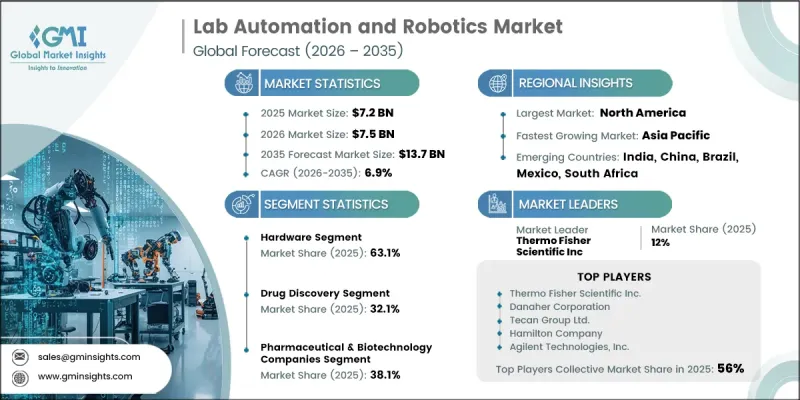
隨著醫療機構、研究機構和生命科學公司不斷利用先進的自動化技術實現實驗室運作現代化,實驗室自動化和機器人產業正經歷穩定成長。對更快實驗室工作流程、更高檢測效率和更精準操作的需求日益成長,推動了自動化實驗室系統的廣泛應用。醫療基礎設施投資的增加、研究的活性化以及藥物研發的持續拓展,進一步支持了市場成長。自動化技術使檢查室能夠最大限度地減少人工操作,提高生產力,增強工作流程的一致性,並降低操作複雜性。整合機器人、軟體、自動化硬體和數位資料管理的平台,透過改進檢體處理、工作流程協調、檢測效率和資訊管理,正在變革檢查室運作。全球診斷測試量的不斷成長,推動了擴充性解決方案的發展,這些解決方案能夠在保持性能穩定的同時處理更大的工作量,從而進一步加速了市場需求。對疾病早期檢測、精準醫療和預防醫學的日益重視,也推動了智慧實驗室自動化系統的應用,這些系統能夠縮短檢測時間,最大限度地利用資源,並提高醫療和生命科學領域的運作效率。
| 市場範圍 | |
|---|---|
| 開始年份 | 2025 |
| 預測期 | 2026-2035 |
| 起始金額 | 72億美元 |
| 預測金額 | 137億美元 |
| 複合年成長率 | 6.9% |
到2025年,硬體部分將佔據63.1%的市場佔有率,成為最大的收入來源。硬體仍將是實驗室自動化基礎設施的核心,因為所有自動化工作流程都依賴可靠的實體系統來準確、一致地執行實驗室操作。對高容量實驗室操作、更高生產力和更高精度操作的需求不斷成長,正推動醫療機構、研究機構和生命科學公司積極投資先進的自動化設備。實驗室設施的持續現代化和智慧自動化技術的廣泛應用預計將在整個預測期內保持對硬體的強勁需求。
到2025年,製藥和生物技術公司將佔據38.1%的市場佔有率,成為最大的終端用戶類別。對藥物研發、生物製藥開發、品質保證和實驗室創新的持續投入,不斷推動該領域自動化實驗室技術的廣泛應用。隨著研究專案日益複雜,研發進度也日趨緊張,各機構紛紛採用先進的自動化解決方案,以提高實驗室生產力、最佳化營運效率、加速科研工作流程並最大限度地利用資源。生命科學研究的持續擴張預計將在未來幾年進一步鞏固該領域的主導地位。
到2025年,北美實驗室自動化和機器人市場將佔據39%的市場。該地區持續保持主導地位,主要得益於在製藥創新、生物技術研究和先進醫療基礎設施方面的大量投資。對新一代實驗室技術的強勁需求正推動各機構擴大自動化工作流程的應用,進而提高研究效率、實驗室效率和營運績效。隨著加速科學發現、提高數據品質和支援複雜研究舉措變得日益重要,該地區實驗室持續採用機器人和自動化技術正推動市場長期成長。
目錄
第1章:調查方法
第2章執行摘要
第3章 行業洞察
- 產業生態系分析
- 影響產業的因素
- 成長促進因素
- 在藥物發現和藥物開發領域不斷擴大應用
- 最佳化臨床工作流程的需求日益成長
- 加大對醫療基礎建設的投資
- 臨床診斷測試數量增加
- 產業潛在風險與挑戰
- 機器人系統成本高
- 與現有實驗室基礎設施的複雜整合
- 市場機遇
- 精準醫療和基因組研究的擴展
- 成長促進因素
- 成長潛力分析
- 監理情勢
- 技術展望
- 最新科技趨勢
- 新興技術
- 未來市場趨勢
- 人工智慧和生成式人工智慧對市場的影響
- 專利分析
- 價格趨勢分析
- 波特的分析
- PESTLE分析
第4章 競爭情勢
- 介紹
- 企業市佔率分析
- 世界
- 北美洲
- 歐洲
- 亞太地區
- 企業矩陣分析
- 主要市場公司的競爭分析
- 競爭定位矩陣
- 主要進展
- 併購
- 夥伴關係和聯盟
- 新產品發布
- 業務拓展計劃
第5章 市場估計與預測:依組件分類,2022-2035年
- 硬體
- 自動液體處理系統
- 機械臂和協作機器人
- 自動移液管、微孔盤讀數儀和洗板機
- 自動化儲存和搜尋系統
- 軟體與資訊科學
- LIMS(實驗室資訊管理系統)
- 其他軟體和資訊技術
- 服務
第6章 市場估計與預測:依應用領域分類,2022-2035年
- 藥物發現
- 基因組學
- 蛋白質體學
- 臨床診斷
- 其他用途
第7章 市場估計與預測:依最終用途分類,2022-2035年
- 製藥和生物技術公司
- 診斷實驗室
- 研究和學術機構
- 受託研究機構(CRO)和合約開發與生產組織(CDMO)
- 其他最終用戶
第8章 市場估計與預測:依地區分類,2022-2035年
- 北美洲
- 美國
- 加拿大
- 歐洲
- 德國
- 英國
- 法國
- 西班牙
- 義大利
- 荷蘭
- 亞太地區
- 中國
- 日本
- 印度
- 澳洲
- 韓國
- 拉丁美洲
- 巴西
- 墨西哥
- 阿根廷
- 中東和非洲
- 南非
- 沙烏地阿拉伯
- UAE
第9章:公司簡介
- Agilent Technologies, Inc.
- Becton, Dickinson and Company(BD)
- Bio-Rad Laboratories, Inc.
- Danaher Corporation(Beckman Coulter Life Sciences)
- Eppendorf SE
- Hamilton Company
- HighRes Biosolutions
- Hudson Robotics, Inc.
- QIAGEN NV
- Revvity, Inc.
- Roche Diagnostics
- Siemens Healthineers AG
- SPT Labtech Ltd.
- Tecan Group Ltd.
- Thermo Fisher Scientific Inc.
The Global Lab Automation and Robotics Market was valued at USD 7.2 billion in 2025 and is estimated to grow at a CAGR of 6.9% to reach USD 13.7 billion by 2035.
The laboratory automation and robotics industry is experiencing steady expansion as healthcare organizations, research institutions, and life sciences companies continue to modernize laboratory operations through advanced automation technologies. Rising demand for faster laboratory workflows, improved testing efficiency, and enhanced operational accuracy is encouraging widespread implementation of automated laboratory systems. Growing investment in healthcare infrastructure, increasing research activities, and the continued expansion of pharmaceutical development are further supporting market growth. Automation technologies enable laboratories to improve productivity while minimizing manual intervention, enhancing workflow consistency, and reducing operational complexity. Integrated platforms that combine robotics, software, automation hardware, and digital data management are transforming laboratory operations by improving sample processing, workflow coordination, testing efficiency, and information management. The increasing volume of diagnostic testing worldwide continues to accelerate market demand as laboratories seek scalable solutions capable of processing larger workloads while maintaining consistent performance. Greater emphasis on early disease detection, precision medicine, and preventive healthcare is also contributing to the adoption of intelligent laboratory automation systems that improve turnaround times, maximize resource utilization, and support higher operational efficiency across healthcare and life sciences environments.
| Market Scope | |
|---|---|
| Start Year | 2025 |
| Forecast Year | 2026-2035 |
| Start Value | $7.2 Billion |
| Forecast Value | $13.7 Billion |
| CAGR | 6.9% |
The hardware segment accounted for a 63.1% share in 2025, making it the largest revenue-generating segment. Hardware remains the core component of laboratory automation infrastructure because every automated workflow depends on reliable physical systems to perform laboratory operations with precision and consistency. Increasing demand for high-volume laboratory processing, improved productivity, and greater operational accuracy is encouraging healthcare organizations, research laboratories, and life sciences companies to invest in advanced automation equipment. Continued modernization of laboratory facilities and growing implementation of intelligent automation technologies are expected to sustain strong demand for hardware throughout the forecast period.
The pharmaceutical and biotechnology companies segment held a 38.1% share in 2025, representing the largest end-user category. Ongoing investment in pharmaceutical research, biologics development, quality assurance, and laboratory innovation continues to support strong adoption of automated laboratory technologies within this segment. As research programs become increasingly complex and development timelines become more demanding, organizations are implementing advanced automation solutions to improve laboratory productivity, optimize operational efficiency, accelerate scientific workflows, and maximize resource utilization. The continued expansion of life sciences research is expected to reinforce the segment's leading position over the coming years.
North America Lab Automation and Robotics Market accounted for a 39% share in 2025. The region continues to maintain a leading position due to significant investment in pharmaceutical innovation, biotechnology research, and advanced healthcare infrastructure. Strong demand for next-generation laboratory technologies is encouraging organizations to expand the adoption of automated workflows that improve research productivity, laboratory efficiency, and operational performance. Increasing emphasis on accelerating scientific discovery, improving data quality, and supporting complex research initiatives is driving continued deployment of robotics and automation technologies throughout laboratories across the region, strengthening long-term market growth.
Major companies operating in the global lab automation and robotics market include Agilent Technologies, Inc., Becton, Dickinson and Company (BD), Bio-Rad Laboratories, Inc., Danaher Corporation (Beckman Coulter Life Sciences), Eppendorf SE, Hamilton Company, HighRes Biosolutions, Hudson Robotics, Inc., QIAGEN N.V., Revvity, Inc., Roche Diagnostics, Siemens Healthineers AG, SPT Labtech Ltd., Tecan Group Ltd., and Thermo Fisher Scientific Inc. Companies operating in the lab automation and robotics market are strengthening their competitive position by expanding investments in advanced robotics, intelligent automation platforms, artificial intelligence, and digital laboratory management technologies. Market participants are focusing on continuous research and development to enhance automation capabilities, improve software integration, and deliver more flexible laboratory solutions that support evolving customer requirements. Strategic collaborations with pharmaceutical companies, biotechnology firms, healthcare organizations, and research institutions are accelerating product adoption while expanding commercial opportunities. Companies also enhancing cloud connectivity, data analytics, workflow management, and system interoperability to improve laboratory efficiency and customer value.
Table of Contents
Chapter 1 Research Methodology
- 1.1 Research approach
- 1.2 Quality commitments
- 1.2.1 GMI AI policy and data integrity commitment
- 1.2.1.1 Source consistency protocol
- 1.2.1 GMI AI policy and data integrity commitment
- 1.3 Research trail and confidence scoring
- 1.3.1 Research trail components
- 1.3.2 Scoring components
- 1.4 Data collection
- 1.4.1 Partial list of primary sources
- 1.5 Data mining sources
- 1.5.1 Paid sources
- 1.5.1.1 Sources, by region
- 1.5.1 Paid sources
- 1.6 Base estimates and calculations
- 1.6.1 Base year calculation for any one approach
- 1.7 Forecast model
- 1.7.1 Quantified market impact analysis
- 1.7.1.1 Mathematical impact of growth parameters on forecast
- 1.7.1 Quantified market impact analysis
- 1.8 Research transparency addendum
- 1.8.1 Source attribution framework
- 1.8.2 Quality assurance metrics
- 1.8.3 Our commitment to trust
Chapter 2 Executive Summary
- 2.1 Industry 360° synopsis
- 2.2 Key market trends
- 2.2.1 Component trends
- 2.2.2 Application trends
- 2.2.3 End use trends
- 2.2.4 Regional trends
- 2.3 CXO perspectives: Strategic imperatives
Chapter 3 Industry Insights
- 3.1 Industry ecosystem analysis
- 3.2 Industry impact forces
- 3.2.1 Growth drivers
- 3.2.1.1 Increasing adoption in drug discovery and development
- 3.2.1.2 Increasing need for optimizing clinical workflow
- 3.2.1.3 Rising investment in healthcare infrastructure
- 3.2.1.4 Rising clinical diagnostic testing volumes
- 3.2.2 Industry pitfalls and challenges
- 3.2.2.1 High cost of robotic systems
- 3.2.2.2 Complex integration with existing laboratory infrastructure
- 3.2.3 Market opportunities
- 3.2.3.1 Expansion of precision medicine and genomics research
- 3.2.1 Growth drivers
- 3.3 Growth potential analysis
- 3.4 Regulatory landscape (Driven by primary research)
- 3.4.1 North America
- 3.4.2 Europe
- 3.4.3 Asia Pacific
- 3.4.4 Latin America
- 3.4.5 Middle East and Africa
- 3.5 Technology landscape (Driven by primary research)
- 3.5.1 Current technological trends
- 3.5.2 Emerging technologies
- 3.6 Future market trends (Driven by primary research)
- 3.7 Impact of AI and Generative AI on the market (Driven by primary research)
- 3.8 Patent analysis
- 3.9 Pricing trend analysis (Driven by primary research)
- 3.10 Porter’s analysis
- 3.11 PESTEL analysis
Chapter 4 Competitive Landscape, 2025
- 4.1 Introduction
- 4.2 Company market share analysis
- 4.2.1 Global
- 4.2.2 North America
- 4.2.3 Europe
- 4.2.4 Asia Pacific
- 4.3 Company matrix analysis
- 4.4 Competitive analysis of major market players
- 4.5 Competitive positioning matrix
- 4.6 Key developments
- 4.6.1 Mergers and acquisitions
- 4.6.2 Partnerships and collaborations
- 4.6.3 New product launches
- 4.6.4 Expansion plans
Chapter 5 Market Estimates and Forecast, By Component, 2022 – 2035 ($ Mn)
- 5.1 Key trends
- 5.2 Hardware
- 5.2.1 Automated liquid handling systems
- 5.2.2 Robotic arms and collaborative lab robots
- 5.2.3 Automated plate handlers, microplate readers, and washers
- 5.2.4 Automated storage and retrieval systems
- 5.3 Software and informatics
- 5.3.1 LIMS (Laboratory Information Management Systems)
- 5.3.2 Other software and informatics
- 5.4 Services
Chapter 6 Market Estimates and Forecast, By Application, 2022 – 2035 ($ Mn)
- 6.1 Key trends
- 6.2 Drug Discovery
- 6.3 Genomics
- 6.4 Proteomics
- 6.5 Clinical diagnostics
- 6.6 Other applications
Chapter 7 Market Estimates and Forecast, By End Use, 2022 – 2035 ($ Mn)
- 7.1 Key trends
- 7.2 Pharmaceutical & biotechnology companies
- 7.3 Diagnostic labs
- 7.4 Research & academic institutes
- 7.5 Contract research organizations & contract development manufacturing
- 7.6 Other end users
Chapter 8 Market Estimates and Forecast, By Region, 2022 – 2035 ($ Mn)
- 8.1 Key trends
- 8.2 North America
- 8.2.1 U.S.
- 8.2.2 Canada
- 8.3 Europe
- 8.3.1 Germany
- 8.3.2 UK
- 8.3.3 France
- 8.3.4 Spain
- 8.3.5 Italy
- 8.3.6 Netherlands
- 8.4 Asia Pacific
- 8.4.1 China
- 8.4.2 Japan
- 8.4.3 India
- 8.4.4 Australia
- 8.4.5 South Korea
- 8.5 Latin America
- 8.5.1 Brazil
- 8.5.2 Mexico
- 8.5.3 Argentina
- 8.6 Middle East and Africa
- 8.6.1 South Africa
- 8.6.2 Saudi Arabia
- 8.6.3 UAE
Chapter 9 Company Profiles
- 9.1 Agilent Technologies, Inc.
- 9.2 Becton, Dickinson and Company (BD)
- 9.3 Bio-Rad Laboratories, Inc.
- 9.4 Danaher Corporation (Beckman Coulter Life Sciences)
- 9.5 Eppendorf SE
- 9.6 Hamilton Company
- 9.7 HighRes Biosolutions
- 9.8 Hudson Robotics, Inc.
- 9.9 QIAGEN N.V.
- 9.10 Revvity, Inc.
- 9.11 Roche Diagnostics
- 9.12 Siemens Healthineers AG
- 9.13 SPT Labtech Ltd.
- 9.14 Tecan Group Ltd.
- 9.15 Thermo Fisher Scientific Inc.

 環境檢測用離散分析儀器市場:全球市場預測(2026-2032年)
 2026-2030年全球自動化分析儀市場
 自動化分析儀市場規模、佔有率和成長分析:按分析儀類型、應用、技術、檢體類型、平台、最終用戶和地區分類-2026-2033年產業預測血液採集管機械市場:依操作模式、技術、管型、最終用戶和應用分類-全球預測,2026-2032年
 2026年全球自動化分析儀市場報告
 自動化分析儀器市場-全球產業規模、佔有率、趨勢、機會、預測:依分析儀器、應用、地區和競爭對手分類,2021-2031年2034年全球自動分析儀市場機會與策略
 全球離散分析儀市場
 自動分析設備的全球市場規模:各產品,各用途,各地區,範圍及預測