


 |
市場調查報告書
商品編碼
2121192
2026 年至 2035 年電氣佈線互連系統的市場機會、成長要素、產業趨勢分析與預測。Electrical Wiring Interconnection System (EWIS) Market Opportunity, Growth Drivers, Industry Trend Analysis, and Forecast 2026 - 2035 |
||||||

全球電氣佈線互連系統市場預計到 2025 年將達到 84 億美元,預計到 2035 年將以 5.2% 的複合年成長率成長至 138 億美元。
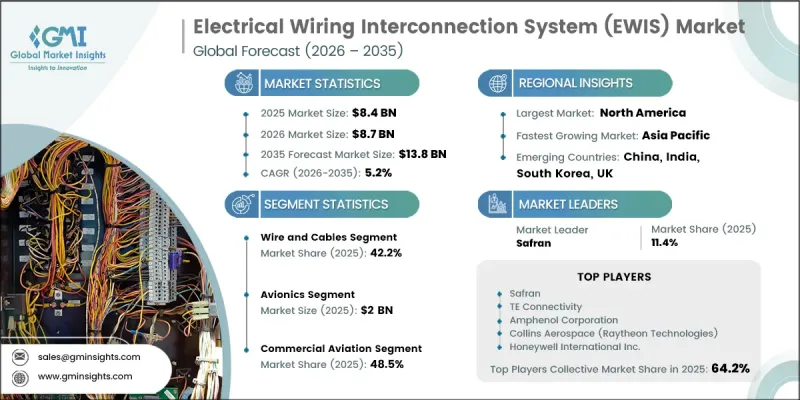
隨著飛機製造商和營運商越來越重視電氣系統的安全性、可靠性、輕量化和性能,該市場正蓬勃發展。日益嚴格的航空安全要求推動了改進型佈線架構的採用,而飛機產量的成長進一步提升了對電氣佈線互連系統 (EWIS) 組件和系統的需求。營運商對老舊飛機進行電氣基礎設施升級改造,也促進了飛機現代化和維修活動,從而推動了市場發展。此外,飛機系統電氣化程度的提高和航空電子設備的日益複雜化進一步提高了對佈線的要求。現代飛機依賴複雜的電氣架構,這些架構必須能夠應對不斷成長的功率負載和高速資料傳輸,同時保持運作可靠性。同時,製造商也在尋求輕巧耐用的佈線解決方案,以提高飛機效率和運行安全性。預計在整個預測期內,這些因素將持續推動航空業對先進 EWIS 解決方案的需求。
| 市場範圍 | |
|---|---|
| 開始年份 | 2025 |
| 預測期 | 2026-2035 |
| 初始市場規模 | 84億美元 |
| 預測金額 | 138億美元 |
| 複合年成長率 | 5.2% |
由於全球對飛機電氣線路安全和認證的要求日益嚴格,電氣線路互連系統 (EWIS) 市場正經歷強勁成長。監管機構不斷制定嚴格的標準,以確保飛機線路系統在其整個使用壽命期間滿足所需的可靠性和適航性要求。在美國,聯邦航空管理局 (FAA) 已在《聯邦法規》第 14 篇第 25 部分 H 子部分中製定了 EWIS 認證要求,作為適用於飛機的適航標準的一部分。同時,隨著電氣系統在航空業中日益整合,飛機架構也在發生變化,電力驅動系統的角色日益凸顯。飛機製造商正逐步以電力驅動功能取代某些液壓和氣壓功能,導致線路網路更加廣泛和複雜。隨著飛機電力驅動功能的增加,製造商需要能夠應對日益複雜的系統,同時保持可靠性、安全性和有效利用可用飛機空間的 EWIS 解決方案。
到2025年,電線電纜產業將佔據42.2%的市場佔有率。電線電纜產品是飛機電氣架構的關鍵組成部分,能夠為整架飛機提供電力和訊號傳輸。現代飛機應用需要輕巧、柔軟性、耐熱且能抵禦電磁干擾的線束產品。這些特性使得電線電纜系統能夠支援關鍵飛機功能和整個飛行中電子架構的電氣連接。隨著飛機系統電氣化程度的提高和數據需求的成長,對能夠應對各種運行條件的可靠線束的需求也在持續成長。因此,製造商正致力於開發既能提供可靠電氣性能,又能幫助飛機設計師控制重量、空間和安裝要求的電線電纜解決方案。
預計到2025年,航空電子設備市場規模將達20億美元。隨著對先進機載電子設備的依賴性不斷增強,飛機航空電子架構中使用的線束、連接器和其他互連組件的需求也顯著成長。現代飛機平台依賴日益複雜的電子系統來支援飛行運行、導航、通訊、監視和任務相關功能。隨著航空電子架構日益複雜,飛機製造商需要能夠提供可靠配電和高速資料傳輸的電子線束資訊系統(EWIS)解決方案。同時,航空業對提升運轉性能、情境察覺和飛行安全的重視,也推動了對先進航空電子設備的持續投資。
預計到2025年,北美電氣佈線和互連系統(EWIS)市佔率將達到37.8%。該地區受益於成熟的航太製造生態系統、主要飛機製造商和供應商的聚集,以及監管機構實施的嚴格航空安全要求。民用和國防航空領域的大量投資也支撐了對現代電氣架構和先進飛機技術的需求。飛機產量的成長和機身升級計畫的擴展進一步刺激了對配電和互連解決方案的需求。航太製造商和政府機構也在投資依賴日益複雜的電氣系統的新興航空技術。電動飛機架構、自主航空平台、數位航空技術以及以永續性發展為導向的航太舉措的發展,預計將進一步提升對先進EWIS解決方案的需求。
目錄
第1章:調查方法和範圍
第2章執行摘要
第3章 行業洞察
- 產業生態系分析
- 供應商情況
- 利潤率
- 成本結構
- 每個階段增加的價值
- 影響價值鏈的因素
- 中斷
- 影響產業的因素
- 促進因素
- 嚴格的航空安全法規和強制性的EWIS認證
- 「MOA電動飛機(MEA)」的廣泛應用以及飛機的電氣化
- 老舊飛機的現代化和維修計劃
- 先進航空電子設備和數位飛機系統的整合正在逐步推進。
- 全球民用和軍用飛機產量增加
- 產業潛在風險與挑戰
- 航太輕型EWIS組件成本高昂
- 複雜的安裝、維護和檢查要求
- 市場機遇
- 「MOA電動飛機(MEA)」和混合動力電動飛機的擴張
- 輕量化、高速、智慧化的EWIS技術開發
- 促進因素
- 成長潛力分析
- 監理情勢
- 波特的分析
- PESTLE分析
- 技術與創新展望
- 最新科技趨勢
- 新興技術
- 價格趨勢
- 按地區
- 依產品
- 定價策略
- 新興經營模式
- 合規要求
- 專利和智慧財產權分析
第4章 競爭情勢
- 介紹
- 企業市佔率分析
- 按地區
- 市場集中度分析
- 主要公司的競爭標竿分析
- 財務績效比較
- 收入
- 利潤率
- R&D
- 產品系列比較
- 產品線寬度
- 科技
- 創新
- 區域擴張比較
- 全球擴張分析
- 服務網路覆蓋
- 按地區分類的市場滲透率
- 競爭定位矩陣
- 領導者
- 挑戰者
- 追蹤者
- 小眾玩家
- 戰略展望矩陣
- 財務績效比較
- 主要進展
- 併購
- 夥伴關係和聯盟
- 技術進步
- 擴張和投資策略
- 數位轉型計劃
- 新興企業競爭公司和新創企業的發展趨勢
第5章 市場估計與預測:依組件分類,2022-2035年
- 電線電纜
- 連接器
- 電氣接地和連接設備
- 電氣連接
- 夾鉗
- 壓力密封
- 其他
第6章 市場估價與預測:依電線保護材料分類,2022-2035年
- 傳統屏蔽材料
- 銅編織
- 鎳銅(NiCu)編織帶
- 輕質屏蔽材料
- 複合屏蔽材料
- 利用奈米碳管(CNTs)進行屏蔽
- 金屬化聚合物屏蔽材料
- 混合屏蔽解決方案
- 導管、袖子、外套
- 其他
第7章 市場估計與預測:依應用領域分類,2022-2035年
- 航空電子設備
- 飛行控制系統
- 電力分配和傳輸
- 數據和通訊系統
- 座艙和內部系統
- 推進系統
- 飛機
- 其他
第8章 市場估算與預測:依最終使用者分類,2022-2035年
- 商業航空
- 窄體飛機
- 寬體飛機
- 超大型飛機
- 支線飛機
- 軍用機
- 公務航空及通用航空
- 無人駕駛飛行器(UAV)
- 太空船
第9章 市場估價與預測:依最終用戶分類,2022-2035年
- OEM
- 售後市場
第10章 市場估價與預測:依地區分類,2022-2035年
- 北美洲
- 美國
- 加拿大
- 歐洲
- 德國
- 英國
- 法國
- 西班牙
- 義大利
- 荷蘭
- 亞太地區
- 中國
- 印度
- 日本
- 澳洲
- 韓國
- 拉丁美洲
- 巴西
- 墨西哥
- 阿根廷
- 中東和非洲
- 南非
- 沙烏地阿拉伯
- UAE
第11章:公司簡介
- 全球主要公司
- Safran
- TE Connectivity
- Amphenol Corporation
- Collins Aerospace(Raytheon Technologies)
- Honeywell International Inc.
- 該地區的主要公司
- 北美洲
- Boeing
- Ducommun Incorporated
- Molex(Koch Industries)
- WL Gore & Associates
- 歐洲
- Leonardo
- 北美洲
- 小眾玩家/顛覆者
- kSARIA Corporation(including CIA &D)
- InterConnect Wiring
- Pic Wire & Cable(Angelus Corporation)
- EIS Electronics GmbH
- Elektro Metall Export GmbH(EME)
The Global Electrical Wiring Interconnection System Market was valued at USD 8.4 billion in 2025 and is estimated to grow at a CAGR of 5.2% to reach USD 13.8 billion by 2035.
The market is gaining momentum as aircraft manufacturers and operators place greater emphasis on electrical system safety, reliability, weight reduction, and performance. More rigorous aviation safety requirements are encouraging the adoption of improved wiring architectures, while rising aircraft production is creating additional demand for EWIS components and systems. Fleet renewal and aircraft retrofit activities are also supporting market development as operators upgrade electrical infrastructure on aging platforms. The continued shift toward more electrically powered aircraft systems and increasingly sophisticated avionics is further expanding wiring requirements. Modern aircraft rely on complex electrical architectures that must support growing power loads and high-speed data transmission while maintaining operational reliability. At the same time, manufacturers are seeking lightweight and durable wiring solutions that can contribute to improved aircraft efficiency and safe operation. These combined factors are expected to sustain demand for advanced EWIS solutions across the aviation industry throughout the forecast period.
| Market Scope | |
|---|---|
| Start Year | 2025 |
| Forecast Year | 2026-2035 |
| Start Value | $8.4 Billion |
| Forecast Value | $13.8 Billion |
| CAGR | 5.2% |
The electrical wiring interconnection system market is receiving strong support from increasingly demanding global requirements governing aircraft electrical wiring safety and certification. Regulatory authorities continue to establish rigorous standards to ensure that aircraft wiring systems meet required levels of reliability and airworthiness throughout their operating life. In the United States, the Federal Aviation Administration established EWIS certification requirements under 14 CFR Part 25, Subpart H, within the airworthiness standards applicable to airplanes. Meanwhile, the aviation industry's transition toward greater electrical system integration is changing aircraft architecture and increasing the role of electrically operated systems. Aircraft manufacturers are progressively replacing certain hydraulic and pneumatic functions with electrical alternatives, resulting in more extensive and complex wiring networks. As aircraft incorporate additional electrically powered functions, manufacturers require EWIS solutions capable of managing higher system complexity while maintaining reliability, safety, and efficient use of available aircraft space.
The wire and cable segment held a 42.2% share in 2025. Wire and cable products form a fundamental part of aircraft electrical architectures because they enable power delivery and signal transmission throughout the aircraft. Modern aviation applications require wiring products that combine low weight with flexibility, thermal resistance, and protection against electromagnetic interference. These characteristics allow wire and cable systems to support electrical connections throughout critical aircraft functions and onboard electronic architectures. As aircraft systems become more electrically intensive and data requirements increase, demand for dependable wiring capable of handling diverse operating conditions continues to rise. Manufacturers are therefore focusing on wire and cable solutions that provide reliable electrical performance while helping aircraft designers manage weight, space, and installation requirements.
The avionics segment generated USD 2 billion in 2025. Increasing reliance on advanced onboard electronics is creating substantial requirements for wiring harnesses, connectors, and other interconnection components used throughout aircraft avionics architectures. Modern aviation platforms depend on increasingly sophisticated electronic systems to support flight operations, navigation, communications, monitoring, and mission-related functions. As avionics architectures become more complex, aircraft manufacturers require EWIS solutions capable of delivering dependable power distribution and high-speed data transmission. At the same time, the aviation industry's focus on improving operational performance, situational awareness, and flight safety is encouraging continued investment in advanced avionics.
North America Electrical Wiring Interconnection System Market accounted for 37.8% share in 2025. The region benefits from a well-established aerospace manufacturing ecosystem, the presence of major aircraft producers and suppliers, and stringent aviation safety requirements enforced by regulatory authorities. Significant investment across commercial and defense aviation is also supporting demand for modern electrical architecture and advanced aircraft technologies. Increasing aircraft production and fleet modernization programs are creating additional requirements for electrical power distribution equipment and interconnection solutions. Aerospace manufacturers and government organizations are also directing investment toward emerging aviation technologies that depend on increasingly sophisticated electrical systems. The development of electrically powered aircraft architectures, autonomous aviation platforms, digital aviation technologies, and sustainability-focused aerospace initiatives is expected to further increase the need for advanced EWIS solutions.
Prominent companies operating in the global electrical wiring interconnection system market include Leonardo, Amphenol Corporation, Honeywell International Inc., TE Connectivity, Boeing, Safran (Safran Electrical & Power), Molex (Koch Industries), Collins Aerospace (RTX), W. L. Gore & Associates, Ducommun Incorporated, Elektro Metall Export GmbH (EME), Pic Wire & Cable (Angelus Corporation), InterConnect Wiring, kSARIA Corporation (including CIA&D), and E.I.S. Electronics GmbH. Companies in the electrical wiring interconnection system market are strengthening their market positions through technology development, portfolio expansion, strategic partnerships, production investments, and long-term relationships with aircraft manufacturers and aerospace suppliers. Manufacturers are developing lighter, more durable, and higher-performance wiring products to address increasingly demanding aircraft electrical architectures. Businesses are also expanding capabilities in advanced connectors, wiring harnesses, cable assemblies, and integrated interconnection solutions to serve a broader range of aerospace requirements. Investment in research and development allows companies to improve thermal performance, electromagnetic protection, reliability, and installation efficiency. Strategic agreements with aerospace OEMs and defense organizations help suppliers secure long-term programs and strengthen customer relationships.
Table of Contents
Chapter 1 Methodology and Scope
- 1.1 Market scope and definition
- 1.2 Research design
- 1.2.1 Research approach
- 1.2.2 Data collection methods
- 1.3 Data mining sources
- 1.3.1 Global
- 1.3.2 Regional/Country
- 1.4 Base estimates and calculations
- 1.4.1 Base year calculation
- 1.4.2 Key trends for market estimation
- 1.5 Primary research and validation
- 1.5.1 Primary sources
- 1.6 Forecast model
- 1.7 Research assumptions and limitations
Chapter 2 Executive Summary
- 2.1 Industry 360° synopsis, 2022 – 2035
- 2.2 Key market trends
- 2.2.1 Component trends
- 2.2.2 Wire protection material trends
- 2.2.3 Application trends
- 2.2.4 Aircraft type trends
- 2.2.5 End-user trends
- 2.2.6 Regional trends
- 2.3 TAM Analysis, 2026-2035
- 2.4 CXO perspectives: Strategic imperatives
Chapter 3 Industry Insights
- 3.1 Industry ecosystem analysis
- 3.1.1 Supplier Landscape
- 3.1.2 Profit Margin
- 3.1.3 Cost structure
- 3.1.4 Value addition at each stage
- 3.1.5 Factor affecting the value chain
- 3.1.6 Disruptions
- 3.2 Industry impact forces
- 3.2.1 Growth drivers
- 3.2.1.1 Stringent aircraft safety regulations and mandatory EWIS certification
- 3.2.1.2 Growing adoption of More Electric Aircraft (MEA) and aircraft electrification
- 3.2.1.3 Fleet modernization and aging aircraft retrofit programs
- 3.2.1.4 Increasing integration of advanced avionics and digital aircraft systems
- 3.2.1.5 Rising commercial and defense aircraft production worldwide
- 3.2.2 Industry pitfalls and challenges
- 3.2.2.1 High cost of lightweight, aerospace-grade EWIS components
- 3.2.2.2 Complex installation, maintenance, and inspection requirements
- 3.2.3 Market opportunities
- 3.2.3.1 Growing adoption of More Electric Aircraft (MEA) and hybrid-electric aviation
- 3.2.3.2 Development of lightweight, high-speed, and smart EWIS technologies
- 3.2.1 Growth drivers
- 3.3 Growth potential analysis
- 3.4 Regulatory landscape
- 3.4.1 North America
- 3.4.2 Europe
- 3.4.3 Asia Pacific
- 3.4.4 Latin America
- 3.4.5 Middle East & Africa
- 3.5 Porter’s analysis
- 3.6 PESTEL analysis
- 3.7 Technology and Innovation landscape
- 3.7.1 Current technological trends
- 3.7.2 Emerging technologies
- 3.8 Price trends
- 3.8.1 By region
- 3.8.2 By product
- 3.9 Pricing Strategies
- 3.10 Emerging Business Models
- 3.11 Compliance Requirements
- 3.12 Patent and IP analysis
Chapter 4 Competitive Landscape, 2025
- 4.1 Introduction
- 4.2 Company market share analysis
- 4.2.1 By region
- 4.2.1.1 North America
- 4.2.1.2 Europe
- 4.2.1.3 Asia Pacific
- 4.2.1.4 Latin America
- 4.2.1.5 Middle East & Africa
- 4.2.2 Market concentration analysis
- 4.2.1 By region
- 4.3 Competitive benchmarking of key players
- 4.3.1 Financial performance comparison
- 4.3.1.1 Revenue
- 4.3.1.2 Profit margin
- 4.3.1.3 R&D
- 4.3.2 Product portfolio comparison
- 4.3.2.1 Product range breadth
- 4.3.2.2 Technology
- 4.3.2.3 Innovation
- 4.3.3 Geographic presence comparison
- 4.3.3.1 Global footprint analysis
- 4.3.3.2 Service network coverage
- 4.3.3.3 Market penetration by region
- 4.3.4 Competitive positioning matrix
- 4.3.4.1 Leaders
- 4.3.4.2 Challengers
- 4.3.4.3 Followers
- 4.3.4.4 Niche players
- 4.3.5 Strategic outlook matrix
- 4.3.1 Financial performance comparison
- 4.4 Key developments
- 4.4.1 Mergers and acquisitions
- 4.4.2 Partnerships and collaborations
- 4.4.3 Technological advancements
- 4.4.4 Expansion and investment strategies
- 4.4.5 Digital transformation initiatives
- 4.5 Emerging/ startup competitors landscape
Chapter 5 Market Estimates and Forecast, By Component, 2022 – 2035 (USD Million)
- 5.1 Key trends
- 5.2 Wire and cables
- 5.3 Connectors
- 5.4 Electrical grounding and bonding devices
- 5.5 Electrical splices
- 5.6 Clamps
- 5.7 Pressure seals
- 5.8 Others
Chapter 6 Market Estimates and Forecast, By Wire Protection Material, 2022 – 2035 (USD Million)
- 6.1 Key trends
- 6.2 Traditional shielding materials
- 6.2.1 Copper braid
- 6.2.2 Nickel-copper (NiCu) braid
- 6.3 Lightweight shielding materials
- 6.3.1 Composite shielding materials
- 6.3.2 Carbon nanotube (CNT) shielding
- 6.3.3 Metalized polymer shielding
- 6.3.4 Hybrid shielding solutions
- 6.4 Conduit, sleeving & jacketing
- 6.5 Others
Chapter 7 Market Estimates and Forecast, By Application, 2022 – 2035 (USD Million)
- 7.1 Key trends
- 7.2 Avionics
- 7.3 Flight control systems
- 7.4 Power distribution & transfer
- 7.5 Data & communication systems
- 7.6 Cabin & interior systems
- 7.7 Propulsion systems
- 7.8 Airframe
- 7.9 Others
Chapter 8 Market Estimates and Forecast, By End-User, 2022 – 2035 (USD Million)
- 8.1 Key trends
- 8.2 Commercial aviation
- 8.2.1 Narrowbody aircraft
- 8.2.2 Widebody aircraft
- 8.2.3 Very large aircraft
- 8.2.4 Regional aircraft
- 8.3 Military aircraft
- 8.4 Business & general aviation
- 8.5 Unmanned aerial vehicles (UAV)
- 8.6 Spacecraft
Chapter 9 Market Estimates and Forecast, By End-User, 2022 – 2035 (USD Million)
- 9.1 Key trends
- 9.2 OEM
- 9.3 Aftermarket
Chapter 10 Market Estimates and Forecast, By Region, 2022 – 2035 (USD Million)
- 10.1 Key trends
- 10.2 North America
- 10.2.1 U.S.
- 10.2.2 Canada
- 10.3 Europe
- 10.3.1 Germany
- 10.3.2 UK
- 10.3.3 France
- 10.3.4 Spain
- 10.3.5 Italy
- 10.3.6 Netherlands
- 10.4 Asia Pacific
- 10.4.1 China
- 10.4.2 India
- 10.4.3 Japan
- 10.4.4 Australia
- 10.4.5 South Korea
- 10.5 Latin America
- 10.5.1 Brazil
- 10.5.2 Mexico
- 10.5.3 Argentina
- 10.6 Middle East and Africa
- 10.6.1 South Africa
- 10.6.2 Saudi Arabia
- 10.6.3 UAE
Chapter 11 Company Profiles
- 11.1 Global Key Players
- 11.1.1 Safran
- 11.1.2 TE Connectivity
- 11.1.3 Amphenol Corporation
- 11.1.4 Collins Aerospace (Raytheon Technologies)
- 11.1.5 Honeywell International Inc.
- 11.2 Regional key players
- 11.2.1 North America
- 11.2.1.1 Boeing
- 11.2.1.2 Ducommun Incorporated
- 11.2.1.3 Molex (Koch Industries)
- 11.2.1.4 W. L. Gore & Associates
- 11.2.2 Europe
- 11.2.2.1 Leonardo
- 11.2.1 North America
- 11.3 Niche Players/Disruptors
- 11.3.1 kSARIA Corporation (including CIA&D)
- 11.3.2 InterConnect Wiring
- 11.3.3 Pic Wire & Cable (Angelus Corporation)
- 11.3.4 E.I.S. Electronics GmbH
- 11.3.5 Elektro Metall Export GmbH (EME)

 電氣佈線互連系統 (EWIS) 市場:按組件、應用、飛機類型、安裝配置、最終用戶、國家和地區分類-全球產業分析、市場規模、市場佔有率及 2026 年至 2033 年預測飛機電子線束資訊系統市場報告:趨勢、預測與競爭分析(至2035年)
 電氣佈線互連系統市場:2026-2032年全球市場預測(按產品類型、電線類型、絕緣材料、導體材料、額定電壓、應用和最終用途行業分類)電氣線路互連系統市場報告:趨勢、預測與競爭分析(至2035年)
 全球電氣佈線互連系統市場-產業規模、佔有率、趨勢、機會和預測,按應用、航空類型、最終用戶、地區和競爭格局分類,2020-2030年預測
 軍用線束及電纜組件的全球市場 (~2035年):產品類型·屏蔽類型·平台·用途·各地區EWIS連接器市場報告:趨勢、預測與競爭分析(至2031年)全球軍用電氣佈線互連繫統 (EWIS) 市場:按組件、應用、最終用戶和地區進行預測(~2032 年)