

 |
市場調查報告書
商品編碼
2121189
體育裁判技術市場機會、成長促進因素、產業趨勢分析及2026-2035年預測。Sports officiating technologies Market Opportunity, Growth Drivers, Industry Trend Analysis, and Forecast 2026 - 2035 |
||||||

全球體育裁判技術市場預計到 2025 年將達到 38 億美元,年複合成長率為 21.3%,到 2035 年將達到 234 億美元。
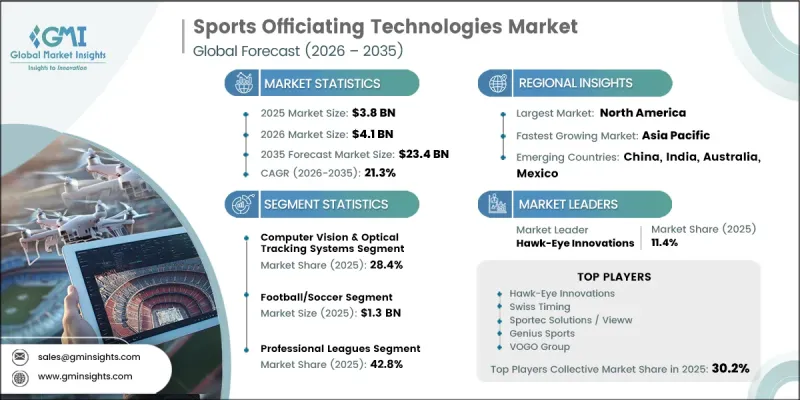
體育組織正迅速採用數位技術來提高裁判判罰的速度、一致性和可靠性。人工智慧、電腦視覺、影像分析、光學追蹤和基於感測器的系統正在改變裁判在比賽中回看和評估判罰的方式。隨著互聯體育設施的發展,組織者對能夠支援即時決策和資料管理的整合基礎設施的需求日益成長,這為技術提供者創造了更多商機。體育統籌機構也更加重視公平性、透明度和規則執行的一致性,這推動了對先進裁判系統投資的增加。競爭對手越來越認知到技術在支持裁判應對快節奏比賽和減少可避免錯誤方面的價值。比賽規則的改變也為數位裁判平台創造了機遇,因為統籌機構正在建立框架以適應技術驅動的決策。隨著對體育技術投資的增加和比賽日益專業化,預計在整個預測期內,對先進裁判解決方案的需求將保持強勁。
| 市場範圍 | |
|---|---|
| 開始年份 | 2025 |
| 預測期 | 2026-2035 |
| 起始金額 | 38億美元 |
| 預測金額 | 234億美元 |
| 複合年成長率 | 21.3% |
隨著體育組織在職業比賽中擴大採用數位化決策支援系統,體育裁判技術市場正蓬勃發展。先進的影像分析、人工智慧和自動化數據處理技術使裁判能夠更一致地檢驗比賽錄影,並在比賽進行過程中做出更準確的判罰。體育統籌機構也不斷加強裁判標準,以提高比賽的公平性,減少主觀判斷,並促進比賽規則的一致執行。對技術先進的體育場館的投資也催生了新的需求,因為組織者正在開發支援即時回看和決策的基礎設施。體育賽事的國際擴張進一步增加了在各種場館和比賽中對可靠的數位化裁判能力的需求。體育聯合會透過更新其比賽框架和實施支援系統來提高判罰的準確性,從而持續推動技術的應用。
預計到2025年,電腦視覺和光學追蹤系統市場佔有率將達到28.4%。職業體育組織越來越依賴基於電腦的視覺分析和光學追蹤技術來捕捉運動軌跡,並快速準確地識別相關物體。這些系統提供連續數據,幫助裁判更準確地評估比賽,同時減少對人工觀察的依賴。該技術支援對球員動作、物體軌跡、位置資訊和其他比賽相關資訊的自動分析。憑藉產生詳細即時資訊的能力,電腦視覺和光學追蹤已成為現代數位化裁判基礎設施的關鍵組成部分。隨著影像處理、追蹤精度、人工智慧和即時分析技術的不斷進步,這些系統的功能也不斷擴展。隨著體育組織對更快、更一致的決策提出更高的要求,對先進視覺追蹤技術的需求預計將保持強勁。
到2025年,美式足球和足球的市場規模將達到13億美元。職業賽事中數位化裁判解決方案的日益普及將繼續鞏固該行業的主導地位。美式足球組織正擴大採用技術驅動的系統,以提高判罰的準確性,確保比賽的公平性,並增強比賽的透明度。數位視訊回放、自動追蹤、通訊系統和其他技術驅動的工具正日益成為現代美式足球裁判基礎設施的重要組成部分。職業聯賽和統籌機構持續投資於技術,以支持裁判工作並提高比賽判罰的一致性。美式足球職業網路的龐大規模,加上對數位裁判基礎設施的持續投入,使得對先進技術的需求依然強勁。
到2025年,北美體育裁判技術市佔率將達到37.1%。該地區持續受益於成熟的體育組織、先進的數位基礎設施以及對創新的大量投資,這些因素正在推動職業體育領域整體技術的廣泛應用。該地區的職業賽事正擴大採用人工智慧、視訊回放、光學追蹤和其他先進技術,以提高裁判的準確性和營運效率。對聯網體育場館和數位廣播基礎設施的投資也推動了高效能裁判解決方案的普及。體育組織、統籌機構和相關人員正在加速向數位競技環境轉型,這為技術供應商創造了商機。
目錄
第1章:調查方法和範圍
第2章執行摘要
第3章 行業洞察
- 產業生態系分析
- 供應商情況
- 利潤率
- 成本結構
- 每個階段增加的價值
- 影響價值鏈的因素
- 中斷
- 影響產業的因素
- 成長促進因素
- 職業運動中影像輔助裁判系統的整體推廣
- 人工智慧、電腦視覺和感測器技術的融合發展。
- 增加對智慧體育場和國際體育賽事的投資
- 越來越重視裁判工作的透明度、公平性和準確性
- 體育規則的不斷現代化以支持數位化裁判
- 產業潛在風險與挑戰
- 高昂的實施成本和基礎設施成本
- 技術整合、延遲和操作複雜性
- 市場機遇
- 人工智慧驅動的自動裁判和即時分析的擴展
- 在新興運動、草根運動和智慧體育場中擴大應用。
- 成長促進因素
- 成長潛力分析
- 監理情勢
- 波特的分析
- PESTLE分析
- 技術與創新展望
- 最新科技趨勢
- 新興技術
- 價格趨勢
- 按地區
- 依產品
- 定價策略
- 新興經營模式
- 合規要求
- 專利和智慧財產權分析
第4章 競爭情勢
- 介紹
- 企業市佔率分析
- 按地區
- 市場集中度分析
- 主要公司的競爭標竿分析
- 財務績效比較
- 收入
- 利潤率
- R&D
- 產品系列比較
- 產品線寬度
- 科技
- 創新
- 區域擴張比較
- 全球擴張分析
- 服務網路覆蓋
- 按地區分類的市場滲透率
- 競爭定位矩陣
- 領導者
- 挑戰者
- 追蹤者
- 小眾玩家
- 戰略展望矩陣
- 財務績效比較
- 主要進展
- 併購
- 夥伴關係和聯盟
- 技術進步
- 擴張和投資策略
- 數位轉型計劃
- 新興企業競爭公司和新創企業的發展趨勢
第5章 市場估計與預測:依技術分類,2022-2035年
- 電腦視覺和光學追蹤系統
- 追蹤球體和物體的運動軌跡
- 半自動越位檢測技術(SAOT)
- 電子線檢測系統
- 光學目標線和邊界線偵測
- 其他
- 影像審查和播放基礎設施
- 視訊助理裁判(VAR)系統
- 決策審查系統(DRS)
- 電視裁判(TMO)和挑戰審查系統
- 高速播放和評論伺服器
- 其他
- 基於感測器和嵌入式感測系統
- 磁性/RFID球門線技術
- 球內插入式及包裝內插入式系統
- 基於感測器的裁判偵測系統
- 接觸和邊界偵測系統
- 其他
- 人工智慧原生自動化裁判平台
- 基於人工智慧的旗幟設定和自動犯規檢測。
- 無標記人工智慧裁判系統
- 決策審計和一致性保證平台
- 裁判表現分析平台
- 自動評分平台
- 其他
- 與裁判溝通和官方支援技術
- 與裁判的溝通系統
- 官方穿戴裝置和位置追蹤技術
- 智慧哨子和自動訊號系統
- 其他
- 時間、測量與競爭性評估系統
- 攝影終點技術
- 愚人啟動偵測系統
- 比賽計時器和擊球計時器系統
- 田徑運動計時系統
- 其他
- 其他
第6章 市場估價與預測:依運動項目分類,2022-2035年
- 足球
- 蟋蟀
- 網球和球拍運動
- 橄欖球
- 籃球
- 美國美式足球
- 棒球
- 田徑
- 游泳和游泳比賽
- 冰上曲棍球
- 其他運動
第7章 市場估價與預測:依最終使用者/買家類型分類,2022-2035年
- 國際聯盟
- 職業聯賽
- 多項運動賽事主辦單位
- 各國統籌機構
- 業餘和基層組織
第8章 市場估計與預測:依地區分類,2022-2035年
- 北美洲
- 美國
- 加拿大
- 歐洲
- 德國
- 英國
- 法國
- 西班牙
- 義大利
- 亞太地區
- 中國
- 印度
- 日本
- ANZ
- 韓國
- 拉丁美洲
- 巴西
- 墨西哥
- 中東和非洲
- 南非
- 沙烏地阿拉伯
- UAE
第9章:公司簡介
- 全球主要公司
- Hawk-Eye Innovations
- Swiss Timing
- Sportec Solutions/Vieww
- Genius Sports
- VOGO Group
- 該地區的主要公司
- 北美洲
- FinishLynx(Lynx System Developers)
- DVSport
- V6 Sports
- Evertz Technologies
- 歐洲
- EVS Broadcast Equipment
- SLOMO.TV
- Dartfish
- Goal Sport Technology
- Vieww GmbH
- 北美洲
- 小眾玩家/顛覆者
- KINEXON Sports
The Global Sports Officiating Technologies Market was valued at USD 3.8 billion in 2025 and is estimated to grow at a CAGR of 21.3% to reach USD 23.4 billion by 2035.
Sports organizations are rapidly adopting digital technologies to improve the speed, consistency, and reliability of officiating decisions. Artificial intelligence, computer vision, video analysis, optical tracking, and sensor-enabled systems are transforming how officials review events and evaluate actions during competitions. The growing development of connected sports venues is creating additional opportunities for technology providers as organizers seek integrated infrastructure that can support real-time decision-making and data management. Sports governing organizations are also placing greater emphasis on fairness, transparency, and consistent rule enforcement, which is encouraging wider investment in advanced officiating systems. Competition organizers increasingly recognize the value of technology in reducing avoidable judgment errors while supporting officials during fast-moving situations. Changes in competition regulations are also creating opportunities for digital officiating platforms as governing bodies establish frameworks that accommodate technology-assisted decision-making. Rising investments in sports technology and the increasing professionalization of competitions are expected to maintain strong demand for advanced officiating solutions throughout the forecast period.
| Market Scope | |
|---|---|
| Start Year | 2025 |
| Forecast Year | 2026-2035 |
| Start Value | $3.8 Billion |
| Forecast Value | $23.4 Billion |
| CAGR | 21.3% |
The sports officiating technologies market is gaining momentum as sports organizations increasingly integrate digital decision-support systems into professional competitions. Advanced video analysis, artificial intelligence, and automated data processing allow officials to review events with greater consistency and make informed decisions during live competitions. Sports governing bodies are also strengthening officiating standards to promote greater fairness, reduce subjective judgment, and encourage consistent enforcement of competition rules. Investment in technologically advanced sports venues is creating another source of demand as organizers develop infrastructure capable of supporting real-time review and decision-making. The international expansion of sporting events is further increasing the need for reliable digital officiating capabilities across different venues and competitions. Governing federations continue to influence technology adoption by updating competition frameworks and supporting systems that improve decision accuracy.
The computer vision and optical tracking systems segment accounted for a 28.4% share in 2025. Professional sports organizations increasingly depend on computer-based visual analysis and optical tracking to capture movements and identify relevant objects with speed and precision. These systems provide continuous data that can help officials evaluate events more accurately while reducing reliance on manual observation alone. The technology supports automated analysis of player movement, object trajectories, positioning, and other competition-related information. Its ability to generate detailed real-time information has made computer vision and optical tracking important components of modern digital officiating infrastructure. Continued improvements in image processing, tracking accuracy, artificial intelligence, and real-time analytics are expanding the functionality of these systems. As sports organizations seek faster and more consistent decision-making, demand for advanced visual tracking technologies is expected to remain strong.
The football and soccer segment generated USD 1.3 billion in 2025. The widespread adoption of digital officiating solutions across professional competitions continues to support the segment's leading position. Football organizations increasingly use technology-assisted systems to improve decision accuracy, strengthen match integrity, and increase transparency during competitions. Digital video review, automated tracking, communication systems, and other technology-enabled tools are becoming increasingly important components of modern football officiating infrastructure. Professional leagues and governing organizations continue to invest in technology to support officials and improve the consistency of match decisions. The scale of football's professional competition network, combined with continued investment in digital officiating infrastructure, is sustaining strong demand for advanced technologies.
North America Sports Officiating Technologies Market accounted for a 37.1% share in 2025. The region continues to benefit from strong technology adoption across professional sports, supported by established sports organizations, advanced digital infrastructure, and significant investment in innovation. Professional competitions across the region are increasingly incorporating artificial intelligence, video review, optical tracking, and other advanced technologies to improve officiating accuracy and operational efficiency. Investments in connected sports venues and digital broadcasting infrastructure are also supporting the deployment of high-performance officiating solutions. Sports organizations, governing bodies, and commercial stakeholders are accelerating their transition toward digitally enabled competition environments, creating opportunities for technology suppliers.
Prominent companies operating in the global sports officiating technologies market include KINEXON Sports, Dartfish, Hawk-Eye Innovations, Evertz Technologies, Genius Sports, Swiss Timing, DVSport, VOGO Group, EVS Broadcast Equipment, Vieww GmbH, Goal Sport Technology, Sportec Solutions, FinishLynx (Lynx System Developers), SLOMO.TV, and V6 Sports. Companies in the sports officiating technologies market are strengthening their market positions through product innovation, strategic partnerships, technology integration, and expansion into new sports and geographic markets. Providers are investing in artificial intelligence, computer vision, automated tracking, video analysis, and real-time data processing to improve the accuracy and speed of officiating solutions. Companies are also developing integrated platforms that combine multiple capabilities, allowing sports organizations to streamline operations and reduce dependence on disconnected technologies. Strategic partnerships with leagues, governing organizations, broadcasters, venue operators, and technology providers help businesses expand their customer base and strengthen market access. Geographic expansion enables suppliers to address growing demand across emerging sports markets, while customization helps them meet the specific requirements of different competitions.
Table of Contents
Chapter 1 Methodology and Scope
- 1.1 Market scope and definition
- 1.2 Research design
- 1.2.1 Research approach
- 1.2.2 Data collection methods
- 1.3 Data mining sources
- 1.3.1 Global
- 1.3.2 Regional/Country
- 1.4 Base estimates and calculations
- 1.4.1 Base year calculation
- 1.4.2 Key trends for market estimation
- 1.5 Primary research and validation
- 1.5.1 Primary sources
- 1.6 Forecast model
- 1.7 Research assumptions and limitations
Chapter 2 Executive Summary
- 2.1 Industry 360° synopsis, 2022 – 2035
- 2.2 Key market trends
- 2.2.1 Technology trends
- 2.2.2 Sport trends
- 2.2.3 End user / buyer type trends
- 2.2.4 Regional trends
- 2.3 TAM Analysis, 2026-2035
- 2.4 CXO perspectives: Strategic imperatives
Chapter 3 Industry Insights
- 3.1 Industry ecosystem analysis
- 3.1.1 Supplier Landscape
- 3.1.2 Profit Margin
- 3.1.3 Cost structure
- 3.1.4 Value addition at each stage
- 3.1.5 Factor affecting the value chain
- 3.1.6 Disruptions
- 3.2 Industry impact forces
- 3.2.1 Growth drivers
- 3.2.1.1 Increasing adoption of video-assisted officiating systems across professional sports
- 3.2.1.2 Growing integration of AI, computer vision, and sensor-based technologies
- 3.2.1.3 Rising investments in smart stadiums and international sporting events
- 3.2.1.4 Growing emphasis on transparency, fairness, and officiating accuracy
- 3.2.1.5 Continuous modernization of sports rules supporting digital officiating
- 3.2.2 Industry pitfalls and challenges
- 3.2.2.1 High implementation and infrastructure costs
- 3.2.2.2 Technology integration, latency, and operational complexity
- 3.2.3 Market opportunities
- 3.2.3.1 Expansion of AI-powered automated officiating and real-time analytics
- 3.2.3.2 Growing adoption across emerging sports, grassroots competitions, and smart stadiums
- 3.2.1 Growth drivers
- 3.3 Growth potential analysis
- 3.4 Regulatory landscape
- 3.4.1 North America
- 3.4.2 Europe
- 3.4.3 Asia Pacific
- 3.4.4 Latin America
- 3.4.5 Middle East & Africa
- 3.5 Porter’s analysis
- 3.6 PESTEL analysis
- 3.7 Technology and Innovation landscape
- 3.7.1 Current technological trends
- 3.7.2 Emerging technologies
- 3.8 Price trends
- 3.8.1 By region
- 3.8.2 By product
- 3.9 Pricing Strategies
- 3.10 Emerging Business Models
- 3.11 Compliance Requirements
- 3.12 Patent and IP analysis
Chapter 4 Competitive Landscape, 2025
- 4.1 Introduction
- 4.2 Company market share analysis
- 4.2.1 By region
- 4.2.1.1 North America
- 4.2.1.2 Europe
- 4.2.1.3 Asia Pacific
- 4.2.1.4 Latin America
- 4.2.1.5 Middle East & Africa
- 4.2.2 Market concentration analysis
- 4.2.1 By region
- 4.3 Competitive benchmarking of key players
- 4.3.1 Financial performance comparison
- 4.3.1.1 Revenue
- 4.3.1.2 Profit margin
- 4.3.1.3 R&D
- 4.3.2 Product portfolio comparison
- 4.3.2.1 Product range breadth
- 4.3.2.2 Technology
- 4.3.2.3 Innovation
- 4.3.3 Geographic presence comparison
- 4.3.3.1 Global footprint analysis
- 4.3.3.2 Service network coverage
- 4.3.3.3 Market penetration by region
- 4.3.4 Competitive positioning matrix
- 4.3.4.1 Leaders
- 4.3.4.2 Challengers
- 4.3.4.3 Followers
- 4.3.4.4 Niche players
- 4.3.5 Strategic outlook matrix
- 4.3.1 Financial performance comparison
- 4.4 Key developments
- 4.4.1 Mergers and acquisitions
- 4.4.2 Partnerships and collaborations
- 4.4.3 Technological advancements
- 4.4.4 Expansion and investment strategies
- 4.4.5 Digital transformation initiatives
- 4.5 Emerging/ startup competitors landscape
Chapter 5 Market Estimates and Forecast, By Technology, 2022 – 2035 (USD Million)
- 5.1 Key trends
- 5.2 Computer vision & optical tracking systems
- 5.2.1 Ball & object trajectory tracking
- 5.2.2 Semi-automated offside technology (SAOT)
- 5.2.3 Electronic line calling systems
- 5.2.4 Optical goal-line & boundary detection
- 5.2.5 Others
- 5.3 Video review & replay infrastructure
- 5.3.1 Video assistant referee (VAR) Systems
- 5.3.2 Decision review system (DRS)
- 5.3.3 Television match official (TMO) & challenge review systems
- 5.3.4 High-speed replay & review servers
- 5.3.5 Others
- 5.4 Sensor-based & embedded detection systems
- 5.4.1 Magnetic/RFID goal-line technology
- 5.4.2 Chip-in-ball & chip-in-puck systems
- 5.4.3 Sensor-based officiating detection systems
- 5.4.4 Contact & boundary detection systems
- 5.4.5 Others
- 5.5 AI-native & automated officiating platforms
- 5.5.1 AI decision flagging & automated infringement detection
- 5.5.2 Markerless AI officiating systems
- 5.5.3 Decision audit & consistency platforms
- 5.5.4 Referee performance analytics platforms
- 5.5.5 Automated scoring platforms
- 5.5.6 Others
- 5.6 Referee communication & official support technology
- 5.6.1 Referee communication systems
- 5.6.2 Official wearables & position tracking
- 5.6.3 Smart whistle & automated signal systems
- 5.6.4 Others
- 5.7 Timing, measurement & competition scoring systems
- 5.7.1 Photo finish technology
- 5.7.2 False start detection systems
- 5.7.3 Match timer & shot clock systems
- 5.7.4 Field event measurement systems
- 5.7.5 Others
- 5.8 Others
Chapter 6 Market Estimates and Forecast, By Sport, 2022 – 2035 (USD Million)
- 6.1 Key trends
- 6.2 Football/soccer
- 6.3 Cricket
- 6.4 Tennis & racket sports
- 6.5 Rugby
- 6.6 Basketball
- 6.7 American football
- 6.8 Baseball
- 6.9 Athletics
- 6.10 Swimming & aquatics
- 6.11 Ice hockey
- 6.12 Other sports
Chapter 7 Market Estimates and Forecast, By End User / Buyer Type, 2022 – 2035 (USD Million)
- 7.1 Key trends
- 7.2 International federations
- 7.3 Professional leagues
- 7.4 Multi-sport event organizers
- 7.5 National governing bodies
- 7.6 Amateur & grassroots organizations
Chapter 8 Market Estimates and Forecast, By Region, 2022 – 2035 (USD Million)
- 8.1 Key trends
- 8.2 North America
- 8.2.1 U.S.
- 8.2.2 Canada
- 8.3 Europe
- 8.3.1 Germany
- 8.3.2 UK
- 8.3.3 France
- 8.3.4 Spain
- 8.3.5 Italy
- 8.4 Asia Pacific
- 8.4.1 China
- 8.4.2 India
- 8.4.3 Japan
- 8.4.4 ANZ
- 8.4.5 South Korea
- 8.5 Latin America
- 8.5.1 Brazil
- 8.5.2 Mexico
- 8.6 Middle East and Africa
- 8.6.1 South Africa
- 8.6.2 Saudi Arabia
- 8.6.3 UAE
Chapter 9 Company Profiles
- 9.1 Global Key Players
- 9.1.1 Hawk-Eye Innovations
- 9.1.2 Swiss Timing
- 9.1.3 Sportec Solutions / Vieww
- 9.1.4 Genius Sports
- 9.1.5 VOGO Group
- 9.2 Regional key players
- 9.2.1 North America
- 9.2.1.1 FinishLynx (Lynx System Developers)
- 9.2.1.2 DVSport
- 9.2.1.3 V6 Sports
- 9.2.1.4 Evertz Technologies
- 9.2.2 Europe
- 9.2.2.1 EVS Broadcast Equipment
- 9.2.2.2 SLOMO.TV
- 9.2.2.3 Dartfish
- 9.2.2.4 Goal Sport Technology
- 9.2.2.5 Vieww GmbH
- 9.2.1 North America
- 9.3 Niche Players/Disruptors
- 9.3.1 KINEXON Sports

 2026-2030年全球運動人工智慧(AI)市場
 智慧足球護腿板市場分析與預測(至2035年):類型、產品、服務、技術、組件、應用、材料類型、設備、最終用戶、功能
 高爾夫揮桿訓練器市場規模、佔有率和成長分析:按訓練器類型、最終用戶、應用、分銷管道、連接方式和地區分類-2026-2033年產業預測
 全球智慧運動器材市場
 旅行裝健康產品市場預測至2034年-全球分析(依產品類型、包裝類型、價格範圍、消費者類型、年齡層、旅遊方式、通路、最終用戶及地區分類)攜帶式健康市場預測:至 2034 年—按產品類型、健康關注點、連接方式、最終用戶、分銷管道和地區分類的全球分析
 智慧運動器材市場-全球產業規模、佔有率、趨勢、機會及預測(依產品類型、最終用戶、通路、地區及競爭格局分類,2021-2031年)智慧運動配件市場-全球產業規模、佔有率、趨勢、機會與預測:按產品類型、通路、地區和競爭格局分類,2021-2031年
 智慧運動健身追蹤器市場報告:2031 年趨勢、預測與競爭分析
 智慧運動器材市場規模、佔有率及成長分析(依產品類型、應用、通路及地區)-2025-2032 年產業預測